This work was originally published as: James F. Cotter, Alan R. Palmiter, and Randall S. Thomas, The First Year of Say-On Pay Under Dodd-Frank: An Empirical Analysis and Look Forward - 81 George Washington Law Review 967 (2013).
+
(,1 1/,1(
2
Citation: 81 Geo. Wash. L. Rev. 967 2013
Content downloaded/printed from HeinOnline (http://heinonline.org) Tue Apr 22 11:01:56 2014
-- Your use of this HeinOnline PDF indicates your acceptance of HeinOnline's Terms and Conditions of the license
agreement available at http://heinonline.org/HOL/License -- The search text of this PDF is generated from
uncorrected OCR text.
-- To obtain permission to use this article beyond the scope of your HeinOnline license, please use:
https://www.copyright.com/ccc/basicSearch.do? &operation=go&searchType=0
The First Year of Say-on-Pay Under
Dodd-Frank: An Empirical Analysis
and Look Forward
James F. Cotter* Alan R. Palmiter** Randall S. Thomas***
ABSTRACT
Using voting data from the first year of say-on-pay votes under Dodd-Frank, we look at the patterns of shareholder voting in advisory votes on exec-utive pay. Consistent with the more limited say-on-pay voting before Dodd-Frank, we find that shareholders in the first year under Dodd-Frank generally gave broad support to management pay packages. But not all pay packages received strong shareholder support. At some companies, management suf-fered the embarrassment of failed say-on-pay votes-that is, less than fifty per-cent of their company's shareholders voted in favor of the proposal. In particular, we find that poorly performing companies with high levels of "ex-cess" executive pay, low total shareholder return, and negative Institutional Shareholder Services ("ISS") voting recommendations experienced greater shareholder "against" votes than at other firms.
Although say-on-pay votes are non-binding and corporate boards need not take action even if the proposal fails, most companies receiving negative ISS recommendations or experiencing low levels of say-on-pay support under-took additional communication with shareholders or made changes to their pay practices, reflecting a shift in the management-shareholder dynamic. Dur-ing 2012, the second year of say-on-pay under Dodd-Frank, we find similar patterns, with companies responding proactively to an unfavorable ISS rec-ommendation or a prior failed (or even weak) say-on-pay vote in 2011. We use four case studies to illustrate this new corporate governance dynamic, which we view as an important consequence of the Dodd-Frank Act.
TABLE OF CONTENTS
INTRODUCTION ... 968
I. SAY-ON-PAY IN THE UNITED STATES ...
971
A. The Say-on-Pay Debate ... 971
1. Arguments for Say-on-Pay... 971
2. Arguments Against Say-on-Pay ... 974 * Thomas S. Goho Chair of Finance and Associate Professor of Finance at Wake Forest University School of Business.
** Howard L. Oleck Professor of Business Law, School of Law, Wake Forest University. *** John S. Beasley II Chair in Law and Business, Vanderbilt Law School, Professor of Management, Owen School of Business, Vanderbilt University.
April 2013 Vol. 81 No. 3
968 THE GEORGE WASHINGTON LAW REVIEW
B. Dodd-Frank's Say-on-Pay Mandate and SEC
Implementation ... 977
II. SHAREHOLDER SAY-ON-PAY VOTING IN 2011... 979
A. Effect of ISS Recommendations on Say-on-Pay Votes ... 981
B. Effect of Other Factors on Say-on-Pay Voting ... 984
1. Effect of "Total Stock Return" ... 984
2. Effect of CEO Pay Growth... ... 987
3. Effect of "Excess" CEO Pay ... 988
C. Multivariate Analysis: Sorting out Factors ... 990
III. SAY-ON-PAY IN 2012 PROXY SEASON ... 992
A. Getting Ready for Say-On-Pay in 2012: Aftermath of 2011 ... 993
1. Company Responses to Say-on-Pay in 2011 .... 993
2. Company (and Shareholder) Responses to Negative ISS Recommendations in 2011... 995
3. Shareholder Litigation Following Failed 2011 Say-on-Pay Votes ... 997
B. Say-on-Pay in 2012: Early Results... 998
C. Company Responses to Negative ISS Recommendations: Four Case Studies ... 1002
1. Case 1: Shuffle Master... 1002
2. Case 2: D isney... 1004
3. Case 3: Adobe Systems... 1006
4. Case 4: Huntington Bancshares... 1008
CONcLusIONs ... 1010
INTRODUCTION
Executive pay in U.S. public companies is controversial.' Re-formers say it is excessive and set by captured boards,2 while support-ers say it reflects a well-functioning market.3 Some legal academics say it creates perverse and even dangerous incentives,4 while some
fi-1 See Randall S. Thomas, Alan R. Palmiter & James F. Cotter, Dodd-Frank's Say on Pay: Will it Lead to a Greater Role for Shareholders in Corporate Governance?, 97 CORNELL L. REV.
1213, 1215 (2012).
2 See, e.g., LUCIAN BEBCHUK & JESSE FRIED, PAY WrrHOUT PERFORMANCE: THE
UN-FULFILLED PROMISE OF EXECUTIVE COMPENSATION 80-86, 121-36 (2004).
3 See, e.g., John E. Core, Wayne R. Guay & Randall S. Thomas, Is U.S. CEO Compensa-tion Inefficient Pay Without Performance?, 103 MICH. L. REV. 1142 (2005) (reviewing BEBCHUK & FRIED, supra note 2).
4 See, e.g., Jennifer Hill & Charles M. Yablon, Corporate Governance and Executive Re-muneration: Rediscovering Managerial Positional Conflict, 25 U. NEW S. WALES L.J. 294 (2002).
2013] THE FIRST YEAR OF SAY-ON-PAY UNDER DODD-FRANK
nance scholars say, if structured properly, it rewards the right things.' Now, with the Dodd-Frank Wall Street Reform and Consumer Protec-tion Act of 2010 ("Dodd-Frank"),6 shareholders also have a say. Dodd-Frank gives shareholders in larger U.S. public companies the right to an advisory vote on the prior year's pay of their companies' top five executives-a say-on-pay.7
In this Article, we ask whether Dodd-Frank has made a differ-ence in how shareholders vote on executive pay practices and whether Dodd-Frank has changed the dynamic in shareholder-management re-lations in U.S. companies. Using voting data from the first year of say-on-pay votes under Dodd-Frank, we look at the patterns of share-holder voting in advisory votes on executive pay. As we anticipated, based on the more limited experience with say-on-pay voting before Dodd-Frank," shareholders in the first year under Dodd-Frank
gener-ally gave broad support to management pay packages.
Yet, during the first year under Dodd-Frank, not all pay packages received strong shareholder support. At some companies, manage-ment suffered the embarrassmanage-ment of failed say-on-pay votes-that is, less than fifty percent of their company's shareholders voted in favor of the proposal. In particular, we find that poorly performing compa-nies with high levels of "excess" executive pay, low total shareholder return, and negative voting recommendations from the third party voting advisor Institutional Shareholder Services (ISS) experienced greater shareholder "against" votes than at other firms. ISS and other third party voting advisors appeared to have played a significant role in mobilizing shareholder opposition-and often a management re-sponse-at these firms.
Although say-on-pay votes are non-binding and corporate boards need not take action even if the proposed pay package fails to garner majority support, most companies receiving negative ISS recommen-dations or experiencing low levels of say-on-pay support undertook additional communication with shareholders or made changes to their pay practices, reflecting a change in their interactions with
sharehold-5 See, e.g., Michael C. Jensen & Kevin J. Murphy, Remuneration: Where We've Been, How We Got to Here, What Are the Problems, and How to Fix Them (Harvard Bus. Sch., NOM
Research Paper No. 04-28, ECGI Fin. Working Paper No. 44/2004, 2004), available at http:// papers.ssrn.com/sol3/papers.cfm?abstractid=561305.
6 Dodd-Frank Wall Street Reform and Consumer Protection Act ("Dodd-Frank"), Pub. L. No. 111-203, 124 Stat. 1375 (2010).
7 See id. § 951, 124 Stat. at 1899-900; see also 17 C.F.R. § 229.402 (2012) (requiring disclo-sure of compensation of the top five executives).
8 See Thomas, Palmiter & Cotter, supra note 1, at 1216.
THE GEORGE WASHINGTON LAW REVIEW
ers. During 2012, the second year of say-on-pay under Dodd-Frank, we find similar patterns, with companies responding proactively when the company comes onto shareholders' radar screens because of an unfavorable ISS recommendation or an earlier poor, or failed, say-on-pay vote in 2011. We use four case studies to illustrate this new dynamic.
In all, our findings suggest that the Dodd-Frank say-on-pay man-date has not broadly unleashed shareholder opposition to executive pay at U.S. companies, as some proponents had hoped for. Nonethe-less, it has affected pay practices at outlier companies experiencing weak performance and high executive pay levels that are identified by proxy advisory firms like ISS. In addition, mandatory say-on-pay seems to have encouraged management to be more responsive to shareholder concerns about executive pay and corporate governance.9 This shift in management-shareholder relations may be the most im-portant consequence of Dodd-Frank thus far.
This Article proceeds as follows: Part I describes the Dodd-Frank say-on-pay legislation and the SEC's implementation of the Dodd-Frank Act, as well as the academic debate over say-on-pay. Part II contains our empirical analysis of the 2011 say-on-pay voting results, looking at both univariate and multivariate results that demonstrate the importance of ISS voting recommendations along with several other firm-specific variables, including total shareholder return, "ex-cess" pay levels, and CEO pay growth rates. Part III examines the aftermath of say-on-pay during the 2011 proxy season and the prelimi-nary 2012 say-on-pay voting results, which show more negative ISS voting recommendations and more companies with failed votes than at the same point in the 2011 proxy voting season. We find manage-ment at these and other companies exhibiting a more proactive atti-tude toward say-on-pay votes and undertaking greater engagement with shareholders. We offer four case studies as examples of the strat-egies that companies have adopted in response to negative ISS voting recommendations. Finally, we conclude with several observations about how the Dodd-Frank say-on-pay mandate has and may con-tinue to shape U.S. corporate governance.
9 See id., at 1256-57 (discussing examples of management responding to shareholder con-cerns by making "changes to the substance and disclosure of their pay programs").
THE FIRST YEAR OF SAY-ON-PAY UNDER DODD-FRANK 971
I. SAY-ON-PAY IN THE UNITED STATES
The idea of say-on-pay began in the United Kingdom in 2002 and spread to the United States in 2006 as a fledgling movement by ac-tivist shareholders.10 The financial crisis of 2008 bolstered these activ-ists, as Congress sought to address perceived problems in our corporate governance system, including executive pay." Dodd-Frank included among its many changes a mandate that all public companies give their shareholders an advisory vote on the company's actual pay practices.12 Before and since Dodd-Frank, academics have debated the merits of say-on-pay. In this Section, we describe this academic debate and the predictions about say-on-pay before its enactment; we then lay out the background of the Dodd-Frank say-on-pay regime. A. The Say-on-Pay Debate
Even before Dodd-Frank imposed its say-on-pay mandate, aca-demics actively debated the merits of federally requiring a share-holder vote on executive pay.13 This say-on-pay debate rehashed the question of whether mandatory corporate law, particularly at the fed-eral level, should displace enabling state law. Those arguing for a say-on-pay mandate viewed a uniform federal standard across all public companies to be preferable to a voluntary company-by-company ap-proach that had already begun with shareholder proposals under Rule 14a-8.14
1. Arguments for Say-on-Pay
Proponents of mandatory say-on-pay pointed to the U.K., which in 2002 "became the first country to adopt requirements for share-holder votes on [executive] pay."15 The legislation required U.K. in-corporated companies "listed on major U.K. or foreign stock exchanges" to submit "an executive remuneration report" annually to shareholders and to "submit such report to a nonbinding shareholder vote at the annual meeting."1 6 The U.K. say-on-pay mandate sought
10 For a history of say-on-pay in the United Kingdom and the United States, see id., at 1217-24, 1226-28.
11 See id. at 1218. 12 See id. 13 See id. at 1226.
14 17 C.F.R. § 240.14a-8 (2012) (governing when shareholder proposals must be included in a proxy statement).
15 Stephen Deane, Say on Pay: Results from Overseas, CORP. BOARD, July-Aug. 2007, at
11, 12.
16 See Sudhakar Balachandran, Fabrizio Ferri & David Maber, Solving the Executive 2013]
972 THE GEORGE WASHINGTON LAW REVIEW
to address "concerns among the public and institutional investors re-garding excessive executive pay."17
Soon after, in 2004, Australia and the Netherlands also adopted say-on-pay reforms.18 The Dutch law calls for "a binding, rather than a merely an [sic] advisory" one, but the vote does not necessarily hap-pen annually and "the shareholders vote on comhap-pensation policies, not on a retrospective report."I9 Then, "Sweden in 2006 and Norway
in 2007 both enacted legislation similar to the Dutch model, requiring a binding shareholder vote on compensation policies."20
Academic studies looking at the U.K. experience with say-on-pay have generally painted a favorable picture, though with results less dramatic than some expected. Sudhakar Balachandran, Fabrizio Ferri, and David Maber compared U.K. pay practices before and after the U.K. say-on-pay mandate, and concluded that the new rule had increased pay-for-performance sensitivity at U.K. companies. 21 An-other study by Ferri and Maber, looking at the impact of the U.K. legislation on stock prices for companies with high executive pay and the voting results under the U.K. say-on-pay regime, found that share-holders reacted favorably to the legislation and later to specific pay reforms at companies receiving negative votes on their pay practices.22 Professors Ferri and Maber concluded:
We document a positive market reaction to the announce-ment of say on pay regulation for firms with controversial
CEO pay practices and, more specifically, weak penalties for
poor performance, consistent with shareholders perceiving say on pay as a value enhancing monitoring mechanism. We also find that firms respond to high voting dissent by remov-ing controversial provisions criticized as rewards for failure,
Compensation Problem Through Shareholder Votes? Evidence from the U.K. 4-5 (Nov. 2007) (unpublished manuscript), available at http://www7.gsb.columbia.edu/ciber/sites/default/files/ balchandranCIBERGrantPaperUKVoting.pdf.
17 Id. at 5; see also Memorandum from Michael J. Segal, Senior Partner, Wachtell, Lipton, Rosen & Katz, U.K. Gov't Announces Binding Vote on Exec. Comp. (June 21, 2012) (on file with author) (describing the U.K.'s recent adoption of proposals that "give shareholders a
bind-ing vote on the executive pay policy of listed companies" in that country).
18 See Regan Adamson & Daniel Lumm, Shareholder Democracy and the Say on Pay Movement: Progress, But How Do You Define Success? 3 (unpublished manuscript) (on file with
the Wake Forest Law Review), available at http://wakeforestlawreview.com/wp-content/uploads/ 2012/09/AdamsonLummSOPDraft-1.pdf.
19 Id. 20 Id.
21 Balachandran, Ferri & Maber, supra note 16, at 1.
22 Fabrizio Ferri & David Maber, Say on Pay Votes and CEO Compensation: Evidence
from the UK, 17 REV. FIN. 527, 559 (2013).
2013] THE FIRST YEAR OF SAY-ON-PAY UNDER DODD-FRANK 973
such as long notice periods and retesting provisions for op-tion grants. Finally, we find a significant increase in the sen-sitivity of CEO pay to poor performance, particularly among firms that experience [high dissent] at the first vote and firms with excess CEO pay before the regulation.23
Besides pointing to the U.K. experience, academic proponents of mandatory say-on-pay for U.S. companies argued that more trans-parency and accountability would lead to greater efficiency and social responsiveness.24 They also argued that say-on-pay would help boards negotiate pay packages with CEOs more effectively on behalf of shareholders.25 Further, the say-on-pay proponents assumed that shareholders would be able to identify companies with poorly de-signed pay packages and vote against them.26
Proponents of say-on-pay also asserted that the ISS and the other proxy advisory firms would help inform shareholders, particularly in-stitutional shareholders, so that they could coordinate their monitor-ing of management and thus reduce managerial agency costs.27 They argued that ISS and other proxy voting advisors created and periodi-cally revised their voting guidelines on say-on-pay, and that this would foster institutional shareholder activism and help institutional clients fulfill their fiduciary duties to exercise portfolio share votes effec-tively.28 This coordinating function, it was argued, saved institutional shareholders the costs of separately doing their own voting research, resulting in the underproduction of voting information and valuable
23 Id.
24 See, e.g., Empowering Shareholders on Executive Compensation: Hearing on H.R. 1257 Before the H. Comm. on Fin. Servs., 110th Cong. 65-68 (2007) [hereinafter House Hearings]
(written testimony of Lucian Bebchuk, William J. Friedman and Alicia Townsend Friedman Pro-fessor of Law, Economics, and Finance and Director of the Corporate Governance Program, Harvard Law School).
25 Id. at 68; Stephen Davis, Does "Say on Pay" Work? Lessons on Making CEO Compen-sation Accountable, in Firm ANNUAL DIRECTORS' INSTITUTE ON CORPORATE GOVERNANCE 33, 46 (PLI Corporate Law & Practice, Course Handbook Ser. No. B-1622, 2007).
26 House Hearings, supra note 24, at 65-66 (written testimony of Lucian Bebchuk, William
J. Friedman and Alicia Townsend Friedman Professor of Law, Economics, and Finance and Di-rector of the Corporate Governance Program Harvard Law School) (concluding that say-on-pay votes "will annually provide companies with valuable information about how their shareholders view company performance in this critical test").
27 This coordination function is illustrated by the say-on-pay voting during the 2011 proxy season, when all of the companies that failed to receive majority support for their say-on-pay resolutions also had received an "against" recommendation by the ISS. See infra Part II.
28 See Paul Rose, The Corporate Governance Industry, 32 J. CORP. L. 887, 899-903 (2007) (describing business and operations of ISS, as well as duties of private pension plans under the Employee Retirement Income Security Act ("ERISA") to vote portfolio shares so as to protect plan assets).
974 THE GEORGE WASHINGTON LAW REVIEW
monitoring.29 Proponents argued that the ISS would monitor com-pany pay practices and formulate voting advice to shareholders, both to paying clients and others who use the publicly available ISS voting recommendations.30 In addition, proponents of say-on-pay antici-pated that the ISS would serve as representative for shareholder vot-ing interests, with company management negotiatvot-ing directly with the
ISS to obtain a favorable voting recommendation or to reverse an
un-favorable one.31
Some proponents further predicted that a mandatory shareholder say-on-pay vote would dampen the spiral in executive pay32 and
"de-ter some egregious compensation arrangements."3 3 Others
antici-pated that a say-on-pay vote would strengthen the relationship between pay and performance, thus reducing payment for failure.34
For example, in written testimony before Congress, Professor Lucian Bebchuk urged that shareholders receive an advisory vote on execu-tive pay at U.S. companies, concluding that such a vote would allow shareholders to express their views when pay was not connected to company performance.35
2. Arguments Against Say-on-Pay
Skeptics of say-on-pay asserted that a federally mandated share-holder vote on executive pay (whether advisory or binding) would up-set the balance of authority between the corporate board and 29 See ROBERT CHARLES CLARK, CORPORATE LAW 389-94 (1986) (classic description of shareholder voting in public corporations, which presents collective action problems similar to the "prisoner's dilemma").
30 Stephen J. Choi & Jill E. Fisch, How To Fix Wall Street: A Voucher Financing Proposal for Securities Intermediaries, 113 YALE L.J. 269, 294-95 (2003) (describing role and influence of
ISS, which operates on a limited budget).
31 See Robin Sidel et al., ISS Is Put in the Spotlight as H-P Claims Victory, WALL ST. J., Mar. 20, 2002, at C20 (stating that ISS's recommendation for the Hewlett-Packard and Compaq merger "helped bolster H-P's position in one of the most contentious proxy battles in recent years").
32 The evidence, however, seems to be to the contrary thus far. See Nathaniel Popper, C.E.O. Pay, Rising Despite the Din, N.Y. TIMEs, June 17, 2012, at BU1 (noting that data from 2011 revealed that the "median pay raise" of "the nation's 200 top-paid C.E.O.'s [sic]" was five percent from the prior year).
33 See Lucian A. Bebchuk & Holger Spamann, Regulating Bankers' Pay, 98 GEo. L.J. 247, 276 (2010) (commenting on the possible effects of say-on-pay for Troubled Asset Relief Program
("TARP") recipients).
34 E.g., House Hearings, supra note 22, at 65-66 (written testimony of Lucian Bebchuk, William J. Friedman and Alicia Townsend Friedman Professor of Law, Economics, and Finance and Director of the Corporate Governance Program Harvard Law School).
35 Id.
2013] THE FIRST YEAR OF SAY-ON-PAY UNDER DODD-FRANK 975
shareholders.36 For example, Timothy J. Bartl, Senior Vice President and General Counsel of The Center on Executive Compensation, ar-gued that "[s]ay on pay would undermine the authority of the Board of Directors under the U.S. system of corporate governance."37 A
mandatory say-on-pay vote would be superfluous because, under the existing allocation of shareholder and board powers, shareholders could already express their concerns about executive pay-through di-rect dialogue with management, the casting of "no" or "withhold" votes against directors sitting on underperforming compensation com-mittees, or the approval of shareholder resolutions seeking individual company say-on-pay votes.3 8
Academic opponents asserted that a mandatory say-on-pay vote would create few benefits, as shareholders could already use Rule
14a-8 to propose such a vote, and a mandatory vote was certain to produce
additional costs.3 9 Some critics questioned whether shareholders would be able to identify differences in pay plans, potentially leading to uninformed say-on-pay votes.4 0 Other critics predicted that some shareholders would use say-on-pay to advance their political agen-das.41 Professor Jeffrey Gordon doubted that U.S. shareholders would be interested in say-on-pay, pointing to the U.K experience where shareholders had overwhelmingly approved pay packages put to a vote, with only eight negative votes in the first six years of U.K. say-on-pay.42 Moreover, Gordon pointed out that overall shareholder
36 See Thomas, Palmiter & Cotter, supra note 1, at 1228.
37 See Letter from Timothy J. Bartl, Senior Vice President & Gen. Counsel, Ctr. on Exec.
Comp., to Elizabeth M. Murphy, Sec'y, U.S. Sec. & Exch. Comm'n 2 (Sept. 8, 2009) [hereinafter Bartl Letter], available at http://www.sec.gov/comments/s7-12-09/s71209-46.pdf.
38 See id.
39 See House Hearings, supra note 24, at 126 (testimony of Steven N. Kaplan, Neubauer
Family Professor of Entrepreneurship and Finance, University of Chicago School of Business); 17 C.F.R. § 240.14a-8 (2012).
40 See, e.g., Bartl Letter, supra note 37, at 4-5.
41 See House Hearings, supra note 24, at 126 (testimony of Steven N. Kaplan, Neubauer
Family Professor of Entrepreneurship and Finance, University of Chicago School of Business). The empirical evidence on this point, however, is mixed. Compare Jie Cai & Ralph A. Walking,
Shareholders' Say on Pay: Does It Create Value?, 46 J. FIN. & QUANTITATIVE ANALYSIs 299, 329
(2011) (finding that "when the say-on-pay proposals are sponsored by labor unions, the market reacts significantly more negatively than otherwise"), with Yonca Ertimur, Fabrizio Ferri & Volkan Muslu, Shareholder Activism and CEO Pay, 24 REV. FIN. STUD. 535, 537 (2011) (finding that "union pension funds are not more likely to target unionized firms"). For a discussion of labor union shareholder activism, see generally Stewart J. Schwab & Randall S. Thomas,
Re-aligning Corporate Governance: Shareholder Activism by Labor Unions, 96 MICH. L. REV. 1018
(1998).
42 Jeffrey N. Gordon, "Say on Pay": Cautionary Notes on the U.K. Experience and the Case
976 THE GEORGE WASHINGTON LAW REVIEW
support in the United States for shareholder proposals seeking com-pany-by-company say-on-pay votes had leveled off at about forty-two percent, suggesting that most shareholders were not taken by the con-cept.43 He concluded that adopting say-on-pay to "better link pay and performance" in the United States would be a "dubious choice."44
Other skeptics of say-on-pay argued that a mandatory regime would only increase the influence of proxy advisory firms, whose pur-portedly one-size-fits-all voting recommendations would be followed blindly by institutional shareholders.45 Some argued that management would thus become controlled by ISS-led shareholders, undermining management's discretionary authority.46 The critics also stated their concerns that ISS voting recommendations could be biased, since the firm both provides voting advice on pay packages and consults with companies on adopting pay policies.47
Some critics of say-on-pay questioned whether pay reform is nec-essary, asserting that pay and performance at public companies are linked.4
8 Testifying before Congress in 2007, Professor Steven Kaplan
stated:
While there have clearly been abuses and unethical CEOs, pay for the typical CEO appears to be largely driven by
mar-ket forces . . . .Firms with CEOs in the top decile of actual
pay earned stock returns that were 90% greater than those of other firms in their industries over the previous 5 years. Firms with CEOs in the bottom decile of actual pay un-derperformed their industries by almost 40% in the previous
invariably approve the Directors Remuneration Report, with perhaps eight turndowns across thousands of votes over a six-year experience"); see also Thomas, Palmiter & Cotter, supra note
1, at 1230-31.
43 Gordon, supra note 42, at 339 ("The number of [say-on-pay] proposals grew only mod-erately [in 2008], to seventy, and the level of shareholder support has remained at the same level, approximately forty-two percent.").
44 Id. at 325.
45 Stephen M. Bainbridge, The Corporate Governance Provisions of Dodd-Frank,
EN-GAGE, Dec. 2010, at 33, 33-34, available at http://www.fed-soc.org/doclib/20101223_Bain-bridgeEngagell.3.pdf; see also Gordon, supra note 42, at 326, 350-52 (arguing that RiskMetrics, the "most important proxy advisor[,] ... faces conflict issues in its dual role of both advising and rating firms on corporate governance [matters]" and predicting institutional shareholders would rely on proxy advisory firms, which would wield undue influence over say-on-pay votes).
46 Stephen N. Bainbridge, Dodd-Frank: Quack Federal Corporate Governance Round II,
95 MINN. L. REV. 1779, 1815 (2011).
47 See CTR. ON EXEC. COMP., A CALL FOR CHANGE IN THE PROXY ADVISORY INDUSTRY STATUS Quo 7-8 (2011), http://online.wsj.com/public/resources/documents/Proxy-AdvisoryWhitePaper02O72011.pdf; Gordon, supra note 42, at 326.
48 See Bainbridge, supra note 46, at 1809-10 (surveying literature and concluding that
"[t]he core premise behind say-on-pay remains, at best, unproven").
2013] THE FIRST YEAR OF SAY-ON-PAY UNDER DODD-FRANK 977
5 years. The results are qualitatively similar if we look at
performance over the previous three years or previous year. There can be absolutely no doubt that the typical CEO in the
U.S. is paid for performance.49
Yet others doubted that say-on-pay would affect pay practices and corporate governance in the ways envisioned by its proponents.50
In a 2001 analysis of the say-on-pay concept, which was prescient in anticipating the reform movement for a shareholder role in executive pay, Professors Brian Cheffins and Randall Thomas concluded that say-on-pay would probably be used sparingly by U.S. shareholders to vote down pay packages that deviated "far from the norm."51 They predicted that say-on-pay votes would probably not stifle the upward spiral in executive pay.52
B. Dodd-Frank's Say-on-Pay Mandate and SEC Implementation
The Dodd-Frank Act mandates that shareholders in public panies be given a "yes" or "no" advisory vote on the pay of the com-pany's top named executives during the prior fiscal year.53 Dodd-Frank also requires that such shareholders be given an advisory vote on the frequency of their say-on-pay vote and on any "golden para-chute" payments made in any acquisition or merger.54 The votes,
however, do not bind the directors or alter directors' duties to share-holders.55 Thus, Dodd-Frank specifies that any shareholder vote should not be construed to overrule any decision by the company or its board, or to imply any additional fiduciary duties for directors or officers.56
As added by Dodd-Frank, the new Section 14A of the Securities Exchange Act requires that management present "a separate resolu-tion subject to shareholder vote to approve the compensaresolu-tion of exec-utives," though the vote "shall not be binding on the issuer or the
49 House Hearings, supra note 24, at 122-23 (testimony of Steven N. Kaplan, Neubauer
Family Professor of Entrepreneurship and Finance, University of Chicago School of Business) (describing study of CEO pay with Josh Rauh).
50 See Thomas, Palmiter & Cotter, supra note 1, at 1233.
51 Brian R. Cheffins & Randall S. Thomas, Should Shareholders Have a Greater Say over
Executive Pay?: Learning from the US Experience, 1 J. CoRP. L. STUD. 277, 310, 315 (2001).
52 See id. at 315.
53 See Dodd-Frank Wall Street Reform and Consumer Protection Act, Pub. L. No.
111-203, § 951, 124 Stat. 1376, 1899 (codified at 15 U.S.C. § 78n-1 (Supp. IV 2011)).
54 See Dodd-Frank sec. 951, § 14A(a), (b), 124 Stat. at 1899 (codified at 15 U.S.C. § 78n-1(a), (b)).
55 See id. sec. 951, § 14A(c), 124 Stat. at 1900 (codified at 15 U.S.C. § 78n-1(c)).
THE GEORGE WASHINGTON LAW REVIEW
board of directors."57 Further, the inclusion by management of a
say-on-pay proposal "may not be construed . . . to restrict or limit the
ability of shareholders to make [their own] proposals for inclusion in the proxy materials related to executive compensation." 5 8
The SEC has implemented the Dodd-Frank say-on-pay mandate to specify the form of the say-on-pay proposal on which shareholders are to vote and the executive officers whose pay is subject to the shareholder vote. For public companies with more than a $75 million public equity float, the SEC required say-on-pay votes at shareholder meetings held after January 20, 2011.59 The say-on-pay vote applies only to the company's CEO and the four other named executive of-ficers included in the compensation table required in the Compensa-tion Discussion & Analysis ("CD&A") secCompensa-tion of the company's proxy statement.60 Shareholders are given a "for" or "against" vote
on the company's overall executive pay package, but do not vote on the pay of specific officers or specific elements of pay (such as bo-nuses, stock options, retirement pay, and performance incentives).61
The SEC rules also required companies to disclose on Form 8-K the results of the say-on-pay vote within four business days of the 57 Id. sec. 951, § 14A(a)(1), (c), 124 Stat. at 1899-1900 (codified at 15 U.S.C. § 78n-1(a)(1),
(c)). In addition, affected companies must hold an advisory vote at least every six years on whether the say-on-pay vote will occur every one, two, or three years. Id. sec. 951, § 14A(a)(2), 124 Stat. at 1899 (codified at 15 U.S.C. § 78n-1(a)(2)).
58 Id. sec. 951, § 14A(c)(4), 124 Stat. at 1900 (codified at 15 U.S.C. § 78n-1(c)(4)). 59 See Shareholder Approval of Executive Compensation and Golden Parachute
Compen-sation, 76 Fed. Reg. 6010, 6010, 6012 (Feb. 2, 2011). "Smaller reporting companies" become subject to the say-on-pay voting requirement for annual meetings after January 20, 2013. Id. at
6010.
60 See 17 C.F.R. § 240.14a-21(a) (2012) (say-on-pay vote required at annual shareholder
meetings at which directors are elected for named executives whose compensation is disclosed "pursuant to Item 402 of Regulation S-K"); id. § 229.402. "[T]he compensation of directors ... is not subject to the shareholder advisory vote." Shareholder Approval of Executive Compensa-tion and Golden Parachute CompensaCompensa-tion, 76 Fed. Reg. at 6014. The SEC rule does not require that the management-submitted say-on-pay proposal be phrased in a particular way, though it must indicate that the proposal seeks a "shareholder vote to approve the compensation of execu-tives as disclosed pursuant to Item 402 of Regulation S-K." Id. at 6019. A suggested proposal calls on shareholders to approve "'compensation paid ... as disclosed pursuant to Item 402 of Regulation S-K, including the Compensation Discussion and Analysis, compensation tables and narrative discussion."' Id. at 6014 n.68. "[A] vote to approve only compensation policies and procedures" would not pass muster. Id. at 6014.
61 See 17 C.F.R. § 240.14a-21(a). In addition, the SEC added a comment to Rule 14a-8
that companies will be allowed to exclude shareholder-submitted proposals under the rule if the shareholder proposes a say-on-pay vote with "substantially the same scope as the say-on-pay vote required by Rule 14a-21(a)." Shareholder Approval of Executive Compensation and Golden Parachute Compensation, 76 Fed. Reg. at 6020.
2013] THE FIRST YEAR OF SAY-ON-PAY UNDER DODD-FRANK 979
shareholders' meeting.62 In addition, the SEC required that compa-nies disclose-in the next year's CD&A-whether the board had con-sidered the results of the shareholder say-on-pay vote as part of making its decisions about future pay levels and, if so, how the board did S0.63 In its say-on-pay rulemaking, the SEC did not take a position on the say-on-pay debate. The agency neither expressed a view on the utility of say-on-pay nor whether say-on-pay would actually affect pay practices or levels.64
II. SHAREHOLDER SAY-ON-PAY VOTING IN 2011
In the 2011 proxy season, the inaugural year for the Dodd-Frank say-on-pay mandate, shareholders at over 2200 U.S. public companies
voted on say-on-pay proposals submitted by management.6 5 Com-mentators reported that shareholders showed strong support for ex-isting pay practices. On average, say-on-pay votes garnered 91.2% support,6 6 as over 70% of the companies conducting a say-on-pay vote garnered more than 90% support and over 90% of the companies gar-nered more than 70% support.67
Commentators identified forty-one Russell 3000 companies68 at which shareholders voted down say-on-pay proposals, representing
62 See SEC. & ExcH. COMM'N, FORM 8-K, at 18-19 (2013) (Item 5.07), available at http://
www.sec.gov/about/forms/form8-k.pdf; see also Shareholder Approval of Executive
Compensa-tion and Golden Parachute CompensaCompensa-tion, 76 Fed. Reg. at 6016 n.100, 6020-21 (modifying what must be disclosed about shareholder votes on say-on-pay frequency, but not shareholder votes on say-on-pay resolution).
63 Shareholder Approval of Executive Compensation and Golden Parachute
Compensa-tion, 76 Fed. Reg. at 6043 (amending Item 402(b)(1) to require disclosure of how the company "considered the results of the most recent shareholder [say-on-pay] vote ... in determining compensation policies and decisions and, if so, how that consideration has affected the regis-trant's executive compensation decisions and policies").
64 See generally id. at 6010.
65 TED ALLEN ET AL., INSTITUTIONAL S'HOLDER SERVS. INC., 2011 U.S. POSTSEASON
RE-PORT 7 (2011), http://www.issgovernance.com/files/private/2011 USPostSeason.Report_
0929.pdf. Equilar, a leading provider of data on executive pay, counted "2,252 companies from
the Russell 3000" as of June 30, 2011. See EQUILAR, INC., AN ANALYSIS OF VOTING RESULTS
AND PERFORMANCE AT RUSSELL 3000 COMPANIES 1 (2011),
http://www.equilar.com/knowledge-network/research-articles/2011/pdf/Equilar-Voting-Analytics-July20l1.pdf.
66 ALLEN ET AL., supra note 65, at 1.
67 James D.C. Barrall, Alice M. Chung & Julie D. Crisp, Proxy Season 2012: The Year of
Pay for Performance, DIRECTOR NOTEs, 1 (Apr. 2012), https://www.conference-board.org/
retrievefile.cfm?filename=TCB-DN-V4N8-12.pdf&type=subsite.
68 The Russell 3000 is an index "measur[ing] the performance of the largest 3000 U.S.
companies representing approximately 98% of the investable U.S. equity market." Russell 3000
Index, RUSSELL INVESTMENTS, https://www.russell.com/Indexes/data/fact_sheets/us/Russell_3000 Index.asp (last updated Feb. 28, 2013)
THE GEORGE WASHINGTON LAW REVIEW
"about 1.3 percent of the index," possibly based on shareholder con-cerns about pay for performance.69 Overall, negative say-on-pay votes in 2011 were correlated with company share returns and CEO pay.70 At all of the companies with failed say-on-pay votes in 2011, proxy advisory firms (particularly the ISS) had issued a negative vot-ing recommendation.71 But ISS voting recommendations did not
al-ways carry the day. There were far more negative ISS voting recommendations than failed say-on-pay votes.72 While the ISS rec-ommended negative say-on-pay votes at 276 companies (12.4% of the companies it reviewed) ,73 only 41 companies had a failed
say-on-pay-that is, about "86 percent of the companies say-on-pay-that received a negative recommendation from ISS," actually received majority support for their say-on-pay proposals.74
What factors drove say-on-pay voting in the 2011 proxy season? To answer this question-and to understand the disparity between ISS voting recommendations and actual voting results-we conducted an empirical analysis of the influence of several important factors that could explain the differences in shareholder voting patterns across va-rious firms. We focused on the relationship between shareholder vot-ing and total stock returns, total CEO pay, and the growth in CEO pay, because they were identified as important factors by the ISS in describing what seemed to influence shareholder say-on-pay voting.75
69 Stephen Joyce, Say-On-Pay Trend Negative, but Some Companies Rewarded for Making Changes, CORP. L. DAILY (BNA) (July 2, 2012), http://www.bna.com/corporate-law-daily-p6009/.
70 See id. (examining the correlation as a reason for differences in shareholder votes from 2011 to 2012).
71 Barrall, Chung & Crisp, supra note 67, at 1.
72 Michael Littenberg, Farzad Damania & Justin Neidig, A Closer Look at Negative
Say-on-Pay Votes During the 2011 Proxy Season, DIRECTOR NOTEs, 3-4 (Nov. 2011), https://www. conference-board.org/retrievefile.cfm?filename=TCB-DN-V3N14-111.pdf&type=subsite.
73 See id. (noting that ISS "recommended a 'for' vote on [say-on-pay] at 1,949 companies" and a "negative recommendation" at 276 companies). The other major proxy advisory firm, Glass Lewis, made negative say-on-pay voting recommendations at a rate that was apparently similar to that of the ISS. See James D.C. Barrall & Alice M. Chung, Say on Pay in the 2011
Proxy Season: Lessons Learned and Coming Attractions for U.S. Public Companies, DIRECTOR
NOTES, 5 (July 2011), https://www.conference-board.org/retrievefile.cfm?filename=1293 1310462608.pdf&type=subsite (noting that Glass Lewis is less transparent than the ISS in disclos-ing the firm's votdisclos-ing recommendations).
74 Littenberg, Damania & Neidig, supra note 72, at 4.
75 The 2011 ISS proxy voting guidelines identified several key factors it considered in its recommendations on management say-on-pay proposals. INSTITUTIONAL S'HOLDERS SERVS. INC., 2011 U.S. PROXY VOTING GUIDELINES SUMMARY 37 (2011) [hereinafter 2011 U.S. PROXY VOTING GUIDELINES SUMMARY], http://www.issgovernance.com/files/ISS2011USPolicySummary Guidelines20110127.pdf. These guidelines generally tracked the five "global principles" identi-fied by the ISS in evaluating pay programs: (1) providing a "pay-for-performance alignment";
2013] THE FIRST YEAR OF SAY-ON-PAY UNDER DODD-FRANK 981
To conduct our Study, we acquired a commercial dataset com-piled by ISS that included all voting results for the 2011 proxy season on say-on-pay proposals presented at Russell 3000 companies.7 6 For each of these companies, we then collected company data on total stock returns, total CEO pay, and growth in CEO pay.77 Although we
received voting data for over 2600 companies, we only were able to obtain data on the relevant pay variables for 1497 firms, which we used as our final sample.
A. Effect of ISS Recommendations on Say-on-Pay Votes
Based on the results of our earlier research on say-on-pay voting before Dodd-Frank,78 we sought in this Study to quantify the effect of
ISS voting recommendations on shareholder say-on-pay voting
behav-ior after Dodd-Frank. The results of our research on say-on-pay vot-ing before Dodd-Frank indicated that ISS votvot-ing recommendations had a significant (though not necessarily decisive) effect on share-holder say-on-pay voting, with an ISS voting recommendation result-ing in an approximately twenty-five percent swresult-ing in how shareholders voted.79
Our pre-Dodd-Frank findings were consistent with those identi-fied in a post-Dodd-Frank survey conducted by The Conference Board about how companies viewed ISS influence on say-on-pay votes.80 According to that survey, "[a] large majority of companies (70.4 percent) reported that their compensation programs were
influ-(2) "[a]void[ing] arrangements that risk 'pay for failure'"; (3) providing an "effective compensa-tion committee"; (4) "[p]rovid[ing] shareholders with clear, comprehensive compensacompensa-tion disclo-sures;" and (5) "[a]void[ing] inappropriate pay" for outside directors. See id. The "ISS based negative SOP recommendations" in the 2011 proxy season largely on perceived disconnects be-tween pay and performance, with specific attention to "year-over-year increases in executive compensation and the long-term trend of the CEO's total compensation relative to shareholder returns." Littenberg, Damania & Neidig, supra note 72, at 4.
76 ISS analysts read company proxy statements to collect this information by hand.
77 We used both the Compustat and ExecuComp databases to compile this information. As discussed in connection with Table 5, see infra Part II.B.3 and infra note 96, we also collected data from these electronic databases to compute "excess pay," based on variable such as tenure of CEO, company sales, company return on assets, company book value, company market value, company stock price, and S&P 500 market price.
78 See Thomas, Palmiter & Cotter, supra notel, at 1241-44. 79 See id at 1255.
80 See David F. Larcker, Allan L. McCall & Brian Tayan, The Influence of Proxy Advisory
Firm Voting Recommendations on Say-on-Pay Votes and Executive Compensation Decisions, Di-RECrOR NOTES, 4 (Mar. 2012), https://www.conference-board.org/retrievefile.cfm?filename= TCB-DN-V4N5-12.pdf&type=subsite.
982 THE GEORGE WASHINGTON LAW REVIEW
enced by the guidance received from proxy advisory firms or by the policies of these firms."81 In particular, the survey showed:
Companies reported making a broad range of changes to their compensation program in response to proxy advisory firm policies. Roughly a third (31.7 percent) enhanced dis-closure in the annual proxy, and 23.8 percent reduced or eliminated certain severance benefits. In addition, 15.8 per-cent reduced other benefits and perquisites, 12.9 perper-cent adopted stock ownership guidelines or retention guidelines, and 8.9 percent introduced performance-based equity awards.
Approximately half of companies (51.2 percent) anticipate making changes to their executive compensation program for the 2012 proxy season. Companies are most likely to make changes to their disclosure policies and practices, to intro-duce performance-based equity awards, and to change to the peer group used for benchmarking purposes....
The survey results clearly show that companies do respond to the [say-on-pay] policies adopted by proxy advisory firms. The majority of companies determine in advance whether
their executive compensation programs are likely to receive a favorable recommendation from ISS or Glass Lewis; and companies are likely to make changes to a program in antici-pation of a negative recommendation from these firms. All areas of the compensation program are affected, including disclosure, guidelines, and plan structure and design-al-though the degree to which these areas are affected varies considerably.82
For these reasons, we begin our empirical analysis of say-on-pay dur-ing the 2011 proxy season by lookdur-ing at the relationship between ISS voting recommendations and actual shareholder voting.
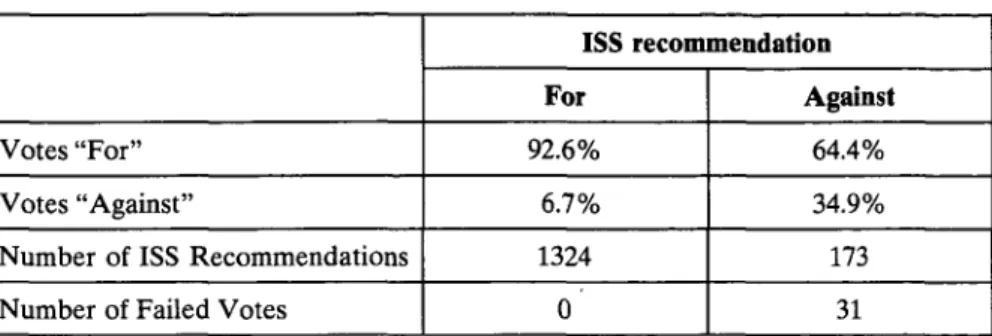
As Table 1 below shows, of the 1497 ISS say-on-pay recommen-dations in our sample, the ISS issued an "against" recommendation
173 times (11.6% of the time). We can calculate a measure of how an
ISS "against" recommendation impacts "for" votes by subtracting
(1) the average percentage of "for" votes when the ISS gives a
posi-tive recommendation from (2) the average percentage of "against" votes when the ISS gives a negative recommendation. This difference is 28.2%-a crude measure of the "ISS effect."83
81 Id.
82 Id. at 5-6.
83 Another way to look at the "ISS effect" is to compare the difference in "against" votes
2013] THE FIRST YEAR OF SAY-ON-PAY UNDER DODD-FRANK
TABLE 1. SAY-ON-PAY VOTEs (ISS RECOMMENDATIONS)
ISS recommendation
For Against
Votes "For" 92.6% 64.4%
Votes "Against" 6.7% 34.9%
Number of ISS Recommendations 1324 173
Number of Failed Votes 0 31
However, a negative ISS recommendation does not necessarily mean that the company will get less than majority support for its say-on-pay proposal. In fact, we find that in only thirty-one cases in our sample did companies "fail" their vote, by getting less than fifty per-cent approval from shareholders. In the other 142 cases where the ISS gave a negative recommendation, shareholders still gave at least ma-jority support for the company's proposal. Even though a negative
ISS recommendation was not sufficient for a company to fail its
say-on-pay vote, such a recommendation appeared necessary for a failed vote.
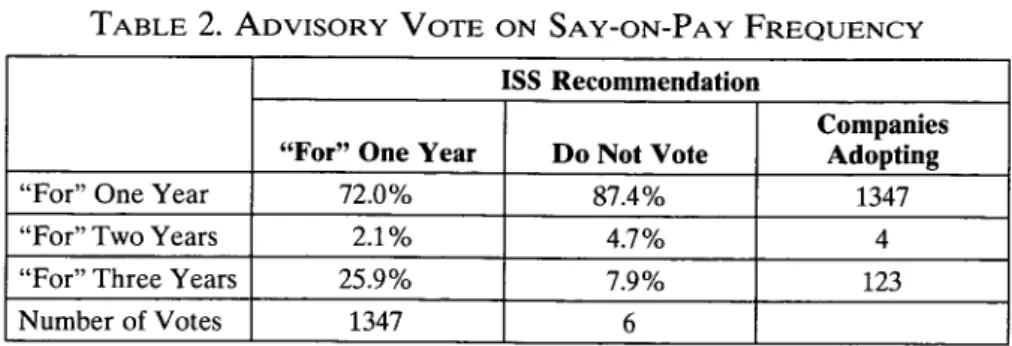
We also looked at how ISS recommendations affected share-holder voting on the frequency with which companies proposed to conduct their say-on-pay votes. Table 2 below shows that ISS almost always recommended in favor of annual say-on-pay votes and that shareholders strongly supported annual voting. Overall, shareholders at 1347 companies in our sample (by majority or plurality vote) sup-ported annual say-on-pay voting, compared with shareholders at only
123 companies supporting triennial voting. In other words, say-on-pay
promises to be an annual event at most larger public companies.
depending on whether the ISS gives a positive or negative recommendation. Here, the ISS effect
is 28.2%.
The ISS effect we find in the post-Dodd-Frank period is somewhat higher than the ISS effect we found for say-on-pay votes in the pre-Dodd-Frank period, where we found a 19.0% ISS effect when the ISS gives a "for" recommendation. Thomas, Palmiter & Cotter, supra note 1, at 1245 tbl.4.
984 THE GEORGE WASHINGTON LAW REVIEW
TABLE 2. ADVISORY VOTE ON SAY-ON-PAY FREQUENCY
ISS Recommendation
Companies
"For" One Year Do Not Vote Adopting
"For" One Year 72.0% 87.4% 1347
"For" Two Years 2.1% 4.7% 4
"For" Three Years 25.9% 7.9% 123
Number of Votes 1347 6
Again, ISS recommendations were influential (but not decisive) in how shareholders voted on the frequency question. At 377 compa-nies in our sample where management recommended biennial or tri-ennial say-on-pay voting, shareholders voted consistently with the ISS recommendation for annual voting in 254 of the companies. Yet at
123 companies (8.2% of our sample), shareholders adopted biennial
or triennial voting despite an ISS recommendation for annual voting.
B. Effect of Other Factors on Say-on-Pay Voting
What other factors-besides an ISS recommendation-affected shareholder say-on-pay voting in the 2011 proxy season? We used our dataset to test for three factors widely identified by the ISS, commen-tators, and other studies as driving say-on-pay-namely, company stock performance, growth in CEO pay levels, and "excess" CEO pay.
1. Effect of "Total Stock Return"
The ISS and The Conference Board have both identified pay-for-performance issues as a principal reason for negative shareholder
say-on-pay votes.84 According to the ISS's 2011 U.S. Postseason Report,
of the companies it examined, "[a]lmost half of the failed-vote firms have reported double-digit negative three-year total shareholder re-turns."85 In the same report, ISS noted (though not as prominently)
84 ALLEN ET AL., supra note 65, at 7 (explaining that "pay-for-performance concerns"
seemed to represent "[t]he primary driver of [the] failed votes ... at 28 companies"); Russell Miller & Yonat Assayag, SOP Drives Compensation Program Changes to Enhance
Pay/Perform-ance Link, DIRECrOR NOTES, 4 (Sept. 2011), https://www.conference-board.org/re-trievefile.cfm?filename=TCB-DN-V3N18-11.pdf&type=subsite. For example, "[alt Constellation [Energy], shareholder support [for company pay practices] was only 38.6 percent," as the CEO's "total compensation increased from $6.7 million in 2009 to almost $16 million in 2010," despite "one-year and three-year total shareholder returns [of] negative 10.3 percent and negative 30.6 percent, respectively." ALLEN ET AL., supra note 65, at 7.
85 ALLEN ET AL., supra note 65, at 3. Jeremy Goldstein of Wachtell, Lipton, Rosen & Katz
also identified certain pay practices as likely to trigger a negative ISS voting recommendation. Jeremy L. Goldstein, How to Win the Say on Pay Vote, HARVARD L. SCH. F. ON CORP. GOVERN-[Vol. 81:967
2013] THE FIRST YEAR OF SAY-ON-PAY UNDER DODD-FRANK 985
the relevance of other compensation issues-"such . . .as tax
gross-ups, discretionary bonuses, inappropriate peer benchmarking ... and failure to address significant opposition to compensation committee members in the past."86
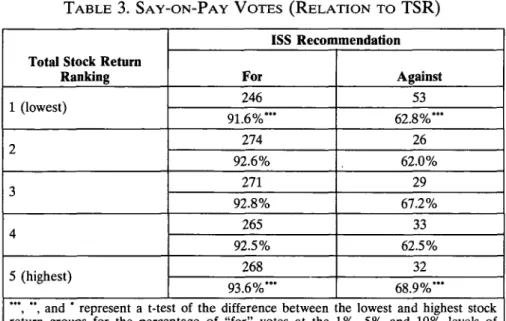
Given the importance that shareholders seemed to attach to pany performance in their say-on-pay voting, we looked at how com-pany total stock returns ("TSR") (defined as the cumulative raw return of the company's stock in the twenty-four months prior to Fis-cal Year End 2010) and ISS recommendations correlated with share-holder votes. As Table 3 shows, TSR is a strong predictor of say-on-pay voting-strong TSRs correlate with high levels of shareholder support and weak TSRs correlate with low levels of shareholder sup-port.8 7 We group companies in our Study by quintile based on their
TSR over two years, with the weakest performers in Group 1 and the strongest in Group 5. We see that a negative ISS recommendation has the biggest impact for Group 1 (the weakest TSR quintile), where say-on-pay proposals received only 62.8% average voting support, com-pared to Group 5 (the strongest TSR quintile), where the proposals averaged 68.9% voting support. These differences are statistically sig-nificant at the 1% level of significance.
ANCE AND FIN. REG. (Dec. 1, 2011, 9:31 AM), http://blogs.law.harvard.edu/corpgov/2011/12/01/ how-to-win-the-say-on-pay-vote/.
86 ALLEN ET AL., supra note 65, at 7. A publication examining "the first 100 proxy filings
by Fortune 500 companies ...subject to shareholder advisory votes under [Dodd-Frank]" by The Conference Board claimed that such other matters did not have a large impact on share-holder votes. Miller & Assayag, supra note 84, at 1, 5. The publication noted that "[a] study of four compensation practices . ..- excise tax gross-ups, perquisites, stock ownership guidelines, and clawbacks-indicates that [say-on-pay) votes for companies with those pay practices did not significantly differ from companies without them." Id. at 5. The study later acknowledged, how-ever, that "when combined with other shareholder concerns (such as a pay and performance disconnect), there is the potential for these practices to swing the vote." Id.
87 See SUBODH MISHRA, INSTITUTIONAL S'HOLDER SERVS. INC., PARSING THE VOTE: CEO
PAY CHARACTERISTICS RELATIVE TO SHAREHOLDER DISSENT 4 (2012), available at http://
986 THE GEORGE WASHINGTON LAW REVIEW
TABLE 3. SAY-ON-PAY VOTEs (RELATION To TSR)
ISS Recommendation
Total Stock Return
Ranking For Against
246 53 1 (lowest) 246853 91.6%"** 62.8%*** 2 274 26 92.6% 62.0% 3 271 29 92.8% 67.2% 4 265 33 92.5% 62.5% 268 32 5 (highest) 268 32 93.6%*** 68.9%'"*
.., ., and * represent a t-test of the difference between the lowest and highest stock return groups for the percentage of "for" votes at the 1%, 5% and 10% levels of significance, respectively.8 8
The total stock return is the cumulative raw return of the company's stock in the twenty-four months prior to Fiscal Year End 2010.
Thus, TSR had a small (but statistically significant) effect when the ISS gave a "for" voting recommendation, with shareholders giving 2.0% more voting support for pay at companies with the highest TSRs than for pay at companies with the lowest TSRs. In addition, a larger effect (also statistically significant) was present when the ISS gave an "against" recommendation, with shareholders giving 6.1% higher sup-port for pay at high-TSR companies than for pay at low-TSR compa-nies. In short, TSR had an effect on shareholder say-on-pay voting,
although less than that of the ISS recommendation.
Our finding that short-term TSR performance was a factor in shareholder voting support, but was not outcome determinative, is borne out by other studies. For example, an Equilar study of say-on-pay in 2011 found that "among those companies receiving greater than 90 percent approval, over 20 percent still had a bottom-quartile TSR ranking."9 Nonetheless, performance results were important, as demonstrated by the figure below from the Equilar study, which shows a "distribution of companies by performance that fall into each voting bracket for one-year total shareholder return":90
88 For a discussion of t-tests and levels of significance, see ROBERT S. PINDYCK & DANIEL
L. RUBINIELD, ECONOMETRIC MODELS AND ECONoMic FORECASTS 36-39 (1981). 89 EQUILAR, INC., supra note 65, at 2.
90 Id. at 2-3.
2013] THE FIRST YEAR OF SAY-ON-PAY UNDER DODD-FRANK 987
FIGURE. SHAREHOLDER SAY-ON-PAY APPROVAL BY ONE-YEAR TSR QUARTILE91 100% E 90% 80% 70% 60%- 24% El 1st Quartile 50% 2% *2nd Quartile 40% --- 26 - -25% O 3rd Quartile o 30% O 4th Quartile a 20% 10% 0% Failed 50-59% 60-69% 70-79% 80-89% 90-100% Shareholder Approval of Say-on-Pay
2. Effect of CEO Pay Growth
Other studies of say-on-pay voting suggest that increases in CEO pay may have been important in say-on-pay voting.92 In addition,
proxy advisory firms have considered one-year pay growth in analyz-ing pay practices, recommendanalyz-ing negative votes more often at compa-nies with above average CEO pay increases than at those with below-average CEO pay increases.93
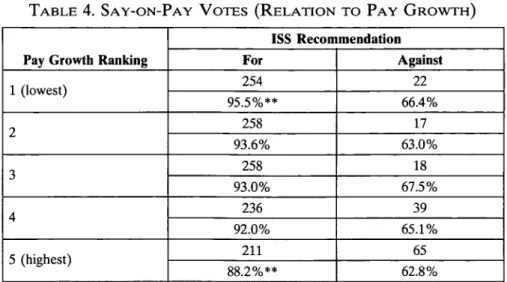
In Table 4, we show the effect of CEO pay growth on shareholder say-on-pay support.94 Companies with the highest rates of CEO pay growth are in Group 5, while those with the lowest rates of growth are in Group 1. Overall, these results show that higher growth rates are associated with lower levels of shareholder support. The differences are statistically significant at the 5% level when ISS makes a "for" recommendation, but the differences are not markedly different (nor statistically significant) when the ISS makes an "against" recommendation.
91 This Figure is a reproduction of a figure appearing in the Equilar study. See id.
92 See, e.g., Miller & Assayag, supra note 84, at 4.
93 See id. at 5.
94 we first calculated total annual compensation for each calendar year, drawn from the company's "total compensation table" found in its proxy statement. We then used those values to calculate percentage change in annual compensation values.
THE GEORGE WASHINGTON LAW REVIEW
TABLE 4. SAY-ON-PAY VOTES (RELATION TO PAY GROWTH)
ISS Recommendation
Pay Growth Ranking For Against
1 (lowest) 254 22 95.5%** 66.4% 2 258 17 93.6% 63.0% 3 258 18 93.0% 67.5% 4 236 39 92.0% 65.1% 5 211 65 5 (highest) 216 88.2%** 62.8%
represents a t-test of the difference between the lowest and highest pay growth groups for the percentage of "for" votes at the 5% level of significance.
Based on these univariate results, CEO pay growth does not ap-pear to have as decisive an effect on shareholder say-on-pay voting as some have said. Although CEO pay growth had a negative effect on say-on-pay votes, this happened only when the ISS gave a "for" voting recommendation. Specifically, in the face of a positive ISS voting rec-ommendation, shareholders gave 7.3% less voting support in the high-est pay-growth companies compared to the lowhigh-est pay-growth companies. But when the ISS gave an "against" voting recommenda-tion, there was no statistically significant difference in the voting re-sults, although there was about a 3.6% lower average vote at companies with high levels of growth of CEO pay compared to com-panies with low levels of growth of CEO pay. In short, shareholders seemed less focused on CEO pay growth compared to company TSR.
3. Effect of "Excess" CEO Pay
Commentators and studies have identified perceived "excess" in
CEO pay-that is, pay above the level predicted by a variety of
vari-ables-as a factor in say-on-pay voting.95
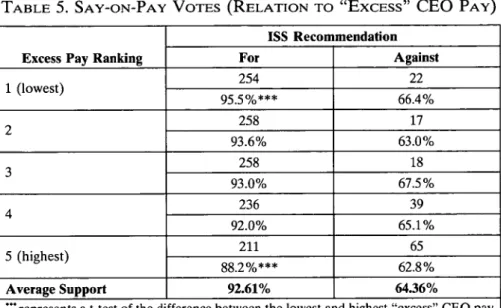
In Table 5, we examine the effect of "excess" CEO pay levels on shareholder support. Excess CEO pay attempts to measure the differ-ence between actual pay levels and expected pay levels, based on an estimated value using several variables.96 We see in Table 5 that
com-95 See, e.g., Thomas, Palmiter & Cotter, supra note 1, at 1221-22 (citing Ertimur, Ferri &
Muslu, supra note 41).
96 The definition of "Excess Pay" follows the "measure of excess CEO compensation,"
[Vol. 81:967