AUTOMATED CASE PICKING SYSTEM
Von der Fakultät für Ingenieurwissenschaften,
Abteilung Maschinenbau und Verfahrenstechnik der
Universität Duisburg-Essen
zur Erlangung des akademischen Grades
eines
Doktors der Ingenieurwissenschaften
Dr.-Ing.
genehmigte Dissertation
von
Mohammed Ruzayqat
aus
Tafouh, Palästina
Referent: Prof. Dr.-Ing. Bernd Noche
Korreferent: Prof. Dr.-Ing. Bernd Künne
I
ABSTRACT
Order picking (OP) is the most expensive and labor-intensive activity in warehouses. Some authors argue that OP might be responsible for up to 55% of the operating costs in a warehouse. This might be more important for companies that handle large volumes of fast-moving commodities. Full-case picking processes and mixed pallet building are expensive and complex activities. Companies are looking for technologies to improve their efficiency and to reduce the operating costs of non-value added activities in their warehouses and distribution centers (DCs). Nowadays, the designers of order picking systems face great challenges due to increasing labor costs, less space and more frequent small orders with short delivery times. Consequently, there are constant research efforts devoted to finding new innovative full-case picking solutions that reduce operating costs, generate higher productivity, optimize space utilization and enhance customer service levels.
This dissertation presents a new fully automated case picking system (ACPS) called the Automated Cellular Case Picking System (ACCPS). The new system is characterized by the full and permanent accessibility of all stock keeping units (SKUs) in the system, which permits a strategic higher picking rate. This new system could be applied to different levels of automation within warehouses and DCs, and it is suitable for a wide range of warehouse automation requirements.
The proposed design consists of storage cells with the same design and operating principle as the vertical indexing case elevator, installed on one conveyor to form a storage line. Several storage lines are connected by a distributing conveyor from the inlet side and by a collecting conveyor from the outlet side, to form an ACCPS use-case model. The concept of this new system is based on the A-Farm concept, in order to create a new innovative dispensing and buffering system for cases.
ACCPS is a new concept for a full-case picking system that aims to provide better solutions for warehouses and DCs that deal with a high volume and low variety of products, which are handled in plastic crates or trays. ACCPS would be an efficient solution for many types of commodities such as (food, beverage, grocery, dairy, flowers, sausage, bakery and others). Optimizing picking processes, minimizing operating cost, and increasing efficiency are the most important aims of the new proposed design. This research investigates the layout, design, structure, costs, operating principles, cycle time, and throughput of the new system. A
II
simple logic process was applied to create a mathematical model in order to calculate the expected average time of the order picking and the throughput of this new ACPS.
A simulation model has been developed to aid in measuring the effectiveness of the ACCPS proposed design under real operating conditions. Two case studies have been used to evaluate the performance of the new system. Based on the real-time data of these two cases, many simulation scenarios were studied and analyzed in order to solve the storage assignment problem and to determine the best order picking strategy. Many optimization scenarios were simulated and analyzed in order to determine the optimum scenario.
In order to evaluate the ACCPS performance, a comparison was made between ACCPS and an alternative system with the same features. The alternative system, which is the most competitive system compared to the ACCPS, is the Gantry Robot System (GRS). The costs, throughput, and required areas were chosen as the main criteria for comparison between the two systems. The comparison confirmed the benefits of the ACCPS in decreasing the operating costs, required area, energy consumption, and the picking time. ACCPS also increased the space utilization rate and the throughput.
ACCPS provides a new technique for automating the full-case picking process (CPP) that contributes greatly to decreasing total operating cost by minimizing labor requirements, space requirements, and potential errors, and increasing productivity and efficiency. The structure of ACCPS, which is based on individual modules, can further increase the flexibility and the adaptability of the system.
III
ZUSAMMENFASSUNG
Der Kommissionierungsprozess (OP) wird als die höchst arbeitsintensive und kostenaufwändige Tätigkeit in den Lagern betrachtet. Einige Autoren behaupten, dass der Kommissionierungsprozess für bis zu 55 % aller Betriebskosten in einem Lager dafür verantwortlich sein könnte. Dies könnte möglicherweise wichtiger sein für Unternehmen, die große Volumina von schnell bewegenden Waren behandeln. Full-case-picking Prozesse und Mischpaletten von verschiedenen Produkten aufzubauen sind teure und komplexe Tätigkeiten. Firmen suchen nach Technologien, um ihre Leistungsfähigkeit zu verbessern und die Betriebskosten von zusätzlichen Tätigkeiten die keine Wertschöpfung erbringen in ihren Lagern und Distributionszentren (DCs) zu reduzieren. Heutzutage stehen die Designer der
Kommissioniersysteme vor großen Herausforderungen, aufgrund der steigenden
Arbeitskosten, weniger Platz und häufigere kleine Aufträge mit kurzen Lieferzeiten. Deshalb sind ständige Forschungsbemühungen gewidmet, um die Suche nach neuen innovativen Kommissionierlösungen für Stückgüter, die die Betriebskosten verringern, die Produktivität erhöhen, die Raumausnutzung optimieren und die Kundenservice verbessern.
Diese Dissertation präsentiert ein neues vollautomatisiertes Kommissioniersystem für Stückgüter (ACPS), das als automatisiertes zelluläres Case-picking-system (ACCPS) bezeichnet wird. Das neue System zeichnet sich durch die vollständige und dauerhafte Zugänglichkeit aller Lagerhaltung Einheiten (SKUs) im System, das einen strategischen höheren Durchsatz des Kommissionierungsprozesses ermöglicht. Dieses neue System könnte auf verschiedene Niveaus der Automation innerhalb von Lagern und DCs angewandt werden, und ist für eine breite Reihe von Lagerautomationsvoraussetzungen passend.
Das vorgeschlagene Design besteht aus Speicherzellen mit demselben Design und Betriebsprinzip wie der vertikale Senkrechtförderer für Stückgüter, der auf einem Förderband installiert ist, um eine Lagerungslinie zu bilden. Mehrere Lagerungslinien werden sich durch einen Verteilförderer von der Einlassseite und durch einen Sammelförderer von der Ausgangsseite verbunden, um ein ACCPS Use-Case-Modell zu bilden. Das Konzept dieses neuen Systems basiert auf dem Konzept des Schachtkommissionsystems (A-Farm), um ein neues innovatives System zum Zuführen und Puffern von Stückgütern zu schaffen. ACCPS ist ein neues Konzept für eine vollständiges Stückgütern Schachtkommissionsystem mit dem Ziel, bessere Lösungen für Lagern und DCs, die sich mit einer großen Menge und niedrigen
IV
Vielfalt von Produkten befassen, die in Kunststoffkisten oder Tablare behandelt werden zur Verfügung zu stellen. ACCPS würde eine effiziente Lösung für viele Typen von Waren wie (Nahrung, Getränk, Lebensmittel, Molkerei, Blumen, Wurst, Bäckerei und andere) sein. Optimierung der Kommissionierungsprozesse, Minimierung der Betriebskosten und Steigerung der Effizienz sind die wichtigsten Ziele des neuen vorgeschlagenen Designs. Diese Forschung untersucht Layout, Design, Struktur, Kosten, Betriebsprinzipien, Zykluszeit und Durchsatz des neuen Systems.
Ein einfacher Logik-Prozess wurde angewendet, um ein mathematisches Modell zu erstellen, damit die erwartete durchschnittliche Zeit der Kommissionierung und der Durchsatz von dieser neuen ACPS zu berechnet werden. Ein Simulationsmodell wurde entwickelt, um bei der Messung der Effektivität des vorgeschlagenen Designs der ACCPS unter realen Betriebsbedingungen zu unterstützen. Zwei Fallstudien sind verwendet worden, um die Leistung des neuen Systems zu bewerten. Gestützt auf den Echtzeitdaten dieser zwei Fälle, viele Simulation Szenarien wurden untersucht und analysiert um das Problem der Lagerplatzzuweisung zu beheben und die beste Strategie für die Kommissionierung zu bestimmen. Viele Optimierung Szenarien wurden simuliert und analysiert um das optimale Szenario zu bestimmen.
Im Hinblick auf die Bewertung der Leistung des ACCPSs, wurde ein Vergleich zwischen ACCPS und ein alternatives System mit denselben Eigenschaften durchgeführt. Das Gantry Robot System (GRS), ist das alternative System für das am meist konkurrenzfähige System im Vergleich zum ACCPS. Die Kosten, der Durchsatz und die erforderliche Fläche wurden als die Hauptkriterien zum Vergleich zwischen den beiden Systemen gewählt. Der Vergleich hat die Vorteile des ACCPSs im Verringern der Betriebskosten, der erforderlichen Fläche, des Energieverbrauchs und der Entnahmezeit (Pickzeit) bestätigt. ACCPS stellt eine neue Technik zur Verfügung, um die Full-case-picking Prozessen (CPP) zu automatisieren, die außerordentlich zum Verringern von Gesamtbetriebskosten durch die Minderung von Arbeitskräftebedarf, Platzbedarf und potenziellen Fehlern, und die Erhöhung der Produktivität und Leistungsfähigkeit beiträgt. Die Struktur von ACCPS, die auf individuellen Modulen basiert, kann weiter die Flexibilität und die Anpassungsfähigkeit des Systems vergrößern.
V
ACKNOWLEDGEMENT
All praise and thanks are only for Allah, the One who, by His blessing and favor, perfected goodness/good works are accomplished. First and foremost, I would like to express my deepest gratitude to my thesis supervisor Prof. Dr. -Ing. Bernd Noche from the Institute for Transport Systems and Logistics at University Duisburg-Essen for his great support, encouragement, and help. I would also like to thank Prof. Dr. -Ing. Bernd Künne from the Institute for Design and Materials Testing at TU Dortmund University for his effort being the co-reviewer for my thesis.
I would like to thank all my long time colleagues at the Chair of Transport Systems and Logistics; Dr. -Ing. Bashir Salah, Dr.-Ing. Muawia Ramadan and Dr. rer. pol. Abdelrahim Alsoussi for their help and support. I am also greatly obliged to thank my colleague Dr.-Ing. Mohammed Alnahhal who not only supported me during my research, but also helped me in building a valid and credible simulation model.
I would like to appreciate the great efforts and support provided by my parents (Ribhi and Inshirah). I would like to acknowledge my wife (Maram) and kids (Elias and Miral) for the sustaining patience and support throughout the years. Staying away from family for such a long period is not an easy job, but many thanks to my family, wife’s family and my friends who not only supported me but also encouraged me to achieve my goals. Finally, I would like to thank my brothers and sisters whom without their love and support I would never be able to conduct this work.
Thanks you all Mohammed Ruzayqat
VI
DEDICATED
To my parents
To my wife and kids
To my family, to my friends
and
VII
TABLE OF CONTENTS
ABSTRACT I ZUSAMMENFASSUNG III ACKNOWLEDGEMENT V TABLE OF CONTENTS VII LIST OF FIGURES X LIST OF TABLES XIII LIST OF ACRONYMS XIV LIST OF NOTATIONS XVI
1
INTRODUCTION ... 1
1.1 Background and Motivation ... 1
1.2 Research Problem ... 3
1.3 Research Objectives ... 4
1.4 Research Questions ... 5
1.5 Research Outline ... 8
2
THEORETICAL BACKGROUND AND LITERATURE REVIEW ... 11
2.1 Introduction ... 11
2.2 Theoretical Background ... 11
2.2.1 Warehousing and distribution center ... 13
2.2.2 Significance of the OPP ... 16
2.2.3 Role of OPP in logistics ... 17
2.2.4 Classification of OPSs ... 19
2.2.5 Types of OP ... 23
2.2.6 Classification of CPP ... 25
2.3 Literature Review ... 26
2.3.1 OP efficiency improvement procedures ... 27
2.3.2 Automated OPP ... 29
2.3.3 Case picking automation ... 30
2.3.4 Basic justifications for automation ... 31
2.3.5 Limitations, problems and risks of automation ... 34
2.3.6 Basic design requirements and stages of an OPS ... 35
VIII
2.3.8 Summary of previous literature ... 50
3
AUTOMATED CELLULAR CASE PICKING SYSTEM ... 53
3.1 Introduction ... 53
3.2 Design Requirements ... 54
3.2.1 Logistical requirements ... 55
3.2.2 Mechanical requirements ... 57
3.2.3 Processes controlling requirements ... 57
3.3 System Structure Development ... 58
3.3.1 System layout design ... 59
3.4 System Operating Principles ... 64
3.4.1 ACCPS filling phase (put-away process) ... 66
3.4.2 OP strategies of the ACCPS ... 68
3.4.3 Replenishment process ... 70
3.5 Management and Control Systems ... 72
3.5.1 Management system ... 73
3.5.2 Control system ... 73
4
USE-CASE MODEL DESIGN AND TECHNICAL PARAMETERS ... 75
4.1 Introduction ... 75
4.2 Initial Technical Parameters of the ACCPS Use-Case Model ... 76
4.3 Size of the Applied ACCPS Use-Case Model ... 77
4.4 General Layout of The ACCPS Use-case Model ... 79
4.5 Technical Parameters of the Use-Case Model’s Parts ... 82
4.5.1 Technical parameters of the storage cells ... 83
4.5.2 Technical parameters of the de-palletizing machine (de-palletizer) ... 88
4.5.3 Technical parameters of the distributing conveyor ... 90
4.5.4 Technical parameters of the de-stacking machine ... 92
4.5.5 Technical parameters of the main conveyor ... 93
4.5.6 Technical parameters of the stacking machine ... 94
4.5.7 Technical parameters of the collecting conveyor ... 95
4.5.8 Technical parameters of the full-stacking machine (re-stacker) ... 96
4.5.9 Technical parameters of the palletizer ... 100
4.6 ACCPS Use-Case Model Calculations ... 100
IX
4.6.2 Expected cycle time and throughput of the ACCPS use-case model ... 104
4.6.3 Initial cost of the ACCPS use-case model ... 114
4.7 ACCPS Layout Design Algorithm ... 118
5
SIMULATION MODEL AND CASE STUDIES ... 123
5.1 Introduction ... 123
5.2 Simulation Model, Logic and Software ... 125
5.3 Simulation Scenario for Filling Process ... 131
5.4 First Case Study: Number of Handled Articles Equals Number of Cells ... 135
5.4.1 Evaluation and improvements ... 147
5.4.2 Comparison between manual OPS and ACCPS ... 150
5.5 Second Case Study: Number of Handled Articles Is More than Number of Cells . 154 5.5.1 First scenario: four cycles to finish the OPP ... 157
5.5.2 Second scenario: three cycles to complete the OPP ... 161
5.5.3 Results evaluation ... 163
6
COMPARISON OF ACCPS WITH AN ALTERNATIVE SYSTEM ... 165
6.1 Introduction ... 165
6.2 Gantry Robot Case Picking System ... 165
6.2.1 GRS cycle time and throughput calculation ... 166
6.2.2 GRS evaluation based on the parameters of the case studies ... 176
6.3 Quantitative and Qualitative Comparison of ACCPS with GRS ... 177
6.3.1 Logistics aspects ... 177
6.3.2 Economic aspects ... 179
6.3.3 Structural design aspects ... 180
6.3.4 Operational aspects ... 181
6.4 Summary ... 182
7
CONCLUSIONS AND FUTURE RESEARCH ... 185
7.1 Conclusions and Contributions ... 185
7.2 Limitations ... 186
7.3 Future Research ... 187
X
LIST OF FIGURES
Figure 1.1 Thesis structure………. 9
Figure 2.1 Warehouses and distribution center activities, flows and other aspects………. 15
Figure 2.2 Main phases of the order process……… 16
Figure 2.3 Logistics costs in Europe in 2010 and 2005……… 18
Figure 2.4 Classification of the OPSs according to De Koster……… 19
Figure 2.5 Classification of the OPSs according to Dallari………. 20
Figure 2.6 Classifications of OP and rack systems……….. 21
Figure 2.7 Parallel aisles of a pallet rack……….. 23
Figure 2.8 Example of a manual full-CPP……… 24
Figure 2.9 Picking individual items from open cartons with a gravity flow rack………. 24
Figure 2.10 Material flows according to indirect CPP……….. 26
Figure 2.11 Drivers of case picking automation requirements………. 31
Figure 2.12 12 Justifications of OP automation………. 32
Figure 2.13 Limitations, problems, and risks of automation……… 35
Figure 2.14 OPS design methodology……….. 36
Figure 3.1 Vertical indexing conveyor……….. 60
Figure 3.2 ACCPS structure-forming phases……….. 61
Figure 3.3 Euro-pallet structure……….... 61
Figure 3.4 Standard crate………... 62
Figure 3.5 3D Layout of the ACCPS………. 63
Figure 3.6 Layout of the ACCPS and the system’s main parts……….. 63
Figure 3.7 Flowchart of basic operating principle of the ACCPS……….. 65
Figure 3.8 The basic phases of ACCPS operating principle………... 66
Figure 3.9 Flowchart of the first picking process scenario………. 69
Figure 3.10 Flowchart of the second picking process scenario………. 70
Figure 4.1 General layouts of ACCPS use-case model according to material shape flow………... 79
Figure 4.2 4.2a 90 grade conveyor transfer module/ 4.2b Curve conveyor transfer module………... 81
Figure 4.3 Final layout of the ACCPS use-case model……… 82
Figure 4.4 The front view of the cell structure and the main parts……… 83
Figure 4.5 4.5a Top view of the one storage cell / 4.5b Top view of two storage cells……….. 84
Figure 4.6 Side view of a storage line with three cells………. 85
Figure 4.7 Kinematic specifications of the cell’s elevation system………. 87
Figure 4.8 De-palletizing process for incoming pallets……… 88
Figure 4.9 Distributing conveyor with roller deflector diverter………. 90
Figure 4.10 De-stacking machine………. 92
Figure 4.11 Layout of the main conveyor and its parts………. 93
XI
Figure 4.13 Layout of collecting conveyor and its parts……… 95
Figure 4.14 Flowchart of the working logic of a full-stacker……… 97
Figure 4.15 Layout of the full-stacker and the technical parameters……….. 98
Figure 4.16 Top view of three storage lines from ACCPS use-case model……….. 101
Figure 4.17 3D layout of the ACCPS use-case model.………... 104
Figure 4.18 3D layout of the use-case model……….. 106
Figure 4.19 Top view of the use-case model……… 106
Figure 4.20 ACCPS layout Design algorithm………. 119
Figure 5.1 Simulation scenarios and evaluation strategies flowchart……… 125
Figure 5.2 Article locations according to the strategy of maximum load to input point……….. 126
Figure 5.3 Articles distribution form in the model according to maximum load to input point strategy….. 127
Figure 5.4 Article locations according to the strategy of maximum load to output point……… 127
Figure 5.5 Article distribution form in the model according to maximum load to output point strategy….. 127
Figure 5.6 Article distribution form in the model according to uniform load distribution………. 128
Figure 5.7 Flowchart of the customer list preparing algorithm………. 130
Figure 5.8 Layout of the simulation model………... 131
Figure 5.9 The filling process of cell_10 on storage line_1……….. 132
Figure 5.10 The filling process of all cells on line_10………. 132
Figure 5.11 State of the de-palletizer over the filling scenario period………. 133
Figure 5.12 State of de-stacker_1 over the filling scenario period………... 134
Figure 5.13 Utilization rates of the de-palletizer and the de-stacking machines over the filling scenario period………. 134
Figure 5.14 Process phases and working plan for bakery plant………... 135
Figure 5.15 Storage and retrieval processes of all cells in storage line_1……… 142
Figure 5.16 Storage and retrieval processes for cell_8 on storage line_1……… 143
Figure 5.17 States of the de-palletizer and the de-stackers over the picking scenario period………... 144
Figure 5.18 State of the de-palletizer over the best simulation scenario time………. 144
Figure 5.19 State of the de-stacker_10 the best simulation scenario……… 145
Figure 5.20 States of the stacking machines over the best simulation scenario time……….. 145
Figure 5.21 The state curve of stacker_9……… 146
Figure 5.22 A snapshot graph of the stacker_9 state curve……….. 147
Figure 5.23 Storage location assignment based on the load distribution strategy per cell……… 156
Figure 5.24 Storage location assignment based on the load distribution strategy per storage line………….. 156
Figure 5.25 Load distributions of the articles in the storage cells in four picking cycles………... 157
Figure 5.26 Storage and retrieval processes of all cells on line_1………. 159
Figure 5.27 Utilization rates of all machines in the simulation scenario of 4-cycles………... 160
Figure 5.28 Load distributions of the articles in the storage cells in three picking cycles………. 161
Figure 5.29 Utilization rates of all machines in the simulation scenario of 3-cycles………... 163
Figure 6.1 Crated gantry robot picking system………... 166
Figure 6.2 3D Layout of the GRS……….. 167
Figure 6.3 Top view of two GRS use-case model layout……….. 167
Figure 6.4 Coordination of the two points (P1 and P2) according to the FEM 9.851 method………. 169
XII
Figure 6.6 The coordinates of the I/O-point, P1 and P2……….. 171
Figure 6.7 GRS double cycles layout and P1 and P2 coordinates……….. 173
Figure 6.8 Flexibility of ACCPS structure and roof utilization rate……….. 180
Figure 6.9 Flexibility of ACCPS structure and utilization rate of the warehouse’s area………. 180
XIII
LIST OF TABLES
Table 4.1 Technical specifications of the standard used crate………. 76
Table 4.2 The main parts of the ACCPS use-case model………. 78
Table 4.3 Diverter principles can be used for ACCPS………. 80
Table 4.4 The input data of the cell’s drive system design………... 87
Table 4.5 The movement behavior of the first ten retrieved crates from cell66……… 107
Table 4.6 Number of kinetic steps for the first ten boxes from Cell66……… 108
Table 4.7 The movement behavior of the first ten retrieved crates from cell55……… 110
Table 4.8 Number of kinetic steps for the first ten boxes from Cell55……… 111
Table 4.9 Total cost of drive systems for the whole use-case model……… 114
Table 4.10 Total cost of the structure frames and elevation belts with the cantilevers………... 114
Table 4.11 Total cost of the sensors and supports for the whole use-case model………. 115
Table 4.12 Total cost of the stoppers and supports for the whole use-case model………... 115
Table 4.13 Total cost of the controlling system for the whole use-case model………. 116
Table 4.14 Total cost of the stacker/de-stacker and palletizer/ de-palletizer for the whole use-case model.. 116
Table 4.15 Total cost of the conveying system for the whole use-case model………... 117
Table 4.16 Total cost of the material flow control and warehouse management function……….. 117
Table 4.17 Expected total initial costs of the ACCPS use-case model………... 118
Table 5.1 Parameters of the first case study and the manual OP problem……… 136
Table 5.2 The initial simulation parameters of the first case study………. 136
Table 5.3 Simulation scenarios of the first case study……….. 137
Table 5.4 Simulation times of all scenarios of the first case study……….. 139
Table 5. 5 The difference in time between all order picking scenarios in the first case study……….. 140
Table 5.6 The total OP time of the optimized scenarios………... 148
Table 5.7 The throughputs of the optimized scenarios……… 149
Table 5.8 The interest and payment value every year over the invested time……… 153
Table 5.9 The parameters of the second case study problem……….. 154
Table 5.10 The initial simulation parameters of the second case study……….... 154
Table 5.11 Results of the simulation scenarios in case of 4-cycles………. 158
Table 5.12 Results of the simulation scenarios of in case 3-cycles………. 162
Table 6.1 The technical parameters of the GRS……….... 168
Table 6.2 The logistical comparison results of the ACCPS vs. GRS………... 178
XIV
LIST OF ACRONYMS
ACCPS Automated Cellular Case Picking System
ACP Automated Case Picking
ACPS Automated Case Picking System
AGV Automated Guided Vehicle
AMHS Automated Material Handling Systems
ASRS Automated Storage and Retrieval System
BMH Bastian Material Handling
CE Create A European
CICMHE College-Industry Council on Material Handling Education
CPP Case Picking Process
CPS Case Picking Systems
ERIM Erasmus Research Institute of Management
GRS Gantry Robot System
KPC Kenya Pipeline Company
LGV Laser Guided Vehicles
LIFO Last In First Out
MFC Material Flow Controller
OP Order Picking
OPP Order Picking Process
OPS Order Picking System
PLC Programmable Logic Controller
RFID Radio Frequency Identification
ROI Return on Investment
XV
SKU Stock Keeping Units
STS Schaefer Tray System
VIC Vertical Indexing Conveyor
WCS Warehouse Control Systems
WMCS Warehouse Management and Control System
XVI
LIST OF NOTATIONS
𝐴𝑐𝑐𝐴𝑟𝑡 The accessibility of the article
𝐴𝑐𝑐𝑎𝑣𝑒 Average accessibility of any stored article within the cell
𝐴𝐶𝐶𝑃𝑆𝑐𝑜𝑠𝑡𝑠 Initial cost of the ACCPS
𝐴𝑣𝑒. 𝑁𝑟. 𝐾. 𝑆 𝑜𝑛𝑒 𝑏𝑜𝑥𝑐𝑒𝑙𝑙66 Average number of kinetic steps for one crate along the retrieving path from cell66 to the output point
𝐴𝑣𝑒. 𝑃. 𝑇 𝑜𝑛𝑒 𝑏𝑜𝑥𝑀𝑜𝑑𝑒𝑙 Average picking time of one crate
𝐴𝑣𝑒. 𝑃. 𝑇 𝑜𝑛𝑒 𝑏𝑜𝑥𝑐𝑒𝑙𝑙66 Average picking time of one box (crate)
𝐴𝑣𝑒. 𝑅. 𝑇 𝑓𝑖𝑟𝑠𝑡 𝑏𝑜𝑥𝑟𝑒𝑞.𝑎𝑟𝑡 Excepted average retrieval time of first crate of the required article stored in a multi-article cell
𝐴𝑥 Number of vertical kinetic steps that the box of number i ( Boxi ) needs to reach the main
conveyor
𝑎𝑥 Horizontal gantry robot acceleration
𝑎𝑦 Crane acceleration
𝑎𝑧 Vertical gantry robot acceleration
Boxi Number of stored crates within the cell. According to their locations in the cell, the
counting starts from the bottom, where i=1, 2, 3…
𝐵𝑥 Number of horizontal kinetic steps on the main conveyor, which Boxi needs to reach the
collecting conveyor
𝐶 Investment amount (principal)
𝐶𝑐𝑒𝑙𝑙 Capacity of the cell
Cells. EnergyS/Rcons/year Energy consumption of the storage and retrieval process for all required crates per year
𝐶𝑚𝑜𝑑𝑒𝑙 Capacity of the use-case model
𝐶𝑛𝑟 Total number of cycles per hour
𝐶𝑥 Number of horizontal kinetic steps on the collecting conveyor, equivalent to the storage
line width, which Boxi needs to reach the output point
𝐷𝑑𝑒 Departing displacement of the wooden base within the de-palletizer
𝐷𝐸𝑥𝑝 Depreciation expense per year
𝐷𝑅 Depreciation rate
𝑑𝑆𝐴 Storage density of the storage area
𝐷𝑠𝑡𝑡𝑟𝑎 Traveling displacement of a stack on the distribution conveyor
𝐷𝑥 Number of horizontal kinetic steps on the collecting conveyor equivalent to the
maintenance hallway width, which Boxi needs to reach the output point
XVII
𝐸𝑥 Number of waiting steps, which Boxi needs to wait within the cell, due to conflict with
advanced crates
𝐻 Vertical crate displacement
𝐻𝑚𝑜𝑑𝑒𝑙 Height of the use-case model
𝐻𝑆𝐴 Width of the effective storage area
𝐼 Interest money
𝑘 total number of stored articles within the cell
𝐿 Horizontal crate displacement
𝐿𝑅 Maximum vertical movement distance of the gantry robot
𝐿𝑆𝐴 Length of the effective storage area
𝐿𝑣 Shifting distance of the I/O
𝑀𝐻𝑤 Width of the maintenance hallway
𝑀𝑖𝑛. 𝐴𝑣𝑒. 𝑃. 𝑇 𝑜𝑛𝑒 𝑏𝑜𝑥𝑀𝑜𝑑𝑒𝑙 Minimum average picking time of a crate from use-case model
𝑀𝑖𝑛. 𝑃. 𝑇 𝐵𝑜𝑥𝑐𝑒𝑙𝑙66𝑖 Minimum picking time of an order from cell66, and the number of required crates in this order is equal to i
𝑀𝑖𝑛. 𝑃. 𝑇 𝐵𝑜𝑥𝑀𝑜𝑑𝑒𝑙𝑖 Expected minimum OP time of an order where i is the total number of the required crates
𝑚𝑖𝑛. 𝑅. 𝑇 𝑓𝑖𝑟𝑠𝑡 𝑏𝑜𝑥𝑟𝑒𝑞.𝑎𝑟𝑡 Excepted minimum retrieval time of the first crate of the required article stored in a multi-article cell
𝑁𝑟𝑚𝑖𝑛 𝑎𝑟𝑡/𝑝𝑝 Minimum number of articles that must be processed in one picking period
𝑁𝑟.𝑐𝑟𝑎𝑡𝑒𝑠/𝑎𝑟𝑡𝑎𝑣𝑒 Average number of stored crates per article
𝑁𝑟𝑚𝑖𝑛.𝑟𝑒𝑞 𝐶𝑒𝑙𝑙𝑠 Minimum number of the required cells
𝑁𝑟𝑐𝑒𝑙𝑙𝑠/𝑙𝑖𝑛𝑒 Number of storage cells per main conveyor or storage line
𝑁𝑟𝑐𝑒𝑙𝑙𝑠/𝑚𝑜𝑑𝑒𝑙 Number of cells in the use-case model
𝑁𝑟𝑐𝑟/𝑝𝑎 Number of crates per pallet
𝑁𝑟𝑐𝑟/𝑠𝑡 Number of crates per full-stack within the pallet
𝑁𝑟handled.cr/day Number of handled crates per year
𝑁𝑟𝑀𝐻 Number of maintenance hallways
𝑁𝑟𝑚𝑎𝑥 𝑅𝑒𝑝 Maximum number of replenishment processes
𝑁𝑟𝑆𝐿 Number of the storage lines in the use-case model
𝑁𝑟𝑚𝑖𝑛 𝑆𝐿 Expected minimum required number of storage lines
𝑁𝑟𝑐 Number of cycles or points that must be visited to pick the full capacity of the GRS robot
based on the average number of the ordered crates per order-line
𝑁𝑟. 𝐾. 𝑆 𝐵𝑜𝑥𝑐𝑒𝑙𝑙661 Total number of kinetic steps for crate_1 along the retrieving path from cell66 to the output point (likewise for crate_2 and crate_10)
𝑁𝑟. 𝐾. 𝑆 𝐵𝑜𝑥𝑐𝑒𝑙𝑙66𝑖 Total number of kinetic steps for an order along the retrieving path from cell66 to the
XVIII
𝑃 Payment per year
𝑃𝑉 Present value
𝑃𝑖𝑐𝑘𝑀𝑎𝑥𝐶𝑎𝑝 Maximum pick capacity of the gantry robot per cycle
𝑅 Interest rate per year
𝑆𝐴𝑙 Length of the storage area
𝑆𝐴𝑚𝑖𝑛.𝑟𝑒𝑞 Minimum required area of the storage part
𝑆𝐴𝑤 Width of the storage area
𝑆𝐶𝑙 Length of the storage cell
𝑆𝐿𝑤 Width of the storage line
𝑇 Period of the investment
𝑇𝑑𝑒 Time of the departing interval for the pallet within the de-palletizer
𝑇𝑓𝑖𝑙 Filling time of the use-case model
𝑇𝑖𝑛 Time of the input interval for the pallet within the de-palletizer
𝑇𝑝𝑟𝑜 Processing time of the de-palletizing intervals within the de-palletizer
𝑇𝑠𝑖𝑚 Simulation time of the OP
𝑇𝐷𝐶 Expected average double cycle time
TMC Expected average multi-cycles time
𝑇𝑆𝐶 Expected average storage or retrieval (single cycle) cycle time
𝑇𝑝𝑎𝑎𝑣𝑒.𝑑𝑒𝑝 Available de-palletizing time for a pallet
𝑇𝑤.𝑏𝑑𝑒 Departing time of the wooden base within the de-palletizer
𝑇𝑇𝑜𝑡𝑎𝑙.𝐷𝑒𝑙𝑎𝑦𝑅𝑒𝑝 Total delay time caused by the replenishment processes
𝑇𝐴𝑣𝑒.𝐷𝑒𝑙𝑎𝑦 𝑅𝑒𝑝 Expected average delay time between two replenishment processes
𝑇𝑃𝑎𝑅𝑒𝑞.𝐷𝑒𝑝 Required time for de-palletizing a pallet
𝑇𝑑𝑖𝑠.𝑐𝑜𝑛𝑠𝑡.𝑡𝑟𝑎 Traveling time of a stack on the distribution conveyor
𝑇𝑐𝑜𝑙.𝑐𝑜𝑛𝑠𝑡.𝑡𝑟𝑎 Traveling time of a stack on the collecting conveyor
𝑇𝑐𝑟𝑎𝑡𝑒𝑡 Total traveling time of the crate during storage or retrieval process within the
boundary of the cell
𝑇𝑂𝑃𝑡𝑜𝑡𝑎𝑙 Total time of the OP
𝑇ℎ𝑟𝑓𝑖𝑙𝑙𝑖𝑛𝑔𝑎𝑣𝑒 Average throughput of the filling process
𝑇ℎ𝑟𝑚𝑜𝑑𝑒𝑙𝑎𝑣𝑒 Average throughput of the model
𝑇ℎ𝑟𝑅𝑒𝑡𝑟𝑖𝑒𝑣𝑎𝑙𝑎𝑣𝑒 Average throughput of the retrieval process
𝑇ℎ𝑟𝑆/𝑅𝑎𝑣𝑒 Average throughput of the storage and retrieval process at the same time
𝑇ℎ𝑟𝑆𝑡𝑜𝑟𝑎𝑔𝑒𝑎𝑣𝑒 Average throughput of the storage process
XIX
𝑇ℎ𝑟𝑑𝑖𝑠.𝑐𝑜𝑛𝑚𝑎𝑥 Maximum number of stacks that the distribution conveyor can feed per hour
𝑇ℎ𝑟𝑐𝑒𝑙𝑙/𝑙𝑖𝑛𝑒𝑚𝑎𝑥 Maximum throughput of the cell per line
𝑇ℎ𝑟𝑐𝑜𝑙.𝑐𝑜𝑛𝑚𝑎𝑥 Maximum available throughput of the collecting conveyor
𝑇ℎ𝑟𝑚𝑜𝑑𝑒𝑙𝑚𝑎𝑥 Maximum throughput of the use-case model
𝑇ℎ𝑟𝑑𝑒𝑝𝑚𝑖𝑛.𝑟𝑒𝑞 Minimum required throughput of the de-palletizer
𝑇ℎ𝑟𝑑𝑖𝑠.𝑐𝑜𝑛𝑚𝑖𝑛.𝑟𝑒𝑞 Minimum required throughput of the distribution conveyor
𝑇ℎ𝑟𝑚𝑎𝑥𝑆𝐿 Maximum throughput of a storage line
𝑇ℎ𝑟𝑚𝑎𝑥.𝑟𝑒𝑞𝑠𝑦𝑠𝑡𝑒𝑚 Maximum required throughput of ACCPS
𝑇ℎ𝑟𝑇𝑜𝑡𝑎𝑙.𝐷𝑒𝑙𝑎𝑦𝑆𝑦𝑠𝑡𝑒𝑚 Total delayed throughput caused by replenishment processes
𝑡 Total tolerance added to the width of every storage line in order to avoid conflict between
the two storage lines, when they are installed back to back
𝑡ℎ Horizontal traveling time of the crate on the main conveyor
𝑡𝑃/𝐷 Picking/depositing time
𝑡𝑃𝑜𝑠 Positioning time
𝑡𝑣 Vertical traveling time of crate in the cell
𝑡𝑧 Total time for the vertical travel time of the gantry robot in one cycle
𝑉𝑑𝑒 Departing velocity of the wooden base within the de-palletizer
vcrate Volume of a stored crate
Vcrates/model Used space volume of the stored crates
𝑉𝑆𝐴 Volume of the storage area
𝑣𝑑𝑖𝑠.𝑐𝑜𝑛 Velocity of the distributing conveyor
𝑣𝑐𝑜𝑙.𝑐𝑜𝑛 Velocity of the collecting conveyor
𝑣𝐹 Input/output conveyor speed
𝑣ℎ Horizontal crate velocity
𝑣𝑣 Vertical crate velocity
𝑣𝑥 Maximum horizontal gantry robot speed
𝑣𝑦 Maximum crane speed
1
1
INTRODUCTION
This chapter gives a general background and describes the motivations for the research. The research problem is described, the objectives are identified, the research questions are formulated and thethesis outline is presented.
1.1 Background and Motivation
The efficiency and the effectiveness of a supply chain can be achieved by realizing the best possible performance of all milestones within that chain. ‘Logistics’ is defined as the effective and efficient management of the flow of goods and services between suppliers and consumers however, the transportation of raw materials, work in process, and finished goods from one point to another in a supply chain usually requires storage points –or warehouses– for varying periods of time. The warehouse thus plays a vital role in the supply chain (Edward, 2002). The location and the type of each warehouse determines its value within the supply chain. In recent times, the roles of warehouses have no longer been limited to storing or buffering products (raw materials, work in process and finished goods); they are more functional than they used to be. Nowadays, warehouses provide further value-added activities and services such as product consolidation, quality checking, final assembly, packaging, refurbishing (reverse logistics), and information services.
Several logistic activities take place in today’s warehouses. Order picking (OP) is one of the core warehouse activities. This task is where the retrieval process of the order items from their storage sites takes place, so that the customer's request can be met. The order picking process (OPP) is a very labor-intensive process in manual systems and a very expensive one in automated systems (Goetschalckx and Ashayeri, 1989). It may consume up to 60% of all work activities in the warehouse (Drury, 1988). In a typical warehouse, the cost of the OPP may be as much as 55% of the total operating cost of the warehouse (Tompkins, 2010). Warehouse professionals therefore place strong emphasis on this activity in order to maximize the productivity of the process. The smoothness and economic performance of the OPS is one of the most significant goals for designers and managers of warehouses and Distribution
2
Centers (DCs). In summary, improving the OP capacity plays a vital role in reducing supply chain costs and in improving a warehouse’s productivity.
OP can be executed manually, mechanically (semi-automated) or automatically (fully automated). In manual OPSs, the picker moves to the item storage locations in order to collect the items requested by customers (picker-to-products). In mechanical OPSs, the products are transported mechanically to the picker’s position and the picker takes the requested items (products-to-picker). In automatic OPSs, the products are transported and picked up automatically without any manual effort (picker-less). While studies focusing on the first two types are easily available, there is a scarcity for the third type.
According to Dallari et al. (2009), high costs and limitations of the application area mean that automatic OPSs are more rare and therefore less studied. De Koster et al. (2007) argue that automatic and robotic picking systems are only used in special situations (e.g. when handling valuable, small or delicate items). Applied automatic OP solutions can be found in many areas nowadays, especially in full-case picking areas. Some of these solutions are semi-automated systems and others are fully automated. According to Gilmore and Holste (2009), there is a need for new innovative case picking solutions that are more efficient and more flexible. Gilmore and Holste (2009) discuss in detail the reasons to invest in picking process automation, and provide a comprehensive view of a variety of automated systems. The systems available include a wide range of automated case picking (ACP) devices, including traditional “mechanized” case picking with auto-sorting, automated guided vehicle (AGV)/mobile robot-based case picking systems (CPSs), conveyor based solutions, vertical cascading order release system, gantry robot-based solutions, and automated storage and retrieval system (ASRS)-based CPSs. Invariably, the processes are tied together and underpinned by intelligent warehouse management systems (WMSs) and warehouse control systems (WCSs) that check on stock location management, material flow, and the whole order completion process.
In ACP, a machine that picks up the items or cases is necessary in order to collect the customer’s order. This process is complicated and time consuming. While a few different case picking methods that can facilitate the procedure already exist, there are fewer solutions that completely replace humans in the OPP. Some solutions are better and more efficient than others. Optimizing the picking process is the goal for many researchers in this field. At present, many research studies improve the productivity level of the OPS by refining the
3
operational policies (storage policies, picking policies and routing policies), and many other publications discuss the role of structural policies (e.g. layout policies, types of equipment and automation levels) in improving optimization levels. According to Goetschalckx and Ashayeri (1989), two types of factors play a fundamental role in designing and selecting the OPS. On the one hand, there are external factors, which include marketing channels, customer demand patterns, supplier replenishment patterns and inventory levels. On the other hand there are
internal factors, which may include system characteristics (mechanization level, information availability and warehouse dimensionality), organization, and operational policies. Operational policies may include storage allocation policies, picking strategies, and picker routing. Any new OPS should consider all these factors, and therefore designing the OPS is a very complex process. There are many strategies to improve the efficiency of an OPS. The diversity of these strategies can be seen in the literature, and includes such as:
- Different types of automated and manual OPSs.
- Different improvement times (during design phases or after installing the system (during the running phases)).
- Internal constraints such as: the stock keeping units (SKUs) nature, automation level, limitations of sources and management constraints.
- External constraints, including customer service level and market fluctuations.
1.2 Research Problem
Of the different picking forms (pallet picking, case picking and piece picking), the case picking process (CPP) is expensive and complex. Many companies are looking for technology to improve the efficiency and to reduce the costs of full-case picking and multi-SKU pallet building processes in their DCs (Gilmore and Holste, 2009). The designers of OPS therefore face great challenges, including: increasing labor costs, less available space and more frequent small orders with shorter delivery times. Consequently, there are constant research efforts devoted to new innovations that aim to reduce operational costs, generate higher productivity, optimize the space utilization rate and enhance service levels.
In general, case picking operations tend to have less diversity of product characteristics than piece picking processes, as they have fewer SKUs and higher picks per SKU. There are many automated systems to handle the CPP, and thus system design varies according to variables such as product type and packaging. This research describes new, innovative, fully automated
4
and high-performance OPS for full-case picking, and the physical profiles of the SKUs in this new system are the crates or the standard boxes.
The requirements of modern OPSs include distributing and delivering materials quickly, in a timely manner, accurately and at minimum cost, and some automatic order picking systems have therefore been developed in order to meet these prerequisites. One is the Automated Cellular Case Picking System (ACCPS). ACCPS is a new concept of OPS, which allows for full-case picking, and aims to find better solutions for many warehouses and DCs. The ACCPS mainly deals with large volumes of products handled in plastic crates or trays. It has the ability to handle a variety of standard trays. As a full-crate picking system, ACCPS is typically applied to commodities such as food, beverage, dairy, flowers, sausages, and bread. Currently, there are many facilities that face great challenges in applying automation, where no full or semi-ACP solutions are applied. This is because the efficiency and the effectiveness of the proposed solutions are unconvincing compared to the investment costs, required areas and picking rates. For example, in the grocery industry and for retailers, selecting an OPP is a great challenge that affects competitiveness. These circumstances push distributors to decrease costs, especially for non-added-value activities (such as the OP costs) and to increase the customer service level, especially delivery time. The grocery business is a large market as the product range is wide and material flows are massive, and so case picking is the most common OP type used in this area, because of the reduced diversity of characteristics and the uniform size of products, and the high picking rate per SKU. Taking this into consideration, a full-ACP solution is a convincing innovation in order to maximize profitability in this area, as well as in many and other related areas. Accordingly, this research presents a comprehensive analysis of a new innovative OP solution for full-CPP in warehouses and DCs, considering the OPS design and control procedures, in order to offer a fully-automated case picking system (ACPS).
1.3 Research Objectives
The purpose of this investigation is to study, analyze and design a new fully ACPS to increase the full-case OP efficiency within warehouses and distribution systems. The new idea improves performance in terms of case picking automation. A case picking operating principle that increases productivity and storage space utilization rate, reduces cycle time and operational costs and increases accuracy is also described. The proposed design in this
5
research falls under the concept of the ASRS design problem, and so the focus is on enhancing the throughput and the utilization rate of storage space, as well as on reducing operating costs.
The ACCPS is expected to provide enhanced efficiency and flexibility to the CPP, and thus it meets the market requirements for several industries which produce high quantity and a small of variety products. In order to intensify analysis and to determine the optimal system design, this research investigates the properties, operating principles, construction, costs, cycle time and throughput of the new system. In order to evaluate the ACCPS performance, a comparison between the ACCPS and an alternative system with the same features has been conducted. The alternative system, which is in closest competition to the ACCPS, is the Gantry Robot System (GRS). The initial costs and the throughput are the criteria for comparison between the ACCPS and GRS. The proposed design of the new CPS has been described in detail in order to support the new system functions and operating principles. In this context, a simulation model based on two real cases has been developed to measure the effectiveness of the proposed system compared to the alternative existing system. Three performance variables are defined: (1) throughput of the system, (2) space utilization rate, and (3) investment costs.
1.4 Research Questions
Automation is a good solution with which to improve the competitiveness of operations by improving productivity, efficiency, quality and safety, as well as lowering costs (Groover, 2008). Many kinds of ACPS are therefore available for warehouses and DCs, and the core question is which one is the best. The most convenient way to answer this question is to conduct a comparison of the existing systems. In this context, the central assessment criteria are productivity, costs, cycle time, accuracy and flexibility. It is crucial in this analysis to reach a common understanding of these terms, and therefore, in a first step, their definitions are discussed, taking into account the corresponding context of each factor.
- Productivity: refers to the pick rate, which can be expressed as cases per hour. There is a close relationship between productivity and accessibility to the required items. This means, that in order to raise the productivity, the accessibility should be increased. The best situation in this respect is the full accessibility of all the items in
6
the system, however, the conflict between the retrieval process and the storage procedure (replenishment of the stock) is also closely connected to productivity. This means that there is an opportunity to increase the pick rate by harmonizing the storage and the retrieval processes during the operations.
- Costs: There are many kinds of costs. In the context of this research, the most important types of costs can be divided into fixed costs and operating costs. Fixed costs are the total costs of the system (e.g. investment costs required to build the system), the costs arising from the required space, and the costs of buildings (such as rent). The operating costs may include costs for labor, energy, maintenance and staff training. Typically, the fixed costs of automated solutions are high, but the operating costs are very low, and therefore, the decisive factor in the comparison is the rate of return in relation to the costs, also known as return on investment (ROI), which is a financial ratio intended to measure the benefit obtained from an investment.
- Cycle time: This term refers to the time an order takes from its entrance to the system until it reaches the shipping area. The cycle time has a close relationship with the customer service level and thus with customer satisfaction. This is due to the fact that customers usually expect timely delivery. The OP time is not the only factor that effects the cycle time, however, there are many other factors such as palletizing time, transportation time within the whole process and also the packaging time. Storage and picking strategies have a substantial effect on the cycle time.
- Accuracy: Accuracy could be defined as the system’s ability to avoid errors occurring while the processes are running, especially in OP procedures. It has a great effect on customer service level. From a customer’s point of view, delivery service can be defined as the right product being delivered to the right place at the right time (without errors), whereas for suppliers, errors translate into increased operating costs. In order to decrease the operational costs in a warehouse, the accuracy of the processes thus needs to be improved. The potential for enhancement thus depends on the proportion of the desired improvement, and for fully automated systems the accuracy ratio might approach to 100%.
7
- Flexibility: Flexibility can be defined as the ability of a system to adapt to a wide range of operating conditions. There are thus many aspects of flexibility. For example, increasing the number of SKUs, physical changes on SKUs, fluctuations of orders, growth requirements, and other factors can affect the flexibility level. The research questions for each assessment criteria are the following:
Productivity: As explained above, productivity is closely linked to accessibility to the respective items as well as to the matching of the storage and retrieving processes. In this context, the operating strategies (such as storage policies and picking policies) play a substantial role in increasing the productivity of the system. The research questions involved with this part of the process are:
- Which mechanical design, operating principle and controlling principle satisfies the defined requirements in the best way?
- How can the productivity be calculated?
In order to answer the second question, a simple logic process is applied in order to develop a mathematical model. This mathematical model is developed in order to calculate the throughput of the system.
Costs: Taking into consideration the different types of costs and the importance of the ROI (which expresses the benefits derived from an investment), theresearch questions related to costs discussed in this research area are:
- What is the total cost of the system and what is the cost calculation method?
- What are the possible ways to decrease fixed and operating costs in the new system?
Basically, the costs of any system depend on its size, and therefore real-time data from an existing company is applied in order to build an accurate case study. The parameters of the use-case model are determined and the use-case model is created in accordance with the logistics requirements and the environmental constraints on operations.
Cycle Time: As explained previously, the cycle time is closely linked to the customer service level and thus to customer satisfaction, however, there are several factors that influence the
8
cycle time (e.g. the time needed in OP, palletizing, transportation within the system and packaging). The storage and picking strategies also have a substantial effect on the cycle time. The research questions considered are thus:
- What are the best storage and picking strategies?
- What is the effect of each strategy?
In order to answer these questions, a simulation model was built and two real-time datasets were taken and analyzed in two actual case studies. Many scenarios were tested and the results of these tests are discussed and analyzed.
Flexibility: as explained previously, flexible systems should be able to deal with all operating conditions that have an expected effect on other relevant factors such as productivity, costs, cycle time and accuracy. The related research questions are:
- What aspects of flexibility should be considered during the designing process?
- How can the system be made flexible considering the changes caused by operations?
In answering these questions, and evaluating the new system, many aspects of flexibility are discussed and compared with an alternative system.
1.5 Research Outline
Figure 1.1 illustrates the thesis structure, where this thesis consists of seven chapters. Chapter 1 introduces and describes the background of the research area and presents the aims, objectives and questions for the research. In Chapter 2, the theoretical background of the OPP in introduced. Focus is placed on its main role, the different types of OPSs and their classification. A comprehensive literature review on strategies for improving OP efficiency, automation solutions and the ACPS design problem is presented. In Chapter 3, the new system (ACCPS) is described and analyzed in detail (design requirements, structure developments, operating principles, and control and management system). In Chapter 4, the case-study model’s parameters are determined, the mathematical model is generated, and the most important calculations are executed.
9 Chapter 1 Introduction Background and Motivation Research Problem, Objectives and Questions Research Outline
Chapter 2
Theoretical Background and Literature Review
Theoretical Background Literature Review
Warehousing and Order Picking Process (OPP)
Chapter 3
Automated Cellular Case Picking System
System Description and Design Requirements System Structure Development System Operation Principles Chapter 5 Simulation and Case
Studies
Chapter 6
Comparison ACCPS Vs. An Alternative System
Gantry Robot Case Picking System (GRS)
GRS Evaluation According to Case Studies Quantitative and Qualitative Comparison between
ACCPS and GRS
Role, Classification, Types Case picking
Order Picking and Efficiency Improvement Procedures Automated OPP, Case Picking Automation, Automated Full-CPSs
Control and Management System
Simulation Logic Filling Process Simulation
Second Case: SKUs > Cells
Results Evaluation and Improvements
First Case: SKUs <= Cells
Conclusions and Contributions Limitations
Future Research Chapter 7
Conclusions and Future Researches
Chapter 4
Use-Case Model Design and Technical Parameters
Designing and Technical Parameters Determining
Mathematical Model and Calculations
Gantry Robot Cycle Time and Throughout
Required Technical Parameters General Layout Parts Technical Parameters
Areas and Space Utilization Cycle Time and Throughput
Initial Cost
Layout Design Algorithm
Simulation Model Simulation Software
Comparison with manual Method
Four Cycles to finish the OPP Three Cycles to finish the OPP
10
The simulation model and the two case studies are presented in Chapter 5. The most important scenarios will be tested and discussed based on these two real cases. At the end of this chapter, the results are evaluated and the improvements are discussed. In Chapter 6, a comparison between the new system and other alternatives is made in order to obtain an extensive evaluation of the new system. Finally, Chapter 7 concludes, and discusses the contributions and limitations of the research. It will also give an outlook for future research opportunities.
11
2
THEORETICAL BACKGROUND AND LITERATURE REVIEW
This chapter is divided into two parts: the first is a background presenting the basic terminologies of OP and warehousing systems and presents the state of the art. This part presents our basic knowledge about the OPP, the role of the OPP in logistics, classification, types and is also about the CPP. The second part presents an overview of the major developments of the ACP problem. Efficiency improvement procedures and case picking automation concepts and systems are presented. Studies related to automation justification, limitation, risks and also the basics of OPS design and automation solution are presented.
2.1 Introduction
Many logistics managers turn to automation to boost DC efficiencies, and make an effort to ameliorate amalgamation between automated systems and human capital for the whole order satisfaction and accomplishment of operation, which will contribute a high number of productivity and also reducing time, however, there is an increasing number of SKUs and shorter product life cycles in industries. It is thus absolutely necessary for numerous warehouses to create more rapidly systems as well as operating strategies. This section gives a comprehensive description and analysis of OPP. The background of OPPs, automated warehouses and full-case picking are introduced.
2.2 Theoretical Background
Optimizing the design of the OPS plays a significant role in solving complex picking processes. From an organizational perspective, each OPP can instantly impact productivity and turnover in DC. Since the design issue of the OPP is the most common practice used, there are many case studies. The problem has been studied by many logistic researchers in order to determine the best OPS. Several simplifying assumptions have been made that could identify practical correlations between practice and academic research. The main objectives within OP operation are to reduce the throughput time for an order, to make sure the
12
warehouse space is utilized in an optimal way and to achieve a minimum cost for the picking system.
Many companies have a strong interest in developing a new generation of highly efficient and multi-factor system OPSs. Improving customer service quality and minimizing global cost through the implementation of flexible OPS is another target (Manzini et al., 2005). Considerations in designing layout, storage capability, type of order release system, routing and sorting systems should result in excellent OPS. This is important in determining the exact amount of the right product to be transferred to right place according to customer orders. De Koster et al. (2007) have defined OP as a process to assemble, and to organize within a specific time, based on customer orders, placing the stock directly in order-lines, releasing the order downstream and providing a picking process at the right place at the right time. In other words, OP can be defined as order fulfillment, from withdrawing items from storage to satisfying a number of customer orders.
An OPS drives both overall logistics costs and the service levels to be provided to the customer. Dallari et al. (2009) proposed a new methodology for designing the OP system. There are four main stages of succession, the early stage is an input stage followed by a selection stage, evaluation stage and finally a detail stage. Generally, genetic algorithms are used to support decision-making at an early stage in designing OPS. A genetic algorithm is an optimization that uses genotypes in a population. Khojasteh-Ghamari and Son (2008) explained that each genotype represents a potential solution to a problem. This method is thus executed based on an evaluation process through a population of chromosomes, and has been developed to carefully and thoroughly search a space of potential solutions. In other words, each chromosome in each generation has been evaluated, a new population is selected according to the probability distribution and the chromosomes in the new population are recombined by mutation and crossover operators. The best chromosome would then represent the optimum solution.
There are two ways in which the process of retrieving items when OPSs are applied. The first way is that load of a single-unit is retrieved and the second way is that load of multiple-unit is retrieved. It is therefore important for every designer to choose the right method before starting the problem solving process for an OPP. OPPs can be classified into two parts. OPPs may employ humans or machines. In picking systems that use human pickers, items may actually be picked based on two methods, picker-to-part or part-to-picker. Picker-to-part can
13
be configured to have high capacity for manual work; and part-to-picker is characterized by the use of ASRS or a carousel system.
Manzini et al. (2007) explain that the rapid growth of the level of the supply chain has placed downward pressure on many DCs. They conducted research to design class-based storage, with efficient performance based on picker-to-part. The combination of dynamic simulation, genetic algorithm and statistical analysis could be the best alternative in order to design excellent OPS. Chang et al. (2007) suggested the optimization of the OP could be improved by the adoption of newer automated picking solutions. For this reason, many companies put effort into development from OPS to an automated picking system.
2.2.1 Warehousing and distribution center
According to Bartholdi III and Hackman (2010), the warehouses can be defined as the points in the supply chain where a product pauses, to better match supply with customer demand, or to consolidate products to reduce transportation costs and to provide customer service. ‘Warehousing’ refers to the activities involving the large-scale storage of goods in a systematic and orderly manner, and making them conveniently available when needed (Achieng and Rotich, 2013). Actually, there is no difference between a warehouse and a DC as a physical system, the main difference is that while the warehouse focuses on storage methods, the DC focuses on the most efficient and cost effective customer order fulfillment methods. A DC can be defined as a facility that is used for the receipt, temporary storage, and redistribution of goods according to customer orders as they are received. The three main types of warehouses are (Van den Berg and Zijm, 1999):
- Distribution warehouses (products from one or many suppliers to many customers).
- Production warehouses (for raw materials, semi-finished products and finished products in production plant).
- Contract warehouses (servicing one or more customers).
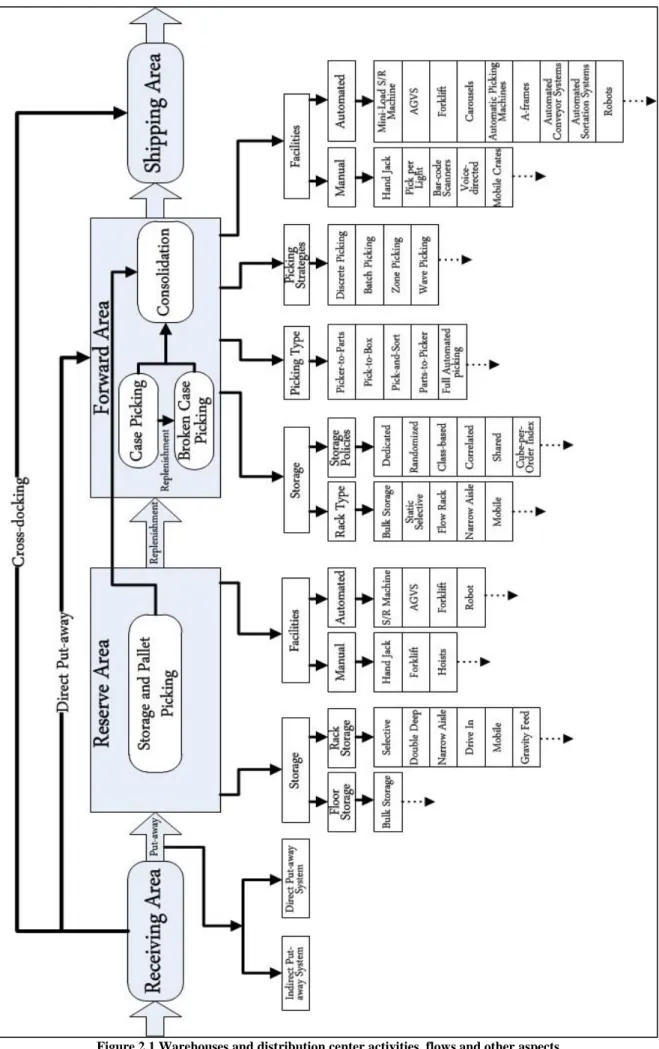
According to Rouwenhorst et al. (2000), the main warehouse activities can be classified in four stages according to the material flow principle:
- Receiving - Storage - OP