Software Model Checking SystemC
Alessandro Cimatti, Iman Narasamdya, and Marco Roveri
Fondazione Bruno Kessler, Italy.Via Sommarive 18, I-38050, Trento, Italy
{cimatti,narasamdya,roveri}@fbk.eu
Abstract—SystemC is an increasingly used language for writing executable specifications of Systems-on-Chip. The verification of SystemC, however, is a very difficult challenge. Simulation features great scalability, but can miss important defects. On the other hand, formal verification of SystemC is extremely hard because of the presence of threads, and the intricacies of the communication and scheduling mechanisms.
In this paper, we explore formal verification for SystemC by means of software model checking techniques, that have demonstrated substantial progress in recent years. We propose an accurate model of SystemC, and three complementary encodings of SystemC to finite-state processes, sequential, and threaded programming models.
We implemented the proposed approaches in a tool-chain, and we carried out a thorough experimental evaluation, using several benchmarks taken from the literature on SystemC verification, and experimenting with different state-of-the-art software model checkers. The results clearly show the applicability and efficiency of the proposed approaches. In particular, the results show the effectiveness of the threaded and of the finite-model encodings to prove and disprove properties, respectively.
Index Terms—SystemC, sequentialization, software model checking, CEGAR.
I. INTRODUCTION
SystemC [3] is a de-facto standard language for writing ex-ecutable designs of System-on-Chips. A high-level exex-ecutable design allows to efficiently simulate the behaviors of the SoC before synthesizing the RTL hardware description. The verification of SystemC designs is of paramount importance, to reveal errors in early stages of the development flow, and to prevent expensive propagation down to the hardware.
Formal verification of SystemC has recently gained signif-icant interests. Compared to simulations, formal verification provides full coverage, and thus may enhance the reliability and the robustness of the design. However, formal verification of SystemC designs poses two main challanges: to handle Sys-temC rich constructs and to achieve high-performance analy-sis. The latter is due to the fact that SystemC has a complex computation model, that can be viewed as a multi-threaded program with a specific scheduling policy [4], and complex communication primitives. For this reason, the previous formal approaches [1], [5]–[10] either show poor performances and scalability, or abstract away significant semantic aspects of SystemC.
Some of the material presented in this paper appears in preliminary version in [1] and in [2]. This manuscript presents a new tool-chain for the formal verification of SystemC based on one unifying formal framework, a uniform description of the proposed encodings, a more extensive and deeper
experimental evaluation, and the new optimizations added to KRATOS to
improve its efficiency.
In this paper, we propose a novel approach to SystemC verification. Our work focuses on achieving high-performance analysis, while reuses existing front-end components to handle the SystemC constructs. The characterizing feature of our work is the precise modeling of the complex features of SystemC, such as the scheduler and the communication primitives. The idea is to leverage recent advances in software model checking (SMC) techniques [11], that have demonstrated significant successes in the analysis of complex software, and have enabled their use in industrial settings [12], [13].
We explore three different SMC approaches to the ver-ification of SystemC designs. The first approach converts a SystemC design into a finite-state model specified in
PROMELA [14], and uses the SPIN explicit-state model
checker to carry out the analysis. The conversion has several variants, each coming with a generic and accurate encoding of the SystemC scheduler, and an encoding of each SystemC thread. Given the infinite nature of SystemC, the modeling into a finite-state model requires to restrict the space of values that can be acquired from the environment, and to bound the search space. As such, this approach provides only an underapproximation, and is only intended for bug finding. This approach, unlike simulation-based verification, provides full coverage since it explores all possible thread interleavings.
The second approach, referred to as sequentialization, en-codes SystemC designs into sequential programs: SystemC threads are encoded as functions, called by a top-level routine that mimics the SystemC scheduler. The resulting sequential programs can then be analyzed by any state-of-the-art model checker for sequential programs (e.g. [13], [15]–[19]).
In the third approach, called Explicit-Scheduler/Symbolic-Threads (ESST) [1], [20], a SystemC design is mapped onto a shared-variable multi-threaded program with cooperative
scheduling and mutually-exclusive thread executions. ESST analyzes each thread using lazy predicate abstraction [16], and orchestrates the overall verification by the direct execution of the SystemC scheduler, using techniques similar to explicit-state model checking. Compared to sequentialization, the scheduler is no longer part of the program being analyzed, but is part of the ESST algorithm itself.
The flow described above was implemented in a compre-hensive tool chain, where PINAPA [21] is used as a front end. The translations were implemented in several modules encoding SystemC designs into finite state PROMELAmodels, sequential C programs, and threaded C programs. The tool chain connects to SPIN and to several existing software model checkers for C [17], [18], [22]–[25]. Substantial work was required to specialize the generic ESST approach of KRATOS
channel updates run thread select thread threads runnable time acceleration notification delta channel updates notification delta evaluation phase threads no runnable notification timed no runnable threads fail no fail initialization phase end start update phase
Fig. 1. The SystemC scheduler.
to the case of SystemC verification.
We have performed a thorough experimental evaluation of the proposed tool chain, using a significant set of benchmarks. The results show that ESST is effective for proving safety properties, much more than simple sequentialization, and is fruitfully complemented by the encodings into finite-state models for bug finding.
The structure of this paper is as follows. Sec. II provides a background on SystemC. Sec. III provides an overview of the approach, and describes the SMC techniques. Sec. IV, V, and VI, respectively, discuss the encodings into finite-state processes, sequential programs, and multi-threaded programs. Sec. VII discusses related works. Sec. VIII shows our experi-mental evaluation. Finally, Sec. IX draws the conclusions and outlines some future work.
II. SYSTEMC
SystemC is a C++ library that consists of a core language for modeling the components of a system design and their interconnections, and a simulation kernel (or a scheduler) for fast simulations of the design. The core language models system components by means of modules (or C++ classes) and abstracts communication between modules by means of chan-nels. SystemC provides several primitive channels such as sig-nal, mutex, semaphore, and queue. A module can have one or more thread definitions that model the parallel behavior of the system design. The core language provides general-purpose events as synchronization mechanisms between threads.
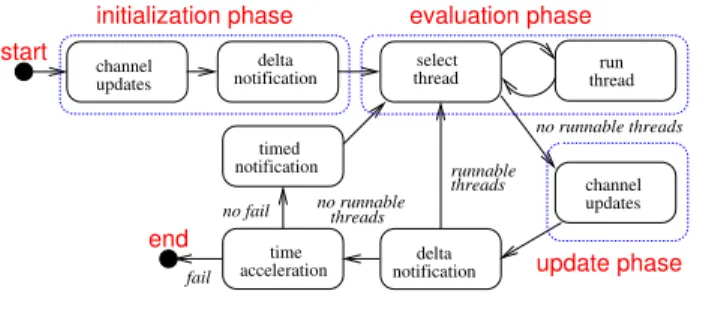
The SystemC scheduler runs the threads during simulations. Following the SystemC semantics in [4], the scheduler consists of several phases as shown in Figure 1. In the initialization phaseall channels are initialized. The scheduler then enters the
evaluation phasewhere it executes all runnable threads while postponing the materialization of channel updates performed by the threads. This phase employs a cooperative scheduling policy with mutually-exclusive thread execution. When there are no more runnable threads, the scheduler goes into the up-date phasewhere it materializes all channel updates postponed during the evaluation phase. An evaluation phase followed by an update phase constitutes a delta cycle.
A thread, during its execution, can perform delayed event notifications. That is, the involved events will be notified at some time in the future, including at the delta notification. The materializations of channel updates also often require the events associated with the updated channels to be notified at the delta notifications. In turn, all threads that are waiting
read_ack write p_to_c c_to_p read_and_ack in_port out_port
out_port in_port Consumer C
Producer P
Fig. 2. AProducer-Consumerdesign.
0SC MODULE( Producer ){ 1 sc evente ; 2 p ub li c: 3 sc in<i n t>i n p o r t ; 4 sc out<i n t>o u t p o r t ; 5 SC CTOR( Producer ){ 6 SC THREAD( w r i t e ) ;
7 SC METHOD( read ack ) ;
8 s e n s i t i v e<<i n p o r t ;
9 d o n t i n i t i a l i z e( ) ;
10 }
11 void w r i t e ( ) {
12 wait(SC ZERO TIME) ;
13 while ( 1 ) {
14 o u t p o r t . w r i t e ( i n p u t ( ) ) ;
15 wait( e ) ;
16 }
17 }
18 void read ack ( ){
19 o u t p u t ( i n p o r t . read ( ) ) ; 20 e .n o t i f y( ) ; 21 } 22 }; 23SC MODULE( Consumer ){ 24 p ub li c: 25 sc in<i n t>i n p o r t ; 26 sc out<i n t>o u t p o r t ; 27 SC CTOR( Consumer ){
28 SC METHOD( read and ack ) ;
29 s e n s i t i v e<<i n p o r t ;
30 d o n t i n i t i a l i z e( ) ;
31 }
32 void read and ack ( ){
33 i n t ack = process ( i n p o r t . read ( ) ) ;
34 o u t p o r t . w r i t e ( ack ) ; 35 } 36 }; 37 38 i n t sc main ( ){ 39 sc signal<i n t>p to c , c to p ;
40 Producer∗p =newProducer ( ‘ ‘ P’ ’) ;
41 Consumer∗c =newConsumer ( ‘ ‘ C’ ’) ;
42 p−>o u t p o r t ( p to c ) ; c−>i n p o r t ( p to c ) ;
43 p−>i n p o r t ( c to p ) ; c−>o u t p o r t ( c to p ) ;
44 s c s t a r t( ) ;
45}
Fig. 3. SystemC code for design of Figure 2.
for the notified events or are sensitive to the channels whose associated events are notified become runnable. If, after the delta notification, there are runnable threads, the scheduler goes back to the evaluation phase to run them. Otherwise, it accelerates the simulation time to the nearest time point where there exist events to be notified. These events are then notified at the timed notification. Similar to the delta notification, some waiting threads can become runnable after the timed notifications, and thus the scheduler has to go back to the evaluation phase to run them. If there are no more events to be notified at some future time, denoted in Figure 1 by failure in time acceleration, then the simulation ends.
An example of a design with two components, Producer and Consumer is depicted in Figure 2, while its SystemC implementation is reported in Figure 3. The constructor of Producer specifies two threads: write for writing value to Consumer through the channel bound to its output port out_port, and read_ack for reading the acknowledgment value sent by Consumer through the channel bound to its input port in_port. For simplicity, we treat a process de-clared by SC_METHOD as a thread that suspends itself only if its execution terminates. The constructor also says that the thread read_ack is sensitive to the value update of the channel bound to in_port (sensitive << in_port), and is not runnable at the beginning of the simulation (dont_initialize()).
In this example, the thread writefirst waits until the next delta cycle (wait(SC_ZERO_TIME)) before entering the loop that feeds values to Consumer. Every time it writes a value toConsumer, it suspends itself waiting for the notification of evente(wait(e)). The structure and behavior ofConsumer can be described similarly to that of Producer. The main functionsc_maininstantiates oneProducer, oneConsumer, binds their ports to the appropriate signal channels, and then starts the simulation (sc_start()).
Symbolic Sequential Analysis
e.g., Eager/Lazy Abstraction, BMC T1 T2 T3 Scheduler Sequential C program Thread T3 Thread T2 Thread T1 SystemC design T1 T2 T3 Scheduler Finite−State Model T1 T2 T3 Threaded C program Explicit−State Analysis
e.g., Promela + SPIN
Scheduler
ESST for SystemC
Fig. 4. Approaches to SystemC verification.
III. OVERVIEW OF THEAPPROACH
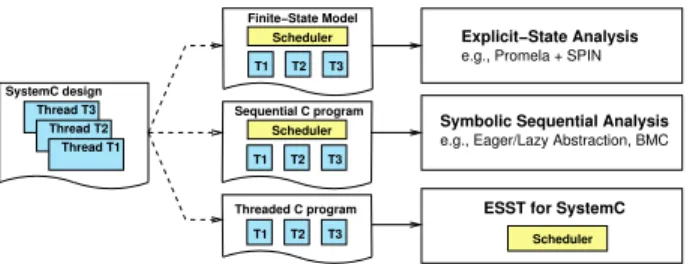
The proposed verification flow, depicted in Figure 4, takes in input a SystemC design, and generates various descriptions that activate different back-end techniques. In this section we first overview the flow, and then we analyze the features of each back-end technique.
A. SystemC Translations
Our verification flow relies on the translation of SystemC designs into forms that can be analyzed by existing software model checking techniques. In the first approach, we translate the SystemC design into a finite-state. The resulting model can then be analyzed using explicit-state model checking techniques. In the second approach, we translate the SystemC design into a sequential C program such that there is a one-to-one correspondence between the threads in the design and the functions in the C program, and thread executions are modeled as function calls. The resulting sequential C program also contains an encoding of the SystemC scheduler. Such a translation enables the use of state-of-the-art symbolic model checking techniques for sequential software, like abstraction-based analyses and bounded model checking. In the third approach, we verify SystemC designs via the ESST technique. We map the threads in the SystemC design onto a set of threads, that are implicitly interpreted by the ESST engine that has been specialized to SystemC. That is, the scheduler of ESST is instantiated to the SystemC scheduler.
Assumptions: Our approaches assume that the number of threads and events are known before the simulation starts, and there is no dynamic creations of objects or threads. We also assume that all function calls in the design can statically be inlined. In our experience, most of SystemC designs satisfy these assumptions. Thus, these assumptions do not severely limit the applicability of our approaches. To enable the use of existing software model checking techniques, we refrain from encoding SystemC constructs to the constructs that most model checkers cannot deal with or cannot handle effectively. For example, most model checkers either do not support arrays or reason about them in an ineffective way. Thus, although encodings into arrays can result in succinct encodings, we would rather encode arrays into multiple variables. Most software model checkers cannot deal with floating-point or real numbers, so we assume that the time delays specified in the SystemC designs can be converted into integers. Additionally, to use the ESST algorithm, we assume that the arguments passed to the synchronization functions are constants.
B. Explicit State Model Checking of Software
Explicit-state model checking techniques have been widely used in the formal verification of software. These techniques, unlike simulation-based verification, provide full coverage because they exercise all possible input values and, on multi-threaded software, explore all possible thread interleavings.
One of the most successful explicit-state model checker is SPIN [26]. It is used for verifying the correctness of software models in the form of (non-deterministic) finite-state models written in PROMELA. Besides detecting assertion violations, SPIN can detect non-progressing cycles in PROMELAmodels. SPIN provides several optimizations techniques to cope with the state explosion problem. For example, to effectively explore process interleavings, SPIN implements a partial-order reduction method [27]. To reduce memory consumption, SPIN implements statement merging that combines sequences of transitions within the same process into a single transition to avoid the creation of intermediate states. It also implements a state compression method, called collapse compression [14]. This method avoids replicating a complete description of all local components of the system state by storing only smaller state components separately, associating each state component with a unique id, and combining the unique identifiers to form the global state descriptor. Collapse compression has some run time overhead, but should significantly reduce the memory consumed to store the state space.
Explicit-state techniques are unable to deal with the infinite nature of the state space of the threads. Unfortunately, a finite-state abstraction is not easily obtained in general. Thus, these techniques are typically oriented towards bug finding.
C. Symbolic Model Checking of Sequential Software
Symbolic model checking is the most prominent approach to verifying software due to its ability to counter the infinite nature of the state space of software. Two main paradigms have emerged: counter-example guided abstraction refinement (CEGAR) [15], and bounded model checking (BMC) for software [18].
The CEGAR approaches start with a coarse abstraction of the program, and successively refine the abstraction using the information extracted from spurious counter-examples. The abstraction provides an effective way to cope with the poten-tially infinite state space, while the abstraction-refinement loop allows to incrementally re-introduce the details required to generate proofs of correctness. The most promising CEGAR-based techniques include the lazy predicate abstraction [16], [22], the lazy abstraction with interpolants [19], and the eager abstraction [13], [17].
The lazy predicate abstraction is based on the on-the-fly construction and analysis of an abstract reachability tree
(ART). An ART describes the reachable abstract states of the program and is obtained by unwinding the control-flow graph (CFG) of the program. An ART node is a pair(l, ϕ)wherelis a control-flow location, andregionϕis a formula representing a set of data states. The verification of safety properties is reduced to checking the reachability of some error locations in the CFG. The lazy predicate abstraction expands an ART
node by computing the abstract post-conditions of the node’s region with respect to the operation of the unwound CFG edge and a finite set of predicates over program variables. The expansion of an ART node (l, ϕ) is stopped if ϕ is unsatisfiable or if the node iscoveredby another node(l, ϕ0)
such thatϕis subsumed byϕ0. During the ART construction, when the expansion reaches an error node (a node with an error location), the path from the root to the reached node is checked for its feasibility. If it is feasible, then the path is a counter-example for the safety property. Otherwise, the path is analyzed to discover new predicates to be used for refining the ART [28]. The ART is then reconstructed by taking into account the newly discovered predicates. An ART iscomplete
if no further node expansion is possible, and is safe if it additionally has no error node with a satisfiable region. A safe ART is a proof that the program is safe.
The lazy abstraction with interpolants, similarly to the lazy predicate abstraction, is also based on the construction of an ART. But, it avoids the expensive computations of abstract post-conditions by using directly the interpolants generated from the unfeasible paths as regions for the nodes.
Eager abstraction techniques typically extract an abstrac-tion of the sequential program in the form of Boolean pro-gram [29] by using predicate abstraction techniques. Unlike sequential programs in general, the reachability problem of Boolean programs is decidable [29]. Boolean programs con-taining no recursive function calls can be directly analyzed using “off-the-shelf” finite-state verification techniques [14], [30], [31]. If the Boolean program is safe, so is the original program. Otherwise, new predicates are discovered and the verification is iterated.
The bounded model checking for sequential programs un-winds the CFG for a fixed number of steps [18]. Given a program, an error location, and an integerk, one constructs a constraint which is satisfiable iff the error location is reachable within ksteps. Satisfiability of this constraint can be checked by any constraint solver. Typically, in this context, the bound k refers to the number of CFG unwindings or to the number of loop unrollings. This approach is sound and complete, but only up to the given bound.
D. Explicit-Scheduler/Symbolic-Threads
The Explicit-Scheduler/Symbolic-Threads (ESST) [1] has been introduced as an effective technique for the verifica-tion of multi-threaded software with cooperative (or non-preemptive) scheduling and mutually-exclusive thread execu-tions: the scheduler executes at most one thread at a time, and when it gives the control to a thread to run, it waits until the thread suspends itself and gives back the control. ESST analyzes multi-threaded software in the form of threaded program that consists of a set of sequential programs (also called threads) that communicate with each other through shared global variables, and communicate with the scheduler (e.g., updating and querying scheduler states) through a set of
primitive functions provided by ESST.
ESST is a CEGAR-based technique, and combines explicit and symbolic model checking techniques. It analyzes each
thread with the lazy predicate abstraction, as if the thread were a sequential program. The whole verification is orchestrated by the direct execution of the scheduler using techniques similar to explicit-state model checking. That is, ESST keeps track of the state of the scheduler explicitly, and includes the scheduler as part of the verification algorithm. To allow the direct execution of the scheduler, ESST needs precise scheduler states, and thus it requires that the arguments passed to the primitive functions are constants. Both the scheduler and the set of primitive functions are left abstract, but the scheduler is required to exhibit a cooperative scheduling policy.
The ESST algorithm is based on the construction and analysis of an abstract reachability forest (ARF) that de-scribes the reachable abstract states of the multi-threaded program. An ARF consists of connected ART’s, each of which is obtained by unwinding the CFG of the running thread. For a program with N threads, an ARF node is a tuple
(hl1, ϕ1i, . . . ,hlN, ϕNi, ϕ,S), where li and ϕi are,
respec-tively, the location and the region of threadi,ϕis the region of global variables, andS is the scheduler state. Regions are formulas describing the values of program variables, while the scheduler state is a mapping from scheduler variables to concrete values. The scheduler state, in particular, maintains information about the threads, e.g., the states of the threads. An ARF is constructed by unwinding the CFGs of threads, and by executing the scheduler. Each ART in the ARF is constructed using the lazy predicate abstraction as for the case of sequential programs. In particular, when the operation of the unwound CFG edge involves a call to a primitive function, then ESST has a primitive function executor that takes as inputs the scheduler state and the call to a primitive function, and returns the updated scheduler state obtained from executing the function.
Given a node (hl1, ϕ1i, . . . ,hli, ϕii, . . . ,hlN, ϕNi, ϕ,S),
such that there are no running threads, ESST then executes the scheduler. The scheduler itself is essentially a function that takes the scheduler state S as an input and outputs a set {S00, . . . ,SM0 } of scheduler states representing all pos-sible schedules. Each of these states forms an ARF node
(hl1, ϕ1i, . . . ,hli, ϕii, . . . ,hlN, ϕNi, ϕ,Sj0), that becomes the
root of new ART of the subsequent running thread. Coverage checks and refinements in ESST are similar to that of the lazy predicate abstraction. In particular, the subsumption checks are done thread-wise and require the scheduler states to match. See [1] for the details of coverage checks and refinements.
In [20] ESST has been enhanced withpartial-order reduc-tion (POR) [32]–[34] to alleviate the problem of exploring a large number of redundant thread interleavings. POR exploits the commutativity of concurrent transitions that result in the same state when they are executed in different orders.
IV. ENCODING INTOFINITE-STATEMODELS
In this section we show how to encode SystemC designs into finite-state models. The encoding of a SystemC design is obtained by combining a generic encoding of the scheduler and an encoding of each thread in the design. In particular, we describe three different encodings of SystemC designs
in PROMELA. All of these encoding variants follow the full semantics of SystemC by modeling precisely the SystemC scheduler, but they differ in the way the scheduler-threads synchronizations are modeled, and in the granularities of state sampling. As a result, they feature different characteristics in terms of the properties that can be verified, but all of them are suitable for verifying program assertions. All the PROMELA
encodings exhibit an under-approximation: we restrict the potentially infinite input values to a finite set of values.
For presentation, we will use the example introduced in Section II. Although the example only uses a small subset of SystemC features, the example is sufficient to describe our encodings. Other SystemC features that are not present in the example can be dealt with in a similar way.
A. Basic Building Blocks
1) Encoding Modules, Events, and Channels: We encode
module instances by opening up their definitions. Members of module instances, global variables or variables accessible by multiple threads are encoded into a set of global variables in the PROMELAmodel. Each thread function (functions declared by SC_THREAD or SC_METHOD) of the instances is encoded either as PROMELA inline code or as PROMELA process, depending on the chosen encoding. For example, a member variable x and a thread function T of a module instance M
are encoded, respectively, into a global variableM_xand into inline code or process M_T. In what follows we drop the module instance name prefix when it is clear from the context. We model an event e by two global variables e_state and e_time. The variable e_state keeps track of the state of e, and ranges over the enumerations {NOTIFIED, NOTIFIED_DELTA, NOTIFIED_TIME, NONE}. The value NOTIFIED indicates that the event is notified. The values NOTIFIED_DELTA and NOTIFIED_TIME indicate that the event will be notified at, respectively, the delta notification and the timed notification, while the valueNONEindicates there is no notification of the event. The variablee_timekeeps track of the time delay of the event notification.
Similar to the encoding of module instances, channel in-stances are encoded by opening up their definitions. We exemplify the encoding of channel instances by the encoding of signal instances. Other kinds of channel can be encoded in a similar way. A SystemC signal s or a port bound to that signal is modeled by a pair s_new, s_old of variables such that every write to sis a write tos_newand every read from
s is a read from s_old. Following the definition of signal, we associate each signal swith a Boolean variables_req_up that will be set to true after every write to s to indicate a request for an update in the update phase. We also associate swith an event e_sthat is used to notify waiting threads that are sensitive to the value update ofs.
For each signal s, we have the encoding of its update function as PROMELA inline code s_update, as shown in Figure 5. The code is executed in the update phase, and accounts for updating the content of s_old with the value of s_new when they are not equal, and in such a case the evente_s is set to be notified at the delta notification.
0 # d ef in eITE (C, T , E ){ i f : : C−>T ; : :else−>E ; f i}
1
2 i n l i n e p to c update ( ) {
3 ITE ( p to c new ! = p to c old ,
4 p t o c o l d = p to c new ; e p to c = NOTIFIED DELTA , skip)
5}
Fig. 5. PROMELAencoding of channel update function.
2) Encoding Thread Bodies: The body of each SystemC
thread T is encoded as PROMELA inline code T_body. We associate each threadT with two global variables:T_pckeeps track of the program counter of the thread, andT_statekeeps track of the state of the thread. The values ofT_staterange over the enumerations {RUNNING, RUNNABLE, WAITING}, whose meanings are obvious.
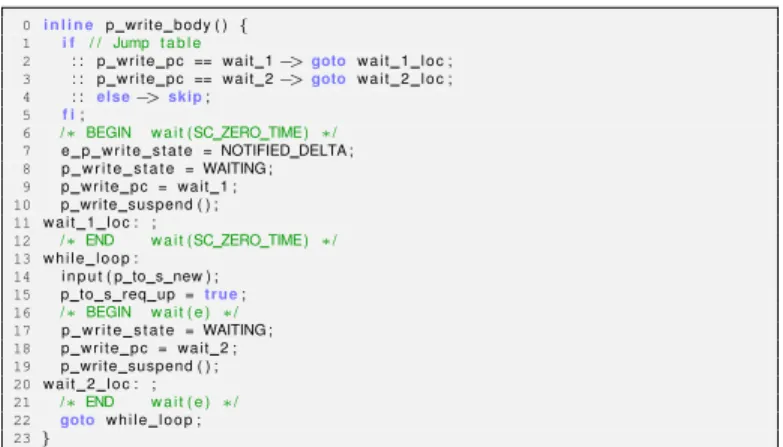
To model thread suspensions and resumption, we add code labels in the body such that the labels mark the locations from which the thread has to resume its execution. We then start the encoding of the body with a jump table that directs the execution to the resuming location. The passing of control from the thread T to the scheduler is modeled by the inline codeT_suspend. Because the thread-scheduler synchronizations are modeled differently in the encodings, so are the expansions ofT_suspend.
When the thread yields the control to the scheduler, it sets the thread state to WAITING, sets the program counter to the code label followingT_suspend, and executesT_suspend. On receiving the control back, with the help of the jump table, the thread resumes its execution from the location it saved in its latest suspension. Figure 6 shows the encoding of the thread write ofProducer p. 0 i n l i n e p w r i t e b o d y ( ){ 1 i f / / Jump t a b l e 2 : : p w r i t e p c == w a i t 1−>goto w a i t 1 l o c ; 3 : : p w r i t e p c == w a i t 2−>goto w a i t 2 l o c ; 4 : : else−>skip; 5 f i;
6 /∗ BEGIN w a i t ( SC ZERO TIME ) ∗/
7 e p w r i t e s t a t e = NOTIFIED DELTA ;
8 p w r i t e s t a t e = WAITING ;
9 p w r i t e p c = w a i t 1 ;
10 p write suspend ( ) ;
11 w a i t 1 l o c : ;
12 /∗END w a i t ( SC ZERO TIME ) ∗/
13 w h i l e l o o p : 14 i n p u t ( p to s new ) ; 15 p to s req up =t r u e; 16 /∗ BEGIN w a i t ( e ) ∗/ 17 p w r i t e s t a t e = WAITING ; 18 p w r i t e p c = w a i t 2 ; 19 p write suspend ( ) ; 20 w a i t 2 l o c : ; 21 /∗END w a i t ( e ) ∗/ 22 goto w h i l e l o o p ; 23}
Fig. 6. PROMELAencoding of the body of threadwrite.
3) Encoding Synchronization Functions: Figure 6 also
shows the encoding of several SystemC synchronization prim-itives. Any call to a SystemC wait function, either wait(e), for an event e, or wait(t), for time t, suspends the thread execution. In particular, to handle a call to wait(t), we associate each threadT with an evente_T. The encoding of wait(t) consists of setting e_T_state to NOTIFIED_TIME ande_T_timetot. WhentisSC_ZERO_TIME, the event will be notified at the delta notification, and so e_T_state is set to NOTIFIED_DELTA and e_T_time can be left unchanged because its value is irrelevant.
The consumer code in our example contains a call e.notify() that immediately notifies the event e. Such an
immediate notification is encoded as the inline codee_notify in Figure 7. The inline code notify_threads in the figure simply makes runnable the threads that are waiting for the event notifications. This code is also executed at the delta notification and timed notification of the scheduler.
0 bool p w r i t e n o t i f i e d , p r e a d n o t i f i e d , c r e a d a n d a c k n o t i f i e d ;
1
2 i n l i n e i s p w r i t e n o t i f i e d ( n o t i f i e d ){
3 ITE ( ( ( p w r i t e p c == w a i t 1 && e p w r i t e s t a t e == NOTIFIED ) | |
4 ( p w r i t e p c == w a i t 2 && e s t a t e == NOTIFIED ) ) , 5 n o t i f i e d =true, n o t i f i e d = f a l s e) ; 6} 7 8 i n l i n e n o t i f y t h r e a d s ( ) { 9 i s p w r i t e n o t i f i e d ( p w r i t e n o t i f i e d ) ;
10 ITE ( p w r i t e n o t i f i e d , p w r i t e s t a t e = RUNNABLE, skip) ;
11 i s p r e a d n o t i f i e d ( p r e a d n o t i f i e d ) ;
12 ITE ( p r e a d n o t i f i e d , p r e a d s t a t e = RUNNABLE, skip) ;
13 i s c r e a d a n d a c k n o t i f i e d ( c r e a d a n d a c k n o t i f i e d ) ;
14 ITE ( c r e a d a n d a c k n o t i f i e d , c read and ack state = RUNNABLE, skip) ;
15}
16
17 i n l i n e e n o t i f y ( ) {e s t a t e = NOTIFIED ; n o t i f y t h r e a d s ( ) ; e s t a t e = NONE; }
Fig. 7. PROMELAencoding of event notifications.
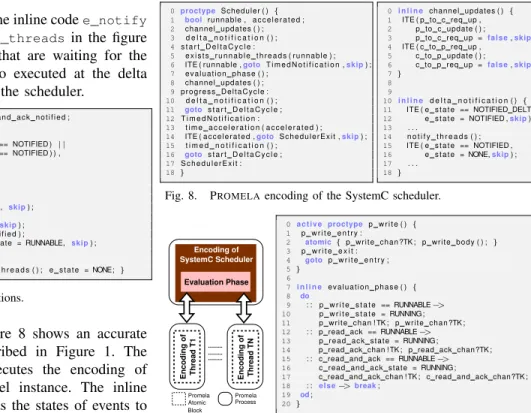
4) Encoding The Scheduler: Figure 8 shows an accurate
encoding of the scheduler as described in Figure 1. The inline code channel_updates executes the encoding of the update function of each channel instance. The inline code delta_notification first sets the states of events to NOTIFIED if their current states areNOTIFIED_DELTA, then executesnotify_threadsto wake up the threads, and finally sets the states of the notified events toNONE. The inline code exists_runnable_threads checks for runnable threads, and setsrunnabletotrueif there exists any runnable thread. The inline codetime_accelerationaccelerates the time by subtracting the value of e_time, for each event e such that e_state is NOTIFIED_TIME, with the smallest value among them. It also setse_statetoNOTIFIED_DELTAif the resulting e_time becomes 0. Prior to accelerating the time, time_acceleration checks if there is an event e whose state is NOTIFIED_TIME. If there is no such an event, then it simply sets accelerated to false and quits; otherwise it accelerates the time and sets accelerated to true. The inline codetimed_notificationworks in the same way as delta_notification.
The encodings that we propose have different expansions of the inline code evaluation_phase, and we will discuss each of them in the following sub-section.
The labelprogress_DeltaCycleis used to detect a non-progressing delta cycle. That is, during the state space explo-ration, SPIN checks whether a label prefixed by progress is visited infinitely often in an infinite execution; violation of this property yields a non-progressing cycle.
To complete our encoding, we have the following init process that initializes the global variables (init_model inline function) and runs the scheduler:
0i n i t {i n i t m o d e l ( ) ; run s c h e d u l e r ( ) ; }
5) Encoding Non-Deterministic Inputs: Input reading is encoded as inline code input(see Figure 6) that selects non-deterministically a value from a finite set of values.
B. Encoding Variants
1) Thread-To-Process Encoding: This encoding treats the scheduler and the threads as separate PROMELAprocesses, as
0 proctype Scheduler ( ) { 1 bool runnable , a c c e l e r a t e d ; 2 channel updates ( ) ; 3 d e l t a n o t i f i c a t i o n ( ) ; 4 s t a r t D e l t a C y c l e : 5 e x i s t s r u n n a b l e t h r e a d s ( r u n n a b l e ) ;
6 ITE ( runnable ,goto T i m e d N o t i f i c a t i o n ,skip) ;
7 e v a l u a t i o n p h a s e ( ) ; 8 channel updates ( ) ; 9 p r o g r e s s D e l t a C y c l e : 10 d e l t a n o t i f i c a t i o n ( ) ; 11 goto s t a r t D e l t a C y c l e ; 12 T i m e d N o t i f i c a t i o n : 13 t i m e a c c e l e r a t i o n ( a c c e l e r a t e d ) ;
14 ITE ( a c c e l e r a t e d ,gotoS c h e d u l e r E x i t ,skip) ;
15 t i m e d n o t i f i c a t i o n ( ) ; 16 goto s t a r t D e l t a C y c l e ; 17 S c h e d u l e r E x i t : 18} 0 i n l i n e channel updates ( ) { 1 ITE ( p to c req up , 2 p to c update ( ) ; 3 p to c req up =f a l s e,skip) ; 4 ITE ( c to p req up , 5 c to p update ( ) ; 6 c to p req up =f a l s e,skip) ; 7 } 8 9 10 i n l i n e d e l t a n o t i f i c a t i o n ( ){
11 ITE ( e s t a t e == NOTIFIED DELTA ,
12 e s t a t e = NOTIFIED ,skip) ; 13 . . . 14 n o t i f y t h r e a d s ( ) ; 15 ITE ( e s t a t e == NOTIFIED , 16 e s t a t e = NONE,skip) ; 17 . . . 18}
Fig. 8. PROMELAencoding of the SystemC scheduler.
Atomic Promela Block Promela Process Encoding of SystemC Scheduler Evaluation Phase
Encoding of Thread T1 Encoding of Thread TN ... ... ... 0 a c t i v e proctype p w r i t e ( ){ 1 p w r i t e e n t r y : 2 atomic{p w r i t e c h a n ?TK ; p w r i t e b o d y ( ) ; } 3 p w r i t e e x i t : 4 goto p w r i t e e n t r y ; 5} 6 7 i n l i n e e v a l u a t i o n p h a s e ( ){ 8 do 9 : : p w r i t e s t a t e == RUNNABLE−> 10 p w r i t e s t a t e = RUNNING ; 11 p w r i t e c h a n ! TK ; p w r i t e c h a n ?TK ;
12 : : p read ack == RUNNABLE−>
13 p r e a d a c k s t a t e = RUNNING ;
14 p read ack chan ! TK ; p read ack chan?TK ;
15 : : c read and ack == RUNNABLE−>
16 c read and ack state = RUNNING ;
17 c read and ack chan ! TK ; c read and ack chan?TK ;
18 : : else−>break;
19 od;
20}
Fig. 9. Thread-to-process encoding.
shown in Figure 9.The synchronization between threads and the scheduler is modeled by passing the token TK through some rendezvous channels that connect the threads with the scheduler. For a design with N threads, we maintain N rendezvous channels such that each thread T exchanges the token with the scheduler through the channelT_chan.
Each thread T is encoded as a non-terminating PROMELA
processT_thread, as shown in Figure 9. The thread body is enclosed within a PROMELAatomicblock and it is preceded by receiving (operator ?) the token TK from the designated channel. The receive statement is executable if and only if the rendezvous channel receives the tokenTK.
The thread suspension in the thread-to-process encoding is modeled as sending (operator !) the token TK, followed by receiving it back from the scheduler.
0 i n l i n e p write suspend ( ) { p w r i t e c h a n ! TK ; p w r i t e c h a n ?TK ;}
The sending and receiving of the token TK are sufficient to keep track of the locations in the control flow of the PROMELA
code. Thus, this encoding does not require the jump table, the code labels for the encoding of thread suspensions, and the variables introduced to keep track of the program counters of threads.
Figure 9 also shows the encoding of the evaluation phase. To model the cooperativeness and to allow the explo-ration of all possible thread interleavings, the scheduler non-deterministically chooses a runnable thread and sends the token TK to the thread (do-od construct). It then waits for the thread to give back the tokenTK.
2) Thread-To-Atomic-Block Encoding: This encoding uses a single PROMELAprocess containing both the scheduler and the threads, such that each SystemC thread is encoded as an atomic block inside the encoding of the evaluation phase,
Atomic Promela Block Promela Process Encoding of SystemC Scheduler
Encoding of Thread T1 Encoding of Thread TN
Evaluation Phase ... ... ... 0 i n l i n e p w r i t e ( ){ 1 atomic{ p w r i t e b o d y ( ) ; } 2 p w r i t e e x i t : 3 skip; 4} 5 6 i n l i n e e v a l u a t i o n p h a s e ( ){ 7 do 8 : : p w r i t e s t a t e == RUNNABLE−> 9 p w r i t e s t a t e = RUNNING ; p w r i t e ( ) ; 10 : : p r e a d a c k s t a t e == RUNNABLE−>
11 p r e a d a c k s t a t e = RUNNING ; p read ack ( ) ;
12 : : c read and ack state == RUNNABLE−>
13 c read and ack state = RUNNING ; c read and ack ( ) ;
14 : : else−>break;
15 od;
16}
Fig. 10. Thread-to-atomic-block encoding.
Atomic Promela Block Promela Process Encoding of SystemC Scheduler
Encoding of Thread T1 Encoding of Thread TN Evaluation Phase ... ... ... 0 proctypes c h e d u l e r ( ) { 1 . . . 2 atomic{ 3 e v a l u a t i o n p h a s e ( ) ; 4 } 5 . . . 6 }
Fig. 11. One-atomic-block encoding.
as shown in Figure 10. Passing control to the thread in the evaluation phase is modeled by executing the inline code of the thread, while giving back control to the scheduler is modeled by simply finishing the execution of the inline code.
Unlike the thread-to-process encoding, in this encoding we do not need the rendezvous channels and the control token. The inline suspension code, e.g.,p_write_suspend, of this encoding can be obtained from that of the thread-to-process encoding by replacing the sending and receiving statements with a jump to the exit label, i.e., p_write_exit.
3) One-Atomic-Block Encoding: This encoding is derived from the thread-to-atomic-block encoding by enclosing the whole evaluation phase in an atomic block, as shown in Figure 11. Although small, this modification can change the search behavior dramatically, and also affects the kinds of property that can be verified.
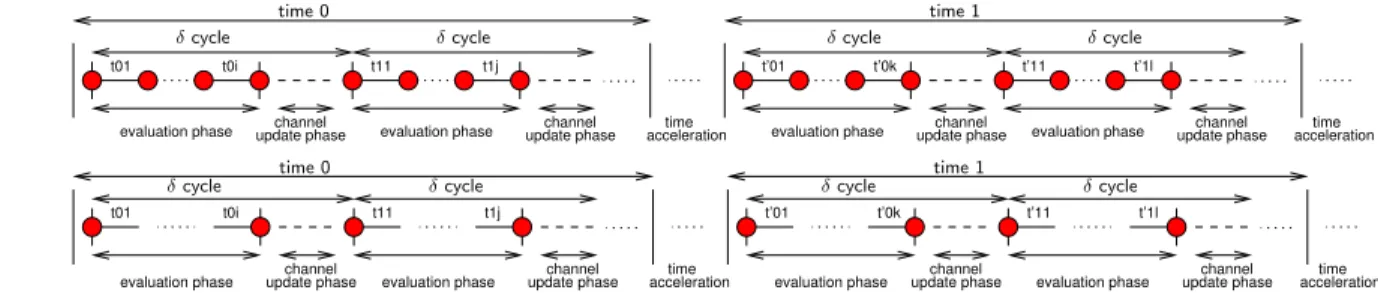
Unlike the other encodings, the one-atomic-block encoding cannot be used to detect non-progressing delta cycles. Recall that we use the labelprogress_DeltaCycleto allow SPIN to detect such cycles. However, to do so, the encodings must allow SPIN to sample states before and after the execution of each thread in the evaluation phase. Otherwise, a cycle of states in the state space that occurs during the exploration of the evaluation phase might go undetected. As shown in Figure 12 (a) (the dark/red circles), the thread-to-process and thread-to-atomic-block encodings sample the states before and after each thread execution, but, as shown in Figure 12 (b), the one-atomic-block encoding only samples states before and after each evaluation phase.
V. ENCODING INTOSEQUENTIALPROGRAMS
In this section we describe an encoding of SystemC designs into sequential programs. The proposed encoding consists of a mapping of SystemC threads in the form of functions, and an encoding of the SystemC scheduler that accurately
captures the semantics of SystemC. For presentation, we will show how to encode SystemC designs into sequential C programs. Encodings into different target sequential languages can be done in the same way modulo the differences in the language constructs. We will also present the encoding using the example introduced in Section II.
A. Encoding Modules, Events, Channels, and Threads
The encodings of modules, events, channels, and threads in C are the same as those described in Section IV-A, modulo the differences in syntactical constructs. In general, all inline code introduced in Section IV-A can easily be turned into C functions. In particular, each SystemC thread is encoded as a C function, calledthread function.
Thread suspensions are modeled as returning from the corresponding thread functions. That is, the inline code
T_suspend, for a thread T, in the PROMELA encodings is replaced with a return statement. To model context switches, we associate each local variable of a thread with a global variable. When the thread yields the control to the scheduler, the corresponding thread function saves the values of its local variables into their associated global variables. On receiving the control back from the scheduler, it restores the values of its local variables. Note that, due to our assumption that all function calls can always be inlined, having additional global variables is sufficient for supporting context switches.
Figure 13 (left) shows the encoding of the thread write. Since he thread has no local variables, there is no saving and restoring of its local variables during thread suspensions. Dif-ferently from the finite-state encoding, the resulting sequential program is not an under-approximation since input reading is modeled by the function call nondet() that returns a non-deterministic input value.
B. Encoding the Scheduler
The encoding of the scheduler in C can easily be de-rived from that of the PROMELA encodings by turning the inline code into C functions. For example, the inline code exists_runnable_threads(b) can be translated into a functionint exists_runnable_threads()that returns 1 if there is any runnable thread, or 0 otherwise.
The most notable difference from the PROMELAencodings is the encoding of the evaluation phase. The C language does not provide a non-deterministic construct likedo-odandif
-fi in PROMELA. To exercise all possible thread
interleav-ings, we use the nondet function to make non-deterministic choices, as shown in Figure 13 (right). Note that the encod-ing yields an additional non-existent simulation where the scheduler does not pick any runnable thread. However, such discrepancy in the encoding of the scheduler does not affect the verification of safety properties.
To complete the encoding, we have a main function (cor-responding to theinitPROMELAprocess) that first calls the init_modelsfunction to perform the necessary initialization of global variables and then invokes thescheduler.
(a)
evaluation phase update phasechannel evaluation phase update phasechannel accelerationtime evaluation phase update phasechannel evaluation phase update phasechannel accelerationtime
t01 t0i t11 t1j t’01 t’0k t’11 t’1l
δcycle
δcycle δcycle δcycle
time 1 time 0 (b) evaluation phase evaluation phase evaluation phase
evaluation phase update phasechannel update phasechannel accelerationtime update phasechannel update phasechannel accelerationtime
t01 t0i t11 t1j t’01 t’0k t’11 t’1l
δcycle
δcycle δcycle δcycle
time 0 time 1
Fig. 12. The granularities of state sampling of (a) thread-to-process and thread-to-atomic-block encodings,and (b) one-atomic-block encoding. The dark/red circles denote the states that are stored during the state exploration of SPIN.
0 void p w r i t e ( ){ 1 /∗∗∗∗Jump t a b l e∗∗∗∗/ 2 i f ( p w r i t e p c == w a i t 1 ) 3 goto w a i t 1 l o c ; 4 else i f ( p w r i t e p c == w a i t 2 ) 5 goto w a i t 2 l o c ; 6
7 /∗ BEGIN w a i t ( SC ZERO TIME ) ∗/
8 e p w r i t e s t a t e = NOTIFIED DELTA ;
9 p w r i t e s t a t e = WAITING ;
10 p w r i t e p c = w a i t 1 ;
11 r e t u r n;
12 w a i t 1 l o c :
13 /∗END w a i t ( SC ZERO TIME ) ∗/
14 while ( 1 ) { 15 p to s new = nondet ( ) ; 16 p to s req up = 1 ; 17 /∗ BEGIN w a i t ( e ) ∗/ 18 p w r i t e s t a t e = WAITING ; 19 p w r i t e p c = w a i t 2 ; 20 r e t u r n; 21 w a i t 2 l o c : 22 /∗END w a i t ( e ) ∗/ 23 } 24} 0 voide v a l u a t i o n p h a s e ( ){ 1 2 while ( e x i s t s r u n n a b l e t h r e a d s ( ) ){ 3 4 i f ( p w r i t e s t a t e == RUNNABLE 5 && nondet ( ) ){ 6 p w r i t e s t a t e = RUNNING ; 7 p w r i t e ( ) ; 8 } 9 10 i f ( p r e a d s t a t e == RUNNABLE 11 && nondet ( ) ) 12 p r e a d s t a t e = RUNNING ; 13 p read ( ) ; 14 } 15 16 i f ( c r e a d a c k s t a t e == RUNNABLE 17 && nondet ( ) ) 18 c r e a d a c k s t a t e = RUNNING ; 19 c read ack ( ) ; 20 } 21 22 } 23 24}
Fig. 13. Encodings of (left) threadwriteand of (right) evaluation phase.
VI. MODELCHECKINGSYSTEMCVIAESST In this section we describe how to verify SystemC designs via ESST. First, we have to specialize the ESST to handle the SystemC scheduler and synchronization primitives. Second, we have to encode the SystemC design into a threaded program that ESST can analyze.
A. Specializing ESST to SystemC
ESST is a generic algorithm for model checking coopera-tive threads. To verify SystemC designs, we need to specialize ESST to SystemC. Such a specialization amounts to instan-tiating the ESST scheduler with an implementation of the SystemC scheduler, and defining a set of primitive functions that implement the synchronization functions of SystemC.
We require that, for each SystemC synchronization function, there is a corresponding primitive function that implements it. Furthermore, we introduce an enumeration type SCEvent that lists all identifiers associated with event instances in the design. For example, the wait functions wait(e), for an evente, andwait(t), for timet, correspond, respectively, to the primitive functionswait_event(E)andwait_time(t), whereE is the member of SCEvent associated to evente.
B. Encoding into Threaded Programs
The encoding of SystemC designs into threaded programs is simpler than the encoding into sequential programs because the presence of primitive functions and the absence of the scheduler in the encoding. We encode each SystemC threads
0 void p w r i t e ( ){ 1 w a i t t i m e ( 0 ) ; /∗ w a i t ( SC ZERO TIME ) ∗/ 2 3 while ( 1 ) { 4 p to s new = nondet ( ) ; 5 6 w a i t e v e n t ( e ) ; /∗ w a i t ( e ) ∗/ 7 } 8}
Fig. 14. The encoding of the threadwritein the threaded program.
into a thread in the threaded program. Furthermore, we encode the update function of each SystemC channel instance into a special thread which is executed by the scheduler only during the update phase. The threaded program also contains amain thread from which the execution starts. Similar to the main function in the sequential program, themainthread performs necessary initializations, and then yields the control back to the scheduler to start the simulation.
Each call to a SystemC synchronization function is en-coded into a call to the corresponding primitive function. In particular, for synchronization functions that involve event instances, the event arguments are replaced with the identifiers corresponding to the event instances (members ofSCEvent). As described in Section III-D, ESST keeps track of the control location of each thread during its analysis. Thus, unlike the encoding into sequential programs, the threaded program does not need the global variables that keep track of program counters nor the jump table for modeling thread suspension. ESST also keeps track of the region of each thread, and so we do not need additional global variables for storing the values of variables local to a thread when the thread suspends itself. Moreover, in its state, the scheduler keeps track of the state of each thread, of each event, and of the notification time delays. Thus, the threaded program does not need supporting variables for tracking such information.
Figure 14 shows the encoding of the SystemC threadwrite as a thread in the threaded program. The encoding largely resembles the thread code in Figure 3. Notice that, the signal channel is modeled in the same way as in the case of the encoding into the sequential program. The same treatment is also applied to the member variables of module instances.
VII. RELATEDWORK
SystemC verification via translation to other languages has been reported in a number of publications. LUSSY [5] is a toolbox that translates SystemC designs into LUSTRE
and SMV models. Similar to our translations, the translation performed by LUSSYcaptures the full semantics of SystemC.
However, due to the complexity of the SystemC scheduler, the experimental evaluation reported in [35] shows that the approach implemented in LUSSYdoes not scale up.
SystemC verification via reduction to CTL model checking over Petri nets has been described in [36]. The experiments in [36] shows that, even for small SystemC designs, the resulting Petri nets can be very large, and thus hard to analyze. An encoding of a SystemC design into a network of timed automata has been reported in [9]. The resulting network of timed automata is then analyzed using UPPAAL [37]. Similar to the PROMELAencodings, the resulting timed automata are under-approximations of the original SystemC design.
The work in [38] encodes SystemC designs into the process algebra LOTOS and uses the CADP toolbox [39] for the ver-ification. The work only considers untimed SystemC designs, and the translation into LOTOS does not faithfully models the semantics of SystemC. That is, the work only considers SystemC as a description language for the design under verification, but does not impose the SystemC simulation semantics in analyzing the design.
There have been several works on translating SystemC designs into PROMELA code; see [8], [40]. Similar to our thread-to-process encodings, each SystemC thread is encoded as a PROMELA process, but, unlike ours, they embed the SystemC scheduler into the encoding of the synchronization primitives. The focus of these encodings is to verify SystemC designs at transaction level modeling (TLM). In TLM the delta cycles are typically not visible, and communications between threads are usually through shared global variables instead of SystemC channels. Thus, unlike our encodings that capture the full semantics of the SystemC scheduler, the existing encodings only consider the evaluation and the timed update phases of the scheduler. Moreover, since the evaluation phase is encoded implicitly in the encoding of the synchronization primitives, these encodings are unable to detect non-progress delta cycles. In [8] each SystemC thread is encoded into an automata, which in turn is encoded as a PROMELA process. This encoding is not efficient because the resulting PROMELA
process has to keep track of the states of the automaton instead of the program counter of thread suspension points. Moreover, the encodings in [8] assume that time is discrete. The PROMELAencoding presented in [40] is an improvement of the one in [8]. It aims at reducing the number of interactions between the encodings of the threads by exploiting PROMELA
blocking statements. We have not been able to empirically compare our PROMELA encodings with those of [40] due to
some regressions that breaks the tool used in [40] to generate the encoding. (Personal communication with Matthieu Moy.)
As a concluding remark, we point out that most of the tools for the works cited above are not publicly available, and therefore could not be included in the experimental evalaution reported in next section.
The work in [41] translates SystemC designs into sequen-tial programs and applies induction-based techniques to the sequential programs. Similar to [38], this work only considers untimed SystemC designs.
Formal verification of SystemC designs that abstracts away the scheduler has been reported in [7]. In this work, each
thread in the SystemC design is encoded as a labelled tran-sition system (LTS), and the behavior of the whole SystemC design is modeled by the parallel composition of the LTS’s of the threads. The scheduler is not explicitly modeled; rather, its encoding is implicitly distributed in the encodings of the threads. This work is limited to the evaluation phase, and does not handle channel updates and time delays.
The work in [10] discusses an approach based on monitoring for the verification of SystemC properties. In [10] the SystemC scheduler and the design are instrumented to observe desirable properties during simulations. However, SystemC simulations do not explore all possible schedules, and so the monitoring process can miss some bugs. Moreover, this approach does not allow for detecting non-progressing delta cycles.
A multi-layer modeling of high-level SystemC designs has been described in [42]. A SystemC design is viewed as having three layers: functional, sequential, and simulation. The first two layers are modeled, respectively, as extended Petri nets, and as predictive synchronization dependence graph, while the simulation layer precisely models the SystemC scheduler. This approach has been used for symbolic simulations and deadlock checking (via BMC), but no methods for full-fledged verification are reported.
Simulation coverage for SystemC designs has been ad-dressed in [43]–[45]. The works in [43], [44] focus on exploring all possible schedules of the design for a given input by using dynamic partial-order reduction. The work in [45] explores subsets of all possible schedules encoded in a partial-order trace that is extracted from a single simulation trace by exploiting concurrency information in the trace.
Formal analysis of SystemC has been applied to other settings than verification. The tool SCOOT [46] has been used to speed up simulations by synthesizing an optimized SystemC scheduler that performs partial-order reduction using information obtained from race analysis [47]. SCOOThas also been used to perform run-time verification by extracting from a SystemC design a flat C++, model that can be analyzed by SATABS [17]. Similar to our sequentialization approach, the SystemC scheduler is included in the flat model.
A general approach for defining temporal languages for SystemC has been described in [4]. The work provides a trace semantics that describes the execution a SystemC design. This semantics has inspired the encodings of the SystemC scheduler in our work, and accounts for the different levels of granularity in our PROMELA encodings (see Figure 12).
The work in [48] provides a rigorous analysis of existing SystemC front-ends, where it emerged that PINAPA[21] and its recent re-implementation PinaVM [49] are the two front-ends covering more SystemC constructs. These two front-front-ends are at the basis of the works in [5], [8], [35], [40].
VIII. IMPLEMENTATION ANDEXPERIMENTS A. The Tool Chain
We have implemented the proposed software model check-ing approaches in a tool chain consistcheck-ing of two main tools:
SYSTEMC2C and KRATOS. The tool chain can be downloaded
SYSTEMC2C performs translations from SystemC designs into sequential and threaded C programs, and is built as a new back-end for PINAPA[21]. PINAPAparses the SystemC design and executes it until the point just before the simulation starts. At that point PINAPAprovides SYSTEMC2C with information about all SystemC objects of the design, including module instances, channel instances, and their interconnections, as well as the abstract syntax tree of the threads.
KRATOS[25] is a software model checker for sequential and
threaded C programs. KRATOSimplements the lazy predicate abstraction and the lazy abstraction with interpolants for ana-lyzing sequential programs, and ESST for anaana-lyzing threaded programs. KRATOSalso provides a specialization of ESST to SystemC verification. KRATOSis built on top of an extended version of NUSMV [50], which is tightly integrated with the MATHSAT SMT solver [51].
KRATOSprovides a capability of performing the PROMELA
encodings, described in Section IV-B, on threaded programs. Thus, to explore the PROMELAencodings, the SystemC design has to be translated first into a threaded program using SYS
-TEMC2C, and then the resulting threaded program is translated into PROMELA using KRATOS.
Limitations: The PINAPASystemC front-end has several limitations. It does not recognize all SystemC TLM constructs and does not fully support function pointers. For the experi-ments we extended PINAPAto handle simple TLM constructs like sc_export, which is quite pervasive in SystemC de-signs. The translator SYSTEMC2C currently does not support rich C++ features like standard template library (STL) data structures. Finally, the KRATOSmodel checker is not able to handle designs that use complex data types (like e.g. structs), arrays, pointers, dynamic creation of objects, and recursive function. Currently, structs are flattened, each fixed-size array is replaced by multiple scalar variables and by two functions implementing reading from and writing to the array, and pointers are replaced by scalar variables.
B. Experimental Evaluation
We have carried out an experimental evaluation using a large set of benchmarks taken and adapted from the SystemC distribution [3], from [35], from [43]. We also derived two new families of unsafe benchmarks,mem-slave-tlm-bug2 from mem-slave-tlmandtoken-ring-bug2fromtoken-ring. In these new families the assertion violations can only be found by non-trivial combinations of input values.
We experimented with the PROMELA encodings for bug hunting. That is, we only consider the unsafe benchmarks in the experiment. We model input reading by selecting a value from a set of ten random values. For the considered benchmarks, we found that such a modeling was sufficient to find the bugs. We ran SPIN on all the proposed PROMELA
encodings by setting the depth limit search to 1,000,000. For the sequentialization approach, we compared SA
-TABS-3.0 [17] for the eager abstraction; BLAST-2.7 [22],
CPACHECKER revision 5160 [23], and KRATOS [25] for
the lazy predicate abstraction; and WOLVERINE-0.5 [24] and
KRATOS for the lazy abstraction with interpolants. We also
evaluated the BMC technique implemented in CBMC-4.0 [18] by setting the size of loop unwindings to 3 and by considering only the unsafe benchmarks. Finally, we experimented with the ESST algorithm implemented in KRATOS.
We ran our experiments on a Linux box with Intel-Xeon DC 3GHz processors and 4GB of RAM. We set the time limit to 1000s and the memory limit to 2GB. Data to reproduce our experiment results are available at http://es.fbk.eu/people/roveri/tests/tcad-2012.
C. Overall Results
Table I shows the run-time results (in seconds) of the experiments. The column V indicates the status of each bench-mark, S for safe and U for unsafe. In the experiments with the PROMELA encodings, the columns T2P, T2AB, and 1AB stand for, respectively, thread-to-process, thread-to-atomic-block, and one-atomic-block encodings. In the experiments with the sequentialization approach, the columns Lazy PA and Lazy AWI stand for, respectively, the lazy predicate abstraction and the lazy abstraction with interpolants. The results T.O. and M.O. indicates that the experiment goes out of time and out of memory, respectively. We mark with - if the result is not available since the experiment was not carried out and mark with Err if the tool produces errors. The best results are highlighted in bold.
Table I shows that, on most unsafe benchmarks, the
PROMELA encodings are effective for bug finding.
How-ever, due to the under-approximations, the approach can miss some bugs, as witnessed by the experiments on the token-ring-bug2 benchmarks. In these benchmarks the assertion violations can only be revealed by intricate com-binations of input values. For small numbers of token rings, the PROMELA encodings can still find assertion violations. However, for large token rings, the combinations of input values, as well as the large number of thread interleavings, lead to the state explosion problem that makes the PROMELA
encodings go out of time or out of memory.
The sequentialization approach can be used to prove and disprove properties. However, as shown on Table I, the ap-proach does not scale up. For example, for thetoken-ring.X families of benchmarks and their buggy versions, the model checkers cannot verify the benchmarks for large X. For these families, the BMC approach via CBMC can disprove the properties. However, for the mem-slave-tlm-bug and mem-slave-tlm-bug2 families of unsafe benchmarks, we mark the results with * because, due to insufficient loop unwindings, CBMC reports that the benchmarks are safe. We have tried to incrementally increase the size of loop unwindings to find the bugs, but, in so doing, the constraint fed into CBMC becomes large and hard to solve. As a result, CBMC goes out of time on some benchmarks that it is able to verify with small loop unwindings.
Table I shows that ESST is effective for both proving and disproving properties. Although it is less effective than the
PROMELA encodings in disproving properties, these results
demonstrate that the PROMELAencodings can fruitfully com-plement ESST in the verification of SystemC designs.
Benchmark V
Finite-State Models Sequentialization Threaded
PROMELA+SPIN Eager Lazy PA Lazy AWI BMC
ESST
T2P T2AB 1AB SATABS BLAST CPACHECKER KRATOS WOLVERINE KRATOS CBMC
bist-cell S - - - 31.740 5.300 7.340 0.400 T.O. 0.300 - 1.390
kundu-bug-1 U 0.001 0.010 0.001 33.730 105.850 24.310 25.000 205.370 25.590 1.080 0.590
kundu-bug-2 U 0.001 0.001 0.001 79.160 Err 17.710 0.890 580.990 11.200 2.450 0.500
kundu S - - - 96.460 Err 35.620 151.490 T.O. T.O. - 1.090
mem-slave-tlm.1 S - - - 69.150 80.360 120.060 139.790 78.920 40.590 - 3.500
mem-slave-tlm.2 S - - - 176.430 Err M.O. T.O. 209.860 326.980 - 13.290
mem-slave-tlm.3 S - - - 385.410 745.690 M.O. T.O. 470.890 596.250 - 42.690
mem-slave-tlm.4 S - - - 832.070 Err M.O. T.O. 894.730 T.O. - 388.660
mem-slave-tlm.5 S - - - T.O. Err T.O. T.O. T.O. T.O. - 280.260
mem-slave-tlm-bug.1 U 0.001 0.001 0.001 83.140 84.420 42.190 13.800 90.710 27.790 53.750 2.600
mem-slave-tlm-bug.2 U 0.001 0.001 0.001 218.350 Err M.O. 137.290 231.170 208.380 55.130* 10.600
mem-slave-tlm-bug.3 U 0.010 0.001 0.001 719.070 763.640 M.O. T.O. 505.100 687.150 55.850* 33.390
mem-slave-tlm-bug.4 U 0.010 0.001 0.001 T.O. T.O. M.O. T.O. 950.870 T.O. 57.550* 105.590
mem-slave-tlm-bug.5 U 0.001 0.001 0.010 T.O. Err M.O. T.O. T.O. T.O. 56.890* 207.970
mem-slave-tlm-bug2.1 U 0.001 0.001 0.001 75.610 82.070 33.160 2.790 85.830 18.000 54.770 1.400
mem-slave-tlm-bug2.2 U 0.020 0.010 0.020 170.780 T.O. 53.700 8.090 309.690 105.990 56.060* 4.100
mem-slave-tlm-bug2.3 U 0.150 0.130 0.300 391.900 T.O. 71.680 18.390 T.O. 401.870 56.400* 12.290
mem-slave-tlm-bug2.5 U 21.000 17.000 43.300 T.O. Err 158.580 85.090 T.O. T.O. 58.960* 40.490
pc-sfifo-1 S - - - 3.490 20.350 16.960 3.300 13.690 3.590 - 0.300
pc-sfifo-2 S - - - 4.810 34.650 25.820 8.400 32.430 25.590 - 0.500
pipeline-bug U 0.001 0.001 0.001 737.320 T.O. 54.840 13.600 T.O. 103.290 - 6.400
pipeline S - - - T.O. T.O. 67.630 T.O. T.O. T.O. - 81.790
token-ring.1 S - - - 9.970 6.360 11.940 4.300 49.880 3.500 - 0.100
token-ring.3 S - - - 84.680 863.050 34.670 164.480 T.O. T.O. - 0.200
token-ring.4 S - - - 252.580 T.O. 108.580 T.O. T.O. T.O. - 0.300
token-ring.5 S - - - 814.160 T.O. M.O. T.O. T.O. T.O. - 0.400
token-ring.6 S - - - T.O. T.O. T.O. T.O. T.O. T.O. - 0.500
token-ring.13 S - - - T.O. M.O. M.O. T.O. T.O. T.O. 290.450 4.500
token-ring-bug.1 U 0.001 0.001 0.001 5.460 3.300 14.870 1.500 T.O. 2.590 1.620 0.001
token-ring-bug.2 U 0.001 0.001 0.001 24.630 37.210 25.790 7.390 T.O. 46.490 2.620 0.001
token-ring-bug.3 U 0.010 0.001 0.001 74.380 T.O. 40.550 31.100 T.O. T.O. 4.470 0.100
token-ring-bug.4 U 0.001 0.001 0.001 198.780 T.O. 97.410 646.960 T.O. T.O. 8.450 0.100
token-ring-bug.5 U 0.001 0.001 0.001 748.250 T.O. M.O. T.O. T.O. T.O. 15.060 0.100
token-ring-bug.6 U 0.001 0.001 0.001 T.O. T.O. M.O. T.O. T.O. T.O. 25.340 0.100
token-ring-bug.13 U 0.001 0.001 0.001 T.O. M.O. M.O. T.O. T.O. T.O. 288.940 1.790
token-ring-bug2.1 U 0.010 0.001 4.100 5.940 2.480 13.980 2.000 T.O. 1.500 1.090 0.001
token-ring-bug2.2 U 0.260 0.190 170.000 27.350 144.430 20.470 17.690 T.O. 15.200 1.800 0.100
token-ring-bug2.3 U 5.290 3.820 T.O. 74.630 T.O. 38.090 117.900 T.O. 497.460 4.680 0.100
token-ring-bug2.4 U 164.000 92.000 T.O. 197.800 T.O. 88.480 555.960 T.O. T.O. 9.070 0.100
token-ring-bug2.5 U T.O. T.O. T.O. 819.060 T.O. M.O. T.O. T.O. T.O. 15.370 0.100
token-ring-bug2.13 U M.O. M.O. T.O. T.O. M.O. M.O. T.O. T.O. T.O. 312.380 2.700
toy-bug-1 U 5.550 5.340 4.560 23.570 241.240 45.650 10.200 T.O. T.O. 1.430 0.490
toy-bug-2 U 5.690 5.290 4.560 19.560 144.610 44.810 3.890 T.O. T.O. 1.410 0.200
toy S - - - 22.150 Err 195.620 T.O. T.O. T.O. - 1.800
transmitter.1 U 0.001 0.001 0.001 2.280 1.190 17.060 1.090 T.O. 0.800 0.430 0.001
transmitter.3 U 0.001 0.001 0.001 43.050 464.200 36.350 18.990 T.O. 587.960 2.190 0.001
transmitter.4 U 0.001 0.001 0.001 85.240 T.O. 71.860 T.O. T.O. T.O. 4.840 0.001
transmitter.5 U 0.001 0.001 0.001 224.070 T.O. 353.480 409.670 T.O. T.O. 10.080 0.001
transmitter.6 U 0.001 0.001 0.001 956.060 T.O. M.O. T.O. T.O. T.O. 17.990 0.001
transmitter.7 U 0.001 0.001 0.001 T.O. T.O. M.O. T.O. T.O. T.O. 31.620 0.100
transmitter.13 U 0.001 0.001 0.001 T.O. T.O. T.O. T.O. T.O. T.O. 259.060 0.090
TABLE I: RESULTS OF EXPERIMENTS.
D. Results of PROMELA Encodings
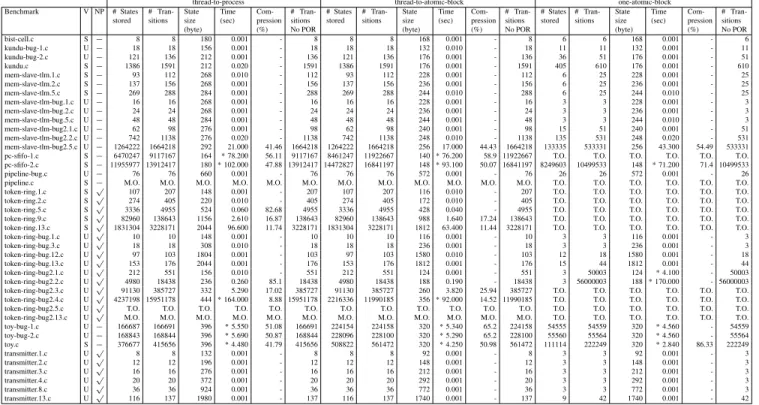
Table II shows the detailed results of experiments with the PROMELA encodings. The table provides the following information: the number of stored states (# States stored), the number of explored transitions (# Transitions), the size of state in byte (# State size), and the run time in second (Time). We mark the result with ∗ when SPIN reaches the depth limit. For the checks for non-progressing cycles, reported by the column NP, we considered only the thread-to-process and the thread-to-atomic-block encodings since the one-atomic-block encoding is not suitable for this check, and also performed ex-periments on both safe and unsafe benchmarks. We mark with
√
and − for, respectively, a detection of a non-progressing cycle and an inconclusive result. The time needed for encoding the SystemC design into PROMELA, as well as for obtaining the protocol analyzer, is negligible and is not reported.
On most of the benchmarks the thread-to-process and the thread-to-atomic-block encodings store the same number of states and explore the same number of transitions. This fact shows that the synchronization mechanism using token passing through rendezvous channels does not interact negatively with the search behavior. However, the size of state for the process encoding is larger than that of the thread-to-atomic-block encoding. In the thread-to-process encoding the more threads in the SystemC design, the more processes and rendezvous channels we need, and thus the size of the states
is larger. In the other encodings the design is encoded as a single process and use no channels for synchronizations.
Comparing the one-atomic-block and thread-to-atomic-block encodings, it is obvious that the former encoding ex-plores less states than the latter one. However, the one-atomic-block encoding can explore more transitions than the thread-to-atomic-block encoding. Consider three runnable threadst1,
t2, andt3such that each of them only accesses local variables.
Suppose that the first exploration in the evaluation phase goes with the sequencet1, t2, t3. Now, if in the second exploration
we have the prefix t2, t1, then, because the resulting states
of performing t1, t2 and t2, t1 are the same, the
thread-to-atomic-block encoding allows to detect that the state has been visited before, and do not explore t3. For the
one-atomic-block encoding the search continues exploringt3 because the
intermediate states between thread executions are not stored. Table II shows that, for the unsafe benchmarks, like token-ring-bug, the one-atomic-block encoding outper-forms the thread-to-atomic-block encoding in terms of the number of stored states and the number of explored transitions. In these benchmarks the assertion violation is found in the first delta cycle. In principle, when the assertion violation occurs after several delta cycles, and there is no guarantee that the delta cycles are progressing, then the one-atomic-block encoding might go out of time.
We experimented with the collapse compression method of SPIN. For the thread-to-process encoding, when there are only