USING JIGSAW READING TECHNIQUE IN IMPROVING
678'(176¶ 5($',1* &2035(+(16,21
Rizka Awwalliya, Endang Susilawati, Sumarni
English Education Study Program, Language and Art Education Department Teacher Training and Education Faculty of Tanjungpura University, Pontianak
Email: [email protected]
Abstrak: Penelitian ini dilakukan untuk mengetahui keefektifan teknik membaca jigsaw dalam meningkatkan pemahaman membaca siswa khususnya pada teks deskriptif terhadap siswa kelas VIII SMP Negeri 18 Pontianak. Penelitian ini juga dilakukan untuk mengetahui apakah teknik tersebut dapat meningkatkan pemahaman membaca siswa. Studi ini menggunakan metode quasi eksperimen dengan non-equivalent control group design. Sampel penelitian ini terdiri dari dua kelompok, yaitu kelas VIII A sebagai kelompok kontrol dan kelas VIII B sebagai kelompok eksperimen. Hasil analisis data menunjukkan bahwa teknik membaca jigsaw efektif dalam meningkatkan pemahaman membaca siswa. Hal ini ditunjukkan oleh ukuran efek dari teknik membaca jigsaw adalah sebesar 1.21 (efek yang besar). Selain itu, data menunjukkan selisih skor antara pretest
dan posttest pada kelompok eksperimen, yaitu sebesar 10,89, lebih tinggi dari selisih skor antara pretest dan posttest pada kelompok kontrol, yaitu sebesar 6,03. Hal itu berarti bahwa teknik tersebut dapat meningkatkan pemahaman membaca siswa pada teks dekriptif.
Kata kunci: Teknik Membaca Jigsaw, Pembelajaran Kooperatif Abstract: This research was conducted to find out the effectiveness of
MLJVDZ UHDGLQJ WHFKQLTXH LQ LPSURYLQJ VWXGHQWV¶ UHDGLQJ
comprehension on descriptive text to the eighth grade students of SMP Negeri 18 Pontianak. It was also to know whether the technique improved VWXGHQWV¶ UHDGLQJ FRPSUHhension. This study used quasi experimental method with non-equivalent control group design. The sample of this research consisted of two groups, class VIII A as control group and class VIII B as experimental group. The result of data analysis showed that jigsaw reading technique was effective in LPSURYLQJ VWXGHQWV¶ UHDGLQJ FRPSUHKHQVLRQ on descriptive text. The effect size of jigsaw reading technique was 1.21 (large effect). Besides, the data showed that the interval score between the pretest and posttest in experimental group (10.89) was higher than the interval score between pretest and posttest in control group (6.03). It meant that the technique improved sWXGHQWV¶ UHDGLQJ FRPSUHKHQVLRQ on descriptive text.
n learning foreign language, in this case learning English language, there are four skills that students need to master, they are receptive skills; listening and reading, and productive skills; speaking and writing. All of those skills are taught to students from elementary school till junior and high school even in university, one of them is reading. The fact is when the students face the examination, the test is reading text form. It happens at almost all of the level of education, include the junior high school. Reading skill is important to be learned, because it helps students to master the knowledge in English language learning. By mastering reading skill, it will be easier for students to understand the material that they learn in English. Reading is a kind of activity to transfer the information and to FRPSUHKHQG WKH ZULWHU¶V LGHDV by the learner through the written or the printed words. When reading a book or text, the students have to concentrate and focus on the book or text that they read in order to get the point of the text. As Ogle and %ODFKRZLF] VWDWHG WKDW ³5HDGLQJ LV HVVHQWLDO´ ,W LV WKH SURFHVV E\ ZKLFK people gain information and ideas from books, manuals, letters, contracts, advertisements and a host of other materials.
Reading is composed of two main processes, those are decoding and comprehension. Decoding is letter recognition, whereas comprehension is an understanding the meaning of text. Generally, some kinds of text which are learned by junior high school students are descriptive text, narrative text, recount text, procedure text, and report text. Comprehending the text is the main problem of students. It makes students feel bored and frustrated in reading an English text because they feel difficult to get the point of what they read. Furthermore, reading WH[W FDQ QRW EH DYRLGHG E\ VWXGHQWV 7R UHGXFH VWXGHQWV¶ IUXVWUDWLRQ DQG LQFUHDVH VWXGHQWV¶ HQWKXVLDVP WKH WHDFKHUV PXVW SURYLGH WKH VWXGHQWV ZLWK UHDGLQJ WH[WV WKDW PDWFK WR WKH VWXGHQWV¶ OHYHO DQG LQWHrest as well as presents them with attractive way. There are some practical applications that can be applied in teaching reading comprehension to students, one of them is different methods have been found to be effective in teaching text comprehension, the teachers can use combinations of the following: co-operative or group learning; graphic organizers (e.g. flow charts, word webs); asking and answering questions; story structure; summarizing; focusing on vocabulary (Pang, et al, 2003). Based on the explanation, the goals of this research were to find out: (1) the effectiveness of jigsaw reading technique LPSURYHV VWXGHQWV¶ UHDGLQJ FRmprehension on descriptive text and (2) whether this technique improves VWXGHQWV¶ UHDGLQJ comprehension.
Comprehension is very important in reading, without comprehension reading can be confusing. Comprehension entails three elements; the reader who is doing the comprehending, the text that is to be comprehended, and the activity in which comprehension is a part. Reading comprehension is much more than decoding. Reading comprehension is resulted when the reader knows which skills and strategies are appropriate for the type of text, and understands how to apply them to accomplish the reading purpose. From the explanation, it could be concluded that reading is decoding and understanding text for particular purposes. Readers are decoding written text by translating the text to speech, and translating to meaning. Then, to understand the written text, readers engage in constructive processes to make the text meaningful, which is the end result or product. Based
on Standar Kompetensi Lulusan (SKL) of reading, there are five main aspects of reading comprehension, as in Collage (2003) states that the five aspects are main idea, supporting detail, reference, inference, and vocabulary. In the other word, supporting detail consists of two types, those are explicit information and implicit information where inference is included to implicit information. In this research, the writer decided designing the assessment which covers all the five aspect of reading comprehension but this research had main focus that is finding main idea and supporting detail of paragraph. The reason why the writer more focused on the two aspects is because in the descriptive text gives the information about description about the features of the subject. The students will get the conclusion of the paragraph and they can cover the information about the subject being described in the text. In comprehending the text, beside aspects of reading comprehension, there is also the level of reading comprehension which is in this case, levels mean the different depth of understanding, different analysis of what is meant. Smith in Westwood (2001) states that there are four levels of comprehension, they are literal level, inferential level, critical level and creative level. In this research, the test was designed by the writer to measure the literal level and the inferential level of reading comprehension. It was because in the descriptive text, the students need to understand the description about something, they do not need to judge and find the value or moral value in the text.
In teaching learning process, strategies influence the successfulness of the students. At this time, teaching and learning strategy has changed from teacher centered to student centered where students are more active rather than the teachers. The recent teaching and learning strategy that centered to student is cooperative learning. In the cooperative learning, students would learn about the process of conducting and creating, working in a group, sharing knowledge and individual responsibility. By working in the group, students can learn about how to be a good member in a group, how to be a leader and responsible in doing the task. They will work cooperatively and support one of each other. Cooperative learning is a teaching learning strategy which emphasize the collective attitude in working or helping in regular cooperative group which consists of two persons or more. In cooperative learning, students are working together in small and heteregenous group and helping each other in learning process 7HDFKHU¶V UROH LQ cooperative learning clearly is as a facilitator, moderator, organizer and mediator. ,Q WKLV FRQGLWLRQ VWXGHQWV¶ UROH DQG IXQFWLRQ FDQ EH VHHQ There are many techniques in cooperative learning, one of them is jigsaw. Jigsaw is a technique that is very famous in cooperative learning which was first developed in the early 1971 by Elliot Aronson, hence this technique is developed by some experts to be two added version, those are jigsaw II that developed by Slavin in 1989 and jigsaw III that developed by Kagan in 1990 and many other. In applying the jigsaw technique in the classroom, the technique can be modified depends on the situation or the necessity. One of the other modification of jigsaw technique is jigsaw reading.
Jigsaw reading is a kind of jigsaw technique which combines the idea of jigsaw puzzle with reading. The technique of jigsaw reading focuses on reading activity. According to Berkeley-Wykes in Farouk (2001), jigsaw reading technique is the technique in which a reading text is cut into segments and the task
of the students to restore it to its proper order to make sense of the text. If used as a group activity where students discuss the decisions of how to order the segments of the text, it can obtain a great deal of communicative interaction. In the implementation of this jigsaw reading, the text given to group is in form of jumbled text. The main benefit of this jigsaw reading rather than the jigsaw is it can cover more reading in a shorter amount of time and allows students to think deeply about an important part of the text. The jigsaw reading is very simple and easy to be applied in the classroom. This technique can be modified if it is considered necessary. The jigsaw reading activity can be applied in any proficiency level as a cooperative learning activity during reading comprehension instruction, according to The Master Teacher (2010), the steps of jigsaw reading with some modification can be seen as follows: (1) Divide students into the heterogeneous group of 4 to 5 that is diverse in ability. This group is called Home Group; (2) Appoint one most mature student from each group as a leader; (3) Prepare the text and a graphic organizer, likes chart RU WDEOH DV WKH VWXGHQWV¶ worksheet; (4) Give the text to the students, the text is formed as text pieces. Distribute the copies of the individual task worksheet and the group task worksheet; (5) Assign students to learn their own part and do the tasks responsibly. They have to finish the individual task first, then they can finish the group task later; (6) Next, ask students to share and discuss their own segment to their group mates cooperatively. After students in each group work together to thoroughly understand the information, be sure to check for the comprehension; (7) Make the new temporary groups, that is the Expert Group. There will be the expert of their own text from their Home Group in this new Expert Group; (8) In the Expert Group, the students take turns teaching their new group mates and discussing the main point about their text; (9) Bring the students back into their Home Group. Ask students to discuss and share the point that they have gotten in their previous Expert Group; (10) Float from group to group, observing the process.; and (11) At the end of the session, give an assessment on the material so that students quickly come to realize that these sessions are not only for fun and game but really valueable.
In jigsaw reading activity, each group gets different text and certainly each member gets the different segment too, it is why in jigsaw reading, students become an exepert of their own part. The success of each group depends on the participation of each individual in completing their task. This means the jigsaw reading technique effectively increases the involvement of each student in the activity. Hawkins (2012) states students are required to find their own meaning WKURXJK UHDGLQJ OLVWHQ WR WKHLU JURXSPDWHV¶ LGHDV DQG V\QWKHVL]H WKDW piece into a VLQJOH VXPPDU\ 7KH\ ZLOO UHDG GLVFXVV DQG VXPPDUL]H D ³FKXQN´ RI UHDGLQJ Students will have questions to guide them so during the activity they focus on details. Farouk (2001), in his research used Jigsaw Reading technique and he used a quasi experimental study to investigate the effect of the technique. Based on his UHVHDUFK LW VKRZV WKH MLJVDZ UHDGLQJ WHFKQLTXH LV HIIHFWLYH LQ LPSURYLQJ VWXGHQWV¶ reading comprehension which accompanies the decrease of reading anxiety in the level of university. The writer applied the jigsaw reading technique in teaching reading comprehension to the lower level of education that is to the eighth grade students of SMP Negeri 18 Pontianak.
METHOD
A method of this research was quasi experimental study. Quasi experimental study is a research where the purpose is to identify the causal relationship. Dornyei (2007) states that quasi-experimental study can establish unambiguous cause-effect relationships. In this quasi experimental research, the writer observes the result of systematically changing one or more variables under controlled condition. This process is called manipulation. An experiment requires the researcher to manipulate something and observe the effect of that manipulation on something else. The effect of manipulation is measured by comparing the pre-test and post-test (Cross & Belli, 2004). In this research, the writer used a quasi-experimental method with non-equivalent control group design. Non-equivalent control group design includes at least an experimental (treatment) group and a control group. The non-equivalent control group design is one of the most widespread experimental design in educational research involves an experimental group and a control group both given a pretest and a posttest (Campbell & Stanley, 1963).
The population of this research was the eighth grade students of SMP 18 Pontianak which consists of six classes with total number of population was 203 students. The writer chose two classes as sample, class VIII A and class VIII B. The class VIII A and class VIII B were chosen by using the judgmental sampling, because the writer assumed that the types of both classess are homogenous and WKH VWXGHQWV¶ DELOLW\ LQ (QJOLVK EHWZHHQ WKRVH FODVVHV ZDV DOmost equal. The writer chose class VIII A as the control group that only treated by particular learning context usually done in the classroom, mostly by the explanation of teacher, whereas the class VIII B was chosen by the writer as the experimental group that treated by the treatment of the implementation of jigsaw reading technique. Both of the class VIII A and class VIII B consists of 34 students each, so the total number of sample in this research was 68 students.
0HDVXUHPHQW WHFKQLTXH ZDV XVHG E\ WKH ZULWHU WR PHDVXUH WKH VWXGHQWV¶ reading comprehension by using jigsaw reading technique. The measurement conducted twice, first, pre-test to collect the data before the treatment, it was conducted to NQRZ WKH VWXGHQWV¶ condition before treatment. Second, post-test to collect data after treatment was given. The tool of data collecting was by using the multiple-choice completion. In this research, the test consist of 20 items with four alternatives. This test was given at before and after the treatment. The validity of the test that used by the writer in this research was content validity. The writer used table of specification to measure the content validity with the aspects of reading comprehension as the representation of the test material. To measure the VWXGHQWV¶ PHDQ VFRUH LQ SUHWHVW DQG SRVWWHVW of each group, the writer was totaling the score of all students then divided it by the number of students in the group. Considering that this research was conducted to find out the effectivenes of jigsaw reading technique implementation as th treatment, the writer used &RKHQ¶V G the formula to measure the effect of treatment. The classifications of effect size are small effect (d 0.20), moderate level (0.25 ± 0.75) and large effect (t 0.80).
FINDINGS AND DISCUSSION a. Findings
This research was conducted to find out whether the jigsaw reading WHFKQLTXH VLJQLILFDQWO\ LPSURYH VWXGHQWV¶ UHDGLQJ FRPSUHKHQVLRQ DQG WKH effectiveness of jigsaw reading technique in teaching reading comprehension on descriptive text. The result of the calculation showed that the pretest score of experimental group was higher than pretest score of control group, but the posttest score of the experimental group and the control group was higher than the pretest of both the experimental and the control group. It meant that the experimental group performed a better achievement than control group. In this research, the jigsaw reading technique was applied in teaching reading comprehension as the treatment to treat the experimental group.
This research was designed to find out the effectiveness of the use of jigsaw UHDGLQJ WHFKQLTXH LQ LPSURYLQJ VWXGHQWV¶ UHDGLQJ FRPSUHKHQVLRQ HVSHFLDOO\ RQ descriptive text which this technique was applied to the class VIII B that consists RI VWXGHQWV ,Q GDWD DQDO\VLV E\ GRLQJ WKH PHDVXUHPHQW RI VWXGHQWV¶ PHDQ score of pretest and posttest in each group, the writer used those scores to analyse the standard deviation between the bot experimental and control group. The standard deviation is a measure of the spread of scores within a set of data. Standard deviation ((Sd) or generally UHSUHVHQWHG E\ WKH V\PERO 1 VKRZV KRZ
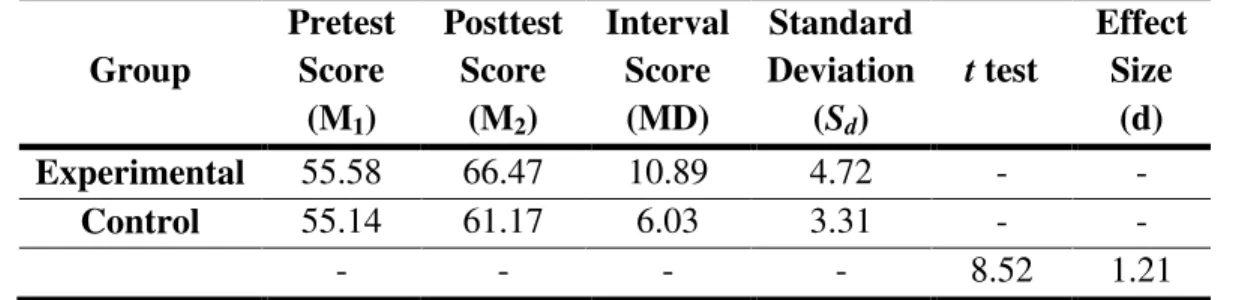
much variation or dispersion exists from the average (mean, or expected value). A low standard deviation indicates that the data points tend to be very close to the mean, whereas high standard deviation indicates that the data points are spread out over a large range of values. Result of this measurement showed that standard deviation of experimental group (4.72) was higher than standard deviation of control group (3.31). After measuring standard deviation, the writer could use the values in analysing the t test to compare the two means from experimental and control group to see the description since they were significantly different from each other. The result of measurement showed that the value of t test was 8.52. To know the effectiveness of the implementation of this technique, the writer used &RKHQ¶V G the formula to measure its effect size. Based on the data analysis, it was found that the effect size of the treatment was 1.21 which meant that 1.21 bigger than 0.80 and it was qualified as large effect.
This research was also designed to find out whether jigsaw reading WHFKQLTXH LPSURYHV VWXGHQWV¶ UHDGLQJ FRPSUHKHQVLRQ From the data analysis, it showed that the pretest score of experimental group was categorized as poor to average (55.58), then after this group was treated by applying jigsaw reading technique, their score in posttest was improved become the category of average to good (66.47) with the interval score between pretest and posttest of this experimental group was 10.89. On the other side, in the control group, the VWXGHQWV¶ SUHWHVW VFRUH ZDV 55.14 which it is classified as poor to average, then their posttest score was 61.17, it is clasified as average to good, therefore the GLIIHUHQFH EHWZHHQ VWXGHQWV¶ SUHWHVW DQG SRVWWHVW VFRUH LQ FRQWURO JURXS ZDV . Eventhough the VWXGHQWV¶ VFRUH RI SRsttest in both experimental group and control group are improved, based on the interval score of pretest and posttest between both groups, the interval score of pretest and posttest in experimental group was higher than the interval score of pretest and posttest in control group. The students
in experimental group performed better rather than students in control group. It meant that this technique improves their reading comprehension significantly.
Although the capability of experimental group and control group were GLIIHUHQW IURP WKH EHJLQQLQJ EXW WKH LQWHUYDO RI WKH VWXGHQWV¶ PHDQ VFRUH EHWZHHQ experimental and control group showed that there was a significant score in H[SHULPHQWDO JURXS DIWHU WKH WUHDWPHQW ZDV JLYHQ 7KH LQWHUYDO RI WKH VWXGHQWV¶ mean score in experimental group was 10.89. On the contrary, the interval of the
VWXGHQWV¶ PHDQ VFRUH LQ FRQWURO JURXS ZDV 7KH GLIIHUHQFH EHWZHHQ WKH
interval score of experimental group and the interval score of control group was 4.86. It indicated that the use of jigsaw reading technique also influenced the VWXGHQWV¶ DFKLHYHPHQW LQ UHDGLQJ FRPSUHKHQVLRQ RQ GHVFULSWLYH WH[W The summary of result of data analysis can be seen on the following table:
Table 1 Numerical Summary of Data Analysis RQ 6WXGHQWV¶ 6core in
Experimental Group and Control Group
Group Pretest Score (M1) Posttest Score (M2) Interval Score (MD) Standard Deviation (Sd) t test Effect Size (d) Experimental 55.58 66.47 10.89 4.72 - - Control 55.14 61.17 6.03 3.31 - - - - - - 8.52 1.21 b. Discussion
In this research, the writer focused on improving whether the jigsaw reading WHFKQLTXH VLJQLILFDQWO\ LPSURYH VWXGHQWV¶ UHDGLQJ FRPSUHKHQVLRQ DQG KRZ HIIHFWLYH WKLV WHFKQLTXH LQ LPSURYLQJ VWXGHQWV¶ UHDGLQJ FRPSUHKHQVLRQ RQ descriptive text. This research was conducted to the eighth grade students of SMP Negeri 18 Pontianak. There were two classes as sample in this research, those were class VIII A as control group and class VIII B as experimental group. In doing this research, the writer acted as teacher in teaching descriptive text to the both experimental group and control group. Considering that class VIII B as experimental group, students of this class was treated by implementing jigsaw reading technique in teaching English, whereas the control group was treated by conventional teaching and learning, that was the writer explained mostly about about the material. The writer gave pretest and posttest to both groups in form of the written test (multiple choices). There were two meetings of treatment for experimental group, after that the writer gave them the posttest.
There were four meetings for each class in this research. For both experimental and control group, the writer gave pretest in the first meeting, in the second and third meeting, the writer gave treatments to the students and in the last meeting, the students in both groups were given the posttest. Pretest was FRQGXFWHG IRU REWDLQLQJ WKH ILUVW VWXGHQWV¶ SUHFRQGLWLRQ LQ VKRUW GHVFULSWLYH WH[W before treated by jigsaw reading technique. Each student had to answer the reading test about descriptive text. The writer asked students to pay attention in
answering the questions, the test consisted of 20 items of multiple choice question. From the data analysis, the writer found that the mean score of pretest in both groups was poor. It indicated that there was not significant difference between experimental group and control group in mean score of pretest.
After the pretest given, the treatment was given to both experimental and control group. The treatment was conducted twice for each group. Treatment of the implementation of jigsaw reading technique was given to experimental group. Jigsaw reading technique is a kind of teaching technique which combines the idea of jigsaw puzzle and English reading. Jigsaw reading enabled students to work cooperatively in small group. They comprehended the descriptive text by sharing the ideas, discussing the detail informations, asking and answering the questions related to the descriptive text that they read. The students improved their reading comprehension on descriptive text after being taught through jigsaw reading technique. In the experimental group, the writer started the meeting by showing the pictures of rabbit to students to help them describe the features of it, then she explained about the descriptive text in order to let them understand about generic structure and language features of kind of that text. In the experimental class, before doing the jigsaw reading activity, the writer divided students into two sides, those were left side and right side, each side consisted of some home groups. There were four jumbled descriptive texts about animal, those were text about elephant, giant panda, lion and cottontail. Both left side and right side got the same texts. One home group got one text, for example home group in left side got the text about elephant and one home group in right side got the text about elephant too. There were four jumbled texts that meant there were four home groups in each side, but considering that there were two students who did not have a group so they are a new home group, as the result, the left side was added by one home group which consisted of two members. Four home groups were in right side and four home group plus one were in left side.
In jigsaw reading technique, each student has his/her own duty to do his/her part to complete the comprehension of the whole text, it means that one student has one piece of jumbled text. There were four paragraph that were cut into four pieces, one member of home group got one piece of the text then their duty was to comprehend their part and discuss it to other member in their own group. They discussed and shared the ideas as well as the detail informations according to their own text then they rearranged the jumbled text into good order in order to they could finish their tasks. After they finished their duties in home group, students are instructed by the writer to make new expert group. In this first meeting, during the treatment, the writer found that students started to learn to be active in doing the discussing in jigsaw reading activity. They tried to share and give the opinion as well as ask and answer the question, eventhough in telling the informations, students did not always use English but they mixed with Indonesian language, even some students did not speak in English anyway. This process was in line ZLWK WKH VWXGHQWV¶ FRPSUHKHQVLRQ DERXW WKH WH[W JLYHQ LQ LQGLYLGXDO WDVN WKH writer found that almost students were confused in getting the detail informations from their own part. But, in group task, the writer found that they could catch the main idea of their text, it was showed by their answers in choosing the appropriate title for their text. In the end of the activity, the writer gave assessment to
students, that was a multiple choice which consisted of the four texts that they had before.
The second treatment in experimental group, the students was treated like in the first meeting, but the writer gave more detail explanation about descriptive text and how to catch the main idea as well as get the detail informations from the descriptive text. In this meeting, the writer gave different texts to students, those were texts about rhinoceros, african girrafe, tiger and dugong to know the how far the progress of students in comprehending the text. During this treatment, students were active and enthusiastic in participating the jigsaw reading activityeventhough they still mixed English with Indonesian language in sharing and discussing also in asking and answering the questions. Based on the individual task and group task, the writer found that there were the improvement in getting the detail informations, although there were few students still confused. This second meeting was ended by giving the assessment to students. From both first and second treatment, the big problem that faced by the writer was the student who did not really pay attention and not responsible on his/her duty, but with the help from the other student from his/her group, the writer could handle it and the process of jigsaw reading activity could work smoothly.
There were also two meetings that conducted in control group. The control group was treated by using the conventional teaching and learning, that were mostly by the explanation of the writer and almost of the classroom activity was teacher centered. The writer explained the material during the meeting. At the end of teaching and learning process, the writer gave students the assessment which VLPLODU WR VWXGHQWV¶ DVVHVVPHQW LQ H[SHULPHQWDO JURXS WKDW FRYHUHG WKH IRXU WH[WV about elephant, giant panda, lion and cottontail in the first meeting and in the second meeting, they were given the assessment that covered about the four texts about rhinoceros, african girrafe, tiger and dugong. During the teaching learning process in two meetings, the writer found that students in this control group were disposed passively and felt shame in asking and answering the question.
After giving the treatment to both experimental and control group, the writer JDYH SRVWWHVW WR WKHP 7KH SRVWWHVW ZDV FRQGXFWHG WR NQRZ WKH VWXGHQWV¶ FRQGLWLRQ after the treatments were given. Based on data analysis, there was significant improvement of mean score of posttest in experimantal group. In the experimental JURXS WKH VWXGHQWV¶ PHDQ VFRUH RI SRVWWHVW ZDV KLJKHU WKDQ VWXGHQWV¶ PHDQ VFRUH of pretest. It indicated that the stuGHQWV¶ UHDGLQJ FRPSUHKHQVLRQ RQ GHVFULSWLYH text significantly improved through applying jigsaw reading technique. It was in line with the interval score between pretest and posttest in experimental group was higher than the interval score between pretest and posttest in control group. It proved that experimental group perform better that than control group.
In conclusion, the writer found that the use of jigsaw reading technique in teaching reading comprehension on descriptive text especially to the eighth grade students of SMP Negeri 18 Pontianak significantly improve their reading comprehension on descriptive text. During the treatment, the writer found out that most of students involved actively in teaching learning process. They were enthusiastic in discussing and sharing the information about the descriptive text by applying the jigsaw reading technique. That meant the treatment by using the jigsaw reading technique in teaching reading comprehension on descriptive text
JLYHV D ODUJH HIIHFW WRZDUG WKH VWXGHQWV¶ DFKLHYHPHQW This was affirmed by the study of Farouk (2001) who found out that the jigsaw reading technique is effective in improving the reading comprehension which accompanies the decrease of reading anxiety in the level of university students.
CONCLUSION AND SUGGESTION a. Conclusions
Based on the analysis of test, the general conclusion of this research ³XVLQJMLJVDZ UHDGLQJ WHFKQLTXH LQ LPSURYLQJ VWXGHQWV¶ UHDGLQJ FRPSUHKHQVLRQ RQ descriptive text to the eighth grade students of SMP Negeri 18 Pontianak in academic year 2013/2014´, the conclusions were as follows: (1) The effectiveness of jigsaw reading techniqXH LQ LPSURYLQJ VWXGHQWV¶ UHDGLQJ FRPSUHKHQVLRQ RQ descriptive text to the eighth grade students of SMP Negeri 18 Pontianak in academic year 2013/2014 is qualified as large effect. It wa showed by the result of
t test was higher than t table (8.52 > 1.67) which meant that there was a significant difference between the experimental group and the control group in their average of reading comprehension on the descriptive text. Moreover, the result of data analysis showed that the effect size was 1.21, greater than 0.80 (1.21 > 0.80), therefore it was categorized as large effect. In the other word, the jigsaw reading WHFKQLTXH LV HIIHFWLYH LQ LPSURYLQJ VWXGHQWV¶ UHDGLQJ FRPSUHKHQVLRQ RQ descriptive text. (2) Using jigsaw reading technique improves the stuGHQWV¶ reading comprehension on descriptive text to the eighth grade students of SMP Negeri 18 Pontianak in academic year 2013/2014. It was showed by the interval score of the pretest and posttest of the experimental group was 10.89 that higher than interval score of the pretest and posttest in control group was 6.03. Thus, the difference between interval score of experimental group and interval score of FRQWURO JURXS ZDV ,W PHDQW WKDW WKH VWXGHQWV¶ Dchievement after the treatment was better than before the treatment was given. In the other word, the experimental group performed better than the control group.
b. Suggestions
Based on data analysis and conclusions of research findings, the writer have some suggestions as follows: (1) In this research the writer applied jigsaw reading technique LQ LPSURYLQJ VWXGHQWV¶ UHDGLQJ FRPSUHKHQVLRQ especially on descriptive text. By implementing this technique, the writer found that it could help students to comprehend the text by discussing and sharing their material with their group mates even with the member of the other group. Through jigsaw UHDGLQJ WHFKQLTXH VWXGHQWV¶ FRXOG FRPSUHKHQG one text even more texts in a shorter amount of time and allowed students to thought deeply about an important part of the text. On the other word, jigsaw reading technique covered some reading texts in limited time allocation efficently. Working in jigsaw reading activity, students had their own part to be comprehended by themselves to share and discuss to their group mates and the students from other group. In this way, students learned to tell their main point and informations of their part, in the end, students could be active in learning. Therefore, the writer thinks that jigsaw reading technique can be applied by teacher in teaching learning process to reduce the monotonous and make a variation in order to students feel excited and fun
during teaching and learning activity; (2) Considering that supporting material from other sources such as the texts play the important role to complete the teaching material of teaching and learning in this research, teacher can use the internet to browsing or googling to find the material relate to the lesson, in providing the material to be learnt in the classroom, not only focus on material in the text book.
BIBLIOGRAPHY
Blachowicz, Camille & Ogle, Donna. 2008. Reading Comprehension Strategies for Independent Learners (2nd Edition). New York: The Guilford Press. Campbell, Donald. T. & Stanley, Julian. C. 1963. Experimental and
Quasi-Experimental Design for Research. Boston: Houghton Mifflin Company.
Cross, L. H. & Belli, G. M. 2004. Experimental Research to Inform Educational Policy. In Marrais, K. D. & Lapan, S. D. Foundation for Research.
New Jersey: Lawrence Erlbaum Associates, Inc.
Cuesta, College. 2003. Identifying Topics, Main Ideas, and Supporting Detail.
Available on: http://[email protected]. [Accessed March 5th 2013].
Dornyei, Zoltan. 2007. Research Method in Applied Linguitics: Quantitative, Qualitative and Mixed Method. Oxford: Oxford University Press. Farouk, Mohammed. 2001. The effect of Using the Jigsaw Reading Technique on
the EFL Pre-VHUYLFH 7HDFKHU¶V 5HDGLQJ $Q[LHW\ DQG &RPSUHKHQVLRQ Cairo: Journal of Education College Helwan University. Available on: http://www.tcr.edu.sa/db/researches/54.pdf [Accessed May 8th 2013] Hawkins, Swerdfeger. 2012. Jigsaw Reading. Utah: Brigham Young University.
Available on: http://www.novelinks.org [Accessed April 11th 2013] Pang, Elizabeth S. 2003. Teaching Reading. Switzerland: International Academy
of Education.
The Master Teacher. 2010. Jigsaw Reading Activity. Available on: http://www.system.netsuite.com [Accessed April 24th 2013]
Urdan, T. C. 2005. Statistic In Plain English. New Jersey: Lawrence Erlbaum Associates, Inc.
Westwood, P .2001. Reading and Learning Difficulties. Australia: The Australian Council for Educational Research Ltd, Camberwell Victoria.