HAL Id: hal-02304918
https://hal.archives-ouvertes.fr/hal-02304918
Submitted on 3 Oct 2019
HAL is a multi-disciplinary open access archive for the deposit and dissemination of sci-entific research documents, whether they are pub-lished or not. The documents may come from teaching and research institutions in France or abroad, or from public or private research centers.
L’archive ouverte pluridisciplinaire HAL, est destinée au dépôt et à la diffusion de documents scientifiques de niveau recherche, publiés ou non, émanant des établissements d’enseignement et de recherche français ou étrangers, des laboratoires publics ou privés.
Functional connectivity and neuronal dynamics: insights
from computational methods
Demian Battaglia, Andrea Brovelli
To cite this version:
Demian Battaglia, Andrea Brovelli. Functional connectivity and neuronal dynamics: insights from computational methods. The Cognitive Neurosciences, In press. �hal-02304918�
Functional connectivity and neuronal
dynamics: insights from computational
methods
Demian Battaglia1 & Andrea Brovelli2
1
Institut de Neurosciences des Systèmes (INS), UMR1106, Aix Marseille Université, INSERM, 13385 Marseille, France
2
Institut de Neurosciences de la Timone (INT), UMR 7289, Aix Marseille Université, CNRS, 13385 Marseille, France
Abstract
Brain functions rely on flexible communication between microcircuits in distinct cortical regions. The mechanisms underlying flexible information routing are still, however, largely unknown. Here, we hypothesize that the emergence of a multiplicity of possible information routing patterns is due to the richness of the complex dynamics that can be supported by an underlying structural network. Analyses of circuit computational models of interacting brain areas suggest that different dynamical states associated with a given connectome mechanistically implement different information routing patterns between system‘s components. As a result, a fast, network-wide and self-organized reconfiguration of information routing patterns – and Functional Connectivity networks, seen as their proxy– can be achieved by inducing a transition between the available intrinsic dynamical states. We present here a survey of theoretical and modelling results, as well as of sophisticated metrics of Functional Connectivity which are compliant with the daunting task of characterizing dynamic routing from neural data.
Theory: Function follows dynamics, rather than structure
Neuronal activity conveys information, but which target should this information be ―pushed‖ to, or which source should new information be ―pulled‖ from? The problem of dynamic information routing is ubiquitous in a distributed information processing system as the brain. Brain functions in general require the control of distributed networks of inter-regional communication on fast time-scales compliant with behavior, but incompatible with plastic modifications of connectivity tracts (Bressler & Kelso, 2001; Varela et al., 2001). This argument led to notions of connectivity based on information exchange – or more generically, an ―interaction‖– between brain regions or neuronal populations, rather than based on the underlying STRUCTURAL CONNECTIVITY (SC, i.e. anatomic). An entire zoo of data-driven metrics has been introduced in the literature and this chapter will review some of them. Notwithstanding, they track simple correlation, or directed causal influence (Friston, 2011) or information transfer (Wibral et al., 2014) between time-series of activity. These
FUNCTIONAL CONNECTIVITIES1 (FC) share the key property of being reconfigurable even
when the underlying SC is fixed. Nevertheless, it is not fully understood which circuit mechanisms allow flexible FC at the brain-wide scale.
Candidate circuit mechanisms for reconfigurable inter-regional communication range from neural circuitry dedicated to routing (Vogels & Abbott, 2009; Zylberberg et al., 2010), conditional signal propagation along interacting ―synfire chains‖ (Kumar et al., 2008; Hahn et al., 2014) and oscillatory rate modulation enabling signal (de)multiplexing through frequency filtering scheme (Akam & Kullmann, 2014). More generally, dynamic patterns of inter-regional oscillatory coherence over multiple frequency bands may have the potential to orchestrate selective and directed information transfer (Engel et al., 2001; Varela et al., 2001; Bastos et al., 2015). According to the influential COMMUNICATION-THROUGH-COHERENCE
(CTC) hypothesis (Fries, 2005; 2015), neuronal groups oscillating in a suitable phase coherence relation –such to align their respective ‗‗communication windows‘‘– are likely to exchange information more efficiently than neuronal groups which are not synchronized. A growing body of experimental evidence has been cumulated in support to communication-through-coherence mechanisms. Yet, our understanding of how inter-areal phase coherence is flexibly regulated is largely incomplete. This challenge is exacerbated by the fact that neural oscillations are far from ideal ―metronomes‖ (Xing et al., 2012; Ray & Maunsell, 2015).
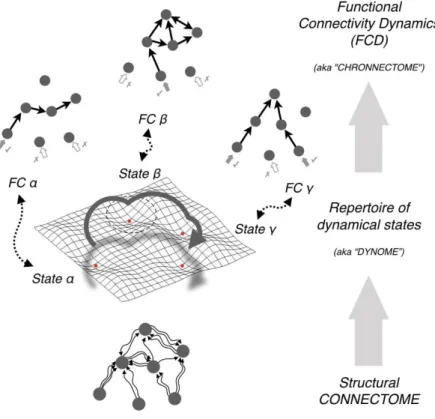
In this chapter, we will show how theoretical and computational neuroscience approaches can bring fresh air into the debate on flexible routing and dynamic functional connectivity. Our core theoretical idea is that the relation between SC and FC is not direct, but necessarily mediated by emergent collective system dynamics. More specifically, the anatomy of brain circuits constrains the functional interactions that these circuits can support (Honey et al., 2007), but cannot determine them fully (Aertsen et al., 1989; Battaglia et al., 2012; Hansen et al., 2015). Indeed, a given structural network can engender a rich repertoire of possible collective dynamical states, also known as the DYNOME (Kopell et al., 2014). On its turn, every dynamical state within the dynome (e.g., different patterns of oscillatory phase coherence between inter-connected neuronal populations) will mechanistically implement a different modality of exchanging information among the network nodes, or ―Information Routing Pattern‖ (Kirst et al., 2016). Thus, streams of information will propagate through the network (or not propagate at all) along different pathways, conditionally on the dynamical state in which the system is prepared (Figure 1). Switching from one information routing pattern to another can simply be induced by biasing neural circuits dynamics to self-organize collectively into another of its possible intrinsic modes. Such scenario for state-dependent routing is robust to noise (Battaglia et al., 2012; Kirst et al, 2016) and is also well compatible with stochastic-like and transient oscillatory dynamics (Palmigiano et al., 2017).
Since the dynome level is not accessible to direct experimental observation,
COMPUTATIONAL MODELS OF NEURAL DYNAMICS are necessary to investigate it. Time-series
can be generated from simulations of ―virtual brains‖ of increased complexity – from toy brains with a few coupled areas (Battaglia et al., 2012; Palmigiano et al., 2017) up to whole thalamo-cortical networks (Deco et al., 2011) – and FC can be estimated using precisely the same metrics used for actual brain recordings. It becomes thus possible to validate our hypothesis that different dynamical states map to different FC networks and ways of exchanging information between brain regions. Furthermore models can be used to interpret
FUNCTIONAL CONNECTIVITY DYNAMICS (FCD), i.e. the structured temporal variability of FC networks observed in the resting state (Hutchison et al., 2013; Calhoun et al., 2014) or
1 Note the use of the plural, to encompass several generalizations within a common notion, thus emphasizing
along tasks (Brovelli et al., 2017) in terms of the sampling of the available dynome (Hansen et al., 2015).
Importantly, the insights achieved by studying information routing and FCD in computational models call for a redesign of the way in which empirical results are analyzed to extract FC information, as we will speculate in the Conclusion section.
Methods: quantification of functional connectivity, information
routing and their dynamics
We provide here a quick survey of common data-driven FC metrics2. Despite their different specializations and relative complexity, all these metrics share a fundamental qualitative aspect: their dependence from the underlying dynamical state. Furthermore, all of them can be applied to the analysis of both empirical and simulated time-series.
A zoo of functional connectivity metrics
The plethora of FC metrics used in cognitive neuroscience can be categorized into undirected and directed measures. UNDIRECTED FC METRICS include various measures
based on covariance, such as Pearson‘s and Spearman‘s rank CORRELATION COEFFICIENTS
(CC). As an extension of linear CC, MUTUAL INFORMATION (MI) provides a more general measure of the dependence between signals by capturing also nonlinear relations. MI quantifies shared information between two signals and it reflects the reduction in uncertainty about one variable given knowledge of another (MacKay, 2003). When dealing with oscillatory neural signals, their functional coupling can vary as a function of frequency. The most commonly-used metric quantifying coupling in the frequency-domain is the
MAGNITUDE-SQUARED COHERENCE (MSC), which can be seen as the frequency-domain analogue of squared CC and measures the linear correlation between signals, at each given frequency. The coupling between neural oscillations can also be quantified using concepts based on: PHASE SYNCHRONIZATION (Rosenblum et al., 1996), defined as the entrainment of phases irrespectively of amplitude correlations; or, PHASE-LOCKING VALUE (Lachaux et al., 1999), detecting preferred values of the phase difference at a given frequency between signals. In its more general form, phase synchrony can occur across different frequencies, a process termed n:m SYCHRONIZATION (Tass et al., 1998). A more general way to establish FC among spectrally complex oscillatory signals relies on cross-frequency coupling (Canolty & Knight, 2010) that can be tracked using metrics such as the PHASE-TO-AMPLITUDE COUPLING (Aru et al., 2015).
DIRECTED FC METRICS include statistical approaches that can resolve the direction of
influence between neural signals and are thus in principle better suited to capture dynamic information routing. In the sense of GRANGER-WIENER CAUSALITY (GC, Wiener, 1956; Granger, 1969; Bressler and Seth, 2011), a time-series exert a causal influence on another if the variance of the autoregressive prediction error of the latter is reduced by including the past measurements of the former. Beyond autoregressive modeling, Granger (1980)
2 We will not review here on the contrary the so-called ―effective connectivity‖ (EC) approaches –such as
Dynamic Causal Modelling (Friston et al., 2003)–, which attempt quantifying the strength of causal influences between neural populations or brain areas, in an interventional sense. Whereas FC is usually considered as a model-free approach describing the dynamic interplay between neural populations just based on data-driven features, EC methods are model-based, relying upon explicit models of neuronal coupling.
formalized a general condition of ―Granger-non causality‖ between two time series X and Y
as:
p(Yi+1| Y (i), X(i)) = p(Yi+1| Y(i)) (1)
where the super-index (i) refers to the past history of the time series up to and including sample i. Accordingly, ―causality‖ can be defined as a deviation from this condition of ―non-causality‖, and quantified by calculating the information-theoretical Kullback–Leibler divergence (MacKay, 2003) between the two conditional probabilities in Equation (1). In a bivariate context comprising only X and Y, this divergence can be written as follows:
FX→Y ≡ H(Yi+1| Y (i)) -H(Yi+1| X (i) , Y (i)) = MI(Yi+1; X (i) | Y (i)) (2) The difference of two conditional entropies H on the right-hand side of Equation (2) quantifies the decrease in uncertainty about future values Yi+1 when the past history X (i) is also known. However, even more interesting is the further rewriting of TEX→Y as a mutual
information term MI(Yi+1; X (i) | Y (i)). In layman terms, this term quantifies the amount of information that wasn‘t already encoded by Y ‘s past history but that can be found in Y ‘s
present because it was transferred there from X. Such quantity TEX→Y has been named TRANSFER ENTROPY (TE, Schreiber, 2000) and represents the most general measure of
information transfer capturing any (linear and nonlinear) time-lagged conditional dependence (Wibral et al., 2014). Note that, for Gaussian variables, TE and GC have been shown to be mathematically equivalent (Barnett et al., 2009). Furthermore, TE implies GC (Marinazzo et al., 2008), but not the other way around.
Directed FC metrics have also been generalized to capture information transfer in the frequency-domain, a feature particularly suitable when investigating the role of neural oscillations in establishing inter-regional interactions at different frequencies. Pairwise time-domain GC can be additively decomposed by frequencies using autoregressive models (Geweke, 1982). More recently, parametric estimation of SPECTRALLY-DECOMPOSED
GRANGER CAUSALITY has been generalized to the non-parametric case, meaning that GC
spectra can be estimated from Fourier and wavelet transforms of time series data (Dhamala et al., 2008). However, there is not yet consensus on how to generalize TE to the spectral domain.
Single-trial based functional connectivity metrics
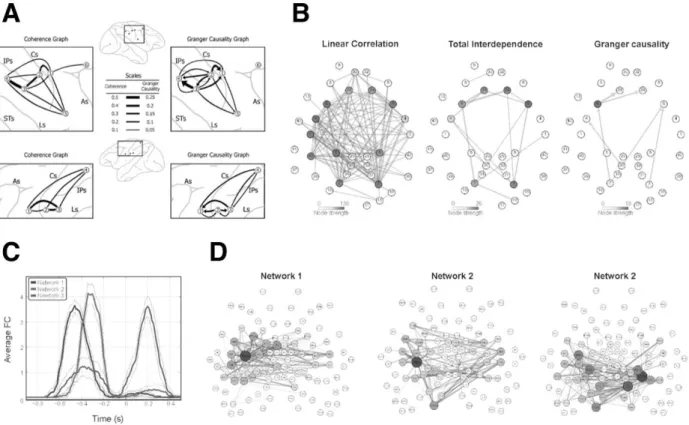
A common strategy to track the temporal dynamics of FC couplings, independently from the used metric, is to assume that experimental trials are realizations of the same stationary stochastic process. In the framework of autoregressive models, this allows the estimation of model coefficients across trials on short time windows for the computation of coherence and Granger causality spectra with high temporal precision (Figure 2A, Brovelli et al., 2004). Neural coupling, however, may vary across trials, and reflect behavioral modulations occurring during learning and adaptive behaviors (e.g., changes in reaction time across trials). There is therefore a need for FC metrics that can be extracted based on single trials.
A classical approach to estimate single-trial FC is to compute the spectral density matrices over sub-segments of time series within a trial stepped to cover the whole duration of the trial. Such approach can be used for the estimate of SINGLE-TRIAL PHASE SYNCHRONY
(Lachaux et al., 2000), and SINGLE-TRIAL GRANGER CAUSALITY using a combination of
general linear models and non-parametric spectral techniques (Brovelli, 2012) or covariance-based methods (Brovelli et al., 2015). Alternatively, JACK-KNIFE APPROACHES have been
shown adequate for single-trial estimate of spectrally-resolved FC metrics (Richter et al., 2015).
A note of caution should, however, be sounded for what concerns the estimation of directed and directed FC metrics, especially when time-resolved. The most common factors that may limit correct estimate and interpretability of FC measures are the sample-size bias problem, varying levels of signal-to-noise ratio, volume conduction and common input or indirect interaction effects (see Bastos and Schoffelen (2015) for a review). Note that the problem of FC estimation is much less severe when dealing with simulated signals which can be arbitrarily long and artifact-free. We expect nevertheless that new techniques first tested ―in silico‖will also become applicable to actual data, thanks to the development of improved estimators, as e.g. for TIME-RESOLVED TRANSFER ENTROPY (Wollstadt et al., 2014).
Hierarchical FC analyses
A promising strategy for a robust FC characterization could be to combine a hierarchy of
COMBINED FC METRICS. In the case of phase-synchronized brain networks, power and coherence spectral analyses can be used in a first step to identify the relevance of brain regions or neural populations in a given cognitive task. As a second step, GC analysis can evaluate the pattern of directional influences between those networks. For example, the analysis of beta frequency (14–30 Hz) oscillations in pre- and postcentral cortical areas of macaque monkeys during a motor maintenance behavior revealed a large-scale network of beta synchronization. Granger causal influences were then observed from primary somatosensory cortex to both motor and inferior posterior parietal cortices, with the latter also exerting Granger causal influences on motor cortex (Figure 2A). The somatosensory cortex therefore played a driving role in the network, whereas intraparietal and motor cortex acted respectively as relay and receiver nodes (Brovelli et al., 2004).
More recently, a hierarchical pipeline has been developed for POWER-TO-POWER FC ANALYSES of high-gamma activity (generalizable to other frequency-bands as well). The
pipeline first isolates regions whose linear correlation and mutual information (i.e., the
TOTAL GRANGER INTERDEPENDENCE between neural signals) increases statically, then
parses the relative direction of this influence using covariance-based Granger causality methods (Figure 2B). The analysis of human high-gamma MEG activity during the performance of visuomotor stimulus-response associations was characterized by an increase in gamma-power and FC over the sensorimotor and frontoparietal network, in addition to medial prefrontal areas. The superior parietal area played a driving role in the network, exerting Granger causality on the dorsal premotor area. Premotor areas acted as relays from parietal to medial prefrontal cortices, which played a receiver role in the network (Brovelli et al., 2015).
Task-relevant Functional Connectivity Dynamics
Ultimately, cognition necessarily unrolls in time, and mental operations are built out of successive steps (Moro et al., 2010), which assemble into a cognitive architecture, mixing serial and massively-parallel information processing, also dubbed a ―human Turing machine‖ (Zylberberg et al., 2011). Time-resolved FC analyses can be used to probe how cognitive functions arise from the time-ordered interplay of multiple networks. In a recent work (Brovelli et al., 2017), time-resolved and single-trial FC analyses of human high-gamma activity showed that visuomotor mapping arises from a SEQUENTIAL RECRUITMENT
SCHEDULE of FC networks (Fig. 2C): first, a network involving visual and parietal regions
coordinated with sensorimotor and premotor areas (Fig. 2D, left); second, the dorsal frontoparietal circuit together with the sensorimotor and associative frontostriatal networks took the lead (Fig. 2D, center); finally, cortico-cortical interhemispheric coordination among bilateral sensorimotor regions coupled with the left frontoparietal network and visual areas (Fig. 2D, right). These cortico-cortical and cortico-subcortical FC networks –partly overlapping– were interpreted as reflecting the processing of visual information, the emergence of visuomotor plans, and the processing of somatosensory reafference or action‘s outcomes, respectively. More generally, FCD analyses showed that the interdependence between brain regions and networks is nonstationary, displays switching dynamics and areal flexibility over timescales relevant for task performance. To conclude, FCD approaches help elucidating the relation between fast dynamic FC reconfiguration and the algorithmic build-up of executive functions.
Modeling dynamic routing and functional connectivity
One structural network engenders many functional networks
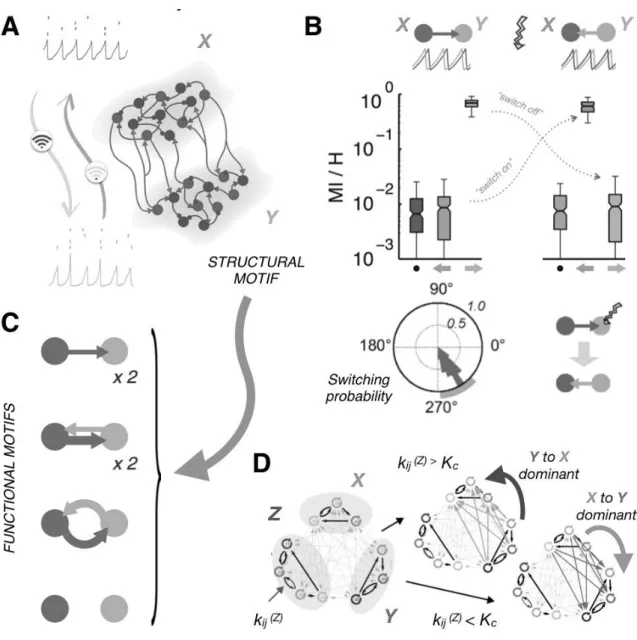
As previously introduced, dynamics on a fixed structural connectome gives rise to a repertoire of possible dynamical modes, composing the connectome‘s dynome. This phenomenon is epitomized by simple toy-models involving a small number of coupled areas. Following Battaglia et al. (2012), we consider in Figure 3A a toy brain of two reciprocally connected brain regions. Such an abstract structural motif serves as a metaphor for canonical cortical circuits in which the relative weights of top-down and bottom-up functional influences must be dynamically adjusted. Every brain region is modelled as a local network of thousands of excitatory and inhibitory spiking neurons, connected by random recurrent connectivity. Parameters are selected in such a way that each local region generates sparsely synchronized collective oscillations, i.e. the firing of individual neurons remain realistically irregular even when the average population activity oscillates periodically at frequencies in the gamma range (40-80 Hz). Since firing is Poisson-like, spike trains have a high entropy and a large amount of information can be conveyed by the oscillating population within every oscillation cycle. In other words, the oscillation themselves are not likely to encode information, but act as carriers for general code-words encoded in detailed spiking patterns3, ―surfing on the wave‖. When coupled by long-range excitation, the oscillating regions will phase-lock with preferred phase-relations which depend on inter-areal delays and influenced by the strength of local inhibition within each region (Battaglia et al., 2007). In particular, for sufficiently strong inhibition, a multiplicity of out-of-phase locking modes tend to emerge, in which one of the two regions leads in phase over the other, despite the reciprocity of coupling.
We quantified the FC associated with different phase-locking modes through the analysis of time-series of LFP-like signals (average regional activity) using TE as a metric of choice. For weak inter-regional coupling, TE was significant only in the direction from the leader (i.e., the sender) to the laggard (receiving) region, in agreement with physiological intuition from the CTC hypothesis (Fries, 2015). Importantly, the directionality of coupling inferred by TE between collective region-level activations also captures the efficiency in information
3
Rate codes are a special case of this code based on detailed spike patterns, which is the most general possible. However, we stress that the representations that can be routed by oscillations are not bounded to be rate-based and could be in principle based on arbitrarily complex encoding schemes (e.g. Arabzadeh et al., 2006).
transfer encoded at the microscopic level of spiking code-words (Figure 3B, top). As quantified by MI analyses at the level of spiking code-word streams, ~70% of the information conveyed by code-words from source neurons in the sending region can be decoded from code-words emitted at the same oscillation cycle by target post-synaptic neurons in the receiving region. In contrast, decoding efficiency in the opposite direction does not rise above chance level. However, when a transition to a different collective phase-locking state occurs, causing the leader and laggard regions to invert their roles, the relative efficiency of decoding in the two directions is also suddenly inverted within the time of one oscillation cycle only. Besides unidirectional transfer of information, other FUNCTIONAL MOTIFS can be implemented by our toy brain (Figure 3C). At stronger inter-regional coupling, other dynamical states enrich the dynome – notably, different types of chaotic oscillations (Battaglia et al., 2007; 2012). At the FC level, these emerging dynamical states map to topologically different motifs, in which information transfer becomes bidirectional, either anisotropic or symmetric. Effective disconnection between the regions is another possible motif, arising from anti-phase locked oscillatory modes. Thus, even a very simple toy brain can give rise to a very rich dynome, translating into a multiplicity of qualitatively different information routing patterns.
Self-organized control of information routing
Under the effect of an arbitrary perturbation, the system will be transiently destabilized, but its dynamics will then converge back to one of the available intrinsic modes. If the applied perturbation kicks the system out of the phase-space basin of attraction of the current dynamical state –a valley in an idealized landscape –, the system will converge toward a different state within its dynome. As a result, the implemented FC network will also switch to the one associated to the newly recruited state (cf. Figure 1). Various mechanisms could force the system to leave its current state and then be used for implementing routing control. A first possibility would be to modulate the relative attractiveness of different states (in the landscape metaphor of Figure 1, this would correspond to make one valley deeper and broader than the others). In presence of multi-stability between multiple dynamical configurations (as the two out-of-phase locking configurations of Figure 3B), it would be enough to apply a STEADY INPUT BIAS to one of the two populations to automatically enhance its probability to become phase-leader, and thus act as an effective information sender (Palmigiano et al., 2017). Importantly, an unspecific and weak bias would be enough, because its role would just be to favor the otherwise self-organized selection of a specific routing state from a pre-existing repertoire. This means that no additional circuitry for the control of routing would be required besides the one already responsible for the generation of collective oscillations themselves, at contrast with other proposed mechanisms for routing (e.g. Vogels & Abbott, 2009; Zylberberg et al., 2010). At the level of physiological implementation, such a steady bias could be provided by context-dependent top-down modulatory signals, neuromodulation or even stimulus saliency itself.
Furthermore, our theory predicts that, if the system‘s dynamical states are sufficiently stable –as in the case of strong oscillatory power– robust rerouting could be induced by
PRECISELY-PHASE PULSE-LIKE INPUTS, removing the need for a steadily applied bias.
Simulations in Battaglia et al. (2012) demonstrate, in agreement with analytical expectations, that the reversal of information flow can be triggered with near-to-one probability by a pulse perturbation delivered to a small fraction of randomly chosen neurons (e.g. in the laggard region), provided that the pulse is applied within a suitable and narrow phase range. Conversely, an equal strength pulse received outside of such control phase-range would fail to induce rerouting, confirming the robustness of intrinsic dynamical modes (Figure 3B,
bottom). Such theoretical prediction has not yet been confirmed, but could be experimentally validated, using e.g. closed-loop optogenetic stimulation (Witt et al., 2013).
Another non-intuitive –and in perspective testable– prediction of our theory is that local perturbations of a target region could induce distributed changes in FC between distant regions, opening the way to a REMOTE CONTROL OF INFORMATION ROUTING (Kirst et al., 2016). In this study, simple phase-oscillator models were used to describe individual network elements allowing to explore, even analytically, the interplay between SC, FC and dynamics in arbitrarily large and complex network architectures. In the example of Figure 3D, a modular network including two bidirectionally coupled regions X and Y, plus a third ―remote
controller‖ region Z is constructed. Plasticity of one local synapse between two network units
i and j within Z is then simulated, by changing the value of a specific control synaptic coupling kij(Z) . Directed FC analyses of units from two remote regions X and Y showed that the dominant direction of transfer and sharing of information can be globally reversed by plastic changes of single synapses within Z. At first sight, the sensitivity of global information routing patterns to microscopic local changes may be seen as an obstacle to the reliable functioning of the system. In reality, the resulting inter-regional FC networks are stable over very broad intervals of synaptic values. As a matter of fact, the dominant directions of information transfer between the three regions X, Y and Z remain unchanged unless the coupling kij(Z) crosses a critical threshold, at which point an abrupt reversal of X
-to-Y connectivity would be triggered. Operating near a critical threshold of some local control parameter4 –an eventuality supported by additional arguments (Chialvo, 2010)– would thus open the way to a ―digital-like‖ control of brain-wide FC. In this scenario, a desired target information routing pattern could be stabilized just by moving farther away the critical threshold (or destabilized by crossing to the other side in order to induce rerouting).
Note that the possibility to remotely control FC appears paradoxical only when considering the simulated network circuit as a collection of local nodes. In reality, as for any complex system, the collective system‘s behavior cannot be reduced to the sum of its parts. The system as a whole should be considered as a single emergent entity of a new type and, in this sense, every effect would be ―local‖, including the network-wide effects of local control actions.
Self-organized routing with transient and stochastic oscillations
The toy models considered in Figure 3 give rise to unrealistically ―clock-like‖ collective oscillations. In reality, oscillatory episodes in vivo are usually transient, lasting only a few aligned cycles and arising at stochastic timings (Xing et al., 2012). Furthermore, oscillations frequency is volatile and its fluctuations inconsistent with input changes (Ray & Maunsell, 2010; Jia et al., 2013). Last but not least, the diversity of inter-regional transmission delays is daunting and could threaten the reliable control of brain-wide synchronization (Ray & Maunsell, 2015). Dynamic self-organization of coordinated oscillatory behavior is once again the ingredient that could rescue the CTC hypothesis, making it compatible with stochastic oscillations transients. In Palmigiano et al. (2017), we have modified the toy models of Battaglia et al. (2012) (Figure 3A-C) to bring them at the edge of developing oscillatory synchrony. By introducing parameter heterogeneity at the level of input conductance to different neurons, such models can give rise to a robust and broad regime in which asynchronous activity co-exist with stochastically occurring meta-stable oscillatory bursts. Remarkably, model simulations show that the oscillatory burst of coupled regions continue to be stochastic, but that correlations in both time of occurrence and fluctuating frequency
spontaneously develop between coupled regions. Once again, from a complex systems point of view, matching oscillatory bursting events may represent an intrinsic system‘s collective mode in which bursts in different regions are ―born coordinated‖ from scratch, rather than requiring an ad hoc additional mechanism to properly re-align them. Indeed, even circuits in a transient synchrony regime give rise to a rich dynome. Co-occurring bursts can manifest with different sets of favorite phase-relations and each set of phase-relations map to a different META-STABLE INFORMATION ROUTING PATTERN, as in the case of the higher
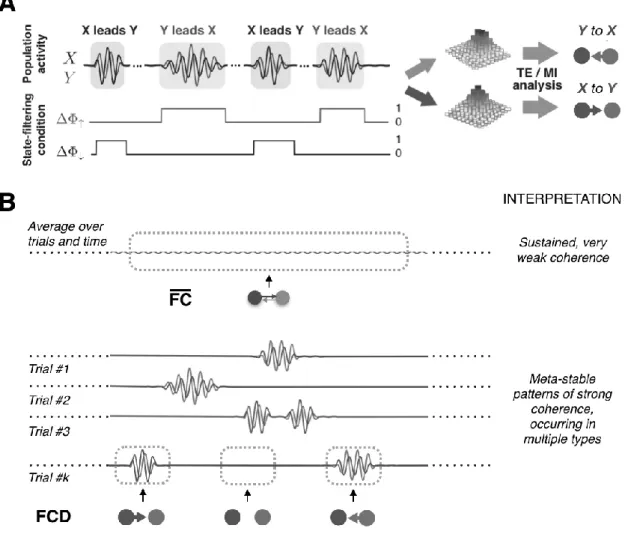
synchrony models of Figure 3. In order to prove it, we can take full advantage of the flexibility of information-theoretical metrics and restrict TE and MI analysis to time epochs pre-labeled as belonging to a specified target state. For instance, in Figure 4A, we defined ―state-selecting filters‖tagging an epoch as belonging to a given routing state if instantaneous coherence exceeds a certain threshold and the inter-regional phase difference between two coupled regions X and Y falls in a specified interval. Different filters can be defined to track the stochastic manifestation of different routing states (e.g. X phase-leading or phase-lagging over Y). STATE-DEPENDENT FUNCTIONAL CONNECTIVITY is then extracted by pooling together activity measurements collected at instants tagged to belong to each given state.
One can thus demonstrate that flexible and controllable selective routing of input signals can be implemented even based on highly transient and stochastic oscillations. An important prediction of the model is that directed information transfer between coupled regions should be strongly enhanced during co-occurring oscillatory bursts and that should be reduced to baseline or even actively suppressed between these oscillatory events (Palmigiano et al., 2017). In such a scenario, information processing would be segregated within each cortical module for a large fraction of time and the results of local computations would be allowed to ―flow‖ from or toward other regions only when specific selective routing events are triggered to occur (speculatively, as an effect of the completion itself of local computations).
Beyond toy-brains
Recently, MEAN-FIELD WHOLE BRAIN MODELLING (Deco et al., 2011) has been used to study the emergence of FC networks from the collective self-organized dynamics of a SC network embedding realistic connectome data, deriving e.g. from tractography data. Stereotypical neural mass models (Deco et al., 2008) are used to directly describe in terms of a limited number of variables the collective dynamics of each local brain region.
Most analyses so far have focused on the rendering in silico of time-averaged resting-state functional connectivity that is tentatively emulated by the noise-driven dynamics of brain models. Converging results suggest that resting-state FC is best rendered by these mean-field models when tuning its global control parameters –global scale of inter-regional connection strength and coupling delay– to be in strict proximity of a rate instability critical point (see Deco et al., 2011 for a review). However, only a few models have attempted to capture the structured fluctuations of resting-state FC over time known as Functional Connectivity Dynamics (FCD), or ―chronnectome‖ (Hutchison et al., 2013; Calhoun et al., 2014). A recent modelling study (Hansen et al., 2015) has shown that such structured FCD can be qualitatively rendered when the global parameters of the model are tuned to a different working point, which is slightly subcritical with respect to the rate instability and maximize the richness of the model‘s dynome. This finding is not surprising according to our theory, since sampling a richer dynome is expected to lead to switching between a larger number of possible FC networks.
Nevertheless, modelling of FCD at the whole brain level is still at its first steps and largely limited to resting state only –e.g. not yet task FC schedules as in Figure 2C-D– and the rendering of plain Pearson Correlation networks. Promising recent developments (see e.g.
Mejias et al., 2016) suggest that mean-field models could become in a near future a valuable tool to study emergent brain-wide networks of flexible multi-frequency coherence.
Implications for FC analyses
We propose that FC networks are a measurable proxy for information routing patterns implemented by collective dynamics of neural circuits. According to this vision, the richness of the dynome of a given structural circuit will translate into a parallel variety of possible FC networks that can be observed at different moments in time. A large number of classic analyses of FC are based on averaging FC metrics over very long times or over many trials, eventually time-aligned to some extrinsic reference event, such as a sensory cur given during a cognitive task (Figure 4B, top). However, if a rich repertoire of states is sampled, either spontaneously as an effect of noise, or in a way guided by exogenous –sensory– or endogenous –cognitive– bias, we expect that FC could vary even dramatically along time. Every averaging procedure is thus going to destroy the precious information that could be present in this time-variability of FC (Hutchison et al., 2013). This is true even for trial-averaging since we cannot a priori guarantee that transitions between internal states are really so tightly linked to task-related events. Figure 4 depicts a cartoon situation in which trial averaging would led to the conclusion that a weak, sustained inter-areal phase-coherence exist between two probed channels. In reality (Figure 4B, bottom), matching oscillatory bursting events with different phase relations are stochastically occurring along each trial and at different timings for different trials. A more correct interpretation should then have been that the two regions transiently exchange information in different direction with a large efficiency, but only at selected times.
The two interpretations are qualitatively different and lead to radically diverging visions of how information processing works. The static vision conveyed by time- and trial-averaging may be too strongly influenced by our a priori hypotheses about how the brain is supposed to work, given the task design that we have chosen. We foresee that tackling the formidable technical challenge of developing new approaches for single-trial and state-based FC analyses will led us to find –paraphrasing Haldane (1927)– that the brain is not only queerer than we suppose, but also queerer than we can suppose.
REFERENCES
Aertsen AM, Gerstein GL, Habib MK, Palm G (1989) Dynamics of neuronal firing correlation: modulation of― effective connectivity.‖ J Neurophysiol 61(5):900–917.
Akam TE, Kullmann DM (2014) Oscillatory multiplexing of population codes for selective communication in the mammalian brain. Nat Rev Neurosci 15(2):111–122.
Arabzadeh E, Panzeri S, Diamond ME (2006) Deciphering the spike train of a sensory neuron: counts and temporal patterns in the rat whisker pathway. Journal of Neuroscience
26(36):9216–9226.
Aru J et al. (2015) Untangling cross-frequency coupling in neuroscience. Curr Opin Neurobiol 31:51–61.
Bastos AM, et al. (2015) Visual Areas Exert Feedforward and Feedback Influences through Distinct Frequency Channels. Neuron 85(2):390–401.
Barnett L, Barrett AB, Seth AK (2009) Granger Causality and Transfer Entropy Are Equivalent for Gaussian Variables. Phys Rev Lett 103
Bastos AM, Schoffelen J-M (2015) A Tutorial Review of Functional Connectivity Analysis Methods and Their Interpretational Pitfalls. Front Syst Neurosci 9:175.
Battaglia D, Brunel N, Hansel D (2007) Temporal decorrelation of collective oscillations in neural networks with local inhibition and long-range excitation. Phys Rev Lett
99(23):238106.
Battaglia D, Witt A, Wolf F, Geisel T (2012) Dynamic Effective Connectivity of Inter-Areal Brain Circuits. PLoS Comp Biol 8(3):e1002438.
Bressler SL, Kelso JA (2001) Cortical coordination dynamics and cognition. Trends Cogn Sci 5: 26–36.
Bressler SL, Seth AK (2011) Wiener-Granger causality: a well-established methodology. Neuroimage 58:323–329.
Brovelli A, Ding M, Ledberg A, Chen Y, Nakamura R, et al. (2004) Beta oscillations in a large-scale sensorimotor cortical network: Directional influences revealed by Granger causality. Proc Natl Acad Sci USA 101: 9849–9854.
Brovelli A (2012) Statistical analysis of single-trial Granger causality spectra. Comput Math Methods Med 2012:697610.
Brovelli A, Chicharro D, Badier J-M, Wang H, Jirsa V (2015) Characterization of Cortical Networks and Corticocortical Functional Connectivity Mediating Arbitrary Visuomotor Mapping. J Neurosci 35:12643–12658.
Brovelli A, et al. (2017) Dynamic Reconfiguration of Visuomotor-Related Functional Connectivity Networks. J Neurosci 37(4):839–853.
Calhoun VD, Miller R, Pearlson G, Adalı T (2014) The Chronnectome: Time-Varying Connectivity Networks as the Next Frontier in fMRI Data Discovery. Neuron 84(2):262–274. Canolty RT, Knight RT (2010) The functional role of cross-frequency coupling. Trends Cogn Sci (Regul Ed) 14(11):506–515.
Chialvo DR (2010) Emergent complex neural dynamics. Nat Phys 6(10):744–750.
Deco G, Jirsa VK, Robinson PA, Breakspear M, Friston K (2008) The dynamic brain: from spiking neurons to neural masses and cortical fields. PLoS Comp Biol 4(8):e1000092–.
Deco G, Jirsa VK, Mcintosh AR (2011) Emerging concepts for the dynamical organization of resting-state activity in the brain. Nat Rev Neurosci 12(1):43–56.
Dhamala M, Rangarajan G, Ding M (2008) Estimating Granger Causality from Fourier and Wavelet Transforms of Time Series Data. Phys Rev Lett 100
Engel AK, Fries P, Singer W (2001) Dynamic predictions: oscillations and synchrony in top-down processing. Nat Rev Neurosci 2(10):704–716.
Fries P (2005) A mechanism for cognitive dynamics: neuronal communication through neuronal coherence. Trends Cogn Sci (Regul Ed) 9(10):474–480.
Fries P (2015) Rhythms for Cognition: Communication through Coherence. Neuron
88(1):220–235.
Friston KJ, Harrison L, Penny W (2003) Dynamic causal modelling. NeuroImage
19(4):1273–1302.
Geweke J (1982) Measurement of Linear Dependence and Feedback Between Multiple Time Series: Rejoinder. J Am Stat Assoc 77:323.
Friston KJ (2011) Functional and effective connectivity: a review. Brain Conn 1: 13–36. Granger CWJ (1969) Investigating Causal Relations by Econometric Models and Cross-spectral Methods. Econometrica 37:424.
Granger CWJ (1980) Testing for causality. J Econ Dyn Control 2:329–352.
Hansen ECA, Battaglia D, Spiegler A, Deco G, Jirsa VK (2015) Functional connectivity dynamics: modeling the switching behavior of the resting state. NeuroImage 105:525–535. Hahn G, Bujan AF, Frégnac Y, Aertsen A, Kumar A (2014). Communication through resonance in spiking neuronal networks. PLoS Comput. Biol. 10: e1003811– e1003816.
Honey CJ, Kötter R, Breakspear M, Sporns O (2007) Network structure of cerebral cortex shapes functional connectivity on multiple time scales. Proc Natl Acad Sci USA 104: 10240– 10245.
Hutchison RM, et al. (2013) Dynamic functional connectivity: promise, issues, and interpretations. NeuroImage 80:360–378.
Jia X, Xing D, Kohn A (2013) No consistent relationship between gamma power and peak frequency in macaque primary visual cortex. J Neurosci 33(1):17–25.
Kirst C, Timme M, Battaglia D (2016) Dynamic information routing in complex networks. Nat Comms 7:11061.
Kopell NJ, Gritton HJ, Whittington MA, Kramer MA (2014) Beyond the connectome: the dynome. Neuron 83(6):1319–1328.
Kumar A, Rotter S, Aertsen A (2008). Conditions for propagating synchronous spiking and asynchronous ring rates in a cortical network model. J. Neurosci. 28: 5268–5280.
Lachaux J-P, Rodriguez E, Martinerie J, Varela FJ (1999) Measuring phase synchrony in brain signals. Hum Brain Mapp 8:194–208.
Lachaux J-P, Rodriguez E, Van Quyen MLE, Lutz A, Martinerie J, Varela FJ (2000) Studying Single-Trials of Phase Synchronous Activity in the Brain. Int J Bifurcat Chaos 10:2429–2439.
MacKay D (2003). Information Theory, Inference, and Learning Algorithms (Cambridge University Press, Cambridge, UK).
Marinazzo D, Pellicoro M, Stramaglia S (2008) Kernel method for nonlinear granger causality. Phys Rev Lett 100(14):144103.
Mejias JF, Murray JD, Kennedy H, Wang X-J (2016) Feedforward and feedback frequency-dependent interactions in a large-scale laminar network of the primate cortex. Sci Adv
2(11):e1601335–e1601335.
Moro SI et al. (2010). Neuronal activity in the visual cortex reveals the temporal order of cognitive operations. J Neurosci 30: 16293–16303.
Palmigiano A, Geisel T, Wolf F, Battaglia D (2017) Flexible information routing by transient synchrony. Nat Neurosci 20(7):1014–1022.
Ray S, Maunsell JHR (2010) Differences in gamma frequencies across visual cortex restrict their possible use in computation. Neuron 67(5):885–896.
Ray S, Maunsell JHR (2015) Do gamma oscillations play a role in cerebral cortex? Trends Cogn Sci (Regul Ed) 19(2):78–85.
Richter CG, Thompson WH, Bosman CA, Fries P (2015) A jackknife approach to quantifying trial correlation between covariance-based metrics undefined on a single-trial basis. Neuroimage 114:57–70.
Rosenblum MG, Pikovsky AS, Kurths J (1996) Phase Synchronization of Chaotic Oscillators. Phys Rev Lett 76:1804–1807.
Schreiber T (2000) Measuring information transfer. Phys Rev Lett 85(2):461–464.
Tass P, et al. (1998) Detection of n:m Phase Locking from Noisy Data: Application to Magnetoencephalography. Phys Rev Lett 81:3291–3294.
Varela F, Lachaux JP, Rodriguez E, Martinerie J (2001) The brainweb: Phase synchronization and large-scale integration. Nat Rev Neurosci 2: 229–239.
Vogels TP, Abbott LF (2009) Gating multiple signals through detailed balance of excitation and inhibition in spiking networks. Nat. Neurosci. 12:483–491.
Wibral M, Vicente R, Lizier JT (2014) Directed Information Measures in Neuroscience eds Wibral M, Vicente R, Lizier JT (Springer, Berlin, Heidelberg) doi:10.1007/978-3-642-54474-3.
Wiener N (1956). Nonlinear Prediction and Dynamics, in Proc. of the Third Berkeley Symposium on Mathematical Statistics and Probability, Vol. 3, 247—252 (University of California Press, Berkeley, CA).
Witt A, et al. (2013) Controlling the oscillation phase through precisely timed closed-loop optogenetic stimulation: a computational study. Front Neural Circuits 7:49.
Wollstadt P, Martínez-Zarzuela M, Vicente R, Díaz-Pernas FJ, Wibral M (2014) Efficient transfer entropy analysis of non-stationary neural time series. PLoS ONE 9(7):e102833. Xing D, et al. (2012) Stochastic generation of gamma-band activity in primary visual cortex of awake and anesthetized monkeys. Journal of Neuroscience 32(40):13873–80a.
Zylberberg A, Fernández Slezak D, Roelfsema PR, Dehaene S, Sigman M (2010) The brain‘s router: a cortical network model of serial processing in the primate brain. PLoS Comput. Biol.
6: e1000765.
Zylberberg A, Dehaene S, Roelfsema PR, Sigman M (2011) The human Turing machine: a neural framework for mental programs. Trends Cogn Sci (Regul Ed) 15(7):293–300.
Figure 1. From structural to functional connectivity via dynamics. Structural connectivity (SC) of a neuronal circuit shapes but does not fully determine neural dynamics. Even for a fixed connectome, a multiplicity of collective dynamical states can exist, e.g. different patterns of oscillatory phase-locking between network units. The set of possible dynamical states compatible with a given connectome constitutes its associated ―dynome‖ (Kopell et al., 2014), or internal repertoire of available dynamical modes. Every dynamical state implements a different way of exchanging information between network units, leading to alternative functional connectivities (Battaglia et al., 2012; Kirst et al., 2016; Palmigiano et al., 2017). Eventually, as a result of the stochastic sampling of the dynome, switching transitions between these many possible functional connectivity (FC) networks may occur even at rest, giving rise to non trivial functional connectivity dynamics (FCD), also referred to as the ―chronnectome‖ (Calhoun et al., 2014)
Figure 2. From static to dynamic functional networks. A. Beta oscillatory networks in monkey sensorimotor cortex as revealed from undirected Coherence (Left) and directed Granger causality (Right) FC analyses for LFP recordings from two monkeys (top and bottom). Adapted from Brovelli et al. (2004). B. FC between visuomotor-related Broadmann areas, estimated from MEG recordings during a visuomotor remapping task. We show undirected and directed graphs of linear correlation between BAs (Left), links with significant increases in total Granger interdependence (Middle) and, finally, directed Granger causality graphs (Right). The hierarchical sequence of analyses steps involving different metrics led to better interpretable directed FC graphs. Adapted from Brovelli et al. (2015). C-D. Time-resolved FC estimated along the performance of a similar task. Three different partially overlapping networks (shown in panel D) activate and de-activate with a characteristic recruitment schedule (shown in panel C). Adapted from Brovelli et al. (2017).
Figure 3. Functional Connectivity depends on the oscillatory state. A. A toy-brain of two coupled model brain regions X and Y, undergoing sparsely synchronized oscillations. Even if the collective rhythm is regular, individual neurons fire irregularly, in such a way that spike patterns (―code-words‖) can convey a large amount of information at every oscillation cycle. Depending on the collective oscillatory state in which the structural motif is set, communication in the two possible directions will be more or less efficient. B. Two possible inter-regional phase-locking modes exist, in which either X (Left) or Y (Right) region are leading in phase. In each of the two possible states, information conveyed by spiking code-words emitted by source neurons in the phase-leading area can be decoded from code-code-words emitted by target neurons in the phase-laggard area. However, decoding efficiency does not rise above chance level (•) in the opposite laggard-to-leader direction. Switching between phase-locking modes can be induced by precisely-phased pulse perturbations, applied within a specific control phase range (correctly predicted by theory, colored range). C. The rich dynome associated to the toy-brain of panel A. Different dynamical states supported by the structural connectivity motif give rise to functional connectivity motifs with different topologies. Here an arrow denote detection of statistically-significant Transfer Entropy in a given direction. The thickness of the arrow reflect the relative strength of transfer in different directions. Adapted from Battaglia et al. (2012). D. Modular network of coupled phase oscillators, representing a toy-brain with three regions, X, Y and Z. The dominant direction of
information transfer between two regions X and Y can be remotely controlled by plastic changes of local connections within a third controller region Z. Control in connectivity is ―digital-like‖, with the inversion of direction occurring sharply when the control synaptic strength kij(Z) crosses a threshold Kc . Adapted from Kirst et al. (2016).
Figure 4. Transient information routing patterns. A. Oscillatory events in vivo are highly transient and occur at stochastic times (Xing et al., 2012). Transfer entropy (TE) and Mutual Information (MI) analyses can be restricted to time epochs only for which a specific set of state-filtering conditions are fulfilled, such as e.g. instantaneous coherence above a threshold, and phase-relation within alternative specified ranges (here, ΔΦ↑,↓ corresponding respectively to X or Y as phase leading regions). Thus directed information transfer can be computed for each specific class of meta-stable oscillatory transients (information routing states). Adapted from Palmigiano et al. (2017). B. The stochasticity of the timing of different routing oscillatory events may lead to spurious interpretations when computing average FC over time-aligned trials, rather than computing FCD along single trials. There is thus a need for methods allowing to estimate state-specific FC, by pooling together epochs belonging to a same putative state.