Kiyoshi Ueda NEC Corporation [email protected] Jun’ichi Nomura NEC Corporation [email protected] Mike Christie Red Hat, Inc.
Abstract
Multipath I/O is the ability to provide increased perfor-mance and fault tolerant access to a device by address-ing it through more than one path. For storage devices, Linux has seen several solutions that were of two types: high-level approaches that live above the I/O scheduler (BIO mappers), and low-level subsystem specific ap-proaches. Each type of implementation has its advan-tage because of the position in the storage stack in which it has been implemented. The authors focus on a solu-tion that attempts to reap the benefits of each type of solution by moving the kernel’s current multipath layer,
dm-multipath, below the I/O scheduler and above the
hardware-specific subsystem. This paper describes the block, Device-mapper, and SCSI layer changes for the solution and its effect on performance.
1 Introduction
Multipath I/O provides the capability to utilize multiple paths between the host and the storage device. Multiple paths can result from host or storage controllers having more than one port, redundancy in the fabric, or having multiple controllers or buses.
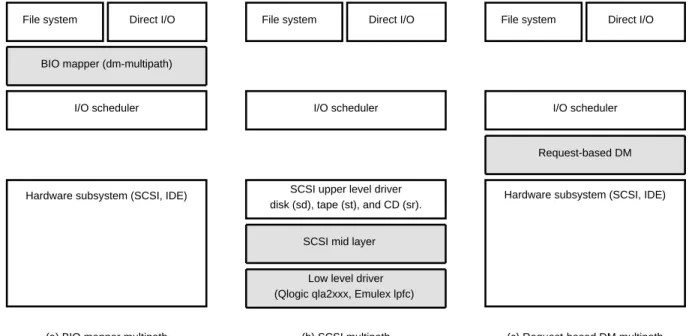
As can be seen in Figure 1(a), multipath architectures like MD Multipath or the Device-mapper (DM) layer’s multipath target have taken advantage of multiple paths at a high level by creating a virtual device that is com-prised of block devices created by the hardware subsys-tem.
In this approach, the hardware subsystem is unaware of multipath, and the lower-level block devices represent paths to the storage device which the higher-level soft-ware routes I/Os in units of BIOs over [1]. This design has the benefit that it can support any block device, and is easy to implement because it uses the same infrastruc-ture that software RAID uses. It has the drawback that it
does not have access to detailed error information, and it resides above the I/O scheduler and I/O merging, which makes it difficult to make load-balancing decisions. Another approach to multipath design modifies the hardware subsystem or low-level driver (LLD) to be multipath-aware. For the Linux SCSI stack (Fig-ure 1(b)), Host Bus Adapter (HBA) manufact(Fig-urers, such as Qlogic, have provided LLDs for their Fibre Channel and iSCSI cards which hide the multipath details from the OS [2]. These drivers coalesce paths into a single device which is exposed to the kernel, and route SCSI commands or driver-specific structures. There have also been multipath implementations in the SCSI layer that are able to route SCSI commands over different types of HBAs. These can be implemented above the LLD in the SCSI mid-layer or as a specialized SCSI upper-layer driver [3]. These designs benefit from being at a lower level, because they are able to quickly distinguish transport problems from device errors, can support any SCSI device including tape, and are able to make more intelligent load-balancing decisions.
This paper describes a multipath technique, Request -based DM, which can be seen in Figure 1(c), that is lo-cated under the I/O scheduler and above the hardware subsystem, and routesstruct requests over the de-vices created by the hardware specific subsystem. (To distinguish from the general meaning ofrequest,request
is used in this paper to mention thestruct request.) As a result of working withrequests instead of BIOs or SCSI commands, this new technique is able to bridge the multipath layer with the lower levels because it has access to the lower-level error information, and is able to leverage the existing block-layer statistics and queue management infrastructure to provide improved load balancing.
In Section 2, we will give an overview of the Linux block and DM layer. Then Section 3 describes in more detail the differences between routing I/O at the BIO-level versus therequest-level, and what modifications to
(c) Request-based DM multipath Request-based DM
I/O scheduler File system Direct I/O
Hardware subsystem (SCSI, IDE)
(b) SCSI multipath SCSI upper level driver disk (sd), tape (st), and CD (sr).
SCSI mid layer
Low level driver (Qlogic qla2xxx, Emulex lpfc)
I/O scheduler File system Direct I/O
(a) BIO mapper multipath BIO mapper (dm-multipath)
I/O scheduler File system Direct I/O
Hardware subsystem (SCSI, IDE)
Figure 1: Multipath implementations
the block, SCSI, and DM layers are necessary to support
Request-based multipath. Finally, we will detail perfor-mance results and load-balancing changes in Section 4 and Section 5.
2 Overview of Linux Block I/O and DM In this section, we look into the building blocks of mul-tipath I/O, specifically, how the applications’ read/write operations are translated into low-level I/O requests.
2.1 Block I/O
When a process, or kernel itself, reads or writes to a block device, the I/O operation is initially packed into a simple container called a BIO. (See Figure 2.) The BIO uses a vector representation pointing to an array of tuples of<page, offset, len> to describe the I/O buffer, and has various other fields describing I/O pa-rameters and state that needs to be maintained for per-forming the I/O [4].
Upon receiving the BIO, the block layer attempts to merge it with other BIOs already packed intorequests and inserted in therequestqueue. This allows the block layer to create largerrequests and to collect enough of them in the queue to be able to take advantage of the sorting/merging logic in the elevator [4].
page
BIO
block layer file system, etc.
low-level device driver
read, write
submit_bio
unplug Request
Figure 2: Relationship between page, BIO, andrequest
This approach to collecting multiple largerrequests be-fore dequeueing is called plugging. If the buffers of two BIOs are contiguous on disk, and the size of the BIO combined with therequestit is to be merged with is within the LLD and hardware’s I/O size limitations, then the BIO is merged with an existingrequest; other-wise the BIO is packed into a newrequestand inserted into the block device’s request queue. Requests will continue to be merged with incoming BIOs and adja-cent requests until the queue is unplugged. An unplug of the queue is triggered by various events such as the
plug timer firing, the number of requests exceeding a given threshold, and I/O completion.
When the queue is unplugged the requests are passed to the low-level driver’s request_fn() to be exe-cuted. And when the I/O completes, subsystems like the SCSI and IDE layer will call blk_complete_
request() to schedule further processing of the
re-quest from the block layer softirq handler. From that context, the subsystem will complete process-ing of the request by asking the block layer to re-queue it, or by calling end_request(), or end_
that_request_first()/chunk()andend_that_
request_last() to pass ownership of the request
back to the block layer. To notify upper layers of the completion of the I/O, the block layer will then call each BIO’s bi_end_io() function and the request’s
end_io()function.
During this process of I/O being merged, queued and executed, the block layer and hardware specific subsys-tem collect a wide range of I/O statistics such as: the number of sectors read/written, the number of merges occurred and accumulated length of timerequests took to complete.
2.2 DM
DM is a virtual block device driver that provides a highly modular kernel framework for stacking block de-vice filter drivers [1]. The filter drivers are called target drivers in DM terminology, and can map a BIO to mul-tiple block devices, or can modify a BIO’s data or simu-late various device conditions and setups. DM performs this BIO manipulation by performing the following op-erations:
• Cloning
– When a BIO is sent to the DM device, a near identical copy of that BIO is created by
DM’smake_request()function. The
ma-jor difference between the two BIOs is that the clone will have a completion handler that points to DM’sclone_endio()function.
• Mapping
– The cloned BIO is passed to the target driver, where the clone’s fields are modified. By tar-gets that map or route I/O, thebi_bdevfield
is set to the device it wants to send the BIO to.
– The cloned BIO is submitted to the underly-ing device.
• Completion
– DM’s completion handler calls the target-specific completion handler where the BIO can be remapped or completed.
– Original BIO is completed when all cloned BIOs are completed.
2.3 dm-multipath
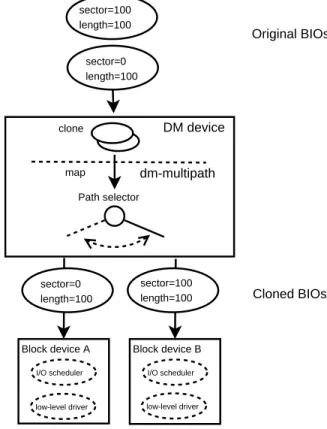
dm-multipath is the DM target driver that imple-ments multipath I/O functionality for block devices. Its map function determines which device to route the BIO to using a path selection module and by ordering paths in priority groups (Figure 3). Currently, there is only the round-robin path selector, which sendsNnumber of BIOs to a path before selecting a new path.
Original BIOs sector=100 length=100 dm-multipath clone map DM device sector=0 length=100 sector=0 length=100 sector=100
length=100 Cloned BIOs
Block device A I/O scheduler low-level driver Block device B I/O scheduler low-level driver Path selector
3 Request-based DM
3.1 Limitations of BIO-baseddm-multipath
There are three primary problems whichRequest-based multipath attempts to overcome:
1. Path selection does not consider I/O scheduler’s be-havior.
2. Block layer statistics are difficult for DM to use. 3. Error severity information is not available to DM.
dm-multipath’s path selection modules must balance
trying to plug the underlyingrequestqueue and creat-ing largerequests against making sure each path is fully utilized. Setting the number of BIOs that cause a path switch to a high value will assure that most BIOs are merged. However, it can cause other paths to be un-derused because it concentrates I/O on a single path for too long. Setting the BIO path-switching threshold too low would cause small requests to be sent down each path and would negate any benefits that plugging the queue would bring. At its current location in the storage stack, the path selector module must guess what will be merged by duplicating the block layer tests or duplicate the block layer statistics so it can attempt to make rea-sonable decisions based on past I/O trends.
Along with enhancing performance, multipath’s other duty is better handling of disruptions. The LLD and the hardware subsystem have a detailed view of most problems. They can decode SCSI sense keys that may indicate a storage controller on the target is being main-tained or is in trouble, and have access to lower level er-ror information such as whether a connection has failed. Unfortunately, the only error information DM receives is the error code value-EIO.
Given that these issues are caused by the location of the dm-multipath map and completion functions,Request -based DM adds new DM target drivers call outs, and modifies DM and the block layer to support mapping at therequest-level. Section 3.2 will explain the design and implementation ofRequest-based DM. Section 3.3 discusses the issues that are still being worked on and problems that were discovered with theRequest-based approach. Finally, Section 3.4 describes user interface changes to DM.
3.2 Design and implementation
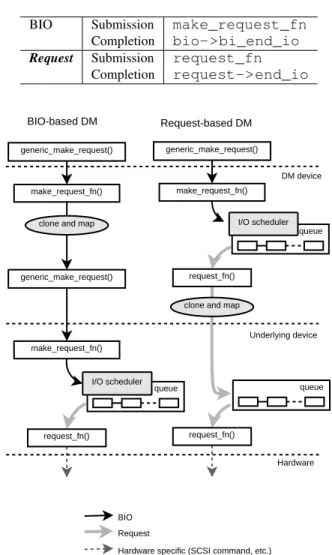
Request-based DM is based on ideas from the block layer multipath [5] patches, which were an experiment that moved the multipath layer down to the request -level. The goal ofRequest-based DM is to integrate into the DM framework so that it is able to utilize existing ap-plications such asmultipath-toolsanddmsetup. As explained in Section 2.2, DM’s key I/O operations are cloning, mapping, and completion of BIOs. To al-low these operations to be executed on requests, DM was modified to take advantage of following block layer interfaces:
BIO Submission make_request_fn
Completion bio->bi_end_io
Request Submission request_fn
Completion request->end_io queue queue DM device Underlying device Hardware BIO-based DM queue BIO Request
Hardware specific (SCSI command, etc.)
Request-based DM
clone and map
generic_make_request() request_fn()
clone and map
make_request_fn() make_request_fn() request_fn() request_fn() generic_make_request() generic_make_request() make_request_fn() I/O scheduler I/O scheduler
Figure 4: Difference of I/O submission flow As can be seen in Figure 4, with BIO-based DM, BIOs submitted by upper layers through generic_make_
request() are sent to DM’s make_request_fn()
where they are cloned, mapped, and then sent to a de-vice below DM. This dede-vice could be another virtual
device, or it could be the real device queue—in which case the BIO would be merged with arequestor packed in a new one and queued, and later executed when the queue is unplugged.
Conversely, with Request-based DM, DM no longer uses a specialized make_request_fn() and instead uses the default make_request_fn(), __make_
request(). To perform cloning and mapping, DM
now implements itsrequest_fn()callback, which is called when the queue is unplugged. From this call-back, the original requestis cloned. The target driver is asked to map the clone. And then the clone is inserted directly into the underlying device’srequestqueue
us-ing__elv_add_request().
To handle I/O completion, the Request-based DM patches allow the request’s end_io() callback to be used to notify upper layers when an I/O is finished. More details on this implementation in Section 3.3. DM only needs to hook into the clonedrequest’s completion handler—similar to what is done for BIO completions. (Figure 5).
default completion handler
DM completion handler Original Cloned Hardware Success Failure Retry Result visible to upper layer
= BIO or Request
Figure 5: Completion handling of cloned I/O
3.3 Request-based DM road bumps
A lot of the Request-based details have been glossed over, so they could be discussed in this section. While working withrequests simplifies the mapping operation, it complicates the cloning path, and requires a lot of new infrastructure for the completion path.
3.3.1 Requestcloning
A clone of the original request is needed, because a layer below DM may modifyrequestfields, and the use of a clone simplifies the handling of partial completions. To allocate the clone, it would be best to use the exist-ingrequestmempools [6], so DM initially attempted to
use get_request(). Unfortunately, the block layer
and some I/O schedulers assume thatget_request()
is called in the process context in which the BIO was submitted, but arequestqueue’srequest_fn()can be called from the completion callback which can be run in a softirq context.
Removing the need for cloning or modifying get_
request() to be usable from any context would be
the preferable solutions, but both required too many changes to the block layer for the initial release. Instead, DM currently uses a private mempool for the request
clones.
3.3.2 Completion handling
dm-multipath’s completion handler has to do the
fol-lowing:
• Check completion status.
• Setup a retry if an error has occurred.
• Release its private data if a retry is not needed.
• Return a result to the upper layer.
When segments of a BIO are completed, the upper lay-ers do not begin processing the completion until the en-tire operation has finished. This allows BIO mappers to hook at a single point—the BIO’s bi_end_io()
callback. Before sending a BIO to generic_make_
request(), DM will copy the mutable fields like the
size, starting sector, and segment/vector index. If an er-ror occurs, DM can wait until the entire I/O has com-pleted, restore the fields it copied, and then retry the BIO from the beginning.
Requests, on the other hand, are completed in two parts: __end_that_request_first(), which com-pletes BIOs in the request (sometimes partially), and
end_that_request_last(), which handles
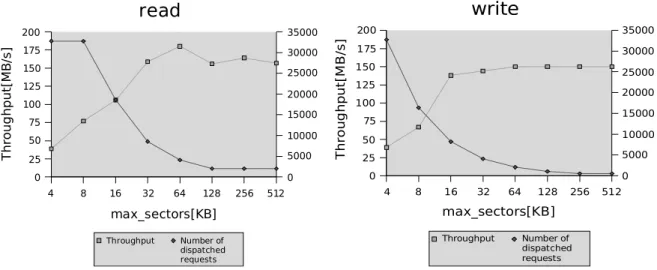
4 8 16 32 64 128 256 512 0 25 50 75 100 125 150 175 200 0 5000 10000 15000 20000 25000 30000 35000
read
Throughput Number of dispatched requests max_sectors[KB] T h ro u g h p u t[ M B /s ] 4 8 16 32 64 128 256 512 0 25 50 75 100 125 150 175 200 0 5000 10000 15000 20000 25000 30000 35000write
Throughput Number of dispatched requests max_sectors[KB] T h ro u g h p u t[ M B /s ]Command: dd if=/dev/<dev|zero> of=/dev/<null|dev> bs=16777216 count=8
Figure 6: Performance effects of I/O merging
io()function. This separation creates a problem for er-ror processing, becauseRequest-based DM does not do a deep copy of therequest’s BIOs. As a result, if there is an error,__end_that_request_first()will end up calling the BIO’sbi_end_io()callback and return-ing the BIO to the upper layer, before DM has a chance to retry it.
A simple solution might be to add a new hook in __
end_that_request_first(), where the new hook
is called before a BIO is completed. DM would then be responsible for completing the BIO when it was ready. However, it just imposes additional complexity on DM because DM needs to split its completion handler into error checking and retrying as the latter still has to wait
forend_that_request_last(). It is nothing more
than a workaround for the lack ofrequeststacking.
Truerequeststacking
To solve the problem, a redesign of the block layer re-quest completion interfaces, so that they function like BIO stacking, is necessary. To accomplish this, Re-quest-based DM implements the following:
• Provide a generic completion handler forrequests which are not using their end_io() in the cur-rent code. __make_request() will set the de-fault handler.
• Modify existingend_io()users to handle the new behavior.
• Provide a new helper function for device drivers to complete a request. The function eventually calls therequest’send_io()function. Device drivers have to be modified to call the new helper function for request completion. (end_that_request_ *()are no longer called from device drivers.) If
the helper function returns 0, device drivers can as-sume therequestis completed. If the helper func-tion returns 1, device drivers can assume the re-quest is not completed and can take actions in re-sponse.
3.4 User-space DM interface
dm-multipath has a wide range of tools like
multipath-tools and installers for major
distribu-tions. To minimize headaches caused by changing the multipath infrastructure, not only did Request-based multipath hook into DM, but it also reused the BIO-based dm-multipath target. As a result, the only change to the user-space DM interface is a new flag for the DM device creation ioctl. The existence of the flag is checked at the ioctl handler and, if it is turned on, the device will be set up forRequest-based DM.
1 2 5 10 50 100 1000 0 5000 10000 15000 20000 25000 30000 35000
read
BIO-based DM Request-based DM rr_min_io T o ta l n u m b e r o f d is p a tc h e d r e q u e s ts (S m a ll e r is b e tt e r) 1 2 5 10 50 100 1000 0 5000 10000 15000 20000 25000 30000 35000write
BIO-based DM Request-based DM rr_min_io T o ta l n u m b e r o f d is p a tc h e d r e q u e s ts (S m a ll e r is b e tt e r)Command: dd if=/dev/<dev|zero> of=/dev/<null|dev> bs=16777216 count=8
Figure 7: Effects of frequent path changes on I/O merging
4 Performance testing
One of the main purposes of Request-based
dm-multipath is to reduce the total number of
requests dispatched to underlying devices even when path change occurs frequently.
In this section, performance effects of I/O merging and how Request-based dm-multipath reduces the number of requests under frequent path change are shown. The test environment used for the measurement is shown in Table 1.
Host CPU Intel Xeon 1.60[GHz] Memory 2[GB] FC HBA Emulex LPe1150-F4 * 2 Storage Port 4[Gbps] * 2
Cache 4[GB] Switch Port 2[Gbps]
Table 1: Test environment
4.1 Effects of I/O merging
Sequential I/O results are shown in Figure 6. The throughput for a fixed amount of reads and writes on a local block device was measured using theddcommand while changing the queue’smax_sectorsparameter. In the test setup, the Emulex driver’s max segment size and max segment count are set high enough, so that
max_sectorscontrols therequestsize. It is expected
that when the value ofmax_sectorsbecomes smaller, the number of dispatchedrequests becomes larger. The results in Figure 6 appear to confirm this, and indicate that I/O merging, or at least larger I/Os, is important to achieve higher throughput.
4.2 Effects of Request-based dm-multipath on I/O merging
While the results shown in the previous section are ob-tained by artificially reducing the max_sectors pa-rameter, such situations can happen when frequent path changes occur in BIO-baseddm-multipath.
Testing results for the same sequential I/O pattern
on a dm-multipath device when changing
round-robin path selector’srr_min_ioparameter which cor-responds to the frequency of path change is shown in Figure 7.
This data shows that, when path change occurs fre-quently, the total number of requests increases with BIO-baseddm-multipath. While under the same con-dition, the number of requests is low and stable with
Request-baseddm-multipath.
4.3 Throughput ofRequest-baseddm-multipath
At this point in time, Request-based dm-multipath
still cannot supersede BIO-baseddm-multipathin se-quential read performance with a simple round-robin
HBA0 sda sdb HBA1 sdd sdc Port0 LUN0 Port1 LUN1 Path1 Path0 multipath device0 Path2 Path3 multipath device1 Host0 Cable1 Cable0
Figure 8: Examples of targets sharing cables
path selector. The performance problem is currently un-der investigation.
5 Dynamic load balancing
The benefit of moving multipath layer below the I/O scheduler is not only for the efficiency of I/O merging. This section reviews the other important feature of Re-quest-baseddm-multipath, dynamic load balancing.
5.1 Needs of dynamic load balancing
There are two load balancing types in general, static and dynamic. dm-multipath currently supports a static balancer with weighted round-robin. It may be suffi-cient in an ideal environment where all paths and storage controllers are symmetric and private to the host system. But in an environment where the load of each path is not same or dynamically changes, round-robin does not work well.
For example, suppose there is a multipath configura-tion described in Figure 8 and Path0(sda) is be-ing used heavily formultipath device0. It means
Cable0is heavily loaded. In this situation,multipath
device1 should use Path3(sdd) to avoid heavily
loadedCable0. However, the round-robin path selector
does not care about that, and will select Path2(sdb)
at next path selection formultipath device1. It will cause congestion onCable0.
To get better performance even in such environments, a dynamic load balancer is needed.
5.2 Load parameters
It is important to define good metrics to model the load of a path. Below is an example of parameters which determine the load of a path.
• Number of in-flight I/Os;
• Block size of in-flight I/Os;
• Recent throughput;
• Recent latency; and
• Hardware specific parameters.
Using information such as the number of in-flight I/Os on a path would be the simplest way to gauge traffic. For BIO-based DM, it was described in Section 2.2 the unit of I/O is the BIO, but BIO counters do not take into account merges.Request-based DM, on the other hand, is better suited for this type of measurement. Its use of
requests allows it to measure traffic in the same units of I/O that are used by lower layers, so it is possible for
Request-based DM to take into account a lower layer’s limitations like HBA, device, or transport queue depths. Throughput or latency is another valuable metric. Many lower layer limits are not dynamic, and even if they were, could not completely account for every bottleneck in the topology. If we used throughput as the load of a path, path selection could be done with the following steps.
1. Track block size of in-flight I/Os on each path . . .in-flight size.
2. At path selection time, calculate recent throughput of each path by using generic diskstats (sectors
andio_ticks) . . .recent throughput.
3. For each path, calculate the time which all in-flight I/Os will finish by using (in-flight size)/ (recent throughput).
4. Select the path of which Step 3 is the shortest time.
We plan to implement such dynamic load balancers after resolving the performance problems of Section 4.3.
6 Conclusion
Request-based multipath has some potential improve-ments over currentdm-multipath. The paper focused on the I/O merging, which affects load balancing, and confirmed the code works correctly.
There is a lot of work to be done to modify the block layer so that it can efficiently and elegantly handle rout-ingrequests. And there are a lot of interesting directions the path selection modules can take, because the multi-path layer is now working in the same units of I/O that the storage device and LLD are.
References
[1] Edward Goggin, Linux MultipathingProceedings of the Linux Symposium, 2005.
[2] Qlogic, Qlogic QL4xxx QL2xxx Driver README,http://www.qlogic.com. [3] Mike Anderson, SCSI Mid-Level Multipath,
Proceedings of the Linux Symposium, 2003.
[4] Jens Axboe, Notes on the Generic Block Layer Rewrite in Linux 2.5,Documentation/block/ biodoc.txt, 2007.
[5] Mike Christie, [PATCH RFC] block layer (request based) multipath,
http://lwn.net/Articles/156058/.
[6] Jonathan Corbet, Driver porting: low-level memory allocation,