Bioprospecting Lab Manual
Chapter 3: Research Record Keeping & Ethics
Topics Lab Notebook Purpose and Formatting Guidelines, Lab Notebook Grading Rubric, Legal Issues, Ethics
Supplemental Reading and References
1. Gallagher, S.R. & Wiley, E.A. Current protocols essential laboratory techniques. (Wiley, 2007). Appendix 2.
2. Fanelli, D. How many scientists fabricate and falsify research? A systematic review and meta-analysis of survey data. PLoS One4, e5738 (2009).
3. The Chemist’s Creed, The American Chemical Society, 14September 1965.
Bioprospecting Lab Manual
Chapter 3: Research Record Keeping & Ethics
Lab Notebooks & Record Keeping
Laboratory notebooks are not new and they are considered legal documents! The standards by which they are used derive from tradition, practicality, and legality. If you search around or query colleagues you will find common, unique, and occasionally bizarre recommendations regarding the format, layout, and content of entries placed in lab notebooks.
Our use of laboratory notebooks will be focused upon the following goals: 1. Research Documentation:
The laboratory notebook is the sole source of dependable documentation for experimental parameters and procedures
2. Training:
Teaching laboratory notebook technique that equips you to walk seamlessly into any research facility in the world and begin work
3. Planning:
Good science does not magically happen at the bench; it is planned for well in advance. The laboratory notebook is a central component of that
planning.
Your lab notebook will be kept in the laboratory at all times.
If you need to take data from your lab notebook in order to complete a write-up or assignment you must copy the data from your notebook or work on the
assignment in lab.
This is standard procedure in research institutions for reasons that will become apparent as we discuss the purpose of lab notebooks further.
Bioprospecting Lab Manual Notebook Selection
Please purchase the following notebook from Office World, Amazon.com or Office Depot:
National Brand Computation Notebook (43-648)
75 sheets, 11-3/4 x 9-1/4 inches, quad-ruled (no carbon)
This notebook is usually available at the University CO-OP. Please be SURE to get the correct one - the product number is 43-648. It looks as it appears in Figure 1.
Figure 1. This is an image of the National Brand Computation Notebook (43-648) available at the University CO-OP.
Bioprospecting Lab Manual
The follow sections are required in your lab notebook for all experiments during your first semester:
1. Title & Date
Title: One-line summation of work
Date: Time and date of when procedure performed. 2. Rationale & Purpose
A few sentences describing why you are doing the experiment. Details are important here. Is there an expected result? Is this a re-attempt from a previous experimental failure? (It is OK to fail! You are only wrong if you do not document your failures and show how you have succeeded) Are any special experimental parameters being used for the first time or tests? As appropriate you should include journal/book/etc. references (include the citation information and summarize the information you are using from that reference).
3. Expected Data Tables
If you are collecting data during the procedure, it is very good to include a table predicting how the data will be collected. Often this is not full size - it’s just a small estimate of what the actual data tables will look like.
4. Actual Data Tables
You have two choices when it comes to data tables: You can either
populate the ones you created in Expected Data Tables or create new ones. 5. Procedure(s) and Observations
A complete, step by step, every detail included account of what you did and how you did it for the experimental procedure. It is acceptable to include Xerox copies of standard protocols. It is also acceptable to denote or
reference standard protocols such as “Protocol 1.0 Solid Media Preparation, 3June2011, Version 2”. (Including the version and date is important as the protocols are updated based on available resources and updated
knowledge) You do not need to waste a lot of time writing the procedure in your notebook step-by-step. Remember - the goal is to reproduce your work. Denote information needed. Record observations and actions as the experiments happen! This will help prevent future mistakes or help you understand the impact of certain parameters on your results. These
Bioprospecting Lab Manual
observations do not have to be complete sentences, but they must be understandable (That means legible too!).
6. Results & Conclusions
The results of the process. How did things work? Was the overall procedure successful? Will you need to do it again? Where does this procedure lead next?
GOAL : Your experiments can be understood and recreated step-for-step, if you were to disappear and only your lab notebook were to be left behind. Thus, the lab notebook must be LEGIBLE and in blue or black ink (NO MARKERS!)!
Anyone must be able to interpret your notes! Printout & External Information
It is very common to wish to include external information (printouts, graphs, charts, printed protocols, etc) in your laboratory notebook. In order to do this simply cut the items to fit and permanently tape (all sides) into place using clear tape
(not labeling tape!).
At this time, you should get into the habit of initializing and dating the edge of the tape attaching the insert onto thenotebook.
The following must be included in your lab notebook in order to maximize your lab notebook grade:
1. Legible. I have to understand what you wrote. 2. Include the date on the top of every page.
3. Pages that are left blank must be crossed out with initials and date. 4. Mistakes must be lined out with a single line. Do NOT scribble! 5. Any special issues must be included (deviations from protocol, spills,
incidents, etc.).
6. Procedures with deviations noted in real time in the lab (you must have your lab notebook with you on the bench!)
7. Controls must be described and included in your discussion of results to clarify your conclusions.
Bioprospecting Lab Manual
8. Observations must be recorded while executing the experiment. These details will help you in the future.
9. Discussion of potential conclusions based on results of your sample and controls.
10.All calculations must be included or it should be obvious where numbers were derived.
11.ONLY use clear tape when taping in external documents! Do not use labeling tape, autoclave tape or masking tape!
After your first semester and good lab notebook recording habits are ingrained, you will not have to adhere to the strict format outlined. I will permit you to format required information in your own style. Importantly, no matter your style, your lab notebook should ALWAYS include what you did every time you are in lab, include all data (“good” and “bad”) that you generated, and all observations. Every page must be dated to show clearly the day to day process. Good researchers pay attention to details since small details may make the difference between expected and unexpected experimental results. The goal of the lab notebook, highlighted in the box above, must always be met.
I even include a list of scientific papers I may have read that day while I wait for something to incubate and I summarize important points that I learned from the papers in my lab notebook. I find this useful for later referencing the scientific papers in my research reports/articles.
Your lab notebook will serve as justification for being included in a journal article. If anyone questions a journal article submission, they will ask for your lab
notebook for source data. If source data cannot be traced, the journal will be denied publication. A lab notebook is considered a legal document and is binding. Keep this in mind as you use your lab notebook!
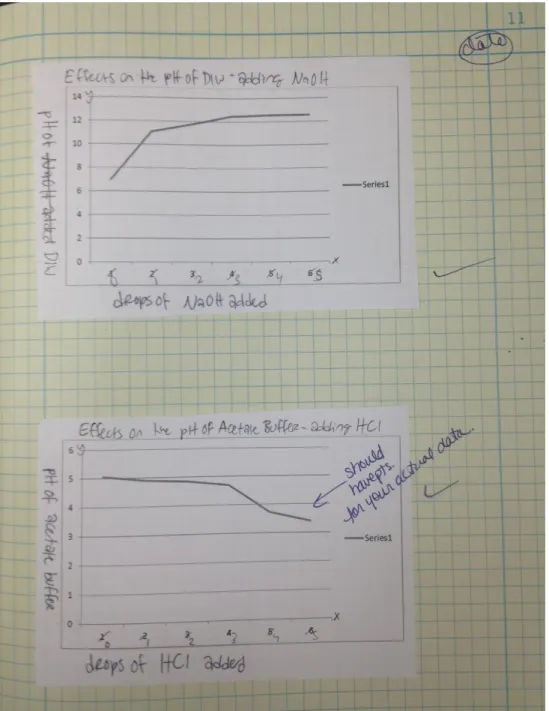
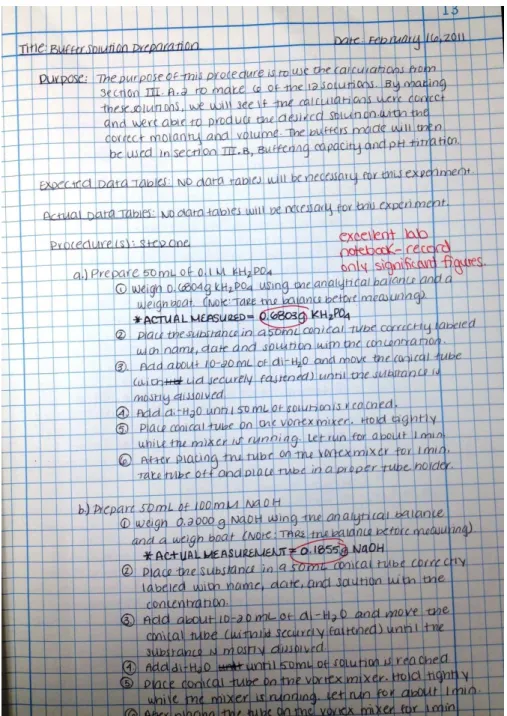
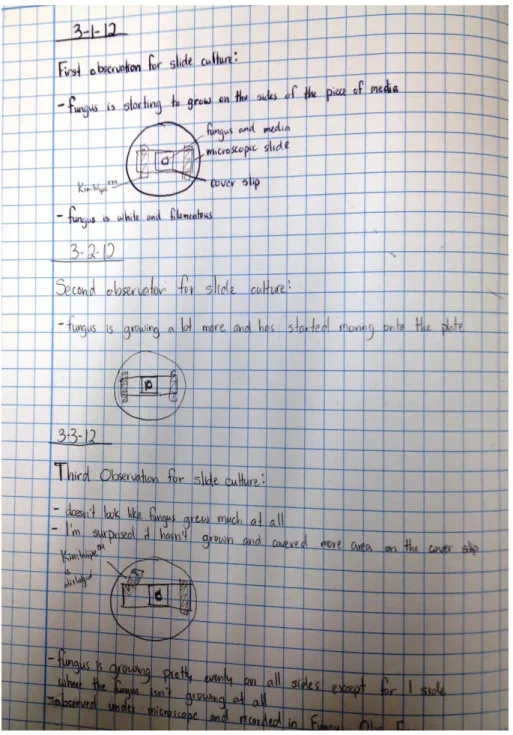
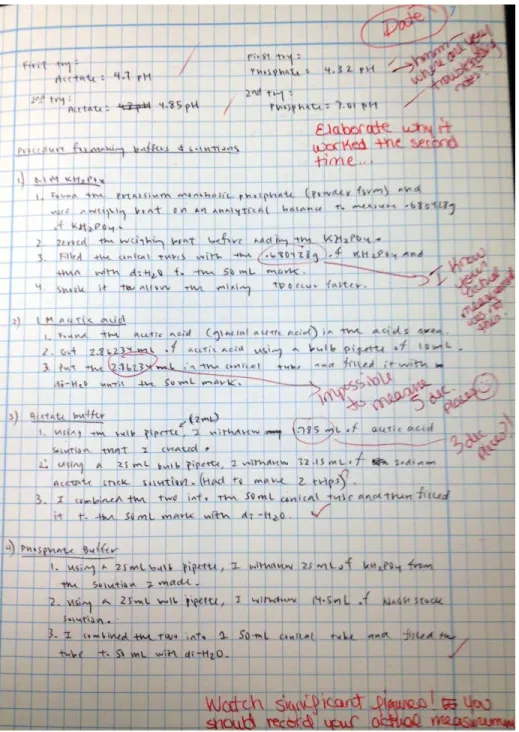
Figures 2 through 5 are examples of good and bad lab notebook pages scanned from previous students’ lab notebooks. All indications of the individual’s identity are removed from these examples.
Bioprospecting Lab Manual
Figure 2. This notebook page is legible and contains graph title and appropriate labels for the x- and y- axis. The date is missing at the top of the page and the discreet data points are missing.
Bioprospecting Lab Manual
Figure 3. This notebook page is legible and contains the requested information for each
experiment during your first semester. The student needs to indicate which figures are significant or only include the significant figures when documenting actual measurements.
Bioprospecting Lab Manual
Figure 4. This notebook page is legible and documents the student’s daily observation of his/her slide culture. This is a good example with descriptive illustrations to support the written
Bioprospecting Lab Manual
Figure 5. This notebook page is legible and contains a satisfactory description of the protocol executed. The student needs to indicate which numbers are significant or round to only include the significant figures when documenting actual measurements. In this case, the student did not document actual measurements and only documents his/her calculations. The equipment used for weighing does not output six figures. Also, the 25 ml pipette cannot be read to two decimal places.
Bioprospecting Lab Manual Ethics
People start off with a belief and a prejudice – we all do. And the job of science is to set that aside to get to the truth. --- Simon Singh (quoted in Wired, 2010)
Truth is sought for its own sake. And those who are engaged upon the quest for anything for its own sake are not interested in other things. Finding the truth is difficult, and the road to it is rough. ---Ibn Al-Haytham (1962)
Scientific research is about problem solving. A researcher’s job is to question or answer others’ questions and then to perform an investigation to find the best possible answer. The best answer is found given the technology and resources available to the researcher. It is the researcher’s responsibility to interrogate the answers and only be satisfied with answers that are robust and represent the truth. Despite the initial common goal for the quest of truth, some researchers find
themselves off the honest path either intentionally or unintentionally.
The easiest way to be accused of unethical work is to include results in your research reports or articles that cannot be traced directly to your lab notebook. This is the legal driver for maintaining an excellent, legible lab notebook. If your work is to be published, for example in the scientific literature, as a patent, support a clinical trial, support drug discovery or manufacturing efforts, or in a funding proposal, it must be fully documented form the bench to the final public issue. There is a code of scholarly conduct established by most institutions and typically includes the following ideas:
o The treatment of human subjects o Honesty
o Maintaining integrity of all experiments and research o Publishing the research and results
o Granting access to others to allow reproduction of the testing o Personal responsibility for the research
Bioprospecting Lab Manual
o Acknowledging others’ contributions
These codes are in place to minimize false reporting and unethical behavior during research. At the University of Texas, Austin the Office of Research Support (ORS) consists of three main areas that addresses these ideas:
1. Institutional Review Board (IRB)
2. Institutional Animal Care and Use Committee (IACUC) 3. Institutional Biosafety Committee (IBC)
The ORS mission is to ensure that all research conducted on campus complies with applicable laws, regulations, and University policies. Please refer to the following link for more information: http://www.utexas.edu/research/rsc/index.html Despite laws, regulations, policies, and the peer review system, scientists have been found guilty of unethical behaviors. These few scientists create a negative public impression leading to pseudo-facts propping bad public policy decisions and a suspicious non-scientific public.
Ethics specific to Journal Publication
Ethical standards for publication exist to ensure high-quality scientific publications, public trust in scientific findings, and that people receive credit for their ideas. It is important to avoid:
Data fabrication and falsification:
Data fabrication means the researcher did not actually do the study, but made up data. Data falsification means the researcher did the
experiment, but then changed some of the data. Both of these practices make people distrust scientists. If the public is mistrustful of science then it will be less willing to provide funding support.
Plagiarism:
Taking the ideas and work of others without giving them credit is unfair and dishonest. Copying even one sentence from someone else’s
manuscript, or even one of your own that has previously been published, without proper citation is considered plagiarism—use your own words instead.
Bioprospecting Lab Manual
It is unethical to submit the same manuscript to more than one journal at the same time. Doing this wastes the time of editors and peer reviewers, and can damage the reputation of journals if published in more than one. Redundant publications (or ‘salami’ publications):
This means publishing many very similar manuscripts based on the same experiment. It can make readers less likely to pay attention to your manuscripts.
Improper author contribution or attribution:
All listed authors must have made a significant scientific contribution to the research in the manuscript and approved all its claims. Don’t forget to list everyone who made a significant scientific contribution, including students and laboratory technicians. The International Committee of Medical Journal Editors has detailed guidelines on authorship that are useful for scientists in all fields:
International Committee of Medical Journal Editors
Tools like CrossCheck make it easy for journals to identify researchers that engage in unethical behavior. Don’t risk being caught!
Remember: if you behave unethically, you will eventually be caught. A few recent examples of people caught follow:
Doctoral student Roxana Gonzalez (social psychology) engaged in scientific misconduct in research supported by National Institute of Mental Health (NIMH) and National Institutes of Health(NIH) (The Scientist, 2008) The Office of Research Integrity (ORI) found that data falsification altered five published publications (ORI Annual Report, 2008). As a result, articles were retracted from the Personality and Social Psychology Bulletin, Biological Psychiatry, and the Journal of Experimental Psychology.
Bioprospecting Lab Manual
Andrew Wakefield, who claimed links between the MMR
vaccine, autism, and inflammatory bowel disease, was found guilty of dishonesty in his research and banned from medicine by the United Kingdom General
Medical Council following an investigation by Brian Deer of the London Sunday Times. (General Medical Council, 24 May, 2010. "Dr. Andrew Jeremy Wakefield: Determination on Serious Professional Misconduct (SPM) and Sanction". )
New York Times
Harvard Finds Scientist Guilty of Misconduct
By NICHOLAS WADE
Published: August 20, 2010
On Friday, Michael D. Smith, dean of the Harvard faculty of arts and
sciences, issued a letter to the faculty confirming the inquiry and saying the eight instances of scientific misconduct involved problems of “data acquisition, data analysis, data retention, and the reporting of research methodologies and results.” No further details were given.
The university said in a statement last week that Dr. Hauser or a co-author had been directed to correct three published papers for which the original data could not be found. But in two of the challenged papers, Dr. Hauser redid the experiments and obtained the same results as published. In one of the journals, his information was titled an “addendum,”
not a correction. The other journal, Science, has not yet decided how to handle the issue. Dr. Hauser presumably tried to repeat the third experiment as well but if so, he apparently failed to do so. He wrote this month to the editor of Cognition, the journal in which it was published, saying he was retracting the paper, but gave no reason for doing so.
As you embark on your research career, start on the right path with finding truth as your goal and your methods aligned with humanity and morality. I will end this section with the Chemist’s Creed, which was published by the American Chemical Society (ACS) on September 14, 1965.
Bioprospecting Lab Manual
The Chemist's Creed
As a Chemist, I Have a Responsibility: to the publicto propagate a true understanding of chemical science, avoiding
premature, false, or exaggerated statements, to discourage enterprises or
practices inimical to the public interest or welfare, and to share with other
citizens a responsibility for the right and beneficent use of scientific
discoveries.
to my science
to search for its truths by use of the scientific method, and to enrich it by
my own contributions for the good of humanity.
to my profession
to uphold its dignity as a foremost branch of learning and practice, to
exchange ideas and information through its societies and publications, to
give generous recognition to the work of others, and to refrain from
undue advertising.
to my employer
to serve him undividedly and zealously in mutual interest, guarding his
concerns and dealing with them as I would my own.
to myself
to maintain my professional integrity as an individual, to strive to keep
abreast of my profession, to hold the highest ideals of personal honor,
and to live an active, well-rounded and useful life.
Bioprospecting Lab Manual to my employees
to treat them as associates, being ever mindful of their physical and
mental well-being, giving them encouragement in their work, as much
freedom for personal development as is consistent with the proper
conduct of work, and compensating them fairly, both financially and by
acknowledgement of their scientific contributions.
to my students and associates
to be a fellow learner with them, to strive for clarity and directness of
approach, to exhibit patience and encouragement, and to lose no
opportunity for stimulating them to carry on the great tradition.
to my clients