Wright State University Wright State University
CORE Scholar
CORE Scholar
Browse all Theses and Dissertations Theses and Dissertations
2009
A Cryptanalysis Methodology for the Reverse Engineering of
A Cryptanalysis Methodology for the Reverse Engineering of
Encrypted Information in Images
Encrypted Information in Images
Allan Anthony RwabutazaWright State University
Follow this and additional works at: https://corescholar.libraries.wright.edu/etd_all
Part of the Computer Engineering Commons, and the Computer Sciences Commons
Repository Citation Repository Citation
Rwabutaza, Allan Anthony, "A Cryptanalysis Methodology for the Reverse Engineering of Encrypted Information in Images" (2009). Browse all Theses and Dissertations. 975.
https://corescholar.libraries.wright.edu/etd_all/975
This Dissertation is brought to you for free and open access by the Theses and Dissertations at CORE Scholar. It has been accepted for inclusion in Browse all Theses and Dissertations by an authorized administrator of CORE
A CRYPTANALYSIS METHODOLOGY FOR THE REVERSE ENGINEERING OF
ENCRYPTED INFORMATION IN IMAGES
A dissertation submitted in partial fulfillment of the requirements for the degree of
Doctor of Philosophy
By
ALLAN ANTHONY RWABUTAZA M.S., Mathematics, Miami University, 2004,
B.A., Mathematics, Berea College, 2002
______________________________________________
2009
2
COPYRIGHT BY
ALLAN ANTHONY RWABUTAZA 2009
3
WRIGHT STATE UNIVERSITY SCHOOL OF GRADUATES STUDIES
November 20, 2009 I HEREBY RECOMMEND THAT THE DISSERTATION PREPARED UNDER MY SUPERVISION BY Allan Anthony Rwabutaza, ENTITLED A Cryptanalysis Methodology for The Reverse Engineering of Encrypted Information in Images BE ACCEPTED IN PARTIAL FULFILLMENT OF THE REQUIREMENTS FOR THE DEGREE OF Doctor of Philosophy
Nikolaos G. Bourbakis, Ph.D. Dissertation Director
Arthur Ardeshir Goshtasby, Ph.D. Director, Computer Science and Engineering
Ph.D. Program
Joseph F. Thomas Jr., Ph.D. Dean, School of Graduate Studies Committee on Final Examination
Nikolaos G. Bourbakis, Ph.D. (Committee Chairman) Soon Chung, Ph.D. Yong Pei, Ph.D. Arnab Shaw, Ph.D. Monish Chatterjee, Ph.D.
4
ABSTRACT
Rwabutaza, Allan Anthony. Ph.D., Department of Computer Science & Engineering, Wright State University, 2009.
A Cryptanalysis Methodology for the Reverse Engineering of Encrypted Information in Images.
Security is an important issue related to the storage and communication of data and information. In data and information security, cryptography and steganography are two of the most common security techniques. On one hand, there is cryptography, which is the secret communication between two parties by message scrambling on the sender’s side and message unscrambling on the receiver’s side so that only the intended receiver gets the secret message. On the other hand, there is steganography, which is the hiding of information in a medium in such a way that no one other than the sender or the intended receiver realizes there is a hidden message. Successful reverse engineering of cryptography and steganography give cryptanalysis and steganalysis respectively. Cryptography and cryptanalysis constitute cryptology (or crypto) while steganography and steganalysis make up steganology (or stegano). This dissertation consists of three parts needed for a scientific study of a cryptanalysis problem. The first part lays out a comparative survey of various cryptology and steganology techniques by analyzing and comparing different methodologies using a set of predefined parameters. This part offers valuable knowledge on the state of the art techniques used on cryptanalysis. The second part proposes a new lossless synthetic stegano-crypto methodology that blends together five cryptography, steganography and compression techniques to form a single methodology for mutual information encryption and hiding in images. The methods that compose the synthetic methodology are SCAN Encryption, SCAN Compression, SCAN Steganography,
5
Least Significant Bit (LSB) Steganography and Regional Steganography with Segmentation. The synthetic methodology plays the role of a complex and difficult technique that we have to work on in an attempt to break it by using a reverse engineering approach. In the third part, a cryptanalysis attack against the proposed synthetic stegano-crypto methodology is presented in order for the important features (weak points) related to the method to be extracted and assist in the reverse engineering process of encrypted information in images.
6
Table of contents
List of figures ... 12
List of tables ... 15
Acknowledgment ... 17
PART 1- A CRYPTOLOGY COMPARATIVE SURVEY ... 18
1. Introduction- Cryptology ... 18
Basic Cryptology Concepts ... 18
2. Cryptography ... 20
2.1. Types of Cryptography ... 20
2.1.1. Symmetric Key Cryptography
... 20
DES... 20
Triple-DES ... 21
AES... 21
IDEA ... 21
Blowfish ... 21
RC4 ... 21
CAST ... 22
GOST ... 22
SKIPJACK ... 22
2.1.2. Asymmetric Key Cryptography
... 22
Diffie-Hellman ... 23
RSA ... 23
7
Elliptic Curve Cryptography ... 23
2.1.3. Hybrid Cryptography
... 24
2.2. Message Integrity in cryptography ... 24
MD4
... 24
MD5
... 24
SHA-1
... 25
RIPEMD
... 25
2.3. Authentication in cryptography ... 25
Digital Signature
... 25
Digital Certificates
... 26
2.4. Applications of Symmetric and Asymmetric cryptography ... 26
2.4.1. Text Encryption
... 27
Transposition ciphers... 27
Substitution ciphers ... 27
Z mod NZ ciphers ... 27
Shift Transformation Ciphers ... 28
Linear Transformation Ciphers ... 28
Affine Map Ciphers ... 28
Z mod N
2Z ciphers ... 28
2.4.2. Data Encryption
... 28
2.4.3. Image Encryption
... 29
SCAN methods... 29
Chaos methods ... 29
2.4.4. Voice Encryption
... 29
8
2.4.5. Video Encryption
... 30
3. Cryptanalysis ... 31
3.1. Classical cryptanalysis ... 31
Frequency analysis
... 31
Index of coincidence
... 31
Kasiski examination
... 32
3.2. Modern cryptanalysis ... 32
3.2.1. Modern cryptanalysis
... 32
Given knowledge
... 32
Secret information deduction
... 33
Computational complexity effort
... 33
3.2.2. Modern cryptanalysis techniques
... 34
General cryptanalysis techniques ... 35
4. Reflections from Contemporary Cryptology Methods ... 35
Multimedia Encryption ... 35
Asymmetric Key Cryptography ... 38
Symmetric Key Cryptology ... 47
5. A Comparative Study on the aforementioned cryptology methodologies ... 88
Comparative Survey Table ... 88
Discussion: The Comparative Survey ... 102
6. Steganology ... 103
7. Subsequent study (Part 2) ... 105
PART 2- THE STEGANO-CRYPTO SCHEME ... 107
9
9. SCAN ... 107
9.1. SCAN Compression ... 108
9.2. SCAN Encryption ... 109
9.3. SCAN Information Hiding ... 110
10. LSB Hiding ... 111
11. Regional Hiding with Segmentation ... 114
11.1. Definition ... 114
11.2. Regional Hiding ... 114
11.3. Regional Hiding Module 1: Pixel-to-region mapping module ... 114
11.3.1: 1-D Segmentation ... 116
11.3.2: 2-D Threshold Segmentation ... 117
11.3.3: Intensity-Address Lookup Table Synthesis ... 118
11.4. Regional Hiding Module 2: Key generation module... 119
11.5. Key space. ... 121
12. The new Synthetic Stegano-Crypto Methodology ... 127
12.1. The Regional Hiding Sub-module 1 ... 128
12.2. The SCAN Compression Module 1 ... 129
12.3. The Regional Hiding Sub-module 2 ... 130
12.4. The SCAN Encryption Module 1 ... 130
12.5. The SCAN Hiding Module ... 131
12.6. The LSB Hiding Module ... 132
12.7. The SCAN Compression Module 2 ... 133
12.8. The Stegano-Crypto Image Packing Module ... 133
10
13. Experiments ... 135
13.1. Experiments Hypothesis ... 135
13.2. Experiments Procedure ... 135
13.3.1. Experiment 1: Results and Analysis ... 138
13.3.2. Experiment 1 Results and Analysis ... 144
13.3.3. Experiment 3 Results and Analysis ... 150
13.3.4. Experiment 4 Results and Analysis ... 156
13.3.5. Experiment 5 Results and Analysis ... 162
13.3.6. Experiment 6 Results and Analysis ... 168
13.5. The effectiveness of the proposed methodology ... 174
13.5. Experiments Conclusion ... 178
14. Complexity Comparisons ... 178
14.1. LSB Hiding ... 179
14.2. Regional Hiding with Segmentation... 179
14.3. SCAN Encryption, Hiding and Compression ... 179
14.4. The complexity of the proposed Stegano-Crypto scheme ... 179
14.5. The Complexity Comparison Summary ... 180
15. Part 2 Conclusion ... 181
PART 3- THE REVERSE ENGINEERING PROCESS ... 182
16. The Overview of Our Reverse Engineering strategy ... 182
17. The Proposed Reverse Engineering Attack ... 185
17.1. Stegano-Crypto Attacks Exploration ... 185
17.2. Stegano-Crypto Attacks Exploitation ... 198
11
17.4. Security Hole Exploration and Exploitation: The Reverse Engineering Attack ... 224
18. A small-scale example of the Reverse Engineering ... 227
19. Experimental Results ... 247
19.1. Robustness testing ... 247
19.2. Penetration testing ... 253
19.3. The final evaluation of the Effectiveness Index of the Encoding Stegano-Crypto Scheme
and the evaluation of the Effectiveness Index of the Reverse Engineering Scheme ... 256
19.4. Part 3 Conclusion ... 257
20. Further Work ... 258
21. Conclusion ... 258
22. Appendix... 260
Appendix A: The SCAN key files ... 260
Appendix B: The message to hide file for medical image cover images ... 260
12
List of figures
Figure 1: A cryptosystem ... 19
Figure 2: A key collision attack [20]... 56
Figure 3: The security and complexity of the timing attacks on DES [24]. ... 60
Figure 4: A Steganography process (Information Hiding). ... 104
Figure 5: The SCAN Compression algorithm [47]. ... 108
Figure 6: The SCAN Encryption algorithm [47]. ... 109
Figure 7: An example of a SCAN key pattern -
B
5(
s
2
Z
0(
c
5
b
0
o
0
s
5)
c
4
d
1) key [47]. ... 109
Figure 8: The SCAN Hiding Embedding algorithm [47] ... 110
Figure 9: The SCAN Hiding Extraction algorithm [47] ... 111
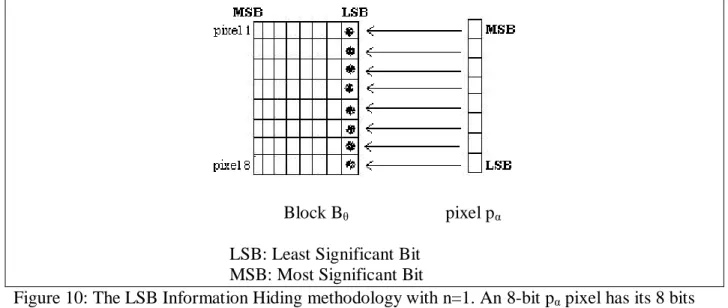
Figure 10: The LSB Information Hiding methodology with n=1. An 8-bit p
αpixel has its 8 bits
replace the last significant bits of pixels 1, 2, …, 8 contained in an 8-pixel Block B
θ.
... 112
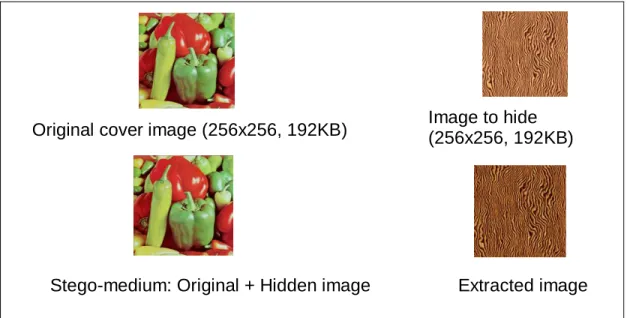
Figure 11: A sample result of a 2-bit LSB Hiding. The image size ratio of the embedding image
to the cover image is 1:1. Therefore, only 6 most significant bits of the embedding
image will be store in the 2 least significant bits of the cover medium. The extracted
image will have some loss of information because the 2 LSB‟s of each bit is replaced
and lost. ... 113
Figure 12: A Regional Hiding module ... 115
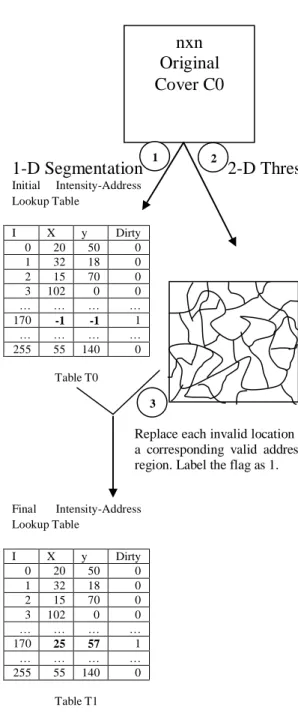
Figure 13: 2-D Threshold Segmentation ... 118
Figure 14: Extracting X and Y masks from the encrypted image M0 using the Intensity-Address
Lookup Table... 120
13
Figure 15: The composition of stego-key K. The stego-key K consists of T1, the X mask and the
Y mask. ... 121
Figure 16: Experimentation results- A 512x512, 257KB PGM cover image was segmented using
different segment intensity ranges d. The above images illustrate the results. ... 123
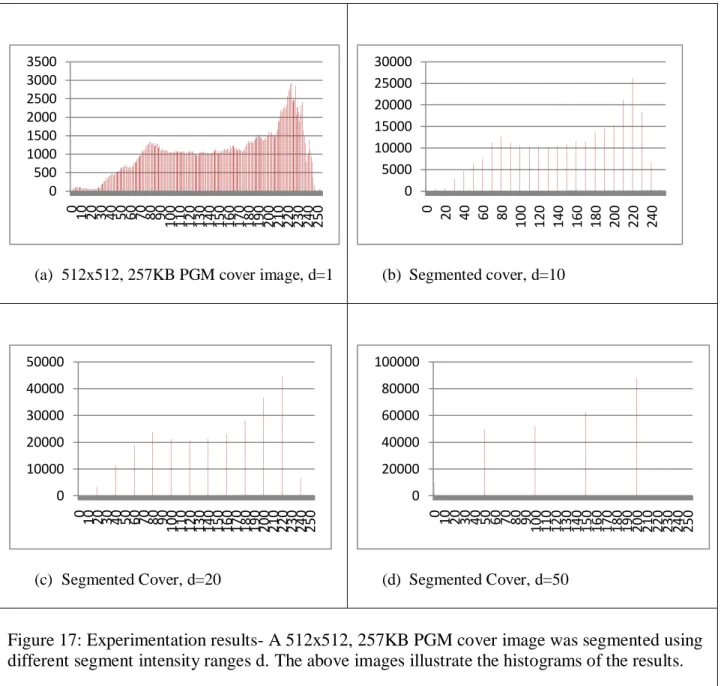
Figure 17: Experimentation results- A 512x512, 257KB PGM cover image was segmented using
different segment intensity ranges d. The above images illustrate the histograms of
the results. ... 124
Figure 18: Experimentation results- A 512x512, 257KB PGM message image was embedded in
another 512x512, 257KB PGM. ... 126
Figure 19: The proposed lossless Stegano-Crypto Methodology ... 128
Figure 20: The original message image M0 is fed into the SCAN Compression module. ... 129
Figure 21: In the SCAN Encryption module, the X and Y masks are independently fed into two
independent SCAN encryption channels, the X and Y channels respectively. ... 131
Figure 22: In the SCAN Hiding module, the original cover image C0 is embedded into the
encrypted X mask X1... 132
Figure 23: In the LSB Hiding module, the encrypted Y mask Y1 is embedded into the
stego-image S0 to get another stego-stego-image S1. ... 133
Figure 24: The output of the Stego-Image Packing module is an image S3 which is stored as
shown above. ... 134
Figure 25: The flow chart of our steganalysis and cryptanalysis attack strategy. ... 185
Figure 26: The flow chart of the processes involved in the Stegano-Crypto Exploration step. .. 186
Figure 27: Reference pointers for known attack techniques. ... 187
Figure 28: The flow chart of the processes involved in the System Analysis step... 199
14
Figure 30: Functions g
ifor i=1,..,5 in the SCAN compression algorithm. ... 208
Figure 31: Function g
6maps the 1-D SCAN compression output space V
2to an equivalent 2-D
space V
3. ... 208
Figure 32: The invertible SCAN Encryption function
Encrypt()
as given in [47]. ... 212
Figure 33: The SCAN Hiding Scheme [47]. ... 214
Figure 34: The SCAN Hiding Algorithm [47]. ... 215
Figure 35: A program context in memory. ... 226
Figure 36: Small scale example, module 1. ... 229
Figure 37: Small scale example, module 2. ... 229
Figure 38: Small scale example, module 3. ... 230
Figure 39: Small scale example, module 4. ... 233
Figure 40: Small scale example, module 5. ... 238
Figure 41: Small scale example, module 6. ... 239
Figure 42: Small scale example, module 7. ... 245
15
List of tables
Table 1: The summary of success probabilities of a fault attack adversary [16]... 40
Table 2: Comparative Survey Table 1 (with brief explanations)... 92
Table 3: Comparative Survey Table 2 (with Values) ... 98
Table 4: The summary of the six experiments... 137
Table 5: The results and analysis of Experiment 1. ... 144
Table 6: The results and analysis of Experiment 2. ... 150
Table 7: The results and analysis of Experiment 3. ... 156
Table 8: The results and analysis of Experiment 4. ... 162
Table 9: The results and analysis of Experiment 5. ... 168
Table 10: The results and analysis of Experiment 6. ... 174
Table 11: The complexity comparison of various image encryption and steganography
methodologies. ... 180
Table 12: The strengths and weaknesses of Chaos Based techniques. ... 189
Table 13: The strengths and weaknesses of Permutation Based techniques. ... 192
Table 14: The strengths and weaknesses of LSB Based techniques. ... 195
Table 15: The strengths and weaknesses of Regional Hiding Based techniques. ... 196
Table 16: The strengths and weaknesses of Hybrid Based techniques. ... 197
Table 17: Growth rates of some functions. ... 200
Table 18: A Big-Oh Hierarchy ... 201
Table 19: Number of SCAN keys [47]... 210
16
Table 21: A summary of results of the Stegano-Crypto methodology‟s forward direction of
information encryption and hiding and that of its corresponding reverse-engineering.
... 253
Table 22: The results of six Penetration Testing experiments... 256
Table 23: The evaluation of the effectiveness index of the Stegano-Crypto Encoding and Reverse
17
Acknowledgment
The author would like to thank and express his great appreciation to his advisor Professor
Nikolaos Bourbakis (Chair of my PhD committee) for his continuous support, guidance,
encouragement and challenges given to me during my research effort towards to a PhD degree. I
would like to thank also the members of my PhD committee Professor Soon Chung, Professor
Yong Pei, Professor Arnab Shaw and Professor Monish Chatterjee for their time and
suggestions.
I would like also to thank the Dept of Computer Science and Engineering, Mrs Donetta Bantle,
the Graduate School for their support, and my colleagues at ATR Center Dimitris Dakopoulos,
Raghudeep Kanavara, Alekos Pantelopoulos, Alex Karargyris, Robert Keefer for our good
challenging times.
I would like to thank Dr. Robert Ewing (AFIT) and Dr. Jay Thomas (Dean of the Graduate
Studies) for their financial support for one quarter helping me to complete my PhD studies.
Finally, I would like to thank my parents for their moral support.
18
PART 1- A CRYPTOLOGY COMPARATIVE SURVEY
1. Introduction- Cryptology
Cryptography is the secret communication between two parties by message scrambling on the sender‟s side and message unscrambling on the receiver‟s side. An unintended interception of the message reveals a scrambled message, which is useless to the attacker. If an attacker undoes this process by unscrambling the intercepted unintelligible message to get the intelligible message, then we get
cryptanalysis, which is the reverse engineering of cryptography.
Cryptography and cryptanalysis both constitute cryptology. Since cryptanalysis works against cryptography, the second section of the paper will look at cryptography, the third will focus on cryptanalysis and the fourth will be on the works of contemporary cryptologists.
Basic Cryptology Concepts
Cryptography is the process where an individual or party sends a message to another individual or party in a scrambled unintelligible manner such that only the intended party will get the scrambled message, which will be unscrambled to get the original message. The reverse engineering of cryptography is known as cryptanalysis. Cryptography and cryptanalysis together constitute cryptology.
A cryptography system is known as a cryptosystem, or a cipher. Any cryptosystem must have a sender, plaintext, an enciphering (encrypting) function, an enciphering (encrypting) key, an algorithm, ciphertext, a transmission medium, a decrypting (deciphering) function, a decrypting (deciphering) key and a receiver (
Figure 1
).19
Figure 1:
A cryptosystemPlaintext is the original intelligible message a sender sends to the receiver. In order to scramble the plaintext to make it unintelligible to the potential attacker, an algorithm, along with a key, maps the plaintext to the unintelligible message known as ciphertext. This plaintext to ciphertext scrambling is known as enciphering. An algorithm is a mathematical function that maps one message to another message. A key is a variable that gives a unique output map when used with an algorithm. In enciphering, the function is referred to as an enciphering function and the key is referred to as an enciphering key. After encryption, the ciphertext is sent through a transmission medium to the receiver.
When a receiver receives the ciphertext, he reverses the encryption to get the original plaintext. This reversing is referred to as deciphering. A deciphering function and a deciphering key are synonymous to their corresponding counterparts in encryption.
20
2. Cryptography
2.1. Types of Cryptography
There are two types of cryptography: Symmetric (private or secret) key cryptography and Asymmetric (public or shared) key cryptography. In symmetric key cryptography, the same key is used to decrypt and encrypt the message. While in asymmetric key cryptography, a non-secret public key and a secret private key are used to encrypt and decrypt messages respectively.
2.1.1. Symmetric Key Cryptography
Symmetric Key Cryptography is the cryptography in which a message is encrypted and decrypted using the same secret key. This type of cryptography is the oldest and the most widely understood. It has been widely used from the beginning of cryptography up-to-date.
Some of the advantages of symmetric key cryptography are: it is fast, relatively secure and widely understood. On the other hand, symmetric key cryptosystems have shortcomings - They require secret sharing, complex administration, and have no authentication or non-repudiation mechanisms.
Some of the widely used symmetric key cryptography algorithms are DES, Triple-DES, AES, IDEA, Blowfish, RC4, CAST, GOST, SKIPJACK and SAFER.
DES
Data Encryption Standard (DES) is one of the most widely used cryptography algorithms. It was developed by IBM in mid 1970s and published in 1977 by the National Bureau of Standards. DES has a key of 8 bytes with 8 bits, one of which is a parity bit to make up an 8 x 7 = 56-bit key. DES is widely used in ATM machines.
21
Triple-DESTriple-DES, or DES-EDE (Encrypt-Decrypt-Encrypt), is a variation of DES that incorporates three DES applications that make up a 56 x 3 = 168-bit key. The larger the key size, the more secure the system. Triple-DES is an attempt to get a more secure system from DES.
AES
Advanced Encryption Standard (AES) is a variable-length key and a variable-length block cipher. It was adopted by the US government as an encryption standard. Before beating other five algorithm finalists to win the title of AES, it was called Rijdael – named after its Belgian developers, Vincent
Rijmen and Joan Daemen. It is a successor of DES and is expected to be studied and used widely.
IDEA
IDEA (International Data Encryption Standard) is a 128-bit symmetric key block cipher. It was developed by James Massey and Xuejia Lai of Switzerland in 1991. IDEA is believed to be more efficient in software implementation than DES or triple-DES.
Blowfish
Blowfish is a variable-length key, 64-bit block cipher. It was developed by Bruce Schneider in 1993. The algorithm first expands the key of size between 32 and 448 bits into several sub-key arrays totaling 4168 bytes. Then, it encrypts the data through a 16-round Feistel network. A Feistel network (named after IBM cryptographer, Horst Feistel) is a block cipher with a particular structure. Blowfish is slowly gaining popularity as an alternative to DES.
RC4
RC4 (Rivest Cipher #4) is a variable-length key stream cipher developed by Ron Rivest of RSA. The export version is only 40-bit; however it is more effective when used with a 128-bit key. RC4 is used in browsers, such as Netscape Navigator and Internet Explorer.
22
CASTCAST is a variable-length key, 64-bit block cipher developed by Carlisle Adams and Strafford Travares. Typical key lengths are between 40 and 256 bits. Supposedly, CAST runs two to three times faster than DES in implementation and runs six to nine times faster than Triple-DES. CAST is used in PGP.
GOST
GOST (Government Standard) is a 256-bit key, 64-bit block cipher developed in Russia in 1990. Its effective key size can be increased to 768 bits by incorporating additional 512-bit secret information from its S-boxes. GOST is a Feistel network of 32 rounds.
SKIPJACK
Skipjack is an 80-bit key, 64-bit block cipher developed by NSA. It was meant to be used in a Clipper chip used in telephony. But its use in the Clipper chip never gained an acceptance. Therefore, Skipjack is more of a theoretical cryptography algorithm than an applied algorithm.
2.1.2. Asymmetric Key Cryptography
Asymmetric Key Cryptography is the cryptography in which a message is encrypted using a non-secret public key, but decrypted using a different non-secret key, or vice versa. It is a more recent cryptosystem. It has been made public just in 1976 when Whitfield Diffie and Martin Hellman of Stanford University first introduced its concept.
Diffie and Hellman were believed to be the pioneers of Asymmetric Key cryptography before the British Government Communications Headquarters (GCHQ), the equivalent of NSA, claimed to have conceived it years earlier and had been using it for years privately.
Some of the advantages of asymmetric key cryptography are: no secret sharing is necessary; it supports authentication and non-repudiation mechanisms; and it is scalable. On the negative side, it is slower or computationally intensive and requires certificate authority.
23
Some examples of the asymmetric key cryptosystems are Diffie-Hellman, RSA, DSA and Elliptic Curve Cryptography (ECC).
Diffie-Hellman
The Diffie-Hellman algorithm is an algorithm based on discrete-logarithm computation problem. It was developed by Whitfield Diffie and Martin Hellman at Stanford University. It is the first asymmetric key algorithm in use.
RSA
RSA (Rivest, Shamir, Adleman) is an algorithm based on a large prime number product factorization problem. It was developed by Ron Rivest, Adi Shamir and Len Adleman at MIT. This algorithm is the one that is mostly associated with asymmetric key cryptography. Moreover, it was the first one to be considered useful for both encryption use and digital signature use.
DSA
DSA (Digital Signature Algorithm) is a digital signature algorithm developed as part of the Digital Signature Standard (DSS). Unlike previous algorithms, DSA is not an encryption algorithm.
Elliptic Curve Cryptography
Elliptic Curve Cryptography (ECC) is an asymmetric key cryptography based on the mathematics of Elliptic curves. Elliptic curves are planes with non-singular functions y2 = x3 + ax + b with no cusps or self-intersections. In 1985, Neal Koblitz and Victor Miller saw a potential of the mathematics of elliptic curves in cryptography and suggested its use. ECC is now expected to be the next generation algorithm. The strength of ECC lies in its computational difficulty in solving elliptic curve discrete logarithm problem; and its ability to offer security comparable to RSA algorithms with smaller keys. It is widely believed that ECC is more difficult to break than RSA.
24
2.1.3. Hybrid Cryptography
Hybrid cryptography is the one that uses both symmetric and asymmetric key cryptography. In hybrid cryptography, an asymmetric key cryptosystem encrypts the communication used to transmit a randomly generated key, which is then used to encrypt the rest of the communication by a symmetric key cryptosystem. This cryptosystem harvests both the speed and efficiency of a symmetric cryptosystem and a secure key exchange of an asymmetric cryptosystem. Hybrid cryptosystems are found in SSL, SSH and PGP.
2.2. Message Integrity in cryptography
Encryption alone does not guarantee that the plaintext intended to reach the receiver is exactly the same message the receiver gets. To ensure that the message was not altered during transmission, the cryptosystem must detect and/ or correct any errors. A hash function technique is one of the techniques used to perform such a task. A hash function is a one-way function that works by computing a unique fixed-value cryptographic checksum for each unique message. A checksum value before and after transmission at both ends must match for „error-free‟ transmission.
Some of the widely used hashing algorithms are MD4, MD5, SHA-1 and RIPEMD.
MD4
MD4 (Message Digest #4) is a 128-bit hash algorithm developed by Ron Rivest of RSA. It is a one-way function whose input is a variable-length message and whose output is a 128-bit hash value or message digest. It is believed that MD4 has serious weaknesses. Its first two rounds out of three are believed to be non-one-way. Thus, MD4 can have collisions. As an improvement, Ron Rivest devised MD5.
MD5
MD5 (Message Digest #5) is a 128-bit hash algorithm developed by Ron Rivest of RSA in 1991 as an improvement of MD4. It operates the same way the MD4 operates except that MD5 covers the
25
collision security holes of the MD4. Despite its improvement on MD4, MD5 has also been shown to have another collision security hole in its compression function. Due to MD4 and MD5 weaknesses, the cryptography community has suggested the use of other hash functions, like SHA-1.
SHA-1
SHA-1 (Secure Hash Algorithm-1) is 160-bit hash algorithm designed by the NSA in 1994 as an alternative to MD5. Like MD5, SHA-1 is used for creating digital signatures. It operates the same way MD4 and MD5 operate, but is considered to be more secure. However, there have been successful attacks against SHA-1. SHA-2 variants, which are successors of SHA-1 are now considered more secure and no known successful attacks to date. SHA-1 is used in TLS, SSL, PGP, SSH, S/MIME and IPSec.
RIPEMD
RIPEMD (RACE Integrity Primitives Evaluation Message Digest) is a hash algorithm developed in Europe by Hans Dobbertin, Antoon Booselaers and Bart Preneel. It was published in 1996. There are several versions depending on its bit-length. Some are RIPEMD-128, RIPEMD-160 and RIPEMD-256.
2.3. Authentication in cryptography
Message encryption and message integrity are not enough in secret communication, especially if highly sensitive information is to be communicated. The communicating parties need to authenticate each other‟s identity to make sure they are communicating with the same receiver they intend to communicate with. The possibility that the receiver may not be the intended receiver must not be overlooked. Digital signatures and digital certificates are some of the techniques used to enforce authentication between communicating parties.
Digital Signature
A digital signature, also known as a public key digital signature, is a digital authentication method analogous to a physical paper signature, implemented using public-key cryptography techniques.
26
To a limited extent, a digital signature allows a receiver to authenticate the identity of the sender and to verify the message integrity.
A digital signature works as follows: A sender creates his digital signature by hashing his message using his private key to get a message digest. The recipient uses the sender‟s public key to verify the message integrity and sender authentication.
RSA and DSA are currently the competing technologies in authentication through digital signatures.
Digital Certificates
A digital certificate, also known as a public key certificate or identity certificate, is a certificate that binds together a public key with an identity using a digital signature. Such identity information maybe name of a person, individual or organization and address. This verifies that an individual owns a particular public key. A digital certificate is useful in verifying that a message has been sent unmodified and verifying the sender‟s identity by public key. In a Public Key Infrastructure (PKI) scheme, a Certificate Authority (CA) usually issues the certificate.
2.4. Applications of Symmetric and Asymmetric cryptography
We have seen two types of cryptography, which are symmetric key and asymmetric key cryptography. Cryptosystems apply these to encrypt different plaintext topologies. We can categorize these plaintext topologies as text, data, image, voice and video. Depending on the topology of each plaintext, we can apply different methods and techniques on the plaintext elements to scramble the plaintext.
For example, if the plaintext is in plaintext form, we could generate a ciphertext by permuting elements in different ways. Say, we could swap two elements; we could move elements around; we could reverse a block of elements; or we could scramble a block of elements. Depending on the topology of the plaintext, we can get different encryption techniques. If the plaintext is in image form, we get image encryption and so forth.
27
2.4.1. Text Encryption
Applying symmetric or asymmetric key encryption on a text plaintext gives Text Encryption. This encryption involves encrypting data using ASCII symbols of the plaintext as plaintext elements. This is the oldest form of encryption even though modern techniques have expanded its complexity and security. The first and earliest application of cryptography involved messages written manually on a paper. Thus, the earliest ciphers focused on text encryption. There are various text encryption techniques. For the sake of completeness, we include the earliest simple insecure text encryption systems to the more modern and more secure ones that are still in use today. The classical ones are the transposition and substitution ciphers and the modern ones are the ones discussed in symmetric and asymmetric key cryptography. We will not repeat the discussion of the modern ones, rather we will look at the classical transposition and substitution ciphers.
Transposition ciphers
Transposition ciphers are the ones that permute the plaintext characters to get the ciphertext.
Substitution ciphers
Substitution ciphers are the ones that substitute plaintext characters or blocks of characters with other characters or blocks of characters to get the ciphertext. These include the Z mod NZ and the Z mod N2Z (Digraph) cryptosystems.
Z mod NZ ciphers
Z mod NZ ciphers are substitution ciphers with a single plaintext character as a message unit, a key together with enciphering and deciphering functions that use modular arithmetic. Some examples of Z mod NZ ciphers are Shift Transformation ciphers, Linear Transformation ciphers and the Affine Map ciphers.
28
Shift Transformation CiphersShift Transformation ciphers are Z mod NZ substitution ciphers with a single plaintext character P (for Plaintext) or C (for ciphertext) as a message unit and have an enciphering function C ≡ P + b mod N and a deciphering function P ≡ C - b mod N together with a key b.
Linear Transformation Ciphers
Linear Transformation ciphers are Z mod NZ substitution ciphers with a single plaintext character P (for Plaintext) or C (for ciphertext) as a message unit and have an enciphering function C ≡ a P mod N and a deciphering function P ≡ a‟C mod N together with an enciphering key a and a deciphering key a‟.
Affine Map Ciphers
Affine Map ciphers are Z mod NZ substitution ciphers with a single plaintext character P (for Plaintext) or C (for ciphertext) as a message unit and have an enciphering function C ≡ a P + b mod N and a deciphering function P ≡ a‟C + b‟ mod N together with an enciphering key pair (a,b) and a deciphering key pair (a‟,b‟). They are an improvement on the Shift and Linear transformation ciphers.
Z mod N2Z ciphers
Z mod N2Z ciphers are substitution ciphers with two plaintext characters as a message unit, a key together with enciphering and deciphering functions that use modular arithmetic. This system is similar to the Z mod NZ system. The main difference is the one- vs. character message unit. Due to its two-character message unit, they are also known as Digraph Transformations. Like the Z mod NZ, there are Z mod N2Z Shift, Linear Transformation and Affine Map ciphers.
2.4.2. Data Encryption
Applying symmetric or asymmetric key encryption on a data plaintext gives Data Encryption. Data plaintext is that which is in binary form. That means the encryption is done on the binary equivalent of the message characters discussed in text encryption. Instead of encrypting the text comprehensible to
29
humans, we first convert it to its binary equivalent and then encrypt it. Its techniques are essentially similar to the text encryption.
2.4.3. Image Encryption
Applying symmetric or asymmetric key encryption on an image plaintext gives Image Encryption. There are various image encryption methods. In this paper we will discuss the SCAN and chaos methods.
SCAN methods
SCAN methods are the ones that bijectively map the original 2-dimensional plaintext array Pmxn
to a 2-dimensional ciphertext array Cmxn through the Pmxn scanning. By bijectively, it is meant that the
mapping is in a one-to-one and onto manner. The new Cmxn represents a scanning of Pmxn accessing every
entry once. The security of this method is based on the NP-complete combinatorial problem of finding the mxn-length Hamiltonian cycle (a cycle with all points accessed once) that matches the key‟s scanning path. Such an mxn-length Hamiltonian cycle has (mxn)! different possible solutions. SCAN based methods control the scrambling process and can apply not only on pixels but also on blocks of pixels of various dimensions.
Chaos methods
Chaos methods are permutation based methods that scramble the plaintext element units by some defined secret permutation to get a ciphertext, which appears chaotic. Chaos methods can be considered subsets of the SCAN based ones mentioned above. In image encryption, the image pixels are scrambled while the wavelet coefficients, blocks or macro-blocks are scrambled in video encryption.
2.4.4. Voice Encryption
Voice Encryption is the application of symmetric or asymmetric key encryption on a voice plaintext. Voice plaintext is digital form and is treated like any other plaintext topology we have discussed.
30
2.4.5. Video Encryption
Applying symmetric or asymmetric key encryption on a video plaintext is known as Video Encryption. Unlike other plaintext topologies, the video plaintext topology is much more massive and dense. Therefore, some traditional symmetric and asymmetric key ciphers may cease to work due to the spatial and computational speed lag caused by the massive and dense video plaintext topology. To encrypt video plaintext, the video plaintext is first compressed and then encrypted. Compression is done first because encryption is a much more expensive task computationally. If we reverse the order of compression and encryption, then the encryption will do much more work to encrypt a large file, which will reduce the net performance of encryption.
There are various techniques to encrypt video plaintext. These include SCAN, chaos, MPEG and Frequency Domain methods. The SCAN and chaos methods have been discussed above. The MPEG and Frequency Domain video encryption methods are discussed below.
MPEG Video Encryption
MPEG stands for Moving Pictures Experts Group. This group develops a series Audio and Video Encryption techniques called MPEG. Some of the MPEG encryption methods are MPEG-1, MPEG-2, MPEG-3, MPEG-4, MPEG-7 and MPEG-21, just to name a few. MPEG encryption is a lossy data compression codec (compressors-decompressors) that uses Transform codecs. The lossy data compression involves compressing the original audio or video sample, then decompressing it to get a sample close to the original. In the process, the original audio or video samples are dissected, and then mapped into a frequency space before being quantized.
Frequency Domain Video Encryption
Frequency Domain Video Encryption is based on the mathematics of Frequency Domain, which the Wikipedia encyclopedia [3] defines as the analysis of mathematical functions with respect to frequency. Video is encoded digitally using the frequency domain. It is through frequency domain that the video signal is decomposed into finite or infinite frequencies. The frequency domain video encryption technique encrypts the digital encoding of the original frequency domain.
31
3. Cryptanalysis
With cryptanalysis and cryptography going hand in hand, cryptanalysis is as old as cryptography. The designing of a cryptosystem takes into consideration cryptanalysis and cryptanalysis aims at breaking cryptography. We will discuss cryptanalysis by looking at classical cryptanalysis techniques and modern cryptanalysis techniques.
3.1. Classical cryptanalysis
Classical cryptanalysis is responsible for breaking classical ciphers discussed previously. Due to the relative simplicity of classical cryptography techniques, classical cryptanalysis techniques also tend to be relatively simple. Frequency analysis, Index of coincidence and Kasiski examination are some of the most common classical cryptanalysis techniques.
Frequency analysis
Frequency analysis is the studying of character frequency in the ciphertext. The oldest written record of cryptanalysis is a ninth century frequency analysis cryptanalysis technique by an Arabic mathematician. Classical ciphers are notoriously weak and vulnerable to this form of attack. This form of attack takes advantage of letter statistics in a language. Looking at a substitution cipher as an example, the most frequent character x in a language L will most likely correspond to the most frequent ciphertext character y, and so forth.
Index of coincidence
The Index of coincidence is the ratio of the number of times a character appears in the same position of two texts being compared to the total number of such comparisons. The technique of using the index of coincidence is useful in breaking the Vigenère cipher, which is a substitution cipher that combines various Caesar ciphers in series. Furthermore, this technique is useful in determining whether the two texts being compared are in the same language. Two texts in the same language have relatively
32
higher indices of coincidences than if they are written in different languages. This is due to the tendency of different languages having different character frequencies.
Kasiski examination
Kasiski examination is a cryptanalysis technique for attacking a polyalphabetic substitution cipher by first determining its keyword-length n, then splitting the ciphertext into n column units and finally attacking each column unit as a single ciphertext of a monoalphabetic substitution cipher by frequency analysis. The Kasiski examination can also break a Vigenère cipher.
3.2. Modern cryptanalysis
With the evolution of cryptography, cryptanalysis also evolved. Some frequency analysis techniques became obsolete against stronger, more secure and more modern ciphers. As a result, frequency analysis was replaced by other techniques such as differential cryptanalysis, linear cryptanalysis and integral cryptanalysis. However, weak ciphers have not been entirely abandoned; some are still in use today. We discuss modern cryptanalysis methods below.
3.2.1. Modern cryptanalysis
A modern cryptanalysis attack depends on whether the attack is theoretical or practical. While, theoretical attacks are theoretical solutions that exploit the weakness of a cipher without a practical implementation, practical attacks are their counterparts that offer a pragmatic implementation solution. We characterize practical attacks depending on given knowledge, secret information deduction and required computational complexity effort.
Given knowledge
The underlying assumption is that a cryptanalyst is aware of how the cryptosystem works. Additional knowledge that a cryptanalyst could have could be:
Ciphertext-only: the only access is ciphertext
33
Chosen-plaintext: the only access is the ciphertext of a chosen plaintext Chosen-ciphertext: the only access is the plaintext of a chosen ciphertext
Adaptive chosen-plaintext: A chosen-plaintext attack where there is also an additional ability of choosing additional plaintext from preceding encryptions.
Adaptive chosen-ciphertext: A ciphertext counterpart of adaptive chosen-plaintext.
Related-key attack: A chosen-plaintext attack where there is also an additional ability of accessing ciphertext encrypted under two unknown related keys that are different, say by two bits.
Having executed a cryptanalysis attack, we classify its success on the basis of secret information deduction as follows.
Secret information deduction
We classify the success of a cryptanalysis attack on the basis of the quality and quantity of the secret information that was obtained from the attack. The classification is as follows:
Information deduction: Some new important information about plaintext or ciphertext is revealed. Local deduction or Instance deduction: New additional plaintext or ciphertext is revealed.
Global deduction: Encrypting and decrypting algorithms without the key are revealed. Distinguishing algorithm: A cipher is distinguished from a random permutation. Total break: The secret key is revealed.
Computational complexity effort
We can characterize a cryptanalysis attack on the basis of how much computational complexity effort we require. The resources could be:
Data: The plaintext and ciphertext quantity required to execute an attack Space: The amount of memory
34
3.2.2. Modern cryptanalysis techniques
3.2.2.1 - Cryptanalysis of Symmetric Key Cryptography
Differential cryptanalysis
Differential cryptanalysis is a cryptanalysis technique that exploits the non-randomness areas of a cryptosystem having studied the effects of the difference of the input change to the difference of the output change. Thus, it is a chosen-plaintext cryptanalysis technique. This technique is useful in breaking block ciphers, stream ciphers and hash functions. It is also one of the two most widely used cryptanalysis technique on block ciphers.
Integral cryptanalysis
Integral cryptanalysis is a cryptanalysis technique similar to differential cryptanalysis, except that integral cryptanalysis focuses on the propagation of sums of many consecutive values while differential cryptanalysis focuses on the propagation of differences between consecutive values. Integral cryptanalysis can be used where differential cryptanalysis is ineffective.
Linear cryptanalysis
Linear cryptanalysis is a cryptanalysis technique that involves determining the cryptosystem action‟s affine approximations. Along with differential cryptanalysis, this technique is widely used in breaking block ciphers.
Statistical cryptanalysis
Statistical cryptanalysis is a cryptanalysis technique that relies on using statistical procedures to break the cipher.
35
3.2.2.2. Cryptanalysis of Asymmetric Key Cryptography
Asymmetric ciphers are designed based on the difficulty of solving hard mathematical problems, such as large number factorization and discrete logarithm determination. To break such ciphers, mathematical solutions of the corresponding mathematical problems need to be determined.
General cryptanalysis techniques
These involve applying previously discussed techniques (generalized) on Asymmetric Key Cryptography.
Side channel cryptanalysis
A side channel cryptanalysis technique is the one that exploits the physical implementation weakness of a cipher after obtaining its physical implementation information. For instance, a cryptanalyst could exploit the cipher‟s physical implementation weakness by taking advantage of relatively little time a certain computation takes in the cipher‟s algorithm.
4. Reflections from Contemporary Cryptology Methods
In the previous discussion, we looked at cryptography and cryptanalysis techniques. We have also discussed some cryptography concepts and techniques by contemporary cryptographers. In this section, we will focus mainly on cryptanalysis work and we will only include cryptography approaches that introduce a concept that will be discussed along with contemporary cryptanalysis methodologies. In so doing, we shift our focus and emphasis on cryptanalysis.Multimedia Encryption
4.1. Liu’s (Jigsaw) Puzzle Algorithm
In [16], Fuwen Liu proposes a High-Resolution Video Encryption algorithm called Puzzle. Puzzle, designed for enciphering software video data, is well-equipped to provide a fast real-time demand
36
in addition to enhanced security required in multimedia cryptosystems. Liu discusses the design and the experimentation results of the algorithm. He also incorporates testing against common cryptanalysis techniques, such as ciphertext-only attack, known-plaintext attack and chosen-plaintext attack. For the sake of completeness, the discussion below will be on both cryptography and cryptanalysis aspects of Liu's proposal.
Problem to solve:
Starting with the cryptography, Liu et al are solving a cryptography problem of creating a secure and efficient cipher for digital video encryption. In our team‟s opinion, their Puzzle algorithm delivers promising expectations. We will discuss this approach from our perspective by looking at the methodology and techniques used, its strengths, weaknesses, limitations and also give suggestions for improvement. We will conclude the Puzzle discussion by summarizing the discussion with a table.
Methodology used:
The Puzzle algorithm [15] consists of two steps: light-weight data encryption and data scrambling. In light-weight data encryption, small portions of the video stream are encrypted by a stream cipher such as SEAL or AES-CTR; and the other portions are self exclusive-ORed with a shifted plaintext key stream. In data scrambling, each frame is first split into n blocks and then the n blocks are partitioned into two parts consisting of n/2 blocks, the top part and the bottom part. The n/2 top blocks are then permuted with n/2 bottom blocks by a permutation list predetermined by the original plaintext and key stream K.
From our perspective, the Puzzle Algorithm, which is for video encryption is a simple permutation-based cryptosystem. Its methodology and techniques are synonymous to scrambling and solving a Jigsaw puzzle: The method encrypts the video data the same way you scramble a Jigsaw puzzle to deface the image of the Jigsaw puzzle; then it decrypts the video ciphertext to get the original video plaintext the same way you put the pieces of the Jigsaw puzzle back together to get the original image. Not only is the algorithm simple, it also appears vulnerable to attacks. How vulnerable is it? The following discussion will look into this.
37
Method’s strengths and limitations:It is known the limitations of conventional ciphers of not supporting the bandwidth requirement of video encryption and also not having a good balance of security and efficiency. To satisfy this need, a cipher that takes care of these limitations is needed. Thus, such a cipher would be Liu's Puzzle algorithm. How successful is this algorithm in fulfilling this?
Assuming that the Puzzle algorithm works well, it will offer support on the bandwidth of real-time video encryption. Its efficient obscuring step of the encryption section uses a stream cipher to encrypt a small section of the video stream and the majority of the video stream uses self exclusive-OR operations. A stream cipher is very slow and inefficient in handling massive and dense video data, therefore it is minimally used. On the other hand, exclusive-OR operations are very fast and these are maximally used. The combination of minimal stream cipher and maximal exclusive-OR operation result in a big performance improvement when compared to using a traditional stream cipher on its own.
When we look at the security aspects of the Puzzle algorithm, it is very weak in backing up its claim that it is sufficiently secure. In ciphertext-only attack, it discusses how big the entire search space of the plaintext combinations is. It claims that the attacker can't possibly try all possible combinations, therefore it is secure.
In general, breaking a system is not about brute-force, trying all possible combinations. It's about finding a clever short-cut or elegant way to break it. The argument they have seem to be inclined into assuming that brute force attack is the only attack, which is not entirely true. In our opinion, a brute force attack is not elegant cryptanalysis because it lacks the art, the beauty and the innovation. In most cases, a brute force attack rarely, if never, succeeds in breaking a cipher because of ultra-high computation power requirement, which is often unavailable. Therefore, we consider that the algorithm is not completely secure against ciphertext-only attack.
This similar argument carries forward to the methodology‟s security argument against known-plaintext and chosen-ciphertext attack. However, it makes a small deviation by arguing that its AES-CTR stream cipher component of the encryption algorithm provides an extra security against known-plaintext
38
and chosen-plaintext attacks. This is a relatively strong point as long as the AES-CTR is not compromised.
The method does not clarify why the disorder of the blocks is chosen by splitting the ciphertext T into two equal parts. In its special cryptanalysis section, no further security analysis is offered and further security studies, such as differential cryptanalysis, will be useful.
Further security analysis: security, complexity and robustness
A brute force attack complexity of the Puzzle algorithm with a minimum of 128 blocks in each picture frame is 64! = 1.27 x 1089 calculations, which makes a brute force attack ineffective computationally.
For improving security the Puzzle algorithm is suggested on video samples with a frame length of at least 300 bytes. This forces the attacker to try at least all 30 x 264 combinations, approximately 269 combinations, to get plaintexts of the scrambled picture blocks for a single frame.
The method‟s security discussion relies on an exhaustive brute force attacks and lacks a comprehensive cryptanalysis research, we therefore doubt if this algorithm is robust in security and in a transmission channel.
Asymmetric Key Cryptography
Many RSA algorithms use the mathematics of the Chinese Remainder Theorem (CRT) as part of the cipher‟s computations. We will call these RSA algorithms CRT-RSA. CRT-RSA algorithms have proved to be very prone to side-channel attacks, particularly fault attacks. This has attracted interest from cryptologists who, days in and out, try to break or improve the security of these systems. In protecting these cryptosystems, many attempts have been done to shield CRT computations against potential attacks such as fault side-channel attacks. The following discussion reflects on some of this work.
4.2. Blömer-Otto-Seifert’s CRT-RSA immune to Bellcore attacks
The next methodology deals with an RSA signature algorithm which is widely used in smartcards. In [19], Blömer et al propose a CRT-RSA algorithm immune to Bellcore attacks. A Bellcore
39
attack is an example of a fault attack in which the cryptic factorization of the RSA modulus N is broken and revealed having introduced a fault that yields a correct signature modulo one of the secret prime factors of N and incorrect modulo the other prime factor.
Problem to solve:
Blömer et al attempt to solve a problem of CRT computation insecurities in RSA signature algorithms that use CRT computations. Particularly, they zero-in on the insecurity of Shamir‟s fault attack countermeasure scheme as well as the infective computations that generate single points of failure of a checking step. The motivation of solving this problem is to improve the security of CRT-RSA applications. Smartcards are typical examples of areas where RSA signature algorithms are used.
Methodology used:
Their methodology is to extend Shamir‟s small prime verification countermeasure to cover the whole CRT-RSA computation and also eradicate the single point of a checking step‟s failure [16].
Why their methodology is good for such a problem
The authors‟ technique works from the ground-up from an existing Shamir‟s CRT-RSA scheme. Their technique is good for such a problem because it is an attempt to patch up the security holes left behind by the older cryptosystem. Briefly, “Shamir‟s technique applies a small prime verification countermeasure to protect the signature computations modulo the two secret prime factors of the RSA modulus N”. The authors in order to improve the countermeasure space, they use Shamir‟s variant in their algorithm and extend it by introducing conditions that ensure a good resistance against attacks on memory parameters as well as providing security against attacks on the CRT combination. They claim their new algorithm is more efficient in computing RSA signatures.
Further security analysis: Security, complexity and robustness
Our understanding is that Shamir already had a „solution‟ to the problem of CRT computation insecurities in RSA signature algorithms that use CRT computations. However, Blomer et al claim that Shamir‟s solution is susceptible to fault attacks because it does not protect the CRT-combination step to obtain the final signature modulo N. Furthermore, a single point of a checking step‟s failure is a security
40
hole that can be fatal with fault attacks. As an improvement, the authors attempt to extend Shamir‟s idea to cover all CRT computations as well as minimize or remove single point faults. They also provide a proof of why they think their system is immune to Bellcore fault attacks.
The complexity and robustness of the method
The space and time complexities of the above proposed algorithm are implementation dependent. However, the different steps of the algorithm are O(xy mod a.b ) where xy = max(mdp , mdq, m-Set1 + 1, Sc1.c2 ) , a = max(p, q) and t = max(t1, t2).
The method shows the security testing of the above algorithm line by line from line 1 to line 6 of the algorithm and in Table 1 the most successful attack scenarios is depicted.
Fault attack on Probability of the attack
Line 1 3/min(t1,t2)
Line 2 3/min(t1,t2)
Line 3 2/min(t1,t2)
Line 4 0 in our fault model
Line 5 0 in our fault model
Line 6 0 in our fault model
Table 1:
The summary of success probabilities of a fault attack adversary [16].Method’s strength:
The authors vividly explain various fault models using a three-part format consisting of parameter setting, mathematical model and a motivation from the real world. In their discussion on the new approach, they give a compact and yet very clear mathematical description of their approach, which is very helpful for a reader. Their subsequent discussion of the efficiency of the new algorithm, the security analysis of their countermeasure and further security considerations are also clear and provide a very good support of their proposal. Furthermore, the strength of their approach lies in the efficiency and security improvement in the RSA computation signatures. If indeed, their algorithm is as efficient and secure as they have proved it to be, it is definitely a CRT-RSA algorithm to adopt over the Shamir‟s scheme.
41
The limitation of their technique is that in their security discussion, they completely ignore other fault attacks, such as when a fault attack is combined with other side channel attacks like power and timing attacks. This can be very crucial if an attacker is clever enough to exploit this weakness, thus their approach is still vulnerable and it is not as secure as it seems.
Suggestions for improvement:
The method could be improved by incorporating other fault attack techniques.
4.3. Li-Li-Chen-Zhang-Bourbakis’ General Cryptanalysis of Permutation-Only Multimedia Encryption Algorithms
In multimedia encryption, many secret permutations and permutation-only ciphers have been proposed. The next methodology looks at one of these techniques.
In [11], Li et al propose a general cryptanalysis of Permutation-Only Multimedia Encryption Algorithms using a known-plaintext and chosen-plaintext attacks. They criticize the security of permutation-only multimedia ciphers claiming that all such ciphers are vulnerable to known-plaintext and chosen-plaintext attacks. Given image size mn and pixel size value x, only O(logx (mn)) known- or
chosen-plaintext images are required to break the cipher. Furthermore, the attack‟s time complexity is only O(p.(mn)2) where p is the number of known- or chosen-plaintext images. They also show empirical results that support the feasibility of known- and chosen-plaintext attacks. In their discussion, they clearly show that secret permutations are weak to be used alone in securing multimedia encryption systems.
Problem to solve:
The objective is to create an efficient and secure image and video encryption algorithm.
Methodology used:
The technique is to expose the weaknesses of “secure” image and video encryption algorithms by theoretically and practically attacking and breaking the secret permutations.
Theoretical explanations
42
In the spatial domain, permutation-only image ciphers use permutations primarily to encrypt data which is in the form of pixels.
Several ways of generating a permutation matrix are readily available in the literature. Some of these are SCAN language, 2-D chaotic maps, Quadtree, Pseudo-random rotations, Fractal curves, matrix transformations and composite methods.
ii. Cryptanalysis of Permutation-Only Image Ciphers in Spatial Domain
There is a detailed discussion on how to decrypt an image encrypted by the above method and the known-plaintext attack method is provided [11].
The chosen-plaintext attack works in a similar way as above except that plain-images are well chosen for optimization for estimating .
Further security analysis: security, complexity and robustness
The proposed methodology capitalizes on the weaknesses of relying on secret permutations as a basis of securing these cryptosystems. They provide a long discussion of how secret permutations are used to secure these encryption algorithms. In addition, they point out the vulnerabilities of these mechanisms. Theoretical and practical results are also given to support the vulnerabilities of these systems.
Why is their technique good for such a problem?
Their cryptanalysis technique is good for such a problem, because cryptanalysis has been a traditional way of securing a cryptosystem. Throughout history, cryptanalysis has co-evolved with cryptography, and the authors have employed the same technique of cryptanalysis as a motivation to improving the cryptography of the cryptosystem.
Strengths:
The authors offer a good awareness of how insecure permutation-only image and video encryption ciphers are. It addresses the importance of not relying on permutations only when designing and implementing multimedia encryption algorithms. If secret permutations are used, they should be used along with other encryption techniques. Otherwise, the cipher is vulnerable.
43
Example:A Hierarchical chaotic image encryption (HCIE) is used as an example of a recently proposed permutation-only cipher. The algorithms and experiment results of known-plaintext, the chosen-plaintext and the brute force attacks on HCIE are provided in [11].
In addition, a performance comparison of the known-plaintext attack to HCIE and the quantitative relationship between the known plain-images count and the decryption quality, which is equivalent to the decryption error ratio, are available in [11].
We totally agree with the authors‟ perspective that the security analysis of brute-force attacks only are not enough to analyze most permutation only ciphers.
Weaknesses:
From the security standpoint, the work is not comprehensive enough, it only focuses on known-plaintext and chosen-known-plaintext attacks. What about all other techniques.
Suggestions for improvement:
The work should also look at other cryptanalysis techniques rather than just know-plaintext and cipher-text techniques.
4.4. Sun-Shieh’s Burst-Error-Correcting-Code Private-Key Cryptanalysis
In
[14]
, Sun et. al. propose how to break private-key encryption schemes that are based onburst-error-correcting codes. They introduce a private-key encryption scheme based on burst-burst-error-correcting codes as proposed by Alencar and one based on array codes as implemented by Campello de Souza. They mathematically show the cipher‟s vulnerability to chosen-plaintext attacks.
Problem to solve:
The objective is to probe the security of the private-key encryption scheme based on the burst-error-correcting codes, as proposed by Alencar et al. It also attempts to test the security of one of its implementation by looking at Compello de Souza et al.‟s implementation, which is based on array codes (a class of burst-error-correcting codes).
44
Further security analysis: security, complexity and robustnessThe work focuses on the private-key encryption schemes based on burst-error-correcting codes as proposed by Alencar et al and implemented by Campello de Souza. The authors provide a background and history of these cryptosystems. According to [13], these cryptosystems can be traced back to 1978 when McEliece used algebraic coding theory to propose a public-key cryptosystem. Rao-Nam proposed an improved version in 1989. However, the improvement was found to be vulnerable to some chosen plaintext attacks. Alencar et al proposed yet another improvement in 1993. Campello de Souza et al provided one of the implementations. Alencar et al‟s and de Souza et al‟s schemes are what their work is focusing on. These two schemes are vulnerable. The authors provide an extensive, yet compact, mathematical description of how vulnerable they are.
Methodology used: Why is it good for such problem?
The authors‟ approach is very similar to the methodology proposed by the authors in [11]. Thus, they also use cryptanalysis to examine the security of the Alencar‟s and de Souza‟s approaches.
Approach’s strength:
The approach is compact and provides a sound mathematical description of the cryptanalysis process.
4.5. Cain-Sherman’s Ciphertext-only attack on Gifford’s cipher
In [26], Cain et. al. show how to use a ciphertext-only attack to break a Gifford‟s cipher, which is MIT‟s David Gifford‟s stream cipher. The Gifford‟s cipher was widely used for online news articles for New York Times and Associated Press. The authors give the description of their ciphertext-only attack on the cipher. Their method is efficient and effective enough to recover the individual article key in about four hours and can also recover the master key used for a month-worth of news articles. Thus, the Gifford‟s stream cipher should be avoided. Moreover, they give their suggestions on how to improve the Gifford‟s cipher.
45
They are trying to solve a problem of breaking the Gifford‟s cipher. Particularly, they use a ciphertext-only attack.
Methodology used:
![Figure 2 : A key collision attack [20]](https://thumb-us.123doks.com/thumbv2/123dok_us/761409.2596395/57.918.242.676.125.380/figure-a-key-collision-attack.webp)
![Figure 3: The security and complexity of the timing attacks on DES [24].](https://thumb-us.123doks.com/thumbv2/123dok_us/761409.2596395/61.918.155.764.103.448/figure-security-complexity-timing-attacks-des.webp)

![Figure 7: An example of a SCAN key pattern - B5(s2 Z0(c5 b0 o0 s5) c4 d1) key [47].](https://thumb-us.123doks.com/thumbv2/123dok_us/761409.2596395/110.918.150.740.528.1022/figure-example-scan-key-pattern-b-z-key.webp)