NBER WORKING PAPER SERIES
DISTRIBUTIONAL EFFECTS OF GLOBALIZATION IN DEVELOPING COUNTRIES Pinelopi Koujianou Goldberg
Nina Pavcnik Working Paper 12885
http://www.nber.org/papers/w12885
NATIONAL BUREAU OF ECONOMIC RESEARCH 1050 Massachusetts Avenue
Cambridge, MA 02138 February 2007
Forthcoming in Journal of Economic Literature. We thank the editor, Roger Gordon, and two anonymous referees for many helpful comments. This research is supported by funding from the National Science Foundation, Grant SES #0213459. The views expressed herein are those of the author(s) and do not necessarily reflect the views of the National Bureau of Economic Research.
© 2007 by Pinelopi Koujianou Goldberg and Nina Pavcnik. All rights reserved. Short sections of text, not to exceed two paragraphs, may be quoted without explicit permission provided that full credit, including © notice, is given to the source.
Distributional Effects of Globalization in Developing Countries Pinelopi Koujianou Goldberg and Nina Pavcnik
NBER Working Paper No. 12885 February 2007
JEL No. F10,F16
ABSTRACT
We discuss recent empirical research on how globalization has affected income inequality in developing countries. We begin with a discussion of conceptual issues regarding the measurement of globalization and inequality. Next, we present empirical evidence on the evolution of globalization and inequality in several developing countries during the 1980s and 1990s. We then examine the channels through which globalization may have affected inequality discussing theory and evidence in parellel. We conclude with directions for future research.
Pinelopi Koujianou Goldberg Department of Economics Yale University 37 Hillhouse Avenue P.O. Box 208264 New Haven, CT 06520-8264 and NBER [email protected] Nina Pavcnik Department of Economics 6106 Rockefeller Center Dartmouth College Hanover, NH 03755 and NBER [email protected]
1. Introduction
One of the few uncontroversial insights of trade theory is that changes in a country’s exposure to international trade, and world markets more generally, affect the distribution of resources within the country and can generate substantial distributional conflict. Hence, it comes as no surprise that the entry of many developing countries into the world market in the last three decades coincides with changes in various measures of inequality in these countries. What is more
surprising is that the distributional changes went in the opposite direction from the one suggested by conventional wisdom: while globalization was expected to help the less skilled who are presumed to be the locally relatively abundant factor in developing countries, there is
overwhelming evidence that these are generally not better off, at least not relative to workers with higher skill or education levels. What explains this apparent paradox? Is the theory
underlying the conventional wisdom too stylized to capture the reality of the developing world? Or were there other forces at work that may have overridden the effects of globalization? What are the mechanisms through which globalization affected inequality? Did the experience vary across countries, and if so, why? What are the general lessons we can draw from the experience of the last three decades? It is these and other related questions that this article aims to address.
To this end, we present a large amount of evidence from several developing countries regarding their exposure to globalization and the parallel evolution of inequality. While the evidence is subject to several measurement problems that we discuss extensively in this article, two trends emerge clearly from the data analysis. First, the exposure of developing countries to international markets as measured by the degree of trade protection, the share of imports and/or exports in GDP, the magnitude of capital flows -- foreign direct investment in particular, and exchange rate fluctuations has increased substantially in recent years. Second, while inequality has many different dimensions, all existing measures for inequality in developing countries seem to point to an increase in inequality, which in some cases (e.g., pre-NAFTA Mexico, Argentina in the 1990’s) is severe.
We next investigate the question whether we can establish a causal link between the increase in inequality and globalization. We examine several mechanisms through which
openness is presumed to have affected inequality and discuss related evidence. Our analysis here draws on several empirical studies of globalization and inequality in developing countries as well as existing surveys of related topics (Harrison and Hanson (1999), Wood (1999), Goldberg and
Pavcnik (2004)). We confine our discussion to the experience of developing countries in the last two to three decades. The primary reason for this focus is that measures of inequality are
typically computed based on household survey data, and such data did not become available until the late 1970’s in many developing countries. In general, the data have become more reliable over time, so that studies focusing on more recent years tend to produce more credible results. The second reason we focus on the last three decades is that during that period many developing countries underwent significant trade liberalization that substantially increased their exposure to international markets. We argue that for many countries, most notably Latin American countries in the 1980’s and early 1990’s and India in the early 1990's, trade liberalization episodes
represent a major part of their globalization. Furthermore, we argue that the trade barrier reductions that occurred during this period can be exploited to establish a causal link between trade openness and changes in inequality. By the mid-1990’s the economic landscape had however changed, and factors other than trade liberalization, such as increased capital flows, FDI, exposure to exchange rate fluctuations that in turn affected exports, immigration, etc… became increasingly more important aspects of these countries’ integration in the world market. Establishing a connection between these phenomena and inequality is more challenging
compared to the case of trade barrier reductions, but we discuss these aspects of globalization when related evidence is available.
From a methodological point of view we explore a variety of possible approaches to identify the impact of globalization on inequality. A common theme across the studies we draw upon is that they focus almost exclusively on the experience of particular developing countries within a relatively short time span. While our survey has a clear comparative aspect as we rely on evidence from a large set of countries, we abstain from relying on cross-country regressions to econometrically identify the effects of trade policy changes, or conducting comparisons of inequality measures over longer time horizons. This focus is primary dictated by data
constraints. Inconsistencies in the measurement of inequality across countries, changes in the household survey response rates over time as incomes rise, and frequent changes in the design of household surveys within the same country, make inference based on cross-country evidence, or comparisons of inequality measures over longer periods of time within a specific country,
potentially less reliable compared to inference that relies on within-country evidence over shorter periods of time. To delineate the scope of this study we should also point out that we focus our
discussion on inequality alone, and not poverty, as the latter is discussed extensively in a recent article in this journal by Winters et al (2004). Finally, we abstract from effects of globalization on inequality that may have occurred through the growth channel, since the evidence on the causal link between trade openness and growth has been controversial and inconclusive to date. However, this channel is potentially important; the perhaps most significant benefit of
globalization is presumed to be that it fosters economic growth, and growth itself brings about distributional changes.
Regarding our conclusions, we identify several channels that may explain why the recent experience of developing countries did not conform to the “naïve” thinking about globalization. We argue that our understanding of the consequences of globalization for inequality has
improved as the theoretical framework underlying the empirical work expanded to include trade in intermediate products, international flows of capital, trade-induced skilled biased
technological change, short-run factor immobility, and firm heterogeneity. We also find that the effect of globalization on inequality depends on many factors, several of which are country- and time-specific, including: a country’s trade protection pattern prior to liberalization; the particular form of liberalization and sectors it affected; the flexibility of domestic markets in adjusting to changes in the economic environment, in particular the degree of within-country labor and capital mobility; and the existence of other concurrent trends (e.g., skill-biased technological change) that may have interacted with or even partially been induced by globalization. Given that different countries experienced globalization in different ways and at different times, it is hardly surprising that the relevant mechanisms through which inequality was affected are case-specific. From a policy point of view this implies that attempts to alleviate the potentially
adverse distributional effects of globalization in the short- or medium run need to be grounded in a careful study of the nature of globalization and the individual circumstances in each country.
The remainder of this article is organized as follows. In section 2 we review some basic conceptual issues regarding the measurement of globalization and inequality respectively. In section 3 we present empirical evidence on the evolution of globalization and inequality in developing countries, and identify the main facts and trends that demand explanation. Section 4 discusses the methodological challenges one faces in attempts to causally link globalization to inequality. Section 5, the core section of the paper, examines the channels through which globalization might affect inequality by presenting theory and evidence in parallel. We start by
focusing on the narrowest measure of inequality, the wage gap between skilled and unskilled workers (or skill premium) and investigate the main globalization-related explanations for its documented increase. We then progressively move to discuss the impact of openness on broader concepts of inequality. Section 6 concludes.
2.
Conceptual Issues
2.1 Measuring Globalization
Globalization is a broad concept casually used to describe a variety of phenomena that reflect increased economic interdependence of countries. Such phenomena include flows of goods and services across borders, reductions in policy and transport barriers to trade, international capital flows, multinational activity, foreign direct investment, outsourcing, increased exposure to exchange rate volatility, and immigration. These movements of goods, services, capital, firms, and people are believed to contribute to the spread of technology, knowledge, culture and information across borders. Research on the effects of globalization in economics has concentrated on those aspects of "globalization" that are easier to capture empirically. Accordingly, we confine our discussion on the more narrowly defined components of
globalization: trade liberalization, outsourcing, flows of capital across borders in the form of FDI, and exchange rate shocks.
Even when one hones in on a narrow dimension of "globalization", measurement challenges abound. The first hurdle is data availability. Detailed information on trade barriers, outsourcing, or foreign direct investment is often not readily available, especially when the analysis requires highly disaggregate data, or longer periods of time that span periods of policy liberalization. For example, in their recent survey of trade costs, Anderson and van Wincoop (2004) note that data on trade policy barriers from UNCTAD's TRAINS data base that is systematically available for a large set of countries only covers years from 1989 onwards. In addition, in a given year, at most 17% of the included countries report both tariff and non-tariff barriers to trade, and trade flows. The lack of reporting is especially pronounced in developing counties. Consequently, researchers have often measured trade liberalization indirectly through more readily available data on trade volumes (i.e., exports and imports). One problem with this approach is that trade volumes are determined not only by (plausibly exogenous) changes in trade policy and transportation barriers, but also by endogenous variables, some of which are in
fact the focus of interest in the globalization and inequality debate (i.e., wages). As a result, more recent studies have mainly relied on national data sources to obtain trade policy
information, as well as information on FDI and outsourcing, spanning periods of policy reforms. Trade liberalization episodes, and in particular reductions in tariff barriers, are perhaps the most commonly studied component of globalization. This focus is determined by practical considerations: tariffs are relatively easier to measure than other forms of globalization.
Because tariffs are usually imposed as ad-valorem taxes on imported goods, they represent price based forms of trade protection. As such, they are transparent, relatively easier to measure consistently across industries and over time, and their magnitude reflects the true restrictiveness of the trade barrier. Of course, tariffs are not the only policy instrument through which
governments in developing countries regulate imports. Imports into developing countries are also subject to non-tariff barriers to trade (NTBs) such as import licenses and quotas. The information on NTBs is often not available or not available at the same level of product/industry aggregation as tariffs, especially for longer time periods surrounding trade liberalization
episodes. Moreover, because many non-tariff barriers to trade are forms of protection that limit the quantity of imports allowed to enter a country (rather than price-based measures), they are more difficult to accurately measure. Researchers usually capture the extent of NTBs at some level of industry aggregation by a non-tariff barrier coverage ratio, which measures the share of products (or total imports, or national production) in an industry aggregate that is subject to NTBs. This measure however does not capture the true restrictiveness of NTBs: for example a certain industry may have the same NTB coverage ratio in two different years, yet the NTB could be more or less restrictive in one of the years because of different demand conditions. As a result, measurement problems are more severe in the case of NTBs, and their comparability across countries, industries and time is more of an issue than in the case of tariffs. While the omission of reliable NTB measures and their changes in empirical studies is a potentially serious limitation, a somewhat encouraging result is that correlations between tariff rates and NTB coverage ratios (and their changes), whenever available, are positive, indicating that tariffs and NTBs have been used in recent years in developing countries as complements and not substitutes1. In terms of the interpretation of empirical results such correlations imply that the
1
effect that is typically attributed to a tariff change represents an overestimate of the pure tariff effect, as it reflects the combined effect of the tariff and NTB change.
Even if one limits the analysis to tariffs, measurement concerns remain. One of the most significant ones is aggregation. National governments set tariffs at a very disaggregate level, as detailed tariff lines. Researchers however typically need to aggregate these tariffs to a higher level to match the level of industry aggregation at which the outcome of interest, such as wages or employment, is reported. This requires the use of concordances between tariff lines and industries that are notoriously noisy, so that aggregate industry tariffs are plausibly measured with error. In addition, aggregation discards some potentially important variation in tariffs (or tariff changes) within industry groups and thus precludes the researcher from examining some channels through which individuals/firms adjust to trade liberalization within broadly defined industries.
A further concern is that industry tariffs on final goods do not capture the true extent to which an industry is affected by protection (or liberalization) since they do not account for intermediate good linkages. One could in principle capture such linkages by constructing effective rates of protection, which take into account not only the direct protection granted to an industry through nominal tariffs on final products, but also the indirect one that results from tariffs on intermediate inputs. Unfortunately, effective rates of protection are not readily available for many countries over periods that span trade liberalization episodes. In addition, effective rates of protection present additional measurement/concordance problems stemming from the use of information from the input output tables required in their construction.
Fortunately, in cases where both nominal and effective measures of protection are available, they tend to be highly correlated. For example, the correlation between industry effective rates of protection and industry tariffs in Colombia is above .9 in years where both of these measures are available (Goldberg and Pavcnik (2005)).
Naturally, the focus on trade policy in studying the effects of "globalization" on
inequality is only useful to the extent that trade policy is an important component of a country's exposure to globalization. This was the case in many of the countries that we discuss in this article, namely Latin American countries such as Brazil, and Colombia, and Mexico during the late 1980’s/early 1990’s and India during the 1990’s. In other settings, most notably Mexico after the implementation of NAFTA, channels other than trade policy, for example, immigration,
foreign direct investment, outsourcing, and the peso crisis have played a potentially more important role. Still, average tariff rates continue to be high in many developing countries, including some that have recently implemented trade reforms. India provides the most striking example. Although India underwent a drastic trade liberalization reform starting in 1991, the average tariff in manufacturing was over 30 percent in 1999 (Topalova (2004a)). Thus, there remains substantial scope for further tariff and NTB reductions and trade policy is likely to continue to be an important component of globalization at least in some of the lower income developing countries.
In addition to the role of trade reforms in fostering trade in final goods, recent work by Feenstra and Hanson (1996, 1997, and 2003) has emphasized the growing importance of trade in intermediate inputs. This phenomenon is also referred to as "outsourcing" or "production
sharing". Recent trade liberalizations, coupled with the removal of restrictions on capital flows and technological change, have enabled firms to "outsource" some stages of production to cost-minimizing locations abroad, either through arm's length imports of intermediate inputs or by setting up their own production facilities in a host country. A country can be exposed to
outsourcing as a purchaser of outsourcing activities (for example, firms in Hong Kong have been importing relatively labor-intensive intermediate products from China since the 1980’s) or as a host of outsourcing activities (for example, Mexico's maquiladoras have been used to assemble intermediate products into final goods made for U.S. markets since the early 1980’s).
In empirical work, one would ideally like to rely on a measure of exposure to outsourcing that is related to plausibly exogenous changes in trade and capital controls. From the receiving country's perspective, this is subject to the same data constraints we discussed in the context of effective rates of protection. Consequently, the literature has mainly used the share of imported inputs in total purchased intermediate inputs in an industry as a measure of outsourcing (see Feenstra and Hanson (2003), Hsieh and Woo (2005)). Because direct data on imported inputs by industry are often not available, the above outsourcing measure is constructed by combining information from input-output tables with information on total trade flows of final products. As a result, it is subject to the same endogeneity concerns as trade flows. Furthermore, this measure of outsourcing suffers from the same measurement problems we discussed earlier in the context of tariffs regarding the concordances between trade data, industry data, and input output tables.
Related to "global production sharing" is the presence of multinational firms and foreign direct investment in developing countries. Their increased presence stems in part from the recent removal of controls on capital flows in these economies. The information on affiliates of
multinational companies in developing countries is usually obtained from national surveys of firms such as the Census of Manufacturers. In some countries, for example Indonesia and Mexico, these surveys provide information on the nationality of the capital sources, so that one can identify whether a particular firm is partly foreign- owned. These surveys are also used to create measures of the presence of multinationals in an industry or region. Such measures usually capture the intensity of multinational activity by computing the share of foreign affiliates in total industry employment or output to capture horizontal linkages, or by additionally applying input-output tables to this information to capture an industry's exposure to FDI through vertical linkages. One concern with this measurement approach, raised recently by Keller and Yeaple (2003) in the context of the U.S., is that measures of an industry's exposure to FDI are highly sensitive to how the economic activity of a foreign affiliate is allocated across the various
industries in which it is active (for example, main line of business vs. other lines). Another more general concern with these measures of FDI is that the decision of a multinational to purchase an existing plant or to locate in a country/industry may depend on unobserved wage and worker characteristics in a firm/industry/region, which creates the potential for simultaneity and selection bias.
Finally, the removal of capital controls combined with a shift away from fixed and towards more flexible exchange rate arrangements in many developing countries has exposed these countries to greater exchange rate volatility. To the extent that these exchange rate changes are partially passed through onto prices, the increased exposure to exchange rate volatility
impacts firms’ incentives to export (or import), and hence presents another channel through which globalization may have affected inequality.2 The advantage of using exchange rate shocks as a measure of globalization is that they are easy to measure, plausibly exogenous – at least from a single industry’s perspective – and large in magnitude. The disadvantage is that they represent aggregate shocks to an economy; they do not exhibit any variation across industries or
2
The evidence suggests that for exchange rate shocks of the magnitude recently witnessed in several Latin
American and Asian economies (for example, Mexico in 1994, Brazil in 1998, and Thailand, Korea, Indonesia, etc. in 1997), the price effects are larger than what is typically observed for more modest shocks. In these cases the exchange rate shocks should be more accurately characterized as currency crises. The fallout from currency crises has potentially its own implications for inequality, but we do not explore these implications in this study.
plants, so that separating their effect from the one of other concurrent macroeconomic shocks or policies can be challenging.
2.2 Measuring Inequality
The ideal measure of inequality would be based on comparisons of individuals’ well-being over their entire lifetime. The most appropriate variable for capturing lifetime well-well-being is arguably consumption (see Deaton (1997) for a related discussion). Compared to income, consumption offers three advantages. First, to the extent that consumers can intertemporally shift resources through lending and borrowing, current consumption better captures life-time well-being. This argument may be less relevant for developing economies characterized by severe capital market imperfections, yet the evidence suggests that even in these countries some borrowing and lending does take place (though this may occur in informal credit markets and at exceedingly high interest rates). Second, reporting problems are less pronounced for
consumption than income. Specifically, it is well documented that high income households tend to underreport their income (but not necessarily their consumption), while most surveys collect data on pre-tax, and not after-tax income. Finally, many policies – trade policies in particular – affect the relative prices of consumer goods so that they impact consumers not only through income changes, but also through changes in the purchasing power of their current incomes. Inequality measures based on consumption data are by nature better suited to capture this effect.
Despite these advantages consumption is rarely used as the basis for measuring inequality in empirical studies of the effects of globalization.3 The reason is that many developing countries do not consistently report expenditures in their household surveys. The Living Standards
Measurement Surveys (LSMS) project of the World Banks aims at changing this pattern, so that research in future years may be able to take advantage of expenditure data to measure inequality. To date however, most empirical studies had to contend themselves with employing income based measures of inequality, given that some measure of income is always included in
household surveys. The most frequently used inequality indices (such as the Gini coefficient or the coefficient of variation) are based on the second moments of the observed income
distribution.
3
The suitability of these indices for capturing true changes in inequality, especially over longer periods of time, has been questioned recently for a variety of reasons. First, even though most household surveys include some measure of income, the coverage of income sources and taxes tends to vary both across countries, and, for a specific country, across years; items such as in-kind gifts and government transfers, implicit rent from own housing, and capital income and profits, tend to be particularly problematic. To avoid these problems, many studies have focused on a more narrow measure of inequality, wage inequality. A second set of problems is related to the fact that high income households are known to have higher non-response rates and
underreport income, so that the income distribution presented in household surveys is a truncated version of the true one.4 Mistiaen and Ravallion (2003) and Deaton (2003) have shown that with non-response rates increasing in income, it is possible that the variance of the truncated
distribution is lower than the variance of the true distribution. In the context of inequality
measurement this counterintuitive result implies that indices based on the second moments of the observed (truncated) income distribution may be misleading about changes in inequality; this is especially the case if the comparisons involve long periods of time during which income has substantially increased. On a similar note, Banerjee and Piketty (2004, 2005) document that income data based on Indian tax returns (where underreporting is presumably less of an issue compared to household survey data) indicate that the “very rich” in India, i.e., those who were in the top 0.1 percent of the population, were getting richer faster than anyone else in the 1990’s. This group seems to be missing from the Indian household survey (National Sample Survey).5 Though tax return data provide a superior source of information for the purpose of documenting income inequality, they have not been used in studies of the causes behind changing trends in inequality, since the confidential nature of the data prevents researchers from linking the income figures to other individual-specific variables of interest.
Another potential problem in inequality studies is that household surveys are often redesigned, so that the wage or income data are not comparable across years. Changes in
4
Szekely and Hilgert (1999) for example report that in many Latin American household surveys the top 10 incomes reported in a given year are about the same as the salary of an average manager in the country under consideration. This suggests that the truly rich households are missing from the surveys.
5
However, the authors point out that this group is too small for its absence to explain important discrepancies in the measurement of inequality and poverty based on NSS and the national accounts data.
topcoding limits, for example, can affect the range of top incomes reported in the surveys6. In addition to these reporting problems, all inequality studies face the conceptual issue of whether to focus on households or individuals. While the primary interest lies in the well-being of individuals, people usually live in households and share resources. To take this into account many studies have focused on some variant of per capita income. The simplest one is obtained by dividing household income by family size; more sophisticated measures take into account consumption scale economies within the household and differences in the needs among
individuals of different gender and age to construct scale- and adult equivalent-adjusted versions of per capita income (see Deaton (1997)). The problem with such adjustments is that the
constructed index of well-being will ultimately depend on the scale and adult-equivalency parameters, which may be poorly known.
Given the conceptual and measurement ambiguities involved in measuring inequality, cross-country comparisons of inequality figures or investigations of long-term trends in
developing countries appear problematic. Studies of the effects of trade openness on inequality have traditionally been narrower in focus, as the majority of them have analyzed concrete trade liberalization episodes or other policy changes in specific countries. Because most of these episodes unfolded over the course of a few (2-3) years and the related studies focus on one country at a time, many of the aforementioned measurement problems are less pronounced here. Furthermore, the increase in inequality documented in many developing countries has been associated with an increase in the so-called skill premium, i.e., the wage gap between skilled and unskilled workers. Motivated by this finding, a substantial amount of related work has focused on an even more narrow measure of inequality than the ones discussed above: the inequality between skilled and unskilled workers.
The definition of skill varies depends on the kind of data employed. Studies that use household survey or labor force survey data define skill based on the education of the household head. Studies that exploit plant- or firm-level data typically differentiate between production and non-production, or blue-collar and white-collar workers. This latter categorization is clearly unsatisfactory, especially since the skill composition of these groups is likely to vary over time. For many countries however plant-level data are more readily available over several years;
6
This was for example the case in Colombia, where a change in the topcoding procedures used in the Encuesta Nacional de Hogares (National Household Survey) in 1994 affected the reported incomes of the richer households.
moreover, they offer the advantage of providing information about the sector of employment at a more disaggregate level compared to household surveys that in many developing countries report industry information only at the 2-digit level. Fortunately, cross-tabulations of matched worker and employer surveys at the plant level in the U.S. and the U.K. indicate a close relationship between the production/non-production status of workers and their educational level;7 non-production workers have more years of schooling and appear to be uniformly better paid.
Although there is no direct evidence on this issue for developing countries, these correlations are encouraging regarding the suitability of plant-level data for analyzing the differential impact of globalization on workers of different skill level. As with the income or wage based measures of inequality, comparisons over short periods of time within a country are likely to be more credible than cross-country comparisons, or analyses of long time trends.
3.
Overview of the Evidence
Despite the difficulties associated with the measurement of globalization and inequality, research in the past 15 years has tried to document their evolution by increasingly relying on new and better data sources. In this section we summarize the existing evidence focusing on the experience of a few representative countries (Mexico, Colombia, Argentina, Brazil, Chile, India, and Hong Kong) during the 1980’s and 1990’s8 . Our choice of time periods and countries is dictated by the timing of trade reforms and data constraints. With few exceptions (Chile for example), most developing countries did not liberalize their trade regimes and did not open their borders to foreign direct investment until the 1980’s. The countries discussed in this section are representative in that sense, since they all experienced drastic trade liberalization during the past two decades. Furthermore, they all collect the detailed micro data required to generate various measures of inequality that span the period before, during, and after policy changes that
increasingly exposed these countries to international markets. Consequently, these countries have
7
See Berman, Bound and Machin (1997) and Machin, Ryan and Van Reenen (1996).
8
One obvious omission is the set of South East Asian countries (South Korea, Taiwan and Singapore) that
underwent trade reforms in the 1960’s and 1970’s. Unfortunately, neither detailed data on tariffs nor micro surveys are readily available for these countries. The existing evidence on these countries has been discussed in detail in Wood (1999). We also leave out China because empirical work on the relationship between inequality and globalization has just recently started to emerge for this country. Wei and Wu (2002) is to our knowledge the only study that examines the link between openness and inequality in China.
served as a testing ground for most empirical research investigating the channels through which globalization may have affected inequality.
3.1 Globalization
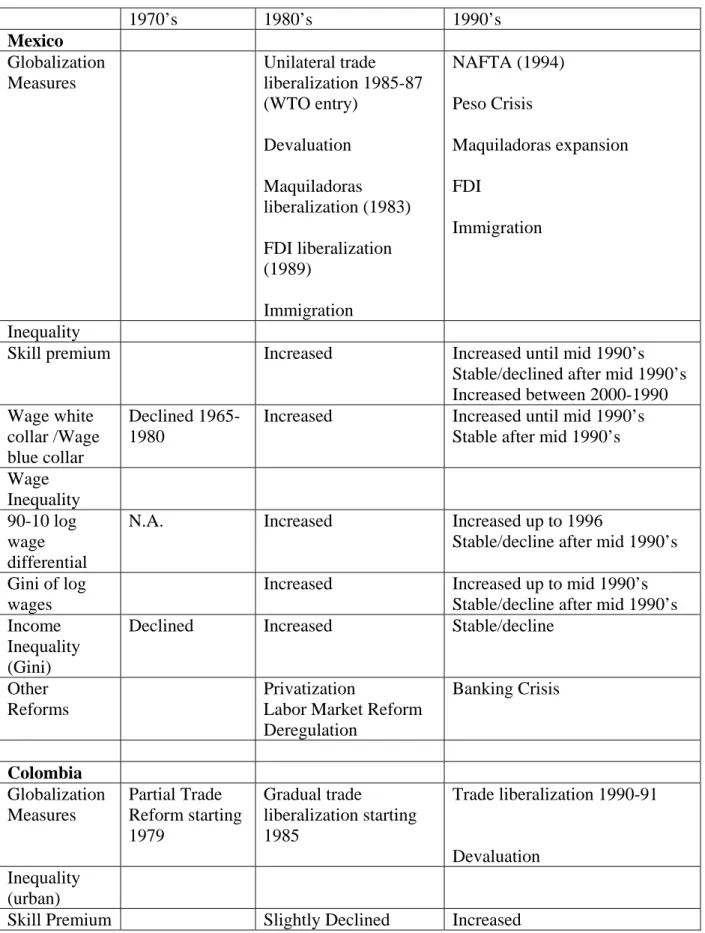
Table 1 provides an overview of the globalization experience of the countries mentioned above (changes in trade policy and other relevant measures of globalization) along with the reported changes in inequality measures. The same table also lists other major reforms that took place during the 1980’s and 1990’s in each of these countries.
Let us first focus on changes in globalization measures, starting with trade liberalization episodes. Table 1 indicates that although some countries (i.e., Argentina and Colombia)
experimented with short-lived trade reforms during the late 1970’s, most countries implemented unilateral trade reforms in the mid- to late 1980’s and early 1990’s: Mexico 1985-87, Colombia 1985-1991, Argentina 1989-1993, Brazil 1988-1994, India 1991-1994. Chile is an exception as it liberalized its trade regime early, from 1974 to 1979.
An important feature of the above reforms was that they drastically reduced tariffs, which were high prior to liberalization and a crucial component of trade protection. The high tariff rates reflect the lack of participation of most developing countries in the tariff-reducing rounds of the GATT/WTO prior to their unilateral trade reforms: some developing countries were not GATT members (for example, Mexico); others (such as Brazil, Colombia, India) were GATT members on paper, but did not have to reciprocate tariff concessions negotiated with the GATT until the Uruguay Round.9 Table 2 reports the average tariffs for the manufacturing industries in the countries of Table 1, in a year before and after the reforms.10 The table illustrates that prior to the reforms tariff levels were high, ranging from 117% in India to 23.5% in Mexico. The comparison of average tariffs before and after the reforms suggests drastic tariff reductions: for example, 85 percentage points in Chile, 73 percentage points in India, and 12.5 percentage points in Mexico. These tariff declines in developing countries are in stark contrast to the low tariff levels and rather minor tariff policy changes in the developed countries during this period. For example, in the Unites States—a country whose tariff policy resembles the policy of most other developed economies— the average tariff was only 4.8 percent in 1982; tariffs declined on
9
Article XVIII of the GATT granted exemption from tariff concessions to developing countries.
10
For each country, the actual year used to describe the period before and after the reforms is recorded below the country name in column 1.
average by .6 percentage points to 4.2 percent between 1982 and 1992 (Bernard, Jensen, Schott (2005)).
In addition to tariff reductions, the unilateral trade reforms also reduced non-tariff
barriers to trade. Unfortunately, as discussed earlier, the information on exact measures of NTBs is often not available, especially for longer periods surrounding trade liberalization episodes. However, the available data on average NTB coverage ratios in manufacturing industries before and after the reforms (presented in columns 3 and 4 of Table 2) suggest that non-tariff barriers to trade were high prior to trade reforms and that liberalization drastically reduced their levels. For example, in Colombia the NTB coverage ratio declined from 72.2% in 1986 to 1.1% in 1992. In Mexico, the share of manufacturing production subject to import licenses dropped from 92% in 1985 to 23.2 % in 1988. In India, the share of manufacturing imports covered by non-tariff barriers dropped from 80% in 1990 to 17% in 1999 (Mishra and Kumar (2005)). Although we do not have access to measures of NTBs in other countries, non-tariff barriers to trade were virtually eliminated in Chile (Dornbusch and Edwards (1994)) and Brazil (Hay (2001)), while Argentina eliminated all import licenses (Galiani and Sanguinetti (2003)).
Table 1 suggests that subsequent to unilateral trade reforms, several countries also
lowered their trade barriers vis a vis specific trading partners through regional trade agreements. The most notable example is Mexico's entry into a free trade agreement with the U.S. and
Canada in 1994 (NAFTA). Argentina and Brazil joined Mercosur in 1991, along with Uruguay and Paraguay. These regional trade agreements likely induced changes in the geographic composition of trade in these countries; however, the changes in trade policy implied by these agreements were substantially smaller than the declines in trade barriers observed during the unilateral trade reforms.
Furthermore, several countries (most notably Mexico and Hong Kong) experienced increases in trade in intermediate inputs associated with global production sharing. For example, after the capital control liberalization in Mexico in the mid- 1980’s, many U.S. companies
shifted relatively low-skill intensive stages of production to Mexico by setting up foreign assembly plants (maquiladoras). Intermediate inputs were imported to Mexico, assembled in maquiladoras, and the final products exported to the U.S. The importance of maquiladoras for the Mexico-U.S. trade was growing during the 1980’s and 1990’s, so that by 2000, maquiladoras accounted for 35% of Mexico's imports from the U.S., and for 48% of its exports to the U.S.
(Hanson (2004)). Similarly, when China liberalized its markets, many firms in Hong Kong shifted their relatively less-skilled labor intensive activities to Chinese border regions, while specializing in higher-skill intensive activities, such as headquarter services at home. As a consequence, the share of intermediate inputs that were imported from China in Hong Kong’s total intermediate inputs rose from less than 10% in 1976 to almost 50% in 1996 (Hsieh and Woo (2005)). A related development has been the growing presence of affiliates of
multinational companies in developing countries during the 1980’s and 1990’s following their capital market reforms. This is illustrated by the increased importance of foreign direct
investment inflows in the economies of developing countries. Table 2 reports FDI inflows as a share of GDP in select countries and illustrates that, while the share of FDI in total GDP was below 1% in 1980’s in these countries, it grew to about 3 % in 2000 for Colombia and Mexico, to 4% in Argentina, and 5% in Brazil. In India however it is still about .5 % of GDP.
Finally, Table 1 indicates that many developing countries experienced large currency fluctuations during the 1980’s and 1990’s. In some instances, these exchange rate changes may have exposed the relevant countries to international markets more than the trade reforms. Verhoogen (2006), for example, argues that Mexico's 1994 peso crisis, during which the peso lost half of its original value, overshadowed the average tariff changes from NAFTA.
3.2 Inequality
The information on inequality is based on empirical studies that have utilized micro surveys of households or firms from the country in question. The relevant sources are cited in the notes to the table. Table 1 reports several measures of inequality: skill premium, wage
inequality, income inequality, and consumption inequality. Note that because of data constraints, some of these measures, most frequently consumption inequality, are missing for many
countries.
We begin by examining the evolution of the narrowest measure of inequality: the wage gap between more and less skilled workers (the so-called skill premium). When information on an individual’s education is available, we use the returns to completed university degree as a measure of the skill premium, and report evidence based on a Mincerian regression; when data on the educational attainment of workers are not available, as is the case with plant surveys, we use the relative wage of white- to blue-collar workers (or, alternatively, the relative wage of
non-production to non-production workers), to measure the skill premium. Several broad patterns emerge.
When we consider the 1980’s and 1990’s as a whole, all countries seem to have
experienced increases in the skill premium. The skill premium increases were largest in Mexico, where the return to university education (relative to primary education) increased by 68%
between 1987 and 1993 (Cragg and Epelbaum (1996)). In other countries the skill premium increased too, but by less: for example, the return to a university degree increased by 16%
(relative to primary education) in Colombia between 1986 and 1998 (Attanasio et. al. (2004)), by over 20% (relative to no complete education) in Argentina between 1992 and 1998 (Gasparini 2004), by 13% in India (relative to primary education) between 1987 and 1999 (Kijima (2006)), and by 10% among men (relative to no complete education) in Brazil (Gasparini (2003)). Given that relatively large skill premium increases have been documented for several countries, it is unlikely that they are all a figment of the measurement problems discussed in section 2, although the exact magnitudes of the changes may be affected by these problems.
A further pattern evident in Table 1 is that the skill premium does not steadily increase throughout the two decades in all countries. Interestingly, the skill premium increases seem to chronologically coincide with the trade reforms in several countries. For example, the skill premium grew steadily during the 1980’s and 1990’s in Mexico,11 which implemented a large trade reform in the mid-1980’s and was continually exposed to other forms of globalization such as outsourcing or FDI for the next two decades. On the other hand, skill premium increases in Colombia, Brazil, Argentina, and India were mainly confined to the 1990’s; the latter countries implemented the bulk of their trade reforms in the early 1990’s. In Chile, where the reforms took place during the 1970’s, the skill premium increased during the 1970’s and 1980’s, declined in the early 1990’s (Robbins (1996), Beyer et. al. (1999)), and then increased again between 1990 and 2000 (Gasparini (2003)). These time-series patterns have led many casual observers to conclude that globalization was the main source of growing inequality in these countries. As we argue in the next section, inference based on these before and after comparisons can be
misleading.
11
Most evidence on Mexico points to a rising skill premium, at least until the mid-1990’s. Gasparini (2003) and Hanson (2004) document skill premium increases over the entire decade using nationally representative household survey and population census data, respectively. However, Robertson (2004) argues that the skill premium declined (or remained relatively stable) after the mid-1990’s in urban areas.
Finally, note that changes in the education-based measure of the skill premium and the relative wage of white-collar to blue-collar workers tend to move in the same direction in countries and periods for which both measures are available. For example, in Mexico the average relative wage of non-production workers increased almost by a factor of 1.5 between 1987 and 1995 (Robertson 2000). This parallel movement is reassuring for studies that rely on the white-collar/blue collar distinction (or non-production/ production worker distinction) as a measure of skill.
The observed changes in the skill premium are generally (but not always) reflected in changes in the wage inequality (usually measured by the Gini coefficient of log wages, or the 90-10 log-wage differential). As with the skill premium, wage inequality increased in Mexico12 in the 1980’s and early to mid-1990’s, in Chile during the 1970’s and 1980’s, and in Colombia, Argentina, and India during the 1990’s. Interestingly, increases in the skill premium are not mirrored in increases in wage inequality in Brazil, where the Gini coefficient remains remarkably stable during 1980’s and 1990’s (Sanchez-Parama and Schady (2003), Green et. al (2001), Gasparini (2003)). Green et al. (2001) attribute this finding to the small share of university graduates in total population. Unfortunately, studies that decompose changes in wage inequality into changes in the distribution of observable skills (such as education), changes in the prices of observable skills, and changes in unobservables, which are common in the literature on the evolution of inequality in the U.S., rarely exist for developing countries. Kijima (2006) provides an example of such decomposition. She formally shows that most of the increase in the post-liberalization wage inequality in urban India can be attributed to increases in the prices for observable skills, and in particular to the return to tertiary education. However, the wage inequality increase of the 1980’s (when returns to tertiary education remained relatively stable), was largely due to changes in the quantity of observed skill. Similarly, Gasparini (2004) finds that wage inequality increases during the 1990’s in Argentina can be to a large extent attributed to the rising skill premium, while changes in the educational composition of the workforce importantly contributed to growing wage inequality in the 1980’s (when the skill premium actually slightly declined).
12
Increases in wage inequality in Mexico during the 1990’s are more pronounced in the first half of the decade, especially in urban areas.
Income-based measures of inequality have been used less widely in the literature on globalization and inequality. As mentioned earlier, this is partly due to the lack of reliable survey data on non-wage sources of income (especially in Latin American countries). Surveys that contain such information are more recent and often less frequently conducted than labor market surveys. The limited information available in Latin American countries (mainly drawn from Gasparini (2003)) suggests that income inequality and wage inequality move in the same direction, although changes in income inequality are at times less pronounced than changes in wage inequality or the skill premium (for example, in Mexico and Colombia during the 1990’s). Finally, a consumption-based measure of inequality is to our knowledge available over this period only for India, which has a nationally representative consumer expenditure survey that spans the 1980’s and 1990’s.13 In urban areas, consumption inequality moves in the same direction as income and wage inequality; it is relatively stable during the 1980’s (a period prior to major liberalization), but it increases during the 1990’s. Although this pattern cannot be generalized to other countries, it is reassuring that at least in the one case where both income and consumption inequality measures are available, they both move in the same direction.
In summary, the evolution of various measures of inequality suggests that most of the developing countries experienced an increase in inequality during the past two decades. More importantly, we find no evidence that any measure of inequality decreased over this entire period when compared to earlier periods characterized by less globalization. As we note in the
introduction to this section, our discussion abstracts from several potentially important countries, most notably China. Branstetter and Lardy (2006) provide an excellent detailed review of the process through which China increasingly liberalized its trade and foreign direct investment policies during the 1980’s and 1990’s, culminating with the country's entry into WTO in 2001. During this period, income inequality in China has increased (Wei and Wu (2002)), so that China's experience is consistent with the positive correlation between inequality and exposure to globalization noted above.
The survey of the evidence confirms Wood (1999), who noted that inequality increased in several middle-income Latin American countries that liberalized their trade regimes during the 1980’s and 1990’s. It further suggests that this positive relationship also holds in the cases of
13
There is however a large debate on whether these survey data allow for over time comparisons during the 1990’s given the changes in the survey questionnaire. See Deaton and Dreze (2002) for an excellent discussion.
India, China, and Hong Kong. As noted previously by Wood (1999), the experience of
developing countries that globalized during the 1980’s and 1990’s contrasts with the experience of several South East Asian countries (South Korea, Taiwan, Singapore) that underwent trade reforms in the 1960’s and 1970’s. The latter observed a decline in inequality as they opened up their economies to foreign markets. We discuss the possible explanations proposed by Wood (1999) for the differences in these correlation patterns between countries that globalized in the 1960’s and 1970’s and countries that globalized in the 1980’s and 1990’s in section 5.1.1. Unfortunately, neither detailed data on tariffs nor micro surveys are readily available for the early globalizers during the periods of reform, to allow us to examine whether the declining inequality in these countries was caused by globalization as opposed to being just coincidental.
In general, one needs to be careful drawing conclusions regarding the link between globalization and inequality simply based on before and after comparisons. Table 1 lists other important reforms that took place during periods of external liberalization in selected countries. Perhaps the most striking feature of these reforms is the fact that not a single country
implemented trade reforms or FDI liberalization in isolation from other policy changes. For example, the most drastic trade policy liberalization in Colombia in 1990/91 coincides with changes in labor market regulation that substantially increased the labor market flexibility. Mexico's 1985 trade reform took place amidst privatization, labor market reform, and deregulation. These concurrent policy reforms combined with the simultaneous change of several globalization measures make it particularly difficult for the researcher to disentangle the effects of trade liberalization (or other aspects of globalization) from the effects of other policies.
4.
Identification of Trade Policy Effects
The previous section documents that many developing countries experienced an increase in inequality as they became more exposed to various dimensions of globalization. But establishing a causal link between globalization and inequality by providing credible empirical evidence poses several challenges beyond the measurement issues discussed in section 2. We highlight these issues for the case of trade policy below, however similar concerns exist with respect to other aspects of globalization
Although there are several channels through which trade policy can affect inequality within a country (we discuss these channels in detail in the next section), a common theme in
many of the mechanisms discussed in the theoretical literature is that trade policy affects wage inequality by changing the relative demand for skilled workers. The main empirical challenge is how to isolate the effects of trade from other contemporaneous changes in the economic
environment that may have induced shifts in the relative demand and supply of skilled labor. Governments in developing countries often implement trade reforms concurrent with other economy-wide policy changes, ranging from labor market reform to industrial de-licensing, tax reforms, and privatization; Table 1 illustrates the prevalence of reforms that may have had confounding effects on wage inequality.
4.1 A General Equilibrium Approach
Any study that attempts to address the ambitious question of "what is the overall effect of trade liberalization on inequality in a country" thus requires strong modeling and identification assumptions. Porto (2006) is an example of such a study. He examines the implications of the Argentinean trade reform for the distribution of household welfare in a general equilibrium model of trade. In his framework, trade policy influences household welfare by changing the relative prices of goods, which in turn affect labor income and consumption. Because
households in different parts of the pre-reform welfare distribution differ in the composition of their consumption bundles and their education endowments, they will be differentially impacted by price changes. For example, households in the left tail of the welfare distribution spend a higher share of their budget on basic items such as food, and are less educated than richer households. The model, combined with predictions about the changes of traded good prices, estimates of wage-price elasticities, and estimates of the responsiveness of the non-traded good prices to traded good prices, can be used to simulate the effect of trade policy changes on the distribution of household welfare (i.e., household expenditure per capita).
The main advantage of this approach is that it ultimately yields an answer to the important question of how trade reform affects the welfare distribution within a country in a general equilibrium setting that explicitly accounts for intermediate good linkages and non-traded goods. However, the predictions of the model depend in a crucial way on estimates of parameters that are typically not known: the wage-price elasticities; the elasticity of non-traded good prices with respect to traded good prices; and the degree of pass-through from trade policy changes to product prices. These parameters are difficult to estimate consistently with
time-series data on wages and prices in a setting when many other policies change contemporaneously with trade. Moreover, if labor and capital are assumed to be mobile within a country, as is often the case in long-run general equilibrium trade models, then the level of industry aggregation needed to empirically implement the general equilibrium approach is very high, implying that there is not enough variation in the data to identify the relationship between trade policy and the variables of interest (prices, wages, etc.). For example, in the Hecksher-Ohlin model, both skilled and unskilled labor are assumed to be perfectly mobile, so that – no matter what the
cross-sectional pattern of trade protection or liberalization is - the wages for skilled and unskilled wages should be equalized across different sectors in an economy. If this were true, it would eliminate the prospect of exploiting any cross-sectional variation in trade barriers and wages in order to identify the relationship between trade and wage changes.
4.2 Differential Exposure Approach
An alternative approach to identifying the effects of trade liberalization on the wage or income distribution is taken by several recent studies that have focused on cross-sectional variation in changes in trade protection; such studies examine whether within a country, industries or regions that were more exposed to trade liberalization, experienced smaller or bigger changes in wage or income inequality than less-exposed industries/regions (Topalova (2004a), Hanson (forthcoming), Goldberg and Pavcnik (2005), Wei and Wu (2002)). The empirical framework in this line of work usually exploits household survey data that include information on individuals’ industry of occupation, wage, region of residence, and various demographic characteristics such as age, education, etc., to construct measures of average wages by industry (after controlling for relevant worker, industry and job characteristics) or measures of wage or income inequality by region. These measures are then related to trade policy changes over the span of a trade liberalization episode to identify the effect of trade barrier reduction on inequality. To the extent that the tariff changes differ across industries/regions and are
exogenous (or can be instrumented for), the differential exposure of various industries/regions to tariff changes enable the researcher to separate the effects of trade liberalization from the effects of concurrent policy changes. The underlying premise of this line of work is that labor is not perfectly mobile across industries and/or regions (or at a minimum that certain skills are sector-specific and not easily transferable across industries), so that wages are not equalized across
sectors/regions. This premise is plausible in the short- and medium-run, but questionable in the long run. At any rate, it is important to note that failure of this premise to hold in practice does not invalidate the approach; it simply implies that one would not find any differential trade policy effects across industries/regions in this case, as wages are equalized across
industries/regions. However, studies that have exploited industry or regional variation in developing countries do find effects, suggesting that the assumption of constrained labor mobility is more appropriate in the context of developing countries.
The main advantage of approaches that exploit differential time-changes in trade protection across cross sectional units is that they require much weaker identification assumptions than the general equilibrium approach described above, so that the causal link between trade and inequality is perhaps more convincingly established. On the other hand, such approaches can only identify industry- or region-specific deviations from aggregate trends that could in principle in part be due to trade policy. This limitation is discussed in Topalova (2004a) who exploits the differential exposure of Indian districts to trade liberalization to identify the effects of trade on poverty. Her results indicate that districts that were more exposed to
liberalization experienced a relative increase in poverty (or, more accurately, a smaller decrease in poverty). However, poverty declines dramatically in India over this period. While her
approach can plausibly identify the role of trade in explaining district-specific deviations from this aggregate trend, it cannot identify the role of trade liberalization in explaining the trend itself.
An additional limitation of the aforementioned studies is that their usual focus on nominal rather than effective tariff rates implies that they ignore intermediate input linkages, so that they are ultimately partial equilibrium in nature. This focus is however not inherent in the nature of the identification approach, but rather dictated by data constraints; effective rates of protection are available for a few, isolated years at best, and even then, they tend to be noisy. Fortunately, for the few years for which effective rates are available, the correlation between nominal and effective rates of protection appears to be positive and high, so that the findings based on nominal tariff rates are likely to be robust to using effective tariff rates as a measure of protection. At any rate, this latter shortcoming could in principle be addressed with better data that would allow one to compute effective rates of protection.
4.3 The Endogeneity of Trade Policy
Another challenge facing the literature on trade and inequality is that trade policy is the outcome of a political process and thus endogenous. While there is a large theoretical and empirical literature on the determinants of the protection structure across industries, empirical work on trade and wages has only recently focused on the endogeneity of trade protection and liberalization. The concerns about the endogeneity of trade policy and political economy of protection apply to all studies. For example, in studies focusing on the overall effects of trade reform, the political economy of protection might affect the assumptions on the expected price changes subsequent to the reforms and the consistency of the estimates of wage and cross-price elasticities.
Similarly, studies that exploit cross-industry or cross-regional changes in the pattern of protection have to answer the question, is it valid to treat such changes as exogenous?
Fortunately, the nature of the tariff reforms in several developing countries such as Colombia, Brazil, Mexico, and India makes the usual concern about the endogeneity of trade policy in the context of these countries’ trade liberalization potentially less severe. Their governments' goal in implementing trade reforms was to lower tariff levels across industries to more uniform levels that were negotiated with the WTO, rather than cater to special lobby interests; as a result, industries with initially higher level of protection experienced greater tariff declines. Thus, trade liberalization did not simply lower tariff levels, but also changed the structure of protection across industries. In fact, studies document that industries with larger pre-reform tariffs experienced larger tariff changes in Colombia (Goldberg and Pavcnik (2005)), Brazil (Pavcnik et. al. (2004)) and India (Topalova (2004a)). This pattern suggests that industry lobbies may have had less influence on the magnitude of the tariff changes during the reform period.
With these methodological issues in mind, we now examine the existing evidence on various channels through which trade policy has affected inequality.
5.
The Relationship between Globalization and Inequality
Globalization affects individuals through three main channels: changes in their labor income, changes in relative prices and hence consumption, and changes in household production
decisions. Consistent with the income- or wage-based measurement of inequality, most research to date has focused on the first channel. The first five parts of this section are therefore devoted
to summarizing the evidence related to the effects through the labor income channel. Since the increase in the skill premium has been identified as one of the main contributing factors to rising wage inequality, we start by reviewing the main explanations for the widely documented
increase in the skill premium (part 5.1). Next we discuss other ways through which globalization may have impacted the income distribution: transitional unemployment (part 5.2); changes in industry wages (part 5.3); uncertainty (part 5.4) and potential effects on labor market standards (part 5.5). The sixth part of this section focuses on the effects of globalization on household production and consumption decisions.
5.1
Explanations for the Increase in the Skill Premium
Whatever explanation for the widening wage gap between skilled and unskilled workers in many developing countries one adopts, there seems to exist wide agreement that the skill premium increase was driven by an increase in the demand for skilled workers. The main evidence on this issue comes from studies that have documented that wages and employment in various skill categories have moved in the same direction implying that demand shifts dominated (Robbins 1996, Sanchez-Paramo and Schady (2003)). The related arguments are similar to the ones used in the context of the inequality debate in developed countries, but appear even more convincing when applied to developing countries, as many of them (Latin American countries in particular) did not experience the same increase in the supply of educated workers as the U.S. and East-Asian economies (Attanasio and Szekely (2000), Sanchez-Paramo and Schady (2003)). The causes of the increased demand for skilled workers have however been the subject of intense debate.
(1) Stolper-Samuelson Effects
The most direct link between trade openness and changes in the skill premium is provided by the best known general equilibrium model of International Trade, the Heckscher-Ohlin model. This model has shaped thinking about the distributional effects of trade openness in the last decades, even though the theoretical and empirical shortcomings of the model are widely recognized by now14. In its simple 2x2 version the model predicts that countries that are relatively rich in unskilled labor will specialize in the production of goods that are unskilled-labor intensive. The
14
On the theoretical side, the model rests on extremely restrictive assumptions such as perfect competition, perfect labor and capital mobility within a country and fixed technology. On the empirical side, there has been no support for the predictions of the model, at least not in its strict version.
connection to the income distribution is provided by the model’s companion theorem, Stolper-Samuelson, that links changes in product prices to changes in factor returns. A
trade-liberalization-induced increase in the price of unskilled-labor-intensive products should according to Stolper-Samuelson increase the return to the factor that is intensively in the production of these products, unskilled labor. In contrast, the expected decrease in the price of the skilled-labor intensive imported products should lead to a decline in the wage of skilled labor. Based on this theorem and the empirical evidence suggesting that developing countries are richly endowed with unskilled labor15, one would expect the distributional changes induced by trade liberalization in developing countries to favor the unskilled workers.
The general equilibrium nature of the Heckscher-Ohlin model makes it extremely hard to bring it to the data. Given that the model’s predictions refer to economy-wide factor returns, one has only one observation per year to work with. In theory one could try to identify Stolper-Samuelson effects by relating trade-policy-induced relative price changes to factor returns over time, but in practice this approach is fraught with problems. Price data are often incomplete, while the changing mix of goods produced with different factor proportions within statistically defined product categories makes price comparisons over time less informative than one would have hoped. Furthermore, prices are determined endogenously and may change for reasons unrelated to trade. For these reasons a direct link between goods and factor prices as suggested by general equilibrium trade models has been empirically elusive.
Despite the lack of direct evidence on Stolper-Samuelson effects, it seems safe to say that the widening wage gap between skilled and unskilled workers in the last two decades in many developing countries that are presumed to be relatively abundant in unskilled labor seems inconsistent with the spirit of the Hecksher-Ohlin theory. In principle it is possible to reconcile the evidence on wage inequality with the theory by considering various extensions of the original model. However, several other patterns documented in developing countries seem inconsistent with Hecksher-Ohlin.
15
The most influential paper on this issue has been the study by Krueger et al (1981) that calculated the factor content of trade in manufactures for several developing countries in the 1970’s and showed that the exporting sectors were less skill-intensive than the import-competing sectors. These results have been confirmed in several other studies (see Wood (1999) for an overview). The only caveat is that most of these studies do not cover the last two decades (they typically include data up to the mid-1980’s) and do not differentiate between higher-skilled and lower-skilled trading partners for each developing country.
First, a fundamental prediction of factor endowment based trade theories is that the adjustment process to trade reforms would involve labor reallocations from sectors that experience price declines, and hence contract, towards sectors that experience relative price increases and hence expand. However, most studies of trade liberalization in developing countries find little evidence in support of such reallocation across sectors. The lack of labor reallocation following trade reform has been documented by Revenga (1997), Hanson and Harrison (1999), and Feliciano (2001) for Mexico; by Attanasio, Goldberg, and Pavcnik (2004) for Colombia; by Currie and Harrison (1997) for Morocco; by Topalova (2004a) for India, and by Wacziarg and Seddon (2004) in a cross-country study of trade liberalization, where, however, trade liberalization is captured only through a time dummy. These studies attribute the lack of labor reallocation in response to trade reform to either rigid labor markets (so that the adjustment to trade liberalization occurs through relative wage adjustments (Colombia, Mexico, India)), or to the existence of imperfect product markets (so that firms respond by lowering of profit margins (Mexico, Morocco) and not through labor reallocation across sectors). An alternative line of explanation for the lack of labor reallocation is suggested by recent work by Munshi and Rosenzweig (2005), who also document very low spatial (and social) mobility in India.16 They argue that the social insurance provided by sub-caste networks creates a disincentive to migrate or out-marry, out of fear of losing the services of these networks. Interestingly, the increase in inequality (possibly due to the Indian reforms) is shown to lower mobility (which was low to start with) even further, as sub-castes successfully coped with the consequences of rising inequality. In contrast, Grossman (1986) and Revenga (1992) find greater employment than wage sensitivity to trade shocks for the U.S. These differences in the adjustment mechanisms are consistent with greater labor mobility in the United States compared to the developing economies.
A second piece of evidence that seems inconsistent with Stolper-Samuelson effects is that empirical work on developing countries typically finds that the share of skilled workers has increased substantially within most industries in the last two decades. Within-industry increases in the share of skilled workers have been reported for Argentina, Brazil, Mexico, Chile, and
16
Further evidence on this issue includes Topalova (2004a), who documents little spatial mobility across districts in India during the 1980’s and 1990’s, and Chiquiar (2004), who finds little mobility of individual across Mexican regions in 5-year intervals surrounding the Mexican trade reforms in the late 1980’s and 1990’s (see Table 5 in his paper).