"AuTopEx": Automated Topic Extraction Techniques
Applied in the Software Engineering Domain
The design and evaluation of an approach for Automated Topic
Extraction
Bachelor of Science Thesis Software Engineering & Management
JONATHAN KLEMETZ
MAGNUS JOHANSSON
University of Gothenburg
Chalmers University of Technology
Department of Computer Science and Engineering
Göteborg, Sweden, June 2016
The Author grants to Chalmers University of Technology and University of Gothenburg
the non-exclusive right to publish the Work electronically and in a non-commercial
purpose make it accessible on the Internet.
The Author warrants that he/she is the author to the Work, and warrants that the Work does
not contain text, pictures or other material that violates copyright law.
The Author shall, when transferring the rights of the Work to a third party (for example a
publisher or a company), acknowledge the third party about this agreement. If the Author
has signed a copyright agreement with a third party regarding the Work, the Author
warrants hereby that he/she has obtained any necessary permission from this third party to
let Chalmers University of Technology and University of Gothenburg store the Work
electronically and make it accessible on the Internet.
"AuTopEx": Automated Topic Extraction Techniques
Applied in the Software Engineering Domain
The design and evaluation of an approach for Automated Topic Extraction
Jonathan Klemetz
Magnus Johansson
© Jonathan Klemetz,
June 2016
.
© Magnus Johansson,
June 2016
.
Examiner: Christian Berger
Supervisor: Alessia Knauss
Supervisor: Hang Yin
University of Gothenburg
Chalmers University of Technology
Department of Computer Science and Engineering
SE-412 96 Göteborg
Sweden
Telephone + 46 (0)31-772 1000
Department of Computer Science and Engineering
”AuTopEx”: Automated Topic Extraction Techniques Applied
in the Software Engineering Domain
Magnus Johansson
Gothenburg University
Software Engineering & Management
Lindholmsplatsen 1, 412 96 Gothenburg, Sweden
Jonathan Klemetz
Gothenburg University
Software Engineering & Management
Abstract
Automatically extracting topics from
scien-tific papers can be very beneficial when a
re-searcher needs to classify a large number of
such papers.
In this thesis we develop and evaluate an
approach for Automatic Topic Extraction,
Au-TopEx.
The approach is comprised of four
parts:
1) Text pre-processing.
2) Training a Latent Dirichlet Allocation model
on part of a corpus.
3) Manually identifying relevant topics from
the model.
4) Querying the model using the rest of the
cor-pus.
We show that it is possible to automatically
extract topics by applying AuTopEx on a corpus
of scientific papers on autonomous vehicles.
According to our evaluation AuTopEx works
better on full-text articles than texts consisting
of just title, abstract and key-words.
Finally we show that this approach is vastly
faster than human annotators, although not as
accurate.
The source code used to build AuTopEx can be
found at:
(https://github.com/Klemetz/TopicExtraction).
1
Introduction
In this thesis we design and evaluate an approach
for Automated Topic Extraction. Which is evaluated
on papers in the Software Engineering domain, more
specifically on autonomous vehicles.
1.1
Background
Automated Topic Analysis and Automated Topic
Extraction allow researchers to extract the potential
topics that are contained in a large text corpus. This
has been tried in other scientific domains but (to the
best of our knowledge) not in the field of Software
En-gineering.
1.2
Problem Domain & Motivation
In order to find relevant information, researchers
of-ten need to read a large number of published articles.
This is especially true when conducting work like
map-ping studies or Systematic Literature Reviews and can
be a very time-consuming process.
There is a lack of automated approaches to topic
extraction that could support activities such as
Sys-tematic Mapping Studies, especially in the Software
Engineering domain.
1.3
Research Goal & Research Questions
Our research goal is to investigate the automation
of Topic Extraction from scientific papers in order to
support time-consuming activities such as Systematic
Mapping Studies [18]. We investigate extraction from
both full-text articles and texts containing only title,
abstract and keywords using a topic model called
La-tent Dirichlet Allocation (LDA).
The research goal has been divided into three
re-search questions.
RQ 1: How can we support Automatic Topic
Ex-traction for scientific papers in the Software
Engineer-ing domain?
RQ 2: Which approach is better for Automatic
Topic Extraction: a) Extraction from title, abstract
and keywords or b) Extraction from full text paper?
RQ 3: How well does the approach of using Latent
Dirichlet Allocation (with suitable pre-processing)
per-form compared to a manual method?
1.4
Contributions
In this paper we present an approach (which we call
”AuTopEx”) for applying Automated Topic Extraction
on a large number of scientific papers.
From the extracted data, relevant topics are
identi-fied and labeled. Researchers can then also automate
the process of finding which papers in the corpus that
are most likely to deal with the relevant topics.
Researchers will benefit from AuTopEx as it shows
the applicability of Natural Language Processing
(NLP) techniques in the Software Engineering Domain.
1.5
Scope
We construct and evaluate an approach for
Auto-matic Topic Extraction using Latent Dirichlet
Allo-cation (LDA). This could contribute in making
Au-tomatic Topic Extraction a viable approach in
Soft-ware Engineering research. We do not evaluate other
statistical models such as the n-gram model or term
frequency-inverse document frequency. However, their
potential use in our approach is discussed in the
Con-clusions and Future Work section.
1.6
Structure of the Article
Section 2 presents related work on Automated Topic
Extraction. Section 3 covers our Research Strategy. In
Section 4 we answer our research questions. First we
describe AuTopEx and go into detail about it’s
mentation. Then we evaluate the results from
imple-menting AuTopEx compared to human performance.
Evaluations are made on two corpuses, one corpus
con-taining articles in full-text and the other only title,
ab-stracts and keywords. Section 5 contains analysis and
discussion of the results. In this section we also discuss
the validity threats to our findings. Section 6 concludes
our findings and discusses what implications they may
have for future research.
2
Related Work
We have not found any articles dealing with tools
specifically tailored towards automation of Systematic
Mapping Studies. These do however share some
sim-ilarities with Systematic Literature Reviews (SLR).
Hence we can discuss tools that support the latter.
According to Marshall and Brereton [16], the two
most popular frameworks for tools that support SLR:s
are the Projection Explorer Pex and ReVis which both
make use of Visual Text Mining techniques.
Projec-tion Explorer Pex [6] can create a visualizaProjec-tion from
a set of textual documents either by building a
vec-tor representation of the text corpus (which is handled
as table data to derive similarity information). It can
also compute similarities by directly comparing text
against text. It could possibly be used in helping with
document classification during a mapping study.
ReVis [5] supports primary studies selection during
SLRs. Among it’s tools is the possibility of
visualiz-ing the relationships of potential primary studies. A
2D document map shows content and similarities of
di
↵
erent documents. This is based on converting the
documents into multi-dimensional vectors which can
be reduced using stemming, by eliminating stop words
and using projection techniques. ReVis only uses title,
abstract and keywords for this document map however,
and we ideally want to use full-text articles to discover
topics.
CitNetExplorer analyzes citation patterns in
scien-tific literature. The tool collects bibliographical data
and constructs a citation network which can then be
analyzed and visualized[11].
This could be useful
for mapping a specific research topic, since key word
searches could miss out on papers that do not contain
these key words.
VOSviewer [10] is a tool for creating and
visualiz-ing bibliographical networks. It can also use text
min-ing to create term maps from a text corpus. Part of
speech-tagging is used to identify noun phrases and a
technique for choosing the most relevant noun phrases
is applied. Maps and clusters can then be created and
visualized.
In
[12]
the
creators
of
CitNetExplorer
and
VOSviewer discuss the limitations of both tools. They
argue that the loss of information occurring when
ap-plying these techniques is very hard to measure and
that they should be used as a complement rather than
substitute to expert judgment.
One approach for speeding up topic extraction could
be automatic summarization of articles.
The
ab-stract of a scientific paper is meant to provide a quick
overview, but does not necessarily provide enough key
information for the researcher. Automatic
summariza-tion techniques can capture scientific concepts such as
Hypotheses, Method and Background on a sentence
level [14] and thus provide more information than just
an abstract. However, this work builds on having many
domain experts manually annotate a large number of
scientific papers used for training the machine learning
classifiers [15]. Such an undertaking is out of scope for
this thesis.
The ”Latent Dirichlet Allocation” method is widely
used and applicable in the discipline of Natural
Lan-guage Processing (NLP) [2]. As Blei puts it ”The
sim-ple LDA model provides a powerful tool for discovering
and exploiting the hidden thematic structure in large
archives of text” [2]. When attempting to extract
top-ics from a large corpus as the purpose is for the
Au-TopEx approach, a tool like the LDA method is very
compelling. Blei has also provided some comparisons
with other models which makes the choice of applying
LDA an attractive option. He shows that even though
LDA is meant to perform ”in the spirit of LSI”(Latent
semantic indexing) [3], the LDA method outperforms
the LSI method regarding perplexity measures [3].
But can we be sure that NLP tools such as the LDA
method are fitting for the Software Engineering
do-main? Studies such as the one performed by Hindle et
al [9], shows us that they can be applied but might not
always be suitable. Hindle presents in his paper that in
the domain of software engineering, neither LDA nor
the n-gram analysis approach may be suitable if the
intended goal is to extract topics from files
contain-ing computer code. However, we do not expect that
code snippets will make up anything but a very small
portion of the scientific articles that we want to apply
Automatic Topic Extraction on.
3
Research Strategy
We have chosen Design Science as our research
strat-egy. Hevner et. al [8] present seven guidelines for
con-ducting, evaluating and presenting Design Science
re-search. These address design as an artifact, problem
relevance, design evaluation, research contributions,
re-search rigor, design as a re-search process, and rere-search
communication.
The artifact is in our case an approach based on
Nat-ural Language Processing techniques. In this approach
we apply a number of pre-processing steps on a large
corpus of texts. Then we automatically extract topics
from the corpus. Finally we automatically classify the
papers based on the extracted topics.
The problem relevance is the fact that doing this
manually is a very time-consuming process.
Evaluation will be done by comparing the topics
that the machine learning algorithm produces with
annotation made manually by humans. Both of the
authors will first do manual annotation of the same
papers separately and then confirm that there exists
an inter-annotator agreement. Basically that both
au-thors have identified the same topics in each paper.
As for research contributions we are transferring
knowledge from the domain of language technology to
the area of Software Engineering. We also believe the
resulting approach can be helpful in future research
where speeding up topic extraction can be beneficial.
When it comes to research rigor we are actively
se-lecting and applying appropriate theories and methods
both when constructing and evaluating the resulting
artifact.
Design as a research process has been a must from
the start, since this approach has not been applied
on scientific articles about Software Engineering
be-fore. Investigating existing tools and techniques that
are already being used for similar purposes and how to
implement them properly, is the whole foundation of
constructing our approach. We have worked in
itera-tions during the whole process, constantly improving
our approach by trying out di↵erent ways of working
with existing tools and developing our own tools where
needed.
Finally research communication must be taken into
account.
Since this thesis is concerned with
re-search, we ensure that we explain our methods as
thoroughly as possible so that other researchers can
evaluate the approach.
All of our code is open
source and available under the Gnu General Public
License Version 2 at
(https://github.com/Klemetz/
TopicExtraction)
along with proper documentation
so that others can apply the approach themselves.
4
Results
4.1
AuTopEx
In order to answer
RQ1: ”How can we
sup-port Automatic Topic Extraction for scientific
papers in the Software Engineering domain?”,
we have developed the approach AuTopEx, which
sup-ports Automatic Topic Extraction.
AuTopEx can be broken down into four steps:
1.
Pre-processing the articles of a large corpus
of scientific paper.
2. Training a Latent Dirichlet Allocation (LDA) model
using 10 percent of the pre-processed papers.
3. Manual identification and labeling of relevant topics
returned by the model.
4. Automatic classification (extracting the topics) of
the rest of the corpus by querying the LDA model.
Some of the papers will be annotated manually
be-fore automatic classification. We can evaluate the
accu-racy of the model by comparing this manual annotation
with the automatic classification of the same papers.
We have chosen existing tools to help answering
our research questions and to construct AuTopEx.
Calibre
(https://calibre-ebook.com/)
is used for
pdf-to -text conversion.
The Natural Language
ToolKit(NLTK)
(http://www.nltk.org/)
is used for
pre-processing individual texts and Gensim
(https:
//radimrehurek.com/gensim/)
is used for applying
the machine learning algorithms. Complementary tools
in the form of Python scripts have been developed by
the authors when needed.
4.1.1
Text Pre-Processing
Pre-processing the scientific papers follows a pipe-line
of six consecutive steps:
1. Pdf-to-text conversion
2. Converting all text to lower-case
3. Tokenization
4. Removal of stop words, numbers and punctuation
5. Lemmatization
6. Removal of references section
Pdf-to-text conversion
The first step of preparing the individual scientific
pa-pers is to convert them from pdf to text format. We
use the free and open-source Calibre software. The
reasons are two-fold: a) Unlike other tools we tried,
Calibre handles ligatures well and b) dehyphenation.
If a word is cut o
↵
with a hyphen at the end of a
col-umn, the program checks if the hyphenated word exists
elsewhere in the document without the hyphen and
de-hyphenates it if that is the case. This ensures that more
accurate words remain in the document.
Converting all text into lower-case
All text is transformed into lower-case format, to
en-sure correct multiplicity of words even if they appear at
the start of a sentence. It is also important that the list
of stop words (introduced below) are all in lowercase.
Tokenization
Tokenization means we break down the stream of text
into meaningful elements. In our case this means
indi-vidual words (all contiguous alphabetic characters
be-come part of a token) which are then separated from
symbols such as punctuation. The Natural Language
Toolkit(NLTK) has a number of tokenizers, we
recom-mend their ”regexptokenizer” for this.
Removal of stop words, numbers and
punctua-tion
Latent Dirichlet Allocation uses a Bag-of-words model
[3]. This means that neither grammar or word order is
important, only the multiplicity of the words. Thus we
can now safely remove all punctuation and also stop
words (such as ”a”, ”and”, ”if”, ”or” etcetera).
Greek letters are often used as mathematical
nota-tion in scientific articles. Such a symbol on it’s own has
little to no semantic value for an annotator examining
our results. Neither do we expect numbers from the
articles to hold any semantic importance in the topic
extraction so these are removed as well. This is
eas-ily solved by only allowing alphabetical words in the
tokenizer.
Punctuation is also removed using regular
expres-sions.
Stop words are removed by using a stop word list.
We use the default stop words list from NLTK, and
supplement it with more words that we deem have no
semantic value. For example the word ”fig.” very
com-monly appears next to images and graphs in research
papers. This word pollutes the results rather than give
the topics any semantic meaning.
Lemmatization
Within a document a word can use several forms (such
as ”organize”, ”organizing” or ”organizes”) while all
referring to the same concept, and we are interested
in the multiplicity of this concept. Stemming is the
process of reducing inflected words to their word stem.
A stemmer only operates on the word at hand by
cut-ting of the word stem. ”Organize”, ”organizing” and
”organizes” would all be reduced to ”organ” using a
stemmer, which is not what we want since the word
now has an entirely new meaning.
Lemmatizing is closely related to stemming in that
it reduces inflected words, however it reduces the word
form to linguistically valid lemmas, using algorithms
that deal with grammar and a built-in dictionary. For
this purpose we use the WordNet Lemmatizer included
with NLTK.
Here are a few example sentences. ”They walk down
the road. She walked by him. The elephant walks on
four legs while we are used to walking on two.”
Using the most common stemmer (Porter) we get:
”They walk down the road . She walk by him . The
eleph walk on four leg while we are use to walk on two
.”
Using the WordNet lemmatizer we instead get:
”They walk down the road . She walked by him . The
Pdf-to-text
conversion
Make text
lowercase
Tokenization
Removal of stop
words, numbers
& punctuation
Lemmatization
Removal of
references
Figure 1: The steps involved in text pre-processing.
elephant walk on four leg while we are used to walking
on two .”
The di
↵
erences between stemmers and the basic
dif-ferences between stemmers and lemmatizers are
dis-cussed in [13].
Removal of References section
Finally, all of the papers have a ”references” section at
the end. We do not want the words in this section to
pollute the article at hand. This section is removed by
finding the last occurrence of the word ”reference”
(re-member we have lemmatized all words) and removing
all remaining words in the document including
”refer-ence”. In the rare event that a reference has the word
”reference” in it, some references might remain in the
document. On the whole however we do not expect
this to have a major impact on the results.
Pre-processing Title, Abstract, Keyword texts
Pre-processing these texts uses the same pipe-line as
the full text method outlined at the beginning of this
section but with the first and last step removed. This
is because we already have the abstracts available in
text format and they don’t contain any references.
Extracting title, abstracts and keywords from a
full-text paper can be di
ffi
cult, since not all articles are
formatted in the same way. Some papers do not even
include the keywords in the article document. Therefor
we chose to extract this information using meta data
stored in the software Endnote used by the researchers
who provided us with the data used for the evaluation.
Endnote can produce a single text file that contains
author names, publishing year, publication, title,
ab-stract and keyword for all articles that you want to
perform topic extraction on.
A Python script extracts the relevant meta data
(title, abstract and keywords) and saves a separate
text file for each article (the model needs an entire
corpus of papers to work with) naming them in the
format author-publication-year-title for identification
purposes when doing the evaluation.
Then we clean each document the same way as we
did for the full-text articles (tokenization, removal of
stop-words, lemmatization).
4.1.2
Training the model
Latent Dirichlet Allocation
The intent of using LDA in this study is to get topics
from the documents in the supplied data sets. LDA
can do this through its probabilistic, generative
func-tionalities. So a trained LDA model will be able to
point out topics for documents[19]. There are however
quite a few ways of training an LDA model to achieve
the queryable functionalities [19].
Most of the ways of training a model boils down to
a guessing game. This guessing game begins when for
every document every word has been assigned to a
ran-dom topic. A topic is a list of words and how many
instances of them there are. A word can reoccur
sev-eral times in a topic, this gives it an increased chance to
be dominant within this topic, and get more instances
of itself within this topic. Then the algorithm, for
ev-ery word in evev-ery document, looks for what topic the
current word could fit in as well, then moves it there.
Depending on how many instances of the current word
there are in that topic already, the chance that the
word will be moved there varies. Now when the
cur-rent word is moved, the curcur-rent words new topic which
has received the current word will have an increased
chance of receiving another instance of this word.
In short the guessing game can be described as that
the LDA model gets better at guessing as it keeps at
it, and a measurement of measuring how well a model
guesses is it’s perplexity value [3].
Using the Gensim Framework
Gensim is a framework that is accessible through the
programming language Python. The Gensim
frame-work allows the user to build and train their own
unique LDA model based on the users own corpora.
Gensim also o
↵
ers other kinds of machine learning
al-gorithms outside the scope of LDA [19].
When creating an LDA model with Gensim, it
re-quires a corpus that has been tokenized. In the case
of AuTopEx, the models trained are handed a
num-ber of the pre-processed text files. AuTopEx can then
through the Gensim framework train an LDA model
given a sample from the whole corpus.
Throughout the training process, the Gensim
frame-work tells the user whether or not the model is
improv-ing by printimprov-ing out what is called a perplexity measure
[2]. An indication of whether the model is improving
is, if the perplexity measure is decreasing for each
iter-ation [3].
Then, when the perplexity measure is down to a
pre-determined value, the LDA model can be saved down
on the hard drive of the users system and reused on
the entire corpus. This is where AuTopEx can return
which topics are deemed most relevant for each
docu-ment.
To find measures that act as good examples when
training a model to perform as well as possible one can
observe Bleis experiments[3]. When asking for more
than a hundred topics in these experiments, the
per-plexity measure is not improving as much anymore
un-like when the number of topics approach a hundred.
Blei also presents in his paper that when training
mod-els, if training a model with a larger sample of ten
per-cent, of the entire corpus, the gain in accuracy is not
significant. However, approaching ten percent of the
entire corpus for a training sample the gain in
accu-racy is certainly appealing [3].
4.1.3
Identifying and labeling relevant topics
The trained model provides us with up to 100 topics,
each topic consisting of a set number of words. A script
exports this data to a spreadsheet for easy access by
the annotators.
An example of a complex topic (10 words)
out-putted after training could look like this:
(0.005):
0.012*communication
+
0.009*channel
+ 0.008*packet + 0.008*velocity + 0.007*protocol
+ 0.006*follower + 0.006*platoon + 0.006*leader +
0.006*transmission + 0.006*controller.
What can be observed from this topic is that the
words that follow a number and a star is related to the
topic. Inside this topic there are several expressions,
for example ”0.012*communication”. This expression
and all other expressions that follows inside this topic
will combined provide the interpreter guidance towards
labeling the topic.
At a first glance it seems like the topic could be
labeled as one of the words that it already contains,
”Communication”. The way this could be argued is
be-cause the topic also contains ”packet” and ”protocol”.
These words are tightly related with communication
solutions/properties in software and computers in
gen-eral. At a closer look there are other options for the
label. Since the topic contains ”platoon”, ”follower”
and ”leader” which all probably refer to a platoon of
vehicles (the corpus being related to autonomous
ve-hicles). The label could then arguably be something
like ”Networked vehicles” or ”Cooperating Vehicles”.
Then again ”Transmission” might be related to
com-munication but could also refer to gearbox and we also
have ”velocity” and ”controller” in the topic.
As you can see the labeling phase can prove quite
di
ffi
cult based on the number of words and their
se-mantic relations.
We chose 7 words per topic but we encourage those
who want to try this approach to experiment with the
number of words per topic. In our experience, with
fewer words the topics became more general (e.g.
”Net-work”) and with more words the topics became more
specific (”Networked vehicles grouped in platoon”).
Seven to us seemed like a good compromise because for
this specific corpus of papers it gave us a large amount
of varied topics.
It’s important to note that not all topics from the
trained model will be interpret-able by humans. This
is due to the generative and probabilistic nature of the
LDA model. A model will produce a number of bad
topics with low scores. From our experience these
top-ics will never be assigned to papers during the
classifi-cation, so this is not a problem.
A very large majority of the topics from our corpus
were however indeed interpret-able and covered a wide
variety of areas (please refer to the Appendix for
ex-amples of the topics we got from the model and how
we labeled them).
4.1.4
Querying the model
When an LDA model is finished and saved onto
the hard drive, one can query this model with
pre-processed documents in order to get the models opinion
of what topics might exist in each specific document.
As an example, when we ask the model to
re-turn three possible topics for the paper ”A Real-Time
Multi-Sensor Fusion Platform for Automated Driving
Application Development”, the model outputs: ”(37,
0.81872937773255205), (55, 0.078783842923631039),
(78, 0.034186934006349756)”
This means that according to the model, topic 37
is the most probable topic for this document, followed
by topics 55 and 78. These results are exported to
a spreadsheet, where the researcher can look up the
Corpus of 2000
research papers
on autonomous
vehicles
50 papers chosen
at random for
evaluation purposes
Each paper is
pre-processed
(tokenization,
lemmatization etc.)
Machine learning
algorithm (Latent
Dirichlet Allocation)
is trained on 200
of the papers
Results in trained model
containing 100 topics:
1: [car, autonomous, drive]
2: [pattern, architecture, style]
… and so on ….
Categories manually labeled:
1 = “Autonomous driving”
2 = “Software architecture”
… and so on ….
Annotator #1 labels
all 50 papers using
only labels from (E)
Inter-Annotator Agreement
(making sure both annotators agree
about which topics are in which papers)
The three most dominant topics for each
paper are chosen as the result.
Automatic classification of the
50 random papers:
Paper 1 is about topic 4, 37, 78
Paper 2 is about topic 0, 16, 54
...and so on ….
Final Evaluation:
How close was the results of the
manual annotation to the automatic
classification from LDA?
After pre-processing
the papers, we ask
the trained model (D)
which topics they are
about
Annotator #2 labels
all 50 papers using
only labels from (E)
A
B
C
D
E
F
G
H
I
J
K
Evaluating automatic topic extraction technique AuTopEx
Figure 2: A simplified overview of how we evaluate the AuTopEx approach.
labels corresponding to these numbers.
4.2
Evaluating AuTopEx
4.2.1
Setting up the evaluation
The data set consists of 425 scientific articles related to
autonomous vehicles. These papers had been screened
based on certain inclusion and exclusion criteria for an
actual Systematic Mapping Study being performed by
researchers at Chalmers University of Technology, thus
we deemed it an excellent data set for performing our
evaluation.
For each of our two evaluations 200 of the 425
sci-entific papers were selected at random for training the
LDA model. This number was chosen because we
ex-pect the final mapping study to include at least 2000
articles, and it is considered good practice to use ten
percent of the data set for training purposes when
im-plementing LDA.
The 100 topics (containing 7 words each) from the
model are now manually labeled by the authors. First
each author labels all of the topics on their own and
then check whether they disagree on any topic label.
Any disagreements are solved by discussing the topic
at hand. The labeling phase is arguably the most
dif-ficult part of the entire process because it requires the
annotators to have very good language skills as well
as domain expertise. More on that in the ”Threats to
Validity” section of this thesis.
4.2.2
Evaluation method
From the remaining 225 papers 50 are chosen at
ran-dom for evaluation purposes. We use a Python script
for random selection as well, in order to eliminate any
potential bias where an annotator could choose
docu-ments with very clear titles that were similar to the
topics we already knew existed in the corpus.
All of the 50 documents are now read and
anno-tated by each of the authors, if a document talks about
a topic labeled in the previous step, it gets the same
label.
After the human labeling is completed we process
the same 50 documents using our trained LDA model.
A Python script exports the most probable topics for
each paper to a spreadsheet.
We chose a two-fold
approach for both full-text and title-abstract-keyword
evaluations here: First we export the three topics with
the highest probability weight according to the
algo-rithm. Then we separately export all probable topics,
no matter how low the probability is. This might give
us insights into both how the Gensim implementation
of LDA works as well as tell us something about the
documents being analyzed (mainly the number of
prob-able topics per paper and their respective probability
weight according to the algorithm).
For the purpose of supporting tasks such as
docu-ment classification in Systematic Mapping Studies we
are interested in knowing whether AuTopEx performs
better with a data set consisting of full-text articles
or a set where the articles only contain titles, abstract
and keywords. In order to evaluate this, as well as
get-ting a measure on how well the human annotators and
the system agree with each other, we use an evaluation
technique called precision and recall [1].
Before one can calculate the values for precision and
recall one must first collect the required data. Rather
than just presenting this data in tabular form, it helps
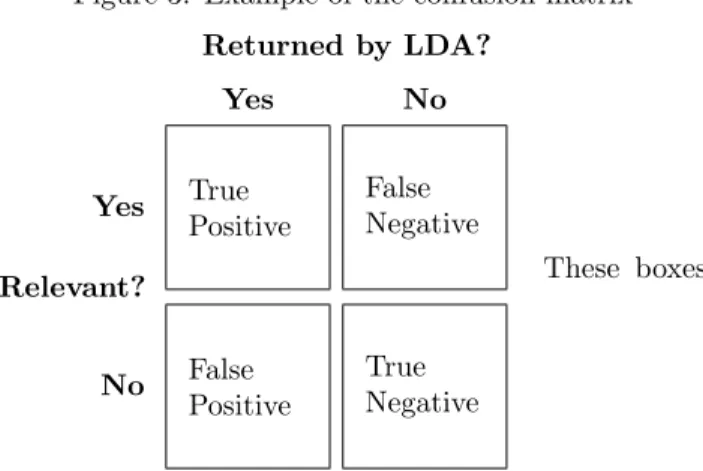
to produce a confusion matrix, consisting of four fields.
See the model below as an example. The four fields are
labeled true positive, false positive, true negative and
false negative.
In this study, true positives are the topics that
are deemed by both the machine and the annotator
as relevant for the given articles.
False negatives
are topics that have not been deemed relevant by
the machine but have been deemed relevant by the
human annotator. False positives are topics that the
machine is returning as relevant topics but have not
been deemed relevant by a human annotator. Lastly
true negatives, are basically just the rest of the topics
that have not been returned by the machine and
that should not have been returned according to the
human.
Figure 3: Example of the confusion matrix
Relevant?
Returned by LDA?
Yes
No
Yes
True
Positive
False
Negative
No
False
Positive
True
Negative
These boxes
would be filled with the values that has been described
previously in the respective box. So to show an
ex-ample of how this would be performed, please refer to
the data supplied in the first appendix. When
look-ing at the first sheet in this spreadsheet, there are four
columns, true positive, false negative, false positive and
true negative that are of importance. The papers are
listed on the left and for each papers corresponding row
the values for each of these elements are represented.
Since this study is focusing on how the di
↵
erent data
sets (full-text vs title, abstract and keywords) perform
against each other, one can observe at the bottom part
of the sheets, the sums of all the precision and recall
values are stored. Here the values from the entire data
set are added together and presented. It is these sums
of the true positives, false negatives, false positives and
true negatives for each data set that are used and later
presented inside these confusion matrices that is
exem-plified above.
When this data has been collected, the following
equations can be applied to get the values of precision
and recall.
P recision
=
T P
T P
+
F P
1
Recall
=
T P
T P
+
F N
2
To bring a bit more clarity to what these values will
indicate in the case of this study, lets quickly
summa-rize.
Precision
serves as an indication of how many
of the topics that are returned as relevant, are truly
relevant.
Recall
represents how many relevant topics
were returned by the system.
This study investigates if there is any preference for
what type of documents to use when performing
Au-tomatic Topic Extraction. Thus, a value called an
F-measure, which is a harmonic mean of precision and
recall will be used in comparing the di
↵
erent results [1]
. The F-measure can be a number between 0 and 1
and measures the accuracy of the test. The closer the
result is to 1 the better.
F M easure
= 2
⇤
P recision
P recision
+
⇤
Recall
Recall
3
The harmonic mean from precision and recall gives
us a good measure of which method is better:
Apply-ing LDA on full-text papers or on title, abstract and
keywords.
With every query executed in the two LDA models
(one for full-text, another for title, abstract and
key-words) and all the human annotated data collected, we
will now outline what the confusion matrices looks like
with the corresponding values.
4.2.3
Evaluation 1: All LDA topics, full-text
articles vs title, abstract & keywords
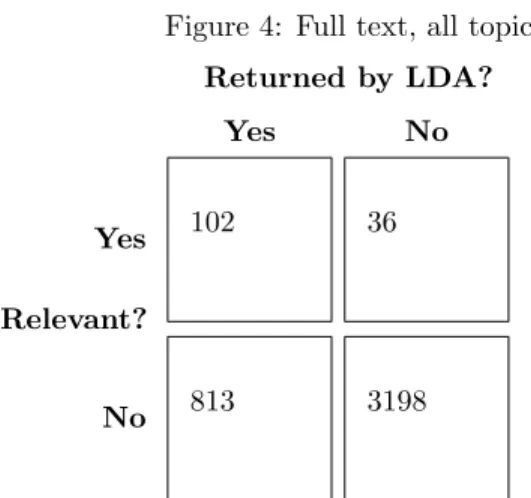
Figure 4: Full text, all topics
Relevant?
Returned by LDA?
Yes
No
Yes
102
36
No
813
3198
The values generated by the table above is:
P recision
=
102
102 + 813
= 0
,
111
4
Recall
=
102
102 + 36
= 0
,
739
5
F M easure
= 2
⇤
0
,
111
⇤
0
,
739
0
,
111 + 0
,
739
=
0,193
6
Figure 5: Title, abstract and keywords, all topics
Relevant?
Returned by LDA?
Yes
No
Yes
83
54
No
591
2273
The values generated by the table above is:
P recision
=
83
83 + 591
= 0
,
123
7
Recall
=
83
83 + 54
= 0
,
606
8
F M easure
= 2
⇤
0
0
,
,
123 + 0
123
⇤
0
,
,
606
606
=
0,204
9
Regarding ”
RQ 2: Which approach is better
for Automatic Topic Extraction: a) Extraction
from title, abstract and keywords or b)
Ex-traction from full text paper?
” The F-Measure is
slightly higher for title, abstract and keywords.
How-ever with such a small di
↵
erence we can’t safely say
that one type is better than the other.
To answer ”
RQ 3: How well does the approach
of using Latent Dirichlet Allocation (with
suit-able pre-processing) perform compared to a
manual method?
” We assume that the human
per-formance is perfect, since that is what is accepted and
applied today in the Software Engineering domain. So
when looking at the amount of false negatives stored
(the amount of topics that should have been returned
by the machine, but were not) in these two confusion
matrices. The full-text gives us 36 and the title,
ab-stract and keyword set 54. So that tells us that full-text
data set returns the relevant topics more often than the
title, abstract and keywords data set. So the full-text
missed 36 topics that the humans had deemed relevant
and the title, abstract and keyword missed 54. This is
the indication of how much the humans and the
algo-rithm disagree
4.2.4
Evaluation 2: Top 3 LDA topics,
full-text articles vs title, abstract &
key-words
Figure 6: Full text, top three topics
Relevant?
Returned by LDA?
Yes
No
Yes
46
103
The values generated by the table above is:
P recision
=
46
46 + 103
= 0
,
309
10
Recall
=
46
46 + 103
= 0
,
309
11
F M easure
= 2
⇤
0
,
309
⇤
0
,
309
0
,
309 + 0
,
309
=
0,309
12
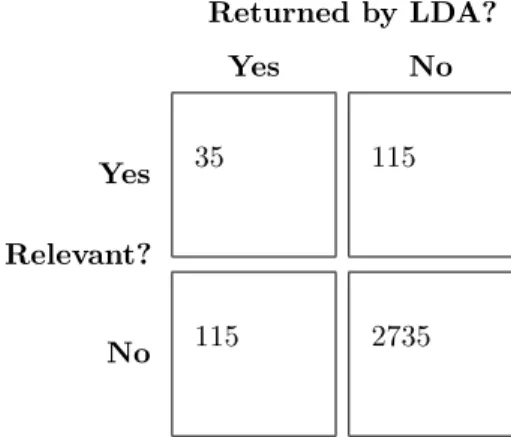
Figure 7: Title, abstract and keywords, top three topics
Relevant?
Returned by LDA?
Yes
No
Yes
35
115
No
115
2735
The values generated by the table above is:
P recision
=
35
35 + 115
= 0
,
233
13
Recall
=
35
35 + 115
= 0
,
233
14
F M easure
= 2
⇤
0
,
233
⇤
0
,
233
0
,
233 + 0
,
233
=
0,233
15
In regards of ”
RQ 2: Which approach is better
for Automatic Topic Extraction: a) Extraction
from title, abstract and keywords or b)
Extrac-tion from full text paper?
” When we ask the model
to only return the three most probable topics per paper
we get a higher F-measure for the full-text articles and
the title, abstract and keywords, than when we asked
it to return all topics. This is probably because when
the Gensim framework only returns three topics, it
re-turns fewer false positives, thus the value of precision
is higher. Though due to probability, there is a smaller
chance for the annotators to agree with the machine
with only three returned topics. So the recall value is
smaller, due to the higher value of false negatives.
Full-text also performs somewhat better than title,
abstract and keywords when looking at the top 3 most
probable topics.
Regarding ”
RQ 3: How well does the approach
of using Latent Dirichlet Allocation (with
suit-able pre-processing) perform compared to a
manual method?
” The topics that the machine
should have returned. When only using the three most
likely topics, there are a lot more topics in the false
neg-ative boxes than when returning all topics. There is a
bigger chance when returning all topics that the topic
the annotator deemed relevant will show up.
How-ever, between the two data sets when only returning
the three most likely topics, yet again, the full-texts
model returns more relevant topics than the title,
ab-stract and keywords. This is since the full-texts
confu-sion matrices only contains 103 false negatives and the
other 115.
4.2.5
Evaluation 3: Most probable LDA topic,
full-text articles vs title, abstract &
key-words
However we are also interested in looking at the most
probable topic for each paper (the topic with the
high-est probability weight according to the algorithm) and
comparing this to the human evaluation.
Therefor (for each paper) we also do a simple binary
comparison to see if the most probable topic according
to the machine is among the three topics identified by
the human annotators.
Figure 8 provides a simplified overview of how this
evaluation was performed. First we compared the
la-beling made by human annotators with the machines
categorization for the full-text articles and secondly we
compared the same results for title, keyword and
ab-stracts.
For
RQ 2: Which approach is better for
Au-tomatic Topic Extraction: a) Extraction from
title, abstract and keywords or b) Extraction
from full text paper?
its a bit di
ffi
cult to motivate
using precision and recall since if the machine would
correctly return a relevant topic, there would still be
two false negatives left. So a more simple approach is
applied for this evaluation. One where if the machine
returned a topic that was among the three the humans
had deemed relevant it is labeled as a hit. The data
Most probable topic according to the Model
Documents with a hit
Missed documents
Hit-ratio
Full-text articles
17
33
0,34
Title/abstract/key-words
13
37
0,26
Figure 8: Only the top favorable topic returned from the queries
This is the result of a comparison of how often the most favorable topic returned from a query was among the three topics assigned
from the annotators
sets model with most hits should therefor have returned
the most relevant topic as their most probable topic.
In the case of this study, please refer to figure 8 to
ob-serve that the full-text has a hit rate of 0.34 and title,
abstract and keywords only have 0.26. So in this case
it seems that the full-text data set has out performed
the title, abstract and keywords.
This is our final evaluation in regards to ”
RQ
3: How well does the approach of using
La-tent Dirichlet Allocation (with suitable
pre-processing) perform compared to a manual
method?
”.
We simply check if the most probable topic
accord-ing to LDA is among the three topics chosen by the
human annotators for each article (see figure 8). Here
the model also performs slightly better on full-text
ar-ticles than on title, abstract and keywords. For 17 out
of 50 documents, the most probable topic according to
the model is also among the topics chosen by the
an-notators. For title, abstract and keywords. the same
number is 14 out of 50. This gives a hit-ratio of 0.34
for full-text and 0.26 for title, abstract and keywords.
5
Analysis & Discussion
5.1
Analysis
With the result from the human annotators
com-pared to the model, it seems fair to argue that the
ma-chine and humans agree more when both are supplied
the articles in their entirety.
From the evaluation results using Precision And
Re-call we can see that the algorithm performs better when
evaluating full-text articles rather than title, abstract
and keywords and only looking at the top 3 topics.
When comparing the full-text, all topics result with
the Abstract and keywords, all topics result, the
F-measure of the lastly mentioned is however actually
0.011 higher than the F-measure of the full-text
evalu-ation.
The reason why it still seems fair to argue that the
full-text evaluation outperforms the Title, abstract and
keywords, is because of when the machine presents its
most probable choices of topics. Then the F-measure is
much higher in the full-text evaluation. Just to add to
this reasoning, another comparison was made with the
singular most probable topic according to the machines
and the annotators topics, as shown in figure 8. Yet
again (with other measurements however) it is clear
that when supplying full-text data sets to the machine,
it performs better.
Worth mentioning is that when the model for title,
abstract and keywords had been trained, it generated
far fewer interpret-able topics when the time came to
label them. In fact, for the full text model, 83 clear
and usable topics were generated as for the abstract
and keywords model, only 60 clear and usable topics
were generated. So that explains the lower values of
the true negatives in the abstract and keywords data
sets.
Another reason why we wanted to compare the
dif-ferences between the results of asking the model for all
topics with the model’s top 3 topics was to show how
the Gensim implementation of LDA produces a lot of
topics for some documents with this data set. A lot
of these topics get very low probability scores (see
ap-pendix) which is why there are a lot less false positives
when we just look at the top 3 topics.
5.2
Discussion
Using AuTopEx for Topic Extraction
With all the tools in place a researcher only needs to
do the following in order to perform automatic topic
extraction:
1. Batch-convert all desired pdf:s.
2. Run the pre-processing script.
3. Train the LDA model using part of the corpus.
4. Query the model with the desired number of
remaining documents from the corpus.
From our experience document conversion and
text-cleaning takes the longest time. For a large corpus
(
>
2000 scientific papers for example) each of these
steps can take several hours. The researcher however
does not need to be present while the programs are
run-ning. Training a model on 200 full-text papers took 40
minutes using a cheap laptop with a Celeron
proces-sor clocked at 2.0 GHz (utilizing two of the procesproces-sor
cores). Querying the trained model with 50 papers
us-ing the same computer is done in a couple of minutes.
Seeing as how it takes a human reader many hours
to read and annotate 50 scientific articles, using an
ap-proach such as AuTopEx can greatly speed up topic
extraction. Especially during tasks that require a
re-searcher to read a large amount of articles, (such as
when doing document classification in a Systematic
Mapping Study).
Of course this requires that the model classifies the
papers accurately enough, and there is room for
im-proving AuTopEx here.
General Discussion
For the full text evaluation, the most probable topic
identified by the algorithm was indeed a topic in the
paper in 34 % of the cases according to the human
annotators. This might not sound as a huge
percent-age, but seeing as this was the very first evaluation of
the AuTopEx approach it seems very promising.
Es-pecially when one compares the many hours it takes
for a human to read 50 scientific papers compared to
the mere minutes it took the algorithm to produce this
result.
It can be a good idea to perform word analysis on
the corpus using NLTK after text pre-processing, for
example checking a lot of the most popular words in the
corpus. While time-consuming it can give insights into
if some of the pre-processing steps might need adjusted.
For example, perhaps there are still words in the corpus
that could be considered stop words.
If batch-converting a large number of documents we
recommend that the file sizes of the documents are
checked afterwards. If any of the text-files have a size
of 0 kilobytes the conversion has failed.
Discussion on Topics and their labeling
Labeling topics manually when performing evaluation
can be a very difficult task. It requires both language
skills as well as domain knowledge. Sometimes the
words in a topic are acronyms or words that have no
meaning to those not familiar with the domain.
Mak-ing sure that you found the correct meanMak-ing of the
acronym (often an acronym has a number of meanings
in a multitude of fields) or finding an explanation of a
very niche word can be quite time consuming.
Interestingly enough adjectives were very
uncom-mon in the results from our corpus.
Besides
”au-tonomous”, which came up in 17 topics, the results
were dominated by nouns, followed by verbs.
For
the full-text experiment only two other adjectives
ap-peared, ”intelligent” and ”content”, and the latter is
also a noun. For title/abstracts/keywords the
adjec-tives were more varied: ”Intelligent”, ”dynamic”,
”gen-eralized”, ”industrial”, ”artificial”, ”automatic” and
”natural” appeared. The word ”real” appeared three
times (and was always accompanied by ”time” in the
same topic).
The dominance of nouns was quite helpful when
la-beling the technology-oriented topics often found in the
software engineering domain. This is especially true
when doing classification that does not take positives
and negatives into account (we don’t need colorful
ad-jectives criticizing or praising something in a topic).
Words like ”car”, ”architecture” or ”network” tells us
a great deal on their own. Verbs are helpful in a
sup-porting role (such as ”driving” appearing in a topic
with ”autonomous” and ”vehicle”).
Another interesting note was that even though the
entire corpus consisted of scientific papers, none of the
topics produced in either of the two evaluation
experi-ments were about scientific methodology. This is useful
data to extract when performing tasks like Systematic
Mapping Studies.
We found it interesting how the LDA model
pro-duced a lot of potential topics with low probabilities
on the corpus on autonomous vehicle research. This
could be due to how the scientific articles are written,
but requires further study before any conclusions can
be drawn.
5.3
Threats to Validity
It’s important to remember that LDA is a
proba-bilistic topic model, thus we are dealing with
probabil-ities. If a human claims that a paper is about a certain
topic and the machine claims that this probability is
high, we only argue that the likelihood of this to be
true is very high.
Properly labeling topics and scientific papers
re-quires a lot from the human annotators. They must
have excellent language skills as well as domain
exper-tise in order to interpret each topic supplied by the
model. One misunderstanding of a word could result
in an improper label, and this could impact the results
of the evaluation.
We mitigated this by reading about concepts we
were not familiar with before finishing the topic
la-beling, and looking up the meaning of any acronyms
that appeared in the results. Both authors are
soft-ware engineering students. Having previously studied
concepts such as image processing or lane following for
autonomous vehicles meant that we had a good
under-standing of a large majority of the topics produced by
the model.
Then again, labeling 100 topics and reading 50
sci-entific articles (for two separate evaluations) can be
dif-ficult for humans. Stress, fatigue or just having a bad
day can impact the accuracy both when performing
topic labeling and when manually assigning topics to
documents. We tried to mitigate this by taking breaks
regularly during the evaluation. However if other
re-searchers would redo our evaluation, using the same
articles, we can not say for certain that they would
la-bel every single topic or classify the papers in exactly
the same way.
Our main mitigation strategy for human error was
that there were two of us doing the same work in
par-allel. We continuously compared the results between
ourselves and where there were any disagreements
re-garding topic labels or which topics belong to a certain
paper, we tried to reason with each other until we came
to a result we could both agree on.
Another thing to consider when performing this kind
of automatic topic extraction is that there is no way of
handling positives and negatives. A paper that deals
with a certain topic may actually reject the idea behind
that topic. We mitigate this by not making any
spe-cific claims regarding the documents. We only state
that in the results where human and machine agree
that a topic exists in a document, that topic is indeed
discussed in that specific document.
AuTopEx has only been evaluated on a corpus in
the scientific domain of Autonomous Vehicles.
We
can’t say with certainty how di
↵
erent the evaluation
results would be if applying the approach on corpora
from other domains. However, steps have been taken
to make AuTopEx as generally applicable as possible.
Especially by only limiting the tokenization to
alpha-betical words and using a very general stop word list.
We recommend that anyone who uses this approach
carefully consider if there are any special measures to
be taken in the text pre-processing stage (e.g. adding
words to the stop words list).
During the testing phase, we noticed that on some
occasions several words would appear together as a
sin-gle token after the texts had been cleaned and we
sus-pect this is due to bad quality of some of the original
pdf:s. While it would be far too time-consuming to
check the entire corpus manually for this we believe
that this should very seldom occur in the data set we
used for evaluation. This is because this data has been
screened by researchers and only contains pdf:s
pub-lished in 2005 or later.
6
Conclusions and Future Work
In this thesis we presented an approach for
Auto-matic Topic Extraction which we call AuTopEx. This
approach uses Natural Language Processing tools and
techniques to pre-process the scientific articles of a
cor-pus. Topics from this corpus are then extracted by
training and querying a Latent Dirichlet Allocation
(LDA) model. This model can be used to
automati-cally classify the documents of the corpus (identifying
which topics exist in which articles).
According to our results, Automatic Topic
Extrac-tion with Latent Dirichlet AllocaExtrac-tion works better on
full-text scientific articles than documents that consist
of title, abstract and keywords. This is true both when
querying the model for the most probable topic per
ar-ticle as well as when asking the model for the three
most probable topics per article.
In our evaluation, the model’s most probable topic
was among the three relevant topics (according to the
human annotators) in 34 % of the full-text documents
evaluated. While the model is not as accurate than the
human annotators it is important to note that this was
the first evaluation of AuTopEx and perhaps most
im-portant of all: The model does this work in a couple of
minutes while it takes humans many hours to perform
the same task.
We believe that by refining this approach it will
be possible to speed up topic extraction tremendously
compared to manually reading and annotating papers.
Future work
One possible future experiment could be to allow
the use of n-grams in the data set before performing
the machine learning algorithm. If for example
”au-tonomous vehicle” was considered a single word it could
free up more space for other words to occur together
with it in topics, possibly allowing for more meaningful
interpretations by human readers. This process could
also easily be automated. NLTK for example has the
tool Collocations which performs n-gram analysis on
documents.
Another idea that could possibly improve the results
of our approach is to apply tf-idf on the text corpus
before training the model. Tfidf is the product of two
statistics, term frequency and inverse document
fre-quency. Term Frequency is the number of times a term
occurs in a document. Inverse Document Frequency is
a factor that diminishes the weight of terms that occur
very frequently in the document set and increases the
weight of terms that occur rarely. Thus a word like
”the” will have a very low weight in tf-idf.
A high weight in tfidf is reached by a high term
fre-quency (in the given document) and a low document
frequency of the term in the whole collection of
doc-uments; the weights hence tend to filter out common
terms. This could potentially be used for stop word
removal.
The results would depend on how focused the
lan-guage is in the di
↵
erent articles.
An article which
uses very broad language (using many synonyms for
the same word) will produce di
↵
erent results than an
article with very focused language. One idea could
also be to duplicate the title of the paper a couple of
times in each document before applying tf-idf. Seeing
as how the title should reflect what the text is about
this would help ensure that the most important words
of the papers get a higher weight. Another experiment
with tf-idf could be to give all nouns and verbs higher
weight since they convey a lot of information about
technologically-oriented topics.
A
domain-specific
lemmatizer
for
text
pre-processing could be useful.
This would however
require a lot of work by several domain experts for
a gold standard to be achieved and might be an
unrealistic thing to wish for.
Automatization of the labeling stage could make the
threat towards validity smaller while making the entire
process quicker and easier to use, since there is less
required input from the user. Such tools are already
being applied[17].
Acknowledgements
We would like to thank Peter Ljungl¨of of Chalmers
University, Simon Dobnik of the University of
Gothen-burg and Victor Botev from Iris AI for their kind
as-sistance. We would also like to thank our supervisors
Alessia Knauss and Hang Yin of Chalmers University
for their invaluable feedback.
References
[1] S. Bird, E. Klein, and L. Edward.
Analyzing Text
with the Natural Language Toolkit
. O’Reilly Media,
Sebastopol, California, United States, 2009.
[2] M. D. Blei. Introduction to probabilistic topic models.
Prinston University
, pages 1–16, 2011.
[3] M. D. Blei and et.al. Latent dirichlet allocation.
Jour-nal of Machine Learning Research
, (3), 2003.
[4] J. Chang, J. Boyd-Graber, and et.al. Reading tea
leaves: How humans interpret topic models.
Neural
Information Processing Systems
, pages 1–9, 2009.
[5] R. Felizardo, Katia, N. Salleh, M. Martins, Rafael,
E. Mendes, G. MacDonell, Stephen, Maldonado, and
C. Jose. Using visual text mining to support the study
selection activity in systematic literature reviews.
In-ternational Symposium on Empirical Software
Engi-neering and Measurement
, pages 77–86, 2011.
[6] P. Fernando, V, C. Maria, O. F, and M. Rosane.
The projection explorer: A flexible tool for
projection-based multidimensional visualization.
Analytical and
Bioanalytical Chemistry Volume 400, Number 4
, pages
1153 – 1159, 2011.
[7] R. Giuseppe and et.al. Semantic enrichment for
rec-ommendation of primary studies in a systematic
lit-erature review.
Digital Scholarship in the Humanities
Advance Access
, pages 1–14, 2015.
[8] Henver, S. T. March, J. Park, and S. Ram. Design
sci-ence in information systems research.
MIS Quarterly
,
pages 1–14, 2004.
[9] A. Hindle and et.al.
On the naturalness of
soft-ware.
International Conference on Software
Engineer-ing (ICSE)
, pages 837–847, 2012.
[10] N. Jan van Eck and L. Waltman. Text mining and
visualization using vosviewer.
ISSI newsletter
, pages
50–54, 2011.
[11] N. Jan van Eck and L. Waltman. Citnetexplorer: A
new software tool for analyzing and visualizing
cita-tion networks.
Journal of Informetrics
, pages 802–823,
2014.
[12] N. Jan van Eck and L. Waltman.
Visualizing
biblio-metric networks. In Y. Ding, R. Rousseau, & D.
Wol-fram (Eds.), Measuring scholarly impact: Methods and
practice
. Springer Publishing Company, 11 West 42nd
Street, 15th Floor New York, NY 10036, 2014.
[13] A. G. Jivani. A comparative study of stemming
algo-rithms.
International Journal of Computer Technology
and Applications
, (Vol 2: Issue 6), 2011.
[14] M. Liakata, S. Dobnik, S. Saha, C. Batchelor, and
D. Rebholz-Schuhmann. A discourse-driven content
model for summarising scientific articles evaluated in
a complex question answering task.
Proceedings of
the 2013 Conference on Empirical Methods in
Natu-ral Language Processing
, page 747757, 2013.
[15] M. Liakata, S. Saha, S. Dobnik, B. Colin, and
D. Rebholz-Schuhmann.
Automatic recognition of
conceptualization zones in scientific articles and two
life science applications.
Bioinformatics
, pages 991–
1000, 2012.
[16] C. Marshall and P. Brereton. Tools to support
sys-tematic literature reviews in software engineering: A
mapping study.
2013 ACM / IEEE International
Sym-posium on Empirical Software Engineering and
Mea-surement
, pages 296 – 299, 2013.
[17] Q. Mei, X. Shen, and C. Zhai. Automatic labeling of
multinomial topic models. pages 1–10, 2007.
[18] K. Petersen, R. Feldt, S. Mujtaba, and M. Mattsson.
Systematic mapping studies in software engineering.
pages 1–10, 2008.
[19] R. Rehurek and P. Sojka.
Software framework for
topic modelling with large corpora.
Natural Language
Processing Laboratory Masaryk University
, pages 1–5,
2010.
title true positive false negative false positive true negative total number of t 17 skräp 83 bra topics Fisheye optics for omnidirectional perception 2 1 16 64 18
Data age based retransmission scheme for reliable
control data exchange in platooning applications 2 0 19 62 21 89, 4, 16, 52, Obstacle Avoidance in Real Time with Nonlinear
Model Predictive Control of Autonomous Vehicles 3 0 15 65 18 Intelligent Cruise Control
Stop and Go with and without Communication 3 0 13 67 16 Autonomous Navigation: Achievements in Complex Enviro 1 0 25 57 26 Bayesian Network Based Collision Avoidance 2 1 17 63 19 Experience, Results and
Lessons Learned from Automated Driving on
Germany’s Highways 3 0 19 61 22
Multi-Objective Path Planning using Spline Represent 3 0 20 60 23 A Study on Autonomous Vehicle Development Process at
University* 3 0 13 67 16
Road Surface Recognition Using Laser Radar for
Automatic Platooning 1 2 20 60 21
Building a Prototype for Power-Aware Automatic
Parking System 2 0 19 62 21
A Computer Vision System for Detection and
Avoidance for Automotive Vehicles 3 0 11 68 15 Path Tracking of Autonomous Ground Vehicle Based on
Fractional Order PID Controller Optimized by PSO 2 0 12 69 14 Off-road Path Following using Region Classification and G
Constraints∗ 3 0 19 61 22
Self-Tuning PID Controller for
Autonomous Car Tracking in Urban Traffic 2 1 18 62 20 Shared Control of Autonomous Vehicles
based on Velocity Space Optimization 2 1 19 61 21 A 13,000 km Intercontinental Trip with Driverless Vehicles: 2 1 11 69 13 Real-Time Coordination of Autonomous Vehicles 1 1 17 64 18 Accurate and Efficient Traffic Sign Detection Using Discrim 3 16 64 19 DeepDriving: Learning Affordance for Direct Perception in 2 1 16 64 18 A Robust Algorithm for the Detection of Vehicle Turn Signa 2 0 5 76 7 Constrained Global Path Optimization for Articulated Steeri 3 0 19 61 22 360◦ detection and tracking algorithm of both pedestrian an
using fisheye images 3 0 15 64 19
State your position 2 0 18 63 20
A robotic platform to evalute autonomous driving systems 3 0 17 61 22 Coordinated control of multiple vehicles with
discrete-time periodic communications 1 3 17 63 17 89, 4, 16, 52, Real-time Implementation of a Novel Safety Function for Pr 3 0 12 68 15
Coordinated Path Following Control for a Group of Car-like 1 2 9 71 10 A Combined Model- and Learning-Based Framework for In 2 1 17 63 19 Towards a Framework for Testing Drivers’ Interaction with 1 1 16 65 17 Adopting WirelessHART for In-Vehicle-Networking 2 0 18 63 20 Terrain Mapping for Off-road Autonomous Ground Vehicle 3 0 18 62 21 Incremental Sampling-based Algorithm for
Minimum-violation Motion Planning 1 2 21 58 23 Vision-based Nighttime Vehicle Detection and Range Esti 3 0 19 62 21 Design and Comparative Analysis of a Driveless LED light 0 3 4 76 4 Local Path Planning for Off-Road Autonomous
Driving With Avoidance of Static Obstacles 3 0 24 56 27 HOG Based Multi-object Detection for Urban Navigation 2 1 17 63 19 Genetic Algorithm Approach for Locating Automatic Vehicl
Ide