THESES PRESENTED 10
ÉCOLE DE TECHNOLOGIE SUPÉRIEURE
IN PARTIAL FULFILLMENT OE THE REQUIREMENTS FOR THE DEGREE OF DOCTOR OE PHILOSOPHY
Ph.D.
BY
MIRANDA DOS SANTOS, Eulanda
STAl'IC AND DYNAMIC OVERPRODUCTION AND SELIX^TION OE CLASSIEIER ENSEMBLES WITH GENETIC ALGORITHMS
MONTREAL, EEBRUARY 27, 2008
THESIS PRESENTED TO
ÉCOLE DE TECHNOLOGIE SUPÉRIEURE
IN PAR'llAL FULl ILLMENT OF l'HE REQUIREMENTS FOR THE DEGREE OE DOCTOR OE PHILOSOPHY
Ph.D.
BY
MIRANDA DOS SANTOS, Eulanda
STATIC AND DYNAMIC OVERPRODUCTION AND SELECTION OE CLASSIEIER ENSEMBLES WITH GENETIC ALGORITHMS
MONTREAL, EEBRUARY 27, 2008 © Copyright 2008 reserved by Eulanda Miranda Dos Santos
Mr. Robert Sabourin, thesis director
Département de génie de la production automatisée at École de technologie supérieure Mr. Patrick Maupin, thesis co-director
Recherche et développement pour la défense Canada (Valcartier), groupe de monotoring et analyse de la situafion
Mr. Pierre Dumouchel, committee président
Département de génie logiciel et des technologies de l'information at École de technologie supérieure
Mr. Jean Meunier, extemal examiner
Département d'Informatique et Recherche Opérationnelle at Université de Montréal Mr. Éric Granger, examiner
Département de génie de la producfion automatisée at École de technologie supérieure
THIS FHESIS WAS PRESENTED AND DEFENDED BEFORE A BOARD OE EXAMINERS AND PUBLIC
ON EEBRUARY 22, 2008
I would like to acknowledgc the support and hclp of many pcoplc who encouraged me throughout thèse years of Ph.D. It is not possible to cnumeratc ail of thcm but 1 would like to express my grafitude to some people in particular,
Eirst, 1 would like to thank my supervisor, Dr. Robert Sabourin who has been source of encouragement, guidance and patience. His support and supervision were fundamental for the development of this work.
Thanks also to Patrick Maupin from Defence Research and Development Canada, DRDC-Valcartier. His involvement along the course of this research helped make the thesis more complète.
1 would like to thank the members of my examining committee: Dr. Éric Granger, Dr. Jean Meunier and Dr. Pierre Dumouchel, who has made valuablc suggesfions to the final version of this thesis.
Thanks to the members of LFVIA (Laboratoire d'imagerie, de vision et d'intelligence
artificielle) who contributed to a friendly and open research environment. Spécial thanks to Albert Ko, Carlos Cadena, Clément Chion, Dominique Rivard, Eduardo Vellasques, Éric Thibodeau, Guillaume 'fremblay, Jonathan Milgram, Luana Bafista, Luis Da Costa, Marcelo Kapp, Malhias Adankon, Paulo Cavalin, Paulo Radtke and Vincent Doré.
This research has been fundcd by the CAPES (Coordenaçâo de Apcrfeiçoamento de Pes-soal de Ni'vel Supenor), Brazilian Government, and Defence Research and Development Canada under the contract W7701-2-4425. Spécial thanks to people from CAPES and Defence Research and Development Canada, DRDC-Valcartier, who hâve had the vision to support this project.
I am indebted to Marie-Adelaide Vaz who has been my family and best friend in Montréal. Words cannot express how grateful 1 am for everything you hâve donc for me. I also would like to thank Cinthia and Marcelo Kapp, who besides friends, hâve been very spécial trip partners. I am also indebted to my family for their love, support, guidance and prayers, not only throughout the years of my PhD, but, throughout my life. To them is ail my love and prayers.
Finally, ail thanks and praise are due to God for giving me the strength and knowledge to complète this work, "for from him and through him and to him are ail things. To him be the glory forever!"
MIRANDA DOS SANTOS, Eulanda ABSTRACT
The overproduce-and-choose sttategy is a static classifier ensemble sélection approach, which is divided into overproduction and sélection phases. This thesis focuses on the sé-lection phase, which is the challenge in overproduce-and-choose strategy. When this phase is implemented as an opttmization process, the search criterion and the search algorithm are the two major topics involved. In this thesis, we concenttate in optimization processes conducted using genetic algorithms guided by both single- and multi-objective functions. We first focus on finding the best search criterion. Various search criteria are investigated, such as diversity, the error rate and ensemble size. Error rate and diversity measures are directly compared in the single-objective optimization approach. Diversity measures are combined with the error rate and with ensemble size, in pairs of objective functions, to guide the multi-optimization approach. Expérimental results are presented and discussed. Thereafter, we show that besides focusing on the characteristics of the décision profiles of ensemble members, the conlrol of overfitting at the sélection phase of overproduce-and-choose strategy must also be taken into account. We show how overfitfing can be detected at the sélection phase and présent three stratégies to control overfitting. Thèse stratégies are tailored for the classifier ensemble sélection problcm and compared. This comparison allows us to show that a global validation strategy should be applied to control overfitting in optimization processes involving a classifier ensembles sélection task. Furthermore, this study has helped us establish that this global validation strategy can be used as a tool to measure the relationship between diversity and classification performance when diversity measures are employed as single-objective functions.
Finally, the main contribution of this thesis is a proposed dynamic overproduce-and-choose strategy. While the static overproduce-and-overproduce-and-choose sélection strategy has tradi-tionally focused on finding the most accuratc subsel of classifiers during the sélection phase, and using it to predict the class of ail the test samples, our dynamic overproduce-and-choose strategy allows the .sélection of the most confident subset of classifiers to label each test sample individually. Our method combines optimization and dynamic sélection in a two-level sélection phase. The optimization level is intended to générale a population of highly accurate classifier ensembles, while the dynamic sélection level applies mea-sures of confidence in order to sélect the ensemble with the highest degree of confidence in the current décision. Three différent confidence measures are presented and compared. Our method outperforms classical static and dynamic sélection stratégies.
MIRANDA DOS SANTOS, liulanda RÉSUMÉ
La stratégie de "surproduction et choix" est une approche de sélecfion stafique des ensem-bles de classificateurs, et elle est divisée en deux étapes: une phase de surproduction et une phase de sélecfion. Cette thèse porte principalement sur l'étude de la phase de sélec-tion, qui constitue le défi le plus important dans la stratégie de surproduction et choix. La phase de sélection est considérée ici comme un problème d'optimisation mono ou multi-critère. Conséquemment, le choix de la fonction objectif et de l'algorithme de recherche font l'objet d'une attention particulière dans cette thèse. Les critères étudiés incluent les mesures de diversité, le taux d'erreur et la cardinalité de l'ensemble. L'optimisafion monocritère permet la comparaison objective des mesures de diversité par rapport à la per-formance globale des ensembles. De plus, les mesures de diversité sont combinées avec le taux d'erreur ou la cardinalité de l'ensemble lors de l'optimisation multicritère. Des résultats expérimentaux sont présentés et discutés.
Ensuite, on montre expérimentalement que le surapprentissage est potentiellement présent lors la phase de sélection du meilleur ensemble de classificateurs. Nous proposons une nouvelle méthode pour délecter la présence de surapprentissage durant le processus d'optimisation (phase de sélection). Trois stratégies sont ensuite analysées pour tenter de contrôler le surapprentissage. L'analyse des résultats révèle qu'une stratégie de valida-tion globale doit être considérée pour contrôler le surapprentissage pendant le processus d'optimisation des ensembles de classificateurs. Cette étude a également permis de véri-fier que la stratégie globale de validation peut être ufilisée comme outil pour mesurer em-piriquement la relation possible entre la diversité et la performance globale des ensembles de classificateurs.
Finalement, la plus importante contribufion de cette thèse est la mise en oeuvre d'une nouvelle stratégie pour la sélecfion dynamique des ensembles de classificateurs. Les approches traditionnelles pour la sélecfion des ensembles de classificateurs sont essen-tiellement stafiques, c'est-à-dire que le choix du meilleur ensemble est définitif et celui-ci servira pour classer tous les exemples futurs. La stratégie de surproduction et choix dy-namique proposée dans cette thèse permet la sélection, pour chaque exemple à classer, du sous-ensemble de classificateurs le plus confiant pour décider de la classe d'appartenance. Notre méthode conciHc l'opfimisafion et la sélection dynamique dans une phase de sélection à deux niveaux. L'objectif du premier niveau est de produire une population d'ensembles de classificateurs candidats qui montrent une grande capacité de
généralisa-fion, alors que le deuxième niveau se charge de sélecfionner dynamiquement l'ensemble qui présente le degré de cerfitude le plus élevé pour décider de la classe d'appartenance de l'objet à classer. La méthode de sélection dynamique proposée domine les approches con-ventionnelles (approches statiques) sur les problèmes de reconnaissance de formes étudiés dans le cadre de cette thèse.
MIRANDA DOS SANTOS, Eulanda SYNTHÈSE
Le choix du meilleur classificaleur est toujours dépendant de la connaissance a priori dé-finie par la base de données utilisée pour l'apprentissage. Généralement la capacité de généraliser sur des nouvelles données n'est pas safisfaisante étant donné que le problème de reconnaissance est mal défini. Afin de palier à ce problème, les ensembles de clas-sificateurs permettent en général une augmentation de la capacité de généraliser sur de nouvelles données.
Les méthodes proposées pour la sélection des ensembles de classificateurs sont réparties en deux catégories : la sélection statique et la sélection dynamique. Dans le premier cas, le sous-ensemble des classificateurs le plus performant, trouvé pendant la phase d'entraîne-ment, est utilisé pour classer tous les échanttllons de la base de test. Dans le second cas, le choix est fait dynamiquement durant la phase de test, en tenant compte des propriétés de l'échantillon à classer. La stratégie de "surproduction et choix" est une approche statique pour la sélection de classificateurs. Cette stratégie repose sur l'hypothèse que plusieurs classificateurs candidats sont redondants et n'apportent pas de contribution supplémen-taire lors de la fusion des décisions individuelles.
La stratégie de "surproduction et choix" est divisée en deux étapes de ttaitement : la phase de surproduction et la phase de sélection. La phase de surproduction est responsable de générer un large groupe initial de classificateurs candidats, alors que la phase de sélec-tion cherche à tester les différents sous-ensembles de classificateurs afin de choisir le sous-ensemble le plus performant. La phase de surproduction peut être mise en oeuvre en ufilisant n'importe quelle méthode de génération des ensembles de classificateurs, et ce indépendamment du choix des classificateurs de base. Cependant, la phase de sélection est l'aspect fondamental de la stratégie de surproduction et choix. Ceci reste un problème non résolu dans la littérature.
La phase de sélecfion est formalisée comme un problème d'optimisation mono ou multi-critère. Conséquemment, le choix de la fonction objectif et de l'algorithme de recherche sont les aspects les plus importants à considérer. Il n'y a pas de consensus actuellement dans la littérature concernant le choix de la fonction objectif lin termes d'algorithmes de recherche, plusieurs algorithmes ont été proposées pour la réalisation du processus de sé-lecfion. Les algorithmes génétiques sont intéressants parce qu'ils génèrent les N meilleures solutions à la fin du processus d'optimisafion. En effet, plusieurs solufions sont
dispo-nibles à la fin du processus ce qui permet éventuellement la conception d'une phase de post-traitement dans les systèmes réels.
L'objectif principal de cette thèse est de proposer une alternative à l'approche classique de type surproduction et choix (approche statique). Cette nouvelle stratégie de surproduc-tion et choix dynamique, permet la sélecsurproduc-tion du sous-ensemble des classificateurs le plus compétent pour décider la classe d'appartenance de chaque échantillon de test à classer. Le premier chapitre présente l'état de l'art dans les domaines des ensembles des classifica-teurs. Premièrement, les méthodes classiques proposées pour la combinaison d'ensemble de classificateurs sont présentées et analysées. Ensuite, une typologie des méthodes pu-bliées pour la sélection dynamique de classificateurs est présentée et la stratégie de sur-production et choix est introduite.
Les critères de recherche pour guider le processus d'optimisafion de la phase de sélection sont évalués au chapitre deux. Les algorithmes génétiques monocritère et mulficritère sont utilisés pour la mise en oeuvre du processus d'optimisation. Nous avons analysé quatorze fonctions objectives qui sont proposées dans la littérature pour la sélection des ensembles de classificateurs : le taux d'erreur, douze mesures de diversité et la cardinalité. Le taux d'erreur et les mesures de diversité ont été directement comparés en utifisant une approche d'optimisation monocritère. Cette comparaison permet de vérifier la possibilité de rem-placer le taux d'erreur par la diversité pour trouver le sous-ensemble des classificateurs le plus performant. De plus, les mesures de diversité ont été ufihsées conjointement avec le taux d'erreur pour l'étude des approches d'optimisation multicritère. Ces expériences permettent de vérifier si l'ufilisafion conjointe de la diversité et du taux d'erreur permet la sélection des ensembles classificateurs plus performants. Ensuite, nous avons montré l'analogie qui existe entre la sélecfion de caractéristiques et la sélection des ensembles des classificateurs en tenant compte conjointement des mesures de cardinalité des ensembles avec le taux d'erreur (ou une mesure de diversité). Les résultats expérimentaux ont a été obtenus sur un problème de reconnaissance de chiffres manuscrits.
Le chapitre trois constitue une contribution importante de cette thèse. Nous montrons dans quelle mesure le processus de sélection des en.sembles de classificateurs souffre du pro-blème de surapprenfissage. Etant donné que les algorithmes génétiques monocritère et multicritère sont utilisés dans cette thèse, trois stratégies basées sur un mécanisme d'ar-chivage des meilleures solutions sont présentées et comparées. Ces stratégies sont : la validation parfielle, oîi le mécanisme d'archivage est mis à jour seulement à la fin du processus d'optimisation ; "backwarding", oii le mécanisme d'archivage est mis à jour à chaque génération sur la base de la meilleure solution identifiée pour chaque populafion durant l'évolution ; et la vaUdation globale, qui permet la mise à jour de l'archive avec la meilleure solution identifiée dans la base de données de validation à chaque génération. Finalement, la stratégie de validafion globale est présentée comme un outil pour mesurer
le lien entre la diversité d'opinion évaluée entte les membres de l'ensemble et la perfor-mance globale. Nous avons montré expérimentalement que plusieurs mesures de diversité ne sont pas reliées avec la performance globale des ensembles, ce qui confirme plusieurs études publiées récemment sur ce sujet.
Finalement, la contribution la plus importante de cette thèse, soit la mise en oeuvre d'une nouvelle stratégie pour la sélection dynamique des ensembles de classificateurs, fait l'objet du chapitre quatre. Les approches tradifionnelles pour la sélection des ensembles de clas-sificateurs sont essentiellement statiques, c'est-à-dire que le choix du meilleur ensemble est définitif et celui-ci servira pour classer tous les exemples futurs. La stratégie de sur-production et choix dynamique proposée dans cette thèse permet la sélection, pour chaque exemple à classer, du sous-ensemble de classificateurs le plus confiant pour décider de la classe d'appartenance. Notre méthode concilie l'optimisation et la sélection dynamique dans une phase de sélection à deux niveaux. L'objectif du premier niveau est de produire une population d'ensembles de classificateurs candidats qui montrent une grande capacité de généralisation, alors que le deuxième niveau se charge de sélecfionner dynamiquement l'ensemble qui présente le degré de certitude le plus élevé pour décider de la classe d'ap-partenance de l'objet à classer. La méthode de sélection dynamique proposée domine les approches conventionnelles (approches statiques) sur les problèmes de reconnaissance de formes étudiés dans le cadre de cette thèse.
ACKNOWLEDGMENTS i ABSTRACT n RÉSUMÉ iii SYNTHÈSE vi TABLE OF CONTENT v LIST OF TABLES vu LIST OF FIGURES xi LIST OF ABBREVIATIONS xvii
LIST OF SYMBOLS xix INTRODUCTION 1 CHAPTER 1 LITERATURE REVIEW 09
1.1 Construction of classifier ensembles 12 1.1.1 Stratégies for generating classifier ensembles 12
1.1.2 Combination Function 16
1.2 Classifier Sélection 20 1.2.1 Dynamic Classifier Sélection 20
1.2.2 Overproduce-and-Choose Strategy 25 1.2.3 Overfitting in Overproduce-and-Choose Strategy 30
1.2.4 Discussion 32 CHAPTER 2 STATIC OVERPRODUCE-AND-CHOOSE STRATEGY 33
2.1 Overproduction Phase 36 2.2 Sélection Phase 36
2.2.1 Search Criteria 36 2.2.2 Search Algorithms: Single- and Mulfi-Objecfive GAs 42
2.3 Experiments 46 2.3.1 Parameter Setfings on Experiments 46
2.3.2 Performance Analysis 48 2.3.3 Ensemble Size Analysis 53
3.1 Overfitting in Selecting Classifier Ensembles 60 3.1.1 Overfitting in single-objective GA 61
3.1.2 Overfitting in MOGA 64 3.2 Overfitfing Control Methods 64
3.2.1 Partial Validation (PV) 66 3.2.2 Backwarding (BV) 67 3.2.3 Global Validation (GV) 69
3.3 Experiments 71 3.3.1 Parameter Settings on Experiments 71
3.3.2 Expérimental Protocol 74 3.3.3 Holdout validation results 75 3.3.4 Cross-validation results 77 3.3.5 Relationship between performance and diversity 79
3.4 Discussion 84 CHAPTER 4 DYNAMIC OVERPRODUCE-AND-CHOOSE STRATEGY 86
4.1 The Proposed Dynamic Overproduce-and-Choose Strategy 89
4.1.1 Overproduction Phase 90
4.2 Optimization Level 91 4.3 Dynamic Sélection Level 93
4.3.1 Ambiguity-Guided Dynamic Sélecfion (ADS) 95 4.3.2 Margin-based Dynamic Sélection (MDS) 97 4.3.3 Class Strength-based Dynamic Sélection (CSDS) 99
4.3.4 Dynamic Ensemble Sélection with Local Accuracy (DCS-LA) 99
4.4 Experiments 103 4.4.1 Comparison of Dynamic Sélection Stratégies 105
4.4.2 Comparison between DOCS and Several Methods 109
4.4.3 Comparison of DOCS and SOCS results 112
4.5 Dicussion 114 CONCLUSION 118 APPENDIX 1 COMPARISON OF MULTl-OBJECTlVE GENETIC ALGORITHMS 122
APPENDIX 2 OVERFITTING ANALYSIS FOR NIST-DIGITS 126
APPENDIX 3 PARETO ANALYSIS 131 APPENDIX 4 ILLUSTRATION OF OVERFITTING IN SINGLE- AND
APPENDIX 5 COMPARISON BETWEEN PARTICLE SWARM OPTIMIZATON AND GENETIC ALGORITHM TAKING EMTO ACCOUNT
OVERFITTING 146
Page Table I Table II Table 111 Table IV Table V Table VI Table VII
Compilation of some of the results reported in the DCS literature highlighfing the type of base classifiers, the strategy employed for generafing régions of compétence, and the phase in which they are gcnerated, the criteria used to perform the sélection and whether or not fusion is also used
(Het: heterogeneous classifiers) 24 Compilation of some of the results reported in the OCS
literature (ESS: Feature Subset Sélecfion, and RSS: Random
Subspace 29 List of search criteria used in the optimization process of
the SOCS conducted in this chapter. The type spécifies whether the search criterion must be minimized (similarity)
or maximized (dissimilarity) 42 Experiments parameters relatcd to the classifiers, ensemble
génération method and database 47 Genetic Algorithms parameters 48 Spécifications of the large datasets used in the experiments in
section 3.3.3 72 Specificafions of the small datasets used in the experiments
in secfion 3.3.4 72 Table VIII Mean and standard déviation values of the error rates
obtained on 30 replications comparing sélection procédures on large datasets using GA and NSGA-II. Values in bold indicate that a validation method decreased the error rates significantly, and underlined values indicate that a validation
strategy is significanfiy beUer than the others ,76 Table IX Mean and standard déviation values of the error rates
obtained on 30 replications comparing sélection procédures on small datasets using GA and NSGA-II. Values in bold indicate that a validation method decreased the error
Table X Table XI Table XI1 Table XIII Table XIV Table XV
rates significantly, and underlined values indicate when a
validation strategy is significantly better than the others ,78 Mean and standard déviation values of the error rates
obtained on measuring the uncontrolled overfitting. The relationship between diversity and performance is sttonger as 0 decreases. 'Hie best resuit for each case is shown in bold. Case study: the results obtained by GA and NSGA-II when
performing SOCS are compared with the resuit achicved by combining ail classifier members of the pool C
83
94 Summary of the four stratégies employed at the dynamic
sélection level. The arrows specify whether or not the certainty of the décision is greater if the strategy is lower
(i) or greater (î) 101
Case study: comparison among the results achieved by combining ail classifiers in the inittal pool C and by performing classifier ensemble sélection employing both SOCS and DOCS
Specificafions of the small datasets used in the experiments.
101 105 Mean and standard déviation values obtained on 30
replications of the sélection phase of our method. The overproduction phase was performed using an initial pool of kNN classifiers generated by RSS. The best resuit for each
dataset is shown in bold 106
Table XVI Mean and standard déviation values obtained on 30 replications of the sélection phase of our method. The overproduction phase was performed using an initial pool of DT classifiers generated by RSS. Ihe best resuit for each
dataset is shown in bold 107
Table XVII Mean and standard déviation values obtained on 30 replications of the sélection phase of our method. The overproduction phase was performed using an initial pool of DT classifiers generated by Bagging. The best resuit for
Table XVII I
Table XIX
Table XX
Error rates attained by several methods. NSGA-II (X), GA (Y), I (DCS-LA), II (ADS), II I (MDS), IV (CSDS). Values in bold and underlined indicate the best resuit in each dataset for each overproduction method and the best overall resuit for each dataset respectively
The error rates obtained, the data partition and the sélection method employed in works which used the databases investigated in this chapter (FSS: feature subset sélection)....
110
112 Mean and standard déviation values of the error rates
obtained on 30 replications comparing DOCS and SOCS with no rejection. Values in bold indicate the lowest error rate and underhned when a method is significantly better
than the others 113
Table XXI Mean and standard déviation values of the error rates obtained on 30 replications comparing DOCS and SOCS with rejection. Values in bold indicate the lowest error rate attained and underlined when a method is significantly better
than the others 115
Table XXII
Table XXIIl Table XXIV
Mean and standard déviation values of the error rates obtained on 30 replications comparing DOCS and SOCS with rejection. Values in bold indicate the lowest error rate attained and underlined when a method is significantly better than the others
Case study: comparing oracle results
116 117 Comparing overfitting control methods on data-test 1. Values
are shown in bold when GV decreased the error rates significantly, and are shown underlined when it increased the
error rates 127
Table XXV
Table XXVI
Comparing overfitting control methods on data-test2. Values are shown in bold when GV decreased the error rates significantly, and are shown underlined when it increased the
error rates 128 Worst and best points, minima and maxima points, the A"*
objecfive Pareto spread values and overall Pareto spread
Table XXVIII
Table XXIX
Comparing GA and PSO in terms of overfitfing control on NIST-digits dataset. Values are shown in bold when GV decreased the error rates significantly. The results were
calculated using data-test 1 and data-test2 149 Comparing GA and PSO in terms of overfitfing control on
Page Figure 1 'ITie stafistical, compulational and representational reasons for
combining classifiers [16] 10 Figure 2 Overview of the création process of classifier ensembles 16
Figure 3 The classical DCS process: DCS is divided into three levels focusing on training individual classifiers, generafing régions of
compétence and selecting the most compétent classifier for each région... 21 Figure 4 Overview of the OCS process. OCS is divided into the
overproduction and Ihe sélection phases. The overproduction phase créâtes a large pool of classifiers, while the sélecfion phase
focus on finding the most performing subset of classifiers 26 Figure 5 l"he overproducfion and sélecfion phases of SOCS. The sélecfion
phase is formulated as an optimization process, which générâtes différent candidate ensembles. This optimizafion process uses a validation strategy to avoid overfitting. The best candidate
ensemble is then selected to classify the test samples 34 Figure 6 (3pttmization using GA with the error rate e as the objective
funcfion in Figure 6(a). Optimizafion using NSGA-II and the pair of objective functions: e and ensemble size C in Figure 6(b). The complète search space, the Pareto front (circles) and the best solution C*' (diamonds) are projected onto the validation dataset.
'Fhe best performing solutions are highlighted by arrows 43 Figure 7 Results of 30 replicafions using GA and 13 différent objective
functions. 'Hie performances were calculated on the data-test 1
(Figure 7(a)) and on the data-tesl2 (Figure 7(b)) 49 Figure 8 Results of 30 replications using NSGA-II and 13 différent pairs of
objective funcfions. The performances were calculated on data-test 1 (Figure 8(a)) and data-data-test2 (Figure 8(b)). The first value corresponds to GA with the error rate e as the objective function while the second value corresponds to NSGA-II guided by e with
Figure 9 Size of the classifier ensembles found using 13 différent measures combined with ensemble size ( in pairs of objective funcfions
used by NSGA-II 53 Figure 10 Performance of the classifier ensembles found using NSGA-II
with pairs of objective functions made up of ensemble size ( and the 13 différent measures. Performances were calculated on
data-test 1 (Figure 10(a)) and on data-data-test2 (Figure 10(b)) 54 Figure 11 Ensemble size of the classifier ensembles found using GA (Figure
11 (a)) and NSGA-II (Figure ll(b)). Each optimizafion process
was performed 30 fimes 55 Figure 12 Overview of the process of sélection of classifier ensembles and
the points of entry of the four datasets used 62 Figure 13 Opfimization using GA guided by e. Hère, we follow the
évolution of C'*(.g) (diamonds) from ^ = 1 to max{g) (Figures 13(a), 13(c) and 13(e)) on the optimizafion dataset O, as well as on the validation dataset V (Figures 13(b), 13(d) and 13(f)). The overfitting is measured as the différence in error between C*' (circles) and C* (13(0)- There is a 0.30% overfit in this example, where the minimal error is reached sfightly after y = 52 on V, and overfitting is measured by comparing it to the minimal error reached on O. Solutions not yet evaluated are in grey and the best
performing solufions are highlighted by arrows 63 Figure 14 Opfimization using NSGA-II and the pair of objecfive functions:
difficulty measure and e. We follow the évolution of Ck{g) (diamonds) from g — l to ma.x{g) (Figures 14(a), 14(c) and
14(e)) on the optimizafion dataset O, as well as on the validation dataset V (Figures 14(b), 14(d) and 14(0). The overfitfing is measured as the différence in error between the most accurate solution in C;^' (circles) and in C^. (14(f)). There is a 0.20% overfit in this example, where the minimal error is reached slighfiy after g = 15 on l/', and overfitfing is measured by comparing it to the minimal error reached on O. Solutions not
yet evaluated are in grey 65 Figure 15 Opfimizafion using GA with the 0 as the objective function.
ail Cj evaluated during the optimizafion process (points), C*
Figure 16 Opfimization using G A with the 9 as the objective funcfion. Ail Cj evaluated during the optimization process (points), C* (diamonds), ( '*' (circles) and C'j (stars) in V. Controlled and
uncontrolled overfitting using GV 81 Figure 17 Overview of the proposed DOCS. The method divides the
sélecfion phase into optimization level, which yields a population of ensembles, and dynamic sélection level, which chooses the most compétent ensemble for classifying each test sample. In
SOCS, only one ensemble is selected to classify the whole test dataset. ... 89 Figure 18 1 ensembles generated using single-objective GA guided by e in
Figure 18(a) and NSGA-II guided by 9 and e in Figure 18(b). The output of the optimization level obtained as the n best solufions by GA in Figure 18(c) and the Pareto front by NSGA-II in Figure
18(d). 'Hiese results were calculated for samples contained in \^. 'Hie black circles indicate the solutions with lowest c, which are
selected when performing SOCS 93 Figure 19 Ambiguity-guided dynamic sélection using a Pareto front as
input. The classifier ensemble with least ambiguity among its
members is selected to classify each test sample 98 Figure 20 Case study: histogram of the frequency of sélecfion of candidate
ensembles performed by each dynamic sélection strategy. The
populafion C* is the n best solution generated by GA (see Figure 18(c)).103 Figure 21 Case study: histogram of the frequency of sélecfion of candidate
ensembles performed by each dynamic sélection method. The populafion C*' is the Pareto front generated by NSGA-II (see
Figure 18(d)) 104 Figure 22 Case Sttidy: Error-reject curves for GA (22(a)) and NSGA-II (22(b)). . . 1 1 4
Figure 23 Results of 30 replications using NSGA, NSGA-II and controlled elitist NSGA. The search was guided using ambiguity and the
error rate 124 Figure 24 Results of 30 replicafions using NSGA, NSGA-II and controlled
elitist NSGA. 'Hie search was guided using ensemble size and the
Figure 25 Uncontrolled overfitting 0 based on 30 replicafions using GA with diversity measures as the objective function. The performances were calculated on the data-test 1. l'he relationship
between diversity and error rate becomes stronger as 0 decreases 129 Figure 26 Uncontrolled overfitting 0 based on 30 replicafions using
GA with diversity measures as the objective function. The performances were calculated on the data-test2. 'ITie relationship
between diversity and error rate becomes stronger as 0 decreases 130 Figure 27 Pareto front after 1000 générations found using NSGA-II and
the pairs of objective functions: jointly minimize the error rate and the difficulty measure (a), jointly minimize the error rate and ensemble size (b), jointly minimize ensemble size and the difficulty measure (c) and jointly minimize ensemble size and the
interrater agreement (d) 134 Figure 28 Scaled objecfive space of a two-objecfive problem used to
calculate the overall Pareto spread and the A-"* objecfive Pareto
spread 135 Figure 29 Pareto front after 1000 générations found using NSGA-II and
the pairs of objective functions: minimize ensemble size and maximizc ambiguity (a) and minimize ensemble size and
maximize Kohavi-Wolpert (b) 140 Figure 30 Opfimization using GA guided by e. Hère, we follow the
évolution of C'*{g) (diamonds) for ^ = 1 (Figure 30(a)) on the optimization dataset O, as well as on the validafion dataset V (Figure 30(b)). Solutions not yet evaluated are in grey and the
best performing solutions are highlighted by arrows 142 Figure 31 Optimization using GA guided by e. Hère, we follow the
évolution of C'*{g) (diamonds) for ^ = 52 (Figure 31 (a)) on the optimization dataset O, as well as on the validation dataset V (Figure 31(b)). The minimal error is reached slighUy after g — 52 on V, and overfitting is measured by comparing it to the minimal error reached on O. Solutions not yet evaluated are in grey and
the best performing solutions are highlighted by arrows 143 Figure 32 Optimizafion using G A guided by e. Hère, we follow the
évolution of Cj{g) (diamonds) for rna.vfg) (Figure 32(a)) on the optimizafion dataset O, as well as on the validafion dataset V
Figure 33 Figure 34 Figure 35 Figure 36 Figure 37 Figure 38 Figure 39
(Figure 32(b)). The overfitting is measured as the différence in error between C*' (circles) and C* (Figure 32(b)). There is a 0.30% overfit in this example. Solutions not yet evaluated are in grey and the best performing solutions are highlighted by arrows. Optimization using NSGA-II and the pair of objective functions: difficulty measure and e. We follow the évolution of CA;(^) (diamonds) ior g = 1 (Figure 33(a)) on the optimization dataset
O, as well as on the validation dataset V (Figure 33(b)). Solutions not yet evaluated are in grey
143
144 Optimization using NSGA-II and the pair of objective functions:
difficulty measure and t. We follow the évolution of Ck{g) (diamonds) for 5 = 1 5 (Figure 34(a)) on the optimization dataset
O, as well as on the validation dataset V (Figure 34(b)). The minimal error is reached slightly after g — 15 on V, and overfitting is measured by comparing it to the minimal error
reached on O. Solutions not yet evaluated are in grey 144 Optimization using NSGA-II and the pair of objective functions:
difficulty measure and e. We follow the évolution of Ck{g) (diamonds) for ma.r{g) (Figure 35(a)) on the optimization dataset
O, as well as on the validation dataset \^ (Figure 35(b)). The overfitting is measured as the différence in error between the most accurate solution in C^' (circles) and in C^. (Figure 35(b)). There is a 0.20% overfit in this example. Solutions not yet evaluated are
in grey 145 NIST-digits: the convergence points of GA and PSO. The
génération when the best solution was found on optimization
(36(a)) and on validation (36(b)) 149 NIST-letters: the convergence points of G A and PSO. The
génération when the best solution was found on optimization
(37(a)) and on validation (37(b)) 150 NlSl-digits: error rates of the solutions found on 30 replications
using GA and PSO. The performances were calculated on the
data-testl (38(a)) and on the data-test2 (38(b)) 151 NIST-letters: error rates of the solutions found on 30 replications
using GA and PSO (39(a)). Size of the ensembles found using
Figure 40 NIST-digits: Size of the ensembles found using both GA and
ADS BAG BKS BS BV CSDS DCS-LA DCS DOCS DT FS FSS GA GANSEN GP GV HC Het
Ambiguity-guided dynamic sélection Bag o i n o
Behavior-Knowledge Space Backward search
Backwarding validation
Class sttength-based dynamic sélection
Dynamic classifier sélection with local accuracy Dynamic classifier sélection
Dynamic overproduce-and-choose strategy Décision tree
Forward search
Feature subset sélection Genetic algorithm
GA-based Sélective Ensemble Genetic Programming
Global Validation Hill-climbing search Heterogeneous classifiers
IPS k^'' Objective Pareto Spread kNN K Nearest Neighbors
KNORA K nearest-oracles
MDS Margin-based dynamic sélection MLP Multilayer perceptron
MOGA Multi-objective genetic algorithm MOOP Multi-objective optimization problems
NlSl' National Institute of Standards and Technology NSGA-II F'ast ehtist non-dominated sorting genetic algorithm NSGA Non-dominated Sorting Genetic Algorithm
OCS Overproduce-and-choose strategy OPS Overall Pareto spread
PBIL Population-based incrémental leaming PSO Particle Swarm Optimization
PV Partial Validation RBE Radial Basis l'unction RSS Random subspace method
SOCS Static overproduce-and-choose strategy SVM Support Vector Machines
Oi Ambiguity of the i-th classifier
A Auxiliary archive
cvcj Local candidate e n s e m b l e ' s class accuracy
C Initial pool of classifiers
C* Population of candidate ensembles found using the vaHdation dataset at the optimization level
C* Population of candidate ensembles found using the optimization dataset at the optimization level
0^(5) Offspring population
C^{g) Elitism population
C{g) Population of ensembles found at each génération g
c* Winning individual classifier
Ci Individual classifier
CJ' The best performing subset of classifiers obtained in the validation
dataset
C* 'l"he best performing subset of classifiers obtained in the opfimization dataset
CJ Individual candidate ensemble
Ck{g) Pareto front found in O at generafion g
Cl Final Pareto fronts found in O
Cl Final Pareto fronts found in V
cav Coverage function
6 Double-fault
e The error rate objective function
F Number of classifiers in Cj that correctly classify a pattem x
f{x) Unknown function
0 Uncontrolled overfitfing
G Test dataset
g Each generafion step
7 Ambiguity
7 Local ambiguity calculated for the test sample X; g
h Approximafion function
H Hypothcsis space
imp Pareto improvement measure
7] Disagreement
K Interrater agreement
/ Number of classifiers in candidate ensemble Cj A Fault majority
inax Maximum mie
max{g) Maximum number of générations
min Minimum rule
m.v Majority voting combination function
m(:r,) Number of classifiers making error on observation x^
p Measure of margin
N°^ Number of examples classified in A', a,b may assume the value of 1 when the classifier is correct and 0, otherwise.
n Size of initial pool of candidate classifiers
nb Naive Bayes
O Opfimization dataset
V{C) PowersetofC
p{i) Probability that /' classifier(s) fail when classifying a sample a:
pr Product rule
p Average individual accuracy
<P Q-statistic
9 Difficulty measure
0 Strength relative to the closest class
R* Winning région of compétence
/"(:!') Number of classifiers that correctly classify sample x
p Corrélation coefficient
sr Sum rule
a Coïncident failure diversity T Training dataset
T GeneraUzed diversity n = {uji , 0^2 • • • ^ i^c} ^^^ of class labels
u!k Class labels
V Validation dataset
y(u-'/,) Number of votes for class tOk
w Size of the population of candidate ensembles ^ Entropy
x,,g Test sample
x,_o Opfimization sample
yi,t Training sample
x,,^, Validation sample
yj Class label output of the i-th classifier
Y Proportion of classifiers that do not correcUy classify a randomly chosen sample x
•il) Kohavi-Wolpert
The ensemble of classifiers method has become a dominant approach in several différent fields of application such as Machine Leaming and Pattern Récognition. Such interest is motivated by the theoretical [16] and expérimental [31; 96] studies, which show that clas-sifier ensembles may improve traditional single clasclas-sifiers. Among the various ensemble génération metiiods available, the most popular are bagging [5], boosting [21] and the ran-dom subspace method [32]. Two main approaches for the design of classifier ensembles are clearly defined in the literature: (1) classifier fusion; and (2) classifier sélection. The most common and most gênerai opération is the combination of ail classifiers mem-bers' décisions. Majority voting, sum, product, maximum, minimum [35], Bayesian rule [86] and Dempster-Shafer [68] are examples of functions used to combine ensemble mem-bers' décisions. Classifier fusion relies on the assumption that ail ensemble members make independent errors. Thus, pooling the décisions of the ensemble members may lead to increasing the overall performance of the System. However, it is difficult to impose independence among ensemble's component members, especially since the component classifiers are redundant [78], i.e. they provide responses to the same problem [30]. As a conséquence, there is no guarantee that a particular ensemble combination method will achieve error independence. When the condition of independence is not verified, it cannot be guaranteed that the combination of classifier members' décision will improve the final classification performance.
Classifier sélection is traditionally defined as a sttategy which assumes that each ensemble membcr is an expert in some local régions of the feature space [107]. The most locally accurate classifier is selected to esfimate the class of each particular test pattern. Two caté-gories of classifier sélection techniques exist: static and dynamic. In the first case, régions of compétence are defined during the training phase, while in the second case, they are defined during the classification phase taking into account the characteristics of the
sam-misclassification [80]. Moreover, thèse approaches, for instance Dynamic Classifier
Sé-lection with Local Accuracy (DCS-LA) [101], often involve high Computing complexity,
as a resuit of cstimating régions of compétence, and may be critically affected by parame-ters such as the number of neighbors considered (k value) for régions defined by k nearest neighbors and distance functions.
Another définition of static classifier sélection can be found in the Neural Network liter-ature. It is called either the overproduce-and-choose strategy [58] or the test-and-select
methodology [78]. From this différent perspective, the overproduction phase involves the génération of an initial large pool of candidate classifiers, while the sélection phase is in-tended to test différent subsets in order to sélect the best performing subset of classifiers, which is then used to classify the whole test set. The assumption behind overproduce-and-choose strategy is that candidate classifiers are redundant as an analogy with the feature subset sélection problem. Thus, finding the most relevant subset of classifiers is better than combining ail the available classifiers.
Problem Statemen t
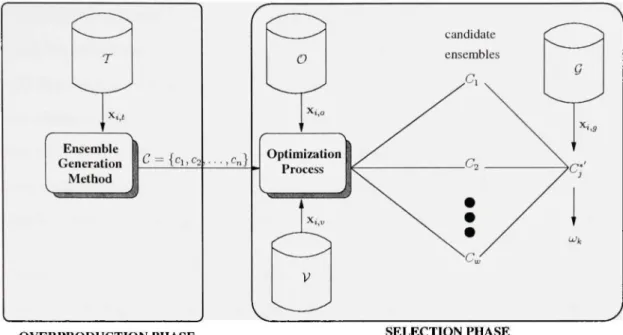
In this thesis, the focus is on the overproduce-and-choose sttategy, which is traditionally divided into two phases: (1) overproducfion; and (2) sélection. The former is devoted to constructing an initial large pool of classifiers. The latter tests différent combinations of thèse classifiers in order to identify the optimal candidate ensemble. Clearly, the over-production phase may be undertaken using any ensemble génération method and base classifier model. The sélection phase, however, is the fundamental issue in overproduce-and-choose strategy, since it focuses on finding the subset of classifiers with optimal accu-racy. This remains an open problem in the literature. Although the search for the optimal subset of classifiers can be exhaustive [78], search algorithms might be used when a large
V{C) the powerset of C defining the population of ail possible candidate ensembles. When dealing with the sélection phase using a non-exhaustive search, two important as-pects should be analyzed: (1) the search criterion; and (2) the search algorithm. The first aspect has received a great deal of attenfion in the récent literature, without much consensus. Ensemble combination performance, ensemble size and diversity measures are the most fréquent search criteria employed in the Uterature. Performance is the most obvions of thèse, since it allows the main objective of pattem récognition, i.e. finding predictors with a high récognition rate, to be achieved. Ensemble size is interesting due to the possibility of increasing performance while minimizing the number of classifiers in order to accomplish requirements of high performance and low ensemble size [62]. Fi-nally, there is agreement on the important rôle played by diversity since ensembles can be more accurate than individual classifiers only when classifier members présent diversity among themselves. Nonetheless, the relationship between diversity measures and accu-racy is unclear [44]. The combination of performance and diversity as search criteria in a multi-objective optimization approach offers a better way to overcome such an apparent dilemma by allowing the simultaneous use of both measures.
In terms of search algorithms, several algorithms hâve been applied in the literature for the sélection phase, ranging from ranking the n best classifiers [58] to genetic algorithms (GAs) [70]. GAs are attractive since they allow the fairly easy implementation of en-semble classifier sélection tasks as optimization processes [82] using both single- and multi-objective functions. Moreover, population-based GAs are good for classifier sélec-tion problems because of the possibility of dealing with a populasélec-tion of solufions rather than only one, which can be important in performing a post-processing phase. However it has been shown that such stochastic search algorithms when used in conjunction to Ma-chine Leaming techniques are prone to overfitting in différent application problems like
tion of Support Vector Machines [87] and wrapper-based feature subset sélection [47; 22]. Even though différent aspects hâve been addressed in works that investigate overfitting in the context of ensemble of classifiers, for instance regularization terms [63] and meth-ods for tuning classifiers members [59], very few work has been devoted to the control of overfitting at the sélection phase.
Besides search criterion and search algorithm, other difficulties are concemed when per-forming sélection of classifier ensembles. Classical overproduce-and-choose strategy is subject to two main problems. Eirst, a fixed subset of classifiers defined using a train-ing/optimization dataset may not be well adapted for the whole test set. This problem is similar to searching for a universal best individual classifier, i.e. due to différences among samples, there is no individual classifier that is perfecUy adapted for every test sample. Moreover, as stated by the "No Free Lunch" theorem [10], no algorithm may be assumed to be better than any other algorithm when averaged over ail possible classes of problems. The second problem occurs when Pareto-based algorithms are used at the sélection phase. Thèse algorithms are efficient tools for overproduce-and-choose strategy due to their ca-pacity to solve multi-objective optimization problems (MOOPs) such as the simultaneous use of diversity and classification performance as the objective functions. They use Pareto dominance to solve MOOPs. Since a Pareto front is a set of nondominated solutions rep-resenting différent tradeoffs with respect to the multiple objective functions, the task of selecting the best subset of classifiers is more complex. This is a persistent problem in MOOPs applications. Often, only one objective function is taken into account to perform the choice. In [89], for example, the solution with the highest classification performance was picked up to classify the test samples, even though the solutions were optimized re-garding both diversity and classificafion performance measures.
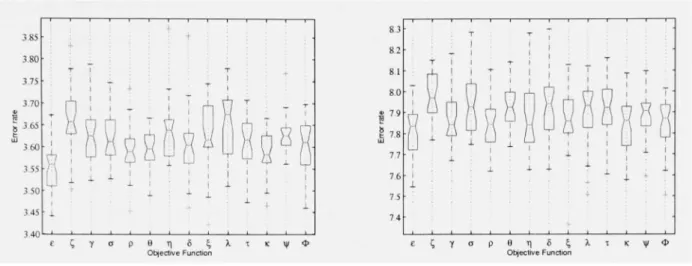
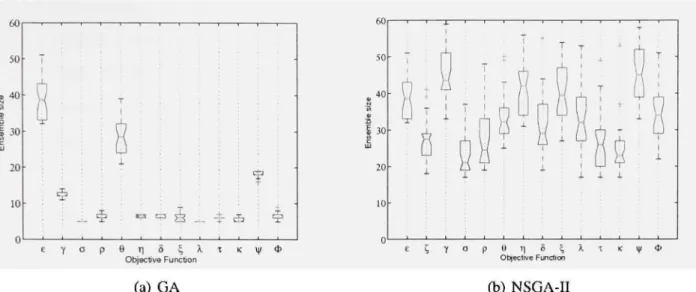
performance classifier ensembles at the sélecfion phase, when this sélection is formulated as an optimization problem performed by both single- and muUi-objecfive GAs. Sev-eral issues were addressed in order to deal with this problem: (1) the error rate and di-versity measures were directly compared using a single-objective optimization approach performed by GA. This direct comparison allowed us to verify the possibility of using di-versity instead of performance to find high-performance subset of classifiers. (2) didi-versity measures were applied in combination with the error rate in pairs of objecfive funcfions in a multi-optimization approach performed by multi-objective GA (MOGA) in order to in-vestigate whether including both performance and diversity as objecfive functions leads to sélection of high-performance classifier ensembles. Finally, (3) we invesfigated the possi-bility of establishing an analogy between feature subset sélection and ensemble classifier sélection by combining ensemble size with the error rate, as well as with the diversity measures in pairs of objective funcfions in the muhi-opfimization approach. Part of this analysis was presented in [72].
The second goal is to show experimentally that an overfitting control strategy must be conducted during the optimization process, which is performed at the sélection phase. In this study, we used the bagging and random subspace algorithms for ensemble génération at the overproduction phase. The classification error rate and a set of diversity measures were applied as search criteria. Since both GA and MOGA search algorithms were exam-ined, we invesfigated in this thesis the use of an auxiliary archive to store the best subset of classifiers (or Pareto front in the MOGA case) obtained in a validation process using a validation dataset to control overfitting. Three différent stratégies to update the aux-iliary archive hâve been compared and adapted in this thesis to the context of single and multi-objective sélection of classifier ensembles: (\) partial validation where the auxiliary archive is updated only in the last génération of the optimization process; (2)
backward-dating the archive by storing in it the Pareto front (or the best solution in the GA case) identified on the validation dataset at each génération step.
The global validation strategy is presented as a tool to show the relafionship between diversity and performance, specifically when diversity measures are used to guide GA. The assumpfion is that if a strong relationship between diversity and performance exists, the solufion obtained by performing global validation solely guided by diversity should be close or equal to the solution with the highest performance among ail solutions evaluated. This offers a new possibility to analyze the relationship between diversity and performance which has received a great deal of attention in the literature. In [75], we présent this overfitting analysis.
Finally, the last goal is to propose a dynamic overproduce-and-choose strategy which com-bines optimization and dynamic sélection in a two-level sélection phase to allow sélecfion of the most confident subset of classifiers to label each test sample individually. Sélecfion at the opfimization level is intended to générale a population of highly accurate candidate classifier ensembles, while at the dynamic sélection level measures of confidence are used to reveal the candidate ensemble with highest degree of confidence in the current décision. Three différent confidence measures are investigated.
Our objective is to overcome the three drawbacks mentioned above: Rather than select-ing only one candidate ensemble found durselect-ing the optimization level, as is done in static overproduce-and-choose strategy, the sélection of the best candidate ensemble is based directly on the test pattems. Our assumption is that the generalization performance will increase, since a population of potential high accuracy candidate ensembles are considered to sélect the most compétent solution for each test sample. 'Fhis first point is parficularly important in problems involving Pareto-based algorithms, because our method allows ail
tion stratégies (both static and dynamic), the sélection of a subset of classifiers may de-crease misclassification; and, finally, (3) Our dynamic sélection avoids estimating régions of compétence and distance measures in selecting the best candidate ensemble for each test sample, since it relies on calculating confidence measures rather than on performance. Moreover, we prove both theoretically and experimentally that the sélection of the solution with the highest level of confidence among its members permits an increase in the "degree of certainty" of the classification, increasing the generalization performance as a consé-quence. Thèse interesting results motivated us to investigate three confidence measures in this thesis which measure the extent of consensus of candidate ensembles: (l) Ambiguity measures the number of classifiers in disagreement with the majority voting; (2) Margin, inspired by the definifion of margin, measures the différence between the number of votes assigned to the two classes with the highest number of votes, indicating the candidate en-semble's level of certainty about the majority voting class; and (3) Strength relative to the
closest class [8] also measures the différence between the number of votes received by
the majority voting class and the class with the second highest number of votes; however, this différence is divided by the performance achieved by each candidate ensemble when assigning the majority voting class for samples contained in a validation dataset. ITiis ad-ditional information indicates how often each candidate ensemble made the right décision in assigning the selected class.
As marginal contributions, we also point out the best method for the overproduction phase on comparing bagging and the random subspace method. In [73], we first introduced the idea that choosing the candidate ensemble with the largest consensus, measured using ambiguity, to predict the test pattern class leads to selecting the solution with greatest certainty in the current décision. In [74], we présent the complète dynamic overproduce-and-choose strategy.
ature related to ensemble of classifiers in order to be able to introduce ail définitions and research work related to the overproduce-and-choose strategy. Firstly, the combination of classifier ensemble is presented. Then, the ttaditional définition of dynamic classifier sé-lecfion is summarized. Finally, the overproduce-and-choose strategy is explained. In this chapter we emphasize that the overproduce-and-choose strategy is based on combining classifier sélection and fusion. In addition, it is shown that the overproduce-and-choose stratégies reported in the literature are static sélection approaches.
In Chapter 2, we investigate the search algorithm and search criteria at the sélection phase, when this sélection is performed as an optimization process. Single- and multi-objective GAs are used to conduct the optimization process, while fourteen objective functions are used to guide this optimization. Thus, the experiments and the results are presented and analyzed.
The overfitting aspect is addressed in Chapter 3. We demonstrate the circumstances under which the process of classifier ensemble sélection results in overfitting. ITien, three straté-gies used to control overfitting are introduced. Finally, expérimental results are presented. In Chapter 4 we présent our proposed dynamic overproduce-and-choose strategy. We describe the opfimization and the dynamic sélection levels performed in the two-level sélection phase by population-based GAs and confidence-based measures respectively. Then, the experiments and the results obtained are presented. Finally, our conclusions and suggestions for future work are discussed.
LITERATURE REVIE W
Leaming algorithms are used to solve tasks for which the design of software using tta-ditional programming techniques is difficult. Machine failures predicfion, filter for elec-tronic mail messages and handwritten digits récognition are examples of thèse tasks. Sev-eral différent learning algorithms hâve been proposed in the literature such as Décision Trees, Neural Networks, k Nearest Neighbors (kNN), Support Vector Machines (SVM), etc. (Jiven sample x and its class label u.\. with an unknown function uj^ = f{x), ail thèse learning algorithms focus on finding in the hypothesis space / / the best approximation function //, which is a classifier, to the funcfion /(;r). Hence, the goal of thèse learning algorithms is the design of a robust well-suited single classifier to the problem concemed. Classifier ensembles attempt to overcome the complex task of designing a robust, well-suited individual classifier by combining the décisions of relatively simpler classifiers. It has been shown that significant performance improvements can be obtained by creating classifier ensembles and combining their classifier members' outputs instead of using sin-gle classifiers. Altinçay [2] and Tremblay et al. [89] showed that ensemble of kNN is superior to single kNN; Zhang [105] and Valentini [93] concluded that ensemble of SVM outperforms single SVM and Ruta and Gabrys [71] demonstrated performance improve-ments by combining ensemble of Neural Networks, instead of using a single Neural Net-work. Moreover, the wide applicability of ensemble-of-classifier techniques is important, since most of the leaming techniques available in the literature may be used for generat-ing classifier ensembles. Besides, ensembles are effective tools to solve difficulty Pattern Récognition problems such as remote sensing, person récognition, intrusion détection, médical applications and others [54].
According to Dietterich [16] there are three main reasons for the improved performance verified using classifier ensembles: (1) statistical; (2) compulational; and (3)
representa-tional. Figure 1 illustrâtes thèse reasons. The first aspect is related to the problem that arises when a learning algorithm finds différent hypothèses h^, which appear equally ac-curate during the training phase, but chooses the less compétent hypothesis, when tested in unknown data. This problem may be avoided by combining ail classifiers. The compu-lational reason refers to the situation when learning algorithms get stuck in local optima, since the combination of différent local minima may lead to better solutions. The last reason refers to the situation when the hypothesis space H does not contain good approx-imations to the function f{x). In this case, classifier ensembles allow to expand the space of functions evaluated, leading to a better approximation of f{x).
Staristicn C'ompiiT.itionn
Representational
Figure 1 The statistical, compulational and representational reasons for combining classifiers [16].
However, the literature has shown that diversity is the key issue for employing classifier ensembles successfully [44]. Il is intuitively accepted that ensemble members must be dif-férent from each other, exhibiting especially diverse errors [7]. However, highly accurate and reliable classificafion is required in practical machine learning and pattem récognition applications. Thus, ideally, ensemble classifier members must be accurate and différent from each other to ensure performance improvement. 'Fherefore, the key challenge for classifier ensemble research is to understand and measure diversity in order to establish the perfect trade-off between diversity and accuracy [23].
Although the concept of diversity is still considered an ill-defined concept [7], there are several différent measures of diversity reported in the literature from différent fields of re-search. Moreover, the most widely used ensemble création techniques, bagging, boosting and the random subspace method are focused on incorporating the concept of diversity into the construction of effecfive ensembles. Bagging and the random subspace method impliciUy try to create diverse ensemble members by using random samples or random features respectively, to train each classifier, while boosting try to explicitly ensure diver-sity among classifiers. The overproduce-and-choose strategy is another way to explicitly enforce a measure of diversity during the génération of ensembles. This strategy allows the sélection of accurate and diverse classifier members [69].
This chapter is organized as follows. In section 1.1, it is presented a survey of construction of classifier ensembles. Ensemble création methods are described in section 1.1.1, while the combination functions are discussed in section 1.1.2. In section 1.2 it is presented an overview of classifier sélection. The classical dynamic classifier sélection is discussed in section 1.2.1; the overproduce-and-choose strategy is presented in section 1.2.2; and the problem of overfitfing in overproduce-and-choose strategy is analysed in section 1.2.3. Finally, section 1.3 présents the dicussion.
1.1 Constructio n o f classifier ensemble s
The constmction of classifier ensembles may be performed by adopting différent straté-gies. One possibility is to manipulate the classifier models involved, such as using différent classifier types [70], différent classifier architectures [71] and différent leaming parame-ters initialization [2]. Another option is varying the data, for instance using différent data sources, différent pre-processing methods, différent sampling methods, distortion, etc. It is important to mention that the génération of an ensemble of classifiers involves the de-sign of the classifiers members and the choice of the fusion function to combine their décisions. Thèse two aspects are analyzed in this section.
1.1.1 Stratégie s for generating classifie r ensemble s
Some authors [77; 7] hâve proposed to divide the ensemble création methods into différent catégories. Sharkey [77] hâve shown that the following four aspects can be manipulated to yield ensembles of Neural Networks: initial conditions, training data, topology of the networks and the training algorithm. More recently, Brown et. al. [7] proposed that ensemble création methods may be divided into three groups according to the aspects that are manipulated. (1) Star'ting point in hypothesis space involves varying the start points of the classifiers, such as the initial random weights of Neural Networks. (2) Set of
accessible hypothesis is related to varying the topology of the classifiers or the data, used for training ensemble's component members. Finally, (3) traversai of hypothesis space is focused on enlarging the search space in order to evaluate a large amount of hypothesis using genetic algorithms and penalty methods, for example. We présent in this section the main ensemble creafion methods divided into five groups. This categorization takes into account whether or not one of the following aspects are manipulated: training examples, input features, output targets, ensemble members and injecting randomness.
Manipulating th e Training Example s
This first group contains methods, which constmct classifier ensembles by varying the training samples in order to generate différent datasets for training the ensemble members. The following ensemble constmcfion methods are examples of this kind of approach.
• Bagging - It is a bootstrap technique proposed by Breiman [5]. Bagging is an
acronym for fiootstrap A^^regation Veaming, which builds n replicate training datasets by randomly sampling, with replacement, from the original ttaining dataset. Thus, each replicated dataset is used to train one classifier member. The classifiers outputs are then combined via an appropriate fusion function. It is expected that 63,2% of the original training samples will be included in each replicate [5].
• Boosting - Several variants of boosting hâve been proposed. We describe hère the
Adaboost (short for A<i(3ptive Boosting) algorithm proposed by Freund and Schapire [21], which appears to be the most popular boosting variant [54J. This ensemble création method is similar to bagging, since it also manipulâtes the training exam-ples to generate multiple hypothèses. However, boosting is an itérative algorithm, which assigns weights to each example contained in the training dataset and génér-âtes classifiers sequentially. At each itération, the algorithm adjusts the weights of the misclassified training samples by previous classifiers. Thus, the samples consid-ered by previous classifiers as difficult for classification, will hâve higher chances to be put together to form the training set for future classifiers. fhe final ensem-ble composed of ail classifiers generated at each itération is usually combined by majority voting or weighted voting.
• Ensemble Clustering - It is a method used in unsupervised classification that is moti-vated for the success of classifier ensembles in the supervised classification context. The idea is to use a partition génération process to produce différent clusters. Af-terwards, thèse partitions are combined in order to produce an improved solution.
Diversity among clusters is also important for the success of this ensemble création method and several stratégies to provide diversity in cluster algorithms hâve been investigated [26].
It is important to take into account the distinction between unstable or stable classifiers [42]. 'Hie first group is strongly dépendent on the training samples, while the second group is less sensitive to changes on the ttaining dataset. The literature has shown that unstable classifiers, such as Décision Trees and Neural Networks, présent high variance, which is a component of the bias-variance décomposition of the error framework [19]. Consequently, stable classifiers like kNN and Fischer linear discriminant présent low variance. Indeed, one of the advantages of combining individual classifiers to compose one ensemble is to reducc the variance component of the error [59]. Thus, due to the fact that boosting is assumed to reduce both bias and variance [19], this ensemble génération method is efficient using both stable and unstable classifiers. On the other hand, bagging is mostiy effective with unstable classifiers, since bagging is assumed to reduce variance [94]. Manipulating th e Input Feature s
Thèse methods construct classifier ensembles manipulating the original set of features available for training. The objecfive is to provide a partial view of the training dataset to each ensemble member, leading them to be différent from each other. In addition, thèse methods try to reduce the number of features to fight the effects of the so-called curse of
dimensionality problem [90].
• Feature Subset Sélection - The objective of ensemble feature sélection is to build sets of classifiers using small subsets of features whilst keeping high accurate classifiers, as was done in [51]. An interesting overview about several techniques used to create ensemble feature sélection is presented in [90].
• The Random Subspace Method - 'Fhis method introduced by Ho in [32] is considered to be a feature subset sélection approach. Il works by randomly choosing n différent subspaces from the original feature space. Each random subspace is used to train one individual classifier. The n classifiers are usually combined by the majority voting rule. Although the random subspace method is supposed to reduce variance [94], it is assumed be an efficient method for building ensembles using both stable and unstable classifiers.
Manipulating th e Output Target s
This group contains methods, which are based on manipulating the labels of the samples contained in the training dataset. In the error-correcting output coding technique used by Dietterich and Bakiri [18], a multi-class problem is transformed into a set of binary problems. At each itération a new binary division of the training dataset is used to train a new classifier. Another example is the method proposed by Breiman [6], which introduces noise to change some class labels of the ttaining samples.
Manipulating th e Ensemble Members (Heterogeneous Ensembles )
Thèse methods work by using différent classifier types [70], différent classifier architec-tures [69] or différent initializations of the leaming parameters [107], whilst maintaining the same training dataset. For instance, Valentini and Dietterich [95] used an ensemble of SVM with kernel RBE (radial basis functions) in which the classifier members were trained using différent parameters a. Ruta and Gabrys [70] employed 15 différent leam-ing algorithms, includleam-ing Quadratic discriminant. Radial Basis Network, k-NN, Décision Tree, and others, in order to compose an ensemble of 15 heterogeneous classifiers.
Injecting randomnes s
This group contains methods, which inject randomness into the classifier members to pro-duce différent classifiers in order to build ensembles. The random initial weights of Neural Networks [78] and the random choice of the feature that décides the split at the internai nodes of Décision Tree [17], are examples of randomness injected into classifier members. 1.1.2 Combinatio n Functio n
The application of one of the above mentioned ensemble création methods générâtes an initial set of classifiers C, where C = {ci,C2,... ,c„}. Figure 2 shows that the ensem-ble generafion method is employed using samples x,,^ contained in the training dataset T . Given such a pool of classifiers, the most common operafion is the fusion of ail n classifiers. Thus, an effective way of combining the classifier members' outputs must be found. Even though some classification techniques, such as Neural Networks [97] and Polynomial classifiers [20], hâve been used to combine classifier members, there are
![Figure 1 The statistical, compulational and representational reasons for combining classifiers [16]](https://thumb-us.123doks.com/thumbv2/123dok_us/771661.2597597/41.864.227.689.515.922/figure-statistical-compulational-representational-reasons-combining-classifiers.webp)