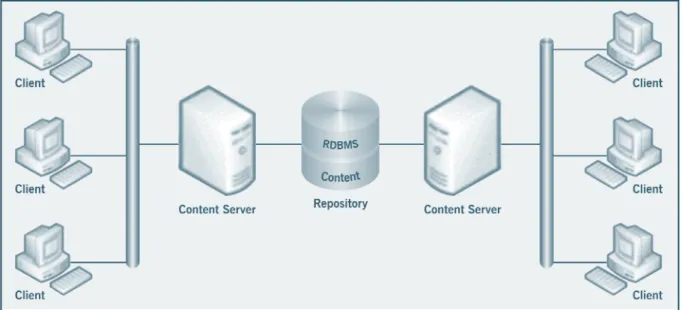
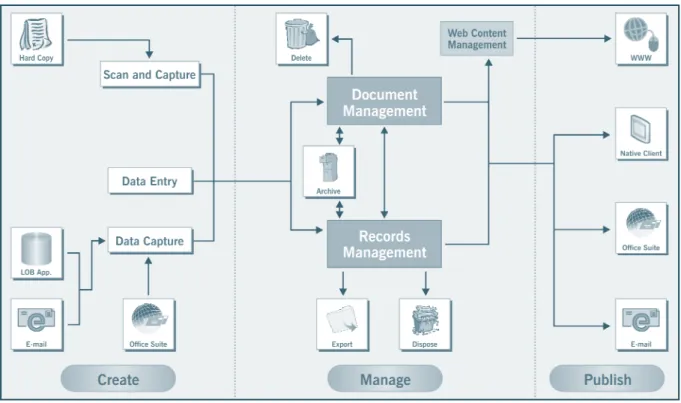
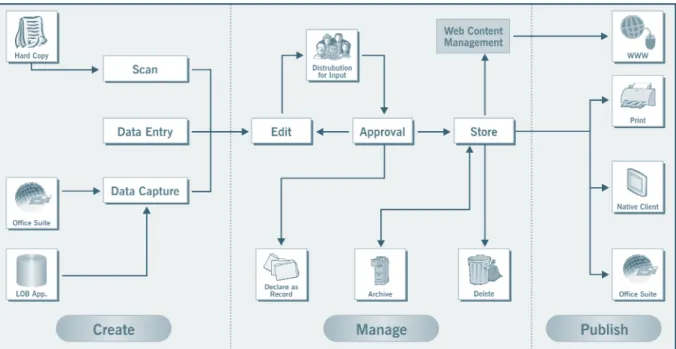
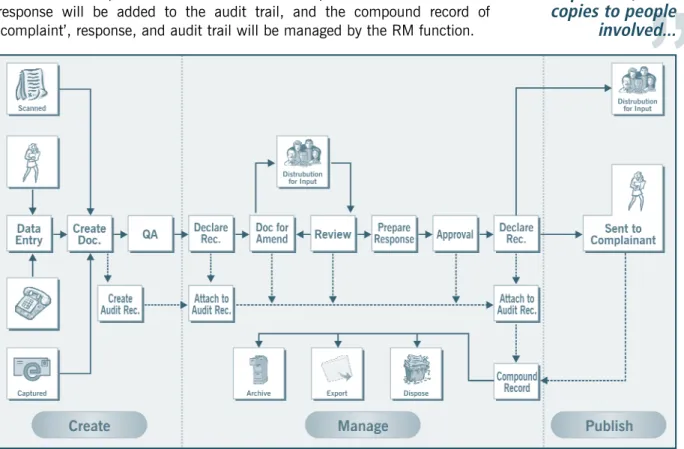
Document and
Records
Management
Document and
Records
Management
Managing Information for Compliance,
Efficiency, and Value
For more information on Butler Group’s Products and Services or to register FREE to
receive TECHwatch, written by Martin Butler and Tim Jennings, together with a
monthly guide to our Research and Events, visit www.butlergroup.com
Founder and President
Martin Butler
Research
Susan Clarke Mike Davis Richard EdwardsImportant Notice
We have relied on data and information which we reasonably believe to be up-to-date and correct when preparing this Report, but because it comes from a variety of sources outside of our direct control, we cannot guarantee that all of it is entirely accurate or up-to-date.
This Report is of a general nature and not intended to be specific, customised, or relevant to the requirements of any particular set of circumstances. The interpretations contained in the Report are non-unique and you are responsible for carrying out your own interpretation of the data and information upon which this Report was based. Accordingly, Butler Direct Limited is not responsible for your use of this Report in any specific circumstances, or for your interpretation of this Report.
The interpretation of the data and information in this Report is based on generalised assumptions and by its very nature is not intended to produce accurate or specific results. Accordingly, it is your responsibility to use your own relevant professional skill and judgement to interpret the data and information provided for your own purposes and take appropriate decisions based on such interpretations.
Ultimate responsibility for all interpretations of the data, information and commentary in this Report and for decisions based on that data, information and commentary remains with you. Butler Direct Limited shall not be liable for any such interpretations or decisions made by you.
Published by Butler Direct Limited Published February 2005
© Butler Direct Limited
All rights reserved. This publication, or any part of it, may not be reproduced or adapted, by any method whatsoever, without prior written Butler Direct Limited consent.
Artwork and layout by Chris Dickinson and Steve Duke
Section 1: Management Summary 9
1.1 Management Summary 11
Section 2: Business Issues 17
2.1 Report Structure 19
2.2 Introduction and Definitions 19
2.3 Business Drivers for Document and Records Management 21 2.4 The Problems of Managing Paper-based Documents and Records 23
2.5 Compliance Issues 25
2.6 Business Challenges Facing Organisations 27
Section 3: Technology Features 31
3.1 Lifecycle Steps to Successful Document and Records Management 33
3.2 Search and Retrieval 37
3.3 Workflow and BPM 41
3.4 Security 42
3.5 Technical Integration 44
Section 4: Architectures and Models 49
4.1 Solution Architecture 51
4.2 ECM Platform vs. Specialist EDRM Solution 54
4.3 Standards 55
4.4 Information Lifecycle Management 57
4.5 Document Process Scenarios and Document Lifecycles 58
Contents – February 2005
Document and Records
Management
Section 5: Market Issues 65
5.1 Developing a Document and Records Management Strategy 67
5.2 Implementation 70
5.3 Role of the National Archives (UK) for Standards and Support 74
5.4 Case Studies 76
5.5 Futures 80
Section 6: Tables 83
6.1 Butler Group Document and Records Management Features Matrix 85 6.2 Butler Group Document and Records Management Product Capability
Diagrams 113
6.3 Butler Group Document and Records Management Market Lifecycle Ratings 120
Section 7: Comparisons 127
7.1 Solution Comparisons 129
Section 8: Technology Audits 143
Diagonal Solutions– Wisdom 145
EMC Documentum– Documentum 5 155
Fabasoft – Fabasoft eGov-Suite Version 6 163
FileNet– FileNet Records Manager 173
Hummingbird– Hummingbird Enterprise Version 5.1.05 181
Hummingbird (Valid Information Systems)– R/KYV Version v9.1 189
Hyperwave– eKnowledge Suite and eRecords Suite 197
IBM– DB2 Document Manager, DB2 Records Manager 207
Interwoven– EDMS Suite 215
Meridio– Meridio 4.2 225
Open Text– Livelink Enterprise Suite 9.5 235
Stellent– Stellent Content Management Version 7.2 243
TOWER Software– TRIM Context 253
Vignette– Vignette Records & Documents Release 4.4 263
Contents – Continued
Section 9: Vendor Profiles 273 80-20 Software 275 Adobe 276 BT openaccess 276 Cimage NovaSoft 277 Convera 279 Dexmar 280
Fujitsu Software Corporation 280
Hyland Software 281
InTechnology 282
Iron Mountain 283
MDY Advanced Technologies 284
Microsoft 285 Neurascript 286 Objective 288 SAPERION 289 Scientific Software 290 SealedMedia 290 Verity 291 ZyLAB 292 Section 10: Glossary 295
Contents – Continued
SECTION 1:
1.1 MANAGEMENT SUMMARY
Introduction
Butler Group does not believe that organisations in general have a clear understanding of their obligations, under current and pending regulations, to retain information. This is leading to confusion as to whether information should be retained, and if so for how long it needs to be retained. In our opinion, the only effective way to safely retain information, in a format where it cannot be altered, is to implement a Document and Records Management (DRM) solution. Unfortunately few organisations outside of the public sector have even a basic understanding of Records Management (RM), and how this differs to Document Management (DM). It is the view of Butler Group that this ignorance will cost organisations dearly as regulators get tougher on companies that fail to discover and retrieve information within the requested timeframe.
Business Issues
In Butler Group’s opinion, much of the confusion over the difference between DM and RM arises because of the integrated DRM functions offered by vendors, which in turn means that the boundaries between the two are often blurred. Because of the ability to embed DRM into applications that users are familiar with, such as Microsoft Word, and drive many of the DRM features through automated workflow, much of the functionality is hidden from the end-user and even the organisation’s management. Furthermore, because records can be automatically declared using the workflow capability, the user may not even be aware that the status of a document has changed to that of a record. We therefore believe that every organisation should have a professional Records Manager to provide oversight and control of all aspects of DRM.
KEY FINDINGS
An ignorance of the obligations under current and pending regulations to retain information will cost organisations dearly as regulators get tougher on companies that fail to discover and retrieve information.
Document and Records Management (DRM) requires a change in culture from secretive to public, individual to corporate, and paper to electronic.
20% of the knowledge capital of any organisation is still in a paper format.
Paper-based records have no built-in provision for disaster recovery.
More requests for information are made for litigation than compliance.
Far too much information is retained by organisations; records should be retained that are required to run the business, or to meet statutory requirements.
Organisations need to balance the risk of disposing of information over that posed by retaining it.
In the public sector information is more likely to become a permanent record than in the private sector.
The selection of a DRM solution should be driven by the ability to address the organisation’s requirements and not based on whether it conforms to TNA 2002 or other standards.
Without a DRM system, knowledge workers spend up to 80% of their time looking for information.
DRM should be available to all employees and not just a few, and must be transparent to the end-user.
The majority of private sector organisations have not implemented RM. Many will already have some form of DM, often within an Enterprise Content Management (ECM) solution, but there are still companies that have no system in place to effectively manage information. In these organisations up to 80% of the organisation’s knowledge capital is stored on local hard disks, never backed-up, and unavailable to other users who could derive value from it. An absence of centralised management of information also results in duplicated information, multiple versions of the same document, and even inaccurate information, which may be sent to partners, or customers. Butler Group believes that the absence of an effective information management system can directly affect the bottom line of the organisation through lost business.
Numerous studies have shown that it can take information workers up to 80% of the time spent on a piece of information actually locating it, with the other 20% spent working on it. If the information being searched for is a record, and its retrieval is required for reference only, then this percentage can be even higher. Whilst not every person in the organisation, can be considered an information worker, this undoubtedly is a major area of inefficiency in organisations and one where demonstrable benefits can easily be seen.
For many organisations the RM policy is to simply finalise a document or other piece of information, archive it off to off-line storage (typically tape) and store the tape or other medium off-site. Retained e-mails are also archived to back-up tapes and again stored off-site. It is not until the organisation is asked to discover and retrieve information, typically for litigation, that it realises that this approach is naive and actually places the organisation at risk of a large fine for a failure to disclose information.
It is in this type of situation, as well as for compliance, that we feel RM has such a vital role to play. Many organisations fail to realise that unless information is stored in a RM system where it cannot be altered, it is difficult to prove to a regulator or a court that a piece of information has not been amended in any way. Therefore organisations must implement RM to provide this proof.
Many organisations have been put off implementing effective archiving or RM systems because they feel that the managerial overheads are too high. In Butler Group’s opinion, this is an area where organisations can learn a great deal from the experience of the public sector. In many parts of the public sector there has been a position of Records Manager for many years. Traditionally, the role of the Records Manager was to file and manage the distribution of paper-based records. With the development of Electronic DRM (EDRM) applications, this role has evolved into managing electronic as well as paper documents, with the Records Manager becoming a corporate Information Manager. We believe that private sector organisations must take a leaf out of the public sector’s book and appoint a dedicated person to manage information, as information is the greatest asset of an organisation and should be maintained as such.
Another prohibiting factor to the implementation of DRM is reluctance from users. Change Management is one of the trickiest areas that organisations have to overcome in order to achieve a successful implementation. DRM involves huge cultural change from secretive to public, as users need to become used to sharing information; individual-to-corporate, as information is no longer stored on local drives; and paper-to-electronic, as the organisation stores more information electronically. This is a problem that is experienced by both the private and public sectors.
Butler Group believes that many organisations considering implementing DRM are misguided in the belief that The National Archives (TNA) 2002, or another standards-approved RM solution will provide them with a superior product. The requirements of the organisation and how well the solution fits these needs should be the overriding drivers, unless an approved system is mandated as in the case of public sector bodies. The approved systems have been developed to address the requirements of specific sectors, and can be overly restrictive for general use, not because they lack functionality (which is extensive and manages all aspects of RM) but because some of the features required for general use are disabled.
Much of the information within an organisation, in both the private and public sectors, is still in a paper-format, despite the fact that we are supposedly in the era of the ‘paperless office’. Storing records in a paper format carries inherent risks. Because there are normally no copies, there is no disaster recovery provision. We therefore urge organisations to implement some form of EDRM for its key information, and wherever possible to maintain all records electronically.
Document and Records Management
www.butlergroup.comFebruary 2005
12
Section 1: Management SummaryWe believe that
private sector
organisations must
take a leaf out of the
public sector’s book
and appoint a
dedicated person to
manage information...
Technology Issues
It is the belief of Butler Group that organisations have failed to fully exploit technology to help in the management of documents and records. One of the major issues is the ability to discover and retrieve information. This may be for internal purposes, for regulators, the courts, or in the UK public sector for Subject Access Requests (SARs) under the Freedom Of Information (FOI) Act 2000. This requires the use of search and retrieval technology. For organisations implementing DRM, search techniques are normally included out-of-the-box, but for organisations that have not yet deployed DRM, searching the indexes of back-up tapes, or searching the hard disks of storage devices are not cost-effective or time-efficient search methods. We believe that it is inevitable that organisations will face increasingly large fines for a failure to disclose information when requested, through an inability to locate it. Organisations must therefore ensure that they have effective search technologies in place to provide them with the ability to discover information. However, search techniques alone are not sufficient to discover specific documents and records from what in the future may be many petabytes of information. Effective indexing and classification of information is also required. Again the public sector can teach the private sector a great deal. Its Records Managers have been creating fileplans or classification systems for records and documents for many years. An effective classification system will make searching for information much speedier and more effective. This is one reason why Butler Group believes that organisations implementing DRM must have a dedicated Records or Information Manager, who can develop and maintain a classification system or fileplan.
To date, many DRM implementations have been departmental, or delivered only to select users. We believe that DRM must be implemented enterprise-wide, with access to specific information and information-types via access rights and permissions. This is the only effective way that knowledge capital can be shared across the organisation. It also addresses the major issue faced by a large number of organisations, which is that of information being stored on local devices, where it is never backed-up or protected.
DRM runs much wider than simply creating and editing, and retrieving documents and records. It manages the entire lifecycle of information, including its storage. Information Lifecycle Management (ILM) is therefore an important element of DRM, and we believe that organisations must implement an ILM strategy for cost-effective DRM. Although only around 10% of ILM is related to technology, this does include the media that the information is stored on at any point in its lifecycle. It is our opinion that information must be stored on the media that best reflects the age and value of an item of information, and that the ability must exist to be able to move the information – even if it is a record – back up the storage hierarchy to higher-performance disk should it, once more, need to be accessed regularly. Butler Group believes that in the future DRM will support the ability to automatically move information up and down the storage hierarchy, based on user demand, but this level of sophistication is currently not generally available.
Market Issues
There are two types of products that provide DRM functionality, ECM solutions where DRM is a sub-set of much wider information management capabilities, and niche EDRM products. Butler Group believes that there is validity in both approaches and has reflected this by reviewing both ECM vendors with DRM functionality and EDRM vendors for this Report.
As the ECM market place continues to consolidate, we believe that the larger ECM vendors will acquire most of the niche EDRM players, particularly those that are TNA 2002 and other standards approved. We have already seen the beginnings of this through the acquisition of Tower Technology by Vignette, and Valid Information Systems by Hummingbird. One of the major benefits of this approach for the ECM vendors is that they gain immediate TNA 2002 approval, which enables them to bid for UK public sector contracts. The reason that many of the major ECM vendors are only now seeking TNA 2002 approval, is because they are US-headquartered, and therefore have chosen DoD 5015.2 approval first, which is the US standard, as a priority over international standards.
It is the belief of
Butler Group that
organisations have
failed to fully exploit
technology to help in
the management of
documents and
records.
It is not only the EDRM vendors that will be subject to acquisition. Many ECM vendors will also either be acquired, or will merge with other vendors to consolidate customer-bases and become more prominent players. Butler Group believes that eventually there will be around six major ECM vendors, and some of these will comprise vendors that do not currently play or predominate in this space. We expect Microsoft and Oracle to enter this arena through the acquisition of ECM or EDRM vendors. Furthermore, following the example of EMC, it is more than likely that other storage vendors will undertake vertical integration by entering this market, again through the acquisition of existing players.
We do not, however, see major risks for customers in this shakeout. Experience has shown, for example with Vignette and IBM, that the existing customers of the acquired vendors are offered security, long-term commitment, and additional functionality/options for the future.
Butler Group Document and Records Management Market Lifecycle Ratings
Butler Group’s vendor ranking and assessment model groups suppliers of DRM solutions into Outperform,
Perform, and Under-performcategories, and shows the predicted progress through the three major market phases of Early Adoption, Market Adoption, and Market Maturity.
Document and Records Management
www.butlergroup.comFebruary 2005
14
Section 1: Management SummaryButler Group believes
that eventually there
will be around six
major ECM vendors,
and some of these
will comprise vendors
that do not currently
play or predominate
in this space.
Early Adopter 2002-2004 Market Adoption 2005-2007 Market Maturity 2008-2010 OUTPERFORM PERFORM UNDER -PERFORM• EMC Documentum • EMC Documentum • Fabasoft • Hummingbird • IBM • Open Text • EMC Documentum • Fabasoft • FileNet • Hummingbird • IBM • Open Text • Fabasoft • FileNet • Hummingbird • Hummingbird (Valid Information Systems) • IBM • Meridio • TOWER Software • Tower Technology • FileNet • Hummingbird (Valid Information Systems) • Hyperwave • Interwoven • TOWER Software • Vignette • Hummingbird (Valid Information Systems) • Hyperwave • Interwoven • Microsoft • Oracle • Stellent • TOWER Software • Vignette • Diagonal Solutions • Hyperwave • Interwoven • Open Text • Stellent • Vignette • Diagonal Solutions • Meridio • Oracle • Stellent • Diagonal Solutions • Meridio
Outperform
EMC Documentum
Documentum 5
An ECM platform which provides unified content services, such as RM, and supports a number of packaged solutions, including DM. It has an integrated approach to the management of all types of information, both electronic and physical.
Fabasoft
Fabasoft e-Gov-Suite Version 6
An EDRM solution designed specifically for public sector deployments. Highly scalable with an impressive range of integration tools, the RM functionality conforms to UK, German, Swiss National, and EU standards.
Hummingbird Hummingbird Enterprise Version 5.1.05 IBM DB2 Document Manager, DB2 Records Manager
An extensive ECM solution that includes DM and RM, which are part of an extensive, tightly-integrated suite of products that provide end-to-end
management of the lifecycle of information. Feature-rich products, Document Manager is a component of Content Manager, which provides extensive DM capabilities, and Record Manager is an engine that provides all of the functionality required to manage records efficiently.
Open Text
Livelink Enterprise Suite 9.5
An extensive, fully-featured ECM solution, which includes functionality in the areas of DM and RM. Open Text is particularly strong in search and retrieval, with its own in-house developed search engine.
P
erform
FileNet
FileNet Records Manager
Records Manager is a component of FileNet’s P8 architecture, which provides comprehensive ECM and BPM capabilities. As a modular solution, P8 addresses a number of requirements of organisations, including a need to manage documents and records more effectively.
Hummingbird
(Valid Information Systems)
R/KYV Version v9.1
R/KYV is an EDRMS that is built around open standards, and has been developed to address government-defined RM requirements. Highly modular, and using XML, R/KYV v9.1 is most suited to those public sector organisations that require a wide range of functionality on an open platform meeting UK TNA 2002 or EU MoReq standards.
Hyperwave
eKnowledge Suite and eRecords Suite
The Hyperwave eKnowledge Infrastructure (eKI) integrates many disparate yet related content-centric functions, such as DM, RM, asynchronous and synchronous collaboration, information discovery and retrieval, and e-learning.
Rating
Company/Product
Butler Group Opinion
Document and Records Management
www.butlergroup.comFebruary 2005
16
Section 1: Management SummaryInterwoven
EDMS Suite
This enterprise-scalable product provides a truly collaborative environment for DRM. With extensive workflow and optional Business Process
Management, vertically aligned Collaborative Document Management business solutions can be constructed, giving an opportunity for rapid operational benefits.
P
erform
cont.
TOWER Software TRIM ContextThis solution is based on Microsoft technology and, as such, integrates extremely well with many desktop and server products from Microsoft. It provides a number of modular features in addition to DRM: workflow; archival management; space management; and barcode tracking.
Vignette
Vignette Records & Documents Release 4.4
Vignette Records & Documents is a central component in Vignette’s V7 ECM Suite, providing integrated DM, RM, and CM. It has an architecture that is most suitable for high-volume requirements, is built on open standards, and is API- rather than product-centric, offering transparent integration to existing systems.
Diagonal Solutions
Wisdom
Wisdom is an integrated DRM system which is Microsoft-based. A strong architectural feature is the ability to store documents in either a Microsoft SQL Server database or within the Windows files system. It exploits the Microsoft .NET architecture.
Meridio
Meridio 4.2
Meridio 4.2 is a Microsoft .NET-based EDRM solution. One of its undoubted strengths is its tight integration with Microsoft products and technologies – such as Office and SharePoint Portal Server. It provides a wealth of functionality in a product that is easy to implement and simple to use, negating the need for lengthy training.
Stellent
Stellent Content
Management Version 7.2
Stellent Content Server fully supports DRM functionality in addition to security, workflow, searching, archiving, and content distribution. It has been built from the ground-up using Java, and this architecture presents a single, logical repository and a set of core services that are easy to manage.
Rating
Company/Product
Butler Group Opinion
Under
SECTION 2:
2.1 REPORT STRUCTURE
In recognition of the fact that this Report will be read by a wide range of senior management personnel, each with different areas of interest and expertise, the Report has been structured to separate-out the elements and issues to as great an extent as possible. The aim is to make each section as freestanding as is practicably achievable. However, we recommend that the whole Report is needed to give the complete picture.
A brief summary of each section of the Report is included below in order to help direct the reader to particular areas of interest.
Section 2 – Business Issues
This section provides the introduction to Document and Records Management (DRM) and puts the subject into context. It includes Butler Group’s definitions of documents, records, Document Management (DM), and Records Management (RM), and sets the scene for the Report, examining the various business issues and drivers.
Section 3 – Technology Features
Section three of this Report looks at the various technology areas that Butler Group expects to see in DRM solutions and includes the core functionality of DRM; the lifecycle steps in a successful DRM strategy through from the creation of a document to the disposition of a record.
Section 4 – Architectures and Models
This section examines the various architecture approaches offered by vendors such as the combination of servers and repositories, the various client options, and the interface options. Also covered in this section are the different approaches to DRM from the specialist Electronic DRM (EDRM) vendors and the functionally larger offerings from the Enterprise Content Management (ECM) vendors.
Section 5 – Market Issues
Market Issues examines the various DRM implementation options, and makes recommendations as to the best way to address this daunting task. There are a number of case studies of organisations that have implemented DRM to provide guidance to organisations considering an implementation.
Section 6 – Tables
This section first presents Butler Group’s Document and Records Management Features Matrix, which allows the selected DRM solutions to be seen side-by-side in terms of features and capabilities. A number of supplementary tables are also included in this section.
Section 7 – Comparisons
This section includes comparisons of the vendors featured in this Report.
Section 8 – Technology Audits
This section contains in-depth Technology Audits for the vendors reviewed in this Report.
Section 9 – Vendor Profiles
This section contains brief profiles of a number of relevant vendors and technologies not covered by a Technology Audit.
2.2 INTRODUCTION AND DEFINITIONS
Butler Group believes that the boundaries between documents and records have become extremely blurred, leading to much confusion amongst organisations, helped in part by unhelpful definitions and terminology from vendors, as well as multiple options for the creation of records. Organisations are also fuelling this confusion in the terminology they use. This is partly due to the fact that documents are declared as records at different stages in the lifecycle of individual pieces of information. For example, a record can be declared as soon as a document is created, which means that every version of the document constitutes a separate record.
Alternatively the record may not be declared until the document has reached the end of its lifecycle in terms of the fact that it will no longer be amended. If this declaration is totally seamless to the end-user, as Butler Group believes that it should be, then the end-user will often not be sure whether he or she should be calling a piece of information a document or a record.
To end this confusion, Butler Group has developed definitions for documents, records, DM and RM.
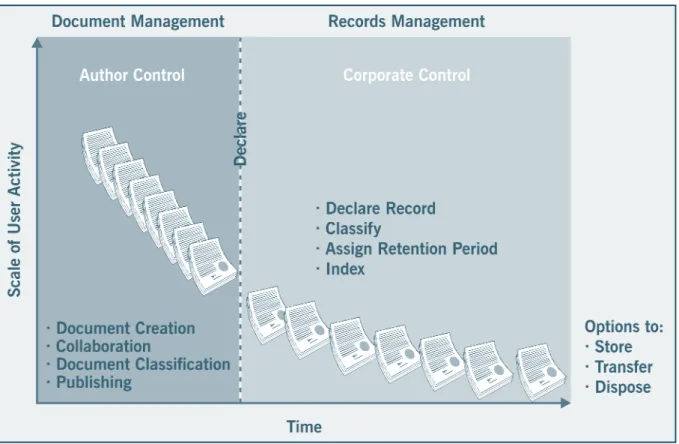
A document is an evolving item of information, which is not fixed, can be changed, and is owned and managed by individuals.
A recordcan take the form of a piece of information in any format, including documents, images, items of evidence, telephone calls, faxes, e-mails, and tape-recorded conversations. It is a statement of fact, is fixed, cannot be altered, has some sort of retention period attached to it, and is managed on behalf of the company/organisation (by an individual or small group).
Following on from this: Document Management helps individuals to manage the lifecycle of electronic documents from creation, through review, and storage to destruction or declaration as a record.
Finally Records Managementis a policy-driven system for the management and control of records from the point of declaration through the review process to disposition or transfer to a permanent archive.
Figure 2.2.1: Definitions of Document and Records Management
Illustrative examples of document and record processes and lifecycles are described in Section 4.5 of this Report.
Documents have a variable lifecycle but this will generally include the creation, often a review process, some form of editing or document development, and deletion or declaration as a record. A record may be superseded, but this becomes a new document or record, and the original remains unchanged. There are three strands to records management: a scheme for the capture of records, which includes supporting a wide range of applications, records with multiple components, and new applications; retrieval, incorporating the methods for search and discovery; and the disposal of records, which includes retention periods and the processes undertaken before the disposal of the record. Butler Group believes that the management of these strands should be the ultimate responsibility of a single person, either a Records Manager or an Information Manager.
Document and Records Management
www.butlergroup.comFebruary 2005
20
Section 2: Business Issues...the management of
these strands should
be the ultimate
responsibility of a
single person, either a
Records Manager or
an Information
Manager.
In Butler Group’s opinion, this dedicated Records Manager role is required because there is a great deal of confusion within organisations about the type of information that should be retained, and therefore needs to be captured or declared as a record, at what point in the lifecycle this declaration should take place, and the format in which the record should be stored. Butler Group believes that the public sector, which has had a role of Records Manager for many years, and is well used to declaring and managing records, is the leader in RM and can set a good example for the private sector.
In the UK, The National Archives (TNA) formerly the Public Records Office (PRO), has developed a series of standards and guidelines for records managers across government organisations to help them meet the requirements of The Freedom Of Information (FOI) Act 2000, The Data Protection Act 1998, and The Human Rights Act 1998, alongside their duty to maintain records in order to deliver services. These were originally introduced in 1999, and revised in 2002. TNA 2002 (PRO II) certification is awarded to vendors whose Electronic Records Management (ERM) systems TNA has tested, and that comply with the functional requirements for ERM systems in UK Government, and TNA 2002 certification is mandatory for ERM systems in UK Government organisations.
Other countries have their own standards, such as AS ISO 15489 and VERS in Australia, MoReq in the European Union, DOMEA in Germany, and DoD5015.2 in the US.
Such is the revere that these standards are held in that many private sector organisations also seek RM solutions that have TNA 2002, or other standards approval, without necessarily appreciating that a significant part of the functionality may add overhead without delivering appropriate business benefit. However, companies that are involved with Public Private Partnerships (PPP) of Public Finance Initiative (PFI) schemes in the UK need to be aware that they are also subject to FOI, and may need a TNA 2002 solution to meet those demands in relation to these projects.
Butler Group believes that the primary consideration of private sector organisations (not bidding for PPP or PFI work) must not be whether or not a solution is approved but whether it addresses the requirements of the organisation.
For example, many organisations have a hybrid system of paper-based and electronic records, which further confuses the issue, and therefore a DRM system must be capable of handling
both electronic and physical records.
At present the majority of retained records are in paper format, and we feel that organisations must aim to reduce this percentage. Butler Group believes that, where possible, organisations should implement an EDRM system in order to store most or all of their records in electronic format, reversing the current trend.
2.3 BUSINESS DRIVERS FOR DOCUMENT AND
RECORDS MANAGEMENT
Until recently the major driver for DRM in the UK and Europe was a desire to improve efficiency and reduce cost through the better management of information, but there are now indications that compliance and litigation are becoming increasingly important, and Butler Group expects to see these become the predominant drivers over the coming months. Another driver is the need to improve the auditability of the lifecycle of information.
Compliance and Litigation
Compliance and the risk of litigation are forcing an increasing number of organisations to retain growing volumes of information. This information includes e-mails, documents, paper documents such as faxes, graphical images, and other multimedia files. To date, e-mail has been the type of information that is most associated with retention. This is because many of the high-profile cases of organisations – particularly in the financial sector – receiving fines has been due to an inability to retrieve e-mails when requested. However, it is not just e-mails that have to be retained, other business-related information also needs to be kept.
In much of the private sector there is no heritage of RM. Butler Group believes that many large organisations will have implemented some form of DM functionality, but that this will rarely extend to RM. In the past this would not have been an issue, and information that was retained would typically have been stored on back-up tapes, often off-site.
Butler Group believes
that, where possible,
organisations should
implement an EDRM
system...
However, the risk of litigation, and in Europe to a lesser extent compliance, are forcing organisations to review how they store this legacy information. It is certainly the case that there are currently more requests for the disclosure of information for litigation purposes than for compliance, and this can affect potentially every organisation, regardless of size or type. It has been estimated that Fortune 500 companies face an average of 125 non-frivolous lawsuits at any given time for which they have to locate information relating to operational decisions.
Without an effective RM system to manage information, it is impossible for an organisation to know whether or not it has the information requested – back-up tapes do not make an adequate retention policy. The fines are high for failure to disclose, and the cost is also high if outside consultants are required to locate the requested information.
Where regulations have been introduced, for example in the financial sector, there is a requirement to be able to prove that information retained has not been altered in any way, and this is where RM has a part to play in compliance, and the same feature is also useful in litigation.
Improved Efficiency and Reduced Costs
A desire to improve the efficiency of the business and reduce costs through better DM and recordkeeping is another important driver for DRM, and one that in Europe has been to date, in the opinion of Butler Group, the predominant reason for implementing DRM.
Exponential growth in the amount of information that organisations store, increased storage requirements, and a requirement of administrators to manage “more with less” as organisations look for new ways to reduce costs, has resulted in many seeking to achieve savings in the management of information. Information Lifecycle Management (ILM) has been touted as a way of helping organisations to better manage their information, and enable them to extract knowledge capital from it.
A large proportion of the knowledge capital within an organisation is contained within information, and this makes information an organisation’s greatest asset. Yet Butler Group believes that the majority of companies are not effective in managing their information, making it readily available to employees that require it. It has been estimated that up to 80% of the total time involved on a particular piece of information is spent locating it, which is clearly not an effective use of an employee’s time.
Part of the problem is caused by the high number of documents that are stored locally on the desktops of individuals, which makes them unavailable to other users. In some cases this simply means that the knowledge capital is unavailable to users who would benefit from it – information cannot be exploited that users are not aware even exists. A more serious implication, in Butler Group’s opinion, is that multiple copies of the same document can be created, resulting in multiple versions and also a repetition of work, so that users do not know which version they should be using. If this document happens to be a contract containing details such as terms and conditions this can have serious repercussions. Even with less sensitive documents, if different versions are sent out, this can result in inconsistent and even inaccurate messages being received by customers or partners.
There are also security implications of allowing information to be stored and managed locally, with the potential for sensitive company information to be passed to competitors or even individuals within the organisation who are not entitled to view this information. Even if the information is stored centrally, without proper controls, it is impossible to manage who has access to it, and what individuals are able to do with it – they could be sending it to competitors via Web-based e-mail accounts unbeknown to the company. Often there is no clear idea of who should do which tasks in the lifecycle of a document, so that when a document is received from a customer, no one takes responsibility for it – with the result that it is not processed. A failure to service customers properly will directly affect the bottom line. A cause of this problem is that there is no one person in charge of information, which makes it difficult to formulate any policies over its management.
Document and Records Management
www.butlergroup.comFebruary 2005
22
Section 2: Business IssuesInformation Lifecycle
Management (ILM)
has been touted as a
way of helping
organisations to
better manage their
information, and
enable them to
extract knowledge
capital from it.
If there is no single person in charge of the management of information, the organisation cannot formulate policies for its management, or indeed have any idea of what information should be kept for its business value, resulting in a great deal of information with no value being kept and knowledge capital being deleted. As an example, a company rationalised its staff a few years ago making redundant a large number of middle managers. There was then an emergency following equipment failure, which could have resulted in an explosion if it was not rectified speedily. Unfortunately, because the problem did not happen very often, no one in the company knew how to deal with it. To make matters worse there was no written documentation. The only people who had experienced the problem before and knew how to deal with it were the middle managers. The company ended up having to bring redundant managers – at great expense – out of retirement to explain how to solve the problem. If the company had implemented a retention policy, any documents or e-mails explaining how to solve the problem would have been retained, and the knowledge to rectify the problem would have been within the organisation, without having to buy in the knowledge.
Lack of Auditability in the Lifecycle of Documents
A lack of auditability in the lifecycle of documents is a common problem where there is no DM solution. With no audit trail of who did what to a document and when, there are problems in disputes or when things go wrong. Because of this it can be impossible to determine whomade a contentious change to a document, and even when it was made. This makes it difficult to defend actions that were taken, if there is no record of who took those actions. A lack of an audit trail can also render it impossible to ensure that a document has passed through all of the stages in its lifecycle, such as its review processes.
Ultimately the organisation is responsible for the content of any documents that are delivered to third parties. Ill written or badly spelt documents sent to customers does not inspire confidence in a company, and can lose it business. Inaccurate terms and conditions or contracts have the potential to do much more damage. Another potential problem with no audit trail is that it is impossible to see who has viewed a document. This is highly dangerous if there are no access rights applied to individual documents.
Under certain regulations, a full audit trail of the entire lifecycle of a document is a requirement. Therefore a lack of an audit trail facility will render an organisation non-compliant.
2.4 THE PROBLEMS OF MANAGING PAPER-BASED
DOCUMENTS AND RECORDS
Despite frequent messages of the imminent arrival of the paperless office, we are actually generating more paper-based documents and records than ever before. Even when documents are created electronically, a hard copy is often taken and stored in a filing cabinet, increasing the amount of physical space required to store documents and records. Many documents will never become electronic, such as correspondence from customers received as letters. These hybrid systems comprising a combination of electronic and paper-based documents and records can be extremely difficult to manage effectively.
Butler Group believes that part of the reason behind the desire to retain paper-based versions of electronic documents and records is that it is much easier for an employee reviewing a customer history, or a public sector body examining a case, to view documents or records in the same format, rather than having to switch between looking at the screen and looking at a document on the desk.
This hybrid approach creates problems, particularly for organisations that need to retain information for compliance purposes. Firstly they must decide which is the corporate version of a document or record, which is the one that must be produced if requested. Secondly whichever format is declared as the corporate version must be accessible and therefore managed. Lastly there are two formats of the record to be managed and kept in line, with all the various events that can take place in a record’s lifecycle such as the retention period, reviews, the movement of the record between storage media or locations, and the final disposition, ensuring that both versions of the record are destroyed. If it is to be transferred to a permanent archive then the redundant version of the record must be destroyed.
Ultimately the
organisation is
responsible for the
content of any
documents that are
delivered to third
parties.
If a document is kept electronically and in a paper format its management is even more difficult than that of a record, because the document is more likely to be an evolving piece of information. If each version of the document is printed, then this adds to the paper mountain. The organisation also needs to decide if a copy of a changed document should be retained or just its final version. Documents go through many iterations before they are finalised or become records. Because a full audit trail is increasingly required for compliance, all versions of a document have to be retained alongside the final record, further adding to the paper mountain if the organisation has elected to use its paper-based versions as the corporate record. If information held in an electronic system is adequately protected, then Butler Group does not see any need to retain a paper-based copy of a record, which can lead to legal problems as already mentioned of deciding which version is the corporate copy. There are also implications if the paper version of the record is superseded, but not the electronic one, or vice versa, and the people access the unchanged version. There are potentially more serious implications if the wrong version is then produced for compliance purposes. Unfortunately there is often mistrust in the ability of IT to perform adequate and regular back-ups, and more importantly in the ability to restore information on demand. Butler Group believes that this is one of the reasons for reluctance on the part of staff to stop retaining a hard copy of electronic documents and records. This is where we believe that proper back-up and recovery, disaster recovery, and business continuity strategies are so vital and necessary. However, the organisation should go further and ensure that these strategies are fully documented and that all employees are made aware of them so that they can be sure that procedures have been implemented to protect their information.
Butler Group does not believe that paper-based documents and records are any more secure than electronic ones, in fact
they are often less accessible. While paper-based documents are stored in a filing cabinet they are easy to find, although not necessarily accessible to everyone who would benefit from using them. Unless there is an electronic index, people would not necessarily know of a document’s existence or where to find it. However, because there are generally no duplicate copies of paper documents or records, while they are located in the general office they are not, in Butler Group’s opinion, adequately protected from disasters.
Once the filing cabinet is full, documents are typically put into storage such as a basement or warehouse, which makes it time-consuming to retrieve documents that are not necessarily stored on site. However, they are generally better protected against disasters if stored off-site.
Documents that are retained need to be protected, because they are normally not duplicated. This means putting in place elaborate measures such as humidity control, and gas-based sprinkler systems, in addition to physical security methods to prevent the theft of sensitive content – particularly pertinent to the public sector, but also in the private sector such as details of drugs trials.
The use of a warehouse, while affording better disaster recovery provision, does not necessarily improve accessibility. If multiple documents are required for litigation or compliance it is costly and time-consuming to retrieve them, particularly if there is no documented indexing system. Many organisations end up calling in outside consultants to locate information required for compliance or litigation. Even internally required documents can be time-consuming to locate, but not many organisations would actually call in external consultants to help locate information for internal users.
It is the view of Butler Group that most organisations do not know what paper-based documents they have, particularly if their ‘archives’ go back 10 or 20 years. We believe that these organisations should be asking themselves whether this information is actually required.
It is our opinion that organisations should consider retaining only historical, paper-based documents that have value to the business, unless they are required for compliance purposes. However, it would be a costly task for any organisation to review a warehouse of historical records dating back many years.
Document and Records Management
www.butlergroup.comFebruary 2005
24
Section 2: Business IssuesUnfortunately there is
often mistrust in the
ability of IT to
perform adequate and
regular back-ups, and
more importantly in
the ability to restore
information on
demand.
Butler Group does not
believe that
paper-based documents and
records are any more
secure than electronic
ones...
Some organisations have developed a policy whereby any information in a paper-based warehouse that is retrieved following a request from an end-user is scanned and stored in the electronic system, and this version replaces the paper version, which can then be safely destroyed.
Butler Group recommends that a sensible approach for organisations that generate large volumes of paper-based documents is to consider adopting a DRM system. To be effective, this must be supported by adequate disaster recovery provision to ensure that employees do not feel the need to print paper copies of electronically stored documents and records. A single discovery process can justify the cost of such an electronic system. Only when organisations have reduced or eliminated the creation of paper documents and records can they start to tackle the vast accumulation of historical documents and records, and review, which pieces of information should be retained and which can safely be deleted.
2.5 COMPLIANCE ISSUES
Compliance is becoming a major driver for the implementation of systems incorporating DRM functionality. Butler Group maintains that if organisations deploy systems that can help them to run their businesses more efficiently, then when they are required to comply with regulations and legislation they will already have many of the systems in place that will help them to achieve compliance, and therefore compliance will be delivered for free or at least at a reduced cost. DRM and in particular RM are systems that help organisations to manage their information more efficiently, but are a vital part of compliance when information has to be retained. RM is required because organisations have to be able to prove that information has not been altered in any way, and an effective RM system, in Butler Group’s opinion, is the only way of proving that the information is stored in an efficient system where it cannot be altered.
It is not just the retention of information that is required for compliance, an increasing number of regulations require organisations to maintain audit trails of the lifecycle of a piece of information. This is one reason why some organisations create a record as soon as the original draft of the document is completed, and then a new record is created at each iteration of the document. Butler Group believes that unless there is a legal requirement to declare a record as soon as a document is created then there is little point in declaring it as a record before it is necessary. A more effective solution is to use DRM functionality, which includes a full audit trail capability that fully documents the lifecycle of the information both as a document and as a record.
Although the maintenance of an audit trail will address some compliance issues, organisations are leaving themselves vulnerable to increasingly large fines because of their inability to be able to discover information when requested. As already discussed, many organisations have a hybrid
system of electronic and paper-based documents, which makes the discovery process much harder and can also create problems providing the regulator with records in a single format.
There are numerous examples of organisations falling foul of the regulators and receiving hefty fines for a failure to keep adequate records. The Financial Services Authority (FSA) fined the Bank of Ireland UK£375,000 in September 2004 for failing to have adequate systems in place to detect a number of suspicious high-risk cash transactions that were worth approximately UK£2 million. A RM system and the appropriate monitoring of the information
gathered would have highlighted these transactions as being suspicious and requiring further investigation. In August 2004, the FSA fined the Shell Transport and Trading Company, Royal Dutch Petroleum Company, and the Royal Dutch/Shell Group of Companies UK£17 million for committing market abuse and breaching the listing rules by issuing misstatements of its proved reserves. Better recordkeeping would have made it much more difficult to misstate its proved reserves. Ironically much of the trouble that Shell found itself in, and the reason for some high-level resignations, was a series of deeply damaging e-mails, which had been retained between the sacked head of exploration Walter van de Vijver and the former Chief Executive Sir Philip Watts.
There are numerous
examples of
organisations falling
foul of the regulators
and receiving hefty
fines for a failure to
keep adequate
records.
This leads to another issue raised by compliance, and that is what information needs to be retained. Butler Group maintains that it is highly dangerous to retain all information, both in terms of content, but also because it greatly increases the amount of information that needs to be stored and maintained. Legislation such as Sarbanes-Oxley demands that organisations be more transparent and open in their accounting and in their recordkeeping. There are new criminal and civil penalties from the Act, in addition to the enhancement of existing penalties, designed to catch a variety of corporate abuses. These include: false certification of financial statements; restatement of financial statements; blackout period violations; tampering with documents and records and impeding investigations; record retention violations by auditors; and securities fraud. The Companies Bill, when introduced in the UK, is expected to involve similar requirements. Sarbanes-Oxley requires the retention of any financial-related information, but there is often confusion about what constitutes financial or any other type of information that needs to be retained for other regulations.
One of the areas where there is a great deal of confusion is in the retention of e-mails. Some organisations err on the side of caution and retain all e-mails, while others just keep business e-mails. In many cases, the boundaries are extremely blurred between what constitutes a business e-mail and what can be construed as personal mail, particularly when an employee has a close relationship with a business acquaintance. There is also confusion whether e-mails and other records need to be retained beyond the retention period. Butler Group believes that organisations need to balance the risk of retaining information against that of the value that can be derived from it. Clearly, information that informs a person how to perform a task that no one currently working for the organisation has ever experienced has a value and should be retained. Similarly, information that has little value and may be regarded as contentious, should be deleted as soon after the end of its retention period as possible.
To date, many of the high-profile cases of non-compliance have related to e-mails, largely, Butler Group believes, because e-mails have not been stored in proper indexed systems where they are easily retrievable, and no thought has been given to which e-mails should be retained. It is also the most widely-used, inter-company communication method, and it is through e-mail that many disputes arise. Without effective DRM, many organisations will find themselves unable to fulfil the requirements of compliance by being unable to discover and produce information, in documents and records as well as in e-mails.
These high-profile cases have often arisen because of the inability of an organisation to produce requested records in the time allowed under the terms of the regulation or legislation. Because of the lack of indexed storage systems, many companies are forced to bring in outside consultants to help them locate requested information, both in electronic format where the information may be located on back-up tapes stored off-site dating back several years, or in a physical location such as a warehouse, where it may be a case of trawling through many boxes. One Fortune 500 company had to spend US$750,000 to locate e-mails from an archive in response to a subpoena for discovery. In the US, companies have been fined between US$10 million and US$100 million for not having adequate information retrieval procedures in place.
Many of these problems arise because organisations are not even aware whether the information they are being asked to produce still exists, which goes back to the issue of which types of information organisations should retain. In a court case in which Burst.com is suing Microsoft over patent infringement, Microsoft has been accused of requesting that its employees routinely destroy internal e-mail every 30 days, despite a court order that states the company should retain such documents. Microsoft is claiming that any documents relating to lawsuits is not included in its deletion policy, but it does demonstrate the difficulty that organisations have if they leave RM to employees, and e-mails that need to be retained must be treated as records in Butler Group’s opinion. Furthermore, the management of records must not be put in the hands of users. Assuming that organisations do retain requested information, the request may require pieces of information from various sources – for example, documents, e-mails, faxes, and voice messages – to be produced. In a well-managed RM system, if these pieces of information are related – for example, a case in the public sector – then they should be stored together in a single folder and be easily accessible. However, without a centralised information management system it is very difficult to gather all of these pieces of information together, and also be sure that all the individual items have been discovered.
Document and Records Management
www.butlergroup.comFebruary 2005
26
Section 2: Business IssuesMany of these
problems arise
because organisations
are not even aware
whether the
information they are
being asked to
produce still exists...
The difficulty that many organisations experience in discovering information has resulted in some preferring to pay the fine rather than search for information, or bring in outside consultants to undertake the task. Butler Group believes that the reason for this has been that the fines have been smaller than the cost of discovering and retrieving the information. As the regulators become tougher we do not believe that this will be a viable option in the future.
Much of the focus of non-compliance has centred on the issue of not being able to find requested information, but there is one issue that many organisations are largely ignorant of, but potentially is more damaging; that is a lack of awareness of the content that employees are sending to external parties in the name of the company. Ultimately it is the company that will be held responsible for non-compliant or contentious material, yet many lack the ability to check outbound content. DRM with proper review procedures at least ensures that documents adhere to company standards.
Butler Group believes that any organisation that has a large amount of information to manage, and wishes to gain competitive advantage by exploiting the knowledge capital within this information, must implement a DRM solution, even if there is currently no requirement to retain records for compliance. With the number of regulations and legislation that companies are subject to increasing in the coming years, including the Companies Act (which will have a huge impact on British companies) and similar legislation in other countries, we believe that now is the time to act and implement DRM. By acting now before they are forced to, organisations have the relative luxury of being able to fully evaluate products that support DRM, and plan the implementation so that the solution is optimised and delivers full value.
Too many organisations leave an implementation of this nature until the last minute when the company is forced to act quickly to be compliant, and this is when implementations are more likely to fail, because the objectives have not been thought-out properly, nor the requirements of such a system determined. Implementations that are rushed also tend to be more expensive because a higher level of external expertise is required to meet tight deadlines.
2.6 BUSINESS CHALLENGES FACING ORGANISATIONS
There are a number of business challenges facing organisations that can be addressed by implementing DRM. These challenges include how to audit information, storing documents and records centrally, better search and retrieval capabilities, and also how to deal with records when they reach the end of their retention period.One of the major challenges facing organisations is how to address a growing requirement to fully audit all actions and events associated with a piece of information throughout its lifecycle. This creates a requirement for the better auditability of the lifecycle of documents and records. Although the main reason for a full audit trail is compliance, it also has other benefits. Knowing who made changes to a document and when can be used to settle disputes, or prove that events did or did not take place. It can also be proved what version of a document was sent to a particular person, on a certain date.
Another challenge for organisations is managing all of their information. By adopting a centralised repository for documents currently stored on remote devices, protection is provided for the documents in that they can easily be backed-up, are easily accessible to employees who do not need to spend hours looking for the information, and access rights can be applied to individual pieces of information. This in turn increases employee productivity. In addition, with all information stored centrally, RM can be put into the hands of a single person or small team, the responsibility for the management of records
can be taken away from individuals, measures can be put in place to ensure that records are correctly classified, and the security of records can be tightly managed.
The greatest challenge for organisations, and the one that Butler Group believes poses the highest risk of failure to achieve, is the ability to locate information. The key to being able to discover information is detailed metadata. Even if DRM is not implemented, the deployment of a search and retrieval solution will help an organisation locate information. However, one of the major search criteria used by search engines is metadata.
The greatest
challenge for
organisations, and the
one that Butler Group
believes poses the
highest risk of failure
to achieve, is the
ability to locate
information.
Part of the functionality of DRM is the creation of metadata both automatically (to enter information such as an author of a document and date of creation), and manually (to enter organisation-nominated information). Although metadata is created by other systems – for example, Microsoft Word and other Office applications – it is often limited and may not have the level of detail required for complex searches. Therefore, DRM provides a more effective way of creating metadata.
Another technique that makes searching a repository easier is to index and categorise each item of information. DRM supports this ability and also allows individual items of information to be associated with other pieces of information, through the ability to utilise sub-categories. For any organisation that needs to retain information, and therefore requires RM to manage information that must not be changed in any way, the capability to be able to classify records is vital, as this will help in the discovery process. A huge challenge for organisations in the future will be the ability to discover and retrieve information dating back many years. With some organisations planning to retain information indefinitely and others having to retain information for upwards of 80 years, search and retrieval technologies will become much more important to organisations than they are today.
All organisations have a requirement for some form of search and retrieval capability, but this becomes absolutely vital if there is a requirement to retain information for compliance. Without the ability to retrieve information there is no point in retaining it. As already mentioned, the regulators in many industries are demanding higher fines for an inability to produce requested information.
Compliance and good business practice are driving organisations to implement different retention periods for different types of information. The challenge is deciding which pieces of information are subject to certain pieces of legislation and regulations, the types of information that have no regulatory obligation to be retained but contain knowledge capital, and finally which types of information do not need to be retained at all, but may be of value to an individual, such as an e-mail. Once this decision has been taken, the retention periods need to be decided. For some pieces of legislation and regulations the retention period is set, but with others it is not so definite. For example, the FSA states that information should be retained for at least six years, leading some financial institutions to delete their business records as soon as the period is up, while others hold on to it for a bit longer in case litigation is pending. Another challenge is deciding when to delete the information, balancing its value against the risk of it being requested for litigation. For organisations needing to comply, there is a requirement to take some form of action at the end of a retention period. The choice is to either dispose immediately and automatically of records at the end of the retention period, or to enter some form of review. Disposition schedules therefore do not match those of a retention period. A disposition schedule could trigger an event, such as a review, or the transfer of the record to a permanent archive, or to set a new retention period. The challenge for the organisation is deciding how to deal with records that have reached the end of their retention period.
Although it will not always be feasible, Butler Group recommends that organisations should review information before destruction if possible. This could be undertaken by firing off a report of records for review to the original author of the piece of information, or the owner if it is not the Records Manager. Alternatively there could be a review panel that checks records due to be destroyed. DRM may support the ability to flag records for destruction, allowing the actual deletion process to be batched.
Some regulations demand that a record should be destroyed at the end of its retention period so that it cannot be recreated even by forensic methods. Again this is a challenge for organisations as it is claimed that data can now be restored that has been overwritten at least 14 times, and that total is rising rapidly. Although not all systems that incorporate DRM overwrite the data that many times, most do several overwrites – enough to satisfy the various RM standards, and also the regulators.
Even where organisations have been forward-thinking and have already implemented DRM, or are well down the procurement process, there are still big challenges to face, and Butler Group believes that the one that is potentially most damaging is a reluctance to change by staff. Any new system is likely to attract some reluctance to embrace new technologies and learn how to use new applications, but this can be reduced by involving all departments impacted by an implementation in the planning and selection choice. By ensuring that the entire company buys into a project, resistance can be reduced or even eliminated altogether.
Document and Records Management
www.butlergroup.comFebruary 2005
Butler Group believes that one of the drivers for DRM should be a desire to improve business processes and promote efficiencies that will invariably result in process changes for users. One way to improve acceptance of the new system is to embed it in an application that users are familiar with, for example Word, and many DRM systems integrate tightly with popular applications that are widely deployed.
Organisations face many challenges, which DRM can address. However, many of these challenges require some action on the part of the organisation in order to adequately address them. DRM should not be seen as functionality that can simply be implemented, it requires careful planning to ensure that it provides
the optimum benefit to the organisation. In Butler Group’s opinion, organisations must address all of these challenges before the implementation stage. Once implemented, it is often too late to start addressing challenges that the application was supposed to solve.
Butler Group believes
that one of the
drivers for DRM
should be a desire to
improve business
processes and
promote efficiencies
that will invariably
result in process
changes for users.
SECTION 3:
3.1 LIFECYCLE STEPS TO SUCCESSFUL DOCUMENT
AND RECORDS MANAGEMENT
To affect a successful Document and Records Management (DRM) strategy some form of DRM system is required, Although the majority of records held by an organisation are still in a paper format, Butler Group would urge any organisation to consider implementing an Electronic Records Management (ERM) system, because we believe that records are better protected within an electronic system and they are easier to discover. This section details the steps that organisations need to undertake to manage documents and records within a DRM system. Not all of these steps will be relevant to every type of document or record, but they provide a general guide to DRM.
Most organisations will have some form of Document Management (DM) system, even if it is only a word processing package such as Microsoft Word, with basic DM functionality. While this may be sufficient for a company that creates very few documents, and only has a small amount of information to manage, it will certainly not be satisfactory for an organisation with more extensive DM requirements. Butler Group strongly recommends that these organisations should implement a DRM solution.
Content Capture/Creation
DM must provide the ability to import previously-created documents as well as allowing for the creation of new documents. For many organisations most documents will be created internally, but not necessarily within the DM system itself. Enterprise applications may be the originator of many documents, and so the ability must exist to import these into the DM system, which is often achieved by having the ability to save the document directly into the DM repository. For this to occur, tight integration is required with the enterprise application.
Integration is also required with standard word processing packages, to allow users to create documents in the applications they are most comfortable with. Again the documents are generally saved directly into the DM repository, through additional menu options. However, not all documents will be in a standard word processing format, so other creation tools need to be supported such as spreadsheet packages, Quark, and Adobe Acrobat.
Integrating with standard packages addresses a major issue faced by organisations, that of a reluctance to use new applications often voiced by employees. By making the use of an application totally transparent to an end-user, Butler Group believes that change management issues can be avoided. Electronic documents originating outside the organisation also need to be supported, so the DM tool must support a