by
Noel Patrick Smit Bachelor of Law
Baccalaureus Educationis (Honours) Training and Development Higher Diploma in Education
Diploma in Education
Thesis submitted in partial fulfilment of the requirements for the degree of
MASTER OF PHILOSOPHY
IN EDUCATION AND TRAINING FOR LIFELONG LEARNING at
Stellenbosch University
Supervisor: Prof BL Frick December 2017
By submitting this thesis electronically, I declare that the entirety of the work contained therein is my own, original work, that I am the owner of the copyright thereof (unless to the extent explicitly otherwise stated) and that I have not previously in its entirety or in part submitted it for obtaining my qualification.
Signature: NP. Smit Date: December 2017
Copyright © 2017 University of Stellenbosch All rights reserved
ABSTRACT
The workplace provides a fertile learning environment where apprentices can improve and fine-tune their trade to develop from apprentice to artisan. The experience and expertise of a seasoned employee transferred to the novice apprentice in this setting through informal workplace learning could contribute to the development of artisanship. Apprentices apply trade theory to what was learned during formal training and reflect on this learning by trial and error. Workplace learning could be provided in the mining context through different modes that could include formal, non-formal as well as informal learning. Various authors emphasise that the workplace provides a legitimate setting for informal workplace learning, which has received increased prominence over the past years. Also, the literature suggests that employees develop significantly more skills and expertise in the workplace through informal learning, which was identified as a leading mode for learning delivery in that environment. Learnerships offered by a mine in South Africa for the development of artisans as a requirement in its Social and Labour Plan to drive community development and organisation sustainability provide a unique opportunity to focus on informal workplace learning. This study explored artisanship through workplace learning to investigate which organisational factors (if any) influenced artisan development, how informal workplace learning is facilitated, and how it occurs at a mine. Data were collected through 18 semi-structured interviews, which were analysed by way of conventional content analysis. The results indicated that informal workplace learning facilitated the development of artisan apprentices in the mining sector.
KEYWORDS: Informal learning, workplace learning, institutional learning,
OPSOMMING
Die werkplek bied 'n vrugbare leeromgewing waar die vakleerlinge hulle vaardigheid kan verbeter en verfyn om van vakleerling tot vakman te ontwikkel. Die ervaring en kundigheid van 'n ervare werknemer wat oorgedra word aan die beginner-leerder in hierdie konteks deur middel van informele werkplek-leer kan bydra tot die ontwikkeling van vakmanskap. Vakleerlinge pas vakteorie toe op dit wat tydens formele opleiding geleer is en besin proefondervindelik oor hierdie leer. In die mynbou-konteks kan werkplek-leer op verskillende wyses voorsien word; dit kan formele, nie-formele sowel as informele leer insluit. Verskeie skrywers beklemtoon dat die werkplek 'n geldige plek bied vir informele werkplek-leer, wat verhoogde status oor die afgelope jare geniet het. Die literatuur dui ook daarop dat werknemers aansienlik meer vaardighede en kundigheid in die werkplek ontwikkel deur middel van informele leer, wat geïdentifiseer was as 'n voorkeurmetode vir die lewering van leer in daardie konteks. Leerlingskappe wat vir die ontwikkeling van ambagsmanne deur 'n myn in Suid-Afrika aangebied word as 'n vereiste in sy Sosiale en Arbeidsplan om gemeenskapsontwikkeling en organisatoriese volhoubaarheid te dryf, bied 'n unieke geleentheid om op informele werkplek-leer te fokus. Hierdie studie het vakmanskap deur werkplek-leer ondersoek om vas te stel watter organisatoriese faktore (indien enige) vaardigheidsontwikkeling beïnvloed, hoe informele werkplek-leer gefasiliteer word, en hoe dit by 'n myn plaasvind. Data is ingesamel deur 18 semi-gestruktureerde onderhoude te doen wat deur middel van konvensionele inhoudsanalise ontleed is. Die resultate het getoon dat informele werkplek-leer die ontwikkeling van vakmanvakleerlinge in die mynbousektor fasiliteer.
SLEUTELWOORDE: Informele leer, werkplek-leer, institusionele leer, vakmanskap,
DEDICATION
I DEDICATE THIS WORK TO:
My late father, Daniel Smit, who never had the opportunity to attend any school, yet he taught me so much about life, about never giving up. He always believed that you can succeed.
My late father-in-law, Hermanus Saunderson, who taught me what it is to be a loving husband to my wife Sabina (his beautiful daughter) and a parent to our children, Hermann, Courtney, Donwin and Manwell.
ACKNOWLEDGEMENTS
My sincerest appreciation goes to my loving wife, Sabina, and my family who supported me on this journey and endured with me the arduous road I travelled to complete this project.
My heartfelt thanks and appreciation also go to my supervisor, Professor Liezel Frick, for walking the extra mile with me. I wanted to give up when the task seemed daunting, but she encouraged me to continue and to finish what I had started.
I wish to acknowledge the following functionaries of the mine where this study was conducted for their approval and organisational support:
General Mine Manager Human Resources Manager Training Manager
Engineering Manager
CONTENTS
DECLARATION ... i ABSTRACT... viii OPSOMMING ... ix DEDICATION ... x ACKNOWLEDGEMENTS ... xi CHAPTER 1 ... 1ORIENTATION TO THE STUDY ... 1
1.1 INTRODUCTION ... 1
1.2 MOTIVATION FOR THE STUDY ... 2
1.3 PROBLEM FORMULATION ... 8
1.4 RESEARCH QUESTION ... 10
1.4.1 Sub-questions ... 10
1.5 DEFINITION OF THE KEY CONCEPTS ... 11
1.5.1 Formal learning ... 11
1.5.2 Non-formal learning ... 12
1.5.3 Informal learning ... 13
1.5.4 Workplace learning ... 15
1.5.5 Artisan development and practical WPL ... 17
1.6 RESEARCH DESIGN AND METHODOLOGY ... 18
1.6.1 Research methodology ... 18
1.7 ETHICAL CONSIDERATIONS ... 20
1.8 CHAPTER ORGANISATION ... 23
1.8.1 Chapter 1: Orientation to the study ... 23
1.8.2 Chapter 2: Literature review ... 23
1.8.3 Chapter 3: Research design and methodology ... 24
1.8.4 Chapter 4: Findings... 24
1.8.5 Chapter 5: Discussions and conclusions from the data ... 24
1.9 CONCLUSION ... 24
CHAPTER 2 ... 26
LITERATURE REVIEW ... 26
2.1 INTRODUCTION ... 26
2.2 WORKPLACE LEARNING ... 27
2.2.1 Dimensions of workplace learning ... 27
2.2.2 Workplace learning ... 28
2.2.3 The workplace as a site for learning ... 30
2.2.4 Model for workplace learning ... 31
2.3 FORMAL LEARNING ... 34
2.4 INFORMAL LEARNING ... 36
2.4.1 Origin of informal learning ... 36
2.4.2 Informal learning in the workplace ... 37
2.4.3 Model for informal learning ... 39
2.5 ORGANISATIONAL FACTORS INFLUENCING ARTISAN DEVELOPMENT ... 46
2.6 HOW LEARNING IS FACILITATED IN AN ARTISAN DEVELOPMENT PROGRAMME ... 49
2.7 INFORMAL WORKPLACE LEARNING AND ARTISAN DEVELOPMENT ... 51
2.7.1 Artisan development in the United Kingdom and Europe ... 52
2.7.2 Artisan development in Finland ... 52
2.7.3 Artisan development in South Africa ... 53
2.7.4 Artisan development in the mining industry ... 57
2.8 CONCLUSION ... 59
CHAPTER 3 ... 61
RESEARCH DESIGN AND METHODOLOGY ... 61
3.1 INTRODUCTION ... 61
3.3 RESEARCH DESIGN AND METHODOLOGY ... 63
3.4 DATA COLLECTION METHODS... 69
3.5 DATA ANALYSIS ... 71
3.6 ASSUMPTIONS AND LIMITATIONS ... 75
3.7 CONCLUSION ... 76
CHAPTER 4 ... 78
FINDINGS ... 78
4.1 INTRODUCTION ... 78
4.2 POPULATION AND SAMPLE ... 78
4.2.1 Summary of different groups of respondents ... 79
4.3 DESCRIPTION OF CATEGORIES OBTAINED FROM THE DATA ... 80
4.3.1 Reasons for joining the programme ... 82
4.3.2 How informal workplace learning was facilitated at the mine ... 85
4.3.3 How situated learning occurred at the mine ... 90
4.3.4 The influence of organisational factors on artisan development at the mine ... 93
4.4 CONCLUSION ... 111
CHAPTER 5 ... 114
DISCUSSION AND CONCLUSIONS ... 114
FROM THE DATA ... 114
5.1 INTRODUCTION ... 114
5.2 CONCLUSIONS ... 115
5.2.1 How, if at all, did informal workplace learning occur at the mine? ... 116
5.2.2 How, if at all, was informal workplace learning facilitated at the mine? ... 118
5.2.3 Factors in the organisation that, if at all, influenced informal workplace learning at the mine ... 119
5.3 CHALLENGES EXPERIENCED BY THE ARTISAN APPRENTICES ... 122
5.4 LIMITATIONS OF THE STUDY ... 127
5.5 CLOSING COMMENTS ... 128
6 REFERENCES ... 130
7 ANNEXURES ... 146
7.1 ANNEXURE A: Ethical clearance form Stellenbosch University ... 146
7.2 ANNEXURE B: Consent of General Mine Manager to conduct the study ... 147
7.3 ANNEXURE C: Interview Guide... 149
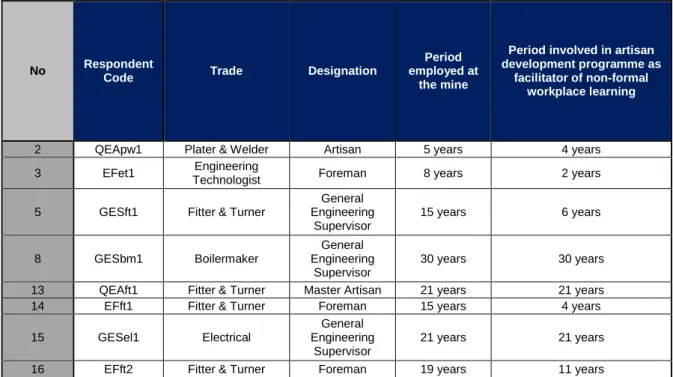
7.4 ANNEXURE D: Details of respondents in the study ... 153
7.5 ANNEXURE E: Informed consent ... 155
LIST OF TABLES
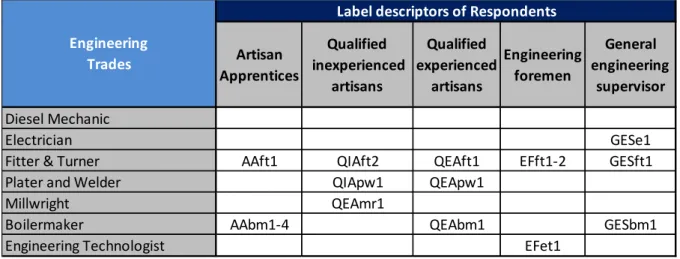
Table 4.1: Summary of respondents ... 79Table 4.2: Descriptor labels of respondents ... 81
Table 4.3: Experience breakdown of coaches ... ...102
LIST OF FIGURES
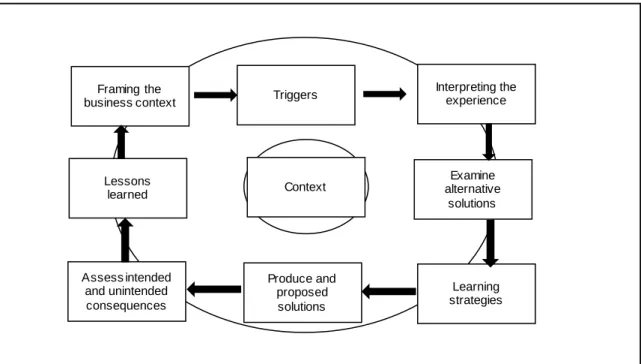
Figure 2.1: The 3-P model on workplace learning ... 32Figure 2.2: Marsick and Watkins’s Informal and Incidental Learning Model ... 39 Figure 3.1: Data collection process
LIST OF ACRONYMS AND ABBREVIATIONS
ADP Artisan Development Programme CHE Council of Higher Education
DHET Department of Higher Education and Training DMR Department of Mineral Resources
ETQA Education and Training Quality Assurer FET Further Education and Training
FETC Further Education and Training College HE Higher Education
HR Human Resources
LOM Life of mine
MHSA Mine Health and Safety Act, No. 29 of 1996
MPRDA Mineral and Petroleum Resources Development Act, No. 28 of 2002 MQA Mining Qualifications Authority
MTA Manpower Training Act, No. 56 of 1981 NAMB National Artisan Moderation Body NCV National Certificate Vocational NQF National Qualification Framework NSDS National Skills Development Strategy PLA Programme-led Apprenticeship
QCTO Quality Council for Trades and Occupations SAQA South African Qualifications Authority SDA Skills Development Act, No. 97 of 1998 SDF Skills Development Fund
SETA Sector Education and Training Authority SIVOS Sishen Vaardigheidsontwikkelingsentrum SLP Social and Labour Plan
TVET Technical Vocational Education and Training
UK United Kingdom
VET Vocational Education and Training WPL Workplace learning
1
CHAPTER 1
ORIENTATION TO THE STUDY
1.1 INTRODUCTION
Adults have the ability to learn effectively throughout life (Farrell, 2013:37). Companies capitalise on this ability by not only providing training and development opportunities to employees, but also by using this ability to respond to market conditions, to stay in business and maintain their competitive advantage. The workplace provides an opportunity for all employees to learn and for experienced employees to share their knowledge with novice employees.
Novices acquire knowledge and skills and sometimes obtain qualifications in a specific field of expertise by means of such sharing. Apprentices in particular may benefit from workplace-based opportunities by learning from experienced artisans. Artisan development through practical workplace learning (WPL) gives the apprentice a unique opportunity to learn from experience by trial and error. Artisan apprentices at the mining workplace setting can develop from novice to artisan through situated learning in the workplace. From this premise the study focused on practical WPL, the kind of learning that happens ‘perchance’.
Much of this WPL takes place informally, which means that it is often not recognised or measured in the artisan development programme (ADP). We thus understand little about the contribution practical WPL makes in developing artisan competence and expertise. This study therefore focused on artisan development through practical WPL within a particular context – that of an iron ore mine1 in the Northern Cape in South Africa (referred to as ‘the mine’ in this study).
A typical training and development path of the artisan in the mine where this study took place would be formal theoretical learning at a technical and vocational training college (TVET college)2 from N1 to N2,3 followed by practical training at a skills
1
The iron ore mine is near Postmasburg in the Northern Cape, a province of South Africa. The mine started in 2009 and ramped up to full iron ore production in 2011 at 9 million tonnes direct shipping ore per annum. The mine has a labour complement of 2 863 people ranging from semi-skilled, skilled, technical and professionally qualified employees.
2
The nearest TVET College to Postmasburg where the mine was situated is in Kathu, approximately 80 km away. Most of the respondents attended this college to complete their trade theory.
3
development centre, after which the apprentice will attend informal on-the-job WPL in the mine. Practical WPL will thus follow after formal theory-based and practical training, which is a combination of coaching by an artisan, master artisan, engineering foreman or general engineering supervisor4 (later referred to as the coach), fault-finding trial and error actions on mining equipment, repair and maintenance of faulty equipment, and engineering assistance during plant shutdowns. No formal classes are attended and learning happens informally as the work progresses using the trade theory as a reference framework.
During the practical WPL at the mine, the apprentice must be exposed to the entire scope of the trade as pre-determined by the curriculum of the occupational trade qualification to ensure that once qualified, he or she will be competent to become a productive worker in the mining industry, thus increasing the available artisan pool. The practical WPL experience is captured in a logbook indicating what practical exposure an apprentice has undergone. The apprentice can only apply to write the national trade test after 18 months of practical on-the-job WPL and completion of all practical modules. The successful apprentice is issued with an N3 national certificate on National Qualification Framework (NQF) level 5 in the relevant trade by the Quality Council for Trades and Occupations (QCTO) in terms of section 26D (4) read with section 36 of the Skills Development Act, No. 97, 1998 (SDA). This qualification is endorsed by the Mining Qualifications Authority (MQA) and the artisan may be appointed in the suitable vacancy in the industry because the qualification is generally accepted as proof of the competency and skills in a particular trade of the artisan. The apprentice has now developed into an artisan through practical WPL.
1.2 MOTIVATION FOR THE STUDY
Training and development in general, and work-related learning in particular, are vital for employees to be able to respond to the changing work demands imposed by the market and society (Doornbos, Bolhuis & Denessen, 2004:174). There is a need to
4
In the mine where the study was conducted the HR organisational structure in the Engineering Department is as follows: Maintenance operator → Artisan → Master Artisan → Engineering Foreman → General Engineering Supervisor → Engineering Section Manager → Engineering Manager → General Mine Manager. The apprentice is positioned between the Maintenance Operator and the Artisan and is assigned to a qualified artisan for WPL according to the respective trade.
ensure the continuous upgrading of knowledge and skills of the workforce within the mining sector to ensure industry competiveness and a measurable increase in the intermediate skills pool especially in artisan, technician and related occupations. The call by mining companies for increased practical workplace experiential learning opportunities to artisan apprentices provided by the mining sector seeks not only to increase the pool of artisans, but also to decrease unemployment thereby safeguarding sustainability in the sector.
South Africa is a growing economy in a global market that faces many challenges with regard to people development, including artisan skills in the mining industry (Rasool & Botha, 2011). Rasool and Botha (2011:1) claim that skill shortages in South Africa still exist. This puts a challenge to government and the private sector to promote skills development. The mining sector in South Africa is cognizant of the small pool of intermediate skills, especially artisan skills, which are too low to support national and sector development and growth. Rasool and Botha (2011:1) assert that regardless of a number of educational reforms, like changes to school curricula, South Africa still experiences a considerable shortage of skills. According to the National Skills Development Strategy III (NSDS III) of 2011, the current workforce is not keeping up with the skills needed to remain competitive in an increasingly knowledge‐based economy (NSDSIII, 2011).
Various national initiatives provide a support structure to artisan training in the corporate sector. The NSDS III (RSA, 2011) seeks to encourage and support large corporate employers and state‐owned enterprises to cooperate with the relevant education and training institutions. This engagement is aimed at providing the required training resources and experienced staff to address specific skills development needs of artisans through focused practical WPL. The mine where this study was completed offered artisan apprentices an 18-month on-the-job practical WPL opportunity before obtaining the national qualification in their trade of choice. The Sector Education and Training Authority (SETA) in South Africa also plays a prominent role in contributing towards artisan practical WPL and sustainable employment, especially through their discretionary funds that add to the capital investment from mining companies to practical WPL opportunities. In terms of
section 3(1)(b) of the Skills Development Levies Act, No. 9 of 1999 (as amended5) (RSA, 1999) every employer has to contribute 1% of the payroll towards a skills development fund (SDF). Revenue created by the SDF will be applied for the training and development of skills within the mining sector, including artisan training promulgated by the SDA.
The MQA is a SETA responsible for the administration of skills development programmes for the mining and minerals sector in South Africa. The MQA was first established under the Mine Health and Safety Act, No. 29, 1996 (MHSA) and later registered as a SETA under the SDA, as amended6. The Department of Mineral Resources (DMR) oversees the application of the MHSA as amended, as well as the Mineral and Petroleum Resources Development Act No. 28 of 2002 (MPRDA) as amended7. The DMR and the MQA have a keen interest in training and development within the mineral sector. The objective of the MPRDA is to facilitate meaningful development of historically disadvantaged South Africans. This requirement is outlined in the Amendment of the Broad-Based Socio-Economic Empowerment Charter for the South African Mining and Minerals Industry Republic of South Africa, also called the Mining Charter (RSA, 2010). At the time of this study the 2010 Mining Charter is in the process of being reviewed.8 This legal framework provides for training and development within the mineral sector and is not applicable only to formal learning.
The core business of the mine is the extraction of iron ore and the selling thereof to off-shore clients, not training and development. However, the workplace has to provide an opportunity and setting for WPL that could be formal as well as informal. WPL in general, both formal and informal, is supported by an extensive legal framework in the mining sector in South Africa, including the mine where this study took place. A clear focus on artisan development drives this programme along clear
5
The Skills Development Levies Act, No. 9 of 1999 was amended by the Skills Develepment Levies Amendment Act, No. 24 of 2010.
6
Refer to the Skills Development Amendment Act, No. 31 of 2003.
7
The MPRDA was amended by the Mineral and Petroleum Resources Development Amendment Act, No. 49 of 2008.
8
The Minister of Mineral Resources, Mosebenzi Joseph Zwane, published the draft Reviewed Broad Based Black Economic Empowerment Charter for the South African Mining and Minerals Industry in the Government Gazette No. 39933 of 15 April 2016, to invite interested and affected parties to submit written representations on the draft Reviewed Mining Charter.
skills development targets set out in the Social and Labour Plan (SLP)9 of the particular company. The SLP is a guiding document developed in terms of Regulation 42(1)(a) of the MPRDA which stipulates that an application for a mining right must be accompanied by an SLP contemplated in Regulation 46, which on approval is valid until a closure certificate in respect of that mine is issued in terms of Regulation 43. The SLP must make provision for skills development within the company and in its feeding employee community.
Different learnership programmes are on offer to the community, of which artisan development is the flagship that forms part of the engineering training programme. These learnerships are combinations of both formal and situated learning, as it is required from incumbents to attend formal classes at the company’s HR Training and Development Centre except in the case of engineering apprentices. This formal training is followed by situated learning that consists of practical exposure in the pit where ore extraction occurs, the processing plant where ore is crushed and screened to product specifications, the engineering workshop where maintenance of all mining and plant equipment takes place, or the load-out station where the final product is loaded for offshore shipping.
This study focused on practical WPL in the engineering department of the mine where apprentices were exposed to learning and development opportunities that are different from formal, structured learning offered at a TVET college. Artisan apprentices accepted by the mine are required to take the practical WPL route after attending a formal theory-based programme at a TVET college followed by practical exposure at the Sishen Artisan Development Centre (more often refered to in the Northern Cape region as the Sishen Vaardigheidsontwikkelingsentrum (SIVOS))10 to gain access to the trade test in order to complete their engineering qualification. The Department of Higher Education and Training (DHET) can only provide formal learning opportunities for artisans through its TVET college sector. Apprentices can only qualify as artisans after successful completion of 80 weeks’ on-the-job training
9
The SLP of mining companies is reviewed every five years and has to be approved by the DMR. Companies annually have to report on progress made against the SLP targets.
10
SIVOS is an artisan development centre that provides practical training to all the Engineering learnerships as part of their apprenticeship training at the TVET College in Kathu. Learners are placed at different mines in the Northern Cape for on-the-job WPL after attending SIVOS. This included the respondents that participated in this study.
under the guidance of and coached by a suitably experienced coach for a prescribed period. Practical WPL is thus an important component of the ADP as it gives access to the trade test, which by its very nature is a practical test based on fault-finding. With a life of mine (LOM)11 prediction of 29 years since operations started in 2011, this particular mine had to secure a constant inflow of a skilled workforce including artisans, to sustainably position itself as a global producer of quality iron ore. Developing the expertise needed for skilled performance in the mining industry has become a seamless and ongoing process in a market under continuous pressure to provide the right product on time, in budget and with zero harm to employees. According to Yamnill and McLean, (2001:195), employees are the medium through which an organisation’s competitive success can be achieved. The workplace can be recognised as a legitimate environment for learning new skills and knowledge that not only allow employees to participate more effectively in the ever-changing work environment, but will also increase the artisan pool in the mining industry.
The mine also had to position itself as an employer of choice where learning and development opportunities of its workforce took centre stage, and the ADP is one of many development programmes on offer. Coetzer (2007:417) claims that learning has become increasingly important to the continued existence of organisations ‘not only for survival, but also because the ability to learn faster than your competitors may be the only sustainable competitive advantage’. Trained artisans are a scarce commodity in South Africa and mining companies offer competitive salaries with company-provided accommodation that results in frequent turnover of human resources in this field. Companies also implement other strategies such as promotions, market-related salaries, development opportunities, production bonuses, scarce skills and shift allowances to retain their artisans longer in their service. Providing skilled artisans to the mine, in an ever increasing scarcity of qualified artisans in South Africa, puts the artisan pool under further pressure. Artisan training and development is an expensive investment for any company and the intake of apprentices is hampered by budget constraints.
11
LOM is a relevant prediction of the life of the mine based on the availability and future cost of minerals to make it profitable to mine such and stay in business.
The workplace provides a rich environment for learning (Le Clus, 2011:356). As such, practical WPL forms an integral part of vocational programmes. Establishing effective partnerships between education and training systems and employers to provide workplace training ensures that skills have real labour market relevance and that young people gain an early appreciation of and exposure to the world of work (see NSDSIII, 2011).
During practical WPL the occupational knowledge and practical learning assimilated during formal learning are applied in the workplace. The apprentice is exposed to real-life situations within the workplace, including all aspects of the artisan’s occupation such as work ethics, discipline, housekeeping (everything in its place), safety, responsibilities and quality performance of work required by the mining industry. In all artisan trades this is the most significant and most difficult of the various learning processes and therefore the apprentice is supported in the workplace by a qualified workplace coach under the guidance of an engineering foreman or general engineering supervisor. These workplace coaches are qualified and experienced artisans and master artisans in the same trade for which the apprentice is registered. The apprentice is also rotated in a section to cover all practical modules of a specific trade. This practical WPL process is known as the ‘on-the-job’ learning process in the mining sector, allowing an apprentice to progressively and sequentially re-learn what he or she learned in the formal learning process at the TVET college to apply the competence in a real workplace setting through informal learning.
Skule (2004:9) claims that informal learning in the workplace creates the most important means of obtaining and developing the skills and competencies required by the organisation. The ADP was uniquely positioned at this mine where apprentices could acquire the skills needed by the engineering department. Skills transfer from the experienced coach to the novice apprentice happens outside a formalised, structured setting that characterises formal learning in a more undisturbed and open workplace setting with its own unique qualities that can never be similar to a formal learning environment. The engineering supervisor takes the role of a coach towards the novice apprentice and the work-related experience allows the coach to transfer those competencies needed by the apprentices to develop their own competence through trial and error in an informal way of doing
things. This type of skills and knowledge transfer in such a setting does not allow for a formal approach, as in most cases it is learning in the moment.
Competence in any occupation determines whether a person can apply and transfer learning at the workplace or across a variety of workplaces. Therefore, the most critical component of learning in artisan development is practical WPL, which takes place in the workplace through work activities performed by the apprentice. Formal education that the artisan apprentice received prior to his or her placement in the workplace setting in the company ‘needs to be backed by IFL to be effective’ (Ellström, 2001, cited in Svensson & Ellström, 2004:481).
Svensson and Ellström (2004:480) claim that in most cases the formal education learners receive improves their ability to assimilate informal learning at work. Apprentices will not be able to make the cognitive connection to repair a broken gearbox or other mechanical breakdown, or rewire an electrical distribution board, without the foundational knowledge of a particular trade acquired during formal education at the TVET college. They will struggle to make the connection with the experience of the coach or interact with his or her (the apprentices’) peers and other employees on the particular issue, further enhancing their informal learning experience. The coach in the engineering department often does not have the time to explain in detail the complexities of a repair or a breakdown in a production environment that is under constant pressure to reach set production targets.
1.3 PROBLEM FORMULATION
From the discussion in section 1.2 above it can be construed that the practical WPL is a key component in the training and development of artisans within the mining industry, including the mining context where this study was undertaken. Rasool and Botha (2011:1) contend that the endorsement of the SDA created an enabling institutional and regulatory framework for expanding strategic investment in education and training across all economic sectors. The mining sector is one of South Africa’s most influential economic sectors where skills development is to a great extent aligned with the provisions of the SDA and the NSDS III of 2011 that promote WPL as one of the strategic objectives of the DHET. These objectives
include practical WPL. The ADP is such an initiative between the DHET and the mining sector where DHET would focus on formal institutionalised learning while the mining industries focus on practical WPL.
The mine at which this study was done is no exception. Its primary focus is not training and development, but providing quality iron ore to its offshore clients. The mine has its own HR training and development centre12 with a group of dedicated training instructors working under a training manager. Training interventions in the training centre take a more formal approach that includes facilitation of different learning programmes, assessment and moderation thereof. Learning in the mine is also facilitated by means of group discussions, mining equipment simulator training, coaching and coaching activities, practical demonstrations, and business simulation board games. WPL at the mine is a combination of formal and informal learning; however, this study focused on practical WPL during artisan development.
The primary objective of the mine is to produce hematite iron ore as per the conditions set out in the stipulations of its mining licence issued in terms of the MPRDA. Learning and development is not its core enterprise. However, in order to retain its licence to operate, the company has to provide learning and development opportunities to its employees and the feeding community as set out in its SLP. The licence to operate is issued by the DMR and is valid for five years only. The licence must be renewed every five years over the LOM of 29 years. The DMR will only renew the licence to operate if the mine can show compliance with its SLP targets on an annual basis. Artisan development was one of the mine’s human resources development targets in the SLP for 2015-2016. The mine has to make financial provision for the implementation of the SLP in terms of the human resources development programme.
The mine is not a formal learning and development centre, but a business venture for high quality iron ore that is shipped to off-shore clients. The learning and development opportunities provided to artisan apprentices by the mine will thus be situated within the context of informal learning, and more so WPL. In this study
12
The mine’s HR Training and Development Centre offers different training programmes, ranging from learnerships for plant and mining operators and Engineering apprentices. Portable skills programmes are also offered to unemployed youth in Bricklaying, Masonry, Cabinet-making, Upholstery and Welding. Furthermore, permanent employees sometimes undergo work-related training in Safety, Induction, and a variety of soft skills programmes.
artisan development was positioned within the context of practical WPL in the mining industry and the factors influencing learning in the engineering department of the mine were highlighted.
When apprentices move from classroom-based instruction at the TVET college to on-the-job training, informal learning takes precedence. Practical WPL and artisan development in the iron ore mining industry is a continuous endeavour for as long as the industry experiences a skills shortage of qualified artisans. Yet research suggests that despite the prevalence of informal learning in the workplace, little is known about how informal learning can best be supported, encouraged, and developed (Marsick & Volpe, 1999:3). The organisation therefore needs to encourage the transfer of knowledge and skills among apprentices in the ADP through WPL, which may be informal in many ways. The limited knowledge of how such informal learning takes place in a specific workplace setting warranted further investigation.
1.4 RESEARCH QUESTION
The following research question was consequently formulated:
How, if at all, does practical WPL in the mining sector facilitate the development of artisan apprentices?
1.4.1 Sub-questions
The following sub-questions were formulated:
• Which organisational factors, if at all, influence artisan development at the specific mine?
• How, if at all, is practical WPL facilitated during the ADP?
1.5 DEFINITION OF THE KEY CONCEPTS
Training and development occurs in different contexts and through different modes of delivery, i.e. formal, non-formal and informal learning. These concepts, as well as practical WPL, are used throughout the thesis and are explained briefly here. A more detailed analysis of the key concepts follows in Chapter 2 and 3.
1.5.1 Formal learning
Manuti, Pastore, Scardigno, Giancaspro, and Morciano, (2015:4) referring to the work of Marsick and Watkins (1990), define formal learning as structured learning that takes place ‘off-the-job’ and outside of the working environment, typically in classroom-based formal educational settings. According to the Organisation for Economic Co-operation and Development (OECD), this kind of learning is usually associated with an institution of learning such as an educational facility or an enterprise that offers formal education and training programmes (2005:5). Misko (2008:10) confirms the view of the OECD (2005) and states that formal learning refers to learning in courses or programmes resulting in nationally and internationally recognised qualifications. Hodkinson, (2010:42) further asserts that formal learning is planned and organised and is assessed by teachers and others.
Werquin (2012:267) points out that formal learning is organised in terms of scheduling, financing, learning objectives and structure. Also, that formal learning is intentional and is exemplified by school, university or training organised at the workplace (Werquin, 2012:267). Werquin (2012:267) also notes that with some exceptions formal learning can also take place at the workplace which will target the adult population, as long as it is structured. Formal learning, according to Nisbet, Lincoln and Dunn (2013:469), is generally characterised by a prescribed learning framework that includes a structured learning package or event, the award of a qualification or some type of credit, or the external specification of learning outcomes.
Similarly, the Organisation for Economic Co-operation and Development, defines formal learning as learning that occurs in an educational institution or in the
workplace and is always recognised in a certificate or qualification (OECD, 2005:5). Therefore, it can be assumed that the workplace could be a setting for formal learning as well as informal learning. Accordingly, the European Commission, (2001) refers to formal learning as learning that is typically provided by an education or training institution; it is structured in terms of objectives, learning time or learning support and leads to certification of the learner. Formal learning is thus intentional from the learner’s perspective.
1.5.2 Non-formal learning
Non-formal learning, according to Cameron and Harrison, (2012:280) refers to learning that occurs through a programme but it is not usually evaluated and does not lead to certification.
According to Kyndt, Dochy, and Nijs, (2009a:370) non-formal learning consists of all education that takes place outside of the school system and is seen as an individual process where the individual learns out of his/her own will or as a by-product of more organised activities.
Non-formal learning, according to the European Commission (2001:32-33), is learning that is not provided by an education or training institution and typically does not lead to certification. It is, however, structured (in terms of learning objectives, learning time or learning support). Non-formal learning is intentional from the learner’s perspective. Livingstone, (2001:22) – in contrast with the EU’s view – contends that non-formal education includes a diverse array of further education courses and workshops in many institutionally organized settings, from schools to workplaces and community centres.
However, Billett (2002:57) argues that there is no such thing as non-formal learning. He sees learning as ever-present in human activity (Billet, 2002) and argues that most learning takes place outside formal educational settings, which means that something similar to non-formal learning should be regarded as the standard form, rather than what is left over once formal learning is accounted for. He also has strong objections to the term ‘informal’, as he sees all learning as taking place within
social organisations or communities that have formalised structures. These formalised structures Billet (2002) refers to may be workplaces, communities and organisations. This argument is supported by Werquin (2012:268), who asserts that there is no consensus on the definition of non-formal learning in the international sphere.
Misko (2008:10) has a different view and contends that the structured programmes for developing skills and knowledge required by formalised social organisations and community structures and individuals can be defined as non-formal learning. Kyndt, Dochy and Nijs (2009:370) further emphasise that non-formal learning consists of all education that takes place outside of the school system, which excludes formal education in the primary and secondary school, as well as at the higher education institutions. Informal learning is discussed in the next section.
1.5.3 Informal learning
Marsick and Volpe, (1999:4) state that informal learning can best be described as learning that is mostly unstructured and experiential in nature and occurs outside a formal learning institution. Marsick and Watkins (2001:25) claim that ‘informal learning is usually intentional but not highly structured’ and they include examples of self-directed learning, networking, coaching, mentoring, and performance planning. The characteristics of informal learning, according to Watkins and Marsick (1992:287), would be:
• learning that is based on learning from experienced employees;
• rooted in the unique context of the organisation;
• concerned with a focus on action;
• directed by non-routine workplace conditions;
• concerned with implicit dimensions that must be made explicit;
• defined by the nature of the job task, the way in which the problems are framed, and the work capacity of the individual employee undertaking the task; and
From the characteristics above one could assume that the workplace with its unique qualities may be a suitable setting for informal learning, but the workplace may also accommodate other forms of learning from formal, institutionally sponsored learning including training and human resources development initiatives towards informal and incidental learning (Matthews, 1999; Watkins, 1995, cited in Ellinger, 2005:390). The scope of this study is informal learning with a focus on practical WPL in a South African mine.
According to Cofer (2000:1), it is important to note that the research supports the introduction of informal learning not as a replacement for formal activities but as a complement to them. Informal learning should thus not be seen as inferior or of a lesser value to institutional learning. Ellinger (2005:390) further contends that research has suggested that informal learning in the workplace takes precedence over formal learning in a sense that it mostly takes place in the workplace.
Informal learning, in contrast to formal learning, is often conceived as learning that is ‘tacit and integrated with work activities’ (Marsick, 2003:389). This type of learning results from daily work-related, family or leisure activities. Some (for example Billet, 2004) would argue, against the view held by Ellinger (2005) noted above, that informal learning is inferior to formal learning in educationalinstitutions, but Malloch, Cairns, Evans, and Connor (2011:5) argue that ‘[t]he notion of informal learning is defined as learning that occurs regularly in work as well as in everyday life, but subordinated to other activities (e.g. work practices) in a sense that learning is not their primary goal’.
The assumption is that the workplace provides opportunity for implied learning that is informal in nature. Skule (2004:9) claims that informal learning constitutes the most important way of acquiring and developing the skills required of employees needed at work, which results in contemporary WPL. Manuti, Pastore, Scardigno, Giancaspro and Morciano (2015:5) claim that informal learning occurs in situations that are not usually intended for learning, most notably in the actual work setting. Manuti et al. (2015:5) argue that informal learning, in contrast to formal learning, calls on and requires a blending of individual difference constructs such as intellectual curiosity, self-directedness and self-efficacy.
Informal learning is further defined by Manuti et al. (2015:5) in reference to the work of Dale and Bell (1999:1) as that form of learning that takes place at work and is passed on to employees’ work performance related to their employability, which is not recognised by the employer as formal curriculum-based training. Dale and Bell (1999:1) contend that the effort by the employees may be recognised by all the different parties involved and may or may not be encouraged. Informal learning could be perceived as incidental and not a highly conscious activity. This mode of learning relates to work performance where different parties may be involved in the sharing of knowledge and expertise within a particular work context with no formality to it, which renders the learning a ‘non-intentional’ activity (see Eraut, 2000). In the following section WPL is explored.
1.5.4 Workplace learning
Jacobs and Park, (2009:134) assert that the term workplace learning could be used to refer to ‘the multiple ways through which employees learn in organizations’. The literature indicates that employees could engage in formal as well as informal learning in the workplace context. Furthermore, Le Clus (2011:357) acknowledges that, ‘[i]n the workplace, learning can be described as situated in the context of social practice, in which work setting provides an opportunity for co-workers to acquire knowledge that connects theory to practice in a realistic and efficient way’. WPL includes experience-based, incidental and informal learning (Le Clus, 2011:357). More importantly, for apprentices to succeed in the ADP at the mine, they are thus required to reflect on the theory and practices learned during the formal learning process in an informal way within the context of everyday work.
Rylatt, (1994:10) defines WPL as ‘a sustained and high leverage development of employees in the line of organisational business outcomes’. The view of the sustainable development of an organisation is at the centre of this definition. Holliday and Retallick (1995:7) describe WPL as the ‘processes’ and ‘outcomes’ of learning undertaken by individual employees and groups of employees with the support of a particular workplace. This description focuses on both the process and the outcomes of learning in the workplace that relate to the goals and objectives of business. Both
views of WPL are connected to different, but related aspects of learning in the context of the workplace, namely the learning by and development of the employee, as well as the sustainability of the organisation.
According to Le Clus (2011:359), workplace learning construed from the perspective of informal learning is meaningful to the employee, and it denotes everyday learning and participation in work activities. The employee makes sense of the daily learning interventions that occur at the workplace that involve examining embedded knowledge and encouraging learners to be self-directed and reflect on their learning experiences (Le Clus, 2011:359). Learning in the workplace from a novice’s perspective may not only provide meaningful, everyday learning and participation in workplace activities, but also allow for an opportunity to engage actively in the development of the novice apprentice’s knowledge and skills, that may facilitate individual growth and development (Karakowsky & McBey, 1999:193).
Moreover, on-the-job WPL provides a platform to apprentices to make sense out of their formal trade theory learning by being involved in and exposed to different practical learning opportunities through self-directed learning and reflection among other things. The process of WPL focuses on apprentices’ active involvement with their coaches where the outcomes are aimed at the understanding of complex systems, fault-finding, manufacturing, and maintenance of mining equipment.
In a mining context it is a legal requirement to invest in the overall training and development of employees and apprentices and to assure the company’s sustainability by retaining its competitive advantage in a country with a shortage of qualified and skilled artisans. Participation in an ADP, as well as other human resources development initiatives, presented considerable benefits to the mine. This investment helped to ensure that apprentices entering its premises as novices took part in WPL under the supervision of a coach where their formal learning theory connects with the practical world of work.
1.5.5 Artisan development and practical WPL
Apprentices in the mine where this study was conducted may be exposed to different modes of learning (including formal, informal, and non-formal learning) during their on-the-job training until being certified as artisans by the QCTO in terms of theSDA. Apprentices were engaged in different learning opportunities in the workplace setting and with experiential guidance from their coaches, by trial and error, reflection and self-directed learning, they acquired the skills and expertise envisioned in the ADP on their way to artisanship. This is a journey that starts with formal learning at the TVET college and ends with practical WPL at the mine.13
WPL and the need to integrate learning and work for the good of both employees and organisations have received increased emphasis over the last decade (Ellström, 2001:421). The mining industry benefits from the ADP as it feeds into the talent pipeline for future employment, since most if not all apprentices are appointed after successful completion of the programme.
The ADP in the mine is uniquely positioned to engage the apprentice with practical WPL over a prescribed period that may be extended if needed. The apprentice may access the trade test after the completion of an on-the-job practical WPL period and if successful may be issued with a National Engineering Certificate qualification. If the mine has vacancies in a particular trade it could offer full-time employment to a qualified artisan. Practical WPL thus serves as a vehicle for employment of the apprentice and ensures the sustainability of the mine.
A qualified artisan is employable, which increases the talent pool of the company. Apart from the employability benefit and the competitive advantage to companies, practical WPL has attracted considerable attention in the WPL literature. The next section focuses on the research design and methodology of this study on practical WPL.
These concepts as in section 1.5.1 to 1.5.4 will be discussed in more detail in Chapters 2 and 3.
13
The mine annually advertises learnerships in its human resources development portfolio as required by its SLP. Grade 12 learners with the relevant entry requirements may apply for the ADP which starts with formal trade theory at the TVET college in Kathu for admission to the National Engineering Certificate programme (N1-N3). Learners then attend practical training at SIVOS before they enter informal on-the job training at the mine for a period of 80 weeks.
1.6 RESEARCH DESIGN AND METHODOLOGY
The research design and methodology employed in this study is discussed in greater depth in Chapter 3. The following sections provide a brief overview of these aspects to orientate the reader to the study.
1.6.1 Research methodology
The study was positioned within the interpretive research paradigm, using a case study methodology. A case study approach was considered most appropriate because according to Pamela and Jack (2008:544, citing Yin, 2003) case studies allow the researcher ‘[t]o explore individuals or organisations, simply through complex interventions, relationships, communities, or programmes and supports the deconstruction and the subsequent reconstruction of various phenomena’.
Yin, (2009:4) contends that a case study methodology can be use use in many situations, to contribute to our knowledge of individual, group, organizational, social, political, and related phenomena. This study looked at artisan development within the engineering department at the mine where apprenticeship training formed the case (refer to Chapter 3, section 3.4). The study focused on artisan apprentices during different stages of their 80-week practical in the engineering department in a mining setting. The study highlighted apprentices’ perceptions of the transfer of knowledge through informal means within their workplace in the organisation. Also, many role players at the mine were involved in the ADP: apprentices, artisans, master artisans, engineering foremen and general engineering supervisors, the TVET college, as well as SIVOS. The artisan, master artisan, engineering foremen and the general engineering supervisors fulfilled a coaching role in the transfer of learning to the apprentice and were included in the study based on this contribution in artisan development. This study highlights practical WPL and the role of the coach in terms of transfer of learning as well as the apprenticeship perception of informal WPL and the organisational factors that influence learning in the mine context.
The mine had 22 engineering learnerships in different stages of the ADP at the time of the study. Some apprentices involved in learnerships were at the TVET college doing their formal trade theory, while others were engaged in practical training at SIVOS. These learners were not considered for the study as they were not actively engaged in practical WPL. Interviews were conducted with six artisan apprentices who had finished their formal trade theory training and were doing their on-the-job training in the engineering department of the mine. The purpose of the semi-structured interviews with open-ended questions was to gain insight into the apprentices’ perceptions of practical WPL within the mine and how transfer of knowledge and skills influenced their learning and development towards the successful completion of the ADP.
A total of 18 individual semi-structured interviews were conducted as indicated in Table 1.1 below (see Annexure C). The respondents were made up of six engineering apprentices, three artisans who just finished the ADP after successful completion of the programme, three experienced master artisans and/or artisans, three engineering foremen and three general engineering supervisors. Data from the interviews were recorded and transcribed for further analysis.
Table 1.1: Summary of respondent groups
Respondents represented the different trades of the artisan development programmes at the mine, i.e. Boilermaker, Fitting, Fitting and Turning, Electrical, Plater and Welder, Diesel Mechanic and Millwright. A selection was done of engineering foremen, general engineering supervisors, experienced artisans and
ORGANISATIONAL LEVEL OF RESPONDENTS Total respondents
Artisan apprentices 6
Artisan apprentices appointed after successful
completion of the informal WPL programme 3
Experienced artisans/master artisans 3
Engineering Foremen 3
General Engineering Supervisors 3
master artisans among the respondents in their chosen trade, as well as their involvement as coaches in the ADP. Experience levels of coaches differed from one to 30 years’ relevant mining engineering experience. Apprentices in the ADP, as well as newly appointed artisans from the talent pool created by the ADP, were also selected. Refer to Chapter 4, section 4.2.1 for a summary of the respondents in this study.
1.7 ETHICAL CONSIDERATIONS
Ethical clearance was obtained from the Human Research (Humanities) Ethics Committee of Stellenbosch University (reference no: DESC/Smit/Nov2014/11, attached as Annexure A). Permission to conduct the study was obtained from the general mine manager, the HR manager, and the training manager of the mine (see memo attached as Annexure B). The general mine manager indicated that I have to obtain approval from the HR manager to have the study published in the public domain. All respondents were also informed of the aim and scope of the study. According to Henning, Van Rensburg and Smit, (2013:73), the suggested code of practice to conduct interviews is to obtain consent from the respondents. I therefore included a consent form as introduction to the interview to ensure that respondents were informed of their rights and that their input would not be exploited (see Annexure D).
All interviews were conducted with full consent of the respondents. None of the respondents were identified in the reporting of the study. Data collected and analysed from the transcripts of the interviews were coded, and names and classified material that might put the company at risk were handled with confidentiality. Confidentiality, as well as anonymity of all respondents, formed an integral part of the study since respondents may have felt that their responses would influence their career opportunities in the organisation. No identifiable reference to any participant is made in the study. All the data collected were securely kept in a locked cabinet in the study at my house.
All the respondents were verbally informed about the aims and objectives of the study and the consent form was completed (see Annexure D). Participation in the semi-structured interview was voluntary and could be carried out in either Afrikaans or English, and respondents were informed that they could leave whenever they felt uncomfortable. They were also informed that the interview would be recorded and transcribed, and that this would be strictly confidential and no third party at the mine would have access to the data. Respondents in the study were referred to by means of pseudonyms to guarantee confidentiality while the recorded interviews were stored in a locked drawer in the study at my house.
Babbie and Mouton (2012:273) contend that the researcher has a central role in the research, that of observer and interpreter, and thus becomes the most important ‘instrument’ in the research process. This position could easily be compromised as the researcher has to be ‘unbiased in his descriptions and interpretations’ (Ibid.). Case study research allows the researcher to get close to the respondents and in this particular study using semi-structured interviews was no different. I got close to the respondents as a researcher, but also as a colleague with an insider view of the company ‘in order to generate legitimate and truthful “insider” descriptions’ (Ibid.) It was, however, important to create a trust relationship between myself and the respondents and obtain truthful and credible data (Ibid.). Trust between the researcher and respondents may create credibility. The trust between the researcher and respondents brings closeness in the relationship that could facilitate access to deeper layers in both the mind of the participant and in the real world that, if not guided by a clear ethical standpoint of the researcher, could lead to transgression or serious danger jeopardising credibility, trustworthiness and rigor.
Taking cognizance of the above authors, my position as researcher in the organisation and the community might have influenced my own authenticity as researcher-colleague. In order to access rich data, I had to be aware of this compromising stance and had to act with due care in my interaction with the respondents. Also, the reality was that any sign of mistrust could negatively influence data integrity if my intentions were not made very clear from the onset of the
semi-structured interviews. This could have compromised the honesty and openness of the respondents and could lead to possible bias and assumptions.
Morse, Barrett, Mayan, Olson, and Spiers, (2002:2) emphasise that without rigor the research is worthless as it becomes fiction, and loses its utility. (Elo, Kääriäinen, Kanste, Pölkki, Utriainen and Kyngäs (2014:2) refer to rigor as validity, reliability and trustworthiness that could be used to assess research validity when working with qualitative data. Lincoln and Guba (1985) use the term ‘trustworthiness’ and Elo et al., (2014:2) assert that the objective of trustworthiness is to support the argument that the findings of the inquiry are worth paying attention to. This objective, according to Elo et al. (2014:2), could be reached through credibility, dependability, conformability, transferability, and authenticity.
In terms of credibility, the respondents in this study had to be identified and described accurately (see Annexure D). The data that were collected by means of semi-structured interviews should be unchanging over time and under different conditions, which would reflect its dependability (Elo et al., 2014:2). Different respondents took part in the study, each with their own view and inputs on the questions; however, the potential for similarity in their responses was mitigated with probing questions to obtain rich data. This approach improved the accuracy and relevance of the data and contributed to the conformability of the study. The study was undertaken in an iron ore mine situated in a rural town where a number of mines operate in the area. These mines also offer similar engineering learnerships and in terms of transferability it may be possible to draw conclusions between the ADP of this specific mine and other organisations where similar conditions for practical WPL occur, although no generalisations are attempted in this study.
The mine is situated in a small rural community in the Northern Cape and some of the apprentices were my learners when I was an educator at a local primary school before 2009. The possibility of negative influences as a result of my previous status was refuted with a professional approach and by showing the values adopted by the organisation, namely care and respect, integrity and accountability. I was ‘sensitive to how one’s status, power and relationship may [affect] the study, and planned to
minimise such influence, [which] helped to improve the quality of the study’ (Rule & John, 2011:113.
I was a teacher prior to my employment as a Senior Instructor at the mine and some of the respondents were former learners. Respondents were also in the engineering learnership programme offered by the mine supervised by a colleague of mine in the HR training department. This may have compromised the integrity of the study and I was well aware of this limitation. Due to soaring commodity prices, the company went through a restructuring process and on 10 August 2015 I was transferred from HR training to the finance department in a different designation within the mine. This transferral created some space between me and the respondents and I was no longer involved in training and development and my new designation excluded any direct contact with any of the respondents.
1.8 CHAPTER ORGANISATION
1.8.1 Chapter 1: Orientation to the study
This chapter provides the background and problem formulation to the study and the context within which the study was conducted. Also, this chapter focuses on the key concepts informal learning, WPL and artisan development.
1.8.2 Chapter 2: Literature review
This chapter refers to the reason for this study in terms of its importance within the context of current literature. It includes an overview of literature on practical WPL, transfer of learning in organisations that inhibit or facilitate practical WPL, as well as how learning occurs within this setting.
The literature review focuses on practical WPL within the current legal framework in the mining sector in South Africa, including policy, organisational context and transfer of learning and draws on best practices and examples from abroad.
1.8.3 Chapter 3: Research design and methodology
This chapter highlights the research question and sub-questions. This chapter also describes the research methodology that was used in the study. It includes interview instruments used for data collection through the semi-structured interviews with engineering supervisors, foremen, artisans and apprentices. The research methodology and the methods used for data collection and data analysis are discussed. All the assumptions and ethical considerations taken into account during the study are attended to in this chapter.
1.8.4 Chapter 4: Findings
The analysis of the interview responses is used to identify specific factors within the transfer of knowledge in the organisation that may inhibit or facilitate practical WPL for the respondents. The transcripts of the semi-structured interviews were utilised for analysing perceptions about the transfer of learning, the occurrence or not of practical WPL, the facilitation thereof and the influence of organisational factors on WPL.
1.8.5 Chapter 5: Discussions and conclusions from the data
The last chapter provides a discussion and conclusions based on the analysis of data in Chapter 4. The chapter reflects upon possible implications for theory, policy and practice regarding practical WPL at the mine.
1.9 CONCLUSION
Practical WPL provides benefits to the apprentice and is a unique opportunity for formal and informal learning to connect. It provides a platform for the apprentice to apply his or her knowledge in the work setting through self-direction and reflection. This development opportunity also benefits the company because its own survival as well as competitive advantage is achieved through people and their ability to learn. This ability to learn is activated by the workplace, which represents a rich source for learning and development to occur.
Chapter 1 provides an introduction to and orientation of the study by describing the significance of the study and clarifying the research question that guided the study. The next chapter focuses on the literature I studied with relevance to the different aspects of theresearch.
CHAPTER 2
LITERATURE REVIEW
2.1 INTRODUCTION
Employees’ ability to learn is activated in different learning contexts and modes of delivery at the workplace. Billett (2013:126) states that the learning of occupations through work is central, and perhaps the most outstanding element of technical and vocational education and training. Companies capitalise on employees’ ability to learn and always strive to be at the forefront of human capital development, information technology, as well as product design and output to maintain their competitive advantage by allowing opportunities for employees to learn, to practise and develop new skills within the work environment. Central to this advantage is its performance as an organisation in a global economy; it is an important element to remaining in business through the competencies of its human resources. The mine where this study was conducted is a subsidiary of an international company with mines in different countries participating globally to extract different mineral resources as part of its portfolio stay in business.
Billett (2013:126) claims that across human history learning through practice has been the single most important process for developing occupational competence of individuals, which had served both the needs of society and employees. According to Ellinger (2005:391), learning is a significant source of sustainable competitive advantage for individuals and organisations. Likewise, the creation of environments that are conducive to learning and development in the organisation can enhance individual and organisational performance.
WPL has become increasingly important to the survival of organisations in a global society, not only for their survival, but also because the ability to learn faster than their competitors may be the only sustainable competitive advantage (Coetzer, 2007:417). Employees are the medium through which an organisation’s competitive success can be achieved (see Yamnill & McLean, 2001:195). The workplace can be recognised as a legitimate environment for learning new skills and knowledge, in an informal way, which not only allows employees to participate more effectively in the
ever-changing work environment, but also provides a platform for training and development for new entrants in the labour market.
This chapter considers practical WPL in the context of artisan development. Artisan development at the mine is discussed from the context of practical WPL. The apprentices enter the mine’s ADP for workplace learning after time spent in a formal learnership at the TVET college during a period of institutional learning, which they use as a reference point. Learning that happens in this workplace setting is meant to complement the formal learning of the artisan received at the TVET college, and is a necessary part of the qualification of an artisan. This study will refer to formal learning on the one hand and informal learning (practical WPL or situated learning) on the other. These second concepts will be used interchangeably in this study. The chapter is divided into the following sections specifically organised in such a way to help answer the research question: ‘How, if at all, does practical WPL in the mining sector facilitate the development of artisan apprentices?’ Section 2.2 focuses on WPL as an element of formal and informal learning. Formal learning is covered in section 2.3 followed by informal learning in section 2.4.
The sub-questions to the main research question focus on three issues, namely (1) the organisational factors that influence practical WPL; (2) how learning is facilitated; and (3) how learning occurs during artisan development. These issues are discussed in sections 2.5 and 2.6. The central theme of the research is artisan development through practical WPL in the mine. In section 2.7 artisan development is discussed from an international perspective (in the UK, Europe and Finland), as well as how artisan training is approached in the South African context with specific reference to the mining context.
2.2 WORKPLACE LEARNING
2.2.1 Dimensions of workplace learning
The workplace as a learning environment provides opportunities for on-the-job learning. This learning could occur by means of both formal and informal learning