Zero-shot Image Classification
Yang Long
Electronic and Electrical Engineering
University of Sheffield
This dissertation is submitted for the degree of
Doctor of Philosophy
Declaration
Parts of this thesis have been taken from published academic conference/journal papers. All of these papers were primarily written by me, Yang Long, during and as a result of my Ph.D. study. Involved papers are listed as follows.
Yang Long, and Ling Shao, Learning to Recognise Unseen Classes by A Few Similes, ACM Multimedia, 2017 (Chapter 7).
Yang Long, Li Liu, Ling Shao, Fumin Shen, Guiguang Ding, and Jungong Han, From Zero-shot Learning to Conventional Supervised Classification: Unseen Visual Data Synthe-sis, CVPR, 2017 (Chapter 5).
Yang Longand Ling Shao, Describing Unseen Classes by Exemplars: Zero-Shot Learn-ing UsLearn-ing Grouped Simile Ensemble, WACV, 2017 (Chapter 6).
Yang Long, Liu Liu, and Ling Shao, Towards Fine-Grained Open Zero-Shot Learning: Inferring Unseen Visual Features from Attributes, WACV, 2017 (Chapter 4).
Yang Long, Fan Zhu, and Ling Shao, Recognising occluded multi-view actions using local nearest neighbour embedding, Computer Vision and Image Understanding 144 (2016): 36-45 (Chapter 2).
Yang Long, Liu Liu, and Ling Shao, Attribute Embedding with Visual-Semantic Am-biguity Removal for Zero-shot Learning, BMVC, 2016 (Chapter 3).
Yang Long November 2017
Acknowledgements
Firstly, I would like to express my sincerest thanks to my supervisor, Prof. Ling Shao, who has provided me patient and inspiring direction towards the academic field. He is gentle and gives me so much freedom to explore the mysteries of computer vision field.
I would also thank my family, especially my mother, Yan Huang, who has provided every possible material and spiritual support for my study. Another significant person who I would like to thank to is my wife, JianQin Zhao. She has spent all her time and energy to take care of me and our daughter, KaiLi Long. My achievement cannot be apart from their continued love and encouragement.
I would also like to appreciate the help and inspirations from my dear colleges. Li Liu, Fan Zhu, Di Wu, as senior members, have provided many helpful supports. Also, I have collaborated with HaoFeng Zhang, Ziyun Cai, Shidong Wang, and Yao Tan with loads of joys. To BingZhang Hu, YuMing Shen, Yi Zhou, JiaoJiao Zhao, Lining Zhang, Heng Liu, and all of whom that could not be fully listed here, I will extend my sincere thanks to all of you. Besides, I would specially thank Daniel Organisciak for many proof readings and hope he could recover very soon.
Finally, I would thank all of my friends during my study in the UK. You let me know that life is not only about the niggles in front of our eyes, but also poem and field far away. A short list will be available on my website that will come very soon.
Abstract
Image classification is one of the essential tasks for the intelligent visual system. Conven-tional image classification techniques rely on a large number of labelled images for super-vised learning, which requires expensive human annotations. Towards real intelligent sys-tems, a more favourable way is to teach the machine how to make classification using prior knowledge like humans. For example, a palaeontologist could recognise an extinct species purely based on the textual descriptions. To this end,Zero-Shot Image Classification(ZIC) is proposed, which aims to make machines that can learn to classify unseen images like hu-mans. The problem can be viewed from two different levels. Low-level technical issues are concerned by the general Zero-shot Learning (ZSL) problem which considers how to train a classifier on the unseen visual domain using prior knowledge. High-level issues incorpo-rates how to design and organise visual knowledge representation to construct a systematic ontology that could be an ultimate knowledge base for machines to learn.
This thesis aims to provide a thorough study of the ZIC problem, regarding models, chal-lenges, possible applications, etc. Besides, each main chapter demonstrates an innovative contribution that is creatively made during my study. The first is to solve the problem of
Visual-Semantic Ambiguity. Namely, the same semantic concepts (e.g.attributes) can refer to a huge variety of visual features, and vice versa. Conventional ZSL methods usually adopt a one-way embedding that maps such high-variance visual features into the semantic space, which may lead to degraded performance. As a solution, a dual-graph regularised embed-ding algorithm namedVisual-Semantic Ambiguity Removal(VSAR) is proposed, which can capture the intrinsic local structure of both visual and semantic spaces. In the intermediate embedding space, the structural difference is reconciled to remove the ambiguity.
The second contribution aims to circumvent costly visual data collection for conventional supervised classification using ZSL techniques. The key idea is to synthesise visual fea-tures from the semantic information, just like humans can imagine feafea-tures of an unseen class from the semantic description of prior knowledge. Hereafter, new objects from unseen classes can be classified in a conventional supervised framework using the inferred visual
x
features. To overcome the correlation problem, we propose an intermediate Orthogonal Semantic-Visual Embedding (OSVE) space to remove the correlated redundancy. The pro-posed method achieves promising performance on fine-grained datasets.
In the third contribution, the graph constraint of VSAR is incorporated to synthesise im-proved visual features. The orthogonal embedding is reconsidered as anInformation Diffu-sionproblem. Through an orthogonal rotation, the synthesised visual features become more discriminative. On four benchmarks, the proposed method demonstrates the advantages of synthesised visual features, which significantly outperforms state-of-the-art results.
Since most of ZSL approaches highly rely on expensive attributes, the fourth contribution of this thesis explores a more feasible but more effectiveSemantic Similemodel to describe unseen classes. From a group of similes, e.g.an unknown animal has the same parts of a wolf, and the colour looks like a bobcat, implicit attributes are discovered by a graph-cut algorithm. Comprehensive experimental results suggest the simile-based implicit attributes can significantly boost the performance.
To maximumly reduce the cost of building ontologies for ZIC, the final chapter introduces a novel scheme, using which ZIC can be achieved by only a few similes of each unseen class. No annotations of seen classes are needed. Such an approach finally sets ZIC attribute-free, which significantly improve the feasibility of ZIC. Unseen classes can be recognised using a conventional setting without expensive attribute ontology.
It can be concluded that the methods introduced in this thesis provide fundamental com-ponents of a zero-shot image classification system. The thesis also points out four core directions for future ZIC research.
Key Words: Zero-shot Learning, Attributes, Similes, Feature Embedding, Graph Regular-isation, Graph Cut, Deep Neural Network, Ontological Engineering, Image Classification, Machine Learning, Artificial Intelligence, Computer Vision.
Table of contents
Table of contents xi
List of figures xv
List of tables xix
1 Introduction 1
1.1 Motivations . . . 2
1.2 Context . . . 5
1.3 Contributions and Thesis Outline . . . 8
2 Background 11 2.1 Image Classification . . . 11
2.2 Attribute Learning and Ontology . . . 13
2.3 Zero-shot Learning . . . 15
2.3.1 Learning Framework . . . 15
2.3.2 Knowledge Representation . . . 16
2.3.3 Assumptions and Scenarios . . . 17
3 Visual-Semantic Ambiguity Removal 21 3.1 Introduction . . . 21
3.2 Visual-Semantic Ambiguity Removal . . . 23
3.2.1 Latent Attribute Embedding . . . 24
3.2.2 Dual-graph Regularisation . . . 25
3.2.3 Optimisation Strategy . . . 26
3.2.4 Zero-shot Image Classification . . . 28
3.3 Experiments . . . 28
3.3.1 Comparison with the state-of-the-arts . . . 28
xii Table of contents
3.3.3 Visual-semantic ambiguity removal . . . 31
3.4 Conclusion and future work . . . 31
4 Towards Open Zero-shot Learning 33 4.1 Introduction . . . 33
4.2 Related work . . . 36
4.3 Visual Feature Inference . . . 37
4.3.1 Problem setup . . . 37
4.3.2 Orthogonal Semantic-Visual Embedding . . . 38
4.3.3 Optimisation Strategy . . . 39
4.3.4 Zero-shot Recognition . . . 42
4.4 Experiments . . . 42
4.4.1 Setup . . . 42
4.4.2 Benchmark Comparison . . . 43
4.4.3 Fine-grained Open Zero-shot Learning . . . 47
4.5 Conclusion . . . 48
5 Zero-shot Data Synthesis 51 5.1 Introduction . . . 51
5.2 Related work . . . 54
5.3 Approach . . . 57
5.3.1 Preliminaries . . . 57
5.3.2 Unseen Visual Data Synthesis . . . 58
5.3.3 Optimisation Strategy . . . 61
5.3.4 Zero-shot Recognition . . . 65
5.4 Experiments . . . 65
5.4.1 Setup . . . 65
5.4.2 Comparison with the State-of-the-art methods . . . 67
5.4.3 Detailed Evaluations . . . 68
5.4.4 Further Discussions . . . 72
5.5 Conclusion . . . 74
6 Beyond Explicit Attributes 75 6.1 Introduction . . . 75
6.2 Related Work . . . 77
6.3 Approach . . . 78
Table of contents xiii
6.3.2 Preliminary . . . 79
6.3.3 Implicit Attributes Discovery . . . 79
6.3.4 Grouped Simile Ensemble . . . 81
6.3.5 Zero-shot Classification . . . 84
6.4 Experiments and Results . . . 84
6.4.1 Implicit Attribute Discovery . . . 85
6.4.2 Compared to State-of-the-art methods . . . 86
6.4.3 Detailed Analysis . . . 87
6.5 Conclusion . . . 90
7 Towards Affordable Ontology 93 7.1 Introduction . . . 93
7.2 Related Work . . . 95
7.3 Approach . . . 97
7.3.1 Preliminary . . . 98
7.3.2 Match Kernel Embedding . . . 98
7.3.3 Simile Quantification . . . 99
7.3.4 Inferring Complete Class-level Prototype . . . 100
7.3.5 Zero-shot Classification . . . 102
7.4 Experiments . . . 103
7.4.1 Simile Annotations . . . 105
7.4.2 Compared to Published Results . . . 106
7.4.3 Detailed Analysis . . . 107
7.5 Conclusions . . . 109
8 Conclusion and Future Work 111 8.1 Learning and Data Synthesis . . . 111
8.2 Simile Ontology . . . 112
8.3 Future Research Interests . . . 113
References 115
Appendix A Glossary 127
List of figures
1.1 Computer vision involves various technologies at different levels. . . 1
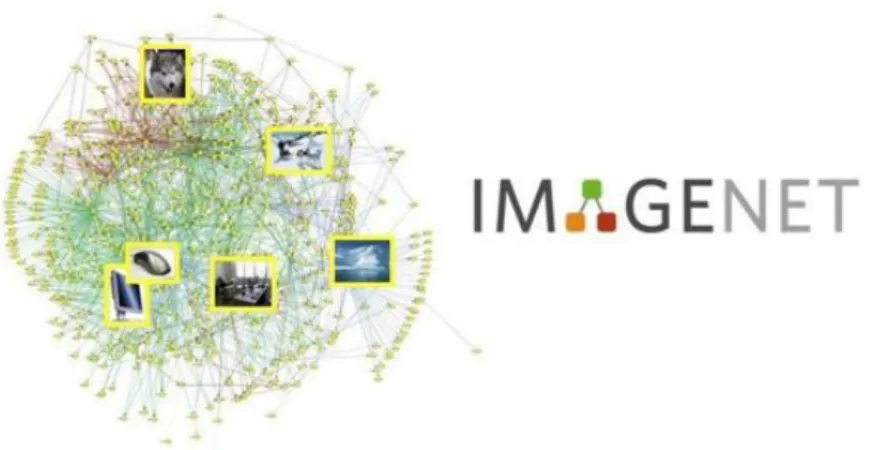
1.2 Illustration of the ImageNet that is organised based on Wordnet. . . 2
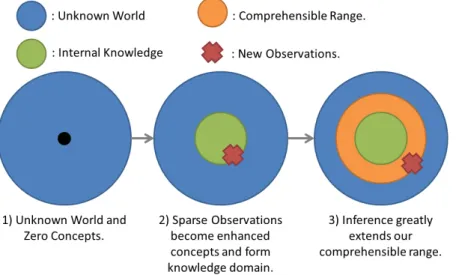
1.3 Illustration of human-like zero-shot learning. . . 3
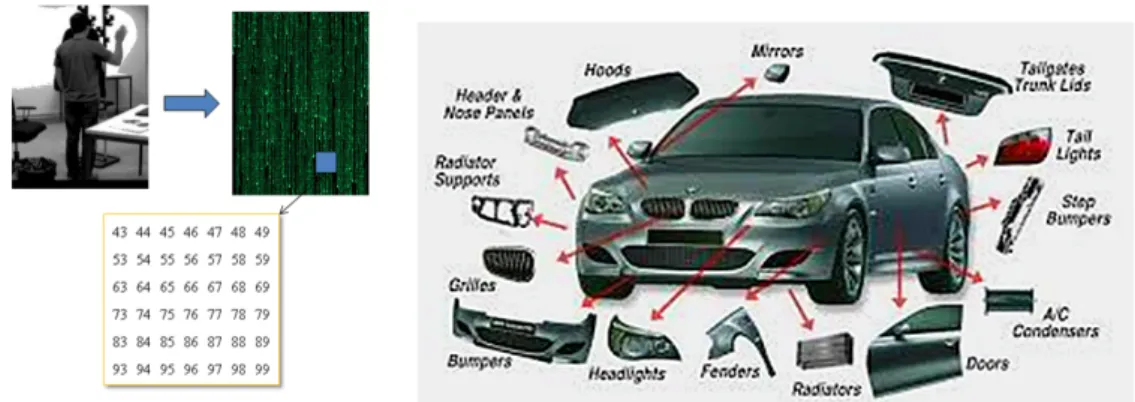
1.4 Left: Raw RGB Image; right: High-level class labels of car parts. . . 6
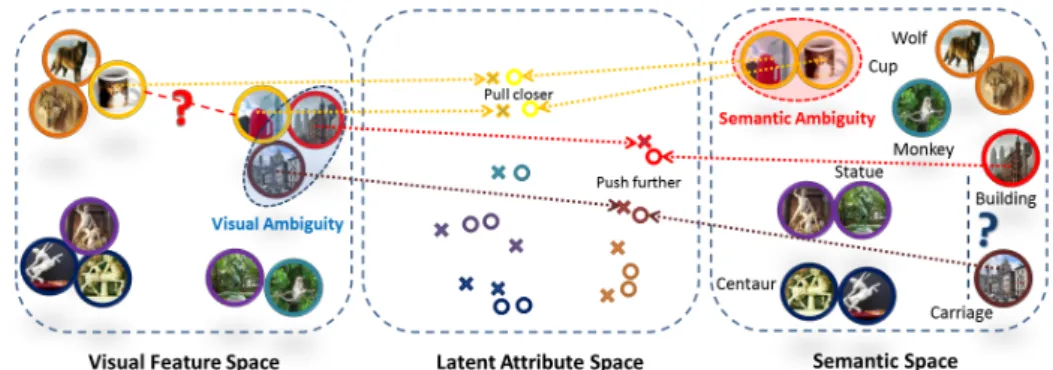
3.1 An intuitive illustration of VSAR (best viewed in colour). Visual Ambiguity (in blue oval): the image of a carriage is taken with a building background. It cannot recover the semantic distance (blue question mark) to the building category. Semantic Ambiguity (in red oval): the cup printed with a wolf and the cup-like building share the same semantic expression which can lead to a large visual variance (the red question mark). After embedding to the latent attribute space using VSAR, such ambiguity is mitigated. . . 22
3.2 Confusion matrix of ZSL performance on aPY (left) and AwA (right). . . . 29
3.3 Evaluating each term of the loss function in Eq. 3.3 (left) and the perfor-mance curve respects to the dimensionKof the latent attribute space (right). 30 3.4 Examples of successful semantic ambiguity removal on aPY (left) and the visual ambiguity removal on AwA (right). . . 31
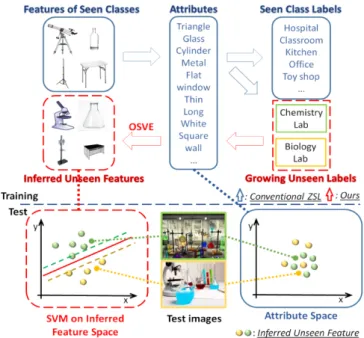
4.1 Comparison between our procedure (Red) and the conventional ZSL frame-work (Blue). Fine-grained classes are often compact and non-describable in the attribute space. Our OSVE can discover tiny visual differences between different instances under the same attribute so as to infer discriminative vi-sual features for unseen classes from fine-grained open candidates. . . 34
4.2 An example of the convergence situations shows the loss with respect to the number of iterations. Term 1 and 2 corresponds to the reconstruction errors to visual and semantic spaces. Term 3 accounts how orthogonal is the embedding space. . . 41
xvi List of figures
4.3 A. overall accuracies of baseline methods by substituting key components of the proposed framework. B. ROC curves of our method on the two datasets. For clarity, only 10 of the 50 unseen classes on CUB are shown. . . 44 4.4 Comparing the data distribution between real (A) and inferred (B) visual
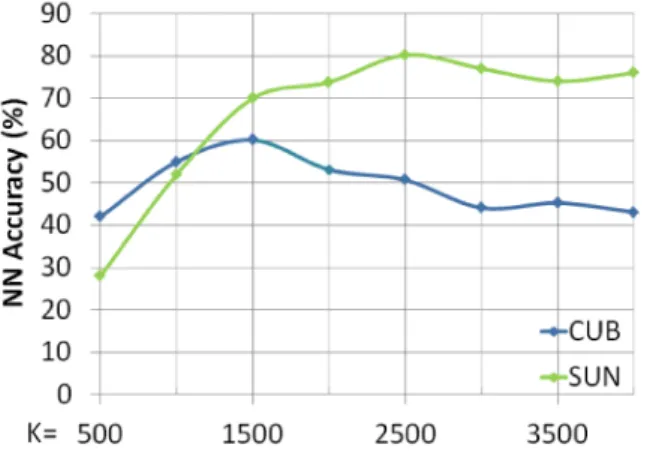
features of unseen classes. Note that t-SNE can result in slight distortion and colour differences. . . 44 4.5 Performance curve with respect to the dimensionKof the intermediate
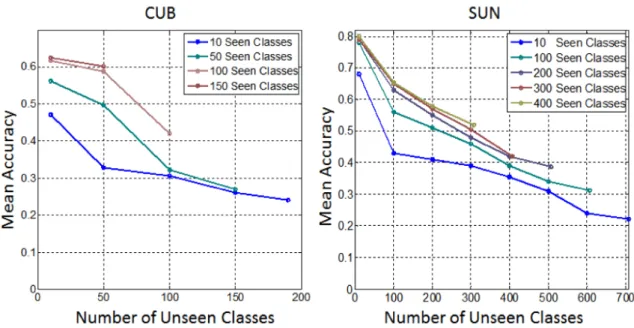
em-bedding space. . . 45 4.6 Open ZSL 2: test by increasing number of unseen classes using different
size of training sets. . . 48 4.7 Top-5 nearest neighbours of the query image under conventional and open
ZSL. Correct and incorrect matches are shown in green and red respectively. Corresponding seen/unseen splits are shown on the right. . . 49 5.1 Given a conceptual description, human can imagine the outline of the scene
by combining previous seen visual elements. . . 52 5.2 Comparison of supervised and zero-shot classifications and existing ZSL
frameworks. (A) a typical supervised classification: the training samples and labels are in pairs; (B) a zero-shot learning problem: without training samples, the classesCandDcannot be predicted; (C) Direct-Attribute Pre-diction model uses attributes as intermediate clues to associate visual fea-tures to class labels; (D) label-embedding: the attributes are concatenated as a semantic embedding; (E) we use semantic embedding to synthesise unseen visual data. . . 54 5.3 An illustration of our framework of unseen data synthesis. Unseen classes
are represented by semantic attributes as inputs. We train a model that maps the semantic space to the visual data space to synthesise training data for these unseen classes. The crosses in the visual spaces denote test feature points. . . 56 5.4 Objective function convergence on the AwA dataset. . . 62 5.5 Some random image and attribute examples of the 4 datasets. . . 64 5.6 Normalised variances of the synthesised data w.r.t.dimensions. Variance
of each dimension is sorted in descending order. We make a comparison between the synthesised data variances ‘with’ (green) and ‘without’ (red) diffusion regularisation. The variances of real data (blue) are computed from real unseen data as references. . . 68
List of figures xvii
5.7 T-SNE of the real and synthesised visual features of unseen classes: (A) real visual features; (B) synthesised visual features; (C) Since t-SNE of different data is not aligned, we also show the distribution of mixed real and synthesised visual features. . . 69 5.8 The performance with respect to the Graph regularisation and Diffusion
reg-ularisation. The results are under the scenario of CA and using NN classifier. 70 5.9 Success and Failure cases of nearest neighbour matching. The query visual
feature is synthesised from its attribute description. We find top-5 nearest neighbours of the query feature from the real instances. It is a match if the nearest instance and the test image have the same label. . . 71 6.1 A new class can be described by similes of seen classes without extra
at-tribute concepts involved. We use semantic grouping to make the similes more discriminative. Similes are more natural to describe complex con-cepts,e.g. behaviourordomestic. . . 76 6.2 An example of simile annotation process: whose colouris similar to
ante-lope. The annotator is asked to choose a number of most similar exemplars. We achieve averaged similarities among all of the annotatior’s associations. 80 6.3 Implicit attribute discovery. Under each simile group, the associated
exem-plars of each class satisfy ak-nn graph (left). Red vertices indicateunseen
classes. Our algorithm can cut the weakest edges and cluster the classes with similar implicit attributes (right). . . 81 6.4 Visualisation of eigenvalues. We demonstrate the example from the
sim-ile group of activity in the AwA dataset. The k-NN graph of similes has two disconnected subsets (one zero eigenvalue). However, we could find roughly four more layers, which indicates that the optimal value formis 5. . 82 6.5 Examples of images annotated by similes under different groups in AwA
(upper) and aPY (lower). . . 85 6.6 Partial results of graph-cut class-clustering. Images with in the same colour
of frames are from the same cluster. . . 88 6.7 Implicit Attribute Prediction Precision on AwA and aPY. Results are shown
by different simile groups. . . 89 7.1 Given some similes as clues, humans can easily make classification for the
unseen classes. . . 94 7.2 Comparison between ZSL frameworks. The gray bars between attributes
xviii List of figures
7.3 An overview of training stages. Each unseen class gains a class-level proto-type by inferring from the paired similes. . . 96 7.4 (A) Raw visual feature distribution of the 10 unseen classes in AwA. (B)
Af-ter MKE, non-discriminative points (red circle in (A)) are separated. Before the test, we aim to infer the centroid of each class as the prototype. . . 99 7.5 Illustration of the idea to infer complete MKE representation (numbers are
only for demonstration purposes). . . 101 7.6 Illustration of test phase: a test image can be converted into the MKE space
and compared to the inferred MKE prototypes of unseen classes to make a prediction. . . 103 7.7 Examples of top-5 similes from human annotations (upper) versus top-5
classes with largest MKE values (lower). . . 104 7.8 Simile error tolerance: ZSL performancew.r.t. different combinations
(up-per). Amount of supervision: ZSL performancew.r.t. different numbers of similes (Lower). Best viewed in colours. . . 106 8.1 Zero-shot Learning and other learning framework. . . 114
List of tables
3.1 Compare with the published state-of-the-art methods. . . 29
4.1 Key statistics of CUB and SUN datasets. . . 42
4.2 Comparison to state-of-the-art methods for both datasets. Results are overall accuracies in %. . . 43
4.3 Results (in %) of Open ZSL 1: add extra seen classes as candidates or add instances from seen classes for testing. . . 47
5.1 Key statistics of the four datasets. . . 64
5.2 Comparison with state-of-the-art methods. . . 66
5.3 Detailed analysis of key aspects of the proposed method. . . 66
5.4 Comparison with published results on GZSL. . . 73
5.5 Comparison with published results on the ImageNet Dataset. . . 74
6.1 Statistics of simile annotation on AwA and aPY datasets. . . 79
6.2 Compared to the state-of-the-arts using deep features. . . 86
6.3 Compared to baseline methods using low-level features. . . 87
6.4 Evaluating GSE on different settings. . . 90
7.1 Dataset statistics . . . 103
7.2 Simile annotation evaluation using hit rate. . . 103
7.3 Main comparison with the state-of-the-art results. . . 105
7.4 Compared to supervised results (%) on Caltech 101. . . 105
7.5 Averaged inference time (s) for each unseen class . . . 106
7.6 Compared to state-of-the-art methods on ZSL and GZSL scenarios. Per-formances (%) under different Auxiliary Information (AI) are compared, in terms of MKE and Attributes. . . 107
7.7 Comparing the performance upper bounds (%) of ZSL and GZSL using MKE and raw features. . . 109
Chapter 1
Introduction
Fig. 1.1 Computer vision involves various technologies at different levels.
Vision is an important perceptive approach. Computer vision community has dedicated to improve the visual system of machines and meanwhile to make it more interpretable. As shown in Fig. 1.1, computer vision involves various technologies at different levels. Natural light through the cameras is firstly converted into digital signals. Afterwards, visual features are extracted for various applications, such as Detection [38], Recognition [138], Segmen-tation [120], Content Based Information Retrial (CBIR) [123], Tracking [56], Simultaneous Localisation and Mapping (SLAM) [30]. These techniques are important premises for real-istic artificial intelligence and robotic controls.
We hope the machine vision is not only a sensor for automatic control, but can also make sense of the real world and achieve concept-level understanding like humans. To this
2 Introduction
Fig. 1.2 Illustration of the ImageNet that is organised based on Wordnet.
end, an essential technique for computer vision is image classification, which involves mak-ing high-level predictions of the given image, such as the category, location, attribute, and relationship. Nowadays, the most popular approach for image classification is supervised learning. Namely, we provide many positive and negative instances that are calledtraining examples. Each training example is tagged with one or multiple labels denoting the corre-sponding concepts. The training process is to discover the features and the rules and how these pieces of information are related to the target concepts. For example, we can train a classifier to recognise dogs and cats. The machine first extracts the discriminative features from the training examples of dogs and cats and then discovers how these features are dif-ferent to each other. At the test time, dogs and cats can be recognised by directly applying the trained classifier to the input image. Using large-scale datasets, such as the ImageNet [32], machines can recognise roughly 24K classes that cover most of the general categories in our human life.
1.1
Motivations
Despite the promising progress, existing supervised learning framework is not easy to be applied for many real-life problems. Firstly, in our real life, new concepts and labels are continually generated every day. Existing supervised training highly relies on sufficient well-labelled training examples for each new class, which requires very costly human anno-tations. Although an alternative approach is to utilise the online search engine, the tags are often based on the semantic content and may not adequately describe the visual concepts. Moreover, the tags can be very noisy due to different purposes of internet users. Therefore, acquiring sufficient high-quality training examples for ever-increasing new classes is infea-sible. Secondly, a basic class can have many finer-grained subclasses. For example, the
1.1 Motivations 3
Fig. 1.3 Illustration of human-like zero-shot learning.
ImageNet mentioned above has 30 mushroom synsets with roughly 1,000 images. How-ever, such a level of granularity is still far behind nature which has approximately 14,000 species of mushrooms. The increased number of required training examples from coarse to fine classes will be huge. Thirdly, sometimes, it is impossible to obtain an even one-shot image for training. For instance, one would recognise an unseen criminal purely based on the description from witnesses. For the reasons mentioned above, the problem of‘training example hunger’has severely restricted the possible applications of supervised learning.
To this end, Zero-shot Learning (ZSL) is proposed, which aims to predict the labels of unseen images without the burden of collecting training examples. From a higher view, as shown in Fig. 1.3, our human life can be regarded as a ZSL process. In the beginning, everyone is born with ‘Zero’. With our growth, we gradually accumulate our observations with paired sparse concepts that come from supervision. For example, we could learn what is an ‘apple’ by seeing it while repetitively hear the pronunciation from our parents. These occurrences may form some early perceptions that are denoted by the green circle. After-wards, we discover the potential associations between concepts. For instance, we found apple is ‘red’ that also applies to ‘strawberry’. Such connections result in the generation of knowledge that allows us to infer the unobserved world through prior human knowledge. For example, when we learn an unseen fruit that is red, smaller than strawberry and looks like an apple, we could imagine how does a ‘cherry’ look like. Such inference significantly extends our comprehensible range of the unobserved world. The fast inheritance of human knowledge also makes new generations can more efficiently explore the unknown world. In-spired by this fact, we could design a similar ZSL system for image classification and make it possible to utilise the vast amount of our prior human knowledge to mitigate the
short-4 Introduction
age and difficulty of acquiring training images. Furthermore, the ZSL visual system can be more interpretable and flexible that provides possibilities for concept-level human-machine interaction.
To achieve practical intelligent Zero-shot Image Classification systems, we consider four fundamental technologies, which are summarised as follows.
• Visual Feature ExtractionTo deal with large-scaled ever-growing new classes, we need to extract high-capability features that can differentiate one image from all of the rest. Meanwhile, the features are better to capture the semantic structure of category labels so that the human-machine gap can be minimal. For example, an ‘apple’ should be close to an ‘orange’ rather than a ‘car’ in the visual feature space.
• Interpretable Knowledge RepresentationZIC is about how to interpret unseen vi-sual features. Although we can have knowledge about the unseen classes, it would be a challenge to convert the knowledge into machine-understandable views. The repre-sentation should be dense, informative, and visual-sensitive so that the machine can maximumly infer the visual features that are close to our human perception.
• Ontological Engineering and DatasetThis is a higher-level requirement of knowl-edge representation. We need to not only teach machines how we human perceive the world, but also design a proper structure that can systematically organise our human knowledge.
• Machine Learning During the past decades, it has been widely acknowledged that rule-based intelligent systems might not be competent to deal with the gigantic infor-mation in the complex environment. Therefore, so far, the learning-based scheme is the most promising methodology towards the real intelligent system. Particularly, a challenge is how to achieve incremental training and let the machine can grow with the progress of the human society and the expanding requirement of automation.
Motivated by the above four concerns, this thesis dedicates to discuss the past, present and future of Zero-shot Image Classification (ZIC). Excepting reviewing the current state of the above four aspects, there are four innovative contributions of the thesis, which focus on addressing crucial problems, such as mathematical modellings, methodologies, and other detailed engineering challenges of ZIC.
1.2 Context 5
1.2
Context
A realistic image classification system involves many complex processes. We first need to detect the interest object and localise it in the image. We then crop the image or make segmentations to distinguish the target from the background. However, it is worth noting that for research purposes, the focus of image classification only focuses on predicting the label of the test image, either cropped or non-cropped. Normally, preprocessing such as detection or image segmentation is out of the scope of image classification.
This section briefly introduces the development of related techniques of image classifi-cation. However, more detailed background knowledge that is frequently used in the main chapters are not included here but will be discussed in the next chapter.
1. Intelligent Visual System As shown in Fig. 1.4, a digital image consists of discrete numbers ranging from 0 to 255 indicating the pixel intensities in each of the RGB channels. It can be seen that the resulted matrix is not as straightforward as what we humans can see in the image. Therefore, a core technique is how to extract invariant features from noisy input images. During the last decade, a large number of heuristic low-level feature descrip-tors have been proposed [29, 35, 88, 132]. These features attempt to simulate the mecha-nism of human vision so that the data can be presented closer to human visual perceptions. Meanwhile, machine learning approaches aim at computing the statistical features between low-level visual signal and a human-defined task space. Some of the learning methods fo-cus on discovering the intrinsic data structure, such as scattering [126], or clustering [130], while some approaches directly interpret data with task labels, e.g., classification [26]. The most impressive progress comes from the technique of Deep Neural Network [54]. Since the first Caffe model [62] becomes open-sourced, an explosively increasing number of pre-trained deep models using large-scaled datasets app. These technologies have significantly improved the performance of image classification.
On the other hand, the learning-based visual feature extraction approaches highly rely on a large number of well-labelled training data. Although the low-cost digital devices have made big data available through the internet, the labels are very noisy and not competent for many practical tasks. For example, the labels may refer to the usages rather the visual appearances; an image can be interpreted by multiple labels or from different viewsetc.
To this end, Zero-shot Image Classification (ZIC) is proposed in 2009 by Lampertet.al
[72]. Despite some Earlier work [74], [72] proposes a standard framework that inspires most of later approaches. The key idea is to learn a knowledge model on the well-labelled source domain and make the model generalise and explore unlabelled or unseen classes. The ultimate challenge is to extract universal visual features that have the capability to represent all of our human knowledge. However, the structure of visual and semantic features are
6 Introduction
Fig. 1.4 Left: Raw RGB Image; right: High-level class labels of car parts.
very heterogeneous. Such transfer is harder than conventional domain adaptation problem (e.g.transferring from one view of a camera to another). Also, new unseen classes are ever-growing, and human knowledge is huge comparing to acquired visual training data. Therefore, existing ZIC methods only focus on an unrealistic assumption of a small close set of unseen classes. For example, we have known the test image must come from the class of either dogs or cats and do not need to consider the other classes. So far, how to make generalised ZIC on large-scaled open dataset remains difficult.
Knowledge Representation In order to recognise unseen classes, one of the fundamen-tal problems is how to explore the potential knowledge using the obtained training source maximumly. Compared to conventional supervised approaches that only associate visual features with labels, knowledge representation aims to capture the relationship between dis-crete concepts,e.g.organise them into a graph. In this way, the learnt model can generalise to new unseen concepts through inference.
However, in the context of ZIC the main difficulty is to describe the visual relationship between concepts,i.e.how do images of a class look like the others. Despite the existence of many advanced language models, such as Word2Vec [97] or textual models [36], the performance is still not competent for realistic applications. The fundamental problem is that most of these models are designed for capturing the semantic relationships rather than for visions. For example, the most popular Word2Vec model is trained using Wikipedia or news. Although these source domains are huge, they are not particular descriptions for visual features. The resultant knowledge model will be highly heterogeneous compared to expected visual relationships. Another difficulty is the limitation of our language power, especially for those intangible or emotional feelings from our visual perceptions. A widely-used existing representations for ZIC are visual attributes [37, 58, 72, 155], which can be a colour ‘red’, a description for parts ‘has hands’, or even some indirect information, such as ‘living in the water’. State-of-the-art ZIC results [142] are typically based on
multi-1.2 Context 7
modal frameworks that jointly consider the visual and attribute domains. The resultant representations can effectively associate visual features with semantic visual attributes and outperform methods using other knowledge models.
Ontological Engineering Despite the advantages of attribute-based ZIC methods, their implementation is highly restricted by existing ontological engineering. The expected at-tributes should be able to represent the required knowledge of all test classes. However, for large-scaled image datasets, such as ImageNet, it is infeasible to associate each class with sufficient attributes. To this end, there are two main difficulties: design and annotation.
To design attributes for ZIC is ambiguous work. For example, it is easy to differentiate a zebra from normal horses by the textures. However, textures may be not the best attributes when distinguishing horses from bulls. The fundamental problem is that we do not have ex-plicit knowledge that can direct us what attributes are adequate for the classification tasks. Therefore, existing datasets [72, 131] often requires expert knowledge on specific domains. Furthermore, the expert knowledge may be not directly sensitive to visual features. For ex-ample, the first ZSL approach DAP [72] is proposed on the AwA dataset. 50 wild animal classes are associated with 85 attributes that are designed by zoologists. One of the attribute groups is ‘character’, such as ‘fierce’, ‘smart’ and ‘domestic’. Classes that share these at-tributes may have very different visual appearances, which leads to severely high variances. Last but not least, some implicit attributes that can hardly be expressed, which breaks the preliminary of existing attribute-based methods.
Annotating attribute training samples is also expensive. Compared to the conventional supervised classification that requires one label for each category, attribute-based ZIC needs a list of labels indicating the presence or absence of the corresponding attributes. Such requirement worsens the original purpose of mitigating annotation expense of large-scaled image classification.
Considering the above shortages of attributes, more advanced ontological engineering is vital for a new generation of ZIC techniques. Some recent work such as Visual Genome [69], and Activity Net [18], has incorporated attributes into a concept net that consists of verbs, nouns, adjectives, etc. These datasets are proposed to address more complex visual problems. However, the total number of involved concepts is still much smaller than the whole ImageNet dataset with 21K categories. Associations between such a large number of classes are out of the limit for existing ontological engineering.
Machine LearningOne of the most popular frameworks is supervised learning. All of the training data is labelled (which is known as supervised). The machine is trained to learn a mapping to satisfy our particular criterion which can be one or multiple class labels. The performance can be measured by the classification accuracy. In semi-supervised learning,
8 Introduction
only part of the training data is labelled. Unlabelled data is complementary to the trained model as long as it can improve the performance. For unsupervised learning, however, the performance can be hardly measured by classification accuracy because all of the training data is unlabelled. Therefore, additional rules need to be specified as implicit criteria. Eval-uation is then based on whether the learnt model can indirectly make contributions to the classification accuracy.
ZIC is indeed a supervised problem since our goal is to predict the labels of images. For example, we first teach the machine what is food by specifying some categories with training examples. But there is no meat during the training. However, from knowledge view, ZIC is semi-supervised,i.e.seen classes are supervised by knowledge representation while unseen classes do not have. If we consider unlabelled visual features from unseen classes are available, the transductive ZSL utilises can be viewed as a special case of semi-supervised learning. Furthermore, unlabelled data of other food could be complementary information to improve the knowledge domain. ZIC assumes that the acquired prior knowledge can be shared to unseen classes,e.g.how does meat relate to vegetables. Such a scenario can be viewed as a special case of transfer learning. Conventionally, the transfer is only considered to happen within visual domains, such as view changing. However, ZIC requires a more challenging transfer that is from knowledge to visual domain. It is worth noting that the machine learning scenarios mentioned above are not exclusive to each other. Although the original purposes are different, these methods can be complementary to each other to improve the performance together.
1.3
Contributions and Thesis Outline
The rest of the thesis is organised as follows. In the next chapter, a comprehensive literature review will be provided for frequently-used techniques. Also, a brief survey of the devel-opment of zero-shot learning will be given, from which we can see there are two streams of contributions that are made by this thesis.
The first stream considers the learning problem that is summarised as follows:
• In chapter 3, we investigate the problem of visual-semantic ambiguity. Namely, some instances that look very similar may have distinctive semantic meanings, whereas large varieties of categories may share the same attribute. Direct mapping from visual to semantic space results in degraded performance. Therefore, there should exist a latent space that can mitigate the heterogeneousness. We model such a problem as a graph, using which we can maximumly preserve the relationships in both visual and semantic spaces.
1.3 Contributions and Thesis Outline 9
• In chapter 4, we consider a more challenging fine-grained ZSL problem. Instead of classifying general categories,e.g.cats or dogs, fine-grained classification focuses on specific subcategories that are close to each other, e.g.bistro or restaurant. Since these classes have very similar attributes, making classification on the conventional semantic space is very difficult. We propose a visual-semantic orthogonal embedding algorithm that inversely projects semantic attributes into the visual feature space so that small discriminative features can be captured. Such a scheme also benefits a more realistic scenario called Open ZSL, i.e.the number of unseen classes is much larger than that of conventional ZSL. Also, we upgrade the visual features by deep learning features and achieve the state-of-the-art performance on both conventional and open ZSL scenarios.
• Finally in chapter 5, we combine the above graph and orthogonal models to synthe-sise unseen visual features. Such a technique ensures that we can achieve training examples for unseen classes as long as we have the prior knowledge. The ZIC prob-lem is addressed by converting it back to conventional supervised classification. The proposed method steadily outperforms the state-of-the-art methods on all of the four benchmarks.
Besides learning problems, we seek for better knowledge representation and ontology for ZIC rather than visual attributes:
• In chapter 6, we propose an alternative to visual attributes for ZIC which is known as Similes,e.g.panda looks like a bear with similar colour as a killer whale. Unseen classes can be associated with seen classes using similes without involving extra at-tributes bothering the attribute design. Through a novel graph-cut scheme, implicit attributes that can hardly be expressed can also be described for ZIC. The resultant grouped similes consist of an ensemble of classifiers, which can significantly improve the state-of-the-art results.
• In chapter 7, the annotation cost of simile is further reduced to an affordable degree. High ZIC performance can be achieved by a powerful inference scheme using Gaus-sian Process Regression. Each unseen class is annotated by only a few sparse similes, and there is no need to provide any similes for seen classes at all. The proposed method enables us to implement ZIC tasks on any conventional supervised scenarios without the burden of attribute ontology. Extensive experiments manifest that similes can better represent complex visual associations and lead to remarkable performance gain over attribute-based ZIC methods.
10 Introduction
In the final chapter seven, the highlights of the thesis are concluded. Furthermore, the conclusion suggests how we could apply the proposed methods in this thesis to a wider range of tasks to make a real impact on the society. Finally, potential future work is advised for whom may continue work on the field of ZIC.
Chapter 2
Background
We first review basic techniques for ZIC, in such as feature extraction and classification. Furthermore, frequently-used ontologies for ZIC, such as visual attributes, word embedding, and knowledge graph, are introduced. Finally, we discuss some variations of ZIC scenarios and assumptions.
2.1
Image Classification
Digital visual data are in the form of pixels, such as images and videos. However, such representation is not straightforward to reflect the contents. As shown in Fig. 1.4, the human in the image is represented by a huge matrix of numbers. To extract informative features, existing methods can be divided into two branches: heuristic visual features and automatic learnt features. After feature extraction, classification rules are applied to predict the labels. In the following, frequently-used feature representation and classification methods are both reviewed.
Heuristic Features Pixel-wise visual data is sensitive to tiny variations, such as motion, illumination, viewpoint, etc. During the past decade, local features are more popular in the computer vision community due to the local invariance. A representative method is known as SIFT in [88]. Its success can be credited by heuristically implementing the mechanism of human vision detection. Key points are detected through Deference-of-Gaussian (DoG) process and localised by Hessian Matrix, which is robust to rotation and scale variations. In general, methods like SIFT attempt to extract local features at the detected regions of interests (ROIs). SURF [12] achieves invariance that similar to SIFT but can further speed up by processing the Hessian Matrix before the pyramid of (DoG). Besides keypoint detec-tion, HOG [29] is proposed to detect objects. It quantises the angles of the pixel gradients within a certain region into bins of a histogram. The target object can be detected by sliding
12 Background
the detectors and match the histogram of each window to the reference histogram. How-ever, local descriptors are prone to neglect the holistic relationships, such as their relative spatial positions. Pyramid representations, such as PHOG, incorporate local features by embedding gradually scaled-up cells of local descriptors into a holistic one [16]. Such a scheme is recently extended to model deformable object parts [38], which has achieved state-of-the-art performance on detection. In contrast to gradient-based descriptors, LBP [2] directly encode local pixels into binary codes, which are then statistically quantised by a histogram. Together with the spatial pyramid, LBP has shown powerful descriptiveness for face recognition [2]. Other than spatial information, Bag-of-words [28] (BoW) meth-ods achieve holistic representations by regarding each local feature as a visual word. Each word is often obtained by clustering nearby training examples, such as K-means [89]. The clustered examples are assumed as the same word. Most of the video local descriptors, such as Cuboid [35], HOG3D [65], Dense Trajectory [132] and LBP-TOP [93], can be smoothly introduced to the BoW framework and achieve state-of-the-art action recognition results. In defence, holistic features also achieve progress on some other tasks. For example, GIST [102] introduces Gabor filters on different scales and orientations, and the feature maps are average pooled on the spatial cells, which has achieved promising performance on scene classification tasks. In addition, some inherently holistic features, such as colours and tex-tures, are better encoded by holistic methods [92].
The above methods have been successfully applied to conventional supervised single-label image classification. However, for ZIC, we need to predict a more complex knowl-edge representation that requires richer visual information. For instance, the attribute "wild" could involve various visual features, like the scene, colour or local parts for wild animals. Typically, a single heuristic feature is believed not to be competent to represent a vast num-ber of different attributes. The typical solution is to combine various heuristic visual features into a rich visual representation of multiple attribute spaces using learning approaches.
Feature LearningFeature learning methods can be supervised or unsupervised. Generally, they learn an objective function that can project the input data to a human-defined space to satisfy particular criteria. The learnt features are more discriminative compared to heuristic methods since the models are more related to samples rather than prior rules. For example, PCA has been successfully applied to face recognition for almost thirty years, which is a well known unsupervised approach dubbed Eigenface [126]. Given a large number of training examples, the principle components of each face can be usually concentrated into its first several eigenvectors that preserve most of the energy. After PCA embedding, the feature dimension drops remarkably, and the embedded points of different faces are scattered. In other words, the embedded features are informative and discriminative. However, due to
2.2 Attribute Learning and Ontology 13
there is no supervision at all, PCA is not task sensitive. It can only scatter the points based on the intrinsic data structure. LDA [13], in contrast, is a supervised feature embedding algorithm. It can crush points with the same label into compact space while widening the distances between points from different classes. After embedding, the feature dimension is reduced to the number of classes minus one. However, the original data structure is completely distorted. Generally, such spectrum embedding methods are still heuristic. The learning objective could be some task-independent criteria, such the variance, correlation. Recently, deep learning features are getting dominant [54, 75, 129] due to its power to unifying feature extraction with image classification. CNN [75] can effectively extract local variations. Different scales from coarse to fine are also considered through pooling scheme. After convolutional layers, local patches are concatenated into a global representation. A deep fully-connected structure like that in DBN [54] is followed to extract higher-level information towards class labels. Another popular unsupervised deep framework is known as SAE [129]. Without supervision, the learning objective is first to compress the input image and then reconstruct it, through which discriminative features are captured. The key advantage of the deep feature is that it is naturally designed for large-scale data. By pre-training the deep model on large-scaled datasets, such as the ImageNet, the extracted features can be directly generalised to other tasks and results in state-of-the-art performance.
Classification The most straight forward classifier could be the NN classifier [27]. The query point is matched to the nearest neighbour in the training set. The underlying principle is called Kernel Density Estimation (KDE), where each training example stands for a radius estimation of the probability distribution. NBNN [15] extends such a simple scheme with image-to-class distance, which achieves state-of-the-art results. While the size of the train-ing set is small, SVM [26] is powerful due to the maximum margin scheme. In contrast to these conventional classifiers, Deep Neural Networks demonstrate the power of end-to-end models. Input visual data is classified by forward propagation through multiple layers of non-linear projections. Besides, ensemble learning attempts to combine multiple classifiers into an ensemble model [34] to make the classifiers complementary to each other.
2.2
Attribute Learning and Ontology
Variations of Attributes Learning visual attributes extends the standard training labels to abstract semantic concepts [39]. Such progress on comprehension richly broadens the range of visual tasks [37, 71, 72, 115, 117]. One of the fundamental questions is how to obtain these attributes? A commonly agreed method is pre-defined category-attribute prediction
14 Background
matrix by specialists [72]. However, there are several drawbacks. Firstly, the category-level attributes are not sensitive to instance variances. For example, we can annotate the category of pandas as ’eating bamboo’. However, there is no guarantee that all of the pandas in the test images are eating bamboo. Secondly, some realistic applications may not have sys-tematic domain knowledge. Defining category-attribute association becomes ambiguous. As an alternative solution, in [37], each image is annotated with a unique attribute code. Moreover, both of [37, 72] involve exhaustive human annotations that are either achieved from volunteers or through the Amazon Mechanical Turk. To reduce the cost, automatic attributes mining through website text information fills in this gap [14, 115]. However, pre-defining the attribute list is still required. Therefore, attributes should be used with respect. Unfortunately, only a few existing research consider the specific characteristic of attributes where as most of the rest just ignore what types of attributes are they using. Particularly, phrases and adjectives are commonly used as attributes, e.g.‘has hands’, and ‘red’. At-tributes can also be relative [104], e.g.‘He is taller than her’. Also, attributes could have grouped or hierarchical relationship [58]. More generally, the conceptual attributes and the objects can be organised into a knowledge-based hierarchical structure, which is known as ontology engineering [32, 100]. By this step, the fundamental problem is human knowledge itself since visual perception may not be adequately described by semantics or organised systematically. Existing work has realised the knowledge-based explicit attributes could be unreliable or debating [4, 57]. However, these work attempt to address the problem through machine learning aspects regardless the fundamental semantic paradox. To circumvent the conflict between visual and semantic relationship, the data-driven attributes aim to implic-itly reconcile the visual-semantic gap [151]. Yet, the misuse of attributes still require future investigation in the future.
Extensive Applications Attributes have been used for describing images [37, 39] and for retrieval [121]. The most common usage of attributes is classification [6, 63, 116, 153]. The underlying rationale is that attribute is a higher-level abstraction of specific categories. Instead of mapping instances to a label, attribute learning aims to discover more general labels that specify the characteristics shared by many classes. In this way, learning attributes can estimate the distribution of completely unseen categories, which is the problem we concern in ZIC. Apart from classification tasks, attribute can improve the interpretation of the model. Especially for deep learning, the surprisingly high performance can hardly be explained by the single value of accuracy. Analysing the huge number of parameters in the model is also intractable. Therefore, attributes can be added as the auxiliary loss to provide interpretation with the co-occurrence. For example, if an image is confidently predicted as
2.3 Zero-shot Learning 15
a bear, but the colour attributes are predicted as black and white. It is likely that the test image is a panda, even though the corresponding label is not included in the training set.
2.3
Zero-shot Learning
Zero-shot learning is getting increasing attentions. This section aims to coarsely review the development of ZSL so as to have an overview of the previous pioneering work. The differences to the contributions of this thesis will not be discussed here but will be covered in later specific chapters. Generally speaking, the contributions to ZSL can be summarised into three directions: low-level, mid-level, and high-level. The low-level focuses on more general machine learning concerns, ZSL is a generalisation of special case for conven-tional supervised methods, such as Error Correction Output Codes[110], Fuzzy Inference [82], active learning [143]. In the mid-level, ZSL techniques focuses on framework design [51, 52, 108, 145, 147, 148] and knowledge representation [1, 47, 136]. Also, it has highly related inspiration to one/few-shot learning [134] and other forms of transfer [23, 106, 107]. The intersection between vision and linguistics is also the unique charm of ZSL, such as relative models [25, 125]. For higher-level, ZSL has various applications. It has been suc-cessfully applied to remote sensing images [77], robotic control [33], Unseen gesture recog-nition [90], First-person Decomposition [154], and Land Cover Prediction [61]. Expanding specific introduction for such various techniques has exceeded the scope of this thesis. We will therefore review the most related three aspects to my thesis, which arelearning frame-work, knowledge representation, and scenarios and assumptions. From the review we can see that the blossom of ZSL is just starting.
2.3.1
Learning Framework
The earliest ZSL techniques can refer to zero-data learning [74] using templates or some earlier transferring approaches [98] using fMRI images. In 2009, Lampertet al.[72] firstly applied ZSL for image classification tasks using an attribute-based protocol. Zoological knowledge is encoded into a class-attribute matrix that can be used as to recognise unseen classes that have no examples during training. Such a ZIC task can be achieved by two models that are named Direct Attribute Prediction (DAP) and Indirect Attribute Prediction (IAP). The basic idea is to train an attribute model using training examples and assume the attribute knowledge can hold for unseen classes. It is worth noting that, although most of existing state-of-the-art results are based on DAP, in [63], IAP model is defended as more applicable for the ever-growing concept space. In the future, IAP related models might gain
16 Background
popularity again for generalised zero-shot learning.
Since ZSL and One-shot learning is closely related in [153], these two problems are unified into a probabilistic framework. The idea of pooling using Bag-of-word is adopted to suppress the variances during knowledge transfer. Besides, more probabilistic models, such as kernel and metric learning [96, 135] are proposed to address the ZSL problem.
The development of ZSL is prominent in 2013. The main contribution is to convert ZSL into an embedding problem. The idea is, rather than predicting each attribute as an independent task, the whole attribute space can be viewed as an embedding of the label space. Such an idea inspires many later frameworks, such as subspace learning, manifold learning, multi-modal learning etc.[6, 41, 42, 101, 150]. The embedding framework also enables many deep models can be applied to the problem [40, 124]. However, since the problem is simplified into finding the correlations between two or more embeddings of different modalities, the unique challenges of ZSL are incorporated into general transfer learning problems.
Therefore, the discussion of learning framework of ZSL can be considered from a more general perspective with a larger volume of literatures on transfer learning. But the unique focuses of ZSL shrink to knowledge representations and various scenarios and assumptions that will be reviewed next.
2.3.2
Knowledge Representation
Besides class-specific attributes, [37] adopts instance-level attribute annotations. Each im-age is annotated by a list of attributes. The advantim-age is that they do not rely on expert knowledge. But the disadvantage is the extremely high cost for annotations. In [103], a match between semantic word and the corresponding fMRI image of the neural activity is considered. In order to achieve the knowledge representation, both word embeddings and semantic attributes are utilised. After emphasizing the importance of ZSL, [115] firstly concerns the burden of constructing ontologies. The consequent problems are two-fold: class-attribute associations and attributes mining, which concern the annotation and design cost, respectively. Three measures: hierarchical path length of the WordNet, Word2Vec similarity, and World Wide Web hit-count are proposed to count the importance of each attribute to a class.
Another creative work is presented by [104], which introduce an intuitive form of rel-ative attributes. Rather than thinking the presence/absence of an attribute, [104] considers the degree of the attribute into a ranking list of corresponding categories. However, due to relative attributes require more expensive human annotations, the related approaches are not the main focuses in the ZSL field.
2.3 Zero-shot Learning 17
More concerns of attributes for ZSL concentrate in 2014. So far, the attribute models are trained by counting the co-occurrence [94] to visual features (like most of the conventional supervised methods). However, [58] believes the correlation between different attributes can harm the co-occurrence-based scheme. For example, ‘iron’ is always accompanying with ‘black’ in the training set. Then, it is unlikely to simultaneously recognise an object with ‘white iron’. More severely, we cannot guarantee the learnt model is exactly targeting the attributes that we want the machine to learn, despite high recognition performance. Besides the debate among the semantic characteristic, the attribute annotation may be not flawless either [57]. Especially for those instance-level approaches, the annotation often requires a collaborative website, such as Amazon Mechanical Turk. The quality of annotations may not hold for different annotators.
For other knowledge representation, [36] proposes a textual model that can directly ma-nipulate ZSL by semantic descriptions. Also, [151] attempts to dispense from the attribute by directly assigning seen classes as positive and negative to unseen classes. [95] follows [114] and uses the hierarchy of ImageNet to infer exemplars of unseen classes. Specifically, they average the ancestor nodes of the unseen class and use the mean vector as the exemplar representation.
Except considering the ‘horizontal’ split between the source and target domain, most of the rest continuously follow the multi-view assumption [43, 149] and attempts to find a solution through manifold learning [44, 55]. To this point, more and more approaches are not satisfied with visual attributes [5, 79, 80]. Textual [76], hierarchical [7] and prototype [60] models gain popularity. [5] provides a comprehensive evaluation of different types of knowledge models, regarding attributes, word2vector, and hierarchy. An interesting topic is to utilise human gaze on ZSL [64]. [3] also utilise strong supervision for ZSL.
2.3.3
Assumptions and Scenarios
Since knowledge transfer has been accepted as the standard approach for ZIC, in 2011, [114] argues that existing methods are surprisingly restricted to small close-sets. To improve, they attempt ZSL on the 1K object classes of the subset of ImageNet. Another interesting work [91] unifies attribute learning with image description, which also aims to weight attributes for each class automatically. Rather than purely mining the associations within the semantic information, [91] also takes visual features into account and optimises a joint distributional loss.
Aside from learning frameworks, [119] argues the explicit attributes may not be suf-ficient to represent visual features. Therefore, attribute augmentation aims to incorporate data-driven attributes to enrich the semantic representation. Furthermore, [113] develops
18 Background
the leverage unlabelled data in [153] and introduce Transductive ZSL settings and followed by various models [41] for ZSL frameworks. Interestingly, most of transductive settings focueses on sequential visual problems, such as activity recognition [24].
The success of ZSL in computer vision has aroused the attention of artificial intelligence field [46]. The benchmark of ZSL is rocketed due to adopting deep learnt features [155]. Developing from knowledge transfer, ZSL is then modelled as a domain adaptation problem [66, 116]. The source domain consists of visual examples with annotated attribute knowl-edge. The test domain only contains knowledge view. And the problem is to predict the visual test domain beforehand. Such adaptation is theoretically analysed by ESZSL [116] which is believed as the simplest state-of-the-art method for ZSL. A similar approach is [81]. Apart from the model, however, the key conclusion is that ‘if the knowledge represen-tation of unseen classes is completely orthogonal to that of source domain, the learnt model will have the minimal effectiveness’. More models [31, 73] and applications [9, 140] of ZSL are proposed as well.
Most approaches further modify the embedding schemes [17, 48, 99, 112, 141, 156, 157] with more specific constraints. More unified joint models are proposed to associate unseen classes using texts [8, 109, 112].[45] encodes pair-wise relationships for human activity recognition. One of the novel ideas starts to make manipulations on the visual domain, which is shared by [20, 21, 146]. [21, 146] aims to infer augmented data for unseen classes using prior knowledge while [20] goes one step further to infer the expected classifiers for unseen visual data. However, the key conclusions of [20, 22] argues that the main problem of existing ZSL is not the model but the definition. At the point, most of existing approaches are restricted to a small close-set of unseen classes. [20] carries out the first ZSL evaluation on whole ImageNet dataset. The trained model using 1K classes is generalised to 20K+ unseen classes. Later on, in [22], they suggest that anomaly detection can benefit such large-scaled Generalised ZSL (GZSL) problems.
Despite the huge amount of study devoted to ZSL, the benchmark is not clear enough. Since ZSL often involves a complex system of various feature extractors, semantic represen-tations, models, setting, etc., we may feel confused which is the fundamental issue for ZSL. To this end, in 2017, a new benchmark is proposed [142] and mainly compares conventional and generalised ZSL. Different models are fed with the same visual feature as input. Yet, it might be ambitious to use a unified measure that can include unpredictable new attempts in the future due to the large variety of models and also the applicable range.
From the literature review, we can see the unique contribution of the thesis is to convert ZSL into conventional supervised classification via various models. Also, similes, as a promising knowledge representation, are creatively proposed by this thesis. More specific
2.3 Zero-shot Learning 19
discussion of the differences will be given in later chapters, depending on each individual contribution.
Chapter 3
Visual-Semantic Ambiguity Removal
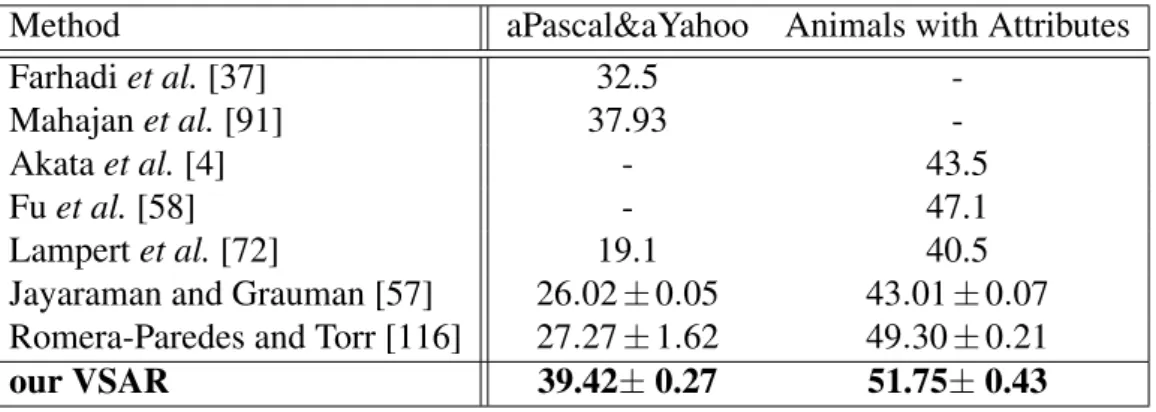
Conventional ZSL methods recognise an unseen instance by projecting its visual features to a semantic space that is shared by both seen and unseen categories. However, we ob-serve that such a one-way paradigm suffers from the visual-semantic ambiguity problem. Namely, the semantic concepts (e.g. attributes) cannot explicitly correspond to visual pat-terns, and vice versa. Such a problem can lead to a huge variance in the visual features for each attribute. In this chapter, we investigate how to remove such semantic ambiguity according to visual training examples. In particular, we propose (1) a novel latent attribute space to mitigate the gap between visual features and semantic attributes; (2) a dual-graph regularised embedding algorithm calledVisual-SemanticAmbiguityRemoval(VSAR) that can simultaneously extract the shared components between visual and semantic informa-tion and mutually align the data distribuinforma-tion based on the intrinsic local structures of both spaces; (3) a new zero-shot recognition framework that can deal with both instance-level and category-level ZSL tasks. We validate our method on two popular zero-shot learning datasets, AwA and aPY. Extensive experiments demonstrate that our proposed approach significantly performs the state-of-the-art methods.
3.1
Introduction
Conventional ZSL methods [4, 40, 72] directly map visual features to a human-interpretable semantic space and the labels are inferred through human knowledge. However, an in-evitable issue of using semantic attributes is theambiguityproblem. In linguistics, a concept is considered ambiguous if its extension is deemed lacking in clarity. It is the uncertainty about which objects belong to the concept or which exhibit characteristics that have this predicate. In the context of ZSL,Visual-Semantic Ambiguityrefers to the situation that a semantic concept (e.g. an attribute) cannot clearly correspond to a certain pattern of visual
22 Visual-Semantic Ambiguity Removal
Fig. 3.1 An intuitive illustration of VSAR (best viewed in colour). Visual Ambiguity (in blue oval): the image of a carriage is taken with a building background. It cannot recover the semantic distance (blue question mark) to the building category. Semantic Ambiguity (in red oval): the cup printed with a wolf and the cup-like building share the same semantic expression which can lead to a large visual variance (the red question mark). After embed-ding to the latent attribute space using VSAR, such ambiguity is mitigated.
data, and vice versa. Therefore, the paradox is that how much difference of the visual pat-terns can we tolerate for each semantic concept? Alternatively, should we split the concept into sub-concepts to fit the visual data? This is known as the Sorites Paradox that can lead to two extreme solutions. (1) We can accept all instances as if they have the same attribute. Jayaraman and Grauman [57] also study this problem. They provide an extreme example that the concept ‘bumpy’ is assigned to both ‘bumpy road’ and ‘bumpy rash’ which can lead to unreasonable classification results. Unfortunately, most of the existing methods accept this solution regardless the large variation of the attribute. (2) We could refuse any ambi-guity and give every instance a unique attribute. For example, compared to ‘smile’, ‘Mona Lisa’s smile’ is clearly referring to a unique visual pattern with no ambiguity. However, it is infeasible to treat everything as unique and assign a new concept to it.
Instead of debating on what is or is not ambiguous, in this chapter, we propose a latent attribute space to mitigate the visual-semantic ambiguity using a novel algorithm named
Visual-SemanticAmbiguityRemoval(VSAR). We measure the visual-semantic ambiguity by the reconstruction error and mitigate it in the latent attribute space. Intuitively, if a se-mantic concept refers to multiple variations of visual features, it should be split into different regions in the latent attribute space. From the visual aspect, if two close feature points are labelled by different attributes, we should find lower-dimensional subspaces so that they can be discriminated after embedding. Specifically, this is modelled by a graph regularised embedding function that can minimise the reconstruction errors in both visual and semantic spaces. Meanwhile, the regularisation can preserve the discriminative information for
recog-3.2 Visual-Semantic Ambiguity Removal 23
nising unseen categories. We illustrate this idea in Fig. 3.1. Our contribution is three-fold: (1) VSAR can simultaneously remove the ambiguity between visual and semantic informa-tion; (2) extensive experimental results suggest the important role of visual-semantic ambi-guity to the performance improvement; (3) we introduce a unified framework that can deal with both category-level (AwA dataset) and instance-level (aPY dataset) zero-shot recogni-tion tasks without adjusting the paradigm.
Related WorkSince learning visual attributes [39] is proposed, extensive studies [37, 41, 91] have been conducted on how to use attributes as an intermediate representation for ZSL tasks. One interesting direction is to investigate the properties of attributes, such as the label co-occurrence property [94], the relativeness [104], the unreliability [57], and the correlation problem [58] of human-nameable attributes. All of these are semantic properties and therefore suffer from the semantic-visual ambiguity problem. Due to this problem, some work turns to abandon human-nameable attributes and discovers data-driven attributes [70, 151]. However, for ZSL, these methods cannot exploit existing attribute ontologies. Hence, the feasibility is limited. Another trend is based on the embedding framework [4, 80, 150]. All these methods follow the restricted one-way paradigm that suffers from the ambiguity between low-level instances and high-level semantic concepts and labels. Another direction of ZSL is the transductive model [41, 66, 113]. Unlabelled target domain data is collected for learning a transfer function. However, this setting slightly differs from the original ZSL purpose because the target domain may be strictly inaccessible. In contrast, our method can exploit the extensive existing attribute ontology while also stressing the existence of visual-semantic ambiguity and removing it through a learning process.
Some related work also adopts the intermediate embedding [53, 146]. Since we aim to recognise unseen classes using nearest neighbour scheme, the key challenge is to preserve the local structure of the data. Therefore, our unique contribution to [53, 146] is the pro-posed dual-graph that can efficiently capture the relationship between data. This shares the idea of manifold learning as [145] for transductive ZSL. In contrast, our model is purely inductive that follows conventional ZSL settings.
3.2
Visual-Semantic Ambiguity Removal
Problem setup: The training data is in N 3-tuples of ‘seen’ samples, attributes, and cate-gory labels: (xxx1,aaa1,y1), ...,(xxxN,aaaN,yN)⊆XXXs×AAAs×YYYs, whereXXXs is aD-dimensional
fea-ture spaceXXXs= [xxxdn]∈RD×N, AAAs is a M-dimensional attribute space AAAs= [aaamn]∈RM×N,
and yn∈ {1, ...,C}consists of C discrete categories. The bold typeface indicates a space.
24 Visual-Semantic Ambiguity Removal
related to ‘unseen’ samples. During testing, the preliminary knowledge is in ˆC pairs of ‘unseen’ category-level attributes and labels: (aˆ1,yˆ1), ...,(aˆCˆ,yˆCˆ)⊆AAAu×YYYu, YYY∩YYYu=∅,
A
AAu= [aaamcˆ]∈RM×Cˆ. The goal is to learn a classifier, f :XXXu→YYYu, where the samples inXXXu
are completely unavailable during training. Such a problem is known as zero-shot learning.
Latent Attribute Embedding: We aim to discover a latent attribute embedding spaceVVV
shared by both visual and semantic spacesXXX andAAAto mitigate the visual-semantic ambigu-ity. During testing, bothXXXuandAAAucan be embedded intoVVV.
Zero-shot Recognition: Instead of typical two-step prediction XXXu →AAAu →YYYu, our em-bedding is two-way from bothXXXu andAAAu. Because attribute space AAAu and label spaceYYYu
are in pairs, we can firstly embed the known AAAu to VVV as a knowledge domain. During testing, an unseen image ˆx is also embedded toVVV so that we can compute the index, i.e.,
X
XXu→VVV ←AAAu←YYYu.
3.2.1
Latent Attribute Embedding
This is the core component to deal with the visual-semantic ambiguity. We require XXXs
and AAAs to computeVVV. In the following, we drop the subscript s for convenience, i.e. we
replace{XXXs,AAAs,YYYs}by{XXX,AAA,YYY}. Typically, each dimensionaaamdenotes a human-nameable
concept, where M ≪D. The attribute notions here are instance-level. For the