University of Nebraska - Lincoln
DigitalCommons@University of Nebraska - Lincoln
Library Philosophy and Practice (e-journal) Libraries at University of Nebraska-Lincoln
10-18-2018
Library and Information Science Blogs in India: An
Evaluative Study
Lun Haumin
University of Delhi, [email protected] Madhusudhan Margam
University of Delhi, [email protected]
Follow this and additional works at:http://digitalcommons.unl.edu/libphilprac
Part of theLibrary and Information Science Commons
Haumin, Lun and Margam, Madhusudhan, "Library and Information Science Blogs in India: An Evaluative Study" (2018).Library Philosophy and Practice (e-journal). 2091.
1
Library and Information Science Blogs in India: An Evaluative Study Abstract
The purpose of the study is to analyze various features and functions of Library and Information Science (LIS) Blogs in India with the help of specially designed evaluation checklist and ranked them based on features/functions. A structured evaluation checklist contains 110 dichotomous questions, categorized in three broad categories. The findings of the study explore different features of LIS blogs which reveals that three of the blogs i.e. Library and Information Science Friends (LIS Friends), The Co-Professionals LIS and Library Soup has the highest scored among the seven studied LIS blogs. The LIS blogs under study are behind exploiting the optimum potential of facilities provided by blogspot.com. Moreover, mobile apps and social networking site features are some of the area that needs to focus on.
It is hoped that lower ranked LIS blog will attend to the lacunae and soon upgrade the LIS blog wherever it lacks, particularly using mobile technologies. The findings of the study will not only help the LIS students and research scholars to understand the features/functions of LIS blogs but also help them in better using and finding the LIS information successfully. These findings may also help the developers of the LIS blogs in India to enhance features/ services to suit the collaborative user.
Keywords: Blogs, Library and Information Science, Blogspot, India.
1. Introduction
Blog has been the perfect platform to publish ideas and thoughts online, it can engage in learning, teaching and discussion and promote oneself. “It is a log of thoughts and writing posted publicly on the World Wide Web”1. In simple words, blogs are “personal web pages written in chronological order and maintained through specific software that helps their administration”2. “It facilitates people to communicate freely offering an easy way to add and share content with an interested audience becoming an important avenue for knowing, learning and sharing opinions”3.
There are many uses for blog in different fields. In the field of academic, blog plays an important role in sharing of knowledge and ideas among peers. “Weblogs are the development of traditional learning logs for students and teachers, whether as a complement to traditional lectures or as an e-learning tool”2.“Blogs are used to consolidate resources that may otherwise be shared through an excessive number of e- mails to advocate a position or personal points of view, to cover areas of interest too small for print publishing and for news and commentary or any topic or area that requires frequent updating. As users and uses of blogs have multiplied they have begun to take on different forms and shapes to meet a wide variety of needs”4.
The study focus on analysing the type of blog related to LIS and analyze the content of the Library and Information Science (LIS) blogs to gain an understanding of the content categorization of the blogs into subject categories, to explore the subject trends being discussed within the broad subject categories and to identify the publication trends of the bloggers in formal channels of communication.
2 2. Review of Literature
“Blog provides emergence of new type of service paradigm due to the development of technology”5. Song, et.al6 writes “academic blog is of great significance to promote academic exchange and knowledge sharing as a very important source of Internet academic resources”. Mynard7 pointed out that “blog could be one important tool for educator and teachers to help their student in learning”. Wang8 states that “the teachers can also share their teaching methods, learning from other peer's experience of teaching practice and enrich their teaching experience in the blog, and they can explore new approaches and strategies for curriculum reform with the promotion of their own professional development”. Lawrence & Michelle9 stressed about “blog as a new ways of communication which is available on the Internet”.
The concept of a blog in LIS is to create an interactive platform to publicize the LIS education and research to the existing and prospective LIS professionals. At university level, “blog help to visualize the courses and their syllabi, to showcase the strength of the faculty, to disseminate the LIS research, and to create an online platform to interact with the department authorities”10.
Wilson11 found that “blog help LIS professionals to navigate the LIS blogosphere”. “It’s a shift in paradigm from traditional to digital-based library and information services. So, in order to keep in touch with modern technologies, libraries have to adopt new technologies”12.
Blog can play a useful role in Library users’ community. “Library bloggers have much to say about the value of blogs”13. “Blogs are among the first Web 2.0 tools that libraries have used to communicate with their users”14. It is “a new online tool and is being effectively used by various libraries across the world to update users regarding library resources”15. “Blogs can greatly enhance traditional library services by disseminating important news and events, communicating the value of particular resources and showcasing staff expertise”16. Communication has always been important in every organization. In the library, “blog is mainly used as a supplement to regular website as well as referring tools. It is a valuable tool to communicate targeted subject specific library information to academic staff”17. “Blog provides value added services to library and information resource centers”18.
There are also challenges in managing blogs. Blog being a medium of communication for users, yet communication and participation of user in interactions is usually found to be very poor. The challenges include “low level of interaction among members”8 and “low level of participation
and activity”19. The review show how blogs were widely used by teachers and students for teaching and sharing of information and deploy in LIS communities, how it emerged and became popular, but no article has come up with the content analysis of the LIS blogs in India. This literature will be pertinent in carrying out to fill the gap. Further, the evaluation approach taken in this study is similar to that of Madhusdhan20 with major modifications.
3. Objectives and Scope the of the Study
The main objective of this study is to analyze the content of the LIS blog that support the user to facilitate their information needs. The other objectives are:
3
(i) to identify the Library and Information Science (LIS) Blogs in India; (ii) to know the different features of LIS Blogs;
(iii) to identify the criteria for the evaluation of LIS Blogs under study;
(iv) to evaluate the LIS blogs with the identified criteria for the verification of the validity, reliability and usefulness of the criteria, and
(v) to compare and rank the study LIS blogs based on the sets of identified criteria.
There are fourteen (14) LIS blogs existing in India with varied domain names and purposes. The present study is restricted to analysis of features of seven LIS blogs (Table 1). The selection was based on the domain name i.e., blogspot.in, which are functional during the reference period and not meant for promotional, advertisement, profile of the organization or an individual. Further, the scope of the study deals with in-depth study of studied LIS blog content features for enhancing information requirements of the LIS students and research scholars, and ranks them on the basis of existing features/functions.
Table-1: Participating Library and Information Science Blogs in India
4. Methodology of the Study
The Evaluation method was used for study with the help of structured evaluation checklist and content analysis. The primary data was collected from the LIS Blogs itself, Secondary data related to LIS blogs were collected from books, websites, articles etc. An evaluation checklist was designed keeping in mind the stated objectives and available literature. The quantitative part of the checklist contains 110 dichotomous questions divided into nine categories, namely: (i) Multimedia features, (ii) General features, (iii) Resources and services, (iv) Web 2.0 features, (v)
Sl.No Name of the Blogs URL
1 Library and Information Science Friends (LIS Friends)
http://lis-friends.blogspot.in
2 Library Soup http://library-soup.blogspot.in 3 LIS Information portal https://lisinfoportal.blogspot.in/ 4 DrLibSc - Desk of Research in Library
Science
https://drlibsc.blogspot.in/
5 LIS CAFÉ https://libraryandinformationscien cecafe.blogspot.in/p/home_6.html 6 The Co-Professionals LIS http://wasimrlis.blogspot.in
7 Library and Information Science Alarm (LIS Alarm)
4
Accessibility, (vi) Authority, (vi) Accuracy, (vii) User interface, (viii) Appearance and Layout, and (ix) Links.
5. Data Analysis and Interpretation
The analysis data took place from 4th November to 22th December 2017. The quantitative part of checklist contains 110 dichotomous questions related to various content aspects of blogs categorized into three (3) major parts namely: Multimedia features (12 points), Content (80 points), and User interface (18 points). The quantitative responses were received from evaluation checklist. Each time a cell (i.e., specific feature in the checklist) was checked (marked “√”), one point was assigned to the respective feature of LIS blog concerned. The score for a system is the total number of cells checked for that LIS blog. Each part has a set of related questions and their sub-parts were analyzed with the help of tables followed by interpretation of data.
5.1 Multimedia Features
The multimedia Features include video, gif/animation and Graphic/Icon/Image (12 Features). Video features include the visual portion of the movie clip or film that is prepared for viewing on a computer monitor, mobile or any gadgets which is accessible to a blog. The video contents were mostly for tutorials where users can learn from the videos (Table 2).
Table-2: Video Features
Sl.no Video Features
LIS Blogs in India
1* 2 3 4 5 6 7
01 Video features √ √ √ x √ √ x
02 Video icon clearly labelled √ √ x x √ x x
03 Video is informative √ √ √ x √ x
04 Textual description of external video file
√ √ x x √ x x
Total Scores (Max. 4) 4/4 4/4 2/4 0/4 3/4 2/4 0/4
GIF and Animation
05 Animation features available √ √ √ √ √ √ √ 06 Animation appropriate to the
Blog feature
√ x √ x √ √ √
07 Animation enhance the Blog design
√ x √ x √ √ √
08 Animation create no distraction to the user
√ √ √ √ x √ √
Total Scores (Max. 4) 4/4 2/4 4/4 2/4 3/4 4/4 4/4
Graphic/Icon/Image Features
09 Graphic illustrate the Blog content
√ √ √ √ √ √ √
10 Graphic appropriate to the information content in Blog
√ √ √ √ √ √ √
5
used in Blog
12 Textual description of file offered for external image
√ √ √ √ √ √ √
Total Scores (Max. 4) 4/4 4/4 4/4 4/4 4/4 4/4 4/4
Grand Total (Max. 12) 12/12 10/12 10/12 06/12 10/12 10/12 08/12
*Note: √=Yes, ×=No. 1=Library and Information Science Friends (LIS Friends). 2=Library Soup. 3=LIS Information Portal. 4. DrLibSc - Desk of Research in Library Science 5= LIS CAFÉ 6= The Co-Professionals LIS 7=Library and Information Science Alarm (LIS ALARM)
Table 2 shows LIS friends and Library soup score 4 out of 4 points (i.e., 100%) which also means the video content is clearly labeled and informative, followed by LIS Cafe with 3 points and LIS Information Portal and the co-professional LIS score fifty percent each. Drlibsc and LIS alarm don’t have video content.
GIF stands for Graphic Image Interface. It enhanced the look and design of the LIS blog and is a good way of noticing the competences of the administrator of the blog. On the other hand, “animation on computers is one of the chief ingredients of multimedia presentations”21.
Table 2 reveals that all the LIS blogs contains GIF and animation features. LIS Friends, LIS Information Portal, The CO- Professionals LIS and LIS Alarm scores 4 out of 4 points (i.e., 100%), which is followed by LIS Café scoring 3 out of 4 points (i.e., 75%) and Library Soup and Drlibsc scores 2 out of 4 each points (i.e., 50%) respectively. It can also be noted that, five (71.43%) of LIS blogs under study contains animation appropriate to the blog and also enhanced to the Blog content. However, GIF and animation features in some areas create distraction to the LIS blog content particularly in LIS Café blog.
Graphic/icon/image features are visual representation of information. Some information is more understandable using these features, thus it poses a good importance and helps in presentation of complex information quickly and clearly such as signs, short notification20 in the LIS blogs (Table 2). Table 2 depict that all the LIS blogs under study contains graphic/icon/image features and all the LIS blogs scored maximum points (100%).
Table 2 reveals that LIS Friends scored the highest multimedia features with cent percent score (i.e., 100%), which is followed by LIS Information portal (10), Library soup, LIS CAFÉ (10) and The Co-Professionals LIS (10). On the other hand LIS Alarm scored 8 points and DrlibSc got lowest total score in this category with 6 points.
5.2 Content Features
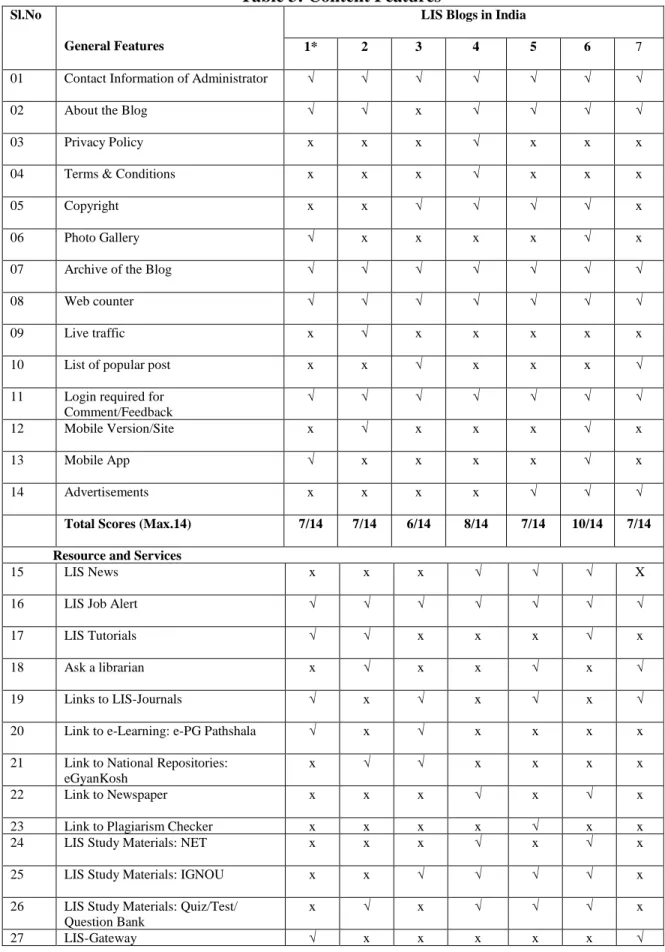
Content is the primary consideration in evaluating the LIS blog content. The numerous elements of content are quite complex and require considerable deliberation on the part of the evaluator. Content analysis having highest of 80 check points (Table 3) as: (i) General features (14 questions), (ii) Resource and services offered (46 questions), (iii) Web 2.0 features (6 questions), (iv) Accessibility (6 questions); (v) Authority (3 questions) and (vi) Accuracy (5 questions).
6
Table 3: Content Features Sl.No
General Features
LIS Blogs in India
1* 2 3 4 5 6 7
01 Contact Information of Administrator √ √ √ √ √ √ √
02 About the Blog √ √ x √ √ √ √
03 Privacy Policy x x x √ x x x
04 Terms & Conditions x x x √ x x x
05 Copyright x x √ √ √ √ x
06 Photo Gallery √ x x x x √ x
07 Archive of the Blog √ √ √ √ √ √ √
08 Web counter √ √ √ √ √ √ √
09 Live traffic x √ x x x x x
10 List of popular post x x √ x x x √
11 Login required for Comment/Feedback
√ √ √ √ √ √ √
12 Mobile Version/Site x √ x x x √ x
13 Mobile App √ x x x x √ x
14 Advertisements x x x x √ √ √
Total Scores (Max.14)
7/14 7/14 6/14 8/14 7/14 10/14 7/14
Resource and Services
15 LIS News x x x √ √ √ X
16 LIS Job Alert √ √ √ √ √ √ √
17 LIS Tutorials √ √ x x x √ x
18 Ask a librarian x √ x x √ x √
19 Links to LIS-Journals √ x √ x √ x √
20 Link to e-Learning: e-PG Pathshala √ x √ x x x x 21 Link to National Repositories:
eGyanKosh
x √ √ x x x x
22 Link to Newspaper x x x √ x √ x
23 Link to Plagiarism Checker x x x x √ x x
24 LIS Study Materials: NET x x x √ x √ x
25 LIS Study Materials: IGNOU x x √ √ √ √ x 26 LIS Study Materials: Quiz/Test/
Question Bank
x √ x √ √ √ x
7
28 Links to Open Access Resources √ √ √ x √ √ x 29 Old UGC-NET question papers √ √ x √ √ √ √ 30 Other LIS Entrance Exam Papers x √ √ √ √ x √
31 Library Association √ √ x x x √ x
32 Librarian Directory x √ x x x √ x
33 Link to Indian Universities x x √ x x x x 34 Link to Commercial Automation
Software: Autolib
√ x x x x x x
35 Link to Commercial Automation Software: Libsoft
√ x x x x x x
36 Link to Commercial Automation Software: Libsys
√ x x x x x x
37 Link to Commercial Automation Software: SOUL (Software for University Libraries)
√ x x x x x x
38 Link to Commercial Automation Software: Easylibsoft
√ x x x x x x
39 Link to Open Source Automation Software: Koha
√ √ x x √ x x
40 Link to Open Source Automation Software: NewGenLib
√ √ x x x x x
41 Link to Open Source Automation Software: Mylibraruan
√ x x x x x x
42 Link to Open Source Automation Software: Evergreen
√ x x x x x x
43 Link to Open Source Automation Software: PhpMylibrary
√ x x x x x x
44 Link to Open Source Automation Software: OpenBiblio
√ x x x x x x
45 Link to Open Source Automation Software: E-Grantalaya
√ x x x x x x
46 Link to Digital Library Software: DSpace
√ √ x x x x x
47 Link to Digital Library Software: Eprint
√ √ x x x x x
48 Link to Digital Library Software: Fedora
√ x x x x x
49 Link to Digital Library Software: Green Stone
√ √ x x x x x
50 Link Content Management software: Wordpress
√ √ x x x √ x
51 Link Content Management software: Drupal
√ √ x x x x x
52 Link Content Management software: Joomla
√ √ x x x √ x
53 Link to other software x √ √ √ x √ x
54 Link to online cataloguing x x x x √ x x 55 Link to Classification: DDC x √ x x x x x
56 Link to DDC Summary x x x √ x √ x
57 Ask /talk to the admin. (if yes, answer the following 3 questions)
√ √ x √ √ √ √
58 Via email √ √ x √ √ √ √
8
60 Others √ √ x √ x √ x
Total Scores (Max. 46) 31/46 24/46 09/46 14/46 15/46 19/46 9/46
Web 2.0 Features
61 RSS feeds x √ √ x x √ √
62 Social Networking Sites: Twitter x √ x √ √ √ x 63 Social Networking Sites: Facebook x √ √ √ √ √ x 64 Social Networking Sites: Google+ √ √ √ √ √ √ √
65 Email x x √ x x x √
66 Pinterest x x x x √ x x
Total Scores (Max. 6) 1/6 4/6 4/6 3/6 4/6 4/6 3/6 Accessibility
67 Accessible from browser: Google Chrome
√ √ √ √ √ √ √
68 Accessible from browser: Opera Mini √ √ √ √ √ √ √ 69 Accessible from browser: Mozilla Fox √ √ √ √ √ √ √ 70 Accessible from browser: Internet
Explorer
√ √ √ √ √ √ √
71 Accessible from browser: Microsoft Edge
√ √ √ √ √ √ √
72 All images/icons/ graphics present when the web page loads
√ √ √ √ √ √ √
Total Scores (Max. 6) 6/6 6/6 6/6 6/6 6/6 6/6 6/6
Authority
73 Easy to determine Authority of the Blog
√ √ √ √ √ √ √
74 Administrator’s qualifications are available
√ x x √ x √ x
75 Information from sources known to be reliable
√ √ √ √ √ √ √
Total Scores (Max. 3) 3/3 2/3 2/3
3/3 2/3 3/3 2/3
Accuracy
76 Information provided is verifiable √ √ √ √ √ √ √ 77 No grammar, spelling and typo error x √ √ √ √ √ √ 78 Information provided is timely √ √ x √ x √ √ 79 Information provided is complete √ √ √ √ √ √ √ 80 Language(s)used is sound and
understandable
√ √ √ √ √ √ √
Total Scores (Max. 5) 4/5 5/5 4/5 5/5 4/5 5/5 5/5
Grand Total (Max. 80) 52/80 48/80 31/80 39/80 38/80 47/80 32/80
*Note: √=Yes, ×=No. 1=Library and Information Science Friends (LIS Friends). 2=Library soup. 3=LIS Information portal. 4. DrLibSc - Desk of Research in Library Science 5= LIS CAFÉ 6= The Co-Professionals LIS 7=Library and Information Science Alarm (LIS ALARM).
9
General information related to LIS blogs contact information, about the blog, privacy statement, photo gallery, copyright, terms and conditions, of the LIS blog, etc. It consists of a total of 14 questions. Table 3 reveals that the co-professional score the highest with 10 out of 14 (i.e., 71.43 %) followed by DrLibsc with 8 points (i.e. 57.14%) and become the second best among them. Four out of seven LIS blogs scored 7 points each (i.e., 50%). LIS Information Portal scored lowest points in the category with 6 points (i.e., 46.67%).
Resources and services (Figure 6) provided by the LIS blogs include, LIS News, LIS Job Alert, Tutorials, Library Manual, Links to LIS-Journals, Links to LIS-Journals, Link to Learning: e-PG Pathshala, links to different software, LIS Study materials, etc. These are content rich features, which facilitates users’ information requirements and they comeback for LIS blogs several times for information requirements. Table 3 reveals that LIS Friends scored the highest with 31 out of 46 points ( 67.39%), followed by Library Soup with 24 points (52.27%) and The Co-Professional LIS with 19 points (41.30%). LIS Information Portal and LIS Alarm scored the least with 9 points each. Service like ‘Job alert’ is common to all of the LIS blogs.
Web 2.0 features are also widely employed in LIS blogs. Web 2.0 is focused on the ability for people to collaborate and share information online via social media, blogging and web-based communities22, which consist of RSS Feeds, Social networking site like Facebook, Twitter, Google+ Email and Pinterest. Table 3 reveals that 57.14 % of the LIS Blog score cent percent in Web 2.0 feature i.e., Library soup, LIS Information Portal, LIS café, and The Co-Professional LIS scored with 4 points each (66.67%). DrLibsc and LIS Alarm scores 3 points out of 4. LIS Friends blog scores just only 1 out of 6 points in Web 2.0 features.
Accessibility refers to the ability to access the LIS blog from different browsers. Table 3 show that all the studied LIS blogs scored cent percent (6 out of 6 points) in this category. It can be concluded that all the studied LIS blogs are compatible with all major web browsers (Google chrome, Opera mini, Mozilla Fox, Microsoft edge, etc.).
Authority simply means the power or right to give orders. Table 3 reveals that three LIS Friends, DrLibsc and The Co-Professional LIS scored 3 out of 3 points i.e., 100% and the rest of the blogs scores 2 of 3 i.e., 66.67%.
Accuracy of creating a blog post, news feed or mail is very important. It is what the user sees first, and should be treated as the most important tool in blogging. Table 3 shows that four out of seven studied LIS Blogs scored cent percent (100%). On the other hand, remaining three LIS blogs scores 4 out of 5 points (80%). The findings of the study clearly indicate good sign on the accuracy of content of the studied LIS blogs.
The total score of content feature is obtained from scores of General features, Resource and services, Web 2.0 features, Accessibility, Authority and Accuracy. Table 3 shows the total score of the Content features of the study is Library and Information Science Friends (LIS Friends) edged all the other blogs by scoring the highest of all i.e., 52 out of 80 points (65%), followed by Library Soup with 48, The Co-Professionals LIS with 47, DrLibSc - Desk of Research in Library Science with 39 and LIS CAFÉ with 38 out of 80 points. Library and Information Science Alarm
10
(LIS ALARM) scores 32 points which is followed by LIS Information portal scoring only 31 and become the last of all.
5.3 User Interface
“A user interface is the system by which users interact with the blog. User interfaces exist for various systems, and provide a means of input (allowing the users to manipulate a system) and output (allowing the system to indicate the effects of the users' manipulation)”23.
Table 4: User Interface
Sl.No User Interface LIS Blogs in India
1* 2 3 4 5 6 7
01 Navigation aid clearly labelled √ √ √ √ √ √ √ 02 Navigation aid present at the bottom of page √ √ √ √ √ √ √ 03 Every pages consist of a Home button √ √ √ √ √ √ √ 04 Search Feature (within the Blog) √ x √ √ x x √
05 Search feature is accurate √ x √ √ x x √
06 Types of information e.g. Text, Symbols, Graphics, etc. are clearly distinguished from each other.
√ √ √ √ √ √ √
07 Image support navigation available x x x √ √ √ x
08 Page headings are consistence √ √ √ √ √ √ √
Total scores (Max. 8) 7/8 5/8 7/8 8/8 6/8 6/8 7/8
Appearance and Layout
09 Graphic and Animation look nice x x √ √ √ √ √
10 Blog look well organized √ √ √ √ √ √ √
11 Blog appears well maintained √ √ √ √ √ √ √
12 Color used are appropriate √ √ √ √ √ √ √
13 Text and numbers are easily readable √ √ √ √ √ √ √ 14 Page layout matches the information
Categorization
√ √ √ √ √ √ √
Total Score (Max. 6) 5/6 5/6 6/6 6/6 6/6 6/6 6/6
Links
15 Links were described in an appropriate way √ √ √ √ √ √ √
16 Links were clearly labeled √ √ √ √ √ √ √
17 Internal links are reliable √ √ √ √ √ √ √
18 List of links to other important Web sites or Blog √ √ √ √ √ √ √
Total scores (Max. 4) 4/4 4/4 4/4 4/4 4/4 4/4 4/4
Grand Total (Max.18) 16/18 14/18 17/1
8
18/18 16/18 16/18 17/1 8
11
*Note: √=Yes, ×=No. 1=Library and Information Science Friends (LIS Friends). 2=Library soup. 3=LIS Information portal. 4. DrLibSc - Desk of Research in Library Science 5= LIS CAFÉ 6= The Co-Professionals LIS 7=Library and Information Science Alarm (LIS ALARM)
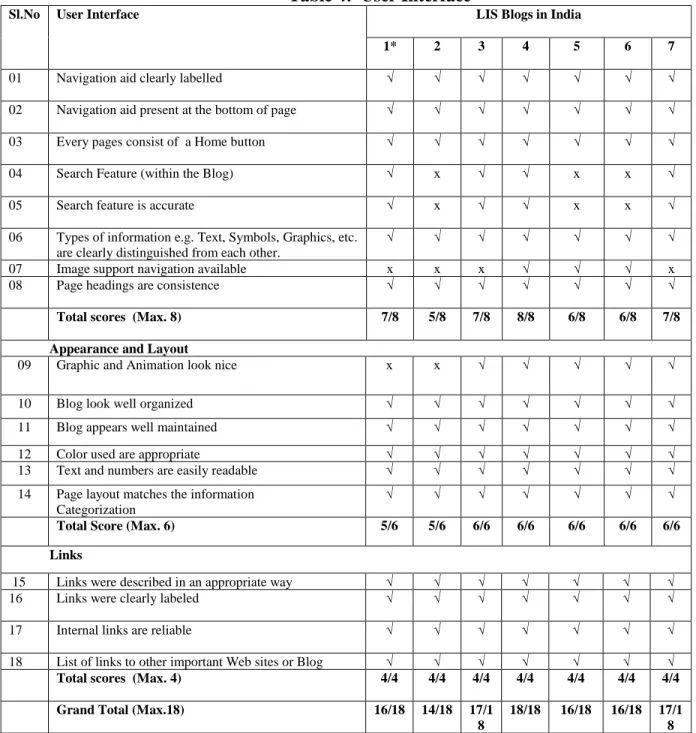
Table 4 depicts that Drlibsc scored the highest with 8 out of 8 points (100%), followed by LIS Friends, LIS information Portal and LIS alarm with 7 points (85.5%) each. On the other hand, LIS Café and The Co-Professionals LIS with 6 points (75%) and the least score are obtained by Library Soup with 5 points (62.5%).
The appearance and layout implies the appearance of the LIS blogs and how the information content in the LIS blogs was organized and arranged. Table 4 reveals 71.2% of studied LIS Blogs scored cent percent (100%) and remaining 18.8% LIS blogs LIS Friends and Library Soup with 5 points each (83.33%).
Links are important components of the LIS blogs. They are used to manage content within the blogs and made them available to users for their information needs. Thus, evaluation of the link is an important part of the present study. Table 4 reveals that all the LIS blogs contain Links. All the LIS blog under study scores 100% each. The links are well described, clearly labeled and reliable at the time of evaluation period.
Table 4 reveals that DrLibSc scored cent percent, followed by LIS Information portal and LIS Alarm with 17 points each. On the other hand, LIS Friends, LIS CAFÉ and The Co-Professionals LIS got the same score of 16 points each. Moreover, Library Soup scored the lowest with 14 points.
5.4 Total Score of LIS Blogs
Table 5 entitled “Total Score of study LIS blogs” on the basis of previous respective tables.
Table- 5: Total Score of study LIS Blogs LIS Blogs Multimedia Features (12) (Table 2) Content Features (80) (Table 3) Users Interface (18) (Table 4) Total Scores (Max.110) 1* 12 52 16 80 2 10 48 14 72 3 10 31 17 58 4 06 39 18 63 5 10 38 16 64 6 10 47 16 73 7 08 32 17 57
*Note: 1=Library and Information Science Friends (LIS Friends). 2=Library soup. 3=LIS Information portal. 4.DrLibSc - Desk of Research in Library Science 5= LIS CAFÉ 6= The Co-Professionals LIS 7=Library and Information Science Alarm (LIS Alarm).
12
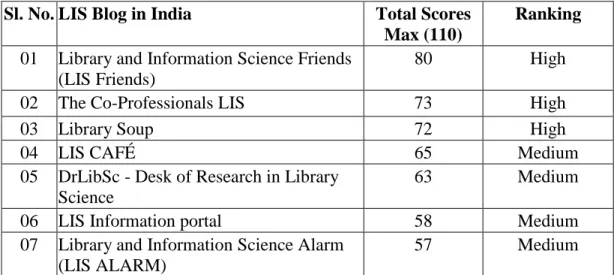
Table 5 shows that the highest scored features study LIS blog is LIS Friends with 80 points, followed by The Co-Professionals with 73 points and Library Soup with 72 points is the three top most LIS blogs in India. Library and Information Science Alarm is least scored LIS blog with 57 points.
5.5 Ranking of the LIS Blogs in India
A quantitative five point rating scale was designed based on intensity scale suggested by Taylor-Powell24 “to range from ‘very high’ to ‘very low’ to rank” the LIS blogs under study. The five-point rating scale was fixed equally based on the maximum score of 110 five-points. Range (Score): 89-110 - Very High; 67-88- High; 45-66- Medium; 23-44- Low; and 01-22- Very Low. “Its purpose is best served when comparing and ranking”20 the LIS blogs in India. Table 6 reveals that out of the seven LIS blogs under study, none of them received a ‘very high’ ranking; three of them received a ‘high’, and the remaining are ranked with a ‘medium’. Table 4 depicts 42.85 % of the LIS blogs are ranked “high” and the remaining 52.14 % were ranked medium. The LIS Friends scored the highest points with 80 out of 110. The LIS Friends (80) along with The Co-Professionals LIS (73) and Library soup (71) were ranked “High” from among the seven LIS Blogs. LIS CAFÉ scoring (65) along with DrLibSc - Desk of Research in Library Science (63), LIS Information portal (58) and Library and Information Science Alarm (LIS Alarm) (57) ranked “Medium”. Surprisingly, no studied LIS blog is good enough to be ranked “Very High” and poor to be ranked “Very Low”.
Table- 6: Ranking of studied LIS Blogs in India
Sl. No. LIS Blog in India Total Scores
Max (110)
Ranking
01 Library and Information Science Friends (LIS Friends)
80 High
02 The Co-Professionals LIS 73 High
03 Library Soup 72 High
04 LIS CAFÉ 65 Medium
05 DrLibSc - Desk of Research in Library Science
63 Medium
06 LIS Information portal 58 Medium 07 Library and Information Science Alarm
(LIS ALARM)
57 Medium
6 Suggestions
The study proposes the following suggestions for effective use of LIS blogs:
(i) Most of the LIS blogs provide sufficient amount of information, but there is a strong requirement of well-designed pages and organization of information.
(ii) Mobile App for LIS blogs is an important feature of present blogs and there is an urgent need to incorporate Mobile apps in studied LIS blogs.
13
(iii) Videos or tutorial are important features where one can learn something virtually. It helps the users to develop technical skills. It is high time to studied LIS blogs to develop relevant video tutorials and incorporate in the respective sections.
(iv) List of popular posts are those posts, which are most viewed and discussed. This feature in provided by meager studied LIS blogs. It will be good if all the studied LIS blogs have this feature to signify that the particular post is important.
(v) LIS students and research scholars are future LIS professionals, Link to Library software, especially Open source software Koha, and Content Management Systems, such as: Wordpress, Joomla, Drupal, etc. are important features that all studied LIS blogs should provide.
7 Conclusion
Blog indeed is a boon for students and professionals. Getting appropriate information when in need is something which is not very easy in this digital. The Library and Information Science Blogs serves its function by providing all predetermined information by keeping in place all the right information and update the blogs with the latest information in terms of LIS tutorials, Software, LIS job, LIS related news, etc. “Blogs engage people in knowledge sharing and reflection, and they often attract a large readership. Instead of providing static information, blogs allow users and readers to respond, to create, and to connect. It is also simple to create and maintain”13.
The findings of the study reveal that all the LIS blogs under study were well maintained and the administrators are updating the information in time. The present study finds that LIS Friends is the best LIS blog among the studied LIS blogs in India. It is well designed, maintained, simple and easy to understand combined with a whole loads of information throughout the blog. The findings of this study will not only guide the LIS blog administrators to provide LIS relevant contents/features/services, but also abreast the knowledge of every LIS fraternity. And the findings will help the studied LIS blog administrators to identify the lacunas and trounce the same for improved efficient services for attracting more web visitors.
References
1. Sullivan, A. Why I blog. The atlantic, Atlantic media company, 2014. www.theatlantic.com/magazine/archive/2008/11/why-i-blog/307060/(Accessed on 20 Jan. 2018).
2. Lujan-Mora, S. & Juana-Espinosa, S. The use of weblogs in higher education: benefits and barriers: Proceedings of the International Technology, Education and Development (INTED), Valencia, 2007, March 7th-9th, 1-7.
doi:desarrolloweb.dlsi.ua.es/blogs/pdf/use-of-weblogs-in-higher-education-benefits-and-barriers.pdf (Accessed on 1 Nov. 2017).
3. Gala, B. Library and information science blogs: a content analysis, Shodhganga@INFLIBNET: Library and information science blogs: a content analysis, 2013.
14
4. Solanki, V. & John, K. Blog: a tool for online library services. Int. J. of Res. in Lib. Sci.,2015, 1(1), 45-50.
5. Verma, M.K. Blog: an innovative tool for electronic reference services in libraries. Lib. Her., 2014, 53 (2), 183.
6. Song, H. S. Y. & Yuen, M.C. Educational blogging: a Malaysian university students' perception and experience: Proceedings ASCILITE Melbourne, 2008, www.ascilite. org/conferences/melbourne08/procs/song.pdf (Accessed on 1 Nov. 2017).
7. Mynard , J. A blog as a tool for reflection for English language learners. Asian EFL J., 2017.
doi: http://www.asian-efl-journal.com/pta_Nov_07_jm.pdf (Accessed on 1 Nov. 2017).
8. Wang, S.J. A research of building virtual learning community strategies on the basis of educational blog for the professional development of teachers Northeast normal university (People's Republic of China), Ann Arbor, 2010.
Doi:https://search.proquest.com/docview/ 1868453978 (Accessed on 10 Oct. 2017).
9. Lawrence, C.N. & Michelle L.D. Blogging in the political science classroom. PS: Pol. Sci. & Politics., 2010, 43 (1), 151-6.
10.Murali Prasad, M.R. Marketing LIS Education through Departmental (DLIS) Blog: A Proposal to Build Relationship with Public and Professionals. DESIDOC J. Lib.& Inf. Tech., 2016, 36 (3), 148-52.
11.Wilson, V. The LIS blogosphere contains tags that can be categorized and it dissemina- tes professional content. Evi.Based Lib.& Inf. Prac., 2010, 5(1), 138-40.
12.Mandal, P.S. Blog and its role in library and information services.”DESIDOC J. Lib. & Inf. Tech., 2011, 31 (3), 155–8.
doi:10.14429/djlit.31.3.983 (Accessed on 20 Jan. 2018).
13.Hong, W. Exploring educational use of blogs in U.S. education. Online, 2008. doi: eric.ed.gov/?id=ED503871 (Accessed on 20 Jan. 2018).
14.Mazzocchi, J. Blogs and social networks in libraries: complementary or antagonistic tools? 2014.
doi:digitalcommons.unl.edu/libphilprac/1191/?utmsource=digitalcommons.unl.edu% 2Flibphilprac%2F1191&utm_medium=PDF&utm_campaign=PDFCoverPages (Accessed on 20 Jan. 2018).
15.Bansode, S.Y. & Pujar, S.M. Blogs: a online tool for library services. Int. CALIBER, 2008, 446–451. ir.inflibnet.ac.in:8080/ir/bitstream/1944/1269/1/48.pdf (Accessed on 20 Jan. 2018).
15
16. Stover, J.S. Making marketing work for your library blog. Taylor & Francis, 2008. www.tandfonline.com/doi/abs/10.1300/J136v11n04_10 (Accessed on 20 Jan. 2018).
17. Cooke, N.A. Becoming an andragogical librarian: using library instruction as a tool to combat library anxiety and empower adult learners. New Rev. Aca. Libship, 2010,
16(2), 208–27.
18. Velmurugan, C. Weblogs and its applications in digital libraries-an introduction. ResearchGate, 2012, www.researchgate.net/publication/291056502 _weblogs_and_its_applications_in_digital_libraries-an_introduction (Accessed on 20 Jan. 2018).
19. Aharony, N. LIS blog comments: an exploratory analysis. Libri, 2010, 60 (1), 65-77.
20. Madhusudhan, M. Content evaluation of Indian institutes of technology library websites in India. W. Dig. Lib, 2012,5 (2), 1-20.
21.ISRD. Internet technology and web design. 2001,New Delhi: Tata MaGraw Hill, 98.
22. Techopedia, 2017. https://www.techopedia.com/dictionary (accessed 22 June 2017).
23. Mishra, P K. Managing electronic resources. Gyan Publishing, 2011, 344.
24. Taylor-Powell, E. Ways to word answer choices in questionnaires, 2008. http:// www. uwex.edu/ces/4h/evaluation/documents/Waystowordanswerchoicesinquestionnaires. pdf (Accessed 22 June 2017).
LIS Blogs:
1. Library and Information Science Friends (LIS Friends) - http://lis-friends.blogspot.in (Accessed on 1 Nov. 2017).
2. Library Soup - http://library-soup.blogspot.in (Accessed on 2 Nov. 2017). 3. LIS Information portal - https://lisinfoportal.blogspot.in/ (Accessed on 1Nov.
2017).
4. DrLibSc - Desk of Research in Library Science - https://drlibsc.blogspot.in/ (Accessed on 1 Nov. 2017).
5. LIS CAFÉ - https://libraryandinformationsciencecafe.blogspot.in/p/home_6. html (Accessed on 2 Nov. 2017).
6. The Co-Professionals LIS - http://wasimrlis.blogspot.in (Accessed on 1 Nov. 2017).
7. Library and Information Science Alarm (LIS Alarm) -http://lisalarm.blogspot. in (Accessed on 1Nov. 2017).
16 About Author:
Dr M. Madhusudhan is currently working as Associate Professor in the Department of Library and Information Science, University of Delhi. He has 19 years of teaching, administration and research experience at the University level. Under his supervision 21 MPhils, 7 PhDs and 120+ project reports have been awarded. He has published one book, edited three books, 60+ research articles in peer-reviewed journals, 25 chapters in books. He is also editorial member of JLIS, IJLIS and reviewer for five international LIS journals. His areas of interest includes: Designing and evaluation of websites, evaluation of web-OPACs, ICT in libraries, social networking sites, e-resources, mobile-based library services, etc. Dr. Madhusudhan, is the principal author and can be contacted at [email protected].
Mr. Hauminlun is obtained his M.L.I.Sc and M.Phil in Library and Information Science degrees from the University of Delhi and Post Graduate Diploma in Library Automation and Networking from the Indira Gandhi National Open University (IGNOU), New Delhi. He presented few papers in Conference/Seminar. He has attended several workshops and training programmes in his area. His specialized fields are LIS websites and blogs.