2015
Static Code Analysis: On Detection of Security Vulnerabilities and
Static Code Analysis: On Detection of Security Vulnerabilities and
Classification of Warning Messages
Classification of Warning Messages
Andrei M. PerhinschiFollow this and additional works at: https://researchrepository.wvu.edu/etd
Recommended Citation Recommended Citation
Perhinschi, Andrei M., "Static Code Analysis: On Detection of Security Vulnerabilities and Classification of Warning Messages" (2015). Graduate Theses, Dissertations, and Problem Reports. 6403.
https://researchrepository.wvu.edu/etd/6403
This Thesis is protected by copyright and/or related rights. It has been brought to you by the The Research Repository @ WVU with permission from the rights-holder(s). You are free to use this Thesis in any way that is permitted by the copyright and related rights legislation that applies to your use. For other uses you must obtain permission from the rights-holder(s) directly, unless additional rights are indicated by a Creative Commons license in the record and/ or on the work itself. This Thesis has been accepted for inclusion in WVU Graduate Theses, Dissertations, and Problem Reports collection by an authorized administrator of The Research Repository @ WVU. For more information, please contact [email protected].
Vulnerabilities and Classification of Warning
Messages
by
Andrei M. Perhinschi Thesis submitted to the
Benjamin M. Statler College of Engineering and Mineral Resources at West Virginia University
in partial fulfillment of the requirements for the degree of
Master of Science in
Computer Science
Katerina Goseva-Popstojanova, Ph.D., Chair Hany Ammar, Ph.D.
Roy Nutter, Ph.D.
Lane Department of Computer Science and Electrical Engineering Morgantown, West Virginia
2015
Keywords: static code analysis, machine learning, information assurance Copyright 2015 Andrei M. Perhinschi
This thesis addresses several aspects of using static code analysis tools for detection of se-curity vulnerabilities and faults within source code. First, the performance of three widely used static code analysis tools with respect to detection of security vulnerabilities is evaluated. This is done with the help of a large benchmarking suite designed to test static code analysis tools’ per-formance regarding security vulnerabilities. The perper-formance of the three tools is also evaluated using three open source software projects with known security vulnerabilities. The main results of the first part of this thesis showed that the three evaluated tools do not have significantly different performance in detecting security vulnerabilities. 27% of C/C++ vulnerabilities along with 11% of Java vulnerabilities were not detected by any of the three tools. Furthermore, overall recall values for all three tools were close to or below 50% indicating performance comparable or worse than random guessing. These results were corroborated by the tools’ performance on the three real soft-ware projects. The second part of this thesis is focused on machine-learning based classification of messages extracted from static code analysis reports. This work is based on data from five real NASA software projects. A classifier is trained on increasing percentages of labeled data in order to emulate an on-going analysis effort for each of the five datasets. Results showed that classifica-tion performance is highly dependent on the distribuclassifica-tion of true and false positives among source code files. One of the five datasets yielded good predictive classification regarding true positives. One more dataset led to acceptable performance, while the remaining three datasets failed to yield good results. Investigating the distribution of true and false positives revealed that messages were classified successfully when either only real faults and/or only false faults were clustered in files or were flagged by the same checker. The high percentages of false positive singletons (files or checkers that produced 0 true positives and 1 false negative) were found to negatively affect the classifier’s performance.
Acknowledgments
The work presented in this thesis was funded in part by the NASA Independent Verification and Validation Facility in Fairmont, WV through grants managed by TASC Inc. The author thanks Brandon Bailey, Keenan Bowens, Richard Brockway, Van Casdorph, Travis Dawson, Roger Harris, Vaughn Harvey, Joelle Loretta, Shirley Savarino, Jerry Sims and Christopher Williams for their input and feedback.
Contents
Acknowledgments v
List of Figures viii
List of Tables ix
1 Introduction 1
1.1 Introduction to Static Code Analysis Tool Evaluation . . . 1
1.2 Introduction to Static Code Analysis Message Classification Experiments . . . 5
2 Related Work 9 2.1 Related Work for Static Code Analysis Tool Evaluation . . . 9
2.2 Related Work for Static Code Analysis Message Classification Experiments . . . . 13
3 Evaluation of Static Code Analysis Tools 16 3.1 Methodology . . . 16
3.1.1 Common Weakness Enumeration and the Juliet Benchmark . . . 16
3.1.2 Description of the program for automatic computation of the tools perfor-mance . . . 19
3.1.3 Metrics used for quantitative comparison of tools performance . . . 23
3.1.4 Background on Statistical Testing . . . 24
3.1.5 Quantitative evaluation based on real open source programs . . . 25
3.2 Evaluation Results based on Juliet Benchmark . . . 27
3.2.1 Evaluation on C/C++ CWEs . . . 27
3.2.2 Evaluation on Java CWEs . . . 29
3.2.3 Summary of the tools performance on the C/C++ and Java subsets . . . 33
3.2.4 Evaluation of tools performance by CWE category . . . 36
3.3 Evaluation Results based on Real Software . . . 38
3.4 Threats to Validity for Tools’ Evaluation . . . 39
3.4.1 Construct Validity . . . 39
3.4.2 Internal Validity . . . 40
3.4.3 Conclusion Validity . . . 40
3.4.4 External Validity . . . 41
4 Static Code Analysis Message Classification 42
4.1 Methodology . . . 42
4.2 Datasets . . . 44
4.3 Results of the Classification Experiments . . . 46
4.3.1 Discussion of Classification Experiments . . . 50
4.4 Threats to Validity of Classification Experiments . . . 53
4.4.1 Construct Validity . . . 53
4.4.2 Internal Validity . . . 54
4.4.3 Conclusion Validity . . . 54
4.4.4 External Validity . . . 54
4.5 Conclusion on Classification Experiments . . . 55
List of Figures
3.1 Metrics computation system block diagram . . . 20
3.2 Metrics for the C/C++ CWEs . . . 28
3.3 ROC squares for the C/C++ CWEs. Some of the data points above represent mul-tiple points stacked on top of one another, for example many CWEs cluster at point (0,0). . . 30
3.4 Metrics for the Java CWEs . . . 31
3.5 ROC squares for the Java CWEs. Some of the data points above represent multiple points stacked on top of one another, for example many CWEs cluster at point (0,0). 32 4.1 Bubble plots for NASA 1 results per file and checker . . . 48
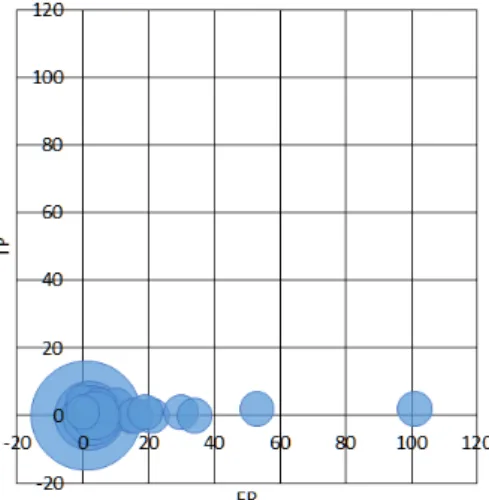
4.2 Bubble plots for NASA 2 results per file and checker . . . 49
4.3 Bubble plots for NASA 3 results per file and checker . . . 50
4.4 Bubble plots for NASA 4 results per file and checker . . . 51
List of Tables
3.1 Confusion matrix . . . 21
3.2 Basic facts about open source programs used for evaluation of the static code anal-ysis tools . . . 26
3.3 Accuracy, Recall, Probability of False Alarm, Balance, and G-Score for both C/C++ and Java CWEs with all three tools . . . 34
3.4 Friedmann results for both C/C++ and Java CWEs with all three tools . . . 36
3.5 C/C++ CWE category grouping . . . 37
3.6 Java CWE category grouping . . . 37
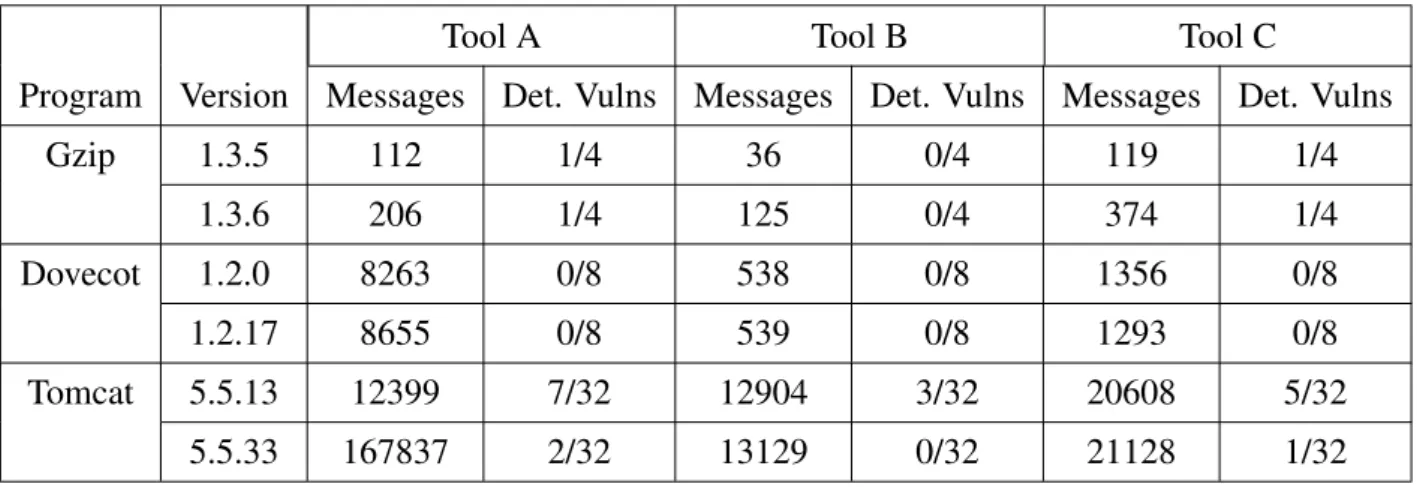
3.7 Number of detected known vulnerabilities in the vulnerable versions (true posi-tives) and reported vulnerabilities in the fixed versions (false posiposi-tives) . . . 38
4.1 Confusion matrix . . . 44
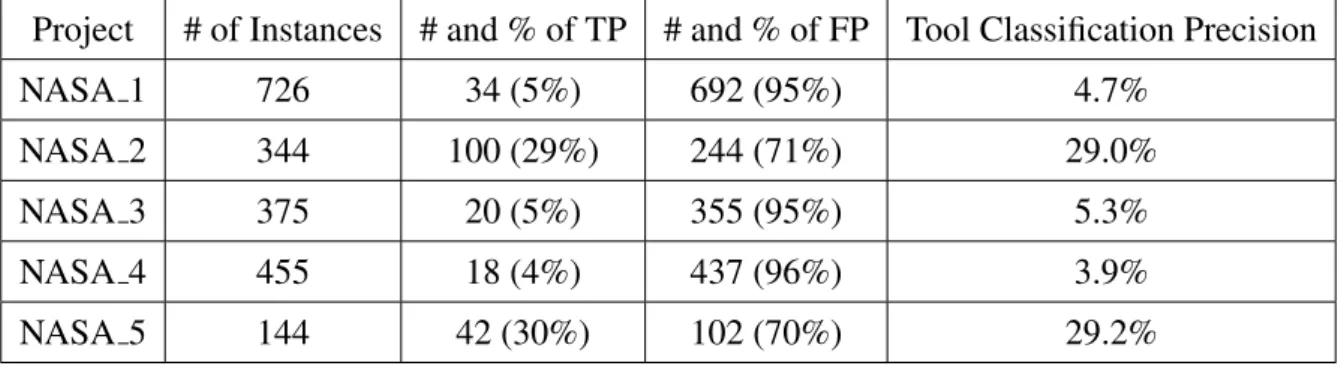
4.2 Basic information on the five datasets . . . 45
4.3 CBA Learning Results for all datasets. . . 47
A.1 List of C/C++ CWEs and the number of associated good and bad functions along with number of test cases used in the experiments . . . 61
A.2 List of Java CWEs and the number of associated good and bad functions along with number of test cases used in the experiments . . . 62
A.3 Accuracy for C/C++ . . . 63
A.4 Recall for C/C++ . . . 64
A.5 Probability of False Alarm for C/C++ . . . 65
A.6 Balance for C/C++ . . . 66
A.7 G-score for C/C++ . . . 67
A.8 Accuracy for Java . . . 68
A.9 Recall for Java . . . 69
A.10 Probability of False Alarm for Java . . . 70
A.11 Balance for Java . . . 71
A.12 G-score for Java . . . 72
A.13 Recall for categories with C/C++ . . . 73
A.14 Probability of False Alarm for categories with C/C++ . . . 74
A.15 G-Score for categories with C/C++ . . . 75
A.16 Recall for categories with Java . . . 76
Chapter 1
Introduction
Static analysis of source code provides a scalable method for code review and helps ensure that coding policies are being followed. Tools for static analysis have rapidly matured in the last decade; they have evolved from simple lexical analysis to employ much more accurate and complex techniques. Many commercial and open source tools exist, and all of them make certain claims about their effectiveness and performance.
However, in general, static analysis problems are undecidable [8] (i.e., it is impossible to con-struct an algorithm which always leads to a correct answer in every case). Therefore, static analysis tools do not detect all faults in source code (false negatives) and are prone to false positives (i.e., they report findings which upon closer examination turn out not to be faults at all). Therefore to be of practical use, a static code analysis tool should find as many faults as possible, ideally all, with a minimum amount of false positives, ideally none.
1.1
Introduction to Static Code Analysis Tool Evaluation
The advances in technology and broadband connectivity, combined with ever increasing num-ber of threats and attacks, require information assurance and cynum-ber security to be integrated into the traditional verification and validation process. Many organizations develop, run, and maintain numerous systems for which one or more security attributes (i.e., confidentiality, integrity, avail-ability, authentication, authorization, and non-repudiation) are of vital importance. Therefore it is becoming imperative to extend current validation and verification capabilities to cover information
assurance and cyber security concerns for sensitive projects.
Vulnerabilities are more costly to fix than prevent in the first place [6]. To be able to prevent vulnerabilities from ever existing, the development process needs to be tailored towards this goal. Related work shows that static code analysis is only one part of a successful development pro-cess [3], [34]. What is unclear is whether or not static analysis tools deliver what they promise. Therefore the motivation for this work was to determine whether static code analysis tools display significant differences in detection of security vulnerabilities and if so where these differences oc-cur. In this thesis the capabilities of three existing state-of-the-practice static code analysis tools were explored. Previous efforts include the work done at the multiple SATE events [29]. While examining more tools than the work presented here, the SATE approach did not include any rigor-ous statistical testing. Instead it relied only on the reporting of metrics such as recall and precision [30]. Similar to the work done within the SATE conference, the experiment presented in this thesis makes use of the Common Weakness Enumeration (CWE) nomenclature, which is a hierarchical classification of security vulnerability types. A given CWE will either denote one particular type of security vulnerability, for example buffer overflow or SQL injection, or it will represent a vul-nerability class, such as numeric errors or coding standard violations. CWEs are described in more detail in Section 3.1.
The main motivation behind this work can be summarized with the following three research questions:
• R1: Is there a difference between three state of the practice static code analysis tools with respect to detection of security related faults when applied to a benchmark suite?
• R2: If so which of the tools performs the best?
• R3: Is the performance of the three static code analysis tools on real software applications consistent with the performance on the benchmark suite?
The three tools evaluated in this thesis were chosen based on factors such as popularity, ease of use, and the ability to check partial source code. This work is based on a large benchmark suite [23] consisting of 22 vulnerability ”classes” for C/C++ and 19 for Java, with approximately 20,000 and 7,500 test cases respectively. The benchmark-based evaluation was conducted
auto-matically by the use of a scripting system developed as part of this effort. The methodology is based on automatic extraction of quantitative metrics from the outputs of the three static analysis tools, denoted throughout this thesis as Tools A, B, and C. The work presented here is an empirical study consisting of a controlled experiment with benchmark input. The Juliet test suite was run through each of the three tools after which the tools’ output was taken and ran through a script system developed to compute detection performance metrics. The results were empirically eval-uated by employing statistical hypothesis testing in order to determine any significant differences between the three tools’ performance. The inclusion of rigorous statistical testing is an important contribution as compared to the related work.
In addition to the automatic benchmark-based experiment, the evaluation was extended with three open source programs, two of which were implemented in C (with 8,500 and 280,000 LOC, respectively) and one implemented in Java (with 4,800,000 LOC). All three of the programs se-lected have known sets of vulnerabilities in order to allow quantitative analysis. For this part of the study all results are obtained by manual inspection of the static tools’ outputs as there was no way of automating the process, nor was it necessary due to the relatively small number of known defects.
The contribution of this work can be shortly summarized as follows:
• Approach
– The experimental approach employed in this work was based on a benchmark suite called Juliet developed by the NSA Center for Assured Software. The main purpose of the Juliet suite is to assess static code analysis tools. Earlier studies based on the Juliet suite either employed a very small subset of the C test cases [12] or did not provide quantitative results [7] [26].
– The work presented here provides a number of quantitative performance metrics: accu-racy, recall, probability of fasle alarm, balance, and G-score. These metrics are reported per individual CWE and also across all CWEs. Formal statistical testing, in the form of the Friedman rank sum test, was employed in comparing the tools’ performance met-rics in order to determine the existence of any significant difference in performance. This is a considerable improvement over the referenced related works, none of which
reported any such statistical tests.
– Three popular open source applications were employed as case studies besides the experimental approach. These were included as a way of verifying the experimental results based on the Juliet benchmark in a more realistic situation.
• Empirical observations
– The three tools were all unable to detect all vulnerabilities. In this context the term “detect” refers to correctly classifying at least one bad function; it does not mean being able to detect each and every instance of faulty code for a given CWE. None of the tools were able to detect six of the 22 C/C++ CWEs. Furthermore seven C/C++ CWEs were detected either by a single tool or a combination of two tools. All three tools were able to detect only nine of C/C++ CWEs. The evaluation of Java CWEs yielded similar results. None of the tools detected two of the 19 Java CWEs while thirteen Java CWEs were detected either by a single tool or a combination of two tools. All three tools were able to detect only four of the Java CWEs.
– The three static analysis tools showed no statistically significant difference in detect-ing security vulnerabilities. This lack of significant difference was observed for both C/C++ and Java test cases. Furthermore, the mean, median, weighted, and overall val-ues for the recall metric were either about or less than 50%. This signifies similar or worse performance than random chance.
– One of the tools displayed better performance with respect to probability of false alarm for the C/C++ test cases. However, no such difference was measured for Java test cases.
– The three open source program case studies confirmed the experimental results with respect to the tools’ security vulnerability detection performance.
1.2
Introduction to Static Code Analysis Message
Classifica-tion Experiments
Being an integral part of the software development process, static code analysis has the poten-tial to improve the quality of software. Static code analysis consists of running source code through a software tool which then outputs a list of messages. Static analysis tools employ pattern matching constructs known as ”checkers” which flag pieces of source code as defective if the source code happens to match a particular checker. For example, a static analysis tool has a checker designed to detect possible buffer overflow conditions. When the tool encounters a piece of source code which matches its buffer overflow checker, a message is produced. Each message (often called a warning) consists of information related to a specific piece of source code that the static analysis tool has flagged as faulty. The information provided varies among static analysis tools; however a majority of tools report the following: source code filename and function or method where po-tentially faulty code is located, line number(s) where faulty code is located, some type of severity ranking of the fault, and checker which flagged the fault.
Throughout the rest of this thesis the list of messages output by static analysis tools is referred to as ”report”. Each report contains many messages, up to hundreds of thousands for large projects with millions of lines of code. Each message is either a true positive (TP) or a false positive (FP). True positives are actual code faults while false positives are not. For each message this determination falls to a software analyst who has to manually inspect the code referenced by the message and decide whether or not the static analysis software has made a mistake. In practice, static analysis tools produce large numbers of false positives [14], [4] which makes it difficult for analysts and developers to put such tools to effective use. It is clear that time expended identifying false positives would be better spent on other tasks, such as fixing true positives.
Analysts’ competence at dealing with the large numbers of false positives resulting from static code analysis was studied in [5]. The findings showed that, while analysts were quite competent with respect to true positive classification, they were not very successful in identifying false posi-tives. Furthermore, it was reported that analyst experience did not make a difference with regard to their ability to identify false positive messages. A newer study by the same research team [4] again confirmed the negative effects of false positives. The results showed a high incidence of false
positives among static analysis tool output, with slightly more than a third of them being identified as such by analysts. The researchers also found that false positives negatively impacted analysts’ efforts by forcing them to spend time looking at and identifying non-issues. These results further confirm that some classification of true and false positives should be an integral part of any static analysis effort. It follows that if the number of false positives could be significantly decreased, the static code analysis process could be made less time consuming and would lead to better outcomes in terms of software quality, including reliability and security.
The motivation for this work was to evaluate the viability of machine learning in classifying static code analysis report messages using only features extracted from the static code analysis re-port. While integrating data from more than just the static analysis tool may make it more likely for machine learning algorithms to perform well, such integration between static analysis tool reports and other sources is not always possible. It would then be desirable to be able to perform ma-chine learning classification using only static analysis reports. Specifically, the following research questions are posed:
• R4: Can static analysis messages be successfully classified to true positives and false posi-tives?
• R5: If so, what percentage of report messages must be labeled before predictions become useful?
• R6: What is the distribution of true and false positives among files and checkers?
Exploring the distribution of true and false positives across files was motivated by the so-called Pareto principle, that is that around 80% of faults are localized in 20% of files. The Pareto principle has been confirmed in numerous studies [27], [1], [18], [11], with the actual percentage of faults contained in about 20% of files ranging from 60% to 90%.
Furthermore, it was found that many checkers also tend to cluster false positives for various reasons such as the inherent vagueness involved when designing such checkers and the variety of possible code constructs that may violate checkers’ rules about what constitutes a correct construct while not actually being incorrect [24]. This motivated the decision to look at true and false positive distribution across checkers.
The classification approach used in this work is based on using the Classification Based on Associations (CBA) algorithm [25]. CBA is an association rule-based classifier which works on categorical data such as the fields found in static code analysis reports. The experimental design is based on train/test experimentation with incremental percentages of a given dataset being trained on. Training was done on 25% and testing on 75% of a given dataset, then training was done on 50% and testing on 50%, then training on 75% and testing on 25%, and finally training on 90% and testing on 10%. This setup was chosen to simulate an ongoing analysis process at different points in time. For the experiments presented in this part of the thesis we used static analysis reports from five real NASA projects which were manually analyzed, that is, the messages were manually checked by a software analyst.
The contributions of this part of the thesis are:
• The experiment presented in this thesis employed association rule based classification with training on different percentages of labeled messages.
• The work presented here applies classification on five datasets obtained from real NASA software projects’ static code analysis efforts.
The main empirical observation of this work are as follows:
• The experiment presented in this thesis showed that two of the projects produced good classi-fication results while the remaining three projects did not lend themselves well to association based classification.
• Classification based on association rules led to good performance when TP and FP messages were clustered in code units (files in the present case) with other messages of their type (TP or FP, respectively). When operating on datasets with code units containing mixed distributions of TP and FP messages performance was significantly decreased.
• Classification based on association rules did not lead to good performance on datasets with large numbers of FP singletons, that is when files produce only one message, which provide no benefit when training the classifier.
• Unlike the Stanford team [24] which found that singleton faults tend to appear quite bal-anced, that is TP and FP singletons seem to occur in relatively similar numbers, the results of this work show a significant trend towards FP singletons. More importantly, it was found that for some projects true and false positives tend to be found mixed together within files or checkers.
Chapter 2
Related Work
This chapter presents related work to both parts of this thesis, the static code analysis tool evaluation and the static code analysis message classification. The related works are split into two sections, respectively, for each main part of this thesis.
2.1
Related Work for Static Code Analysis Tool Evaluation
Despite the prevalent use of static analysis, few evaluation efforts of static code analysis tools based on repeatable benchmarking systems have been undertaken, and even fewer with a focus on security vulnerability detection. The following related works are based on static code analysis with some kind of benchmarking input.
The SAMATE (Software Assurance Metrics and Tool Evaluation) project, sponsored by the U.S. Department of Homeland Security (DHS) National Cyber Security Division and NIST, hosts the Static Analysis Tool Exposition [29], which annually reviews a wide variety of different tools. A recent study by the NSA [15], presented at the fourth SATE conference, tested eight commercial tools and one open source static analysis tool for C/C++ and seven commercial and one open source tool for Java. In that study, the evaluated tools were not identified and specific results for each tool were not made public. However, it was reported that 21% of the vulnerabilities in the C/C++ test cases and 27% of vulnerabilities in Java test cases were not detected by any tool. Furthermore, although open source tools detected some vulnerabilities, they were not among the best in any class of test cases.
A similar study, based on creating a test suite consisting of injected vulnerabilities in otherwise clean code, was conducted by the University of Hamburg in collaboration with the Siemens CERT [22]. Like the NSA evaluation, this work examined the performance of static code analysis tools in detecting security vulnerabilities. The study presented in [22] compared the performance of six tools. The findings showed that tools for analyzing C code scored within a range of 50-72 points out of the possible 168, and that tools for analyzing Java code scored within a range of 53-89 points out of the possible 147. Similar to the work done by NSA, this study did not identify the evaluated tools or the individual results.
A 2014 study [32] evaluated 2 commercial static analysis tools against the Juliet test suite. The Velicheti study was focused on evaluating tool performance with respect to code complexity. The authors found that both tools performed better at code with low cyclomatic complexity rather than high. Furthermore the researchers concluded that static analysis results are highly variable depend-ing on the tool used, the type of vulnerability in question, and even the specific code construct in question.
A study [21] presented a comparison of 12 static code analysis tools, 11 open source and one commercial tool. This study was focused only on qualitative comparison using metrics such as installation process, configuration, support, reports understand, vulnerabilities coverage degree and support for handling projects. Although interesting, the study lacked quantitative comparison of tools performance.
The comparison of three commercials tools, Polyspace, Prevent and Klocwork Insight pub-lished in [13] concluded that Prevent and Klocwork found largely disjoint sets of vulnerabilities. The study also indicated that Prevent and Klocwork Insight sacrificed finding vulnerabilities in favor of reducing the number of false positives, while PolySpace produced a high rate of false positives.
A recent study [12] compared the performance of nine tools, most of them commercial, with respect to detection of security vulnerabilities in C code. The evaluation results presented in [12] were based on a very small benchmark test suite consisting of only 73 test cases for a total of only 22 CWEs. The examined tools had mean recall values in the range from 37.6% to 66.5%. Seven out of 22 CWEs were not detected by any tool. The results in [12] were consistent with those from [13] regarding the lack of detection overlap between Prevent and Klocwork. In agreement with
previous work, the study recommended that static analysis be integrated into the defect detection and removal process alongside other methods. Furthermore the study concluded that current gen-eration static analysis tools cannot be employed interchangeably as their internal designs, as well as output formats, yield greatly differing results.
While many related studies conclude that false positives are a major issue in the application of static analysis, the effects of high numbers of false positives on the development process are rarely discussed. Understanding the implications of false positives is paramount when selecting a static code analysis tool to be integrated into a development environment. The following related works either looked at static code analysis tools from an environment integration point of view or they compare static analysis tools to other approaches such as penetration testing as part of an integrated development environment.
A recent study [4] investigated how static analysis should be integrated into the development process in order to assure successful usage and improvement in software quality with regards to security. The study focused on 4 commercial products from Ericsson analyzed with a single static analysis tool. The researchers concluded that most of the tool output was not security related and that false positives were an issue, albeit not as much as other studies with a false positive rate ranging from 5% to 20% depending on the product. More interestingly the study showed that only 37.5% of false positives were correctly identified as false positives. Furthermore it was found that developers may introduce new vulnerabilities while attempting to fix code that did not need to be fixed (that is the remaining 62.5% of false positives which are not identified as such). While this may be explained by a lack of developer experience, the same research team found that experience has no effect on developers false positive classification accuracy [5]. The study [5] claimed that while the developers used in the study were good at identifying true positives, false positive identification rates were not better than chance. Additionally developers were found to be bad at judging the accuracy of their own classifications. These conclusions indicated that high numbers of false positives were detrimental to the development process not only through the amount of time spent classifying them, but also through the added risk of fixing improperly classified false positives.
Another study regarding static code analysis with respect to security was aimed at web ser-vice vulnerabilities [2]. Specifically the study attempted to compare penetration testing and static
code analysis with regard to SQL injection vulnerabilities. The researchers chose three commer-cial automated penetration testing tools along with one testing tool proposed in previous work. These penetration testing tools were compared with three static code analysis tools by employing all tools over a set of eight web services. The researchers key metrics of interest were simply vulnerability coverage and false positive rate. This study concluded with three key observations: static analysis provided more coverage than penetration testing, false positives were a problem for both approaches but static analysis was affected more, and different tools often reported different vulnerabilities for the same piece of source code.
Taking an economic standpoint, yet another study evaluated the effectiveness of static analysis as pertaining to large organizations efforts in improving software quality [34]. The researchers fo-cused on static analysis with Flexelint, Klocwork, and Illuma as applied to 3 large network service products from Nortel. In comparing the three tools defect removal rates with manual inspection the study found no significant difference. Furthermore the defect removal rates of execution-based testing were found to be two to three times higher than that of static analysis techniques. While this study was not exclusively focused on security vulnerabilities and these only comprised a small subset of the vulnerabilities explored, the study concluded that while static analysis can be used to identify certain programming errors with the potential to manifest as security vulnerabilities, static analysis is essentially complementary to other defect detection methods.
A 2013 study [3] compared 4 vulnerability detection techniques: exploratory manual penetra-tion testing, systematic manual penetrapenetra-tion testing, automated penetrapenetra-tion testing, and automated static analysis. The study used 3 large software projects. The authors found that static analysis re-sulted in many more false positives than the other 3 methods. They also found that static analysis did quite poorly on certain vulnerability types.
The work presented in this thesis takes a quantitative approach based on a standard software vulnerability nomenclature, namely the Common Weakness Enumeration [9]. Furthermore the way the CWE hierarchy is employed is indirectly through the automatically generated Juliet test suite which provides a repeatable benchmark. Despite the shortcomings of the CWE nomenclature itself, this approach is considered to be more straightforward and objective than methods based on researchers own categorizing of vulnerabilities, which much of the related work employs. In addition to using a repeatable benchmark statistical hypothesis testing was employed in the form
of the Friedman rank sum test to draw empirical conclusions about the results.
2.2
Related Work for Static Code Analysis Message
Classifica-tion Experiments
The most primitive technique of dealing with large numbers of expected false positives is sim-ple statistical sampling of reports followed by exhaustive manual analysis of the samsim-ple. The obvious issue with this simple method is the probability that significant true positives may not be part of the sample and be missed by analysts; in other words the sample of error reports might not be representative of the overall distribution. The fact that automated methods for message classi-fication can cover the entirety of reports makes them attractive alternatives. One such method is based on error ranking schemes which apply a ranking centered on some metrics to static analysis reports in an attempt to push the most likely true positives to the front of the list and the most likely false positives to the bottom [24]. The researchers introduced a Bayesian incremental mes-sage ranking technique which takes into account newly inspected mesmes-sages. They examined the clustering behavior of true and false positives within the source code of two large software systems. The researchers observed that when graphing the number of false vs. true positives per source code unit (file and function) the data fell into a particular “L” shape. The “sides” of the “L” shaped graph represent the distribution of source code units which contain only true positives and those which contain only false positives. These source code units which cluster along the axes of the TP/FP per source code unit charts represent the most predictively powerful data from a classification point of view. The source code units which cluster further away from the axes contain a mix of true and false positives. If these observations hold for other projects then it may be possible to apply machine learning techniques in order to perform classification on static analysis reports.
Many automated methods for message classification described in literature are based on some kind of machine learning. The end goal of such methods is to predict whether or not a previously unseen message will be a true or false positive based on a previously learned model, a very attrac-tive prospect for the beleaguered analyst. Machine learning methods described in literature tend to integrate static code analysis report information with data from other sources such as static code
metrics, churn metrics, complexity metrics, etc, [28], [20].
A 2008 study [28] introduced four classification models for true and false positives based on features extracted from static analysis reports, such as checker, category, and priority. In addition to the features extracted from static analysis reports, the researchers also included other features, such as number of messages per file and several different churn metrics. The four models were evaluated with static analysis reports obtained by running Googles Java codebase through the open source FindBugs [16] static analysis tool. The study only reported precision metrics: 61-72% for true positive classification and 77-88% for false positive classification.
A code study [20] presented a comparison of fifteen machine learning algorithms applied to static analysis reports. The algorithms were evaluated using two real JAVA software projects. Similar to Ruthruff et al., this study used a mixture of features obtained from several sources. In addition to the features extracted directly from static analysis reports, the researchers also included source code features, such as cyclomatic complexity, code churn features, as well as other features such as file age and number of open issues per revision. Five of the fifteen machine learning algorithms evaluated were rule based learners. The paper reported very high average precision, recall, and accuracy for both software projects: 89% and 98% average precision, 83% and 99% average recall, and 87% and 96% average accuracy.
While other related work focused on evaluating different machine learning algorithms, a 2008 paper [19] introduced a benchmark for evaluating and comparing static analysis report prioritiza-tion and classificaprioritiza-tion techniques. They evaluated the benchmark with three classificaprioritiza-tion methods: one based on static analysis message type, one based on static analysis message locality within source code, and one based on a combination of the previous two. The benchmark, which con-sisted of static code analysis reports from six software projects, resulted in average recall values of 42%, 25%, and 32% for the three respective methods employed when used to perform classifica-tion. The study also provided precision and accuracy metrics in addition to the recall metric. The methods presented in this study include incremental analyst feedback which is beyond the scope of the work presented in this thesis.
Not much previous work marrying association rules to static code analysis error reports has been published. A 2006 paper [31] employed association rule learning to predict fault associa-tions of the type “if fault x occurs then fault y is likely to occur”. The study compared association
rule learning with three other machine learning algorithms: PART, C4.5, and Naive Bayes and concluded that association rules perform roughly 25% better in terms of accuracy than the other methods. While the application of association rules in [31] did not focus on static code analysis re-port mining and is only loosely related to the work presented here, the study shows that association rules can be a powerful tool for gaining insight into the relationships between faults.
Much of the previous work focusing on machine learning methods as applied to static analy-sis reports employed features extracted from sources other than static analyanaly-sis reports [28], [19], such as issue tracking systems (historical metrics such as how many faults have been fixed in this file/function) and versioning/revision control systems (change metrics such as code churn and number of developers having worked on a file/function). The work presented here is based solely on features extracted from static analysis reports and includes discussion and analysis on how the TP/FP distribution across source code can affect classification performance.
Chapter 3
Evaluation of Static Code Analysis Tools
This chapter presents the background, methodology, and results for the static code analysis tool evaluation. This chapter also includes threats to validity and the conclusion for the evaluation part of this thesis.
3.1
Methodology
The methodology for this chapter is based on automatic computation of confusion matrices. The following steps outline the way results were obtained:
• Run the benchmark through each of the three tools.
• Take the static analysis reports from each of the three tools and run them through an auto-mated system of scripts to compute confusion matrices.
The static code analysis tools employed in this experiment were all commercial off the shelf products. One of the tools was designed with the explicit purpose of detecting security vulnerabil-ities in source code while the other two are static code analysis tools that have added the ability to detect vulnerabilities.
3.1.1
Common Weakness Enumeration and the Juliet Benchmark
In order to take repeatable and objective performance measurements from the selected tools a standard and easily reproducible way of categorizing software vulnerabilities was required. This
section provides some background information on the Common Weakness Enumeration [9] tax-onomy regarding its design and hierarchical structure. The Juliet test suite [23] is also described along with a brief explanation of the structure of its test cases.
CWE description
The Common Weakness Enumeration taxonomy is maintained by the MITRE Corporation with support from the DHS [9] and it provides a common language of discourse for discussing, finding and dealing with the causes of software security vulnerabilities. Many static code analysis tools map their messages to CWEs. Each individual CWE ID represents a single vulnerability type or category. For example CWE 121 is Stack-based Buffer Overflow, CWE 78 is OS Command Injec-tion, and so on. The CWE nomenclature consists of a hierarchical structure with broad category CWEs on the top level. The top level CWEs may have multiple children which in turn may or may not have further children. Each CWE may have one or more parents and zero or more children. The further down this hierarchy one goes the more specific the vulnerabilities become.
Juliet Description
The Juliet test suites were created by the NSA evaluation effort [15] and have been made publicly available at the NIST web site [23]. The Juliet test suites were specifically designed to evaluate static code analysis tools by acting as input to such tools. Juliet consists of many sets (one set per CWE) of mini-tests, each with only one vulnerability mapped to one CWE. The test cases are designed in such a way as to produce output which can easily be processed automatically. This is accomplished by having a strict naming convention for functions and methods as well as by each test case having a standard design common throughout the entire test suite. Juliet test suite v.1.1 [23] was used for this work. For C/C++ it has 57,099 test cases for a total of 119 CWEs and for Java it has 23,957 test cases for 113 CWEs. Only those CWEs which were covered by all tools were included.
Juliets test case design is such that automatic evaluation of static analysis results can be feasibly implemented. Note that throughout the rest of this chapter the term function is used when referring to either C/C++ functions or Java methods. The main characteristic of Juliet is that correct code
constructs are found in functions which have the string ”good” in their names and incorrect code constructs are found in functions which have the string ”bad” in their name. This makes it so that a confusion matrix of true positives, false positives, true negatives, and false negatives can be automatically constructed as described in Section 3.1.2. This is a very simplified description of the general Juliet test case, which in addition to good and bad functions, also contains source, sink, and helper functions. The following is a detailed description of the Juliet test case format:
• All C test cases and the vast majority of C++ and Java test cases implement flaws contained in arbitrary functions. These test cases are called non-class-based flaw test cases. The simplest of these test cases consist of a single source file, while the more complex test cases are often implemented within multiple files.
• Each non-class-based flaw test case contains exactly one primary bad function. For test cases which span multiple files this primary bad function is located in the primary file.
• Each non-class-based flaw test case contains exactly one primary good function. This pri-mary good function does not contain non-flawed constructs, its only purpose is to call the secondary good functions.
• Each non-class-based flaw test case contains one or more secondary good functions. Simpler test cases will have the non-flawed construct in the secondary good function(s), however in more complex test cases the secondary good function(s) can also be used to call some source and/or sink functions.
• Non-class-based flaw test cases which test for different data flow variants use source and sink functions. These source and sink functions can be either good or bad. Each such function can be mapped to either the primary bad function or exactly one secondary good function.
• When the implementation of a flaw cannot be represented within a single function, helper functions are used. Helper functions are mapped to either the bad function or one of the good functions. The source and sink functions mentioned above are not considered helper functions.
• Very few C++ and Java test cases implement vulnerabilities which are based on entire classes as opposed to individual statements or blocks of code. These are called class-based flaw test cases and are implemented across multiple files with each file containing a separate class:
• Each class-based flaw test case has one bad file. This file contains the required bad function.
• Each class-based flaw test case has one good file. This file contains a primary good function as well as one or more secondary good functions.
• There are some test cases for certain flow variants for C++ and Java which use virtual func-tions, in the case of C++, or abstract methods, in the case of Java. These test cases can be comprised of four or five files.
• Very few of the test cases contain only flawed constructs. As Juliet was being designed it was found that non-flawed constructs which correctly rectify the flaw being tested could not be generated for a small number of non-class-based vulnerabilities, which resulted in these bad-only test cases.
3.1.2
Description of the program for automatic computation of the tools
per-formance
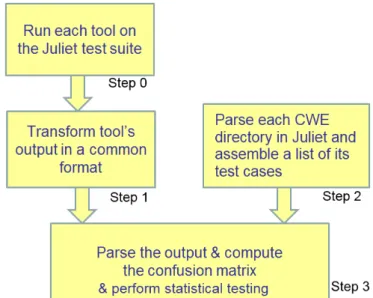
To compute the metrics for quantitative evaluation of the tools performance we implemented several scripts to automatically compute the confusion matrix for each CWE (i.e., the number of true positives (TP), false negatives (FN), true negatives (TN) and false positives (FP)). This automatic system consists of three steps shown in Figure 3.1.
The first step is to convert the tool report into a common format. This was done so that the same scripts could be used for all three tools without modification. The common format is a simple flat text file containing one report message per line. Each line is a comma-separated value list containing information such as file name, function name, line number, vulnerability CWE ID, and a unique identifier (in some cases more than one of the same vulnerability can be reported in the same place).
The second step is to parse each CWE directory in Juliet and assemble a complete list of test cases to be taken into account. This is needed because each CWE directory can have one or more
(thousands in some cases) test cases. Furthermore, for each test case considered, the script parses the test case source files to obtain the function list, which may be rather complex as described in section 3.1.1. This step is specific to the Juliet test suite and is common for the evaluation of all three tools.
Figure 3.1: Metrics computation system block diagram
The third step loads the tool output file and iterates through it while matching the messages to the list of test cases assembled in the first step. The output of the second step is a flat text file (tr out.txt) containing a list of each test case, the functions found within each test case (excluding the primary good function), and the messages produced by the tool for each test case.
During this third step all messages from some test cases were excluded, as well as some mes-sages from all test cases. Following the suggestions given in [26] test cases and/or mesmes-sages were discarded due to the following reasons:
• Messages produced by the tools which were not related to security vulnerabilities were ex-cluded as the scope of the work described in this chapter was to evaluate tools performance regarding security vulnerability detection. In addition, almost all Juliet test cases contain incidental flaws, such as unreachable code and unused variables, which are typically consid-ered unrelated to security vulnerabilities. Therefore such incidental flaws were also ignored, with the exception of two CWEs specifically designed for unreachable code, CWE561, and unused variables, CWE563.
• In the event that a test case contains more than one secondary good function as well as one or more helper function, the helper function cannot be mapped to the secondary good function from which it was called. This is an artifact of the automatically generated nature of the Juliet test suite. Due to this issue messages flagged within helper functions were ignored.
• Class-based flaw test cases comprise a very small subset of the total number of test cases. Furthermore their naming convention clashes with the naming convention of the much more numerous virtual function/abstract method test cases. Due to these issues class-based flaw test cases were ignored.
• Bad-only test cases can contain empty primary/secondary good functions but since they do not contain non-flawed constructs they cannot be counted as false positives and/or true neg-atives. All bad-only test cases were therefore excluded from the analysis as the results they produce cannot be properly evaluated.
• Additionally Windows-only test cases were excluded from all experiments as the available installation of Tool C was Linux-only. Only a few of the CWEs consist of Windows-only test cases.
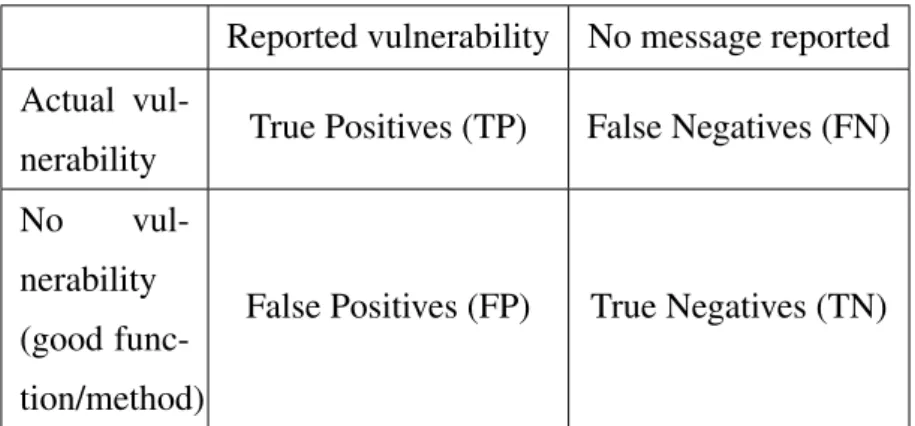
The final step uses the text file output described above to compute the confusion matrix, shown in Table 3.1. After this final step statistical testing is performed on the results to draw empirical conclusions.
Table 3.1: Confusion matrix
Reported vulnerability No message reported Actual
vul-nerability True Positives (TP) False Negatives (FN) No
vul-nerability (good func-tion/method)
False Positives (FP) True Negatives (TN)
For each test case, the script parses through the messages associated with it and evaluates whether or not each message constitutes a true positive (TP), false negative (FN), true negative
(TN), false positive (FP), or if it should be ignored. The following points provide an explicit listing of which messages are taken into account and how special functions (i.e., source, sink) were taken care of when computing the confusion matrix:
• If a message was flagged as an appropriate CWE within bad code one true positive (TP) was counted.
• If no messages were flagged as an appropriate CWE within bad code one false negative (FN) was counted.
• If a message was flagged as an appropriate CWE within good code one false positive (FP) was counted.
• If no messages were flagged as an appropriate CWE within good code one true negative (TN) was counted.
• Source and sink functions, as described in section 3.1.1, were mapped to their calling func-tion, either a primary bad function or a secondary good function. Messages flagged within a source or sink function were counted as messages relating to the specific calling function.
• Messages flagged in non-class-based test cases were all taken into account, with the excep-tion of what is described in the Excluded Messages/Test-cases secexcep-tion.
• Messages flagged in virtual function/abstract method test cases were all taken into account, with the exception of what is described in the Excluded Messages/Test-cases section.
• For each bad function (one per test case) only one true positive was counted regardless of how many messages match the criteria for true positives.
The determination of whether or not a message was flagged as the appropriate CWE being tested goes beyond a simple exact match. As mentioned in section 3.1.1, each CWE may have one or more parents and zero or more children. Due to the nature of the CWE hierarchy and the complex relationships it establishes between individual CWEs the definition of “appropriate CWE” was expanded to include the currently investigated CWEs immediate parents and children. This was done because the vague relationships between CWEs, at the very least, make the problem
of automatic labeling of individual messages by the static analysis tools ambiguous enough to introduce some uncertainty in those labels. Without having access to the process by which static analysis tools label the reports they generate the benefits gained in terms of better chances for detecting true positives outweigh the slight bias introduced in favor of the tools.
A simple example to illustrate the above is as follows: consider Java CWE 129 and the as-sociated list of its parents and children: CWE-867 (2011 Top 25 - Weaknesses On the Cusp), CWE-802 (2010 Top 25 - Risky Resource Management), CWE-20 (Improper Input Validation), CWE-189 (Numeric Errors), CWE-633 (Weaknesses that Affect Memory), CWE-738 (CERT C Secure Coding Section 04 - Integers ), CWE-740 (CERT C Secure Coding Section 06 - Arrays ), CWE-872 (CERT C++ Secure Coding Section 04 - Integers ), CWE-874 (CERT C++ Secure Cod-ing Section 06 - Arrays and the STL), CWE-970 (SFP Secondary Cluster: Faulty Buffer Access). While computing the confusion matrix for CWE 129 a message flagged as any of the CWEs listed previously is considered an “appropriate CWE”. Please note that only the immediate parent and children CWEs of the current CWE being looked at are considered. “Siblings” of the current CWE are not considered. For example, another one of the Java CWEs is CWE 190. It is also a child of CWE 189, just like CWE 129, however it is not considered when computing the confusion matrix for CWE 129.
The total number of bad functions and the total number of good functions counted by the first script were used as a sanity check. This was done because TP + FN = number of bad functions and FP + TN = number of good functions.
3.1.3
Metrics used for quantitative comparison of tools performance
For each CWE the script automatically produced the confusion matrix, which was then used to compute the following metrics used to quantitatively evaluate the static code analysis tools.
Accuracy: This metric provides the percentage of correctly classified instances, both true pos-itives and true negatives, or the ratio of the sum of true pospos-itives and true negatives to the sum of true positives, true negatives, false positives, and false negatives.
Acc = (T N+T P)
Probability of Detection: Sometimes called recall, this metric provides the probability of cor-rectly classifying true positives, or in other words the ratio of true positives to the sum of true positives and false negatives. The closer the probability of detection is to a value of 1 for a given CWE, the better the tool performs on that CWE.
PD = T P
(F N +T P) (3.2)
Probability of False Alarm: This metric provides the probability of incorrectly classifying non-flawed constructs as non-flawed, or the ratio of false positives to the sum of true negatives and false positives. The closer the probability of false alarm is to 0 for a given CWE, the better the tool performs on that CWE.
PF = F P
(T N+F P) (3.3)
Balance: Balance is a rather useful metric of performance because it combines the two most important metrics above: probability of detection and probability of false alarm. It is defined as the Euclidian distance from the ideal point of pf = 0, pd = 1 to a pair of (pf, pd). For convenience, the balance is normalized by the maximum possible distance across the ROC square (i.e.,√2) and then subtracted from 1. It follows that higher balance is better since (pf, pd) point falls closer to the ideal point (0, 1).
Bal =1− p
(0−P F)2+ (1−P D)2
√
2 (3.4)
G-Score: G-Score is the harmonic mean between recall, (PD), and (1-PF). Similarly to balance, it helps elucidate the relationship between recall and probability of false alarm. G-Score values are close to 1 when recall is high and probability of false alarm is low, which is the desirable outcome.
G-Score = 2P D(1−P F)
P D+ 1−P F (3.5)
3.1.4
Background on Statistical Testing
The goal of any statistical testing is to refute the given null hypothesis. In the case being presented here the null hypothesis was that there is no difference between the performance of the
three tools, where performance is defined in terms of the metrics described in Section 3.1.3. The experiment presented in this chapter is of a simple two-factor design (tools and CWEs), however because of the same samples being used for testing all of the tools, only one factor can be tested. The factor in question is the tool being tested, of which there are three. The Friedman rank sum test is a non-parametric version of the repeated measure ANOVA and is similar to the Kruskal-Wallis test in its use of ranks. The Friedman test process consists of ranking each data row (in this case the metric values per CWE) followed by a comparison of the rank values by column (in this case the columns represent each of the three tools tested). When the null hypothesis that there is no difference between tools’ performance is refuted, post-hoc tests are used to determine where the difference is.
3.1.5
Quantitative evaluation based on real open source programs
Using the Juliet test suite for evaluation has several advantages. It allows automatic evaluation of the tools performance using metrics such as recall, probability of false alarm and balance, on a large number of test cases for many different vulnerabilities. However, individual Juliet test cases are rather small, containing only a single vulnerability of a specific type. Such synthetic test cases may not leverage the full potential of any given tool. Therefore the tools performance was also evaluated using real open source programs with known vulnerabilities in an attempt to discern any difference in performance.
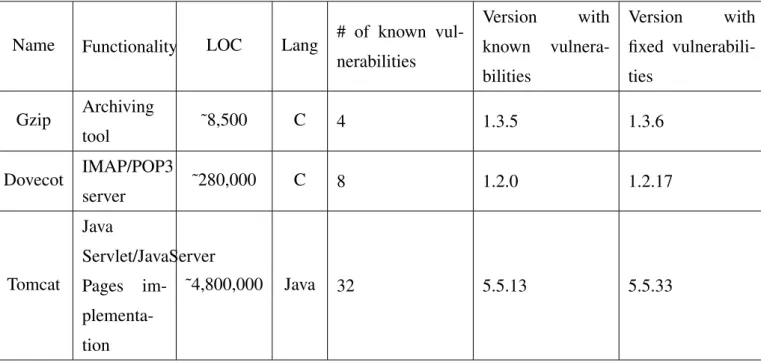
In order to test static analysis on real programs software with known vulnerabilities for which exact locations in source code is also known was required. Furthermore fixed versions of the same software were needed in order to properly compare the tools. With these requirements in mind for evaluation of the selected tools we constructed a small test suite of three open source programs: Gzip, Dovecot, and Tomcat. The basic facts about these programs are given in Table 3.2.
This approach allowed evaluating the tools’ performance on applications with realistic com-plexity. However it also has some limitations. Since unknown vulnerabilities may still be present in the source code, the assessment of all false negatives is impossible. Instead, only the messages relating to the locations of the known vulnerabilities were analyzed.
Table 3.2: Basic facts about open source programs used for evaluation of the static code analysis tools
Name Functionality LOC Lang # of known vul-nerabilities Version with known vulnera-bilities Version with fixed vulnerabili-ties Gzip Archiving tool ˜8,500 C 4 1.3.5 1.3.6 Dovecot IMAP/POP3 server ˜280,000 C 8 1.2.0 1.2.17 Tomcat Java Servlet/JavaServer Pages im- plementa-tion ˜4,800,000 Java 32 5.5.13 5.5.33
Each of the Tomcat vulnerabilities spanned several locations within the same file and/or multiple files. Specifically, out of 32 known vulnerabilities in Tomcat version 5.5.13, four occurred in one location within one file, nine occurred at multiple locations within one file, and 19 occurred across multiple files. A true positive was counted, i.e., vulnerability being detected, if at least one of the file(s)/location(s) were matched by a tool’s message.
With a total of 44 known vulnerabilities between all three applications the breakdown in terms of CWE mapping is as follows:
• 10 vulnerabilities did not have available CWE mappings
• 8 vulnerabilities were mapped to CWE 264 (Permissions, privileges, and access controls)
• 7 vulnerabilities were mapped to CWE 22 (Path traversal)
• 7 vulnerabilities were mapped to CWE 200 (Information exposure)
• 5 vulnerabilities were mapped to CWE 79 (Cross-site scripting)
• 1 vulnerability was mapped to CWE 399 (Resource management errors)
• 1 vulnerability was mapped to CWE 119 (Improper restriction of operations within the bounds of a memory buffer)
• 1 vulnerability was mapped to CWE 16 (Configuration)
Out of the CWEs listed above, two are part of MITREs Top 25 Most Dangerous Software Errors, namely CWE 22 (Path traversal) and CWE 79 (Cross-site scripting). These two CWEs add up to a total of 12 out of 44 known vulnerabilities being in MITREs Top 25. Since the number of known vulnerabilities was small, matching the messages to the vulnerabilities was done manually. It should be noted that due to the large number of messages produced by the tools, (see Table 3.7) analyzing all messages and inspecting the code to find the false positives was impractical.
3.2
Evaluation Results based on Juliet Benchmark
In this section the quantitative results of the evaluation for all three tools with C/C++ and Java CWEs (i.e., 22 C/C++ CWEs common among all tools and 19 Java CWEs common among all tools) are presented. The tools’ performance is then discussed with regards to several CWE categories and finally the results for the real-software-based evaluation are presented. The actual data used in this section is given in more detail in Appendix A.
3.2.1
Evaluation on C/C++ CWEs
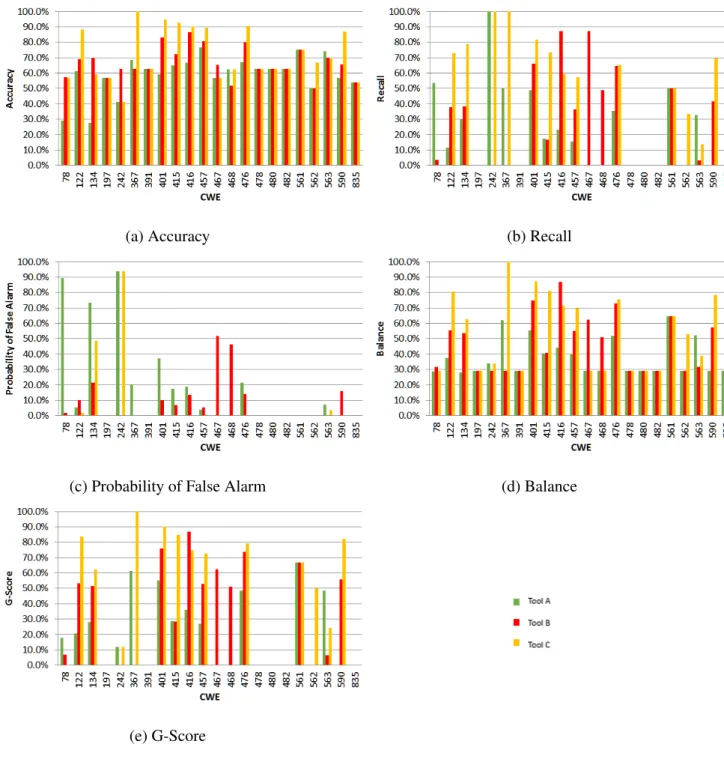
Figure 3.2a presents the accuracy of the three tools for the C/C++ test suite. With the accuracy metric, the higher the value, the better the performance. From Figure 3.2a it can be observed that the three tools have similar performance with respect to accuracy, with Tool C performing slightly better.
Figure 3.2b is the tools recall values for the C/C++ CWEs. The recall metric (i.e., probability of detection) is important because it is related to the number of true positives (i.e., flawed constructs detected). As with accuracy, a higher recall value indicates better performance. It can be observed from Figure 3.2b that each tool has recall of 0% for several CWEs. Furthermore, for some CWEs,
(a) Accuracy (b) Recall
(c) Probability of False Alarm (d) Balance
(e) G-Score
Figure 3.2: Metrics for the C/C++ CWEs
such as 478 and 480, all three tools have recall of 0%. These recall values show that even though the accuracy may look promising, all of the tools perform rather poorly when it comes to detecting certain flawed constructs.
Here smaller values indicate better performance as they represent less non-flawed constructs being misclassified as flawed. As it can be observed from Figure 3.2c, Tool C appears to have compar-atively lower false positive rate than Tool A and Tool B for all CWEs except CWE 134 and CWE 242.
Figure 3.2d presents the balance metric for the C/C++ CWEs. When it comes to the balance metric higher values indicate better performance. As it can be seen in Figure 3.2d the balance values for many CWEs were around 30%. This indicates rather poor overall performance from all tools. Similarly, as with accuracy, Tool C performed slightly better than the other two tool, most likely due to its low false positive rate. It also appears from Figure3.2d that Tool B performed slightly better than Tool A when it comes to this metric.
Figure 3.2e shows the G-Score metric for the C/C++ CWEs. Similar to balance, G-Score values close to 1 indicate performance with high recall and low probability of false alarm. As with the other metrics, all three tools display poor performance overall.
Figures 3.3a through 3.3c present the ROC squares for each of the three tools. In these figures the probability of false alarm is shown on the x-axis, while recall (i.e., probability of detection) is shown on the y-axis. The closer a point is to the ideal point (0, 1), the better the tools performance is on that particular CWE.
Figures 3.3a through 3.3c indicate the following main observations:
• For each of the three tools not many points are close to the ideal (0, 1) point.
• Tool C has a noticeably lower probability of false alarm than both Tool A and Tool B.
• For each tool there are multiple CWEs at the (0, 0) point as a consequence of the tools failing to detect any of the test cases associated with those CWEs.
3.2.2
Evaluation on Java CWEs
Figure 3.4a shows the accuracy metric for the Java CWEs. From Figure 3.4a one notices that the accuracy values for Java vary somewhat more than those for C/C++ shown in Figure 3.2a. Furthermore it is observed that all three tools attain a maximum accuracy value for several CWEs. This means that for those CWEs and the respective tool(s), all constructs, both flawed and
non-(a) ROC square for the C/C++ CWEs with Tool A (b) ROC square for the C/C++ CWEs with Tool B
(c) ROC square for the C/C++ CWEs with Tool C
Figure 3.3: ROC squares for the C/C++ CWEs. Some of the data points above represent multiple points stacked on top of one another, for example many CWEs cluster at point (0,0). flawed, were correctly classified. As in case of the C/C++ CWEs, Tool C seems to be performing slightly better than the other two tools
Figure 3.4b presents the recall values for the Java CWEs. One can see that there are again a couple CWEs (486 and 489) for which none of the tools correctly flagged any flawed constructs, however there were not as many as in the case of the C/C++ suite.
Figure 3.4c displays the probability of false alarm values for the Java CWEs. The trend here is similar to the C/C++ false alarm values; Tool C performed significantly better than the other two tools and Tool A performed slightly better than Tool B.
(a) Accuracy (b) Recall
(c) Probability of False Alarm (d) Balance
(e) G-Score
Figure 3.4: Metrics for the Java CWEs
Figure 3.4d shows the balance values for the Java CWEs. Again one notices a similar trend to the C/C++ balance values for many CWEs the balance values were around 30% for either all or some of the tools, which is an indication of overall poor performance. Tool C and Tool A appear to perform slightly better than Tool B.
Figure 3.4e shows the G-Score values for the Java CWEs. As with the C/C++ G-Score values, the Java data shows overall poor performance from all three of the tools.
Figures 3.5a through 3.5c show the ROC squares for the Java CWEs with Tool A, Tool B, and Tool C, respectively. The closer the points are to the ideal point (0, 1), the better the tools performance.
(a) ROC square for the Java CWEs with Tool A (b) ROC square for the Java CWEs with Tool B
(c) ROC square for the Java CWEs with Tool C
Figure 3.5: ROC squares for the Java CWEs. Some of the data points above represent multiple points stacked on top of one another, for example many CWEs cluster at point (0,0). Based on Figures 3.5a through 3.5c one can make following main observations:
• Tool C has noticeable smaller probability of false alarm than Tool A and Tool B.
• For each tool there are multiple CWEs at the (0, 0) point as a consequence of failing to detect any of the test cases associated with those CWEs.
3.2.3
Summary of the tools performance on the C/C++ and Java subsets
Table 3.3 presents the summary results of how each tool performed with respect to the 22 C/C++ CWEs and 19 Java CWEs. For each metric four statistic measures are provided: mean (simple arithmetic average), median, a weighted mean which takes into account the number of test cases for each CWE (i.e., CWEs with larger numbers of test cases carry more weight than ones with only a few test cases), and an overall value computed from the total sum of TP, FP, TN, and FN over all CWEs (that is, the sums of all TPs, FPs, TNs, and FNs for all CWEs). The weight for each CWE was simply computed as follows:
Weight = number of test cases for current CWE
total number of test cases (3.6) The best values for each tool are shown in grey. As it can be seen from Table 3.3, Tool C tends to perform slightly better than the other tools for most metrics, except for the recall for the Java CWEs for which Tool A performs best. However, Tool C still has slightly better Balance statistics than Tool A, which is due to lower probability of false alarm.
As it can be seen from Figures 3.2a to 3.2e and Figures 3.4a to 3.4e, none of the tools was able to detect all vulnerabilities. Out of the 22 C/C++ CWEs, 9 were detected by all three tools (around 41%) and 6 were not detected by any tool (i.e., 27%). The remaining 7 CWEs were detected by a single tool or a combination of two tools.
Table 3.3: Accuracy, Recall, Probability of False Alarm, Balance, and G-Score for both C/C++ and Java CWEs with all three tools
Tool A Tool B Tool C Mean 59% 67% 72% C/C++ Median 63% 64% 64% Accuracy Weighted 51% 69% 82% Overall 51% 69% 82% Mean 67% 60% 73% Accuracy Java Median 63% 63% 67% Weighted 69% 66% 72% Overall 69% 66% 73% Mean 21% 26% 39% C/C++ Median 14% 10% 42% Recall Weighted 26% 34% 61% Overall 25% 32% 59% Mean 49% 35% 36% Java Median 50% 18% 17% Weighted 13% 25% 3% Overall 14% 26% 3% Mean 18% 9% 7% C/C++ Median 2% 1% 0% Prob. of Weighted 35% 11% 6% Overall 35% 12% 7% False Mean 24% 25% 5% Alarm Java Median 0% 3% 0% Weighted 10% 19% 1% Overall 10% 19% 1% Continued on the next page
Table 3.3: (continued)
Tool A Tool B Tool C Mean 39% 46% 53% C/C++ Median 29% 36% 46% Balance Weighted 36% 52% 70% Overall 42% 51% 71% Mean 50% 43% 52% Java Median 34% 34% 41% Weighted 36% 44% 31% Overall 39% 46% 31% Mean 20% 31% 40% C/C++ Median 15% 18% 37% G-Score Weighted 24% 45% 68% Overall 36% 47% 73% Mean 36% 23% 38% Java Median 12% 0% 29% Weighted 16% 35% 4% Overall 24% 39% 6%
The results obtained when running the Java CWEs were similar. None of the tools was able to detect all vulnerabilities and many CWEs were not detected by either tool. Out of the 19 CWEs, 4 were detected by all three tools and 2 by none (i.e., over 10%). The remaining 13 CWEs were detected by a single tool or a combination of two tools.
An important observation is that there is no significant difference in the recall values. Fur-thermore, the values themselves fall under 50% which would be the expected outcome at random guessing. This implies that the three tools are worse at detecting true positives than random chance. There does appear to be a difference in performance when looking at the probability of false alarm metric between tools A and C. This metric is important when trying to minimize false positives so it represents a positive result. A difference in performance between tools A and C is also found when looking at the accuracy metric as well but the accuracy metric is not considered to be very representative in the context of this experiment.
The results obtained were tested for significance using the Friedmann test. Furthermore, post-hoc testing was performed in those cases in which a significant difference was detected by the Friedmann test. The results are given in Table 3.4 and show the null hypotheses of no difference among tools to be rejected between tools A and C with respect to Accuracy, Balance, and Probabil-ity of False Alarm for C/C++ CWEs.