In: A. Kononov et al. (eds.): DOOR 2016, Vladivostok, Russia, published at http://ceur-ws.org
Com
bin
at
i
o
ns
of t
h
e
G
ree
d
y
H
e
u
r
is
t
i
c Met
h
o
d
for C
lus
ter
in
g Pro
bl
em
s
a
nd
L
oca
l
S
earc
h
A
l
gor
i
t
h
m
s
Lev Kazakovtsev1,2,*, Alexander Antamoshkin1,2
1Siberian State Aerospace University Named after Academician M.F.Reshetnev, Krasnoyarsk,
Russian Federation 2
Siberian Federal University, Krasnoyarsk, Russian Federation [email protected], [email protected]
Abstract. In this paper, we investigate application of various options of algo-rithms with greedy agglomerative heuristic procedure for object clustering problems in continuousspace in combination with various local search m eth-ods. We propose new modifications of the greedy agglomerative heuristic algo-rithms with local search in SWAP neighborhood for the p-medoid problems and j-means procedure for continuous clustering problems (p-median and k-means). New modifications of algorithms were applied to clustering problems in both continuous and discrete settings. Computational results with classical data sets and real data show the comparative efficiency of new algorithms for m iddle-size problems only.
Keywords: p-median · k-means· p-medoids· Genetic algorithm· Heuristic op-timization ·Clustering
1
I
n
tro
du
ct
i
o
n
Problems of automatic groupping of objectsin a continuousspace with defined dis -tance measure function between two points are the most widely applied clustering models. The k-means problemismost popular clustering modelin which itis required to splitN objectsinto k groupsso thatthe sum of squares of distances from objectsto the closest center of a group reachesitsminimum. Centers (sometimes called by cen-troids) are unknown pointsin the same space. Other popular clustering modelisthe p -median problem [9] which has similar setting but instead of the sum of distance squares, sum of distances hasto be minimized. Thus, in the k-means problem, a measure of distance isthe squared Euclidean distance. The similarity of the conti nu-ousp-median problem and k-means problem was emphasized by many researchers [25, 12, 16, 13].
There exists a special class of discrete optimization problems operating concepts of the continuous problems called p-medoid problem [19] or discrete p-median prob-lem [37]. Such clustering problems can be considered aslocation problems [34, 28] since the main parameters of such continuous and discrete problems are coordinates of objects and distance between them [10, 9]. Such problems arise in statistics (for
M
example, problems of estimation), statistical data processing, signal or image pro-cessing and other engineering applications [20].
The formulation of the p-median problem [12, 7] is as follows:
(1)
Here, is a set of known points (data vectors), are un-known points (centers, centroids), are weight coefficients (usually equalto 1), isthe distance function in a d-dimensionalspace [14, 9]. In most popular cases, issquared Euclidean distance, Euclidean or Manhattan metric.
The center of each cluster (group) isthe solution of the 1-median (Weber) prob-lem for this cluster. If the distance measure issquared Euclidean distance ( ) then the solution is [12]:
(2)
Here, , .
Such p-median, k-means and k-medoids problems are problems of general optimi za-tion: objective function is non-convex [8]. Moreover, they are NP-hard [11, 2, 33, 40, 41, 15]. The most popular ALA procedure for such problemsis based on the Lloyd algorithm [30] also known asstandard k-means procedure [32]. Nevertheless, many authors offered faster methods based on thisstandard procedure [46, 1] for data sets and data streams. The ALA and similar procedures are algorithmssequentially im -proving the known solution. They are nottrue localsearch algorithmsin strictsense since the new decision issearched not ne -neighborhood of the known solution.
The modern literature offersmany heuristic methods [36] for seeding of the initial solutions (sets of centers) for the ALA procedure which are various evolutionary methods and randomsearch methodssuch as k-means++ procedure [4].
Popular idea is use of the genetic algorithms (GA) and for improving of results of localsearch [18, 27, 39]. In case of GAs, authors use variousmethods of coding of solutions which form a "population" of the evolutionary algorithm. Hosage and Goodchild [17] offered the first genetic algorithm for the p-median problem on a net -work. Rather precise but very slow algorithm based on special greedy agglomerative heuristics was offered by Bozkaya, Zhang and Erkutin 2002 [46].
Rather precise and fast algorithm with the greedy agglomerative heuristic recombi na-tion procedure for the p-median problem on a network was offered by Alp, Erkut and Drezner in 2002 [3]. This algorithm was adapted for the continuous problems by Neema et al. in 2011 [39]. At each iteration, this algorithm generatesinitialsolutions for the local search procedure. Thus, this approach becomes extremely slow with growth of number of clustersp. Other method of recombination is offered by Sheng and Liu (2006) [43]. These algorithms work quicker, however, they are less precise. Also Lim and Xiu in 2003 offered the genetic algorithm based on recombination of subsets of centers of the fixed length [29].
The genetic algorithm with greedy heuristics [3] does not provide use of a mutation procedure which is common for GAs [38].
In [21], authors propose the GA with greedy agglomerative heuristic using floating point alphabet. Most GAs for p-median problems [39] use the integer alphabet for coding of initial solutions of the ALA procedure by numbers of corresponding data vectors. In [21], authors encode the interimsolutionsin a form of sets of points (cen-ters) in the d-dimensional space which are changed by the ALA procedure. Such combination of greedy agglomerative heuristics and ALA procedure allows algorithm to receive more precise results.
In this paper, we propose further modification of the genetic algorithm with greedy heuristic which includes combination of the greedy agglomerative heuristic proce-dures with localsearch in wider neighborhoodssuch asSWAP neighborhood.
2
K
n
ow
n
a
l
gor
i
t
h
m
s
The ALA procedure includestwo simple steps: Algorithm 1. ALA procedure.
Required: data vectorsA1...A
N, kinitial cluster centersX1...Xk. 1. For each center Xi, determine its cluster C
i as a subset of the data vectors for
which this center X
iisthe closest one.
2. For each cluster , recalculate its center Xi (i.e., solve the Weber problem).
3. RepeatStep 1 unlessSteps 1, 2 made no change in any cluster.
Many papers propose approachesto improve the speed of the ALA algorithm [1] such as randomsampling [35] etc.
The GA with greedy heuristic [3, 23] with modifications [39, 21, 24] can be de-scribed as follows.
Algorithm 2. GA with greedy heuristic for p-median and p-medoid problems. Required:Population size N
POP.
1. Generate (randomly with equal probabilities or using the k-means++ procedure) N
POPinitialsolutions χ, . . .χ ,N , POP
N {1 }
1 χi=p i=1,NPOP which are sets of data
vectors used asinitialsolutions for the ALA procedure. For each of them, run the ALA procedure and estimate the values
F
fitnessχ
of the objective function (1) forthe results of the ALA procedure, save these valuesto variables . 1, . . . ,fNPOP f
2. If the stop conditions are reached then STOP. The solution if the set of the ini -tial centers
*
i
χ corresponding the minimal value of f
i. For estimating the finalsol u-tion, run the ALA procedure for *
i χ . 3. Choose randomly two indexes
2 1 2 1k {1,N},k k k , . 4. Form an interimsolution 2 1 k k c=χ χ χ .
M
5. If
χ
c>p
then go to Step 7:6. Performthe greedy agglomerative heuristic procedure (Algorithm 3) for
χ
c 7. If i {1,NPOP}:χi=χcthen go to Step 2.8. Choose an index {1 }
3 ,NPOP
k . Authors [21] use a simple tournamentsel ec-tion procedure: choose randomly k4,k5 {1,NPOP}, if fk4>fk5then k3=k4, ot her-wise 5 3=k k . 9. Replace 3 k
χ and corresponding objective function value:
c k =χ χ 3 , c fitness k=F χ f 3 . Go to Step 2.
The greedy agglomerative heuristic is realized as follows: Algorithm 3. Greedy agglomerative heuristic.
Required:initialsolution
χ
c 1.For eachj
χ
cdo: 1.1. Form a set χ =χ\{j}с . For each data vector A {A...,AN} , i 1 , choose the closest center j i χ , j= - LA,X min arg = C -i 1
. Form - sets of data vectors for each of
which the center isits closest center:Сclust= i ,N |Ci =j j 1 ; for each cluster
,
1
с clus t-j,
j
=
,
χ
С
calculate its center Xj-, and then calculate. ,A X L w = f k- i χ k i N i -j 1 min 1.2. Nextiteration 1. 2. Sortthe set of pairs (j, f= w LX ,A . i -k χ k i N i -j 1 min ) in ascending order of -j f , form a setE elim of the firstNe
limindexes of data vectors fromthis arranged set.
FromthissetE
elim, eliminate indexesisuch that j Ee :Ai Aj L , j i min
lim .
Here, Nelim=[ (|
χ
c|-p)]+1. The value of parameter Lminis equalto 0.1-0.5 of the average distance between two data vectors. We use 0,2 ( ( , )).min LAi Aj
L Param
e-interimsolution. Value 0 meanssequential deleting of elements (centers, centroids, medoids) one by one. The default value 0.2 makesthe algorithm work faster which isimportantif val -ue of pis comparatively large (p>10).
3. Eliminate Eelim from c
χ
: χc=χc\ Eelim.and return.Algorithm 4. Calculating the objective function value
F
fitnessχ
.Required:initialsolution
χ
={ }1,...,Xp
X .
1. Run the ALA procedure or the PAM procedure with the initialsolution
χ
to gen new set of centers{ }1,...,Xp X . 2. Return F χ= w LXj,Ai. ,p j i N i fitness min } 1 { 1
Step 4 of Algorithm 2 generates an interimsolution set with cardinality up to 2p from which we sequentially eliminate elements (Step 6) until we reach cardinality equalto p. At each iteration, the value Ffintessis calculated up to 2ptimes. Thus, the
localsearch procedure isstarted up to p2in each iteration of the greedy heuristic re-combination. In the case of the k-medoid problem, the computational complexity increases. In this case, we must calculate . ) a (a = x d k i j clust j C j clust j C i j,k 1 2 min
Instead of the ALA procedure, we can use faster PAM procedure. Nevertheless, its complexity also depends on p and N.
3
Com
bin
at
i
o
n
w
i
t
h
a
l
ter
n
at
i
ve
l
oca
l
s
earc
h
a
l
gor
i
t
h
m
s
The structure of Algorithm 4 can be described asthree nested loop.The first of them performsiterations of iteration of strategy of globalsearch (for the GA, thisis execution of evolutionary operators of randomselection and starting the crossingover procedure, however, other metaheuristics can be also applied [22]). The second nested loop performsthe iterations greedy heuristic procedure untilthe feasible solution is reached. The third nested loop within this procedure provides es -timation of consequences of eliminating each of elements of the intermediate deci -sion.
The steps realizing greedy agglomerative heuristics are launched in combination with one of the existing algorithms of localsearch. Thus, for the continuous problems, it can be the ALA procedure or other two-step procedures of the alternating location and allocation, for example, the j-means or h-means procdure. Search in different types of neighborhoods can be applied to the discrete clustering problems. The PAM
procedure (Partition around Medoid, i.e. neighborhood of the given quantity of the closest data vectors), ALA procedure (wider neighborhood: all data vectors of a clus -ter), or search in wider SWAP or K-SWAP-neighborhoods can be applied to the p -medoid problem.
For the p-median, p-medoids and k-means problems, we can use the ALA proce-dure as a localsearch procedure [44, 31]. The PAM procedure is a search algorithmin neighborhood of each of medoids consisting of the solutions received by changeover of a medoid by one of pPAM of the closest data vectors. In our research, we used pPAM =3. However, experiments did not reveal any universal advantage of each of methods:
M
PAM allowsto have a good result quicker case of a small number of large clusters, ALA procedure ismore efficientin the case of small clusters.
Meanwhile, there are many other efficientlocalsearch methodsthe discrete clus -tering problems [45, 42, 26]. Long ago it was noted [42] that very precise solutions can be obtained with the algorithms based on search in a SWAP neighborhood formed by changeover of a medoid by any data vector. In many cases, search in this nei gh-borhood allowsto receive exactsolutions [26]. Computing complexity of one it era-tion of such procedure lies within O(pN2). Traditionally, this procedure is applied to rather small data sets (N <5000). Larger neighborhoodssuch as K-SWAP (changeo-ver of Kmedoids with other data vectors), certainly, are capable to increase the ex-pected accuracy of the result received after the single start of such procedure, buttime expenses grow so fastthat even in the 2-SWAP neighborhood, search is possible for very small data sets only. In the case when K=p, search in this neighborhood degener-atesinto the fullsearch and givesthe exactsolution.
The greedy genetic algorithmsmentioned in this paper (including Algorithm 2) use the ALA procedure (asit wasmentioned above, in the case of the p-medoid prob-lem, PAM procedure is also possible). In this research, we add search in SWAP neighborhood to this procedure . Algorithm 5 can be used instead of the ALA proce-dure option in Algorithms 2 and 4.
Algorithm 5. Localsearch combination for the greedy heuristic algorithm.
Required:initialsolution which is a set of centers, centroids or medoids. Step 1. Run the ALA procedure (or the PAM procedure) fromthe initialsolution . Store the new value of .
Step 2. If Step 1 did notimprove the solution then STOP and return . Step 3. Form array I of numbers , shuffle this array randomly. Step 4. For each do:
Step 4.1. Store i=Ii’.Store .
Step 4.2. Store )). Here, is the ith
center or centroid or medoid in the solution, Ajisthe jth data vector.
Step 4.3. If ))<F )), then store and go
to Step 1.
Steps of this algorithm combine search in SWAP neighborhood (Steps 4-4.3) with the ALA procedure (Step 1). While the PAM procedure is a simple localsearch al go-rithm, the ALA procedure is not a true localsearch algorithm. However, itimproves an existing solution step by step similarly to the localsearch algorithm.
For the continuous problems (k-means, p-median) there existsthe j-means proce-dure [16] similar to search in SWAP neighborhood which scope is also restricted to comparatively small problems. This procedure is reduced to changeover of cen-ters/centroids by one of data vectors with the subsequent continuation of search by standard ALA procedure. Itis easy to note thatthis principle of search is realized by Algorithm 5. Thus, Algorithm 5 realizes alternation of ALA or PAM procedure with search in SWAP neighborhood for the discrete problems and the j-means procedure for the continuous ones.
We will apply Algorithm 5 instead of Algorithm 4 for solving discrete and conti n-uous problems as a part of genetic algorithms with greedy heuristic (Algorithm 2). For testing purposes, we use the real data and the generated data sets collected by department of processing of the speech and images of computing School of Universi -ty of Eastern Finland and a repository of machine training of UCI, and also data of tests of EEE components for spaceships [20].
4
Com
pu
tat
i
o
n
a
l
ex
p
er
i
me
n
t
s
In our experiments, we used the Depo X8Sti computer (6-core CPU Xeon X5650 2.67 GHz, 12Gb RAM). We launched each algorithm with each data set 30 times.
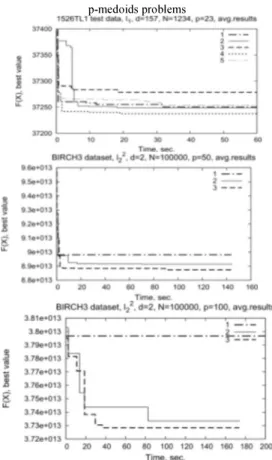
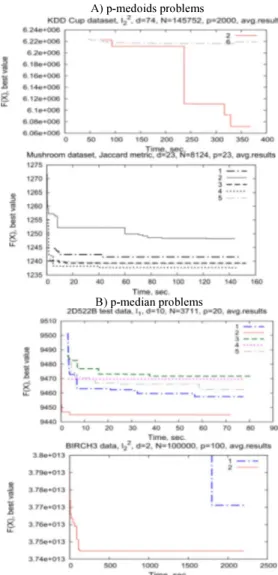
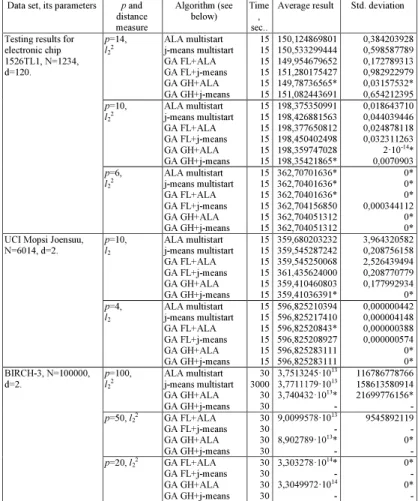
In Fig. 1, 2 and Table 1, some results of computing experiments are provided. With number of vectors of data N>10000, the attemptsto apply Algorithm 5 as a part of the genetic algorithm with greedy heuristics were unsuccessful since the single start of Algorithm 5 required time exceeding alltime limit of for the GA.
Dynamics of change of the best known value of the objective function showsthat for small discrete problems (N <1000), application of Algorithm 5 has advantage in comparison with Algorithm 4. Moreover, for such problems, application of Al go-rithm 5 even as a separate algorithm, without use of the genetic algorithm has ad-vantage in comparison with the genetic algorithm with greedy heuristicsin a combi -nation with Algorithm 4.
Middle-size problems (N<10000) show other situation. In certain cases, the genet -ic algorithm with greedy heuristics even without application of search in SWAP neighborhood showsthe best results. In other cases, application of search in SWAP neighborhood is repaid but application of thistype of localsearch as a part of the genetic algorithmleadsto further improving of result. Moreover, in certain cases, simpler recombination procedures of the genetic algorithmsuch asthe genetic al go-rithm with a recombination of fixed length subsets [43] yield the best resultsin com -parison with GA with greedy heuristics. Thisismost evident for problems with Bool
-ean and categorical data. Nevertheless, the obtained results are comparable by accura-cy and use of the GA with greedy heuristics can be competitive for problems with 1000<N<10000.
For the continuous problems, (exceptthe smallest ones with N<1000), application of algorithms with greedy heuristicsin a combination with Algorithm 5 is quite justi -fied in the majority of practical cases.
5
Co
n
c
lu
s
i
o
n
s
Application of search in SWAP neighborhood (and probably wider neighborhoods) can be competitive in the case of the small problems, butis not competitive for l arge-scale problems (N>10000). Experimentsshow thatthis effect does not depend on the heuristic used for constructing the initial population. As a rule, obtaining an accept a-ble resultis decelerated in case of using SWAP procedure. The exception issome problems with Jacquard metric and Hamming metric. Depending on problem param
e-M
ters (N, p, d, metric) and time limit and accuracy requirements, variouslocalsearch procedures are more or less efficient. The mostimportant factor in the case of the large-scale problemsistime consumption for a single run of the SWAPlocalsearch procedure.
p-medoids problems
Fig. 1.Comparative results of algorithms. 1 localSWAPsearch multistart, 2 GA with
greedy heuristic (PAM as a localsearch procedure), 3 Algorithm 2 with =0 (in combination
with SWAPsearch), 4 Algorithm 2 with =0.2 (in combination with SWAPsearch), 5 GA with fixed length subset recombination [43,29], 6 PAM procedure multistart
A) p-medoids problems
B) p-median problems
Fig. 2.Comparative results of algorithms. 1 localSWAPsearch multistart (j-meansin the
case of p-median problem), 2 GA with greedy heuristic (PAM or ALA as a localsearch pro-cedure), 3 Algorithm 2 with =0 (in combination with SWAPsearch or j-means), 4 Al
go-rithm 2 with =0.2 (in combination with SWAPsearch or j-means), 5 GA with fixed length subset recombination [43], 6 ALA or PAM procedure multistart
M
Table 1.Comparative results for p-median problems, 30 runs.
Data set, its parameters p and distance measure Algorithm (see below) Time , sec.. Average result Std. deviation Testing results for electronic chip 1526TL1, N=1234, d=120. p=14, l22 ALA multistart j-meansmultistart GA FL+ALA GA FL+j-means GA GH+ALA GA GH+j-means 15 15 15 15 15 15 150,124869801 150,533299444 149,954679652 151,280175427 149,78736565* 151,082443691 0,384203928 0,598587789 0,172789313 0,982922979 0,03157532* 0,654212395 p=10, l22 ALA multistart j-meansmultistart GA FL+ALA GA FL+j-means GA GH+ALA GA GH+j-means 15 15 15 15 15 15 198,375350991 198,426881563 198,377650812 198,450402498 198,359747028 198,35421865* 0,018643710 0,044039446 0,024878118 0,032311263 -14* 0,0070903 p=6, l22 ALA multistart j-meansmultistart GA FL+ALA GA FL+j-means GA GH+ALA GA GH+j-means 15 15 15 15 15 15 362,70701636* 362,70401636* 362,70401636* 362,704156850 362,704051312 362,704051312 0* 0* 0* 0,000344112 0* 0* UCI MopsiJoensuu, N=6014, d=2. p=10, l2 ALA multistart j-meansmultistart GA FL+ALA GA FL+j-means GA GH+ALA GA GH+j-means 15 15 15 15 15 15 359,680203232 359,545287242 359,545250068 361,435624000 359,410460803 359,41036391* 3,964320582 0,208756158 2,526439494 0,208770779 0,177992934 0* p=4, l2 ALA multistart j-meansmultistart GA FL+ALA GA FL+j-means GA GH+ALA GA GH+j-means 15 15 15 15 15 15 596,825210394 596,825217410 596,82520843* 596,825208927 596,825283111 596,825283111 0,000000442 0,000004148 0,000000388 0,000000574 0* 0* BIRCH-3, N=100000, d=2. p=100, l22 ALA multistart j-meansmultistart GA GH+ALA GA GH+j-means 30 3000 30 30 13 13 13* - 116786778766 158613580914 21699776156* - p=50, l22 GA FL+ALA GA FL+j-means GA GH+ALA GA GH+j-means 30 30 30 30 13 - 13* - 9545892119 - 0* - p=20, l22 GA FL +ALA GA FL+j-means GA GH+ALA GA GH+j-means 30 30 30 30 14* - 14 - 0* - 0* - Notation: GA FL isthe GA with fixed length subset recombination [43], GA GH
isthe GA with greedy heuristic. .
Refere
n
ce
s
1. Ackermann, M.R. et al.:StreamKM: A Clustering Algorithm for Data Streams. J. Exp. Algorithmics17, Article 2.4 (2012), DOI:10.1145/2133803.2184450.
2. Aloise, D., Deshpande, A., Hansen, P. Popat, P.: NP-Hardness of Euclidean Sum -of-SquaresClustering. Machine Learning 75, 245-249 (2009), DOI:10.1007/s
10994-009-5103-0.
3. Alp, O., Erkut, E., Drezner, Z.: An Efficient Genetic Algorithm for the p-Median Problem. Annals of OperationsResearch 122(1-4), 21 42 (2003), DOI 10.1023/A:1026130003508
4. Arthur, D., Vassilvitskii, D.: k-Means++:C The Advantages of CarefulSeeding. P roceed-ings of the Eighteenth Annual ACM-SIAMSymposium on Discrete algorithms (SODA
), pp. 1027-1035. SIAM (2007).
5. Balcan, M.-F., Ehrlich, S., Liang, Y.: Distributed k-Means and k-Median Clustering on GeneralCommunication Topologies. Advancesin Neural Information Processing Systems, pp. 1995-2003 (2013).
6. Bozkaya, B.A., Zhang, J., Erkut, E.: Genetic Algorithm for the p-Median Problem. In:
Drezner, Z., Hamacher, H. [eds.].:Facility Location: Applications and Theory,
pp.179-205, Springer, New York (2002).
7. Cooper, L.: An Extension of the Generalized Weber Problem. Journal of RegionalScience 8(2), 181-197 (1968).
8. Cooper, L.: Location-Allocation Problem. OperationsResearch 11, 331-343 (1963).
9. Drezner, Z., Hamacher, H.:Facility Location: Applications and Theory, 460p., Spri
nger-Verlag, Berlin (2004).
10. Drezner, Z., Wesolowsky, G.O.A.: Trajectory Method for the Optimization of the Multifacility Location Problem with lp Distances. ManagementScience 24, 1507-1514
(1978).
11. Drineas, P., Frieze, A., Kannan, R., Vempala, S., Vinay, V.:Clustering Large Graphs via the Singular Value Decomposition. Machine learning 56(1-3), 9-33 (1999).
12. Farahani, R., Hekmatfar, M. (eds.):Facility Location:Concepts, Models, Algorithms and
Case Studies, 549 p., Springer-Verlag, Berlin-Heidelberg (2009).
13. Har-Peled, S., Mazudmar, S.:Coresets for k-Means and k-Median Clustering and their
Applications. Proc. 36th Annu. ACMSympos. Theory Comput., pp. 291-300 (2003).
14. Hakimi, S.L. Optimum Locations of Switching Centers and the Absolute Centers and M e-dians of a Graph. OperationsResearch 12(3), 450-459 (1964).
15. Hansen P. Brimberg, J., Urosevic, D., Mladenovic, N.:Solving Large p-Median Clustering Problems by Primal-dual Variable Neighborhood Search. Data Mining and Knowledge
Discovery 19(3), 351-375 (2009).
16. Hansen, P., Mladenovic N.:J-Means: a New LocalSearch Heuristic for MinimumSum of SquaresClustering. Pattern Recognition 34(2), 405 413 (2001).
17. Hosage, C.M., Goodchild, M.F.: Discrete Space LocationAllocation Solutions from Genet -ic Algorithms. Annals of OperationsResearch 6, 35-46 (1986).
18. Houck, C.R., Joines, J.A., Kay, G.M.:Comparison of Genetic Algorithms, RandomR
e-start, and Two-OptSwitching for Solving Large Location-Allocation Problems. Computers
and OperationsResearch 23, 587-596 (1996).
19. Kaufman, L., Rousseeuw, P.J.:Finding Groupsin Data: an Introduction to Cluster Anal y-sis. Wiley, 368 p., New York (1990).
20. Kazakovtsev, L.A., Antamoshkin, A.N., Masich, I.S.:Fast Deterministic Algorithm for
EEE ComponentsClassification. IOPConf. Series:MaterialsScience and Engineering 94, Article ID 012015, 10 p. (2015), DOI: 10.1088/1757-899X/04/1012015.
21. Kazakovtsev, L.A. Antamoshkin, N.A.: Genetic Algorithm with Fast Greedy Heuristic for
Clustering and Location Problems. Informatica 38(3), (2014).
22. Kazakovtsev, L.A., Antamoshkin, A.N. Greedy Heuristic Method for Location Problems. SibSAU Vestnik 16(2), 317-325 (2015).
M
23. Kazakovtsev, L.A., Antamoshkin, A.N., Gudyma, M.N. Parallelnyi algoritm dlya p-mediannoy zadachi [Parallel Algorithm for p-Median Problem]. Sistemy Upravleniya I
Informatsionnye Tekhnologii 52 (2.1), 124 128 (2013).
24. Kazakovtsev, L.A., Orlov, V.I., Stupina, A.A., Kazakovtsev, V.L.:Modied Genetic Al go-rithm with Greedy Heuristic for Continuous and Discrete p-Median Problems. Facta
Universitatis, Series:Mathematics and Informatics30 (1), 89-106 (2015).
25. Klastorin, T.D.: The p-Median Problem for Cluster Analysis: A Comparative Test Using the Mixture Model Approach. ManagementScience 31(1), 84-95 (1985).
26. Kochetov, Yu. A.:Metody lokalnogo poiska dlya diskretnykh zadach razmescheniya [Lo-calSearch Methods for Discrete Location Problems]. Doctoral Thesis. 259 p., Sobolev
In-stitute of Mathematics, Novosibirsk (2010).
27. Krishna, K., Murty, M.: Genetic K-Means Algorithm. IEEE Transaction on System, Man
and Cybernetics - PartB29, 433-439 (1999).- Vol.29.
28. Liao, K., Guo, D.: A Clustering-Based Approach to the Capacitated Facility Location Problem. Transactionsin GIS12(3), 323-339 (2008).
29. Lim, A., Xu, Z.: A Fixed-Length Subset Genetic Algorithm for the p-Median Problem.
Lecture Notesin Computer Science 2724, 1596-1597 (2003).
30. Lloyd, S.P.: LeastSquares Quantization in PCM. IEEE Transactions on Information
Theo-ry 28, 129-137 (1982).
31. Lucasius, C.B., Dane, A.D., Kateman, G.: On K-Medoid Clustering of Large Data Sets
with the Aid of a Genetic Algorithm:Background, Feasibility and Comparison. Analytical Chimica Acta 282, 647-669 (1993).
32. MacQueen, J.B.:Some Methods of Classification and Analysis of Multivariate Obs erva-tions. Proceedings of the 5th Berkley Symposium on MathematicalStatistics and Probabil -ity 1, 281 297 (1967).
33. Masuyama, S., Ibaraki, T., Hasegawa, T.: The ComputationalComplexity of the m-Center Problems on the Plane. The Transactions of the Institute of Electronics and Communi ca-tion Engineers of Japan 64E, 57-64 (1981).
34. Meira, L.A.A., Miyazawa, F.K.: A ContinuousFacility Location Problem and Its Appli ca-tion to a Clustering Problem. Proceedings of the ACMsymposium on Applied computing
(SAC '08), pp.1826-1831, ACM, New York (2008), DOI:10.1145/1363686.1364126. 35. Mishra, N., Oblinger, D., Pitt, L.:Sublinear Time Approximate Clustering. 12th SODA,
pp. 439 447 (2001).
36. Mladenovic, N., Brimberg, J., Hansen, P.: The p-Median Problem: A Survey of Metaheuristic Approaches. European Journal of OperationalResearch 179(3), 927 939 (2007).
37. Moreno-Perez, J.A., Roda Garcia, J.L., Moreno-Vega, J.M.: A Parallel Genetic Algorithm
for the Discrete p-Median Problem. Studiesin Location Analysis 7, 131-141 (1994).
38. Muhlenbein, H., Shomisch, M., Born, J.: The parallel Genetic Algorithm asFunction Op-timizer. Proceedings of the Fourth Conference of Genetic Algorithms, pp.271-278, San Mateo,Morgan Kaufmann (1991).
39. Neema, M.N., Maniruzzaman, K.M., Ohgai, A.: New Genetic Algorithms Based
Ap-proaches to Continuous p-Median Problem. Netw. Spat. Econ. 11, 83-99 (2011),
DOI:10.1007/s11067-008-9084-5.
40. Resende, M.G.C.:Metaheuristic hybridization with Greedy Randomized Adaptive Search Procedures. In:Chen, Zh.-L., Raghavan, S. (eds.): TutORialsin OperationsResearch, pp.295-319. INFORMS (2008).
41. Resende, M.G.C., Ribeiro, C.C., Glover, F., Marti, R.:Scatter Search and Path Relinking: Fundamentals, Advances, and Applications. In: Gendreau, M., Potvin, J.-Y. (eds.):
Hand-book of Metaheuristics, 2nd Edition, pp.87-107, Springer (2010).
42. Resende, M., Werneck, R.: On the Implementation of a Swap-Based LocalSearch P roce-dure for the p-Median Problem. Proceedings of the Fifth Workshop on Algorithm Engi
-neering and Experiments (ALENEX'03), pp.119-127, SIAM, Philadelphia (2003).
43. Sheng, W., Liu, X.: A Genetic k-MedoidsClustering Algorithm. Journal of Heuristics12,
447-466 (2006).
44. Sun, Zh., Fox, G., Gu, W., Li, Zh.: A ParallelClustering Method Combined Information
Bottleneck Theory and Centroid Based Clustering. The Journal of Supercomputing 69(1), 452-467 (2014), DOI: 10.1007/s11227-014-1174-1.
45. Teitz, M.B., Bart, P. Heuristic Methods for Estimating the Generalized Vertex Median of a
Weighted Graph. OperationsResearch 16, 955-961 (1968).
46. Zhang T., Ramakrishnan, R., Livny, M.:BIRCH: An Effcient Data Clustering Method for Very Large Databases. Proceedings of the 1996 ACMSIGMOD InternationalConference on Management of Data (SIGMOD '96), pp. 103-114, ACM, New York (1996).