Abstract—Due to its special data structure and manipulative principle, Object-Oriented Database (OODB) has a particular security protection and authorization methods. This paper first introduces the features of security mechanism about OODB, and then talked about authorization checking process of OODB. Implicit authorization mechanism is based on the subject hierarchies, object hierarchies and access hierarchies of the security authorization modes, and simplifies the authorization mode. In addition, to combine with other authorization mechanisms, implicit authorization can make protection on the authorization of OODB expediently and effectively.
Keywords—Object-oriented database(OODB); security
protection; authorization mechanism; implicit authorization;
authorization check.
I. INTRODUCTION
ITH the growing development of computer network technology, database systems have to face the resulting requirements of data centralization and multi-user demand for multi-service access. Database security issues have become increasingly complex and serious[1]. OODB introduced the concept of object-oriented into the database system to make a significant progress in the history of database system’s development [2]. Since the generation of the Object-Oriented Database, its security issues have always attracted extensive research and attention of vast number of scholars. With the wide applications of OODB in various fields, the researches on its security mechanism is also with great significance.
In the researches of security of OODB, the authorization mechanism and access control have always beenthe contents of which have been noted.1994, Fernandez and others put forward the concept of authorization strategy with a class hierarchy, and further improved the five dimensions which have been widely applied in the relational database to three dimensions [3]. Subsequently, Bertino [4]and others added the effectiveness time limits into three dimensions and raised a temporary authorization model (Temporal Authorization), but its effectiveness and flexibility is not enough. Demurjian [5] and others have tried applying the user-role security in the OO
Haibo Hu is with Chongqing University, 400030 P.R. China (phone: 86-23-65111025; fax: 86-23-65111025; e-mail: [email protected]).
Hong Xiang is with Chongqing University, 400030 P.R. China (e-mail: [email protected]).
This work is supported by the National High Tech Research and Development Plan of China under grant No. 2007AA01Z445, and the Natural Science Foundation in Chongqing City (CSTC) of China under Grant No. 2008BB2312.
model. Thomas and others have modeling the multi-level security of OODB based on a hierarchy of the subject, and advanced the message transferring mechanism between the subject levels, this improved the researches to a new height [6]. Bertino [7] then combined strong authorization and weak authorization to improve the flexibility, and called for the concerted effortof research.
Based on comparing and summarizing the advantages and disadvantages of each model, this paper further developed the Subject, Object and access Operation hierarchy structures of OODB, and also expanded the implicit authorization to Subject and Operation levels, focusing on the study of implicit authorization control strategy.
II. FEATURESOFOODBSECURITY MECHANISM
The special data model structure ofobject-oriented database determined its security mechanisms of the following characteristics:
A. Complexity of Objects
Different from the traditional relationship between the tables of RDB, the basic object-oriented database access unit is the object. Each object has its own unique identifier. Each object is unique and independence in the database. In addition, Object-Oriented data model is composed by the class hierarchy. There exist close correlation between class and sub-classes, class and instances. This makes the object hierarchy and the relationship between objects in the security mechanisms become more complicated.
B. Variety of Operation
The relationship in the relational model is only composed by data attributes. While the object (or class) in the OO data model is encapsulated by common attributes and methods [8]. The operation of OODB is not only limited to traditional additions, deletions, search and update. Users can also define user-methods based on actual requirements, and achieve the various operations on the DB through implementation of these methods. Therefore, the security mechanism should not only consider the permission of attributes of data but also the permission of methods.
C. Security of Original
Object-oriented data model itself has a certain degree of security protection measures. Since the encapsulation characteristics of Object-Oriented model, the state and behavior of OODB was encapsulated in respective object. Users implement the user-method or system-method though sends the
Implicit Authorization Mechanism of
Object-Oriented Database
Haibo Hu, and Hong Xiang
W
specified explicit messages to accomplish access or call [9]. Object-oriented data model itself promotes the data encapsulation and information transfer mechanism has also provided implementation restrictions and access protection of attributes and methods though public/private type.
D. Classified Protection
Object-oriented database provides a number of different security mechanism [10], such as: sub-graph mechanism, view mechanism, authorization mechanism, object model mechanism and so on, to realize the OODB security protection on the database level, sub- graph level, view level, class level and object level.
Although the view mechanism and model mechanism of OODB has , to some extent, provided a good protection, but did not provide the specified object to the specified user's access mechanism, that is unable to provide suitable accuracy.
OODB authorization mechanism based on the complexity hierarchy of object and operation, and combined strong/weak authorization and positive/negative authorization to complete the OODB access control flexibly and precisely.
III. SECURITY AUTHORIZATION MODEL
The authorization control model can be defined by a three-tuple (S, O, Op): access subject S, access Object O and access Operation Op. The relationship between these three elements can be illustrated in Fig. 1. If (S, O, Op) = true (or 1), it means that the subject S (commonly be user or control group) have the operation permission Op on object (or object set) O.
Fig. 1 Authorization Control Model
Based on the features of OODB security authorization model, we will make these extension and improvement on each element hierarchy of Authorization Control Model.
A. Subject Hierarchy
According to the role of user u, the object can be organized into different control group Gk .Access Object can be either user or group. The member of group can be either user or other group. These elements together construct an acyclic digraph. Access subject Hierarchy can be shown in the relationships between these user and control group. A control group can be composed by several users or control groups which hold the same access permission on the same subject, as “u directly belonged to Gk “: u
∈
Gk , or “u indirectly belonged to Gk”: u∈
1G1
∈
2 …∈
n Gk , show as Fig.2:… Fig. 2 Subject Hierarchy B. Object Hierarchy
The division of the authorization Object level can effectively simplify the OODB database authorization set, and reduce the complexity of the authorization model. OODB object hierarchy includes all the authorization objects, and expanded the class method (Method)[11].
According to the granularity of authorization object, the object can be divided to different levels, from database system level to object attribute level. These object levels together composed a structure of acyclic digraph with root, shown as Fig. 3. The object authorization in higher level would include those of lower level implicitly.
Fig. 3 Object authorization Hierarchy C. Access Mode (Operation)
Access Mode to object of the subject also refers to the hierarchical associated relationship of the operation authority, which make the object has another operation implicitly when it has some authorization. In the associated relationship in access operation, written authorization implies read authorization (can be represented as read<write), and the authorization of new type definition implies the read authorization on definition (can be represented as read<write).
The hierarchies of OO Modal also include the authorization mechanism on methods. Methods include three operations in general, they are calling, modifying and creating, and the hierarchical relationships can be represented as:
call<modify<create.
IV. AUTHORIZATION CONTROL MECHANISMS
In the hierarchical OODB Systems, authorization mechanism can be sufficient to support the various access requirements
flexibly [12]. It must make a unified control on the some authorizations which access subject precise and flexible, and also precisely positions the operation properties of different subject’s authorization on a particular object hierarchy. Authorization mechanisms of OODB make full use of Positive Authorization and Negative Authorization (represented by “﹁ ”) to authorize and cancel the authorization.
A. Authorization Check
Once the subject requires accessing a certain object, firstly should perform the authorization check. According to the check result to decide whether the required access operation is allowed [13].
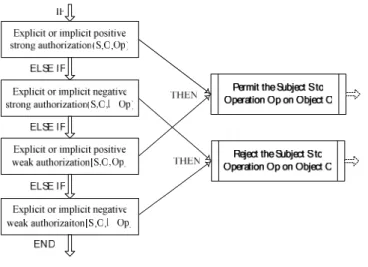
Assuming the subject S requires performing the access operation Op on object O, and then we should perform the permission check on subject S. The check result would direct whether the required operation is allowed or refused. According to the ideals of Bertino in citation [7], the basic thought of authorization check is from strong authorization to weak authorization, from positive authorization to negative authorization, to complete the authorization check on certain subject access permission, shown as Fig. 4:
Fig. 4 Basic thought of authorization check
Based on the above mentioned check thought, on the subject hierarchy (Fig. 2), authorization check process begins from a certain user. According to the return result of check to decide whether terminate the whole check process or go on to check the above-level subject. Assume that user u requires the access operation Op on object O, detailed check process check_auth can be described as following, shown as Fig. 5:
(1) Firstly perform the strong authorization on user u: Begin check_strong (u):
if (exist(u,o,op)=1) then
return true; exit check_auth;
elseif(exist (u,o,﹁op)=1) then
return false; exit check_auth; else go to (2);
(2) Then perform the strong authorization on group Gi which user u directly belonged to, check_strong(Gi),u
∈
Gi:if (exist(Gi,o,op)=1) then
return true; exit check_auth;
elseif(exist (Gi,o,﹁op)=1) then
return false; exit check_auth; else
exit check_strong;
(3) And thengo on the weak authorization on user u: Begin check_weak(u):
if(exist [u,o,op]=1)then
return true; exit check_auth;
elseif (exist [u,o,﹁op]=1) then
return false; exit check_auth; else go to (4);
(4) Next, perform the weak authorization on group Gi which user u directly belonged to, check_weak(Gi),u
∈
Giif exist( [Gi,o,op]=1) then
return true; exit check_auth;
elseif exist([Gi,o,﹁op]=1) then
return false; exit check_auth; else go to (5);
(5) In order check the above control group Gj which user u indirectly belonged to, u
∈
1Gi。。。∈
m Gj。。。∈
nGk, (m<j<n):while (exist(Gj, Gi
∈
Gj))redo check_weak(Gi);-- step (4)
exit check_weak;
exit check_auth; -- end of authorization check Begin authorization check Check_auth strong authorizaiton Check_strong weak authorization Check_strong i. check user u exist(u,o,op)=1 exist(u,o, op)=1 if elseif elseif undecided i. check user u exist(u,o,op)=1 exist(u,o, op)=1 exist(u,o,op)=1 elseif elseif undecided if undecided if iii.check Gk, u∈1Gi…∈m Gk Exit undecided true false Return ii. check Gi, u G∈ i ii. check Gi, u G∈ i
Fig. 5 Authorization check process B. Implicit Authorization
Implicit authorization utilizes the existing authorization and authorization rules to deduce the new authorization. New authorization is contained in the existing authorizations and authorization rules [2, 14]. Implicit authorization improve the authorization efficiency to a certain extent, also recede the complexity of authorization model.
According to the derivative direction, implicit authorization can be divided into two kinds: Upset implicit authorization and
Downset implicit authorization. Implicit authorization means the inheritance of authorization, following will be the detailed illustrations on three facts: Subject, Object and access operation [8, 15]. Symbols “< ” and “ > ” in the context represent the level relationships on the Object and access operation hierarchy.
On the view of subject, implicit authorization is closely connected to the Subject hierarchy.
(1) Upset implicit authorization on the subject hierarchy: If there exist the explicit authorization (Gi, O, Op) on the control group Gi, then will have implicit authorization (Gk, O, Op),
Gi
∈
n Gk; If there exist the explicit negative authorization (Gi,O,﹁Op) on the control group Gi, then to the control group Gj will have implicit authorization (Gj, O, Op), Gj
∈
m Gi(2) Downset implicit authorization on the subject hierarchy: Control group on the subject hierarchy can realize the implicit on whole members in the group. If there exist the explicit authorization (Gk, O, Op)on the control group Gk, then to ui, Gi where ui
∈
Gk and Gi∈
i Gk, there will be hold the implicit authorization (ui, O, Op)and (Gi, O, Op).If there exist the explicit positive authorization(S, O, Op) on
Op, then to the Op_ where Op_<Op(Op_ represents the access operation on the lower level of Op) ,there will be (S, O, Op_); If there exist the explicit negative authorization (S, O, ﹁Op) on
Op, then to the Op‾ where Op‾>Op (Op‾ represents the access operation on the higher level of Op) ,there will be (S, O, ﹁ Op‾). Consequently, it is downset implicit authorization on the access operation hierarchy.
Certain object authorization on the Object hierarchy can be transferred to the lower object, and also can affect the higher object. Due to the flexibility and particularity of authorization object itself, the direction of implicit authorization is connected to the specific access operation.
Upset implicit authorization on the object hierarchy: If there exist the explicit positive authorization (S ,O, Op) of the subject
S on the object O, then to the Object O‾ where O‾ ison the higher lever in the object hierarchy, there will be (S, O‾,Op); If there exist the explicit negative authorization (S, O,﹁Op)of the subject S on the object O, then to the Object O_ where O_ ison the lower lever in the object hierarchy, there will be (S, O_,Op). For example, assume there exists (s, obj, write), and object obj
is an instance of class C, then there will be (s, C, read); Moreover, we can deduce the authorization (s, obj, ﹁read) from(s, C, ﹁read).
TABLE.I
IMPLICIT AUTHORIZATION TRANSFERRING ON THE SUBJECT,OBJECT AND ACCESS OPERATION HIERARCHY
Explicit authorization Upsetimplicit authorization Downsetimplicit authorization (Gi,o,op) (Gk,o,op), Gi
∈
n Gk S(Gi,o,﹁op) (Gj,o,﹁op),Gj
∈
m Gi(ui, o, op) , ui
∈
Gi(Gj, o, op),Gj
∈
mGi(s,o,op) (s, o‾,op), o‾>o (s,o_,op), o_< o O
(s,o,﹁op) (s, o_,﹁op), o_<o (s,o‾,﹁op), o‾>o Op (s,o,op)
(s,o,﹁op) -- --
(s,o,op_), op_< op (s,o,﹁op‾), op‾>op
Downset implicit authorization on the object hierarchy: If there exist the explicit positive authorization (S, O, Op) of the subject S on the object O, then to the Object O_ where O_ ison the lower lever in the object hierarchy, there will be (S, O_ ,Op); If there exist the explicit negative authorization(S, O,﹁Op) of the subject S on the object O, then to the Object O‾ where O‾ is on the higher lever in the object hierarchy, there will be (S, O‾, ﹁Op). For example, assume there exists (s, C, read), and c is an sub-class of class C, then there will be (s, c, read); assume there exists (s, obj, write) and ai is an attribute of object obj, then there will be (s, ai, write) and ( s, mi, execute ); Moreover, assume
mic_obj is a part-of the complex object obj, then there will be (s, mic_obj, write).
C. Conflict and Overriding
On account to the Upset and Downset authorization transferring on each hierarchy, there might be conflict for one subject on the same object. Based on the Object hierarchy to control the conflict, commonly there exist following priority rules:
(1) Same subject on the same object for the same kind of access operation, weak authorization will be overridden by strong authorization and implicit will be overlapped by explicit authorization.
(2) For the conflict between two weak authorizations, the authorization for the members of control group Gi is always in preference to the control group Gi.
(3) The authorization inherited from the direct belonged control group is always in preference to the authorization inherited from indirect belonged control group.
(4) For the conflict between two strong authorization, the authorization occur later will be treated as invalid.
In brief, implicit authorization in a certain degree simplifies the authorization mechanism of object-oriented database. Implicit authorization accomplishes the authorization transfer on three facts subject, object and access operation. However, it to some extent lack of flexibility could not sufficiently satisfy the need of practice application. Since weak authorization holds the features of being overriding, it can be used in the exception disposal. Weak authorization can work together with negative authorization to localize the authorization invalidate level and node to accomplish the flexibly control of exceptions.
V. INSTANCE VALIDATE
Based on the above researches and summaries, this section tries to accomplish implement and validate. Shown as Fig. 6, define class Student and its subclass grad_stud, implement two instances of subclass: grad_stud1 and grad_stud2.
On account to the subject hierarchy defined in Fig. 2 to carry on the validation of authorization mechanism:
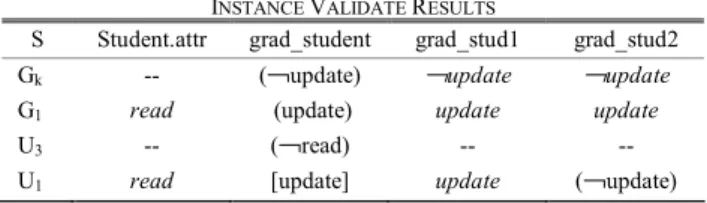
(1) Assuming exists the explicit strong authorization (G1, grad_student, update) on control group G1:
GRANT update ON grad_student TO G1; Since U1,
∈
G1, U3 can get the implicit strong authorization(U3, grad_student, update) transferred from G1 to hold the
read/write permission on the attributes, member methods and instance objects of subclass grad_student. Moreover, since
grad_student inherited from Student class, U3 can also get the read permission on the father class attributes: id and name.
If grant explicit negative authorization (U3, grad_student, ﹁read) on U3:
NONGRANT read ON grad_student TO U3; According to the priority principle of group members, U3 will lose the read permission on class grad_student.
Fig. 6 Class hierarchy of instance
(2) Same preconditions as (1), and assuming exists the explicit positive authorization (G1, grad_student, update) on G1 and explicit positive authorization (Gk, grad_student, ﹁update) on Gk. Since U1
∈
G1, and U1∈
1G1∈
2Gk, according to the priority principle of direct belonged control group, U1 can get the implicit authorization (U1, grad_student, update).(3) Once U1 gets the update permission on subclass
grad_student, it will also get the read/write permission on all instance objects of grad_studen.
In the practical situation, generally one class have several lot of instances, the authorization to all instances of a class will be much too rough and general. Assume that in a particular situation, we don not want to grant U3 read/write permission on certain instance (such as grad_stud1), but reserve the permission on remaining all other instances (such as
grad_stud2). Then it will be needed to utilize weak authorization [U1, grad_student, update] on U1 to
grad_student, and utilize negative read/write authorization (U1,
grad_stud2, update) on grad_stud2 to satisfy this flexible requirement.
WEAKLY GRANT update ON grad_student TO U1;
NONGRANT update ON grad_stud2 TO U1;
Oracle object system obeys to the basic features of object-oriented ideology. Define the instance structure in Oracle object system, shown as Fig. 6. Utilize the role to control the permission of control group and its members in Fig. 2. Use the grant and revoke command to implement the negative and positive authorization. Following results can be shown through the validate processes:
In brief, implicit authorization mechanism based on each hierarchy insecure mode to implement the permission transferring and conflict resolving. Moreover, combine the weak authorization with negative authorization to adjust the subject implicit authorization on particular object hierarchy can
improve the flexibility and usability of authorization mechanism [3].
TABLE.II INSTANCE VALIDATE RESULTS
VI. CONCLUSION
OODB introduces the concept of Object-Oriented, which make the security protection mechanism of OODB more complex. Authorization provides suitable precision to access the specified users, and guaranteed to protect the securities of OODB in company with other security mechanisms. Implicit Authorization is based on the subject’s hierarchies, objects hierarchies and access hierarchies of the security authorization modes, and simplifies the authorization mode, in addition, to combine with other authorization mechanisms, implicit authorization can make protection on the authorization of OODB expediently and effectively. Implicit Authorization introduces the authorization conflicts when the same subject accesses the object while it simplifies the complexity of the authorization mode. We also have a long way to go to make a more deep research and conclusion of the authorization conflicts.
REFERENCES
[1] Oki Y, Chikaraishi T, Shimomura T and Ohta T. A design method for data integrity in object-oriented database systems. International Conference on Information Engineering, Proceedings of IEEE Singapore, 1995: 204-209.
[2] Ambhore, Premchand B, Meshram B, and Waghmare V B. An implementation of object-oriented database security. Software Engineering Research, Management & Applications, 2007. SERA 2007. 5th ACIS International Conference, 2007:359-365.
[3] Fernandez E B, Gudes E, and Hauyan Song. A model for evaluation and administration of security in object-oriented database systems. Knowledge and Data Engineering, IEEE Transactions on Vol. 6, Issue 2, April 1994: 275-292.
[4] Bertino E, Bettini C, Ferrari E and Samarati P. A temporal access control mechanism for database systems [J]. Knowledge and Data Engineering, IEEE Transactions on Vol. 8, Issue 1, February. 1996: 67-80.
[5] Demurjian SA, Hu M Y, Ting T C and Kleinman D. Towards an Authorizaiton Mechanism for User-Role Based Security in an Object-Oriented Design model[C]. Computer and Communications, 1993, 12th Annual International Phoenix Conference on, March 1993:195-202.
[6] Thomas R K, Sandhu R S. A Trusted Subject Architecture for Multilevel Secure Object-oriented Database [J]. Knowledge and Data Engineering, IEEE Transactions on Vol. 8, Issue 1, Feb. 1996: 16-31.
[7] Bertino E, Jajodia S and Samarati P. Supporting multiple access policies in database systems[C]. Security and Privacy, 1996. Proceedings, 1996 IEEE Symposium on May1996: 94-107.
[8] Xu Jiepan, Object Oriented Database and Applications. Beijing: Science Press, 2003:78-95.
[9] Ni Xianjun. A logic specification and implementation approach for object-oriented database security. Knowledge Discovery and Data Mining, 2008. WKDD 2008. International Workshop, 2008: 461-464. [10] Zhou Deyu, Luobin, Chen Shifu, Security Model for Object-Oriented
Database Systems and its Application. Computer Engineering and Applications. 2003.27:210-212.
S Student.attr grad_student grad_stud1 grad_stud2
Gk -- (﹁update) ﹁update ﹁update
G1 read (update) update update
U3 -- (﹁read) -- --
U1 read [update] update (﹁update)
[11] Wang Yijie, Object Oriented Database. Beijing: Electronic Industry Press, 2003:253-267.
[12] Zhang Min, Xu Zhen, Feng Dengguo, Database Security. Beijing: Science Press, 2005: 140-146.
[13] Chen Qiang. The Problem About the Safe Protection of Object-oriented Database. Computer Engineering Vol. 24, No.6, 1994:41-43.
[14] Milen J K, Lunt T F. Security for object-oriented database systems. Research in Security and Privacy, 1992. Proceedings, 1992 IEEE Computer Society Symposium on May. 1992: 260-272.
[15] Zhang C N, Honglan Zhong. An Integrated approach for database security and fault tolerance. Information Technology: Coding and Computing, 2004. Proceedings. ITCC 2004. International Conference on Vol. 1, 2004: 762-766.