ISSN 1392-1517. Online ISSN 2029-8315. KALBOTYRA. 2015 • 67 DOI: http://dx.doi.org/10.15388/Klbt.2015.8945
Evidential adverbials in Lithuanian: a corpus-based study
Anna Ruskan
Department of English Philology Vilnius University
Universiteto g. 5
LT-01513 Vilnius, Lithuania E-mail: [email protected] Abstract
The present study examines the functional distribution of the adverbials akivaizdžiai ‘evidently’, aiškiai ‘clearly’, ryškiai ‘visibly/clearly’, tariamai ‘allegedly/supposedly’ and aišku ‘clearly/of course’ in Lithuanian fiction and academic discourse. The aim of the study is to identify the evidential and/or pragmatic functions of perception and communication-based adverbials which can be traced synchronically to different syntactic environment (a predication manner adverbial and a CTP clause). The paper examines the frequency of these adverbials, their position, scope, functions, co-occurrence with argumentative markers, word class (adverb or non-agreeing adjective) and the type of discourse they occur in. The research is conducted by applying a corpus-based methodology and the data are obtained from the Corpus of the Contemporary Lithuanian Language, namely from the subcorpus of fiction, and the Corpus of Academic Lithuanian.
The perception-based adverbials akivaizdžiai ‘evidently’, aiškiai ‘clearly’, ryškiai ‘clearly/visibly’ and aišku ‘clearly/of course’ denote inferences drawn from perceptual and conceptual evidence and contribute to persuasive authorial argumentation, while the communication-based adverbial tariamai ‘allegedly/supposedly’ functions as a hearsay marker. The latter may also be used as an epistemic marker which refers to unreal or imagined situations. In contexts of common knowledge, the adverbial aišku ‘clearly/of course’ acquires interactional and textual functions and thus reveals traces of pragmaticalisation. In academic discourse, it signals interaction with the addressee and links units of discourse, while in fiction it functions as a speech act modifier in a variety of emotive contexts. The pragmaticalisation of aišku ‘clearly/of course’ is also marked by its high frequency, positional mobility (initial, medial, final) and scopal variability (clausal, phrasal). Alongside its discrete evidential and pragmatic functions, the adverbial aišku ‘clearly/of course’ displays the merger of the two functions. The
adverbials akivaizdžiai ‘evidently’, aiškiai ‘clearly’, ryškiai ‘visibly/clearly’ and tariamai ‘allegedly/supposedly’ do not acquire a pragmatic function, which is indicated by their frequency and position. The results of the present study corroborate the findings of previous studies that common sources of evidential adverbials and pragmatic markers in Lithuanian are verb-based, adjective-based and noun-based CTP clauses.
Keywords: evidential adverbial, inference, hearsay, pragmatic marker, fiction, academic discourse
1 Introduction
In European and other languages, evidential adverbials are common devices for expressing an author’s source of information for the proposition, i.e. for direct and indirect types of evidence (Ramat, Ricca 1998; Boye, Harder 2009; Boye 2012). The latest intralinguistic and crosslinguistic studies into evidential adverbials in English (Simon-Vandenbergen, Aijmer 2007; Aijmer 2008; Kaltenböck 2009, 2013), Spanish, Catalan (Cornillie 2010; Cuenca, Marín 2012) and Estonian (Valdmets 2013) show that they may also function as pragmatic markers which establish a common ground with the addressee, emphasise the author’s argumentation and link units of discourse (Brinton 2008). The present study sets out to examine the functional distribution of evidential adverbials in Lithuanian and to check their potential for acquiring discursive functions. The focus is on the adverbials akivaizdžiai ‘evidently’, aiškiai ‘clearly’, ryškiai ‘visibly/ clearly’ and tariamai ‘allegedly/supposedly’ as exemplified in (1) and the adverbial aišku ‘clearly/of course’ as illustrated in (2). The former derive from adverbs and may also function as predication1 adverbials (3), while the latter derives from a non-agreeing
adjective and may be used as a Complement-Taking-Predicate (CTP) followed by a that -clause (4):
(1) Šeimininkas akivaizdžiai suglumo.2 (F)
‘The host evidently became confused.’ (2) Klausimai, aišku, pašaipūs.(F)
‘The questions are, clearly/of course, sarcastic.’ (3) Akivaizdžiai matau, kad esi neramus. (F)
‘I clearly (lit. ‘evidently’) see that you are worried.’ (4) Jau aišku, kad į mokyklą šiandien neis. (F)
‘It is clear (NAGR.ADJ) that s/he is not going to school today.’
1 The adverbial tariamai ‘allegedly’ is not used as a predication (manner) adverbial. 2 All examples have been translated into English by the author of the article.
The treatment of the markers in (1) and (2) within the same functional class is justified by their adverbial distribution and meaning of secondary predication characteristic of similar crosslinguistic units (Ramat, Ricca 1998; Nuyts 2001; Wierzbicka 2006; Boye, Harder 2007; Brinton 2008; Van Bogaert 2010). For example, the English markers evidently and apparently, which are expressed by a single adverb, and the markers I think and I guess, which are realised by a clause, belong to author stance adverbials (Biber et al. 1999, 854–855). In Lithuanian, as has been shown in previous studies (Usonienė 2012, 2013, 2015; Smetona, Usonienė 2012), alongside the adverbs and non-agreeing adjectives illustrated in (1) and (2), common synchronic sources of adverbialisation can be verbs (e.g. atrodo ‘it seems’, girdi ‘hear’), non-agreeing participles (e.g. žinoma ‘known’, manoma ‘thought’) and nouns (e.g. tiesa ‘truth’, žinia ‘knowledge’) functioning as parenthetical CTPs. Adverbial functions are also revealed by the particles esą ‘they say’, neva ‘as if’, tarsi/tarytum/tartum ‘as if’ and atseit ‘supposedly’ (Wiemer 2007, 2010a, 2010b; Petit 2008; Šinkūnienė 2012).
The aim of the present study is to identify the evidential and/or pragmatic functions of perception and communication-based adverbials as exemplified in (1) and (2) in Lithuanian fiction and academic discourse. Since fiction is the closest representative of spoken language, which is spontaneous and direct, and academic discourse represents written language, which is planned and less direct (Chafe 1986, 262; Cornillie 2010, 311), some distributional differences among these adverbials can be expected. The paper will examine the frequency of the adverbials, their position, scope, functions, co-occurrence with argumentative markers and the type of discourse they occur in. As Lampert and Lampert (2010), Wiemer and Kampf (2012), Usonienė (2013) and Fetzer (2014) have all demonstrated, the functional identification of evidential markers in European languages is to a large extent context dependent.
2 Previous research
A great deal of attention has been devoted in the literature to discussing the notional boundaries of evidential adverbials. In a number of studies in Germanic (Marín-Arrese 2009; Celle 2009), Romance (Squartini 2008) and Slavic languages (Wiemer 2006; Wiemer, Kampf 2012), they are considered to be conceptually different from adverbials of epistemic modality. Evidential adverbials specify the source of information, while epistemic adverbials express the degree of the author’s epistemic commitment (Carretero, Zamorano-Mansilla 2013, 320). Although evidential adverbials could be regarded as “epistential” as they contain both the semantic feature of the evaluation of evidence and an assessment of its probability (Simon-Vandenbergen, Aijmer 2007, 38; Carretero, Zamorano-Mansilla 2013, 320), their primary function is undoubtedly evidential. As the analysis of the hearsay particle podobno ‘supposedly’ in Polish shows (Wiemer 2006,
25), its epistemic meaning components can be suppressed in a number of pragmatic contexts. Similarly, the English adverbials reportedly, allegedly and supposedly do not express the author’s epistemic judgment but mark distance from the original sources of information or propositional content (Celle 2009, 289). Evidential adverbials may imply the validity of the propositional content (Marín-Arrese 2009, 245) but validity cannot be identified with epistemic commitment (Cornillie 2009, 59; Boye 2012, 166).
A discourse-functional approach to evidentiality adopted in studies on evidential markers in European languages (Squartini 2007; Diewald, Smirnova 2010a) revealed that evidential adverbials may acquire interactional and textual functions typical of pragmatic markers (Brinton 2008, 17–18) across different types of discourse (e.g. spoken, academic, journalistic). As a result of the process of pragmaticalisation (Aijmer 1997), they cease to mark the author’s epistemic justification and extend into discourse management devices. Although the functional extension of evidential and epistemic adverbials may pose a problem in drawing sharp boundaries between their evidential/ modal and discursive use, prototypical meanings can still be distinguished. For example, the English adverbial of course “in some of its uses (...) will have a meaning which is close to its propositional one, in other uses its meaning will be far removed from it, with a grey area in the middle, giving a cline of more lexical to more grammatical meanings, or more propositional to more textual or interpersonal ones” (Wichmann et al. 2010, 123). Similarly, the marker (és) clar ‘of course/clearly’ in Catalan presents a gradient from modal to discourse marker meaning (Cuenca, Marín 2012, 2221–2222). In order to explore the range of meanings of pragmatic markers, it is important to investigate their position in a clause, scopal properties, collocational profile, type of text, the author’s and the addressee’s social roles and relationship. According to Aijmer (2013, 18), “pragmatic markers can be looked upon as combinations of formal and functional features and descriptions of the contexts in which they are used”.
Lithuanian evidential adverbials (e.g. matyt ‘evidently’, atrodo ‘it seems’, regis ‘seemingly’, esą ‘they say’, aišku ‘clearly/of course’, žinoma ‘certainly’) have been traditionally treated as markers of epistemic modality (Akelaitis 1992; Ambrazas 2006). Their reference to the source of information as primary meaning has been attested in Wiemer (2007, 2010a, 2010b), Usonienė (2013, 2015) and Ruskan (2013). The relation of evidential and epistemic meaning components has been addressed in intralinguistic and crosslinguistic studies dealing with the adverbials matyt ‘evidently’, regis ‘seemingly’ and atrodo ‘it seems’ (Usonienė 2003, 2015; Šinkūnienė 2012; Šolienė 2012; Usonienė, Šinkūnienė 2013). The pragmaticalisation of evidential adverbials in Lithuanian, as in other European languages, is reflected by their syntactic mobility, bleaching of lexical meaning, displays of interpersonal and textual functions and their acquisition of grammatical status (Usonienė 2012, 2013, 2015). The status of a
pragmatic marker is typically assigned to adverbials based on second person verb forms (e.g. žinote ‘you know’, matote ‘you see’), non-agreeing present passive participles (e.g. žinoma ‘certainly’ (lit. known), suprantama ‘naturally’ (lit. understandable)), the non-agreeing adjective aišku ‘clearly’ (lit. clear) and the noun tiesa ‘really’ (lit. truth). The present study aligns with the view that evidential adverbials primarily specify the source of information which should be retrievable from the micro or macro linguistic context (Wiemer, Kampf 2012, 15–17), while pragmatic markers are used as interactional or textual strategies in discourse.
3 Data selection and methods
The present study has been carried out by applying corpus based-methodology, which has been an effective tool in describing the use of evidential and epistemic markers in Germanic (Nuyts 2001; Simon-Vandenbergen, Aijmer 2007), Romance (Cornillie 2010), Slavic (Wiemer, Kampf 2012) and Baltic languages (Usonienė, Šolienė 2010; Šinkūnienė 2012; Smetona, Usonienė 2012; Ruskan 2012; Chojnicka 2012). Authentic data from representative corpora have allowed the functional intricacies of evidential markers in a variety of registers and discourse types to be disentangled. The data for the current study have been retrieved from the Corpus of the Contemporary Lithuanian Language (CCLL) (http://donelaitis.vdu.lt), namely from the subcorpus of fiction (about seven million words), and from the Corpus of Academic Lithuanian (CorALit) (http:// www.coralit.lt/, about nine million words) which consists of academic texts published from 1999 to 2009. The corpus of academic Lithuanian contains the subcorpora of biomedical sciences (1, 638, 444 words), humanities (2, 028, 906 words), physical sciences (1, 527, 455 words), social sciences (1, 510, 981 words) and technological sciences (1, 964, 827 words).
Before the qualitative and quantitative analysis proper was carried out, the data retrieved from the corpora had to be selected manually. The study includes the use of akivaizdžiai ‘evidently’, aiškiai ‘clearly’, ryškiai ‘visibly/clearly’ and tariamai ‘allegedly/supposedly’ as sentence adverbials and excludes their use as predication adverbials denoting manner. The forms of the adverbs were retrieved automatically, while the distinction between the meanings of manner and evidentiality was done manually. The main distinguishing criterion of sentence and predication adverbials is the semantic type of predicates they collocate with. Manner adverbials collocate with verbs of perception (e.g. matyti ‘see’), cognition (e.g. manyti ‘think’), communication (e.g. sakyti ‘say’, rodyti ‘show’), the existential and relational verbs atspindėti ‘reflect’, išryškėti ‘become visible’, atsiskleisti ‘be disclosed’ and verbs denoting material processes (e.g. bėgti ‘run’, statyti ‘build’,
įvykti ‘happen’)3. They define actions, events, and states which refer to objective reality
but not the author’s subjective reasoning (Traugott 1989, 46), e.g. (5) Aš taip ryškiaimatydavau tavo veidą... (F)
‘I used to see your face so distinctly/clearly.’
(6) <...> noriu aiškiaipasakyti – jokių žurnalistų mes pas jus nesiuntėme. (F) ‘<...> I would like to sayclearly– we have not sent any journalists to you.’ (7) <...> ji aiškiai išdainuoja melodiją, o žodžius rūpestingai seka iš sąsiuvinio. (F)
‘<...> she clearly sings a melody and attentively follows the words from the notebook.’
Similar collocations of manner adverbials have been attested in English (Simon-Vandenbergen 2007, 163; Carretero, Zamorano-Mansilla 2013, 349). The markers are considered to function as evidential adverbials when they collocate with the existential and relational verbs būti ‘be’, atrodyti ‘look’, tapti ‘become’, turėti ‘have’, priklausyti ‘belong’, trūkti ‘lack’, mental verbs describing psychological states and emotions (e.g. patikti ‘be likeable’, nuobodžiauti ‘be bored’) as well as verbs denoting material processes which relate to some changes (e.g. didėti ‘increase’, mažėti ‘decrease’). Sentence adverbials can be paraphrased by the corresponding adjective in the impersonal construction (Carretero, Zamorano-Mansilla 2013, 345), e.g.
(8) Jie atžygiavo į kiemą tvirtu žingsniu, akivaizdžiai turėdami ir tos dienos tikslą, ir aiškų planą. (F)
‘They marched into the yard with a firm step, evidentlyhaving the goal of that day and a clear plan.’
Akivaizdu, kad turėdami ‘It is evident that they had’
(9) Vienintelis šitame rūsyje nesiautėjo <...> – šis cheminis vakarėlis jam akivaizdžiai neįtiko <...>. (F)
‘He was the only one in that basement who did not rage <...> – he evidentlydid not enjoy this chemical party <...>.’
Akivaizdu, kad neįtiko
‘It is evident that he did not enjoy’
(10) Tačiau aiškiai (11.7%) gerėjo žolyno botaninė sudėtis <...>. (AD, B)
‘However, the chemical composition of the lawn was clearly (11.7%)getting better <...>.’
Aišku, kad gerėjo
‘It is clear that it was getting better’
As the examples above illustrate, the adverbials akivaizdžiai ‘evidently’ and aiškiai ‘clearly’ express the author’s evaluation of the source of information rather than describing objective reality. Alongside the semantics of the predicate, there are other cues distingui-shing manner and evidential adverbials. Manner adverbials are modified by degree ad-verbs, as in (11) and (12), and they can occur in imperative sentences (13), e.g.
(11) <...> kaip kitas atsimena seniai prabėgusias dienas: kartais neaiškiai, tarsi per miglą, o kartais taipryškiai, lyg tai būtų atsitikę vakar. (F)
‘<...> as somebody remembers days gone a long time ago: sometimes vaguely, as if through a mist, and sometimes soclearly, as if it had happened yesterday.’ (12) Nors šis pasiūlytas pasirinkimas sąlyginis, tačiau pakankamaiakivaizdžiai išreiškė
tiriamųjų nuostatas <...>. (AD, H)
‘Although the offer suggested is relative, it quiteevidently expressed the beliefs of the target group.’
(13) Venkiteakivaizdžiai domėtis interjeru, paveikslais, vaizdais už lango ir kt. (AD, S) ‘Avoid being interested so manifestly in the interior, pictures and views through
the window, etc.’
The criteria for distinguishing manner adverbials from evidential adverbials cannot be taken in isolation but should be combined. There are also a number of cases which display merger between the use of manner and evidential adverbials. Cases of merger are found in contexts where there are evaluative elements and the adverbials collocate with verbs denoting material and verbal processes, e.g.
(14) Parinktos citatos akivaizdžiairodo jauno žmogaus nuotaikas, nuostatas, ieškojimus, svajones. (F)
‘The citations chosen evidently show the young person’s mood, beliefs, quests, dreams.’
(15) Reklama ypatinga ir tuo, kad joje reklamuotojas, užmokėjęs už plotą spaudos leidinio puslapiuose ar laiką radijo bei televizijos laidoje, kreipiasi į skaitytojus, klausytojus ar žiūrovus su specifiniais raginimais ir reikalavimais, aiškiai pabrėždamas savo suinteresuotumą. (AD, H)
‘Advertisement is also special in the respect that an advertiser, having paid for the space in a newspaper or radio or television programme, addresses the reader, listener or audience with specific encouragement and requirements, clearlyemphasising his/her interest.’
(16) Rinkinyje ryškiai brėžiama erdvės vertikalė: mintys nuolat kyla į kalnus, į dangų. (AD, H)
‘The collection clearlyemphasises vertical space: thoughts are constantly going up the mountains and the sky.’
The evaluative elements are the verb collocations rodyti nuotaikas, svajones ‘show moods, dreams’ (14), pabrėžti suinteresuotumą ‘emphasise interest’ (15) and brėžti erdvės vertikalę ‘draw vertical space’(16). They can represent the author’s reasoning about reality and/or modify the way in which things happen. The present study excludes cases of merger from further quantitative and qualitative analysis. The non-agreeing adjective aišku ‘clear’is considered to be an adverbial when it is used parenthetically in the initial (17), medial (18) and final (19) positions and shows no formal links with the host clause it modifies, e.g.
(17) Saulė tiesiog nesugeba, negali paminti tokią šviesią, tokią romantišką, tokią karštą ir skaisčią jų pirmąją meilę! Aišku, jo laukia! (F)
‘Saulė simply cannot forget their bright romantic, hot and pure first love! Clearly/ Of course she is waiting for him!’
(18) O paukščiai, aišku, buvo tie patys <...>. (F)
‘And the birds, clearly/of course, were the same <...>.’ (19) Įtartinai lengvas. Tuščias, aišku. (F)
‘It is suspiciously light. It is empty, of course.’
The lack of formal links with the host clause is marked by the omission of the complementiser kad/jog ‘that’, the copular and the subject (Usonienė 2013, 80). The use of aišku ‘clearly, of course’with the zero complementiser in the initial position (17) has been regarded as parenthetical due to functional evidence pointing out its adverbial status (Wierzbicka 2006, 216–217). From a communicative point of view, the exclamatory sentence Jo laukia! ‘She is waiting for him!’ is more prominent than aišku ‘clearly, of course’. The former can be addressed by the question Really? (Boye, Harder 2007, 578; Usonienė 2012, 229), while the latter is non-addressable and discourse secondary. Aišku ‘clearly/of course’ is also considered to be an adverbial when it is used as a structurally independent element (Biber et al. 1999, 551) which occurs as a response to questions, e.g.
(20) – Ir tėtis kartu? –Aišku. (F)
‘– And is father together? – Of course.’
Aišku ‘clearly/of course’ as a response marker has its crosslinguistic parallels, such as zeker ‘certainly in Dutch (Byloo et al. 2006), sure in English (Aijmer 2012), claro ‘of courseʼ in Spanish and clar ‘of courseʼ in Catalan (Cuenca, Marín 2012), all of which also have an adjectival origin and function as pragmatic markers in present-day language. Byloo et al. (2006, 48) call it “an absolutive use” and argue that it can no longer be regarded as an adjectival or elliptical case of adjectival use. The present study includes only the adverbial use of aišku ‘clearly/of course’, since other
non-agreeing adjectives such as akivaizdu ‘evidentʼ and ryšku ‘visibleʼ do not show traces of adverbialisation. They are mainly used as CTPs with kad/jog ‘thatʼ complementiser or in reduced clauses (Nuyts 2001, 82). The fact that only aišku ‘clearly/of course’ displays adverbial use confirms Boye and Harder’s (2007, 588) claim that not all CTPs tend to express secondary predication and acquire a grammatical status.
4Findings and discussion
This section will focus on the frequency of the adverbials under study in fiction and academic discourse, their position in a clause, scopal properties and functions in discourse (inferential, hearsay and pragmatic).
4.1 Frequency in the corpora
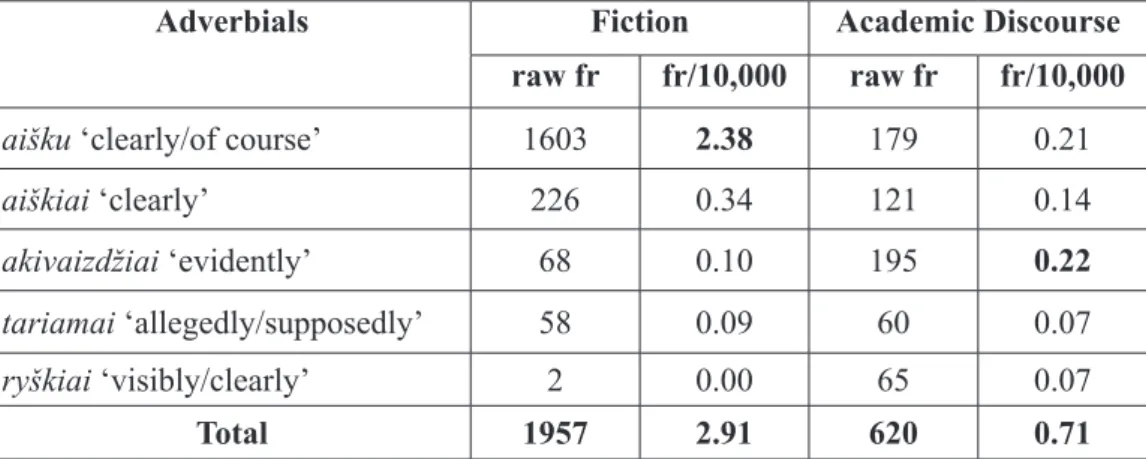
The distribution of the adverbials in the subcorpus of fiction of the CCLL and the CorALit shows that they are most frequent in fiction. The frequencies are presented in Table 1.
Adverbials Fiction Academic Discourse
raw fr fr/10,000 raw fr fr/10,000
aišku ‘clearly/of course’ 1603 2.38 179 0.21
aiškiai ‘clearly’ 226 0.34 121 0.14
akivaizdžiai ‘evidently’ 68 0.10 195 0.22
tariamai ‘allegedly/supposedly’ 58 0.09 60 0.07
ryškiai ‘visibly/clearly’ 2 0.00 65 0.07
Total 1957 2.91 620 0.71
Table 1. Frequency of the adverbials in the subcorpus of fiction of the CCLL and the CorALit
In fiction, the most frequent adverbial is aišku ‘clearly/of course’ which derives from the non-agreeing adjective-based CTP clause. Its relatively high frequency in discourse representing spoken language can be explained by its multifunctionality. As the following subsections illustrate, its functions range from evidential to interactional and textual. The most frequent adverbial in academic discourse is akivaizdžiai ‘evidently’ which functions as an inferential marker displaying authorial emphasis. In contrast to aiškiai ‘clearly’ and ryškiai ‘visibly/clearly’, which function most frequently as manner adverbials in both types of discourse, the evidential use of akivaizdžiai ‘evidently’ makes up 50% of its overall use.
The least frequent adverbials in both fiction and academic discourse are ryškiai ‘visibly/ clearly’ and tariamai ‘allegedly/supposedly’. As was mentioned earlier, the adverbial ryškiai ‘visibly/clearly’ is not frequently used evidentially as it mainly functions as a manner or degree adverbial which modifies actions and qualities referring to objective reality. In general, the evidential adverbials expressed by a single adverb, with the exception of the adverbial akivaizdžiai ‘evidently’ in academic discourse, are less frequent than the adverbial aišku ‘clearly/of courseʼ deriving from a CTP clause. This variation in frequency corroborates the findings obtained in previous studies that evidential and other stance adverbials derive from a variety of CTP clauses (adjectival, nominal, verbal) in Lithuanian (Usonienė 2012, 2013, 2015) and that adverbs are not productive means in expressing the source of information (Ruskan 2013).
4.2Position and scope
In a similar manner to epistemic adverbials and the comment clauses I think, I believe in English and other languages (Paradis 2003; Kaltenböck 2009; Boye 2012; Kӓrkkӓinen 2012), the adverbials under study may display both clausal and phrasal scope. The scope is determined by the position of the markers (Kaltenböck 2009: 55) and can shed light on their functional variation. The clausal scope of the evidential adverbials has been illustrated in (1)–(2), (8)–(10) and (17)–(19). The phrasal scope is exemplified in (21)– (25). The adverbial can be a modifier within a noun phrase (21), (22) or a prepositional phrase (23); it can also take scope over an elliptical (24) or incomplete clause (25) (Kaltenböck 2009, 55), e.g.
(21) – Duosiu darbo, aišku, ir atlyginimą. (F) ‘I will give you a job, of course, and a salary.’
(22) Jis <...> plūdo tokias atsilikusias, tiesiog akivaizdžiai kvailas pažiūras. (F) ‘He <...> aired such regressive, evidently silly views.’
(23) Jie pražingsniavo pro <...> vaikiškos išvaizdos <...> policininką su aiškiai per didele uniformine kepure. (F)
‘They passed by <...> the policeman with a childish appearance and clearly too big uniform cap.’
(24) Kaip baigiasi ginčas? Aišku, brolišku apsikabinimu. (F)
‘How does the quarrel end? Clearly/Of course, with a fraternal hug.’
(25) Apie Vilę tartum apie numirėlę nereikia šnekėti. O be to, argi ji tik viena? –Aišku, ne! (F)
‘You should not talk about Vile as if she were dead. Moreover, is she the only one? – Clearly/Of course, not!’
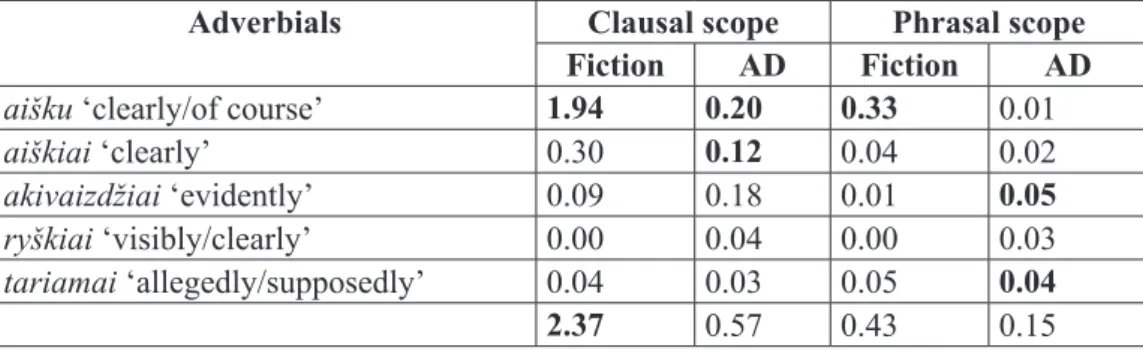
The phrasal scope of the adverbials reflects their functional variation. The adverbial aišku ‘clearly, of course’ in (21), (24) and (25) shows a bleaching of evidential functions and displays features of a pragmatic marker indicating common knowledge and interaction with the addressee. In (21) a promise is made to provide a job and as a natural course of things a promise is also made to provide a salary. In (24) and (25) the adverbial is used in response to the question in the preceding discourse. The adverbials akivaizdžiai ‘evidently’ (22) and aiškiai ‘clearly’ (23) function as emphasisers of the evaluative adjectives kvailas ‘silly’ and per didele ‘too big’, although this use is also compatible with their evidential functions, which can be foregrounded or backgrounded depending on the context. In a similar manner to comment clauses in English (Kaltenböck 2009, 61; Kӓrkkӓinen 2012, 2197), the adverbials under study take scope over a clause more frequently than over a phrase. The distribution of clausal and phrasal scope of the adverbials is presented in Table 2.
Adverbials Clausal scope Phrasal scope
Fiction AD Fiction AD
aišku ‘clearly/of course’ 1.94 0.20 0.33 0.01
aiškiai ‘clearly’ 0.30 0.12 0.04 0.02
akivaizdžiai ‘evidently’ 0.09 0.18 0.01 0.05
ryškiai ‘visibly/clearly’ 0.00 0.04 0.00 0.03
tariamai ‘allegedly/supposedly’ 0.04 0.03 0.05 0.04
2.37 0.57 0.43 0.15
Table 2. Distribution of clausal and phrasal scope of the adverbials (normalised frequency per 10,000)
In fiction, phrasal scope is most characteristic of the adverbial aišku ‘clearly/of course’, which occurs in elliptical sentences and interactional contexts, while in academic discourse, the adverbial akivaizdžiai ‘evidently’ frequently functions as a modifier within a phrase. Other common adverbials with a phrasal scope found in academic discourse are tariamai ‘allegedly/supposedly’ and ryškiai ‘visibly/clearly’.
Adverbials with a clausal scope may take the initial, medial and final positions. They occur clause initially if they are used “before the subject or other obligatory elements of the clause” (Biber et al. 1999, 771) as in (26). When the adverbials occur “between obligatory initial and final clausal elements” (Biber et al. 1999, 771), their position is considered as medial. They can be used between the subject and the verb phrase (27) or between the object and the verb phrase (28) or placed after the auxiliary verb (29). The adverbials take clause final position when they occur after all obligatory elements in the clause (Biber et al. 1999, 771) as in (30):
(26) <...> akivaizdžiai pakito pacientų charakteristikos ir jų lūkesčiai <...>. (AD, B)
‘<...> evidently the patients’ characteristics and their expectations have changed <...>.’
(27) prieškambaris, aišku, buvo tuščias. (F) ‘the hall, clearly/of course, was empty.’
(28) Nelaimingąjį akivaizdžiai kamavo baltoji karštinė. (F)
‘The poor was evidently suffering (lit. ‘evidently was suffering’) from fits of delirium.’
(29) Varnelio šneka jam buvo aiškiai nemaloni. (F) ‘Varnelis’ talk was clearly unpleasant to him.’ (30) – Kaip reikalai, puikūs, aišku, kam dar klaust. (F)
‘– How are things, fine, of course, why asking.’
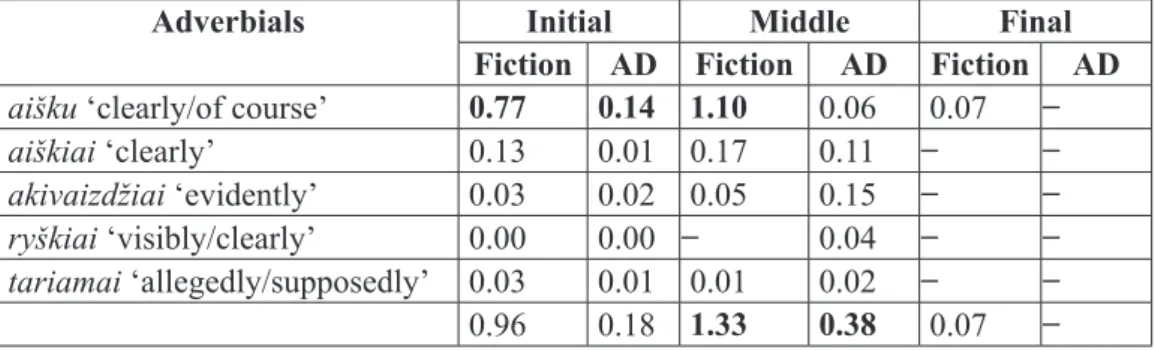
The positional distribution of clausal adverbials shows that they occur in the medial position most frequently in both types of discourse. Only aišku ‘clearly/of course’ in academic discourse and tariamai ‘allegedly/supposedly’ in fiction are more common in the initial position. The data are presented in Table 3.
Adverbials Initial Middle Final
Fiction AD Fiction AD Fiction AD
aišku ‘clearly/of course’ 0.77 0.14 1.10 0.06 0.07 ̶
aiškiai ‘clearly’ 0.13 0.01 0.17 0.11 ̶ ̶
akivaizdžiai ‘evidently’ 0.03 0.02 0.05 0.15 ̶ ̶
ryškiai ‘visibly/clearly’ 0.00 0.00 ̶ 0.04 ̶ ̶
tariamai ‘allegedly/supposedly’ 0.03 0.01 0.01 0.02 ̶ ̶
0.96 0.18 1.33 0.38 0.07 ̶
Table 3. Positional distribution of clausal adverbials (normalised frequency per 10,000 words)
The common medial position of aišku ‘clearly/of course’in fiction and its occurrence in the final position is indicative of its adverbialisation, multifunctionality and grammatical status (Boye, Harder 2007; Usonienė 2013). As Usonienė shows (2013, 88–89), other adverbials commonly attested in the medial position deriving from CTP clauses are mačiau ‘I saw’, manau ‘I think’, manyčiau ‘I would think’, atrodo ‘it seems’, suprantama ‘naturally’; the final position is characteristic of the adverbials žinok ‘you know’ and žinoma ‘certainly’. The fact that the adverbials aiškiai ‘clearly’ and akivaizdžiai ‘evidently’are frequent in the medial position may suggest their status as adverbs rather than discourse particles which are likely to occur either clause initially
or finally (cf. of course Simon-Vandenbergen, Aijmer 2002/2003, 23–24). The non-occurrence of the adverbials aiškiai ‘clearly’, akivaizdžiai ‘evidently’, ryškiai ‘visibly/ clearly’ and tariamai ‘allegedly/supposedly’ in the final position shows their lack of pragmatic functions typically associated with the right periphery of the clause.
4.3 Inferential function
In contexts referring to perceptual or conceptual evidence, the adverbials aišku ‘clearly/ of course’, akivaizdžiai ‘evidently’, aiškiai ‘clearly’ and ryškiai ‘visibly/clearly’ mark inferences. The functional motivation of an inference lies in the assignment of a reason to an observed situation. As Diewald and Smirnova (2010b, 63) put it, “<…> inferential evidentials primarily denote the speaker’s reflection of some evidence, i.e. they indicate the relation between the described situation and some other situation, which is treated by the speaker as evidence for the former”. In fiction and academic discourse, perceptual inferences expressed by the adverbials under study may refer to visual, auditory or other sensory data as in the examples below:
(31) 1570 m. žemėlapyje <...> pavaizduoti keturi paukščiai, centre – aiškiai plėšrus, panašiausias į pelėdą. (AD, H)
‘The map of 1570 <...> illustrates four birds, in the centre there is clearly a bird of prey, it strongly resembles an owl.’
(32) o štai sėdi ir laukia Hrasildos, tyli, čiaupo lūpas. – O! – mandagiai nustebo Hrasilda; apsimetė, aišku. (F)
‘he is sitting and waiting for Hrasilda, he remains silent and presses his lips together. – Oh! – Hrasilda said in utter suprise; she pretended, clearly/of course.
(33) Iš netolimos sodybos pakvimpa dūmelis, – ten aiškiai kūrenama beržinėm malkom <...>. (F)
‘From a nearby farm there is a smell of smoke, – they are clearly heating the place with birch-wood <…>.’
The judgment about the bird of prey (31) is based on visual information accessible to the author, namely the map illustrating the birds. Hrasilda’s pretending (32) is judged from her response O ‘Oh’, while the fact of heating with birch wood (33) is deduced from the smoke from a nearby farm. Conceptual inferences reflect the author’s reasoning based on intuition, logic, previous experience or another mental construct (Willett 1988, 96). In this study, conceptual inferences refer to conceptualisations involving the logical relationship between an observed situation and reflected evidence. Conceptual evidence underlying the inference can be expressed by a clause of reason (34) and facts available in the adjacent context (35), e.g.
(34) Susilpnėjus ES Tarybos ir Komisijos vaidmeniui, visas teisės aktų leidybos galias suteikus Europos Parlamentui, ES ryškiai žengtų federacijos linkme, kadangi sprendimai būtų priimami ne valstybių bendradarbiavimo pagrindu, o Sąjungos piliečių valia per tiesiogiai išrinktus atstovus. (AD, S)
‘After the role of the EU Council and the Committee diminishes and the European Parliament takes on all the responsibilities of issuing legal acts, the EU would clearly move in the direction of a federation becauseall decisions would be taken not in cooperation with member states but by representatives directly and willingly chosen by the citizens of the Union.’
(35) Jis džiugiai gali tęsti, plačiau nušviesti kai kuriuos lietuvių literatūros istorijos, rašytojų gyvenimo, kūrybos puslapius. Mokiniams, aišku, įdomu... (F)
‘He can enthusiastically continue and enlighten on the history of Lithuanian literature, writers’ life and works. The students were, clearly/of course, interested...’ In both fiction and academic discourse, the inferential adverbials tend to modify propositions of negative polarity as in comparison with positive polarity, the former is marked and requires evidential justification. In fiction, they occur in contexts illustrating the characters’ negative psychological states or qualities; in academic discourse, they ground negative evaluation of facts and opinions, e.g.
(36) Dukra, priėmusi puokštę ir išklausiusi trumpą pasveikinimą, staiga graudžiai apsiverkė. Akivaizdžiai sutriko ir likusieji. (F)
‘Having received a bouquet and listened to a short greeting, the daughter suddenly burst into tears. Evidently the rest got also confused.’
(37) „Jūsų dokumentai?.. – pasigirdo iš langelio. – Prašau dokumentus!..“ Buvo tai, aišku, visai ne kokios kasininkės balsas... (F)
‘“Your documents?.. – a voice was heard from the window. – Your documents, please!” It was, clearly/of course, not some shop assistant’s voice.’
(38) Tačiau išsyk būtina pabrėžti, kad H. Garlikowskos kataloge net neužsimenama apie mažesnius nei 1,0 ha ežerus – susidaro įspūdis, kad autorė tokių telkinių aiškiai nelaikė ežerais. (AD, P)
‘However, it is necessary to emphasise that H. Garlikowska’s catalogue does not even mention lakes which are smaller than one hectare – there is an impression that the author clearly did not consider them to be lakes.’
(39) Įstatymo (20 str. 2 d. 5 p.) nuostata, numatanti žemės ūkio subjektų (įmonių, ūkininko ūkių) darbuotojams individualų NPD tik 330 Lt per mėnesį (anksčiau buvo 225 Lt), yra akivaizdžiai nepakankama. Manome, kad <...>(AD, S)
‘The regulation of the law (Article 20, part 2, page 5) on the individual tax free income of 330 litas per month (it used to be 225 litas) for employees of agricultural subjects (firms, farms) is evidently not sufficient. We think that <...>.’
The negative polarity of the proposition is marked by the lexical items sutriko ‘got confused’ (36), ne kokios kasininkės balsas ‘not some shop assistant’s voice’ (37), nelaikė ‘did not consider’ (38) and nepakankama ‘not sufficient’ (39). The inferential adverbials co-occur with other argumentative markers, such as the participle būtina ‘necessary’ (38), the speech act verb pabrėžti ‘emphasise’ (38), the collocation susidaro įspūdis ‘there is an impression’ (38) and the intersubjective verb manome ‘we think’ (39). Their co-occurrence with other argumentative markers explicates the author’s debate with other points of view. In (38), an unfavourable attitude is expressed towards the catalogue compiled by H. Garlikowska, while in (39) a crititical attitude is expressed towards the law and its makers. The argumentative contexts of use of the inferential adverbials become apparent, especially in academic discourse, when the markers modify propositions that pertain to the results of research or comparison with other studies, e.g. (40) DOM kiekio tyrimų duomenys pateikiami 2 lentelėje. <...> Abu <...> variantai
pagal DOM sukaupimą tarpusavyje skiriasi nežymiai, bet aiškiai atsilieka nuo anksčiau minėto varianto. (AD, B)
‘The results of the research on Organic Soil Substance are provided in table 2. <...> The amount of Organic Soil Substance in both <...> variants does not differ significantly but clearly does not keep up with the variant mentioned above.’ (41) Tikslių vertinimo kriterijų stygius tampa pagrindine kliūtimi, rengiant ilgalaikes
privataus ūkio veiklos strategijas, ir apsunkina ūkininkavimo tradicijų formavimąsi. Šiuo požiūriu dabartinio Lietuvos ūkininko padėtis yra ryškiai nelygiavertė, lyginant su Vakarų Europos valstybių ūkininkais, kurių ūkių istorija jau šimtametė. (AD, B)
‘The lack of precise criteria for evaluation becomes the major obstacle in preparing long-term strategies for activities of private farms and obstructs the formation of farming traditions. In this respect, the position of a Lithuanian farmer today is clearly not the same if compared to farmers in Western Europe, where the history of farming is one hundred years old.’
In (40), the amount of organic soil substance is compared across several variants; in (41) the situation of a farmer in Lithuania and Western European countries is juxtaposed. The comparison is highlighted by the verb atsilieka ‘does not keep up’(41), the adjective nelygiavertė ‘not the same’ (41), and the participial clause lyginant su Vakarų Europos ūkininkais ‘compared to farmers in Western Europe’ (41). The adverbials aiškiai ‘clearly’ and ryškiai ‘visibly/clearly’ highlight the author’s conclusion and eliminate any doubt as to the veracity of the claim. Although the lexical evidential markers are not obligatory, their elimination from the contexts above would make the utterances incomplete. In a similar manner to inferential adverbials in English and other languages (Simon-Vandenbergen, Aijmer 2007; Lampert, Lampert 2010; Chojnicka 2012; Wiemer,
Kampf 2012), the use of the inferential adverbials above shows that contextual cues play a great role in defining their functions.
4.4 Hearsay function
The adverbial tariamai ‘allegedly/supposedly’ most frequently functions as a hearsay marker which indicates that responsibility for the propositional content is attributed to some external source but not to the author. In fiction (42), the original source of information cannot be retrieved from the context as it may be unimportant, unknown or even non-existent. For example, the English adverbial allegedly “does not necessarily imply an assertive source, hearsay serving as a fictitious pretext in a number of cases” (Celle 2009, 285). In academic discourse (43)–(44), the original source may be recovered from the adjacent context because the author explicitly engages into discussion with the source and may question its validity, e.g.
(42) demonstruodamas visam pasauliui, jog dieviškieji žaibai iš dausų jo netrenks, nes jokių dausų apskritai nėra. Kaip ir tų tariamai dieviškų, visuomet teisingų elgesio taisyklių. (F)
‘he demonstrated to the whole world that divine lightning from paradise will not strike him because in general there is no paradise. Similarly, there are no allegedly divine, always right, rules of behaviour.’
(43) „masių mobilizavimas“ reiškia, kad rinkėjų paramos politinis elitas siekia ignoruodamas realią socialinę-ekonominę, tautinę, kultūrinę ir kitokią visuomenės stratifikaciją, visuomenę ar žmones kaip tokius agituodamas kovoti su realiomis ar išgalvotomis politinės sistemos ydomis, žadėdamas tariamai esminę jos transformaciją ir pan. (AD, S)
‘“mass mobilisation” means that the political elite are trying to gain voters’ support by ignoring the real socio-economic, national, cultural or other stratifications of society. They agitate society or people for fighting against real or made up drawbacks of the political system by promising its allegedly crucial transformation and the like.’
(44) Regionizmo ideologų įsitikinimas, kad lietuvių savitumas gali išlikti ne priešpriešinant globalizacijai tautos vienybę ir bendrą jos „etninę kultūrą“, o iškeliant į pirmą vietą tariamai svarbiausią rezistencinį segmentą – regioninę kultūrą, yra nepagrįstas. Kitų Europos šalių patirtis rodo. (AD, H)
‘Regional ideologists’ belief that Lithuanian uniqueness can be preserved not by contrasting national identity and its “ethnic culture” with globalisation but by emphasising first of all the allegedly most important resistant segment, i.e. regional culture is not justified.’
In (43), the author criticises the political elite who promise people the substantial transformation of the political system. The author distrusts politicians’ promises because h/she disapproves of their attitude and actions (ignorance of the real socio-economic, national and cultural stratification of society, misleading agitation). Similarly, the regional ideologists’ belief in (44) that regional culture is the most important factor contributing to the preservation of Lithuanian uniqueness is questioned. The author’s disagreement with the position pursued by the original source is made explicit through the argumentative contextual cues (e.g. įsitikinimas ‘conviction’, nepagrįstas ‘not justified’).
The proposition modified by tariamai ‘allegedly/supposedly’ may also turn out to be false, e.g.
(45) Išgalvojimai sekė vienas kitą. <…> tariamai <…> mano sušauktas <…> susirinkimas <…>. Tokio susirinkimo niekad nebuvo. (F)
‘Made up stories followed one another. <…> allegedly <…> arranged by me <…> meeting <…>. Such meeting has never taken place.’
(46) Iš pradžių Dimitrui sekėsi, 1605 m. mirė caras Borisas, <...> pakvietė Dimitrą į sostą, bet 1606 m. Maskva sukilo, jis žuvo. Rusija nenurimo, atsirado antrasis apsišaukėlis, tariamai išsigelbėjęs Dimitras. (AD, H)
‘At first Dimitr was successful, in 1650 tsar Boris died, <...> he was invited to the throne, but in 1606 there was an uprising in Moscow, he died. Russia did not become quiet, a second imposter, allegedly rescued Dimitr, appeared.’
The falseness of the propositional content is made explicit in the adjacent context, namely through the lexical items išsigalvojimai ‘untrue stories’ (45), niekad nebuvo ‘has never taken place’ (45) and apsišaukėlis ‘imposter’ (46). In a similar manner to its functional counterparts in English (cf. allegedly Wierzbicka 2006; Celle 2009) and Polish (cf. rzekomo ‘allegedly’ Wiemer 2006), tariamai ‘allegedly/supposedly’ expresses the author’s distance from the propositional content. On the scale of “evidentiary validity” (Marín-Arrese 2009, 245), it could be qualified as a marker of low validity. The adverbial tariamai ‘allegedly/supposedly’ may also express “a contrast with reality” (Quirk et al. 1985, 621) which is not motivated by hearsay, e.g.
(47) Dabar tu panašus į oro pilių statytoją! Gaile, užsimerk ir klausyk, švarus garsas įkvėpė į mano širdį poezijos jausmą. O moteris neįkvepia? tariamai supykusi pasiteiravo Gailė (F)
‘Now you resemble a maker of sandcastles! Gaile, close your eyes and listen, pure sound has inspired a feeling of poetry into my heart. And does a woman not inspire you? Gailė asked with the supposed anger.’
(48) Tariamai išpjovus iš suformuotos betono masės prizmės <…> bandinį, į prizmės pagrindą veiks slėgis (AD, T)
‘Supposedly having cut <…> a sample from the prism of the formed concrete, the base of the prism will be affected by pressure.’
In (47), Gailė’s pretention of anger is apparent from the way in which she asks the question, i. e. from the direct auditory evidence available to the author. In (48), the adverbial merely refers to the imagined or unreal situation which does not arise either from hearsay or perceptual evidence. The use of tariamai ‘allegedly/supposedly’ in (47)– (48) can be compared to the use of the English adverbial outwardly (Quirk et al. 1985) and the Polish adverbial pozornie ‘seemingly/outwardly’ (Wiemer 2006). Although Wiemer (2006, 61) claims that negated inferences can be considered as an instantiation of evidential meaning, in this study such cases of use are regarded as epistemic. Their main function lies in expressing “lack of ‘reality’ in what is said” (Quirk et al. 1985, 621).
4.5 Pragmatic functions
In contexts of common knowledge and interaction with the addressee, a variety of pragmatic functions are displayed by the adverbial aišku ‘clearly/of course’. Its evidential meaning is bleached because the inferential basis cannot be identified. The interactive dimension of the adverbial is apparent in contexts showing a negative attitude towards the addressee, e.g.
(49) Namie, aišku, nieko neradai? (F)
‘You, of course, did not find anyone home?’ (50) – Nevadink jos Papūga, aišku? (F)
‘– Do not call her Parrot, clear?’
(51) Maniau, jums bloga. Jam gera, asile, aišku? (F)
‘I thought you felt bad. He feels good, you fool, clear?’
(52) Ir ar tu žinai, ką mums sako skaitytojai?! <...> Ne, nežinau! ... Esu kvailas! O tu, aišku, – protingas! ... Gudrus! (F)
‘Do you know what readers say to us?! <...> No, I do not know! ... I am silly! And you, are, of course, clever! ... Smart!’
The author’s unfavourable attitude is highlighted by the negative polarity of the speech act (49)–(50), the offensive vocative asile ‘fool’ (51) and the ironic protingas, gudrus ‘clever/smart’ (52). The second person verb forms neradai ‘you did not find’ (49), nevadink ‘do not call’ (50) and the pronoun tu ‘you’ (52) address the interlocutor directly, which
shows an intimate relationship between the participants in the speech act. In (49), the author ironically tries to elicit a response, which is well known to both participants in the speech act. H/she emotionally appeals to the addressee’s understanding of the situation. The right periphery of aišku ‘clearly/of course’ in (50)–(51) reveals the intersubjective function of the adverbial and a bleaching of its evidential function. In the contexts above, the adverbial aišku ‘clearly/of course’ is used for discursive purposes rather than an evaluation of the sources of information. In fiction, the adverbial aišku ‘clearly/of course’ is also typically found in first person singular or plural contexts reinforcing the author’s claim:
(53) Toks pasimetęs <...> Džimis, aišku, man patiko. (F) ‘I liked, of course, such confused <...> Jim.’ (54) Duris užtrenkiau, aišku, per garsiai <...>.(F)
‘I shut the door, of course, too loudly <...>.’
(55) Važiavome, aišku, be bilietų. Tai buvo tikrai romantiška kelionė. (F)
‘We were, of course, going without tickets. It was a really romantic journey.’ (56) Mane, valdybos viršininką, ir tai mūsų draugas direktorius žada priimti tiktai po
savaitės ar dviejų!.. Jums, aišku, linkiu didesnio pasisekimo! (F)
‘Our friend the director promises to meet me, the administration manager, only in a week or two! I wish, of course, more success to you!’
In (53), the author provides information about his/her emotional state (patiko ‘I liked’) and in (54)–(55) about his/her actions (užtrenkiau ‘I shut’, važiavome ‘we were going’). The adverbial aišku ‘clearly/of course’ actualises the common ground between the author and the addressee and creates a vivid narrative of the events. The performative verb linkiu ‘I wish’ (56) also suggests that the author comments on the performance of the speech act but not the evaluation of the propositional content. In academic discourse, the adverbial aišku ‘clearly/of course’ modifies self-evident and irrefutable propositions that strengthen the author’s argumentation (Ajimer 2008, 70):
(57) Savaime aišku, kiekvienas žurnalistas turi pasižymėti ne tik specifinėmis, profesinėmis savybėmis, bet ir visiems žmonėms būdingais bruožais – darbštumu, kūrybiškumu, jautrumu, kuklumu <...> (AD, H)
‘Clearly/Naturally, every journalist must show not only specific professional qualities but also traits characteristic of all people, namely diligence, creativity, sensitivity, modesty <...>.’
(58) Beje, makaronai netukina. Net ir kasdien valgydami makaronų nenutuksime. <...> Aišku, riebių padažų reikėtų vengti. (AD, B)
‘By the way, pasta does not make you put on weight. Even if we eat it every day, we will not put on weight. <...> Clearly/Of course, fattening dressings should be avoided.’
Resorting to well-known facts and truths, the author activates the addressee’s knowledge and encourages him/her to share their opinion (cf. concurrence strategy Martin, White 2005, 122). Appeal to common knowledge is also strengthened by the verbs of deontic necessity turi ‘must’ and reikėtų ‘would need/be necessary’. The range of pragmatic functions in academic discourse is not as wide as in fiction as the latter displays a number of emotive contexts in which the relationship between the author and the addressee is more individual than in the former. However, in all contexts of its use aišku ‘clearly/ of course’ presupposes common knowledge, which may serve different functions depending on the type of discourse (cf. of course Wichmann et al. 2010, 114–115). In fiction, reference to common knowledge appeals to the addressee’s emotions, emphasises the relationship between the author and the addressee (asking for confirmation, showing understanding, expressing irritation), while in academic discourse it appeals to the addressee’s knowledge and helps him/her follow the author’s argumentation. Despite the distinction between clearly pragmatic and evidential uses of aišku ‘clearly/of course’, there are cases which reveal merger of the two functions:
(59) <...> varykit luotą, žeberklai paruošti, greičiau, durniai, žuvis <...> gali mums iš rankų išslysti, greičiau... Vyrai, aišku, nedelsia. Štai luotas jau vandeny, keli vyrai – luote, visi su žeberklais <...>. (F)
‘<...> bring a boat, the hooks are ready, quickly, you fools, we can <...> lose the fish, quickly... The men, clearly/of course, do not procrastinate. The boat is in the water, several men are in the boat, all of them have hooks <...>.’
(60) Popiečiu ji išgirdo durų dunkstelėjimą. Kostas, aišku! (F)
‘In the afternoon she heard the door bang. It is Kostas, clearly/of course!’ (61) Ir apie Palemono kalną jis rašė, ir,aišku, matė jį. (AD, H)
‘He wrote about the hill of Palemonas, and, clearly/of course, he had seen it.’ In (59) the inference that the men were in a hurry is drawn from perceptual evidence, and in (60) the deduction about Kosta’s coming is based on auditory information. However, common knowledge is also presupposed since the events illustrated happen in accordance with the author’s and the addressee’s expectations. In (61) the inferential function of the adverbial aišku ‘clearly/of course’ overlaps with its textual linking function. The co-occurrence of the adverbial with the conjunction ir ‘and’ strengthens the linking function and contributes to the connection of authorial arguments in a similar manner to the epistemic verbs I think, I believe, I guess co-occurring with the pragmatic marker and (Fetzer 2014, 80). The use of the adverbial aišku ‘clearly/of course’ in (61) can be compared to the use of of course as an evidential/epistemic marker (Wichmann et al. 2010, 124–125) and a conjunct expressing result (Quirk et al. 1985, 638). The merger of
evidential and pragmatic functions can be explained by the fact that the lexical meaning of the adverbial aišku ‘clearly/of course’ is not totally bleached (Usonienė 2012, 224). 5 Concluding remarks
The functional distribution of the adverbials under consideration shows that they function as inferential, hearsay and pragmatic markers in Lithuanian fiction and academic discourse. The perception-based adverbials akivaizdžiai ‘evidently’, aiškiai ‘clearly’, ryškiai ‘visibly/clearly’ and aišku ‘clearly/of course’ denote inferences drawn from perceptual and conceptual evidence and contribute to persuasive authorial argumentation, while the communication-based adverbial tariamai ‘allegedly/supposedly’ functions as a hearsay marker which presupposes the low validity of the propositional content. Tariamai ‘allegedly/supposedly’ may also be used as an epistemic marker which refers to imagined or unreal situations. The evidential functions of the adverbials have been mainly identified through the retrieval of the source of information in the adjacent context. Although the evidential adverbials are not obligatory elements of a clause, their elimination from the context would result in the pragmatic incompleteness of the utterance. They are brought into discourse because they have a preemptive function (Fetzer 2014, 334), which is especially highlighted in contexts of negative polarity which require evidential justification.
Functional extension into a pragmatic marker, which is signalled by high frequency, syntactic mobility, scopal variation, interactional and intertextual functions, is disclosed by the adverbial aišku ‘clearly/of course’. Despite the overlap of its evidential and pragmatic functions, it is possible to distinguish prototypical contexts of use of aišku ‘clearly/of course’ as a pragmatic marker. In fiction, it occurs in emotive contexts in which the relationship between the interlocutors is emphasised, and which is not necessarily agreement seeking and positive politeness oriented as is the case with the Catalan clar ‘of course’ (Cuenca, Marín 2012, 2214). It may express an ironic and hostile attitude towards the addressee. In first person singular or plural subject contexts, aišku ‘clearly/ of course’ reveals the author’s subjective account of the events and states. Certainly, fiction cannot be regarded as a total equivalent of spoken discourse, and in order to have a full picture of the interactional functions of aišku ‘clearly/of course’, it is necessary to explore this marker in casual conversation conveying a greater variety of dialogical exchanges. In academic discourse, the adverbial aišku ‘clearly/of course’ activates the addressee’s common knowledge, prompts the sharing of an expressed opinion and helps him/her follow the authorial line of argumentation.
Pragmaticalisation has not been attested in the use of the adverbials akivaizdžiai ‘evidently’, aiškiai ‘clearly’, ryškiai ‘visibly/clearly’ and tariamai ‘allegedly/supposedly’. With the exception of akivaizdžiai ‘evidently’ in academic discourse, the adverbials discussed
above are not very frequent, especially ryškiai ‘visibly/clearly’ and tariamai ‘allegedly/ supposedly’, which is not characteristic of pragmatic markers. Unlike the adverbial aišku ‘clearly/of course’, the adverbials akivaizdžiai ‘evidently’, aiškiai ‘clearly’, ryškiai ‘visibly/clearly’ and tariamai ‘allegedly/supposedly’ are not positionally mobile. They are not found in the right periphery of the clause typically associated with intersubjective functions and interactional contexts. Moreover, the conceptual meaning of the source of information is not eroded even in cases where they occur as modifiers within a phrase. These findings support the results obtained from previous studies (Usonienė 2012, 2013, 2015) that pragmatic markers in Lithuanian derive from verbal, participial, adjectival and nominal parenthetical CTPs.
The present study also shows that the evidential adverbials in Lithuanian reveal a number of similarities and differences with evidential adverbials in other languages. The adverbial aišku ‘clearly/of course’ reveals the merger of evidential and pragmatic functions in a similar manner to its English counterpart of course (Wichmann et al. 2010), Spanish claro ‘of course’ and Catalan clar ‘of course’ (Cuenca, Marín 2012). However, the adverbials akivaizdžiai ‘evidently’ and aiškiai ‘clearly’, unlike their English equivalents obviously and clearly (Simon-Vandenbergen, Aijmer 2007, Aijmer 2008) do not reveal traces of pragmaticalisation.
Acknowledgements
The current study has been carried out within the project Modality and Evidentiality in the Lithuanian Language (Project No MIP-062/2014) funded by the Research Council of Lithuania. I would also like to express my sincere gratitude to two anonymous reviewers for their helpful comments and suggestions.
Abbreviations AD academic discourse ADJ adjective CTP Complement-Taking-Predicate F fiction Fr frequency B Biomedical sciences H Humanities lit. literal NAGR non-agreeing P Physical sciences S Social sciences T Technological sciences
Data sources
CorALit Lietuvių mokslo kalbos tekstynas (Corpus Academicum Lithuanicum). Available at: http: //www.coralit.lt/
CCLL Corpus of the Contemporary Lithuanian Language. Available at: http: // donelaitis.vdu.lt
References
Aijmer, Karin. 1997. I think – an English modal particle. Modality in Germanic languages. Toril Swan & Olaf J. Westvik, eds. Berlin: Mouton de Gruyter. 1–47. Aijmer, Karin. 2008. Modal adverbs in interaction − obviously and definitely in adolescent
speech. The dynamics of linguistic variation: Corpus evidence on English past and present. Terttu Nevalainen, Irma Taavitsainen, Päivi Pahta & Minna Korhonen, eds. Amsterdam, Philadelphia: John Benjamins Publishing Company. 61–83. Aijmer, Karin. 2012. The pragmatics of adverbs. One language, two grammars?
Differences between British and American English. Günter Rohdenburg & Julia Schlüter, eds. 324–340.
Aijmer, Karin. 2013. Understanding pragmatic markers. A variational pragmatic approach. Edinburgh: Edinburgh University Press.
Aikhenvald, Alexandra Y. 2004. Evidentiality. Oxford: Oxford University Press.
Akelaitis, Gintautas. 1992. Dabartinės lietuvių kalbos įterptiniai vienetai (semantika, struktūra, paskirtis diskurse). [Parentheticals in contemporary Lithuanian (semantics, structure, functions in discourse)]. Humanitarinių mokslų daktaro disertacija [PhD dissertation]. Vilnius: Vilniaus universitetas.
Ambrazas, Vytautas, red. 2006. Dabartinės lietuvių kalbos gramatika. [Grammar of Modern Lithuanian]. Vilnius: Mokslo ir enciklopedijų leidybos institutas.
Anderson, Lloyd B. 1986. Evidentials, paths of change, and mental maps: Typologically regular asymmetries. Evidentiality: The linguistic coding of epistemology. Wallace Chafe & Johanna Nichols, eds. Norwood, NJ: Ablex Publishing Corporation. 273–312.
Biber, Douglas, Stig Johansson, Geoffrey Leech, Susan Conrad, Edward Finegan, eds. 1999. Longman grammar of spoken and written English. London: Longman. Boye, Kasper. 2012. Epistemic meaning: a crosslinguistic and functional-cognitive
study. Berlin: de Gruyter Mouton.
Boye, Kasper, Peter Harder. 2007. Complement-taking predicates. Usage and linguistic structure. Studies in Language 31 (3), 569–606.
Boye, Kasper, Peter Harder. 2009. Evidentiality: Linguistic categories and grammaticalization. Functions of Language 16 (1), 9–43.
Brinton, Laurel J. 2008. The comment clause in English. Cambridge: Cambridge University Press.
Byloo, Pieter, Richard Kastein, Jan Nuyts. 2006. On certainly and zeker. Topics in subjectification and modalization.Bert Cornillie & Nicole Delbecque, eds. 45–72. Carretero, Marta, Juan Rafael Zamorano-Mansilla. 2013. Annotating English adverbials
for the categories of epistemic modality and evidentiality. English modality: Core, periphery and evidentiality. Juana I. Marín-Arrese, Marta Carretero, Jorge Arús Hita & Johan van der Auwera, eds. Berlin: De Gruyter Mouton. 317–355.
Celle, Agnès. 2009. Hearsay adverbs and modality. Modality in English: Theory and description. Raphael Salkie, Pierre Busuttil & Johan van der Auwera, eds. Berlin, New York: Mouton de Gruyter. 269–293.
Chafe, Wallace. 1986. Evidentiality in English conversation and academic writing. Evidentiality: The linguistic coding of epistemology. Wallace Chafe & Johanna Nichols, eds. Norwood, NJ: Ablex Publishing Corporation. 261–272.
Chojnicka, Joanna. 2012. Linguistic markers of stance in Latvian parliamentary debates [PhD dissertation]. Zakład Bałtologii. Instytut Językoznawstwa: Poznań.
Cornillie, Bert. 2009. Evidentiality and epistemic modality: On the close relationship between two different categories. Functions of Language 16 (1), 44–62.
Cornillie, Bert. 2010. An interactional approach to epistemic and evidential adverbs in Spanish conversation. Linguistic realization of evidentiality in European languages. Gabriele Diewald & Elena Smirnova, eds. Berlin: Mouton de Gruyter. 309–330.
Cuenca, Maria-Josep, Maria Josep Marín. 2012. Discourse marker and modality in spoken Catalan: The Case of (és)clar. Journal of Pragmatics 44, 2211–2225. Diewald, Gabriele, Elena Smirnova. 2010a. Linguistic realization of evidentiality in
European languages. Berlin: Mouton de Gruyter.
Diewald, Gabriele, Elena Smirnova. 2010b. Evidentiality in German. Linguistic realization and regularities in grammaticalization. Berlin: Mouton de Gruyter. Downing, Angela, Philip Locke. 2002. A university course in English grammar. London:
Routledge.
Fetzer, Anita. 2014. Foregrounding evidentiality in (English) academic discourse: Patterned co-occurrences of the sensory perception verbs seem and appear. Intercultural Pragmatics 11 (3), 333–555.
Kaltenböck, Gunther. 2009. Initial I think: main or comment clause? Discourse and Interaction 2 (1), 49–70.
Kaltenböck, Gunther. 2013. Development of comment clauses. The English verb phrase: Investigating recent language change with corpora. Bas Aarts, Joanne Close, Geoffrey Leech & Sean Wallis, eds. Cambridge: Cambridge University Press. 286–317.
Kӓrkkӓinen, Elise. 2012. I thought it was very interesting. Conversational formats for taking a stance. Journal of Pragmatics 44, 2194–2210.
Lampert, Günther, Martina Lampert. 2010. Where does evidentiality reside? Notes on (alleged) limiting cases: Seem and be like. Sprachtypologie und Universalienforschung 63 (4), 308–321.
Marín-Arrese, Juana I. 2009. Commitment and subjectivity in the discourse of a judicial inquiry. Modality in English. Theory and description. Raphael Salkie, Pierre Busuttil & Johan van der Auwera, eds. Berlin, New York: Mouton de Gruyter. 237–268.
Martin, James R., Peter R. R. White. 2005. The language of evaluation: Appraisal in English. Basingstoke: Palgrave Macmillan.
Nuyts, Jan. 2001. Epistemic modality, language and conceptualization: A cognitive-pragmatic perspective. Amsterdam, Philadelphia: John Benjamins Publishing Company.
Paradis, Carita. 2003. Between epistemic modality and degree: the case of really. Modality in contemporary English. Facchinetti, Roberta, Frank Robert Palmer & Manfred G. Krug, eds. Berlin: Mouton de Gruyter. 197–220.
Petit, Daniel. 2008. Zum Ausdruck der Evidentialität im Baltischen: die litauische Partikel nevà. Acta Linguistica Lithuanica LIX, 57–80.
Quirk, Randolph, Sidney Greenbaum, Geoffrey Leech, Jan Svartvik. 1985. A
comprehensive grammar of the English language. London, New York: Longman. Ramat, Paolo, Davide Ricca. 1998. Sentence adverbs in the languages of Europe.
Adverbial constructions in the languages of Europe. van der Auwera, Johan, D. P. Ó Baoill, eds. Berlin: Mouton de Gruyer. 187–275.
Ruskan, Anna. 2012. Evidential adjectives in Lithuanian academic discourse. Kalbotyra 64 (3), 103–123.
Ruskan, Anna. 2013. Nemorfologinio evidencialumo raiška ir turinys lietuvių kalboje: bevardės giminės būdvardžiai ir prieveiksmiai. [The expression and contents of non-morphological evidentiality in Lithuanian: the case of neuter adjectives and adverbs]. Humanitarinių mokslų daktaro disertacija [PhD dissertation]. Vilnius: Vilniaus universitetas.
Simon-Vandenbergen, Anne-Marie, Karin Aijmer. 2002/2003. The expectation marker of course in a cross-linguistic perspective. Languages in Contrast 4 (1), 13–43. Simon-Vandenbergen, Anne-Marie, Karin Aijmer. 2007. The semantic field of modal
certainty. A corpus-based study of English adverbs. Berlin: Mouton de Gruyter. Smetona, Antanas, Aurelija Usonienė. 2012. Autoriaus pozicijos adverbialai ir
adverbializacija lietuvių mokslo kalboje. [Stance adverbials and adverbialisation in Lithuanian academic discourse]. Kalbotyra 64 (3), 124–139.
Squartini, Mario. 2007. Investigating a grammatical category and its lexical correlates. Rivista di Linguistica 19 (1), 1–6.
Squartini, Mario. 2008. Lexical vs. grammatical evidentiality in French and Italian. Linguistics 46 (5), 917–947.