Manuscript received August 30, 2013; initial decision March 31, 2014; revised August 08, 2017; accepted October 22, 2017. Date of current version: November 15, 2017. (Corresponding author:
Robert S. Weissbach.)
R. S. Weissbach is with the Department of Engineering Technology, Indiana University—Purdue University Indianapolis, Indianapolis, IN 46202 USA (email: [email protected]).
R. C. Pflueger is with the Learning Resource Center, Penn State Erie, The Behrend College, Erie PA 16563 USA (email: [email protected]).
Teaching Case
Collaborating with Writing Centers on Interdisciplinary Peer Tutor Training to Improve Writing Support for Engineering Students
—ROBERTS S.WEISSBACH AND RUTH C.PFLUEGER
Abstract—Introduction: Faculty members have little time and usually lack expertise to provide
writing feedback on lab reports. Sending students to a writing center, an existing resource on virtually all college campuses, could fill that gap. However, the majority of peer writing tutors are in nontechnical majors, and little research exists on training them to provide support for engineering students. Research question: Can peer writing tutors without technical
backgrounds be trained to provide effective feedback to engineering students? About the case: Previously, sending students to the writing center was ineffective. The students did not see the value and the tutors did not feel capable of providing feedback to them. To remedy this situation, an interdisciplinary training method was developed collaboratively by an engineering professor and the writing center director. Situating the case: Researchers have suggested that it is ___________________________________________________________________
This is the author's manuscript of the article published in final edited form as:
Weissbach, R. S., & Pflueger, R. C. (2018). Collaborating With Writing Centers on Interdisciplinary Peer Tutor Training to Improve Writing Support for Engineering Students. IEEE Transactions on Professional Communication, 61(2), 206–220. https://doi.org/10.1109/TPC.2017.2778949
possible, and the authors have designed an interdisciplinary training method that has produced positive results. Supporting literature includes the use of generalist tutors, writing in the
discipline, genre theory and knowledge transfer. Methods/Approach: This was a three-year experiential project conducted in a junior-level engineering course. The assignment, a lab report, remained the same. Qualitative and quantitative data were collected from students and tutors. Results/Discussion: Tutor feedback and student satisfaction significantly improved. However, a few students who were satisfied overall still expressed interest in having their reports reviewed by a tutor with a technical background. Conclusions: Interdisciplinary tutor training can improve the feedback of peer writing tutors, providing support for faculty efforts to improve student writing. The method requires minimal faculty time and capitalizes on existing resources.
Index Terms— First-year composition, interdisciplinary collaboration, peer tutors, knowledge
transfer, technical writing, writing center.
The Accreditation Board for Engineering and Technology (ABET) [1] identifies technical communication as a student outcome, and graduates consistently report it as an important competency [2]. However, research and feedback from engineering alumni show that writing, in particular, needs to improve [3], [4].
One barrier is time. Engineering faculty often provide minimal guidance about writing due to heavy teaching loads and the resulting time constraints. Zhu’s study of business and engineering faculty [5] identifies two other common issues. First, faculty see responding to writing problems as secondary to responding to issues with technical content. Second, faculty believe that writing should be taught by colleagues with disciplinary expertise in that area. A compromise view
suggests joint instruction by writing and engineering faculty. One step in that direction is to have students access the tutoring services provided by writing centers. Although tutors are not
substitutes for writing instructors, engineering faculty and writing center supervisors working collaboratively can train tutors to provide effective, targeted advice to students on specific assignments.
Theoretically, writing centers can provide all students with feedback. Unfortunately, as
Mackiewicz notes, they are generally staffed by peer tutors in non-technical majors. Her study describes the negative impact this fact has on the quality of the feedback that engineering students receive there [6]. However, she and other researchers suggest ways that faculty can collaborate with writing centers to improve tutor effectiveness.
The authors, an engineering professor and writing center director, began collaborating seven years ago without success. Whether or not the tutors, who did not have technical backgrounds, could be trained to give effective feedback became the critical research question to answer. With continued effort, the training method emerged in its current form with very positive results. Over a three-year period, its effectiveness was measured by qualitative and limited quantitative data from both students and tutors.
With improved tutor feedback, a secondary advantage emerged. Reave [7] notes that technical jargon used between engineers continues into the workplace, despite its incomprehensibility to clients, managers, and investors. Non-technical tutors give students the opportunity to experience the reaction of a non-technical audience. In fact, one of the students in this study commented that just explaining technical concepts to a tutor without an engineering background was a useful
experience. Hubbuch agrees [8], noting that non-technical tutors put more responsibility on students to explain their arguments clearly.
Finally, the increased readability of the tutored reports eases the burden that faculty face when grading them, whether or not the engineering principles are applied correctly. The training focuses on a single assignment, and the process is easily replicated.
ABOUT THE CASE
This section outlines the method that the authors developed to improve tutor feedback. It describes the problem, the solution, and the process for developing the solution.
Problem Barriers hinder tutors’ ability to apply the rhetorical skills that they develop in tutoring students in non-technical disciplines. First, the tutors feel unqualified to tutor engineering
students, a belief that the students share. To understand why, consider the work of Black [9], who discusses the asymmetry of power statuses in teacher-student conferences when established roles are predefined. In a tutoring session with an engineering student on a technical report, the tutor’s status is unlikely to follow the same asymmetrical relationship because the engineering student feels that the tutor does not have the technical expertise required to write the report. The latter is alluded to by Patton [10, p. 72] in the case study of a chemical engineer who is also a patent attorney:
[The chemical engineer/patent attorney] believes that most engineers are not initially receptive to mentoring from authorities in nontechnical fields and that, by the time engineers are receptive, their attitudes and literate behaviors are deeply set and hard to change.
We found confirmation of these attitudes when the tutors’ supervisor requested feedback from the tutors prior to this study. It was clear that they felt uncomfortable and ineffective, as this comment from one illustrates:
I did about 4 or 5 of them, and in at least 3 cases the students openly told me they had no interest in being tutored, commenting that, “You don't really have to check it,” or “I just want to get out of here, quick.” I was not sure how to handle the situation. I corrected mistakes on all of the papers, but the students were not really interested in learning what the mistakes were so I basically just tried to go through the papers quickly.
If the tutor is insecure about providing feedback, the result is an uncomfortable session where the student feels no need to engage with the tutor. As the above quote demonstrates, even when the tutor tried to give students feedback that would help them improve their grammar and syntax, the students were not interested in learning from the tutor. Consequently, the tutor scanned the lab reports quickly, unable to add anything of value to the session. It is obvious, then, that the role of the tutor is unclear to both tutors and students, and that fact is another barrier.
Finally, both students and tutors fail to see that writing skills acquired in first-year composition (FYC) courses are transferable to writing in engineering courses, yet researchers have indicated that they are directly transferable to discipline-specific writing. The intimate relationship between skills taught in FYC courses and technical writing is clearly illustrated by Hounsell’s [11] definition of an essay as an ordered presentation of an argument well-supported by evidence. As further stated by Donnell, et al. [12, p. 114],
For undergraduate students, we want to teach rhetorical skills in professional content courses, such as engineering lab and design, where communication is naturally important
…. they learn how to articulate points for the different audiences they may face, and they learn what kinds of evidence best support what kinds of points.
Hughes [13, p. 43] also identifies a similarity between composition and technical writing in that persuasion is an element of both. The difference is that “In composition the emphasis is mostly upon argumentation …. in technical communication the elements of persuasion are not denied, but are downplayed.” This shift may be partly responsible for students’ inability to recognize and adapt the concept of persuasion by argument learned in an FYC course to a technical writing assignment.
It is also evident in the fact that the term “content” is defined differently by tutors and students. The tutors’ definition is more akin to “meaning”—that is, the tutors are able to follow the
students’ line of reasoning whether or not they are familiar with the terminology and engineering processes. However, the students see content to be correctness in understanding and applying engineering concepts. This lack of a shared vocabulary about writing surfaces in the Nelms and Dively study [14], who identify it as a barrier to knowledge transfer, and is evident in the following comment made by a student in 2014 after meeting with a tutor:
The tutors are effective at finding grammar errors and punctuation. The only downfall is they cannot help with content. Content is a major part of the report and they have no prior background on the subject to make or give meaningful advice.
Some of the constraints of the solution include additional grading due to the submission of individual versus team reports. The course in this study generally has fewer than 25 students enrolled. Courses with large sections could strain both instructors and writing centers. There should be enough trained tutors to accommodate increased demand within a short time frame,
which could be a budgetary and staffing constraint. Finally, the course schedule must be flexible enough to allow time for students to meet with tutors. For the assignment listed here, students were allowed an extra four business days to submit their reports.
Solution The investigators have developed a tutor training method that overcomes the problems associated with using non-technical peer writing tutors. This section briefly describes the project and the process for developing the training session.
The method begins with collaboration between the instructor and writing center, assignment selection, creation of training materials, and development and delivery of the training. The training is assignment-specific and is scheduled two weeks prior to tutoring. Materials include the assignment, a glossary of technical terms, sample lab reports of relative quality, and a checklist. The one-hour training is conducted by the instructor and moderated by the tutors’ supervisor. To successfully adapt tutor expertise to the lab report, the principles of knowledge transfer have been incorporated in the method. During the tutoring session, a log is completed by both students and tutors. Students submit an assessment of the tutoring session after completion of the assignment. Table I lists additional facts about the solution.
Process for Developing the Solution The process for developing the collaboration method has three key milestones that are presented sequentially in Fig. 1.
Milestone I: The Evolution of the Training Method The first milestone began with the
collaboration between the authors when it became clear to the instructor that students did not see the value in writing tutoring, and therefore were not using that resource effectively. Initially the instructor was invited to address the tutors during their regular training session at the start of the
academic year. Although the tutors’ reaction was very positive, tutor feedback and students’ attitudes during the sessions did not change.
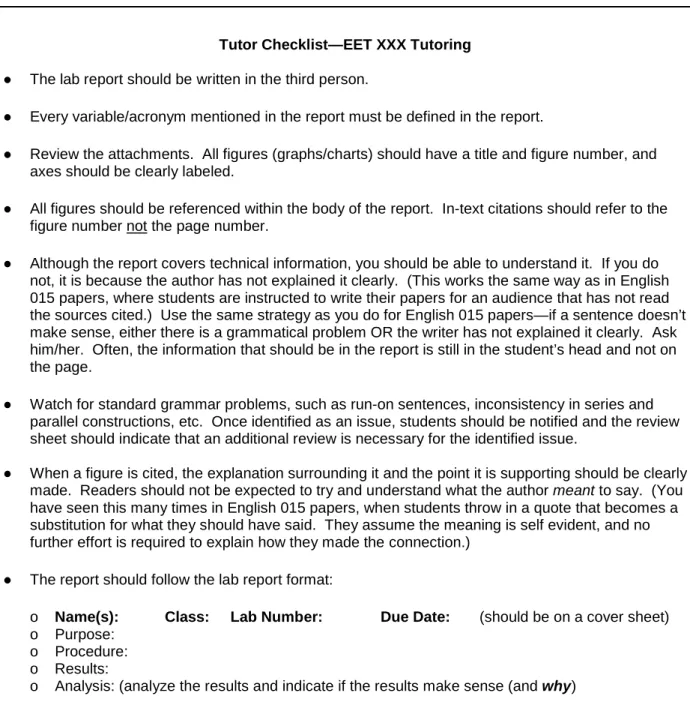
Further discussions about the types of problems the instructor was seeing in the lab reports led to an important discovery. Since the tutor supervisor periodically teaches an FYC course, she recognized the similarity between the problems in the lab reports and the problems routinely seen in FYC papers. Therefore, theoretically, the tutors should be able to adapt their experience in tutoring FYC essays to the lab report. The instructor and tutor supervisor decided that a checklist of elements for tutors to review with students during the tutoring session would be beneficial. That checklist is provided in Fig. 2.
Although the checklist touches on elements specific to technical reports and makes comparisons between the report and tutors’ experience with FYC papers, it does not provide tutors with a lay person’s understanding of the assignment. Neither does it provide a clear, complete example of the conventions for a lab report or demonstrate how to apply the writing principles that tutors learned in FYC and developed through tutoring. The discovery of these missing pieces—which are suggested by research in writing in the disciplines (WID), genre theory, and knowledge transfer—led to the second milestone, the development of the training session, including timing, content, and delivery.
Milestone II: Designing and Conducting the Training Session We decided that training would be held two weeks prior to tutoring to ensure that the information remains fresh in the tutors’ minds and gives them enough time to review materials provided during training. The training is
supervisor, who identifies the areas where the tutors’ experience with FYC papers applies to the engineering report.
For the assignment, students are given a simple electrical circuit, which they are to analyze using three different approaches: they do a mathematical analysis, perform a computer simulation, and physically build the circuit. They have to present and compare all three sets of results in their reports.
The Training Session First, the instructor gives an overview of the learning outcomes, distributes a copy of the assignment, and displays examples of well-written and poorly-written lab reports to illustrate key points and frame the tutors’ role.
The lab report is divided into four sections: purpose, procedure, results, and analysis. In the purpose and procedure sections, tutors are advised that their primary role is to focus on style, grammar, and organization. They are also told to ask questions if they cannot follow students’ logic. This approach helps students realize when they have not clearly defined their purpose or accurately described their procedures. At this point, the supervisor demonstrates how these types of errors parallel those that tutors commonly see in FYC papers. For example, an unclear
purpose section is comparable to the lack of a thesis statement, which is intended to define the argument that a student will make in the paper.
The procedure section must provide a detailed set of instructions that the student followed to generate data. It includes constructing circuits, using simulation software to recreate an electrical circuit on a computer, and using mathematical analysis to generate a transfer function for the system. Different results can be obtained from the transfer function, including the order of the system and the expected damping. Tutors are given a glossary of technical terms, as familiarity
with the terminology helps them recognize whether any confusion that they experience is due to poor writing rather than their lack of technical background.
For the results section, tutors are shown tables of values and charts that illustrate the various types of damping and the rise and settling times of the circuit response. Tutors will then be able to ensure that the students’ prose matches their data. Proper formatting conventions are
reviewed. Tutors are advised that in well-written reports lab results obtained with different methods are amalgamated to allow for easy comparison by the reader.
The instructor highlights the persuasive nature of the analysis section. Tutors are told that they are not responsible for validatingresults. They should focus on how the prose explains and is supported by the results. The supervisor gives specific examples of how the feedback that tutors give FYC students applies to the lab reports. For example, FYC students frequently use quotes to support their arguments without an introductory explanation, as if the way a quotation supports their argument is self-evident. This problem is similar to that seen in lab reports that contain figures and tables that are not discussed in the analysis. Tutors also check that results from all three methods (mathematical, hardware, simulation) have been referenced and compared. Finally, the instructor outlines the responsibilities of the students.
Tutors are encouraged to ask questions to clarify expectations. The instructor expresses confidence in their ability to provide effective feedback because of their writing skills and tutoring experience. The supervisor reiterates the connections between the tutors’ experience and their role in the assignment.
Milestone III: Data Collection and Analysis The final milestone focuses on collecting and analyzing data from two assessment instruments: a tutor log and student survey. The instructor
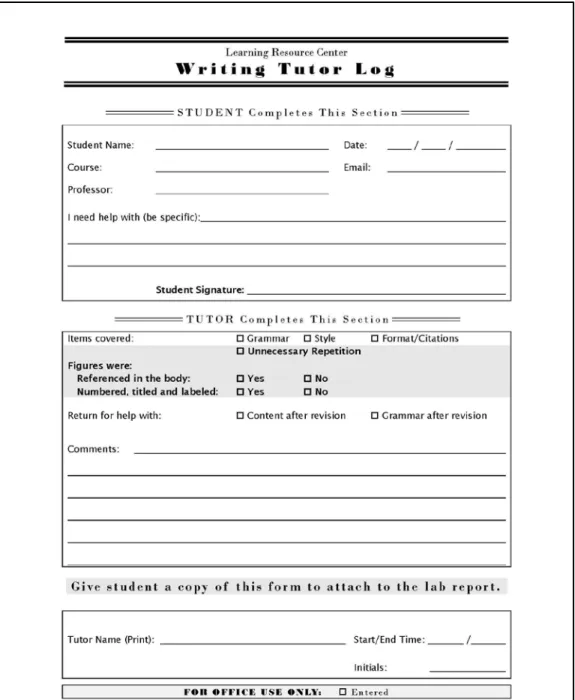
and tutor supervisor were specifically interested in measuring improvement in tutor feedback and collaboration between tutors and students. The standard writing center tutor log was used, with the addition of checkboxes for formatting conventions (see Fig. 3). Additions are highlighted and in bold typeface.
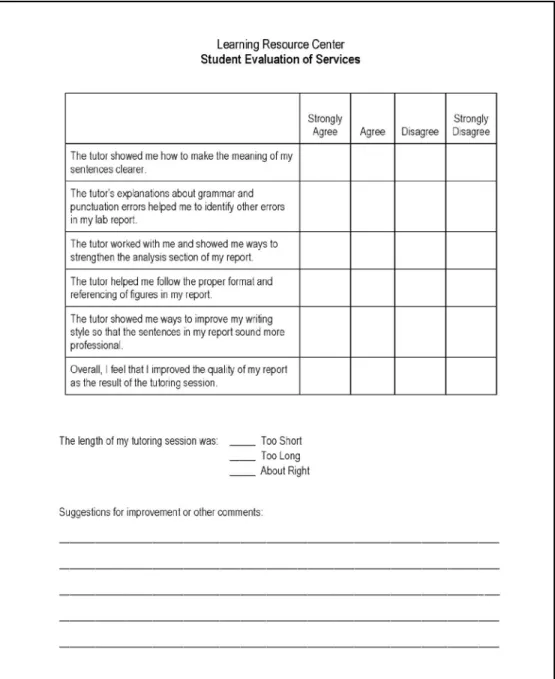
The student survey was created to evaluate both tutoring and student-tutor collaboration; see Fig. 4.
Since the knowledge transfer of rhetorical concepts from FYC courses is important to this method, how the training session meets the five conditions for transfer is outlined as follows:
1. Learner familiarity with the problem domains. The instructor familiarizes the tutors and tutor supervisor with a layman’s understanding of the lab, formatting of the report, and basic definitions of the terminology being used.
2. Examples accompanied with rules, particularly when the latter are formulated by the learners themselves. The instructor uses examples of lab reports of varying quality to train the tutors regarding the conventions of a lab report.
3. Learning that takes place in a social context (e.g., reciprocal teaching), whereby justifications, principles, and explanations are socially fostered, generated, and contrasted. The tutors meet with the instructor and tutor supervisor in a collaborative group environment. Tutors are able to ask questions to clarify expectations, better understand the assignment, and challenge statements made by the instructor or
supervisor. Interactions between the instructor and supervisor provide examples of how principles are applied.
4. Showing learners how problems resemble each other. The supervisor notes
similarities in feedback that tutors give on FYC papers and the feedback that they should give on the lab reports.
5. Directing learners’ attention to the underlying goal structure of comparable problems. Students in the college’s FYC courses learn how to structure an academic research paper. This learning involves comparing sources in ways that are similar to the comparison of results in the engineering lab report. Similarity between other structures is noted. Most importantly, the persuasive nature of an FYC paper and the lab report is emphasized.
SITUATING THE CASE
This case is positioned within the broad literature of peer tutoring, WID, genre theory, and knowledge transfer. Knowledge regarding peer tutoring was necessary to understand why the tutors were ineffective. Background on WID and genre theory helped to determine the content of the training. Knowledge-transfer theory provided the theoretical framework and shaped the format of the training.
How the Literature was Selected Literature in the use of generalist and specialist tutors was studied to fully delineate the problem. WID and genre theory informed the practical aspects of the training, particularly the level of engineering faculty involvement necessary. We sought literature on knowledge transfer because we discovered that many of the writing problems that we identified in the lab reports dealt with concepts that are taught in FYC courses. Since papers from FYC courses comprise the majority of tutoring that the writing center tutors do, training
based on knowledge-transfer principles enables them to more readily adapt their existing knowledge and experience to lab reports.
Peer Tutoring In this teaching case, the tutors are knowledgeable about writing but not about writing in the technical discipline. Dinitz and Harrington [15, p. 95] identify the negative effects that this fact has on the quality and effectiveness of the tutoring session, particularly tutors’ lack of confidence to ask questions and challenge writers’ points of view. However, they add that tutors could be trained “to be helpful even when they lack disciplinary expertise” and “gain the confidence to be more assertive in these sessions.”
Kiedaisch and Dinitz [16, pp. 72-73] hypothesize about turning “generalist tutors into
knowledgeable tutors through a series of training sessions.” Both Mackiewicz [6] and Hughes [13, p. 226] propose that tutors can be trained to provide effective feedback on technical documents. Hughes suggests that instructors and writing centers form partnerships that would “provide a better understanding of the needs of this population and how the writing center can offer support for those students.” She notes [13, p. 231] that faculty could give tutors “better insight on their unique assignment expectations.”
Writing in the Discipline (WID) and Genre Theory WID focuses on the writing conventions of a discipline and how disciplinary knowledge shapes them. As noted by The WAC
Clearinghouse [17], “the engineering lab report includes much different information in a quite different format from the annual business report.” WID provides methods for procedural writing within an organized structure that has been codified over time [18]. Therefore, the authors decided that the conventions for the lab report were an important component of the training.
Gordon [19] provides a general overview of genre theory with a view to how tutors might use it while tutoring. However, during the training, it is the engineering instructor who is using genre theory to teach the tutors, thereby including them in the discourse community of engineers. The instructor helps the tutors to see how their work contributes to that group and to recognize their power within the tutoring session.
Knowledge Transfer Knowledge transfer is the ability to apply knowledge learned in one situation to a different circumstance. The conditions for knowledge transfer that are identified by Perkins and Salomon [20], based on research by Brown and Kane [21], were essential to creating the training session.
Mark Blaauw-Hara, who examined the research of several authors in addition to his own work in applying knowledge-transfer theory via curricular change to an FYC course, comments that finding “an application that works has proven elusive” [22, p. 355]. Blaauw-Hara was teaching new writers to adapt the rhetorical principles that they were learning to future assignments. He included sample assignments from a business and science course to provide the bridge. In our study, tutors have already mastered those rhetorical principles and analytically applied them through their prior tutoring. What is new is adapting the tutors’ experience to the lab report. Blaauw-Hara provides evidence that transfer of writing principles taught in an FYC course to engineering assignments is possible. He cites a study by Teresa Thonney of 24 research articles written in six disciplines from business, science, the humanities, medicine, and engineering. Thonney’s evidence suggests that identifiable patterns exist across disciplines. Blaauw-Hara notes that her research was supported by Christopher R. Wolfe, who analyzed 265 undergraduate writing assignments and noted that 59 percent required argumentation.
Adler-Kassner, Majewski, and Koshnick [23] provide additional insight into how to structure the process. Their study involves the transfer of concepts from writing to history. They indicate that genre and context are critical to understanding how to create a document in the target discipline. They also note that the interpretation and comprehension of a document depends upon the expectations of the audience (in our case the tutors), especially their expectations of conventions and standards. Therefore, it is important for both genre and context to be covered in the training. Hill [24] reinforces the importance of tutors’ understanding of the genre in which they are
tutoring. Her study focuses on training tutors to use knowledge-transfer principles when tutoring and was insightful in considering future research.
She also references another condition that facilitates transfer which is present in the authors’ method—a high level of initial learning, which the tutors possess as a result of their experience. METHODS/APPROACH
This teaching case is guided by our research question:
RQ: Can interdisciplinary training overcome the limitations of peer writing tutors without technical backgrounds and improve their feedback on technical documents? This is an experiential research project. This section describes participants, data collection and analysis, and how credibility and trustworthiness were assured.
Selection of a Research Methodology This project began with the instructor’s desire to improve the writing skills of engineering students by using tutors. The research data is primarily qualitative due to the nature of the study, the small sample sizes, and the fact that the instruments
were not designed to be statistically robust. Limited quantitative data supports the qualitative results. Qualitative data were collected from students via a survey, since their evaluation of the success or failure of the tutoring session and the reasoning behind it are essential not just to measure effectiveness, but to determine any negative underlying factors. The quantitative data were collected from a log submitted by the tutor immediately after the tutoring session. It includes information about session length and the tutor’s written comments, which were coded. These data are a measure of the scope and depth of the content of the tutoring session.
Participants Participants were tutors and students in the course. Employment criteria for all writing center tutors were a minimum cumulative GPA of 3.0, two faculty recommendations, and a critical writing sample. Additional selection criteria for tutors in this study were a minimum of one semester of tutoring experience, an interest in tutoring technical writing, and attendance at the training session.
Students were junior-level Electrical and Computer Engineering Technology majors who had completed their general-education composition courses. The tutoring session was mandatory. The researchers’ Office for Research Protections determined that this project did not meet the definition of Human Participant Research, as defined by the US Department of Health and Human Services regulations.
How Data Were Collected Two paper forms were used: a session tutoring log and a student survey. The log provides an overview of the interaction between the tutor and student during the tutoring session, as well as session length. The student survey provides the student’s evaluation of the tutoring session and includes specific, global and open-ended questions. The completion of a one-page log is standard procedure for all tutoring contacts. When students arrive, they are
asked to complete the top portion, which identifies the student and course, and asks for a succinct description of the reason for the visit to guide the tutor.
The tutor completes the remainder. There are several checkboxes so that tutors do not waste time commenting on routine matters such as grammar and formatting. Two additional checkboxes added for this assignment address conventions of lab reports. Space for detailed comments is provided and is primarily used to cover content issues—organization, argument, and the degree to which the paper fulfills the assignment’s basic criteria. Start and end times are completed and initialed by the tutor. Students were required to submit a copy of the log with their reports, and tutors gave them copies at the end of their sessions.
The student survey is a one-page, anonymous evaluation of the tutor that includes specific and open-ended questions to provide quantitative and qualitative data. The researchers felt that anonymity and brevity would result in candor and a greater number of complete responses. Surveys were collected after the reports were submitted, but prior to grading. For the first two years, students submitted the survey electronically. In 2014, a paper survey was administered by the tutor supervisor.
How the Data Were Analyzed The researchers coded the narrative comments on the logs for grammar, formatting, style, and content to assess the quality and scope of the feedback. The student survey contains complementary questions about the same areas. The tutor logs and student surveys were analyzed comparatively to determine whether data from the logs were supported by student perceptions of the sessions.
• The narrative comments on grammar indicate that specific explanations about grammar errors and remediation took place.
• Since familiarity with the genre was incorporated into the training, formatting comments provide a measure of the tutor’s understanding of the genre.
• Comments on style improve the readability of a paper and demonstrate some understanding of the content.
• Comments on content relate to the strength of a student’s argument and demonstrate the desired knowledge transfer.
• The length of the sessions was calculated as a measure of collaboration between tutors and students.
By collecting and analyzing these data, the authors were able to ascertain whether the feedback provided by the tutors was both relevant and appropriate to the assignment, and therefore demonstrate that tutors without knowledge in engineering can be trained to provide effective feedback to engineering students on technical documents.
Assuring Credibility and Trustworthiness Tutors were unaware that they were taking part in a research project. Tutoring sessions were not monitored. Both students and tutors signed the logs. Also, the different backgrounds of tutors and students, as well as differences in semester
standing, made it unlikely that they knew each other. The student survey was elective and known not to be part of the grade.
RESULTS/DISCUSSION
Dinitz and Harrington [15] note that a lack of disciplinary knowledge affects tutors’ ability to ask questions or challenge writers, and we saw clear evidence of that problem prior to implementing
the training. So we sought data that could measure improvement in tutor confidence. The length of a tutoring session is a valuable indicator since it is negotiated between the student and tutor. If a tutor has few comments to make or if a student is uncooperative, the session ends quickly. Also, this indicator complements the other data that we collected because its value is an interval of time and therefore not subject to the interpretation of responders, e.g., individual differences between perceptions of strongly agree and agree [25].
Average and median lengths increased significantly in 2012, the year that the training was initiated. Previously, students left as soon as possible because they did not see the value of working with a tutor without an engineering background. Sessions were short in 2013 because students came for tutoring with incomplete reports, and there was little for tutors to review. This problem was remedied in 2014, when tutors were advised not to tutor students with incomplete reports, and students were informed of that fact by the instructor. A comparison of the average length of tutoring sessions can be seen in Table II.
Verification that students did not feel compelled to stay in the sessions can be seen in the results of the student survey (see Table III). The session time was considered “about right” by the majority of students.
A number of authors suggest that tutors could be trained to provide effective feedback. Hughes [13] in particular proposes a partnership of the type described in this paper, between a faculty member and the writing center. She notes that an important feature of that collaboration is the insight that an instructor provides to tutors about assignment expectations, which is at the heart of our training session. The logs also provide data to determine the impact that the training had on the tutors. The dramatic increase in logs with detailed comments and the number of comments
(see Table II) points to the improved ability of the tutors to effectively and confidently assess the written elements of the reports. The percentage of logs with comments rose from 20% in 2011 to 100% in the years after the training was implemented. The same is true of the average number of comments on the logs, which rose from 0.4 comments/student in 2011 to 2.67 comments/student in 2014.
The impact of including in the training materials that were chosen in accordance with WID and genre theory was measured by the number of detailed comments about formatting conventions. Their number also increased significantly and can be seen in the representative comments that follow.
Content-related comments are also an important measure of knowledge transfer because they reveal the tutors’ ability to understand and provide feedback on the report. Tutors working with FYC students always focus on a paper’s argument and its validity. Grammar and style are secondary. Prior to the training, tutors did the opposite when reviewing lab reports. Their ability to transfer their expertise is revealed by the number and quality of content-related comments they make. Total comments were higher than the base year of 2011 in all years when the training took place (see Table II). Representative comments from the logs are listed below:
I also advised him to add explanations to his figures so that the reader could understand the purpose of the graphs.
He needs to do a little more defending in his analysis, but he had good information. You need to include a lot more explanation within your analysis section. Last, make sure you’re referencing your figures, especially in your analysis.
In addition, the tutors were very positive about their experiences with the students. This evidence supports Gordon’s [19] view about the impact of genre theory. The training showed the tutors the value of their contribution and enabled them to recognize their power within the tutoring session. All the tutors who participated in 2012 also attended the training in 2013. The training was voluntary, but only tutors who attended the training could tutor the engineering students. The tutors were also very interested in more training on tutoring technical documents and suggested that it be offered as a course.
Blaauw-Hara used knowledge-transfer theory in an FYC course and incorporated sample assignments from business and science courses to provide a bridge. We echoed that approach, the difference being the expertise that tutors develop by working primarily with students in FYC courses. Our bridge was the engineering assignment. Blaauw-Hara [22] supports this approach by pointing to Thonney’s research, which suggests that identifiable patterns exist across disciplines. These patterns can be seen in the questions in Table III, which contains the student survey results. (In 2011, prior to the training, the survey was not administered.)
With the exception of the question about the referencing of figures, these questions could be asked of a student from any discipline who has had writing tutoring. The same is true of the formatting part of that question, since need for proper format is ubiquitous across disciplines. Overall, the majority of the responses were positive, indicating strong agreement or agreement with the combined stated objectives—89.6% in 2012, 91.7% in 2013, and 92.6% in 2014. Positive responses to question three, regarding the analysis section of the report, gradually improved from 62.5% in 2012, to 91.7% in 2013, and finally to 100% in 2014. The vast majority of students in all three years felt that tutoring helped them improve the clarity, grammar, style,
professionalism, and overall quality of their reports. There was also a perceivable shift in the value of writing tutoring, as noted by the following responses to a request for additional comments on the survey:
The tutors acted very professional and even though I originally thought it would be a waste of time, the tutors helped a great deal. [2012]
Aside from just having serious struggles fitting it into my schedule, it was helpful. I wish we had done it earlier in the semester and definitely earlier in the overall curriculum. [2014]
Table IV illustrates the ways that the five conditions for knowledge transfer were met by the training and/or tutoring session and evidence that transfer occurred.
CONCLUSIONS
The goal of this project was to improve writing tutoring support for engineering students using an existing, low-cost resource. Interdisciplinary collaboration that provides experienced tutors with additional training regarding the assignment, common student errors, clear expectations about the feedback they are to provide students, and ways to adapt their expertise to writing in a technical discipline have produced encouraging results towards that goal and are supported by other research noted earlier. Overall, the investigators believe that the results are very promising. Overcoming the problems associated with using writing tutors without technical backgrounds is essential, since it is extremely difficult to recruit engineering students to become writing tutors. The college’s writing center actively recruits writing tutors from all majors and has regularly
employed writing tutors from the sciences and business as well as the humanities. However, it has been able to recruit only one engineering student to tutor writing in the past 15 years. The authors believe that this method can be replicated at other institutions. The approach outlined was implemented with individual reports, and therefore can be employed for courses with smaller sections (under 25 students). For larger courses, implementation may need to be adapted as individual tutoring sessions could overwhelm the writing center. The method has yet to be thoroughly tested for viability on team projects, which, if successful, would greatly expand its applicability to larger courses. However, an initial test was conducted in one academic
program that uses only team reports, and the results were promising. Further research is planned. In conclusion, improved collaboration between engineering students and peer writing tutors has the potential both to change students’ misconception that the thinking, organization, and
communication skills required to write lab reports are not related to the technical mastery
required to complete the lab, as well as to make students realize that accurate, quality writing is a critical-thinking, transferrable skill that is essential to most professional occupations.
Limitations One of the limitations of the research is its sample size. Upper-level engineering lab courses at the college are small, making it impossible to significantly increase sample size at this institution. However, the research was conducted consistently over three years with similar results in the number of comments on the logs, the increased length of the sessions, and the overall evaluation by the students. Other limitations noted are the lack of an in-depth analysis of the effectiveness of the feedback from the tutors and the fact that the research focused only on individual reports. This project did not measure whether or not students’ writing skills or
understanding of engineering principles improved as a result of the tutoring, as that is outside its scope.
Suggestions for Future Research Currently, knowledge transfer regarding writing skills
learned in FYC courses was applied only in tutor training. Collaboration with FYC courses could expand it to include students and could help to dispel students’ perception that in English
courses, as one engineering student in Bergmann and Zepernick’s [26, p. 132] study commented, “You entertain. You look for flow and variety.” The same student stated that when writing for disciplinary courses, “what you want is to get ideas across.”
If the writing center trained tutors to use knowledge-transfer theory, tutors would reinforce the efforts of the collaboration between FYC instructors and engineering faculty by facilitating knowledge transfer for the students.
Preparation of the engineering students for the tutoring session can also be explored. To ensure that the engineering students understand their role in the tutoring session, the investigators intend to meet with the students and “train” them for the tutoring session. This training would involve explaining the roles and responsibilities of the tutor, and conveying to the students how the tutors provide both a strong persuasive writing background, as well as a non-technical viewpoint that will help strengthen their writing skills by requiring them to explain concepts to a nontechnical audience.
Finally, the method should be studied with group assignments. Additional research on implementation using team-based reports may enable replication in courses with larger enrollments.
ACKNOWLEDGEMENT
The authors would like to thank Dr. Carolyn Labun of the University of British Columbia for her valuable insight and editorial expertise in the shaping of this manuscript.
REFERENCES
[1] Accreditation Board for Engineering and Technology. [Online]. Available: http://www.abet.org
[2] J. Passow, “Which ABET competencies do engineering graduates find most important in their work?” J. Eng. Educ., vol. 101, no. 1, pp. 95–118, 2012.
[3] J. Lievens, “Debunking the ‘nerd’myth: Doing action research with first-year engineering students in the academic writing class,” Journal of Academic Writing, vol. 2, no. 1, pp. 74-84, 2012.
[4] J. Craig, N. Lerner, and M. Poe, “Innovation across the curriculum: Three case studies in teaching science and engineering communication,” IEEE Trans. Prof. Commun., vol. 51, no. 3, pp. 280-301, 2008.
[5] W. Zhu, “Faculty views on the importance of writing, the nature of academic writing, and teaching and responding to writing in the disciplines,” J. Second. Lang. Writ., vol. 13, pp. 29-48, 2004.
[6] J. Mackiewicz, “The effects of tutor expertise in engineering writing: a linguistic analysis of writing tutors’ comments,” IEEE Trans. Prof. Commun., vol. 47, no. 4, pp. 316-328, 2004.
[7] L. Reave, “Technical communication instruction in engineering schools: A survey of top-ranked US and Canadian programs,” J. Bus. Tech. Commun., vol. 18, no. 4, pp. 452-490, 2004.
[8] S. M. Hubbuch, “A tutor needs to know the subject matter to help a student with a paper: [] agree [] disagree [] not sure,” Writing Center Journal, vol. 8, no. 2, pp. 23-30, 1988. [9] L. J. Black, Between Talk and Teaching: Reconsidering the Writing Conference. Boulder,
CO, USA: Utah State University Press, 1998.
[10] M. D. Patton, Writing in the Research University: A Darwinian Study of WID with Cases from Civil Engineering. New York, NY, USA: Hampton Press, 2010.
[11] D. Hounsell, “Contrasting conceptions of essay-writing,” in The Experience of Learning: Implications for Teaching and Studying in Higher Education. 2nd ed.F. Marton, D. Hounsell, N., J. Entwistle, Eds. Edinburgh, UK: Scottish Academic Press, 1997, pp. 106-125.
[12] J. A. Donnell, J. Petraglia-Bahri and A. C. Gable. “Writing vs. content, skills vs. rhetoric: More and less false dichotomies,” Language and Learning Across the Disciplines, vol. 3, no. 2, pp. 113-117, 1999.
[13] L. R. Hughes, “Tutoring technical documents in the writing center: implications for tutor training and practices,” Ph.D. dissertation, Texas Tech Univ., Lubbock, TX, USA, 2009.
[14] G. Nelms and R. L. Dively, “Perceived roadblocks to transferring knowledge from first-year composition to writing-intensive major courses: A pilot study,” WPA: Writing Program Administration, vol. 31, no. 1-2, pp. 214 – 240, 2007.
[15] S. Dinitz and S. Harrington, “The role of disciplinary expertise in shaping writing tutorials,” The Writing Center Journal, vol. 33, no. 2, pp. 73 – 98, 2014.
[16] J. Kiedaisch and S. Dinitz, “Look back and say ‘so what’: The limitations of the generalist tutor,” The Writing Center Journal, vol. 14, no. 1, pp. 63-74, 1993. [17] What is Writing in the Disciplines? The WAC Clearing House. [Online]. Available:
http://wac.colostate.edu/intro/pop2e.cfm
[18] C. Michael, “Ways of knowing, doing, and writing in the disciplines,” College Composition and Communication, vol. 58, no. 3, pp. 385-418, 2007.
[19] L. Gordon, “Beyond generalist vs. specialist: Making connections between genre theory and writing center pedagogy,” Praxis: A Writing Center Journal, vol.11, no. 2, pp. 35-39, 2014.
[20] D. N. Perkins and G. Salomon, “Are cognitive skills context-bound?” Educational Researcher, vol. 18, no. 1, pp. 16-25, 1989.
[21] A. L. Brown and M. J. Kane, “Preschool children can learn to transfer: Learning to learn and learning from example,” Cognitive Psychology, vol. 20, no. 4, pp. 493-523, 1988.
[22] M. Blaauw-Hara, “Transfer theory, threshold concepts, and first-year composition: Connecting writing courses to the rest of the college,” Teaching English in the Two Year College, vol. 41, no. 4, pp. 354 – 365, 2014.
[23] L. Adler-Kassner, J. Majewski and D. Koshnick, “The value of troublesome knowledge: transfer and threshold concepts in writing and history,” Composition Forum, vol. 26, 2012.
[24] H. Hill, “Tutoring for Transfer: The benefits of teaching writing center tutors about transfer theory,” The Writing Center Journal, vol. 35, no 3, pp. 77-102, 2016.
[25] J. W. Bowers, Communication Research Methods. Glenview, IL, USA: Scott, Foresman, 1984.
[26] L. S. Bergmann and J. Zepernick, “Disciplinarity and transfer: Students’ perceptions of learning to write,” WPA: Writing Program Administration, vol. 31, no. 1-2, pp. 124 – 149, 2007.
Robert Weissbach received his Ph.D. in Electrical Engineering from Arizona State University in 1998. He is currently the chair of the Department of Engineering Technology at Indiana University – Purdue University Indianapolis. Previously, he was an associate professor of Engineering at Penn State Behrend and has also worked on the design and testing of submarine turbine generator sets for General Dynamics Electric Boat Division. His research interests include renewable energy, energy storage, and engineering education. Ruth C. Pflueger received the M.F.A. degree in Creative Writing from Goddard College,
is the director of the Learning Resource Center and an adjunct instructor of English at Penn State Erie, The Behrend College. Her research interests focus on improving the efficacy of tutoring services, particularly in writing. She has been an investigator on two NSF-STEM grants.
Practitioner Takeaway
• Faculty members lack time and lack expertise to provide writing feedback on lab reports, but
sending students to a writing center could fill that gap.
• To enable tutors to provide helpful feedback, an interdisciplinary training method was
developed collaboratively by an engineering professor and the writing center director.
• Tutor feedback and student satisfaction significantly improved, though a few students who
were satisfied overall still expressed interest in having their reports reviewed by a tutor with a technical background.
Note: This table (without a table number or call-out in the text) always appears across both columns at the top of page 2 of the article.
TABLE I
FACTS ABOUT THE SOLUTION
Budget No special funds were allocated. Existing resources were used for training and
tutoring. Development of the method was part of the regular responsibilities of the faculty member and tutor supervisor.
Length of Project
The method was part of the course design, which began several months prior to the course. Key factors included identification of tutors, compilation of training materials, and assignment selection. Preparation and scheduling of the training session began one week prior to the assignment of the lab report. The project was complete when survey results were analyzed at the end of the semester.
Assignment Selection
The assignment contained enough technical material to force students to effectively explain technical concepts, but was not too demanding—allowing students to focus more of their energies on how they structured their reports.
Instructor and Tutor
Supervisor Hours
Instructor time included 30 minutes to prepare training materials and one hour for the training session. Approximately 30-45 minutes was required to grade each additional report since individual rather than group reports were assigned. Approximately two hours were devoted to generating survey instruments by the instructor and tutor supervisor, along with approximately three hours of compilation and analysis of data by the tutor supervisor.
Tutor Hours Additional time included the 1-hour training session, 30 minutes to review
materials prior to the time window for tutoring sessions, and 30-60 minutes for each tutoring session.
Collaborate with Writing Center for assignment-specific writing tutoring
Design training, including content, supplementary materials, and assessment Conduct assessment and analyze results
Tutor Checklist—EET XXX Tutoring
● The lab report should be written in the third person.
● Every variable/acronym mentioned in the report must be defined in the report.
● Review the attachments. All figures (graphs/charts) should have a title and figure number, and
axes should be clearly labeled.
● All figures should be referenced within the body of the report. In-text citations should refer to the
figure number not the page number.
● Although the report covers technical information, you should be able to understand it. If you do
not, it is because the author has not explained it clearly. (This works the same way as in English 015 papers, where students are instructed to write their papers for an audience that has not read the sources cited.) Use the same strategy as you do for English 015 papers—if a sentence doesn’t make sense, either there is a grammatical problem OR the writer has not explained it clearly. Ask him/her. Often, the information that should be in the report is still in the student’s head and not on the page.
● Watch for standard grammar problems, such as run-on sentences, inconsistency in series and
parallel constructions, etc. Once identified as an issue, students should be notified and the review sheet should indicate that an additional review is necessary for the identified issue.
● When a figure is cited, the explanation surrounding it and the point it is supporting should be clearly
made. Readers should not be expected to try and understand what the author meant to say. (You
have seen this many times in English 015 papers, when students throw in a quote that becomes a substitution for what they should have said. They assume the meaning is self evident, and no further effort is required to explain how they made the connection.)
● The report should follow the lab report format:
o Name(s): Class: Lab Number: Due Date: (should be on a cover sheet)
o Purpose: o Procedure: o Results:
o Analysis: (analyze the results and indicate if the results make sense (and why)
Fig. 2. Tutor checklist.
TABLE II
DATA COLLECTED FROM LOGS OF TUTORING SESSIONS
Tutoring Sessions Spring 2011* Spring 2012 Spring 2013 Spring 2014
Total Students Tutored 20 17 13 9
Average Appointment Length
(minutes) 27 45 29 35
Median Appointment Length
(minutes) 25 55 30 37
Logs with Detailed Comments 4 17 13 9
• Grammar 4 12 8 3
• Formatting Conventions 1 10 8 9
• Content 3 8 16 6
• Style 0 5 2 6
TABLE III
ENGINEERING STUDENT SURVEY RESULTS
Stated Objectives 2012 2013 2014
SA A D SD SA A D SD SA A D SD
The tutor showed me how to make the meaning of my sentences clearer.
4 11 1 0 4 8 0 0 2 6 1 0
The tutor’s explanations about grammar and punctuation errors helped me to identify other errors in my lab report.
7 9 0 0 5 6 1 0 5 3 1 0
The tutor worked with me and showed me ways to strengthen the analysis section of my report.
3 7 6 0 4 7 1 0 4 5 0 0
The tutor helped me follow the proper format and referencing of figures in my report.
5 10 1 0 8 4 0 0 4 5 0 0
The tutor showed me ways to improve my writing style so that the sentences in my report sound more professional.
5 9 2 0 3 6 3 0 2 5 2 0
Overall, I feel that I improved the quality of my report as the result of the tutoring session.
10 6 0 0 3 8 1 0 3 6 0 0
TOTAL 34 52 10 0 27 39 6 0 20 30 4 0
SA = Strongly Agree; A = Agree; D = Disagree; SD = Strongly Disagree
Length of Tutoring Session Short About Right Long
2012 1 14 1
2013 0 12 0
TABLE IV
APPLICATION OF KNOWLEDGE TRANSFER PRINCIPLES AND EVIDENCE OF TRANSFER
Knowledge Transfer Condition Application in Training Session Application in Tutoring Session Evidence of Transfer Learner familiarity with problem domains Instruction on engineering concepts employed in lab Tutors given a glossary of technical terms
Increased number of comments on content
Examples
accompanied with rules
Use of sample lab reports
Handout on formatting Tutor Checklist
Increased number of comments on formatting
Learning in a social context
Q&A between tutors and trainers
Students giving further explanation on engineering concepts to tutors
Increased average length of a tutoring session
Tutors providing adapted writing feedback to students
Increased perceived value of writing tutoring by students Showing learners how problems resemble each other Instruction on application of previous tutoring experience on FYC papers to lab report
Increased number of detailed comments in multiple areas due to improved tutor ability to identify when problems were related to writing rather than assume that they could not understand a report because they were unfamiliar with the engineering concepts
Directing learner’s attention to underlying goal structures
Instruction emphasized the persuasive nature of the analysis portion of lab report
81% of students indicated that the tutor “showed me ways to strengthen the analysis section of my report”