
IMPROVING SOFTWARE SECURITY
WITH
PRECISE STATIC AND RUNTIME ANALYSIS
A DISSERTATION
SUBMITTED TO THE DEPARTMENT OF COMPUTER SCIENCE
AND THE COMMITTEE ON GRADUATE STUDIES
OF STANFORD UNIVERSITY
IN PARTIAL FULFILLMENT OF THE REQUIREMENTS
FOR THE DEGREE OF
DOCTOR OF PHILOSOPHY
Benjamin Livshits December, 2006
c
Copyright by Benjamin Livshits 2006
All Rights Reserved
I certify that I have read this dissertation and that, in my opinion, it is fully adequate in scope and quality as a dissertation for the degree of Doctor of Philosophy.
(Monica S. Lam) Principal Adviser
I certify that I have read this dissertation and that, in my opinion, it is fully adequate in scope and quality as a dissertation for the degree of Doctor of Philosophy.
(Alexander Aiken)
I certify that I have read this dissertation and that, in my opinion, it is fully adequate in scope and quality as a dissertation for the degree of Doctor of Philosophy.
(Dawson Engler)
Approved for the University Committee on Graduate Studies.
Abstract
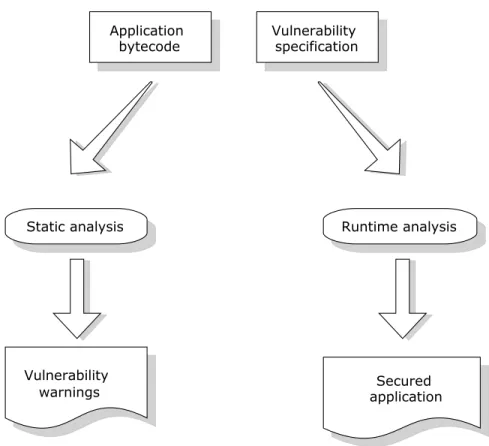
The landscape of security vulnerabilities has changed dramatically in the last sev-eral years. While buffer overruns and format string violations accounted for a large fraction of all exploited vulnerabilities in the 1990s, the picture started to change in the first decade of the new millennium. As Web-based applications became more prominent, familiar buffer overruns are now far outnumbered by Web application vulnerabilities such as SQL injections and cross-site scripting attacks. These vulner-abilities have been responsible for a multitude of attacks against large e-commerce sites, financial institutions and other sites, leading to millions of dollars in damages. In this thesis, we describe the Griffin project, which provides a comprehensive static and runtime compiler-based solution to a wide range of Web application vul-nerabilities. Our approach targets large real-life Web-based Java applications. Given a vulnerability description a static code checker is generated. The checker statically analyzes the code and produces vulnerability warnings. Alternatively, a specially in-strumented, secured version of the original application bytecode is produced, which can be deployed on a standard application server alongside other applications.
To make our approach to vulnerability detection and prevention both extensible and user-friendly, vulnerability specifications are expressed in PQL, a Program Query Language. The initial PQL vulnerability specification is provided by the user, but the majority of the specification can be shared among multiple applications being analyzed. This is because most of the PQL specification is specific to the framework being used, such as Java J2EE, rather than the application.
The static checker generated based on the PQL specification finds vulnerabilities by analyzing the Web-based applications. The static approach is sound, which ensures that it finds all vulnerabilities captured by the specification in the statically analyzed
code. We evaluate analysis features such as context-, object- and map sensitivity that help keep the number of false positives low.
Modern Java applications make an extensive use of runtime reflection; this is especially common in extensible applications that support plugins and extensions. Being oblivious to reflection in the process of call graph construction leads to large portions of the application being ignored. This thesis describes the first call graph construction algorithm to explicitly address the issue of reflection. When reflection
is taken into account by our approach, the size of the resulting application call graph often increases many-fold.
Conservative static analysis provides an over-approximation of runtime behavior. As such, it is impossible to have a conservative static solution that is completely free of false positives, despite our efforts to improve static analysis precision. Therefore, as an alternative to static analysis, secured application executables can be automatically generated based on the same PQL vulnerability specification. As an alternative to terminating the Web application whenever an exploit is detected, vulnerability recov-ery rules may be provided as part of the PQL specification. Recovrecov-ery allows injecting security into existing applications without sacrificing application availability. Finally, we show how static analysis can be used to significantly reduce the instrumentation overhead required for runtime protection.
Our experimental results show that Griffin provides effective and practical tools for finding and preventing security vulnerabilities. We were able to find a total of 98 security errors, and all but one of our 11 large real-life benchmark applications were vulnerable. Two vulnerabilities were located in commonly used libraries, thus subject-ing applications ussubject-ing the libraries to potential vulnerabilities. Most of the security errors we reported were confirmed as exploitable vulnerabilities by their maintainers, resulting in more than a dozen code fixes. The static analysis reported false positives for only one of 11 applications we have analyzed. While the runtime overhead can be quite high for our runtime protection, information we compute statically allows us to reduce the number of necessary instrumentation points dramatically, reducing the dynamic overhead to below 10% in the majority of cases. Finally, our runtime system was able to recover from all exploits we performed against it in practice.
Acknowledgments
This thesis would not exist without the help, advice, and encouragement of many people. I thank my advisor, Monica, for giving me the freedom and resources to pursue research that interested and excited me. I learned a great deal from her about how to create the best research I can and how to persevere and not to give up when faced with adversity.
I am also indebted to several people in particular who greatly influenced my research approach style and style. Mooly Sagiv was kind enough to offer me a visiting researcher position at Tel Aviv University, which taught me about choosing good problems to attacks and led me to re-evaluate my research strategy. I am grateful to Alex Aiken for many thought-provoking conversations, which provided an often needed complementary view on my research, program analysis, and the overall field of computer research in general. I learned a great deal about how to pick good problems to work on from Dawson Engler; his research served as an example of how to stay grounded and how seek out problems with real-life visibility and impact while in academia. Finally, I want to thank Andreas Zeller, who was always supportive and upbeat and also encouraging of my work with one of his graduate students, Tom Zimmerman. Working with Tom made my foray into revision history mining both fun and productive [133, 134, 214].
I am grateful to the professors at Stanford who, while not being directly involved in my thesis work, nevertheless influenced me greatly. I want to thanks John Mitchell, who taught me much about teaching and research. His broad theoretical knowledge and a positive, laid-back attitude has always brought a breath of fresh air during the most challenging of times. I was particularly fortunate to TA a compiler course with
Jeff Ullman. While an honor in itself, it proved an invaluable experience. I learned a great deal from his approach to research and life in general. My thanks also go to Wei Li who provided many valuable insights based on his experiences in both the academia and the industry.
Many thanks go to the members of SUIF group at Stanford, who made the lab an exciting place to work, debate, and hang out. So many people enriched my experience. I am also grateful to the previous generation of students in the SUIF group, who taught me so much about systems research and also in terms of strategies for getting things done. I am particularly grateful to David Heine, Brian Murphy, Amer Divan, Michael Martin, Chris Unkel, Ramesh Chandra, and Costa Szapunkakis.
The material in Chapters 2 and 3 is based on “Finding Security Errors in Java Programs with Static Analysis” published in Usenix Security [129,130]. John Whaley and especially Michael Martin contributed greatly to the material described in Chap-ters 4 and 5 and first presented in our joint APLAS and OOPSLA papers, entitled “Reflection Analysis for Java” [131, 132] and “Finding Application Errors and Secu-rity Vulnerabilities Using PQL: a Program Query Language” [140,141], respectively. Runtime translation of PQL queries in Section 5.2 is part of Michael’s contribution and is provided here for completeness reasons.
I am also indebted to John Whaley for building and supporting much of the compiler infrastructure that enabled a significant portion of the research described in this thesis. Other students in the Stanford Computer Science Department often provided a much welcome outlet for thought, worries, and complains. I am especially grateful to Ted Kremenek, Paul Thohey, and Iddo Lev. I also had the fortune of working with and mentoring many wonderful and hard-working master’s students over the last several years, including Ben DeAngelo, Jean-Gabriel Morard, Chang-Seo Park, Will Robinson, and Naeim Semsarilar.
I am grateful to many people in the security community who encouraged this research and provided a great deal of help in its early stages. I am grateful to Brian Chess for turning my attention to the problems of Web application security in early 2004. I thank Amit Klein for reviewing some of my earlier writing and pro-viding detailed clarifications on some of the more obscure security vulnerabilities.
Professor Dan Boneh at Stanford has also been a positive and encouraging influence on my research efforts.
This research was funded in part by the National Science Foundation under grants NSF CCF-0326227 and NSF/UCB CCF-0424422. I am also grateful to the NSF for awarding me with a multi-year Graduate Research Fellowship early in my graduate student career.
I devote a separate paragraph to the dissertation support group run by Ron Burg. I joined the group in late 2004, when my dissertation progress was slow, there was no particularly exciting thesis topic in sight, and the future looked especially bleak. In the group, I was fortunate to find a wonderful close-knit group of folks who were struggling with many of the same issues in their dissertation process. If not for the magic of group support over the subsequent two years, this thesis would most likely not have materialized. I wish you guys the very best!
For me, graduate school was tolerable because I had a group of close friends. Mine were the best: Mark Dilman, Sofya Pogreb, Elena Vileshina, and many others. Finally, I thank my family. To my parents, who were ultimately the people who prepared me for this endeavor. I owe you all my success.
Sonnet
All we need is fourteen lines, well, thirteen now, and after this one just a dozen
to launch a little ship on love’s storm-tossed seas, then only ten more left like rows of beans.
How easily it goes unless you get Elizabethan and insist the iambic bongos must be played and rhymes positioned at the ends of lines, one for every station of the cross.
But hang on here wile we make the turn into the final six where all will be resolved, where longing and heartache will find an end, where Laura will tell Petrarch to put down his pen, take off those crazy medieval tights,
blow out the lights, and come at last to bed.
Griffin Software Security Project
Contents
Abstract v
Acknowledgments vii
1 Introduction 1
1.1 Introduction . . . 1
1.2 Web Application Vulnerability Statistics . . . 4
1.2.1 NIST Study . . . 4
1.2.2 SecurityFocus.com Study . . . 5
1.2.3 Relative Popularity of Java . . . 6
1.2.4 History of Web Application Vulnerabilities . . . 7
1.3 Overview of Web Application Vulnerabilities . . . 8
1.3.1 Categorization of Taint-Style Vulnerabilities . . . 9
1.3.2 SQL Injection Example . . . 10
1.3.3 Injecting Malicious Data . . . 11
1.3.4 Exploiting Unchecked Input . . . 16
1.3.5 Unvalidated Output and Information Leaks . . . 20
1.4 Existing Solutions . . . 20
1.4.1 Client-side Protection. . . 21
1.4.2 Penetration Testing . . . 21
1.4.3 Application Firewalls . . . 22
1.4.4 Code Auditing for Security . . . 23
1.4.5 Griffin Project Scope and Goals . . . 24
1.5 Overview of Our Solution . . . 24
1.5.1 Summary of Thesis Contributions . . . 27
1.6 Thesis Organization. . . 29
2 Analysis Framework 31 2.1 Framework Overview . . . 31
2.1.1 Tainted Object Propagation Problem . . . 33
2.1.2 Derivation and Sanitization Descriptors . . . 34
2.1.3 Security Violations . . . 36
2.1.4 Specifications Completeness . . . 37
2.2 Specifying Vulnerabilities in PQL . . . 38
2.2.1 Simple SQL Injection Query . . . 39
2.2.2 Queries for a Taint Propagation Problem . . . 42
2.3 Static Analysis Overview . . . 44
2.4 Runtime Analysis Overview . . . 45
2.5 Chapter Summary . . . 46
3 Static Analysis 47 3.1 Chapter Overview. . . 47
3.2 Motivating Example . . . 48
3.3 Static Analysis Overview . . . 50
3.3.1 Static Program Representation . . . 51
3.3.2 Role of Pointer Information . . . 53
3.4 Pointer Analysis Precision Improvements . . . 56
3.4.1 Role of Pointer Analysis Precision . . . 56
3.4.2 Role of Context Sensitivity . . . 57
3.4.3 Imprecision of Allocation Site Object Naming . . . 59
3.4.4 Improved Object Naming . . . 63
3.4.5 Improved Handling of Constant-Key Maps . . . 67
3.4.6 Flow and Path Sensitivity . . . 69
3.5 Finding Security Violations Statically . . . 70
3.5.2 Simple SQL Injection Query Translated. . . 72
3.5.3 Systematic Translation from PQL into Datalog . . . 74
3.5.4 Extracting the Relevant Bytecodes . . . 77
3.5.5 Dealing with Sanitizers . . . 81
3.6 Static Analysis Soundness . . . 82
3.6.1 Static Analysis Limitations. . . 82
3.6.2 Troublesome Program Constructs . . . 83
3.7 Static Analysis Coverage . . . 85
3.7.1 Challenges of Call Graph Construction in Web Applications . 85 3.7.2 Finding Call Graph Roots . . . 86
3.7.3 Using a Mock Library . . . 88
3.7.4 Limitations of This Approach . . . 89
3.8 User Interface to Analysis Results . . . 91
3.9 Chapter Summary . . . 92
4 Analysis of Reflection 93 4.1 Introduction . . . 93
4.1.1 Chapter Contributions . . . 97
4.1.2 Chapter Organization. . . 98
4.2 Overview of Reflection in Java . . . 99
4.2.1 Reflection APIs in Java. . . 99
4.3 Use of Reflection: Case Studies . . . 102
4.3.1 Specifying Application Extensions . . . 102
4.3.2 Custom-made Object Serialization Scheme . . . 102
4.3.3 Improving Portability Using Reflection . . . 107
4.3.4 Code Unavailable Until Deployment . . . 108
4.3.5 UsingClass.forName for its Side-effects . . . 108
4.3.6 Getting Around Static Type Checking . . . 109
4.3.7 Providing a Built-in Interpreter . . . 109
4.4 Assumptions About Reflection . . . 109
4.5.1 Call Graph Discovery . . . 112
4.5.2 Pointer Analysis for Reflection . . . 113
4.5.3 Reflection Resolution Using Casts . . . 123
4.6 Experimental Results . . . 126
4.6.1 Experimental Setup. . . 127
4.6.2 Evaluation Approach . . . 127
4.6.3 Local Analysis for Reflection Resolution (Local) . . . 129
4.6.4 Points-to & Reflection Resolution (Points-to) . . . 130
4.6.5 Casts & Reflection Resolution (Casts) . . . 132
4.6.6 A Sound Call Graph Approximation (Sound) . . . 133
4.6.7 Effect of Reflection Resolution on Call Graph Size . . . 137
4.6.8 Running Times . . . 139
4.7 Chapter Summary . . . 140
5 Runtime Analysis 142 5.1 Advantages of the Runtime Approach . . . 142
5.2 Matching PQL Queries at Runtime . . . 144
5.2.1 Translation From Queries To State Machines . . . 144
5.2.2 Instrumenting the Program . . . 147
5.2.3 The Runtime Query Matcher . . . 147
5.3 Translating Vulnerability Queries . . . 149
5.4 Reducing Instrumentation Overhead . . . 151
5.5 Dynamic Recovery from Vulnerabilities . . . 151
5.5.1 Built-in Sanitization . . . 152
5.5.2 Shortcomings of Built-in Sanitizers . . . 153
6 Experimental Results 154 6.1 Experimental Setup . . . 154
6.1.1 SecuriBench Benchmark Applications . . . 155
6.1.2 SecuriBench Micro Benchmarks . . . 159
6.2 Static Analysis Results . . . 163
6.2.2 Summary of Discovered Vulnerabilities . . . 164
6.2.3 Validating the Vulnerabilities . . . 165
6.2.4 Classification of Errors . . . 169
6.3 Discussion of Static Analysis Results . . . 170
6.3.1 SQL Injection Vector inhibernate . . . 170
6.3.2 Cross-site Tracing Attacks . . . 171
6.3.3 Effect of Analysis Features on False Positives. . . 173
6.3.4 Connectivity Between Sources and Sinks . . . 173
6.3.5 Shallow vs. Long Vulnerability Traces . . . 176
6.4 Runtime Analysis Results . . . 177
6.4.1 Performance Summary . . . 179
6.4.2 Importance of Static Optimization . . . 180
6.5 Chapter Summary . . . 181
7 Related Work 182 7.1 Web Application Security Techniques . . . 183
7.2 Security Frameworks . . . 183
7.2.1 Secure Information Flow . . . 183
7.2.2 Security Automata . . . 184
7.3 Static Techniques for Security . . . 184
7.3.1 Finding Vulnerabilities in Type-Unsafe Languages . . . 185
7.3.2 Static Analysis for Web Application Security . . . 187
7.4 Runtime Analysis for Security . . . 189
7.4.1 Finding Vulnerabilities in Type-Unsafe Languages . . . 189
7.4.2 Runtime Analysis for Web Application Security . . . 190
7.5 Other Web Application Security Approaches . . . 192
7.5.1 Intrusion Detection . . . 192
7.5.2 Client-side Protection. . . 192
7.5.3 System Design for Better Application Security . . . 193
7.6 Reflection and Call Graph Construction . . . 194
7.6.2 Call Graph Construction . . . 196
7.6.3 Dynamic Analysis Approaches . . . 197
7.7 PQL and Runtime Matching Formalisms . . . 198
7.7.1 Aspect-Oriented Formalisms . . . 198
7.7.2 Other Program Query Languages . . . 199
7.7.3 Analysis Generators . . . 200
8 Conclusions and Future Work 201 8.1 Thesis Contributions . . . 201
8.2 Future Work . . . 203
8.2.1 Better Static Analysis Scalability . . . 203
8.2.2 Specification Discovery . . . 204
8.2.3 Model Checking . . . 204
List of Figures
1.1 Number of vulnerabilities reported by year.. . . 4
1.2 Relative frequency of vulnerabilities in the SecurityFocus.com sample. 5 1.3 Relative frequency of input/output validation vulnerabilities. . . 6
1.4 History of common Web application vulnerabilities. . . 7
1.5 Simple SQL injection example.. . . 10
1.6 An HTTP request fragment. . . 14
1.7 Two different ways to update an employee’s salary. . . 15
1.8 An HTTP GETrequest containing a cookie. . . 16
1.9 A very simple PQL query for finding SQL injections. . . 25
2.1 High-level architecture of the Griffin project. . . 32
2.2 Character-level string manipulation not captured by our model. . . . 35
2.3 The PQL query for finding simple SQL injections. . . 39
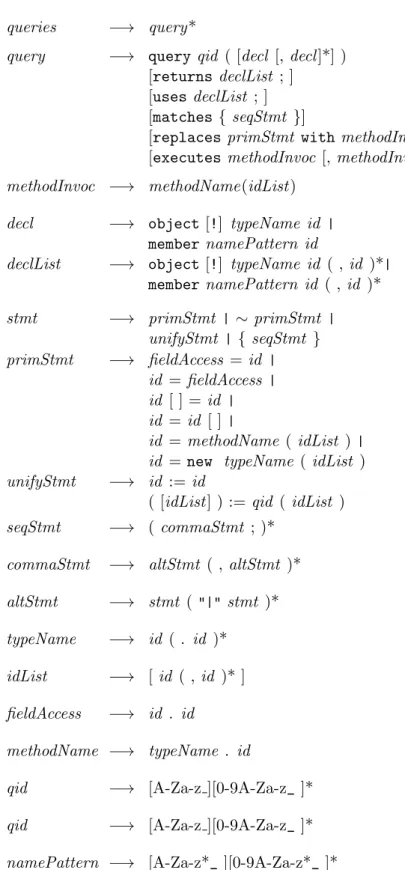
2.4 BNF grammar specification for PQL. . . 40
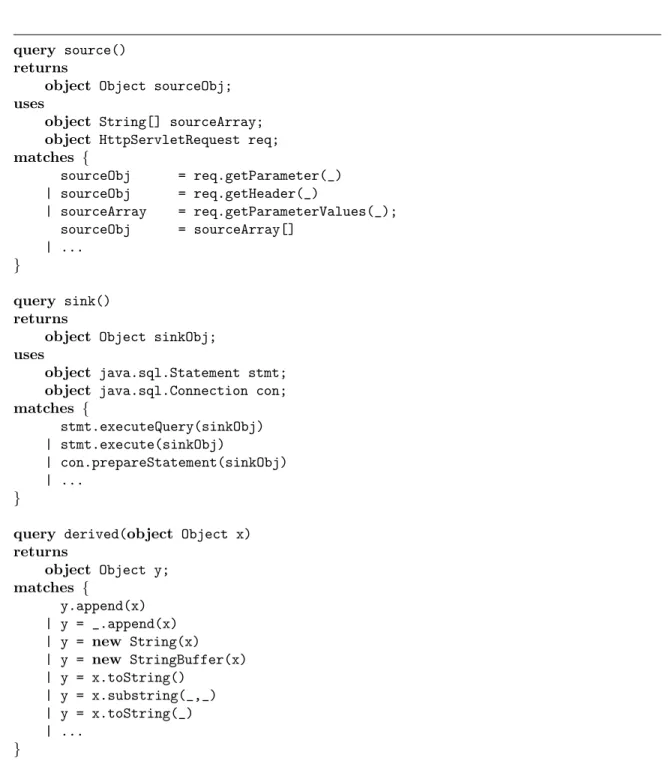
2.5 Main query for finding source-sink pairs. . . 41
2.6 Transitive derived relationderived?. . . 42
2.7 PQL subqueries for finding SQL injections. . . 43
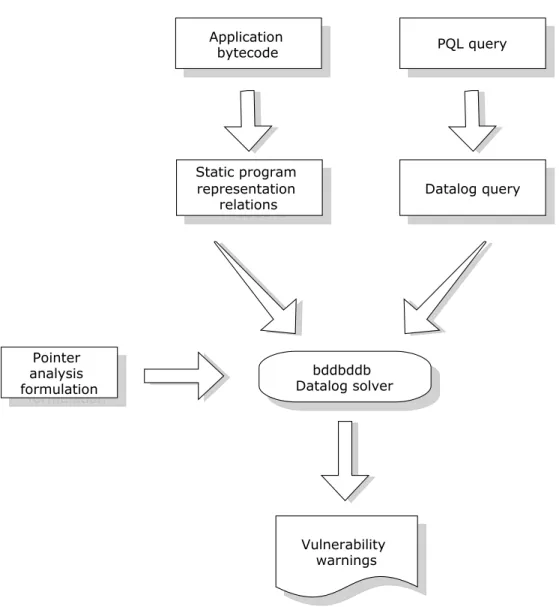
3.1 Architecture of the static analysis part of the Griffin project. . . 48
3.2 Datalog domains used throughout this chapter. . . 52
3.3 Datalog relations used to represent the input program. . . 54
3.4 Role of aliasing and points-to information. . . 55
3.5 Effect of object naming on precision of the results.. . . 56
3.6 Example showing the importance of context sensitivity. . . 58
3.7 Context-sensitive pointer analysis rules of Whaley and Lam. . . 60
3.8 A sampleVector class definition and usage. . . 61
3.9 A sample factory function from thehibernate library, version 2.1. . . 62
3.10 A sample string-manipulation routine. . . 63
3.11 Incremental algorithm for determining methods to inline. . . 64
3.12 Inlining a virtual site with multiple targets. . . 65
3.13 Expanded call site to a virtual method with more than one target. . . 66
3.14 Example from roller requiring precise map value handling. . . 67
3.15 Rules for map sensitivity in pointer analysis. . . 68
3.16 Simple SQL injection query translated into Datalog. . . 73
3.17 Translation of primitive statements from PQL into Datalog. . . 75
3.18 Simple SQL injection query: exctracting bytecodes. . . 78
3.19 Recursive query for tracking data from sockets. . . 79
3.20 Datalog translation of the PQL query in Figure 3.19. . . 80
3.21 Extracting relevant bytecodes for the PQL query in Figure 3.19. . . . 81
3.22 Simple conditional sanitization example. . . 82
3.23 False positive in our formulation. . . 83
3.24 Inline character-level string manipulation . . . 84
3.25 Typical application server architecture. . . 85
3.26 Invocation stub program generated for blueblog. . . 87
3.27 Eclipse plugin for reviewing analysis results. . . 90
4.1 Call graph construction in the presence of reflection.. . . 94
4.2 Java API methods for reflective object creation. . . 95
4.3 Java API methods for method invocation. . . 96
4.4 Java API methods for field access and manipulation. . . 97
4.5 Typical use of reflection to create new objects. . . 99
4.6 Interpretation of .class in JDK version 1.4 and below. . . 100
4.7 Creating objects reflectively based on an XML specification. . . 103
4.8 Creating objects reflectively based on an XML specification. . . 103
4.10 Checking if a method is present before calling it. . . 104
4.11 Using reflection to circumventing JDK inconsistencies. . . 105
4.12 Using a method that is not available at compile time. . . 105
4.13 Using Class.forNamefor its side-effects. . . 106
4.14 Circumventing static type checking to set a field. . . 106
4.15 Specification fragments. . . 120
4.16 A case where casts information is insufficient. . . 125
4.17 Summary of information about reflection benchmarks.. . . 126
4.18 Results of resolving Class.forName calls. . . 128
4.19 Reflection resolution using points-to results . . . 131
4.20 User-provided specification statistics. . . 136
4.21 Call graph statistics. . . 138
4.22 Running times for different analysis versions, in seconds. . . 139
5.1 State machine that corresponds to themain PQL query. . . 149
5.2 State machines corresponding tosource and sink queries. . . 150
5.3 State machines corresponding to the derivedand derived∗. . . 151
5.4 Augmentedmain query for recovering from exploits at runtime. . . . 152
6.1 Summary of information about SecuriBench benchmarks. . . 156
6.2 Sizes of SecuriBench benchmark applications. . . 157
6.3 Analysis times. . . 160
6.4 SecuriBench Micro test case categories. . . 161
6.5 Sample benchmark from the SecuriBench Micro suite. . . 162
6.6 A false positive related to array handling.. . . 163
6.7 SecuriBench Micro static analysis result summary. . . 164
6.8 SecuriBench static analysis result summary. . . 165
6.9 Classification of the vulnerabilities found.. . . 166
6.10 Typical string sanitization routine in pebble. . . 168
6.11 Cross-site scripting vulnerability in method doTrace. . . 172
6.12 False positives in blojsom. . . 173
6.14 Vulnerability trace length histogram. . . 176 6.15 Runtime analysis results summary. . . 178 6.16 Runtime analysis overhead comparison. . . 179
Chapter 1
Introduction
The security of Web applications has become increasingly important in the last decade. Web applications are rapidly becoming the norm for a wide range of soft-ware development projects, as client-server solutions are getting less popular. More and more Web-based enterprise applications deal with sensitive financial and medical data, which, if compromised, can cause significant downtime and millions of dollars in damages. It is crucial to protect these applications from hacker attacks.
1.1
Introduction
The current state of application security leaves much to be desired. The 2002 Com-puter Crime and Security Survey conducted by the ComCom-puter Security Institute and the FBI revealed that, on a yearly basis, over half of all databases experience at least one security breach and an average episode results in close to $4 million in losses [37]. The survey also noted that Web crime has become commonplace. Web crimes range from cyber-vandalism (e.g., Web site defacement) at the low end, to theft of sensitive information and financial fraud at the high end.
A recent penetration testing study performed by the Imperva Application Defense Center included more than 250 Web applications from e-commerce, online banking, enterprise collaboration, and supply chain management sites [200]. Their vulnera-bility assessment concluded that at least 92% of Web applications are vulnerable to
CHAPTER 1. INTRODUCTION 2
some form of hacker attacks. Security compliance of application vendors is especially important in light of recent U.S. industry regulations such as the Sarbanes-Oxley act pertaining to information security [20,70].
According to the 2005 E-Crime Watch survey conducted in cooperation with the United States Secret Service, 43% of respondents reported an increase in e-crimes and intrusions over the previous year [138]. Overall 70% of respondents reported at least one e-crime or intrusion was committed against their organization. During the first six months of 2005, malicious code that exposed confidential information repre-sented 74% of the top 50 malicious code samples, according to Symantec’s Internet Security Threat Report Volume VIII [40]. The report also documents 1,872 vulner-abilities in the first half of 2005, the most ever recorded since the inception of the report. Despite this sampling of data pointing to the increasing threat of directed attacks, the threat is likely still understated. Many directed attacks go unreported for the following reasons:
• Many organizations try to suppress the fact that they were attacked in the hope of avoiding negative publicity and damage to their reputation.
• Many organizations that have been attacked simply do not know that they have been the victim of a targeted attack.
While a great deal of attention over the last decade has been given to network-level attacks such as port scanning, about 75% of all attacks against Web servers target Web-based applications, according to a recent survey [89]. It is easy to un-derestimate the potential level of risk associated with sensitive information within databases accessed through Web applications until a severe security breach actually occurs. Traditional defense strategies such as firewalls do not protect against Web application attacks, as these attacks rely solely on HTTP traffic, which is usually allowed to pass through firewalls unhindered. Thus, attackers typically have a direct line to Web applications.
Many projects in the past focused on guarding against problems caused by the unsafe nature of C, such as buffer overruns and format string vulnerabili-ties [41, 177, 194]. However, in recent years, Java has emerged as the language
CHAPTER 1. INTRODUCTION 3
of choice for building large complex Web-based systems, in part because of language safety features that disallow direct memory access and eliminate problems such as buffer overruns. Platforms such as J2EE (Java 2 Enterprise Edition), Struts, Web-Works, and Tapestry also helped to promote the adoption of Java as a language for implementing e-commerce applications such as Web stores, banking sites, customer information management sites, etc.
A typical Web application accepts input from the user browser and interacts with a back-end database to serve user requests; J2EE libraries make these common tasks easy to implement. However, despite Java language’s safety, it is possible to make logical programming errors that lead to vulnerabilities such as SQL injections [6,7,59] and cross-site scripting attacks [33,87,179]. Discovered several years ago, these attack techniques are now commonly used to create exploits by malicious hackers. A score of recently discovered vulnerabilities can be attributed to these attacks. A simple programming mistake can leave a Web application vulnerable to unauthorized data access, unauthorized updates or deletion of data, and application crashes leading to denial-of-service attacks. Moreover, certain types of attacks may result in the attacker gaining complete control over the underlying system.
The fact that many applications are deployed on external sites greatly increases the perimeter of the attack. Many Web sites need to be made public in order to give the necessary access to their customers, however, this also exposes them to malicious hackers. A good example of this is a recent attack on a government Web site ri.gov perpetrated by a college student living in Eastern Europe [170]. The enabling mechanism for the attack was the presence of a SQL injection vulnerability, which allowed the hacker to discover the structure of database tables and then to execute a shell command through the underlying SQL server database. This incident led to the theft of hundreds of credit card numbers.
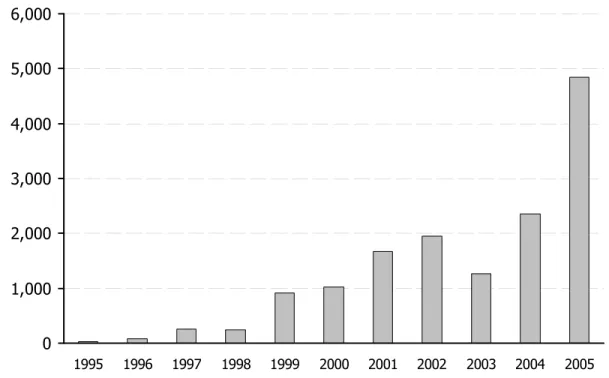
CHAPTER 1. INTRODUCTION 4 0 1,000 2,000 3,000 4,000 5,000 6,000 1995 1996 1997 1998 1999 2000 2001 2002 2003 2004 2005
Figure 1.1: Number of vulnerabilities reported by year (based on NIST/DHS data).
1.2
Web Application Vulnerability Statistics
To further motivate our focus on Web application vulnerabilities in this thesis, this section presents statistics that demonstrate how common various categories of vulner-abilities are. While there are many cataloguing sites that collect vulnerability reports, reliable statistics on the frequency of different vulnerability categories is hard to come by. Below we report on the data obtained from some publicly available sources that shed light on this matter.
1.2.1
NIST Study
The National Institute of Standards and Technology (NIST) and the Department of Homeland Security have been aggregating vulnerability data for many years [156]. Statistics summarizing the total number of vulnerabilities in the NIST database are presented in Figure1.1. While the numbers for 2006 are not yet available at the time
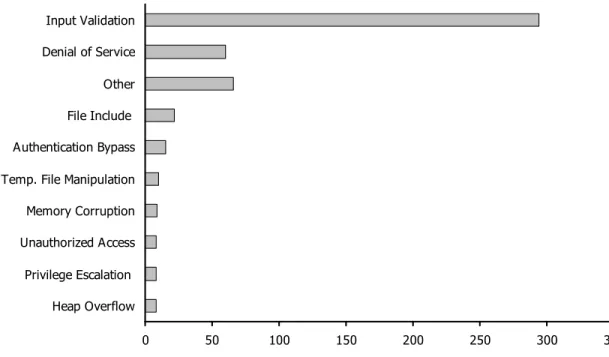
CHAPTER 1. INTRODUCTION 5 0 50 100 150 200 250 300 350 Input Validation Denial of Service Other File Include Authentication Bypass
Temp. File Manipulation
Memory Corruption
Unauthorized Access
Privilege Escalation
Heap Overflow
Figure 1.2: Relative frequency of vulnerabilities in the SecurityFocus.com sample.
of this writing, the number of vulnerabilities is projected to be higher than in 2005. As can be seen from Figure 1.1, there is a slight decline in the number of vulner-abilities in 2003, followed by a sharp increase in 2004 and 2005. While it is difficult to validate these claims precisely, one interpretation of this anomaly is that the de-cline in 2003 is attributable to most of “shallow” buffer overruns being found. The sharp increase in 2004 can be attributed to Web application vulnerabilities becoming commonplace.
1.2.2
SecurityFocus.com Study
To gain insight into the relative frequencies of different vulnerability types, we con-sidered a sample of 500 vulnerability reports obtained from the SecurityFocus.com database. This vulnerability sample spans a week in November 2005. The format of the vulnerability database allows for relatively easy processing and classification of this data. A coarse classification of these vulnerabilities is shown in Figure 1.2. It is apparent from the picture that input and output validation vulnerabilities account for over 50% of the sample.
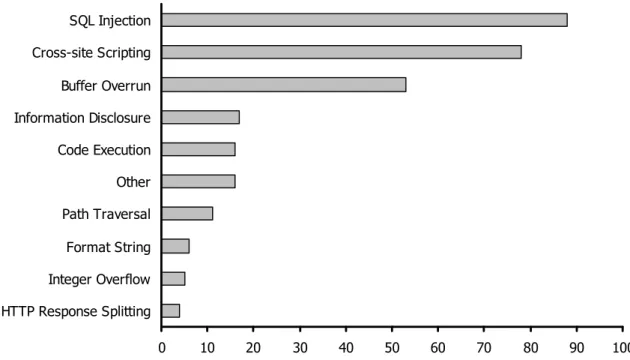
CHAPTER 1. INTRODUCTION 6 0 10 20 30 40 50 60 70 80 90 100 SQL Injection Cross-site Scripting Buffer Overrun Information Disclosure Code Execution Other Path Traversal Format String Integer Overflow HTTP Response Splitting
Figure 1.3: Relative frequency of input/output validation vulnerabilities.
Focusing in on input and output validation vulnerabilities shows that most are vulnerabilities specific to Web applications, as can be seen from Figure 1.3. In fact, the infamous buffer overrun issue comes in a distant third, trailing SQL injection and cross-site scripting attacks.
1.2.3
Relative Popularity of Java
The focus of our work is on large mission-critical software systems written in Java. The rise of such systems is in part due to the type safety and modularization features of Java, which allow the development of large systems, which we defined to be over 100,000 lines of code. The popularity of Java for Web applications has also been fueled by the rise of Web application development frameworks such as J2EE, Tapestry, WebWorks, Apache Struts and many others.
While no reliable data on this subject is available, anecdotal evidence suggest that Java J2EE applications comprise a significant fraction of Web applications at large financial firms and e-commerce sites [181]. .NET applications, which are typically
CHAPTER 1. INTRODUCTION 7
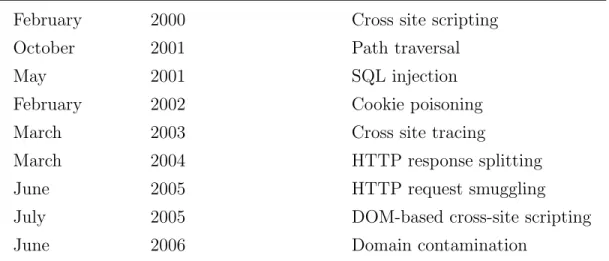
February 2000 Cross site scripting
October 2001 Path traversal
May 2001 SQL injection
February 2002 Cookie poisoning
March 2003 Cross site tracing
March 2004 HTTP response splitting
June 2005 HTTP request smuggling
July 2005 DOM-based cross-site scripting
June 2006 Domain contamination
Figure 1.4: History of common Web application vulnerabilities. The date of the first report describing a vulnerability found “in the wild” or the article describing the vulnerability is given.
written in C#, account for another big fraction of Web applications. Most of the ideas described in this thesis apply to applications written in C# as well. One C# language feature potentially complicating the pointer analysis described in Chapter3 is the presence of stack-allocated objects. Moreover, the presence of unmanaged code makes the soundness guarantees of our static approach much harder to sustain; see Section3.6 for a discussion of soundness.
As the recent research in vulnerability detection in scripting languages such as PHP demonstrates [95, 207], a different approach is typically required for that class of languages. In particular, control flow of the program is typically more important than it is in Java. Furthermore, the presence of theeval construct makes soundness very difficult to maintain.
1.2.4
History of Web Application Vulnerabilities
Web application vulnerabilities have a short but an illustrious history. Figure 1.4 shows the first time each type of vulnerability was discovered. In many cases, vulner-abilities were first discovered and described in a paper by a vulnerability researcher, with actual exploits following soon thereafter.
CHAPTER 1. INTRODUCTION 8
We can also expect new types of vulnerabilities to appear in the future. For in-stance, two new flavors of injection attacks,control injection and reflection injection, which allow the hacker to influence the control flow path taken by an application and what classes are created reflectively are entirely possible [178]. How these vulnerabil-ities can be exploited remains to be seen.
1.3
Overview of Web Application Vulnerabilities
As supported by the statistics presented in Section 1.2.2, of all vulnerabilities identi-fied in Web applications, problems caused by input/output validation are recognized as being the most common. These vulnerabilities, also sometimes referred to as taint-style or information flow vulnerabilities are the focus of this thesis.
Our statistics in Section 1.2.2 are further supported by security surveys. Ac-cording to an influential survey performed by the Open Web Application Security Project [157], unvalidated input is the number one security problem in Web appli-cations. Many such security vulnerabilities have recently appeared on specialized vulnerability tracking sites such as SecurityFocus and are widely publicized in the technical press [151, 157]. Recent reports include SQL injections in Oracle prod-ucts [122] and cross-site scripting vulnerabilities in Mozilla Firefox [112].
Input validation problems are similar to those handled dynamically by the taint mode in Perl [197]. Perl maintains a runtime taint bit it attaches to every value. The taint bit is set for data that comes from the outside (return result of file or network read methods, etc.). Perl automatically un-taints a value that is matched against a regular expression. While a good heuristic, this approach is obviously not safe if the regular expression is /(.*)/, which matches all strings. Moreover, when the blacklist validation approach is used, regular expressions are created to recognize malicious values, in which case matching strings should definitely not be untainted. Our approach to controlling the flow of taint is considerably more extensible, as summarized in Section 2.1.1.
In Section 1.3.1 below we list the vulnerabilities this thesis addresses. However, the framework presented here is general enough to encompass other, yet undiscovered
CHAPTER 1. INTRODUCTION 9
vulnerability types. As mentioned above, reflection injection refers to the user being able to control which classes are reflectively instantiated at runtime [178]. While we are able to find such vulnerabilities, none has been observed in the wild yet.
1.3.1
Categorization of Taint-Style Vulnerabilities
To exploit unchecked input, an attacker must achieve two goals:
Inject malicious data into Web applications. Common methods used include: • Parameter manipulation: pass specially crafted malicious values in fields of
HTML forms.
• Hidden field manipulation: set hidden fields of HTML forms in Web pages to malicious values.
• HTTP header tampering: manipulate parts of HTTP requests sent to the application.
• Cookie poisoning: place malicious data in cookies, small files sent to Web-based applications.
• Non-Web sources: set command-line parameters to malicious values.
Manipulate applications using malicious data. Common methods used include: • SQL injection: pass input containing SQL commands to a database server for
execution.
• Cross-site scripting: exploit applications that output unchecked input ver-batim to trick the user into executing malicious scripts.
• HTTP response splitting: exploit applications that output input verbatim to perform Web page defacements or Web cache poisoning attacks.
• Path traversal: exploit unchecked user input to control which files are accessed on the server.
CHAPTER 1. INTRODUCTION 10
1. javax.sql.Connection con = ...
2. javax.servlet.http.HttpServletRequest request = ...; 3. String userName = request.getParameter("username");
4. String query = "SELECT * FROM Users " + " WHERE name = ’" + userName + "’"; 5. con.execute(query);
Figure 1.5: Simple SQL injection example.
The kinds of vulnerabilities described above are widespread in today’s Web applica-tions. A recent empirical study found that parameter manipulation, SQL injection, and cross-site scripting attacks account for more than a third of all reported Web application vulnerabilities [185]. While different on the surface, all types of attacks listed above are made possible by user input that has not been (properly) validated. In this chapter we only outline the basics of each vulnerability. More detailed information about the vulnerabilities outlined below can be found in “The 21 Primary Classes of Web Application Threats” [151] and the “OWASP Secure Development Guide” [158].
1.3.2
SQL Injection Example
Let us start with a discussion of SQL injections, one of the most well-known security vulnerabilities found in Web applications. SQL injections are caused by unchecked user input being passed to a back-end database for execution [6,7,59,109,123,180]. The hacker may embed SQL commands into the data he sends to the application, leading to unintended actions performed on the back-end database. When exploited, a SQL injection may cause unauthorized access to sensitive data, updates or deletions from the database, and even shell command execution.
Example 1.1. A simple example of a SQL injection is shown in Fig-ure 1.5. This code snippet obtains a user name (userName) by invoking method request.getParameter("username") and uses it to construct a query to be passed to a database for execution (viacon.execute(query)). This seemingly innocent piece of code may allow an attacker to gain access to unauthorized information: if an at-tacker has full control of string userName obtained from an HTTP request, he can,
CHAPTER 1. INTRODUCTION 11
for example, set it to ’OR 1=1;−−. Two dashes are used in the Oracle dialect of SQL to indicate the beginning of a comment. (Other databases use a slightly different syntax.) Therefore, the WHERE clause of the query effectively becomes the tautology name=’’ OR 1=1. Thus, the attacker may circumvent the name check and gain access to all user records in the database.
SQL injection is but one of the vulnerabilities that can be formulated as tainted object propagation problems. In this case, the input variable userName is considered
tainted. If a tainted object (the source or any other object derived from it) is passed as a parameter to con.execute (the sink), then there is a vulnerability.As discussed above, such an attack typically consists of two steps:
Step 1. injecting malicious data into the application, and Step 2. using the data to manipulate the application.
The former corresponds to thesourcesof a tainted object propagation problem and the latter to the sinks. The rest of this section presents attack techniques and examples of how exploits may be created in practice1.
1.3.3
Injecting Malicious Data
Protecting Web applications against unchecked input vulnerabilities is difficult be-cause applications can obtain information from the user in a variety of different ways. One must check all sources of user-controlled data such as form parameters, HTTP headers, and cookie values systematically. While commonly used, client-side filtering of malicious values is not an effective defense strategy. For example, a banking ap-plication may present the user with a form containing a choice of only two account numbers; however, this restriction is easily circumvented by saving the HTML page, editing the values in the list, and resubmitting the form. Therefore, inputs must be filtered by the Web application on the server. Note that many attacks are relatively 1Most security exploitation techniques described in this chapter are independent of the program-ming language being used. To make the discussion below concrete, we use Java examples. Code snippets we show in this section are extracted from a suite of Web application benchmarks described in Chapter6.
CHAPTER 1. INTRODUCTION 12
easy to mount: an attacker needs little more than a standard Web browser to attack Web applications in most cases.
Parameter Manipulation
The most common way for a Web application to accept parameters is through HTML forms. When a form is submitted, parameters are sent as part of an HTTP request. An attacker can easily tamper with parameters passed to a Web application by en-tering maliciously crafted values into text fields of HTML forms.
A variation of this technique is know as URL manipulation. For HTML forms that are submitted using the HTTP GET method, form parameters as well as their values appear as part of the URL that is accessed after the form is submitted. An attacker may directly edit the URL string, embed malicious data in it, and then access this new URL to submit malicious data to the application.
Example 1.2. Consider a Web page at a bank site that allows an authenticated user to select one of her accounts from a list and debit $100 from the account. When the submit button is pressed in the Web browser, the following URL is requested:
http://www.mybank.com/myaccount?accountnumber=341948&debit_amount=100
However, if no additional precautions are taken by the Web application receiving this request, accessing
http://www.mybank.com/myaccount?accountnumber=341948&debit_amount=-5000 may in fact increase the account balance.
There are other URL parameters that an attacker can modify, including attribute parameters and internal modules. Attribute parameters are unique parameters that characterize the behavior of the uploading page. For example, consider a content-sharing Web application that enables the content creator to modify content, while other users can only view content. The Web server checks whether the user that is accessing an entry is the author or not (usually via a cookie). An ordinary user will request the following link:
CHAPTER 1. INTRODUCTION 13
http://www.mydomain.com/myaccount?id=77492&mode=readonly
An attacker can modify the mode parameter toreadwritein order to gain authoring permissions for the content.
Hidden Field Manipulation
Because HTTP is stateless, many Web applications use hidden fields to emulate persistence. Hidden fields are just form fields made invisible to the end-user. For example, consider an order form that includes a hidden field to store the price of items in the shopping cart:
<input type="hidden" name="total_price" value="25.00">
A typical Web site using multiple forms, such as an online store will likely rely on hidden fields to transfer state information between pages. For instance, a single page we sampled on Amazon.com contains a total of 25 built-in hidden fields. Unlike regular fields, hidden fields cannot be modified directly by typing values into an HTML form. However, since the hidden field is part of the page source, saving the HTML page, editing the hidden field value, and reloading the page will cause the Web application to receive the newly updated value of the hidden field. This attack technique is commonly used to forge information being sent to the Web application and to mount SQL injection or cross-site scripting attacks.
HTTP Header Manipulation
HTTP headers typically remain invisible to the user and are used only by the browser and the Web server. However, some Web applications do process these headers, and attackers can inject malicious data into applications through them. While a normal Web browser will not allow forging the outgoing headers, multiple freely available tools allow a hacker to craft an HTTP request leading to an exploit [35].
Example 1.3. An HTTP request fragment is shown in Figure 1.6. The Accept-Language header indicates the preferred language of the user. An interna-tionalized Web application may take the language label from the HTTP request and
CHAPTER 1. INTRODUCTION 14
Host: www.mybank.com
Accept-Language: en-us, en;q=0.50
User-Agent: Lynx/2.8.4dev.9 libwww-FM/2.14 Referer: http://www.mybank.com/login Content-type: application/
x-www-form-urlencoded Content-length: 100
Figure 1.6: An HTTP request fragment.
pass it to a database to look up a language-specific text message. If this header is sent verbatim to the database, an attacker may inject SQL commands by modify-ing the header value. Likewise, if the header value is used to build the name of file that contains messages for the correct language, an attacker may be able to launch a path-traversal attack [158].
Consider, for example, the Referer field, which contains the URL indicating where the request comes from. This field is commonly trusted by the Web applica-tion, but can be easily forged by an attacker. It is possible to manipulate theReferer field’s value used in an error page or for redirection to mount cross-site scripting or HTTP response splitting attacks. Similarly, the Referer field should never be used to authenticate valid clients, as this authentication scheme may be easily circum-vented [158].
Cookie Poisoning
Cookie poisoning attacks consist of modifying a cookie, which is a small file accessi-ble to Web applications stored on the user’s computer [103]. Many Web applications use cookies to store information such as user login/password pairs and user identi-fiers. This information is often created and stored on the user’s computer after the initial interaction with the Web application, such as visiting the application login page. Cookie poisoning is a variation of header manipulation: malicious input can be passed into applications through values stored within cookies. Because cookies are supposedly invisible to the user, cookie poisoning is often more dangerous in practice than other forms of parameter or header manipulation attacks.
CHAPTER 1. INTRODUCTION 15
con.executeUpdate("UPDATE EMPLOYEES " PreparedStatement pstmt = + " SET SALARY = " + salary con.prepareStatement( + " WHERE ID = " + id); "UPDATE EMPLOYEES " +
" SET SALARY = ? " + " WHERE ID = ?");
pstmt.setBigDecimal(1, salary); pstmt.setInt(2, id);
(a) (b)
Figure 1.7: Two different ways to update an employee’s salary: (a) may lead to a SQL injection and (b) safely updates the salary using aPreparedStatement.
Example 1.4. Consider the HTTP GET request in Figure 1.8. The URL on host
http://www.mybank.comrequested by the browser transfer and the parameter string transfer=yes indicates that the user wants to perform a funds transfer.
The request includes a cookie that contains the following parameters: SESSION, which is a unique identification string that associates the user with the site and Amount, which is the transfer amount for this transaction. Amount is validated by the Web application before being stored in a cookie. However, an attacker can easily edit the cookie and change theAmountvalue in order to circumvent account overdraw checks that are performed before the cookie is created to transfer more money than is contained in an account.
As this example illustrates, cookie poisoning is typically used in a manner similar to hidden field manipulation, i.e. to change the outcome to the attacker’s advantage. However, since programmers rely on cookies as a location for storing parameters, all parameter attacks including SQL injection, cross-site scripting, etc. can be performed with the help of cookie poisoning [18].
Non-Web Input Sources
Malicious data can also be passed in as command-line parameters. This problem is not as important because typically only administrators are allowed to execute components of Web-based applications directly from the command line. However,
CHAPTER 1. INTRODUCTION 16
GET transfer?complete=yes
HTTP/1.0 Host: www.mybank.com Accept: */* Referrer: http://www.mybank.com/login
Cookie: SESSION=89DSSSXX89JJSYUJG; Amount=5000
Figure 1.8: An HTTP GETrequest containing a cookie.
by examining our benchmarks, we discovered that command-line utilities are often used to perform critical tasks such as initializing, cleaning, or validating a back-end database or migrating the data. Therefore, attacks against these important utilities can still be dangerous.
1.3.4
Exploiting Unchecked Input
Once malicious data is injected into an application, an attacker may use one of many techniques to take advantage of this data, as described below.
In this section we present the following techniques: SQL injections, cross-site scripting vulnerabilities, HTTP response splitting attacks, path-traversal attacks, and command injections.
SQL Injections
SQL injections (first described in Section 1.3.2) are caused by unchecked user input being passed to a back-end database for execution. When exploited, a SQL injec-tion may cause a variety of consequences from leaking the structure of the back-end database to adding new users, mailing passwords to the hacker, or even executing arbitrary shell commands.
Many SQL injections can be avoided relatively easily with the use of better APIs. J2EE provides the PreparedStatement class, that allows specifying a SQL state-ment template with ?’s indicating statestate-ment parameters. Prepared SQL statestate-ments are precompiled, and expanded parameters never become part of executable SQL. However, not using or improperly using prepared statements still leaves plenty of room for errors.
CHAPTER 1. INTRODUCTION 17
Example 1.5. Figure 1.7 shows two ways to update the salary of an employee, whose id is provided. The first method in Figure 1.7 (a) uses string concatenation to construct the query and leads to potential SQL injection attacks; the second in Figure1.7(b) usesPreparedStatementsand is safe from SQL injection attacks.
Most SQL injections we have encountered can be categorized as the result of con-structing SQL statements directly instead of using PreparedStatements. However, while a good practical strategy for most purposes when programming using J2EE, PreparedStamtents are not a panacea. As our practical experience with auditing for SQL injections shows, there are some legitimate reasons for using dynamically constructed SQL statements:
• SQL statements may depend on the way the application is configured. For in-stance, SQL statements are often read from configuration files that are different depending on the back-end database being used.
• Only certain parts of SQL statements may be parameterized, for instance, an online store that performs a search depending on both the search criterion that corresponds to a database column, such as the name or the address will likely construct the SQL query using string concatenation.
• Improper use ofPreparedStatements, e.g. using non-constant template strings for constructing prepared statements defeats the purpose of using them in the first place.
Cross-site Scripting Vulnerabilities
Cross-site scripting occurs when dynamically generated Web pages display input that has not been properly validated [33, 38, 87, 102, 179]. An attacker may embed malicious JavaScript code into dynamically generated pages of trusted sites. When executed on the machine of a user who views the page, these scripts may hijack the user account credentials, change user settings, steal cookies, or insert unwanted content (such as ads) into the page. At the application level, echoing the application
CHAPTER 1. INTRODUCTION 18
input back to the browser verbatim enables cross-site scripting.
Example 1.6. A cross-site scripting attack leverages the trust the user has for a particular Web site, such as that of a financial institution, to perform malicious activities. Suppose a bank’s online accounting system has an error page that displays input verbatim. An attacker may trick the legitimate user into following a benign-looking URL, which results in displaying an error page containing a malicious script. Suppose the script looks like the following:
<script>
document.location =
’http://www.attack.org/?cookies=’ + document.cookie </script>
When the error page is opened, the script redirects the user’s browser, while submit-ting the user’s cookie to a malicious site in the meantime.
HTTP Response Splitting
HTTP response splitting is a general technique that enables various new attacks in-cluding Web cache poisoning, cross-user defacement, sensitive page hijacking, as well as cross-site scripting [104]. By supplying unexpected line break CR and LF charac-ters, an attacker can cause two HTTP responses to be generated for one maliciously constructed HTTP request. The second HTTP response may be erroneously matched with the next HTTP request. By controlling the second response, an attacker can generate a variety of issues, such as forging or poisoning Web pages on a caching proxy server. Because the proxy cache is typically shared by many users, this makes the effects of defacing a page or constructing a spoofed page to collect user data even more devastating. For HTTP splitting to be possible, the application must include unchecked input as part of the response headers sent back to the client. For example, applications that embed unchecked data in HTTP Location headers returned back to users are often vulnerable.
Several HTTP splitting vulnerabilities in deployed software have been announced recently, including two in Java applications (SecurityFocus.com bid ids 11413 and
CHAPTER 1. INTRODUCTION 19
11180). The latter one is insnipsnap, which is one of the benchmarks in our suite. A common coding pattern that makes Java applications vulnerable to HTTP response splitting is redirecting to user-defined URLs, as illustrated by this code from one of our benchmark applications, personalblog:
request.sendRedirect(request.getParameter("referer"));
Path Traversal
Path-traversal vulnerabilities allow a hacker to access or control files outside of the in-tended file access path. Path-traversal attacks are normally carried out via unchecked URL input parameters, cookies, and HTTP request headers. Many Java Web appli-cations use files to maintain an ad-hoc database and store application resources such as visual themes, images, and so on.
If an attacker has control over the specification of these file locations, then he may be able to read or remove files with sensitive data or mount a denial-of-service attack by trying to write to read-only files. Using Java security policies allows the developer to restrict access to the file system (similar to using chroot jail in Unix). However, missing or incorrect policy configuration still leaves room for errors. When used carelessly, input/output operations in Java may lead to path-traversal attacks.
Example 1.7. The following code snippet we found inblojsomturns out to be not secure because permalink is under user control:
String permalinkEntry =
_blog.getBlogHome() + category + permalink; File blogFile = new File(permalinkEntry);
Changing permalink on the part of the attacker can be used to mount denial of service attacks when accessing non-existent files.
Command Injection
Command injection (also sometimes referred to as “stealth commanding”) involves passing shell commands into the application for execution. This technique enables
CHAPTER 1. INTRODUCTION 20
a hacker to attack the server using access rights of the application. While relatively uncommon in Web applications, especially those written in Java, this attack technique is still possible when applications carelessly use functions that execute shell commands or load dynamic libraries.
1.3.5
Unvalidated Output and Information Leaks
While the focus of the discussion above has been on poorly validated user input, many of the same concerns apply to validating the output that is passed from the Web application to the user’s browser.
A common Web application vulnerability that stems from poorly validated output is information leaks. For example, when a piece of sensitive data is leaked from a back-end underlying database, this might be a sign of trouble. Another common error pattern is revealing too much in exception messages. When a Web application encounters an exception, these messages containing potentially sensitive information are often sent to the browser. Furthermore, cross-site scripting attacks can be seen as unvalidated output issues.
Conceptually, unvalidated output attacks are really the same as unvalidated input attacks and they fit equally well into our analysis framework described in Chapter2. However, fewer potential output validation issues are clear-cut cases of exploitable vulnerabilities. Often, leaking a piece of data from the database does not have any undesirable consequences. Because of this, we chose not to look for output validation issues in our experiments. However, if needed, these types of vulnerabilities can be easily expressed in the Griffin framework.
1.4
Existing Solutions
In this section we briefly summarize existing approaches to Web application security issues. In this section, our focus is on accepted industry practices. We postpone a detailed discussion of related research until Chapter 7.
CHAPTER 1. INTRODUCTION 21
1.4.1
Client-side Protection
The simplest approach used to combat Web application security issues is to perform validation on the client side. This is typically done by having Javascript execute in the client’s browser when a form is submitted. While a common technique, client-side protection is quite easy to circumvent:
• An attacker can save the Web page in the browser, edit it to remove the vali-dating Javascript code, and resubmit the form again.
• Another technique consists of crafting HTTP packets manually or with the help of tools such as PacketCrafter [108]. Specially crafted malicious packets can be sent to the application directly, completely circumventing browser-based protection.
While more sophisticated browser-based security measures have recently been pro-posed [100], clearly, simple client-side validation is completely helpless when either of the two approaches described above is used.
1.4.2
Penetration Testing
Penetration testing is a commonly used technique for improving Web application security [105, 135, 136, 187]. Penetration testing is an approach that involves a person or a tool constructing potentially malicious inputs and feeding them to the Web application, mimicking the actions of a hacker. This is done in an effort to either crash or exploit the application being tested.
The most common difference between penetration testing strategies is the amount of knowledge about the implementation of the system being tested. Black box testing assumes no prior knowledge of the infrastructure to be tested. At the other end of the spectrum, white box testing provides the testers with complete knowledge of the infrastructure to be tested, often including network diagrams, source code, and IP addressing information. There are also several variations in between, often referred to as gray box testing.
CHAPTER 1. INTRODUCTION 22
The relative merits of these approaches are debatable. It is argued that black box testing most closely simulates the actions of a real hacker, however this ignores the fact that any targeted attack on a system most probably requires some knowledge of the system, and any insider attacker would be in possession of as much information as the system owners. In most cases it is preferable to assume a worst-case scenario and provide the testers with as much information as they require, assuming that any determined attacker would already have acquired this. The end-goal of penetration testing is to either produce a crash or to get the application to disclose sensitive data. The difficulty of performing such tests manually lead to the development of auto-matic techniques such as Cenzic’s Hailstorm [32]. However, no matter how automated the approach, as a testing technique, penetration testing still suffers from lack of cov-erage and therefore likely misses a large fraction of vulnerabilities.
1.4.3
Application Firewalls
According to the Web Application Security Consortium Glossary [199], an application firewall is “An intermediary device, sitting between a Web client and a Web server, analyzing layer-7 messages for violations in the programmed security policy. A Web application firewall is used as a security device protecting the Web server from attack.” Standard firewalls are designed to restrict access to certain ports, or services that an administrator does not want unauthorized people to access. Application firewalls are often called “deep packet inspection firewalls” because they examine every request and response within the HTTP, SOAP, XML-RPC, and Web service layers.
Application firewalls vary in the filtering approach, which includes both whitelist-ing and blacklistwhitelist-ing or a combination of the two. The blacklistwhitelist-ing approach consists of maintaining a database of attack signatures, not unlike regular firewalls or in-trusion detection software. The whitelisting relies on having a model of “normal” traffic between the application and the client. Moreover, some application firewalls include the ability to fully configure filtering policies and learn them based on past traffic. However, coming up with proper policies that reduce the number of both false positives and false negatives is a formidable challenge.
CHAPTER 1. INTRODUCTION 23
Web application firewalls can be either software, or hardware appliance based and are installed in front of a Web or application server in an effort to try and shield it from incoming attacks.
1.4.4
Code Auditing for Security
Code reviews or code audits have been commonly used to improve the security posture of applications, leading to the creation of a large number of consulting companies and code auditing guidelines. While an effective approach to finding vulnerabilities, code auditing is a heavily manual task. Code auditing suffers from the following shortcomings:
• Security vulnerabilities elude detection. Vulnerabilities described in Sec-tion 1.3 involve following data flow in the program, which is especially difficult when a given piece of data is deposited into data structures. The branching factor adds another level of complication to the code auditing task: if a given method is invoked from dozens of different call sites, all of them need to be considered by the reviewer. While shallow security bugs are easily detected with code review, vulnerabilities that span a large number of methods, files, or directories are much less likely to be found with manual inspection. As our ex-periments described in Chapter6suggest, a significant number of vulnerabilities require examining numerous methods and files.
• Lack of guarantees about the results. A security audit typically improves the application security posture and is often the only approach to improving to overall application architecture. However, completeness is difficult to achieve: vulnerabilities are missed by manual efforts. This is especially true when it comes to vulnerabilities that span multiple methods and files, which are not uncommon, according to our experimental results.
• Difficult to maintain continuous security. The rapid pace of change in software development, especially when applied to Web applications, means that the security assessment may no longer be valid whenever the application code
CHAPTER 1. INTRODUCTION 24
is changed. Since security code reviews are often done by outside consultants, new code changes may not get reviewed until the next consulting engagement, leaving the application in an insecure state for long periods of time.
1.4.5
Griffin Project Scope and Goals
The overarching goal of the Griffin project is to address a large range of Web ap-plications security issues. Existing approaches described in Section 1.4 provide a best-effort attempt at improving Web application security. Instead, the goal of our research is to provideguarantees about the security posture of a given application.
The focus of the Griffin project is on large applications written in Java. As discussed in Section 1.2.3, Java is the primary development language for a large number of Web applications, especially mission-critical ones, making it an attractive analysis target.
1.5
Overview of Our Solution
The Griffin project aims to provide a comprehensive solution to a wide range of Web application security vulnerabilities. It offers a combination of static and runtime analysis techniques to achieve this goal.
The user of the Griffin project tools specifies what constitutes a vulnerability. Specifications are expressed in PQL, a Program Query Language [140]. PQL is a generic language that can be used to capture events that happen to objects, such as specific method calls being invoked with an object passed as a parameter or returned from a method. While PQL has been used to express a variety of queries for purposes ranging from debugging to finding optimization opportunities, in this thesis it is used to capture vulnerability queries.
Since most portions of vulnerability specification consist of J2EE library meth-ods, and since the J2EE library is shared among most Java Web applications, the per-application specification effort in usually minor. Moreover, most vulnerabilities
CHAPTER 1. INTRODUCTION 25
query verySimpleSQLInjection()
returns
object String param;
uses
object HttpServletRequest req;
object Connection con;
matches {
param = req.getParameter(_); con.execute(param);
}
Figure 1.9: A very simple PQL query for finding SQL injections.
can be found with a “generic” specification that is specific to the Web application de-velopment framework such as J2EE or Apache Struts, which completely removes the need for user involvement. A very simple PQL query that captures only some SQL injection vulnerabilities is shown in Figure 1.9; more complete vulnerability queries are described in Chapter 2. This PQL query will locate all objects param which are returned from a call to getParameterand are passed into method executeQuery.
Based on the PQL vulnerability specification, a static analyzer is automatically generated. The static analysis runs over the application bytecode and produces vul-nerability warnings. The static approach has the following important benefits:
• Finds vulnerabilities early in the development cycle. It is well-known that finding defects before they make it into a production system has great benefits because the communications between the party that detects the bug, the developer who fixes it, etc. are completely obviated [195]. Moreover, the window of opportunity that a vulnerable program presents is never opened with static assurance.
• Explores all possible program executions. Designing a test suite that adequately explores many program execution paths is generally a challenge. In the case of security exploits that often take trained hackers hours and days to design, adequate testing is an even harder problem. Static analysis obviates the need for security testing, while providing full path coverage.
CHAPTER 1. INTRODUCTION 26
• No false negatives. Soundness of our technique is one of the features that set it apart from other security efforts [88,207]. Using a sound technique is the only way to provideguarantees about the security posture of a given application, as discussed in Section 3.6.
A significant disadvantage of a static analyzer is that it may suffer from impreci-sion. While a great deal of thinking and experimentation went into the design of our static analysis abstraction, the problem of soundly and precisely identifying security violations is undecidable. This means that in the worst case, false positives will still be reported no matter how precise we make our analysis technique.
The potential for imprecision in the static solution is one of the primary reasons we chose to provide a runtime alternative. Moreover, since a static analyzer would typically run as part of the development phase after the code is written, a runtime analysis is also a good fit in less established development environments, which may not have a separate testing phase or when the pace of development and deployment is especially fast. Finally, unlike a static technique, runtime analysis is not complicated by dynamic language features (such as reflection) and inter-language interpretability complications (such as native methods).
Our runtime technique works by instrumenting the existing application based on the PQL specification provided by the user to prevent
![Figure 3.7: Context-sensitive pointer analysis rules of Whaley and Lam [205].](https://thumb-us.123doks.com/thumbv2/123dok_us/1061069.2640985/81.918.170.804.200.660/figure-context-sensitive-pointer-analysis-rules-whaley-lam.webp)