CONCEPT DEVELOPMENT
Mathematics Assessment Project
CLASSROOM CHALLENGES
A Formative Assessment Lesson
Classifying
Rational and
Irrational
Numbers
Mathematics Assessment Resource Service
University of Nottingham & UC Berkeley
For more details, visit: http://map.mathshell.org © 2015 MARS, Shell Center, University of Nottingham
May be reproduced, unmodified, for non-commercial purposes under the Creative Commons license detailed at http://creativecommons.org/licenses/by-nc-nd/3.0/ - all other rights reserved
Classifying Rational and Irrational Numbers
MATHEMATICAL GOALS
This lesson unit is intended to help you assess how well students are able to distinguish between rational and irrational numbers. In particular, it aims to help you identify and assist students who have difficulties in:
• Classifying numbers as rational or irrational.
• Moving between different representations of rational and irrational numbers.
COMMON CORE STATE STANDARDS
This lesson relates to the following Standards for Mathematical Content in the Common Core State
Standards for Mathematics:
N-RN: Use properties of rational and irrational numbers.
This lesson also relates to the following Standards for Mathematical Practice in the Common Core
State Standards for Mathematics, with a particular emphasis on Practices 3 and 6:
1. Make sense of problems and persevere in solving them.
3. Construct viable arguments and critique the reasoning of others.
5. Use appropriate tools strategically.
6. Attend to precision.
7. Look for and make use of structure.
8. Look for and express regularity in repeated reasoning.
INTRODUCTION
The lesson unit is structured in the following way:
• Before the lesson, students attempt the assessment task individually. You then review students’ work and formulate questions that will help them improve their solutions.
• After a whole-class introduction, students work collaboratively in pairs or threes classifying numbers as rational and irrational, justifying and explaining their decisions to each other. Once complete, they compare and check their work with another group before a whole-class discussion, where they revisit some representations of numbers that could be either rational or irrational and compare their classification decisions.
• In a follow-up lesson, students work individually on a second assessment task.
MATERIALS REQUIRED
• Each individual student will need a mini-whiteboard, pen, and eraser, and a copy of Is it
Rational? and Classifying Rational and Irrational Numbers.
• Each small group of students will need the Poster Headings, a copy of Rational and Irrational
Numbers (1) and (2), a large sheet of poster paper, scrap paper, and a glue stick.
• Have calculators and several copies of the Hint Sheet available in case students wish to use them. • Either cut the resource sheets Poster Headings, Rational and Irrational Numbers (1) and (2), and
Hint Sheet into cards before the lesson, or provide students with scissors to cut-up the cards
themselves.
• You will need some large sticky notes and a marker pen for use in whole-class discussions. • There is a projector resource to help with whole-class discussions.
TIME NEEDED
15 minutes before the lesson for the assessment task, a 1-hour lesson, and 20 minutes in a follow-up lesson. All timings are approximate and will depend on the needs of your students.
BEFORE THE LESSON
Assessment task: Is it Rational? (15 minutes)
Have students do this task in class or for homework a day or more before the formative assessment lesson. This will give you an opportunity to assess the work and identify students who have misconceptions or need other forms of help. You should then be able to target your help more effectively in the
subsequent lesson.
Give each student a copy of Is it Rational? I’d like you to work alone for this part of the lesson.
Spend 15 minutes answering these
questions. Show all your work on the sheet and make sure you explain your answers really clearly.
I have some calculators if you wish to use one.
It is important that, as far as possible, students answer the questions without assistance. Help students to understand that they should not worry too much if they cannot understand or do everything because, in the next lesson, they will work on a related task that should help them make progress.
Assessing students’ responses
Collect students’ responses to the task. Make some notes on what their work reveals about their current levels of understanding and any difficulties they encounter. The purpose of this is to forewarn you of the issues that will arise during the lesson, so that you may prepare carefully.
We suggest that you do not score students’ work. The research shows that this is
counterproductive, as it encourages students to compare scores and distracts their attention from how they may improve their mathematics.
Instead, help students to make progress by asking questions that focus attention on aspects of their work. Some suggestions for these are given in the Common issues table on pages T-3 and T-4. These have been drawn from common difficulties observed in trials of this unit.
Student materials Rational and Irrational Numbers 1 S-2 © 2014 MARS, Shell Center, University of Nottingham
2. Arlo, Hao, Eiji, Korbin, and Hank were discussing
!
0.57. This is the script of their conversation.
Student Statement Agree or disagree?
Arlo:
!
0.57 is an irrational number.
Hao: No, Arlo, it is rational, because
!
0.57 can be written as a fraction.
Eiji: Maybe Hao’s correct, you know. Because
!
0.57=57
100.
Korbin: Hang on. The decimal for
!
0.57 would go on forever if you tried to write it. That’s what the bar thing means, right?
Hank: And because it goes on forever, that proves
!
0.57 has got to be irrational.
a. In the right hand column, write whether you agree or disagree with each student’s statement. b. If you think
!
0.57 is rational, say what fraction it is and explain why. If you think it is not rational, explain how you know.
Student materials Rational and Irrational Numbers 1 S-1
© 2014 MARS, Shell Center, University of Nottingham
Is it Rational?
Remember that a bar over digits indicates a recurring decimal number, e.g.
!
0.256=0.2565656...
1. For each of the numbers below, decide whether it is rational or irrational. Explain your reasoning in detail.
5 5 7 0.575 5 5+ 7 10 2 5.75.... (5+ 5)(5! 5) (7+ 5)(5! 5)
We suggest you make a list of your own questions, based on your students’ work. We recommend you either:
• write one or two questions on each student’s work, or
• give each student a printed version of your list of questions and highlight the questions for each individual student.
If you do not have time to do this, you could select a few questions that will be of help to the majority of students and write these on the board when you return the work to the students in the follow-up lesson.
Common issues: Suggested questions and prompts:
Does not recognize rational numbers from simple representations
For example: The student does not recognize integers as rational numbers.
Or: The student does not recognize terminating decimals as rational numbers.
• A rational number can be written as a fraction
of whole numbers. Is it possible to write 5 as a fraction using whole numbers? What about 0.575?
• Are all fractions less than one?
Does not recognize non-terminating repeating decimals as rational
For example: The student states that a non-terminating repeating decimal cannot be written as a fraction.
• Use a calculator to find
€ 1 9, € 2 9, € 3 9… as a decimal. • What fraction is € 0.8 _ ?
• What kind of decimal is
€
1 3?
Does not recognize irrational numbers from simple representations
For example: The student does not recognize
€
5 is irrational.
• Write the first few square numbers. Only
these perfect square integers have whole number square roots. So which numbers can you find that have irrational square roots?
Assumes that all fractions are rational
For example: The student claims
€
10
2 is rational.
• Are all fractions rational?
• Show me a fraction that represents a
rational/irrational number?
Does not simplify expressions involving radicals
For example: The student assumes
€
(5+ 5)(5− 5) is irrational because there is an
irrational number in each parenthesis.
• What happens if you remove the parentheses?
• Are all expressions that involve a radical
irrational?
Explanations are poor
For example: The student provides little or no reasoning.
• Suppose you were to explain this to someone
unfamiliar with this type of work. How could you make this math clear, to help the student to understand?
Common issues: Suggested questions and prompts:
Does not recognize that some representations are ambiguous
For example: The student writes that is rational or that it is irrational, not seeing that
is a truncated decimal that could continue in ways that represent rational numbers (such as
), and that represent irrational numbers (non-terminating non-repeating decimals).
• The dots tell you that the digits would
continue forever, but not how. Write a number that could continue but does repeat. And another… And another…
• Now think about what kind of number this
would be if subsequent digits were the same
as the decimal expansion of π.
Does not recognize that repeating decimals are rational
For example: The student agrees with Arlo that is an irrational number.
Or: The student disagrees with Hao, claiming cannot be written as a fraction.
• How do you write as a decimal?
What about ?
• Does every rational number have a
terminating decimal expansion?
Does not know how to convert repeating decimals to fraction form
For example: The student makes an error when converting between representations (Q2b.)
• What is the difference between 0.57and 0.57?
• How do you write
€
1
2 as a decimal?
• How would you write 0.5 as a fraction?
• Explain each stage of these calculations:
• x=0.7, 10x=7.7, 9x=7, x=97.
Does not interpret repeating decimal notation correctly
For example: The student disagrees with Korbin, who said that the bar over the decimal digits means the decimal “would go on forever if you tried to write it out.”
• Remember that a bar indicates that a decimal
number is repeating. Write the first ten digits
of these numbers: 0.45, 0.345. Could you
figure out the 100th digit in either number?
Does not understand that repeating terminating decimals are rational and non-repeating non-terminating decimals are irrational
For example: The student agrees with Hank, that because 0.57 is non-terminating, it is irrational and does not distinguish non-repeating from repeating non-terminating decimals.
• How do you write
€ 1 3 as a decimal? What about € 4 9?
• Does every rational number have a
terminating decimal expansion?
• Does every irrational number have a
terminating decimal expansion?
• Which non-terminating decimals can be
written as fractions?
€
5.75...
€
5.75...
€ 5.75 € 0.57 € 0.57 € 1 3 € 4 9SUGGESTED LESSON OUTLINE
Introduction (10 minutes)
Give each student a mini-whiteboard, pen, and eraser. Use these to maximize participation in the introductory discussion.
Explain the structure of the lesson to students:
Recall your work on irrational and rational numbers [last lesson]. You’ll have a chance to review that work in the lesson that follows today.
Today’s lesson is to help you improve your solutions.
Display Slide P-1 of the projector resource:
Explain to students that this lesson they will make a poster classifying rational and irrational numbers.
I’m going to give you some headings and a large sheet of paper. You’re going to use the headings to make this classification poster.
You will be given some cards with numbers on them and you have to classify them as rational or irrational, deciding where each number fits on your poster.
Check students’ understanding of the terminology used for decimal numbers:
On your whiteboard, write a number with a terminating decimal.
Can you show a number with a non-terminating decimal on your whiteboard? Show me a number with a repeating decimal.
Show me the first six digits of a non-repeating decimal.
Write 0.123 on a large sticky note. Model the classification activity using the number 0.123.
0.123. Remind me what the little bar over the digits means. [It is a repeating decimal that begins
0.123123123...; the digits continue in a repeating pattern; it does not terminate.]
In which row of the table does 0.123 go? Why? [Row 2, because the decimal does not terminate
but does repeat.]
Ok. So this number is a non-terminating repeating decimal because the bar shows it has endless repeats of the same three digits. [Write this on the card.]
Show me on your whiteboard: is rational or irrational? [Rational.]
Rational and Irrational Numbers 1 Projector Resources
Classifying Rational and Irrational Numbers
Rational Numbers Irrational Numbers Terminating decimal Non-terminating repeating decimal Non-terminating non-repeating decimal P-1 0.123
Students may offer different opinions on the rationality of 0.123. If there is dispute, accept students’ answers for either classification at this stage in the lesson. Make it clear to students that the issue is unresolved and will be discussed again later in the lesson.
Collaborative small-group work (20 minutes)
Organize students into groups of two or three. For each group provide the Poster Headings, the sheets
Rational and Irrational Numbers (1) and (2), a large sheet of paper for making a poster, and scrap
paper. Do not distribute the glue sticks yet.
Students take turns to place cards and collaborate on justifying these placements. Once they have agreed on a placement, the justification is written on the card and either placed on the poster or to one side.
Display Slide P-2 of the projector resource and explain to students how you expect them to collaborate:
Here are some instructions for working together.
All students in your group should be able to give reasons for every placement.
Don’t glue things in place or draw in the lines on the poster yet, as you may change your mind later.
During small group work you have two tasks: to find out about students’ work and to support their thinking.
Find out about students’ work
Listen carefully to students’ conversations.Note especially difficulties that emerge for more than one group.
Do students assume that all fractions represent rational numbers? Do students manipulate the expressions involving radicals to show that the number represented is rational/irrational? Or do they evaluate the expressions on a calculator? Figure out which students can convert a non-terminating repeating decimal to a fraction. Do students identify all the meanings of ambiguous expressions such as ‘0.123 rounded correct to 3 decimal places’?
Listen for the kind of reasoning students give in support of their classifications. Do they use definitions? Do they reason using analogies with other examples?
You can use what you hear to identify students to call on in the whole-class discussion and in particular, find two or three cards as a focus for that discussion.
Rational and Irrational Numbers 1 Projector Resources
Instructions for Placing Number Cards • Take turns to choose a number card.
• When it is your turn:
– Decide where your number card fits on the poster. – Does it fit in just one place, or in more than one place? – Give reasons for your decisions.
• When it is your partner’s turn:
– If you agree with your partner’s reasoning, explain it in your own words.
– If you disagree with your partner’s decision, explain why. Then together, figure out where to put the card.
• When you have reached an agreement:
– Write reasons for your decision on the number card.
– If the number card fits in just one place on the poster, place it on the poster.
– If not, put it to one side.
Support student thinking
If you hear students providing incorrect classifications or justifications, try not to resolve the issues for them directly. Instead, ask questions that help them to identify their errors and to redirect their thinking. You may want to use some of the questions and prompts from the Common issues table. If students are relying on a calculator to place the cards, encourage them to explain the answers displayed on it.
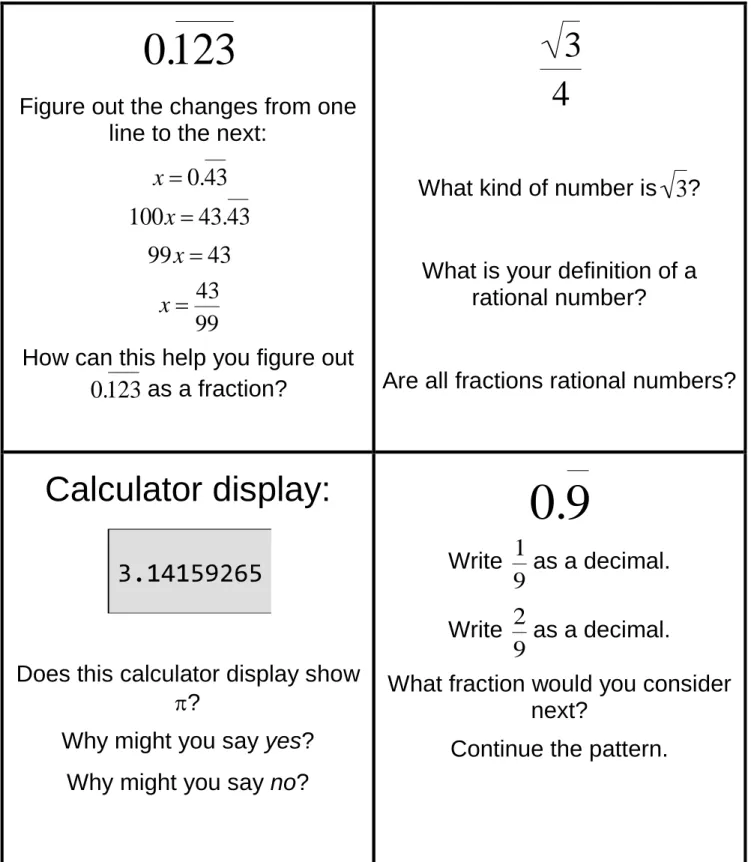
If a student struggles to get started, encourage them to ask a specific question about the task. Articulating the problem in this way can sometimes offer ideas to pursue that were previously overlooked. However, if the student needs their question answered, ask another member of the group for a response. There is a Hint Sheet provided to help students who struggle to make progress in classifying these numbers:
€
0.123,
€
3
4 , the calculator display 3.14159265, and
€
0.9.
If one group of students has difficulty with a problem another group dealt with well, you could ask them to talk to each other. If several groups of students are finding the same issue difficult, you might write a suitable question on the board, or organize a brief whole-class discussion focusing on that aspect of mathematics.
Are all fractions rational? Show me a fraction that is rational/that is irrational.
What does a calculator display 0.7777777778 / 0.1457878342 tell you about the number? Is any number with a root sign irrational?
Prompt students to write reasons for their decisions next to the cards. If you hear one student
providing a justification, prompt the other members of the group to either challenge or rephrase what they heard.
If any groups finish early, ask them to use the blank card to try to make up a new number to fit in an empty cell on the poster.
A couple of minutes before the end of the activity, ask each group to write onto a sheet of scrap paper the numbers from cards they have decided not to place on the poster.
Comparing solutions (10 minutes)
Ask one student from each group to swap with a student in another group, taking with them the sheet of scrap paper on which they have written their group’s non-classified numbers.
In the new groups, students compare the numbers they have not classified, to see if there are any differences. Ask students to share their reasons for the numbers they have not classified.
Gluing posters (5 minutes)
Ask students to return to their original small groups and distribute glue sticks. Ask them to discuss with their partners any changes they might want to make. Once students are satisfied with their answers, they can glue the cards in place. Remind students not to put on the poster any number cards they think can go in more than one place.
While students work on this, think about the numbers your students found difficult to place, or numbers for which you know there are different solutions. You can use these numbers as a focus for the whole-class discussion. Write these numbers in marker pen on large sticky notes.
Whole-class discussion (15 minutes)
In this discussion, we suggest you focus on reasoning about one or two examples that students found difficult, rather than checking students all have the same classifications.
Check that each student has a mini-whiteboard, pen, and eraser. Display Slide P-1 Classifying
Rational and Irrational Numbers again. Use the numbers you wrote on sticky notes: you will be able
to move them from one position to another on the classification table until students have reached agreement about proper placement.
Choose one of your sticky notes and read it to the class. Ask students to write on their
mini-whiteboards where to place it on the classification table. Place your sticky note on the part of the table indicated by one student and ask them to justify their placement of the card. Now ask another student to comment on the justification. Call on students who gave different answers on their whiteboards.
Bradley, where did you place this card? What was your reasoning?
Do you agree, Lia? You do? Please explain Bradley’s answer in your own words. Kanya, can you tell us why you think differently?
Move the cards from one cell to another until students reach agreement on the placement of the card. If there is no disagreement, provoke some by placing a number incorrectly and asking students for an explanation.
The discussion below is indicative. You may feel that other issues should be the focus of discussion for your students.
Sample discussion
You might begin by checking the placement of the non-terminating repeating decimal 0.123.
Write on your mini-whiteboard. Is terminating or non-terminating?
Is 0.123 rational or irrational?
Alicia, where did you place 0.123? Why might you think it goes there?
As part of this discussion, you might ask students to show on their mini-whiteboards how to change from the repeating non-terminating decimal representation to a fraction. If necessary, ask students to work with you, as you model use of the standard algorithm for changing a repeating decimal to a fraction.
Focus on the decimal representations 0.123, 0.123, 0.123..., 0.123, and 0.123 (rounded correct to three decimal places). To actively involve students, ask them to use their mini-whiteboards.
Are 0.123 and 0.123 the same number? How do you know? Is 0.123 rational or irrational? How do you know?
What about
€
0.123? Is that rational or irrational? How do you know?
What is the difference between 0.123 and 0.123...? What difference do those little dots [the
ellipsis] make?
Show me a way 0.123... might continue if it’s a rational number.
Show me a way 0.123... might continue that would make it an irrational number. Why is this
difficult?
Push students to identify explicitly the difference between decimals in which there is a repeating pattern of digits and non-terminating decimals in which there is a pattern, but no repeats.
Either refer to one of the student’s whiteboards, or write 0.123456789101112131415... on the board.
What would the next six digits be, Jenny? How do you know? Tell me about the pattern in the digits of this decimal number. Is this a repeating decimal?
Do the same digits repeat in the same order again and again?
Consider the other ambiguous representations:
What if the number is rounded to 0.123? Is this a rational or an irrational number?
Show me a number that could be rounded to 0.123 that is a rational number.
Show me a number that could be rounded to 0.123 that is an irrational number.
Did you find any other representations that might be rational, or might be irrational, depending on how the number continued? [The calculator display looks like the first digits of pi, but could be a rational number.]
Explain how the calculator display number might continue. Show me a rational version of the calculator display number.
If there is time, consider
€
0.9 and how, as this can be written as 1, the distinction between terminating and non-terminating decimal representations becomes blurred.
Finally, discuss the empty cells on the classification table (irrational terminating decimal, irrational non-terminating repeating decimal, rational non-terminating non-repeating decimal).
Which numbers go in this cell?
Is it possible to place numbers in this cell? [No. No terminating decimals/non-terminating repeating decimals are irrational numbers and no non-terminating non-repeating decimals are rational numbers.]
Follow-up lesson: individual review (20 minutes)
Give each student his or her original solution to the assessment task, Is it Rational? along with a new copy of the same task. If you have not added questions to individual pieces of work, write your list of questions on the board. Students should select from this list only those questions they think are appropriate to their own work.
Invite students to revise their work using your questions:
I would like you to read through your original solutions and the questions I have written (on the board/on your script) to help you improve your work.
Answer these questions and revise your response.
Now give each student a copy of the Classifying Rational and Irrational Numbers assessment task.
Use what you have learned to answer these questions. Show all your work on the sheet and make sure you explain your answers really clearly. I have some calculators if you wish to use one.
If students struggled with the original assessment task, you may feel it more appropriate for them to just spend their time revisiting Is it Rational? rather than attempting Classifying Rational and
Irrational Numbers as well.
Teacher guide Classifying Rational and Irrational Numbers T-10
SOLUTIONS
Assessment task: Is it Rational? 1.
Number Possible student reasoning 5 5 is rational.
It can be written as a fraction, the ratio of two integers a, b, with b
€ ≠ 0, e.g. € 35 7 , € −5 −1. Students sometimes discount whole number rationals, especially 0.
€
5 7€
57 is rational, since it can be written as the ratio of two integers a, b, with b
€ ≠ 0. € 0.575 € 0.575 is rational.
Using decimal place value, € 0.575= 575 1000. € 5 € 5 is irrational.
Students might argue that if a number is not a perfect square then its root is irrational. Or they might argue that
€
4< <
€
9, and there is no integer between 2
and 3. This doesn’t establish that there is no fractional value for though. At this stage of their math learning, students are unlikely to produce a standard proof by contradiction of the irrationality of
€ 5. € 5+ 7 €
5+ 7 is irrational because the sum of a rational and irrational number is always
irrational. € 10 2 € 10 2 is irrational.
Students may think it is rational because it is represented as a fraction.
€
5.75....
€
5.75.... From this truncated decimal representation, it is not possible to decide whether the number represented by is rational or irrational.
This is a difficulty that students often encounter when reading calculator displays. The dots here indicate that the decimal is non-terminating, but the number might have a repeating (rational) or non-repeating (irrational) tail. Students could give examples to show this, e.g.
€ 5.757 _ and 5.75123456789101112131415…. €
(5+ 5)(5− 5) The product of these two irrational factors is rational. Using a calculator will
suggest that the product is rational, but not why.
€
(5+ 5)(5− 5)=25−5 5+5 5−5=20. Removing the parentheses and simplifying does provide a reason why the expression is rational.
€
(7+ 5)(5− 5) The product of these two irrational factors is irrational.
€ (7+ 5)(5− 5)=35−7 5+5 5−5=30−2 5. Since € 5 is irrational, € 2 5is irrational and € 30−2 5is irrational. Use of a
calculator will not help to show the irrationality of
€
30−2 5.
€
2.
Student Statement Agree or
disagree?
Arlo: 0.57 is an irrational number. Disagree Agreeing with Arlo, that 0.57 is an irrational number, may indicate a standard misconception. Many students believe that a number with an infinitely long decimal representation must be irrational.
Hao: No, Arlo, it is rational, because 0.57 can be written as a fraction.
Agree Hao is correct. 0.57=19
33 Eiji: Maybe Hao’s correct, you know.
Because 0.57= 57 100. Agree with statement, but disagree with reason.
Eiji is correct in that Hao’s answer is correct, but he is incorrect to say that
0.57= 57
100. This is a common error.
Korbin: Hang on. The decimal for
would go on forever if you tried to write it out. That’s what the bar thing means, right?
Agree 0.57=0.57575757... does “go on forever.” Not recognizing this is a misunderstanding of standard notation. Hank: And because it goes on forever, that
proves 0.57 has got to be irrational.
Disagree Thinking that an infinitely long decimal tail means a number can’t be rational is a common student error.
2. b. 0.57 is rational. Let x=0.57. Then 100x=57.57. So € 99x=57. Thus x=57 99= 19 33. 0.57
Collaborative small-group work
Rational numbers Irrational numbers
Terminating decimal
€
7
8= 0.875 and is a terminating decimal.
This cell is empty: there are no terminating decimal representations of irrational numbers. € 0.123= 123
1000 and so rational and terminating.
€ (8+ 2 )(8− 2 )=64−8 2+8 2− 2 2 € =64−2=62. 62 rational, with a terminating decimal representation.
€ 8 2 = 2 2 2 =2
2 is rational, with a terminating decimal representation.
€
2× 8= 2×2 2=2×2=4
4 is rational, with a terminating decimal representation. Non-terminating repeating decimal € 2 3=0.6
Students might already know this decimal conversion, or perform division to calculate it.
This cell is empty: there are no non-terminating repeating decimal representations of irrational numbers. € 22 7 =3.142897
Students might use division to calculate this commonly used approximation of π. Using a calculator, they may not find all the repeating digits and so would have no reason to suppose it is a repeating decimal.
x = 0.123 1000x = 123.123 1000x − x = 123 999x = 123 x = 0.123 = 123 999 x=0.123 10x = 1.23 1000x = 123.23 1000x − 10x = 122 x = 122 990 = 61 495
Rational numbers Irrational numbers Non-terminating non-repeating decimal
This cell is empty: no rational number has a non-terminating non-repeating decimal representation.
€
π is irrational, with a non-terminating, non-repeating
decimal representation. We expect students will have been told of the irrationality of
€
π and do not expect this claim to be justified.
3
4 is irrational since 3 is not a perfect square and only
integers that are perfect squares have rational roots. An irrational divided by a rational is irrational.
€
8 is irrational since 8 is not a square number and only integers that are square numbers have rational roots.
€
2+ 8 is the sum of two irrational numbers. It is irrational, since
€
2+ 8= 2+2 2=3 2and the
product of a non-zero rational number and an irrational number is irrational. Some sums of irrational numbers are rational, such as
€
4 2−2 8.
There is insufficient information to assign the following number cards to a unique category: 0.123 ....
This is a non-terminating decimal, but the ellipsis does not determine whether it is repeating or non-repeating.
It could turn out to be a rational number, such as 0.1234.
It could turn out to be an irrational number, such as 0.12301001000100001… (a patterned tail of zeros and ones, with one extra zero between ones each time.)
0.123 (rounded correct to three decimal places)and the calculator display: 3.14159265
0.123 could be a rounded version of either a rational or an irrational number, because it might be a rounded terminating decimal, rounded non-terminating repeating decimal (both rational), or a non-terminating non-repeating decimal (irrational). This is also the case with the calculator display, which shows the first 9 digits of pi.
0.9 is a separate case.
It is clearly a rational number, but its categorization as a non-terminating repeating decimal, rather than as a terminating decimal is dubious.
Students might argue that 0.1=1 9, 0.2=
2
9, … , 0.9= 9 9=1.
Alternatively, they could show that if x=0.9, 10x=9.9 so 9x=9and x=9
9=1.
Assessment task: Classifying Rational and Irrational Numbers
1.
Number Possible student reasoning
€
0.21
0.21 is a rational number. A student might establish this by showing that is can be written as a fraction of integers e.g.€
21
100
or by stating that it is aterminating decimal, and therefore rational.
€
3
12
3
12is the ratio of two integersa, b, withb 0and so is rational. Or
alternatively,
€
3
12
=
0.25
, which is a terminating decimal and so is rational.€
12
−
2
Students may argue that 12is irrational because 12= 3×4=2× 3and the product of a non-zero rational and an irrational number is irrational.€ 12 4 12 4 = 2 3 4 = 3
2 . The quotient of an irrational and a non-zero integer is
irrational.
€
4.125...
The ellipsis does not determine how the decimal digits will continue, only that they do. The number could be irrational (the digits continue and do not repeat) or rational (the digits continue and repeat). Check whether students confuse “non-repeating” with “non-patterned”: a number in which the pattern of the digits is e.g. 4.12512612712812912101211… is irrational because although patterned, the non-terminating tail will never repeat itself.( 12−4)(4+ 12) ( 12−4)(4+ 12)=4 12+12−16−4 12=−4. This is a rational number.
12.52 (rounded to 2 d.p.)
There is no way of telling whether this is rational or irrational.
For example: 12.521234567891011…. is irrational (providing the pattern continues) but 12.524 is rational.
€
2. In this question, the student’s explanations are more important than the truth value assigned to the statement. These explanations may indicate the student still makes common errors or has alternative conceptions.
Student Statement Agree or
disagree?
Otis 3
8 is a rational number because it can be written as a fraction.
Disagree Otis is incorrect. Students who agree with Otis may not understand that some fractions are irrational! That error comes from a partial definition of rational. A fuller definition of rational number is that it is a number that can be written as a ratio of integers.
Lulu 3
8 is irrational because 3is irrational.
Agree Lulu’s statement is correct, but her justification is incomplete.
3
8 is irrational because 3is irrational and the quotient of an irrational number and non-zero integer is irrational. Leon 0.286 is rational because you can
write it as the fraction 286 1000. Agree with statement, but disagree with reason.
Leon is correct that
€
0.286
is rational, but his claim that it is the fraction 2861000 is incorrect.
Students may produce the correct rational representation of the recurring decimal:
0.286=286
999. Alternatively, students may argue that 286
1000=0.286≠0.286. Joan is an irrational number
because that decimal will carry on forever.
Disagree Joan is incorrect to claim that
€
0.286
is irrational. A repeating non-terminating decimal is a rational number.Ray 0.286 (rounded to three decimal places) might be rational or irrational.
Agree Ray is correct. If 0.286 were rounded from e.g. 0.2855555555… then it would be a rational number. If it were rounded from 0.2861234567891011121314… then, since this pattern does not repeat, the number would be irrational.
Arita 0.286… is rational - the little dots show the digits carry on in the same pattern forever.
Disagree Arita is incorrect. The ellipsis shows only that the digits do continue, not how.
0.286... could represent either a rational or an irrational number
€
Student materials Classifying Rational and Irrational Numbers S-1 © 2015 MARS, Shell Center, University of Nottingham
Is it Rational?
Remember that a bar over digits indicates a recurring decimal number, e.g.
0.256
=
0.2565656...
1. For each of the numbers below, decide whether it is rational or irrational.Explain your reasoning in detail.
5
5
7
0.575
5
5
+
7
10
2
5.75....
(5
+
5)(5
-
5)
(7
+
5)(5
-
5)
Student materials Classifying Rational and Irrational Numbers S-2 © 2015 MARS, Shell Center, University of Nottingham
2. Arlo, Hao, Eiji, Korbin, and Hank were discussing
0.57
. This is the script of their conversation.Student Statement Agree or disagree?
Arlo: 0.57is an irrational number.
Hao: No, Arlo, it is rational, because 0.57can be written as a fraction.
Eiji: Maybe Hao’s correct, you know. Because 0.57= 57
100.
Korbin: Hang on. The decimal for 0.57would go on forever if you tried to write it. That’s what the bar thing means, right?
Hank: And because it goes on forever, thatproves 0.57has gotto be irrational.
a. In the right hand column, write whether you agree or disagree with each student’s statement. b. If you think
0.57
is rational, say what fraction it is and explain why.Student materials Classifying Rational and Irrational Numbers S-3 © 2015 MARS, Shell Center, University of Nottingham
Poster Headings
C
la
s
s
if
y
in
g
R
a
ti
o
n
a
l
a
n
d
Ir
ra
ti
o
n
a
l
N
u
m
b
e
rs
T
e
rm
in
a
ti
n
g
d
e
c
im
a
l
R
a
ti
o
n
a
l
n
u
m
b
e
rs
N
o
n
-t
e
rm
in
a
ti
n
g
n
o
n
-r
e
p
e
a
ti
n
g
d
e
c
im
a
l
N
o
n
-t
e
rm
in
a
ti
n
g
re
p
e
a
ti
n
g
d
e
c
im
a
l
Ir
ra
ti
o
n
a
l
n
u
m
b
e
rs
Student materials Classifying Rational and Irrational Numbers S-4 © 2015 MARS, Shell Center, University of Nottingham
Rational and Irrational Numbers (1)
7
8
0.123
…
0.9
_
2
3
22
7
(8
+
2)(8
-
2)
p
8
2
8
Student materials Classifying Rational and Irrational Numbers S-5 © 2015 MARS, Shell Center, University of Nottingham
Rational and Irrational Numbers (2)
2
´
8
2
+
8
3
4
0.123
0.123
rounded correct
to 3 decimal
places
Calculator display:
0.123
0.123
Student materials Classifying Rational and Irrational Numbers S-6 © 2015 MARS, Shell Center, University of Nottingham
Hint Sheet
0.123
Figure out the changes from one
line to the next:
x
=
0.43
100
x
=
43.43
99
x
=
43
x
=
43
99
How can this help you figure out
0.123
as a fraction?
3
4
What kind of number is
3
?
What is your definition of a
rational number?
Are all fractions rational numbers?
Calculator display:
Does this calculator display show
?
Why might you say
yes
?
Why might you say
no
?
0.9
Write
1
9
as a decimal.
Write
2
9
as a decimal.
What fraction would you consider
next?
Student materials Classifying Rational and Irrational Numbers S-7 © 2015 MARS, Shell Center, University of Nottingham
Classifying Rational and Irrational Numbers
1. For each of the numbers below, decide whether it is rational or irrational. Explain your answers.
Number Reasoning
0.21
3
12
12
-
2
12
4
4.125...
( 12
-
4)(4
+
12 )
12.52
(rounded to 2 d.p.)
Student materials Classifying Rational and Irrational Numbers S-8 © 2015 MARS, Shell Center, University of Nottingham
2. Some students were classifying numbers as rational and irrational. Decide whether you agree or disagree with each statement.
Correct any errors. Explain your answers clearly.
Student Statement Agree or disagree?
Otis 3
8 is a rational number because it can be written as a fraction.
Lulu 3
8 is irrational because 3 is irrational.
Leon 0.286is rational because you can write it as the fraction 286
1000.
Joan 0.286is an irrational number because that decimal will carry on forever.
Ray 0.286 (rounded to three decimal places) might be rational or irrational.
Arita 0.286…
is rational - the little dots show the digits carry on in the same pattern forever.
Classifying Rational and Irrational Numbers Projector Resources
Classifying Rational and Irrational Numbers
Rational Numbers
Irrational Numbers
Terminating
decimal
Non-terminating
repeating decimal
Non-terminating
non-repeating
decimal
P-1Classifying Rational and Irrational Numbers Projector Resources
Instructions for Placing Number Cards
•
Take turns to choose a number card.
•
When it is your turn:
–
Decide where your number card fits on the poster.
–
Does it fit in just one place, or in more than one place?
–
Give reasons for your decisions.
•
When it is your partner’s turn:
–
If you agree with your partner’s reasoning, explain it in your own
words.
–
If you disagree with your partner’s decision, explain why. Then
together, figure out where to put the card.
•
When you have reached an agreement:
–
Write reasons for your decision on the number card.
–
If the number card fits in just one place on the poster, place it on the
poster.
–
If not, put it to one side.
© 2015 MARS, Shell Center, University of Nottingham
This material may be reproduced and distributed, without modification, for non-commercial purposes, under the Creative Commons License detailed at http://creativecommons.org/licenses/by-nc-nd/3.0/
All other rights reserved.
Mathematics Assessment Project
Classroom Challenges
These materialswere designed and developed by theShell Center Team at the Center for Research in Mathematical Education University of Nottingham, England:
Malcolm Swan,
Nichola Clarke, Clare Dawson, Sheila Evans, Colin Foster, and Marie Joubert
with
Hugh Burkhardt, Rita Crust, Andy Noyes, and Daniel Pead
We are grateful to the many teachers and students, in the UK and the US,
who took part in the classroom trials that played a critical role in developing these materials The classroom observation teams in the US were led by
David Foster, Mary Bouck, and Diane Schaefer
This project was conceived and directed for
The Mathematics Assessment Resource Service (MARS) by
Alan Schoenfeld at the University of California, Berkeley, and
Hugh Burkhardt, Daniel Pead, and Malcolm Swan at the University of Nottingham
Thanks also to Mat Crosier, Anne Floyde, Michael Galan, Judith Mills, Nick Orchard, and Alvaro Villanueva who contributed to the design and production of these materials
This development would not have been possible without the support of Bill & Melinda Gates Foundation
We are particularly grateful to
Carina Wong, Melissa Chabran, and Jamie McKee
The full collection of Mathematics Assessment Project materials is available from