Environmental Protection Emergency Response & Innovation October 2003
Agency (5302W) (1807T) www.epa.gov/
innovation/lean.htm
Lean Manufacturing and the Environment:
Research on Advanced Manufacturing Systems and the Environment and
Recommendations for Leveraging Better Environmental Performance
This report was prepared for the U.S. Environmental Protection Agency's Office of Solid Waste and Emergency Response (OSWER) and Office of Policy, Economics, and Innovation (OPEI). Ross & Associates Environmental Consulting, Ltd. prepared this report for U.S. EPA under contract to Industrial Economics, Inc. (U.S. EPA Contract # 68-D9-9018).
DISCLAIMER
The observations articulated in this report and its appendices represent Ross & Associates’ interpretation of the research, case study information, and interviews with lean experts and do not necessarily represent the opinions of the organizations or lean experts interviewed or researched as part of this effort. U.S. Environmental Protection Agency (EPA) representatives have reviewed and approved this report, but this does not necessarily constitute EPA endorsement of the observations or recommendations presented in this report.
Recommendations for Leveraging Better Environmental Performance Table of Contents Executive Summary . . . 1 I. Introduction . . . 6 A. Purpose . . . 6 B. Project Activities . . . 7
II. Introduction to Lean Manufacturing . . . 8
A. What is Lean Manufacturing? . . . 8
B. What Methods Are Organizations Using to Implement Lean? . . . 10
C. Why Do Companies Engage in Lean Manufacturing? . . . 14
D. Who Is Implementing Lean? . . . 18
III. Key Observations Related to Lean Manufacturing and its Relationship to Environmental Performance and the Regulatory System . . . 21
Observation 1 . . . 21 Observation 2 . . . 29 Observation 3 . . . 33 Observation 4 . . . 40 IV. Recommendations . . . 44 Recommendation 1 . . . 44 Recommendation 2 . . . 45 Recommendation 3 . . . 46 Bibliography . . . 48
Appendix A: Lean Terms and Definitions . . . 51
Appendix B: Lean Experts and Case Study Companies . . . 53
Lean Experts Interviewed . . . 53
Companies Addressed by Case Studies . . . 53
Appendix C: Case Study Summaries . . . 54
Apollo Hardwoods Company . . . 54
General Motors Corporation . . . 57
Goodrich Corporation - Aerostructures Group . . . 60
U.S. Environmental Protection Agency. Pursuing Perfection: Case Studies Examining Lean
1
Manufacturing Strategies, Pollution Prevention, and Environmental Regulatory Management Implications. U.S. EPA Contract # 68-W 50012 (August 20, 2000).
Simon Caulkin. “W aste Not, W ant Not,” The Observer (September 2002).
2
Executive Summary
Background
“Lean manufacturing” is a leading manufacturing paradigm being applied in many sectors of the U.S. economy, where improving product quality, reducing production costs, and being “first to market” and quick to respond to customer needs are critical to competitiveness and success. Lean principles and methods focus on creating a continual improvement culture that engages employees in reducing the intensity of time, materials, and capital necessary for meeting a customer’s needs. While lean production’s fundamental focus is on the systematic elimination of non-value added activity and waste from the production process, the implementation of lean principles and methods also results in improved environmental performance.
The U.S. Environmental Protection Agency (EPA) sponsored a study on lean manufacturing in 2000 that included a series of case studies with the Boeing Company to explore the relationship between lean production and environmental performance. The study found that lean implementation at the Boeing1
Company resulted in significant resource productivity improvements with important environmental improvement implications. The Boeing case studies also found evidence that some environmentally sensitive processes, such as painting and chemical treatment, can be more difficult to lean, leaving potential resource productivity and environmental improvements unrealized. These findings led EPA’s Office of Solid Waste and Emergency Response (OSWER), in partnership with the Office of Policy, Economics, and Innovation (OPEI), to pursue new research to examine further the relationship between lean manufacturing and environmental performance and the regulatory framework. The goal of this effort is to help public environmental agencies understand ways to better leverage lean manufacturing, existing government environmental management programs and initiatives, and regulatory requirements in the hope that even greater environmental and economic benefits will result.
What is Lean Manufacturing?
In its most basic form, lean manufacturing is the systematic elimination of waste from all aspects of an organization’s operations, where waste is viewed as any use or loss of resources that does not lead directly to creating the product or service a customer wants when they want it. In many industrial processes, such non-value added activity can comprise more than 90 percent of a factory’s total activity. 2
Nationwide, numerous companies of varying size across multiple industry sectors, primarily in the manufacturing and service sectors, are implementing such lean production systems, and experts report that the rate of lean adoption is accelerating. Companies primarily choose to engage in lean manufacturing for three reasons: to reduce production resource requirements and costs; to increase customer responsiveness; and to improve product quality, all which combine to boost company profits and competitiveness. To help accomplish these improvements and associated waste reduction, lean involves a fundamental paradigm shift from conventional “batch and queue” mass production to product-aligned “one-piece flow” pull production. Whereas “batch and queue” involves mass production of large lots of products in advance based on potential or predicted customer demands, a “one-piece flow” system rearranges production activities in a way that processing steps of different types are conducted immediately adjacent to each other in a continuous flow.
Examples of conventional P2 return on investment factors include reductions in liability, compliance
3
management costs, waste management costs, material input costs, as well as avoided pollution control equipment.
This shift requires highly controlled processes operated in a well maintained, ordered, and clean environment that incorporates principles of employee-involved, system-wide, continual improvement. Common methods used in lean manufacturing include: Kaizen; 5S; Total Productive Maintenance (TPM); Cellular Manufacturing; Just-in-Time Production; Six Sigma; Pre-Production Planning (3P); and Lean Enterprise Supplier Networks.
Research Observations
Written material research, telephone interviews with “lean experts” from relevant industry, academic, and non-profit entities, and a series of brief lean case studies generated four main research observations. Key points are summarizes under each of these observations below.
• Lean produces an operational and cultural environment that is highly conducive to waste minimization and pollution prevention (P2). Lean methods focus on continually improving the resource productivity and production efficiency, which frequently translates into less material, less capital, less energy, and less waste per unit of production. In addition, lean fosters a systemic, employee-involved, continual improvement culture that is similar to that encouraged by public agencies’ existing voluntary programs and initiatives, such as those focused on environmental management systems (EMS), waste minimization, pollution prevention, and Design for Environment, among others. There is strong evidence that lean produces environmental performance improvements that would have had very limited financial or organizational attractiveness if the business case had rested primarily on conventional P2 return on investment factors associated with the projects. This research indicates that the lean drivers for culture change—substantial3
improvements in profitability and competitiveness by driving down the capital and time intensity of production and service processes—are consistently much stronger than the drivers that come through the “green door,” such as savings from pollution prevention activities and reductions in compliance risk and liability.
This research found that lean implementation efforts create powerful coattails for environmental improvement. To the extent that improved environmental outcomes can ride the coattails of lean culture change, there is a win for business and a win for environmental improvement. Pollution prevention may “pay,” but when associated with lean implementation efforts, the likelihood that pollution prevention will compete rises substantially.
• Lean can be leveraged to produce more environmental improvement, filling key “blind spots” that can arise during lean implementation. Although lean currently produces environmental benefits and establishes a systemic, continual improvement-based waste elimination culture, lean methods do not explicitly incorporate environmental performance considerations, leaving environmental improvement opportunities on the table. In many cases, lean methods have “blind spots” with respect to environmental risk and life-cycle impacts.
This research identified three key gaps associated with these blind spots, that, if filled, could further enhance the environmental improvements resulting from lean implementation. First, lean methods do not explicitly identify pollution and environmental risk as “wastes” to target for elimination. Second, in many organizations, environmental personnel are not well integrated into
operations-based lean implementation efforts, often leading environmental management activities to operate in a “parallel universe” to lean implementation efforts. Third, the wealth of information and expertise related to waste minimization and pollution prevention that environmental management agencies have assembled over the past two decades is not routinely making it into the hands of lean practitioners.
Despite these gaps, there is evidence that lean provides an excellent platform for incorporating environmental management tools such as life-cycle assessment, design-for-environment, and other tools designed to reduce environmental risk and life-cycle environmental impacts.
• Lean experiences regulatory “friction” around environmentally-sensitive processes. Where there are environmentally-sensitive manufacturing processes, the right-sized, flexible, and mobile operating environment sought under lean initiatives can be complex and difficult to implement. This research indicates that the number of environmentally sensitive processes that generate complexity and difficulty is relatively small, including:
• Chemical point-of-use management; • Chemical treatment;
• Metal finishing processes; • Painting and coating; and • Parts cleaning and degreasing.
“Friction,” in the form of uncertainty or delay, typically results where environmental regulations did not explicitly contemplate right-sized, mobile production systems or fast-paced, iterative operational change. This results in situations where either environmental performance improvements can be constrained, or the risk of potential non-compliance with environmental regulations is increased. Where companies are delayed or deterred from applying lean to environmentally-sensitive processes, not only are they less able to address competitive industry pressures, they also do not realize the waste reduction benefits around these processes that typically result from lean implementation. Alternatively, lack of regulatory precedent or clarity can cause even the most well meaning companies to misinterpret requirements and experience violations, even where environmental improvement has resulted. This research found that regulatory relief is not necessary to address these friction areas, but rather that increased clarity around acceptable compliance strategies (and regulatory interpretations) for leaning these environmentally-sensitive processes and increased government responsiveness within its administrative activities are likely to reduce this friction.
• Environmental agencies have a window of opportunity to enhance the environmental benefits associated with lean. There is a strong and growing network of companies implementing, and organizations promoting, lean across the U.S. For those companies transitioning into a lean production environment, EPA has a key opportunity to influence their lean investments and implementation strategies by helping to explicitly establish with lean methods environmental performance considerations and opportunities. Similarly, EPA can build on the educational base of lean support organizations—non-profits, publishers, and consulting firms—to ensure they incorporate environmental considerations into their efforts.
As several lean experts suggested, efforts to “paint lean green” are not likely to get far with most lean practitioners and promoters. Instead, public environmental management agencies will be better served by being at the table with practitioners and promoters, seeking opportunities to fit
environmental considerations and tools, where appropriate, into the context of operations-focused lean methods.
Recommendations
The observations gained from this research indicate three overarching recommendations and several potential actions that the EPA can take to facilitate improved environmental performance associated with lean implementation.
Recommendation 1: Work with lean experts to identify and address the environmental “blind spots” that typically arise in lean methods
By addressing the few environmental blind spots and gaps in lean manuals, publications, training, and lean implementation, environmental regulatory agencies have an opportunity to harness even greater environmental improvement from industry lean implementation efforts. To address this opportunity, EPA should consider involving “lean experts” in developing and implementing strategies for raising awareness among companies of opportunities to achieve further environmental improvements while leaning, and developing books, fact sheets, and website materials for corporate environmental managers that articulate the connection between lean endeavors and environmental improvements. Such materials would articulate the connection between lean endeavors and environmental improvements, and explain ways in which additional environmental considerations and questions can potentially be incorporated into lean manufacturing methods. For example, questions could draw on EPA’s substantial pool of waste minimization and P2 methodologies that could be considered in the context of a kaizen rapid process improvement event (e.g., Does the process have waste streams? If so, what are the pollutants? Can materials with lower toxicity be used? Can they be reduced or eliminated?). More specific actions the EPA can take to facilitate this process include:
• Develop an action plan for raising awareness among companies of opportunities to achieve further environmental improvements during lean implementation;
• Partner with lean promoters to develop and modify lean tools, manuals, training, and conference sessions to address environmental performance topics;
• Develop and disseminate resources and tools for environmental practitioners to help them better understand lean manufacturing techniques and benefits;
• Develop resources, fact sheets, and website materials that highlight important environmental questions and criteria that can be incorporated into lean methods; and
• Conduct explicit outreach (e.g., materials, conference presentations, workshops) to corporate environment, health, and safety (EHS) managers to raise awareness about techniques they can use to integrate environmental considerations into their companies’ lean initiatives.
Recommendation 2: Develop a pilot/demonstration program to encourage companies who are implementing lean to achieve more waste reduction and P2 by explicitly incorporating environmental considerations and tools into their lean initiatives.
EPA can help build the bridge between lean manufacturing initiatives and environmental management by assisting companies who are implementing lean to achieve more waste reduction and P2 through the explicit incorporation of environmental considerations and tools into their lean initiatives. Beginning a pilot/demonstration program with specific companies could open avenues for putting the wealth of pollution prevention expertise, techniques, and technologies developed in recent decades for driving waste and risk out of these processes into the hands of lean practitioners who are engaged in process innovation. By
building such a “bridge,” environmental agencies will be better positioned to understand lean implementation processes and to realize greater environmental improvement result from lean initiatives. Specific pilot/demonstration activities could include:
• Work with companies to document and disseminate case study examples of companies that have successfully integrated environmental activities into lean. In addition , EPA could explore and highlight case study examples that illustrate how companies have effectively used lean as a platform for implementing environmentally sustainable tools (e.g., life-cycle analyses, Design for Environment);
• Partner with selected industry sectors and associated organizations in which there is large amount of lean activity to improve the environmental benefits associated with lean. For example, EPA could explore partnership opportunities with the Lean Aerospace Initiative or the Society for Automotive Engineers to bridge lean and the environment in these sectors; and
• Expand individual EPA initiatives, such as OSWER’s “Greening Hospitals” initiative, by integrating waste reduction and product stewardship techniques into the organizations’ lean initiatives. This effort could include conducting a pilot project with a hospital implementing lean, designed to integrate waste reduction and product stewardship techniques into its lean initiatives. The resulting lessons could then be publicized for the benefit of other hospitals.
Recommendation 3: Use pilot projects and resulting documentation to clarify specific areas of environmental regulatory uncertainty associated with lean implementation and improve regulatory responsiveness to lean implementation.
This research suggests that public environmental management agencies have an important opportunity to align the environmental regulatory system to address key business competitiveness needs in a manner that improves environmental performance. Lack of regulatory precedent associated with mobile, “right-sized” equipment begs the need for environmental agencies to articulate acceptable compliance strategies for addressing applicable requirements in the lean operating environment. At the same time, regulatory “friction”—cost, delay, uncertainty—can often arise when regulatory “lead times” (e.g., time to secure applicability determinations, permits, and approval) slow the fast-paced, iterative operational change that is typically associated with lean implementation.
Using pilot projects with specific companies, EPA can address specific areas of environmental regulatory uncertainty associated with lean implementation as well as improve regulatory responsiveness to lean implementation. EPA can then communicate the results of such endeavors through guidance documents for companies implementing advanced manufacturing methods that clarify the appropriate regulatory procedures for leaning environmentally-sensitive processes, and replicable models for reducing the lead times associated with certain regulatory processes. More specific actions EPA can take to facilitate this process include:
• Developing guidance on acceptable compliance strategies for implementing lean techniques around environmentally sensitive processes (for example, clarifying acceptable approaches for addressing RCRA satellite hazardous waste accumulation requirements in the context of implementing chemical point-of-use management systems);
• Developing acceptable compliance strategies and permitting tools that can accommodate the implementation of mobile, right-sized equipment around environmentally sensitive processes; and • Identifying and documenting guidance regarding acceptable strategies for applying lean to other
U.S. Environmental Protection Agency. Pursuing Perfection: Case Studies Examining Lean
4
Manufacturing Strategies, Pollution Prevention, and Environmental Regulatory Management Implications. U.S. EPA Contract # 68-W 50012 (August 20, 2000).
I. Introduction
A. Purpose
The U.S. Environmental Protection Agency (EPA) through work in various innovation initiatives with regulated industries over the past decade has recognized an emerging and very real transformation of the economic landscape. Largely, this change has arisen in the context of today’s competitive global market, increasing the pressure on U.S. companies to conceive and deliver products faster, at lower cost, and of better quality than their competitors. Pioneered by the Toyota Motor Company in Japan in the 1950s, a variety of advanced manufacturing techniques are increasingly being implemented by U.S. companies across a broad range of manufacturing and service industry sectors in response to these competitive pressures. “Lean manufacturing,” which focuses on the systematic elimination of waste, is a leading manufacturing paradigm of this new economy and competitive landscape.
In 2000, the U.S. EPA sponsored a study on lean manufacturing that included a series of case studies with the Boeing Company. The study found that lean implementation at the Boeing Company resulted in4
significant resource productivity improvements with important environmental improvement implications. Moreover, the continual improvement, waste elimination organizational culture engendered by lean methods at Boeing closely resembled the organizational culture that environmental agencies have been working successfully to encourage through the development and promotion of environmental management systems (EMS), pollution prevention, waste minimization, Design for Environment, and other voluntary initiatives. At the same time, the Boeing case studies found that certain environmentally sensitive processes, such as painting and chemical treatment, can be difficult to lean, leaving potential resource productivity and environmental improvements unrealized.
EPA’s Office of Solid Waste and Emergency Response (OSWER), in partnership with the Office of Policy, Economics, and Innovation (OPEI), initiated this project to examine further the relationship between lean manufacturing, environmental performance, and the environmental regulatory framework. The goal of this effort was to help public environmental agencies better understand the environmental implications of lean manufacturing and to help them adjust environmental management and regulatory initiatives to boost the environmental and economic benefits of lean initiatives. Through this effort, EPA aimed specifically to:
• Better understand the transformation occurring in the U.S. economy as companies shift to lean production systems as well as the environmental benefits associated with this change;
• Identify opportunities to better align existing public agency pollution prevention and sustainability promotion initiatives, programs, and tools to encourage improved environmental performance through increased integration with lean production techniques and tools;
• Understand the potential areas where environmental regulations and requirements, including those associated with the Resource Conservation and Recovery Act (RCRA), may impede and/or help companies’ abilities to implement and optimize lean production systems; and
• Identify opportunities to improve public agencies’ responsiveness to needs associated with organizations’ implementation of lean production systems, while improving environmental performance.
The W arner Robins Air Force Base case study was assembled based on published interviews with Air
5
Force officials and articles documenting the base’s lean implementation efforts and results. See Appendix C for information on the specific information sources.
B. Project Activities
This project sought to address the objectives listed above through a multi-pronged research approach. Key research activities are summarized below.
• The research included extensive review and analysis of academic, business, news, and internet publications addressing lean manufacturing trends, methods, case studies, and results.
• A series of telephone interviews with “lean experts” from both industry and non-profit entities actively involved in promoting, implementing, and studying advanced manufacturing methods were conducted to collect information and opinions related to the above-mentioned objectives (see Appendix B for a list of interviews conducted). These interviews provided numerous examples and mini-case studies that highlight the relationship between lean implementation and environmental performance. Several of these examples are woven through this report.
• A series of brief case studies were completed to document four organizations’ experience with implementing lean production systems, and the implications for environmental management and performance. The case studies typically included analyses of publically available information, supplemented in most cases by telephone interviews with company representatives or others responsible for or familiar with the detailed aspects of lean manufacturing implementation at their facilities. A site visit was also performed in the case of Goodrich Corporation. Case study5
organizations were selected based on information obtained in the review of lean literature and recommendations obtained during lean expert interviews, with an attempt to cover a variety of different business sectors. The case studies include: Apollo Hardwoods Company; General Motors Corporation; Goodrich Corporation; and Warner Robins Air Force Base (see Appendix C for summaries of the case studies).
• The results of this research has been compiled into this report and its attachments. Section II provides background information on lean manufacturing, section III documents four key observations on the relationship between lean manufacturing and environmental management, and section IV discusses recommendations for EPA and other public environmental management agencies based on the observations from this research.
James W omack, Daniel Jones, and Daniel Roos. The Machine That Changed the World (New York:
6
Simon & Schuster, 1990).
Simon Caulkin. “W aste Not, W ant Not,” The Observer (September 2002).
7
II. Introduction to Lean Manufacturing
A. What is Lean Manufacturing?
James Womack, Daniel Jones, and Daniel Roos coined the term “lean production” in their 1990 book The Machine that Changed the World to describe the manufacturing paradigm established by the Toyota Production System. In the 1950s, the Toyota Motor Company pioneered a collection of advanced6
manufacturing methods that aimed to minimize the resources it takes for a single product to flow through the entire production process. Inspired by the waste elimination concepts developed by Henry Ford in the early 1900s, Toyota created an organizational culture focused on the systematic identification and elimination of all waste from the production process. In the lean context, waste was viewed as any activity that does not lead directly to creating the product or service a customer wants when they want it. In many industrial processes, such “non-value added” activity can comprise more than 90 percent of the total activity as a result of time spent waiting, unnecessary “touches” of the product, overproduction, wasted movement, and inefficient use of raw materials, energy, and other factors. Toyota’s success from implementing advanced7
manufacturing methods has lead hundreds of other companies across numerous industry sectors to tailor these advanced production methods to address their operations. Throughout this report, the term “lean” is used to describe broadly the implementation of several advanced manufacturing methods.
Lean production typically represents a paradigm shift from conventional “batch and queue,” functionally-aligned mass production to “one-piece flow,” product-functionally-aligned pull production. This shift requires highly controlled processes operated in a well maintained, ordered, and clean operational setting that incorporates principles of just-in-time production and employee-involved, system-wide, continual improvement. To accomplish this, companies employ a variety of advanced manufacturing tools (see profiles of core lean methods later in this section) to lower the time intensity, material intensity, and capital intensity of production. When companies implement several or all of these lean methods, several outcomes consistently result:
• Reduced inventory levels (raw material, work-in-progress, finished product) along with associated carrying costs and loss due to damage, spoilage, off-specification, etc;
• Decreased material usage(product inputs, including energy, water, metals, chemicals, etc.) by reducing material requirements and creating less material waste during manufacturing;
• Optimized equipment (capital equipment utilized for direct production and support purposes) using lower capital and resource-intensive machines to drive down costs;
• Reduced need for factory facilities (physical infrastructure primarily in the form of buildings and associated material demands) by driving down the space required for product production;
• Increased production velocity (the time required to process a product from initial raw material to delivery to a consumer) by eliminating process steps, movement, wait times, and downtime; • Enhanced production flexibility (the ability to alter or reconfigure products and processes rapidly to
adjust to customer needs and changing market circumstances) enabling the implementation of a pull production, just-in-time oriented system which lowers inventory and capital requirements; and
Productivity Development Team, Just-in-Time for Operators (Portland, Oregon: Productivity Press,
8
2000) 3.
• Reduced complexity (complicated products and processes that increase opportunities for variation and error) by reducing the number of parts and material types in products, and by eliminating unnecessary process steps and equipment with unneeded features.
At the same time, lean implementation consistently fosters changes in organizational culture that exhibit the following characteristics:
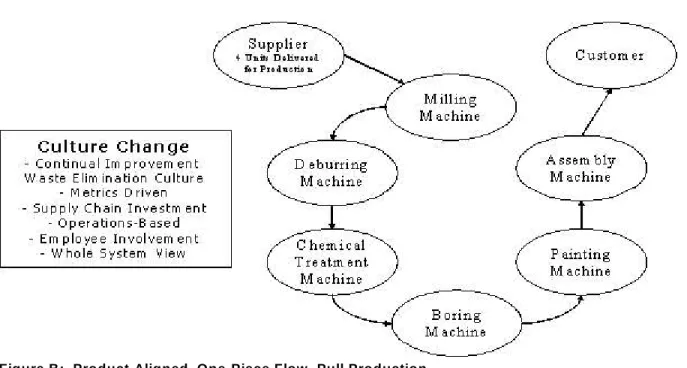
• A continual improvement culture focused on identifying and eliminating waste throughout the production process;
• Employee involvement in continual improvement and problem-solving; • Operations-based focus of activity and involvement;
• A metrics-driven operational setting that emphasizes rapid performance feedback and leading indicators;
• Supply chain investment to improve enterprise-wide performance; and • A whole systems view and thinking for optimizing performance.
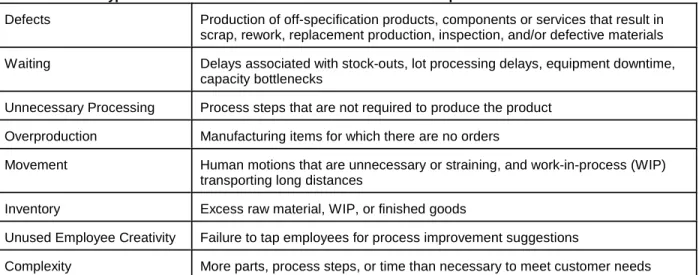
Lean methods typically target eight types of waste. These waste types are listed in Table 1. It is interesting8
to note that the “wastes” typically targeted by environmental management agencies, such as non-product output and raw material wastes, are not explicitly included in the list of manufacturing wastes that lean practitioners routinely target.
Table 1. Eight Types of M anufacturing W aste Targeted by Lean M ethods
Waste Type Examples
Defects Production of off-specification products, components or services that result in scrap, rework, replacement production, inspection, and/or defective materials Waiting Delays associated with stock-outs, lot processing delays, equipment downtime,
capacity bottlenecks
Unnecessary Processing Process steps that are not required to produce the product Overproduction Manufacturing items for which there are no orders
Movement Human motions that are unnecessary or straining, and work-in-process (WIP) transporting long distances
Inventory Excess raw material, WIP, or finished goods
Unused Employee Creativity Failure to tap employees for process improvement suggestions
B. What Methods Are Organizations Using to Implement Lean?
There are numerous methods and tools that organizations use to implement lean production systems. Eight core lean methods are described briefly below. The methods include:
1. Kaizen Rapid Improvement Process
2. 5S
3. Total Productive Maintenance (TPM)
4. Cellular Manufacturing / One-piece Flow Production Systems 5. Just-in-time Production / Kanban
6. Six Sigma
7. Pre-Production Planning (3P) 8. Lean Enterprise Supplier Networks
While most of these lean methods are interrelated and can occur concurrently, their implementation is often sequenced in the order they are presented below. Most organizations begin by implementing lean techniques in a particular production area or at a “pilot” facility, and then expand use of the methods over time. Companies typically tailor these methods to address their own unique needs and circumstances, although the methods generally remain similar. In doing so, they may develop their own terminology around the various methods. Appendix A includes a glossary of common lean manufacturing terms.
Kaizen Rapid Improvement Process. Lean production is founded on the idea of kaizen, or continual improvement. This philosophy implies that small, incremental changes routinely applied and sustained over a long period result in significant improvements. Kaizen, or rapid improvement processes, often are considered to be the ‘building block” of all lean production methods, as it is a key method used to foster a culture of continual improvement and waste elimination. Kaizen focuses on eliminating waste in the targeted systems and processes of an organization, improving productivity, and achieving sustained continual improvement. The kaizen strategy aims to involve workers from multiple functions and levels in the organization in working together to address a problem or improve a particular process. The team uses analytical techniques, such as Value Stream Mapping, to quickly identify opportunities to eliminate waste in a targeted process. The team works to rapidly implement chosen improvements (often within 72 hours of initiating the kaizen event), typically focusing on ways that do not involve large capital outlays. Periodic follow-up events aim to ensure that the improvements from the kaizen “blitz” are sustained over time. Kaizen can be used as an implementation tool for most of the other lean methods.
5S. 5S is a system to reduce waste and optimize productivity through maintaining an orderly workplace and using visual cues to achieve more consistent operational results. It derives from the belief that, in the daily work of a company, routines that maintain organization and orderliness are essential to a smooth and efficient flow of activities. Implementation of this method “cleans up” and organizes the workplace basically in its existing configuration, and it is typically the starting point for shop-floor transformation. The 5S pillars, Sort
(Seiri), Set in Order (Seiton), Shine (Seiso), Standardize (Seiketsu), and Sustain (Shitsuke), provide a methodology for organizing, cleaning, developing, and sustaining a productive work environment. 5S encourages workers to improve the physical setting of their work and teaches them to reduce waste, unplanned downtime, and in-process inventory. A typical 5S implementation would result in significant reductions in the square footage of space needed for existing operations. It also would result in the organization of tools and materials into labeled and color coded storage locations, as well as “kits” that contain just what is needed to perform a task. 5S provides the foundation on which other lean methods, such as TPM, cellular manufacturing, just-in-time production, and six sigma, can be introduced effectively.
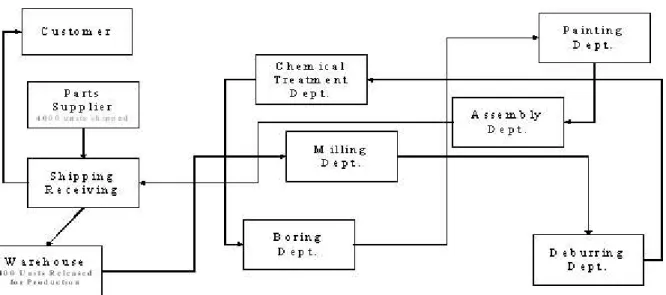
Figure A: Functionally-Aligned, Batch and Queue, M ass Production
Total Productive Maintenance (TPM). Total Productive Maintenance (TPM) seeks to engage all levels and functions in an organization to maximize the overall effectiveness of production equipment. This method further tunes up existing processes and equipment by reducing mistakes and accidents. Whereas maintenance departments are the traditional center of preventive maintenance programs, TPM seeks to involve workers in all departments and levels, from the plant-floor to senior executives, to ensure effective equipment operation. Autonomous maintenance, a key aspect of TPM, trains and focuses workers to take care of the equipment and machines with which they work. TPM addresses the entire production system lifecycle and builds a solid, plant-floor based system to prevent accidents, defects, and breakdowns. TPM focuses on preventing breakdowns (preventive maintenance), “mistake-proofing” equipment (or poka-yoke) to eliminate equipment malfunctions and product defects, making maintenance easier (corrective maintenance), designing and installing equipment that needs little or no maintenance (maintenance prevention), and quickly repairing equipment after breakdowns occur (breakdown maintenance). TPM’s goal is the total elimination of all losses, including breakdowns, equipment setup and adjustment losses, idling and minor stoppages, reduced speed, defects and rework, spills and process upset conditions, and startup and yield losses. The ultimate goals of TPM are zero equipment breakdowns and zero product defects, which lead to improved utilization of production assets and plant capacity.
Cellular Manufacturing/One-Piece Flow Systems. In cellular manufacturing, production work stations and equipment are arranged in a product-aligned sequence that supports a smooth flow of materials and components through the production process with minimal transport or delay. Implementation of this lean method often represents the first major shift in production activity and shop floor configuration, and it is the key enabler of increased production velocity and flexibility, as well as the reduction of capital requirements, in the form of excess inventories, facilities, and large production equipment. Figure A illustrates the production flow in a conventional batch and queue system, where the process begins with a large batch of units from the parts supplier. The parts make their way through the various functional departments in large “lots,” until the assembled products eventually are shipped to the customer.
Rather than processing multiple parts before sending them on to the next machine or process step (as is the case in batch-and-queue, or large-lot production), cellular manufacturing aims to move products through the
manufacturing process one-piece at a time, at a rate determined by customer demand (the pull). Cellular manufacturing can also provide companies with the flexibility to make quick “changeovers” to vary product type or features on the production line in response to specific customer demands. This can eliminate the need
Figure B: Product-Aligned, One-Piece Flow , Pull Production
for uncertain forecasting as well as the waste associated with unsuccessful forecasting. Figure B illustrates production in this product-aligned, one-piece flow, pull production approach.
Cellular manufacturing methods include specific analytical techniques for assessing current operations and designing a new cell-based manufacturing layout that will shorten cycle times and changeover times. To enhance the productivity of the cellular design, an organization must often replace large, high volume production machines with small, mobile, flexible, “right-sized” machines to fit well in the cell. Equipment often must be modified to stop and signal when a cycle is complete or when problems occur, using a technique called autonomation (or jidoka). This transformation often shifts worker responsibilities from watching a single machine, to managing multiple machines in a production cell. While plant-floor workers may need to feed or unload pieces at the beginning or end of the process sequence, they are generally freed to focus on implementing TPM and process improvements. Using this technique, production capacity can be incrementally increased or decreased by adding or removing production cells.
Just-in-time Production Systems/Kanban. Just-in-time production, or JIT, and cellular manufacturing are closely related, as a cellular production layout is typically a prerequisite for achieving just-in-time production. JIT leverages the cellular manufacturing layout to reduce significantly inventory and work-in-process (WIP). JIT enables a company to produce the products its customers want, when they want them, in the amount they want. JIT techniques work to level production, spreading production evenly over time to foster a smooth flow between processes. Varying the mix of products produced on a single line, often referred to as shish-kebab production, provides an effective means for producing the desired production mix in a smooth manner. JIT frequently relies on the use of physical inventory control cues (or kanban), often in the form of reusable containers, to signal the need to move or produce new raw materials or components from the previous process. Many companies implementing lean production systems are also requiring suppliers to deliver components using JIT. The company signals its suppliers, using computers or delivery of empty containers, to supply more of a particular component when they are needed. The end result is typically a significant reduction in waste associated with unnecessary inventory, WIP, packaging, and overproduction.
W omack, Jones, and Roos, 1990, 266.
9
Six Sigma. Six Sigma was developed by Motorola in the 1990s, drawing on well-established statistical quality control techniques and data analysis methods. The term sigma is a Greek alphabet letter used to describe variability. A sigma quality level serves as an indicator of how often defects are likely to occur in processes, parts, or products. A Six Sigma quality level equates to approximately 3.4 defects per million opportunities, representing high quality and minimal process variability. Six Sigma consists of a set of structured, data-driven methods for systemically analyzing processes to reduce process variation, which are sometimes used to support and guide organizational continual improvement activities. Six Sigma’s toolbox of statistical process control and analytical techniques are being used by some companies to assess process quality and waste areas to which other lean methods can be applied as solutions. Six Sigma is also being used to further drive productivity and quality improvements in lean operations. Not all companies using Six Sigma methods, however, are implementing lean manufacturing systems or using other lean methods. Six Sigma has evolved among some companies to include methods for implementing and maintaining performance of process improvements. The statistical tools of the Six Sigma system are designed to help an organization correctly diagnose the root causes of performance gaps and variability, and apply the most appropriate tools and solutions to address those gaps.
Pre-Production Planning (3P). Whereas other lean methods take a product and its core production process steps and techniques as given, the Pre-Production Planning (3P) focuses on eliminating waste through “greenfield” product and process redesign. 3P represents a key pivot point, as organizations move beyond a focus on efficiency to incorporate effectiveness in meeting customer needs. Lean experts typically view 3P as one of the most powerful and transformative advanced manufacturing tools, and it is typically only used by organizations that have experience implementing other lean methods. 3P seeks to meet customer requirements by starting with a clean product development slate to rapidly create and test potential product and process designs that require the least time, material, and capital resources. This method typically engages a diverse group of employees (and at times product customers) in a week-long creative process to identify several alternative ways to meet the customer’s needs using different product or process designs. Participants seek to identify the key activities required to produce a product (e.g., shaving wood for veneer, attaching an airplane engine to the wing), and then look for examples of how these activities are performed in nature. Promising designs are quickly “mocked up” to test their feasibility, and are evaluated on their ability to satisfy criteria along several dimensions (e.g., capital cost, production cost, quality, time). 3P typically results in products that are less complex, easier to manufacture (often referred to as “design for manufacturability”), and easier to use and maintain. 3P can also design production processes that eliminate multiple process steps and that utilize homemade, right-sized equipment that better meet production needs.
Lean Enterprise Supplier Networks. To fully realize the benefits of implementing advanced manufacturing systems, many companies are working more aggressively with other companies in their supply chain to encourage and facilitate broader adoption of lean methods. Lean enterprise supplier networks aim to deliver products of the right design and quantity at the right place and time, resulting in shared cost, quality, and waste reduction benefits. As companies move to just-in-time production, the implications of supply disruptions due to poor quality, poor planning, or unplanned downtime become more acute. Some suppliers may increase their own inventories to meet their customer’s just-in-time needs, merely shifting inventorying carrying costs upstream in the supply chain. At the same time, some lean companies are finding value in tapping supplier knowledge and experience by collaborating with key suppliers to design components, instead of sending out specifications and procuring from the low bidder. It is estimated that many companies can only lean operations by 25 to 30 percent if suppliers and customer firms are not similarly leaned. Some9
Numerous books written in recent years document the competitive pressures arising from globalization
10
and other factors. See: Thomas Friedman., The Lexus and the Olive Tree: Understanding Globalization (Thorndike, M E: Thorndike Press, 1999); and Gary Hamel and C.K. Prahalad. Competing for the Future (Boston: Harvard Business Review Press, 1996).
M ost of the available evidence on the benefits of lean production systems comes in the form of case
11
studies and anecdotes assembled by various companies, organizations, academics, and authors investigating lean. Looking across multiple sources, there appears to be robust patterns in the levels of performance improvements that are typically possible through lean implementation (e.g., resource productivity improvements ranging from 30 to 70 percent). The few empirical studies that have been conducted on the economic benefits of lean appear to support the case study evidence. For example, a study of 249 small automotive part suppliers used statistical techniques to test the relationship between lean manufacturing and production performance outcomes. The study, based on a 1992 survey by the M idwest M anufacturing Technology Center, found that key facets of lean production (i.e., a lean supplier system; a high involvement, team-based organization; a built-in quality system; and just-in-time production systems) are each associated with production performance improvements, as measured by shopfloor efficiency, product quality, and machine uptime. The study also found that firms implementing a combination of just-in-time production, total productive maintenance, and kaizen-type, team-based continual improvement systems experienced a multiplier effect, achieving even higher levels of production performance improvement. See Steven F. Rasch. “Lean M anufacturing Practices at Small and M edium-Sized U.S. Parts Suppliers-Does It W ork?” Becoming Lean: Inside Stories of U.S. Manufacturers (Portland, Oregon: Productivity Press, 1998).
methods throughout their supply chain. Specific techniques can include training, technical assistance, annual supply chain meetings, site visits, employee exchanges, and joint projects (e.g., product or component design).
C. Why Do Companies Engage in Lean Manufacturing?
Fundamentally, organizations implement lean to achieve the highest quality product or service at the lowest possible cost with maximum customer responsiveness. To accomplish this, they typically focus on three key goals:
• Reducing product or service production resource requirements in the form of capital and materials; • Increasing manufacturing velocity and flexibility; and
• Improving first time product quality.
Economic and competitiveness factors related to customer responsiveness, product quality, and cost are increasingly driving U.S. companies to implement lean production systems. Global competition is intensifying across nearly every business sector. The integration of financial markets, reductions in trade barriers, and increased industrial development in Asia and other regions where production costs are often lower are eroding barriers to competition. In this context, being “first to market” and quick to respond to10
customer needs, improving product quality, and reducing production costs (to help maintain or lower prices) are critical to success. Lean production, with its fundamental focus on the systematic elimination of waste, has quickly emerged as a prominent strategy for meeting these objectives and maintaining business competitiveness.
C.1 Production Resource Requirements and Costs. Advanced manufacturing methods can improve a company’s profitability by reducing production costs in a variety of ways.11
Lean reduces the amount of cash tied up in inventory and “work in process” (WIP) and shortens the time between when a company purchases inputs and receives payment for product or service delivery.
“Functionally-aligned” refers to the conventional production approach which establishes processing
12
departments such as milling, heat treating, etc. that requires parts to move from department to department. Interview with Gary W aggoner, Director of Lean Programs, Air Force Research Laboratory’s M aterials
13
and M anufacturing Directorate, as published in “Lean Becomes a Basic Pillar In Air Force M anufacturing Technology Program,” Manufacturing News (January 15, 2002).
The Economist, July 14, 2001, 65.
14
Conventional large-lot mass production methods use a functionally-aligned, “batch and queue” approach12
where large quantities of parts are produced in batches and wait “in queue” until the lot moves to the next process step. This results in the need to hold significant stocks of inventory that in turn takes up floor space and increases energy requirements and costs. Lean manufacturing realigns the production process to focus on products, grouping all of the machines and conducting all of the process steps in a compact “cell” that “flows” one part through the process as it is needed. This realignment substantially reduces inventory requirements and associated factory floor and energy needs with the result that the capital intensity of production has been substantially reduced. As one company representative quipped, “We suddenly realized we’re working in a factory, not a warehouse!” Lean implementation also increases “inventory turns” (the number of times per year a facility’s inventory turns over), reducing the probability of product deterioration or damage, minimizing the potential for overproduction and obsolescence, releasing cash for other productive uses, further driving down inventory stock requirements, and reducing the overall time intensity of product production or service delivery.
For example, implementation of lean methods at Warner Robins U.S. Air Force Base in Georgia has reduced the number of days it takes to overhaul a C-5 transport plane from approximately 360 to 260. This has major resource requirement implications for the Air Force, since the 25 to 30 percent reduction in maintenance time means that the Air Force needs to procure fewer total planes (i.e., maintain a lower inventory of planes) to maintain a target number of planes in service. According to one Air Force official, “If we can achieve even half of the typical lean results, we would expect to be able to cut the programmed depot maintenance time of our systems [e.g., planes] in half. This would put up to 10 percent more of our aircraft in flying status at any given time.” As a result, the total cost of maintaining a given in-service aircraft target level is13
substantially reduced.
As another example of WIP reductions and competitiveness, advanced manufacturing systems have enabled Maytag Corporation’s higher-priced, water-saving washing machines to compete against lower-priced competitors. Maytag’s Jackson, Tennessee dishwasher plant cut work in process by 60 percent, reduced space needs by 43,000 square feet, and improved quality by 55 percent, while increasing capacity by 50 percent and enabling the plant to quickly switch the production mix to respond to department store demand for various models.14
Lean lowers the capital equipment requirements of production, and makes it less costly to increase or decrease production levels or to alter the mix of products produced. Under the conventional mass production approach, companies often purchased large pieces of equipment with sufficient capacity to meet peak forecasted demand levels, plus some. Large machines could then be used to perform the same function (e.g., milling) on different part types, using (often complicated and time consuming) tooling changes. Functional departments established in this manner then look to minimize marginal cost by processing large lots of identical parts over longer time frames. This can fully utilize the capacity of the machines and minimizes tooling changes, but comes at the expense of requiring large inventories, substantial added overall production time, limited flexibility, and the need to predict demand accurately or bear the expense of overproduction.
Case study interviews with Goodrich Aerostructures Group representatives on October 3, 2002 and
15
“Aerospace Industry M imics Toyota,” Financial Post, Canada (M arch 10, 1999).
George Cahlink. “Air Support,” Government Executive Magazine. (http://www.govexec.com) (June
16
2001).
Lean methods, on the other hand, focus on developing smaller, “right-sized” equipment specifically tailored to a particular product or product line that meet current needs in a manner that is significantly less capital intensive and more flexible.
For example, Apollo Hardwoods, a veneer manufacturing start-up company, is using lean methods to create “right-sized” equipment that is approximately one half of the capital intensity of the typical large-scale equipment used in the industry today. Companies such as the Boeing Company, Goodrich Aerospace, and Hon Industries have developed small, mobile equipment (e.g., parts washers, paint booths, presses, drying ovens) that cost a fraction of the cost of conventional large equipment, and that can be readily duplicated to meet increases in demand. Under a conventional mass production approach with large equipment, it is typically not possible to add new capacity in small increments and without major new investment in capital equipment.
Lean substantially reduces the facility footprint of production. The realignment of production around products and into cells using right-sized equipment—which in turn drives inventory requirements and movement out of the production system—has allowed companies to reduce by as much as 50 percent their floor space requirements. This can significantly reduce facility capital costs (e.g., property, buildings), as well as facility operating expenses (e.g., maintenance, utilities). For example, Goodrich Aerostructures consolidated the manufacturing operations at its Chula Vista, California facility into two buildings from five while doubling output as a result of implementing lean methods. This decreased overall facility space needs by 50 percent, enabling the facility to sell property to the city for waterfront redevelopment.15
Lean reduces operating costs associated with material use, movement, equipment downtime, rework, and other factors. Lean tools and methods seek the optimization of any given manufacturing, service, or administrative process, enabling companies to drive down operating costs and time requirements. Material use reductions result from lean methods that address inventory control, point- of-use material management, and workplace organization; movement reductions result from production process realignment; equipment downtime reductions result from the implementation of Total Productive Maintenance (TPM) activities that prevent errors and malfunctions; and defects and rework reductions result from “mistake-proofing” equipment and processes. These individual tools and methods are embedded in “whole systems thinking” that can allow paying higher prices—for materials, for example—if it reduces overall system costs due to efficiency gains in other areas such as time, mistakes, and material loss. For example, this thinking may lead a company to pay more to have smaller amounts of chemicals delivered in “right-sized” containers rather than buying bulk chemicals at cheaper prices. Optimizing processes and reducing operating costs can occur both before major conversion to product-aligned, cellular manufacturing or after. The combined impact of reducing various operating costs using lean tools and continual improvement efforts can produce large dividends. For example, applying lean methods to a small number of maintenance operations at Robins Air Force Base has saved the Air Force about $8 million.16
C.2 Velocity and Flexibility. Lean enables companies to increase substantially the velocity and flexibility of the manufacturing or service process. These outcomes produce two critical benefits: reducing the cash requirements of the process by shortening the time frames between material acquisition expenses and customer payments; and increasing customer and marketplace responsiveness. Responsiveness to
“A Long March: Special Report on M ass Customization,” The Economist, July 14, 2001, 63-65. Also
17
see M ickey Howard and Andrew Graves. “Painting the 3Daycar: Developing a new Approach to Automotive Coatings and Lean M anufacture,” SAE Technical Paper Series (W arrendale, PA: SAE International, 2001).
James W allace. “Just 15 Days to Assemble a 737,” Seattle Post-Intelligencer (May 24, 2002) C1, and
18
discussions with Boeing Company representatives on June 21, 2002 and October 23, 2002.
Daniel W oolson and M ike Husar. “Transforming a Plant to Lean in a Large, Traditional Company:
19
Delphi Saginaw Steering Systems, GM ” in Jeffrey Liker. Becoming Lean: Inside Stories of U.S. Manufacturers (Portland, Oregon: Productivity Press, 1998) 121-159.
marketplace and customer needs, in particular, is a high priority for companies implementing lean. Such responsiveness involves meeting rapidly changing customer “just-in-time” demands through similarly rapid product mix changes and increases in manufacturing velocity. Time is often a critical dimension of customer responsiveness—getting the customer what they want when they want it. To compete successfully, many companies need to improve continually the time responsiveness both for current products (promptly delivering products meeting customer specifications) and new products on the horizon (by reducing total time-to-market for product development and launch).
For example, global competition, coupled with computer-aided design and advanced manufacturing techniques, has shrunk the new vehicle development process among leader companies in the automotive industry from 5 years to as little as 18 months. Fragmentation of market demand is expanding the mix of products, while customers are requesting shorter lead times for new vehicle delivery. Ford, General Motors, and other car makers are participating in the “3 Day Car” initiative to reduce vehicle lead times from 60 days to 3. The percentage of “built-to-order” vehicles is also rising, with customers requesting increased variety in vehicle types and features. Automotive companies indicate that diversifying product mix, shortening product lead times, and building to customer orders are key elements of their competitive strategies.17
Lean producers constantly strive to reduce “flow time” (total time to produce one unit of a product), “cycle time” (time it takes for a machine to perform a single operation), and “lead time” (the total amount of time it takes to get an order into the hands of the customer). In the lean operating environment, optimizing production around “takt time” (the rate at which each product needs to be completed to meet customer requirements) becomes a central focus. As a further example, stiff competition during the 1990s has lead many aerospace companies to pursue lean production systems, enabling them to reduce lead times for filling customer orders and to shorten the time between outlaying cash for input procurement and collecting cash upon airplane delivery. For example, Boeing’s 737 airplane production facility in Renton, Washington until recently utilized three production lines and required more than 22 flow days to assemble an airplane. Upon collapsing the three lines to a single, more efficient, continuously moving, one-piece flow assembly line, Boeing has reduced flow time for the 737 to 15 days and envisions further reductions to as low as 5 days.18
C.3 Product Quality. Maintaining high and consistent product quality is a key dimension of competitiveness, affecting both product cost and customer loyalty. Product defects compound production costs due to added time and space for rework and repair, waste materials, and waste disposal costs. Recurring delays in product delivery and defects in products or parts can reduce sales or trigger the loss of lucrative supply contracts to large manufacturers, distributers, or retailers. For example, between 1993 and 1997, Delphi Automotive System’s Saginaw Steering Systems plant utilized lean methods to reduce defect rates from almost 2,000 defective parts per million (ppm) to 75 defective ppm, providing a key factor in General Motors’ decision to continue sourcing steering components from Delphi.19
Rick Harris, President of Harris Lean Systems, Inc. as quoted in Austin W eber. “Lean M achines,”
20
Assembly Magazine (M arch 2002). Also based on interviews with lean experts.
There are a number of ways that lean production, when compared to conventional large-lot mass production, can significantly improve product quality. Under conventional “batch and queue” mass production methods, large quantities of inventory, or “work in process” (WIP), often remain on the factory floor for lengthy periods of time, increasing the probability of product deterioration or damage. Defects typically are not discovered until an entire batch is completed, at which point repair is often time consuming and costly. Lean production offers several techniques for identifying and addressing product defects at earlier (and less costly) stages of the production process. These include: cellular, one-piece flow manufacturing, which enables employees to quickly stop the production process at the first sign of quality problems; kaizen-type rapid improvement processes for rapidly involving cross-functional teams to identify and solve production problems; Six Sigma, a statistical process for controlling product defect rates; poka-yoke, which involves “mistake-proofing” equipment and processes; and total productive maintenance, a procedure that helps ensure optimal performance of equipment.
D. Who Is Implementing Lean?
Numerous companies of varying size across multiple industry sectors are implementing lean production systems, and the rate of lean adoption is increasing. Implementation of lean production systems in the U.S. has increased significantly since being introduced in the U.S. in the 1980s. Interest in lean began in the U.S. automotive sector, but has spread rapidly to other sectors such as aerospace, appliance manufacturing, electronics, sporting goods, and general manufacturing, and even in service sectors such as health care and banking. Some lean experts indicate that between 30 and 40 percent of all U.S. manufacturers claim to have begun implementing lean methods, with approximately five percent aggressively implementing multiple advanced manufacturing tools modeled on the Toyota Production System. While a few companies in heavy20
industries such as steelmaking, primary metals, chemical production, and petroleum refining are adopting lean principles and methods such as kaizen and 5S, these sectors have not had areas of significant lean implementation activity to date. Much of the current lean implementation activity is focused in the manufacturing and service sectors.
Lean experts interviewed for this research suggested that the economic downturn in recent years has prompted an increasing number of organizations to look to advanced manufacturing techniques to remain competitive. Intensifying competitiveness and supply chain pressures are leading increasing numbers of small and medium-sized companies to implement lean systems. This coincides with the expansion of government, university, and not-for-profit technical assistance programs providing training and support for implementation of lean production systems. The transition to lean production systems frequently takes an organization from five to ten years (or more), and the degree of lean implementation can vary significantly among facilities across a company.
Implementation of lean production systems in the U.S. began in the early to mid-1980s in the automotive sector. Strong productivity and quality performance among Japanese auto manufacturers such as Toyota and Honda raised the competitiveness bar, prompting U.S. companies to investigate the Toyota Production System. The New United Motor Manufacturing Inc. (NUMMI), a joint venture initiated in 1984 between the classic mass producer, General Motors (GM), and the classic lean producer, Toyota, was one of the first plants to pioneer the implementation of lean production systems in the U.S. Compared to a conventional GM plant, NUMMI was able to cut assembly hours per car from 31 to 19 and assembly defects per 100 cars from
W omack, Jones, and Roos, 1990, 83.
21
Jeffrey Liker, 1998, 6.
22
See W omack, Jones, and Roos, 1990 and Jeffrey Liker, 1998 for discussions and case studies of early
23
lean implementation in the U.S.
Interview with Gary W aggoner, Manufacturing News, January 15, 2002.
24
135 to 45. By the early 1990s, the success of NUMMI, among other factors, made it increasingly clear to21
the “big three”auto manufacturers (DaimlerChrysler, GM, and Ford) that lean manufacturing offered potent productivity, product quality, and profitability advantages over conventional mass production, batch and queue systems. By 1997, the “big three” indicated that they intended to implement their own lean systems across all of their manufacturing operations.22
In the 1990s, numerous small, medium, and large suppliers of automotive components began the transition to lean production systems. As auto assemblers moved towards just-in-time production, their expectations for improved responsiveness, quality, and cost from suppliers also evolved. Some companies indicated that they would not continue to pay the costs associated with their suppliers’ carrying large inventories. Increasing numbers of automotive suppliers view lean production systems as the key to meeting these evolving cost, quality, and responsiveness expectations and to improving profitability. In some cases, large auto manufacturers are supporting supplier implementation of lean systems. For example, Toyota established the Toyota Supplier Support Center in Lexington, Kentucky in 1992 to provide free assistance to U.S. companies interested to learn about lean manufacturing. Large integrated automotive suppliers such as Delphi Corporation, Donnelly Corporation, Eaton Corporation, and Johnson Controls, Inc. are among the leaders in lean implementation. Several other medium-sized companies in diverse manufacturing sectors were early adopters of lean systems. Companies such as the Danaher Corporation, Freudenberg-NOK, Garden State Tanning, and the Wiremold Company posted significant productivity, quality, and cost-competitiveness improvements.23
During the early-1990s, the aerospace industry stepped up efforts to implement lean production systems. In 1993, the U.S. Air Force, the Massachusetts Institute of Technology, 25 aerospace companies, and labor unions initiated the Lean Aerospace Initiative to support lean implementation in the aerospace sector. Companies such as The Boeing Company, Lockheed Martin, and Raytheon are implementing lean production systems across many parts of their organizations. Lean implementation has also grown rapidly among aerospace parts and components suppliers, such as Goodrich Corporation. The U.S. Air Force has moved aggressively in recent years to implement lean production methods throughout its operations, from Air Logistics Centers to contractor manufacturing and maintenance operations.24
Hundreds of other companies across multiple industry sectors are implementing lean production systems to varying degrees. Leader companies in lean implementation have emerged in numerous industry sectors, from Alcoa in metal processing to the Maytag Corporation in appliance manufacturing. Evidence of increasing business interest in and adoption of lean manufacturing can be found in the rapidly increasing rates of company participation and membership in lean networks and organizations.
• The Northwest Lean Manufacturing Network (NWLEAN) provides training and on-line forums through which lean practitioners can share lean experiences, knowledge, and practices. There are over 5,100 members of NWLEAN, representing organizations in diverse industry sectors including
Northwest Lean M anufacturing Network (NW LEAN), http://www.nwlean.net, September 1, 2003.
25
See http://www.shingoprize.org
26
Lisa Heyamoto. “Hospital on Cost-Cutting M ission Adds Trip to Japan.” Seattle Times (June 6, 2002).
27
automotive, aerospace, furniture, healthcare, luxury goods, metal processing, paper products, and sporting goods.25
• The Shingo Prize for Excellence in Manufacturing awards companies that excel in lean manufacturing. Dubbed “the Nobel prize for manufacturing excellence” by Business Week
magazine, applications for the prize have increased between 40 to 60 percent each year over the past several years. Past award recipients come from small, medium, and large manufacturers in industry sectors including aerospace, automotive, chemical processing, construction equipment, electronics, furniture, medical equipment, and metal processing.26
Interviews indicate that lean production methods have made fewer inroads in industrial sectors and processes that have very large-scale, fixed capital assets, such as primary metals, foundries, bulk chemical manufacturing, and petroleum refining. Lean experts suggested that advanced manufacturing tool implementation in these sectors, where practiced, focus on work practice standardization (e.g., 5S, standard work, visual controls) and equipment effectiveness (e.g., TPM). The interviews and case studies conducted for this research did not identify sufficient information to understand potential barriers to applying fully lean techniques to these industry sectors and processes.
Recently, companies in service industries such as banking and health care have begun to adopt lean methods to reduce waste in service delivery and administrative processes and to more efficiently meet customer needs. For example, several hospitals across the Pacific Northwest are applying lean methods to hospital management, addressing processes such as supply inventory management, instrument sterilization and surgery prep, medical waste management, and patient appointment scheduling. For example, as part of a four-year strategic plan, Virginia Mason Hospital in Seattle, Washington has dedicated itself to “lean thinking,” applying lean production techniques to its healthcare administration operations. Virginia Mason is evaluating everything from how long a patient waits for an appointment to the amount of paper used in offices and waiting rooms to identify opportunities for minimizing “waste” (e.g., waiting, materials, inventory, movement). In 2002, Virginia Mason’s top 30 executives attended a two-week training session in Japan on lean production methods.27