Kent Academic Repository
Full text document (pdf)
Copyright & reuse
Content in the Kent Academic Repository is made available for research purposes. Unless otherwise stated all content is protected by copyright and in the absence of an open licence (eg Creative Commons), permissions for further reuse of content should be sought from the publisher, author or other copyright holder.
Versions of research
The version in the Kent Academic Repository may differ from the final published version.
Users are advised to check http://kar.kent.ac.uk for the status of the paper. Users should always cite the published version of record.
Enquiries
For any further enquiries regarding the licence status of this document, please contact:
If you believe this document infringes copyright then please contact the KAR admin team with the take-down information provided at http://kar.kent.ac.uk/contact.html
Citation for published version
Jin, Ma and Song, Yan and McLoughlin, Ian Vince (2017) End-to-end DNN-CNN Classification
for Language Identification. In: International Conference of Computational Intelligence and
Intelligent Systems (ICCIIS 2017), part of World Conference on Engineering 2017 (WCE 2017),
2017 July, Imperial College, London, UK.
DOI
Link to record in KAR
http://kar.kent.ac.uk/61426/
Document Version
End-to-end DNN-CNN Classification for Language
Identification
Ma Jin, Yan Song, and Ian McLoughlin
Abstract—A defining problem in spoken language identifi-cation (LID) is how to design effective representations which allow features to be extracted that are specific to language information. Recent advances in deep neural networks for feature extraction have led to significant improvements in results, with deep end-to-end methods proving effective. In this paper, a novel network is proposed and explored that models an effective representation using first and second-order statistics of features extracted from a well-trained phoneme-related DNN bottleneck network followed by a stack of CNN convolutional layers. The high-order statistics extracted through second order pooling at the output of the CNN are robust to speaker and channel variability, and background noise. Evaluation with NIST LRE 2009 shows improved performance compared to current state-of-the-art systems, achieving over 33% and 20% relative equal error rate (EER) improvement for 3s and 10s utterances.
Index Terms—anguage identification, utterance representa-tion extracrepresenta-tion, convolurepresenta-tional neural network, deep neural network, bilinear pooling
I. INTRODUCTION
O
NE of the key issues in building language identification(LID) classifiers is how to extract efficient and compact features that are specific to LID information, and useful for discriminating between languages. This is challenging due to large variation in speech content, speakers, channels and background noise, coupled with a scarcity or mismatch in training resources. Total variability (TV) methods currently tend to achieve state-of-the-art performance through their powerful ability to model, exploiting zeroth, first and sec-ond order Baum-Welch statistics of features in a speaker, phoneme and channel dependent space. This is true both in speaker recognition (SR) [1] and language identification (LID) [2] domains. However, i-vectors are extracted in an unsupervised fashion and consequently need discriminant backends such as Linear Discriminant Analysis (LDA) and Within-Class Covariance Normalization (WCCN). Due to the generative attributes of Gaussian Mixture Models (GMM), it is more difficult to model the variance of short speech utter-ances, thereby significantly reducing performance compared to long utterances.
Deep learning techniques have been shown to achieve im-pressive results in related applications that include large scale speech recognition and image classification. Deep Neural Networks (DNN) demonstrate particularly strong learning capabilities in both front-end feature extraction and
back-end modelling positions. For example, Song et.al,
Richard-son et.al and Jiang et.al [3], [4], [5] proposed the use of
Manuscript received April 9, 2017; revised April 17, 2017.
Ma Jin and Yan Song are with the National Engineering Laboratory of Speech and Language Information Processing, Anhui, China. e-mail: [email protected].
Ian McLoughlin is with the University of Kent School of Computing, Medway, UK.
deep bottleneck features (DBFs) from a well trained DNN for automatic speech recognition (ASR) [6]. DBFs – formed from a lower dimensionality central construction in a trained deep network, are inherently quite robust to phonotactically irrelevant information. DNNs have been shown to excel when combined with phonotactic training in LID modelling, nevertheless both the DBFs and their calculated statistics are extracted from phoneme information. Neither phonemes or phoneme states are discriminative between all combinations of languages.
To extract language discriminant features and representa-tions, more and more end-to-end NNs have been proposed which can span from a frame level to an utterance level LID identity – avoiding the need for separate back-end algorithms which are discriminative. End-to-end schemes have been used in image processing [7], [8], [9] and speech recogni-tion [10], combining good performance with convenience in
training. Lopez-Moreno et.al [11] proposed an end-to-end
LID scheme that used large scale DNNs, and which which had good performance. In their scheme, speech is segmented into small parts containing just a few frames, with each part aligned into a specific language ID. However it can be difficult to train a language discriminant model because DNN input dimension may not scale to the size necessary to
repre-sent a language discriminant unit. Garcia-Romeroet.al[12]
improved upon this by introducing the use of a time delay neural network (TDNN), which spans a wider temporal context, hence contributing a greater number of features from which to form statistics. In that approach, a bottom-up hierarchical structure was used to produce a posterior probability over the set of languages concatenated over a long
time span. Gellyet.al[13] and Gonzalezet.al[14] proposed
building Long Short Term Memory-Recurrent Neural Net-works (LSTM-RNN) to identify languages. This architecture has natural advantages of sequence modelling which can choose what to remember and to forget automatically across
a wide context. Genget.al[15] applied attention-based RNN
mechanisms, first used in neural machine translation, to LID. In that scheme, each speech frame had a posterior, forming vectors that were weighted and summed into a single utterance representation. The unified nature of that architecture allowed it to benefit from end-to-end training, which boosted system performance.
Unlike LSTM-RNNs, convolutional neural networks (CNN) tend to be more flexible and hence many variant architectures have been published [18], [17], [16]. Aiming for similar performance gains, the authors [19] also introduced an end-to-end approach, which was named LID-net. This combined the proven frame-level feature extraction capabil-ities of DNNs with the effective utterance level organising abilities of CNNs. In that network, language discriminant features were obtained in intermediate CNN layers. We
PLP feature 1@(48×21)×N conv(n-1) conv(n) fc Uerance representaon DNN layer 1 DNN layer 2 LID-senone Kn@1×(N-n+1) LID-senone Sta s cs Kn@1×1 1@2048×N 1@2048×N LID-senone Kn-1@1×(N-n+1)
(a) LID-net architecture
lter sizeKn-2@1×1 lter size Kn-1@1×1
DNN layer 3 (b) LID-net2 architecture LID-feature 1@50×N conv(n-1) conv(n) LID-senone Kn@1×(N-n+1) LID-senone Kn-1@1×N Utterance representation L angua ge i de nt it y fc2 LID-senone Sta s cs Kn-1×Kn@1x1 fc1 512@1×1 O2P (c) LID-Bilinear-net architecture conv(n-1) conv(n) LID-senone Kn@1×(N-n+1) LID-senone Kn-1@1×N Utterance representation fc2 LID-senone Statistics Kn-1×Kn@1x1 Bilinear Pooling fc1 512@1×1
{
conv1 to SPP{
Fig. 1. (a)LID-net(top) where features are extracted frame-by-frame fromDNN layers 1-3. LID-senones are obtained through several convolutional layers, with the expansion of filter size in convolutional layer1to a context of 21 frames, followed by several1×1filters (convolutional layers2ton).(b)LID-net2(middle) is based on LID-net up to the pooling layer which is the second order pooling of the LID-senones, yielding higher order statistics. (c)LID-bilinear-net(bottom) based on LID-net2 but now the statistics are derived from the outer product of two feature maps from different convolutional layers, from which first and second order statistics can be obtained.
named the features LID-senones because they were analo-gous to the senones used in many competing methods. The initial performance evaluation of LID-net showed that it was at least as good as state-of-the-art DBF/i-vector systems, and slightly better for short utterances. While it worked well, LID-net only averaged LID-senone posteriors using zeroth order Baum-Welch statistics and did not make use of higher level statistics.
In this paper, we extend the idea further by extracting first and second order Baum-Welch statistics. The method we pro-pose is inspired by the image processing domain where two
dimensional feature maps are common. Perronnin et.al and
Carreiraet.al introduced fisher vector (FV) [20] and second
order pooling (O2P) [21] respectively, showing how first and second order statistics, widely used in patten recognition, can be extracted and contribute outstanding performance to classification. In LID-net2, we use O2P to deriver utterance-level feature statistics on LID-senones, and will show that performance is excellent. However DNN and CNN inter-mediate layers are known to form graduated representations from the input features to the output classes. In this case, the CNN transforms LID-features into language classes. Since the layers concentrate information differently, there is potential for output from multiple layers to be somewhat complimentary. We therefore test a system that generates the higher order statistics from different layers. This is called LID-bilinear-net. In both LID-net2 and LID-bilinear-net, we include additional fully-connected (fc) layers for the output classification to map the pooled statistics into the language classes.
A. Contribution
We introduce two end-to-end DNN-CNN neural network variants that utilize high-order LID-senone statistics. Both systems combine the advantage of both the high-order Baum-Welch statistics calculation of i-vector systems with the
natural discriminant attributes of neural networks. In
LID-net2, high-order statistics are obtained through an O2P method borrowed from fine-grained visual recognition [22],
whereas in LID-bilinear-net, the statistics are obtained
us-ing the outer product operation from two different layers and pooled to obtain an utterance representation. The three architectures are shown in Fig. 1, with LID-net having been introduced in [19],. The main differences are that the spatial pyramid pooling (SPP) operation (which was also adapted from image processing [23]) is replaced by O2P from the same or different layers. The detailed theory and mechanism of bilinear pooling will be discussed in Section II-B while the proposed architectures are detailed in Section II-C. In Section III,we explore the strong modelling capability of the networks.
To summarise, the contribution of this paper is two novel end-to-end architectures named LID-net2 and LID-bilinear-net, that utilize LID-senones to obtain high-order statis-tics. Experiments on the full 23 languages of NIST LRE 2009 compare performance to state-of-the-art DBF/i-vector systems, demonstrating a very considerable improvement, especially for the shortest utterances.
II. BILINEARMODELS FORLID
A. A Statistical View of LID-net
The structure of LID-net [19], shown in Fig.1(a), consists of a DNN-based front-end to derive LID-related acoustic features, followed by a CNN back-end, using SPP to form an utterance representation. The DNN is configured with a constricted bottleneck (BN) layer to transform acoustic features into a compact representation in a frame-by-frame manner. Convolutional layers then perform nonlinear trans-formations of BN features into units which are discriminative to language, termed LID-senones. The SPP layer forms an utterance representation from LID-senones, then the derived vector can be classified directly as described in [19].
The size1of LID-senone after convolutionallayer n(fn) is
Kn@1×N2, and for convenience it can be reshaped toKn×
N2, then the LID-senone statistics (N) are also reshaped
from Kn@1×1 to Kn×1. The fn is transferred into γn
after softmaxγn=sof tmax(fn). The elements of γn are
γnk(t) (k = 1. . . Kn and t= 1. . . N2) while the elements of N are Nk (k= 1. . . Kn). Therefore if average pooling is used, zeroth order statistics are
Nk = 1 N2 N2 X t=1 γnk(t) (1)
It is clear that with this method the kth senone statistic
is computed just like the zeroth Baum-Welch statistic of
acoustic features in thekth Gaussian in the standard i-vector
system. The previous end-to-end system that used only zeroth order LID-senone statistics [19] outperformed state-of-the-art DBF/i-vector systems which utilized high-order statistics. Therefore utilizing higher order statistics obtained using the back-propagation algorithm in LID-bilinear-net would be expected to improve performance even further.
B. New Pooling Mechanism
The pooling modelB in CNN can be viewed asfA,B =
B(fA,fB). Let fA andfB be the A and B feature maps
derived from structured CNN layers. In LID-net2, A and
B are from the same layer feature maps, whereas in
LID-bilinar-net, they are from different layer feature maps. In
each case, fA,B is the output of bilinear pooling. The size
of fA and fB are (H ×W)×KA and (H ×W)×KB
respectively (reshaped fromKA@H×W andKB@H×W
respectively), implying bothfAandfB must have the same
feature dimensionW andH to be compatible, but could have
different numbers of channels.
The expression of bilinear pooling can be developed to
fA,B = B(fA,fB) = P(fAT · fB). The feature map outputs are combined at each location using the matrix outer
product, thus the shape of (fAT·fB)is simplyKA×KB.
To obtain an utterance representation descriptor, the pooling
function P aggregates the bilinear feature across the entire
spatial domain of one combination, and here we choose
average pooling and sofA,Bwill end up with sizeKA×KB,
effectively reshaped to (KA×KB)@1×1. The descriptor
then can be used with a classifier, and here we use a multi-layer neural network.
C. Bilinear model for LID
Referring to the structure of the existing LID-net and proposed LID-bilinear-net shown in Fig.1, a DNN-based front-end extracts LID-features while a CNN-based back-end derives LID-senones. LID-bilinear-net’s bilinear pooling layer extracts a high-order utterance representation utilizing correlation of dimensions in LID-senones. This utterance descriptor could then be directly used with a classifier, and the whole network can use back-propagation rather than typical high-order statistics algorithms such as FV [20] or O2P [21].
1A size ofKn@1×N2 means the height is1, the number of weights
isN2 and there areKnchannels.
As Section II-A mentioned, feature mapsfAandfBcould
be reshaped into sizes ofKA×N2andKB×N2respectively
(whereN2 is the number of elements in each channel). Due
to the filter size of convolutional layer 1 covering the full
LID-feature dimension, the height of feature maps after it
are set to unity. Elements in feature mapfA are defined as
fAd(t)(d= 1. . . KA,t= 1. . . N2) and in feature map fB the element could befBk(t) (k= 1. . . KB, t = 1. . . N2).
After the softmax operation,fB becomes γ, which can be
viewed as the posterior of corresponding LID-senones at frame level, with its elements defined asγk(t)(k= 1. . . KB,
t= 1. . . N2). Following the mechanism of bilinear pooling,
using the feature map fA and its corresponding posterior
γ, the bilinear pooling models the first order LID-senone
statistics, fAB(k)= 1 N2 N2 X t=1 γk(t)·fA(t) (2)
With feature maps fA and fB, the bilinear pooling can
also model the second order LID-senone statistics with vectorization expression
fAB = 1
N2fA
T ·
fB (3)
If fA andfB come from the same layer in the CNN, this
would be the standard formula to calculate O2P (e.g. eqn.(2) in [21]).
The high-order LID-senone statistics can not only cover a wide speech context, but also extract the relationship along its feature dimension. Typically, i-vector methods do not learn the feature extractor functions, with only the parameters of the encoder being learnt. Furthermore, even though an i-vector is compact, its training procedure is not end-to-end. The advantages of LID-net2 and LID-bilinear-net are to learn the feature extractor and encoder simultaneously, allowing the whole network to be easily fine-tuned. Owing to the flexibility of CNNs, the input feature maps of bilinear pooling can be either from the same or different layers. We believe that bilinear pooling from different input layers can further improve performance since the information that they contain is to some extent complementary.
D. Training Procedure
Due to the large quantity of training parameters, many of
which are in thefull connection layers, and the fact that
LID-net, LID-net2 and LID-bilinear-net share a structure for their front end, we initialize the network with the trained LID-net parameters, then train the two new networks from this. The process is namely: (1)
1) Train a 6 layer DNN (48×21-2048-2048-50-2048
-2048-3020) with an internal bottleneck layer using a
large scale ASR corpus (SwitchBoard);
2) Transfer parameters from the first 3 layers to DNN
layer1-layer3 of LID-net and train LID-net;
3) Transfer all layer parameters below the SPP layer to LID-net2 and LID-bilinear-net and train the two new networks separately.
Steps (1) and (2) are the same as for LID-net so detailed information can be found in [19]. Step (3) is described below.
III. EXPERIMENTAL EVALUATION A. Experiments Setup
To evaluate the effectiveness of the proposed network, we conduct extensive experiments with the NIST LRE09 corpus comprising 23 languages. Equal error rate (EER)
and Cavg are used to measure performance. Due to the
evaluations being performed on 30s, 10s and 3s temporal scales, when training the two shorter scales, we randomly extract shorter speech segments from the 30s training dataset during each epoch. For comparison, the following system are implemented.
DBF/i-vector:This is the state-of-the-art baseline system
used for comparison. The i-vector method uses DBF as front-end features and back-front-end modeling from a well-trained DNN trained on ASR data. LDA and WCCN compensate the variability, and cosine distance is used to obtain the final score.
LID-net: The end-to-end network in [19] is used for
comparison. This only employs zeroth order Baum-Welch statistics from LID-senones.
LID-net2: The first new network proposed in this paper,
where high-order statistics of LID-senones are obtained through second order pooling (O2P) of posteriors pooled from the CNN convolution layer prior to the fc mapping network.
LID-bilinear-net: As above but instead of using outputs
from a single convolution layer, this network utilizes poste-riors pooled from two different CNN layers.
Each network is trained and tested independently for 30s, 10s and 3s duration data. For LID-net and variants, cosine distances on corresponding language posteriors are directly utilized to obtain scores without LDA and WCCN.
B. Configuration of new networks
Three separate copies of each system are trained for the different time scales (3s, 10s and 30s). Each have 6 convolutional layers. The feature maps from CNN layers 1-5 have 512 channels and the feature maps after layer 6 are evaluated with between 64 and 512 channels. Each convolutional layer is followed by a batch normalization layer [24] and first and second order LID-senone statistics
are evaluated. The feature map f is obtained before the
batch normalization while the feature map γ is extracted
from a convolutional layer output followed by a softmax operation. The input of the LID-senone pooling process could be from either the same or different feature maps. In LID-net2, these are obtained from after convolutional 6; whereas LID-bilinear-net performs bilinear pooling with input feature maps from convolutional layers 5 and 6.
C. Experiments on LID-net and DBF/i-vector
Before training the new networks, we must train the corre-sponding LID-net first. This also has six convolutional layers, and must also be trained with 64 to 512 channels in the feature map after layer 6 for comparison. The performance of various LID-net configurations is shown in Table I alongside the current state-of-the-art DBF/i-vector system. The notation LID-net-64 means the feature map after CNN layer 6 has 64 channels.
TABLE I
COMPARISON OF PERFORMANCE BETWEENLID-NET AND
DBF/I-VECTOR INEER (%)FOR ALL SYSTEMS AND SCALES. EER 3s 10s 30s DBF/i-vector 10.79 3.05 1.48 LID-net-64 7.76 2.92 1.54 LID-net-128 7.58 2.89 1.55 LID-net-256 7.57 2.66 1.46 LID-net-512 7.79 2.81 1.50
Fig. 2. Histogram of 3s EER performance for same-layer pooling (LID-net) and cross-layer pooling (LID-bilinear-(LID-net) incorporating both first and second order statistics.
Thanks to the end-to-end nature of LID-net, it achieves better performance than the baseline DBF/i-vector system over all scales. In general, the shorter the segment, the greater the advantage for LID-net. The compelling improvement achieved by LID-net at almost all scales lends confidence to the ability of the discriminative training procedure. As far as we concerned, the discriminative model can handle the variance of speakers, channels and noise in short utterances better than a generative model. However the number of channels should not be too small or too large, as too many trained parameters leads to over-fitting whereas too few parameters cannot model the LID-senones effectively.
D. Evaluation on LID-net2 LID-bilinear-net
After transferring trained LID-net parameters to the corre-sponding LID-net2 and LID-bilinear-net systems, we re-train using the same training data, and verify whether higher order statistics from the pooling improves performance. Focusing only on the most difficult 3s utterances, we conducted ex-tensive experiments to explore the mechanism for computing the statistics through same- or cross-layer pooling.
Fig. 2 shows EER performance for various systems and feature dimensions on 3s utterances. Results are shown for both LID-net2 and LID-bilinar-net, with the latter computed using either first or second order statistics. Comparing with Table I we first see that both systems outperform LID-net (EER=7.57 for 3s utterances), demonstrating clearly the robustness that is gained by using higher-order LID-senone statistics. Cross-layer bilinear pooling performs better than same-layer pooling, and we argue that computing statistics across layers provides some degree of complementary infor-mation as well as perhaps some improvement in robustness. This is demonstrated by bilinear-net outperforming
LID-net2 in every condition. We thus evaluate LID-bilinear-net more fully.
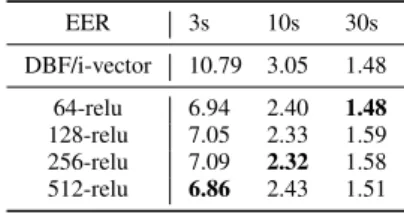
TABLE II
COMPARISON OF PERFORMANCE OF CROSS LAYERLID-BILINEAR-NET FOR ALL SCALES INEER (%)WITH DIFFERENT DIMENSIONS.
EER 3s 10s 30s DBF/i-vector 10.79 3.05 1.48 64-relu 6.94 2.40 1.48 128-relu 7.05 2.33 1.59 256-relu 7.09 2.32 1.58 512-relu 6.86 2.43 1.51
Table II includes 3s, 10s and 30s LID-bilinear-net re-sults, for different numbers of channels in the output layer. Performance is good compared to Table I, although the 30s result seems to be data-limited rather than architecture-limited (LID-bilinear-net and LID-net2 have more param-eters to train than LID-net through having an additional fully connected output layer). Note that the bilinear pooling method demonstrates its compactness: just 64 channels in LID-bilinear-net outperforms both the DBF/i-vector and the LID-net systems for shorter utterances in terms of EER.
IV. CONCLUSION
This paper has introduced two novel end-to-end neural net-works, named LID-net2 and LID-bilinear-net. Both systems share their trained lower DNN layer parameters with LID-net, a previous DNN/CNN network that did not incorporate bilinear pooling and could only utilize zeroth order statistics. In all systems, DNN layers are first used to extract LID-features from acoustic training LID-features, then LID-senones obtained by CNN through several convolutional layers which span a time context. LID-senones are thought to be discrimi-native to languages in the way that senones are discrimidiscrimi-native to phonetic content. The LID-senone derivation is followed by a pooling layer that spans from frame to utterance level, from which high-order (first and second order) statistics are computed. In LID-net2 these are dervied from convolutional layer 6 whereas in LID-bilinear-net they are computed cross-layer from feature maps of convolutional cross-layers 5 and 6. Each system is trained end-to-end via back-propagation with LID labels. The performance of each LID-net variant is better than state-of-the-art DNN/i-vector systems, and the two novel networks in this paper perform best of all, with LID-bilinear-net demonstrating the highest performance and greatest degree of robustness.
REFERENCES
[1] N. Dehak, P. J. Kenny, R. Dehak, P. Dumouchel, and P. Ouellet, “Front-end factor analysis for speaker verification,”IEEE Transactions on Audio, Speech, and Language Processing, vol. 19, no. 4, pp. 788– 798, 2011.
[2] N. Dehak, P. A. Torres-Carrasquillo, D. A. Reynolds, and R. Dehak, “Language recognition via i-vectors and dimensionality reduction.”
Proc. of Interspeech, pp. 857–860, 2011.
[3] Y. Song, X. Hong, B. Jiang, R. Cui, I. V. McLoughlin, and L. Dai, “Deep bottleneck network based i-vector representation for language identification,”Proc. of InterSpeech, pp. 398–402, 2015.
[4] F. Richardson, D. Reynolds, and N. Dehak, “A unified deep neu-ral network for speaker and language recognition,” arXiv preprint arXiv:1504.00923, 2015.
[5] B. Jiang, Y. Song, S. Wei, J.-H. Liu, I. V. McLoughlin, and L.-R. Dai, “Deep bottleneck features for spoken language identification,”PLoS ONE, vol. 9, no. 7, 2014.
[6] Y. Song, B. Jiang, Y. Bao, S. Wei, and L.-R. Dai, “I-vector repre-sentation based on bottleneck features for language identification,”
Electronics Letters, vol. 49, no. 24, pp. 1569–1570, 2013.
[7] A. Krizhevsky, I. Sutskever, and G. E. Hinton, “Imagenet classifica-tion with deep convoluclassifica-tional neural networks,” Advances in neural information processing systems, pp. 1097–1105, 2012.
[8] K. Simonyan and A. Zisserman, “Very deep convolutional networks for large-scale image recognition,”arXiv preprint arXiv:1409.1556, 2014.
[9] R. Datta, D. Joshi, J. Li, and J. Z. Wang, “Image retrieval: Ideas, influences, and trends of the new age,” ACM Computing Surveys (Csur), vol. 40, no. 2, p. 5, 2008.
[10] A. Graves and N. Jaitly, “Towards end-to-end speech recognition with recurrent neural networks.”International Conference on Machine Learning, vol. 14, pp. 1764–1772, 2014.
[11] I. Lopez-Moreno, J. Gonzalez-Dominguez, O. Plchot, D. Martinez, J. Gonzalez-Rodriguez, and P. Moreno, “Automatic language identifi-cation using deep neural networks,”Proc. of ICASSP, pp. 5337–5341, 2014.
[12] D. Garcia-Romero and A. McCree, “Stacked long-term TDNN for spoken language recognition,”Proc. of Interspeech, pp. 3226–3230, 2016.
[13] G. Gelly, J.-L. Gauvain, V. Le, and A. Messaoudi, “A divide-and-conquer approach for language identification based on recurrent neural networks,”Proc. of Interspeech, pp. 3231–3235, 2016.
[14] J. Dominguez, I. Lopez-Moreno, H. Sak, J. Gonzalez-Rodriguez, and P. J. Moreno, “Automatic language identification using long short-term memory recurrent neural networks,”Proc. InterSpeech, 2014.
[15] W. Geng, W. Wang, Y. Zhao, X. Cai, and B. Xu, “End-to-end language identification using attention-based recurrent neural networks,”Proc. of Interspeech, pp. 2944–2948, 2016.
[16] K. He, X. Zhang, S. Ren, and J. Sun, “Deep residual learning for image recognition,”The IEEE Conference on Computer Vision and Pattern Recognition (CVPR), June 2016.
[17] J. Long, E. Shelhamer, and T. Darrell, “Fully convolutional networks for semantic segmentation,”Proceedings of the IEEE Conference on Computer Vision and Pattern Recognition, pp. 3431–3440, 2015. [18] R. Girshick, J. Donahue, T. Darrell, and J. Malik, “Rich feature
hierarchies for accurate object detection and semantic segmentation,”
Proceedings of the IEEE conference on computer vision and pattern recognition, pp. 580–587, 2014.
[19] M. Jin, Y. Song, I. McLoughlin, L.-R. Dai, and Z.-F. Ye, “LID-senone extraction via deep neural networks for end-to-end language identification,”Proc. of Odyssey, 2016.
[20] F. Perronnin, J. S´anchez, and T. Mensink, “Improving the Fisher kernel for large-scale image classification,”European conference on computer vision, pp. 143–156, 2010.
[21] J. Carreira, R. Caseiro, J. Batista, and C. Sminchisescu, “Semantic segmentation with second-order pooling,” European Conference on Computer Vision, pp. 430–443, 2012.
[22] T.-Y. Lin, A. RoyChowdhury, and S. Maji, “Bilinear CNN models for fine-grained visual recognition,” The IEEE International Conference on Computer Vision (ICCV), December 2015.
[23] K. He, X. Zhang, S. Ren, and J. Sun, “Spatial pyramid pooling in deep convolutional networks for visual recognition,”346–361, 2014. [24] S. Ioffe and C. Szegedy, “Batch normalization: Accelerating deep
network training by reducing internal covariate shift,”arXiv preprint arXiv:1502.03167, 2015.