Wireless power… why?
•
Convenience
–
end-users can charge multiple devices
(camera, phone, tablet, headset, other accessories) on
a common charging pad or table without carrying
cables or adapters
–
Infrastructure (charging station) is needed in public places:
offices, hotels, vehicles, to drive growth
–
starting now
–
Compare to the growth of wireless LAN ~ 10 years ago
–
Users will not need to carry chargers while traveling!
•
Longer term, wireless charging enables portability in
other applications e.g. medical, wearable, that need to
be sealed / waterproof
3 3
Overview / Agenda
•
Brief wireless power market / standards overview
•
Theory of operation: Near Field / Inductively Coupled
Wireless Power Systems (in widespread use today)
•
Evolution of the WPC standard & new features
– Foreign Object Detection
– Constant Voltage vs. Direct Battery Charge RX
– Dual Mode Compatible RX
– Free Positioning
– Automotive Application Considerations
– Wearable (low power) applications
TI Leadership in Wireless Charging
Wireless Power Consortium (WPC)
Industry wide standard for delivering wireless power up to 5W
Aimed to enable interoperability between various charging pads and portable
devices
Standard continues to gain traction with increasing list of members (105+)
Compatible devices will be marked with a Qi logo
and more…
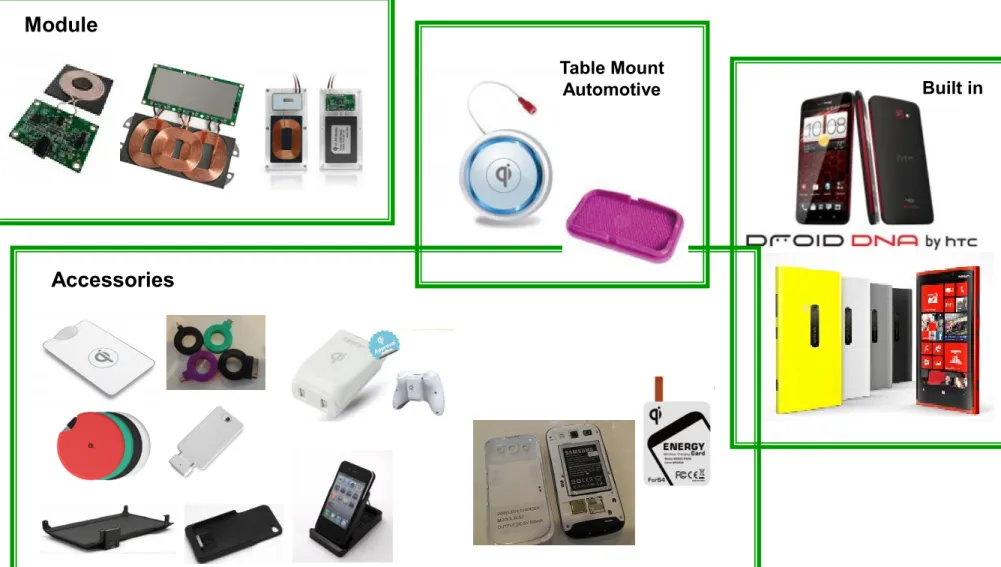
Various Product Concepts
Module
Accessories
Table Mount
The Evolving Wireless Power Market
• Standardization, Ecosystem, and Interoperability Drive Growth
• Estimate 15 M+ units shipped in 2012 40M+ in 2013
• Verizon and AT&T driving adoption in US; DoCoMo in Japan
•
www.wirelesspowerconsortium.com
•
http://www.powermatters.org
Wireless Power Interface Standards
9 9
WPC / Qi 1.1
PMA
A4WP
Coupling Tightly Coupled Tightly Coupled Loosely Coupled
Approximate Operating Frequency Range
100 – 200 KHz 200 – 300 KHz 6.78 MHz
Communication Path In-Band (signaling over the power path)
In-Band (signaling over the power path)
BLE / out-of-band (separate channels for power &
control)
System level Efficiency > 70% > 70%
Spatial Freedom with existing standard
Medium Lowest Highest
Future enhancements planned
Qi 1.2 spec extension will add loosely
coupled / resonant capability to WPC Standard
Adopted A4WP as resonant spec; next steps TBD
HOW DOES IT WORK?
•
Current in primary coil (transmitter) generates magnetic field
•
Magnetic field induces current in secondary coil (receiver)
•
Received current is used to charge battery or power load device
current magnetic field Source: www.wirelesspowerconsortium.com
Inductive Coupling
Wireless charging beyond the toothbrush:
Intelligent Control of Inductively Coupled Power Transfer
•
Power transmitted through shared
magnetic field
–
Transmit coil creates magnetic field
–
Magnetic field induces current in receiver coil
–
Shielding material below TX and above RX coils
•
Power transferred only when needed
–
Transmitter waits until its field has been perturbed
–
Transmitter sends seek energy and waits for a digital
response
–
If response is valid, power transfer begins
•
Power transferred only at level needed
–
Receiver constantly monitors power received and delivered
–
Transmitter adjusts power sent based on receiver feedback
–
If feedback is lost, power transfer stops
I
z < D
D
Factors Affecting Coupling Efficiency
•
Coil Geometry
– Distance (z) between coils
– Ratio of diameters (D2 / D) of the two
coils ideally D2 = D
– Physical orientation
•
Quality factor
– Ratio of inductance to resistance
– Geometric mean of two Q factors
•
Near field allows TX to
“see” when RX is present
•
Good Efficiency when
coils displacement is less
than coil diameter (z << D)
40% at 1 diameter 1% at 2.5 diameters 0.1% at 4 diameters
0.01% at 6 diameters Optimal operating distance
Factors Affecting Coupling Efficiency
TI Solution: bq50xxx + bq51xxx chipset
Power Communication / Feedback 15 + _ DC Source (Wall Adapter or Vehicle) 5V / 12V / 19V Depending on TX type usedOptimizing Efficiency & Load Transient Response
• RX has linear regulator stage, but the overall system (TX+RX) acts
as a feedback-controlled switch mode regulator
• LDO output stage can be efficient if linear regulator is operated
near dropout (VIN only slightly above VOUT)
• LDO input (VRECT) is controlled to be higher at light loads –
allows more headroom in case of low-to-high load transient so output regulation is maintained
• If a given system design does not require max output power, there
is an “RLIM” resistor that can be adusted to reduce the LDO input (in exchange for limiting max IOUT)
Communication - Basics
•
Primary side controller must detect that an object is placed on the
charging pad.
–
When a load is placed on the pad, the primary coil effective
impedance changes.
– “
Analog ping
” occurs to detect the device.
•
After an object is detected, must validate that it is WPC-compatible
receiver device.
– “
Digital Ping
” –
transmitter sends a longer packet which powers up
the RX side controller.
–
RX side controller responds with signal strength indicator packet.
–
TX controller will send multiple digital pings corresponding to each
possible primary coil to identify best positioning of the RX device.
•
After object is detected and validated, Power Transfer phase begins.
–
RX will send Control Error Packets to increase or decrease power
level
•
WPC Compliant protocol ensures interoperability.
(a) No object on pad
(b) RX Device placed on pad
Vertical Scale: 20V/div Horizontal Scale: 20 uS/div
Analog Ping with and without object on pad
Communication
–
Implementation
Communication
–
actual waveform
Analog Ping / Digital Ping / Startup
Vertical Scale: 20V/div Horizontal Scale: 200
mS/div
TX COIL VOLTAGE Analog Pings – no
object detected detected. Followed by Analog Ping – object subsequent Digital Ping
and initiation of
communications functions
COMM
Resonant Power Transfer
–
Switching Frequency Variation
• 5W Capable System operates near resonance for improved efficiency.
• Power control by changing the frequency, moving along the resonance curve; about 100 – 200KHz for Qi
• Modulation using the power transfer coils establishes the communications.
• Feedback is transferred to the primary as error.
80 KHz 100 KHz 120 KHz
Operating Point
bqTesla System Efficiency Breakdown
20% 30% 40% 50% 60% 70% 80% 90% 100% 0 0.5 1 1.5 2 2.5 3 3.5 4 4.5 5 E ff ici ency ( % ) Output Power (W)Tx Eff. Magnetics Eff. Rx Eff. System Efficiency
System Eff TX Eff Magnetics Eff RX Eff 23 TX RX Charger Battery Measured Block
• Efficiency is RX Coil design dependent
• Measured from DC input of BQ500210 TX to DC output of BQ51013 RX @ 5V out
Qi-compliant coil used w/ EVM kit
40-mm x 30-mm x 0.75-mm
WPC Compliant Receiver Coil WPC Compliant Receiver Coil
WPC Compliant Transmitter Coil WPC Compliant Transmitter Coil
bq51013 “form factor” demo PCB
(PR1041)5 x 15 mm footprint for all RX side circuitry
• Represents what an OEM would design into their actual end-product to enable wireless power from a QI-compliant charging pad.
WPC1.0
WPC1.1 Evolution: “FOD”
• Metal between TX and RX
– Bottom of TX and top of RX coils are shielded to create a “closed system”
– Any metal BETWEEN the RX and TX coils will result in loss / heating due to energy lost in Foreign Metals (Eddy Current)
Two methods to detect foreign objects via monitoring power losses:
• PMOD (TI method, Parasitic Metal Object Detection) – An approximation based on the Rectified Power reported by
RX to calculate losses in the TX-RX system
• WPC1.1: Foreign Object Detection
– This uses specific information from characterized RX to improve the accuracy of Foreign Object Detection in WPC system (looking at Received Power from RX, and power lost in shield, coil, rectifier and control circuit).
– FOD is finalized in WPC 1.1 spec
Basic Options for WPC1.1 solution
• TX, A version – BQ500212A – BQ500410A • RX, B version – Power Supply, BQ5101xB – Direct Charge, BQ5105xB M BQ500212A 5V A5 A11 BQ500410A 12V A6, 3 Coil BQ5105xB Direct Charge Power Supply BQ5101xB Charger29
Standard TX Coil Types: A1/A10 vs A6
TX Type A1 A10 A6 Single Coil Magnet Yes No No Vin 19V 12V Lower cost adaptor Ferrite size 53x53mm2
Coil Area Circle Rectangle, bigger
Power Half Bridge
Example 1 Example 2 Example 3 Example 4 Example 5 Shield z 0.65 mm 0.44 mm 0.40 mm 0.65 mm 0.65 mm Coil z 0.35 mm 0.35 mm 0.40 mm 0.40 mm 0.35 mm Coil x,y 29x30 mm2 32x32 mm2 30x34 mm2 13x24 mm2 29x30 mm2 Circuit Component z 1.0 mm 0.5 mm 0.60 mm 0.9 mm 1.0 mm PCB z 0.75 mm 0.4 mm 0.25 mm 0.5 mm 0.5 mm Area 16x36 mm2 14x37 mm2 20x32 mm2 10x33 mm2 5x15 mm2 Power 5W 4W 3.5W 4W 2.5W PCB Thermal Performance ^ 45C* 50C* 55C* 58C* 62C* 30 Side View
PCB w/ components Side View Coil w/ shield
* Temp will depend on many factors. This is just representative of one design. Actual implementation will vary thermal performance
RX: bq51k Family options
Voltage Source Power Supply BQ5101x Battery Charger BQ5105x Direct Charge Integrate CC/CV Control32
Dual Mode RX: Works on PMA and WPC Pads
• RX device will recognize and respond to detection signals from TX pad
• New silicon core with higher efficiency (lower loss) power FETs
bq500412
–
3 Coil Transmitter
Enables “Free Positioning” of portable device
• WPC A6 improves Charging Area for WPC Compliance
– From A1 18x18mm to > 70x20mm
– Extend definition to “At least one Primary Coil” • Key Specs
– 12V Input Voltage
– A1 Power Transfer Methodology,
– Half Bridge
– 120KHz to 205KHz frequency range
– 175KHz +/-5KHz Digital Ping to initiate Transfer
– Same Shielding
• Drives one coil at a time, Enables Efficiencies > 70%
• Robust Drive methodology addresses potential issues w/ large Transmitter coils (several patents pending)
– RX Overvoltage
– Controlled coupling for WPC1.1
34
CE4A preferred solution -- Qi
-
CE4A announces that Qi is the approved technology for contactless
charging inside of cars
-
CE4A is a group of automobile manufacturers founded in 2006 for the
purpose of advancing the standardization of mobile device interfaces.
-
CE4A has selected Qi as the their in-vehicle standard for mobile
device charging.
-
Demonstrated confidence that Qi is suitable for automotive use and
also Qi-compliant products will continue to be used for a long time.
Extended Charging Area for “Free Positioning” with Multi
-Coil TX
–
key requirement for automotive built-in TX
bq500414Q
–
Three Coil Transmitter for Automotive
• WPC 3 coil A6 and A21 Transmitter – Liked by CE4A
• ~70x20mm Guaranteed Charging Area
•120kHz to 205kHz frequency range
•135kHz Analog Ping to detect RX presence
• 175kHz Digital Ping to initiate Power
• Excellent Efficiency ~70%
• Q100 Certification
• WPC 1.1 Compliance (FOD)
• CAN/LIN can access device commands via I2C
• System level EMI improvement (EMI shield)
• Option to move Tx operating frequency when smart key/immobilizer is in use
• Supports 6V to 16V Input Voltage Range with additional SEPIC
• Optional Customer Defined Proximity Sensor to turn TX on/off
bq500414Q System Level Efficiency
• bq50xxx transmitter controllers use a regulated (5V, 12V, or 19V) power source depending on the specific device
• For an automotive application, vehicle DC power rail is not inherently regulated
• A front-end SEPIC or buck-boost regulator is required to adapt the (typical) 6 – 16V DC source to regulated +12V for input to the bq500414Q
• Net result is that overall system efficiency is about 90% of the standard wireless power system due to additional losses in SEPIC pre-regulator stage
bq500414Q System Level Efficiency with PCB Coil
(A21 Type)
38
•
PCB Coil benefit =
resistant to shock &
vibration (desired in vehicle
environment)
•
Drawback = lower
efficiency due to limited
copper thickness possible
in PCB windings
Wireless Power Solutions for
Wearable Applications
0% 10% 20% 30% 40% 50% 60% 70% 80% 0 0.5 1 1.5 2 2.5 Power (W) Effi c ie n c y (% )•
Transmitter:
– bq500212A with modified Coil
•
Receiver:
– bq51003, New 2.5W Receiver with fixed output voltage
– Total solution size <50mm2
bqTESLA
™ RX in Wearable Products
• bqTesla™ wireless power receivers are ideally suited for wearable
devices
– Industry’s Smallest solution size –
only 50 mm
2true application
area
–
Best in class efficiency
bq510xxB Wireless
receiver chip Wireless charging Coil for
Wearable Devices
DEVICE FUNCTION VOUT IOUT
Low Power TX
• Design based on bq500212A
– Capacitors changed to low loss COG for test.
– FOD and PMOD disabled
– TX to RX coil distance 2.3mm TX and 1.5mm RX
• Coil based on Würth Elektronik RX coil
– Wurth P/N 760308201 WPC RX coil, 10uH 30mm round
– Reduced number of turns to 10 and inductance of 6.5uH
– This coil is NOT WPC approved type - solution would be customized for the application
• Tested with bq51013B RX
– System Efficiency will be affected by ILIMIT set point of RX.
– Dynamic Efficiency Scaling will change set point of RX V_RECT
• Performance was good with no problems detecting RX and starting power transfer.
42
bq51013B 5W Receiver
Receiver-side rectifier efficiency System-level efficiency
•
Slight optimization for low currents is possible by adjusting
receiver current limit
bq51003 2.5W Optimized Receiver
•
10
–
15% efficiency improvement at 1W output power vs.
standard (5W-rated) receiver
Dynamic Power Limit
TM
–
Key Feature for
USB-input powered wireless TX
• For WPC Compliance, RX can request max 5W, thus, TX need to deliver >7.5W at 75% system efficiency. Typically, 10W TX design is recommended
• 5V TX is welcome because of the 5V DC source is everywhere, but the TX supply may not provide sufficient power
– Typical Laptop USB port is 2.5W only (5Vx500mA)
– Typical small adaptor is 5W only (5Vx1A)
• Latest WPC Spec recognizes operation from lower power ports
– Need to notify user that “Full 5W Capability” is not available • bq500211/A & bq500412 feature “Dynamic Power LimitTM”
– Limits output current to ensure Input Supply not pulled down
– Activates LED to indicate ‘Non WPC/Restricted Power’ operation
10W
2.5W
DPL Active
• Not All RX can take advantage of DPLTM
– Rx send EPT due to not enough power
– No ‘Input DPM on Charger’
Normal Operation
Summary
•
Wireless power is a reality today for millions of end-users
• Vast majority of today’s systems use Qi / WPC
•
Many use PMA
–
similar concept; dual-mode receivers are
already available
•
A4WP
–
offers benefit of “spatial freedom” but still in
development phase
•
Challenges to growth need to be overcome
–
Convergence of standards (?)
–
Automotive
–
additional layer of compliance testing/certification
–
Infrastructure buildout
•
Enables new applications in addition to making existing
devices more convenient
•
We expect wireless power to be a growth market
TI Supporting Tools for Wireless Power
• TI Wireless Power Web Page
http://www.ti.com/wirelesspower
• bqTESLATM Evaluation Modules and User Guides
http://www.ti.com/ww/en/analog/wireless_power_solutions/tools.htm
• TI E2E Community: Wireless Power Forum
http://e2e.ti.com/support/power_management/wireless_power/default.aspx
• An Introduction to the Wireless Power Consortium Standard and TI’s Compliant
Solutions
http://www.ti.com/lit/an/slyt401/slyt401.pdf
48
Rx Module bq51013EVM-725