using Classification-Clustering
Framework
A thesis submitted in partial fulfilment
of the requirement for the degree of Doctor of Philosophy
Nasser Alsaedi
Cardiff University
School of Computer Science & Informatics
Jan 2017
Declaration
This work has not been submitted in substance for any other degree or award at this or any other university or place of learning, nor is being submitted concurrently in candidature for any degree or other award.
Signed ... (candidate) Date ...
STATEMENT 1
This thesis is being submitted in partial fulfilment of the requirements for the degree of PhD.
Signed ... (candidate) Date ...
STATEMENT 2
This thesis is the result of my own independent work/investigation, except where other-wise stated, and the thesis has not been edited by a third party beyond what is permitted by Cardiff University’ s Policy on the Use of Third Party Editors by Research Degree Students. Other sources are acknowledged by explicit references. The views expressed are my own.
Date ...
STATEMENT 3
I hereby give consent for my thesis, if accepted, to be available online in the Univer-sity’s Open Access repository and for inter-library loan, and for the title and summary to be made available to outside organisations.
Signed ... (candidate) Date ...
Abstract
In recent years, there has been increased interest in real-world event detection using publicly accessible data made available through Internet technology such as Twitter, Facebook and YouTube. In these highly interactive systems the general public are able to post real-time reactions to “real world" events - thereby acting as social sensors of terrestrial activity. Automatically detecting and categorizing events, particularly small-scale incidents, using streamed data is a non-trivial task, due to the heterogeneity, the scalability and the varied quality of the data as well as the presence of noise and irrel-evant information. However, it would be of high value to public safety organisations such as local police, who need to respond accordingly. To address these challenges we present an end-to-end integrated event detection framework which comprises five main components: data collection, pre-processing, classification, online clustering and summarization. The integration between classification and clustering enables events to be detected, especially “disruptive events" - incidents that threaten social safety and security, or that could disrupt social order. We present an evaluation of the effective-ness of detecting events using a variety of features derived from Twitter posts, namely: temporal, spatial and textual content. We evaluate our framework on large-scale, real-world datasets from Twitter and Flickr. Furthermore, we apply our event detection system to a large corpus of tweets posted during the August 2011 riots in England. We show that our system can perform as well as terrestrial sources, such as police reports, traditional surveillance, and emergency calls, even better than local police in-telligence in most cases. The framework developed in this thesis provides a scalable,
online solution, to handle the high volume of social media documents in different lan-guages including English, Arabic, Eastern lanlan-guages such as Chinese, and many Latin languages.
Moreover, event detection is a concept that is crucial to the assurance of public safety surrounding real-world events. Decision makers use information from a range of ter-restrial and online sources to help inform decisions that enable them to develop policies and react appropriately to events as they unfold. Due to the heterogeneity and scale of the data and the fact that some messages are more salient than others for the purposes of understanding any risk to human safety and managing any disruption caused by events, automatic summarization of event-related microblogs is a non-trivial and important problem. In this thesis we tackle the task of automatic summarization of Twitter posts, and present three methods that produce summaries by selecting the most representative posts from real-world tweet-event clusters. To evaluate our approaches, we compare them to the state-of-the-art summarization systems and human generated summaries. Our results show that our proposed methods outperform all the other summarization systems for English and non-English corpora.
Acknowledgements
When I write these acknowledgments, I realize that my formal education will end very soon. Reviewing the three years and three months of my graduate study at the Cardiff School of Computer Science & Informatics, not only has Cardiff University given me a very solid education in computer science and informatics, but it has helped me to build my confidence to pursue career success after my graduation. I am greatly indebted to many people for the completion of this thesis, and to still more for making the journey a uniquely rewarding one.
First of all, I would like to thank my country and my sponsors; I would like to thank H.H. Sheikh Mohamed bin Zayed Al Nahyan, Crown Prince of Abu Dhabi and Deputy Supreme Commander of the UAE Armed Forces, for his continuous support and guid-ance. I would also like to thank H.H. Sheikh Saif bin Zayed Al Nahyan, Deputy Prime Minister and Minister of Interior for his support to education and encouraging students and researchers. I sincerely thank my sponsor Abu Dhabi Police GHQ and H.E. Major General Mohammed Al Romaithi, Commander-in-Chief of Abu Dhabi Police, for his role, support and encouragement.
This thesis and the research it contains could not exist if not for the unfailing support of my supervisor, Pete Burnap. His guidance and input have provided drive, shaped my research and have given me the confidence required for producing and defending ideas both within and outside of research. A big thanks also goes to my second supervisor Omer Rana for his experience, intellectual guidance and belief in me. It has been a
very long journey!
Finally, my time as a research student would not have been the same without the con-stant presence, support and the positive atmosphere from the School of Computer Sci-ence & Informatics. In addition, I am grateful to the fellow researchers with whom I shared an office for the research period. I am also grateful to all my colleagues and friends in Cardiff who have always pushed me and provided encouragement to make me who I am today. They deserve my utmost thanks.
Most importantly, thanks to my family, for supporting me all the way throughout the journey. The thesis journey ends, but ours continues!
Contents
Declaration ii
Abstract iv
Acknowledgements vi
Contents viii
List of Publications xii
List of Figures xiv
List of Tables xvi
List of Algorithms xviii
List of Acronyms xix
1 Introduction 1
1.1 Background and Motivation . . . 1 1.2 Hypothesis and Research Questions . . . 6
1.3 Research Methodology . . . 7
1.4 Main Contributions . . . 10
1.5 Organization of the Thesis . . . 12
2 Event Detection and Characterization 15 2.1 Introduction . . . 15
2.2 Event Definition and Examples . . . 16
2.3 Related Work: Event Detection in Social Media . . . 20
2.4 Data Collection . . . 27
2.4.1 F1 Twitter Corpus . . . 28
2.4.2 Abu Dhabi Twitter Corpus (Crime detection) . . . 30
2.4.3 Middle East Twitter Corpus . . . 31
2.4.4 MediaEval2012 Flickr Corpus . . . 31
2.4.5 2011 Riots in England . . . 32
2.5 Data Pre-processing . . . 33
2.6 Summary . . . 35
3 Classification and Categorization 36 3.1 Introduction . . . 36
3.2 Proposed Event Identification Framework . . . 37
3.3 Machine Learning approaches . . . 39
3.3.1 Naive Bayes Classifiers . . . 42
3.3.3 Logistic Regression . . . 46 3.4 Summary of Features . . . 47 3.5 Empirical Evaluation . . . 49 3.5.1 Experimental Setup . . . 49 3.5.2 Experimental Results . . . 53 3.6 Summary . . . 55
4 Clustering (On-line Clustering) 57 4.1 Introduction . . . 57
4.2 Background of clustering . . . 59
4.3 Disruptive Event Definition . . . 63
4.4 On-line Clustering Algorithm . . . 65
4.5 Feature Selection . . . 68
4.5.1 Related Work: Feature Selection in Social Media . . . 69
4.5.2 Clustering Features . . . 73
4.5.3 Feature Selection Algorithm . . . 80
4.6 Empirical Evaluation . . . 83
4.6.1 Experimental Setup . . . 84
4.6.2 On-line Clustering Evaluation . . . 88
4.6.3 Feature Selection Evaluation . . . 92
4.6.4 Feature Selection usingNDCGscores . . . 101
4.6.6 Arabic Event Detection in Social Media . . . 106
4.6.7 Case Study: 2011 Riots in England . . . 106
4.7 Summary . . . 114
5 Representation and Summarization 116 5.1 Introduction . . . 116
5.2 Related Work: Summarization Approaches . . . 118
5.3 Proposed Summarization Techniques . . . 121
5.3.1 TEMPORAL TF-IDF . . . 122
5.3.2 Retweet Voting Approach . . . 123
5.3.3 Centroid Representation Method . . . 125
5.4 Empirical Evaluation . . . 126
5.4.1 Datasets and Setup . . . 126
5.4.2 Experimental Results . . . 129
5.5 Summary . . . 133
6 Conclusions and Future Work 134 6.1 Conclusions . . . 135
6.2 Future Work . . . 137
Appendix 145
List of Publications
The work introduced in this thesis is based on the following publications:
• Nasser Alsaedi, Pete Burnap, and Omer Rana. Can we predict a riot? disruptive event detection using twitter. ACM Transactions on Internet Technology (TOIT), 17(2):18:1–18:26, March 2017
• Nasser Alsaedi, Pete Burnap, and Omer Rana. A combined classification-clustering framework for identifying disruptive events. InProceedings of the 7th ASE In-ternational Conference on Social Computing, Stanford University, CA., USA, SocialCom ’14, 2014
• Nasser Alsaedi and Pete Burnap. Arabic event detection in social media. In Proceedings of the 16th International Conference on Intelligent Text Processing
and Computational Linguistics, Cairo, Egypt, 14 _ 20 April, CICLing ’15, pages 384–401. Springer, 2015
• Nasser Alsaedi, Pete Burnap, and Omer Rana. Identifying disruptive events from social media to enhance situational awareness. InProceedings of the 2015 IEEE/ACM International Conference on Advances in Social Networks Analysis
and Mining 2015, ASONAM ’15, pages 934–941, New York, NY, USA, 2015. ACM
• Nasser Alsaedi and Pete Burnap. Feature extraction and analysis for identifying disruptive events from social media. In Proceedings of the 2015 IEEE/ACM
International Conference on Advances in Social Networks Analysis and Mining
2015, ASONAM ’15, pages 1495–1502, New York, NY, USA, 2015. ACM
• Nasser Alsaedi, Pete Burnap, and Omer F. Rana. Automatic summarization of real world events using twitter. InProceedings of the Tenth International Con-ference on Web and Social Media, Cologne, Germany, May 17-20, 2016., pages 511–514, 2016
• Nasser Alsaedi, Pete Burnap, and Omer F. Rana. Sensing real-world events using arabic twitter posts. In Proceedings of the Tenth International Conference on Web and Social Media, Cologne, Germany, May 17-20, 2016., pages 515–518, 2016
List of Figures
1.1 Design Science Research Methadology (DSRM) Process Model.
Ad-apted and modified from Peffers et al. [110] . . . 7
2.1 Document clustering using different sets of features . . . 20
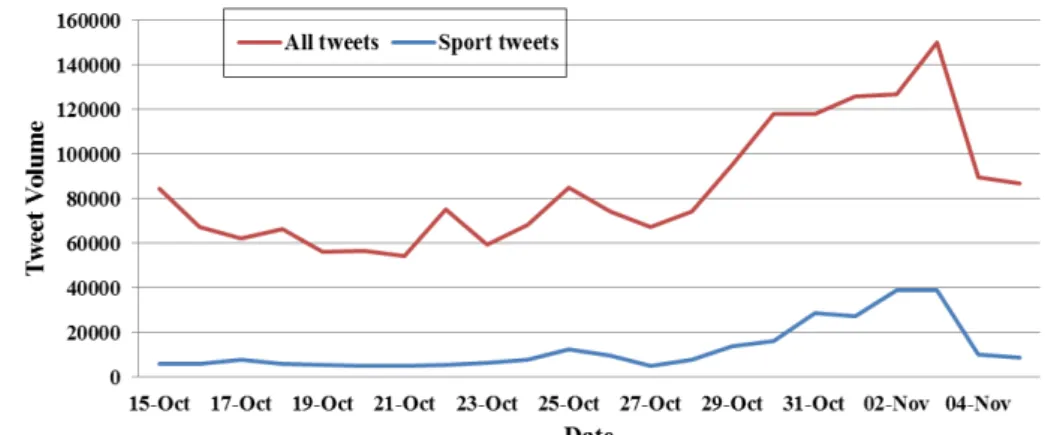
2.2 The volume of tweets in the first data set from 15th October to 5th November in Abu Dhabi . . . 29
2.3 The volume of tweets in the second data set from 26th November to 8th December in Abu Dhabi . . . 30
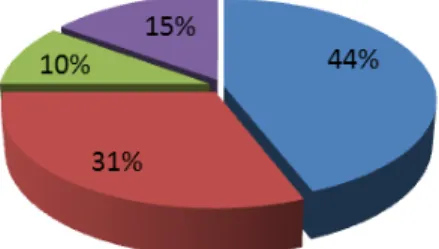
2.4 The distribution of languages used in the Middle East dataset . . . 31
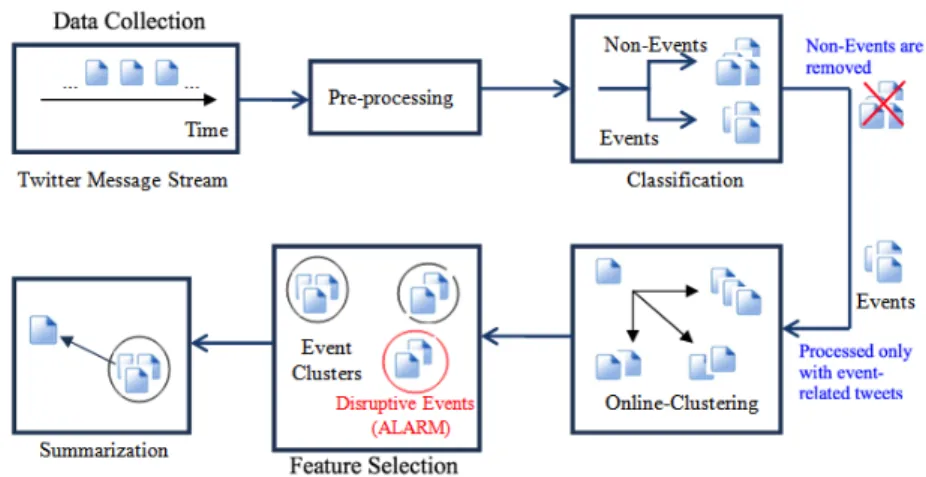
3.1 Event Detection Framework for Social Media Content . . . 38
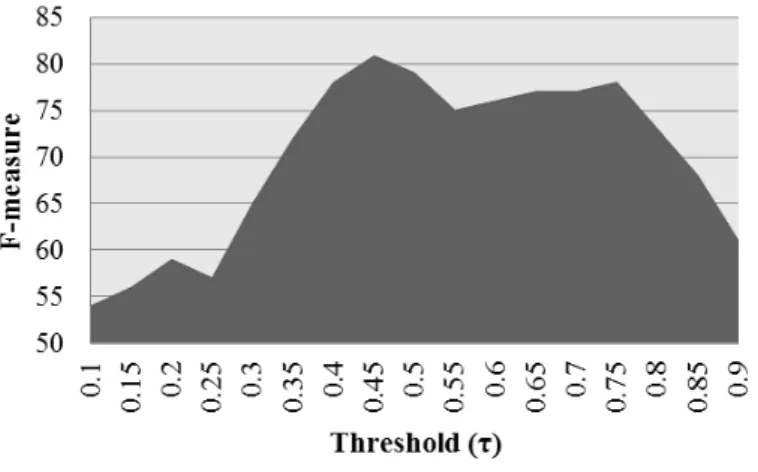
4.1 F-measure of the online clustering algorithm over different thresholds 67 4.2 P recision@K of our classification-clustering framework . . . 90
4.3 NDCGat K of our classification-clustering framework . . . 92
4.4 Accuracy (A) obtained using various temporal settings . . . 93
4.5 Efficiency comparison with various temporal granularities (s) . . . 93
4.7 Comparison of different models on the event identification task accord-ing to the F-measure. Higher is better. . . 100 4.8 Performance of various proposed features . . . 101 4.9 Comparison of different models for the event identification task
ac-cording toNDCGscores . . . 103 4.10 Comparison of disruptive events obtained by our framework (top) and
MPS (bottom) for Enfield borough. The source of the bottom image is from the Metropolitan Police Service (MPS) report [92] . . . 112
5.1 Results of our proposed approaches against other summarization tech-niques (The Y-axis shows the ROUGE-1 scores) . . . 129 5.2 Comparison of content selection techniques. . . 130 5.3 ROUGE-1 results of various summarization techniques for different
languages. The Y-axis shows the ROUGE-1 scores . . . 132
6.1 Results of combining summarization approaches after classification-clustering framework . . . 155 6.2 The timeline of identified events and disruptive events with examples
List of Tables
3.1 The instructions provided to the annotators for the annotation task (Classification), followed by an example tweet . . . 50 3.2 List of example tweets and annotations that were provided to the
an-notators for the classification task (Classes are: Event or Non-Event) . 51 3.3 The confusion matrix for two-class classification problem . . . 52 3.4 Accuracy, Precision, Recall and F-measure for different classification
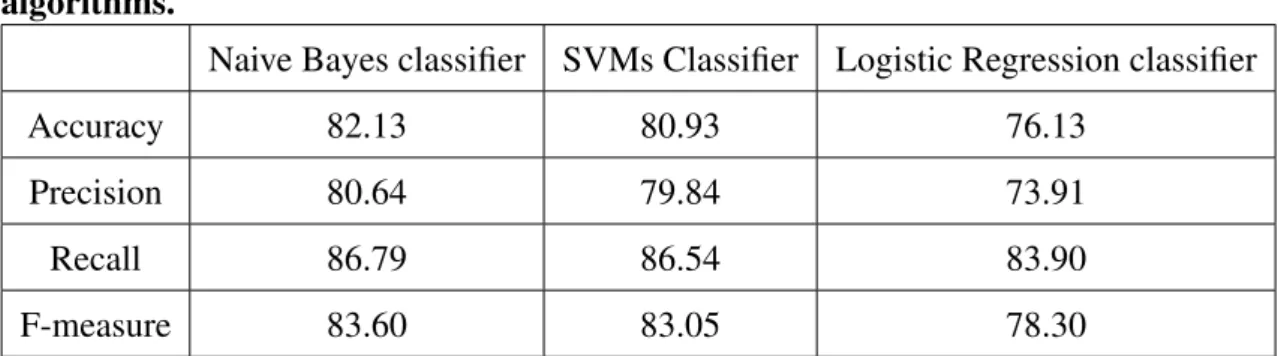
algorithms . . . 54 3.5 Comparison of classification accuracies of different classification
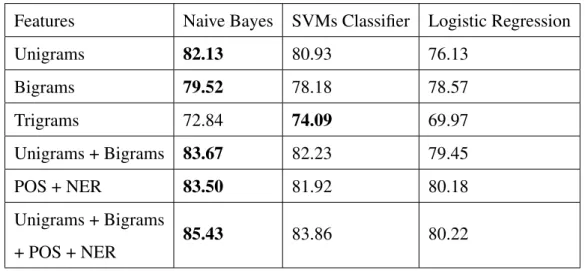
al-gorithms over a set of features . . . 55
4.1 Topics and sub-topics with examples taken from the corresponding lex-icons . . . 81 4.2 The instructions provided to the annotators for the annotation task
(Clustering), followed by an example tweet . . . 86 4.3 List of example tweets and annotations that were provided to the
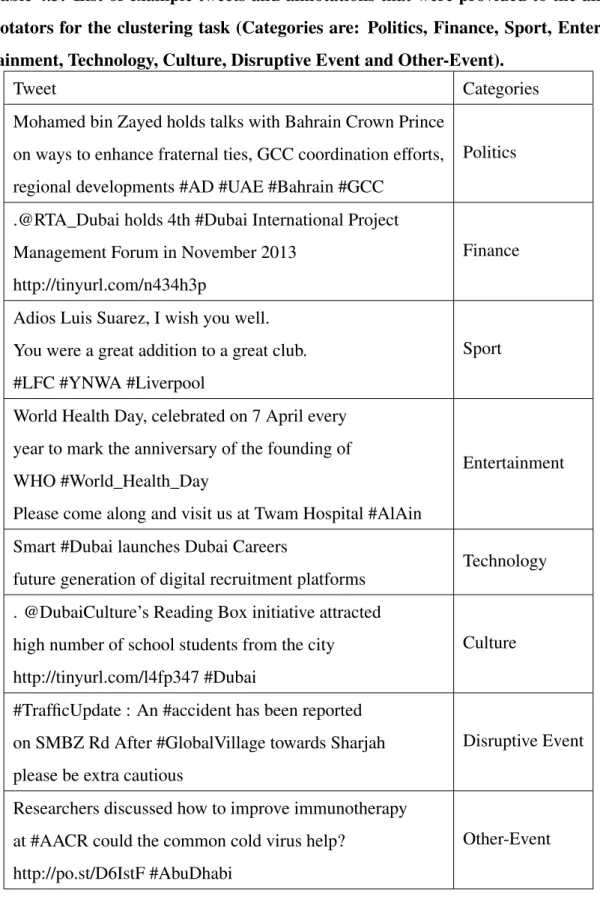
annot-ators for the clustering task (Categories are: Politics, Finance, Sport, Entertainment, Technology, Culture, Disruptive Event and Other-Event) 87 4.4 Average precision of the online clustering algorithm, in percent . . . . 89
4.5 Examples of the events described in October 2015 and November 2015 articles of Wikipedia, which were used as ground truth, for evaluation of the proposed framework. . . 91 4.6 Recall comparison using different location granularities. . . 95 4.7 Comparison of the performance using various textual feature models. 97 4.8 F-measures for positive, neural and negative sentiment models, which
clearly shows that the negative model outperforms others by at least 1.43% . . . 98 4.9 The most effective textual features (above 1.50 differences) . . . 99 4.10 Results of the proposed approach against other event detection
ap-proaches using MediaEval2012 Detection Task. . . 105 4.11 Comparison of approaches for disruptive event detection. . . 108 4.12 Disruptive event exploration using police intelligence and by our
frame-work for Enfield borough on August 7th 2011 (+ when Twitter leads) . 113
6.1 List of example tweets and annotations that were provided to the an-notators for the classification task (Classes are: Event or Non-Event) . 146 6.2 List of example tweets and annotations that were provided to the
annot-ators for the Clustering task (Categories are: Politics, Finance, Enter-tainment, Sport, Technology, Culture, Disruptive Event and Other-Event)149 6.3 The instructions provided to the annotators for the annotation task.
Note: a topic consists of 15 tweets because we have selected the top 5 posts, for each event cluster, according to our proposed approaches (Temporal TF-IDF, Retweet voting, and Temporal centroid method). i.e. 5 posts per approach . . . 153 6.4 An example tweet of the summarization annotation task . . . 154
List of Algorithms
1 Online Clustering Algorithm . . . 66 2 Feature Selection Algorithm . . . 83
List of Acronyms
TDT Topic Detection and Tracking
NLP Natural Language Processing
IR Information Retrieval
TC Text Categorization
API Application Programming Interface
SED Social Event Detection
MPS Metropolitan Police Service
DSS Decision Support System
DSRM Data Science Research Methodology
NB Naive Bayes
SVMs Support Vector Machines
POS Part-of-Speech
NER Named Entity Recognition
MICI Maximal Information Compression Index
KLD Kullback-Leibler Divergence
DFT Discrete Fourier Transformation
LSH Locality-Sensitive Hashing
LDA Latent Dirichlet Allocation
SVD Singular Value Decomposition
SCAN Structural Clustering Algorithm for Networks
FP false positives
FN false negatives
TP true positives
TN true negatives
AP average precision
NDCG Normalized Discounted Cumulative Gain
NMI Normalized Mutual Information
ROC Receiver Operating Characteristics
ROUGE Recall-Oriented Understudy for Gisting Evaluation
PR Phrase Reinforcement
MDS Multi-Document Summarization
PRF Pseudo Relevance Feedback
DTM Decay Topic Model
TCV Tweet Cluster Vector
NMF Non-negative Matrix Factorization
pLSA Probabilistic Latent Semantic Analysis
Chapter 1
Introduction
1.1
Background and Motivation
Microblogging, as a form of social media, is a fast emerging tool for expressing opin-ions, broadcasting news, and facilitating the interaction between people. The ease of publishing content on social media sites and the wide spread of various electronic devices (e.g. cellphones, tablets, etc.) have enabled users to report real-life events as they happen around them. One of the most representative examples of social media is Twitter, which allows users to publish short tweets (messages within a 140-character limit) about any subject. The range of widely known events includes community-specific events, such as local gatherings, or can be wider-reaching national or even international in significance. For example, the Iranian election protests in 2009 were extensively reported by Twitter users [65, 165]. Another good example, where Twitter was employed as a resource for the US government to communicate with citizens, was the outbreak of swine flu when the US Center for Disease Control (CDC) used Twitter to post the latest updates on the pandemic [125].
People tend to comment on real-world events they encounter, both local and global, when a topic suddenly attracts their attention, for example, a sporting event [8, 40], adverse weather update [102], or terror attack [104, 99, 84], etc. For the purposes of this study an event can be defined as an occurrence at a specific time and place that is associated with a topic (Chapter 2). From this definition, we can infer that these events
have several characteristics: i) there are enough users interacting and connecting with the event using tweets (therefore if an event was not reported by users in social media platforms, it will not be identified by our framework), ii) these tweets are discussing the same topic in similar words, and iii) the event takes place at a specific time and within a geographical boundary.
As an example of an event, consider a possible football match "Manchester United vs Liverpool". Users and supporters will use similar vocabulary to describe and report this event. They might use players’ names, managers’ names, and locations (e.g. the venue or surrounding areas), and also verbs, adjectives and nouns, etc. in reporting the match. Mining these features offers the potential for events to be detected and summarised promptly [127]. User engagement may depend on the event’s significance and scale, which could play an important role in identifying events [55]. In this thesis, the termsdetectionandidentificationare used interchangeably.
Recently, increased interest has been shown in real-world event identification from so-cial media sites. It is very challenging to automatically organize user-generated content with respect to events, as well as identifying and characterizing these events according to scale in real time. First, the speed and volume at which data arrive, where tweets arrive continuously in chronological order, and the size of the Twitter network produce a continuously changing dynamic corpus. The significant amount of "noise" presen-ted in the stream is another key challenge; in fact noise constitutes around 40% of all tweets, which have been reported as pointless "babbles" [157] like "let’s go to the beach" or "the weather is amazing". In addition, the dynamic nature of events leads to a diverse set of linguistic features. This is compounded by the fact that each social media post (or tag, in the case of photos or videos) is short, which means that only a limited content is available for analysis.
The number of users of social media who actively post content is growing rapidly day by day, so event detection algorithms need to incorporate the minimal number of operations if they are to reduce computational overhead when analyzing real-time
streams. Other challenges are inherent to the microblogging language and nature; they include the frequent use of informal, irregular, and abbreviated words, the high num-ber of spelling and grammatical errors, and the use of improper (informal) sentence structures and mixed language. Additionally, social media characteristics and popular-ity have attracted spammers to spread advertisements, pornography, viruses, and other malicious activities [13, 57, 73].
Decision makers or researchers might be interested in many kinds of event, making it difficult to anticipate those types which could be important and a priori build detectors for them [124]. Moreover, non-event content is, of course, prominent on Twitter and similar systems; people want to share various types of content, such as personal up-dates, random thoughts and musings, opinions, and information [16]. The rapid growth of online social media has made it possible for rumors and misinformation to spread very quickly and widely. These online platforms have enabled unreliable and untrusted sources to spread large amounts of unverified information to users, which leads to other challenging problems [116].
Yet social media services such as Facebook and Twitter are providing researchers with new opportunities thanks to the availability of the data they provide. These platforms are by definition free and openly accessible and also pervasive via Smartphone apps, not to mention being part of a widespread subculture of social media sites that encour-ages users to acquire a large pool of friends [129]. In addition, the social media have substantially reduced communication response time below that needed by the indus-trial media, in significantly altering the rate at which information is exchanged and consumed [154]. The restriction on the length of a Twitter message invariably means that the tweets do not necessarily contain well-formed ideas, yet full enough for users to make sense of what they read in them [8, 129].
Furthermore, not all events reported in social media are reported in newspapers and other traditional media due to their nature and the freedom of social media platforms. Messages posted on Twitter (tweets) have been reporting everything as they occur from
stories of everyday life to the latest local and global news and events. Thus Twitter can be used as a varied, valuable, and continuous source of information that enables users and organizations to acquire actionable knowledge [9].
Many recent approaches have been proposed for identifying events in the social media which rely on a set of manually selected terms to retrieve event-related documents or those related to particular types of event. Some of these approaches are limited to widely discussed events and are not designed to report small-scale incidents. Moreover, other existing methods have the main drawback of requiring an a priori specification of the total number of topics or are not ideal for social media event detection because they may not be able to capture events in real time given the velocity and scale of the updates in social networks. Moreover, small-scale event detection systems can only detect small or particular type events such as only fire incidents or only car accidents (or road and traffic updates) which limit their overall usability and functionality. There are also disaster identification approaches which are mainly used in filtering, searching, and analyzing tweets during natural disasters such as earthquakes, tornadoes, etc. In this thesis, we propose a general online classification-clustering framework which is able to handle a constant stream of new documents with a threshold parameter that can be modified experimentally during the training phase. Our proposed framework can detect both large (widely reported) or small scale events (only reported by small number of users), however it does not classify events as large or small events. The high volume of updates from the social media sites is the input of the system, which identifies a number of events in a particular region, the associated sub-events (details), and "disruptive" events - incidents that threaten social safety and security, or that could disrupt social order (Chapter 4). The event detection framework comprises five main elements: data collection, pre-processing, classification, online clustering and sum-marization. Social media data are very noisy; hence, the first step in this framework after collecting data is pre-processing, which aims to reduce the amount of noise be-fore classification by reducing the number of attributes and putting tweets in the correct
form before they can be analyzed.
The next step is to separate event-related tweets and non-event content using machine learning algorithms, particularly classification learning. Then we compute the fea-tures of messages in order to extract similar characteristics and apply incremental on-line clustering algorithms to assign each message in turn to a suitable event-based cluster after calculating the message’s similarity to the existing clusters. The integra-tion between classificaintegra-tion and clustering makes it possible to detect events including disruptive events within a particular time-frame (daily or hourly). Finally, we tackle the task of selecting the most salient social media content for an event (cluster) in a process called summarization or representation.
Here, we are interested not only in identifying events and their associated social media documents throughout the day, but also in the identification of a special type of event called "disruptive events". We define a disruptive event in the context of the social media as a special type of event that obstructs the achieving of the objective(s) of another event or interrupts the routine of another event (Chapter 4). Disruptive events have different characteristics and we hypothesize that they can be captured by a set of features: temporal, spatial and textual. Therefore, understanding the features of social media content that single out disruptive events is a key motivation behind this work. One way to optimize the identification of the patterns and signals that indicate an event is to undertake feature selection (optimization), because not all features are expected to lead to better system performance or contribute equally towards improved machine classification and/or clustering accuracy.
Disruptive events, like other events, range from large-scale events, often global in scale such as terrorist attacks or disaster-related events, to small-scale and localized incid-ents such as fires, car accidincid-ents, and evincid-ents threatening public order. In this thesis, we define a small-scale event as: An occurrence that discusses a particular topic at a specific time and place but only reported by few number of users, whereas scale event is an event that is reported by large number of users. Some of the
large-scale events start as small-large-scale incidents before they escalate and become damaging to the wider society and business. It has been noted that detecting of small-scale events is essential to improving situational awareness of both citizens and decision makers [132, 153, 76] and hence this remains a well motivated research topic for the social computing community. In this thesis, we propose a novel approach to event detection that aims to overcome many challenges and provide a system for detecting both large-scale events and related small-large-scale events. The approach is based on the integration of supervised machine learning algorithms to detect larger-scale events, and unsuper-vised approaches to clustering, disambiguating and summarizing smaller sub-events, with the goal of improving situational awareness in emergency situations by automatic methods.
1.2
Hypothesis and Research Questions
The hypothesis of the present research is as follows.
We can automatically identify real-world events including disruptive events as they
happen from posts on the social media in a particular place and for a predefined time
period to improve public safety and decision support.
The research questions assist in understanding the scope of the work in this thesis. There are four main research questions:
RQ1 Can we detect "events" in real time from the streaming media and introduce a strategy to integrate this knowledge into a Decision Support System (DSS)?
RQ2 Can we identify sub-event details including disruptive events and their context within the streaming media (topic clustering)?
RQ3 Since not all features are expected to improve a system’s performance, can we investigate the dynamics of event/topic identification of three kinds of influential
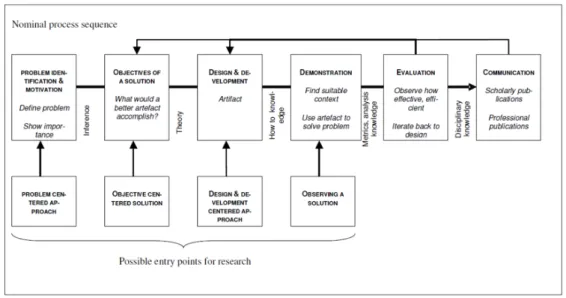
Figure 1.1: Design Science Research Methadology (DSRM) Process Model. Ad-apted and modified from Peffers et al. [110].
feature: temporal, spatial and textual, in order to optimize feature selection and to improve the effectiveness of topic clustering?
RQ4 Can we summarize events to enable decision makers to read effectively only high quality summaries of most representative posts from Twitter?
1.3
Research Methodology
The main purpose behind our work in this thesis is to develop techniques for identifying real-world events in real-time using a classification-clustering framework to improve the performance of social media event identification. To this end, and to verify the hypothesis, we design a general methodology that we use in the different parts of this thesis. Our methodology uses the Data Science Research Methodology (DSRM) in-troduced by Peffers el al. [110] as depicted in Figure 1.1. Each step is described and related to the thesis chapters as follows:
1. Problem Identification and Motivation:
This phase involves critical thinking of the research problem and modelling strategies and justifies the value of designing a solution to that problem. The first step of this phase involves the identification of gaps in related literature as presented in Chapter 2. A literature review investigates several existing models and techniques for the task of event detection in social media as well as identifies shortcomings in current approaches and looks at what can be done to improve social media event detection. In the second step, the research hypothesis state-ment and the research questions are identified as presented in Chapter 1. The third step requires the choice of the data source and the development tools that will be used to test the hypotheses. The last step involves research planing by dividing the main problem into tasks (classification, clustering, feature selection and summarization) and identifying the required milestones.
2. Objectives of the Solution:
This stage requires knowledge of the state of the problem, and current solutions and their efficacy. The problem definition in the previous stage is used in order to propose the objectives of the solution. In this research, our problem is most similar to the event detection and tracking task, whose objective is to identify events in a continuous stream of news documents (e.g., newswire). However, our problem exhibits some fundamental differences from traditional event detection that originate from the focus on social media sources. The objective of this work is to develop a framework to mine, analyze and summarize events from social media sites. The aim of this thesis also to test the performance of a number of methods and models with the intended outcome of selecting the best performance methods for the event detection task.
3. Design and Development:
This step aims to design and develop a solution of the problem. This step is explained in chapters (three, four, and five). The entire design of the proposed
framework is outlined in Chapter 3. The design of different machine learning methods used in text classification for separating event content from non-event is introduced in Chapter 3. In Chapter 4, we design an incremental on-line clus-tering algorithm which assigns similar messages in turn to similar clusters based on a similarity measure. We also explore three sets of features (temporal, spatial and textual) and combinations of them, in Chapter 4. Finally, the design of three techniques for the task of microblog summarization is presented in Chapter 5. 4. Demonstration:
This step involves using the developed framework in a suitable context. In this thesis, different experiments are carried out in chapters (three, four, and five) us-ing samples of realistic and representative data sets for a representative number of users with different locations, communities, languages, and backgrounds to demonstrate the effectiveness of the proposed framework. We have also demon-strated that the proposed framework can be used to identify real-world events, in Chapter 4, when we compare its performance against other leading approaches using Twitter posts from the UK riots in 2011, and publicly accessible reports received by the Metropolitan Police Service during the UK riots in 2011.
5. Evaluation:
This step observes and measures how well the proposed framework supports a solution to the problem. It involves assessing the effectiveness of the proposed framework compared to other existing methods. In this research, once the meth-ods are developed, researchers start a thorough testing process for each element of the framework. First, the three machine learning methods are extensively evaluated to separate event content from non-event according to standard eval-uation metrics (Chapter 3). Next, we extensively test the effectiveness of our online clustering algorithm using several large real-world datasets from differ-ent social media platforms. Several experimdiffer-ents are conducted to compare the proposed clustering approach performance against many leading approaches in
the event detection task. Finally, three automatic summarization/representation techniques for summarizing Twitter messages are successfully tested on English, Arabic and Japanese language tweets to test their applicability across multiple languages. We also compare the three proposed summarization techniques with a number of recent and leading summarization systems
6. Communication:
The main contributions of this thesis have been published in peer reviewed schol-arly publications. This thesis resulted in seven publications, six conference pa-pers and one journal article paper. The publications are listed in the list of pub-lications section.
1.4
Main Contributions
This research describes effective techniques for event detection, event monitoring (track-ing), topic clustering and event summarization. The combination of supervised learn-ing and unsupervised learnlearn-ing enables the identification of main events and sub-events, including disruptive events, and supports our hypothesis that the social media can be used as primary sources of information. In addition, one way to optimize the iden-tification of patterns and signals that would be indicative of an event is to undertake feature selection experiments. We aim to understand the effectiveness of a range of features for identifying events, in particular, features that would distinguish "normal" events from disruptive events. We then propose techniques that reduce noise and focus on summarizing Twitter messages linked with events to improve event reasoning, visu-alization, and analytics. Our methods are language independent, and satisfy real-time requirements as well as being suitable to the huge volume of data. Therefore, the main contributions of this thesis are the following:
media activity and real-world events and detects key events throughout the day;
• Using temporal, spatial and textual features, our framework is able to detect disruptive events in a given place for a certain time;
• Extensive feature analysis and feature selection are performed in order to demon-strate that these features contribute differently in the process of decision-making with regard to the management of real-time disruptive events.
• We develop several approaches for summarizing microblogging posts linked with events without the need for prior knowledge of the entire dataset;
• We evaluate the behaviour and effectiveness of the machine learning algorithms, the on-line clustering and summarization techniques on large real-world datasets.
• We validate the overall model performance on several events (including a For-mula 1 car racing event) as well as the MediaEval2012 Social Event Detection (SED) benchmark [108] to show the effectiveness of the framework. We fur-ther evaluate it against ofur-ther leading approaches using Twitter posts from the UK riots in 2011, and a publicly accessible account of actual reported intelli-gence obtained and reports received by the Metropolitan Police Service during this event. Smaller scale events included localized looting, violence and criminal damage. The results show that our system can detect events related to the riots as well as terrestrial sources did - in some cases we detect the eventbefore the intelligence reports were recorded.
• We extend and test the applicability of our algorithm to identify events and dis-ruptive events in the Arabic microblogging context (Arabic is the most complex and challenging language regarding data mining, due to its orthography and mor-phology [37]). To the best of our knowledge, this study is the first attempt to identify real-world events in Arabic from social media posts, which itself can be considered a contribution. This work has been previously published at the following venues [6, 12].
1.5
Organization of the Thesis
In this thesis, we investigate and evaluate solutions to the problem of online real-world event identification for both large-scale and rare events such as car accidents in a given location. We present techniques that are related to three main areas: text classification, online clustering and automated summarization for various microblogging platforms. In particular, we investigate and examine new and exciting techniques in order to pro-pose an event identification framework which can be generalized in the future to de-velop a social awareness system or a credible source of information. The outline of this thesis is as follows:
Chapter 2 discusses different definitions of an event with examples from real-world scenarios. We then review the related work on event detection in the social media (advantages and limitations of each work) and the main applications that could arise from a scalable event detection approach. Then, we describe the first two steps in our framework: data collection and pre-processing. Details are given of the datasets that we have used for the purposes of evaluating the proposed framework in total and in its various aspects. This chapter also presents various pre-processing techniques and we analyze the impact of preprocessing social media content for the task of event detection.
Chapter 3investigates different machine learning methods used in text classification for separating event content from non-event, mainly the Naive Bayes classifier [75], Logistic Regression [47] and Support Vector Machines (SVMs) [62]. Throughout our extensive experimentation, we evaluate these classification methods and their effective-ness at distinguishing event and non-event messages. Furthermore, we aim to investig-ate methods to improve the performance of the classification results; thus we consider several features which capture patterns in the data, such as the gram presence or n-gram frequency, the use of unin-grams, bin-grams and trin-grams, linguistic features such as parts-of-speech (POS) tagging and Named Entity Recognition (NER). Parts of this chapter were published at the following venue [8].
Chapter 4defines the term ‘disruptive event’ in the context of the social media. Then we outline the incremental on-line clustering algorithm which assigns each message in turn to a suitable event-based cluster after calculating similarity of the post to the existing clusters. We also test the effectiveness of the on-line clustering using different events and various datasets. To explore three kinds of feature (temporal, spatial and textual) and combinations of them, in order to achieve better system performance, we implement an improved model for feature selection that is suitable for microblog data. We perform extensive feature analysis and feature selection in order to demonstrate that these features contribute differently to the process of decision-making regarding the management of real-time disruptive events. Then, we validate the effectiveness of our framework using several large real-world datasets from Twitter and Flickr. We compare the overall performance of our system using the optimized model in terms of Precision, Recall, F-Measure and NMI to the performance of many leading systems, namely, Spatial LDA [106], unsupervised methods [16], [167], topic models [148] and a graph-based approach [131]. We further evaluate it against other leading approaches using Twitter posts from the UK riots in 2011.Together with parts of Chapter 3, the research in these two chapters has been published at the following venues [10, 7, 12].
Chapter 5 presents three techniques for the task of microblog summarization. Sum-marization methods are language independent, they satisfy the real-time requirement and are suitable for high volumes of data. We evaluate our proposed techniques us-ing two noisy datasets accordus-ing to well-known metrics (quality, relevance and use-fulness). We also validate our system against the state-of-the-art methods including centroid method (Becker et al.) [17], Zubiaga et al. sub-event detection and then the tweet selection method [167], Xu et al.; a graph-based approach [160] and a hybrid TF-IDF (term frequency summarization approach) [59]. We further validate the sys-tem using English, Arabic and Japanese corpora. Our results show that our proposed methods outperform all the other summarization systems for English and non-English corpora. The research in this chapter extends work that has been previously published at the following venue [11].
Chapter 6presents our conclusions from the research and discusses the possible dir-ections that future work might take.
Chapter 2
Event Detection and Characterization
2.1
Introduction
The term ‘event’ can be defined in a number of ways, depending on the domains and the interest of the users or decision makers. The definition of an event varies in granu-larity as well, depending on the way in which the event detection will be applied. Our focus is to define and connect these definitions to our task of identifying and charac-terizing events in the social media. The goal of identifying events and their associated documents on social media sites is to monitor real-time social media streams and ex-tract information. We seek in particular information of high value to public safety organizations such as the local police or emergency departments who need to respond accordingly.
The rapid growth of Internet-enabled communication technology in the form of social networking services (often collectively referred to as the social media) and their associ-ated smartphone apps has enabled billions of global citizens to broadcast news and ‘on the ground’ information during ‘real world’ events as they unfold. Twitter, for example, has been studied as an emerging news reporting platform [113, 157, 105] and has been widely used to disseminate information about the Arab Spring uprisings [143, 6] and other disaster-related incidents [57, 136, 25, 158]. The interaction between people, events, and Internet-enabled technology, presents both an opportunity and a challenge to social computing scholars, public sector organizations (e.g. governments and
poli-cing agencies), and the private sector, all of whom aim to understand how events are reported using social media and how millions of online posts can be reduced to accur-ate but meaningful information for making wise decisions and carrying out productive action.
In this chapter, we survey the various definitions of ‘event’ in the literature from a vari-ety of academic disciplines, especially Topic Detection and Tracking (TDT), which include tasks such as event identification, tracking, and filtering, as well as topic seg-mentation and event summarization. Then we overview some recent works that use user generated content sources for global and local event identification in the social media, and highlight both their benefits and shortcomings. In addition, we present our end-to-end integrated event detection framework which contains five main elements: data collection, pre-processing, classification, online clustering and summarization. Section ( 2.4, 2.5) discusses the first two stages, data collection and pre-processing. In data collection, we describe the datasets that we use in our subsequent experimental chapters, including three large-scale, real-world datasets from Twitter and one data-set from Flickr [109]. Section 2.5 explores traditional text processing steps such as stop-word elimination and stemming.
2.2
Event Definition and Examples
The definition of ‘event’ varies across academic fields, from social computing to Topic Detection and Tracking (TDT). Even within a specific domain, researchers often dis-agree on what precisely constitutes an event or the characteristics of an event [93]. An event on a social media platform can be loosely defined as a specific thing that happens at a specific time and place [3]. Wang et al. [154] defined an event as: "An occurrence causing changes in the volume of text data that discusses the associated topic at a specific time". This definition suggests that the occurrence is characterized by topic and time, and often associated with entities such as people and location. Of
course, if an event was not reported by social media users, then it will not be identified by our framework. For example, if a conference or a local gathering or a small car accident were not reported in social media sites, then event detection systems will not be able to detect such events from social media. Furthermore, [135] defined an event as something that happens with a defined beginning and ending within the scope of a document. These definitions touch on an important aspect of an event, namely, its necessary association with the time dimension.
All these definitions share the same aspects of an event; hence, an event can be charac-terized by one or more of the following attributes: Topic, Time, People and Location. In other words, according to the knowledge from social media sources, events can be represented by four kinds of attribute: what (topic or keywords), when (time), where (location) and who (people) [77]. We define an event as a real world happening that is reflected by change in the volume of text data that discusses the associated topic at a specific time and place, similar to Dong et al. in [42]. For the purposes of this study, we define a small-scale event as: An occurrence that discusses a particular topic at a specific time and place but only reported by few number of users, whereas large-scale event is an event that is reported by a large number of users.
Chen and Roy [29] slightly adapted the definition of an event in the context of a set of photos rather than text. Thus, if a set of photos represents an event, it should at least satisfy the following three constraints: (1) The group of photos concerns the same specific thing. That is, the content of the photos should be semantically consistent. (2) The group of photos should be taken within a certain time segment. (3) The group of photos should be taken within a similar location. We can also generally extend or modify the definition of event to handle a set of videos.
These events range from widely known (global) ones (such as political events or pro-fessional sports/games) to smaller-scale, local events (such as a community gathering or a local conference). Global events are events that refer to real world happenings whose effects are not restricted to a certain location. Local events, by contrast, are
events that refer to real world happenings whose effects are restricted to a certain loca-tion [21]. People are interested in both types of event: the former are important world events that one should know about, and the latter affect our everyday life more directly [156].
Real world events are also divided into known (predictable or planned) events such as concerts or conferences andunknown(unpredictable or unplanned) events such as earthquakes. Obviously, known events should be relatively easy to detect, given the long time of planning and preparation for them that is involved [151, 16]. Events can be further divided intoperiodicandaperiodicevents. The former are events that occur in sequence at roughly equal intervals, whereas an aperiodic event happens only once within a given period [29, 53]. Other researchers describe periodic events as sched-uled or known events where the system is provided with the time that the events will start, scheduled in advance, so the system knows when to start looking for them [167]. Examples of scheduled events are sporting events, ceremonies and product launches. He et al. [53] defined and investigated periodic and aperiodic events and applied spec-tral analysis using Discrete Fourier transformation (DFT) to categorize the features of both.
Different events have different context-specific features but are generally conveyed on social media using verbs (actions), nouns (names, places, topics ...), adjectives (de-scriptive) and prepositional phrases (describing proximity and location). Our aim is to represent the data extracted from the social media as a time-line of events (clusters), where each cluster contains sufficient data to discriminate between events and sum-marize them into actionable information for use by public safety officials and policy makers.
Experimentally, events can be characterized by burst detection, where different events have different terms causing a "volume change" to the use of these terms when dis-cussed on social media platforms [8]. The rationale behind our approach is that events belonging to the same topic often share a set of keywords. Tweets discussing the same
event, for instance an air crash, tend to share similar patterns or words, such as airplane, crash, death, and injuries [163]. An event is therefore conventionally represented by a number of keywords showing a burst in their frequency count [67].
Although these keywords are informative and used to discriminate on-topic and off-topic documents, they cannot differentiate between similar events or events of the same type. Hence event detection methods that are based only on word occurrence/frequency analysis cannot distinguish between two or more events of the same type. Consequently these methods may fail to report multiple airplane crashes, or, more precisely, they may identify the first event and miss the others. Or they might consider all of them as one incident/event which means that one event which could be a major event might be omitted - unless the system has the ability to distinguish the discriminative features (words or phrases) for classifying the topic from those discriminative for event distinc-tion [163].
Therefore, relying on textual content alone is generally insufficient particularly for small-scale incidents such as car accidents. Many road accidents are of a kind that happens every day and has effects that last for a few hours on different roads. To achieve good system performance, small-scale incident detection that analyzes tweets for incidents needs to distinguish crashes from one another [132]. Hence, additional knowledge of the time and the location is needed and probably other entities (ex. Url, link or picture) should be brought in to distinguish between similar events and aggreg-ate further information about the kinds that occur repeaggreg-atedly.
We assume that the task of event detection may be needed in one of the following three scenarios: (a) different events occurring in the same location within one time period, where we assume that each event can be characterized using differenttextual features; (b) similar multiple events in different locations, where we assume that the most appropriate features will betemporalandspatial features; and (c) similar events in the same location at almost the same time. In this case we assume that they are the same event and group them together, treating the new documents as updates of earlier
Figure 2.1: Document clustering using different sets of features
ones.
One of the main empirical foci of this work is an exploration of the most effective features in the data from the social media for event detection. Consider a text stream
D= (D1, D2, ..., Dn)whereDiis a document, and the length ofDis|D|. A document
di consists of a set of features,(F1, F2, ..., Fk), and is reported at time ti. The text
stream, D, is divided into time windows, Wi of the same length e.g. per day, per 12
hours, per minute. The problem of real-time event detection is to find an optimal set of features to detect events in each unit of time, where all known events are identified and correctly summarized. Figure 2.1 illustrates the relationship between events and the different sets of features.
2.3
Related Work: Event Detection in Social Media
The general topic of detecting real-world events from the social media has drawn con-siderable research interest. Research efforts have focused on real-time event detection and tracking, social media analysis, micro-blog summarization and information visu-alization. We describe the related work in three areas: large-scale (global) event de-tection, small-scale (local) event dede-tection, and systems used to extract crisis relevant information from the social media.
States presidential election or the reaction to the 2014-2015 Ebola Outbreak in West Africa, Petrovic et al. [112] presented an approach to detect breaking stories from a stream of tweets using locality-sensitive hashing (LSH). Becker et al. [16] proposed an online clustering framework to identify different types of real-world event. Then the researchers used different machine learning models to predict whether a pair of documents belonged to the group of real-world events or not. The authors in [148] proposed an efficient methodology for performing event detection from large time-stamped web document streams. Their methodology successfully integrated named entity recognition, dynamic topic map discovery, topic clustering, and peak detection techniques. All these approaches, however, are limited to widely discussed events and are not designed to report rare and potentially disruptive small-scale incidents.
Large-scale event detection has also been explored through the clustering of discrete wavelet signals built from individual words generated by Twitter [157]. Auto-correlation then, by modularity graph partitioning, filters out the trivial words (noise) and cross correlation groups together with words that relate to an event. Similarly, Cordeiro in [35] proposed a continuous wavelet transformation based on hashtag occurrences com-bined with topic model inference using Latent Dirichlet Allocation (LDA) [20]. In fact, LDA and its variants form a widely used statistical modelling approach implemented in event detection tasks [148, 106, 35, 150]. However, these methods have the main drawback of requiring an a priori specification of the total number of topics, which leads to problems when the total number of event exceeds this number.
Other approaches have focused on structural networks and graph models to discover events in the social media feeds. Benson et al. [18] presented a structured graphical model which simultaneously analyzed individual messages, clustered them according to event, and induced a canonical value for each event property. Using a different graph analytical approach, Sayyadi and Raschid [130] used a KeyGraph algorithm [100] to convert text data into a term graph based on co-occurrence relations between the terms. Then they employed a community detection approach to partition the graph. In this,
each community is regarded as a topic and the terms in the community are eventually considered the topic’s features. In addition, Schinas et al. [131] used the Structural Clustering Algorithm for Networks (SCAN) to detect “communities" of documents. These candidate social events were further processed by splitting the events that ex-ceeded a predefined time range into shorter events. Then the researchers used a clas-sification approach based on median geolocations and accumulated tf-idf vectors for each cluster to separate the relevant and irrelevant candidate events. However, these graph partitioning algorithms are not ideal for social media event detection because they may not be able to capture events given the velocity and scale of the updates in social networks in real time as events unfold.
Small-scale event detection: Various methods have been proposed to identify small-scale (local) events such as fire incidents, traffic jams, shooting incidents etc. from social media streams. Walther and Kaisser [153] developed spatiotemporal cluster-ing methods which monitor the specific locations of high tweetcluster-ing activity and cluster tweets that are geographically and temporally close to each other. A machine-learning module is then used to evaluate whether a cluster of tweets refers to an event based on 41 features, including the tweet content. Another clustering approach is presented in [132] by Schulz et al., with a small-scale incident detection pipeline based on the clus-tering of incident-related micro-posts. It uses three properties that define an incident: (1) incident type, (2) location and (3) time period. Various techniques are adopted to increase the quality of their clustering approach: (A) the incident type determination, using supervised machine learning (Semantic Abstraction); (B) geotagging of tweets based on their geolocalization; and (C) the extraction of the time period of the incid-ent. Although both methods are very specific to particular incident type (for example [132] is specific to car incidents, fire incidents, and shooting incidents) without giv-ing aspects of the general context (i.e. what are the other events around these specific events?), it is critical that the system can provide insight into the other ongoing events and sub-events arising amid the specific events. This may explain the low recall val-ues of the [132] and [153] approaches when validated using real-world official reports,
32.14% and 4.75%, respectively.
Another event detection system, Twitcident [1] by Abel et al., presents a Web-based application for searching, filtering and aggregating information about known events re-ported by emergency broadcasting services in the Netherlands. In addition, Watanabe et al. [156] proposed a system called Jasmine, for detecting local events in the real world using geolocation information from microblog documents. It obtains the name list of locations from geotagged tweets and adds positional information to tweets by matching the location name. They use two gazetteers or as they call them (Place Name Database): the first one is the well-known Foursquare service (https://foursquare.com/) and the second is Solr (http://lucene.apache.org/solr/), an open source search plat-form based on Lucene. A similar system is EventRadar [21] by Boettcher and Lee. EventRadar introduces a statistical method for detecting local events using a temporal and spatial analysis by considering seven- day historic data. The main contribution of EventRadar is that it detects local events without needing a list of locations by find-ing clusters of Tweets that contain the same subset of words. Another related system is proposed by Li et al. in [76] to detect crime and disaster related Events (CDE) from tweets. They use the spatial and temporal information from tweets to detect new events and extract the meta information by a number of text mining techniques (e.g., geo-location names, temporal phrase, and keywords) for event interpretation. These systems (Twitcident, Jasmine, EventRadar, and TEDAS) can only detect small events and all of them (except EventRadar) require location names in advance, which limit their overall scope and portability.
Event detection for disaster and emergency events: Regarding the use of social media data in disasters, researchers have proposed several visual analytics approaches aiming at real-time microblog analysis that often facilitates interactive means for ex-ploring and identifying anomalies [43]. TwitterMonitor [88] performs trend detection in two steps and analyzes trends in a third step. During the first phase, it identifies bursty keywords which are then grouped on the basis of their co-occurrence. Once
a trend is identified, additional information from the tweets is extracted to analyze and describe the trend. AIDR (Artificial Intelligence for Disaster Response) [58] is a platform for filtering and classifying messages in real time that are posted to social media during humanitarian crises. AIDR uses human-assigned labels (crowdsourcing messages), and pre-existing classification techniques to classify Twitter messages into a set of user-defined situational awareness categories in real time. Vieweg et al. in 2010 [151] analyzes the Twitter logs for pairs of concurrent emergency events, for example, the Oklahoma grassfires (April 2009) and the Red River floods (March and April 2009). Their automated framework is based on the relative frequency of a geo-location and geo-location-referencing information from the users’ posts.
In a related work in 2014, Vieweg et al. [150] has enabled filtering, searching, and analyzing of tweets during another natural disaster (the 2013 typhoon Yolanda). The researchers used a supervised classification algorithm to automatically classify the tweets into three categories, labelled Informative, Not informative and Not related to this crisis. Then they employed topic modelling using the LDA [20] model to fur-ther classify the informative tweets into 10 clusters according to the Humanitarian Clusters Framework. Similarly, Twitinfo [87] automatically detects and labels unusual bursts in real-time Twitter streams. However, TwitInfo adapts signal processing and streaming techniques to extract peaks and label them meaningfully, using text from the tweets. Additionally, Olteanu et al. [103] created a lexicon of the crisis-related terms (380 single-word terms) that frequently appear in relevant messages posted during six crisis events. Then they demonstrated how the lexicon can be used to automatically identify new terms by employing pseudo-relevance feedback mechanisms to extract crisis-related messages during emergency events.
In research that was mostly analytical, Shamma et al. [136] presented Tweetgeist for identifying structure and semantics in Twitter about media events and sending such information back to the microbloggers to enhance their experience. However, most of the current disaster identification approaches are desinged to detect certain events, such
as earthquakes, tornadoes, etc. and may struggle to detect other non-disaster related events. Another presumption of these approaches is that users have to know the event in advance to represent the keyword quires to be detected. In addition, Thapen et al. [144] built a situational awareness system that uses frequency statistics and cosine similarity based measures to produce terms characterizing localized events (the detection of an outbreak of illness, in their case) and then retrieve relevant news and representative tweets.
It may also be useful to report some studies that have been proposed to identify event phases and the temporal boundaries of mass disruption events. For instance, Chow-dhury et al. [32] introduced a system called Tweet4act to automatically determine different phases of an event by extracting content features from each message. They applied the popular k-mean clustering algorithm to classify messages for three crisis events (the Joplin tornado in USA, the Nesat typhoon in the Philippines and the earth-quake in Haiti). Similarly but with a broader perspective on events, Iyengar et al. [60] described an approach to automatically determine when an anticipated event star-ted and ended by analyzing the content of tweets using an SVM classifier and hid-den Markov model with various textual features, such as bag of words, POS (part-of-speech) tags, etc. Both studies aim to automatically classify tweets according to the three phases of an event: before, during, and after. Additionally, Yin et al. [164] investigated several approaches that have been shown useful for analyzing event to a local level the Twitter messages generated during humanitarian crises. Three key rel-evant methods for burst detection were evaluated: a) tweet filtering and classification, b) online clustering, and c) geotagging.
In summary and from the above review, although many approaches exist for the task of event detection in social media, they are generally used for large scale events such as large-scale event detection systems and hence are not designed to capture important small-scale events. On the other hand, the small-scale event detection systems are very specific and are limited to detecting some events alone - thus missing the context
of larger events. Moreover, and regarding the use of social media data in disasters, researchers have proposed several event detection systems for disaster and emergency events aiming at filtering, searching, and analyzing tweets during disasters in real-time. Many of these approaches require a priori knowledge of the number of events, or require manually selected terms or phrases to retrieve documents for each event, or are limited to specific type of event (i.e., concerts), or are limited to specific language particularly the English language.
Overall, a common and serious limitation of both, large-scale event detection and small-scale event detection approaches is the real-time elements of these approaches to identify events in social media. Together with the limitations of traditional approaches and disaster event detection approaches, these constitute the motivation behind the research work in this thesis. Hence, we need to propose a general online classification-clustering framework, suitable for large-scale and small-scale social media content, in real-time and for multiple languages. We also need to develop new techniques for se-lecting top messages that represent an event with high quality, strong relevance and are useful to people looking for information about an event.
In contrast to the above approaches, we propose a novel approach to event detection that aims to overcome many of the above limitations and challenges to provide a sys-tem to detect large-scale events and related small-scale events. Our integrated event de-tection framework consists of five main components: data collection, pre-processing, classification (supervised machine learning algorithms), online clustering (unsuper-vised learning), and summarization (representation). The proposed system automatic-ally identifies real-world events and disruptive events in a particular time and location. We propose the use of an online clustering algorithm with a sliding window timeframe which can be used to detect large and smallscale events from social media streams -with particular attention to filtering from large to small-scale events.
To this end, we investigate the deployment of a supervised classification model to clas-sify each tweet into ’event class’ or ’non-event class’ before clustering, as an approach
for reducing computational overhead at the clustering stage by potentially significantly reducing the number of tweets to those containing only event related tweet. Thus clustering, feature selection, and summarization could become much faster and more suitable for real-time analysis. In addition, we validate the overall model perform-ance of our integrated framework on several events and using multiple Twitter datasets to show the effectiveness of the framework. We evaluate it against different leading event detection approaches, described above, including spatial LDA [106], unsuper-vised methods [16], [167], topic models [148] and a graph-based approach [131]. We also presented a case study of our approach, evaluating it against other leading ap-proaches using Twitter posts from the UK riots in 2011 which is different because this evaluation is based on high quality ground truth data from public Metropolitan Police Service (MPS) reports.
2.4
Data Collection
Since we receive a high volume of widely varied tweets per day, traditional monitoring and analyzing is impractical and moreover it significantly reduces the set of potentially applicable real-time algorithms. We collected user-generated updates directly from the social media using the streaming API (Application Programming Interface) because it allows us to subscribe to a continuous live stream of data. Our goal is to detect events in a given location without any prior knowledge of these events. Generally, Twitter offers two application programming interfaces (APIs) for collecting tweets: one is the search API, which is used to retrieve past tweets matching a user specified criteria; the other is the streaming API, which is used to subscribe to a continuing live stream of new tweets matching a user defined criteria and delivered to the user as soon as they become available. The most open and widely used social medium is Twitter. Other social media sites, such as Facebook and Google+, are largely closed and access to public online discourse is more restricted. This is due to that different social networking sites are used for different purposes, but commonalities do exist. For
instance, the top 3 activities on Twitter are to (1) post about daily activities, (2) upload and share photos, and (3) comment on posts of others; while on Facebook they are to (1) upload and share photos with friends, (2) message with friends on a one-on-one basis, and (3) comment on posts of friends [57].
Terrestrial events by definition occur in space and thus we collected tweets based on a set of keywords describing a country or region (e.g., Iraq, Syria, Egypt, ...) using different languages. We also collected tweets from users who selectively added the re-quired region as their location in their profile metadata or turned on the GPS option on their smartphones. Although Twitter users have the option to enable location services on their account, this feature is off by default and requires users to opt in, but once it is enabled users can geotag their tweets with precise location data in the form of latitude and longitude [139]. Geotagging tweets means that the exact position of where the tweeter was when the tweet was posted is recorded using longitude and latitude meas-urements. Although the proportion of geotagged tweets with precise location is small [139], these samples of tweets actually contain very valuable information for the pur-pose of disruptive event detection . Details of the spatial features and geotagging can be found in Chapter 4. Finally, we made use of geographic Hashtags (e.g., #Ramadi, #Aleppo, #Cairo, #Dubai ...) in the data collection process.
The data were stored temporarily using a MongoDB database, which is open-source, easy to use and boasts high access speed and me