Interdisciplinary Journal of Problem-Based Learning
Interdisciplinary Journal of Problem-Based Learning
Volume 11 Issue 2 Article 4
Published online: 6-5-2017
Developing Teacher Competencies for Problem-Based Learning
Developing Teacher Competencies for Problem-Based Learning
Pedagogy and for Supporting Learning in Language-Minority
Pedagogy and for Supporting Learning in Language-Minority
Students
Students
Peter RilleroArizona State University, [email protected]
Mari Koerner
Arizona State University
Margarita Jimenez-Silva
Arizona State University
Joi Merritt
Arizona State University
Wendy J. Farr
Arizona State University
IJPBL is Published in Open Access Format through the Generous Support of the Teaching Academy at Purdue University, the School of Education at Indiana University, and the Jeannine Rainbolt College of Education at the University of Oklahoma.
Recommended Citation Recommended Citation
Rillero, P. , Koerner, M. , Jimenez-Silva, M. , Merritt, J. , & Farr, W. J. (2017). Developing Teacher
Competencies for Problem-Based Learning Pedagogy and for Supporting Learning in Language-Minority Students. Interdisciplinary Journal of Problem-Based Learning, 11(2).
Available at: https://doi.org/10.7771/1541-5015.1675
This document has been made available through Purdue e-Pubs, a service of the Purdue University Libraries. Please contact [email protected] for additional information.
This is an Open Access journal. This means that it uses a funding model that does not charge readers or their institutions for access. Readers may freely read, download, copy, distribute, print, search, or link to the full texts of articles. This journal is covered under the CC BY-NC-ND license.
for Supporting Learning in Language-Minority Students
for Supporting Learning in Language-Minority Students
Cover Page FootnoteCover Page Footnote
This project is possible by the funding from the United States Department of Education Teacher Quality Partnership grant, “Integrating STEM, Literacy, and Language to Prepare All Teachers to Teach English Language Learners: iTeach ELLs.”
This voices from the field is available in Interdisciplinary Journal of Problem-Based Learning:
September 2017 | Volume 11 | Issue 2
The Interdisciplinary Journal of
Problem-based Learning
Special iSSue On cOmpetency OrientatiOn in prOblem-baSeD learning:
VOiceS FrOm tHe FielD
Introduction
There is no better time to implement large-scale problem-based learning (PBL) in K–12 schools than now. PBL integrates sci-ence, technology, engineering, and mathematics (STEM) with meaningful experiences; it provides a path to realize the Next Generation Science Standards (NGSS Lead States, 2013), and it is the way to achieve the inquiry described in the Common Core mathematics standards (Nariman & Chrispeels, 2016). These standards align with the view that the ultimate outcome of education is people’s abilities to recognize and solve prob-lems. PBL as a method and a philosophy can enrich learning and school experiences for both students and teachers.
The needs of English Language Learners (ELLs) in the United States are currently not being met (Gándara, 2010). While advantaged by multicultural perspectives and lan-guages (Luk, De Sa, & Bialystok, 2011), these students often face challenges in schools. Language is the fundamental tool of learning. Difficulty speaking, writing, and understanding
the language of instruction and assessment threaten academic success. This obvious challenge can be made more diffi-cult by often accompanying factors. Immigration and pre- /post-immigration conditions may have interrupted school attendance and learning (Suárez-Orozco & Suárez-Orozco, 2015). Students of families without legal immigration sta-tus may face economic struggles requiring parents to work more and have less safe and desirable living arrangements (Orfield, 2014). Parents may not have the time and famil-iarity with the language of instruction to help their children succeed academically (Pong, Hao, & Gardner, 2005). Finally, all too often, districts who have many non-English speaking children in areas with lower-cost housing may also struggle to attract and retain high quality teachers (Johnson, 2006).
As a teachers college, we have prioritized the goal to prepare high-quality teachers who embrace the aforementioned oppor-tunities and challenges. We have combined PBL with ELL meth-ods to create a new instructional model. Through language objectives, language supports, and deliberate opportunities for
Developing Teacher Competencies for Problem-Based
Learning Pedagogy and for Supporting Learning
in Language-Minority Students
Peter Rillero, Mari Koerner, Margarita Jimenez-Silva, Joi Merritt, and Wendy J. Farr (Arizona State University)
Abstract
Teachers need to be able to design and implement problem-based learning (PBL) experiences to help students master the content and the processes in new mathematics and science education standards. Due to the changed population of learners within schools, it is also critically important that teachers in the elementary grades have the abilities to work effectively with English language learners (ELL). This article discusses the implementation of a major initiative by our teachers college to achieve both of these goals through Problem-Based Enhanced Language Learning (PBELL), which combines PBL, enhanced opportunities for language, and ELL methods. The implementation began with a small group of faculty members developing and piloting PBELL experiences, with coaching spread throughout the program. Our student-teachers are graduating with multiple opportunities to experience PBELL as learners and to design and implement PBELL experiences.
Keywords: problem-based learning, science education, mathematics education, English language learners, teacher education, elementary education, language acquisition
discussion there is an enhanced focus on the use and devel-opment of language. We call our approach Problem-Based Enhanced-Language Learning (PBELL). By working with fac-ulty, this method is being infused in our elementary education programs. Our future teachers experience PBELL as learners and then have multiple opportunities to design and implement the approach as preservice teachers. The goals of this “Voices from the Field” article is to describe the (a) rationale for the development of PBELL, (b) specifics of the approach, and (c) how we are changing our teachers college so that our graduates can effectively employ the method and meet the needs of all their students. Though this work is presented in the context of our US system, it can serve as a model for both the worldwide development of teachers and for supporting students in devel-oping abilities in the language of instruction.
Problem-Based Learning in K–8 Schools
More than a century ago, Dewey philosophized about the power of an educational experience to promote a disturbing state of perplexity, the importance of curiosity in learning, and steps in the problem-solving process (Dewey, 1910; Dewey, 1938). The incorporation of PBL methods, however, did not gain footing in education until the 1970s, when it was introduced in medical education in the 1970s at McMaster University (Bar-rows, 1996; Barrows & Tamblyn, 1980;Zubaidah, 2005). In a reform of the existing lecture and memorize method, medical students learned content and clinical reasoning by identifying symptoms in real patients, simulated patients, or written case studies (Barrows & Tamblyn, 1980); diagnosing medical con-ditions; and prescribing treatments (Barrows, 1996). With suc-cesses in medical education, PBL emerged in other professional education programs including nursing, architecture, engineer-ing, advertisengineer-ing, physical therapy, and business administration (Barrows, 1996; Gould & Sadera, 2015; Quinn & Albano, 2008; Rideout & Carpio, 2001; Zubaidah, 2005).
The move of PBL into K–12 education necessitated a broader view from foci on clinical skills or problem- solving for a single profession to K–12 experiences designed to prepare learners for many possibilities in life (Delisle, 1997; Edwards & Hammer, 2007; Marle et al., 2012; Torp & Sage, 2002). To understand the effects of PBL on measures of student science and mathematics learning in K–8 settings, a team at our center conducted a systematic review of the literature on control group studies with PBL as the indepen-dent variable (Merritt, Lee, Rillero, & Kinach, 2016). The ini-tial search yielded 504 abstracts from ERIC and PsycINFO databases. Further iterative examinations of these abstracts and then articles yielded only nine articles that fit our crite-ria, and these were all in science education. The analysis of the dependent variables across the studies provided evidence
that K–8 science PBL experiences may foster academic achievement, knowledge retention, conceptual development, and improved attitudes.
English Language Learners
As Cochran-Smith and colleagues (2015) state, “demo-graphic changes worldwide resulting from the mass move-ment of people across the world and higher birthrates for racial/ethnic minority groups . . . have dramatically increased the enrollment of students from diverse backgrounds in ele-mentary and secondary schools in many countries around the world” (p. 114). When the language in which academic content is delivered to students is not accessible, their aca-demic success is significantly jeopardized (Wright, 2015). The population of ELLs in U.S. schools has been increasing steadily over the past thirty years (Shin & Kominski, 2010). The percentage of public school students classified as ELL in the 2013–2014 school year was 9.3%, or an estimated 4.5 mil-lion students (U.S. Dept. of Ed., 2016). More than 41 milmil-lion immigrants lived in the United States as of 2013, more than four times as many as in 1960 and 1970, according to recent U.S. census data reported by the Pew Research Center (2015). In addition, the share of U.S. immigrants who speak Eng-lish “less than very well” grew from 43% in 1980 to 50% in 2013 (Pew Research Center, 2015). Furthermore, nationally, most ELLs are in the elementary grades (Kena et al., 2015). In Arizona, the state in which we are situated, the 2013–2014 ELL demographics indicate that 79% of the state’s ELLs are in grades K–5, while 13% are in grades 6–8 and 8% are in grades 9–12 (Arizona Department of Education, 2016). This is critical information for those of us preparing the next gen-eration of teachers to meet the academic and linguistic needs of this growing population of students.
In a number of contexts ELLs have very limited opportu-nities to access science and mathematics content. For exam-ple, due to restrictive language policies that currently exist in Arizona, ELLs are to be taught in classes that focus only on English language development (Lillie et al., 2010). ELLs are often provided limited access to various content areas outside of English language arts (Gándara & Hopkins, 2010). While mathematics is integrated to a limited extent, science and social studies are often not addressed with ELLs in Ari-zona schools (Jimenez-Silva, Gomez, & Cisneros, 2014).
Developing academic language in science is challenging for both native English speakers and ELLs. However, a num-ber of additional challenges exists for ELLs and their teach-ers. A number of studies have shown that teachers of ELLs are more effective in increasing ELLs’ academic achieve-ment across content areas when they have a greater amount of specialized preparation in meeting ELLs’ specific needs
Rillero, P., et al. Developing Teacher Competencies
3 | www.ijpbl.org (ISSN 1541-5015) September 2017 | Volume 11 | Issue 2 (Maxwell-Jolly & Gándara, 2006). More current work by
scholars at Stanford’s Understanding Language project has identified six key principles for ELL instruction (Stanford School of Education, 2013) that are intended to address the increased rigor of mathematics and science standards. The six principles are as follows:
1. Instruction focuses on providing ELLs with opportu-nities to engage in discipline-specific practices, which are designed to build conceptual understanding and language competence in tandem.
2. Instruction leverages ELLs’ home language(s), cul-tural assets, and prior knowledge.
3. Standards-aligned instruction for ELLs is rigorous, grade-level appropriate, and provides deliberate and appropriate scaffolds.
4. Instruction moves ELLs forward by taking into account their English proficiency level(s) and prior schooling experiences.
5. Instruction fosters ELLs’ autonomy by equipping them with the strategies necessary to comprehend and use language in a variety of academic settings. 6. Diagnostic tools and formative assessment practices
are employed to measure students’ content knowl-edge, academic language competence, and participa-tion in disciplinary practices.
One challenge that exists is that many teachers see them-selves as transmitters of content and believe that the teaching of English should be left to others who may have specialized training in developing English language proficiency. The reality is that ELLs can most efficiently learn the language when it is taught through meaningful and engaging con-tent, especially in an area such as science. Furthermore, with limited time in the school day, teaching academic subjects in isolation is not a good use of precious time. Sometimes, instruction for ELLs is seen as simply a matter of applying “just good teaching” (deJong & Harper, 2005), although there is general consensus among second-language experts in the field that specific knowledge and skills (see Menken & Look, 2000) are critical for all teachers working with ELLs. General education discussions of ELLs continue to fail to acknowledge the language and literacy demands specific to ELLs (deJong & Harper, 2005).
Teacher Education
Although the history of America’s schools of education con-sistently shows a “romance” with progressivism, K–12 schools have not (Labaree, 2004). Couched in language like “progres-sive vs. traditional,” “content-centered vs. student-centered,” or “hands-on vs. direct instruction,” schools, especially in the
current accountability era, focus on measurable and strict curriculum and outcomes, not on instructional practices— as if content and pedagogy can be separated. Because the teachers who are prepared for the schools in the real world of standards and accountability demand a working knowledge of how to be successful in that context, and, because profes-sors who teach those classes themselves are experts in often narrowly defined areas of content (e.g. mathematics educa-tion, developmental psychology, historical foundaeduca-tion, etc.), the preparation programs tend to focus narrowly on specific content and methods in constrained and very defined areas with little focus on how to teach effectively. As Mary Ken-nedy (2016) asserts, knowledge is “portioned” and practice is divided into little bits.
Over the years, teacher educators have tried several times to partition the fluid practice of teaching so that they could articulate its constituent parts, define the specific bodies of knowledge that are relevant to teaching practice, or define the practices that comprise teaching, or those things that comprise “good teaching” in particular. (Kennedy, 2016, p. 7)
Colleges of education have to do more than minimally meet state certificate requirements, and they must integrate theory and practice. As Labaree (2004) notes, “education professors . . . are bundles of contradictions” (p. 193). They retain this seeming commitment to active learning while focusing on “a practical commitment to instrumentalism” (p. 193). In other words, talking about PBL is easier than implementing it into courses and programs.
It is only common sense that in order to basically change teacher programs, the curriculum in teacher education has to be updated as well as the actual instructional practices of the faculty. While faculty improvements in teaching abilities are often advocated for by faculty members at many colleges (Handelsman et al, 2004), perhaps it is taken for granted that faculty in colleges of education will always remain current on what and how to teach. Teacher educators, however, also need opportunities to develop and improve their work with teacher candidates (Livingston, 2014). In order to change what teacher candidates learn, this project had to seriously grapple with the problem of changing the practices of faculty.
Problem-Based Enhanced-Language Learning
PBL experiences in content areas infused with design ele-ments to enhance language development can help all learn-ers. PBL naturally presents opportunities for thinking, reading, writing, and discussing. By deepening these oppor-tunities, PBL becomes an ally for the acquisition of content, the development of academic language, and the enrichment
of social language when working with language-minority learners. This approach can benefit all learners as they are both basic and needed skills. A recent study in elementary grades found the need for better oral and written language support in PBL (Nariman & Chrispeels, 2015).
We call our language-rich PBL approach Problem-Based Enhanced-Language Learning (PBELL). Although length limits prevent depicting a full example of PBELL in this arti-cle, there are published examples and links to works (Baca, Bostick, Hernandez, Saltmarsh, & Thibault, 2016; Birrell, Hernandez, Bostick, & Aparicio, 2016; Rillero & Hernan-dez, 2016), and a rich description of a PBELL experience is provided in the “Implementation and Results” section. The following two sections are intended to be guides for under-standing, developing, and using PBELL.
PBL in PBELL
There are several aspects of PBL that are fundamental to the PBELL approach. The problem precedes instruction. Learn-ers grapple with an engaging, meaningful problem. Thus with some uncertainty learners work together and with materials to understand the problem and work toward a resolution. As such, student exploration occurs before explanation, which is consistent with learning cycles, such as those used in the Science Curriculum Improvement Study (Atkin & Karplus, 1962) and the 5-E instructional model (Bybee, 2014). In the curriculum design, the focus is not merely on solving a prob-lem but also developing mastery of academic standards and academic language. Embedded content supports maximize the learning potential of the experience. It is not just about problem solving; the achievement of content knowledge through PBL is an important aspect of the approach.
ELL Methods in PBELL
Traditionally, the role of language development has been left to the language arts teacher for fluent English speakers or to the English as a Second Language teacher for English language learners. Presently, many ELLs have no access to content instruction by teachers with specialized language training; therefore, mainstream teachers are expected to know how to effectively support ELLs in both learning English and devel-oping content knowledge (Lucas & Grinberg, 2008). PBELL holds exceptional promise for use by all teachers because it amplifies the role of language in the learning experience.
To make content comprehensible the experience needs to include planned activities for students to develop and practice academic language. Each experience has a content- language objective that addresses a specific language function. Language functions refer to the many ways in which we use
language for various formal and informal purposes. Specific grammatical structures and vocabulary are often used with each language function. Some examples of language functions are compare and contrast, persuasion, and argumentation. Kinsella (2010) provides helpful suggestions for developing language functions. For example, if we were focusing on the language function of compare and contrast in our lesson, we could use supports such as venn diagrams to visually repre-sent similarities and differences. Some words, such as likewise, however, nonetheless, and contrary to, may need preteaching. Language supports could include sentence starters, as shown in the following examples: “One similarity/difference between ____ and ___ is_____” or “____and ___ are rather different because while ___has ____, ____ has ____.” One benefit of incorporating language functions into PBELL is generalizabil-ity; once students learn the language of comparing and con-trasting, for example, they can extend this knowledge beyond the task at hand. As Kinsella (2010) noted, this approach allows language to become a vehicle instead of a barrier to learning academic content—in our case, science and mathematics.
Conceptual Framework
This project’s framework is that teaching and learning for students who are classified as ELL can be improved when discipline-specific instruction is grounded in language-based theories of learning (Halliday, 1993). Halliday posits that language is the “prototypical resource for meaning mak-ing” (p. 113) and that learning should occur in multiple ways: learning language, learning through language, and learning about language (1993). Language skills become a means to content learning, and should be regarded as tools that should be practiced with students in tandem with—and in equal sig-nificance to—conceptual content learning (Wright, 2015).
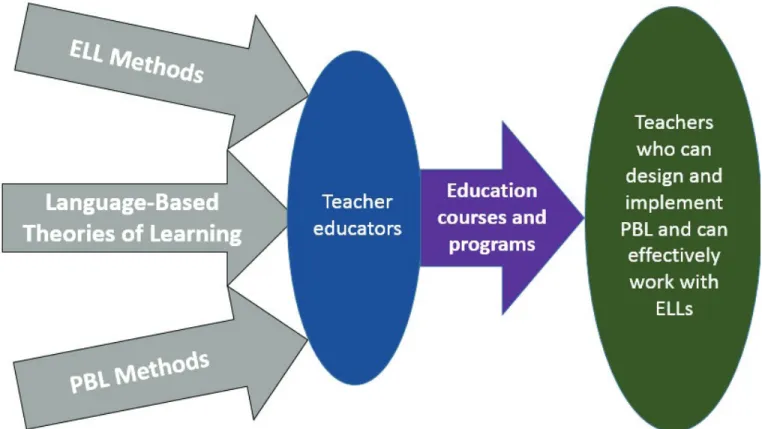
We selected PBL because of its potential to create purpose-ful and meaningpurpose-ful opportunities for students to use language. Informed by the role of instruction for teaching language to ELLs (Goldenberg, 2008) and the role of language for learning (Halliday, 1993), this project advances by (a) enabling teacher educators to address PBL, language-based theories of learning, ELL methods, and PBELL; (b) redesigning the teacher educa-tion programs; and (c) developing teachers who can create opportunities for students to develop and practice academic discourses through PBL. This is represented in Figure 1.
Context
Our college embraces the roles of being part of a Research I university and the leading producer of teachers for our state. Partnering with 26 public school districts throughout Arizona provides clinically enhanced pre-K–12 programs to
Rillero, P., et al. Developing Teacher Competencies
5 | www.ijpbl.org (ISSN 1541-5015) September 2017 | Volume 11 | Issue 2
Program Enhancement Team
To achieve educational reform, we recognized the need for collaborative work across disciplines to reform and enhance coursework. To cultivate a culture of change, we began by engaging approximately 20 faculty members in Program Enhancement Team (PET) meetings, using the principles of the professional learning communities’ framework (DuFour, Eaker, & DuFour, 2005). The PET participants represent key instructor and coordinator positions in our undergraduate programs. The initial group consisted of faculty who taught mathematics content, mathematics methods, science meth-ods, and bilingual education courses. PET provides the forum for faculty to work together around the common goals of the program, providing a sense of ownership and opportunities to contribute to program reforms and enhancements. The PET team has met nine times during each school year. These meetings have helped to (a) identify faculty members’ prior knowledge of PBL and ELLs and (b) provide a forum for learning strategies for scaffolding ELLs in the development of academic vocabulary—both by identifying strategies that were already being implemented as well as additional strate-gies for meeting the needs of ELLs. Moreover, mathematics prepare highly qualified teachers and retain them in the field.
Since the fall of 2013–2014, 1,934 students have enrolled in our program. Teacher candidates participate in classroom internships during their first two semesters of the program and a full year of collaborative-teaching experience during their last two semesters. During the senior-year residency, teacher candidates fully integrate site-based coursework, participate in an apprenticeship, and learn within a cohort model while co-teaching in a pre-K–12 classroom at a part-ner school.
Implementation and Results
In this section we discuss our approach for infusing PBELL into our teacher education programs (elementary education and elementary/special education) and describe a PBELL experience. Three approaches supported the adoption of PBELL: (a) the formation of a program enhancement team, (b) the deployment of instructional coaches, and (c) work for broad implementation within our college. Communication played a vital role throughout the process as did the shared idea that when we improve as a college we can have a tremen-dous impact on the classrooms of today and tomorrow.
and science methods faculty were able to develop PBELL lessons as well as share their experiences in developing and implementing PBELL lessons. These lessons are also a part of the archive of lessons for future use by both faculty and preservice teachers in their placements.
The PET meetings attracted a subset of faculty within our college who were willing to lead change. To reach the rest of the faculty who teach or support preservice teachers in our undergraduate programs, we conducted PBELL experiences at regularly scheduled faculty meetings. In addition, we con-ducted professional development sessions, which included conducting PBELL experiences with site coordinators who work closely with preservice teachers in their one-year stu-dent teaching school placements. To reach outside stakehold-ers, demonstrations also occurred at local school districts and included conference presentations by the project team.
Instructional Coaching
To aid in implementing these reforms, we have added addi-tional expertise in the form of coaches in three separate areas—ELL, instructional coaching, and PBL—and ensured there is strength in the cadre throughout the K–8 range and in both mathematics and science education.Five coaches have doctoral degrees and the remaining two are enrolled in doc-toral programs.The coaches are integral to the project and work collaboratively with faculty, teacher candidates, men-tors of student teachers, and outside stakeholders (Jimenez-Silva, Merritt, Rillero, & Kelley, 2016). The job specifically entails developing curriculum; infusing PBELL strategies into courses, syllabi, and activities; supporting research and data collection; preparing and delivering professional devel-opment; and developing relationships with various groups relating to the project.
The coaches’ support of the development and implemen-tation of PBELL started with piloting changes in science and mathematics methods courses. In fall 2015, the first two coaches piloted coaching methods in working with two science methods faculty members. The approach provided individualized coaching focused on helping to support pre-service teachers to write content-language objectives and to identify opportunities to infuse strategies for helping ELLs to develop academic vocabulary. In addition, they helped the two science method instructors design and implement model PBELL lessons for preservice teachers, which were also field tested in public school classrooms with significant numbers of ELLs. In spring 2016, coaching was conducted with two additional faculty members—one teaching elemen-tary mathematics methods and the other science and STEM methods courses. Since these initial efforts, we hired addi-tional PBL and ELL coaches.
In addition, the coaches observed the teaching of lessons and co-taught lessons with faculty, at both the university and elementary school levels. Moreover, the coaches assisted in the design of the PBELL lesson template for science and mathematics methods courses. The piloting of coaching methods not only provided insight on the types of support needed but also the need to identify a coaching model, which could reach a larger number of faculty members.
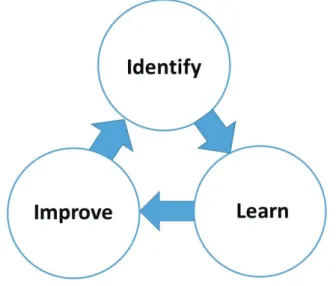
To further assist faculty in implementing the PBELL model, an extensive review of literature was conducted to determine the best way to support faculty and develop a menu of coach-ing options—in other words, possibilities for what the work of a coach looks like. A coaching cycle (see Figure 2) of iden-tify, learn, and improve was built from the work of Knight and colleagues (2015). This cycle is grounded in the critical components needed for effective instructional coaching.
Identify: new learning either through ELL principles or PBL components,
Learn: explicit explanation and modeling of targeted practices, and
Improve: application of the new learning with inten-tional follow-up (observation, in class modeling, or co-teaching).
In fall 2016, the instructional coaching team continued supporting faculty in one-on-one settings and began monthly small group sessions called “Faculty Institutes,” which com-plimented the one-on-one coaching support. This model of support helped to develop and implement PBELL lessons with 10 faculty members in fall 2016. The initial group of 10 faculty members and coaches worked on PBELL lesson
Rillero, P., et al. Developing Teacher Competencies
7 | www.ijpbl.org (ISSN 1541-5015) September 2017 | Volume 11 | Issue 2 development, pilot testing PBELL experiences, filming
les-sons, and examining each PBELL lesson through the lens of the Stanford key principles for ELL instruction.
PBELL Lesson
To reiterate, we began implementing a variety of PBELL expe-riences in fall 2015 in university-level science and mathemat-ics methods courses offered within our teacher preparation program. Eight faculty members and their approximately 250 students participated in this initial endeavor. We also wanted to optimize these lessons for real classrooms. Thus, these les-sons have also been taught in elementary and middle school classrooms with significant populations of ELLs (for exam-ple, see Rillero & Hernandez, 2016) to further refine them for use in methods classrooms. In order to clarify the approach, we present an example of a PBELL lesson.
In the middle school science PBELL lesson Save the Brain
(Baca et al., 2016), the classic problem of protecting a fall-ing egg from breakfall-ing is a vehicle for learnfall-ing about New-ton’s second law of motion and practicing language-based argumentation skills. Table 1 below shows the grade-level standards and the content and language objectives written for this lesson. The science standard helps ensure that the focus is not only on problem-solving but also on develop-ing science content. The language objective makes the lesson purposeful about the role and type of language being used and developed through this lesson. Explicit expression of this objective allows for its evaluation through formative and summative assessment processes. The development of lan-guage is considered as important as the development of the content knowledge and not as incidental.
In Save the Brain, key vocabulary words (mass, force, and acceleration) were reviewed at the start of the lesson. To enhance language learning, we structured in an argu-mentation activity where students were asked to respond to the question: How can the National Football League (NFL) reduce the number of traumatic brain injuries sustained by its
players? Thus, students were tasked with constructing a hel-met prototype that could, hypothetically, prevent a football player from sustaining a traumatic brain injury. In response to this question, students were asked to review evidence that either supported or did not support the claim that helmets can reduce the number of traumatic brain injuries sustained by NFL players. This format for teaching argumentation was found to be a productive tool for intentionally planning an activity for developing academic discourse.
Consistent with literature on PBL (Karchmer-Klein & Layton, 2006; Wolk, 1994), in this lesson we observed increased student participation, self-directed learning, and engagement as measured by the number of students with 80% or more of their time spent on task. As students tested and discussed the effectiveness of their prototypes, the teacher was able to listen for and assess use of key vocabu-lary to explain whether or not the helmet protected the egg or whether the egg shattered.
However, in our initial rounds of implementation, we found that further work would be needed to support ELLs in argumentation discussions. As a result, in subsequent deliveries of this lesson, we implemented a practice oppor-tunity where students could study the language that they would need to participate in this discussion, have the oppor-tunity to ask clarifying questions of their peers, look for Spanish-English cognates, and practice using sentence start-ers related to argumentation with evidence. In this practice opportunity, students were grouped heterogeneously by levels of language proficiency and were invited to use their primary language as they studied the ways to use English to participate in the discussion.
Our emerging findings are that students need regular opportunities to learn how to think across two languages that include teacher modeling of the metalinguistic tools (using cognates; deciding on the correct, multiple meaning words, etc.). We also found that when students are given the tools to prepare for academic discussions, rates of participa-tion increase.
Standards
MS-PS2 Motion and Stability: Forces and Interactions
8-2-PO3 Describe how the acceleration of a body is dependent on its mass and net applied force (New-ton’s 2nd Law of Motion)
Content Objective
Students will be able to identify and manipulate the variables affecting force.
Language Objective
Students will use the language of argumentation to discuss variables affecting force using relevant prob-lems, hands-on materials, structured small groups, and sentence frames.
Curriculum Changes
Initially, our efforts focused on implementing PBELL in mathematics and science methods classrooms. As we pre-sented our efforts to faculty in faculty meetings, professional development sessions, and conferences, faculty with exper-tise in social studies, special education, and classroom man-agement volunteered to participate. This momentum led to expanded thinking about how to structure support of PBELL within our undergraduate programs.
To further prepare the next generation of teachers to inte-grate PBELL into their own classrooms, we piloted a new course in spring 2016. This course is designed for all ele-mentary education teacher candidates to take prior to their subject-matter methods courses and includes PBELL as part of the curriculum. Preservice teachers who participated in this course created PBELL lessons as part of an assignment and were interviewed about their experiences. Most prese-vice teachers in the class stated that they were planning to integrate PBELL in their classes and saw the approach as a promising tool for providing ELLs access to science content. The three most common concerns identified by preservice teachers included, from most to least common, finding class-room time for the lessons required (usually across 2–3 class periods), finding time to write PBELL lessons, and managing the classroom during lesson implementation.
Based on this feedback, we made adjustments to the course. We included a session on curriculum integration and discussions on collaborating with colleagues to create lessons that cut across content areas and are efficient in use of class time. In addition, we added a session on classroom manage-ment. To address time to prepare lessons, preservice teach-ers work in teams of three to collaborate on a PBELL lesson and are encouraged to continue collaborating within content areas and across content classes. We also introduced a num-ber of e-tools to aid the collaborative process outside of the physical setting of the school.
Currently, our teacher education programs have a sequence of courses that help teacher candidates understand and use the PBELL approach. Near the start of their two-year program they take a course to assist them in working with ELLs. This course now also includes having them experience PBELL as a learner and then work with the approach as preservice teach-ers. This semester, there are 180 teacher candidates enrolled in ten sections of this course. The methods courses also have students learn through PBELL and apply the approach. The capstone of the approach will be the full-year student-teaching experience. We are currently working with student- teaching coordinators to make PBELL design and delivery required abilities for successful program completion.
Conclusion
Our increasing number of diverse language, ability, and cul-ture learners in classrooms offers us the opportunity and presents the need to prepare teachers to design and imple-ment PBL in K–8 classrooms. PBELL is an instructional model that combines PBL with ELL methods to intentionally enhance the use and development of language. Understand-ing and implementUnderstand-ing the approach can make K–8 teachers more effective in implementing new standards and work-ing with all students, includwork-ing those whose first language is not English. Aspects of this approach may be considered for use in schools in worldwide contexts with recent language-minority immigrants.
As they understand and implement the approach, teacher education faculty better prepare future teachers. Commu-nication, collaboration, and coaching have been vital for implementing this change in our college. This project has brought together a PET team of leading innovators to estab-lish and promote a culture of change. Project coaches have implemented a model of working with faculty to design and develop their abilities to use and teach the PBELL method. We recommend that other projects be led by the people who are most willing to change and have effective coaching to facilitate the change.
Future research will focus on the use of PBELL in our preservice teachers’ classrooms and the impact on K–12 students’ STEM content knowledge and skill development. Although PBELL focuses on the academic and language needs of ELLs, we believe that all students, regardless of Eng-lish language ability, can benefit from the enhanced language supports provided in PBELL, and further research will docu-ment and analyze students’ language developdocu-ment in the process. Finally, further research will be conducted to exam-ine how the curricular and pedagogical changes that have taken place through PBELL will be sustained in our college.
References
Arizona Department of Education. (2015). ELL demograph-ics 2013–2014: Percent of ELL students by grade level.
Retrieved from http://www.azed.gov/english-language -learners/ell-data/ell-demographics-2014/
Atkin, J. M., & Karplus, R. (1962). Discovery or invention?
The Science Teacher, 29(5), 45–51.
Baca, M., Bostick, B., Hernandez, J., Saltmarsh, S., & Thibault, M. (2016). Save the Brain—8th grade science. Tempe, AZ:
Center for Art and Science of Teaching. Retrieved from https://sites.google.com/a/asu.edu/pbell-experiences /home/pbell1
Rillero, P., et al. Developing Teacher Competencies
9 | www.ijpbl.org (ISSN 1541-5015) September 2017 | Volume 11 | Issue 2 Barrows, H. S. (1996). Problem-based learning in
medi-cine and beyond: A brief overview. In L. Wilkerson & W. H. Gijselaers (Eds.), Bringing problem-based learning to higher education: Theory and practice (pp. 3–12). San Francisco: JosseyBass.
Barrows H. S., & Tamblyn R. M. (1980). Problem-based learn-ing: An approach to medical education. New York: Springer. Birrell, J., Hernandez, J, Bostick, B., & Aparicio, S. (2016).
Justifying ingredients for a lemonade stand—5th grade
math. Tempe, AZ: Center for Art and Science of Teach-ing. Retrieved from https://sites.google.com/a/asu.edu /pbell-experiences/home/pbell2
Bybee, R. W. (2014). The BSCS 5E instructional model: Per-sonal reflections and contemporary implications. Science and Children, 51(8), 10–13.
Cochran-Smith, M., Villegas, A. M., Abrams, L., Chavez-Moreno, L., Mills, T., & Stern, R. (2015). Critiquing teacher preparation research an overview of the field, part II. Journal of Teacher Education, 66(2), 109–121.
de Jong, E. J., & Harper, C. A. (2005). Preparing mainstream teachers for English language learners. Teacher Education Quarterly, 32(2), 101–124.
Delisle, R. (1997). How to use problem-based learning in the classroom. Alexandria, VA: Association for Supervision and Curriculum Development.
Dewey, J. (1910). How we think. Boston: D. C. Heath. Dewey, J. (1938). Experience and education. London: Collier
Macmillan.
DuFour, R., Eaker, R., & DuFour, R. (2005). On common ground: The power of profession learning communities.
Bloomington, IN: National Education Service.
Edwards, S., & Hammer, M. (2007). Problem-based learning in early childhood and primary pre-service teacher edu-cation: Identifying the issues and examining the benefits.
Australian Journal of Teacher Education, 32(2), 21–36. Retrieved from https://doi.org/10.14221/ajte.2007v32n2.3 Gándara, P. (February 2010). Meeting students where they
are. Educational Leadership, 67(5), 24–30.
Gándara, P., & Hopkins, M. (2010). Forbidden languages: English learners and restrictive language policies. New York: Teachers College Press.
Goldenberg, C. (2008). Teaching English language learners: What the research does—and does not—say. American Educator, Summer 2008, 8–44.
Gould, K., & Sadera, W. (2015). Evaluation of health pro-fession student attitudes toward an online nutrition edu-cation problem-based learning module. International Journal on E-Learning, 14(2), 181–198.
Halliday, M. A. K. (1993). Towards a language-based theory of learning. Linguistics and Education, 5(2), 93–116.
Handelsman, J., Ebert-May, D., Beichner, R., Bruns, P., Chang, A., DeHaan, R., . . . Wood, W. B. (2004). Scientific teaching. Science, 304(5670), 521–552.
Jimenez-Silva, M., Gomez, L., & Cisneros, J. (2014). Examin-ing Arizona’s policy response post Flores v. Arizona in edu-cating K–12 English language learners. Journal of Latinos and Education, 13(3), 181–195. https://doi.org/10.1080 /15348431.2013.849600
Jimenez-Silva, M., Merritt, J., Rillero, P., & Kelley, M. (2016). Working together to prepare teachers of science and lan-guage: Examining the value of collaboration among sci-ence and language faculty. Electronic Journal of Science Education, 20(3). Retrieved from http://ejse.southwestern .edu/article/view/15866
Johnson, S. M. (2006). The workplace matters: Teacher qual-ity, retention, and effectiveness. Washington, DC: National Education Association.
Kena, G., Musu-Gillette, L., Robinson, J., Wang, X., Rathbun, A., Zhang, J., Wilkinson-Flicker, S., Barmer, A., & Velez, E. D. (2015). The condition of education 2015. Washington, DC: National Center for Education Statistics. Retrieved from http://nces.ed.gov/pubs2015/2015144.pdf
Kennedy, M. (2016). Parsing the practice of teaching. Journal of teacher Education, 67(1), 6–17.
Kinsella, K. (2010). Academic language function toolkit. Chula Vista, CA: Sweetwater Union High School District. Knight, J., Elford, M. D., Hock, M. F., Dunekack, D.,
Brad-ley, B., Deshler, D. D., & Knight, D. S. (2015). Three steps to great coaching: A simple but powerful instructional coaching cycle nets results. Journal of Staff Development, 36(1), 10–18.
Karchmer‐Klein, R., & Layton, V. (2006). Literature‐based collaborative internet projects in elementary classrooms,
Reading Research and Instruction, 45(4), 261–294.
Labaree, D. F. (2004). The trouble with ed schools. New Haven, CT: Yale University Press.
Lillie, K. E., Markos, A., Estrella, A., Nguyen, T., Trifiro, A., Arias, B., & Wiley, T.G. (2010). Policy in practice: The implementation of structured English immersion in Ari-zona. Los Angeles, CA: The Civil Rights Project at UCLA. Livingston, K. (2014). Teacher educators: Hidden profes-sionals? European Journal of Education, 49(2), 218–232. https://doi.org/10.1111/ejed.12074
Lucas, T., & Grinberg, J. (2008). Responding to the linguistic reality of mainstream classrooms: Preparing all teachers to teach English language learners. In M. Cochran-Smith, S. Feiman-Nemser, & J. McIntyre (Eds.), Handbook of research on teacher education: Enduring issues in changing contexts (3rd ed., pp. 606–636). Mahwah, NJ: Lawrence Erlbaum.
Luk, G., De Sa, E., & Bialystok, E. (2011). Is there a relation between onset age of bilingualism and enhancement of cognitive control? Bilingualism: Language and Cognition,
14(4), 588–595.
Marle, P. D., Decker, L. L., Taylor, V., Fitzpatrick, K., Khaliqi, D., Owens, J. E., & Henry, R. M. (2012). CSI-chocolate sci-ence investigation and the case of the recipe rip-off: Using forensic science to engage students. Journal of Chemical Education, 91(3), 345–350.
Maxwell-Jolly, J., & Gándara, P. (2006). Critical issues in preparing teachers of English learners. In Crucial issues in California education 2006: Rekindling reform. Berkeley, CA: Policy Analysis for California Education.
Menken, K., & Look, K. (2000). Meeting the needs of linguis-tically and culturally diverse students: Schools in the mid-dle. Washington, DC: National Association of Secondary School Principals.
Merritt, J., Lee, M. Y., Rillero, P., & Kinach, B. (2016). Prob-lem-based learning in K–8 mathematics and science edu-cation: A literature review. Paper presented at the annual meeting of the Problem-Based Learning Conference, Zurich, Switzerland.
Nariman, N., & Chrispeels, J. (2016). PBL in the era of reform standards: Challenges and benefits perceived by teachers in one elementary school. Interdisciplinary Journal of Problem-Based Learning, 10(1). https://doi.org /10.7771/1541-5015.1521
NGSS Lead States. (2013). Next Generation Science Stan-dards: For states, by states. Washington, DC: National Academies Press.
Orfield, G. (2014). Brown at 60: Great progress, a long retreat, and an uncertain future. Los Angeles, CA: The Civil Rights Project at UCLA.
Pew Research Center. (2015). Modern immigration wave brings 59 million to U.S., driving population growth and change through 2065: Views of immigration’s impact on U.S. society mixed. Washington, DC: Pew Research Center. Retrieved from http://www.pewhispanic.org/2015/09/28 /chapter-5-u-s-foreign-born-population-trends/
Pong, S. L., Hao, L., & Gardner, E. (2005). The roles of par-enting styles and social capital in the school performance of immigrant Asian and Hispanic adolescents. Social Sci-ence Quarterly, 86(4), 928–950.
Quinn, K., & Albano, L. (2008). Problem-based learning in structural engineering education. Journal of Professional Issues in Engineering Education and Practice, 134(4), 329–334.
Rideout, E., & Carpio, D. (2001). The problem based learning model of nursing education. In E. Rideout (Ed.), Trans-forming nursing education through problem based learning
(pp. 21–47). Mississauga, Ontario: Jones and Bartlett.
Rillero, P., & Hernandez, J. (April/May 2016). Problem-based enhanced-language learning with pendulums. Science Scope, 39(8), 10–15.
Shin, H. B., & Kominski, R. A. (2010). Language use in the United States: 2007. Retrieved from http://www.census.gov /prod/2010pubs/acs-12.pdf
Stanford Graduate School of Education. (2013). Six key princi-ples for ELL instruction:Understanding language. Retrieved from http://ell.stanford.edu/content/six-key-principles-ell -instruction
Suárez-Orozco, C., & Suárez-Orozco, M. (2015). Children of immigration. Phi Delta Kappan, 97(4), 8–14.
Torp, L., & Sage, S. (2002). Problems as possibilities: Problem-based learning for K–16 education. Alexandria, VA: Asso-ciation for Supervision and Curriculum Development. U.S. Department of Education, National Center for Education
Statistics. (2016). The condition of education 2016 (NCES 2016-144), Washington, DC: U.S. Department of Education. Wolk, S. (1994). Project-based learning: Pursuits with a
pur-pose. Educational Leadership, 52(3), 42–45.
Wright, W. (2015). Foundations for teaching English language learners: Research, theory, policy, and practice (2nd ed.).
Philadelphia: Caslon Publishing.
Zubaidah, S. (2005). Problem-based learning: Literature review. Singapore Nursing Journal, 32(4), 50–55.
Peter Rillero, associate professor of science education at Ari-zona State University, began his career in Kenya (1982) teach-ing science with the U.S. Peace Corps. Rillero’s scholarship interests include deep-conceptual learning, problem-based learning, inquiry, teacher education, program evaluation, modeling, and the history of science education.
Mari Koerner is the Alice Wiley Snell professor of education and director of the Center for the Art and Science of Teaching (CAST) in the Mary Lou Fulton Teachers College at Arizona State University. CAST is focused on innovative research and implementation of funded projects and services for improv-ing teachimprov-ing in formal and informal settimprov-ings. Its goals are to increase the rigor of the practice of teaching wherever it may occur and to think of teaching in new and exciting ways. Margarita Jimenez Silva is a former classroom teacher with preschool through ninth grade teaching experience in vari-ous states. Over the past twenty years, she has been working with preservice and inservice teachers to meet the academic and language needs of English learners and students with special needs. She is currently an associate professor in the Mary Lou Fulton Teachers College at Arizona State Univer-sity and has published over 50 articles in her field.
Rillero, P., et al. Developing Teacher Competencies
11 | www.ijpbl.org (ISSN 1541-5015) September 2017 | Volume 11 | Issue 2 Joi Merritt is an assistant professor in the Mary Lou Fulton
Teachers College at Arizona State University. Her research currently focuses on designing science curriculum materials and assessments to investigate K–12 student learning over time as well as research on and development of approaches for preparing preservice teachers to provide equitable sci-ence instruction.
Wendy J. Farr is the director of iTeach ELLs and a clinical associate professor at Arizona State University. Dr. Farr has her PhD in curriculum and instruction, and she spent 17 years working with students with special needs (from early childhood to high school). Dr. Farr’s scholarship interests include English language learners, problem-based learning, teacher preparation, and special education.