Granular Computing Approach for
Intelligent Classifier Design
By
M
OHAMMEDA
L-S
HAMMAAA Thesis Submitted in Partial Fulfilment of the
Requirements for the Degree of
D
OCTOR OFP
HILOSOPHYDepartment of Electronic and Computer Engineering
College of Engineering, Design and Physical Sciences
B
RUNELU
NIVERSITYL
ONDONA
BSTRACT
Granular computing facilitates dealing with information by providing a theoretical framework to deal with information as granules at different levels of granularity (different levels of specificity/abstraction). It aims to provide an abstract explainable description of the data by forming granules that represent the features or the underlying structure of corresponding subsets of the data.
In this thesis, a granular computing approach to the design of intelligent clas-sification systems is proposed. The proposed approach is employed for different classification systems to investigate its efficiency. Fuzzy inference systems, neural networks, neuro-fuzzy systems and classifier ensembles are considered to evaluate the efficiency of the proposed approach. Each of the considered systems is designed using the proposed approach and classification performance is evaluated and com-pared to that of the standard system.
The proposed approach is based on constructing information granules from data at multiple levels of granularity. The granulation process is performed using a modified fuzzy c-means algorithm that takes classification problem into account. Clustering is followed by a coarsening process that involves merging small clusters into large ones to form a lower granularity level. The resulted granules are used to build each of the considered binary classifiers in different settings and approaches.
Granules produced by the proposed granulation method are used to build a fuzzy classifier for each granulation level or set of levels. The performance of the classifiers is evaluated using real life data sets and measured by two classification performance measures: accuracy and area under receiver operating characteristic
curve. Experimental results show that fuzzy systems constructed using the proposed method achieved better classification performance.
In addition, the proposed approach is used for the design of neural network clas-sifiers. Resulted granules from one or more granulation levels are used to train the classifiers at different levels of specificity/abstraction. Using this approach, the classi-fication problem is broken down into the modelling of classiclassi-fication rules represented by the information granules resulting in more interpretable system. Experimental results show that neural network classifiers trained using the proposed approach have better classification performance for most of the data sets. In a similar manner, the proposed approach is used for the training of neuro-fuzzy systems resulting in similar improvement in classification performance.
Lastly, neural networks built using the proposed approach are used to construct a classifier ensemble. Information granules are used to generate and train the base classifiers. The final ensemble output is produced by a weighted sum combiner. Based on the experimental results, the proposed approach has improved the classification performance of the base classifiers for most of the data sets. Furthermore, a genetic algorithm is used to determine the combiner weights automatically.
To my wife and daughter,
A
CKNOWLEDGEMENTS
Firstly, I would like to express my sincere gratitude to my supervisor Dr Maysam F. Abbod for the continuous support of my Ph.D study and related research, for his patience and motivation. His guidance helped me in all the time of research and writing of this thesis.
I would also like to thank my sponsors, the Higher Committee for Education Development in Iraq (HCED), for their continuous help and support.
D
ECLARATION
I declare that this thesis is my own work and is submitted for the first time to the Post-Graduate Research Office. The study was originated, composed and reviewed by myself and my supervisors in the Department of Electronic and Computer Engineer-ing, College of EngineerEngineer-ing, Design and Physical Sciences, Brunel University London UK. All the information derived from other works has been properly referenced and acknowledged.
T
ABLE OF
C
ONTENTS
Page Abstract iii Dedication iv Acknowledgements v Declaration vi List of Tables ix List of Figures xList of Abbreviations xii
1 Introduction 1
1.1 Background . . . 1
1.2 Research Motivation . . . 3
1.3 Aim and Objectives . . . 4
1.4 Thesis Organisation . . . 5
1.5 Publications . . . 6
2 Granular Computing 7 2.1 Introduction . . . 7
2.2 Granular Computing Frameworks . . . 10
2.2.1 Interval Analysis . . . 10
2.2.2 Fuzzy Sets . . . 11
2.2.3 Rough Sets . . . 13
2.2.4 Cluster Analysis . . . 16
2.3 Granular Computing and Computational Intelligence . . . 18
2.3.1 Fuzzy Systems . . . 18
TABLE OFCONTENTS
2.4 Granular Computing Applications . . . 22
2.4.1 Data Clustering . . . 22
2.4.2 Classification . . . 24
2.5 Conclusions . . . 26
3 Clustering-Based Granulation for Data Classification 28 3.1 Introduction . . . 28
3.2 Fuzzy C-means Clustering Method . . . 30
3.2.1 Soft Clustering . . . 30
3.2.2 Fuzzy C-means Algorithm . . . 31
3.3 Granulation using FCM . . . 33
3.3.1 The proposed FCM clustering algorithm . . . 34
3.3.2 Cluster Merging Algorithm . . . 36
3.3.3 Complete proposed algorithm . . . 37
3.4 Implementation . . . 39
3.4.1 Data Sets . . . 39
3.4.2 Classification Measures . . . 43
3.4.3 Granulation Results . . . 45
3.5 Fuzzy Classifier Design . . . 46
3.5.1 Fuzzy Inference System . . . 46
3.5.2 Fuzzy System Identification . . . 50
3.5.3 Classification Results . . . 50
3.5.4 Automatic Selection of Granulation Level . . . 51
3.5.5 Multi-Level FCMGr . . . 56
3.5.6 Discussion . . . 59
3.6 Conclusions . . . 60
4 Granular Computing Approach for Neural Network Classifier De-sign 62 4.1 Introduction . . . 62
4.1.1 Neural Network Learning . . . 64
4.1.2 Generalisation and Overfitting . . . 68
4.1.3 Number of Layers and Neurons . . . 68
4.2 Proposed Granular Computing Approach . . . 70
4.2.1 Interpretability of GrCNNC . . . 72 4.2.2 Application of GrCNNC in ANFIS . . . 74 4.3 Experimental Results . . . 75 4.3.1 Single Level GrCNNC . . . 75 4.3.2 Multi-level GrCNNC . . . 77 4.3.3 ANFIS with GrCNNC . . . 83 4.3.4 Results Summary . . . 84
TABLE OFCONTENTS
4.4 Experimental Comparison . . . 85
4.5 Conclusions . . . 90
5 Granular Computing Approach for Classifier Ensemble 91 5.1 Introduction . . . 91
5.2 Proposed Granular Computing Approach . . . 94
5.3 Experimental Results . . . 95
5.3.1 Ensemble with Multi-level GrCNNC . . . 101
5.4 Genetic Algorithm for Weights Assignment . . . 105
5.5 Conclusions . . . 109
6 Conclusions and Future Work 110 6.1 Conclusions . . . 110
6.2 Future Work . . . 112
L
IST OF
T
ABLES
TABLE Page
3.1 Properties of the selected data sets . . . 41
3.2 Confusion Matrix . . . 43
3.3 Granulation results for the selected data sets (P1 partitioning) . . . 47
3.4 Granulation results for the selected data sets (P2 partitioning) . . . 48
3.5 Accuracy (%) and AUC (%) for bladder cancer data set . . . 52
3.6 Accuracy (%) and AUC (%) for Statlog heart disease data set . . . 52
3.7 Accuracy (%) and AUC (%) for Wisconsin breast cancer data set . . . 53
3.8 Accuracy (%) and AUC (%) for BUPA liver disorders data set . . . 53
3.9 Maximum values of accuracy (%) and AUC (%) for all the data sets . . . 54
3.10 Accuracy (%) and AUC (%) of automatic selection of granulation level . . 56
3.11 Accuracy (%) and AUC (%) for multi-level FCMGr, single-level FCMGr and FCM with different values ofm . . . 59
4.1 Test Accuracy (%), STD and AUC (%) of NN and GrCNNC . . . 76
4.2 Training Accuracy (%), STD and AUC (%) of NN and GrCNNC . . . 76
4.3 Test Accuracy (%), STD and AUC (%) of NN and multi-level GrCNNC . . 78
4.4 Training Accuracy (%), STD and AUC (%) of NN and multi-level GrCNNC 78 4.5 Test Accuracy (%) and AUC (%) of ANFIS and multi-level GrCNNC ANFIS 84 4.6 Training Accuracy (%) and AUC (%) of ANFIS and multi-level GrCNNC ANFIS . . . 84
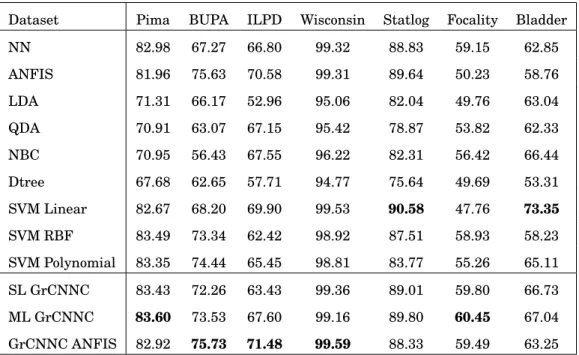
4.7 Test accuracy of the compared classifiers . . . 87
4.8 Test AUC of the compared classifiers . . . 87
5.1 Classification disagreement (%) of the five base classifiers for Pima data set 96 5.2 Test Accuracy (%) and AUC (%) of SL GrCNNC and SL ensemble . . . . 97
5.3 Training Accuracy (%) and AUC (%) of SL GrCNNC and SL ensemble . . 97
5.4 Test Accuracy (%) and AUC (%) of ML GrCNNC and ML ensemble . . . . 102
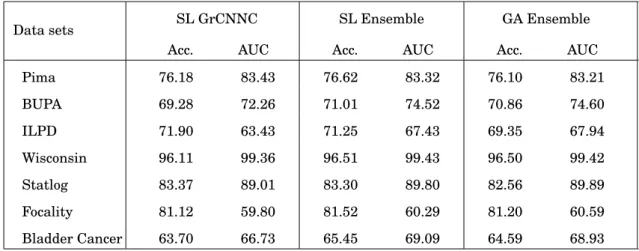
5.5 Training Accuracy (%) and AUC (%) of ML GrCNNC and ML ensemble . 102 5.6 Accuracy (%) and AUC (%) of SL GrCNNC, SL ensemble and ensemble tuned by GA . . . 106
L
IST OF
F
IGURES
FIGURE Page
2.1 Granules and granulation levels . . . 9
2.2 Granule representation by fuzzy sets . . . 13
2.3 Rough set approximation . . . 15
2.4 Rough membership function . . . 16
2.5 Fuzzy neural network example . . . 21
3.1 Illustrative example of fuzzy clustering. . . 32
3.2 Illustrative example of labelled data fuzzy clustering. . . 35
3.3 Flowchart of the FCMGr algorithm. . . 40
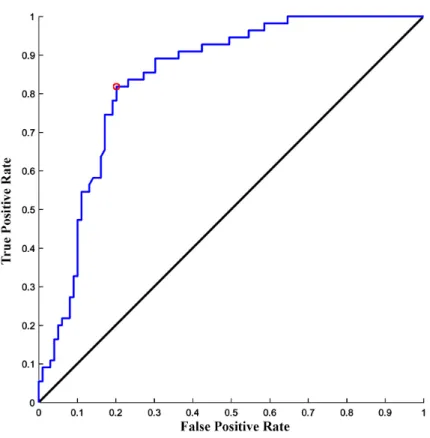
3.4 Receiver operating characteristic curve . . . 45
3.5 Block Diagram of a Fuzzy Inference System . . . 49
3.6 Accuracy of automatic selection of best granulation levels for Pima cancer data set partitioning (P1) . . . 57
3.7 Accuracy of automatic selection of best granulation levels for Pima cancer data set (P2) . . . 57
3.8 Mean accuracy of automatic selection of best granulation levels for Pima cancer data set (P1-P5) . . . 58
4.1 Multilayer feedforward neural network . . . 64
4.2 Training set and validation set error as a function of epoch . . . 69
4.3 Block diagram of the GrCNNC for training phase . . . 73
4.4 Block diagram of the GrCNNC for validation . . . 73
4.5 Block diagram of the GrCNNC for test phase . . . 73
4.6 Accuracy improvement of single level GrCNNC vs. accuracy improvement of multi-level GrCNNC vs. standard deviation of NN accuracy . . . 79
4.7 AUC improvement of single level GrCNNC vs. AUC improvement of multi-level GrCNNC . . . 79
4.8 ROC curve of NN, single level GrCNNC and multi-level GrCNNC for Pima data set . . . 80
LIST OFFIGURES
4.9 ROC curve of NN, single level GrCNNC and multi-level GrCNNC for
BUPA data set . . . 80
4.10 ROC curve of NN, single level GrCNNC and multi-level GrCNNC for ILPD data set . . . 81
4.11 ROC curve of NN, single level GrCNNC and multi-level GrCNNC for Wisconsin data set . . . 81
4.12 ROC curve of NN, single level GrCNNC and multi-level GrCNNC for Statlog data set . . . 82
4.13 ROC curve of NN, single level GrCNNC and multi-level GrCNNC for focality data set . . . 82
4.14 ROC curve of NN, single level GrCNNC and multi-level GrCNNC for bladder cancer data set . . . 83
4.15 Relative improvement of accuracy and rank of classifiers in terms of accuracy for each data set . . . 88
4.16 Relative improvement of AUC and rank of classifiers in terms of AUC for each data set . . . 89
5.1 ROC curve of SL GrCNNC and SL Ensemble for Pima data set . . . 98
5.2 ROC curve of SL GrCNNC and SL Ensemble for BUPA data set . . . 98
5.3 ROC curve of SL GrCNNC and SL Ensemble for ILPD data set . . . 99
5.4 ROC curve of SL GrCNNC and SL Ensemble for Wisconsin data set . . . 99
5.5 ROC curve of SL GrCNNC and SL Ensemble for Statlog data set . . . 100
5.6 ROC curve of SL GrCNNC and SL Ensemble for Focality data set . . . . 100
5.7 ROC curve of SL GrCNNC and SL Ensemble for bladder cancer data set 101 5.8 Improvement in test accuracy of multi-level GrCNNC NN, SL ensemble and ML ensemble . . . 103
5.9 Improvement in test AUC of multi-level GrCNNC NN, SL ensemble and ML ensemble . . . 103
5.10 Improvement in training accuracy of multi-level GrCNNC NN, SL ensem-ble and ML ensemensem-ble . . . 104
5.11 Improvement in training AUC of multi-level GrCNNC NN, SL ensemble and ML ensemble . . . 104
5.12 Best score value and mean score of GA for Bupa data set . . . 107
5.13 Best score value and mean score of GA for Statlog data set . . . 107
5.14 Improvement in accuracy of SL ensemble and GA ensemble . . . 108
L
IST OF
A
BBREVIATIONS
ANFIS Adaptive-Network-based Fuzzy Inference Systems.
AUC Area Under Curve.
CI Computational Intelligence.
DBSCAN Density-Based Spatial Clustering of Applications with Noise.
FCM Fuzzy C-Mean.
FCMGr FCM-based Granulation.
FN False Negative.
FP False Positive.
GrC Granular Computing.
GrCNNC GrC approach for NN Classifier design.
LDA Linear Discriminant Analysis.
NBC Naive Bayes Classifier.
QDA Quadratic Discriminant Analysis.
RBF Radial Basis Function.
ROC Receiver Operating Characteristic.
STD Standard Deviation.
TN True Negative.
C
H A P T E R1
I
NTRODUCTION
R
ESEARCHbackground, motivation, aim and objectives are presented in thischapter. Research background is presented in Section 1.1 while Section 1.2 contains the motivation of this thesis. The aim and objectives of this thesis are stated in Section 1.3 and its organisation is described in Section 1.4. Publications are listed in Section 1.5
1.1
Background
Classification is a supervised learning method that aims to group or cluster objects into predefined groups (classes) based on certain criteria. It has a wide range of applications as in financial forecast [1, 2, 3], medical diagnosis [4, 5, 6], fault diagnosis [7, 8], image classification [9, 10] and text classification [11, 12]. In most applications, neither the classification process can be described algorithmically nor the relationship between input and output can be derived analytically. Therefore, in the paradigm of machine learning, classification is usually achieved by learning the relationship that exists between a set of input (feature) variables and an output variable (target class label). The problem of classification can be stated as follows [13]:
CHAPTER1. INTRODUCTION 1.1. BACKGROUND
“Given a set of training data points along with associated training labels, deter-mine the class label for an unlabeled test instance.”
Thus, classification algorithms are generally comprised of two phases [13, 14]:
• Training Phase: In this phase, the construction of a classification model from the training data set is performed. The data set consists of sample input data with a preassigned class labels. A machine learning method is used to extract knowledge from the labelled training data. One important desirable characteristic of classification systems is their ability to interpret the data structures underlying the classification model (e.g. the decision rules) [15].
• Testing Phase: In this phase, the constructed model is used to classify new testing data relying on knowledge extracted in the training stage.
The main objective of designing a classifier is to achieve the highest classification accuracy (the lowest error rate) in the testing phase. In other words, achieving highest possible level of generalisation, i.e. the classifier’s ability to generalise the classification process learnt from the training phase to classify new data in the testing phase [16].
The task of classification is addressed by numerous methods such decision trees, rule-based methods, neural networks, Support Vector Machine (SVM) methods, and nearest neighbour methods. There are two types of outputs a classification algorithm may result in [13]:
• Discrete Label: A class label is assigned to the input instance.
• Numerical Score: Numerical scores are computed to indicate the degree to which the input instance belong to each class. A discrete label for an input instance can be produced from its numerical scores by choosing the class with the highest score.
In terms of the number of classes, there are two types of classification: binary classification (grouping data into only two classes), and multi-class classification (classifying the data into more than two classes). In this thesis, only binary classi-fication is considered since any multi-class classiclassi-fication task can be divided into
CHAPTER1. INTRODUCTION 1.2. RESEARCHMOTIVATION
multiple binary classification tasks. This can be achieved by classifying data into one class against all other classes [17].
1.2
Research Motivation
Granular Computing (GrC) is a general computation theory that imitates human thinking and reasoning by dealing with information as a form of aggregates called information granules. An information granule is a collection or group of elements (usually data points) that are linked together due to the fact that they share some degree of similarity, functionality or indistinguishablity [18]. The process of forming information granules, information granulation, underlays most of the activities that involve information processing, from human thinking and problem solving to artificial intelligence and digital signal processing [18, 19]. Information granula-tion facilitates dealing with informagranula-tion by providing a theoretical framework to deal with information at different levels of granularity, that is different levels of specificity/abstraction [18].
A lot of research on GrC in data classification has been carried out in various settings and diverse applications. Due to its broad range of coverage in many differ-ent frameworks and its wide spectrum of application fields, GrC research comes in numerous approaches, objectives and points of view.
Addressing the problem of data classification, different GrC studies have been conducted in different frameworks such as: cluster analysis, set theory [20], fuzzy theory [20, 21], graph theory [15, 22, 23] and rough set [20, 21, 24, 25]. Concepts of GrC have been realised in various methodologies including data clustering, image segmentation [23], fuzzy lattice [26, 27], rough logic [20, 21, 24, 25], information tables [28] and graphs [15, 22, 23].
One of the common technique in the GrC research in data classification is forming larger information granules from smaller ones. This is achieved by different methods and under different names such as: dilation [26, 27], coarsening or merging [29]. These methods are usually based on finding some relation between granules depend-ing on the framework and approach. Examples of relations between granules are: spatial relations [23], distance measures [29], rough inclusion and fuzzy inclusion.
CHAPTER1. INTRODUCTION 1.3. AIM ANDOBJECTIVES
On the other hand, dividing large granules into smaller ones is adopted by some studies [30].
GrC-based methods have been employed in achieving common tasks of data classification. Two of the vital tasks are the extraction of classification rules from data [15, 20, 25, 28, 30, 31] and the identification of classification systems [24].
Studies of GrC in data classification are aimed at various applications such as, medical data classification [25], text classification [30, 32, 33], image classification [15, 21, 23] and spam detection [21].
1.3
Aim and Objectives
The main aim of this thesis is to develop a GrC approach to the design of intelligent classification systems and investigate its efficiency. Different classification systems are considered to investigate the efficiency of the proposed approach. In particular, the following classification systems are considered: Fuzzy inference system (FIS), Neural Network (NN), neuro-fuzzy system and classifier ensemble.
Based on the review of concepts, methods and applications of GrC, and to achieve the aforementioned aim, the following objectives have been identified:
1. Develop a clustering algorithm to construct granules that represent the data for building classification systems.
2. Evaluate the effectiveness of the developed clustering algorithm in forming information granules at various levels of granularity for classification problem.
3. Investigate how the resulted granules can be used in building classifiers of different types.
4. Evaluate the performance of different classifiers built using the proposed method.
CHAPTER1. INTRODUCTION 1.4. THESISORGANISATION
1.4
Thesis Organisation
This thesis consists of six chapters and is organised as follows:
• Chapter 2 introduces the fundamentals, principles, methods and applications of GrC. A summary of the common frameworks of GrC is provided in Sec-tion 2.2. SecSec-tion 2.3 reviews the synergy between GrC and ComputaSec-tional Intelligence (CI) with emphasis being laid on NNs, fuzzy systems and evolu-tionary algorithms. Applications of GrC in data clustering and classification are reviewed in Section 2.4.
• In chapter 3, a method of clustering-based information granulation for the problem of data classification is presented. The proposed method is used for the identification of fuzzy classifiers. The proposed method is described in Section 3.3. The implementation of the proposed method and experimental setup and results are provided in Section 3.4. Section 3.5 is dedicated to the application of the proposed method in fuzzy system identification and the comparison of its performance to standard Fuzzy C-Mean (FCM) based fuzzy systems.
• A GrC approach for the design of NN classifiers is proposed in Chapter 4. The approach is applied to NNs and Adaptive-Network-based Fuzzy Inference Systems (ANFIS). The proposed approach is described in Section 4.2 and the results of its application on NNs are presented in Section 4.3. In Section 4.4, an experimental comparison of classifiers constructed using the proposed approach and other well-known classifiers is provided.
• In Chapter 5, a GrC approach to classifier ensemble is proposed. The proposed method is described in Section 5.2. Experimental results of the evaluation of the proposed approach are reported in Section 5.3. Section 5.4 investigates the use of a genetic algorithm for the weights assignment of the ensemble.
CHAPTER1. INTRODUCTION 1.5. PUBLICATIONS
1.5
Publications
• M. Al-Shammaa and M.-F. Abbod, "Automatic generation of fuzzy classification rules from data," in Proceedings of the International Conference on Neural Networks-Fuzzy Systems (NN-FS ’14), pp. 74-80, Venice, Italy, 2014
• M. Al-Shammaa and M. F. Abbod, "Automatic generation of fuzzy classifica-tion rules using granulaclassifica-tion-based adaptive clustering," Systems Conference (SysCon), 2015 9th Annual IEEE International, Vancouver, BC, 2015, pp. 653-659.
(Best Student Paper Award - 2ndplace)
• M. Al-Shammaa and M. F. Abbod, "Granular computing approach for the design of medical data classification systems," Computational Intelligence in Bioinformatics and Computational Biology (CIBCB), 2015 IEEE Conference on, Niagara Falls, ON, 2015, pp. 1-7.
C
H A P T E R2
G
RANULAR
C
OMPUTING
T
HISchapter introduces the fundamentals, principles, methods andapplica-tions of Granular Computing (GrC). Section 2.1 provides a brief introduction to the fundamentals and principles of GrC. Section 2.2 summarises the common frameworks of GrC. Section 2.3 reviews the synergy between GrC and Com-putational Intelligence (CI) with emphasis being laid on Neural Networks (NNs), fuzzy systems and evolutionary algorithms. Applications of GrC in data clustering and classification are reviewed in Section 2.4. Conclusions of this chapter are given in Section 2.5.
2.1
Introduction
While the concept of GrC was first introduced by Zadeh in 1979 [34], the term GrC was first used in 1997 [35] and since then it drew the interest of many researchers and witnessed a rapid development and research growth. Although the term was recently brought to live, the concepts of GrC are believed to be applied throughout human history, as it is a natural methodology for humans to deal with daily life issues. The ideas and principles underlying GrC have been covered in many different
CHAPTER2. GRANULARCOMPUTING 2.1. INTRODUCTION
fields under different names, such as divide and conquer, structured programming, interval analysis, cluster analysis, etc. [36].
GrC is a general computation theory that imitates human thinking and reasoning by dealing with information as a form of aggregates calledinformation granules. A granule is defined in Merriam Webster’s Dictionary as: "a small particle; especially: one of numerous particles forming a larger unit" [37]. An information granule is a collection or group of elements (usually data points) that are linked together due to the fact that they share some degree of similarity, functionality or indistinguishablity [18]. The process of forming information granules (namely,information granulation) underlays, in a way or another, most of the activities that involve information processing, from human thinking and problem solving to artificial intelligence and digital signal processing [18, 19]. For example, in image processing, an image can be processed as a group of some features (lines, regions, etc.) which in turn can be dealt with as sets of individual pixels. GrC aims to provide an abstract explainable description of the data by forming granules that represent, with respect to a certain viewpoint, the features or the underlying structure of corresponding subsets of the data.
In order to solve a problem, it may be desirable in some cases to split it into smaller more achievable modules, or, in other cases, one may need to make generali-sations (abstraction) of the problem, away from the burden of its details, in order to get a better comprehension. Either way, information granulation facilitates dealing with information by providing a theoretical framework to deal with information at differentlevels of granularity, that is different levels of specificity/abstraction [18]. Granularity is represented by the size, number and distribution of information granules. The larger is a granule, the lower is its granularity and the higher is its abstraction (generality) [38].
The process of forming granules is based on therelationshipsthat exist among them, namely:interrelationshipsandintrarelationships. Interrelationships reflect the extent to which the elements within a granule are related, while intrarelation-ships describe the relation among different granules (in the same level). Granules are formed either by combining granules of higher granularity (usually smaller
CHAPTER2. GRANULARCOMPUTING 2.1. INTRODUCTION
FIGURE 2.1. Granules and granulation levels [39].
in size) into granules of lower granularity (usually larger in size), or by dividing granules of lower granularity into granules of higher granularity. The former way of constructing granules can be represented by the intrarelationship ofcoarsening, i.e. producing coarser granules (granules with lower granularity), while the latter can be represented by the interrelationship ofrefinement, i.e. producing finer granules (granules with higher granularity) [19]. Figure 2.1 illustrates the relationships among granules and process of granulation.
GrC attempts to establish a unifying theory that integrates multiple theories, methodologies, techniques, and tools that adopt a granulation approach for solving complex problems [40]. Due to the application-dependent nature of the formulation and interpretation of information granules, different terminology may be used for description at different levels. GrC is a multidisciplinary study and can be viewed from different perspectives. For example, Y.Y. Yao [41] presented the "granular computing triangle" in which GrC can be studied from three different perspectives: philosophical perspective, methodological perspective and computational perspective. From the first perspective, GrC depicts a paradigm for the structuring and extraction of human thinking, while from the second perspective GrC deals with methods and techniques for structured problem solving. In the computational perspective, GrC
CHAPTER2. GRANULARCOMPUTING 2.2. GRC FRAMEWORKS
represents an approach for information processing in the abstract level, in the brain, and in machines. The common factor of the three perspectives is the main feature of GrC: representing information at multiple levels of granularity.
While numeric computing isdata-oriented, GrC isknowledge-oriented, thus, it imposes many challenges and open questions. Some of the questions that still need to be answered are: How to precisely define "Granular Computing"? How to formalise the framework of GrC and the process of constructing granules? How to measure the level of granularity and how to define the "size" of a granule? [18, 40]
2.2
Granular Computing Frameworks
The process of information granulation has been one of the key components of several models and frameworks that are already developed in various domains such as: sys-tem modelling, image processing, pattern recognition, and data compression. Some of these frameworks are: interval computation, rough sets, fuzzy sets and cluster analysis. This section highlights some of the attempts to information granulation within each framework.
Methods of each framework have different approaches and perspectives on infor-mation granulation. In fuzzy sets, for example, inforinfor-mation granulation is performed by the means of fuzzification using fuzzy membership function. While, in another example, hierarchical clustering performs information granulation by clustering data based on their proximity or distance either by merging smaller clusters or by dividing larger ones. Although these examples are very different in their ap-proaches, nature and perspectives, they are both considered methods of information granulation from the perspective of the unifying theory of GrC.
2.2.1 Interval Analysis
Interval analysis is an active field of research and application that addresses the problem of ambiguity that results from the uncertainty of numerical computation. In interval analysis, a variable is dealt with as an interval number, represented by an ordered pair of real numbers (endpoints), instead of a single value [42]. All elements of an interval can be represented by a single label that stands for the interval, hence
CHAPTER2. GRANULARCOMPUTING 2.2. GRC FRAMEWORKS
they become completely indistinguishable [43]. This way of dealing with a set of values (interval) as an entity that embraces them all indistinguishably is one way of performing information granulation from the viewpoint of GrC.
Several studies have adopted the approach of interval analysis to information granulation. For example, a formal framework for information granulation is in-troduced in [44]. The proposed framework, which is named distributed intervals, is based on interval analysis theory and the criteria of coherency and proximity. The framework was derived by combining the concepts and characteristics of dis-tributed entities and intervals. Benefiting from the two paradigms of disdis-tributed entities and intervals, the distributed interval frameworks results in a rich model for granulation.
A type of granular classifiers, named hyperbox-driven classifiers, is developed in [45]. The classifier relies on the interaction of interval analysis and fuzzy sets. The development of classifiers was achieved from the viewpoint of information granulation where a class of patterns represents an information granule in the feature space.
Other examples of studies addressing the approach of interval analysis to infor-mation granulation can be found in [46, 47]. In the former, the concept of knowledge granulation based on the maximal consistent block in interval valued informa-tion systems was proposed. While the latter developed multilevel and multi-view granular structures using various inclusion relations and operations on interval sets.
2.2.2 Fuzzy Sets
While interval theory addresses the the uncertainty that results from numerical computation, fuzzy set theory addresses the uncertainty that results from the transitional nature of entities [42], i.e. the gradual evaluation of the membership of different elements in a set. Fuzzy set theory is based on the vital concept of partial membership where the degree by which an object belongs to a set is represented by a membership function that takes a value between 0 and 1. Thus, from the viewpoint of GrC, fuzzy sets represent a naturally suited formalism to model information
CHAPTER2. GRANULARCOMPUTING 2.2. GRC FRAMEWORKS
granulation [48, 49]. Figure 2.2 shows how granules are represented by fuzzy sets for a 2-dimensional illustrative data.
A hierarchy of granules is formed by an algorithm based on fuzzy concept lattices [50]. The concept of knowledge granularity presents in the hierarchy of fuzzy concept lattice. This hierarchy consists of multiple levels of nodes where each node represents a granule. Nodes at higher levels represent coarser granules while nodes at lower levels represent finer granules. The coarsest granule (top node) is divided into a number of children nodes (finer granules). Children nodes are further divided into finer granules until the finest granule (bottom node) is reached. Thus, a node includes all elements of its children nodes and the top node consists of all elements from the universe of the fuzzy concept lattice.
Another approach for the modelling of information granules is the formation of fuzzy descriptors as information granules [51]. Fuzzy descriptors are the main ele-ments of fuzzy descriptive models that aim to provide with constructs that describe experimental data at a general level of relationships. An interactive approach is adopted for the formation of the information granules. In this interactive approach, a structure in a data set is visualised so that it can be examined by a designer who chooses from some visualized regions according to its level of data homogeneity. The visualization process is implemented using self-organizing maps.
Fuzzy relations are used alongside with spectral clustering to construct word granules that represent text in order to improve knowledge discovery [52]. As a result of this technique, topics in a text or a set of documents are represented by word granules containing words of sufficient significance. The technique captures the relationships that exist among related words by combining them into granules.
Information granules are formed as a representation of numeric membership functions of fuzzy sets [53]. As a result of the granulation of the membership func-tions, a set of finite number of information granules is produced to provide an abstract view at the membership concept instead of numeric membership values.
CHAPTER2. GRANULARCOMPUTING 2.2. GRC FRAMEWORKS
FIGURE 2.2. Granule representation by fuzzy sets.
2.2.3 Rough Sets
First described by Pawlak in 1982 [54], rough set theory is one of the main methods of GrC modelling. One research survey study showed that 39% of the surveyed articles (113 articles) belongs to the rough set framework [55].
Similar to interval analysis and fuzzy sets theory, rough set theory addresses vagueness and uncertainty. While fuzzy set theory uses fuzzy membership to address gradualness of knowledge, rough set theory addresses granularity of knowledge through the indiscernibility relation. The indiscernibility relation reflects the inablity to recognise some objects due to the lack of sufficient knowledge. Therefore, instead
CHAPTER2. GRANULARCOMPUTING 2.2. GRC FRAMEWORKS
of dealing with single objects, reasoning is limited to dealing with granules of indiscernible objects which represent the amount of knowledge perceivable due to the indiscernibility relation [56]. Thus, objects with identical attributes (indiscernible objects) are aggregated into blocks (equivalence class) that represent elementary granules of knowledge [57].
Rough sets are defined by approximation or rough membership function. In rough set theory, a set S is characterized by three factors: lower approximation, upper approximation and boundary region, as shown in Figure 2.3. The lower approximation L of S is the union of all sets that are subsets of S. In other words, the lower approximation is the set of all objects that are certainly classified as S. The upper approximation U is the union of all sets that have a non-empty intersection with S, i.e. the set of all objects that are possibly classified as S. The boundary region of S is the set-theoretic difference of U and L, that is the set of all objects that are possibly but not certainly classified as S. A rough set is a set that has a non-empty boundary region. On the other hand, a set with empty boundary region is crisp [57]. Unlike interval analysis, rough set approximations are approximation of known sets in an approximation space defined by an underlying indiscernibility relation [58]. In contrast to membership function in the fuzzy set theory, rough set theory does not require prior knowledge about the system [59, 60].
Alternatively, rough sets can be defined by rough membership functions that express conditional probability that an object belongs to S given an indiscernibility relation (as illustrated in Figure 2.4) [61].
Rough inclusion for information granulation. Based on the concept of rough membership function, rough inclusion can be defined as the partial inclusion of a rough set in a rough set (i.e. partial inclusion of an information granule in an information granule) and reads "an object x is a part of an object y to degree at least r" [62, 63]. Therefore, several attempts have been made to model information granulation based on rough inclusion [63, 64, 65, 66].
Multi-granulation rough sets. In rough set theory, the equivalence classes produce a partition of the universe where an object belongs to a single class only. The inflexible nature of the binary equivalence relation imposes limitations on the
CHAPTER2. GRANULARCOMPUTING 2.2. GRC FRAMEWORKS
FIGURE 2.3. Rough set approximation [57].
development and application of rough sets as it results in single (fixed) granulation. To overcome these limitations, some extensions of rough set are proposed. One of the extensions of rough set is multi-granulation rough sets which employ multiple binary relations to describe a concept [67, 68].
Variable precision rough sets. Another extension of rough set is variable pre-cision rough sets which uses partial classification to classify objects into equivalence classes. As a result, there is an admissible error, within a predefined boundary, in the inclusion relation. Based on variable precision rough sets, information multi-granulation can be achieved [69, 70, 71, 72].
Covering-based rough sets. Covering-based rough sets is another extension of rough set that is based on a covering instead of a partition of the universe. Like
CHAPTER2. GRANULARCOMPUTING 2.2. GRC FRAMEWORKS
FIGURE2.4. Rough membership functionµRX(x) of the element x to the set X given the equivalence class R [57].
(a)µRX(x)=0. (b) 0<µXR(x)<1. (c)µRX(x)=1.
other rough set extensions, covering-based rough sets provide a framework for multi-granulation of information [73, 74, 75].
2.2.4 Cluster Analysis
Clustering is the process of grouping a set of objects into a number of groups (clusters) so that objects belonging to the same group have a higher level of similarity to each other than to those in other groups [76]. It plays a major role in some research fields, such as pattern recognition, data mining, machine learning, etc. Clustering is a useful tool for identifying the underlying relationship and structure of data. Clustering is a competent candidate for modelling information granulation due to
CHAPTER2. GRANULARCOMPUTING 2.2. GRC FRAMEWORKS
the fact that it has a far less time and space complexity compared to other models of information granulation [77].
Constructing information granules. Various clustering algorithms are used to form information granules such as hierarchical clustering, K-means clustering and Fuzzy C-Mean (FCM) clustering. In [78], either hierarchical clustering or K-means clustering is used in the first phase of the proposed method to form information granules. In the second phase, a parametric refinement of information granules is performed using the principle of justifiable granularity. Thus, the proposed method combines the unsupervised (clustering) and supervised (justifiable granularity) approaches.
Data-driven information granulation. As an unsupervised approach, clus-tering allows the construction of information granules in a data-driven environment. Such environment is discussed in [79] for fuzzy clustering algorithms highlighting their advantage of producing fuzzy granules that can be described linguistically.
Refinement of coarser information granules. Clustering is also used in the refinement of coarser information granules. The process of forming finer granules from coarser ones is discussed in [80] where the refinement process is addressed as an optimisation task in which a general partition requirement has to be satisfied. In this study, the conditional FCM clustering algorithm is used.
A multi-level view of information granulation. Clustering is an efficient method for the extraction of information granules in a multi-level view of information granulation which plays an important role in problem solving. From the viewpoint of GrC, granularity level is determined by cluster size (or total number of clusters). Bigger clusters (fewer clusters) indicate coarser granularity level, while smaller clusters (more clusters) represent finer granularity level. Different granularity levels can be achieved by varying the similarity threshold used by the clustering method which results in varying the size and number of clusters.
One approach based on double clustering framework is proposed in [81] to address the extraction of fuzzy information granules from numerical data. The proposed approach, which is called multi-level double clustering, is a double-clustering
ap-CHAPTER2. GRANULARCOMPUTING 2.3. GRCANDCOMPUTATIONALINTELLIGENCE
proach where conditional FCM clustering algorithm is used in the multi-dimensional clustering and hierarchical clustering algorithm is used in the one-dimensional clustering.
Dynamic data granulation. Clustering is used to identify structures that present in data in a dynamic manner. In [82], an algorithm is proposed for the dynamic data granulation by performing conditional FCM clustering for each data snapshots. The constructed granules evolves dynamically from one data snapshot to another by adjusting the number of clusters depending on the structure and complexity of patterns in each data snapshot.
2.3
Granular Computing and Computational Intelligence
CI is a sub-field of artificial intelligence that is concerned with adaptive techniques that aim to enable or facilitate intelligent behaviour in complex and changing systems. The paradigms of CI are charactrised by their ability to learn, generalise, discover and adapt to new situations [83]. Some of CI paradigms are: artificial neural networks, evolutionary computation, swarm intelligence, artificial immune systems, and fuzzy systems.
One shortcoming of CI techniques is the lack of efficient knowledge acquisition, representation and retrieval structures. Thus, there is a demanding need to develop more efficient tools for the representation and retrieval of knowledge [84]. As a framework for knowledge acquisition and representation, GrC serves as a paradigm to overcome this shortcoming. There have been many studies that incorporate GrC with various CI techniques. In this section, the integration of GrC methods with fuzzy systems and NNs is discussed.
2.3.1 Fuzzy Systems
Generally, the integration of GrC methods in fuzzy system design aims to provide more interpretable fuzzy rule base. As a result, complexity of the fuzzy system is re-duced. In such granular fuzzy systems, antecedents of the fuzzy rules are represented by granular extensions of the original fuzzy sets [85]. Particle swarm optimization is used to find the optimal distribution of information granulation in order to achieve a
CHAPTER2. GRANULARCOMPUTING 2.3. GRCANDCOMPUTATIONALINTELLIGENCE
balance between the complexity and performance of the constructed granular fuzzy rule-based system.
GrC methods are used to describe data clusters automatically. A cluster is described by a fuzzy IF-THEN rule providing knowledge that is more understandable by human. In this case, each sample is given a fuzzy description then clustering is guided by selected exemplar fuzzy descriptions [86].
Using GrC approaches, the rules of rule-based fuzzy systems are automatically generated. Rough sets constructed by a genetic algorithm are used to generate the fuzzy rules. Fuzzy rules generated using rough sets have a reduced number of antecedent terms and a high coverage rate [87].
2.3.2 Neural Networks
NNs are a powerful tool for solving non-linear mapping problems due to their strong fault tolerance, self-organization and massive parallel processing. NNs are widely used in many fields of science and many areas of application [88]. However, due to the distributed style of NNs, they are regarded as black boxes, i.e. they are difficult to interpret. In addition, traditional NNs have some disadvantages like long training time and the high computational complexity when dealing with high dimensional problems. One way to address the problem of computational complexity is to decompose the problem into a set of simpler and easier to handle subtasks. GrC is a suitable framework to achieve this modular approach.
Due to the architecture of traditional NNs, they are primarily used to process numeric data. However, there are many cases where processing of non-numeric data (e.g. linguistic data) is desired. Incorporating concepts and methods of GrC allows NNs to deal with data of low granularity (i.e. non-numeric data) as information granules [89]. Based on the granularity of data and architecture of NNs, four classes of NNs [43]:
• Networks where both input data and structures (connections) are of high granularity. Standard numerically-driven NNs and their training methods belong to this class. Generalisation in networks of this class is represented by their ability to predict outputs of new numeric entries.
CHAPTER2. GRANULARCOMPUTING 2.3. GRCANDCOMPUTATIONALINTELLIGENCE
• Networks trained using numeric data (data of high granularity) but used with input data of low granularity (granulated input). Networks of this class have to be able to process non-numeric data (data of low granularity), usually through a preprocessing input layer. Outputs of theses networks tend to be of low granularity and their generalization includes the ability to deal with inputs of varying granularity.
• Networks with granular connections (architecture of low granularity ) but used with input data of high granularity. The outputs of such networks may be of low granularity as a result of their granular connections.
• Networks where both input data and structures (connections) are of low gran-ularity.
The fusion of GrC and NNs results in Granular Neural Networks (GNNs) that belong to the last three classes of the above classes. The development of GNNs comprises of two key stages [43]:
• The first stage is information granulation where information granules are formed from the numeric data.
• Then, NNs are trained by the information granules resulted from the first stage. That is, the NN does not deal with the numeric data, instead, it deals with information granules of lower granularity.
One approach to construct a GNN is to build a NN based on fuzzy IF ... THEN rules [90]. Each rule is represented by a hidden layer node and the weights of connections are fuzzy sets of the rule instead of numerical values. Fuzzy sets used by the fuzzy rules represent knowledge that can be extracted from the NN architecture. An illustrative example is shown in Figure 2.5.
Fuzzy rule based GNNs are used in many applications like performing land use classification of satellite images [90, 91]. A fuzzy rule based evolving GNN is used for the modelling of evolving fuzzy system from fuzzy data streams of non-stationary environments [92]. In this system, granular fuzzy models are constructed using trapezoidal membership function representation.
CHAPTER2. GRANULARCOMPUTING 2.3. GRCANDCOMPUTATIONALINTELLIGENCE
FIGURE 2.5. An illustrative example of a fuzzy NN built from two fuzzy rules [90]: IF rainfallis heavy AND altitude is low THENyield is good, IFrainfallislightANDaltitudeishighTHENyieldisbad
A NN whose connection weights are represented by fuzzy sets (linguistic terms) is used to determine the natural granularity of a dataset [93]. The GNN is based on multilayer perceptron architecture and the back-propagation learning algorithm with momentum. Linguistic arithmetic operations based on fuzzy sets are used in training the granular connection weights.
Another method to the realisations of GNNs is the interval-valued NN. In the approach of interval-valued NNs, the connections of standard (numeric) NNs are augmented by granular connections (intervals) formed from granulating a data set [89].
In addition to fuzzy and interval approaches, many studies that aim to develop GNNs adopt approaches based on rough sets. For example, a NN is developed from a set of rough rules extracted from data in a framework named rough rule granular extreme learning machine [94]. The rough rules are extracted by a process of data reduction using the algorithms of attributes reduction and attributes values reduction in rough set theory.
CHAPTER2. GRANULARCOMPUTING 2.4. GRC APPLICATIONS
Hybrid methods that involve the combination of rough set and fuzzy set are em-ployed in the development of GNNs. A fuzzy rough GNN that is based on multilayer perceptron and back-propagation algorithm is used for pattern classification [95, 96]. Initial weights of the GNN are derived from knowledge extracted from data using fuzzy rough set theoretic techniques. Input and target vectors are represented by fuzzy granules and membership values.
2.4
Granular Computing Applications
GrC has a wide spectrum of applications like decision making [97, 98, 99], pattern recognition [100, 101, 102], image segmentation [103, 104, 105] and data mining [106, 107, 108]. In this section, applications of GrC in data clustering and classifica-tion are presented.
2.4.1 Data Clustering
As discussed in Section 2.2.4, cluster analysis is one of many fields that provide frameworks for the concepts and approaches of GrC. Conventional clustering meth-ods are unsupervised, i.e. there is no prior knowledge about the training data set nor the desired clustering output. However, some clustering methods, namely semi-supervised clustering methods, make use of information or constraints on the clusters or desired output for a subset of the training data set [109]. While both unsupervised and semi-supervised clustering methods aim to group data into clus-ters, GrC aims to use the resulted granules (clusters) as information entities that represent the data at a certain level of abstraction. On the other hand, the approach and concepts of GrC are widely adopted for the task of clustering. For example, GrC concepts in fuzzy sets and rough sets are employed to develop soft clustering methods.
Conventional clustering uses hard partitioning that assign each object into only one cluster. However, for many practical applications, there is incompleteness and uncertainty in data. Clustering based on GrC allows for soft partitioning. That is, allowing partial inclusion and overlap of clusters. In addition, the multi-level gran-ularity approach of GrC facilitates processing high-dimensional data or providing
CHAPTER2. GRANULARCOMPUTING 2.4. GRC APPLICATIONS
abstract (general) view of finely-detailed data. Other advantages of granularity clus-tering include enabling the integration of different clusclus-tering methods and reducing processing time and storage [77]. Clustering based on two main frameworks of GrC, namely fuzzy granular clustering and rough granular clustering, are addressed here.
2.4.1.1 Fuzzy Granular Clustering
Fuzzy clustering methods are frequently used for granular clustering. One of the widely used fuzzy clustering algorithms is FCM [110, 111, 112, 113]. For example, FCM is used to create meaningful profiles of a social network of phone users. The profiles are created by repeated applications of FCM to form granules that are de-scribed by fuzzy cluster memberships [112]. Clustering guided by domain knowledge is achieved by using FCM. The domain knowledge is represented by information granules that portray user’s point of view at the data [113]. In this case, information granules represent the viewpoints that serve as prototypes for the clustering process.
A fuzzy clustering algorithm called multi-step maxmin and merging algorithm is used alongside with a clustering validity measure called granularity-dissimilarity to find prototypes with optimal granularity [114]. The validity measure uses fuzzy membership functions to calculate granularity. The algorithm involves merging the worst granule (the granule with largest granularity and least dissimilarity) into other granules until granulation criteria is reached.
Fuzzy granular gravitational clustering algorithm is based on Newton’s law of universal gravitation and GrC [115]. In this algorithm, two user-set variables control the granularity of the final resulted clusters. Clusters with low gravitational density are merged into clusters with high gravitational density if the distance between them is less than the radius, i.e. the first user-set variable. The algorithm continues iteratively until no distance between two clusters is shorter than the user set radius. The radius is changed each iteration according to the second user set variable to control the number and size of clusters. The radius of influence of each cluster is represented by a fuzzy membership function.
A rapid fuzzy rule clustering algorithm based on granular computing is used to describe clusters [86]. The algorithm comprises of an unsupervised feature
se-CHAPTER2. GRANULARCOMPUTING 2.4. GRC APPLICATIONS
lection method and data granulation. Data granulation is based on exemplar fuzzy descriptions selected from descriptions created by the feature selection method for all samples. A single fuzzy rule is extracted from each granule to make it under-standable for humans.
2.4.1.2 Rough Granular Clustering
As a framework of GrC, rough sets are used in many studies in data clustering [116, 117, 118, 119]. The rough inclusion and rough membership function allow for an object to partially belong to more than one cluster.
One application of rough granular clustering is document clustering and its application in search engine technology and the problem of Web search result clustering [120]. The approach is based on tolerance rough set that is used to provide approximation of concepts in documents and to enhance the vector representation of text snippets. As a result, clusters of documents of similar concepts are formed followed by cluster labelling that is derived from tolerance classes.
Another application of rough granular clustering is the development of ordered ranking of objects [117]. Daily price patterns are grouped based on volatility using an ensemble of two rough ordered clustering scheme.
2.4.2 Classification
Classification is a supervised learning method that aims to group or cluster objects into predefined groups (classes) based on certain criteria. One important desirable characteristic of classification systems is their ability to interpret the data structures underlying the classification model (e.g. the decision rules). That is, the system should be able to extract knowledge related to the classification task regardless of data complexity [15]. In this regard, GrC is an appropriate approach that allow for the automatic extraction and representation of knowledge, hence, there has been many studies that have adopted this approach to address classification problem.
GrC approach to classification is adopted in various applications. For example, GrC helps in improving the classification of photographic images [15] and remote sensing images [90, 121]. GrC provides an effective framework for text
classifica-CHAPTER2. GRANULARCOMPUTING 2.4. GRC APPLICATIONS
tion and categorisation [32, 33] and pattern classification [122, 123]. In addition, relational data classification is addressed through GrC approach [31]. Another application of GrC in classification is medical and biomedical data classification [124, 125, 126]. Numerical data classification [127] and financial data classification [128] are also addressed through GrC.
In general, a classification system based on GrC is realised in two stages:
• First, information granulation is performed by partitioning, covering or other methods. The resulted granules provide a knowledge base that describes features, semantics and/or structures of data.
• Based on information granules, the next stage involves categorising data into predefined classes according to some measure of similarity.
The construction of information granules is achieved by any of granule modelling methods. Data clustering algorithms are widely used to construct information gran-ules [22, 33, 127, 129]. Another method for the formation of grangran-ules that is used in image classification problems is image segmentation [15, 121]. Also, a method that relies on fuzzy inclusion relation to perform granulation is presented in [26]. Divide-and-conquer principle is used in [124] to form granules through partitioning.
The next stage involves a classification technique that is based on machine learn-ing, computational intelligence, statistical analysis, etc. A set of rules that is induced from the granules constructed in the first stage, is used to perform the classification [28, 31, 121]. Alternatively, fuzzy sets are employed for the classification task [129]. SVMs are frequently used for classification in this stage too [124, 125, 126].
GrC helps solving the imbalanced data challenge where most of the data samples are labelled as one class and far few samples are labelled as the other class. With imbalanced data, traditional machine learning algorithms usually achieve high accu-racy for the majority class but poor accuaccu-racy for the minority class. A method based on GrC is proposed in [130] to solve this problem. The method, called "knowledge acquisition via information granulation", uses information granulation to eliminate some unnecessary details by representing data by granules at a selected level of granularity. As a result, the minority examples in imbalanced learning tasks are
CHAPTER2. GRANULARCOMPUTING 2.5. CONCLUSIONS
better identified. The level of granularity is determined using two proposed indices: the homogeneity index (H-index) and the undistinguishable ratio (U-ratio).
2.5
Conclusions
Fundamentals, principles, methods and applications of GrC were introduced in this chapter. GrC is a general computation theory that imitates human thinking and reasoning by dealing with information as a form of aggregates (i.e. information granules). An information granule is a collection or group of elements (usually data points) that are linked together due to the fact that they share some degree of simi-larity, functionality or indistinguishablity. GrC facilitates dealing with information by providing a theoretical framework to deal with information at different levels of granularity, that is different levels of specificity/abstraction.
The process of information granulation has been one of the key components of several models and frameworks that are developed in various domains. Some of these frameworks are: interval computation, rough sets, fuzzy sets and cluster analysis. One of the main aims of interval analysis, fuzzy sets theory and rough set theory is to address vagueness and uncertainty. Interval theory addresses the the uncertainty that results from numerical computation by approximation (interval number). While fuzzy set theory uses fuzzy membership to address gradualness of knowledge, rough set theory addresses granularity of knowledge through rough approximation and rough membership (based on indiscernibility relation).
As a framework for knowledge acquisition and representation, GrC serves as a paradigm to overcome some shortcomings of CI, specifically, the lack of efficient knowledge acquisition of CI techniques. There have been many studies that in-corporate GrC with various CI techniques in order to develop more efficient tools for the representation and retrieval of knowledge. GrC methods are employed in fuzzy system design to provide more interpretable fuzzy rule base and reduce its complexity.
GrC is a suitable framework to achieve a modular approach to address the problem of computational complexity of NNs by decomposing the problem into a set of simpler and easier to handle subtasks. Incorporating concepts and methods of
CHAPTER2. GRANULARCOMPUTING 2.5. CONCLUSIONS
GrC allows NNs to deal with data of low granularity (i.e. non-numeric data) that exist in many applications.
GrC has a wide spectrum of applications like decision making, pattern recogni-tion, image segmentation and data mining. Applications of GrC in data clustering and classification were presented in this chapter. Due to the intrinsic relationship be-tween clustering and GrC, the approach and concepts of GrC are widely adopted for the task of clustering. From the viewpoint of GrC, granularity level is determined by cluster size (or total number of clusters). Different granularity levels can be achieved by varying the similarity threshold used by the clustering method which results in varying the size and number of clusters. Clustering based on frameworks of GrC, such as fuzzy sets and rough sets, allows for soft partitioning (partial inclusion and overlap of clusters). In addition, the multi-level granularity approach of GrC facilitates processing high-dimensional data or providing abstract (general) view of finely-detailed data.
GrC is an appropriate approach that allow for the automatic extraction and representation of knowledge, hence, there has been many studies that have adopted this approach to address classification problem. GrC provides classification systems with the ability to interpret the data structures underlying the classification model (e.g. the decision rules).
C
H A P T E R3
C
LUSTERING
-B
ASED
G
RANULATION
FOR
D
ATA
C
LASSIFICATION
A
METHODof clustering-based information granulation for the problem of dataclassification is presented in this chapter. The proposed method is used for the identification of fuzzy classifiers. Section 3.1 provides a brief introduction followed by Section 3.2 that introduces the FCM method used in the proposed method. The proposed method is described in Section 3.3. The implementation of the proposed method and experimental setup and results are provided in Section 3.4. Section 3.5 is dedicated to the application of the proposed method in fuzzy system identification and the comparison of its performance to standard FCM-based fuzzy systems. Conclusions of this chapter are provided in Section 3.6.
3.1
Introduction
Data clustering is an unsupervised learning method that aims to group or cluster objects into groups (clusters) based on the similarities among the feature variables. Data clustering is one of the most widely studied in the data mining and machine learning paradigms. It has a wide range of applications such as handwriting
recogni-CHAPTER3. CLUSTERING-BASEDGRANULATION 3.1. INTRODUCTION
tion [131], document clustering [132], gene expression analysis [133, 134, 135] and content-based image retrieval [136, 137].
The basic problem of clustering may be stated as follows [138]
“Given a set of data points, partition them into a set of groups which are as similar as possible.”
Clustering provide a concise model of the data which can be interpreted in the sense of either a summary or a generative model. There is a wide spectrum of data clustering algorithms depending on data type and the nature of of the problem. Some of the widely used clustering algorithms are: Density-Based Spatial Clustering of Applications with Noise (DBSCAN) [139], k-means algorithm [140] (centre-based algorithm), the global k-means algorithm [141] (search-based algorithm) and FCM algorithm [142, 143].
The task of data clustering is similar to data classification in the sense that it segments the input (feature) space into segments. However, in classification, segmentation is based on knowledge of the structure of the class groups that is extracted from the training data set in the training phase while in clustering the segmentation is based on the similarities among the feature variables without any knowledge of the structure of the class groups [14]. Data clustering serves as an intermediate step in many types of classification methods, such as rule-based clustering methods where the resulted clustering is used to construct classification rules.
In this chapter, a method of information granulation is proposed to produce information granules from training data set at multiple levels of granularity. The granulation process is performed using a modified FCM clustering method followed by a coarsening process, i.e. merging the clusters of higher granularity level into larger clusters of lower granularity level. The resulted granules are to be used to build binary classifiers of various types using various methods. In particular, the identification of fuzzy classifier systems using the granulated data is investigated in this chapter.
CHAPTER3. CLUSTERING-BASEDGRANULATION 3.2. FCM METHOD
3.2
Fuzzy C-means Clustering Method
3.2.1 Soft Clustering
In terms of how clusters are formed, there are two main types of clustering algo-rithms: hierarchical and partitioning clustering. While in hierarchical clustering input data are clustered in a nested hierarchy way, partitioning clustering uses objective function to segment the input space into a number of clusters.
A clustering algorithm may assign an object to one and only one cluster. Such clus-tering algorithm is referred to as hard clusclus-tering algorithm where the partitioning is described by the matrix [144]:
U= u11 u12 · · · u1n u21 u22 · · · u2n .. . ... . .. ... uc1 uc2 · · · ucn (3.1)
wherenis the number of objects in the data set andcis the number of clusters. In hard clustering, the partitioning matrix U has the following properties [144]:
• The association of an object to a cluster is either 1 or 0 (the object either belongs to the cluster or not):
uji∈{0, 1}, 1≤j≤c, 1≤i≤n (3.2)
• An object belongs to only one cluster:
c
X
j=1
uji=1, 1≤i≤n (3.3)
• A cluster is associated with at least one object:
n
X
i=1
CHAPTER3. CLUSTERING-BASEDGRANULATION 3.2. FCM METHOD
In many cases, it is necessary for the clustering algorithm to be able to express uncertainty in the association of objects to clusters. That is, the clustering algorithm is required to allow for the overlapping of clusters. To meet this requirement, soft clustering is used. In soft clustering, an object can belong to more than one cluster with partial inclusion, namely, a fuzzy membership function as illustrated in Fig-ure 3.1. In soft clustering, the partitioning matrix U has the following properties [144]:
• The association of an object to a cluster is a fuzzy membership function that takes a value between 0 and 1 (the objectibelongs to the clusterjby a degree ofuji):
uji∈[0, 1], 1≤ j≤c, 1≤i≤n (3.5) • The sum of degree of association of an object to all the clusters is equal to 1:
c
X
j=1
uji=1, 1≤i≤n (3.6)
• A cluster is associated with at least one object by a degree greater than 0:
n
X
i=1
uji>0, 1≤j≤c (3.7)
3.2.2 Fuzzy C-means Algorithm
FCM is one of the most popular clustering methods that has been used in a broad spectrum of applications and has provided efficient solutions for several problems [145]. FCM was developed by Dunn [142] and was then improved by Bezdek [143]. FCM results in a fuzzy partitioning of the input space into C clusters depending on their means (centroid), hence the name.
The FCM algorithm attempts to find a solution for the minimisation of the objective function [146]: Jm(U,V)= n X i=1 c X j=1 umjid2(xi,vj) (3.8) where:
CHAPTER3. CLUSTERING-BASEDGRANULATION 3.2. FCM METHOD
FIGURE3.1. Illustrative example of fuzzy clustering. (a) Overlapping clus-ters. (b) Fuzzy membership function of a sample point P0
X={x1,x2. . .xn}is the data,
cis the number of clusters; 2≤c<n,
mis a weighting exponent that controls the "fuzziness" of the resulting clusters; 1≤m< ∞,
Uis the fuzzy c-partition ofX,
V={v1,v2. . .vc}is the vector of clusters centres,
d(., .) is an inner product metric, e.g. Euclidean distance.
The FCM algorithm can be formalised by the following iterative procedure:
1. Starting with fixed candm, choose an initial (usually, random) matrixU0.
2. For step k,k=1, 2, . . .I trmax, perform the following: