
Non-Executable Files
Dissertation
der Mathematisch-Naturwissenschaftlichen Fakultät der Eberhard Karls Universität Tübingen
zur Erlangung des Grades eines Doktors der Naturwissenschaften
(Dr. rer. nat.)
vorgelegt von
Nedim Šrndi´c
aus Maglaj/Bosnien-HerzegowinaTübingen 2017
Tag der mündlichen Qualifikation: 4.10.2017
Dekan: Prof. Dr. Wolfgang Rosenstiel 1. Berichterstatter: Prof. Dr. Andreas Zell
Computer malware is a well-known threat in security which, despite the enormous time and effort invested in fighting it, is today more prevalent than ever. Recent years have brought a surge in one particular type: malware embedded in non-executable file formats, e.g., PDF, SWF and various office file formats. The result has been a massive number of infections, owed primarily to the trust that ordinary computer users have in these file formats. In addition, their feature-richness and implementation complexity have created enormous attack surfaces in widely deployed client software, resulting in regular discoveries of new vulnerabilities.
The traditional approach to malware detection – signature matching, heuristics and behavioral profiling – has from its inception been a labor-intensive manual task, always lagging one step behind the attacker. With the exponential growth of computers and networks, malware has become more diverse, wide-spread and adaptive than ever, scaling much faster than the available talent pool of human malware analysts. An automated and scalable approach is needed to fill the gap between automated malware adaptation and manual malware detection, and machine learning is emerging as a viable solution. Its branch called adversarial machine learning studies the security of machine learning algorithms and the special conditions that arise when machine learning is applied for security.
This thesis is a study of adversarial machine learning in the context of static detection of malware in non-executable file formats. It evaluates the effectiveness, efficiency and security of machine learning applications in this context. To this end, it introduces 3 data-driven detection methods developed using very large, high quality datasets. PJScan detects malicious PDF files based on lexical properties of embedded JavaScript code and is the fastest method published to date. SL2013 extends its coverage to all PDF files, regardless of JavaScript presence, by analyzing the hierarchical structure of PDF logical building blocks and demonstrates excellent performance in a novel long-term realistic experiment. Finally, Hidost generalizes the hierarchical-structure-based feature set to become the first machine-learning-based malware detector operating on multiple file for-mats. In a comprehensive experimental evaluation on PDF and SWF, it outperforms other academic methods and commercial antivirus systems in detection effectiveness.
Furthermore, the thesis presents a framework for security evaluation of machine learn-ing classifiers in a case study performed on an independent PDF malware detector. The results show that the ability to manipulate a part of the classifier’s feature set allows a malicious adversary to disguise malware so that it appears benign to the classifier with a high success rate. The presented methods are released as open-source software.
Schadsoftware ist eine gut bekannte Sicherheitsbedrohung. Trotz der enormen Zeit und des Aufwands die investiert werden, um sie zu beseitigen, ist sie heute weiter verbreitet als je zuvor. In den letzten Jahren kam es zu einem starken Anstieg von Schadsoftwa-re, welche in nicht-ausführbaren Dateiformaten, wie PDF, SWF und diversen Offi ce-Formaten, eingebettet ist. Die Folge war eine massive Anzahl von Infektionen, ermög-licht durch das Vertrauen, das normale Rechnerbenutzer in diese Dateiformate haben. Außerdem hat die Komplexität und Vielseitigkeit dieser Dateiformate große Angriff sflä-chen in weitverbreiteter Klient-Software verursacht, und neue Sicherheitslücken werden regelmäßig entdeckt.
Der traditionelle Ansatz zur Erkennung von Schadsoftware – Mustererkennung, Heu-ristiken und Verhaltensanalyse – war vom Anfang an eine äußerst mühevolle Handarbeit, immer einen Schritt hinter den Angreifern zurück. Mit dem exponentiellen Wachstum von Rechenleistung und Netzwerkgeschwindigkeit ist Schadsoftware diverser, zahlrei-cher und schneller-anpassend geworden als je zuvor, doch die Verfügbarkeit von mensch-lichen Schadsoftware-Analysten kann nicht so schnell skalieren. Ein automatischer und skalierbarer Ansatz ist gefragt, und maschinelles Lernen tritt als eine brauchbare Lösung hervor. Ein Bereich davon, Adversarial Machine Learning, untersucht die Sicherheit von maschinellen Lernverfahren und die besonderen Verhältnisse, die bei der Anwendung von machinellem Lernen für Sicherheit entstehen.
Diese Arbeit ist eine Studie von Adversarial Machine Learning im Kontext statischer Schadsoftware-Erkennung in nicht-ausführbaren Dateiformaten. Sie evaluiert die Wirk-samkeit,LeistungsfähigkeitundSicherheitvon maschinellem Lernen in diesem Kontext. Zu diesem Zweck stellt sie 3 datengesteuerte Erkennungsmethoden vor, die alle auf sehr großen und diversen Datensätzen entwickelt wurden. PJScan erkennt bösartige PDF-Dateien anhand lexikalischer Eigenschaften von eingebettetem JavaScript-Code und ist die schnellste bisher veröffentliche Methode. SL2013 erweitert die Erkennung auf alle PDF-Dateien, unabhängig davon, ob sie JavaScript enthalten, indem es die hierarchische Struktur von logischen PDF-Bausteinen analysiert. Es zeigt hervorragende Leistung in einem neuen, langfristigen und realistischen Experiment. Schließlich generalisiert Hi -dost den auf hierarchischen Strukturen basierten Merkmalsraum und wurde zum ersten auf maschinellem Lernen basierten Schadsoftware-Erkennungssystem, das auf mehre-ren Dateiformaten anwendbar ist. In einer umfassenden experimentellen Evaulierung auf PDF- und SWF-Formaten schlägt es andere akademische Methoden und kommerzielle Antiviren-Lösungen bezüglich Erkennungswirksamkeit.
machinellem Lernen basierten Klassifikatoren vor und wendet es in einer Fallstudie auf eine unabhängige akademische Schadsoftware-Erkennungsmethode an. Die Ergebnisse zeigen, dass die Fähigkeit, nur einen Teil von Features, die ein Klasifikator verwendet, zu manipulieren, einem Angreifer ermöglicht, Schadsoftware in Dateien so einzubetten, dass sie von der Erkennungsmethode mit hoher Erfolgsrate als gutartig fehlklassifiziert wird. Die vorgestellten Methoden wurden als Open-Source-Software veröffentlicht.
This thesis would not have been possible without the support of Prof. Andreas Zell and Dr. Pavel Laskov. I kindly thank Prof. Zell for his backing during both good and hard times and for providing valuable advice and guidance. I owe a particular debt to Pavel for his continuous mentorship and friendship during this entire journey and for teaching me the value of perseverance in scientific investigations. Furthermore, I kindly thank my colleagues and friends Dr. Blaine Nelson, Dr. Florian Mittag, Dr. Battista Biggio, Goran Huski´c and numerous members of the Cognitive Systems Department of the University of Tübingen for their scientific feedback and collaboration. I would also like to thank Prof. Saša Mrdovi´c for helping me start my doctoral studies.
I acknowledge the support of the German Research Foundation (Deutsche Forschungs-gemeinschaft, DFG) and the German Federal Office for Information Security (Bunde-samt für Sicherheit in der Informationstechnik, BSI), especially Dr. Robert Krawczyk, in funding a substantial part of this work. I kindly thank VirusTotal for providing access to file data. The opinions in this thesis are those of its author and do not necessarily reflect the opinions of funding sponsors.
Finally, this thesis would not have been completed without the love and support of my family, including my wife Lola, daughter Luna, parents Mirsada and Idriz, and brother Mahir.
1 Introduction 1
1.1 Structure of the Dissertation . . . 4
1.2 Data Sources . . . 4
2 File Formats 7 2.1 Portable Document Format . . . 7
2.2 SWF File Format . . . 10
3 A Case Study of Malicious PDF File Detection 13 3.1 Introduction . . . 13
3.2 Prior Work . . . 16
3.3 JavaScript in PDF . . . 18
3.4 System Design . . . 19
3.4.1 Extraction of JavaScript Content . . . 20
3.4.2 Lexical Analysis . . . 21
3.4.3 Learning and Classification . . . 22
3.5 Data Collection and Analysis . . . 25
3.6 Experimental Evaluation . . . 26
3.6.1 Objectives and Evaluation Criteria . . . 27
3.6.2 Experimental Protocol . . . 28 3.6.3 Experimental Results . . . 29 3.6.4 Significant Features . . . 30 3.6.5 Throughput . . . 31 3.7 Discussion . . . 33 3.7.1 Later Work . . . 34 3.8 Conclusions . . . 36
4 A General Approach for Malware Detection in Non-Executable Files 37 4.1 Introduction . . . 37
4.2 Prior Work . . . 41
4.3 Hierarchically Structured File Formats . . . 42
4.3.1 Portable Document Format (PDF) . . . 43
4.3.2 SWF File Format . . . 46
4.4.1 Feature Definition . . . 48
4.4.2 Extraction of PDF Document Structure . . . 50
4.4.3 Learning and Classification . . . 51
4.5 SL2013 Experimental Evaluation . . . 53
4.5.1 Experimental Datasets . . . 53
4.5.2 Experimental Protocol . . . 54
4.5.3 Experimental Results . . . 56
4.5.4 Throughput . . . 60
4.6 HidostSystem Design . . . 62
4.6.1 Logical Structure Extraction . . . 63
4.6.2 Structural Path Consolidation . . . 66
4.6.3 Feature Selection . . . 70
4.6.4 Vectorization . . . 71
4.6.5 Learning and Classification . . . 72
4.7 HidostExperimental Evaluation . . . 72
4.7.1 Experimental Datasets . . . 73
4.7.2 Experimental Protocol . . . 73
4.7.3 Experimental Results . . . 75
4.8 Discussion . . . 81
4.8.1 Extensibility to Other File Formats . . . 83
4.8.2 Adversarial Considerations . . . 85
4.8.3 Later Work . . . 86
4.9 Conclusions . . . 88
5 A Case Study of Machine Learning Classifier Evasion 91 5.1 Introduction . . . 92
5.2 Evasion Attacks against Learning Systems . . . 94
5.2.1 Scenario F . . . 95 5.2.2 Scenario FT . . . 96 5.2.3 Scenario FC . . . 97 5.2.4 Scenario FTC . . . 97 5.3 PDFrate . . . 97 5.3.1 Features . . . 97 5.3.2 Datasets . . . 98 5.3.3 Classification Algorithm . . . 98 5.3.4 Adversarial Considerations . . . 99 5.4 Methodology . . . 100
5.4.1 Reimplementation of PDFrateFeatures . . . 100
5.4.2 Modification of PDFrateFeature Values . . . 101
5.4.3 Attack Algorithms . . . 105
5.5 Experimental Evaluation . . . 106
5.5.2 Classifiers . . . 107 5.5.3 Attack Scenarios . . . 109 5.5.4 Results . . . 110 5.5.5 Defensive Measures . . . 113 5.6 Interpretation of Attacks . . . 114 5.7 Discussion . . . 117 5.7.1 Later Work . . . 119 5.8 Conclusions . . . 121
6 Summary and Conclusions 123
A PDFrateFeature Reimplementation 129
Abbreviations 131
Introduction
The advent of the computer era has had a transformative effect on our world. The ubiq-uitous availability of computers has changed the way we communicate, learn, work, socialize, trade, etc. There is an unsurpassed amount of information available around the hour at our fingertips, enabling an unprecedented level of prosperity for our society globally.
The benefits of the computer era, however, do not come without drawbacks. As in the physical world, where every economic niche attracts its share of criminals, there is a thriving ecosystem of unlawful activity in the virtual realm as well. Whether interception of personal communications, use of networks of slave computers for denial-of-service attacks against businesses or ransom demands for the release of private data held hostage – the consequences of such activity reach beyond the virtual realm and affect our daily lives.
An especially wide-spread and effective method for computer-related criminal activi-ties ismalware, i.e., computer software with a malicious function. Historically, the ma-jority of malware was distributed as executable files, e.g., MS-DOS programs or Portable Executable (PE) files. However, in recent years there has been an increasing focus on malware disguised inside non-executable files of different file formats, e.g., Portable Document Format (PDF), SWF file format or office document formats such as OOXML and ODF. Particularly for targeted attacks, non-executable file formats provide attackers with multiple benefits: a) ordinary computer users have learned to distrust executable files but not office documents, b) the complexity of popular non-executable file formats whose specifications have thousands of pages has fueled a surge in documented vulner-abilities in recent years,c) designed for flexibility, these formats facilitate the hiding of malware using obfuscation, dynamic loading or encryption.
As the complexity and frequency of malware attacks grew, it warranted the develop-ment of novel defensive technologies that can automate and scale the work of human professionals in the field. A promising avenue of research was found in the area of machine learning, with many successful applications. Still, as typical in science, many more research questions were opened than answered. Specifically, applications of ma-chine learning for security impose a set of constraints that make them more challenging than in other areas. The cost of false predictions in, e.g., misuse detection, is a lot higher
(financial fraud) than in, e.g., product recommendation (loss of a sales opportunity). Fur-thermore, while in many other areas, e.g., in speech recognition, the data has a relatively stationary distribution or is evolving slowly, in security the data is often changing rapidly, e.g., in intrusion detection, where there are new threats every day. Finally, a unique char-acteristic of machine learning in the context of security is that the evolution of the data is a direct response to the machine learning systems themselves. The data is continually be-ing adapted to cheat the evolvbe-ing systems, leadbe-ing to an arms race.Adversarial machine learningis the scientific discipline studying the interplay between machine learning and security.
This thesis is a study of adversarial machine learning in the context of static detection of malware in non-executable file formats. It evaluates the effectiveness, efficiencyand securityof machine learning applications in this context. It introduces novel methods for malware detection in non-executable file formats and presents a comprehensive experi-mental analysis of their effectiveness and efficiency and, where available, an independent evaluation of their security. Furthermore, it presents a framework for security evaluation of machine learning classifiers with a case study of an established independently pub-lished system for PDF malware detection.
Staticdetection is performed by examining the file itself, as opposed to the dynamic approach that includes the execution of the file in a monitored environment. Static meth-ods operate orders of magnitude faster and can be efficiently applied to massive datasets. Their inherent drawback is the inability to access malicious content in cases where it is dynamically loaded from otherwise seemingly benign files. Well-implemented dy-namic methods solve this problem but are too slow for real-time detection and relatively resource-intensive. They have to cope with stealthy malware and support a combinatorial explosion of different versions of targeted software and libraries. A third type of meth-ods, hybrid, combines both, in an attempt to balance their advantages and drawbacks. The focus of this thesis is on high efficiency, i.e., methods that can be applied at network speeds, which limits its scope to static approaches.
In 2011, when work on this thesis started, the state of the art in machine-learning-based detection of malware in non-executable file formats was heavily focused on detecting malware targeting web browsers using JavaScript [14, 22, 23, 29, 59, 72, 76, 80, 107]. In 2008 attackers started increasingly using PDF as their attack vector of choice and it remained the dominant threat for several following years. Work on browser malware detection, especially [80], has motivated the question of viability of detecting malware in PDF files which make use of JavaScript, which forms the basis of the first method published as part of this thesis. Most early PDF malware detectors were at least partly based on dynamic execution [1, 22, 28, 71, 103, 104], but their long runtime is ill-suited for network-level detection. The only 2 static methods [48, 84] are based on analysis of n-grams extracted from binary PDF files. These methods are, however, highly prone to evasion due to the wide-spread obfuscation techniques and file-level encryption built into the PDF file format. Along with PDF, late 2000s saw a rapid rise in SWF malware. The only SWF malware detector proposed before 2011, OdoSwiff, is a hybrid method
scale to data quantities traveling through modern networks. Furthermore, the established practice in experimental evaluation was the use of relatively small datasets (some studies used less than 100 samples) and cross-validation instead of a clear temporal separation of training (old) and test datasets (unseen malware). Finally, published methods were com-pared to previous academic work but rarely to commercial products. The contributions of this thesis address these shortcomings and can be summarized as follows:
• Implementation and evaluation of a static machine-learning-based detector of ma-licious PDF files, PJScan, based on lexical properties of JavaScript code used by malware embedded inside PDF files. The experimental evaluation was performed on an unprecedentedly large real-world PDF dataset. It demonstrated solid ef-fectiveness and, with 31 ms/file/CPU, unsurpassed efficiency of the system. Fur-thermore, it was able to detect 71 % zero-day malicious PDF files missed by all surveyed antivirus scanners.
• Definition of a novel set of features for characterization of file formats internally logically organized as hierarchies, e.g., PDF, SWF, HTML, office file formats, etc.
• Implementation and evaluation of a static machine-learning-based detector of ma-licious PDF files SL2013 based on the defined structural features. A 10-week simulated real-world deployment of the proposed detector on 440,000 malicious and benign PDF files with weekly retraining achieved detection performance close to that of the best antivirus tools.
• Implementation and evaluation of a static machine-learning-based detector of ma-licious PDF and SWF files, Hidost, based on the defined structural features. This is the first such system applicable to multiple file formats and extensible to other ones. An experimental evaluation performed on both formats under the same simu-lated real-world deployment experiment as SL2013 demonstrated that Hidost out-performs all surveyed antivirus engines on PDF and ranks among the best on SWF files.
• The first automated practical attack against a machine-learning-based detector of malicious PDF files (PDFrate) deployed “in the wild”, performed without knowl-edge of the learned model and entirely in problem space. Systematic evaluation of different evasion scenarios with varying degrees of knowledge available to the attacker, implemented in a software framework Mimicus, reveals that simple at-tacks can lower the average classification score from almost 100 % down to 28 % to 33 %.
• All developed methods and frameworks, i.e., PJScan, SL2013, Hidost and Mim -icus, together with code for experiments evaluating Hidost are released as free
and open-source software to guarantee the reproducibility of the published results. Furthermore, all datasets used for the evaluation of Hidostare released in form of extracted feature vectors.
1.1 Structure of the Dissertation
The remainder of this thesis is structured as follows. Chapter 2 describes the technical details of two file formats necessary for the understanding of subsequent chapters, i.e., the Portable Document Format (PDF) and the SWF file format.
Chapter 3 presents a case study of machine learning for malware detection on the example of PDF, introducing PJScan. The subsequent Chapter 4 provides an elaborate presentation of two static machine-learning-based malware detectors for non-executable file formats based on hierarchical logical structure. The first, SL2013, is limited to PDF, while its successor Hidostintroduces a set of innovations that extend the basic idea and the same feature set to a second format, SWF. Furthermore, a basic outline is provided how to further extend it to generalize to other non-executable file formats, e.g., HTML, OOXML and ODF.
While the last two chapters concern themselves with the question of applicability of machine learning to detection of non-executable malware, Chapter 5 explores the ques-tion of security of machine learning itself in this domain in a case study of evasion of a deployed classifier.
Chapters 3, 4 and 5 present methods published in our earlier scientific publications, cited at the beginning of each chapter. They provide a separate account of respective relevant prior work. Furthermore, each has a section titled “Discussion” concerned with the most important scientific findings, limitations of the proposed methods and relevant later work citing the publications underlying the given chapter.
Finally, Chapter 6 concludes the manuscript. Technical details relevant to Mimicus implementation are described in Appendix A.
1.2 Data Sources
Novel methods developed in this thesis were compared to previous work, both aca-demic and commercial. Dataset collection and comparison to commercial antivirus tools proceeded through VirusTotal1, a website enabling users to upload files to have them scanned by virtually all commercial antivirus tools. Using data from VirusTotal en-sured that all evaluations were performed on diverse real-world malicious and benign files and that the data quantity was plentiful. Scan reports obtained from VirusTotal re-flect static detection capabilities of deployed antivirus tools; their dynamic components are not utilized. As such, they can be compared with the fully static methods presented in
1V
this thesis. Google Search was used as an independent source of benign PDF data. De-tailed descriptions of concrete datasets can be found in sections concerning experimental evaluation in every chapter.
File Formats
Knowledge of these file formats is indispensable for understanding methods elaborated in the remainder of this manuscript, hence we present in the following sections their minimal self-contained description to serve as a common base for the coming chapters.
2.1 Portable Document Format
The Portable Document Format (PDF) is a file format that enables creation of docu-ments that render and print consistently, independent of the underlying environment. It was created by Adobe Systems Inc. in 1993 and published in 2008 as open standard ISO 32000-1:2008 [67], a document referred to as thePDF Referencehereinafter. This and later sections concerning the PDF format contain direct citations from the PDF Ref-erence.
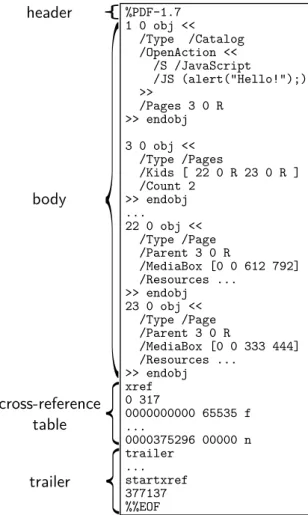
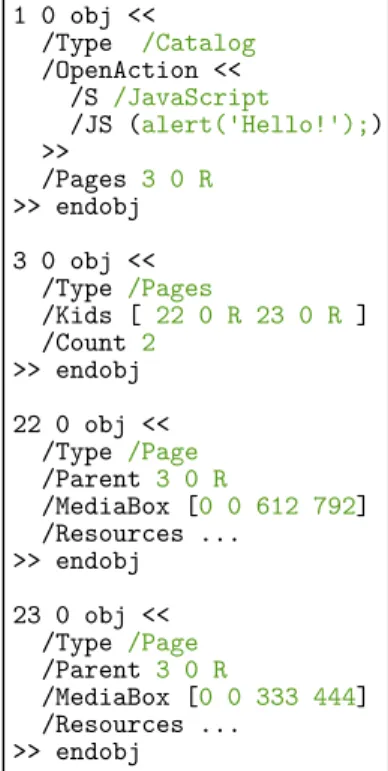
The syntax of PDF comprises four main elements and is illustrated in a simplified example PDF file in Fig. 2.1:
• Objects. These are the basic building blocks in PDF described in more detail in the remainder of this section.
• File structure. It specifies how objects are laid out, accessed and modified in a PDF file. At this level, a PDF file consists of:
– aheaderwith the PDF magic number%PDF-followed by the version of the PDF standard utilized in the file, e.g.,1.7,
– abodywith PDF objects that make up the actual content of the document, – across-reference tableintroduced with the keywordxref, identifying
indi-rectly referenced objects in the body and their file offsets,
– a trailer, denoted by the keyword trailer, containing the location of the cross-reference table and special objects in the file body and followed by the keyword%%EOF.
Although linear PDF files exist, objects are layed out non-linearly in most PDF files, including our example. In order to parse such a file, a PDF parser must
therefore begin by checking the version number and looking at the file trailer for information about the location of the cross-reference table and some special objects in the file body. Starting from there, it can locate the information necessary for rendering.
The file structure lies at the heart of methods elaborated in Chapter 5.
• Document structure. It determines how objects are logically organized to repre-sent the components of a PDF file, e.g., fonts, pages, etc. A detailed description of the elaborate document structure is deferred to Chapter 4.
• Content streams. They describe the appearance of the content in PDFs and are not further considered in this manuscript.
%PDF-1.7 1 0 obj << /Type /Catalog /OpenAction << /S /JavaScript /JS (alert("Hello!");) >> /Pages 3 0 R >> endobj 3 0 obj << /Type /Pages /Kids [ 22 0 R 23 0 R ] /Count 2 >> endobj ... 22 0 obj << /Type /Page /Parent 3 0 R /MediaBox [0 0 612 792] /Resources ... >> endobj 23 0 obj << /Type /Page /Parent 3 0 R /MediaBox [0 0 333 444] /Resources ... >> endobj xref 0 317 0000000000 65535 f ... 0000375296 00000 n trailer ... startxref 377137 %%EOF header body cross-reference table trailer
Figure 2.1: An example PDF file, simplified and formatted for brevity.
PDF objects reside in the body of a PDF file. There are 9 basic object types specified in the PDF Reference:
1. Booleanobjects can take on valuestrueandfalse.
2. Anumericobject may be an integer or a real number. 3. Stringsmay be stored in two ways:
• as a sequence of literal characters between parentheses ‘(’ and ‘)’, e.g., the stringalert(”Hello!”);in Fig. 2.1,
• as a sequence of hexadecimal numbers between angle brackets ‘<’ and ‘>’. Strings may be encrypted.
4. Anameis a sequence of 8-bit characters used as identifier. Names are introduced using the forward slash character (‘/’) and can contain arbitrary characters except null(0x00). Examples areType,CatalogorMediaBoxin Fig. 2.1.
5. Thenullobject is denoted by the keywordnull.
The object types introduced so far, i.e., boolean, numeric, string, name and null, will be referred to asprimitivetypes hereinafter.
6. Anarrayis a one-dimensional sequence of PDF objects enclosed between square brackets, ‘[’ and ‘]’, e.g., [0 0 333 444]. It may contain heterogeneous PDF objects and be nested.
7. Dictionariesare unordered sets of key-value pairs enclosed between symbols ‘<<’ and ‘>>’. The keys must be name objects unique within a dictionary. The val-ues may be of any PDF object type, including nested dictionaries. There are 5 dictionaries in Fig. 2.1, one of them being nested inside the first dictionary. 8. A streamis a dictionary followed by a sequence of bytes enclosed between
key-words stream and endstream. Streams are usually used to represent large ob-jects, such as images, in a compact way. The content of the byte sequence may be encoded or compressed and the associated dictionary contains information on whether and how to decode or decompress it. Stream content may also be en-crypted. A special type of streams are object streams containing arbitrary PDF objects.
9. Anindirect objectis any of the previously defined objects supplied with a unique object identifier and enclosed within keywords obj and endobj. Fig. 2.1 con-tains 4 indirect dictionaries. The unique identifier comprises an object number and a generation number, a sort of a version number for tracking changes to ob-jects. Indirect objects can be referenced from other objects viaindirect references written as a sequence of the object number, the generation number and the capital letter ‘R’. For example,23 0 Rin Fig. 2.1 refers to the dictionary with the object number 23 and generation number 0.
The PDF body is structured as a hierarchy of objects interconnected in a semanti-cally meaningful way to describe pages, outlines, annotations, etc. A central role in the hierarchy belongs to the Catalog dictionarypointed to by the/Rootentry in the cross-reference table.
Having described the PDF file format in sufficient detail, we can now interpret the body of the PDF file illustrated in Fig. 2.1 in its entirety1. It contains four indirect objects indicated by two-part object identifiers, e.g., 1 0for the first object, and the keywords
obj andendobj. They are all dictionaries, as they are surrounded by the symbols ‘<<’ and ‘>>’. The first indirect object is the Catalogdictionary, distinguishable by having
Catalogfor itsType. TheCataloghas 2 further dictionary entries:
• OpenAction is an example of a nested dictionary. It has two entries: S, a name indicating that this is a JavaScript action dictionary, andJS, a string with the actual JavaScript code,alert(’Hello!’);.
• Pagesis an indirect reference to the object with the ID3 0: thePagesdictionary that immediately follows Catalog. It has an integer,Count, announcing that the document has 2 pages, and an arrayKidsidentifiable by the square brackets, with two references to 2 Page objects describing the appearance of the pages. The remaining objects are interpreted analogously.
Many parsers fail to strictly follow the PDF Reference. Even Adobe’s own Adobe Reader is notorious for such lack of compliance. For example, it ignores arbitrary sym-bols before the header [37] and can dispense with the trailer and cross-references [110].
2.2 SWF File Format
TheSWF File Format(SWF, pronouncedswiff) is a proprietary binary file format widely used for interactive content on the World Wide Web. Adobe Systems Incorporated has published the partialSWF Specification[95]. This and later sections concerning the SWF format contain direct citations from the SWF Specification.
SWF files consist of a header and a sequence of tags – well-defined data structures with a set of predefinedfieldsand correspondingvalues. There are 65 different types of tags specified, each defining its own set of fields with different names and data types. Some basic SWF data types are:
• 8-, 16-, 32- and 64-bit integers, both signed and unsigned, arrays of these types and integers with a variable number of bytes
• fixed-andfloating-point numberswith different widths and precisions
• integerand fixed-point numbers with widths that are not exponents of 2
• strings
• variousdata structuressuch as 24- and 32-bit color records, rectangle records, 2D transformation matrices, etc.
000 46 57 53 06 24 00 00 00 70 00 0b 9a 00 00 3e 80 010 00 01 02 00 43 02 aa bb cc 40 00 43 02 11 22 33 020 40 00 00 00
Figure 2.2: Hexadecimal view of an example SWF file. Left column shows hexadecimal addresses of rows.
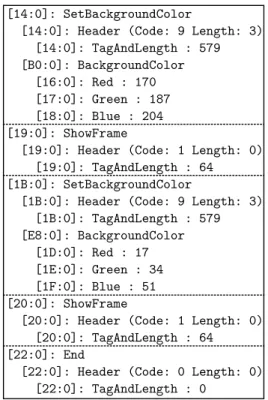
Fig. 2.2 shows a toy SWF file used for illustrative purposes. The physical layout of SWF is too obscure for direct interpretation. Instead, we base our description of the SWF file format on the decoded, human-readable depiction of the same file, illustrated in Fig. 2.32.
[14:0]: SetBackgroundColor
[14:0]: Header (Code: 9 Length: 3) [14:0]: TagAndLength : 579 [B0:0]: BackgroundColor [16:0]: Red : 170 [17:0]: Green : 187 [18:0]: Blue : 204 [19:0]: ShowFrame
[19:0]: Header (Code: 1 Length: 0) [19:0]: TagAndLength : 64 [1B:0]: SetBackgroundColor
[1B:0]: Header (Code: 9 Length: 3) [1B:0]: TagAndLength : 579 [E8:0]: BackgroundColor [1D:0]: Red : 17 [1E:0]: Green : 34 [1F:0]: Blue : 51 [20:0]: ShowFrame
[20:0]: Header (Code: 1 Length: 0) [20:0]: TagAndLength : 64 [22:0]: End
[22:0]: Header (Code: 0 Length: 0) [22:0]: TagAndLength : 0
Figure 2.3: SWF file depicted in Fig. 2.2, decoded, header omitted for brevity. Every line starts with a hexadecimal number within square brackets denoting the offset, in bytes, of the corresponding tag field from the beginning of the file.
2This textual description of the original SWF file was produced using theConsoleDumper class
of SWFRETools, an open-source Java toolkit for reverse-engineering SWF files available at https: //github.com/sporst/SWFREtools.
The illustration shows 5 SWF tags separated by dotted lines: two tags with type
SetBackgroundColor at bytes 0x14 and 0x1B, two ShowFrame tags at bytes 0x19 and 0x20 and an End tag at byte 0x22. Tags of a SWF file are laid out sequentially. Every tag has a header with an unsigned 16-bit little-endian TagCodeAndLengthfield that comprises a 10-byte tag type identifier and a 6-bit tag length field, with an optional wider length field for tags longer than 62 bytes.
The first tag in this file is used to set the background color of the display. It is a simple tag, defining 3 unsigned one-byte values of the red (0xAA=170), green (0xBB=187) and blue (0xCC=204) color components. The second tag makes the content of the canvas render on screen for the duration of one frame. Following this, the background color is set to #112233 and the screen is refreshed one more time. Finally, the Endtag signals the end of the file.
A Case Study of Malicious PDF File
Detection
In this chapter we present a method for malicious PDF file detection that specializes in PDF files that contain JavaScript code. At the heart of the detection approach lies the hy-pothesis that lexical properties of embedded JavaScript code differ between benign and malicious files. Due to its specialization, the proposed method has a restricted applicabil-ity and is thus explored in form of a case study in this chapter. A more general detection method for both PDF and Adobe Flash files will be presented in Chapter 4. The remain-der of this chapter contains material from our Annual Computer Security Applications Conference (ACSAC) 2011 publication [45].
After the introduction in Section 3.1, we present a survey of prior work (Section 3.2) followed by a brief summary of mechanisms for embedding JavaScript into PDF (Sec-tion 3.3). The system design and methodology is presented in Sec(Sec-tion 3.4. In Sec(Sec-tion 3.5 we explore the data corpus and analyze its statistical features. Our experimental evalu-ation is presented in Section 3.6. Limitevalu-ations of our method and related later work are discussed in Section 3.7, and Section 3.8 concludes this chapter.
3.1 Introduction
Since the discovery of the first critical vulnerability in Adobe Reader in 20081, the Portable Document Format has become one of the main attack vectors used by mis-creants. PDF-based attacks were the most frequently used remote exploitation technique in 2009 with a proud share of 49 %. Two specific PDF-based vulnerabilities were ranked second and fifth among all discovered in 2009 [96]. Overall, more than 50 vulnera-bilities were discovered in Adobe Reader in 2008–2010, which has led to numerous security-related updates.
The vulnerabilities of Adobe Reader can be classified into three categories:
1. The earliest—and the largest—class of vulnerabilities arises from bugs in the im-plementation of the Adobe JavaScript API. This API significantly extends the
vaScript functionality in the specific context of PDF files.
2. The second class of vulnerabilities is rooted in non-JavaScript features of Adobe Reader but typically requires JavaScript for exploitation, e.g., using heap spraying. Examples of such vulnerabilities are the JBIG2 filter (e.g., CVE-2009-0658) and heap overflow (e.g., CVE-2009-1862) exploits.
3. Finally, the smallest class of vulnerabilities, e.g., the flawed embedded TrueType font handling (CVE-2010-0195), does not involve JavaScript functionality.
Unlike other exploitation techniques such as drive-by-downloads, SQL injection or cross-site scripting, PDF-based attacks have not received significant attention in the re-search community before 2011. Previous work in this field has mostly focused on dy-namic analysis techniques. For example, well-known sandboxes JSand [22] and CW-Sandbox[109] have been adapted to the analysis of malicious PDF files. Due to heavy instrumentation and security risks associated with dynamic analysis, the practical appli-cability of such approaches is limited to malware research systems. For end-user sys-tems, some early work on the detection of potential exploits in PDF files [48, 84] has gone largely unnoticed, and in practice the detection of malicious PDF files hinges upon signatures provided by antivirus vendors.
In this chapter we explore static techniques for detection of JavaScript-based PDF malware. Our aim is to develop efficient detection methods suitable for deployment on end-user systems as well as in the networking infrastructure, e.g., email gateways and HTTP proxies. We present the tool PJScan2, capable of reliably detecting PDF attacks with operational false positive rates in the promille range. Its low computational overhead makes it very attractive for large-scale analysis of PDF files.
Conceptually, PJScan is closely related to static analysis techniques for detection of browser-based JavaScript attacks. Similarly to previous work by Rieck et al. [80], our methodology is based on lexical analysis of JavaScript code and uses machine learning to automatically construct models from available data for subsequent classification of new data. The crucial difference from browser-based JavaScript attacks is that reliable ground truth information is hardly available for PDF files. It is especially difficult to identify benign JavaScript-bearing PDF files. Firstly, as our study will show, such examples are indeed much more rare than malicious ones. Secondly, while it is relatively easy to verify that web content at a certain URL is benign, e.g., by using Google Safe Browsing3, it is much more difficult to extract and analyze JavaScript code in PDF files. These implications necessitate a conceptual re-design of detection methods. We therefore resort toanomaly detectionto learn only from malicious examples.
Furthermore, reliable extraction of JavaScript code from PDF files poses a challenge in itself. Not only is PDF very complex, it is also rich with features that can be used for
2The source code of PJS
cancan be found athttp://sf.net/p/pjscan.
hiding the presence of JavaScript code. As elaborated in Chapter 2, PDF supports com-pression of arbitrary objects as well as various encodings for JavaScript content. Such features are routinely used by attackers to avoid detection by signature-based methods. In our experience, none of the previous tools for static analysis of PDF files, e.g., PDFID4, JSUNPACK5, or PDF Dissector(discontinued), were able to provide reliable extraction of JavaScript code from PDF files. In the preprocessing component of PJScan, we have developed an interface to the PDF rendering library Poppler6. Using this interface, our system is able to handle nearly all potential locations of JavaScript known to us from the PDF Reference7.
We have evaluated the effectiveness of PJScan on a large real-world dataset com-prising 3 months of data uploaded by users to the malware analysis portal VirusTotal. This is the first study of malicious PDF files carried out at such scale. Our analysis has found zero-day PDF malware samples, i.e., malicious PDF files undetected by all an-tiviruses (we have found 52 such files among more than 40,000 classified by VirusTotal antiviruses as benign). In our experiments, PJScan has attained average detection rates of 85 % for known and 71 % for previously unseen PDF malware with the average oper-ational false positive rate of about 0.37 %. Due to the difference in the nature of benign data, a direct comparison of PJScan with methods for detection of browser-based Java-Script attacks is impossible. Wepawet, unfortunately since discontinued, was the only previous detection method suitable for PDF-based JavaScript attacks. Much to our sur-prise, while attaining a perfect false positive score and being very good in detection of novel PDF attacks (90 %), Wepawethas shown poor performance onknownPDF attacks, for which it only reached the detection accuracy of 63.6 %. As a dynamic analysis tool, Wepawet has been conceived for offline processing and therefore incurs a significant runtime overhead.
In summary, this chapter provides the following contributions:
• Robust extraction of JavaScript from PDF files. We provide a detailed account of mechanisms for embedding JavaScript into PDF files and present a methodology for its reliable extraction using the open-source PDF parser Poppler.
• Fully static detection of malicious JavaScript. We describe a method for dis-crimination between malicious and benign JavaScript instances based on lexical analysis and anomaly detection. Unlike previous work, the proposed method does not require manual ground truth labeling. This is especially important for PDF files for which it is difficult to establish ground truth.
• High performance. The key advantage of static analysis is that it allows sev-eral orders of magnitude higher processing speed. Our system PJScan attains an
4PDFID –http://blog.didierstevens.com/programs/pdf-tools/. 5JSUNPACK –https://github.com/urule99/jsunpack-n.
6P
oppler–https://poppler.freedesktop.org/. Version 0.14.3 was used in our implementation. 7The sole exception, JavaScript code in XFA forms, will be discussed in Section 3.7.
average runtime of 31 ms/file/CPU, the fastest of all published methods.
• Comprehensive evaluation. We present the results of the first large-scale evalu-ation of malicious PDF detection on a real-world dataset comprising over 65,000 PDF files. PJScanhas detected 85 % PDF files labeled by at least 5 antivirus tools deployed at VirusTotal as malicious. Furthermore, it detects 71 % of zero-day malicious PDF files missed by all VirusTotalscanners. The promille-range false positive rate of PJScanmakes it suitable for practical deployment.
• Source code release. Source code of PJScanis released as open-source software.
3.2 Prior Work
The earliest approaches to identification of malware in PDF files [48, 84] were based on n-gram analysis of raw file content. The scope of experimental evaluation in this work was rather limited. It included self-generated malicious PDF files as well as a rela-tively small number of examples (less than 300) from the outdated VXHeavensmalware repository. Due to the wide-spread use of evasion techniques in modern PDF malware, especially object compression and code-level obfuscation, we find the analysis of raw content of PDF files inadequate. Consequently, the approach taken in PJScan is funda-mentally different from the above-mentioned work in that our methods spend a lot of effort in discovering and utilizing the appropriate lexical features of PDF.
Other prior work on PDF file classification has emerged from existing tools for static and dynamic analysis. Early dynamic approaches were based on software emulation [1, 71] and abstract payload execution [103]. However, they were shown to be susceptible to evasion and computationally intensive. Besides the portal Wepawetconsidered in our experiments and based on the sandbox JSand[22], some other tools use a combination of static and dynamic analysis. One example is MalOffice[28], which also employs heuris-tics. Its static analysis is based on the utility PDFtk8, and its dynamic analysis builds on CWSandbox[109]. Detections are made by combining scores from various heuris-tics and policies attached to the analysis tools. Another example is MDscan, proposed in [104]. From the architectural point of view, MDscan is similar to our approach. It also uses static analysis to extract JavaScript content (although using a self-made parser) and a heuristic approach for the extraction of JavaScript code. The extracted code is interpreted using SpiderMonkeyand the detection is carried out dynamically by utiliz-ing the shellcode detection tool Nemu[71]. The method was evaluated on a set of 197 malicious PDF files artificially generated using the Metasploit framework and 2000 be-nign files. Compared to MDscan, we use SpiderMonkey only for token extraction and perform detection statically, which brings a performance improvement of two orders of magnitude.
8PDF
A significant body of prior work has addressed the detection of malicious JavaScript in web content, especially in the context of drive-by-downloads. One cannot directly compare the accuracy of such methods with PJScandue to the fact that the data corpora used for the experimental evaluation of respective methods are very different. We will hence focus on methodical comparison of our approach with such methods.
Similar to PDF malware, the methods for detection of malicious JavaScript in web content can be classified into static, dynamic and hybrid. Purely dynamic methods de-ploy various techniques for monitoring the run-time execution of processes accessing web content, e.g., full-fledged host virtualization [107], client virtualization [59], instru-mentation of a JavaScript engine [29] or heap monitoring [76]. Dynamic methods have high detection accuracy and are hardly prone to false positives, however, due to their performance overhead they are usually limited to “post-mortem” analysis.
Hybrid methods aim to minimize run-time overhead while retaining high detection accuracy. Several such methods have methodical affinity with PJScan. JSand [22] uses instrumented versions of HtmlUnit9, a Java-based browser simulator, and the Mozilla Rhino10 JavaScript interpreter to extract heuristic features while monitoring code execu-tion. These features are used to train an anomaly detection system by running JSandon benign web pages. Cujo [80] is another interesting combination of static and dynamic methods. Its static part is similar to PJScan, with the exception that PJScan employs anomaly detection instead of two-class classification in its learning component. Cujo’s dynamic component extracts symbolic features from the light-weight sandbox ADSand -box [25] and deploys similarn-gram analysis and learning techniques as the static part. As a “mostly static” detection system, Zozzle [23] avoids dynamic analysis except for unraveling source-code obfuscation before using statistical feature extraction and su-pervised learning for classification. Compared to these hybrid methods, PJScan uses “reverse” anomaly detection—since only malicious data is widely available for PDF files—and completely dispenses with run-time analysis. Another hybrid method has been proposed by Provos et al. [72]; however, the lack of a technical presentation in this reference prevents us from a detailed comparison.
The only fully static method in the web domain is Prophiler [14]. It deploys tech-niques similar to JSandexcept that its features are extracted from a JavaScript engine at the parsing stagewithout running the code(a similar idea is used in our method but one step earlier, by stopping SpiderMonkey after the lexical analysis). However, Prophiler has a high false positive rate and is intended to be used as a filter for subsequent dynamic analysis.
9H
tmlUnit–http://htmlunit.sourceforge.net/. 10R
3.3 JavaScript in PDF
PDF provides several mechanisms for inclusion of JavaScript code. They are important for the realization of interactive features, such as forms, dynamic content or 3D render-ing. Some PDF usage scenarios relying on these features cannot be realized without JavaScript.
The main indicator of JavaScript code is the presence of the keyword /JS in a PDF dictionary. The JavaScript source code can be supplied directly as a string (literal or hexadecimal) or stored in another object accessedviaan indirect reference. In the latter case, it is usually stored as a compressed or encrypted stream. Examples of typical syntax for embedding of JavaScript code are shown in Fig. 3.1.
1 0 obj << /Type /Catalog /Pages 2 0 R /OpenAction << /S /Rendition /JS 23 0 R >> >> endobj 1 0 obj << /Type /Catalog /Pages 2 0 R /OpenAction << /S /JavaScript /JS (alert(’Hello World!’);) >> >> endobj
Figure 3.1: Examples of syntactic constructs for embedding JavaScript code in PDF files. Left: code is placed in another object (omitted) pointed to by an indirect reference. Right: code is supplied as a literal string.
A simple search for/JSpatterns in PDF files – as it was realized in some tools for PDF file analysis, e.g., PDFID – does not suffice for identification of JavaScript locations. It can be easily evaded by placing dictionaries containing JavaScript into object streams. PDF stream compression makes the keyword/JS in that case appear obfuscated when viewed in plain text. The simple search may also yield multiple references to identical code if different revisions of the same content are present.
In order to reliably extract JavaScript code, files must be processed at the semantic level, i.e., considering potential uses of JavaScript in the file. In general, the use of Java-Script code in PDF files is bound to the so-calledaction dictionaries. Such dictionaries may be tagged by a keyword/value pair/Type/Action, but such explicit qualification is optional and cannot be relied upon. A mandatory feature of all action dictionaries is the keyword /Swhich may take on 18 different name values. Two of those,/JavaScript
and /Rendition, are important for the search for JavaScript code. The former must, and the latter may have a keyword /JS [67], as shown in Fig. 3.1. Content associated with the keyword/JS, i.e., the code itself, must be encoded using one of two encodings: the encoding defined in the PDF Reference as PDFDocEncoding or the UTF-16BE
(big-endian) Unicode encoding. In the rest of this chapter we denote JavaScript source code located in or referred to by oneJavaScriptorRenditionaction dictionary as aJavaScript snippet.
JavaScriptorRenditionaction dictionaries can be found at the following locations of the PDF object hierarchy:
• theCatalogdictionary’s/AAentry may define an additional action specified by a JavaScript action dictionary,
• theCatalogdictionary’s/OpenActionentry may define an action to be run when the file is opened,
• the file’s name tree may contain an entryJavaScriptthat maps name strings to file-level JavaScript action dictionaries executed when the file is opened,
• the file’sOutlinehierarchy, referenced by theOutlinesentry of theCatalog dic-tionary, may contain references to JavaScript action dictionaries,
• pages, file attachments and forms may also contain references to JavaScript action dictionaries11.
Besides being directly embedded in a PDF file, JavaScript code may also reside in a different file on the local host computer or even be retrieved from a remote location using the directives /URI or /GoTo. However, newer versions of PDF viewers restrict this behavior to increase security. JavaScript also supports dynamic code execution using the
eval() function or its equivalent,setTimeOut(). Such code is generally inaccessible to static analysis; however, it has to be fetched from existing snippets inside the file, i.e., entry point code, which we have access to.
3.4 System Design
Conceptually, our system comprises two main components,feature extractionand learn-ing, as shown in Fig. 3.2. The first component extracts JavaScript code embedded in PDF files and performs lexical analysis on it, outputting as result one sequence of lexi-cal tokens for every file. The second component operates in two steps. In the first step, i.e., attrainingtime, it takes the extracted token sequences and trains an anomaly detec-tion algorithm on examples ofmaliciousfiles, thus learning amodelof lexical properties of JavaScript code in malicious PDF files. In the second step, i.e., duringdeployment, this model is used for classification of new files for which the ground truth labels are unknown. Classification is performed by measuring the deviation of a new file from a learned model and comparing it against a predefined threshold usually determined at
11PJS
JavaScript Extractor (Poppler) Tokenizer (Spider-Monkey) Training PDF File Test PDF File JavaScript Entity Token Sequence Learning Algorithm Detector Model Prediction
Feature Extraction Learning
Figure 3.2: Architecture of PJScan.
training time. Files falling close to the learned model are classified as malicious and otherwise as benign. Details of individual components depicted in Fig. 3.2 are reported in the following sections.
3.4.1 Extraction of JavaScript Content
The main technical challenge in extracting JavaScript code from PDF files lies in the decoding of object streams and handling of string encodings. Furthermore, a parser must be robust against potential incompatibilities with the PDF Reference. For this reason, contrary to the approach taken in [104], we have decided against parsing PDF files “by hand” and instead utilize the popular open-source PDF parser Poppler.
Our JavaScript extractor begins by opening the PDF file and initializing Poppler and its internal data structures. Next, the Catalog dictionary is retrieved which serves as the starting point in the search for action dictionaries. All candidate locations listed in Section 3.3 are checked, and the found action dictionaries are queried for their type. If the type is Renditionor JavaScript and a dictionary contains the /JSkey, the value of this key (or the referenced object in case of an indirect reference) is retrieved. The string containing JavaScript is then decompressed and decoded where necessary.
The peculiarity of our approach is that we fully process only those objects in which JavaScriptandRenditionaction dictionaries may occur. This strongly reduces the com-putational effort for JavaScript extraction and is crucial for efficient batch processing of large datasets. Files without JavaScript are not processed beyond this stage.
3.4.2 Lexical Analysis
At the lexical level, source code is represented as a series of tokens denoting individual lexical elements, e.g., keywords, literals, variable and function names, punctuation, etc. Let us illustrate the tokenization process using an example. The malicious JavaScript snippet
bvb(’var lBvXSUfYYL7RK = ev’ + ’al;’); // a real example lBvXSUfYYL7RK(’var uzWPsX8 = this.info’ +
z("%2e%46%61%6b") + ’erss;’);
is translated into the lexical token sequence shown in Table 3.1, in order from top to bottom.
Value Symbolic name Description
29 TOK_NAME identifier
27 TOK_LP left parenthesis
31 TOK_STRING string constant
15 TOK_PLUS plus
31 TOK_STRING string constant
28 TOK_RP right parenthesis
2 TOK_SEMI semicolon
29 TOK_NAME identifier
27 TOK_LP left parenthesis
31 TOK_STRING string constant
15 TOK_PLUS plus
29 TOK_NAME identifier
27 TOK_LP left parenthesis
31 TOK_STRING string constant
28 TOK_RP right parenthesis
15 TOK_PLUS plus
31 TOK_STRING string constant
28 TOK_RP right parenthesis
2 TOK_SEMI semicolon
0 TOK_EOF end of file
Table 3.1: Example token sequence.
We were motivated to use token sequences instead of other properties of JavaScript code because their extraction and processing can be implemented very efficiently and they capture the essential program flow.
Lexical analysis is efficiently performed by the open-source JavaScript interpreter Spi -derMonkey12developed by the Mozilla Foundation. We have patched SpiderMonkeyto stop immediately after lexical analysis. This ensures that code does not get executed and thus PJScanis guaranteed to be a static method. Our extractor queries SpiderMonkeyfor lexical tokens until an end-of-file or an error is encountered. Tokens in SpiderMonkey are defined as named integer constants ranging from -1 (error) to 85.
Some semantics of the code are lost during lexical analysis. For example, all identifiers are translated to the same token TOK_NAME, regardless of their names. We refer to this as identifier erasure. Similarly, calls to functions with different names but otherwise identical signatures are translated into equal token sequences. As a result, two JavaScript snippets with different source code may translate to identical token sequences. We say for such snippets that they are distinct at the source code level but equivalent at the lexical level.
Besides the tokens recognized by SpiderMonkey, we have defined extra tokens that are indicative of malicious JavaScript snippets. The newly-introduced tokens are listed in Table 3.2. Their impact on classification performance of is evaluated in Section 3.6.4.
Value Symbolic name Description
101 TOK_STR_10 string literal of length<10
102 TOK_STR_100 string literal of length<100
103 TOK_STR_1000 string literal of length<1,000 104 TOK_STR_10000 string literal of length<10,000 105 TOK_STR_UNBOUND string literal of length>10,000
120 TOK_UNESCAPE call tounescape()
121 TOK_SETTIMEOUT call tosetTimeOut()13
122 TOK_FROMCHARCODE call tofromCharCode()14
123 TOK_EVAL call toeval()
Table 3.2: Custom tokens.
3.4.3 Learning and Classification
In the last step of our processing chain, the learning component of PJScan determines whether a PDF file is benign or malicious. After the feature extraction steps described in
12S
piderMonkey – https://developer.mozilla.org/en-US/docs/Mozilla/Projects/ SpiderMonkey.
13In the PDF JavaScript API, the functionsetTimeOut()of theappobject can be used as a
replace-ment foreval()to execute arbitrary JavaScript code after the specified timeout.
14fromCharCode()is a static method of theStringobject that converts Unicode values to characters.
Sections 3.4.1 and 3.4.2 are completed, the distance of the token sequence from the new file to the model is computed. Our system employs the One-Class Support Vector Ma-chine (OCSVM) [101] as the learning method15, a specialization of the Support Vector Machine classifier described in more detail in Section 4.4.3. Its main advantage is that it only requires examples of one class, in our case malicious, to build a model. This is necessary for our problem since examples of benign PDF files with JavaScript content are quite rare, and it takes a lot of manual effort to verify that they are indeed benign. On the other hand, examples of malicious PDF files abound on malware collection systems, and their maliciousness can be ascertained with high confidence if they are detected by antivirus products.
The learning stage of OCSVM, illustrated in Fig. 3.3a, amounts to finding the centerc and radiusRof a high-dimensional hypersphere such that the total percentage of all data points lying outside of the hypersphere is at most ν. A hypersphere may be extended to arbitrary surfaces by a non-linear transformation to a special feature space equipped with the so-called “kernel function”. The type of the employed kernel function and the training rejection rateν are the only parameters to be specified for training of OCSVM. The learned model comprises the center of the spherecand radiusR.
In the classification stage of OCSVM, we compute the distance between the data point of interest and the center of the hypersphere. If the distance is greater thanR , i.e., the data point lies outside of the hypersphere, then it is considered an anomaly and labeled benign. The radius thus serves as a threshold that is automatically determined at the training stage. The classification stage of OCSVM is illustrated in Fig. 3.3b.
c R
(a) Learning stage: the centercand the radiusR
of the sphere are determined.
c R
(b) Classification stage: new data are accepted (green) or rejected (red).
Figure 3.3: One-Class Support Vector Machine operation.
OCSVM cannot be directly applied to token sequences emitted by PJScan’s feature extraction component. The reason for this is that OCSVM expects the data points to be numeric values lying in a high-dimensional space equipped with typical
mathemat-15The popular open-source SVM implementation L
ibSVM [17] version 2.86 was used in our
alert
29
(
27
“hello”
31
)
28
;
2
parseInt
29
(
27
“42”
31
)
28
0, …, 0, 1, 0, …, 0, 1, 0, …, 0, 1, 0, …, 0, 2, 0, …, 0, 1, 0 … 0
Feature vector:
4-grams:
Token sequence:
JavaScript:
31
27
29
28
+
[index] [0] [4883 1670 0] [232-1 ] [521 9292 45] [455 0236 18] [469 9005 71] [354 6191 9]31
27
28
2
…
Figure 3.4: PJScan feature extraction. JavaScript is transformed into token sequences, from which 4-grams are extracted and counted (for clarity, only 2 of 5 distinct ones shown). Finally, the resulting counts are assigned to corresponding dimensions of the feature space.
ical operations such as addition, multiplication with a constant and the inner product. Sequential data does not form such a space: it is not immediately clear how to add or multiply two strings. A solution to this problem involves a well-established technique of embedding sequences in metric spaces [79]. By counting the occurrences of substrings in data points and assigning the resulting numeric values to coordinate axes, the required mathematical properties can be enforced.
Fig. 3.4 illustrates this in more detail. In the first step, the token sequence is obtained by lexical analysis of the given JavaScript snippet. Next, all 4-grams are extracted from the token sequence. Every n-gram corresponds to one dimension of the feature space, as determined by the functiont:Gn→1,|Gn|, whereGn is the set of alln-grams. Thus,
for G4 and an alphabet of 87 tokens, the feature space has 874 dimensions. However, for performance reasons, PJScan uses 8 bits per token, resulting in a feature space of 284 =232 dimensions. Functiontoperates by concatenating the 8-bit representations of the 4 tokens and interpreting the resulting 32-bit number as an unsigned integer. For example,
t(29,27,31,28)=29·224+27·216+31·28+28=488316700.
Multiple occurrences of the same n-gram are summed, as illustrated on the example ofn-gram29,27,31,28.
Sequence embedding solves the problem of handling multiple JavaScript snippets in the same file in an elegant way. To obtain an aggregated representation of all JavaScript snippets, it suffices to sum them using the addition operation provided by the embedding. To avoid the dependence on sequence length, the values in individual dimensions are binarized (by setting any non-zero values to 1) and normalized so that the Euclidean norm of the resulting vectors equals 1.
3.5 Data Collection and Analysis
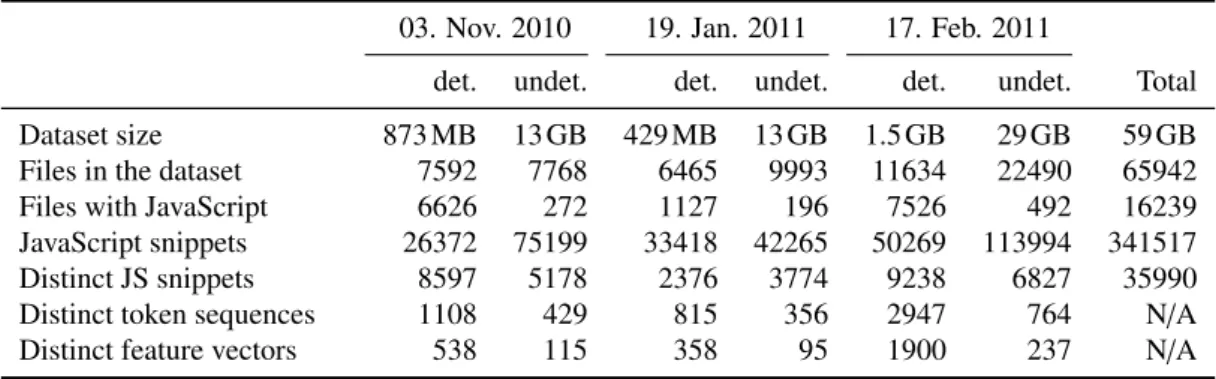
The success of any learning-based approach crucially depends on the quality of data available for training. Likewise, the viability of a learned model can only be demon-strated on up-to-date real data. The evaluation of our method rests on an extensive dataset collected from the research interface to VirusTotal, a web service that enables ordinary users to upload suspicious files to be scanned by most commercially available antivirus tools16. Our dataset comprises 65,942 PDF files with the total size of nearly 59 GB. This data has revealed some interesting features, and is worth looking at in some detail.
We downloaded 3 batches of data at 3 separate occasions: 1. November 3, 2010
2. January 19, 2011 3. February 17, 2011.
Every downloaded batch contains all PDF files available at the given date. The data is kept on VirusTotalonly for 30 days. In fact, we were originally unaware of the 30-day lifespan and started a periodic collection of snapshots only in January. There is surprisingly little overlap between subsequent months as we have observed at most 200 identical files across different snapshots. Our corpora were split into two parts:
• Detected, comprising files labeled malicious by at least one antivirus product,
• Undetected, comprising supposedly benign data.
It is instructive to look at the statistical properties of our data presented in Table 3.3 where a number of revealing observations can be made. Files in the Detected corpora with an average size of 0.106 MB are an order of magnitude smaller than those in Unde -tected(1.39 MB), suggesting an utter lack of meaningful content in malicious PDF files, a finding confirmed by a manual investigation of a subset of them. Furthermore, the percentage of files with JavaScript in the Detectedcorpora (59.5 %) is in stark contrast to the Undetected corpora (2.4 %), providing further indication that JavaScript plays a crucial role in PDF-related exploits.
Further narrowing our focus to files containing JavaScript, we notice that there are on average over 30 times lessJavaScript snippets per file in Detected (7.2) than in Unde -tected datasets (241.1). This observation seemed counter-intuitive before we analyzed
03. Nov. 2010 19. Jan. 2011 17. Feb. 2011
det. undet. det. undet. det. undet. Total Dataset size 873 MB 13 GB 429 MB 13 GB 1.5 GB 29 GB 59 GB Files in the dataset 7592 7768 6465 9993 11634 22490 65942 Files with JavaScript 6626 272 1127 196 7526 492 16239 JavaScript snippets 26372 75199 33418 42265 50269 113994 341517 Distinct JS snippets 8597 5178 2376 3774 9238 6827 35990 Distinct token sequences 1108 429 815 356 2947 764 N/A Distinct feature vectors 538 115 358 95 1900 237 N/A
Table 3.3: Statistics of PDF files collected from VirusTotal.
the snippets themselves, but we discovered that Undetected data usually contains hun-dreds of very simple ones such as:
this.zoom=100;this.pagenum=39
while Detectedordinarily contains large snippets, i.e., complete programs. Furthermore, distinctness of JavaScript snippets at the code level is 3.2 times higher in Detected cor-pora than in Undetected (16.9 % vs. 5.2 %), suggesting that benign JavaScript in PDF files essentially boils down to boring and redundant code.
Similar effects take place at the lexical level (Table 3.3, second-to-last row). One can observe a further decrease in distinctness (6,419 vs. 35,990, or 17.8 %) due to lexical analysis. This effect can be explained by identifier erasure as elaborated in Section 3.4.2. As with source code, Detectedremain more distinct than the Undetectedsub-corpora on the lexical level as well. Finally, the last row in Table 3.3 reveals that many files contain identical sets of token sequences, i.e., when all their token sequences are embedded and summed they result in the same feature vector. This can be explained by common code reuse in both types of files.
To enable a quantitative evaluation of detection accuracy in the forthcoming experi-ments, we have manually labeled the Undetected part of our data. Among 960 benign files with JavaScript, we found 52 that we believe to have been falsely classified as be-nign by all antivirus tools at VirusTotal. However, no cases were found where PDF files belonging to the same group of lexically distinct files were assigned conflicting labels.
3.6 Experimental Evaluation
The real-world nature and the sheer size of the VirusTotaldata make the evaluation chal-lenging. Firstly, the distinction between Detectedand Undetected corpora is somewhat vague, as classifications by antivirus engines cannot be fully trusted. Secondly, the huge size of the Detectedcorpus makes its manual analysis infeasible. On the other hand, the
size of the labeled JavaScript-bearing part of the Undetected corpus is too small to be used for training purposes.
As the baseline for comparison we consider Wepawet, a web-based service using JSand [22]. Wepawet performs both static and dynamic analysis of PDF files based on their JavaScript content and can detect both malware that it has a signature for (la-beled asmalicious), as well as unknown malware (labeled assuspicious) using statistical features. In the evaluation, we treat both categories as detections. Similar to our system, Wepawet generally does not recognize PDF malware that lacks JavaScript. Table 3.4 shows Wepawet’s classification on the Detectedand Undetected parts of the three data corpora at our disposal. In some cases file uploads were rejected by Wepawet, referred to asfail, or resulted in internal errors despite multiple submissions, referred to aserror. We treat such cases (about 1.7 % of the total data) as benign.
03. Nov. 2010 19. Jan. 2011 17. Feb. 2011
detected undetected detected undetected detected undetected
Fail 12 38 9 25 19 73
Error 15 1 5 0 83 0
Benign 3860 212 502 167 1050 397
Suspicious 1474 11 149 0 257 0
Malicious 1265 10 462 4 6117 22
Table 3.4: Wepawetclassification results.
3.6.1 Objectives and Evaluation Criteria
Our experiments address the following questions:
1. How well doPJScanandWepawetdetect known malicious files?
This question may appear meaningless: why bother detecting something that is already detected? In practice, however, it is infeasible to deploy all antivirus tools from VirusTotal. For a single method, attaining the detection accuracy close to that of the combined accuracy of all established antivirus tools is a very challeng-ing goal17. The corresponding metric is the true positive rate on known attacks T PRknown, defined as the percentage of correctly identified malicious
JavaScript-bearing files in the Detectedcorpus.
17Unfortunately we were unable to compare against thebestdetector at V
irusTotal. At the time of
collection, labels in batch data from VirusTotalreflected only the number of detections but not the specific detectors that classified a file as malicious.
2. How well do both methods detect attacks that were missed by allVirusTotal de-tectors?
We consider files in the Undetected corpus as novel attacks if they are shown to be malicious during manual analysis. The true positive rate on unknown at-tacks T PRunknown is defined as the percentage of correctly identified malicious
JavaScript-bearing files in the Undetectedcorpus. In Section 3.5 we have identi-fied just 52 such files.
3. How many normal files are classified as malicious by the methods in question? The laboratory false positive rate FPRlab is defined as the percentage of
incor-rectly classified benign JavaScript-bearing files in the Undetected corpus. There are only 960 such files.
Theoperational false positive rate FPRoperational is the ratio between the number
of incorrectly classified benign files and the total number of files in the Undetected corpus, i.e., including benign files without JavaScript.
The distinction between the laboratory and the operational false positive rates is essential for estimation of the expected impact of false positives in practical de-ployment.
3.6.2 Experimental Protocol
Our experiments were carried out using the following procedure. We merged all 3 cor-pora from different dates keeping only the distinction between “detected” and “unde-tected” parts, thus creating two data sets, Detectedand Undetected. Next we extracted token sequences from files – the most computationally intensive task in our experiments. We randomly split the Detected dataset into two non-overlapping partitions in such a way that they contained approximately the same number of distinct token sequences. One of these data sets is used to train PJScan, the other to evaluateT PRknown. To
de-crease the impact of non-determinism via random splitting, we repeat the experiment the second time by swapping the training and the evaluation datasets and averaging the detection accuracy. This process is known as2-fold cross-validation.
To determine the detection accuracy on unknown data, we apply the trained model on the full Undetectedcorpus. We use the ground truth information to computeT PRunknown,
FPRlabandFPRoperational. The reported results are also averaged over the two partitions
of the training data.
Since the models used by Wepawet do not depend on our training data but rather on the data it was trained on, the results presented here for Wepawetreflect its performance on our complete datasets (Detectedand Undetected).
Some experimentation was needed to choose the parameters for OCSVM. We selected the training rejection rateν=0.15 and then-gram length of 4, which seem to provide the best trade-offbetween true positive and false positive rates, using a grid search.


![Figure 4.4: Structural tree of the PDF file depicted in Fig. 4.3. Dictionaries are illustrated using the symbol ‘<< >>’, arrays using ‘[ ]’](https://thumb-us.123doks.com/thumbv2/123dok_us/9897773.2483300/59.892.246.620.165.439/figure-structural-depicted-dictionaries-illustrated-using-symbol-arrays.webp)
