Physics Procedia 33 ( 2012 ) 265 – 270
1875-3892 © 2012 Published by Elsevier B.V. Selection and/or peer review under responsibility of ICMPBE International Committee. doi: 10.1016/j.phpro.2012.05.061
2012 International Conference on Medical Physics and Biomedical Engineering
A New Elliptical Grid Clustering Method
Zheng Guansheng
School of Computer and SoftwareNanjing University of Information Science & Technology,Nanjing, 210044, China [email protected]
Abstract
A new base on grid clustering method is presented in this paper. This new method first does unsupervised learning on the high dimensions data. This paper proposed a grid-based approach to clustering. It maps the data onto a multi-dimensional space and applies a linear transformation to the feature space instead of to the objects themselves and then approach a grid-clustering method. Unlike the conventional methods, it uses a multidimensional hyper-eclipse grid cell. Some case studies and ideas how to use the algorithms are described. The experimental results show that EGC can discover abnormity shapes of clusters.
© 2011 Published by Elsevier Ltd. Selection and/or peer-review under responsibility of [name organizer] Keywords—Elliptical-grid, PCA,Clustering
Introduction
Clustering, or unsupervised classification, as it is more often referred as, is an important branch of data mining that aims to divide into different groups (or clusters) inside a given data objects [1]. The resulting groups are to be built so that objects within a cluster to have high similarity with each other and low similarity with objects in other groups and extract useful information from those objects. And then, researchers have proposed a number of clustering algorithms, [2] have done a very good analysis and summary. Applications of data clustering are found in many fields, ranging from engineering, computer sciences, life and medical sciences [3].
There are many researches about clustering methods, such as partition clustering methods, density clustering methods, grid clustering methods, subspace methods, graph methods and so on. The grid-based clustering approach uses a multi resolution grid data structure. It partitions the point’s space into a finite number of cells to perform the task of clustering. Grid-based clustering algorithms are drawing great attention for its advantages of discovering clusters of different shapes and sizes with high efficiency. The main advantage of the approach is its fast process, usually, independent of the number of data objects, yet dependent on only the number of cells in each dimension in the quantized space [4].
© 2012 Published by Elsevier B.V. Selection and/or peer review under responsibility of ICMPBE International Committee.
Open access under CC BY-NC-ND license.
Clustering plays a significant role in searching for structures in dataset. However, the dataset what we sampled has not enough attributes to group into different clusters, in despite of it can be disturbed the application sometimes in reality, taking the flight delay, for instance. The data are the real records of flights in the hub-airport of China in 2006 and have been standardized in order to offset the difference of absolute values of different attributes. But, Literature [5] proposed the method is very sensitive to the number of clusters and similarity to handle. We propose a new method to solve these problems.
In this paper, we proposes a new clustering algorithm, based on PCA which can decrease the dimensions of dataset and improves the efficiency of neighbor seeking and precision of clustering using Elliptical-grid. In section 2 we talk about the underlying idea is presented and related work. Our New Elliptical Grid Clustering (EGC) algorithm is described in section 3. In section 4 we show our experiences and conclusion.
Background of Application and Related Work
Principal Components Analysis (PCA) is a dimension reduction procedure for analyzing the linear correlation of variation present in a multi-dimensional dataset [6]. The main advantage of PCA is that once we have found these patterns in the data, and reduced the number of dimensions. In order to reduce the dimensions of original dataset, PCA with this assumption is now limited to reexpressing the data as a linear combination of its eigenvectors. But, with the high dimensions dataset, only use this linear method to reduce the dimension of dataset; it may be lost some valuable property. Based on this assumption, we extend the PCA's linear hypothesis in section 3. Using those attributes that ignores by PCA formed another dimensional with their linear combination.
According to the general machine learning methods, there is always a serious challenge for clustering algorithms to large data sets of high dimensionality. Although, many developed clustering algorithms have recently attempted to address either handling data with very large number of records or data sets with very high number of dimensions. Traditional grid-based clustering algorithms can be divided into two categories: fix-up grid partition method and adaptive grid partition method. Certain clustering algorithms for example CLIQUE[7], STING[8], WaveCluster[9], DENCLUE[10], GDILC[11], and Dclust[12] adopt fix-up grid partition technology; while some other clustering algorithms adopt adaptive grid partition method, for example MAFIA[13], OptiGrid[14] ,etc.
CLIQUE is a typical grid-based clustering algorithm using fix-up grid partition, whose basic idea is to partition every dimension of data space into intervals with equal length, and then non-intersecting rectangular cells with equal size are formed. Because points fallen into the same grid are probably to belong to a cluster, they can be processed as one object. All the clustering processes are operated on these grid cells, so they have nothing to do with the size of input data, but the number of grid cells. Another typical grid-based clustering algorithm using adaptive grid partition is MAFIA, which partitions data space into non-intersecting grid cells with different sizes according to distributional feature of data. The total number of grid cells is greatly reduced in comparison of those algorithms adopting fix-up grid partition technology, but selecting spitting points still needs much computation. Clustering algorithms adopting fix-up and adaptive grid partition method use non-intersecting grids to form clusters, which need neighbor seeking. Because searching for neighbors usually cost much more time, the latter clustering algorithms mostly build index for grids to improve the efficiency of searching neighbors. Those clustering algorithms usually use depth-first search to connect grids and use growing pattern of greedy algorithm to form clusters [13].
Generally, when the number of dimension is high, there could be caused too many grid cells using fix-up grid partition. Accordingly, it is a time-consuming process to search near-neighbor. Although adaptive grid partition technology could decrease the total number of grids, how to cutting points into a grid still had more computation.
The Grid-Clustering uses Grid Structure to precluster the multidimensional dataset. The grid structure divided the points of dataset by a set of surrounding rectangular shaped blocks. With that, to approximate the dense regions of the clustering space, those blocks is quantized into a finite number of cells and identifying cells that contains more than a number of points as dense. Clusters are then formed by connecting these dense cells.
A. Authors and Affiliations
Let C ( ,C C1 2, ,Cn)be the set of nclusters. Ciis thei-th cluster consisting of a tuple of describing
features ( ,x x xi1 i2, i3 ,xid), wheredis the number of dimensions. A block is a dimensional rectangular
shaped cube containing up to a maximum of bspatterns (bs= block size).The following properties are
satisfied, is the empty set, For all,
, , i j j j k j j C C B B B if j k B B C
The proposed Grid-Clustering algorithm uses this block information via the index structure of the Grid File and clusters the patterns according to their surrounding blocks.
Figure 1. Block structure for 1000 patters, 3 clusters
The algorithm calculates the density of each block via the numbers of patterns and the spatial volume of the block. The blocks with the highest density (obviously with strongest pattern correlation) build the clustering centers. Iteratively the remaining blocks are clustered in sequence to their density, building new cluster centers or merging with existing clusters. Only blocks, which adjoin a cluster, can be merged. Adjacent blocks are called neighbor blocks. The neighbors can be distinguished by the dimensionality of the connection. We call the neighbors adjacent via a d-1 dimensional hyper plane, the nearest neighbors.
Clustering plays a significant role in searching for structures in dataset. However, the dataset what we sampled has not enough attributes to group into different clusters, in despite of it can be disturbed the application sometimes in reality, taking the flight delay, for instance. The data are the real records of flights in the hub-airport of China in 2006 and have been standardized in order to offset the difference of absolute values of different attributes. But, [Lv ]'s method is very sensitive to the number of clusters and similarity to handle. We propose a new method to solve these problems.
B. Expend PCA
PCA using linear algebra is based on an important property of eigenvector decomposition. Those eigenvectors as principal components in dataset are orthogonal. This assumption provides an intuitive simplification that makes PCA soluble with linear algebra decomposition techniques. In the high dimension datasets, some useful attributes information may be ignored. In order to use those ignored attributes, we have to expend the PCA.
Definition 1. Given a d-dimensional vectors x ( , , ,x x1 2 xd) , a new d’-dimensional
f x x( ,j j 1, )xk y mm, 1, 2, , ,t t k (2)
From definition 1, we can see that it can be mapped to a higher-dimensional space for a given dataset, which making data more attribute values in order to describe the characteristics of data. In this paper, for the sake of convenience, we use a linear transformation as the mapping relations. We construct a linear combination that is composed of the zero eigenvector components for the dataset. This combination as an attribute, constructed a new dataset to make up the Grid Clustering in neglected property. If the original dataset can by its eigenvalues and eigenvectors, then let X be a sample, whose eigenvector is e, i.e.: Xe = e
in which is the eigenvector e corresponding eigenvalue. Then we can denote as X’ : X’e’ = ’e’
which X’ denoted as: X’ = (X,Y), 1 d i i i
Y
x
(3) C. Elliptical GridDefinition 2. Given a d-dimensional pointx ( , , , )x x1 2 xn , a grid cell is a hyper-ellipse with x as its
internal point and as Diits shafts. It could be described as:
1 | | n i i i D x (4) i D is defined as: (max { } min { }) / i x D i x D i i D x x K (5)
in which Ki is the intervals on every dimension, and xi is attribute value of points x on its i th
dimension.
Definition 2 shows that each grid cell should have at least one point. If a point y ( , , ,y y1 2 yn)falls
into the grid cell whose boundary point is x, the following condition must be satisfied and vice versa. 2 1 ( ) 1 n i i i x y Di (6)
Traditional technology dealing with grid cell is hyper-rectangle and has a right-open interval in every dimension; the hyper-ellipse grid cell we defined here has a full-close interval in every dimension. This means that the boundary of the grid may be parallel, or even curved. In the algorithms, we take a grid cell as an isolated grid cell, if it doesn’t intersect with any other grid cell. A cluster is the maximal region with density estimation connection.
Figure 2. Elliptical Grid Clustering Algorithm Experiments and conclusions
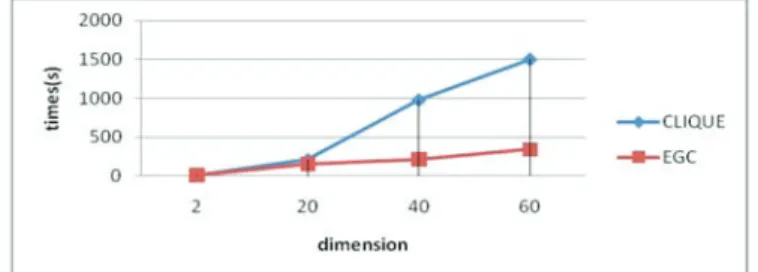
The total time complexity of this algorithm is O ndm( ). Here, n is the number of total data points, d is the number of new dataset of eigenvectors, and m is the number of grids. The time complexity is linear to the size of data dimension, while the time complexity of clustering algorithms adopting fix-up and adaptive grids partition (for example CLIQUE) grow exponentially with size of dimensions.
Some experimental is shown here to demonstrate the effectiveness of EGC. Using artificial dataset, we select 5000 records and set k = 3. Table 1 describes the number of grids created by CLIQUE and our Elliptical Grid-Clustering.
Table 1 The number of grids at different dimensions using CLIQUE and Elliptical Grid-Clustering Algorithms
Mehod Dimensions
2 10 20 30 40
CLIQUE 32 310 320 330 340
Elliptical Grid 20 83 125 231 332
From table 1, we can see that the number of grids generated by GCOD doesn’t grow exponentially with increasing dimensions. So GCOD is suitable for clustering in high dimension.
Figure 3. Scalability with the number of dimensions Elliptical Grid Clustering Algorithm : Inputs: ki, // ki is the interval on ith dimension.
1: Read dataset, computing its eigenvalues, mapping a new dataset;
2: Creating grids: create grid cells according to eigenvectors of dataset, and record the information of shared points of intersecting grid cells;
2.1 read data;
2.2 generating Elliptical grids;
2.3 compute and record information of shared points.
3: Generating clusters: Forming clusters according to density estimation connection, and deal with the clusters that isolated grid cells belong to.
Figure3 shows the relation between running time and the number of dimension, from which we can see that execution efficiency of CLIQUE is higher than that of ours when the size of dimension is lower, while running time of GCOD is much less than that of CLIQUE with increasing dimension.
In the paper, Elliptical Grid-Clustering Algorithm has been proposed. The method organizes unlike the conventional methods. We used the hyper-ellipse grid cell to find near-neighbor. The resulting block partitioning of the value space is clustered via a topological neighbor search. The Grid-Clustering method proved itself as a valuable tool for analyzing the structural information of very large data sets. It can also be used as a valuable connecting element between hierarchical and partitioning methods. It can be used for a quick scan over the data set and can be followed by a partitioning method. One of the most appealing factors is the extremely good run time behavior.
References
[1] Duda, R. O., Hart, P. E. and Stork, D. G. (2000). Pattern Classification, John Wiley & Sons,Inc.
[2] C.H.Chou, M.C.Su and E.Lai, A New Cluster Validity Measure and Its Application to Image Compression, Pattern Analysis and Applications, 2004, 7(2): 205-220.
[3] Berkhin P.. A Survey of Clustering Data Mining Techniques in Grouping Multidimensional Data (Kogan Jacob, Nicholas Charles, Teboulle Marc. , eds.)ch. 2, :25-71Berlin/Heidelberg: Springer-Verlag 2006
[4] Jiawei Han and Micheline Kamber, Data Mining: Concepts and Techniques, 2nd edition, Morgan Kaufmann, 2006 [5] Lv Zonglei, Wang Jiandong. Fast Clustering Algorithm Based on Hypersphere of Multidimensional Space. Journal of Nanjing University of Aeronautics and Astronautics, 2006, 38(6): 706-711
[6] E. Schikuta, "Grid-Clustering: An Efficient Hierarchical Clustering Method for Very Large Data Sets," Pattern Recognition, International Conference on, p. 101, 13th International Conference on Pattern Recognition (ICPR'96) - Volume 2, 1996 .
[7] Shi Lina. Application of multi-grade fuzzy comprehensive evaluation method to flight delay. Journal of Shanghai University of engineering science, 2006, 20(3): 276-279
[8] Ma Zhengping, Cui Deguang. Optimizing airport flight delays. Journal of Tsinghua University (Science and Technology), 2004, 44(4): 474-477,484
[9] Agrawal, R., Gehrke, J., Gunopulos, D., et al.: Automatic Subspace Clustering of High Dimensional Data for Data Mining Applications. In: Proc. of the ACM SIGMOD Int’l Conference on Management of Data. Seattle, Washington, pp. 94– 105 (June 1998)
[10] W., Yang, J., Muntz, R.: STING: A statistical information grid approach to spatial data mining. In: Proc. 23rd Int. conf. on very large data bases, pp. 186–195. Morgan Kaufmann, San Francisco (1997)
[11] Sheikholeslami, G., Chatterjee, S., Zhang, A.:WaveCluster: A multiresolution clustering approach for very large spatial databases. In: Proc. 1998 Int. conf. very large data bases, New York, pp. 428–439 (1998)
[12] Hinneburg, A., Keim, D.A.: An Efficient Approach to Clustering in Large Multimedia databases with Noise. In: KDD 1998, pp. 58–65.
[13] Yanchang, Z., Jjunde, S.: GDILC: A Grid-based Density-Isoline Clustering Algorithm. In: Proc. of 2001 Int’l Conferences on Info-tech and Info-net, Beijing, China,October 2001, pp. 140–145.
[14] Bao-Zhi Qiu, Xiang-Li Li, and Jun-Yi Shen. 2007. Grid-based clustering algorithm based on intersecting partition and density estimation. In Proceedings of the 2007 international conference on Emerging technologies in knowledge discovery and data mining (PAKDD'07).