A Study on Social Performance of Microfinance Institutes: A
Consumer Perspective
Aiswarya Aravind MBA in Finance and Marketing Abstract
The objective of the paper is to conduct a comparative study on the social performance of MFIs in rural and urban areas in various districts of Kerala and analyze the overall impact of micro financial services on the lives of respondents in these areas. The study is undertaken in rural and urban areas of four districts in Kerala using primary data. A total of 110 samples were collected from the districts of Alappuzha, Kollam, Pathanamthitta and Ernakulam. The analysis shows that the borrowers have seen an improvement in their standard of living because of the financial assistance provided by microfinance institutions. The comparison of the rural and urban areas shows that there are considerable differences as people in urban areas are more beneficial from the service provided by MFIs and the main reason behind this is their income status. The people in urban areas have high financial backup as compared to rural areas, so they are more benefitted from the loan facilities availed from MFIs to start their own ventures.
1. INTRODUCTION
Microfinance is the provision of financial services to low-income clients or solidarity lending groups including consumers and the self-employed who traditionally lack access to banking and related services.”The main objective of microfinance is not only to provide micro credit facilities to people but also they focus on economic development thereby they try to eradicate the poverty among poor section of the society. They provide a wide range of financial services like extending credit, providing savings, insurance, remittance facilities and also non-financial services like training, counseling etc.
The concept of providing financial services to low income section of the society is very common. Many formal as well as informal financial institutions are operating in our country for several years and the main aim of all these institutions is to eradicate the poverty, which is one of the prevalent problems in both developing as well as underdeveloped countries. According to the World Bank Report on 2012, about 40 percent of world’s population lives less than USD 2 per day and 80 percent of the people live on less than USD 10 per day. As a result, most of the developing and underdeveloped countries pursue various policies to eliminate poverty and promote sustainable economic development in their countries. Among these policies one of the most important and effective one is Microfinance.
The formal banking sector and capital market systems operating in developing countries focus on increasing the wealth and power of people who are already rich and among the formal financial services providing in developing countries only serves 20% of populations. So the poor section of the society is still falling in to poverty and there is no improvement in their financial position. Due to this, it is necessary to fill the gap between the supply and demand for financial services in formal sector, but it is not an easy task as it involves high transaction cost as well as high risk for the financial institutions. So the government intervened microfinance in India which serves as an important credit provider to the poor section of the society who seek small of amount of money without having any asset as collateral.
Microfinance not only the target on poverty eradication but also they try to provide saving and investment facility to poor people in our country. By providing savings, insurance as well as credit facilities enable the poor to smoothen their consumption, to manage their perils, to carry out their business activities competently, to enhance their income and by this means increased their standard of living.
The system of microfinance was introduced to the world by famous economist Prof.Mohammed Yunus with an organization of Grameen Bank in Bangladesh. He observed that the poor people are unable to access the institutional credit at reasonable rate. Initially he lends money to the people from his own pocket in order to buy raw materials for starting small ventures of their own. In 1976, he setup Grameen Bank to aid poor families by granting credit facilities to them. Till now, the success of Grameen Bank shows that the microcredit system provided by Grameen Bank has been a motivation and an opportunity for the rural poor to improve their own situations and it also provide a sense of confidence as well as self sufficiency when they pay back their loans from the bank.
In India, Microfinance institutions are the organizations are dedicated in providing small scale financial services to poor and low income people and these include SHGs, Non Government Organizations and Credit Unions, Private Commercial Banks, NBFCs etc. The efforts made by SHGs for providing savings and credit services facilitate microfinance sector to grow up significantly in which women’s are the major users or borrowers of micro credit and savings services from SHGs. Nowadays microfinance has been emerging as
powerful instrument for empowering women, especially rural women. Furthermore organizations like NABARD; SIDBI has devoted their time, energy as well as financial resources to uplift low income section of the society by extending micro financial services.
It is found that microfinance sector outreach increased over 23% year on year and its gross loan portfolio has increased to 42% year on year on 2014.In India the microfinance sector is expected to grow with a CAGR of 24%. A large number of people are remaining outside the fold of formal financial system but there is no doubt that the microfinance can able to provide better access to financial services to this section of people. But in recent times, the sector is facing some challenges in terms of competition as well as some financial pressures. With the intervention of more commercial banks, partnership firms including private investors, and other service providers increases the MFIs exposure to risk. Consequently the double bottom line of microfinance services is not guaranteed anymore. The social performance of MFIs cannot be achieved at its desired level. So it is necessary to identify the social performance of MFIs and analyze the extent and the reliability of their services from customer’s perspective. This study tend to focus on the same and to make suitable suggestions on the basis of analysis.
2. REVIEW OF LITERATURE
Microfinance can be considered as a poverty reduction tool in which microfinance movement has almost assumed the shape of an industry, embracing thousands of MFIs and NGOs in India. During the last decade, the sector has witnessed a sharp growth with the emergence of large number of MFIs providing financial and non-financial supports to the poor in an effort to lift them out of poverty. These institutions assume the responsibility of making available much needed microcredit to the poor section of the society for generating self employment and raising income level. The MFI channel of credit delivery, coupled with national level programme of SHG-Bank linkage, today reached million of poor across the country (Mohanty, Mohapatra and Khuntia (2013). There was a considerable impact for microfinance programmes in order to improve the living standard of people especially women’s both in economic as well as social terms. As it is easy for the people to obtain the loans from MFIs than conventional banks and furthermore microfinance has become popular among rural people because people will avail loan without any collateral securities and the loan taking procedure is less complex than that of commercial banks. So there was a positive and perceptible impact of microfinance activities on living standards, empowerment and poverty alleviation among poor people (khan and rahman, 2007).In analyzing the impact of microfinance on household welfare on the basis of their expenditure on health, education, consumption as well as their income level and asset generation capability, we can found an improvement in asset base among the members however many members had not purchased any productive item and loan amount from bank as well as group was also the main source of finance to acquire these assets. Members have experienced improvement in food, health and education expenditure but again in many cases, the loan amount had been providing main assistance rather than income and he conclude that the microfinance is necessary but not a sufficient condition for household welfare (Batra 2012).
Kofi Annan (2005) address the importance of microfinance as an integral part in order to meet the Millennium Development Goals and according to him the great challenge before MFI is to address the constraints that exclude people from full participation in the financial sector. But there was a prevailing gap in the functioning of MFIs in India in terms of practices in credit delivery, lack of product diversification, customer overlapping and duplication, collection of savings/loans and high interest rate etc. Despite of all these issues MFIs still paid an important role in the poverty alleviation and enhancing the living standard of the poor and they hope that if all shortcomings will be eliminated they can able to give positive results on the economy and also lead to greater efficiency and improvement of living standard of the thousands of poor (Sibghatullah Nasir, 2013). Microfinance has been effectively contributing to women empowerment significantly in their family development in terms of getting credit for housing repairs, education and marriage of their children, and also for personal consumption etc, this study found good saving habit among females but still there are many obstacles in the way of financial inclusion of women such as lack of awareness among micro financial services as being provided by the banks (Dr Sangeetha and Meenu ,2011).The social performance of MFIs was increased by 72% from 2008 to 2009 of which 43% of them are NGOs and 38% are NBFIs and almost 81% of MFIs social performance is aims to reach low income clients especially women borrowers who are living in semi-urban or rural areas. Nearly half of the MFIs are providing products and services for housing and household needs rather than spending on productive entrepreneurial activity (Sujani Thrikawala, Stuart Locke and Krishna Reddy, 2013).
Social capital is one of the major determinant of the successful self employment besides other factors such as education, age, and other household characteristics of micro credit clients. The individuals having little or no financial collateral may benefit from increased level of social capital (Gomez and Eric Santor, 2001). The cash flow of household obliged to MFIs is different from those who are not obliged to MFI loans. For the borrowers despite of their significantly high cash outflows, consumption was dominated by food and in case of non-borrowers, money was laid aside for travel and clothes. For most of the people loans were a burden than a
help in which people are taking loans from multiple MFIs and they tend to focus on the repayment of these loans rather than using it for other personal purposes (Kamath, Dattasharma and Ramanathan, 2013).
There are some contradictions regarding MFIs performance in which some of the scholars criticize that MFIs tend to have poorer social performance than NGOs and MFIs are likely to change their client base towards wealthier borrowers. Moreover, the donor’s investment decision on these MFIs is based on its social performance, so they need to quantify their social goals more specifically for getting higher investment (Julian Schmied, 2014)
All these studies help to get a better understanding about the various dimensions of performance of MFIs. All the MFI s is try to help the poor in order to improve their income and create wealth among these people. So we can assume that the main objective of MFIs is to alleviate the poverty by extending credit to weaker sections of the society. Through this study we try to analyze how much effectively they are rendering their services to the customers at the desired level.
3. OBJECTIVES OF THE STUDY
The study aims
To conduct a comparative study on the social performance of MFIs in rural and urban areas under study. To analyze the overall impact of micro financial services on the lives of respondents.
4. RESEARCH METHODOLOGY
Sources of Data: The study is undertaken in rural and urban areas of four districts in Kerala. For this study, both primary and secondary data’s are used. Primary data is enumerated from a questionnaire in which population for the study encompasses people who are members of various SHG groups for at least 10 years and live in various districts of kerala.A structured questionnaire was drafted for collecting the data and interview the clients accordingly who are availing financial services from micro financial institutions. Secondary data is collected from websites and other journals. The following are the districts selected for conducting this study:
• Alappuzha • Kollam • Pathanamthitta • Ernakulam
Sampling Method: Convenient Sampling method is used for collecting data from the clients.
Sampling Size: The size of the sample is 110 and data is collected from rural and urban areas of four districts. Statistical Tools Used: t test and Descriptive statistics has been used to analyze and interpret the data.
Performance Rating Scale: Scores are consigned to ROI on the basis of loans usage by the customers for various purposes. If the loans are not meant for productive purpose ,it is assigned as 4;if the loan amount is invested with some intention but there is no increase in the income of customers from this investment ,it is ranked as 3;due to the loan amount invested for some activities there is sufficient increase in income but it is not enough to cover the installment amount it is ranked as 2;loan amount availed from financial institutions invested for productive purposes and there is significant increase in the income of customers from the income received from this investment ,it is ranked as 1 and if the customers are not taking any loan, it is ranked as 0.
Similarly loan repayment experience is ranked on the basis of complexity that is faced by the customers at the time of availing the loan as well as at the time of its repayment. If the customer is never faced any difficulties or hurdles for the repayment of loan amount or its installment it is ranked as 1; while if the customers faced difficulties less often, it is ranked as 2; whereas if the customers are often face hurdles at the time of repayment of loan, it is ranked as 3.
Index Calculation: Index rate is calculated by multiplying the score that is assigned to the ROI and Loan experience for each customer.
Possible maximum score for loan experience is 33 and minimum score is 11.For ROI the maximum possible score is 4 and minimum score is 0.So the maximum score for index is 132 and minimum score is 11.
Methods of Data Collection: Data is collected from sample respondents through a structured questionnaire which was prepared by the researcher.
DATA ANALYSIS AND INTERPRETATION
This section discusses the descriptive statistics and analysis of t test on the effect of social performance of MFIs in the economy. The results obtained from the analysis were used to test the hypotheses of the study which is stated as follows:
Testing of Hypothesis
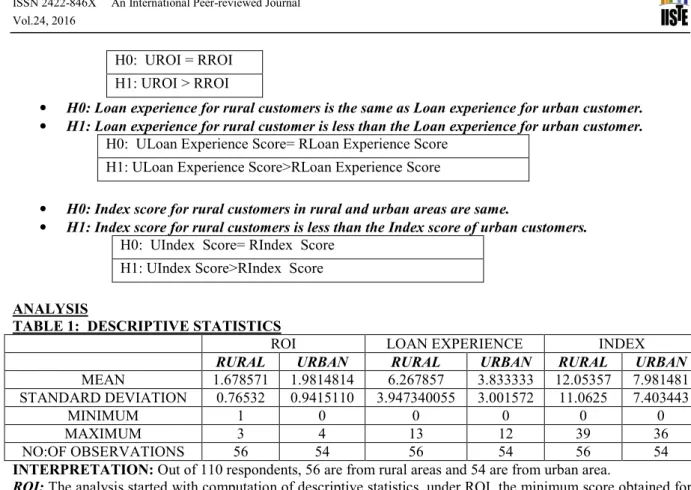
• H0: Return on Investment for rural customer is the same as ROI for urban customer. • H1: Return on Investment for rural customer is less than the ROI for urban customer.
• H0: Loan experience for rural customers is the same as Loan experience for urban customer. • H1: Loan experience for rural customer is less than the Loan experience for urban customer.
H0: ULoan Experience Score= RLoan Experience Score H1: ULoan Experience Score>RLoan Experience Score
• H0: Index score for rural customers in rural and urban areas are same.
• H1: Index score for rural customers is less than the Index score of urban customers. H0: UIndex Score= RIndex Score
H1: UIndex Score>RIndex Score ANALYSIS
TABLE 1: DESCRIPTIVE STATISTICS
ROI LOAN EXPERIENCE INDEX
RURAL URBAN RURAL URBAN RURAL URBAN
MEAN 1.678571 1.9814814 6.267857 3.833333 12.05357 7.981481 STANDARD DEVIATION 0.76532 0.9415110 3.947340055 3.001572 11.0625 7.403443
MINIMUM 1 0 0 0 0 0
MAXIMUM 3 4 13 12 39 36
NO:OF OBSERVATIONS 56 54 56 54 56 54
INTERPRETATION: Out of 110 respondents, 56 are from rural areas and 54 are from urban area.
ROI: The analysis started with computation of descriptive statistics, under ROI, the minimum score obtained for ROI in rural area is 1 and for urban area it is 0, while the maximum were 3 for rural area and it is 4 in case of urban area, the average was skewed to the right at 1.6785 for rural and 1.9814 for urban and the deviation of ROI from the mean was 0.76532 for rural and 0.94151 for urban.
LOAN EXPERIENCE: For loan experience, the minimum score obtained for rural and urban were 0 and maximum score is 13 &12 for rural and urban area respectively. The average score of loan experience were 6.267 for rural and 3.833 for urban, whereas the deviation from the mean was 3.947 and 3.0015 for rural and urban areas respectively.
INDEX: For overall index score, the minimum score obtained is Zero for both rural and urban area and the maximum score is 39 for rural and 36 for urban, the average was skewed to the right at 12.0535 for rural and 7.9814 for urban and the deviation of ROI from the mean was 11.0625 for rural and 7.4034 for urban.
The average score obtained for ROI in rural areas is 1.67 and in case of urban it is 1.98.So from this we can found that the Return on investment that the customers get by investing the loan amount availed from MFIs help them to increase their income but it is not sufficient to cover the installment of loans.
In considering the average score for loan experience, it is 6.26 in rural areas and 3.83 in urban areas. Higher the score more level of dissatisfaction among the customers at the time of loan repayment. By comparing the loan experience score we can inferred that the customers in rural areas faced much difficulty at the time of loan repayment i.e. the maximum score that is assigned to loan experience is 3 and the average score for loan experience in rural area in much more than that. So the customers are not at all satisfied with the service provided by MFIs and by analyzing the loan experience score of urban area ,it is found that the average score is 3.83,it means the urban customers are also facing obstacles at the time of loan repayment.
By analyzing the overall index score, the average index score for rural area is 12.05, it is much less than the average score of the index and in case of urban area the index score is 7.98, it is even less than the minimum score .So from this it is clear that MFIs are giving good emphasis for customers perspective in their performance exposure and they are maintaining their efficiency for providing better services to its clients. From the customers responses we can surmise that MFIs are paying high attention to the customer satisfaction of the borrowers and thereby they met the social performance objectives from customer’s perspective.
In considering the standard deviation of variables in rural and urban areas, it is found that ROI score is varied by small amount it means that there is a great deal of similarity between the return on investment of rural and urban areas as in case of loan experience the standard deviation varies by high amount, this indicates that there is difference in the loan experience score of rural and urban areas. From the overall index score we can see a high variation in the standard deviation is, this indicates that the social performance management of MFIs is different in both rural and urban areas.
H0: UROI = RROI H1: UROI > RROI
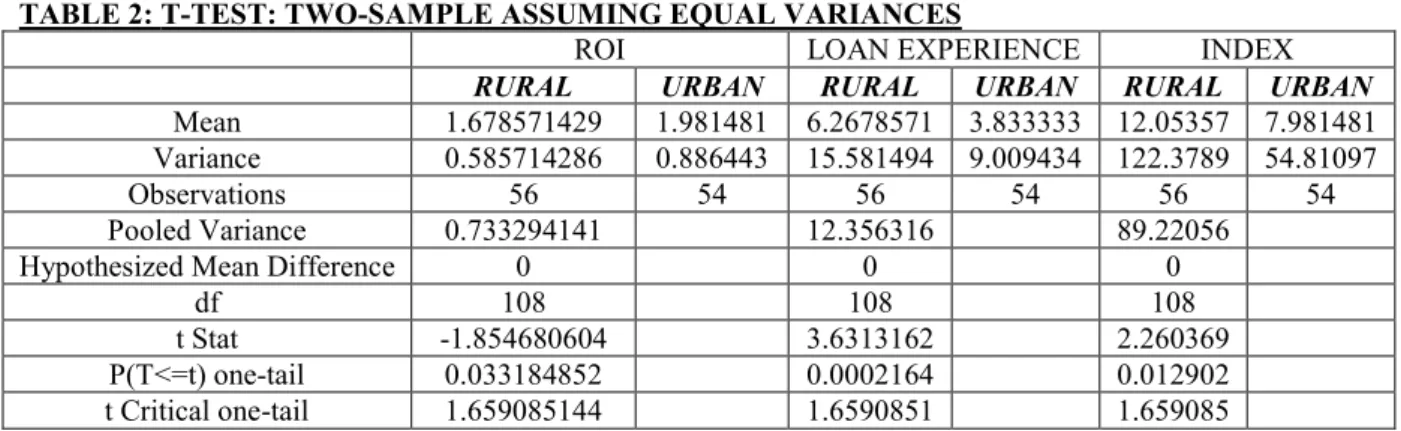
TABLE 2: T-TEST: TWO-SAMPLE ASSUMING EQUAL VARIANCES
ROI LOAN EXPERIENCE INDEX
RURAL URBAN RURAL URBAN RURAL URBAN Mean 1.678571429 1.981481 6.2678571 3.833333 12.05357 7.981481 Variance 0.585714286 0.886443 15.581494 9.009434 122.3789 54.81097
Observations 56 54 56 54 56 54
Pooled Variance 0.733294141 12.356316 89.22056
Hypothesized Mean Difference 0 0 0
df 108 108 108
t Stat -1.854680604 3.6313162 2.260369
P(T<=t) one-tail 0.033184852 0.0002164 0.012902
t Critical one-tail 1.659085144 1.6590851 1.659085
INTERPRETATION OF ROI: The results of two-sample test are given above table. If the test statistic is less than -1.659 or greater than 1.659 at 0.05 level of significance, we reject the null hypothesis in favor of alternative. Here the test statistic is -1.854, which does not fall in the rejection region, so we fail to reject the null hypotheses of no difference between the ROI of rural and urban areas.
INTERPRETATION OF LOAN EXPERIENCE: From the above table it is inferred that the calculated t value 3.63 is higher than the critical value 1.65 at 0.05 level of significance. So we reject H0 and accept H1 therefore it is proved that there is significant difference in loan experience availed from microfinance institutions for the people in rural and urban areas.
INTERPRETATION OF INDEX SCORE: The critical value of t with 108 d.f for one-tailed test is 1.659 and Computed value of t is 2.2603. By comparing the t-critical value with obtained value, it is found that the obtained t value is higher than the critical value at 0.05 level of significance. |t obtained|>=|t critical|=|2.2603|>=|1.659|. So we reject the null hypothesis and proved that there is significant difference in index score of people in rural and urban area.
RESEARCH DISCUSSION
From the analysis it is noticed that all most all the respondents revealed that microfinance helped to improve their standard of living. Through SHGs there was an increase in the socio-economic empowerment among women that helps to make them financially strong as well as it assist them to save certain amount of money for future activities. It also assists customers to better access to loans from banks more easily as compared to pre SHG period. Moreover it encourages customers to increase their savings and to reinvest it in various entrepreneurial activities.
By comparing the service facilitated by MFIs in rural and urban areas separately, we can see considerable changes as people in urban areas are more beneficial from the service provided by MFIs and the main reason behind this is their income status. The people in urban areas have high financial backup as compared to rural areas, so they are more benefitted from the loan facilities availed from MFIs to start their own ventures. But with the help of various SHGs running by government this gap in getting financial support from MFIs is considerably reduced and it is more easy for the people in rural areas to get financial support from banks through these SHGs. Customers can avail loan facility from MFIs without any collaterals and they can also enjoy Interest rate advantage in which the interest rate is much lower in MFIs as compared to conventional banking system, so it will be more helpful for people who are in below poverty line.
Education is another important factor which influences the living standard of people in rural areas in which people in rural areas are not getting any information or acquaintance about the events happening around their society whereby those who are in urban areas are getting more aware about the government schemes, rights and privileges, employment opportunity and the importance of professional jobs, so they try to explore their prospects in a better way. Even though the people in rural areas are not fully availing reimbursement offered by MFIs, till now they are not much interested in borrowing from private lender. The main reason behind in this is trust as well as they cannot afford to buy money at high rate of interest. So this will give an opportunity for MFIs to enhance their performance and widen their services.
CONCLUSION
The present study shows about the social performance management of MFIs in rural and urban areas from customer’s perspective. It shows that micro financial institutions accomplished self sufficiency, this help them to achieve its main goal of poverty alleviation along with the corporation of government. SHGs located in the rural
locale are good platform for the women in village areas for availing financial support from banks through various schemes and also help them to develop their inborn qualities like confidence, skill, courage etc. This kind of support made significant changes in the lives of women’s by giving psychological and social empowerment along with economic empowerment.
This study set out to establish the relationship between income and return on investment of customers with respect to micro financial institutions, loan repayment experience of people in rural and urban areas, skill enhancement and improvement in status of customers in the society after availing finance facilities from MFIs through SHGs and overall improvement in standard of living of customers. After conducting a statistical and theoretical analysis, the paper found that there is no significant difference between the return on investment of customers in rural and urban areas but in case of loan repayment experience of customers there is much difference. On the premises of revelation from this study, we can conclude that the services facilitated by micro financial institutions in rural and urban areas of various districts in Kerala are different. Even though there is much improvement in the living standard of people in rural areas after availing financial support from MFIs running by government. But still the outreach and service portfolio of MFIs are constrained to a limited area. So the government needs to take initiatives to enhance the performance of MFIs and help them to extend their services to a wider area in order to reach the poor people with loans: as more people are reached with financial services, the greater the social benefit.
REFERENCES • http://web.stanford.edu/group/seam/cgi-bin/SEAM/about.html • http://citeseerx.ist.psu.edu/viewdoc/download?doi=10.1.1.683.3445&rep=rep1&type=pdf • http://www.iosrjournals.org/iosr-jef/papers/ICIMS/Volume-1/10.pdf • http://www.omicsonline.com/open-access/analysis-of-microfinance-and-poverty-reduction-in-bayelsa-state-of-nigeria-2224-8358-1-159.pdf • http://www.sdmcujire.in/userfiles/MRP/MRP%20Final_Lnarayana.pdf • http://vista.cira.colostate.edu/improve/Studies/MOHAVE/Reports/ProjectPlan/Chap10.pdf • http://www.gredeg.cnrs.fr/Colloques/NFI/Papers/PapierOnLine/Berguiga.pdf • http://www.microsave.net/files/pdf/The_Competitive_Environment_in_Uganda_Implications_for_Microfina nce_Institutions_and_their_Clients.pdf
• Sangeetha Mohanty, Rashmi Ranjan Mohapatra, & Sashikanta Khuntia (2013). Micro Finance : A Poverty Reduction Tool. Special Issue of International Journal on Advanced Computer Theory and Engineering (IJACTE) ISSN, 2&1. from http://www.irdindia.in/journal_ijacte/pdf/vol2_iss1/13.pdf.
• Mohammad Arifujjaman Khan, Mohammed Anisur Rahaman, & (2007). Impact of Microfinance on Living Standards, Empowerment and Poverty Alleviation of Poor People: A Case Study on Microfinance in the Chittagong District of Bangladesh. Umeå School of Business (USBE), Department of Business Administration.
• Vikas Batra, & Kavita Chakravarty (2012). Impact of Microfinance on Household W elfare of Rural W omen: Evidence from Haryana. Jharkhand Journal of Social Development, IV (1&2). retrieved ISSN 0974 651x,fromhttp://www.iesd.org.in/jjsd/Journal%20pdf/2012-V
1&2%20Impact%20of%20Microfinance%20on%20Household%20Welfare.pdf.
• Kofi Annan, (2005). Microfinance: Banking for the poor, not poor banking. The Hindu,Business Line. • Sibghatullah Nasir, (2013). Microfinance in India: Contemporary Issues and Challenges. Middle-East
Journal of Scientific Research, 15 (2): 191-199. From http://idosi.org/mejsr/mejsr15%282%2913/4.pdf. • Dr. Sangeeta Arora, & Ms Meenu (2011). WOMEN EMPOWERMENT THROUGH MICROFINANCE
INTERVENTION IN THE COMMERCIAL BANKS. Meenu, et.al.,Int. J. Eco. Res, 2(2), 35-45. from http://www.ijeronline.com/documents/volumes/Vol2issue2/ijer20110202%285%29.pdf.
• Sujani Thrikawala, Stuart Locke, & Krishna Reddy (2013). Social Performance of Microfinance Institutions (MFIs): Does Existing Practice Imply a Social Objective?. American Journal of Business and Management, 2(2). from http://papers.ssrn.com/sol3/papers.cfm?abstract_id=2333246.
• Rajalaxmi Kamath, Abhi Dattasharma, & Smita Ramanathan (2013). MFI (Microfinance Institutes) Borrowers: Their loans and Repayments – A study in Ramanagaram, India. INDIAN INSTITUTE OF
MANANGEMENT,BANGLORE, WORKING PAPER NO: 397. from
http://www.iimb.ernet.in/research/working-papers/mfi-microfinance-institutes-borrowers-their-loans-and-repayments-%E2%80%93-study-ramanagaram-1.
• Julian Schmied, (2014). Financial Performance and Social Goals of Microfinance Institutions. Potsdam Economic Papers | 2.
• Rafael Gomez & Eric Santor (2001). Membership has its privileges: the effect of social capital and neighborhood characteristics on the earnings of microfinance borrowers. LSE Research Articles Online, from core.ac.uk/download/pdf/92551.pdf.
• APPAH, EBIMOBOWEI, JOHN, M. SOPHIA, & SOREH WISDOM (2012). AN ANALYSIS OF MICROFINANCE AND PO VERTY REDUCTION IN BAYELSA STATE OF NIGERIA. Kuwait Chapter of Arabian Journal of Business and Management Review , 1(7)
• Gemunu Nanayakkara, Errol R Iselin (2012). An Exploratory Study of the Performance of Micro financing Institutions Using the Balanced Scorecard Approach. International Journal of Business and Information, 7(2).