MPRA
Munich Personal RePEc Archive
Private Debt with Default Risk within
and across Border
Xiang Gao
Iowa State University
1. September 2009
Online at
http://mpra.ub.uni-muenchen.de/18377/
Private Debt with Default Risk within
and across Border
Xiang Gao
Iowa State University
[email protected]
This Draft: August 2009
Abstract
Following Jeske’s (2006) decentralized international risk sharing arrangement where residents have access to international capital markets, this paper studies the presence of resident default risk on bor-rowing happened between domestic agents, in addition to default risk on private debt contracts across border. The paper shows that, without the assumption of perfect domestic contract enforcement, more international risk sharing and higher welfare can be supported. Moreover, the domestic interest rate equals to the highest marginal rate of substitution in countries that are participation constrained in international …nancial markets. This asset pricing result overturns the well established argument that interest rate should be the lowest to induce repayment in closed economy models with domestic credit crisis.
Keywords: Default risk, private debt, limited commitment.
JEL Classification: F34, F41
I am thankful to Rajesh Singh for helpful comments and suggestions. All remaining errors are mine. Address for corre-spondence: Department of Economics, 477 Heady Hall, Iowa State University, Ames IA 50011. E-mail: [email protected].
1
Introduction
In the presence of limited commitment, regardless of complete international …nancial markets, friction still comes from the fact that loans are available only to the extent that their repayments can be enforced by the threat of reversion to autarky. Frictions of this kind result in limited risk sharing between countries across the world. Jeske (2006) predicts that capital centralization increases the national welfare in a decentralized setting where individual agents can lend and borrow internationally. This paper relaxes Jeske’s perfect enforcement assumption on debt contracts between domestic agents, and shows that pervasive enforcement problem can also increase aggregate welfare. Although the increment is not as much as in the case of a resulting planner’s problem when agents are patient enough, my model turns out to be better when consumers are impatient and centralization leads to nothing but autarky.
Jeske (2006) considers an open economy model where each country in the world is populated by di¤erent types of individuals. He assumes that debt contracts between domestic and foreign agents (henceforth international debt) are not enforced, whereas contracts between domestic agents (henceforth domestic debt) are perfectly enforceable. Under these assumptions, allowing private access to international …nancial markets turns out to be inferior than controlling capital ‡ows by centralization because participation constraints are slacker in the latter scenario. Moreover, marginal rate of substitution is equalized across di¤erent types of agents within the same country, thus domestic bond price is determined by that prevailing domestic marginal rate of substitution.
In this paper, I add enforcement problem between domestic agents in Jeske’s (2006) setup. With lim-ited enforcement problem on both domestic and international asset markets, agents now have two options when contemplating a default. If one only defaults on international debt, the punishment is exclusion from international …nancial markets forever while still having access to the domestic market. At this point, what happens if one defaults solely on domestic debt but repaying his international debt is not yet clear. I make the assumption that domestic debt repudiation would result in living on one’s own endowment. In other words, agents are banned from borrowing and lending in all …nancial asset markets after declaring bankruptcy costlessly at domestic court.
The main …nding of this paper is that with no enforcement inside the border more risk sharing can be supported than Jeske’s model. To put it di¤erently, when domestic legal system gives imperfect protection to foreign creditors, there is a rationale in favor of not enforcing debt contracts between domestic agents as well. The reason is the following. Defaulters on international debt now face harsher punishments because of
domestic credit crisis. When defaulters are denied from international markets, their borrowing in domestic markets might be restricted by the domestic debt participation constraint. On the other hand, defaulters in Jeske’s model can still trade international debtfreely andindirectly by using other non-defaulted domestic residents as intermediaries with domestic contracts perfectly enforceable.
We see that to improve welfare both capital control by government and not enforcing domestic contracts would work. Which is better? The answer depends on the stochastic endowment distribution for all residents living in the same country. Speci…cally, capital control is always better when the endowment structure is such that government can reallocate the aggregate endowment without making any resident worse o¤ than living by his own endowment.
The assumption about punishing domestic and international defaulters di¤erently overturns the domestic bond pricing rule in the commitment problem literature. In this paper, domestic bond price equals to the minimum of marginal rate of substitution among all domestic agents living in the same country that is constrained internationally as a whole. In the previous literature, domestic bond price equals to the maximum of marginal rate of substitution among all domestic agents in absence of private international …nancial markets1. And in Jeske’s (2006) model with private international borrowing and lending available, marginal rate of substitution is equalized within the country since no commitment problem within border and the domestic bond price equals to that marginal rate of substitution.
The remainder of the paper is organized as follows. Section 2 reviews important works related to my model in the order of evolution of ideas. In section 3, I present the model of international lending and borrowing with enforcement problem within and across border and derive competitive equilibrium results. Section 4 compares the level of risk sharing and welfare in di¤erent setup, thus gives policy implications. Section 5 introduces a simple numerical example that illustrates the result. Section 6 concludes and …nally a technical Appendix includes all proofs.
2
Literature Review
Commitment problem can lead to limited risk sharing between agents within the same country and/or across countries. Early works contribute to …nding satisfying participation constraints on the individual level to decentralize the planner’s allocations with competitive equilibrium. In Kehoe and Levine (1993), these allocations are decentralized within an Arrow Debreu set up where participation constraints are modeled as
direct restrictions on the consumption possibility sets. Kocherlakota (1996) studies the same environment, but let the risk sharing parties interact strategically. The constrained allocation was decentralized as a dynamic game where participation constraints become restrictions derived from the requirement of sub-game perfect. Alvarez and Jermann (2000) decentralize e¢ cient allocations with sequentially trading markets, in which agent maximizes utility under a system of solvency constraints that are appropriately set on Arrow debt. Wright (2006) implements decentralization with governmental capital controls in the form of tax on debt, where tax plays the role of adjusting general world prices of Arrow securities to type, country and history dependent ones. Krueger (2000) predicts that Alvarez and Jermann’s and Wright’s way of decentralization are essentially the same, where in Wright everyone faces the same natural borrowing constraint but government makes price of Arrow securities contingent on types through tax, and in Alvarez and Jermann each agent confronts the same prices but personalized solvency constraint. Kehoe and Perri (2004) decentralize e¢ cient allocations in the environment where agent deals with only resource constraint while taking as given national default probabilities set by governments, and government default decisions are endogenized by dynamic game ex-ante. All the above decentralization methods are designed to limit borrowing to levels that ensures debtors have no incentive to default. Because of the enforcement constraints, borrowing amount is smaller than the one in an economy without enforcement problem. Models with enforcement constraints have been used for studying the implications of real business cycle models as in Kehoe and Perri (2002). Some authors have also applied these models to investigate asset pricing implications including Alvarez and Jermann (2001), Azariadis and Lambertini (2002), Lustig (2007) and Krueger, Lustig and Perri (2008). Krueger and Perri (2006) use the model to address the question of consumption inequality in the United States. Bodenstein (2008) examines the extent to which models with complete markets and enforcement constraints for international …nancial contracts can resolve the exchange rate volatility puzzle and the Backus-Smith puzzle.
However, the punishment of completely excluding defaulters from future trading might be the harshest punishment that is available. A growing branch of the literature has sought to relax it in ways that the speci…cation of the punishments is carefully modeled, and even endogenous. Kehoe and Levine (1993) themselves describe partial exclusion as the situation where agents may retain some access to international capital markets even after the default. As one can expect, the size of international capital ‡ow would decrease more since the punishment is not so severe. When individuals have access to international capital markets as studied by Jeske (2006), partial exclusion arise because individual defaulters can re-enter world markets
indirectly by using others as intermediaries. Jeske (2006) shows that this decentralized arrangement is welfare inferior to a centralized arrangement, where individual access to international asset markets is prohibited, only government borrows internationally and apportions among residents. Therefore, there is a positive role for government regulation of international borrowing. Wright (2006) builds on the analysis of Jeske and argues that international capital ‡ow subsidies can also lead to constrained e¢ cient allocations instead of Jeske’s radical way of centralization. This paper continues with Jeske’s decentralized setup and assumes that debt contracts between domestic residents are not enforced either. Thus, defaulters’ plan to re-enter international markets indirectly through other non-defaulting agents is hindered by constrained domestic borrowing. The resulting equilibrium allocation in this paper is better than the one from Jeske’s debt constrained equilibrium, but it is not as e¤ecient as centralization in terms of the increment of a country’s aggregate welfare level. Another way to model partial exclusion is simply punishing defaulters by preventing them from further borrowing but still entitling them the right to save internationally at market interest rates. Bulow and Rogo¤ (1989) …rst use this idea to show that once savings are allowed, no positive debt equilibria exist. However, they focus on a small open economy that takes the world interest rate as given (partial equilibrium). Hellwig and Lorenzoni (2007) then carry further their ideas to a general equilibrium (multi country) set up and show that private liquidity equilibria can exist with low equilibrium interest rates. Finally, Mark Wright (2006) establishes an equivalence result between the above two reduced default penalties. The equivalency is limited only by the fact that in Jeske’s model, there is an extra dimension of heterogeneity among residents of a country. Speci…cally, Wright shows …rst that every private liquidity equilibrium in Hellwig and Lorenzoni (2007) is also a debt constrained equilibrium with individual default risk in Jeske (2006). He then goes on to show that for every debt constrained equilibrium with individual default risk, there exists a set of representative agents such that the equilibrium allocations are attained in the corresponding private liquidity equilibrium. The intuition is that excluded resident in default can still save domestically at an international interest rate through others, however, when they borrow, they face a domestic interest rate that is much higher than the world interest rate. Thus it is as if they were excluded from borrowing but can still save internationally. Reduced penalty can be due to other internal opportunities as well. For example, Kehoe and Perri (2002, 2004) studied international risk sharing in a real business cycle model under production shock instead of exchange economy, with capital accumulation in which country’s autarky utility depends on the quantity of capital the country has accumulated up to defaults. In their
capital and other …nancial assets. All these models capture the fact that agents have alternative ways to smooth their consumption, making life after default less painful than it would be otherwise.
There are still a number of other studies in which default is assumed to induce punishments other than autarkic consumption of an endowment forever. Lustig (2007) studies an economy in which bankruptcy results only in seizure of a collateral asset not labor income, with bankrupt agents resuming their participation in …nancial markets after default. Lustig and Van Nieuwerburgh (2006) examine economies in which housing acts as collateral, and bankruptcy results only in the seizure of that asset. Azariadis and Kaas (2004) characterize the equilibrium when bankruptcy is costly and exclusion ends with …nite periods. Saunders (2004) describes an environment where while banished from …nancial assets markets, agents can still self-insure by accumulating and decumulating the non-collateral asset through trade after having reneged on a …nancial contract. Saunders (2007) characterizes (up to a technical condition) the set of allocations that may be interpreted as e¢ cient with respect tosomepunishment. He then illustrates how e¢ cient allocations can be decentralized in Arrow-Debreu markets with solvency constraints that set lower limits on agents’claims positions as in Alvarez and Jermann (2000).
To sum up, of critical importance in such work with partial default punishment is the speci…cation of what agents may be entitled after a deviation from contracted actions. The speci…cation in this paper is that individual defaulters on international debt can still borrowing in world markets indirectly through others but the amount they borrow from domestic peers is restricted because of not domestic enforcement.
3
Model
The paper considers a world that consists of a …nite number of countries denoted as m= 1; :::; M and each countrymis populated byNtypes of residents with a continuum of them in each typen= 1; :::; N:2Residents live forever so that time is in…nite and discrete, denoted byr=t; t+1; t+2; :::;1:3 Information about current
and future endowments is indexed by the state r 2 : History is summarized in r f t; t+1; :::; rg 2
2Unlike Jeske (2006), I am assuming that in any country m the mass of type n agents m
n is normalized to 1 for all n2 f1;2; :::; Ng:Note that in Jeske’s (2006) model one’s endowment only depends on type not country. This means that the same type of agents in di¤erent countries receive the same endowment each period. As a result, assuming m
n = 1for allnand min Jeske’s model implies that countries are symmetric ex-ante, thus there may not be any role for international capital ‡ow. However, in this paper one’s endowment vary upon both type and country, which will be clear after I introduce history and endowment structure. mn = 1simpli…es notation but still brings in the need for international borrowing and lending.
r t+1:Transition probability from today’s history rto tomorrow’s state
r+1 is given by ( r+1j r)with the initial history t given. ( rj t)means the probability of observing r=f t; t+1; t+2:::; rg given the
history t:There is only one non-storable consumption good which can be exchanged internationally. I denote byem
n( r
)the endowment of a typenresident in countrymafter history rand bycm n(
r
)the corresponding consumption. There are M domestic bonds for each country m2 f1;2; :::; Mg and only one international
bond traded across the world. Letbm
n( r
; r+1)and fnm( r
; r+1)respectively be the amounts of domestic
and foreign state-contingent securities held by agents of type n living in country m; which are purchased
after history rand for payment next period in state r+1;pm( r; r+1)andq( r; r+1)are their respective prices. For all types of residents in all countries, I use 2(0;1) as the discount factor and denote byU( ) the period utility function which is strictly increasing, strictly concave, and twice continuously di¤erentiable. Thus, after initial history t;individual residents have life time preferences given by
1 X r=t r tX rj t ( rj t)U(cmn( r)):
Besides the fact that domestic court does not enforce contracts between domestic agents and foreigners, I add another layer of …nancial friction that domestic agents can declare bankruptcy to renege debt contracts between themselves and other domestic residents. Border still matters here because defaults on di¤erent types of debts (international or domestic) lead to di¤erent results. I assume that an individual defaulter on international debts can still trade internationally indirectly, through borrowing from other domestic agents in the same country. I call this scenario resident international autarky. However, an individual who defaults
on domestic debts in the …rst place would be denied of access from any …nancial markets. I refer to this
situation as resident autarky. The value of resident autarky for an agent of type nin countrym after any history tis Amn( t) 1 X r=t r tX rj t ( rj t)U(emn( r)); (RA)
regardless the agent has defaulted or not on international debts. By de…nition, Am
n( t) is the discounted
utility when the agent simply consumes his endowments every period from defaulting dateton.
De…nition 1 Type n agent from country m lives in resident autarky after any history t if his period consumptioncm;A
n ( r) =emn( r)for all r2[t;1)and all histories r:
Since all residents are small relative to the market, a resident that defaults on international debt does
so by assuming that the sequence of prices in domestic markets fpm( r
; r+1)gr2[t;1) stays unchanged. Consider the same agent above reneges only on international debts in history t, after default, his value can
be represented as Vnm( t; bmn( t)) max fcm n( r);bmn(r+1)gr2[t;1) 1 X r=t r tX r j t ( rj t)U(cmn( r)); (RIA)
subject to the resource constraint
emn( r) +bmn( r)>cmn( r) + X
r+1
pm( r; r+1)bmn( r; r+1); the participation constraint in domestic …nancial markets
Vnm( r; bmn( r))>Amn( r); (1) for allr2[t;1)and any history r, and the no-Ponzi condition
bmn( r; r+1)> B for all ( r; r+1); with
bmn( t)given,
where bm
n( t) denotes the initial domestic bond holdings when the agent enters period t and B >0 is too
large for no-Ponzi condition to bind in equilibrium, therefore ensures compactness of the budget set. Notice that the domestic participation constraint (1) in resident international autarky problem is crucial in this paper since removing this constraint takes us back to Jeske’s model.
De…nition 2 Given a price sequencefpm( r;
r+1); q( r; r+1)gr2[t;1)and initial domestic asset holdings in
any history t; typenagent from countrymlives inresident international autarky after tif his future consumption and debt allocationfcm;D
n ( r); bm;Dn ( r; r+1)gr2[t;1)solves the problem (RIA) with initial bond
holdingbm n(
t
)given.
Up to now, I have de…ned the utility level of outside options for a defaulter in (RA) when he repudiates domestic debt claims, and in (RIA) when he chooses to renege on international debts. I am ready to present the consumer’s problem in which both international and domestic participation constraints are used to ensure that defaults are never optimal in equilibrium. In history tbefore any default, resident’s problem is to choose sequences for consumption and for holdings of both domestic and international bonds to maximize life time utility under budget and participation constraints.
Wnm( t; bmn( t); fnm( t)) max fcm n(r);bmn(r+1);;fnm( r+1)gr2[t;1) 1 X r=t r tX rj t ( rj t)U(cmn( r)); (RP)
subject to the budget constraint emn( r) +bmn( r) +fnm( r) (2) > cmn( r) + X r+1 pm( r; r+1)bmn( r; r+1) + X r+1 q( r; r+1)fnm( r; r+1); the participation constraint in international asset markets
Wnm( r; bmn( r); fnm( r))>Vnm( r; bmn( r)); (3) the participation constraint in domestic asset markets
Wnm( r; bmn( r); fnm( r))>Amn( r) (4) for allr2[t;1)and all histories r, and
bmn( r; r+1)> B; fnm( r; r+1)> F for all ( r; r+1); with the initial bond holdings
bmn( t)andfnm( t)given and the bond price sequences
fpm( r; r+1); q( r; r+1)gr2[t;1) given.
To solve the problem, one has to notice the fact that international participation constraint (3) implies the domestic participation constraint (4) is also satis…ed because Vnm( r; bmn( r))is always greater or equal to
Am
n( r)for all histories r> tby de…nition of problem (RIA). Hence, constraint (4) is redundant in …nding
optimal solutions to the resident’s problem (RP). Intuitively, no one defaults on domestic debst before international debts in the equilibrium. This is a direct result from the assumption I made that defaults on domestic debt lead to living on one’s own endowment forever, which is much harsher than defaults on international debt. The assumption simpli…es life by ensuring that the domestic …nancial market friction I added would only a¤ect the equilibrium indirectly through the resident international autarky utility level,
Vm
n ( r; bmn( r)); appearing only in (3). The rest of this section …rst de…nes and then characterizes the
equilibrium results in this default free economy.
De…nition 3 A trade equilibrium is an allocationfcm n( r ); bm n( r ; r+1); fnm( r ; r+1)gr2[t;1) and a price sequencefpm( r;
r+1); q( r; r+1)gr2[t;1) such that each agent solves his problem (RP) given price sequences
and initial asset holdings, resource feasibility is satis…ed:
M X m=1 N X n=1 cmn( r) M X m=1 N X n=1 emn( r);
and bond markets clear conditions including domestic and international ones:
N X n=1
bmn( r; rt+1) = 0; for all r+1 and all m;
and M X m=1 N X n=1 fnm( r; r+1) = 0; for all r+1
for allr2[t;1)and all histories r:
The Lagrangian of the consumer’s problem (RP) is (drop the superscript and subscript for simplicity)
LW = 1 X r=t r tX r jt ( rj t)U(c( r)) + + 1 X r=t X rjt ( r) [e( r) +b( r) +f( r) c( r)] 1 X r=t X r jt ( r) [p( r; r+1)b( r; r+1) +q( r; r+1)f( r; r+1)] + 1 X r=t X r jt ( r) 2 4X1 s=r s r X sj r ( sj r)U(c( s)) V( r; bmn( r)) 3 5; where m
n( r)and mn( r)denote respectively the Lagrange multipliers on the budget constraint (2) and the
international participation constraint (3) of agentnin countrymafter history r occurred. First order conditions are: with respect to c( r);
r t ( rj t)U0(c( r)) ( r) + r X s=t ( s) r s X rj s ( rj s)U0(c( r)) = 0; (5) with respect tob( r; r+1); p( r; r+1) ( r) + ( r; r+1) ( r; r+1) @V( r; r+1; b( r; r+1)) @b( r; r+1) = 0; (6)
and with respect tof( r; r+1);
q( r; r+1) ( r) + ( r; r+1) = 0: (7)
Using equation (5) to get
( r) = r t ( rj t)U0(c( r)) 2 41 + r X s=t X rj s ( s) t s ( r j s) ( rj t) 3 5: (8)
Before I can utilize equation (6), I need to solve the previous resident international autarky problem in order to get a closed form of the envelope condition, @V(r; r+1;b( r; r+1))
@b(r;
To solve problem (RIA), …rst write down the Lagrangian of the consumer’s problem in resident interna-tional autarky. LV = 1 X r=t r t X rj t ( rj t)U(c( r)) + 1 X r=t X r j t ( r) 2 4e( r) +b( r) c( r) X r+1 p( r; r+1)b( r; r+1) 3 5 + 1 X r=t X rj t ( r) 2 4X1 s=r s r X sjr ( sj r)U(c( s)) Amn( r) 3 5:
Let mn( r) be the Lagrange multipliers imposed on participation constraint (1) of agent n in country m
after history r in problem (RIA). First order condition with respect to consumptionc( r)is
r t ( r j t)U0(c( r)) ( r) + r X s=t ( s) r s X rjs ( rj s)U0(c( r)) = 0:
Rewrite it to get an expression for the Lagrange multiplier ( r)on budget constraint,
( r) = r t ( rj t)U0(c( r)) 2 41 + r X s=t X rjs ( s) t s ( r j s) ( rj t) 3 5: (9)
Envelope theorem with respect to the initial domestic debt holdingsbm n( t )yields @V( t; b( t)) @b( t) = @LV @b( t) = ( t): (10)
Combining (9) and (10) together, I can get
@V( t; b( t)) @b( t) = t t ( t j t)U0(cD( t)) 2 41 + t X s=t X t j s ( s) t s ( t j s) ( tj t) 3 5 = 1 + ( t) U0(cD( t));
wherecD( t)is the consumption at tin the optimal sequence cD( r)
r2[t;1)that solves the maximization problem (RIA). Iterating @V(@bt(;bt()t)) one period forward generates
@V( t; t+1; b( t; t+1))
@b( t; t+1)
= 1 + ( t; t+1) U0(cD( t; t+1)): (11)
Now, I can go back to problem (RP) and solve for the domestic bond prices using equation (8), (6) and (11), which yields p( r; r+1) = ( r; r+1) ( r; r+1)@V( r; r+1;b( r; r+1)) b( r; r+1) ( r) (12) = ( r ; r+1) ( r; r+1) [1 + ( r; r+1)]U0(cD( r; r+1)) ( r) = U0(c( r ; r+1)) U0(c( r)) ( r+1j r) 1 +A2 (1 + ( r; r+1))A1 1 +A3 ;
where A1 = ( r; r+1) r 1 U0(cD( r; r+1)) U0(c( r; r+1)) 1 ( r; r+1j t) ; A2 = r+1 X s=t X r; r+1js ( s) s ( r; r+1j s) ( r; r+1j t) ; A3 = r X s=t X rjs ( s) s ( r j s) ( rj t):
Solving for international bond prices by equation (8) and (7) leads to
q( r; r+1) = ( r; r+1) ( r) (13) = U 0(c( r; r+1)) U0(c( r)) ( r+1j r )1 +A2 1 +A3 :
The proceeding of all proofs in this paper closely follows Jeske (2006) with slight change to accommodate
the extra enforcement problem within border. Consider some agents with typenin countrymafter history
t for whom both m
n( t)>0andvmn( t)>0. Therefore, in ttheir international participation constraints
(3) are binding in the trade equilibrium of problem (RP), and their domestic participation constraints (1) bind in the resident international autarky problem (RIA). That is to say, they attain the same utility level in resident international autarky and in trade equilibrium so that they are indi¤erent between defaulting and
repaying their international debts by m
n( t)>0. Proposition 1 states that at history t not only do they
have identical discounted future utility, but they consume exactly the same amount of goods every period
from ton as well.
Proposition 1 In equilibrium, if m
n( t)>0for somem; n; t;thencm;Dn ( r)andcmn( r)are identical for all r
= t; t+1;:::; r happening with positive probability and allr2[t;1];wherecm;Dn ( r)andcmn( r)denote
the optimal consumption path in resident international autarky problem (RIA) and in resident’s problem (RP) for type nagents in country m;respectively.
Proof. See Appendix 6.
I get the same result above as in Jeske’s (2006) proposition 1. Next proposition is new since it is derived from adding enforcement problem in domestic contracts. If indi¤erent agents with mn( t) > 0 choose to
default on international debt and live in resident international autarky ever after, then they achieve the same utility level as in the resident autarky because the Lagrange multiplier m
n( t)on constraint (1) in problem
(RIA) is strictly greater than0: Jeske assume a perfect enforcement environment in home country, thus no agents are domestic participation constrained back in the domestic asset markets in his model. Proposition
2 says that these double constrained agents can neither borrow nor lend domestically beyond the optimal domestic debt holdingbm
n( t
)in history t 1in trade equilibrium. Otherwise, the international participation constraint (3) in resident’s problem (RP) would be violated.
Proposition 2 In equilibrium in addition to m n(
t
)>0, if m
n( t
)>0 for some m; n; t; then for agents typen in countrym;
(I) their resident international autarky utility,Vm n (
t
; bm n(
t
));increases (decreases) faster than their util-ity when staying with the trade equilibrium with regards to an increase4 (decrease) in domestic bond
holdings, @Vm n ( t; bmn( t)) @bm n( t ) > @Wm n ( t; bmn( t); fnm( t)) @bm n( t ) ;
(II) their domestic asset market participations (4) in the trade equilibrium also bind,
Wnm( t; bmn( t); fnm( t)) =Amn( t):
Proof. See Appendix 6.1.
In history t 1;this group of agents with m
n( t
)>0 and m
n( t
)>0 has three things to worry about when participating in the …nancial markets. First of all, they are borrowing constrained in international asset
markets by assumption because next period they are internationally participation constrained, m
n( t
)>0.
Secondly, they are also borrowing constrained in domestic asset markets in the trade equilibrium by part (II) of proposition 2. Finally, they are in addition lending constrained in domestic asset markets because a little bit more lending beyond the thresholdbm
n( t)would violate the international participation constraint
(3) by part (I) of proposition 2. The threshold bm n(
t
) is de…ned as the optimal domestic bond holding to
the problem (RP). The second and third facts are direct results due to the assumption m
n( t) >0; and
the thrid observation is critical to prove the next proposition 3. To make things clear, I introduce another
group of agents with m
n( t)>0 but vmn( t) = 0 in Corollary 1 before diving into next proposition. This
newly joined group is participation constrained in international asset markets when staying with the trade equilibrium, but their domestic participation constraints (1) in resident international autarky are slack in history t. I.e., even if they do default on international debt and reverse to resident international autarky in history t, they can still borrow and lend freely with domestic peers. The order of discounted future utility
4An increase in one’s domestic bond holdings means the agent lends consumption goods to others. Similarly, a decrease
for them is
Wnm( t; bmn( t); fnm( t)) =Vnm( t; bmn( t))> Amn( t):
Corollary 1 states that this group has full access to the domestic …nancial market in the trade equilibrium. Changes inbm
n( t)cause resident international autarky utility and trade equilibrium utility to change at the
same pace. Thus, domestic …nancial activities do not a¤ect their international participation constraints (3) at all. People in this group behave in consistence with international participation constrained agents from Jeske’s (2006) model.
Corollary 1 In equilibrium, if mn( t)>0 for somem; n; t;then for agents type nin country m;
m n( t ) = 0, @V m n ( t ; bmn( t)) @bm n( t) =@W m n ( t ; bmn( t); fnm( t)) @bm n( t) :
Proof. See Appendix 6.1.
In general, the international participation constraint (3) makes resident’s problem (RP) non-convex. To show that the …rst order conditions for a maximum are also su¢ cient. I use Jeske’s method of de…ning an alternative maximization problem with the same objective function and a convex constraint set that is a superset of the original non-convex set. I then show that a solution to the original non-convex problem is also a¤ordable and individually rational in the alternative convex problem. It turns out that both problems have identical …rst order conditions, thus the solution to the original problem is also the solution to the alternative problem. In conclusion, …rst order conditions for the alternative convex problem characterize the global maximum for the original non-convex problem as well. The proof of next proposition in Appendix 6.2 formalizes the verbal deduction here.
Proposition 3 Together with a transversality condition
lim T!1 TX T U0(cmn( T)) ( Tj t) h
bmn( T) +fnm( T)i= 0 for all typen and countrym;
the …rst order conditions (6), (7) and (8) are su¢ cient to characterize the optimal solutions to the resident’s problem (RP).
Proof. See Appendix 6.2.
The next proposition states that, given any history, within each countrym either everyone is borrowing constrained internationally or no one is, even if residents are heterogeneous in terms of endowments. This result is not strikingly surprising any more since it is the same as Jeske’s (2006) proposition 4. Relaxing the assumption of no domestic commitment problem has no a¤ect on this one-binds-all-bind feature in trade equilibrium.
Proposition 4 For all countriesm= 1; :::; M and all histories( r; r+1)withr2[t;1];eitherq( r; r+1)> pm( r ; r+1) and mn( r ; r+1) > 0 for all n = 1; :::; N; or mn( r
; r+1) = 0 for all n = 1; :::; N and
q( t; t+1) =pm( t; t+1):
Proof. See Appendix 6.3.
In the rest of this paper, I will refer one of country m’s residents is internationally participation con-strained as countrymas a whole is internationally participation constrained because these two expressions are the same as implied by the above proposition. Similarly, I will refer the case when no one in countrymis international participation constrained as countrym’s international participation constraint is slack. Finally, I am now ready to show how domestic and foreign bond prices are determined in the trade equilibrium.
Proposition 5 In equilibrium, for all n; mand histories( r; r+1)withr2[t;1);
(I) the price for the universal international bond is
q( r; r+1) = max m=1;:::;M;n=1;:::;N U0(cm n( r; r+1)) U0(cm n( r )) ( r+1j r ) ;
(II) the prices for domestic bonds in country m2 f1; :::; Mg are
pm( r; r+1) = 8 > < > : min n=1;:::;N n U0(cm n( r; r+1)) U0(cm n(r)) ( r+1j r )o if m n( t ; r+1)>0 for any n; q( r; r+1)if nm( t; r+1) = 0for any n. and
(III) …nally the relationship between allM domestic bond prices and the unique international bond price,
q( r; r+1) = max
m=1;:::;Mfp m( r;
r+1)g:
Proof. See Appendix 6.4.
The international bond price has to be the maximum of the marginal rate of substitution among allN
types across all M countries. Alternatively, the international interest rate equals to the minimum of the
reciprocal of all existing marginal rate of substitution so that paying back international debts would not hurt debtors as much as living isolated from the world.
The second part of proposition 5 says that if countrymis internationally participation constrained, then its domestic bond price is equal to the lowest marginal rate of substitution among all resident types within
m. This result di¤ers from the closed economy model with domestic debt enforcement problem in this strand of literature where domestic interest rate must be the lowest possible to guarantee debtors have the incentive
to ful…ll their obligations.5 The discrepancy comes from the fact that a domestic default can never occur without a default on international debt in this paper. Domestic interest rate as a device to ensure repayment of domestic debts is no longer needed. Instead, domestic interest rate plays a role of making punishment on international default harsher, thus higher international capital ‡ow can be supported. Consider agents in a constrained country with marginal rate of substitution strictly greater than domestic bond price. When they are contemplating a default on international debt, they …nd themselves more miserable in resident international autarky because the domestic interest rate is higher than the level they would accept. However, if countrym’s international participation constraint is slack, then its domestic bond price is identical to, the highest bond price around the world, international bond price. This equivalence rules out the possibilities of arbitrage. The third part of the result is a direct result of combining the …rst and second parts together.
4
Welfare Analysis
In this section, I brie‡y introduce Jeske’s (2006) private borrowing problem where enforcement problem only happens between domestic agents and foreigners, and show that problem (RP) with pervasive enforcement
problem improves welfare in Jeske’s model. Consider type n agents in country m renege on international
debt in any history t, his value after default can be represented as
Vnm;J( t; bmn( t)) max fcm n( r);bmn( r+1)gr2[t;1) 1 X r=t r tX rjt ( rj t)U(cmn( r)); (RIAJ)
subject to the resource constraint
emn( r) +bmn( r)>cmn( r) +X
r+1
pm( r; r+1)bmn( r; r+1); for allr2[t;1)and any history r, and the no-Ponzi condition
bmn( r; r+1)> B for all ( r; r+1);
fpm( r; r+1)gr2[t;1) andbmn( t)given.
Again in history tbefore any default, consumer’s problem is to choose sequences for consumption and for
holdings of both domestic and international bonds to maximize life time utility under budget and participa-tion constraints: Wm;J n ( t; bmn( t); fnm( t)) max fcm n(r);bmn(r+1);;fnm(r+1)gr2[t;1) 1 X r=t r t X r j t ( rj t)U(cm n( t)); (RPJ)
subject to the budget constraint emn( r) +bmn( r) +fnm( r) > cmn( r) +X r+1 pm( r; r+1)bmn( r ; r+1) + X r+1 q( r; r+1)fnm( r ; r+1); the participation constraint in international asset markets
Wnm;J( r; bmn( r); fnm( r))>Vnm;J( r; bmn( r)); (14) for allr2[t;1)and all histories r, and
bmn( r; r+1)> B; fnm( r; r+1)> F for all ( r; r+1); with the initial bond holdings
bmn( t)andfnm( t)given and the bond price sequences
fpm( r; r+1); q( r; r+1)gr
2[t;1) given.
In an economy with domestic enforcement problem in addition to across border enforcement problem, more international risk sharing and higher welfare are possible. The intuitive explanation is that everyone in the economy now faces a more severe penalty (lower utility in resident international autarky) because of the presence of domestic friction. Assume that a small open economy stops enforcing contracts between its domestic residents. Then the original allocation is both a¤ordable, since both domestic and international bond prices do not change, and individual rational, since international participation constraints are less tighter. Hence, agents in an economy with no enforcement on domestic contracts can do at least as well as individuals borrowing and lending freely in the domestic market. If there are types of agents for whom the Lagrange multipliers on domestic market participation constraints are positive in resident international autarky, and if in addition there is a history with positive foreign capital in‡ow for the same types of agents in Jeske’s economy with private borrowing, adding domestic enforcement problem can do strictly better by relaxing the international constraint in that history.
Proposition 6 Letfm;J
n ( r; r+1)be the optimal international bond holdings to problem (RPJ) at( r; r+1).
For alln; m; bmn( r); and t
Moreover, if the initial bond holdings in international assetsfm
n ( t)are the same in (RP) and (RPJ) for all t
;then
Wnm( t; bmn( t); fnm( t))>Wnm;J( t; bmn( t); fnm( t));
with strict inequality if there is ( r; r+1) for all r 2 [t;1) such that mn( r
; r+1) > 0 in (RP) and
fm;J
n ( r; r+1)<0 in (RPJ).
Proof. See Appendix 6.5.
There are other ways to improve aggregate utility in Jeske’s (2006) private borrowing model with full domestic commitment. For example, Jeske himself proposes a centralized economy arrangement in which sovereign government deprive individuals of the rights to lend and borrow both internationally and domesti-cally. Instead, government reallocates the country’s endowment plus foreign capital ‡ow among all residents, and it decides whether or not to renege on international debt owned by the country. The rest of section de…nes the centralization setup and shows that it is better than private borrowing and lending with pervasive commitment problem under the condition that for all agents sharing is at least as good as resident autarky.
The centralized economy mwould get the utility of autarky if there occurs a national default. Assume
that government of country m is benevolent with respect to its own residents and use the weight 'm
n for
each type of agents. Jeske shows that if the utility is CES then the amount of foreign borrowing does not depend on the weights. Also in the centralized economy, government can make arbitrary lump-sum transfers between its residents. The weighted average utility in international autarky since history tcan be denoted as Vm( t;f'mng) max fcm n( r)gr=t;:::;1 N X n=1 'mn 1 X r=t r t X r j t ( rj t)U(cmn( r)); (15)
subject to the resource constraint,
N X n=1 cmn( r) N X n=1 emn( r); for all r> t:
The government retains access to international …nancial markets before a default. fmis used to denote the
holdings of government debt. The government’s problem in countrymis
Wm( t; fm( t);f'mng) max fcm n( r);fm( r+1)gr=t;:::;1 N X n=1 'mn 1 X r=t r tX rj t ( rj t)U(cmn( r)); (16) subject to N X n=1 emn( r) +fm( r)> N X n=1 cmn( r) +X r+1 q( r; r+1)fm( r; r+1);
Wm( t; fm( t);f'mng)>Vm( t;f'mng);
for allr2[t;1)and all histories r, and
fm( r; r+1)> F for all ( r; r+1); with the initial bond holdings and the international bond price sequence
fm( t);fq( r; r+1)gr2[t;1) given.
That is, the government redistributes the country’s total endowment plus the net borrowing while the participation constraint is satis…ed.
Proposition 7 If 1 X r=t r tX r j t
( t)U(cmn( t))>Amn( t)for allnand t;wherecmn( t)solves problem (15),
then for alln;f mngn=1;:::N and t
Wm( t; fm( t);f'mng)> N X n=1 m nWnm( t; bmn( t); fnm( t));
with strict inequality if there is history( r; r+1)with
N X n=1
fm;P
n ( r; r+1)<0such that the optimal allocations
are non-autarkic, wherefm;P
n ( r; r+1)solves (RP).
Proof. See Appendix 6.6.
5
Numerical Example
Consider a world with two countries, country 1 and country 2, each of them is populated by a unit mass of residents with identical log utility. Residents live forever and time is discrete. In both countries, aggregate
endowment of a non-storable good alternates between high state1 +y and low state 1 y, and half of the
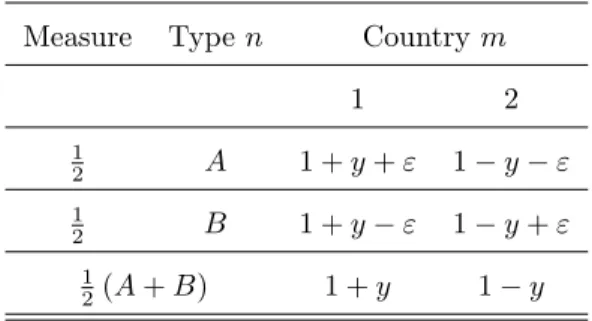
residents is referred as type A who face idiosyncratic endowment shock with negative " in low state and positive " in high state while another half is called type B who face just the opposite idiosyncratic shock as type A, with positive " in low state and negative " in high state. The endowment structure at t can be summarized in the following Table 1, superscriptm=f1;2g denotes country and subscriptn=fA; Bg
Table 1. Endowment structureemn;t
Measure Typen Countrym
1 2 1 2 A 1 +y+" 1 y " 1 2 B 1 +y " 1 y+" 1 2(A+B) 1 +y 1 y
and Table 2 presents the endowment structure att+ 1
Table 2. Endowment structureemn;t+1
Measure Typen Countrym
1 2 1 2 A 1 y " 1 +y+" 1 2 B 1 y+" 1 +y " 1 2(A+B) 1 y 1 +y
The endowment structure repeats itself every two periods. Country 1 as a whole is internationally participa-tion constrained at all even numbered periodst; t+ 2; :::;1, even type B with a relatively lower endowment. At odd numbered periods t+ 1; t+ 3; :::;1; all residents in country 1 are unconstrained even for type B with a higher endowment. Country 2 experiences just the opposite of country 1, participation constrained at odd periods and unconstrained at even periods. In the rest of this section, I present 3 di¤erent scenarios in the order of Jeske’s model …rst, then centralized economy and …nally my model. The mission is to …nd out which case gives the smallest self enforcing deviation in consumption smoothing.
5.1
Private Borrowing with Full Commitment Domestically
Because domestic contracts are enforced di¤erent types in the same country consume the same amount every period. By symmetry, we know the consumption follows this pattern
c1t = 1 +x; c1t+1= 1 x; for country 1;
Country 1 (2) is participation constrained at t (t+ 1), the net payments to foreigners discounted by domestic bond prices are zero
x y+q(y x)
1 pq = 0; (17)
where the price for internationally traded bond denoted byq is determined by the marginal rate of substi-tution of the type who is unconstrained next period. In other words, international bond price is determined
by the country whose residents consume1 +xtoday and1 xtomorrow.
q= 1 +x
1 x; (18)
and pdenotes the price for domestically traded bonds when the country is participation constrained next
period
p= 1 x
1 +x:
As a result, for both countries fromton the price sequence for domestically traded bonds alternates like the following p1 = 8 > < > : p; fort; t+ 2; t+ 4; ::: q; fort+ 1; t+ 3; ::: ; p2 = 8 > < > : q; fort; t+ 2; t+ 4; ::: p; fort+ 1; t+ 3; ::: :
There are two solutions to equation (17). The …rst is autarky, or x=y;while the second requires q= 1;
which further impliesx= 11+ using equation (18).
5.2
Centralized Borrowing
A representative agent with aggregate endowment has the following allocation
c1t = 1 +xc; c1t+1= 1 xc; for country 1;
c2t = 1 xc; c2t+1= 1 +xc; for country 2.
xc is determined as
xc= min
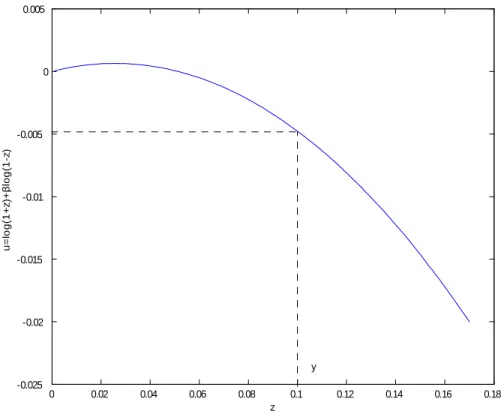
For the problem to be interesting, I am looking for the situation where some risk sharing can be supported with centralized economy. This is only possible if (I)
< log(1 +y)
log(1 y);
otherwise countries fully smooth consumption,z= 0;as in Figure 1,
0 0.02 0.04 0.06 0.08 0.1 0.12 0.14 0.16 0.18 -0.025 -0.02 -0.015 -0.01 -0.005 0 0.005 z u=l o g(1 + z )+ β log (1 -z ) y
Figure 1: Full Consumption Smoothing
and if (II)
> 1 y
1 +y;
ory > 1
otherwise autarky is the highest utility one can achieve and no trade in equilibrium as in Figure 2. 0 0.02 0.04 0.06 0.08 0.1 0.12 0.14 0.16 0.18 0 0.005 0.01 0.015 0.02 0.025 0.03 z u= log( 1+ z )+ β lo g( 1-z ) y Figure 2: Autarky
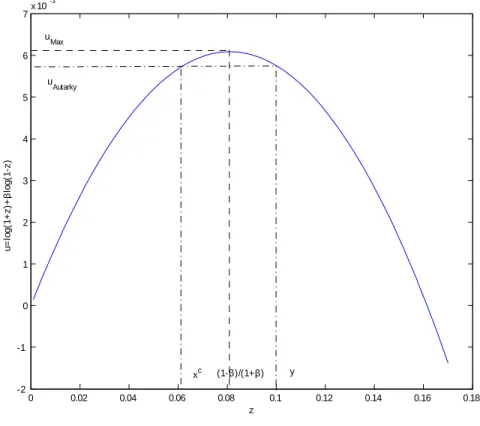
If (I) and (II) are both satis…ed, some risk sharing not full can be supported across border. As can be seen in Figure 3, the risk sharing level in centralized economy turns out to be better than the private international borrowing in section 5.1,6
0< xc< 1
1 + < y:
6In this simple numerical example, welfare ordering is determined by the level of risk sharingz, not by the size of utility u(z) = log(1 +z) + log(1 z):For example,xcis better than 1
1+ becausex
cis smaller althoughu(1
1+ )> u(x
0 0.02 0.04 0.06 0.08 0.1 0.12 0.14 0.16 0.18 -2 -1 0 1 2 3 4 5 6 7x 10 -3 u =lo g (1 +z )+ β lo g (1 -z ) z y xc (1-β)/(1+β) uMax uAutarky
Figure 3: Some International Risk Sharing Given thatx= 11+ or y;I know the following relationship
0< xc< x6y:
5.3
Private Borrowing with No Commitment Domestically
Assume type B agents are constrained domestically back in resident international autarky if they are con-strained internationally in the trade equilibrium. In my model by symmetry, the allocations alternate in di¤erent countries.
c1t = 1 +xp; c1t+1= 1 xp; for country 1;
c2t = 1 xp; c2t+1= 1 +xp; for country 2,
where xp is determined by the condition that for both types in country 1 the present value of all future
constrained internationally as a whole. xp (y+"p) +q[(y+"p) xp] 1 pq = 0for type A, xp (y "p) +q[(y "p) xp] 1 pq = 0for type B, where"p is determined as "p = min
z>0flog(1 +y z) + log(1 y+z) log(1 +y ") + log(1 y+")g:
The price of international bond q is determined by the marginal rate of substitution of residents live in
constrained country.
q= 1 +x
P
1 xP:
The solution to this problem is unique,q= 1:Att, borrowers in country 2 face the same international bond priceqand their domestic bond price
p= 1 x
p
1 +xp:
As a result, for both countries fromton the price sequence for domestically traded bonds alternates like the following p1 = 8 > < > : p; fort; t+ 2; t+ 4; ::: q; fort+ 1; t+ 3; ::: ; p2 = 8 > < > : q; fort; t+ 2; t+ 4; ::: p; fort+ 1; t+ 3; ::: :
The optimal solution in my model is unique xp = 1
1+ : When comparing to the allocation from section 5.1
x=y or 11+ ;we know
xp6x6y:
Again, if (I) and (II) in section 5.1 are both satis…ed, then
0< xc< xp6x6y:
Ifx=y, then
0< xc< xp< x=y:
Ifx=11+ ;then
Like centralized economy in section 5.2, adding domestic enforcement problem to private international borrowing can improve the utility level in 5.1 as well. If > log(1+log(1 yy)); then complete risk sharing is attainable with centralized economy, which makes it the best policy. If log(1log(1+yy)) > > 11+yy;then centralized economy is better than private international borrowing with full domestic commitment problem because more international capital ‡ow can be supported with centralization, and private international borrowing with full domestic commitment problem is further better than no domestic commitment problem since the former setup rules out the autarky solution. Policy implication in Jeske (2006) is, consequently, that centralization improves aggregate utility in a private international borrowing setup with perfect domestic contract enforcement. My contribution of adding domestic contract enforcement problem identi…es a middle stage between centralization and Jeske’s private borrowing model. However, if 611+yy;then both centralized economy and private international borrowing with no commitment problem domestically lead to autarky
allocation in equilibrium, xc = x = y. Private international borrowing with no domestic commitment
problem might correspondingly result in resident autarky, in whichxp=y+"for typeAandxp=y "for
typeB:
6
Conclusion
I develop an open economy model with heterogeneous agents in each country sharing risk across and within countries where risk of repudiation is pervasive in all debt contracts including both international and domes-tic. The model and analysis is built on Jeske’s (2006) private international borrowing model but relaxing his assumption on domestic contracts being perfectly enforceable. In this paper, the only di¤erence between international and domestic debt contracts is their punishing strategies for defaulters. Defaulters on inter-national debt are excluded only from interinter-national …nancial markets while defaulters on domestic debt are denied from all …nancial markets.
This paper’s contribution is to show that an economy with a pervasive commitment problem does better in international capital markets than an economy with cross-border commitment problem alone. The reason is that in this paper punishment on international debt repudiation is at least as harsh as in Jeske’s model and strictly harsher for some types with the smallest endowment variations overtime. Thus, for those types of agents, harsher punishment could support more international borrowing, more risk sharing and achieve higher utility level. If for every type of agent in all countries living on their own endowments thereafter is
their last choice, then the aggregate welfare increment by adding commitment problem to domestic …nancial markets is smaller than the increment by using a centralized setup where only government can borrow and lend internationally. Intuitively, capital control internalizes the externality of individual’s default decisions while pervasive commitment problem mitigates the negative externality. Besides welfare implications, the domestic bond pricing rules change in respond to the domestic credit crisis. In my setup, the domestic bond price equals to the lowest marginal rate of substitution in the internationally participation constrained countries. This overturns the well established argument that interest rate should be the lowest (or bond price should be the highest) to induce repayment in an environment without …nancial contract enforcement. This result is due to the crucial ingredient of my model: in equilibrium domestic debt default can never happen without international debt default, therefore repayment of domestic debt is secured by repayment of international debt. The lowest domestic bond price re‡ects the harshest punishment for agents who are constrained both domestically and internationally.
Appendix
Proof of Proposition 1
Consider an Arrow-Debreu setup in which there exists a …nancial market for all kinds of bonds that mature at any future period. DenotePm( r) =Pm( r 1)pm( r 1;
r) = r Y s=t
pm( s)the forward price for a t-period
matured domestic contingent bond at date 0. I rede…ne the resident international autarky problem (RIA) as
Vnm( t; bmn( t)) max fcm n( r);bmn(r+1)gr2[t;1) 1 X r=t r tX rj t ( rj t)U(cmn( r)); (19) such that X r> t Pm( r)cmn( r) = X r> t Pm( r)emn( r) +Pm( t)bmn( t); and Vnm( r; bmn( r))>Amn( r);
for all history r> t:
Lemma 1 The above maximization problem (19) has unique solution.
Proof. Prove will proceed by contradiction. Suppose there are two di¤ erent optimal solutions to problem (19), which I denote by cm
n;1( r) r2[t;1) and cmn;2( r) r2[t;1); respectively. Create another consumption
sequence cmn;3( r) r 2[t;1)as a linear combination of c m n;1( r ) r 2[t;1)and c m n;2( r ) r 2[t;1), i.e.,c m n;3( r ) = cm
n;1( r)+(1 )cmn;2( r)for any 2(0;1)and any history r> t. Thus, cmn;3( r) r2[t;1)is both a¤ ordable
and individual rational. Strictly concave utility function then implies
1 X r=t r tX rj t ( rj t)U(cmn;3( r))> 1 X r=t r tX rj t ( rj t)U(cmn;1(2)( r))>Amn( r):
But this contradicts with the assumption that cm
n;1( r) r2[t;1) and cmn;2( r) r2[t;1) are the optimal
solu-tions.
De…ne another optimization problem
Wnm;F( t; bmn( t); F( t)) max 1 X r=t r tX r j t ( rj t)U(cmn( r)): (20)
subject to the summation of all future resource constraints after history r discounted to date 0
X s> r Pm( s)cmn( s) = X s> r Pm( s)emn( s) +Pm( r)bmn( r) +F( r);
and 1 X r=t r t X r j t ( rj t)U(cmn( r))>Amn( r);
for any history r> t:Notice that by de…nition of the rede…ned resident international autarky,
Vnm( t; bmn( t)) =Wnm;F( t; bmn( t);0); for all t; bmn( t): If one de…nes F( r) = 1 X s=r X sj r Pm( s) 2 4fnm( s) X s+1 q( s; s+1)fnm( s; s+1) 3 5; then Wnm( t; bmn( t); fnm( t)) =Wnm;F( t; bmn( t); F( t));
The continuation utility of the original resident problem (RP) equals to the value function of the newly
de…ned problem Wm;F n ( t ; bm n( t
); F( t)) after any history t: But this equation is only true under one condition that the international asset market participation constraint (3) from (RP),
Wnm( r; bmn( r); fnm( r))>Vnm( r; bmn( r)); for all r
also holds in the rede…ned problem (20). Suppose that the above participation constraint is satis…ed under the optimization problem (20), I can rewrite the above participation constraint as the following
Wnm;F( r; bmn( r); F( r))>Wnm;F( r; bmn( r);0):
SinceWnm;F is strictly increasing in F( r);it further implies that F( r)>0:What is more,
Wnm( r; bmn( r); fnm( r)) =Vnm( r; bmn( r)))F( r) = 0:
If (3) holds with equality, thenF( r) = 0. This proves the following lemma 2
Lemma 2 For all histories r> t; the international asset market participation constraint (3) implies
1 X s=r X sj r Pm( s) 2 4fnm( s) X s+1 q( s; s+1)fnm( s ; s+1) 3 5>0:
Moreover, if (3) holds with equality, then
1 X s=r X sj r Pm( s) 2 4fnm( s) X s+1 q( s; s+1)fnm( s; s+1) 3 5= 0:
Now I am ready to prove proposition 1. Given that some typen agents in countrym are participation constrained internationally in history t:That is, the international asset market participation constraint (3) holds with equality, then the second part of Lemma 2 tells us thatF( t) = 0:By de…nition, the consumption
sequence cm;D
n ( r
) r
2(t;1] solves problem (RIA) and the other sequence fc
m n( r )gr2(0;1] solves problem (RP). As a result, both cm;D n ( r) r2(t;1] and c m n( t) r2(t;1] solve the W m;F n ( t; bmn( t);0) problem,
or both of them solve the Vm
n ( t
; bm n(
t
)) problem. Finally, by Lemma 1, the optimization problem of
Vm
n ( t; bmn( t)) has unique solution proves that cnm;D( r) and cmn( r) have to be identical in any history r> t
.
6.1
Proof of Proposition 2
Drop the superscript and subscript for simplicity. We already know the envelope condition
@V( t; b( t))
@b( t) = 1 + (
t) U0(cD( t)): (21)
from (10), where ( t) is the Lagrange multiplier on the domestic participation constraint (1) in problem
(RIA). To see how a change in the domestic bond holdings a¤ects the value of staying with the trade equilibrium, I write down the envelope theorem in the consumer’s problem (RP).
@W( t; b( t); f( t)) @b( t) = @LW @b( t)= ( t) ( t)@V( t ; b( t)) @b( t) ; (22)
where ( t)and ( t)are the Lagrange multipliers on the budget constraint and participation consntraint
(3) in problem (RP), respectively. Combining the …rst order condition (8) and the envelope condition (22)
@W( t; b( t); f( t)) @b( t) = t t ( tj t)U0(c( t)) 2 41 + t X s=t X s j t ( s) s t ( s j t) ( sj s) 3 5 ( t)@V( t ; b( t)) @b( t) = 1 + ( t) U0(c( t)) ( t) 1 + ( t) U0(cD( t)):
where c( t)is the optimal solution to the original maximization problem (RP). From previous proposition 1 we know thatcD( r) =c( r)for all histories r> twith ( t)>0:I can then collect terms on the right hand side of the above equation and get
@W( t; b( t); f( t))
@b( t) = 1 (
t) ( t) U0(cD( t)): (23)
Comparing (21) and (23), we draw the conclusion that @V(@bt(;bt()t)) >
@W( t;b(t);f( t)) @b( t) if and only if ( t)>0: Moreover, @V(@bt(;bt()t)) = @W( t;b(t);f( t)) @b( t) if and only if ( t
6.2
Proof of Proposition 3
By lemma 2, the international asset market participation constraint (3) implies
X s> r Pm( s) 2 4fnm( s) X s+1 q( s; s+1)fnm( s; s+1) 3 5>0;
for all histories r> t:
Besides this, (3) implies
bmn( r) =B m n( r)if mn( r)>0 and mn( r)>0; whereBmn( r)is determined byVm n ( r ; Bmn( r)) =Am n( r
)for all histories r> t. The reasoning is as follow. The de…nition of resident international autarky problem (RIA) implicitly requiresVm
n ( r; bmn( r))>Amn( r)
under any circumstances, this impliesbm n(
r
)>Bmn( r)for all histories r:Proposition 2 states that (3) also implies that there is a lending ceiling for domestic debt in problem (RP)
bmn( r)6B m
n( r)if mn( r)>0 and mn( r)>0;
for all histories r> t:
Replace the international asset market participation constraint (3) in problem (RP) with the two weaker restrictions derived above. I can write down an alternative consumer’s problem as
max 1 X r=t r tX rj t ( rj t)U(cmn( r)); (RPa)
subject to, for allr2[t;1)and history r
emn( r) +bmn( r) +fnm( r) = cmn( r) +X r+1 pm( r; r+1)bmn( r ; r+1) + X r+1 q( r; r+1)fnm( r ; r+1); 1 X s=r X s j r Pm( s) 2 4fnm( s) X s+1 q( s; s+1)fnm( s ; s+1) 3 5>0; bmn( r; r+1) =B m n( r ; r+1)if mn( r ; r+1)>0 and mn( r ; r+1)>0:
Let ; f;and b be the multiplier on resource constraint, non-negative foreign capital ‡ow condition, restric-tion on domestic asset holdings, respectively. First order condirestric-tions are: with respect toc( r);
with respect to domestic bond holdingsb( r; r+1); p( r; r+1) ( r) = 8 > < > : ( r; r+1) b( r ; r+1)if ( r; r+1)>0and ( r; r+1)>0; ( r; r+1)otherwise.
and with respect to international bond holdingsf( r; r+1);
q( r; r+1) ( r) = ( r; r+1) + r+1 X s=t X r; r+1j s f( s )P( r; r+1) r X s=t X r js f( s )P( r)q( r; r+1):
I can derive from the above …rst order conditions
p( r; r+1) = 8 > < > : U0(c( r;r+1)) U0(c( r)) ( r+1j r)[1 b( r ; r+1) (r; r+1)]if ( r ; r+1)>0 and ( r; r+1)>0; U0(c(r; r+1)) U0(c( r)) ( r+1j r)otherwise. (24) q( r; r+1) = U0(c( r; r+1)) U0(c( r)) ( r+1j r) 1 +Xr+1 s=t X r; r+1js f( s)P(r; r+1) ( r; r+1) 1 +Xr s=t X rjs f(s)P( r) ( r) : (25)
I only consider the case ( r; r+1)>0since non-convexity is only caused by the binding of international participation constraints.
If ( r; r+1)>0and ( r; r+1) = 0;the domestic bond pricing rule (24) degenerates into
p( r; r+1) = ( r; r+1) ( r) = U0(c( r; r+1)) U0(c( r )) ( r+1j r): (26) Therefore, P( r; r+1) = P( r)p( r; r+1) = P( r) ( r; r+1)
( r) ; plug (28) into the international bond pricing rule (25), I get q( t; t+1) = U0(c( r; r+1)) U0(c( r)) ( r+1j r ) 1 +Xr+1 s=t X r; r+1js f( s)P( r) (r) 1 +Xr s=t X rjs f( s)P( r) (r) :
Rescale the Lagrange multipliers f( s)and de…ne 0 f( s) = f( s) s P( r) ( r; r+1j t) ( r) ( r; r+1j s) ; (27) where ( r; r+1j s) (r; r+1jt) = ( r+1jr) ( rj s) (r+1j r) (rj t) = ( rjs) ( rj t) for all r> s> t
: Using (27) to replace f( s)gives
q( r; r+1) = U0(c( r; r+1)) U0(c( r)) ( r+1j r) 1 +Xr+1 s=t X r; r+1j s 0 f( s ) s ( r;r+1j s) ( r; r+1jt) 1 +Xr s=t X rj s 0 f( s) s ( rj s) (r j t) : (28)
If ( r; r+1)>0 and ( r; r+1)>0;the pricing rule for international assets is unchanged and deter-mined by equation (26). For the domestic asset price, rescale b( r; r+1)and de…ne
0 b( r; r+1) b ( r; r+1) U0(c( r; r+1)) 0f( r; r+1) t 2 41 + r X s=t X rj s 0 f( s) s ( rj s) ( rj t) 3 5; (29) where 0 f( r
; r+1)>0 since in equilibrium the non-negative foreign capital ‡ow condition binds. Then the domestic bond pricing rule (24) degenerates into
U0(c( r ; r+1)) U0(c( r)) ( r+1j r)[1 b ( r; r+1) ( r; r+1) ]:
Using (29) to replace b( r; r+1)gives us
p( r; r+1) = U0(c( r ; r+1)) U0(c( r)) ( t+1j t) 2 6 6 6 41 0 b( r; r+1) 0f( r; r+1) r 1 ( r;1 r+1j t) 1 +Xr s=t X r js 0 f( s ) s (( rrjjst)) 3 7 7 7 5: (30)
Now, recall the domestic and international bond pricing condition (12) and (13) in problem (RP).
q( r; r+1) = U0(c( r ; r+1)) U0(c( r)) ( r+1j r) 1 +A2 1 +A3 (31) = U0(c( r; r+1)) U0(c( r )) ( r+1j r) 1 +Xr+1 s=t X r; r+1js ( s) s ( r;r+1j s) ( r; r+1j t) 1 +Xr s=t X r js ( s) s ((rrjs) j t) : p( r; r+1) = U0(c( r ; r+1)) U0(c( r)) ( r+1j r) 1 +A2 (1 + ( r; r+1))A1 1 +A3 = U0(c( r; r+1)) U0(c( r )) ( r+1j r) 2 6 6 6 4 1 +Xr+1 s=t X r; r+1js ( s) s ( r; r+1j s) (r; r+1jt) (1+ ( r; r+1)) ( r; r+1) (r; r+1jt) r 1U0(cD(r; r+1)) U0(c( r; r+1)) 1 +Xr s=t X rj s ( s) s (( rrjs) j t) 3 7 7 7 5: p( r; r+1) = 8 > > > > > > > > > > > > < > > > > > > > > > > > > : U0(c( r;r+1)) U0(c( r)) ( r+1j r), if ( r; r+1)>0and ( r; r+1) = 0; U0(c(r; r+1)) U0(c(r)) ( r+1j r) 2 6 6 41 ( r; r+1) (r; r+1) r 1 (r ;1r+1 ) 1+X r s=t X rj s ( s) s ( rj s) (rj t) 3 7 7 5; if ( r; r+1)>0and ( r; r+1)>0: (32)
Notice that the domestic bond price (26) when ( r; r+1) > 0 and ( r; r+1) = 0 and (30) when ( r; r+1)>0 and ( r; r+1)>0 are identical to the ones in (32) from the original consumer’s problem (RP). So does the international bond price (28) comparing to (31) in (RP). Both maximization problems have the same …rst order condition and hence same solutions. These same solutions must be a¤ordable and
individual rational in both the original (RP) and alternative (RPa) problem. Following Jeske’s method,
I de…ne an alternative maximization problem with the same objective function and a convex constraint set that is a super set of the original (non-convex in general) constraint set. The optimal solution is the global maximum to the alternative problem with a larger convex constraint set, thus it has to be the global maximum for the original problem with the same objective function, same solutions and a constraint set that is a subset of the convex constraint set. In conclusion, …rst order conditions leads to the global maximum in the original problem (RP). This proves the su¢ ciency.
6.3
Proof of Proposition 4
In equilibrium, the domestic and international bond pricing rules are determined by (12) and (13), respec-tively. p( r; r+1) = U0(c( r; r+1)) U0(c( r)) ( r+1j r) 1 +A2 (1 + ( r; r+1))A1 1 +A3 ; q( r; r+1) = U0(c( r; r+1)) U0(c( r)) ( r+1j r )1 +A2 1 +A3 ; where A1 = ( r; r+1) r 1 U0(cD( r; r+1)) U0(c( r; r+1)) 1 ( r; r+1j t) ; A2 = r+1 X s=t X r; r+1js ( s) s ( r; r+1j s) ( r; r+1j t) ; A3 = r X s=t X r js ( s) s ( r j s) ( rj t):
The lagrange multiplier ( r; r+1)>0)A2 = ( r; r+1) r 1 (r;1
r+1jt)+A3 >A3;therefore for all typesnin all countriesm;
q( r; r+1)> U0(cm n( r; r+1)) U0(cm n( t )) ( r+1j r); with equality if m n( r; r+1) = 0: (33)