Experimental Analysis of Task-based Energy
Consumption in Cloud Computing Systems
Feifei Chen, John Grundy, Yun Yang, Jean-Guy Schneider and Qiang He
Faculty of Information and Communication Technologies
Swinburne University of Technology
Melbourne, Australia 3122
{feifeichen, jgrundy, yyang, jschneider, qhe}@swin.edu.au
ABSTRACT
Cloud computing delivers IT solutions as a utility to users. One consequence of this model is that large cloud data centres consume large amounts of energy and produce significant carbon footprints. A common objective of cloud providers is to develop resource provisioning and management solutions that minimise energy consumption while guaranteeing Service Level Agreements (SLAs). In order to achieve this objective, a thorough understanding of energy consumption patterns in complex cloud systems is imperative. We have developed an energy consumption model for cloud computing systems. To operationalise this model, we have conducted extensive experiments to profile the energy consumption in cloud computing systems based on three types of tasks: computation-intensive, data-intensive and communication-intensive tasks. We collected fine-grained energy consumption and performance data with varying system configurations and workloads. Our experimental results show the correlation coefficients of energy consumption, system configuration and workload, as well as system performance in cloud systems. These results can be used for designing energy consumption monitors, and static or dynamic system-level energy consumption optimisation strategies for green cloud computing systems.
Categories and Subject Descriptors
C.4 [Computer System Organization]: Performance of Systems; K.4.1 [Public Policy Issues]: Use/abuse of power; B.8.2 [Performance Analysis and Design Aids]
General Terms
Measurement, Performance, Experimentation
Keywords
Cloud computing, green cloud, energy consumption, performance analysis, energy efficiency.
1.
INTRODUCTION
Cloud computing is a new and promising computing paradigm which delivers computing as a utility [1]. It provides rented services for computation, application software, and data storage
via the Internet. Key advantages for consumers include flexible scaling on demand to their computing and data storage needs without the traditional and potentially large upfront investment in computing infrastructure. Over the last few years many large-scale data centres have been built due to the massive growth in demand for high performance cloud data and computational services. As cloud computing becomes more widespread, increasing data storage and computation needs raise the energy consumed by large cloud infrastructures. Thus, energy consumption has become a critical concern in designing modern cloud systems.
Firstly, a common economic objective of cloud providers is to minimise their total operational costs. High energy consumption directly contributes to operational costs, especially as energy unit costs continue to rise significantly. A utility provider in Virgina estimates that in 2012, 10% of all the energy it supplies to northern Virgina will be consumed by data centres [2]. Power consumption currently contributes up to 42% of a data centre’s monthly expenses [3]. Secondly, due to the need to respond on-demand to customer load, many data centres consume electricity produced by “brown” generation facilities, such as coal. Thirdly, cloud system performance must not be jeopardised while minimising cloud system energy consumption. Therefore, energy consumption, as well as its impact on cloud system performance, operational cost and the environment, have become critical issues in green cloud computing systems [4].
Many efforts have been made to improve the energy efficiency of cloud systems. Some simple techniques provide basic energy management for servers in cloud systems, for example, turning on and off servers, putting them to sleep or using Dynamic Voltage/Frequency Scaling (DVFS) [5] to adjust servers’ power states. DVFS adjusts CPU power (consequently the performance level) according to the workload. However, the scope of DVFS optimisation is limited to CPUs. Another approach for improving energy efficiency is to adopt virtualisation techniques to obtain better resource isolation and reduce infrastructure energy consumption through resource consolidation and live migration [6]. Based on virtualisation techniques, several energy-aware resource allocation policies and scheduling algorithms have been proposed to optimise energy consumption in cloud systems [7]. However, energy consumption and performance of cloud systems vary drastically with different system configuration and resource allocation strategies, as well as the workloads and types of runtime tasks in cloud systems [8]. By nature, the workloads of cloud systems are highly variable, application-specific and can often not be predicted in advance. Ideally, system performance should not be adversely impacted while energy consumption is being minimised. We thus require a thorough understanding of Permission to make digital or hard copies of all or part of this work for
personal or classroom use is granted without fee provided that copies are not made or distributed for profit or commercial advantage and that copies bear this notice and the full citation on the first page. To copy otherwise, or republish, to post on servers or to redistribute to lists, requires prior specific permission and/or a fee.
ICPE’13, April 21–24, 2013, Prague, Czech Republic. Copyright © 2013 ACM 978-1-4503-1636-1/13/04...$15.00.
energy consumption patterns of different types of tasks in cloud systems, for example, data retrieval and data processing tasks. We also need to understand how energy consumption of such tasks and cloud system performance are affected by different workloads and system configurations, respectively.
We proposed an energy consumption model to calculate the energy consumption of specific types of tasks in cloud systems, and to use this model to statically and/or dynamically organise cloud application load [9]. In our model, runtime cloud tasks are divided into three types: computation-intensive, data-intensive and communication intensive. The model identifies what factors determine the energy consumption of a specific task. However, the following major issues have yet to be addressed:
How do we characterise and profile the energy consumption of different types of tasks?
How do system configuration and resource allocation
strategies affect the energy consumption?
What is the relationship between energy consumption and workload of tasks?
What is the relationship between energy consumption and cloud system performance?
In order to address these issues, we have conducted a series of experiments to empirically analyse the energy consumption in cloud systems. Based on our experimental results, we have identified the correlation coefficients of energy consumption, system configuration, workload, and system performance in cloud systems. Our analytical results provide guidelines for deriving energy consumption models based on different types of runtime cloud computing tasks. In addition, our analytical results also provide guidelines for statically planning tasks and scheduling on available cloud platforms, and dynamically monitoring energy consumption. They may be used to support system- or application-level energy consumption and performance optimisation (or both).
We briefly summarise the state-of-the-art of energy consumption models, energy-saving policies and analysis approaches in Section 2. In Section 3, we describe our energy consumption model to profile energy consumption. Our experimental energy consumption profiling setup and method are described in Section 4. In Section 5, we present our experimental profiling results and detailed analysis. We discuss observations derived from our analysis in Section 6. Finally, we summarise key findings and discuss directions for future work in Section 7.
2.
RELATED WORK
Energy consumption of cloud systems has become a popular research topic in recent years. Several efforts have been made to build energy consumption models for cloud systems. Jung et al. [10] focused on the energy consumed by physical servers. Their energy consumption model does not take into account the impact of specific workloads running in cloud systems. Mach and Schikuta [11] proposed a method for energy consumption calculation based on the number of Java Virtual Machine (JVM) instances. However, it is difficult to measure the actual numbers of JVMs because of the dynamic nature of the JVM life cycle. Lee and Zomaya [12] proposed an energy model of cloud tasks for developing energy-conscious task consolidation algorithms that reduce energy consumption of cloud systems. However, in their model it is assumed that the relation between CPU utilisation and energy consumption is linear. This is a huge limitation
because the utilisation of other resources such as memory and hard disk can also greatly influence the energy consumption. Energy-saving policies of cloud systems have also been investigated in the past few years. Liu et al. [13] described a new cloud infrastructure which can dynamically consolidate Virtual Machines (VMs) based on CPU utilisation of servers in order to identify idle physical servers. Identified idle physical servers can be turned off to save energy. Verma et al. [14] used the characteristics of VMs, such as cache footprint and the set of applications running on the VMs, to drive power-aware placement of VMs. VirtualPower [15] was proposed to exploit power management decisions of guest VMs on virtual power states. The virtual power states of guest VMs were considered as preconditions to run local and global energy management policies across the computation. These energy saving policies do not take the workload in cloud systems into consideration.
Research efforts have also focused on profiling and analysing the energy consumption of cloud systems. Most existing profiling efforts were conducted by using energy benchmarks or closely monitoring the energy profiles of individual system components at runtime, such as CPU, cache, hard disk and memory. A framework has been proposed by Stoess et al [16] for energy optimisation and development of energy-aware operation systems based on the availability of energy models for each hardware component. Chen et al. [17] developed a linear power model that presents the behaviour and power consumption of individual hardware components of a single physical server. Joulemeter, a power meter for VMs [18], makes use of software components to monitor the resource usage of VMs and then converts the resource usage to energy consumption based on the power model of each individual hardware component.Although some of the profiling and analysis are conducted based on specific applications in cloud systems, the evaluation only includes a single type of cloud application. For instance, Lefèvre and Orgerie [19] evaluated energy efficient cloud systems on a multicore platform. They focused only on CPU cores and conducted their evaluation of the energy consumption during migration of VMs only with computation-intensive cloud applications.
Some of the above work have made initial efforts in profiling the energy consumption and performance of cloud systems. However, none of them has identified the relationship between energy consumption and runtime tasks under different cloud system configurations and the correlation with cloud system performance. In order to address these issues, in this paper we present our energy consumption profiling results obtained from extensive experiments conducted on a cloud test-bed. Our goal is to investigate and characterise the impact of both system configurations and workload on the energy consumption and system performance.
3.
ENERGY CONSUMPTION MODEL
Our energy consumption profiling and analysis is motivated by our existing energy consumption model proposed for cloud-wide energy analysis [9]. It provides a basis for characterising the energy consumption in cloud systems under different system configurations.
In this model, the total energy consumption of a cloud workload is divided into a fixed part and a dynamic part. The fixed part of energy consumption includes the energy consumption during idle time and energy consumption of the cooling system, defined as
ECFix. The dynamic energy consumption is the energy consumed by running tasks in the cloud system, defined as ECVar. Thus, the total energy consumption defined as ECTotal is formulated as:
Total Fix Var
EC EC EC (1)
Instead of individual hardware components, we set single task running in a cloud system as the fundamental unit for energy consumption calculation. All runtime tasks in cloud systems utilise computation, storage and communication resources. However, the percentage of each resource used by different types of tasks is significantly different. Based on the major type of resource consumed by the task, we characterise all cloud runtime tasks three types: computation-intensive, data-intensive and
communication-intensive. For a computation-intensive task i comp
t ,
1≤i≤n, where n is the total number of computation-intensive tasks, the energy consumption of i
comp t is defined as (i ) comp EC t . For a data-intensive task i data
t , 1≤i≤m, where m is the total number of data-intensive tasks, the energy consumption of i
data
t is defined as (i )
data
EC t . For a communication-intensive task i com
t , 1≤i≤k, where
k is the total number of communication-intensive tasks, the energy consumption of i
com
t is defined as (i )
com
EC t . Due to
scheduling and other overheads, which is denoted as ECsche, the total energy consumption of two tasks is usually not the sum of the energy individually consumed by the tasks. In our model, the total energy consumption is defined as:
m
1 1 1
( ) ( ) ( )
n k
i i i
Total Fix comp data com sche
i i i
EC EC EC t EC t EC t EC
(2)For each task, its energy consumption is dependent on the task workload. The factors related to workload influence energy consumption of the task directly and largely. In our model, the parameters of a task taken into account in the calculation of the energy consumption include: number of processes for the task, defined as PT; the size of data to be processed, defined as DS; and the size of data to be transmitted, defined as DT. In addition, system configurations, such as hardware of the physical server and the scale of the configured VMs, have significant impact on energy consumption. Hence, the energy consumed by each task is determined by the task parameters and the system configuration, denoted as C. Thus, the energy consumption of each type of task are defined as:
(i ) i , i , i , i
comp
comp comp comp comp comp
EC t f PT DS DT C (3)
(i ) i , i , i , i
data
data data data data data
EC t f PT DS DT C (4)
(i ) i , i , i , i
com
com com com com com
EC t f PT DS DT C (5) In order to determine the energy consumption model of a cloud system, it is essential to specify the factors that have impact on the energy consumption of each type of tasks.
4.
EXPERIMENTAL SETUP
Our energy consumption profiling and analysis were performed based using the energy consumption model described in Section 3. Based on the energy consumption profiling results, the impact of the factors indicated in equations (3)-(5) on the energy consumption of different tasks will be verified. Our objective was to collect data and analyse the correlation coefficients of energy consumption, system configuration, workload, and system
performance. The analysis result will be adopted to refine and formalise our energy consumption model, used to support predictive analysis of workload energy consumption, and used to support static and dynamic optimisation of energy usage. We profiled the energy consumption by creating heterogeneous Virtual Machines in a cloud system and running computation-intensive tasks, data-computation-intensive tasks and communication-computation-intensive tasks, respectively. For each type of task, we also profiled the energy consumption and system performance with various task parameters, that is, the number of processes, the size of data to be processed, the size of data to be transmitted, and task workload. We introduce the experimental setup in this section.
4.1
Testbed
SwinCloud is a private cloud that provides a common computational infrastructure to researchers at Swinburne University of Technology. Our experiments were conducted in SwinCloud as we have detailed knowledge of the cloud hardware, networking, operating system versions, and other application software. SwinCloud was experimented in the Energy Research Lab (ERL) at Swinburne University of Technology. This lab focuses on energy-related research and development. Using the extensive and sensitive power monitoring facilities provided by this lab, we could precisely monitor the power consumption of the SwinCloud server and network devices, including network cards, switches and routers. The power consumption measurement was realised and managed using PowerNode, a power usage profiling
equipment developed by GreenWave Reality1. It supports
measurement of both immediate and average power consumption. Collected power readings were reported to the GreenWave Gateway, which is used for creating a mesh-based Home Area Network (HAN). The GreenWave Gateway then sent the data to the GreenWave Reality data centre, where the information could be viewed and analysed.
A cloud computing system is composed of multiple servers. The energy consumption of the cloud system includes the energy consumed by individual servers and the scheduling and communication overhead across different servers. In this paper, we focus on the energy consumption of individual servers as it is the predominant part [20]. Furthermore, the cross-server scheduling and communication overhead of one cloud system can be significantly different from the other, depending on the scheduling mechanism adopted by the cloud systems and the distribution of the constituent servers. Thus, we conducted our experiments by measuring energy consumption of tasks running
1 http://www.greenwavereality.com/
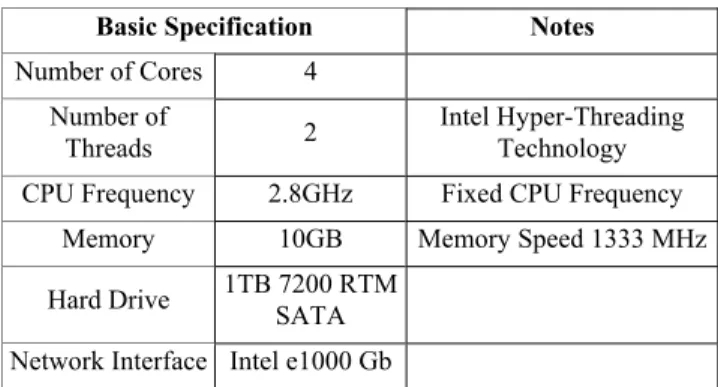
Table 1. Specifications of HP Z400
Basic Specification Notes
Number of Cores 4
Number of
Threads 2 Intel Hyper-Threading Technology
CPU Frequency 2.8GHz Fixed CPU Frequency
Memory 10GB Memory Speed 1333 MHz
Hard Drive 1TB 7200 RTM SATA Network Interface Intel e1000 Gb
on a single discrete server. We left research to determine the energy consumption incurred by cross-server scheduling for future work. Moreover, we did not adopt any existing energy-saving policies in our experiments such as DVFS [5] or VirtualPower [15], in order to be able to isolate the factors causing unexpected energy consumption. Our experimental set up can however be reused to include these options enabled. A type of the servers currently deployed in SwinCloud is HP Z400. Table 1 lists the specifications of the HP Z400. The Virtual Machine Manager (VMM) utilised for VM management is VMware ESX 4.1 and the operating systems running on the virtual machines are either Window Server 2008 or Windows XP Professional.
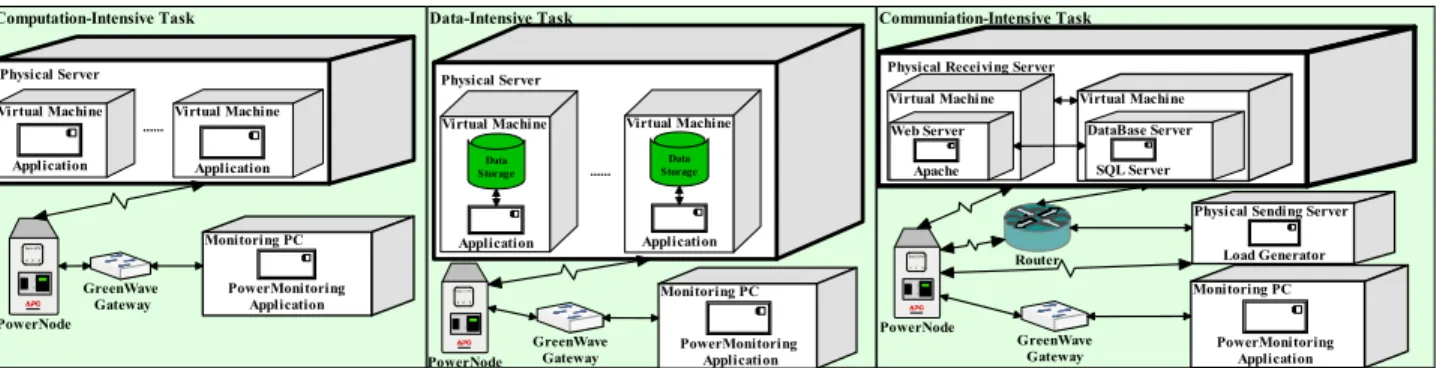
Figure 1 presents the energy profiling framework for different tasks used in our experiments. For computation-intensive tasks and data-intensive tasks, stand-alone applications were deployed. For communication-intensive tasks, a Web Application was deployed. The user requests were sent to the Web server through the router from a client PC. The major energy consumption of computation-intensive tasks was introduced by the computation of the deployed application. For data-intensive tasks and communication-intensive tasks, the energy consumption of the deployed application caused by computation is minimal. The major energy consumption of data-intensive tasks is introduced by reading/writing data in data storage. For communication-intensive tasks, the major energy consumption includes the energy consumed to send user request, the energy consumed to serialise/deserialise data and the energy consumed to process user requests. In order to focus on the communication aspects, the workload applied for communication-intensive tasks in our experiments was arranged to minimize load on sender/receiver so almost all energy is the encoding and decoding overhead.
In the experiments, all VMs were assigned with 2GB, 4GB, 6GB or 8GB memory. The number of virtual CPUs (vCPUs) of each VM varied from 1 to 4 in steps of 1. The number of vCPUs corresponded to the number of physical cores assigned to the VM. The configuration of VMs in different scales is presented in Table 2. System configurations related to specific task types will be introduced in Sections 5.1, 5.2 and 5.3, respectively.
4.2
Profiling Method
The energy consumption result of a task equals the difference of average power consumption between the server with and without workload multiplied by the execution time of the task. We firstly retrieved the average power consumption measured by PowerNode with no hosted application workload in the cloud system as our idle state benchmark. Then, we retrieved the average power consumption measured by PowerNode during the running time of each task. Finally, we multiplied the average power consumption by the execution time of the task to obtain the energy consumption of the task.
As discussed in Section 3, the task parameters, including the number of processes, the size of data to be processed, the size of data to be transmitted, have impact on the task energy consumption and system performance based on the energy consumption model. These task parameters determine the workload of a single task. In addition, the number of running tasks determines the overall workload in the cloud system. Energy consumption is highly influenced by the workloads in the cloud system as higher workloads consume more resources that leads to higher energy consumption. Moreover, system configurations, such as the number and scale of the configured VMs, also impact energy consumption significantly. As such, we took the cloud system workload and system configuration as inputs of our experiments. We set energy consumption and system performance as outputs of our experiments. We selected the throughput of the system as the profiled system performance measure. This is because throughput is often a key performance parameter monitored in cloud systems. It has the advantage of reflecting resource usage accurately [21]. For computation-intensive tasks, throughput is defined as the number of computation tasks completed per hour. For data-intensive tasks, throughput is defined as the amount of data transferred per second. For communication-intensive tasks, throughput is defined as the total number of user interactions requested and completed successfully per second.
4.3
Test Case Design
Again, we used three types of tasks: computation-intensive, data-intensive and communication-data-intensive tasks. We designed and conducted three series of experiments, described as follows:
1. Computation-intensive tasks: The major resources
consumed by computation-intensive tasks are the CPU cores. In order to make sure the computation workload would be distributed to all available CPU cores, an application which calculates Fibonacci sequence has been developed and parallelism has been applied to the application. We deployed multiple
Communiation-Intensive Task
Physical Receiving Server
Data-Intensive Task Physical Server Virtual Machine Computation-Intensive Task Physical Server Virtual Machine Application Application PowerNode PowerNode Virtual Machine Application ... Virtual Machine Application ... Router
Virtual Machine Virtual Machine
PowerNode
Web Server DataBase Server
Monitoring PC
Physical Sending Server Load Generator PowerMonitoring Application Monitoring PC PowerMonitoring Application Monitoring PC PowerMonitoring Application Apache SQL Server GreenWave Gateway GreenWave Gateway GreenWave Gateway Data Storage Data Storage
Figure 1. Energy profiling Framework
Table 2. Type of VM
Virtual Machine Number of Cores RAM Hard Disk
Small 1 2GB 80GB
Medium 2 4GB 80GB
Large 3 6GB 80GB
processes to calculate Fibonacci sequences to implement computation-intensive tasks. Each calculation was considered as a computation-intensive task. As the largest number of the Fibonacci sequence determines the duration of each calculation task, we mapped this number to the workload of each computation-intensive task – defined as LN. As this application purely consumes CPU resources, the energy consumption caused by other resources such as memory can be eliminated. In order to analyse the impact of workload and cloud system configurations on the total energy consumption and throughput, we designed three sets of test cases in this series of experiments. We first ran a single task to calculate Fibonacci sequence and increased the LN
of the task gradually with fixed system configuration in test set 5.1.1 as described in Section 5.1. Then, we increased the resource allocated to the task while keeping LN constant. Computation-intensive tasks mainly consume CPU resources and Hyper-Threading (HT) technology is usually applied to improve the overall performance of the CPU. Thus, we measured the energy consumption and system performance with HT enabled and disabled in test set 5.1.2 as described in Section 5.1, to analyse the impact of HT technology on energy consumption and system performance. In these tests we kept the resources allocated constant and increased the LN of the tasks gradually and turned on and off HT. In test set 5.1.3 as described in Section 5.1, we ran multiple tasks with the same LN simultaneously and kept the system configuration and resource allocation constant to analyse the scheduling overhead.
2. Data-intensive tasks: As a data-intensive task mainly
consumes the storage resources in cloud systems, we ran IOzone benchmark2 in our tests, a disk and file system benchmarking application. Using IOzone, we generated a large number of I/O operations and stressed the disk I/O as required. Each run of IOzone benchmark was considered as a data-intensive task. The total amount of data read/writer determined the workload of a task. In each task, we set the read and write ratio to 50% - 50%. The parameters of a data-intensive task to be changed include the process number and the size of the data record. We set the size of the data record to be transferred at 4K, 8K and 64K bytes as our basic test suite. 4K is the memory page size, 8K is what Microsoft Windows uses for network transfers, and 64K is the typical record size that Windows uses when applications try to transfer blocks of data bigger than 64K [22]. We also tested a few very large data records, including 8MB and 16MB data records. A total of five sets of tests were designed and run in this series of experiments. Test set 5.2.1 as described in Section 5.2 aimed to reveal the impact of workload on energy consumption and system throughput while keeping the task parameters and system configuration constant. The purpose of test set 5.2.2 as described in Section 5.2 was to analyse the impact of system configuration on energy consumption and system throughput. So we kept workload and task parameters constant and changed the number and type of virtual machines. In test set 5.2.3 as described in Section 5.2, we aimed to evaluate the impact of task parameters on energy consumption and system throughput by keeping workload and system configuration constant. Furthermore, we evaluated the impact of scheduling overhead on energy consumption and system throughput in test set 5.2.4 as described in Section 5.2. Similar to computation-intensive tasks, resource allocated to data-intensive tasks would affect the energy
2 http://www.iozone.org
consumption and system performance. Therefore, we measured the energy consumption and system throughput by changing the total resource allocation in test set 5.2.5 as described in Section 5.2.
3. Communication-intensive tasks: We deployed a Java Web
Application named JPetstore 3 in SwinCloud as the
communication-intensive application. It is a Web e-commerce application which has been used as a representative application for a transactional workload that stresses the servers and network devices as required in our tests. JPetstore uses a Web server to handle the user requests and a database server to process the database queries in response to the user requests. Therefore, it is a composite task which is composed of communication-intensive task, data-intensive task and a small level of computation-intensive task. For our experiment, we used its communication aspects only. As mentioned in Section 4.1, we arranged the workload of communication-intensive task to minimize load on sender/receiverin order to measure the energy consumption of the communication aspects only of this reference application. All network traffic generated by customers was emulated using JMeter4. JMeter is a load testing tool for analysing and measuring the performance of variety of Web applications. Each user session generated by JMeter consisted of a series of sequential user requests, such as browsing the list of products, adding items to the shopping cart, checking out, and so on. Each run of JMeter was considered as a communication-intensive task and the number of user sessions generated by JMeter determined the workload of the task. All user sessions were started with fixed time interval in each test set. The time interval decreased when the number of user sessions increased. The parameters of a communication-intensive task to be changed included the user request type, the number of requests in each user session and the packet size of each user request. We developed three test sets for communication-intensive tasks. We applied different workloads for each test set by mixing browsing requests or shopping requests in different percentages. In test set 5.3.1 as described in Section 5.3, we fixed the task parameter and the workload and changed virtual machine types. In test set 5.3.2 as described in Section 5.3, we changed the workload of the task while fixing the task parameter, the system configuration and the resource allocation. We only changed the task parameter and kept all other factors constant to evaluate the impact of task parameters on energy consumption and system performance in test set 5.3.3 as described in Section 5.3.
5.
EXPERIMENTAL RESULTS
We conducted three major sets of tests to analyse the energy consumption of three types of cloud-hosted application tasks in order to analyse the relationship between the system energy consumption and system performance. For each test set, we took cloud system workload and system configuration as inputs. Energy consumption of each task and the system throughput were the outputs of our experiments. We modified the configuration of SwinCloud, including the number of VMs, the hardware and software resources allocated to the VMs. We then measured the energy consumption of SwinCloud running different types of tasks. Each set of tests was repeated ten times to reduce measurement error. We analysed the impact of system
3 http://java.sun.com/developer/releases/petstore/ 4 http://jmeter.apache.org/
configuration, task parameters and workload on the energy consumption and performance of the cloud system based on the experimental results.
5.1
Computation-intensive Tasks Results
A computation-intensive task usually requires a number of isolated processes to perform the computation in a cloud system. The total energy consumption might increase with the number of processes since the increased overhead of scheduling will cause extra energy consumption. Moreover, the energy consumption of the cloud system is subject to change under different system configurations.
We deployed multiple processes that calculate Fibonacci sequences to implement computation-intensive tasks. Parallelism was applied to make sure the computation workload would be distributed to all available vCPUs. As the largest number of the Fibonacci sequence determines the duration of each calculation task, we mapped this number to the workload of each computation-intensive task – defined as LN (see Section 4.3). In order to control the execution time of each task within a reasonable value, we set LN from 52 to 56 in the following tests.
Test Set 5.1.1:Keeping the number of tasks constant, while
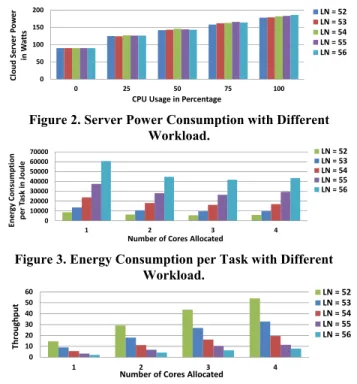
gradually increasing the number of active CPU cores allocated to the task, and the workload of the task. The total number of tasks was wet to one. This set of tests was run on an XLarge virtual machine (see Table 2 for specification details). The server power usage is presented in Figure 2. We observed increasing power consumption caused by increasing CPU usage. The power consumption was linear to CPU usage. The energy consumption per task is displayed in Figure 3. We noticed that the energy consumption of the task was impacted by the number of CPU cores allocated to the task. Moreover, the largest LN of the Fibonacci sequence also affected the energy consumption. As shown in Figure 3, the energy consumption of each task increased with the workload of the task. Moreover, the energy consumption of each task decreased dramatically as the number of cores allocated to the task increased. This is because the execution time of a task will decrease as more computation resources are allocated to the task. However, the increase in average energy usage rate caused by extra CPU cores is not as much as the execution time of the task. Therefore, the energy consumption will decrease accordingly. In addition, we observed a slight turning point of the energy consumption when the number of cores allocated to the task reaches three. For instance, when we set the largest number of the Fibonacci sequence LN to 56, the energy consumption with four cores allocated increased 4% compared to energy consumption with three cores. This shows that the overhead of scheduling an extra core can cancel out the task running time saved and will also cause more energy consumption. Therefore, the energy consumption as a function of number of cores is highly nonlinear, with a minimum at three. In addition, we observe that most of the reduction of energy consumption is in the changing from one core to two cores, and then it does not change much any more. The system throughput is presented in Figure 4. As expected, the more resources allocated to the task the better the system throughput obtained. This result shows that, for computation-intensive tasks, the system throughput rises with the number of allocated cores and the increase of system throughput is nonlinear. Together with the results of Figure 3, we can conclude that energy consumption of
computation-intensive tasks is a more complex nonlinear function of allocated cores and execution time.
Test Set 5.1.2: Keeping the number of tasks and resources allocated constant, gradually increasing the workload of the task, and turning Hyper Threading on and off. Only one task was running on the test-bed at one time. This set of tests was run on an XLarge virtual machine. The results are presented in Figures 5 and 6. As showed by Figure 5, with Hyper-Threading enabled, there is a significant increase in the energy consumption of the task – the Hyper-Threading causing extra power consumption. In the case of “LN = 56”, the extra energy consumption caused by Hyper-Threading is 8%. However, as shown in Figure 6, the extra system throughput obtained by enabling Hyper-Threading is not as much as expected. In cases of “LN = 53”, “LN = 54”and “LN = 55”, Hyper-Threading even led to decrease in system throughput. This suggests that Hyper-Threading be disabled for computation-intensive tasks since there is little to gain form Hyper-Threading if a core’s execution resources are already well utilised.
0 10000 20000 30000 40000 50000 60000 70000 1 2 3 4 En e rg y Con sumpti on per Ta sk in Jo u le Number of Cores Allocated LN = 52 LN = 53 LN = 54 LN = 55 LN = 56
Figure 3. Energy Consumption per Task with Different Workload. 0 50 100 150 200 0 25 50 75 100 Cl ou d Se rv er Po we r in Wa tt s CPU Usage in Percentage LN = 52 LN = 53 LN = 54 LN = 55 LN = 56
Figure 2. Server Power Consumption with Different Workload. 0 10 20 30 40 50 60 1 2 3 4 Throughp ut
Number of Cores Allocated
LN = 52 LN = 53 LN = 54 LN = 55 LN = 56
Figure 4. System Throughput with Different Workload.
0 20 40 60 52 53 54 55 56 Tr o u gh p u t
Largest Number of the Fibonacci sequence LN
Host with HT on Host with HT off
Figure 6. System Throughput with HT on and off.
0 10000 20000 30000 40000 50000 52 53 54 55 56 To ta l En er gy C o nsump tio n per Ta sk in Jo ule Largest Number of the Fibonacci sequence LN Host with HT on Host with HT off
Test Set 5.1.3: Keeping the workload of each task constant, and increasing the total number of tasks and number of VMs allocated to tasks. In this set of tests, the type of each VM was set to Small. Figure 7 shows the results. The number of running tasks can influence the average energy consumption of a single task: a larger number of tasks lead to higher average energy consumption of individual tasks. When the total number of tasks increased, more consequential scheduling overhead caused extra energy consumption. Moreover, it is clear that the increase in number of VMs significantly resulted in increase in per-task energy consumption. For instance, in the case of 6 tasks, the per-task energy consumption increased by 5% when we increased the number of VMs from one to two. As more VMs were deployed, the VM maintenance overhead increased as well. This caused more memory consumption, resulting in more power consumption. On the other hand, as depicted in Figure 8, the throughput was minimal when only one VM was configured. The throughput of two VMs and three VMs were at the same level. However, three VMs consumed 3% more energy than two VMs on average, as presented in Figure 7. Thus the two VMs configuration demonstrates higher energy efficiency than other configurations when there are multiple computation-intensive tasks running simultaneously.
5.2
Data-intensive Tasks Results
A data-intensive task needs to retrieve or store a large amount of data stored in one or more data storage servers. It requires high local disk I/O bandwidth in order to meet performance requirements. In reality the storage servers can be deployed in different data centres located in different geographic locations. However, we only consider the energy consumption in one data centre for the purpose of simplicity as the characteristics of data centres of the same service provider are often very similar. We focused on the correlation between the energy consumption and the amount of data transferred in and out of the storage server. To profile and analyse the energy consumption caused by different data sizes and system configurations, we stress the cloud test-bed with data-intensive tasks generated using IOzone. In every set of tests, we observed major spikes of energy consumption at the beginning and at the end of each task. They corresponded to the moments when disk I/O were stressed. We conducted five sets of tests in this series of experiments.
Test Set 5.2.1: Keeping the total number of tasks, process number of each task, resources allocated and VM
configuration constant, while increasing the total amount of
data transferred and record size. This set of tests was
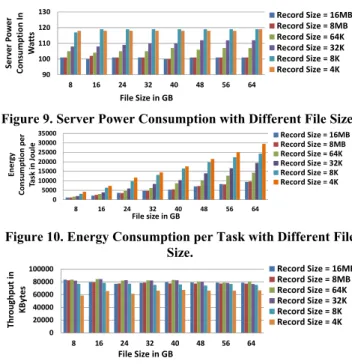
performed on an XLarge virtual machine. Only one task was running on the cloud test-bed at one time and the number of processes was fixed at one. Therefore, the impact of scheduling overhead caused by multiple tasks and processes on energy consumption were avoided. As presented in Figure 9, server power consumption increased as the data record size decreased. However, the effect of record sizes on power consumption is nonlinear as displayed in Figure 9, with larger record sizes leading to convergence to a certain value. For instance, server power consumption did not change too much when we increased the record size from 8MB to 16MB. Smaller data record sizes led to generation of more overhead information for keeping track of where the data were located on the storage media. The overhead information consisted of the directory information, the space allocation and any other data that was not a part of the data to be transferred. As a result, the tasks used more computational resources, consuming more energy.
The results of system energy consumption and system throughput are displayed in Figure 10 and Figure 11, respectively. From Figure 10, we see that the energy consumption increases proportionally to the total amount of transferred data. The per-task energy consumption increases in a linear manner. As the total amount of data transferred increased, smaller record size would cause higher gradient when the total energy consumption increased because the execution time and the energy consumption increased simultaneously. As the record size decreased, more overhead information needed to be processed and stored. In summary, if only one process is configured to run the data-intensive task, bigger record size is more energy-efficient. As shown in Figure 11, the system throughput was higher when we set the record size to 64K, compared to other record sizes. As 64K is the typical record size Windows uses when applications try to transfer blocks of data bigger than 64K, data is transferred most efficiently in this size.
3300 3400 3500 3600 3700 3800 3900 3 6 9 12 15 18 21 24 27 Ener gy Consume d Pe r Ta sk in Jo ule Number of Tasks Number of VM = 1 Number of VM = 2 Number of VM = 3
Figure 7. Energy Consumption per Task with Different VM Numbers. 0 5000 10000 15000 20000 25000 30000 35000 8 16 24 32 40 48 56 64 En er gy Consu m pt ion per Ta sk in Jou le File size in GB Record Size = 16MB Record Size = 8MB Record Size = 64K Record Size = 32K Record Size = 8K Record Size = 4K
Figure 10. Energy Consumption per Task with Different File Size. 0 20000 40000 60000 80000 100000 8 16 24 32 40 48 56 64 Thr o ugh put in KB yt es File Size in GB Record Size = 16MB Record Size = 8MB Record Size = 64K Record Size = 32K Record Size = 8K Record Size = 4K
Figure 11. Throughput with Different File Size. 0 20 40 60 80 100 120 140 3 6 9 12 15 18 21 24 27 Th rough put Number of Tasks Number of VM = 1 Number of VM = 2 Number of VM = 3
Figure 8. Throughput with Different VM Numbers.
90 100 110 120 130 8 16 24 32 40 48 56 64 Se rver Po w er C o nsu m pt io n In W atts File Size in GB Record Size = 16MB Record Size = 8MB Record Size = 64K Record Size = 32K Record Size = 8K Record Size = 4K
Test Set 5.2.2: Keeping total number of tasks, process number per task, total amount of data transferred and resource allocated constant, while changing VM configurations and record size of the task. This set of experiments was running on one XLarge VM, two Medium VMs and four Small VMs respectively so as to fix the size of the total virtual memory and the total number of virtual cores allocated to the VMs. The total number of tasks was set to four and the number of processes instantiated for each task was set to one. All the tasks were distributed on the VMs evenly. The total amount of data to be transferred was 64GB.
The system energy consumption and system throughput are presented in Figure 12 and Figure 13. We observed that the energy consumption increased and the throughput decreased as we changed the VM deployment from one XLarge VMs to four Small VMs. On one hand, VMs compete with each other for I/O bandwidth. On the other hand, more VMs will cause more read/write latency that lead to longer execution time of each task. As shown in Figure 12, the per-task energy consumption increased in a sub-linear manner. As shown in Figure 13, the best system throughput presented when we ran the workload on one XLarge VM. From these tests we conclude that running one VM for the entire I/O operation is most energy-efficient.
Test Set 5.2.3:With single task, keeping the total amount of data transferred stable, resource allocation and VM configuration constant while increasing the process numbers
for task and the record size of the task. An XLarge VM was
deployed to run this set of tests. Only one task was running on the VM and it was assigned to transfer a 64GB file. As depicted in Figure 14, the per-task energy consumption increased with the number of processes. Although the power consumption of the server decreased slightly as the number of processes increased, as presented by Figure 15, multiple processes caused scheduling and synchronisation overhead. Thus, the total execution time of one data-intensive task increased accordingly. As a result, the system throughput decreased, as shown in Figure 16. Our conclusion is
that running data-intensive tasks with one sequential I/O operation is the most energy-efficient when the total amount of data transferred is fixed.
Test Set 5.2.4: With multiple tasks, fix the total amount of data transferred, the resource allocation and number of processes for each task, changing VM configuration and record size for each task. The total number of tasks was set to four and the tasks were distributed to all the VMs evenly. We fixed the number of processes for each task running on each virtual machine at four and the total amount of data to be transferred of all the tasks at 64GB. The system energy consumption and system throughput are shown in Figure 17 and Figure 18, respectively. As we already observed in previous tests, energy consumption is greatly impacted by data record size. Smaller record size results in more energy consumption. The highest throughput was approximately 30% less than the highest throughput we obtained in test set 5.3.2. The numbers of process in both test sets were the same. However, there were multiple tasks running simultaneously this test set while only one task was running in test set 5.3.2. Therefore, multiple task scheduling causes extra scheduling overhead.
Test Set 5.2.5: Keeping the total number of tasks, the total
amount of data transferred and the number of processes for each task constant, while changing the resources allocated, VM configuration and record size of each task. Only one task was running on the cloud test-bed at one time. We fixed the number of processes for the data-intensive task at one and the
0 20 40 60 80 100 120 140 1 2 4 8 16 32 64 Se rv er Po w er Consum pt ion in W atts
Number of Processes per Task
Record Size = 16MB Record Size = 8MB Record Size = 64K Record Size = 32K Record Size = 8K Record Size = 4K
Figure 15. Server Power Consumption with Multiple Processes and Single VM.
0 20000 40000 60000 80000 100000 1 2 4 8 16 32 64 Throu ghp ut in KB yt es Number of Processes per Task Record Size = 16MB Record Size = 8MB Record Size = 64K Record Size = 32K Record Size = 8K Record Size = 4K
Figure 16. Throughput with Multiple Processes and Single VM. 0 20000 40000 60000 80000
1XLarge 2Medium 4Small
Thoughp u t in KB yt es Number of VMs Record Size = 16MB Record Size = 8MB Record Size = 64K Record Size = 32K Record Size = 8K Record Size = 4K
Figure 18. Throughput with Multiple Processes and Multiple VMs. 0 10000 20000 30000 40000 50000 1 2 4 8 16 32 64 En e rg y Co nsu m pti o n per Ta sk in Jo ul e
Number of Processes per Task
Record size = 16MB Record size = 8MB Record size = 64K Record Size = 32K Record Size = 8K Record Size = 4K
Figure 14. Energy Consumption per Task with Multiple Processes and Single VM.
0 20000 40000 60000 80000 100000
1XLarge 2Medium 4Small
Thr o ughpu t in KByt es Number of VMs Record Size = 16MB Record Size = 8MB Record Size = 64K Record Size = 32K Record Size = 8K Record Size = 4K
Figure 13. Throughput with Different VM Configurations.
0 10000 20000 30000 40000 50000
1XLarge 2Medium 4Small
To ta l En e rg y Co ns ump tion in Jo ule Number of VMs Record Size = 16MB Record Size = 8MB Record Size = 64K Record Size = 32K Record Size = 8K Record Size = 4K
Figure 12. Energy Consumption with Different VM Configurations. 0 10000 20000 30000 40000 50000
1XLarge 2Medium 4Small
To ta l Ene rg y co n sum pt ion in Jou le Number of VMs Record Size = 16MB Record Size = 8MB Record Size = 64K Record Size = 32K Record Size = 8K Record Size = 4K
Figure 17. Energy Consumption with Multiple Processes and Multiple VMs.
total amount of data transferred at 64GB and scaled up the size of VM from Small to XLarge. These results are shown in Figure 19 and Figure 20. Compared to computation-intensive tasks, the VM type did not impact the energy consumption and throughput significantly when the record size was fixed. Running on an XLarge virtual machine was most energy-efficient when the record size was smaller than 64K. When the record sizes were 8M and 16M, running the data-intensive task on a Small virtual machine was most energy-efficient.
5.3
Communication-intensive Tasks Results
A communication-intensive task requires a lot of network resources to transmit large amounts of data. Switches form the basis of the interconnection fabric of a private cloud network. Thus, switches, plus network cards, are the main energy consumers of the network resources. Traditionally, energy consumption of a switch depends on hardware parameters, such as the type of switch, the number of ports and the port transmission rates. However, the energy consumption may increase with the amount of data transferred over the network because of the data processing overhead. In addition, the total energy consumption might be impacted by network congestion because of the imbalance between the computation speed and the communication speed. The computation speed of the switch may be slower than the data transmission speed. We investigated this issue by applying different network workloads. A Cisco 2960 switch connected the cloud servers and client PCs. All parameters of the switch were set as default to avoid potential impact caused by switch configuration. We deployed the Web server and database server of JPetstore onto two different VMs to isolate the impact of different user requests.
In order to reveal the impact of the network packet size, the types of user requests and the system configuration on the energy
consumption of communication-intensive tasks, we conducted three sets of tests in this series of experiments, described as follows:
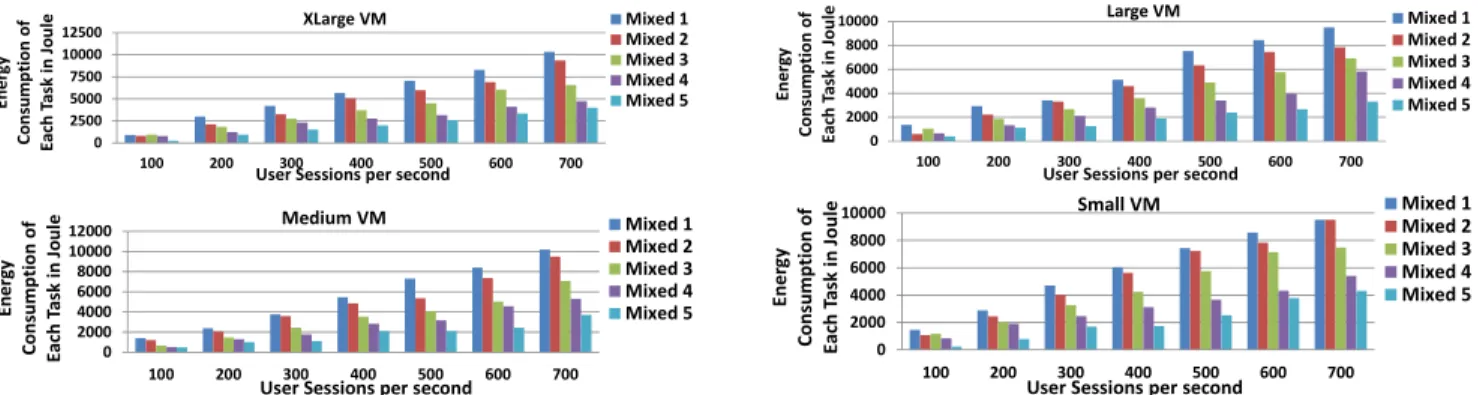
Test Set 5.3.1: Keeping the total number of user requests each user session, the resources allocated and the VM configuration of the Web server constant, while changing the total number of user sessions and workload type. In this set of tests, each user session consisted of mixed browsing requests or shopping requests in different percentages. There are five types of mixed workload, as presented in Table 4. Browsing requests include checking home page, viewing catalogue, viewing products, searching products and so on. Shopping requests include checking out, updating shopping cart, filling order forms, ordering inquiry, and so on. For each type of the mixed workload, we increased the number of concurrent user sessions from 100 to 700 in steps of 100. The resulting system energy consumption and system throughput are shown in Figures 21 and 22.
As the number of concurrent user sessions increased, the energy consumption increased but the throughput decreased when we fixed the type of VM as presented in Figures 21 and 22. This was due to the increase in the number of concurrent user sessions causing extra scheduling overhead as each user request was processed. However, the decrease in throughput was not proportional to the increase in energy consumption. For instance, when running Mixed 1 on an XLarge virtual machine and after we changed the number of concurrent user sessions from 600 to 700, the system energy consumption increased by 24.7% and the system throughput decreased by 3.7%. In addition, we noticed that Mixed 1 consumed the most energy while Mixed 5 consumed the least energy among all five workload types, despite the type of VM. Meanwhile, we observed that Mixed 1 resulted in the lowest throughput compared to the other four types of mixed workload. Since Mixed 1 contained the most browsing requests and Mixed 5 contained the most shopping requests, Mixed 1 had the most disk and memory access of all as opposed to Mixed 5. Thus, it took longer to complete requests of type Mixed 1 compared to the other four workload types. As a result, the energy efficiency of Mixed 1 was lower than the other four workload types.
0 2500 5000 7500 10000 12500 100 200 300 400 500 600 700 Ene rg y Cons um pt ion of Each Ta sk in Jo ule XLarge VM
User Sessions per second
Mixed 1 Mixed 2 Mixed 3 Mixed 4 Mixed 5 0 2000 4000 6000 8000 10000 100 200 300 400 500 600 700 Ene rg y Consum ption of Each Ta sk in Jou le Large VM
User Sessions per second
Mixed 1 Mixed 2 Mixed 3 Mixed 4 Mixed 5 0 2000 4000 6000 8000 10000 12000 100 200 300 400 500 600 700 En e rg y Cons umpt ion of Eac h Ta sk in Jo u le Medium VM
User Sessions per second
Mixed 1 Mixed 2 Mixed 3 Mixed 4 Mixed 5 0 2000 4000 6000 8000 10000 100 200 300 400 500 600 700 En e rgy Consumpti o n of Each Ta sk in Jo u le Small VM
User Sessions per second
Mixed 1 Mixed 2 Mixed 3 Mixed 4 Mixed 5
Figure 21. Energy Consumption per Task with Different VMs.
0 20000 40000 60000 80000 100000
Small Medium Large Xlarge
Thr o ug hpu t in KB yt e VM Type Record Size = 16MB Record Size = 8MB Record Size = 64K Record Size = 32K Record Size = 8K Record Size = 4K
Figure 20. Throughput with Different VM.
0 10000 20000 30000 40000
Small Medium Large Xlarge
En er gy consum pti on pe r Ta sk in Joule VM Type Record Size = 16MB Record Size = 8MB Record Size = 64K Record Size = 32K Record Size = 8K Record Size = 4K
Figure 19. Energy Consumption per Task with Different
Table 4. Mixed Workload
Mixed 1 Mixed 2 Mixed 3 Mixed 4 Mixed 5 Browsing
Request 100% 80% 50% 20% 0%
Shopping
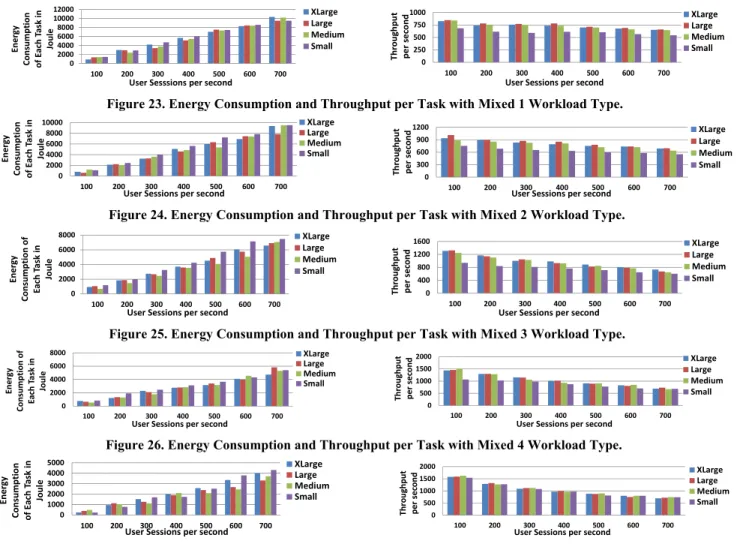
Test Set 5.3.2: Keeping the total request number of each user session and the workload type constant, while changing the number of user sessions, the resources allocated and VM
deployment on the Web server. The energy consumption and
system throughput are presented in Figures 23 - 27. We observed that when the size of the VM deployed for the Web server increased from Small to Large, the system throughput increased while the energy consumption decreased in general. Intuitively, the more resources used the greater the energy consumption. However in this case, the smaller the instance the higher the disk accesses due to the thrashing of the cache, which leads to increase in energy consumption. Even for the Medium VM, which has two cores, the extra energy consumption by the additional core was
cancelled out by the much larger added memory, reducing the number of accesses to the database server. Noticeably, when the size of the VM deployed for the Web server changed from Large to XLarge, the system throughput decreased and the system energy consumption increased in general.
When we set the type of the VM to Large, the total capacity of the Web server and the database server reached the full capacity of the physical server. However, when we set the size of the VM for the Web server at XLarge, the total capacity of the Web server and the database server exceeded the full capacity of the host. In this situation, extra overhead occurred because of the scheduling of VMs, which caused extra energy consumption.
0 2500 5000 7500 10000 12500 100 200 300 400 500 600 700 Ene rg y C o ns um p ti o n of Each Ta sk in Jo u le XLarge VM
User Sessions per second
Mixed 1 Mixed 2 Mixed 3 Mixed 4 Mixed 5 0 500 1000 1500 2000 100 200 300 400 500 600 700 Th ro u ghp ut pe r sec o n d Large VM
User Sessions per second
Mixed 1 Mixed 2 Mixed 3 Mixed 4 Mixed 5 0 500 1000 1500 2000 100 200 300 400 500 600 700 Thr o ug hpu t pe r sec o nd Medium VM
User Sessions per second
Mixed 1 Mixed 2 Mixed 3 Mixed 4 Mixed 5 0 500 1000 1500 2000 100 200 300 400 500 600 700 Thr o ug hput per se co nd Small VM
User Sessions per second
Mixed 1 Mixed 2 Mixed 3 Mixed 4 Mixed 5
Figure 22. Throughput per Task with Different VMs.
0 2000 4000 6000 8000 100 200 300 400 500 600 700 Ene rgy Consum pt io n of Eac h Ta sk in Joul e
User Sessions per second
XLarge Large Medium Small 0 500 1000 1500 2000 100 200 300 400 500 600 700 Thr o ug hput pe r se co nd
User Sessions per second
XLarge Large Medium Small
Figure 26. Energy Consumption and Throughput per Task with Mixed 4 Workload Type. 0 2000 4000 6000 8000 10000 100 200 300 400 500 600 700 Ene rgy Consumption of Each Ta sk in Joule
User Sessions per second
XLarge Large Medium Small 0 300 600 900 1200 100 200 300 400 500 600 700 Th ro ughp ut per second
User Sessions per second
XLarge Large Medium Small
Figure 24. Energy Consumption and Throughput per Task with Mixed 2 Workload Type. 0 2000 4000 6000 8000 10000 12000 100 200 300 400 500 600 700 Ener gy Consum pt ion of Eac h Ta sk in Joul e
User Sesssions per second
XLarge Large Medium Small 0 250 500 750 1000 100 200 300 400 500 600 700 Th ro ug hp ut pe r se co nd
User Sessions per second
XLarge Large Medium Small
Figure 23. Energy Consumption and Throughput per Task with Mixed 1 Workload Type.
0 2000 4000 6000 8000 100 200 300 400 500 600 700 Ene rgy Consumption of Each Ta sk in Joule
User Sessions per second
XLarge Large Medium Small 0 400 800 1200 1600 100 200 300 400 500 600 700 Th ro ug hpu t pe r sec ond
User Sessions per second
XLarge Large Medium Small
Figure 25. Energy Consumption and Throughput per Task with Mixed 3 Workload Type.
0 1000 2000 3000 4000 5000 100 200 300 400 500 600 700 Ene rgy C o nsumptio n of Eac h Ta sk in Jo u le
User Sessions per second
XLarge Large Medium Small 0 500 1000 1500 2000 100 200 300 400 500 600 700 Th ro ughput pe r se co nd
User Sessions per second
XLarge Large Medium Small