J¨
org Nitzsche, Daniel Wutke, and Tammo van Lessen
Institute of Architecture of Application Systems
University of Stuttgart
Universitaetsstrasse 38, 70569 Stuttgart, Germany
{joerg.nitzsche,daniel.wutke,tammo.van.lessen}
@iaas.uni-stuttgart.de
http://www.iaas.uni-stuttgart.de
Abstract
The
Web Service Business Process Execution Language
(WS-BPEL)
is the de facto standard for describing workflow-like compositions
of Web services, so-called Web service orchestrations. In this paper an
ontology for executable BPEL processes is presented, which reflects both
the natural language description and the syntax given in the specification.
The ontology makes BPEL process models accessible at a semantic level
and thus to intelligent queries and machine reasoning.
Key words:
BPM, BPEL, ontology, semantics, WSML
1
Introduction
An ontology is an explicit formal specification of a domain [1]. It consists of (i) a
number of concepts represented as
classes
supporting the definition of hierarchies
through (multiple) inheritance, (ii)
instances
of concepts representing concrete
objects of the ontology, (iii)
relations
between concepts, and (iv)
axioms
that
capture knowledge that cannot be inferred. An ontology is described using a
formally defined language.
This document presents an ontology for the
Web Service Business Process
Execution Language 2.0 (WS-BPEL)
[2] using the formalism of the
Web Service
Modeling Language (WSML)
[3].
WS-BPEL (BPEL for short) is the de facto standard for describing Web
service flows in a workflow-like manner by combining activities that represent
interaction with Web services (
invoke
,
receive
,
pick
,
reply
) with control
flow activities (
flow
,
sequence
,
while
). BPEL [2] has been approved by the
WS-BPEL Technical Committee as a Committee Specification in 01/2007. It
enables the composition of Web services [4] and the modeled process is itself
exposed as a Web service. Thus it provides a recursive aggregation model for
Web services.
BPEL is the foundation of process execution and represents the IT view on
processes in Semantic Business Process Management (SBPM) [5] which aims
at bridging the gap between the business and IT view. Building an ontology of
BPEL and representing BPEL processes ontologically facilitates reasoning about
In: M. Hepp, K. Hinkelmann, D. Karagiannis, R. Klein, N. Stojanovic (eds.): Semantic Business Process
and Product Lifecycle Management. Proceedings of the Workshop SBPM 2007, Innsbruck, April 7, 2007,
CEUR Workshop Proceedings, ISSN 1613-0073, online CEUR-WS.org/Vol-251/
executable process models. Through semantic annotation of BPEL activities
(e.g. relating the concept of a service invocation to a concept that represents
the purpose of the invocation), queries can be formulated on the semantics
of a process, rather than its syntactic representation. Ontologies of business
centric process notations such as BPMN [6] and EPC [7] together with the BPEL
ontology make up the orchestration part of the process space defined in [8]. Using
ontology mediation queries on the business level (BPMN, EPC) can involve
reasoning BPEL processes, i.e. queries can span multiple levels of abstraction.
Additionally, the semantically enriched audit log of a BPEL engine in conjunction
with the process models expressed in terms of the BPEL ontology can be used
for semantic mining, i.e. reasoning not only on the process model level but also
on the process instance level.
WSML
[
3
] is a family of Web ontology languages with native support for the
conceptual framework of the
Web Service Modeling Ontology (WSMO)
[9]. The
main features of the language are support for modeling classes, attributes, binary
relations and instances. Additionally, the language supports class hierarchies.
WSML has multiple variants, possessing different levels of logical expressiveness
and the use of different language paradigms, providing its users with the possibility
to choose between the provided expressivity and the implied complexity. WSML
Core forms the foundation of all the WSML variants, providing the minimum
expressivity through function- and negation-free Datalog [3]. WSML Core is
extended in two directions: description logics (WSML-DL) and logic programming
(WSML-Flight and WSML-Rule). The variant WSML-Full unifies both extensions
and therefore allows the creation of ontologies which are undecidable.
For the BPEL ontology WSML-Flight was chosen since it is the least
expres-sive variant that allows for cardinality constraints and inequality in the logical
language, which are necessary for the definition of the ontology. The ontology
was defined following the basic principles of ontology development, as described
in [10].
2
Building the ontology
The conceptualization of BPEL is based on the XML schema defined by the
BPEL specification. The general rule we follow is to express each BPEL XML
element as a class in the BPEL ontology and its corresponding attributes as
attributes of the class. When possible, WSML built-in data types were reused
as attributes (e.g. the strings “yes” and “no” are represented as values of type
boolean rather than string). In case of conflicting names for concepts defined in
the ontology and WSML keywords, the concept names are represented as full
IRIs [11]. Cardinality constraints defined in the XML schema definition were
adopted as far as possible. This initial conceptualization is enriched by a formal
description of information described in the specification in natural-language form
and not expressed in the XML schema definition. Due to this semantic enrichment
of the definition of the BPEL syntax, certain aspects of the specification (e.g. the
concept of fault handlers, described in Section 2.1 were modeled differently to
what their XML schema definition suggests, resulting in an abstraction from the
concrete specification of the language syntax.
In the following sections, the BPEL ontology is presented by means of examples
of notable design choices.
2.1
Abstraction from XSD
By following the generic approach of ontologizing the XML schema definition of
BPEL, unnecessary containers which do not represent any additional semantics
are introduced. The
faultHandler
element for instance is only a container
that allows specifying multiple
catch
elements and one
catchAll
element to
be used within a process or a scope. As the BPEL ontology captures only the
semantics of the language and not syntax specific details, it abstracts from these,
modeling the concepts
Catch
and
CatchAll
(which both inherit from
FaultHandler
)
directly as attributes of the concept
Process
(Listing 1).
conceptProcess
nonFunctionalProperties
xmlnshasValue”http://docs.oasis−open.org/wsBPEL/2.0/Process/executable”
dc#descriptionhasValue”Concept of being a<process>−Element of an executable BPEL Process”
endNonFunctionalProperties [...]
hasCatchofTypeCatch
hasCatchAllofType(0 1) CatchAll hasActivityofType(1) Activity
conceptFaultHandler nonFunctionalProperties
dc#descriptionhasValue”Concept of being a<faultHandler>−Element” endNonFunctionalProperties
hasActivityofType(1) Activity
conceptCatchsubConceptOfFaultHandler nonFunctionalProperties
dc#descriptionhasValue”Concept of being a<catch>−Element” endNonFunctionalProperties
hasFaultNameofType(0 1) sqname hasFaultVariableofType(0 1) Variable hasFaultTypeofType(0 1) DataType
conceptCatchAllsubConceptOfFaultHandler nonFunctionalProperties
dc#descriptionhasValue”Concept of being a<catchAll>−Element” endNonFunctionalProperties
Listing 1.
Abstraction from XML Schema: Fault Handlers
In some cases however, the XML syntax directly influences the semantics
of the BPEL specification. Thus an abstraction is impossible. An example for
this scenario is the extension mechanism that enables introducing new activity
types (Listing 2). The
extensionActivity
element represents an activity that
can be used everywhere in a process where an activity is required. However, it
does not come with the standard attributes an activity has to provide, but is a
container for a new activity type that has to come with the standard attributes
(also depicted in Listing 2).
conceptExtensionActivitysubConceptOfBasicActivity nonFunctionalProperties
dc#descriptionhasValue”Concept of being an ExtensionActivity, i.e. by inheriting from this activity type new operational semantics can be defined”
endNonFunctionalProperties
hasActivtityofType(1) NewActivityType
conceptstandardAttributes nonFunctionalProperties
dc#descriptionhasValue”Concept of providing the standard attributes For Activities in BPEL” endNonFunctionalProperties
hasNameofType(0 1) string
hasSuppressJoinFailureofType(0 1) boolean isTargetofTypeLink
hasJoinConditionofType(0 1) Condition isSourceofType(0*) Link
Listing 2.
Abstraction from XML Schema: Extension activity
2.2
Introduction of hierarchies
In BPEL there are two kinds of activities, basic activities (e.g.
receive
,
reply
,
invoke
and
assign
) and structured activities (e.g.
sequence
,
flow
and
while
). While this information is part of the textual description of BPEL, it
is not reflected in the XML schema definition of the language syntax. This
kind of knowledge can be added by introducing additional hierarchies. Listing
3 illustrates the activity hierarchy: both
BasicActivity
and
StructuredActivity
inherit from the concept
Activity. The concepts representing the BPEL elements
receive
,
reply
,
invoke
or
assign
then inherit from
BasicActivity
whereas
the concepts representing
sequence
,
flow
or
while
inherit from the concept
StructuredActivity.
conceptActivity
nonFunctionalProperties
dc#descriptionhasValue”Concept of being a BPEL Activity” endNonFunctionalProperties
conceptBasicActivitysubConceptOfActivity nonFunctionalProperties
dc#descriptionhasValue”Concept of being a basic activity” endNonFunctionalProperties
conceptStructuredActivitysubConceptOfActivity nonFunctionalProperties
dc#descriptionhasValue”Concept of being a structured activity” endNonFunctionalProperties
conceptAssignsubConceptOf{BasicActivity, StandardAttributes} nonFunctionalProperties
dc#descriptionhasValue”Concept of being an<assign>−Activity” endNonFunctionalProperties
hasValidateofType(0 1) boolean
hasAssignOperationimpliesType(1*) AssignOperation
conceptSequencesubConceptOf{StructuredActivity, StandardAttributes} nonFunctionalProperties
dc#descriptionhasValue”Concept of being a<sequence>−Activity” endNonFunctionalProperties
hasOrderedActivityofType(1) OrderedActivity
The multiple inheritance of
Assign
and
Sequence
is further elaborated in
Section 2.4.
2.3
Axioms
Axioms add semantics to an ontology because they are statements that are
assumed to be true without any proof. In BPEL processes communicate with
other services on a
partnerLink
which specifies which role the partner service
and the process itself take. The BPEL specification informally defines, that a
partnerLink
has to specify at least one role, ”myRole” or ”partnerRole”, which
is expressed using the axioms presented in Listing 4.
concept ”http://www.ip−super.org/ontologies/sBPEL/20070404#PartnerLink” nonFunctionalProperties
dc#descriptionhasValue”Concept of being a<partnerLink>−Element” endNonFunctionalProperties
hasNameofType(1) string
hasPartnerLinkTypeofType(1) wsdlx#PartnerLinkType hasMyRoleofType(0 1) wsdlx#Role
hasPartnerRoleofType(0 1) wsdlx#Role doesInitializePartnerRoleofType(0 1) boolean
conceptWellformedPartnerlink
axiom definedBy
?xmemberOfWellformedPartnerLink :−?x[hasMyRolehasValue?y]memberOf PartnerLink.
axiom definedBy
?xmemberOfWellformedPartnerLink :−?x[hasPartnerRolehasValue?y] memberOfPartnerLink.
axiom definedBy
!−?xmemberOfPartnerLinkandnaf (?xmemberOfWellformedPartnerLink).
Listing 4.
Axiom: Well-formed partner link
2.4
Multiple inheritance
A workflow comprises three dimensions: process logic (what is to be done?),
orga-nization (who is supposed to do it?), and infrastructure (using which resources?)
[12]. In contrast to this, a Web service flow is characterized by only the dimensions
process logic, describing the control-flow of a process, i.e. what the process does,
and infrastructure, defining the services that implement the activities. Since
there are activities in BPEL that deal with both dimensions (control flow and
interaction), they inherit from both the interaction- and the control-flow domain.
Due to the BPEL extension mechanism, the control-flow domain is split into the
Activity
branch and the
StandardAttributes
branch. The chosen design approach
of multiple inheritance is depicted in Listing 5. The concept
Invoke
inherits from
WSDLInteraction,
BasicActivity
and
StandardAttributes.
conceptInteraction nonFunctionalProperties
dc#descriptionhasValue”Concept of interaction” endNonFunctionalProperties
conceptWSDLInteractionsubConceptOfInteraction nonFunctionalProperties
dc#descriptionhasValue”Concept of doing WSDL dependant interaction” endNonFunctionalProperties
hasPartnerLinkofType(1) ”http://www.ip−super.org/ontologies/sBPEL/20070404#PartnerLink” hasPortTypeofType(0 1) sqname
hasOperationofType(1) sqname hasCorrelationofTypeCorrelation
conceptInvokesubConceptOf{WSDLInteraction, BasicActivity, standardAttributes} nonFunctionalProperties
dc#descriptionhasValue”Concept of being a<invoke>−Activity” endNonFunctionalProperties
hasCorrelationofTypeCorrelation hasInputVariableofType(1) Variable hasOutputVariableofType(0 1) Variable hasCatchofTypeCatch
hasCatchAllofType(0 1) CatchAll hasPatternofType(0 1) string
hasCompensationHandlerofType(0 1) CompensationHandler hasToPartsofTypeToParts
hasFromPartsofTypeFromParts
Listing 5.
Multiple Inheritance: Invoke activity
2.5
Workaround for missing expressivity in WSML
In WSML there is no construct that allows expressing the order of elements.
Since the BPEL element
sequence
defines a list of activities which are to be
executed sequentially and thus requires ordering of elements, the BPEL ontology
implements a workaround for this issue. The approach chosen is to model a linked
list, as modeling an array would require an axiom to ensure well-formedness by
defining that there is only one entry for each position of the array. This is depicted
in Listing 6. The activity
Sequence
has one attribute
OrderedActivity
which is
a container with an attribute
Activity
and optionally another
OrderedActivity.
This workaround enables ordering elements. It does not affect the operational
semantics of BPEL which are implicit.
conceptSequencesubConceptOf{StructuredActivity, standardAttributes} nonFunctionalProperties
dc#descriptionhasValue”Concept of being a<sequence>−Activity” endNonFunctionalProperties
hasOrderedActivityofType(1) OrderedActivity
conceptOrderedActivity nonFunctionalProperties
dc#descriptionhasValue”concept of being an item of an ordered Activity list” endNonFunctionalProperties
hasActivityofType(1) Activity
hasOrderedActivityofType(0 1) OrderedActivity
Listing 6.
Ordered List of Activities
The same approach was used for modeling
elseif
branches which also
require ordering (OrderedConditionalBranch).
3
Sample process
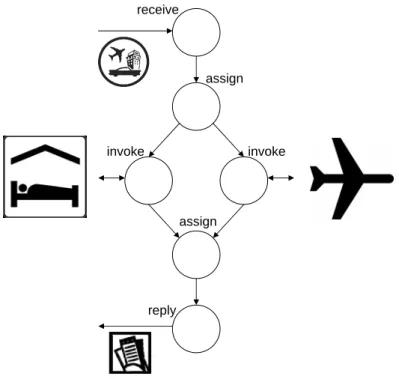
By means of a Virtual travel agency process (Figure 1) we show the applicability
of the ontology to represent business processes. The travel booking process
receives a request, prepares the input data for Web service invocations, invokes
the HotelBooking and the FlightBooking Web service, aggregates the result and
sends the result back to the requester. The process model in terms of instances of
the BPEL ontology is in the appendix. Using this representation, simple queries
like “Which activities deal with hotel booking?” can be answered. As
invoke
is
sub concept of
basicActivity
which is sub concept of
activity, it can be inferred
that an
invoke
is an
activity. Compared to e.g. a relational databases where a
user has to explicitly encode the knowledge that
invoke,
receive
and
reply
are
activities within the query, this knowledge can be inferred by the reasoner when
using the BPEL ontology. In conjunction with the process instance data, queries
like “Which process instances deal with journeys to Germany or Austria?” can
be answered. Assuming appropriate domain ontologies are used to describe the
destinations it can be inferred for instance that Berlin and Stuttgart are cities in
Germany and Innsbruck and Vienna are located in Austria and are thus included
in the result set of the query.
receive
invoke
invoke
reply
assign
assign
4
Conclusions
In this document, an ontology of the BPEL specification was presented and the
most essential design decisions were explained. Due to the chosen formalism, not
all constraints given by the BPEL language can be expressed, i.e. the correctness
of a BPEL process can not be checked using the ontology. However, this does
not affect the application of the ontology for the purpose of process reasoning: (i)
reasoning about process models, (ii) reasoning across different levels of abstraction,
i.e. across modelling notations and languages on the business level and the IT
level and (iii) reasoning including process instance data.
5
Acknowledgments
We would like to thank Axel Polleres for his helpful comments and explanations
regarding the definition of the WSML axioms used in the ontology and Barry
Norton for fruitful discussion about the subject matter.
The work published in this article was partially funded by the SUPER project
1(contract no. FP6-026850) and the TripCom project
2(contract no. FP6-027324)
under the EU 6th Framework Programme Information Society Technologies.
References
1.
Gruber, T.R.: Towards Principles for the Design of Ontologies Used for Knowledge
Sharing. In Guarino, N., Poli, R., eds.: Formal Ontology in Conceptual Analysis
and Knowledge Representation, Deventer, The Netherlands, Kluwer Academic
Publishers (1993)
2.
Alves, A., Arkin, A., Askary, S., Barreto, C., Bloch, B., Curbera, F., Ford, M.,
Goland, Y., Gu´ızar, A., Kartha, N., Liu, C.K., Khalaf, R., K¨
onig, D., Marin, M.,
Mehta, V., Thatte, S., van der Rijn, D., Yendluri, P., Yiu, A.: Web services business
process execution language version 2.0. Committee specification, OASIS Web
Services Business Process Execution Language (WSBPEL) TC (January 2007)
3. de Bruijn, J., Lausen, H., Krummenacher, R., Polleres, A., Predoiu, L., Kifer, M.,
Fensel, D.: D16. 1v0. 2 The Web Service Modeling Language WSML. WSML Final
Draft March
20
(2005)
4.
Weerawarana, S., Curbera, F., Leymann, F., Storey, T., Ferguson, D.: Web Services
Platform Architecture: SOAP, WSDL, WS-Policy, WS-Addressing, WS-BPEL,
WS-Reliable Messaging and More. Prentice Hall PTR Upper Saddle River, NJ,
USA (2005)
5.
Hepp, M., Leymann, F., Domingue, J., Wahler, A., Fensel, D.: Semantic Business
Process Management: A Vision Towards Using Semantic Web Services for Business
Process Management. IEEE International Conference on e-Business Engineering
(ICEBE 2005). Beijing, China (2005) 535–540
6.
White, S.: Business Process Modeling Notation (BPMN) Version 1.0. Business
Process Management Initiative, BPMI. org, May (2004)
1
http://www.ip-super.org/
27.
Hoffmann, W., Kirsch, J., Scheer, A.: Modellierung mit ereignisgesteuerten
Prozess-ketten:(methodenhandbuch, Stand: Dezember 1992). Iwi (1993)
8.
Hepp, M., Roman, D.: An Ontology Framework for Semantic Business Process
Management. In: eOrganization: Service-, Prozess, Market- Engeneering. Volume 1.,
8th international conference Wirtschaftsinformatik. Karlsruhe, Germany (2007)
423–440
9.
Lausen, H., Polleres, A., Roman, D.: Web Service Modeling Ontology (WSMO).
W3C Member Submission
3
(2005)
10.
Noy, N., McGuinness, D.: Ontology Development 101: A Guide to Creating Your
First Ontology. Knowledge Systems Laboratory, March (2001)
11. Duerst, M., Suignard, M.: Internationalized Resource Identifiers (IRIs). (2005)
12. Leymann, F., Roller, D.: Production workflow. Prentice Hall (2000)
Appendix
wsmlVariant ”http://www.wsmo.org/wsml/wsml−syntax/wsml−flight” namespace{ ”http://www.ip−super.org/ontologies/sBPEL/TravelBookingProcess#”, sbpel ”http://www.ip−super.org/ontologies/sBPEL/20070404#”, dc ”http://purl.org/dc/elements/1.1#”} ontologysbpelProcess nonFunctionalPropertiesdc#titlehasValue”Travel Booking sBPEL Process” dc#creatorhasValue”Joerg Nitzsche”
dc#publisherhasValue”SUPER European Integrated Project” dc#subjecthasValue{”sBPEL”, ”business process”, ”workflow”} dc#languagehasValue”en−UK”
dc#datehasValue”$Date: 2007/04/04$” endNonFunctionalProperties
importsOntology
{ ”http://www.ip−super.org/ontologies/sBPEL/20070404#”,
”http://www.ip−super.org/ontologies/wsdlExtension4BPEL/20070126#”} instanceprocessTravelBookingmemberOfProcess
hasNamehasValue”ContentProvision”
hasTargetNamespacehasValue”http://www.ip−super.org/ontologies/prereview” hasPartnerLinkhasValuetravelBookingPL, hotelBookingPL, flightBookingPL} hasActivityhasValueprocessFlow
hasVariablehasValue{varTravelBookingRequest, varHotelBookingRequest, varFlightBookingRequest, varTravelBookingResponse, varHotelBookingResponse, varFlightBookingResponse}
instancetypeTravelBookingRequestmemberOfMessageType
hasMessageTypehasValue”http://ip−super.org/processes/TravelAgency.wsdl# travelBookingRequestMessage”
instancevarTravelBookingRequestmemberOfVariable hasNamehasValue”varTravelBookingRequest” hasDataTypehasValuetypeTravelBookingRequest
instancetypeTravelBookingResponsememberOfMessageType
hasMessageTypehasValue”http://ip−super.org/processes/TravelAgency.wsdl# travelBookingResponseMessage”
instancevarTravelBookingResponsetmemberOfVariable hasNamehasValue”varTravelBookingResponse” hasDataTypehasValuetypeTravelBookingResponse
instancetypeHotelBookingRequestmemberOfMessageType
hotelBookingRequestMessage”
instancevarHotelBookingRequestmemberOfVariable hasNamehasValue”varHotelBookingRequest” hasDataTypehasValuetypeHotelBookingRequest
instancetypeHotelBookingResponsememberOfMessageType
hasMessageTypehasValue”http://ip−super.org/processes/HotelService.wsdl# hotelBookingResponseMessage”
instancevarHotelBookingResponsetmemberOfVariable hasNamehasValue”varHotelBookingResponse” hasDataTypehasValuetypeHotelBookingResponse
instancetypeFlightBookingRequestmemberOfMessageType
hasMessageTypehasValue”http://ip−super.org/processes/FlightService.wsdl# flightBookingRequestMessage”
instancevarFlightBookingRequestmemberOfVariable hasNamehasValue”varFlightBookingRequest” hasDataTypehasValuetypeFlightBookingRequest
instancetypeFlightBookingResponsememberOfMessageType
hasMessageTypehasValue”http://ip−super.org/processes/FlightService.wsdl# flightBookingResponseMessage”
instancevarFlightBookingResponsetmemberOfVariable hasNamehasValue”varFlightBookingResponse” hasDataTypehasValuetypeFlightBookingResponse
instancetravelBookingPLmemberOf ”http://www.ip−super.org/ontologies/sBPEL/20070308#PartnerLink” hasNamehasValue”travelBookingPL”
hasPartnerLinkTypehasValuetravelBookingPLT hasMyRolehasValueprovider
instancetravelBookingPLTmemberOfPartnerLinkType hasNamehasValue”travelBookingPLT”
hasRolehasValueprovider
instanceprovidermemberOfRole hasNamehasValue”provider”
hasPortTypehasValue”http://ip−super.org/processes/TravelAgency.wsdl#TravelBookingPortType”
instancehotelBookingPLmemberOf ”http://www.ip−super.org/ontologies/sBPEL/20070308#PartnerLink” hasNamehasValue”hotelBookingPL”
hasPartnerLinkTypehasValuehotelBookingPLT hasPartnerRolehasValueprovider
instancehotelBookingPLTmemberOfPartnerLinkType hasNamehasValue”hotelBookingPLT”
hasRolehasValueprovider
instanceprovidermemberOfRole hasNamehasValue”provider”
hasPortTypehasValue”http://ip−super.org/processes/HotelService.wsdl#HotelBookingPortType”
instanceflightBookingPLmemberOf ”http://www.ip−super.org/ontologies/sBPEL/20070308#PartnerLink” hasNamehasValue”flightBookingPL”
hasPartnerLinkTypehasValueflightBookingPLT hasPartnerRolehasValueprovider
instanceflightBookingPLTmemberOfPartnerLinkType hasNamehasValue”flightBookingPLT”
hasRolehasValueprovider
instanceprovidermemberOfRole hasNamehasValue”provider”
instanceprocessFlowmemberOfFlow
hasActivityhasValue{recTravelBookingRequest, assSplitRequest, invHotelService, invFlightService, assMergeResults, repTravelBookingResponse}
hasLinkhasValue{receiveToSplitRequest, splitRequestToInvHotelService, splitRequestToInvFlightService, invHotelServiceToMergeResults, invFlightlServiceToMergeResults, mergeResultsToReply} instancereceiveToSplitRequestmemberOfLink
hasNamehasValue”receiveToSplitRequest”
instancesplitRequestToInvHotelServicememberOfLink hasNamehasValue”splitRequestToInvHotelService”
instancesplitRequestToInvFlightServicememberOfLink hasNamehasValue”splitRequestToInvFlightService”
instanceinvHotelServiceToMergeResultsmemberOfLink hasNamehasValue”invHotelServiceToMergeResults”
instanceinvFlightlServiceToMergeResultsmemberOfLink hasNamehasValue”invFlightlServiceToMergeResults”
instancemergeResultsToReplymemberOfLink hasNamehasValue”mergeResultsToReply”
instancerecTravelBookingRequestmemberOfReceive hasNamehasValue”recTravelBookingRequest” hasCreateInstancehasValuetrue
hasVariablehasValuevarTravelBookingRequest hasPartnerLinkhasValuetravelBookingPL hasOperationhasValue”bookFlight” isSourcehasValuereceiveToSplitRequest
instanceassSplitRequestmemberOfAssign hasNamehasValue”assSplitRequest”
hasAssignOperationhasValue{copyHotelRequest, copyFlightRequest} isTargethasValuereceiveToSplitRequest
isSourcehasValue{splitRequestToInvHotelService, splitRequestToInvFlightService}
instancecopyHotelRequestmemberOfCopy
hasFromSpecificationhasValuefromTravelRequestHotel hasToSpecificationhasValuetoHotelRequest
instancefromTravelRequestHotelmemberOfCopyVariablePart hasVariablehasValuevarTravelBookingRequest
hasParthasValue”http://ip−super.org/processes/TravelAgency.wsdl#wsdl11.messagePart( travelBookingRequestMessage/Hotel)”
instancetoHotelRequestmemberOfCopyVariablePart hasVariablehasValuevarHotelBookingRequest
hasParthasValue”http://ip−super.org/processes/HotelService.wsdl#wsdl11.messagePart( hotelBookingRequestMessage/Hotel)”
instancecopyFlightRequestmemberOfCopy
hasFromSpecificationhasValuefromTravelRequestFlight hasToSpecificationhasValuetoHotelRequest
instancefromTravelRequestFlightmemberOfCopyVariablePart hasVariablehasValuevarTravelBookingRequest
hasParthasValue”http://ip−super.org/processes/TravelAgency.wsdl#wsdl11.messagePart( travelBookingRequestMessage/Flight)”
instancetoHotelRequestmemberOfCopyVariablePart hasVariablehasValuevarFlightBookingRequest
hasParthasValue”http://ip−super.org/processes/FlightService.wsdl#wsdl11.messagePart( flightBookingRequestMessage/Flight)”
hasNamehasValue”invHotelService” hasVariablehasValuevarHotelBookingRequest hasPartnerLinkhasValuehotelBookingPL hasOperationhasValue”bookHotel”
isTargethasValuesplitRequestToInvHotelService isSourcehasValueinvHotelServiceToMergeResults
instanceinvFlightServicememberOfInvoke hasNamehasValue”invFlightService” hasVariablehasValuevarFlightBookingRequest hasPartnerLinkhasValueflightBookingPL hasOperationhasValue”bookFlight”
isTargethasValuesplitRequestToInvFlightService isSourcehasValueinvFlightServiceToMergeResults
instanceassMergeResultsmemberOfAssign hasNamehasValue”assMergeResults”
hasAssignOperationhasValue{copyHotelResponse, copyFlightResponse}
isTargethasValue{invHotelServiceToMergeResults, invFlightlServiceToMergeResults} isSourcehasValuemergeResultsToReply
instancecopyHotelResponsememberOfCopy hasFromSpecificationhasValuefromHotelResponse hasToSpecificationhasValuetoTravelResponseHotel
instancefromHotelResponsememberOfCopyVariablePart hasVariablehasValuevarHotelBookingResponse
hasParthasValue”http://ip−super.org/processes/HotelService.wsdl#wsdl11.messagePart( hotelBookingResponseMessage/Hotel)”
instancetoTravelResponseHotelmemberOfCopyVariablePart hasVariablehasValuevarTravelBookingResponse
hasParthasValue”http://ip−super.org/processes/TravelAgency.wsdl#wsdl11.messagePart( travelBookingResponseMessage/Hotel)”
instancecopyFlightResponsememberOfCopy hasFromSpecificationhasValuefromFlightResponse hasToSpecificationhasValuetoTravelResponseFlight
instancefromFlightResponsememberOfCopyVariablePart hasVariablehasValuevarFlightBookingResponse
hasParthasValue”http://ip−super.org/processes/FlightService.wsdl#wsdl11.messagePart( flightBookingResponseMessage/Flight)”
instancetoTravelResponseFlightmemberOfCopyVariablePart hasVariablehasValuevarTravelBookingResponse
hasParthasValue”http://ip−super.org/processes/TravelAgency.wsdl#wsdl11.messagePart( travelBookingResponseMessage/Flight)”
instancerepTravelBookingResponsememberOfReply hasNamehasValue”repTravelBookingResponse” hasVariablehasValuevarTravelBookingResponse hasPartnerLinkhasValuetravelBookingPL hasOperationhasValue”bookFlight” isTargethasValuemergeResultsToReply