Risk Management Practices in a
Construction Project – a case study
Master of Science Thesis in the Master’s Programme Design and Construction Project Management
EWELINA GAJEWSKA
MIKAELA ROPEL
Department of Civil and Environmental Engineering
Division of Construction Management
CHALMERS UNIVERSITY OF TECHNOLOGY Göteborg, Sweden 2011
MASTER‟S THESIS 2011:47
Risk Management Practices in a
Construction Project – a case study
Masterof Science Thesis in the Master’s Programme
EWELINA GAJEWSKA MIKAELA ROPEL
Department of Civil and Environmental Engineering
Division ofConstruction Management
CHALMERS UNIVERSITY OF TECHNOLOGY Göteborg, Sweden 2011
Risk Management Practices in a Construction Project – a case study
Master of Science Thesis in the Master’s Programme
EWELINA GAJEWSKA MIKAELA ROPEL
© EWELINA GAJEWSKA, MIKAELA ROPEL, 2011
Examensarbete / Institutionen för bygg- och miljöteknik, Chalmers tekniska högskola2011:47
Department of Civil and Environmental Engineering
Division of Construction Management
Chalmers University of Technology SE-412 96 Göteborg
Sweden
Telephone: + 46 (0)31-772 1000
Reproservice / Department of Civil and Environmental Engineering Göteborg, Sweden 2011
CHALMERS, Civil and Environmental Engineering, Master‟s Thesis 2011:47
VI
Risk Management Practices in a Construction Project – a case study
Master of Science Thesis in the Master’s Programme
EWELINA GAJEWSKA MIKAELA ROPEL
Department of Civil and Environmental Engineering
Division of Construction Management
Chalmers University of Technology
ABSTRACT
Risk management is a concept which becomes very popular in a number of businesses. Many companies often establish a risk management procedure in their projects for improving the performance and increase the profits. Projects undertaken in the construction sector are widely complex and have often significant budgets, and thus reducing risks associated should be a priority for each project manager. This master thesis presents an application of risk management in the early stage of a project life cycle of a construction project. In order to examine how risk and risk management process is perceived a case study of a school project was chosen. Moreover, based on the conducted interviews, the research presents how risks change during a project life cycle. All analyses are based on a theoretical background regarding risk, risk management process and project life cycle approach in the construction sector.
Key words: Key words: Risk; Risk management; Risk management process; Risk management methods; Project life cycle
CHALMERS Civil and Environmental Engineering, Master‟s Thesis 2011:47 VII
Contents
ABSTRACT VI CONTENTS VII PREFACE X 1INTRODUCTION 11 1.1 Purpose 12 1.2 Limitations 121.3Outline of the thesis 12
2 THEORETICAL FRAMEWORK 13
2.1 Project life cycle 13
2.1.1 Pre-project phase 15
2.1.2 Planning and design phase 16
2.1.3 Contractor selection phase 17
2.1.4 Project mobilization phase 17
2.1.5 Project operation phase 17
2.1.6 Project close-out and termination phase 18
2.1.7 Risks in the PLC 18
2.2 Project manager/project organization 19
2.3 Decision making process from risk management perspective 19
2.4 The risk management 20
2.4.1 Risk definition 20
2.4.2 A concept of risk management 21
2.4.3 Benefits with risk management 22
2.4.4 Limits of risk management 23
2.4.5 Risks in construction projects 23
2.5 The risk management process 24
2.5.1 Risk identification 24
2.5.2 Assessment/analysis 26
2.5.3 Risk response 32
2.5.4 Monitoring 33
3 METHOD AND MATERIALS 35
3.1 Data collection 35
3.2 Case study and interviews 36
3.3 Limitations 36
4 RESULTS 37
CHALMERS, Civil and Environmental Engineering, Master‟s Thesis 2011:47 VIII 4.2 The PLC 37 4.3 Risk definition 38 4.4 The RMP 39 4.4.1 Risk identification 40 4.4.2 Risk assessment 41 4.4.3 Risk response 42
4.5 Risks handled in the project 44
4.6 The vision of ”0 errors” in the project 44
4.7 Application of the probability and impact method 44
5 DISCUSSION 50
5.1 How are risks and risk management perceived in a construction project? 50 5.2 How is the risk management process used in practice? 51
5.2.1 Identification 51
5.2.1 Assessment 51
5.2.3 Response 52
5.3 How do risks change during a project life cycle? 53
6 CONCLUSION 54
7 REFLECTION 55
REFERENCES 56
CHALMERS Civil and Environmental Engineering, Master‟s Thesis 2011:47
CHALMERS, Civil and Environmental Engineering, Master‟s Thesis 2011:47
X
Preface
In this thesis, risk management have been investigated in a case study which helped to realize how the construction industry works with this concept. The research has been carried out from January 2011 to may 2011, at the Department of Civil and Environmental Engineering, Chalmers University of Technology, Sweden.
The thesis has been carried out with Bygg-Fast, a consultancy company within construction project management, where a school project has been investigated in order to do this research. The research has also been supervised by Sven Gunnarsson at Chalmers University of Technology and an examination of the thesis regarding the language and formatting was made by Nancy Lea Eik-Nes. We appreciate for their help and support in this thesis. We would also want to thank all respondents in the school project for their involvement in the interviews which we could support our research on.
Göteborg May 2011
11
1
Introduction
Risk management (RM) is a concept which is used in all industries, from IT related business, automobile or pharmaceutical industry, to the construction sector. Each industry has developed their own RM standards, but the general ideas of the concept usually remain the same regardless of the sector. According to the Project Management Institute (PMI) (2004), project risk management is one of the nine most critical parts of project commissioning. This indicates a strong relationship between managing risks and a project success. While RM is described as the most difficult area within construction management (Winch, 2002; Potts 2008) its application is promoted in all projects in order to avoid negative consequences (Potts, 2008).
One concept which is widely used within the field of RM is called the risk management process (RMP) and consists of four main steps: identification, assessment, taking action and monitoring the risks (Cooper et al., 2005). In each of these steps, there are a number of methods and techniques which facilitate handling the risks.
Many industries have become more proactive and aware of using analyses in projects. Likewise, RM has become a timely issue widely discussed across industries. However, with regard to the construction industry, risk management is not commonly used (Klemetti, 2006). More construction companies are starting to become aware of the RMP, but are still not using models and techniques aimed for managing risks. This contradicts the fact that the industry is trying to be more cost and time efficient as well as have more control over projects. Risk is associated to any project regardless the industry and thus RM should be of interest to any project manager. Risks differ between projects due to the fact that every project is unique, especially in the construction industry (Gould and Joyce, 2002). However there are still many practitioners that have not realized the importance of including risk management in the process of delivering the project (Smith et al., 2006). Even though there is an awareness of risks and their consequences, some organizations do not approach them with established RM methods.
The construction industry operates in a very uncertain environment where conditions can change due to the complexity of each project (Sanvido et al., 1992). The aim of each organization is to be successful and RM can facilitate it. However it should be underlined that risk management is not a tool which ensures success but rather a tool which helps to increase the probability of achieving success. Risk management is therefore a proactive rather than a reactive concept.
Many previous studies (Klemetti, 2006; Lyons and Skitmore, 2002; Zou et al. 2006) have been conducted within the field of RM but each presents a different approach to this concept. The research in this master thesis focuses on the construction industry and how the subject is practiced in the everyday operation. The concept of RM is presented in a systematized project life cycle (PLC) approach to show differences between elements of RMP in different project phases.
The research for this study was conducted together with a consultancy company working with construction project management, which consults a variety of construction projects. This organization works with risks in a way that they are aware of risks, but do not use any specific structured methods to handle them. However, they believe that a project‟s performance can be improved by implementing risk management methods. At the time when research was conducted, the company was working on a school project in the western part of Gothenburg, which is the case study in this thesis. The project was chosen in order to investigate the practices of risk management across project organization.
12
1.1 Purpose
The purpose of this master thesis is to evaluate how the risk management process is used in the construction industry and how the practitioners are managing risks in everyday situations. The theory of the risk management process will be compared to the actual practice in order to investigate similarities and differences. In other words, the main idea is to see if the construction industry is working with risk management as it is described in the literature regarding the methods and techniques presented.
In order to achieve the purpose, the following research questions have been formulated to support the investigation:
How are risks and risk management perceived in a construction project? How is risk management process used in practice?
How do risks change during a project life cycle?
The objectives are to understand the concept of RM and the RMP, investigate how the sector manages risks and facilitate the use of RM focused on the construction industry.
1.2 Limitations
The research focuses on the construction industry and is based on theories of risk management described in the literature. The research was complemented by a study of a construction project in Goteborg in cooperation with some of the stakeholders involved in it. Due to the limited research time of the thesis, the project was investigated during the planning and design phase only.
1.3
Outline of the thesis
The research starts with a literature overview in order to provide the theoretical context about the project in general terms with the focus on the project life cycle. Further, a description of how the construction industry is operating in the field of risk management is provided. RM, including the definition of risk, a descriptive part of the steps of the RMP, is then presented in order to establish the foundation for this thesis. Subsequently, results from conducted interviews are presented to show how the industry works with risks. In the discussion part, the results from the interviews are analyzed and compared to the theoretical framework. Finally the final recommendations are drawn up in the conclusion section. In Figure 1, a more illustrative picture of the research structure can be found.
Figure 1 The outline of the thesis
Introduction Theory Interview s Discussion Conclusion Result
13
2. Theoretical framework
The theory part is divided into three parts. The first part is a description of a project organization structure. Its purpose is to provide a reader with general information about a construction project and its organization. The second part introduces concept of risk management and provides definitions of terms used in this process. Finally, the theoretical concept of risk management process and methods used for risk assessment are presented. Some risks which occur commonly in the construction industry are, for example weather, design issues, problems with material, accidents, labor issues etc. Risks can vary in character and have different impacts on a project. In spite of this, risk management is not widely used within the construction industry.
2.1 Project life cycle
Each activity or process, regardless of the area of business domain, has a beginning and an end. Similar concepts are used in the engineering world to systemize projects over time. The term project life cycle is used as a management tool to improve a project‟s performance. The scope of life cycles differs among industries and diverse terminology with a various number of phases is used depending on the sectors. However, several terms are often used within one particular sector even though a number of phases can vary (Smith et al., 2006). Therefore, it is difficult to systemize and provide one common scope and definition of a project life cycle. Smith et al. (2006) concluded that various forms of PLC frameworks described in the literature are a result of variety of project types. For construction projects, for instance, the PLC model can consist of eight succeeding phases including pre-feasibility, feasibility, design, contract/procurement, implementation, commissioning, handover and operation (Smith et al., 2006). In contrast, Pinto and Prescott (1988) present a four stage PLC developed by Adams and Brandt, and King and Cleland as the most widely used framework, where conceptualization, planning, execution and termination are the main phases. A similar model is used by Westland (2006) who identifies initiation, planning, execution and closure as principal project steps.
Yet another model was developed by Ward and Chapman (1995) which sets up concept, planning, execution and termination to constitute PLC. The same authors in another publication make a further division of each of the four phases into another number of stages and steps. Such fragmentation of the activities provides easier and more accurate potential risk identification and makes risk management processes more effective (Chapman and Ward, 2003). Due to the variety of project types, PLC requires adjustments and an individual approach. A number of further stages within each phase should be adjusted to a particular project depending on its scope and structure. Since each project is unique, a framework used in one project can turn out to be completely inapplicable in another. Therefore the model, as the one proposed by Chapman and Ward (2003) that is shown in Table 1, should be used as an example and not as ready-made template.
14
Table 1 Phases, stages, and steps in the PLC (Chapman and Ward, 2003)
Phases Stages Steps
Conceptualization Conceive The product Trigger event Concept capture Clarification of purpose Concept elaboration Concept evaluation Planning Design The product strategically Basic design
Development of performance criteria Design development
Design evaluation
Plan
The execution strategically
Basic activities and resources basic plan Development of targets and milestones Plan development
Plan evaluation
Allocate
Resources tactically
Basic design and activity-based plan detail Development of resource allocation criteria Allocation development
Allocation evaluation
Execution Execute
Production
Co-ordinate and control Monitor progress
Modification of targets and milestones Allocation modification
Control evaluation
Termination Deliver The product
Basic deliverable verification Deliverable modification
Modification of performance criteria Deliver evaluation Review The process Basic review Review development Review evaluation
15 From the literature research emerges the most common PLC model which consists of four main project phases. The presented examples of PLC are applicable to a general project concept, and their scope can be adjusted depending on the industry. To make project planning in the PLC more convenient, some authors describe PLC‟s which are typical for a certain industry or sector.
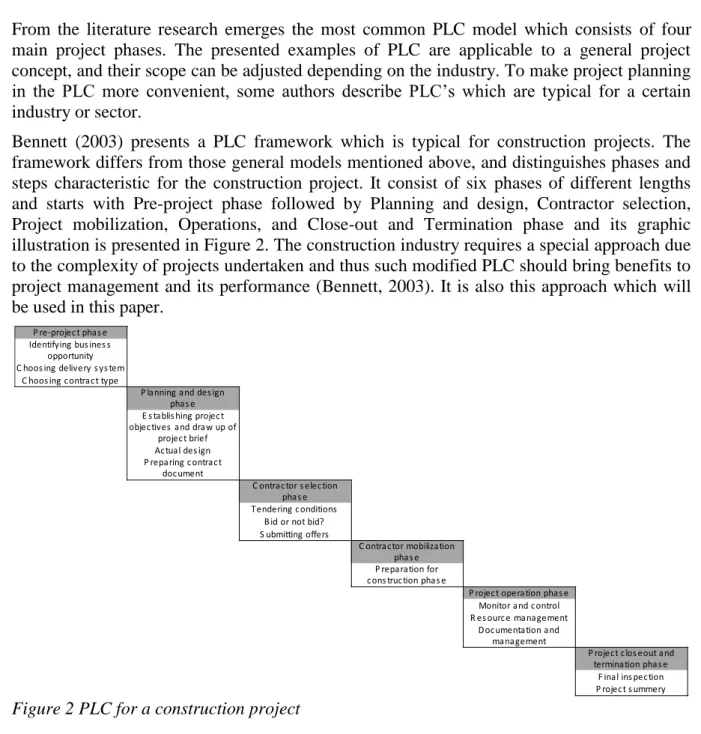
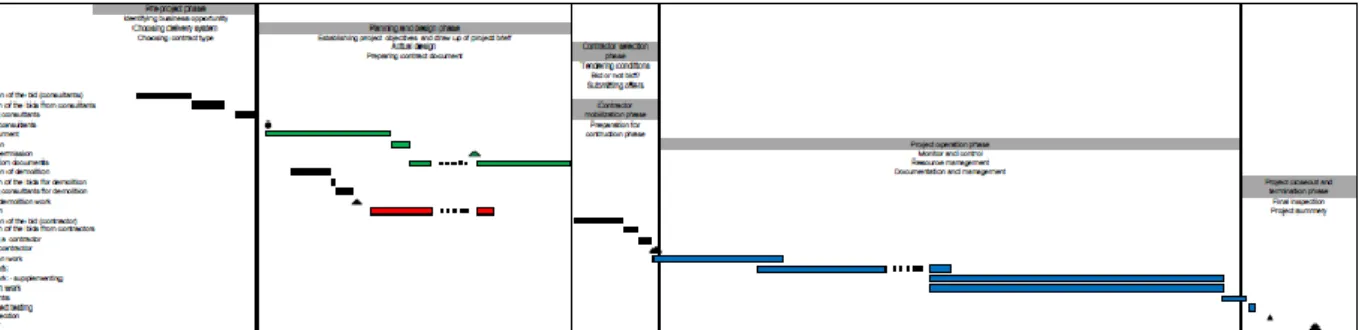
Bennett (2003) presents a PLC framework which is typical for construction projects. The framework differs from those general models mentioned above, and distinguishes phases and steps characteristic for the construction project. It consist of six phases of different lengths and starts with Pre-project phase followed by Planning and design, Contractor selection, Project mobilization, Operations, and Close-out and Termination phase and its graphic illustration is presented in Figure 2. The construction industry requires a special approach due to the complexity of projects undertaken and thus such modified PLC should bring benefits to project management and its performance (Bennett, 2003). It is also this approach which will be used in this paper.
Figure 2 PLC for a construction project
2.1.1 Pre-project phase
The purpose of the initial phase in a PLC is to develop an idea for a potential project (Bennett, 2003). Westland (2006) describes this step more in detail as developing a business opportunity which includes identification of a subject matter or problem which could be further developed into a project. Identifying business opportunities requires a number of assessments and discussions which should result in creating a project idea. Initial problem description, its scope, time frames and an outline of a plan for activities and steps in next
Support The product
Basic maintenance and liability perception Development of support criteria
Support perception development
P re-project phas e C hoos ing delivery s ys tem
C hoos ing contract type
Actual des ign
Tendering conditions B id or not bid? S ubmitting offers
P roject operation phas e Monitor and control R es ource management
F inal ins pection P roject s ummery Identifying bus ines s
opportunity
P lanning and des ign phas e E s tablis hing project objectives and draw up of
project brief P reparing contract document C ontractor s election phas e C ontractor mobilization phas e P reparation for cons truction phas e
Documentation and management
P roject clos eout and termination phas e
16 phases of the PLC, are some of the factors which should be determined by the time the proposal is presented to a potential sponsor (Westland, 2006).
Moreover, in the pre-project phase a project delivery system is chosen. It establishes relationships between main actors in the project: the owner, the designer and the construction organization. Previous studies show that the choice of procurement system has a great impact of how risks are managed in the construction industry; this indicates that there is a relation between these factors. Chege and Rwelamila (1999) emphasized the correlation between risk response in the RMP and the procurement system.
2.1.2 Planning and design phase
The second phase in the PLC, presented by Bennett (2003), is the planning and design phase which is relatively longer than the others. This project development process consists of three sequential stages for more convenient phase completion and project delivery.
In the first step, project organization starts to be formulated. Main actors in the project and their roles are defined along with competences which are assigned to each position in particular (Bennett, 2003). After appointing the project team, a project brief is written which in detail describes the scope of the project and its objectives. In a construction project, first the needs of the stakeholders must being identified and then the design team makes initial sketches of each idea separately (Bennett, 2003). It helps to identify potential risks associated with proposed solutions. As a result of this examination, all identified ideas are ranked and the most feasible one is chosen for further development (Westland, 2006).
Further on, in the planning phase, site investigation and constructability analysis should be undertaken. A number of potential sites should be examined in respect to soil conditions, topography, location and price. A constructability analysis determines whether a proposed structure is easy to build and what effect will it have on schedule, budget or safety. In a planning phase, it is vital to determine whether potential investment is financially feasible. Thus the cost estimator should prepare a preliminary budget of a project where all types of possible costs and the price per unit or activity are determined (Bennett, 2003).
When all options in the feasibility study are analyzed, the project team chooses the best alternatives and proceeds to the next step in the PLC which is the design process. All assumptions made in previous stages are put into practice. In other words, schematic drawings drawn up under planning phase are developed into actual detail plans. Every technical aspect such as structure calculation or accessory planning is developed by a small specialized group of engineers. As a result of the whole design process, a clear vision of the investment emerges.
The last activity in the planning and design phase is development of a contract document. The contract document includes technical specifications, up-front documents and drawings. Its format can be based on standards issued by various institutions such as FIDIC, which is a standard widely used in international projects. This document sets form as well as instructions and invitation to tender. Established tendering processes enable the project team to proceed to the next stage which is contractor selection (Bennett, 2003).
17
2.1.3 Contractor selection phase
In this stage a contractor is selected (Bennett, 2003). However it is not always price which decides who will be awarded the contract (Potts, 2008). In a selection process, a number of criteria are taken into consideration such as qualifications, resources held or bid price and compiled in a criteria matrix. Such collected data are evaluated and the offer which scores highest is usually awarded the contract if no other criteria have been set. For the selection phase to be completed, a legally bidding contract agreement is signed between the owner and contractor (Bennett, 2003).
2.1.4 Project mobilization phase
In between choosing contractor and beginning of construction there is a number of activities which need to be considered. It is in the contractor‟s responsibility to apply for any type of necessary permits and licenses prior to construction works initiations. Moreover, detail schedule, initially drawn up in the planning phase, is developed with help of computer software in this phase. It is further used to plan employment and other resource utilities over time (Bennett, 2003).
2.1.5 Project operation phase
During the operation phase, there are three key activities in addition to the construction itself: monitor and control, resource management, and documentation and management. Monitor and control covers supervision of, among others, time, cost and quality (Bennett, 2003). The project manager is usually the person who undertakes this management process to keep track of undergoing activities. As previously mentioned, time, cost and quality are key aspects of each project and hence managing them is an important activity. Time management is used to log actual time spent for execution of certain tasks. It also helps to allocate resources more effectively and control schedule of performing works (Westland, 2006).
The actual schedule and work progress is compared to the schedule drawn up in previous phases. If any discrepancies are detected, a person responsible should take an appropriate action in order to bring the project back into conformance (Bennett, 2003). Keeping track of the time aspect makes it possible to manage other key issues, finances and quality. Cost control is used to record all actual expenses within the project and gives control over a budget and out-of-pocket expenditures. Whereas quality monitoring is performed in order to deliver what was promised to the client (Westland, 2006), it also controls whether the work performed is in compliance with technical requirements stated in tender documentation (Bennett, 2003).
Undertaking the second activity, resource management, results in better project performance. Personnel supervision consists of ensuring that workers perform their tasks in a right manner and comply with officially set working hours. Other resources, such as materials or equipment need to be tracked along with personnel. Any irregularity in these matters may negatively impact the schedule, budget or quality, causing delays or cost overruns (Bennett, 2003). Document management is the last activity in the operation phase, but its importance should not be ignored. It treats communication within the project and grandness of other documents. As in previous examples, proper management of this matter will make the project proceed in a timely, cost-effective and quality assurance manner (Bennett, 2003).
18
2.1.6 Project close-out and termination phase
Most of PLC‟s end up at the execution phase where the final product is handed over after being accepted by the client. Performing a project summary requires additional resources, time and money, which investors tend to prefer to spend on new investments instead (Westland, 2006). However, project close-out and termination is important, among others, from a legal perspective. Before installation works can be considered as completed, there are still activities which must take place. The main ones are final clean up, inspections, handover to the owner and project closure (Bennett, 2003).
The final procedure in the PLC, as suggested by Westland (2006), is to review the project completion. In this step the overall project assessment is performed. It gives possibility to draw conclusions for next projects to improve their performance. All initially planned activities such as budget, schedule or scope are compared with the completed activities to assess how the product was delivered in comparison to the plan. Such a review can be performed some time after the project handover in order to be able to assess all benefits (Westland, 2006).
2.1.7 Risks in the PLC
To make sure that everybody connected with a project is aware what a risk is, one common definition should be drawn up for the purpose of the particular project. To quantify identified risks, Westland (2006) uses a tool where likelihood of occurring risk is rated. This method is described later in this paper along with other assessment models, in the section 2.5.2.2. When risk plan is completed the risk management process execution starts, which is a tool to track and control previously identified risks (Westland, 2006).
Risks are associated with every project and should be identified in order to avoid negative impacts on the overall performance. Many problems which are faced in later phases of the PLC result from unmanaged risks from the earlier stage (Chapman and Ward, 2003). This indicates how important it is to carry out accurate analysis especially in an initial phase of a project. Raz et al. (2002) perceive RM as a process which starts at project definition and continues through planning, execution, control and closure phase. However, a study conducted by Lyons and Skitmore (2002) proves that planning and execution are the two phases where RM is most widely used. In contrast, Elkington and Sallman (2002) found that the conceptualization phase is the most important in the RMP.
Westland (2006) identifies project steps where more attention should be directed toward risk management. In the initial project phase, the feasibility study is undertaken, which is a thorough analysis of a project proposal. At this stage, a number of solutions are identified and assessed and the study is conducted to identify potential risks associated with proposed solutions. Further in the planning phase, a risk plan is drawn up where potential risks related to project planning are identified. All the stakeholders should contribute in drawing up this plan to make sure that every potential risk has been identified. In addition to identifying risk, the risk plan assigns the type of action which should be taken in order to respond to a particular problem. Performing this stage in the planning phase aims at mitigating risk before the execution phase, during which any occurring risk is very costly if no action is taken in advance (Westland, 2006).
Westland (2006) suggests that risk assessment should be performed during the review of each phase of the PLC. At the beginning of a project, a high level of uncertainty is expected which
19 decreases along with project progress. Doubts which rise at any point make it necessary to go back and revise controversial issues from their origin. Such a procedure will require going back to previous steps and discussing them with the new assumptions. While making decisions while moving further in the PLC raises a need for adjustments in previous steps. In other words, decisions made at a certain point of time may result in changing concepts of steps further up in the PLC which were made at the initial phase.
In the execution phase of the PLC, monitoring and control are performed in order to make sure that the process is going according to the plan and all identified risks are being handled. Such monitoring should be done under the whole project process, starting with the point in time when the risks were recognized. At the project closure, where the whole project is summarized, the project's objectives, benefits and deliverables are evaluated. All parties then have a chance to list all activities or risks which were not fully managed within the project. Those unmanaged risks can be a subject of further discussion and be used as warning for next projects (Westland, 2006).
2.2 Project manager/project organization
A construction project is characterized not only by its size and complexity, but also by various events and interactions which take place during the life cycle of a project. The work environment is constantly changing due to the number of participants involved, the project duration and the events along the way (Sanvido et al. 1992).
In the construction industry, the most common way of working is within project teams, which often are only temporary organizations. Winch (2002) describes a project as relying on human and equipment resources. This constellation will be different in each project, since all projects are unique. Human resources, the actors, working in the project form a project team. The aim of such a group is to achieve the objectives set for the project. Dependencies between members can be compared to a hierarchical structure. In such an organizational form, a formal leadership is executed by a project manager (Winch, 2002) who has the overall responsibility for the project, and organizes its structure and operation (Sears et al. 2008). Within the project team, the tasks are divided among the members, depending on their areas of expertise (Winch, 2002).
The main task for a project manager is to ensure that the project is properly managed in order to complete it in time, within budget and with required performance. These most important project factors are exposed to risks and uncertainties. The project manager should use an RMP in order to ensure that the risks have been identified, analyzed and managed. (Perry, 1986) Some companies have a separate risk management department which is a highly specialized unit within the field of risks. Their role is to assist project managers in handling risk associated to the project. It means that risks are managed in the organization and the responsibilities are shared within the company.
2.3 Decision making process from risk management perspective
Each of the phases of the PLC has certain purpose and scope of work assigned. At the completion of each phase there is a decision point where risk assessment takes place. Based on the risk assessment, an appropriate decision is made regarding further actions or proceeding to the next phase (Smith et al., 2006). For project management to be effective, an evaluation should be made including all phases of the PLC. Ward and Chapman (1995) use 'go', 'maybe' and 'no go' options in a decision making process. A 'go' status will constitute a green light for proceeding on to the next phase while 'no go' will stop the project. Evaluation20 resulting in a 'maybe' decision will lead to return to a previous phase or even phases for further improvements and minimizing risk (Ward and Chapman, 1995). The further on in the stages the 'maybe' decision is made, which takes the process back to the initial phases, the more problems it causes. According to Chapman and Ward (2003) it is possible to go back in phases within a PLC, however this undermines decisions which were made in previous stages and leads to waste of resources, usually both time and money (Chapman and Ward, 2003). Decisions which are made at the end of each stage should be made after a careful study of the possible risks and hindrances which might be encountered.
2.4 The risk management
Many explanations and definitions of risks and risk management have been recently developed, and thus it is difficult to choose one which is always true. Each author provides his own perception of what risk means and how to manage it. The description depends on the profession, project and type of business (Samson, 2009). Risk management in general is a very broad subject and definitions of risk can therefore differ and be difficult to apply in all industries in general. For the purpose of this thesis one definition of risk and risk management will be chosen, in order to have a clear understanding of these concepts in construction industry.
2.4.1 Risk definition
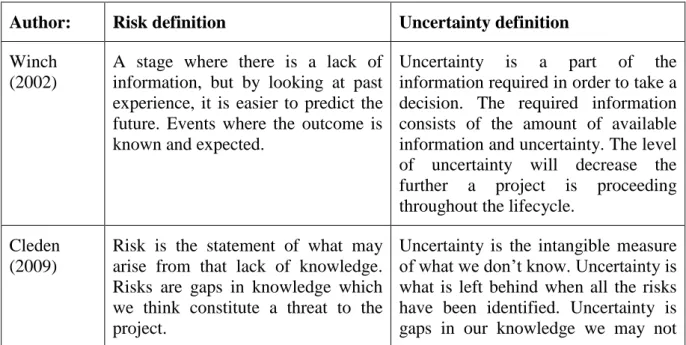
Risk and uncertainty are the two most often used concepts in the literature covering RM field. Although these terms are closely related, a number of authors differentiate between them (Samson, 2009). Also practitioners working with risk have difficulty in defining and distinguishing between these two. Often definitions of risk or uncertainty are tailored for the use of a particular project. To make it more systematized, a literature research was done. The findings of this search resulted in a number of definitions of risk and uncertainties. These have been compiled and are presented in Table 2.
Table 2 Definitions of risk and uncertainty
Author: Risk definition Uncertainty definition
Winch (2002)
A stage where there is a lack of information, but by looking at past experience, it is easier to predict the future. Events where the outcome is known and expected.
Uncertainty is a part of the information required in order to take a decision. The required information consists of the amount of available information and uncertainty. The level of uncertainty will decrease the further a project is proceeding throughout the lifecycle.
Cleden (2009)
Risk is the statement of what may arise from that lack of knowledge. Risks are gaps in knowledge which we think constitute a threat to the project.
Uncertainty is the intangible measure of what we don‟t know. Uncertainty is what is left behind when all the risks have been identified. Uncertainty is gaps in our knowledge we may not
21 even be aware of.
Smith et al.
(2006)
Risks occur where there is some knowledge about the event.
There might be not enough information about the occurrence of an event, but we know that it might occur.
Webb (2003)
Risk is a situation in which he possesses some objectives information about what the outcome might be. Risk exposure can be valued either positively or negatively.
Uncertainty is a situation with an outcome about which a person has no knowledge.
Darnall and Preston (2010)
Risk is a possibility of loss or injury.
Cooper et al. (2005)
Risk is exposure to the consequences of uncertainty.
All risk definitions complied in Table 2 describe risk as a situation where lack of some aspect can cause a threat to the project. Lack of information and knowledge are those factors which are most commonly mentioned by all the authors as leading reasons for a failure. The description provided by Cleden (2009) will best fit the purpose of this paper; it concerns how risk is defined as a gap in knowledge which, if not handled correctly, will constitute a threat to the project.
Uncertainty is defined in a more abstract way. The descriptions provided in Table 2 are similar to each other and the common factor is again lack of information and knowledge. The biggest difference by definition is awareness. For the purpose of this thesis, the definition of uncertainty provided by Cleden (2009) will be used. These two chosen definitions best show the difference between risk and uncertainty and help to be consistent with terminology in the paper.
Darnall and Preston (2010) find some of the risks to be predictable and easy to identify before they occur, while the others are unforeseeable and can result in unexpected time delays or additional costs. This statement finds confirmation in the definition provided by Cleden (2009) who uses the same arguments defining uncertainty as rather unpredicted, unforeseeable events, while risk should be possible to foresee. The overview of definitions which can be found in literature regarding those two terms implies that uncertainty is a broad concept and risk is a part of it. This confirms close relation between those two concepts but at the same time distinguishes them.
In the following chapters, the focus is on risk itself and how it should be handled. Uncertainty is not a tangible term and thus will not be further developed in the paper.
2.4.2 A concept of risk management
Smith et al. (2006) provide a comprehensive description of the concept of RM and how it can be used in practice. According to the authors, risk management cannot be perceived as a tool
22 to predict the future, since that is rather impossible. Instead, they describe it as a tool to facilitate the project in order to make better decisions based on the information from the investment. In this way, decisions based on insufficient information can be avoided, and this will lead to better overall performance. In the literature, RM is described as a process with some predefined procedures. The scope of its definition differs among the authors, however the core information is the same. From a number of definitions which can be found in the management literature Cooper et al. (2005) explanation brings the essence of this concept:
The risk management process involves the systematic application of management policies, processes and procedures to the tasks of establishing the context, identifying, analyzing, assessing, treating, monitoring and communicating risks
(Cooper et al., 2005).
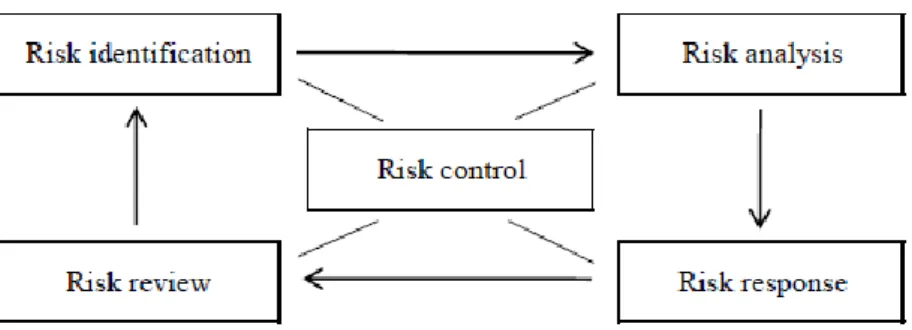
Risk management process (RMP) is the basic principle of understanding and managing risks in a project. It consists of the main phases: identification, assessment and analysis, and response (Smith et al. 2006) as shown in Figure 3. All steps in RMP should be included when dealing with risks, in order to efficiently implement the process in the project. There are many variations of RMP available in literature, but most commonly described frameworks consist of those mentioned steps. In some models there is one more step added, and the majority of sources identify it as risk monitoring or review. For the purpose of this paper the model of RMP described by Smith et al. (2006) will be used for further analysis and will be further explained in the following section.
Figure 3 The Process of managing risks (Smith et al. 2006)
2.4.3 Benefits with risk management
To maximize the efficiency of risk management, the RMP should be continuously developed during the entire project. In this way, risks will be discovered and managed throughout all the phases (Smith et al. 2006). The benefits from RM are not only reserved for the project itself, but also for the actors involved. The main incentives are clear understanding and awareness of potential risks in the project. In other words, risk management contributes to a better view of possible consequences resulting from unmanaged risks and how to avoid them. (Thomas, 2009) Another benefit of working with risk management is increased level of control over the whole project and more efficient problem solving processes which can be supported on a more genuine basis. It results from an analysis of project conditions already in the beginning of the project. (Perry, 1986) The risk management also provides a procedure which can reduce possible and sudden surprises (Cooper et al. 2005).
Different attitudes towards risk can be explained as cultural differences between organizations, where the approach depends on the company's policy and their internal procedures (Webb, 2003). Within the RM, three company‟s approaches can be distinguished.
23 The first one is the risk-natural firm which does not invest much in risk management but is still aware of the most important risks. The second approach is the risk-averse, where no investments are made in order to reduce the probability of occurrence of risk. The last one is the risk-seeker where the organization is prepared to face all risks and is often called gambler. In the long term, the seeking companies can get a lower profitability compared to risk-natural firms. This is because of the large investments and losses when repeating the risk management processes over and over again to ensure all risks have been managed before the risks actually occurs (Winch, 2002).
2.4.4 Limits of risk management
The level of risk is always related to the project complexity (Darnall and Preston, 2010). The fact that there are so many risks which can be identified in the construction industry, can be explained by the projects‟ size and their complexity. The bigger the project is, the larger the number of potential risks that may be faced. Several factors can stimulate risk occurrence. Those most often mentioned in the literature are financial, environmental (the project‟s surrounding, location and overall regulations), time, design and quality. Other influences on the occurrence of risk are the level of technology used and the organization‟s risks (Gould and Joyce, 2002).
Cleden (2009) claims that complexity is a factor that can limit a project; the bigger and more complex a project is, the more resources are required to complete it. Moreover, when all potential risks have been identified, the project team must remember that there might be more threats. Therefore, the project team should not solely focus on management of those identified risks but also be alert for any new potential risks which might arise. RM should be used as a tool to discover the majority of risks and a project manager should be also prepared for managing uncertainties not included in a RM plan (Cleden, 2009).
2.4.5 Risks in construction projects
Due to the nature of the construction sector, RM is a very important process here. It is most widely used in those projects which include high level of uncertainty. These types of risk investments are characterized by more formal planning, monitor and control processes.. The easiest way to identify risk is to analyze and draw a conclusion from projects which failed in the past. To make sure that the project objectives are met, the portfolio of risks associated with all actors across the project life cycle (PLC) should be considered (Cleland and Gareis, 2006). In the early stages of the project where planning and contracting of work, together with the preliminary capital budget are being drawn, risk management procedures should be initiated. In later stages, RM applied systemically, helps to control those critical elements which can negatively impact project performance. In other words, to keep track of previously identified threats, will result in early warnings to the project manager if any of the objectives, time, cost or quality, are not being met (Tummala and Burchett, 1999).
There are a number of risks which can be identified in the construction industry and which can be faced in each construction project regardless of its size and scope. Changes in design and scope along with time frames for project completion are the most common risks for the construction sector. The further in the process, changes in scope or design are implemented, the more additional resources, time and cost, those changes require. Project completion ahead of time may be as troublesome as delays in a schedule. Too quick completion may be a result of insufficient planning or design problems which in fact shorten the completion time but on the other hand lead to a low quality of final product and increased overall cost. Being behind
24 schedule generates greater costs for both investors and contractors due to non-compliance with contracted works (Gould and Joyce, 2002). And thus it is important to keep a balance in the concept of time-cost-quality tradeoff, which more widely is becoming an important issue for the construction sector (Zhang and Xing, 2010). Depending on the project scope, types of risks may differ among investments. Thus, a more detailed risk identification analysis for the construction sector will be a subject of one of the next chapters (2.5.1) in this paper.
2.5 The risk management process
As mentioned above, an RMP described by Smith et al. (2006) has been chosen for the
purpose of this paper. This section will further explain the RMP, its four stages and how it can be used in managing risks.
2.5.1 Risk identification
Winch (2002) claims that the first step in the RMP is usually informal and can be performed in various ways, depending on the organization and the project team. It means that the identification of risks relies mostly on past experience that should be used in upcoming projects. In order to find the potential risks, an allocation needs to be done. This can be decided and arranged by the organization. In this case, no method is better than another, since the only purpose is to establish the possible risks in a project.
Risks and other threats can be hard to eliminate, but when they have been identified, it is easier to take actions and have control over them. If the causes of the risks have been identified and allocated before any problems occur, the risk management will be more effective (PMI, 2004). RM is not only solving problems in advance, but also being prepared for potential problems that can occur unexpectedly. Handling potential threats is not only a way to minimize losses within the project, but also a way to transfer risks into opportunities, which can lead to economical profitability, environmental and other advantages (Winch, 2002).
The purpose of identifying risks is to obtain a list with potential risks to be managed in a project (PMI, 2004). In order to find all potential risks which might impact a specific project, different techniques can be applied. It is important to use a method that the project team is most familiar with and the project will benefit from. The aim is to highlight the potential problems, in order for the project team to be aware of them. Authors describe many creative alternative methods. To systematize this process, all the methods which can be found in the literature have been put together in Table 3. (Smith et al. 2006; Lester, 2007; PMI, 2004)
Table 3 Risk identification techniques
Information gathering methods Workshops Brainstorming Interviews Questionnaires Benchmarking
25
Consulting experts
Past experience
Delphi technique
Risk breakdown structure
Visit locations
Documentation Databases, historical data from
similar projects Templates
Checklists
Study project documentation (plan, files etc.)
Study specialist literature
Research Stakeholder analysis
Research assumptions
Research interfaces
Lists with potential problems are created on different bases and are tailored for a certain project individually. In the literature, examples of risks can be found which can be used in creating those compilations. Possible risks which can be found in the literature are combined in Table 4. (Smith et al. 2006; Potts, 2008; Lester, 2007; Bing, et al, 2005; Webb, 2003; Darnall and Preston, 2010; Edwards, 1995; Jeynes, 2002)
Table 4 Risk categories divided into groups
Risk categories Groups: Risks: Monetary Financial Economical Investment Political Legal Political Environment Environmental Natural, physical Technical Technical
26 Project objectives Planning, scheduling Construction Design Quality Operational Organizational Human Labor, stakeholder Human factors Cultural Market Market Safety Safety Security, crime Materials Resources Logistics
2.5.2 Assessment/analysis
Risk analysis is the second stage in the RMP where collected data about the potential risk are analyzed. Risk analysis can be described as short listing risks with the highest impact on the project, out of all threats mentioned in the identification phase (Cooper et al. 2005). Although some researchers distinguish between terms risk assessment and risk analysis and describe them as two separate processes, for the purpose of this paper, this part of RMP will be consistent with the model provided by Smith et al. (2006) and described as one process. In the analysis of the identified risk, two categories of methods – qualitative and quantitative – have been developed. The qualitative methods are most applicable when risks can be placed somewhere on a descriptive scale from high to low level. The quantitative methods are used to determine the probability and impact of the risks identified and are based on numeric estimations (Winch, 2002). Companies tend to use a qualitative approach since it is more convenient to describe the risks than to quantify them (Lichtenstein, 1996). In addition, there is also one approach called semi-quantitative analysis, which combines numerical values from quantitative analysis and description of risk factors, the qualitative method (Cooper et al.
2005). However, this approach will not be further addressed in this paper.
Within the quantitative and qualitative categories, a number of methods which use different assumptions can be found, and it may be problematic to choose an appropriate risk assessment model for a specific project. The methods should be chosen depending on the type of risk, project scope as well as on the specific method‟s requirements and criteria. Regardless of the
27 method chosen, the desired outcome of such assessment should be reliable (Lichtenstein, 1996). Perry (1986) mentions that the selection of the right technique often depends on past experience, expertise, and nowadays it also depends on the available computer software. Lichtenstein (1996) explains a number of factors that can influence the selection of the most appropriate methods in the risk assessment for the right purpose. It is up to each organization to decide which of these factors are the most critical for them and develop the assessment accordingly. In a survey conducted by Lichtenstein (1996), many factors were discovered, and the most important ones are listed below.
Cost of using the method, both the employment cost and the method itself Adaptability, the need of adapting to the organization‟s requirement Complexity, how limited and simple the method is
Completeness, the method needs to be feasible Usability, the method should be understandable to use Validity, the results should be valid
Credibility
Below is a brief description of various risk analysis methods. All of these methods are used in the construction industry (Azari, 2010).
2.5.2.1 Quantitative methods
Quantitative methods need a lot of work for the analysis to be performed. The effort should be weighed against the benefits and outcomes from the chosen method, for example smaller projects may sometimes require only identification and taking action on the identified risks, while larger projects require more in depth analysis. The quantitative methods estimate the impact of a risk in a project (PMI, 2009). They are more suitable for medium and large projects due to the number of required resources such as complex software and skilled personnel (Heldman, 2005).
Scenario technique - Monte Carlo simulation
The Monte Carlo method is based on statistics which are used in a simulation to assess the risks. The simulation is used for forecasting, estimations and risk analysis by generating different scenarios (Mun, 2006). Information collected for the simulation is, for instance, historical data from previous projects. The data represent variables of schedule and costs for each small activity in a project, and may contain pessimistic, most likely and optimistic scenarios (Heldman, 2005). The simulation can be presented as a basket with golf balls, as Mun (2006) explains the process. Data (the golf balls) are mixed and one of them is picked each time the simulation is done. The chosen unit is an outcome which is recorded and the ball will be put back into the basket. The simulation is then redone a number of times and all outcomes are recorded. After completing the simulations required number of times, the average is drawn from all of the outcomes, which will constitute the forecast for the risk (Mun, 2006). The result from this method is a probability of a risk to occur, often expressed in a percentage (Darnall and Preston, 2010).
The most common way of performing the Monte Carlo simulation is to use the program Risk Simulator software, where more efficient simulations can be performed. This analysis can be also done in Microsoft Excel where a special function is used to pick the data randomly, but the results can be very limited (Mun, 2006).
28 Modeling technique - Sensitivity analysis
The purpose of a sensitivity analysis is to establish the risk events which have the greatest impact or value. Those events are later weighed against the objectives of the project. The higher the level of uncertainty a specific risk has, the more sensitive it is concerning the objectives. In other words, the risk events which are the most critical to the project are the most sensitive and appropriate action needs to be taken. (Heldman, 2005)
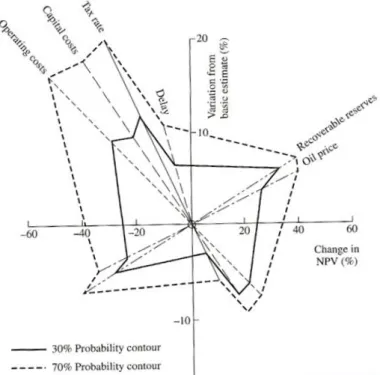
The result from the analysis can be presented in a spider diagram, Figure 4, that shows the areas in the project which are the most critical and sensitive. Moreover, one disadvantage with this analysis is that the variables are considered separately, which means that there is no connection between them (Perry, 1986 and Smith et al. 2006).
Figure 4 This figure shows how a sensitivity analysis can look like. (Smith et al. 2006)
The method requires a model of project in order to be analyzed with computer software. According to Smith et al. (2006), the project will benefit if the method is carried out in the project‟s initial phases in order to focus on critical areas during the project.
Diagramming technique
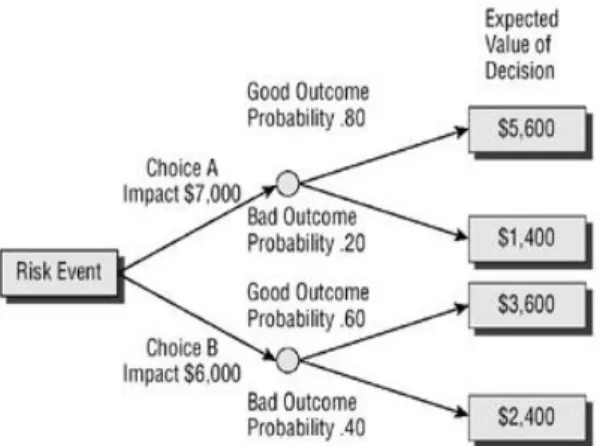
Decision tree analyses are commonly used when certain risks have an exceptionally high impact on the two main project objectives: time and cost (Heldman, 2005). There are two types of decisions trees; called Fault tree analysis (FTA) and Event tree analysis (ETA). The FTA method of analysis is used to determine the probability of the risk and is used to identify risks that can contribute or cause a failure of one event (Cooper et al. 2005). The purpose is to find the underlying causes to this event. It is usually drawn up as a sketch of a tree. The branches are the causes to the problem, and the starting point of the tree is the problem itself. Each branch has its own sequence of events and possible outcomes. The problem could depend on some causes that are interrelated with each other, or simply random
29 causes (Cooper et al. 2005). By having many branches, the tree provides an opportunity to choose which branch to follow and base decisions on, see Figure 5 (Heldman, 2005).
Figure 5 An example of a decision tree (Heldman, 2005)
Fault tree analysis (FTA) and a similar analysis called event tree analysis (ETA), are simple methods which can be used as a structured model to identify causes and effects of a single event, but present different approaches (White, 1995).
As explained, ETA is very similar to the FTA, but what differentiates the methods is the outcome. ETA is also drawn as a tree but in an opposite approach than the FTA. According to White (1995), failure generally does not has its roots in a single cause. It is rather described as a chain of causes and consequences in a sequence which can end up in major damage for the project. The tree consists of branches which represent the consequences that can be followed by that main event that this method is analyzing. Every branch has its own focus on a specific type of causes, which is why the importance is so great to create a risk assessment. (White, 1995)
In both FTA and ETA, cause-effect skills are required including the possibility to understand how failure could occur and see which failure modes can arise from the situation respectively. Therefore it is preferable to have an analyst within the field of risk management in the project team (White, 1995).
2.5.2.2 Qualitative methods
Qualitative methods for risk assessment are based on descriptive scales, and are used for describing the likelihood and impact of a risk. These relatively simple techniques apply when quick assessment is required (Cooper et al. 2005) in small and medium size projects (Heldman, 2005). Moreover, this method is often used in case of inadequate, limited or unavailable numerical data as well as limited resources of time and money (Radu, 2009). The main aim is to prioritize potential threats in order to identify those of greatest impact on the project (Cooper et al. 2005), and by focusing on those threats, improve the project‟s overall
performance (PMI, 2004). The complexity of scales (Cooper et al. 2005) and definitions (PMI, 2004) used in this examination reflect the project's size and its objectives. During the phases of the PLC, risks may change, and thus continuous risk assessment helps to establish actual risk status (Cooper et al. 2005).
Limitations of qualitative methods lie in the accuracy of the data needed to provide credible analysis. In order for the risk analysis to be of use for the project team, the accuracy, quality, reliability, and integrity of the information as well as understanding the risk is essential.
30 Qualitative methods are related to the quantitative methods, and in some cases constitute its foundations (PMI, 2004).
PMI (2004) identifies four qualitative methods for risk assessment: Risk probability and impact assessment, Probability/impact risk rating matrix, Risk Categorization and Risk Urgency Assessment. These methods are briefly discussed below.
Risk probability and impact assessment
By applying the method called risk probability and impact assessment, the likelihood of a specific risk to occur is evaluated. Furthermore, risk impact on a project‟s objectives is assessed regarding its positive effects for opportunities, as well as negative effects which result from threats. For the purpose of this assessment, probability and impact should be defined and tailored to a particular project (PMI, 2004). This means that clear definitions of scale should be drawn up and its scope depends on the project's nature, criteria and objectives (Cooper et al. 2005). PMI (2004) identifies exemplary range of probability from 'very unlikely' to 'almost certain', however, corresponding numerical assessment is admissible. The impact scale varies from 'very low' to 'very high'. Moreover, as shown in Figure 6, assessing impact of project factors like time, cost or quality requires further definitions of each degree in scale to be drawn up. Each risk listed under the identification phase is assessed in terms of the probability and the impact of its occurrence (PMI, 2004).
Figure 6 Definition of Impact Scales for Four Project Objectives (PMI, 2004)
Risk impact assessment investigates the potential effect on a project objective such as time, cost, scope, or quality. Risk probability assessment investigates the likelihood of each specific risk to occur. The level of probability for each risk and its impact on each objective is evaluated during an interview or meeting. Explanatory detail, including assumptions justifying the levels assigned, are also recorded. Risk probabilities and impacts are rated according to the definitions given in the risk management plan. Sometimes, risks with obviously low ratings of probability and impact will not be rated, but will be included on a watch-list for future monitoring (Ritter, 2008).
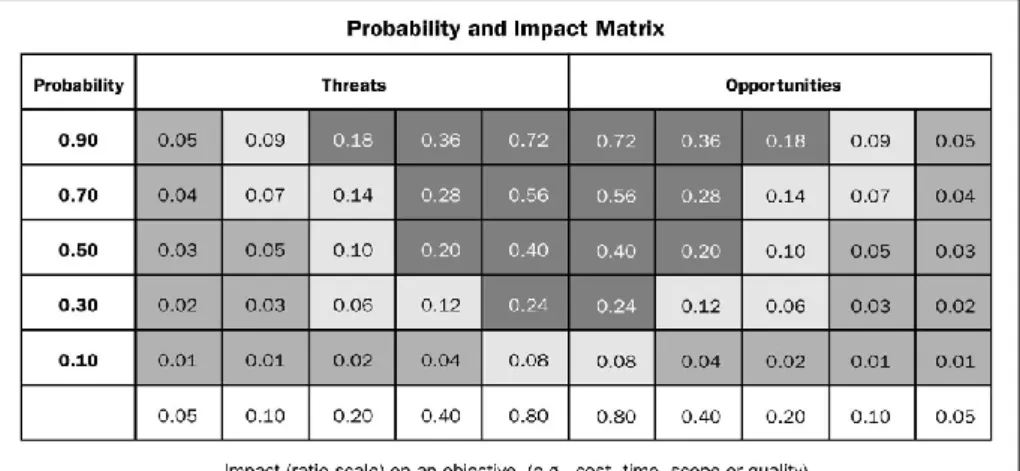
31 Probability/impact risk rating matrix
Probability and impact, which were assessed in the previous step, are used as basis for quantitative analysis and risk response which will be explained further in the paper. For this reason findings from the assessment are prioritized by using various methods of calculation which can be found in the literature (PMI, 2004). Westland (2006) computes the priority score as the average of the probability and impact. The range of priority score, the rating and color are assigned to indicate the importance of each risk (Westland, 2006). In order to set priorities, impact is multiplied by probability. The compiled results are shown in the matrix in Figure 7(PMI, 2004). Such combination of factors indicates which risks are of low, moderate or high priority. Regardless of the calculation method chosen, such a combination of data shows priority of previously identified risks by use of i.e. corresponding colors or numerical system and helps to assign appropriate risk response. For instance, threats with high impact and likelihood are identified as high-risk and may require immediate response, while low priority score threats can be monitored with action being taken only if, or when, needed (PMI, 2004).
Figure 7 Probability and Impact Matrix (PMI, 2004)
Risk categorization, and Risk Urgency Assessment
Two methods mentioned by PMI (2004) are not as commonly used as probability and impact. Risk categorization is a way of systematizing project threats according to e.g. their sources, in order to identify areas of the project that are most exposed to those risks. Tools which can be used in this method are work break down structure (WBS) or risk breakdown structure (RBS), and their role is to develop effective risk response (PMI, 2004). WBS breaks down large activities into small, manageable units and creates linked, hierarchical series of independent activities (Maylor, 2005). RBS categorizes risks and shows their dependencies (Dallas, 2006). The role of the second method, Risk Urgency Assessment, is to prioritize risks according to how quick response they require.
Lists with risks prioritized by applying qualitative methods, can be used to bring attention to significant problems to the project. Problems that are classified as a medium level risks can be a subject of a quantitative analysis to have better control over them. The threats that are assessed as low impact can be placed on a watch list and monitored. It will allow the project
32 team to focus on more important issues. Risk categorization helps reveal the weak links in the project organization where more attention should be directed (PMI, 2004).
2.5.3 Risk response
This third step of the RMP indicates what action should be taken towards the identified risks and threats. The response strategy and approach chosen depend on the kind of risks concerned (Winch, 2002). Other requirements are that the risk needs to have a supervisor to monitor the development of the response, which will be agreed by the actors involved in this risk management process. (PMI, 2004)
Winch (2002) claims that the lower impact the risk has, the better it can be managed. Most common strategies for risk response are: avoidance, reduction, transfer and retention (Potts, 2008). Beyond those types of responses, Winch (2002) describes that sometimes it is difficult to take a decision based on too little information. This may be avoided by waiting until the appropriate information is available in order to deal with the risk. This way of acting is called „Delay the decision‟ but this approach is not appropriate in all situations, especially when handling critical risks. Those need to be managed earlier in the process.
2.5.3.1 Avoidance/prevention
If the risk is classified as bringing negative consequences to the whole project, it is of importance to review the project‟s aim. In other words, if the risk has significant impact on the project, the best solution is to avoid it by changing the scope of the project or, worst scenario, cancel it. There are many potential risks that a project can be exposed to, and which can impact its success (Potts, 2008). This is why risk management is required in the early stages of a project instead of dealing with the damage after the occurrence of the risk (PMI, 2004).
The avoidance means that by looking at alternatives in the project, many risks can be eliminated. If major changes are required in the project in order to avoid risks, Darnall and Preston (2010) suggest applying known and well developed strategies instead of new ones, even if the new ones may appear to be more cost efficient. In this way, the risks can be avoided and work can proceed smoothly because strategy is less stressful to the users.
Cooper et al. (2005) list some activities that can help to avoid potential risk:
More detailed planning Alternative approaches Protection and safety systems Operation reviews
Regular inspections
Training and skills enhancement Permits to work
Procedural changes