Generic Compilers for Authenticated Key
Exchange
?Tibor Jager, Florian Kohlar, Sven Sch¨age, and J¨org Schwenk Ruhr-University Bochum
Abstract. So far, all solutions proposed forauthenticated key agreement combine key agreement and authentication into a single cryptographic protocol. However, in many important application scenarios, key agree-ment and entity authentication are clearly separated protocols. This fact enables efficient attacks on the na¨ıve combination of these protocols. In this paper, we propose new compilers for two-party key agreement and authentication, which are provably secure in the standard Bellare-Rogaway model. The constructions are generic: key agreement is exe-cuted first and results (without intervention of the adversary) in a secret session key on both sides. This key (or a derived key) is handed over, together with a transcript of all key exchange messages, to the authen-tication protocol, where it is combined with the random challenge(s) exchanged during authentication.
Keywords:authenticated key agreement, protocol compiler, TLS
1
Introduction
Authenticated key agreement(AKE) is a basic building block in modern cryptog-raphy. Many secure protocols for two-party and group key agreement have been proposed, including generic compilers that transform simple key agreement pro-tocols into authenticated key agreement propro-tocols, with many additional security properties.
However, all known constructions (including e.g. the modular approach of [1], and the Katz-Yung compiler [22]) result in a single cryptographic proto-col, whereas many security-criticalreal-world applications combine two or more clearly separated protocols:
– (Client) Authentication and SSL/TLS.The most prominent example is SSL/TLS. Although server and browser can be authenticated in a provably secure way [20, 25] within a single cryptographic protocol (the TLS hand-shake protocol), nearly all known web applications authenticate the client through a different protocol on top of the TLS channel. The security of these protocols is based on the sole assumption that the (human) user is able to
?The research leading to these results has received funding from the European
Com-munity (FP7/2007-2013) under grant agreement number ICT-2007-216646 - Euro-pean Network of Excellence in Cryptology II (ECRYPT II).
authenticate the server on the basis of security indicators of the browser, which was shown to be false in [17]. We do not rely on this assumption. In-stead, we regard SSL/TLS simply as a key agreement protocol, which cannot be changed due to the large number of implementations that are running worldwide. We may however change the authentication protocol, since the authentication protocol is often implemented in HTML/Javascript.1 – Browser based Single Sign-On (SSO).This scenario is perhaps the most
complex one and a formalization is out of scope of this paper. However, it may serve as an illustration of how cryptographic protocols are combined today to implement key exchange (KE) and authentication functionalities. In SSO protocols, two key agreement protocols, and two different authentication protocols are combined to achieve the desired goal. Cryptographically secure SSO protocols have e.g. been described in [19].
In this work, we present a new compiler that handles these scenarios. More-over, we can use our compiler to combine existing authentication protocols in a novel way with key exchange protocols. This includes:
– Zero-Knowledge Authentication. Zero-knowledge protocols have been developed with the goal to authenticate entities. However, in all known com-pilers, they cannot be combined with key agreement, except if they are trans-formed into digital signature schemes using the Fiat-Shamir heuristic. With our second compiler, ZK protocols can be used directly, which enables many interesting new protocols.
– Privacy-preserving authentication. With our compiler, we can easily combine privacy-preserving authentication protocols like Direct Anonymous Attestation with different key agreement protocols.
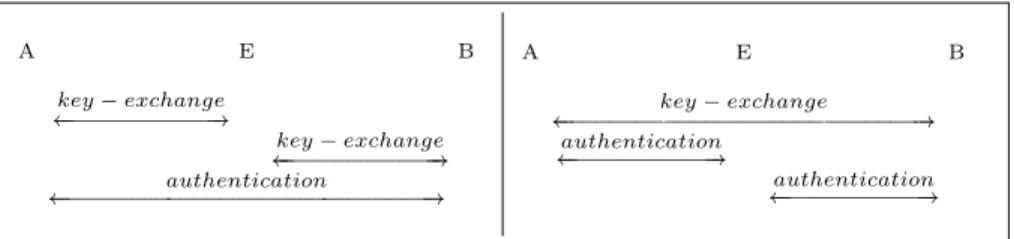
Man-in-the-middle Attack.Our real world attack scenario is as follows (cf. Figure 1): the adversary E (”Eve”) acts as an active (wo)man-in-the-middle (MITM) between A and B during key exchange, and then acts as a passive ”wire” during authentication. As a result, E has successfully authenticated as ”A” towards B, and as ”B” towardsA, and shares (different) keys with A and
B.
To counter this attack, one could of course apply standard cryptographic primitives to turn the key exchange protocol into an authenticated key exchange protocol (AKE) [1], but this is not possible in the cases cited above,because the implementation of the KE protocol cannot be changed, or the desired security goals (e.g. privacy) cannot be reached with standard compilers. Our compiler
1
At first glance, it seems that the security of TLS as a key agreement protocol could easily be proven in the Bellare-Rogaway model, since we only have to consider passive adversaries, and the TLS ciphersuites includes e.g. ephemeral Diffie-Hellman key exchange. However, there are some subtle problems with theRevealquery and the fact that the finalFinished message of the TLS handshake is already encrypted. Therefore it is still unclear if TLS fits in our theoretical framework.
A E B ← − key−exchange −−−−−−−−−−−−→− ← − key−exchange −−−−−−−−−−−−→− ← −−−−−−−−−−−−−−−−−−−−−−−−−−−−−−authentication → A E B ← −−−−−−−−key−−−−−−−−−−−−−−−−−−−−−exchange → ← −authentication−−−−−−−−−−−−→− ← −−−−−−−−−−−−−authentication→−
Fig. 1.Attack Scenario: Real world man-in-the-middle attack (left), and unknown key share attack (right)
turns the combination of the two protocols into a provably secure AKE protocol. During compilation, only the authentication protocol is changed slightly. Unknown Key Share (UKS) Attacks.To be able to prove the security in the standard Bellare-Rogaway (BR) model, the resulting AKE protocol must also be secure against unknown key share (UKS) attacks [14, 13] that do not directly lead to an attack in the real world, but invalidate security proofs in the model. Interestingly, in our scenario this is a kind of orthogonal attack to MITM attacks (cf. Figure 1): The adversary acts as a man-in-the-middle on the authentication protocol. To achieve security against both (MITM and UKS) attacks, one usually needs two compilers: One compiler who adds authenticators to each message [1], and one compiler who includes the complete state of the session into the computation of the session key [15]. Our compilers achieve this in one step, because we force the adversary to prove knowledge of the session key
kthrough the derived keydkduring authentication. Thus the adversary cannot authenticate toA orB without knowingk, and neitherAnorB will accept. Practical AKE protocols.If the two parties accept, they share a common state. This state consists of the secret keyk, and the transcript of all messages sent and received. This transcript plays an important role in the BR model, since it defines the attack possibilities of the adversary. In practically relevant AKE protocols, a hash of this transcript is included in a final message secured with a MAC, to protect against MITM attacks.
The A&KE Compilers.To protect against MITM attacks in our generic sce-nario, it is sufficient to simply include the transcript of the KE protocol into the authentication protocol. (Many authentication protocols offer the possibility to authenticate arbitrary strings chosen byA od B, e.g. authentication protocols based on digital signatures, or the MAP2 protocol from [2].) Such a compiler protects against MITM attacks because (a) any modification of messages in the KE protocol automatically results in a modification of messages in the authen-tication protocol (since the transcript is included), which results in an abort of the authentication protocol if this protocol is secure in the BR model. Thus (b) the adversary is restricted to a passive role when attacking the KE protocol, but this protocol is by definition secure against passive adversaries.
Unfortunately, this simple compiler cannot be proven secure in the BR model, because the adversary also has access to the transcript of the protocol, and can use this in both instances of the authentication protocol (cf. right side of Fig. 1.) To avoid this attack, a secret value only known toAand B (i.e. the session keyk) must be used in the authentication protocol in a generic way. There are at least two different methods (besides [15]) how to achieve this:
– An additional pair of messages can be sent after the KE and the authenti-cation protocol. These messages contain a cryptographic checksum over the transcripts of both protocols. This checksum is basically a MAC, computed over the transcript of both the KE and the authentication protocol, using a keyKmac =PRF(k,“MAC”) derived from the key k returned by the KE protocol and somepseudo-random function PRF. The actual session keyK
returned by the compiled protocol (i.e., the value returned by a Reveal or
Testquery in the BR model) is also derived fromkasK=PRF(k,“KE”). In Section 3, we describe the compiler for this in detail, and prove its security in the standard model.
– Alternatively, we can modify a value that is present inallsecure authentica-tion protocols, in such a way that it does not change the security properties of the protocol:
In a generic authentication protocol, a random challengerAguaranteeing the freshness of the message(s) must be sent from the challengerAto the prover
B, which is answered with a response sB from B. Ideally, this challenge is chosen from a large message space with uniform distribution.
We assume thatrAis chosen uniformly from{0,1}t, for some security param-etert. The answersB:=f(skB, rA) is computed using the secret long-lived keyskB ofB, and the challengerA.
Our compiler changes the computation ofsB slightly. Instead of using the challengerAdirectly, we use a derived valuer0Afrom the same distribution:
r0A:=H(Kmac, rA, transcriptKE), s0B:=f(skB, r0A),
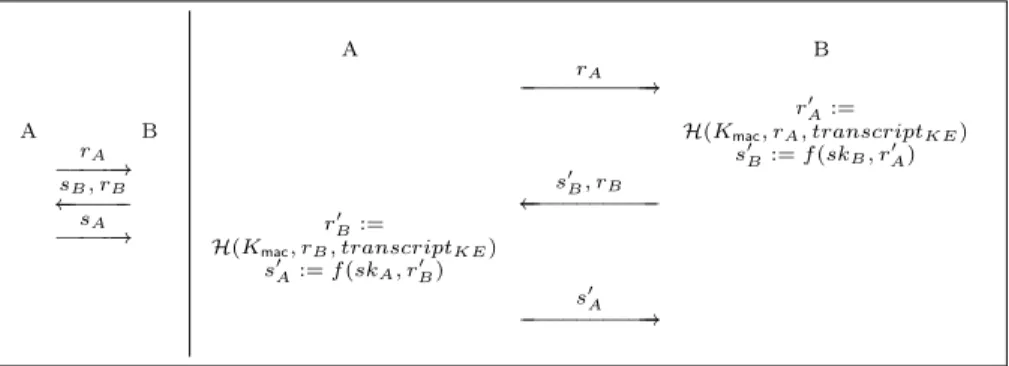
where H is some hash function modeled as a random oracle. Please note that r0A is never sent (cf. Figure 3), but has to be computed by A and B. Thus the adversary E does not learnrA0 . This construction does not alter the security properties of the authentication protocol.
In Section 4, we give a security proof for this compiler in the random oracle model.
1.1 Related Work
In their seminal papers [2, 1] on two-party authenticated key agreement, Bellare et al. started a line of research that has expanded in two directions: group key agreement [9], [8, 22, 10], and refined models to cover different types of attacks [11, 23, 24]. All these models cover concurrent execution of the protocol, and at least corruption of non-related session keys.
All models can roughly be classified in two groups: models that require a unique session ID before the start of the protocol, and models that construct this session ID. [11] is the prototype of the former case: proofs and definitions are easier, but it is unclear how a session ID can be defined for practical applications. (E.g. in case of an SSL man-in-the-middle, browser and server do not share any common state.) Newer models like [24] or [23] thus avoid this assumption, and construct the session identifiers from the messages sent and received by the intended communication partners.
Unknown key share [5] attacks do not threaten the real world security of cryptographic protocols, but invalidate security proofs in the formal models that follow [2]: If the adversary is able to force two protocol participants into accepting the same session key, but without a matching conversation, a Reveal query to one of the participants will help to win the Test game against the other participant. Choo, Boyd and Hitchcock have shown how to invalidate security proofs of various protocols in the different models [14, 13], and how to fix the problem by including the whole session information in the computation of the session key [15]. They were able to compare the relative strengths of the different models assuming that session identifiers are constructed as a concatenation of the exchanged messages.
Canetti and Krawczyk in [12] consider a practically important protocol (IPSec IKE), which has a structure that places authentication after key exchange. Still, this is a single AKE protocol, and thus not comparable to our construction. In 2008 Morissey et al. studied the security of the TLS key agreement protocol [25] and provided a modular and generic proof of security for the established application keys.
Katz and Yung presented in [22] a first scalable compiler that transforms any passively secure group key-exchange protocol to an actively secure AKE. Their compiler adds one round and constant size (per user) to the original scheme, by appending an additional signature to each message of the protocol.
1.2 Contribution
In this paper, we describe two new compilers that allow us to combine key agreement protocols (which, in the BR model, need only be secure against passive adversaries) with arbitrary authentication protocols to form an authenticated key agreement (AKE) protocol in the sense of [2].
These compilers enable us to formally prove the security of real world proto-cols in the BR model, which was not possible before. The most important case here is TLS with an authentication protocol on top of the TLS channel, which can be proven secure if the authentication protocol is secure in the BR model. This is possible since we consider TLS only as a key agreement protocol, and not as an AKE protocol, and it seems likely that the security of (some ciphersuites of) TLS against passive adversaries can be proven.
Additionally, the compilers allow for a modular design of new AKE protocols, using existing protocols (e.g. TLS, IPSec IKE) or new ones (e.g. zero-knowledge
authentication, group signatures). The formal security proof is simplified consid-erably, since the security of key agreement and authentication protocols can be proven separately, and our theorems yield the security of the combined protocol.
2
Preliminaries and Definitions
In this section, we recall the syntax and security definitions of the building blocks for our protocol compilers.
2.1 Digital Signature Schemes
A digital signature scheme is a triple Σ= (SIG.Gen,SIG.Sign,SIG.Vfy), consist-ing of a key generation algorithm (sk, pk)←$ SIG.Gen(1κ) generating a (public) verification key pk and a secret signing key sk on input of security parameter
κ, signing algorithmσ←$ SIG.Sign(sk, m) generating a signature for messagem, and verification algorithmSIG.Vfy(pk, m, σ) returning 1, ifσis a valid signature formunder keypk, and 0 otherwise.
Consider the following security experiment played between a challenger C
and an adversaryA.
1. The challenger generates a public/secret key pair (sk, pk) ←$ SIG.Gen(1κ), the adversary receivespk as input.
2. The adversary may query arbitrary messagesmito the challenger. The chal-lenger replies each query with a signatureσi =SIG.Sign(sk, mi). Here i is an index, ranging between 1≤i≤qfor some polynomialq=q(κ). Queries can be made adaptively.
3. Eventually, the adversary outputs a message/signature pair (m, σ).
Definition 1. We say thatΣis secure against existential forgeries under adap-tive chosen-message attacks(EUF-CMA), if
Prh(m, σ)← A$ C(1κ, pk) :SIG.Vfy(pk, m, σ) = 1∧m6∈ {m
1, . . . , mq}
i
≤.
for all probabilistic polynomial-time (inκ) adversariesA, where =(κ)is some negligible function in the security parameter.
2.2 Message Authentication Codes
Amessage authentication codeis an algorithmMAC. This algorithm implements a deterministic functionw=MAC(Kmac, m), taking as input a (symmetric) key
Kmac∈ {0,1}κ and a messagem, and returning a stringw.
Consider the following security experiment played between a challenger C
and an adversaryA.
1. The challenger samplesKmac
$
2. The adversary may query arbitrary messagesmito the challenger. The chal-lenger replies each query withwi=MAC(Kmac, mi). Hereiis an index, rang-ing between 1≤i≤q for some polynomial q=q(κ). Queries can be made adaptively.
3. Eventually, the adversary outputs a pair (m, w).
Definition 2. We say thatMAC is a securemessage authentication code, if
Prh(m, w)← A$ C(1κ) :w=MAC(Kmac, m)∧m6∈ {m1, . . . , mq}
i
≤
for all probabilistic polynomial-time (inκ) adversariesA, where=(κ)is some negligible function in the security parameter.
2.3 Pseudo-Random Functions
A pseudo-random function is an algorithm PRF. This algorithm implements a deterministic functionz=PRF(k, x), taking as input a keyk∈ {0,1}κand some bit stringx, and returning a stringz∈ {0,1}κ.
Consider the following security experiment played between a challenger C
and an adversaryA.
1. The challenger samplesk← {$ 0,1}κ uniformly random.
2. The adversary may query arbitrary values xi to the challenger. The chal-lenger replies each query withzi =PRF(k, xi). Here i is an index, ranging between 1 ≤ i ≤ q for some polynomial q = q(κ). Queries can be made adaptively.
3. Eventually, the adversary outputs value x and a special symbol >. The challenger setsz0=PRF(k, x) and samplesz1
$
← {0,1}κ uniformly random. Then it tosses a coinb← {$ 0,1}, and returnszb to the adversary.
4. Finally, the adversary outputs a guessb0∈ {0,1}.
Definition 3. We say thatPRFis a securepseudo-random function, if
|Pr [b=b0]−1/2| ≤
for all probabilistic polynomial-time (inκ) adversariesA, where=(κ)is some negligible function in the security parameter.
2.4 Key Exchange Protocols
A (two-party) key-exchange protocol is a protocol executed among two parties
AandB. At the end of the protocol, both AandB obtain the same keyK0 as the output of the protocol.
Definition 4. We say that a key-exchange protocol is passively-secureif for all polynomial-time adversary holds that |Pr[b=b0]−1/2| ≤ for some negligible function in the following experiment.
1. A challenger generates the public parameters Λ of the protocol (e.g. a gen-erator describing a group etc.).
2. The adversary receives Λ as input, and may query the challenger. To this end, it submits a symbol⊥. Then, the challenger runs a protocol instance, and obtains the transcriptT of all messages exchanged during the protocol and a keyK0. The challenger returns (T, K0).
3. Eventually, the adversary outputs a special symbol >. Given >, the chal-lenger runs a protocol instance, obtaining the transcriptT and keyK0,
sam-ples K1 uniformly at random from the key space of the protocol, and tosses
a fair coinb∈ {0,1}. Then it returns (T, Kb)to the adversary.
4. The adversary may continue making⊥-queries to the challenger. 5. Finally, adversaryE outputs a bitb0.
We say that the adversary wins the game, ifb=b0.
Simple protocols satisfying the above definition are the Diffie-Hellman protocol (under the DDH assumption), or key-transport using an IND-CPA secure en-cryption scheme (i.e., party A samples a random key k, encrypts k under B’s public key, and sends the ciphertext toB).
2.5 Secure Authenticated Key Exchange
While the security model for passively-secure key-exchange protocols is very simple, a more complex model is required to model the capabilities of active adversaries to define secure authenticated key-exchange. We must describe the subtleties of executions that we expect from the implementations of the protocol, the attacks against which our protocol should be secure, and which outcome we expect if we run the protocol with the defined adversary. In accordance with the line of research [5, 11, 24, 16] initiated by Bellare and Rogaway [2], we model our adversary by providing an “execution environment”, which emulates the real-world capabilities of an active adversary. That is, the adversary has full control over the communication network, thus may forward, alter, or drop any message sent by the participants, or insert new messages.
Execution Model.LetI=I(κ) andS=S(κ) be polynomials in the security parameterκ. Our model is characterized by a collection of oracles
{πsi,j:i, j∈[I], s∈[S]}
An oracle πi,js represents an entityi running the protocol with entityj for the
s-th time. Each oracle maintains its own internal state (e.g. nonces), all oracles representing some entityishare the same long-term secrets of entityi. Moreover, each oracle πs
i,j maintains a variable T storing an ordered list of all messages sent and received by πs
i,j so far.
An oracle aborts, if it receives a message which is not valid according to the protocol specification, or terminates after it has sent or received the last protocol message according to the protocol specification. When a process terminates, it outputs “accept” or “reject” and (possibly) a keyk.
An adversary may interact with these oracles by issuing different types of queries. Before the first query is asked, long-term secret/public key pairs (pki, ski) for each entity iare generated. An adversaryAreceives as input the long-term public keys (pk1, . . . , pkl) of all parties, and may then ask the following query:
– Send(πs
i,j, m): The adversary can use this query to send any messagemof his own choice to oracleπs
i,j. The oracle will respond according to the protocol specification. If m = ∅, where ∅ denotes the empty string, then πsi,j will respond with the first protocol message.
Secure Authentication Protocols. An authentication protocol is a pro-tocol run between two processes πs
i,j and πj,it of two parties Pi and Pj, where both processes output either “accept” or “reject” at the end of the protocol. We define correctness and security of an authentication protocol following the idea ofmatching conversations, as introduced by Bellare and Rogaway [2].
In the following letTi,sdenote the transcript of all messages sent and received by process πsi,j. Intuitively, we would like to say that a protocol is correct, if a process πsi,j outputs “accept” if there exists a process πj,it with Ti,s = Tj,t. Likewise, we would like to say that a protocol issecure, if a process acceptsonly if there exists a process πt
j,iwithTi,s =Tj,t.
As in [2], we face a minor technical obstacle here, which is inherent to authen-tication protocols. Suppose thatPjsends the last message of the protocol (thus,
Pihas initiated the protocol run if the number of protocol rounds is even, orPj has initiated the protocol if the number of rounds is odd). PartyPj does not get any response to its last message, thus has to accept without knowing whether
Pireceived the last message.2To overcome this obstacle, we letTi,s0 be the tran-scriptTi,s truncated by the last message, and we have to define correctness and security in a slightly more complicated way.
Definition 5. We say that two processesπs
i,j andπj,it have matching conversa-tions, if either
– Pisends the last message of the protocol according to the protocol specification
and it holds thatTj,t0 =Ti,s0 , or
– Pj sends the last message of the protocol according to the protocol
specifica-tion and it holds thatTj,t=Ti,s.
Definition 6. We say that an authentication protocol is correct, if for all pro-cesses πs
i,j holds that πsi,j “accepts” if there exists a process πj,it such that πsi,j
andπt
j,ihave matching conversations.
Definition 7. We say that an authentication protocol is securein the Bellare-Rogaway model, if for all probabilistic polynomial-time (PPT) adversaries A, 2 In contrast, a protocol can be designed such that the party receiving the last
mes-sage accepts only if it has received this mesmes-sage correctly according to the protocol specification.
interacting with the black-box O(Π) as described above in the execution model, holds that:
Each process πs
i,j of O(Π) “accepts” only if there exists a process πtj,i such
that πs
i,j and πj,it have matching conversations, except for some negligible
prob-ability=(κ)in the security parameter.
Secure Authenticated Key-Exchange Protocols.An authenticated key-exchange protocol is an authentication protocol, where additionally both parties obtain a keykafter accepting. Intuitively, we would like to say that a authenti-cated key-exchange protocol is secure, if
– the protocol is a secure authentication protocol, and
– an adversary can not distinguish a keyk computed in a protocol run from a uniformly random value from the key space. This should hold even if the adversary is able to learn the key computed in other protocol instances. We formalize this by extending the execution model by two more type of queries, which may be asked by the adversary.
– Test(πs
i,j): This query may only be asked once throughout the game. If pro-cessπs
i,jhas not (yet) “accepted”, the black-box returns some failure symbol
⊥. Otherwise the black-box flips a fair coin b. If b = 0, a random element from the keyspace is returned. Ifb= 1 then the session key kcomputed in processπs
i,j is returned.
– Reveal(πi,js ): The adversary may learn the encryption key K computed in processπi,js by asking this type of query. The adversary submits πsi,j to the black-box. If processπs
i,j has “accepted”, the black-box responds with the keykin processπs
i,j. Otherwise some failure symbol⊥is returned.
Definition 8. Let A be a PPT adversary, interacting with the black-boxO(Π)
described in the above execution model (denoted withAO(Π)).
We say that an authenticated key-exchange protocolΠissecurein the Bellare-Rogaway model, if 1.)Π is a secure authentication protocol according to Defini-tion 7, and 2.) Pr[AO(Π)(1κ) =b]−1 2 ≤ for allA.
As Shoup pointed out in [27, §15], we do not have to explicitly model a
Corrupt-query, as one can efficiently reduce the standard BR-Model to a model withoutCorrupt-queries (see also [6, p. 70 ff.]).
3
Authenticated Key Exchange Compiler in the Standard
Model
Let us now describe our generic AKE compiler. The compiler takes as input the following building blocks (which have been defined in Section 2).
– A key-exchange protocolKE,
– a digital signature schemeΣ= (SIG.Gen,SIG.Sign,SIG.Vfy), – a message authentication codeMAC,
– and a pseudorandom functionPRF.
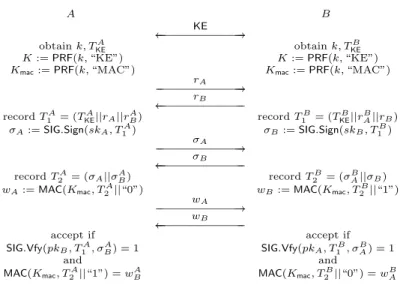
The compiled protocol between two parties A and B proceeds as follows (see also Figure 2).
1. A and B run the key exchange protocol. For instance, both parties may run the well-known Diffie-Hellman protocol [18]. Throughout this protocol run, both parties compute keykand record a transcriptTA
KEandT B
KE, whereT C KE consists of the list of all messages sent and received by partyC∈ {A, B}. 2. The key k computed by KE is used to derive two keys K =PRF(k,“KE”)
andKmac =PRF(k,“MAC”), where “KE” and “MAC” are some arbitrary fixed constants such that “KE”6= “MAC”.3
3. ThenAsamples a random noncerA
$
← {0,1}λand sends it toB,Bsamples
rB
$
← {0,1}λ and sends it toA. 4. PartyAcomputes a signatureσA
$
←SIG.Sign(skA, T1A) underA’s secret key
skA, where T1A = (TKEA||rA||rAB) is the transcript of all messages sent and received byAso far. ThenBcomputes a signature over the transcriptTB
1 = (TB
KE||r B
A||rB) of all messages sent and received by B. Let T2A = (σA||σAB) denote the signatures sent and received byA, and TB
2 = (σBA||σB) be the signatures sent and received byB.
5. A sends a MACtA =MAC(Kmac, T2A||0) over transcript T2A using the key
Kmac computed in 2.B replies withtB =MAC(Kmac, T2B||1).
6. Party A accepts, if SIG.Vfy(pkB, T1A, σBA) = 1 andtB =MAC(Kmac, T2A||1), that is, if σBA is a valid signature for T2A under B’s verification key pkB and ifwB is a valid MAC under key Kmac for T2A||1.B accepts if it holds thatSIG.Vfy(pkA, T1B, σBA) = 1 andwA=MAC(Kmac, T2B||0). Finally, if both parties accept then the keyK is returned.
Observe that the signatures and MACs are verified using theinternaltranscripts of party A andB. The intention behind the idea of embedding the transcripts in the protocol is to detect any changes that an active adversary makes to the messages sent byAandB. Informally, in the two-layer authentication consisting of the signature scheme and MAC, the signature is used to authenticate users and thwartman-in-the-middle attacks on the key-exchange protocol, while the MAC is used as an implicit “key confirmation” step to avoidunknown key-share
attacks [14, 13].
This allows us to prove security requiring only pretty weak security properties from the utilized building blocks, namely we require that KE is secure against
passive adversaries only, that the digital signatures are existential unforgeable under (non-adaptive) chosen-message attacks, and that the MAC and PRF meet their standard security notions.
3 Note that we assume here implicitly, that the output key space ofKEmatches the
input key space ofPRF. This fact is not only important for correctness, but also for the security proof.
A B ← −−−−−−−−−−−−−−KE →− obtaink, TA KE obtaink, T B KE K:=PRF(k,“KE”) K:=PRF(k,“KE”) Kmac:=PRF(k,“MAC”) Kmac:=PRF(k,“MAC”)
−−−−−−−−−−−−−−rA →− ← −−−−−−−−−−−−−−rB − recordTA 1 = (TKEA||rA||rAB) recordT1B= (TKEB||rAB||rB) σA:=SIG.Sign(skA, T1A) σB:=SIG.Sign(skB, T1B) −−−−−−−−−−−−−−σA →− ← −−−−−−−−−−−−−−σB − recordT2A= (σA||σAB) recordT B 2 = (σ B A||σB) wA:=MAC(Kmac, T2A||“0”) wB:=MAC(Kmac, T2B||“1”)
−−−−−−−−−−−−−−wA →− ← −−−−−−−−−−−−−−wB − accept if accept if SIG.Vfy(pkB, T1A, σ A B) = 1 SIG.Vfy(pkA, T1B, σ B A) = 1 and and MAC(Kmac, T2A||“1”) =w A B MAC(Kmac, T2B||“0”) =w B A
Fig. 2.AKE Protocol
Remark 1. The digital signatures sent in the first round after running KE are merely a concrete instantiation of a tag-based authentication scheme as intro-duced in [21]. It is possible to generalize the above protocol by replacing the digital signatures with a tag-based authentication scheme, without making sub-stantial changes to the protocol or the security proof given below.
3.1 Security Analysis
Theorem 1. If theKE protocol, the signature scheme, the message authentica-tion code and the pseudo-random funcauthentica-tion are secure with respect to the defini-tions in Section 2, then the above protocol is a secure AKEprotocol in the sense of Definition 8.
We prove the above theorem by two lemmas. Lemma 1 states that the AKE protocol meets property 1) of Definition 8, Lemma 2 states that it meets property 2) of Definition 8.
Lemma 1. If the key exchange protocol (KE), the signature scheme (SIG), the message authentication code (MAC) and the pseudo-random function (PRF) are secure with respect to the definitions in Section 2, then the above protocol holds property 1) of Definition 8.
Proof. (Sketch) The proof proceeds in a sequence of games, following [3, 28]. The first game is the real security experiment. By assumption there exists an adversary A that breaks the security of the above protocol. We then describe several intermediate games that step-wisely modify the original game. Next we show that in the final security game the adversary has only negligible advantage
in breaking the security of the protocol. Finally we prove that (under the stated security assumptions) no adversary can distinguish any of these gamesXi+1from its predecessorXi. LetXi be the event thatAwins in Game i. In the following letnegl(κ) be some (unspecified) negligible function in the security parameterκ.
Game 0. This is the original security game with b = 1, that is, the adversary receives always the “real” key. By assumptionAcan distinguish Kfrom a ran-dom key (i.e. correctly answer the Test(πsi,j) query) when given access to the
Send(πsi,j, m) andReveal(πi,js ) oracles whileA andB accept.
Game 1. This game proceeds exactly like the previous game, except that the simulator aborts ifAor B accept andTA
1 6=T1B.
Claim 1.We claim that
|Pr[X1]−Pr[X0]| ≤negl(κ)
by the EUF-CMA security of the digital signature scheme. The proof of this claim exploits that fromA’s perspective the transcriptTA
1 is unique with overwhelming probability (due to the honest random choice of rA) and fromB’s perspective
TB
1 is unique for (honestly-chosen) rB with overwhelming probability.
Game 2. This game proceeds exactly like the previous game, except that the simulator now chooses a uniformly random key ˆk to derive Kmac and K as
Kmac=PRF(ˆk, “MAC”) andK=PRF(ˆk, “KE”).
Claim 2.We claim that
|Pr[X2]−Pr[X1]| ≤negl(κ)
by the security ofKE against passive adversaries. In the proof we exploit that we must haveTA
1 =T1B ifAorB accept, as otherwise we abort due to Game 1.
Game 3. This game proceeds exactly like the previous game, except that the simulator now chooses a uniformly random key ˜k(instead of Kmac) to compute
wA andwB aswA=MAC(˜k, T2||0) andwB=MAC(˜k, T2||1).
Claim 3.We claim that
|Pr[X3]−Pr[X2]| ≤negl(κ)
by the security of the pseudorandom functionPRF. In the proof we exploit that we have exchanged the “real” keykcomputed inKE with a “random” key ˜kin Game 2.
Observe here that, since the output key space ofKE must match the input key space of PRF, and PRF is assumed to be secure, it follows implicitly here that the output key space ofKEneeds to be super-polynomially large.
Game 4. This game proceeds exactly like the previous game, except that the simulator aborts ifAor B accepts andTA
2 6=T2B.
Claim 4.We claim that
|Pr[X4]−Pr[X3]| ≤negl(κ)
Recall that in Game 4 we must have T1A=T1B due to our abort condition from Game 1, and that we have replaced the keykcomputed inKEwith a uniformly random key ˜k in Game 3 to compute the MACs in the considered protocol instance. Thus, if we have TA
2 6= T2B, then the adversary must have forged a MAC to makeA orB accept. We can therefore use the adversary to break the security ofMAC.
Game 5. This game proceeds exactly like the previous game except that the simulator aborts ifAorB accepts andTA
3 =6 T3B, whereT3A= (wA, wAB) consists of the MACs sent and received byAandTB
3 = (wBA, wB) consists of the MACs sent and received by B.
Claim 5.We have
Pr[X5] = Pr[X4].
This follows from the fact that we have definedMACas a deterministic function, and we haveT1A=T1B due to Game 1 andT2A=T2B due to Game 4.
Collecting probabilities from Game 0 to 5, we obtain that both A and B
accept only if they have matching conversations, except for some negligible error probability.
Lemma 2. IfKE,SIG,MACandPRFare secure with respect to the definitions in Section 2, then the above protocol holds property 2) of Definition 8.
Proof. (Sketch). Again we proceed in a sequence of games. The first 5 games of the proof are identical to the sequence in the proof of Lemma 1. We merely add one further game.
Game 6. This game proceeds exactly like the previous game except that the simulator now choosesKuniformly at random from the keyspace.
Claim 6.We claim that
|Pr[X6]−Pr[X5]| ≤negl(κ).
This again follows from the security of thePRF, where we use that the seed ˆkis chosen uniformly random and independent (cf. Game 2).
In Game 6, the adversary receives a uniformly random keyK. However, by collecting probabilities from Game 0 to 6 we obtain that Game 6 is (computation-ally) indistinguishable from Game 0, which proves indistinguishability of “real” from “random” keys. Thus, the protocol is secure in the sense of Definition 8.
4
An Alternative AKE Compiler for Practical Protocols
Our second compiler is designed for practical applications, where we cannot change the session key K resulting from the KE protocol [15], or where we want to avoid an additional round of protocol messages after the authentication protocol. In this compiler, we directly integrate the transcript of the KE protocol, and the secret value Kmac, into the authentication protocol. To do so, we first have to define a ”generic” scheme for an authentication protocol.A B −−−−−−rA→ ← −s−−−−−B, rB− −−s−−−−A→ A B −−−−−−−−−−−rA →− r0 A:= H(Kmac, rA, transcriptKE) s0B:=f(skB, r0A) ← − s0 B, rB −−−−−−−−−−− rB0 := H(Kmac, rB, transcriptKE) s0A:=f(skA, r0B) − s0A −−−−−−−−−−→−
Fig. 3.Scheme of a standard mutual authentication protocolΓ (left), and the version
Γ0modified by our compiler (right).
We only have minimal requirements on the authentication protocols. The party (”challenger”) who wants to authenticate the other party (”prover”) has to include a random value of high entropy into one of its protocol messages. (Otherwise an adversary may just query different instances of the prover for responses for the most probable challenges to increase her advantage.) The prover must answer with a value that was computed using his long-lived key sk, and the challenge itself.
The following protocols fulfill our requirements: – AKEP1 and AKEP2 as defined in [2]
– Sigma- and Schnorr protocols (see [26])
– Zero-Knowledge Authentication protocols as introduced in [7] – Zero-Knowledge Password-Proof protocols as introduced in [4]. – Signature based authentication protocols.
In this respect, our compiler may even enhance the security of the authentication protocol. This applies to the authentication of both parties, or of one party only. LetΓ be an authentication protocol as depicted in Fig. 3. Then we denote byrAa value (the challenge) that is sent fromAtoB, and bysB=f(skB, rA) the value (response) returned toAthat allowsAto check the authenticity ofB. The valuesrB andsA are defined analogously.
The main idea in the construction of a modified authentication protocol
to compute the response based on both the received challenge, the transcript
transcriptΠ of the key agreement protocol Π, and secret value Kmac. This is done using a random oracleH. Our compilerComp, which takes as input a key agreement protocolΠ secure against passive adversaries, and a secure authenti-cation protocolΓ, outputs an authenticated key agreement protocolComp(Π, Γ) which works as follows:
A&KE-2 Compiler: Let (πs
A,B, γA,Bs ) and (πB,At , γB,At ) be two pairs of ora-cles forΠ andΓ.
1. Πis executed by πsA,B and πB,At without any change. The resulting secret value isk = (K, Kmac) for πA,Bs , andk0 = (K0, Kmac0 ) for πB,At . (Ideally
k = k0, but we have to take into account actions by the adversary.) The session key K (K0, resp.) is used for encryption and integrity protection, and the secret valueKmac(Kmac0 , resp.) is sent locally to the processes γA,Bs and γt
B,A , together with the local transcript of the messages of Π. (The valuesK andKmacare computed as described in Section 3.)
2. Now Γ is executed by γA,Bs and γB,At with the following change: In the computation of sA and sB, the values rA and rB are replaced with
r0
A := H(Kmac, rB, transcriptΠ) and rB0 := H(Kmac0 , rA, transcript0Π), and thus we get s0A = f(skA, rA0 ) and s
0
B = f(skB, r0B), where H(·,·,·) is a random oracle. If γs
A,B accepts, the local output isK, andK
0 for γt B,A . Lemma 3. IfΠ is a key agreement protocol secure against passive adversaries, then it is impossible that three different oracles accept with the same (secret) state(k, transcriptΠ), where k= (K, Kmac)is the secret value computed by Π,
andtranscriptΠ is the transcript of all protocol messages.
Proof. If this was the case, then A, B and the (active) adversary E all would be able to computek, but the adversary would not have modified any message exchanged betweenAandB(since the transcripts are identical). ThusE, acting as a passive adversary, would be able to computek, a contradiction.
Lemma 4. In Comp(Π, Γ), any two oracles γs
A,B and γtB,A with
match-ing conversations have access to a unique random oracle that is defined as
HAtBs(·) :=H(Kmac,·, transcriptΠ). NeitherE, nor any other oracle has access
to this random oracle.
Proof. Since the pair (Kmac, transcriptΠ) is unique for any pair of oracles,
HAtBs(·) is unique, too.
Theorem 2. IfΓ is a secure authentication protocol, thenΓ0 as defined in Fig. 3 also is a secure authentication protocol.
Proof. Let γ0sA,B and γ0tB,A be two process (oracle) instances ofA andB in
Γ0. It should be clear that if γ0sA,B and γ0tB,A have matching conversations, then both oracles will accept.
We have to show that the probability that γ0sA,B or γ0tB,A accepts without a matching conversation is negligible. Now assume on the contrary that there is an adversary E0 that is able to make γ0sA,B or γ0tB,A accept without a matching conversation, with non-negligible probability. Then we can define an adversary E that achieves the same goal with the protocol Γ: SinceE0 has no access to the random oracleHAB, she can only try to guess the challengerA0 (rB0 , resp.). NowEis simply ignoring the challengerX she sees, and simply guesses a random challengerX00, and tries to computes0Y from this challenge. This strategy succeeds with non-negligible probability , and we have thus contradicted our assumption that Γ is a secure authentication protocol.
Theorem 3. If Π is a key agreement protocol secure against passive adver-saries, and ifΓ is a secure authentication protocol, thenComp(Π, Γ)is a secure authenticated key agreement protocol.
Proof (Sketch).γs
A,B and γB,At will accept inΓ0if and only if they have access to the same random oracleHAtBs(·). (Otherwise they have to guess the challenge
r0X, which succeeds only with negligible probability.) If they have access to the same random oracle, then πsA,B and πB,At completedΠ with the same state (k, transcriptΠ). If γA,Bs and γB,At accept, Π and Γ were both completed by the same endpoints A andB. This excludes active attacks onΠ (since the transcript is unchanged), and UKS attacks on Γ. Thus E may only mount a passive attack onΠ, which succeeds only with negligible probability.
References
1. Mihir Bellare, Ran Canetti, and Hugo Krawczyk. A modular approach to the design and analysis of authentication and key exchange protocols (extended abstract). In STOC, pages 419–428, 1998.
2. Mihir Bellare and Phillip Rogaway. Entity authentication and key distribution. In CRYPTO, pages 232–249. Springer, 1993.
3. Mihir Bellare and Phillip Rogaway. The security of triple encryption and a framework for code-based game-playing proofs. InEUROCRYPT, pages 409–426. Springer, 2006.
4. Steven M. Bellovin and Michael Merritt. Encrypted key exchange: Password-based protocols secure against dictionary attacks. In IEEE SYMPOSIUM ON RESEARCH IN SECURITY AND PRIVACY, pages 72–84, 1992.
5. Simon Blake-Wilson and Alfred Menezes. Unknown key-share attacks on the station-to-station (STS) protocol. In Public Key Cryptography, pages 154–170, 1999.
6. Colin Boyd and Anish Mathuria. Protocols for Authentication and Key Establish-ment. Springer, 1 edition, September 2003.
7. J. Brandt, I. B. Damg˚ard, P. Landrock, and T. Pedersen. Zero-knowledge authen-tication scheme with secret key exchange. InCRYPTO, pages 583–588. Springer, 1990.
8. Emmanuel Bresson, Olivier Chevassut, and David Pointcheval. Dynamic group Diffie-Hellman key exchange under standard assumptions. InEUROCRYPT, pages 321–336. Springer, 2002.
9. Emmanuel Bresson, Olivier Chevassut, David Pointcheval, and Jean-Jacques Quisquater. Provably authenticated group Diffie-Hellman key exchange. InACM Conference on Computer and Communications Security, pages 255–264, 2001. 10. Emmanuel Bresson and Mark Manulis. Securing group key exchange against strong
corruptions. In Masayuki Abe and Virgil D. Gligor, editors,ASIACCS, pages 249– 260. ACM, 2008.
11. Ran Canetti and Hugo Krawczyk. Analysis of key-exchange protocols and their use for building secure channels. InEUROCRYPT, pages 453–474. Springer, 2001. 12. Ran Canetti and Hugo Krawczyk. Security analysis of IKE’s signature-based
key-exchange protocol. InCRYPTO, pages 143–161. Springer, 2002.
13. Kim-Kwang Raymond Choo, Colin Boyd, and Yvonne Hitchcock. Errors in compu-tational complexity proofs for protocols. InASIACRYPT, pages 624–643. Springer, 2005.
14. Kim-Kwang Raymond Choo, Colin Boyd, and Yvonne Hitchcock. Examining indistinguishability-based proof models for key establishment protocols. In ASI-ACRYPT, pages 585–604. Springer, 2005.
15. Kim-Kwang Raymond Choo, Colin Boyd, and Yvonne Hitchcock. On session key construction in provably-secure key establishment protocols. In Mycrypt, pages 116–131. Springer, 2005.
16. Cas J. F. Cremers. Session-state reveal is stronger than ephemeral key reveal: Attacking the NAXOS authenticated key exchange protocol. InACNS, pages 20– 33, 2009.
17. Rachna Dhamija, J. D. Tygar, and Marti A. Hearst. Why phishing works. In Rebecca E. Grinter, Tom Rodden, Paul M. Aoki, Edward Cutrell, Robin Jeffries, and Gary M. Olson, editors,CHI, pages 581–590. ACM, 2006.
18. Whitfield Diffie and Martin Hellman. New directions in cryptography. IEEE Transactions on Information Theory, 22:644–654, 1976.
19. Sebastian Gajek, Tibor Jager, Mark Manulis, and J¨org Schwenk. A browser-based kerberos authentication scheme. InESORICS, pages 115–129. Springer, 2008. 20. Sebastian Gajek, Mark Manulis, Olivier Pereira, Ahmad-Reza Sadeghi, and J¨org
Schwenk. Universally composable security analysis of TLS. In ProvSec, pages 313–327. Springer, 2008.
21. Tibor Jager, Florian Kohlar, Sven Sch¨age, and J¨org Schwenk. Generic compilers for authenticated key exchange. Full version. To appear on eprinthttp://eprint. iacr.org/, 2010.
22. Jonathan Katz and Moti Yung. Scalable protocols for authenticated group key exchange. InCRYPTO, pages 110–125. Springer, 2003.
23. Hugo Krawczyk. HMQV: A high-performance secure Diffie-Hellman protocol. In CRYPTO, pages 546–566. Springer, 2005.
24. Brian A. LaMacchia, Kristin Lauter, and Anton Mityagin. Stronger security of authenticated key exchange. InProvSec, pages 1–16. Springer, 2007.
25. Paul Morrissey, Nigel P. Smart, and Bogdan Warinschi. A modular security analy-sis of the TLS handshake protocol. InASIACRYPT, pages 55–73. Springer, 2008. 26. Claus P. Schnorr. Efficient identification and signatures for smart cards. In
CRYPTO, pages 239–252. Springer, 1989.
27. V. Shoup. On formal models for secure key exchange. IBM Research Report RZ, 3120, 1999.
28. Victor Shoup. Sequences of games: a tool for taming complexity in security proofs. Cryptology ePrint Archive, Report 2004/332, Nov 2004.