FACULTY OF SCIENCE AND TECHNOLOGY
A BOTNET NEEDLE IN A
VIRTUAL HAYSTACK
MARK GRAHAM
A thesis in partial fulfilment of the
requirements of Anglia Ruskin University
for the degree of Doctor of Philosophy
i
Acknowledgements
This dissertation was prepared in part fulfilment of the requirements of the degree of Doctor of Philosophy under the supervision of Adrian Winckles and Dr Erika Sanchez-Velazquez at Anglia Ruskin University.
This Ph.D. journey would not have been possible without the support that I have received from many people. In particular, I express huge gratitude to my first supervisor Adrian Winckles for his inspiration and support. Adrian has been a mentor to me for many years. A huge thank you also to my second supervisor Dr. Erika Sanchez for her encouragement and motivation. I also extend my thanks to Chris Holmes for his friendship and companionship during my years spent at Anglia Ruskin University.
I gratefully acknowledge the funding I received for my Ph.D. from Anglia Ruskin University. Sincere thanks goes to my head of department, Professor Marcian Cirstea for his guidance and advice. May I express my thanks to other members of the department, especially my fellow Ph.D. students; Mohamed Kettouch and Dr. Arooj Fatima.
ii
ANGLIA RUSKIN UNIVERSITY
ABSTRACT
FACULTY OF SCIENCE AND TECHNOLOGY
DOCTOR OF PHILOSOPHY
Abstract
A
B
OTNET
N
EEDLE IN A
V
IRTUAL
H
AYSTACK
MARK GRAHAM
JUNE 2017
The Cloud Security Alliance’s 2015 Cloud Adoption Practices and Priorities Survey
reports that 73% of global IT professionals cite security as the top challenge holding back cloud services adoption. Malware with the capabilities to jump between the abstracted virtual infrastructures found within cloud service provider networks heightens the threat from botnet attack upon a cloud infrastructure. This research project aimed to provide a novel methodological approach for capturing communication traffic between botnets. The originality of this study comes from the application of standards-based IPFIX flow export protocol as a traffic capture mechanism.
The first contribution to knowledge is a critical investigation into how IPFIX export overcomes the limitations of traditional NetFlow-based botnet communication traffic capture in cloud provider networks. The second contribution is the BotProbe IPFIX template, comprising eleven IANA IPFIX information elements. Field occupancy count and Spearman’s Rank correlation on 25 million botnet flows created an IPFIX template tailored specifically for botnet traffic capture. The third contribution is BotStack, a modular, non-intrusive IPFIX monitoring framework, created upon Xen hypervisor and virtual switched platforms, to incorporate IPFIX export into existing cloud stacks. The fourth contribution is compelling empirical evidence from weighted-factor observation across multiple network vantage points, that siting IPFIX exporters on the host hypervisor provides maximum traffic visibility.
BotProbe performs on average 26.73%±0.03% quicker than traditional NetFlow v5, with 14.06%±0.01% less storage requirements. BotProbe can be extended with additional application layer attributes, for use in less privacy sensitive environments. Both novel IPFIX templates were tested on the BotStack framework, capturing four distinct traffic profiles in the life cycle of a Zeus botnet.
The techniques developed in this research can be repurposed to create IPFIX traffic capture templates for most Cybersecurity threats, including DDoS and spam, turning behavioural-based traffic capture from a big data challenge into a manageable data solution.
iii
Contents
Abstract ... ii
List of Figures ... v
List of Tables ... vi
List of Acronyms ... vii
List of Publications ... viii
Copyright ... ix
1. Introduction ... 1
1.1 Motivation ... 2
1.2 Research Aim ... 4
1.3 Research Hypothesis, Objectives and Boundaries ... 4
1.4 Research Methodology ... 6
1.5 Ethical Considerations ... 9
1.6 A Summary of the Contributions to Knowledge ... 10
1.7 Thesis Structure and Organisation ... 11
2. Technological Review ... 12
2.1 Introduction ... 12
2.2 Botnet Fundamentals ... 13
2.3 A Review of the Limitations of Botnet Detection Techniques ... 14
2.4 A Review of Botnet Mitigation Legislation and Responsibility ... 16
2.5 A Review of the Cloud as an Attack Platform ... 17
2.6 A Review of the Cloud as an Attack Surface ... 19
2.7 A Model for Attacking a Cloud Infrastructure ... 21
2.8 Summary ... 24
3. An Overview of Flow Export ... 25
3.1 Introduction ... 25
3.2 A Brief History of Flow ... 26
3.3 Flow Export Architecture ... 27
3.4 IPFIX Compared with NetFlow ... 28
3.5 Flow Export Compared with Packet Capture ... 36
3.6 Flow-Based Botnet Detection ... 38
3.7 Summary ... 45
4. BotProbe: A Novel IPFIX Template for Botnet Traffic Capture ... 47
4.1 Introduction ... 47
4.2 IPFIX Template Customisation ... 48
4.3 BotProbe IPFIX Template Creation Methodology... 49
4.4 Information Elements Results ... 58
4.5 Enterprise Elements Results ... 63
4.6 Presenting the BotProbe IPFIX Templates ... 72
4.7 Discussion of the BotProbe IPFIX Templates ... 74
4.8 BotProbe Performance Test Methodology ... 86
4.9 BotProbe Performance Results ... 95
iv
4.11 Summary ... 99
5. BotStack: A Novel IPFIX Framework ... 101
5.1 Introduction ... 101
5.2 Design Considerations for IPFIX Export in a CSP Environment ... 101
5.3 Presenting BotStack: An IPFIX Framework for CSPs ... 113
5.4 Probe Positioning Test Methodology ... 114
5.5 Probe Positioning Results ... 118
5.6 Probe Timing Test Methodology ... 122
5.7 Probe Timing Results ... 126
5.8 Discussion ... 127
5.9 Summary ... 129
6. Concept Validation ... 131
6.1 Introduction ... 131
6.2 Botnet Life Cycle Model ... 131
6.3 Proof of Concept Validation Methodology ... 132
6.4 Proof of Concept Results ... 135
6.5 Discussion ... 137
6.6 Summary ... 139
7. Conclusions ... 141
7.1 Contributions to Knowledge ... 142
7.2 Limitations of the Study ... 146
7.3 Future Work ... 148
7.4 Concluding Remarks ... 151
References ... 152
Appendix A: Field Counts for all IEs/EEs ... 165
Appendix B: List of Botnet Samples Analysed During this Study ... 169
Appendix C: SuperMediator Files ... 170
Appendix D: Python Scripts ... 175
v
List of Figures
Figure 1. An illustration of the gap in knowledge in botnet detection. ... 4
Figure 2. The phases of the research approach. ... 8
Figure 3. A diagramatical view summarising how this thesis contributes to knowledge. ... 10
Figure 4. A three stage model for hypervisor exploitation. ... 22
Figure 5. The four elements of a flow monitoring architecture. ... 28
Figure 6. Flow diagram of the IPFIX template creation test. ... 53
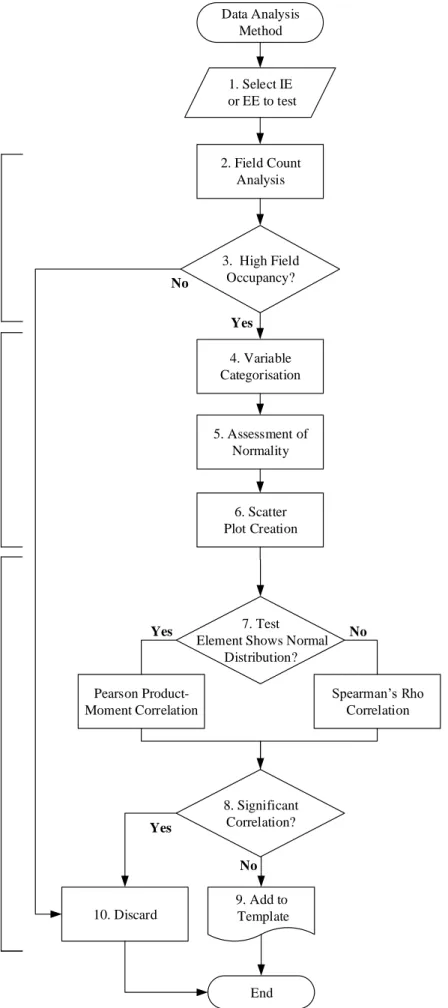
Figure 7. Flow diagram of the IPFIX template creation data analysis. ... 57
Figure 8. IE scatter plots. ... 60
Figure 9. HTTP scatter plots. ... 66
Figure 10. DNS scatter plots. ... 66
Figure 11. SMTP scatter plots. ... 67
Figure 12. SSL scatter plots. ... 67
Figure 13. The BotProbe IPFIX template, comprising of 11 SuperMediator IEs ... 72
Figure 14. The extended BotProbe IPFIX template, including an additional seven EEs ... 73
Figure 15. A comparison of the NetFlow v5 template with the template simulated in IPFIX .... 87
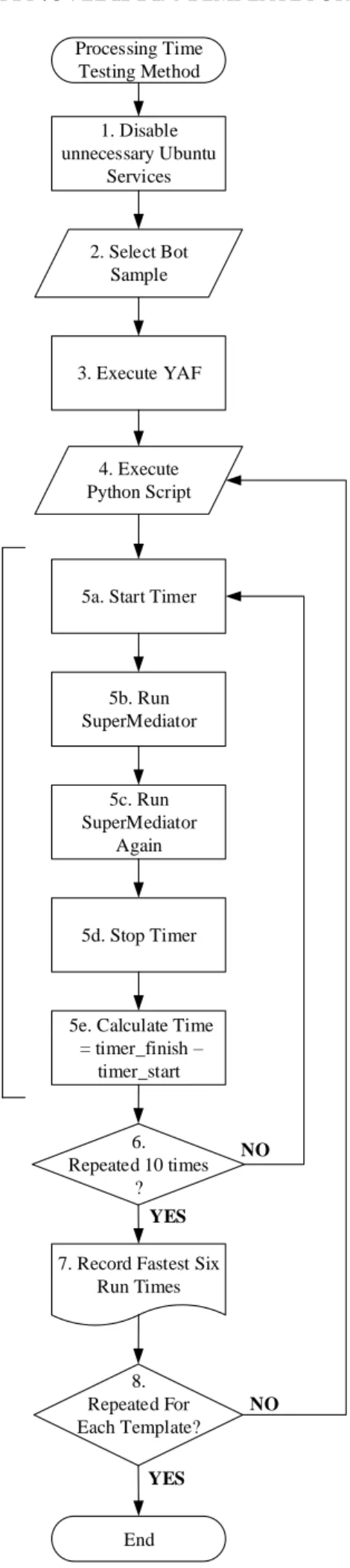
Figure 16. Flow diagram of the processing time test... 89
Figure 17. Flow diagram of the data volume test. ... 92
Figure 18. Flow diagram of the CPU load test. ... 94
Figure 19. CPU utilisation for each of the three templates. ... 96
Figure 20. A comparison of hypervisors. ... 103
Figure 21. A comparison of Xen toolstacks. ... 105
Figure 22. A comparison of management GUIs. ... 106
Figure 23. A comparison of data centre virtual switches. ... 107
Figure 24. A comparison of open source IPFIX flow exporters. ... 110
Figure 25. A comparison of open source IPFIX flow collectors. ... 112
Figure 26. The logical architecture of BotStack. ... 113
Figure 27. An illustration of potential probe vantage placements. ... 115
Figure 28. Flow diagram of the probe location optimisation test. ... 116
Figure 29. Network vista weightings, by importance in botnet communication detection. .... 117
Figure 30. Location Test #1 - ICMP ping traffic captured by a probe in each tenant VM ... 120
Figure 31. Location Test #2 - ICMP ping traffic captured by a probe on the LAN ... 120
Figure 32. Location Test #3 - ICMP ping traffic captured by a probe on a host server ... 121
Figure 33. Location Test #4 - ICMP ping traffic captured by a probe on each host server ... 121
Figure 34. Location Test #5 - ICMP ping traffic captured by a probe on each device ... 122
Figure 35. The logical architecture for the probe timing test environment ... 123
Figure 36. Flow diagram of the probe timer misalignment test. ... 125
Figure 37. The logical architecture for the proof of concept network. ... 132
Figure 38. Flow diagram of the Zeus botnet traffic capture test. ... 134
Figure 39. Arc diagram of the entire botnet infection. ... 135
Figure 40. Four botnet life cycle profiles visualised through IPFIX export data. ... 136
Figure 41. Traffic scanning and attack profile. ... 138
vi
List of Tables
TABLE 1. FEATURE COMPARISON BETWEEN NETFLOW V5, NETFLOW V9 AND IPFIX PROTOCOLS ... 29
TABLE 2. A SUMMARY OF BOTNET DETECTION EXPERIMENTS ... 44
TABLE 3. SUPPORT FOR IANA DEFINED IES AND EE PROTOCOLS, BY IPFIX PROBE ... 51
TABLE 4. SUPPORT FOR EES IN BOTNET TRAFFIC PROTOCOLS, BY IPFIX PROBE ... 52
TABLE 5. FIELD COUNT AND DATA TYPE CATEGORISATION FOR THE 25 IES ... 58
TABLE 6. AGGREGATED CORRELATION MATRIX: IES ... 62
TABLE 7. 21 BOTNET SAMPLES USED IN THE CREATION OF THE IE AGGREGATED CORRELATION MATRIX ... 62
TABLE 8. PROTOCOL DISTRIBUTION FOR THE 33 BOTNETS SAMPLED ... 63
TABLE 9. FIELD COUNT AND DATA TYPE CATEGORISATION FOR HTTP EES ... 64
TABLE 10. FIELD COUNT AND DATA TYPE CATEGORISATION FOR DNS EES ... 64
TABLE 11. FIELD COUNT AND DATA TYPE CATEGORISATION FOR SMTP EES ... 64
TABLE 12. FIELD COUNT AND DATA TYPE CATEGORISATION FOR SSL EES ... 65
TABLE 13. FIELD COUNT AND DATA TYPE CATEGORISATION FOR IRC EES ... 65
TABLE 14. AGGREGATED CORRELATION MATRIX: HTTP ... 68
TABLE 15. BOTNET SAMPLES USED IN THE CREATION OF THE HTTP CORRELATION MATRIX ... 68
TABLE 16. AGGREGATED CORRELATION MATRIX: DNS ... 69
TABLE 17. BOTNET SAMPLES USED IN THE CREATION OF THE DNS CORRELATION MATRIX... 69
TABLE 18. AGGREGATED CORRELATION MATRIX: SMTP ... 70
TABLE 19. BOTNET SAMPLES USED IN THE CREATION OF THE SMTP CORRELATION MATRIX ... 70
TABLE 20. AGGREGATED CORRELATION MATRIX: SSL ... 71
TABLE 21. BOTNET SAMPLES USED IN THE CREATION OF THE SSL CORRELATION MATRIX ... 71
TABLE 22. A COMPARISON IN PROCESSING TIMES BETWEEN IPFIX AND NETFLOW V5... 95
TABLE 23. A COMPARISON IN DATA VOLUMES BETWEEN IPFIX, NETFLOW V5 AND PCAP ... 96
TABLE 24. BOTSTACK FRAMEWORK COMPONENTS ... 113
TABLE 25. NETWORK LINK COSTINGS ... 117
TABLE 26. WEIGHTED VALUES FOR ICMP PINGS, FOR EACH PROBE PLACEMENT TEST ... 118
TABLE 27. TIMING TEST #1 - BOTH SERVER CLOCKS MANUALLY SET TO GMT ... 126
TABLE 28. TIMING TEST #2 - BOTH SERVER CLOCKS ARE SYNCHRONISED TO GMT, VIA NTP ... 126
TABLE 29. TIMING TEST #3 - SERVER #1 SET TO GMT, SERVER #2 SET TO GMT +7, BOTH VIA NTP ... 127
TABLE 30. TIMING TEST #4 - BOTH SERVERS ARE SYNCHRONISED TO GMT, VIA NTP ... 127
TABLE 31. COMPREHENSIVE FIELD COUNT FOR EACH IE, ACROSS ALL BOT SAMPLES ... 165
TABLE 32. COMPREHENSIVE FIELD COUNT FOR EACH HTTP EE, ACROSS ALL BOT SAMPLES ... 166
TABLE 33. COMPREHENSIVE FIELD COUNT FOR EACH DNS EE, ACROSS ALL BOT SAMPLES ... 167
TABLE 34. DETAILED FIELD COUNT FOR EACH SMTP EE, ACROSS ALL BOT SAMPLES ... 167
TABLE 35. COMPREHENSIVE FIELD COUNT FOR EACH IRC EE, ACROSS ALL BOT SAMPLES... 167
TABLE 36. DETAILED FIELD COUNT FOR EACH SSL EE, ACROSS ALL BOT SAMPLES ... 168
TABLE 37. A DETAILED LIST OF BOT SAMPLES USED IN THE CREATION OF BOTH BOTPROBE TEMPLATES ... 169
vii
List of Acronyms
AV Anti-Virus
C&C Command and Control CSA Cloud Security Alliance CSP Cloud Service Provider DDoS Distributed Denial of Service DNS Domain Name System EE Enterprise Element
HTTP Hypertext Transfer Protocol
IANA Internet Assigned Numbers Authority ICMP Internet Control Message Protocol IDS Intrusion Detection System IE Information Element
IETF Internet Engineering Task Force IPFIX IPFlow Information Export IPS Intrusion Prevention System ISP Internet Service Provider IoT Internet of Things IRC Internet Relay Chat K-S Kolmogorov-Smirnov MITM Man-In-The-Middle P2P Peer-to-Peer PCAP Packet CAPture PDU Protocol Data Unit PSAMP Packet SAMPling SCAN Smart City Area Network
SCTP Stream Control Transmission Protocol SMTP Simple Mail Transfer Protocol
SNMP Simple Network Management Protocol SSL Secure Socket Layer
ToS Type of Service VE Virtual Environment VM Virtual Machine YAF Yet Another Flowmeter
viii
List of Publications
Some of the ideas for the text and figures in this thesis have previously appeared in the following peer reviewed publications and presentations:
Chapter 2: Technological Review
Graham, M., Winckles, A. 2014. An Analysis of Pre-Infection Detection Techniques for Botnets and other Malware. In: 7th International Conference on Cybercrime Forensics Education and Training. Canterbury, UK, 10-11 May 2014. CFET.
Graham, M., 2014. Cloud-Based Detection Techniques for Botnets and Other Malware. In: OWASP Appsec EU 2014. Cambridge, UK, 4 July 2014. [video online] Available at: <http://www.youtube.com/watch?v=fV5kED7nryw>.
Chapter 3: Flow Export Overview
Graham, M., Winckles, A. and Sanchez, E., 2015b. Practical Experiences of Building an IPFIX Based Open Source Botnet Detector. The Journal on Cybercrime & Digital Investigations. 1(1), pp.21-28.
Chapter 4: BotProbe: A Novel IPFIX Template for Botnet Traffic Capture
Graham, M., 2017. BotProbe: Reducing Big Data Challenges in Threat Detection. In:
CyberUK 2017. Liverpool, UK, 14 – 16 March 2017. [poster & demonstration].
Graham, M., 2017. BotProbe: Making Network Big Data Manageable. In: CRESTCon and IISP Congress Conference. London, UK, 19 April 2017. [poster & demonstration].
Graham, M., 2017. Botnet Observations: What can be done to up our game against this significant threat? In: Institute of Information Security Professionals (IISP) East Anglia Chapter, 2017. Ipswich, UK, 25 May 2017.
Chapter 5: BotStack: A Novel IPFIX Framework
Graham, M., Winckles, A. and Moore, A., 2014. Botnet Detection in Virtual Environments using NetFlow. In: 7th International Conference on Cybercrime Forensics Education and Training. Canterbury, UK, 10-11 May 2014. CFET.
Graham, M., Winckles, A. and Sanchez, E., 2015a. Botnet Detection within Cloud Server Provider Networks using Flow Protocols. In: IEEE 13th International Conference on Industrial Informatics. Cambridge, UK, 22-24 July 2015. IEEE.
ix
A
B
OTNETN
EEDLE IN AV
IRTUALH
AYSTACKMARK GRAHAM
Copyright
Attention is drawn to the fact that copyright of this thesis rests with
(i) Anglia Ruskin University for one year and thereafter with (ii) Mark Graham
This copy of the thesis has been supplied on condition that anyone who consults it is bound by copyright.
This work may:
(i) be made available for consultation within Anglia Ruskin University Library, or (ii) be lent to other libraries for the purpose of consultation or may be photocopied for such purposes;
(iii)be made available in Anglia Ruskin University’s repository and made available on open access worldwide for non-commercial educational purposes, for an indefinite period.
x
I think computer viruses should count as life. Maybe it says something about human nature, that the only form of life we have created so far is purely destructive.
1
1.
Introduction
The European Union Agency for Network and Information Security claims that botnets are the main component in cybercrime consumerisation and the first Cybercrime as a Service to reach maturity (ENISA, 2015). To entirely eliminate a botnet the Command and Control (C&C) server must be taken off-line. Forensic techniques like signature-based detection are widely used in anti-malware software. This approach can disinfect a host device against a known malware strain, but does little to aid the takedown of a botnet C&C server. Internet Service Providers are able to facilitate takedown of botnet C&C servers across the Internet through analysis of Internet traffic protocols such as DNS, to sink hole malicious IP address ranges. In a networked environment, such as a Cloud Service Provider (CSP) infrastructure, such Internet protocols may not be present. Instead, analysis of network traffic can be used to identify malicious behaviour.
Academics have constructed many botnet detection algorithms based upon traffic analysis techniques. Network traffic is sampled at multiple collection points distributed across a network. Captured traffic is then cleansed and filtered before being fed into a botnet detection algorithm. Existing traffic capture methods have distinct drawbacks. Traffic capture using flow export protocols, such as NetFlow, are limited in the traffic attributes they capture, which in turn imposes limitations upon the attributes that can be used in the detection algorithms. Where flow export protocols are not able to capture a desired traffic attribute, traffic capture is supplemented with packet capture (PCAP) (Sperotto, et al., 2010). In high-speed data networks, the high data volumes captured by such methods turn threat intelligence into a big data challenge. NetFlow export traffic can be one of the largest heterogeneous data sources in high-speed data networks. It can grow to tens of terabytes of data per day and is expected to grow to petabytes over the years (Santos, 2016).
2
This research project conceptually developed a novel methodological approach to botnet traffic capture using IPFIX, a new generation of flow export protocols, to address a gap in knowledge around botnet detection in CSP networks. The design, construction and validation of this approach are described within this thesis.
This first chapter introduces the reader to the motivation behind botnet detection within CSPs. The boundaries of this research are defined, before outlining the overall research approach. Finally, this chapter declares the original contributions to knowledge from this research.
1.1 Motivation
History recalls countless technologies developed to steal or injure in order to obtain other people’s resources, be it land, possessions or information. Today’s technologically advanced civilisation is no different; stealthy malicious software (malware) is a tool to steal information or disrupt information systems. In 1948, John von Neumann predicted that computer code will one day have the ability to reproduce itself. The essay, the Theory of Self-Reproducing Automata (von Neumann and Burks, 1966), is considered by many as the forerunner theory behind today’s computer viruses. In 1971, Creeper became the first self-replicating program, designed as an academic experiment to infect computers connected to ARPANET, an early version of the Internet. Thirteen years later, Cohen coined the term virus to refer to a self-replicating program, hypothesising that these would become a major computer security problem. Cohen went on to suggest that since “prevention of computer viruses may be infeasible if widespread sharing [of programs] is desired” a cure “depends on the ability to detect a virus and overcome it.” (Cohen, 1984).
A bot is a software application that is used to perform repetitive operations - such as Google’s web crawler. A bot only becomes malicious when it is used as a delivery mechanism for a nefarious payload, such as malware. A botnet is a network of infected host machines under the control of a human operator known as a botmaster.
What makes a botnet different to other malware is the use of C&C channels which a botmaster uses to disseminate commands to their bot armies. Chapter 2 explains how the power of botnets comes from this critical-mass of networked machines working together as a single platform from which to launch massive coordinated attacks such as distributed denial-of-service (DDoS) and click-fraud.
Anyone can pay to gain access to a cloud service. Therefore anyone with the right motivation can attack the cloud from within. As CSPs become vital building blocks in
3
the Internet of Things (IoT), as a convenient way to centrally store sensor or device data, the attack profile upon CSPs will change. Attacks have been witnessed upon the hypervisors that lie at the heart of CSP network infrastructures. Since 2014, attacks using botnets hosted within unsecure IoT devices have risen. With the public release of the Mirai bot source code in 2016 (Mansfield-Devine, 2016), copycat attacks have started to increase.
The CSP built environment poses challenges for botnet detection. Privacy expectations around tenant data restrict a CSP from providing malware detection services that require packet inspection-based forensics. Furthermore, if a CSP were to locate a detection probe within the tenant environment, it could raise concerns over whether data collected for malware detection is also being surveilled. Internet Service Providers (ISPs) use DNS record analysis to takedown botnets on the Internet. However, virtualisation methods used for tenant isolation make a CSP environment closer to a traditional LAN rather than the Internet, thereby limiting the availability of DNS for botnet detection. Additionally, high-performance remains a priority in multi-tenant cloud environments from users demanding access to real-time and interactive applications and services (Garcia-Valls, Cucinotta and Lu, 2014).
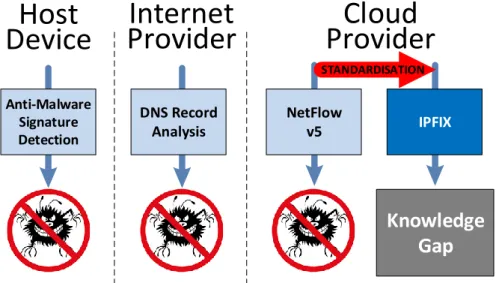
Behaviour-based botnet detection has focused on NetFlow v5 as the primary method of traffic capture in botnet detection. NetFlow is an old protocol and has its drawbacks. Early flow protocols, such as NetFlow, were created to capture network traffic statistics as a context for measurement, billing and network management (Santos, 2016). Gates, et al., (2004) stated that the main weakness of NetFlow v5 for threat detection is its fixed template, which captures a rigid set of data fields that are not used in their entirety in security analysis, resulting in wasted data capture. In 2013, IP Flow Information Export (IPFIX) was created under RFC-7011 (Internet Engineering Task Force, 2013a) as a standards-based replacement to overcome the many shortfalls of NetFlow. Figure 1 illustrates how a gap in knowledge exists in understanding how the functionality of IPFIX can be applied to threat detection and in particular for botnet detection within CSPs.
During the course of this research, informal conversations with Amazon and Microsoft have alluded to botnet detection in privacy sensitive environments being a problem that CSPs are currently facing. Such discussions have indicated that the impact of this research is not limited to just CSPs. The contributions from this research project have impact for any data network infrastructure that has potential for botnet attack, including the IoT, Smart City Area Networks (SCANs), future home networks and corporate networks.
4 DNS Record Analysis
Internet
Provider
NetFlow v5 IPFIXKnowledge
Gap
Anti-Malware Signature DetectionCloud
Provider
Host
Device
STANDARDISATIONFigure 1. An illustration of the gap in knowledge in botnet detection.
Note that the gap in knowledge lies in how IPFIX can be applied to botnet detection.
1.2 Research Aim
This research has been driven by the gap in knowledge around how IPFIX can be applied to the challenge of botnet detection. The overall aim of this research is to address the problem of botnet detection in CSP multi-tenant virtualised networks through the creation of a traffic capture method utilising the IPFIX protocol. In high-speed data networks analysis of captured traffic can become a big data challenge due to traffic volumes. The proposed capture method will use features of the IPFIX export protocol to collect only network traffic pertaining to botnet communication to reduce data capture volumes, whilst retaining CSP tenant isolation and tenant privacy.
1.3 Research Hypothesis, Objectives and Boundaries
Flow export protocols, such as NetFlow, are widely utilised within CSPs for network management reporting and statistics (Collins, 2014). IPFIX was designed to improve the known weaknesses of the NetFlow protocol, in particular NetFlow v5 (Trammell, et al., 2007).
This research project was based upon the hypothesis that:
“As NetFlow is already a successful candidate for behaviour-based botnet detection; the enhancements to IPFIX should offer advantages to CSPs over NetFlow v5 for capture of botnet communications.”
5
To achieve the aim of creating a novel botnet traffic capture method, the following objectives were addressed:
Objective #1 was a critical investigation into IPFIX as an alternative flow export
protocol to NetFlow v5, for botnet communication traffic capture in cloud provider networks;
Objective #2 was the conceptual development of an innovative IPFIX template for
botnet communication traffic capture in cloud provider networks;
Objective #3 was to define, design and construct an IPFIX export framework for
botnet communication traffic capture in cloud provider networks;
Objective #4 was to validate the effectiveness of the novel design by demonstrating
botnet communication traffic capture in a proof of concept network built upon both the template and framework.
The boundaries of this research project will be delimited to:
Creation of a traffic capture method, rather than a detection algorithm;
Evaluation of IPFIX against NetFlow v5, rather than NetFlow v9. In the context of this research NetFlow v9 will be considered a non-standardised forerunner to IPFIX and will be primarily ignored;
CSP operating environments where infrastructure design includes tenant isolation and tenant privacy, for example Amazon EC2, Microsoft Azure and emerging IOT platforms, rather than ISP operating environments which face a different set of challenges;
Open source technology where possible, to facilitate future code modification, rather than using closed source technology.
6
1.4 Research Methodology
All research is based on underlying philosophical assumptions about what constitutes valid research and which research methods are appropriate for the development of knowledge in a particular field. The following section outlines the assumptions and design strategies underpinning this study.
1.4.1 Justification of Research Design
An investigatory strategy was adopted to approach this research study, in order to utilise observational analysis through quantitative methods. The experimental methodology was designed in accordance with scientific method. A hypothesis was proposed in order to allow deductive reasoning to prove this hypothesis. Appropriat e research objectives, see above, were devised to link evidence collection to the theory behind the hypothesis. These research objectives were defined in order to gather primary evidence from literature, as well as to obtain empirical evidence through experimentation, in order to justify the design elements for a proof of concept botnet communication capture prototype. The prototype was constructed from these design elements, and tested to compare performance against similar state of the art studies undertaken by other authors. The analysis of empirical data from testing allowed the hypothesis to be confirmed. A quantitative research method was adopted throughout this study to permit collection of numerical data for interpretation through statistical analysis. A quantitative approach allows relationships between test variables to be expressed as relative frequencies and correlation, in order to prove the theory.
1.4.2 Rationale for the Research Approach
Extensive evidence can be seen throughout global media of the extent of the social and economic threat from malicious botnets. The literature review provided a considerable body of evidence to suggest that cloud environments and virtualised infrastructures are at a risk from vulnerabilities in the underlying technologies that form these environments. In particular, vulnerabilities in hypervisors (see Chapter 2) make cloud environments an ideal tool for the rapid creation and deployment of infected virtual machines, with cloud management software being incapable of detecting such malicious behaviour. In a cloud environment all network traffic must pass through virtual switches contained within the cloud infrastructure. Therefore it is logical to monitor such devices for malicious behaviour. Collins, (2014) explained
7
how nearly all network devices used in the creation of cloud environments support flow technologies, such as NetFlow, which are used for network management and collection of network performance statistics. Literature showed that many existing botnet detection algorithms reply on packet capture or NetFlow for the collection of data to input into their detection algorithms. Research Objective #1, was prompted by studies from Trammell, et al., (2007) who claim that IPFIX was designed to address the known weaknesses of the NetFlow protocol.
From the outset, the purpose of this study was to capture botnet communication within cloud provider environments. Review of the state of the art revealed that multiple botnet detection algorithms exist, with varying degrees of success dependent upon the traffic attributes collected from the network. Often these detection attributes are arbitrarily selected with little supporting evidence of their relevance to botnet detection. The challenge in threat detection is not just the detection engine, but also the speed of detection. Networks, and associated business assets, are most at risk in the between infection and detection, which is on average 191 days (IBM, 2017).
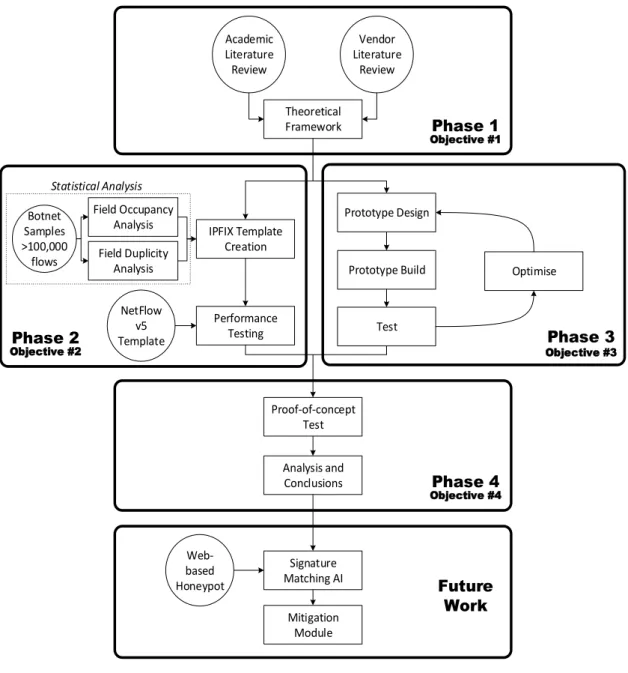
It became evident that the drawback of most existing traffic capture techniques, when applied to high throughput networks, is that they collect big data; large volumes of highly varying information that requires processing for insight and decision making. As network traffic volumes continue to increase year upon year, analyses time is lengthened simply from increasing data volumes. Therefore this research set out to create a more efficient method of traffic capture that can be applied to existing botnet detection algorithms (see Chapter 3). Research Objective #2 was built upon claims by Trammell, et al. (2007) that IPFIX overcomes weaknesses in NetFlow v5, and took inspiration from Gates et al., (2004) who stated that the fixed template nature of NetFlow v5 limits its suitability to security analysis. Empirical data evidence was collected to demonstrate that IPFIX collects smaller data volumes than NetFlow and PCAP, is faster and demonstrates no noticeable impact upon host device CPU consumption. With Research Objective #2 demonstrating advantages of IPFIX when applied to botnet traffic communication capture, Research Objective #3 was defined so as to demonstrate how IPFIX collection can be incorporated into a prototype cloud stack. The theory of IPFIX export of botnet communication traffic was proven b y testing the prototype with IPFIX templates to capture a real world botnet deployed within a sandboxed test network. The research approach is summarised in Figure 2.
8 Academic Literature Review Vendor Literature Review Prototype Design Prototype Build Test Optimise Proof-of-concept Test Phase 1 Phase 3 Objective #1 Phase 2 Objective #2 Objective #3 Phase 4 Objective #4 Analysis and Conclusions Web-based Honeypot Signature Matching AI Mitigation Module Future Work Performance Testing NetFlow v5 Template IPFIX Template Creation Field Duplicity Analysis Botnet Samples >100,000 flows Field Occupancy Analysis Theoretical Framework Statistical Analysis
Figure 2. The phases of the research approach.
The approach to researching the problem of botnet detection in CSP networks was conducted in four phases. Phase 1 was a review of technology and state of the art in botnet detection methods. Phase 2 was the construction, justified through empirical statistical evidence, of an IPFIX template for botnet traffic capture, which was performance tested against NetFlow v5. Phase 3 was the evaluation of component elements for the construction of a modular framework architecture that allows IPFIX export to be built into cloud network stacks. Phase 4 validates the design of the template and framework in a botnet traffic capture test.
9
1.4.3 Experimental Design
Figure 2 shows three distinct experimental phases within the research approach. Phase 2 used statistical analysis to create the IPFIX template, and also to demonstrate advantages in performance over other capture methods. Phase 3 was the design of IPFIX export into the cloud stack. Phase 4 tested the stack and the templates against real world malware. Thus addressing Research Objectives 2, 3 and 4.
The methodological approach for each phase of experimentation is outlined within the following chapters; creation of the BotProbe templates in chapter 4.3 with performance testing in chapter 4.8, testing of the BotStack framework in chapters 5.4 and 5.6, and concept validation testing in chapter 6.3. Each methodology details the dataset origins, equipment used, methodical procedures and justification for the methods of analysis. Each chapter includes a critical discussion of the results together with the implications of how the experimental findings contribute towards the hypothesis of botnet communication traffic capture in cloud provider networks.
1.5 Ethical Considerations
All original research undertaken within Anglia Ruskin University must be performed in accordance to the university’s guidance and mandatory training on ethical research. Whilst this study did not involve animal or human participation, the research does involve handling of malicious software (malware). Therefore due ethical consideration was required to protect the researcher and the reputation of Anglia Ruskin University. Throughout this study the following ethical considerations were adhered to:
Malware was only executed in a sandboxed environment which was physical air-gap from both the university network and the Internet;
Malware was used for testing purposes only, and not used for malicious intensions or personal gain;
Malware was stored on appropriately labelled USB sticks, and kept in a restricted access environment;
Malware and PCAP were only obtained through legitimate repositories;
Where PCAP contains personal identifiable information, confidentiality was respected through the redaction of personal data.
10
1.6 A Summary of the Contributions to Knowledge
Figure 3 outlines how this research makes several practical as well as theoretical contributions to knowledge, indicating in which peer reviewed articles these findings have been published:
OBJECTIVE #2: The conceptual development of an innovative IPFIX template for botnet communication traffic capture in cloud provider networks. (Chapter 4)
A B O T N E T N E E DLE IN A V IR T U A L HA Y ST A CK (o r a n o v e l IP F IX t ra ff ic c a p tu re m e th o d f o r c lo u d s e rv ic e p ro v id e r n e tw o rk
s) Contribution #1: A critical investigation into how IPFIX export overcomes the limitations of
traditional NetFlow-based botnet communication traffic capture in cloud provider networks.
Graham & Winckles, 2014. An Analysis of Pre-Infection Detection Techniques for Botnets and other Malware
Graham, M., 2014. Cloud-Based Detection Techniques for Botnets and Other Malware
Graham, Winckles & Sanchez, 2015b. Practical Experiences of Building an IPFIX Open Source Botnet Detector
Contribution #2: BotProbe: A novel IPFIX template; tailored for botnet traffic capture.
Graham, Winckles & Sanchez, 2015b. Practical Experiences of Building an IPFIX Open Source Botnet Detector
Graham, 2017. BotProbe: Reducing Big Data Challenges in Threat Detection
Graham, 2017. BotProbe: Making Network Big Data Manageable
Graham, 2017. Botnet Observations: What can be done to up our game against this significant threat?
OBJECTIVE #3: To define, design and construct an IPFIX export framework for botnet communication traffic capture in cloud provider networks. (Chapter 5)
Contribution #3: BotStack: A novel IPFIX monitoring framework.
Contribution #4: Empirical evidence for the optimum siting of a capture probe on the hypervisor.
Graham, Winckles & Moore, 2014. Botnet Detection in Virtual Environments using NetFlow
Graham, Winckles & Sanchez, 2015a. Botnet Detection within CSP Networks using Flow Protocols
Graham, 2017. BotProbe: Reducing Big Data Challenges in Threat Detection
Graham, 2017. BotProbe: Making Network Big Data Manageable
Graham, 2017. Botnet Observations: What can be done to up our game against this significant threat?
OBJECTIVE #4: To validate the effectiveness of the novel design by demonstrating botnet communication traffic capture in a proof of concept network. (Chapter 6) OBJECTIVE #1: A critical investigation into IPFIX as an alternative flow export protocol to NetFlow v5, for botnet communication traffic capture in cloud provider networks. (Chapter 2 and Chapter 3)
11
1.7 Thesis Structure and Organisation
The remainder of this thesis has been structured as follows:
Chapter 2: This chapter justifies the necessity for the research within this project. Real world examples are used to describe how new families of bots are beginning to target cloud infrastructures. The chapter also reviews the legal responsibility for cloud providers towards botnet takedown.
Chapter 3: Through a thorough review of academic literature, this chapter outlines the features of IPFIX that bring advantages over NetFlow v5 to botnet traffic capture in a cloud service provider environment. The chapter reviews the state of the art in botnet detection using flow protocols, whilst explaining how IPFIX could be applied to improve these studies. NetFlow v9 is discussed, although throughout this thesis NetFlow v9 is considered to be a vendor proprietary forerunner of IPFIX and is therefore given marginal attention.
Chapter 4: Using the understanding gained from chapters 2 and 3, this chapter describes the process by which almost 25 million botnet traffic flows are analysed in the creation of the novel BotProbe IPFIX templates. Empirical data is collected and analysed for the performance impact (processing times, data volumes and CPU loadings) of the BotProbe templates against NetFlow v5.
Chapter 5: This chapter presents BotStack, a novel IPFIX framework for botnet traffic capture in cloud provider networks. Using this framework, a proof of concept network is constructed to determine the optimum siting of IPFIX sensors, as well as an understanding of how sensor clock settings impact traffic data capture.
Chapter 6: The interoperability of BotProbe with BotStack is validated by infecting a proof of concept network with the Zeus botnet. BotProbe captures botnet traffic communications across four distinct profile phases of a botnet life cycle.
Chapter 7: The final chapter summarises the research findings, drawing conclusions of the impact of this study for cloud service providers. This chapter also highlights future directions for this research.
12
2.
Technological Review
2.1 Introduction
The aim of this research project, as described above, is to understand how the IPFIX protocol can form a capture mechanism for botnet traffic in CSP multi-tenant virtualised networks. The starting point to achieving this aim is to understand what makes a CSP infrastructure vulnerable to attack, the potential threats from malware that specifically abuses the cloud and the limitations of current detection techniques.
Many real world scenarios exist where cloud infrastructures have provided host to botnet C&C servers. The Cloud Security Alliance (CSA) recognises Abuse and Nefarious Use of Cloud Services as a top threat to cloud computing (Brook, et al., 2016). The Internet of Things (IoT) has started to become intrinsically linked to cloud hosted infrastructures, due to its ability to store data centrally. The International Data Corporation (IDC) predicts that by 2020, over 90% of all IoT data will be hosted on cloud platforms (Turner, 2015). Increasingly IoTs devices have been found hosting botnets; 2013 had the Darlloz botnet (Hayashi, 2013), 2014 had fridges sending SPAM (Thomas, 2014), 2015 had Lizard Stresser (Krebs, 2015) and 2016 had the Mirai botnet (Mansfield-Devine, 2016) which sustained a record-breaking 620Gbps DDoS attack, before the source code was publically released prompting copycat attacks.
The attack surface of a cloud can be extended both through infrastructure design techniques and the hardware or software upon which it is provisioned. Tenant separation is typically achieved through virtualisation of both physical (Input/Output, CPU) and networking (switching, storage) functions. Real world attacks have utilised hypervisor vulnerabilities to allow malware to jump into, across and out of virtualised environments. In a CSP this could mean an attack on another tenant, or upon a storage repository.
13
2.2 Botnet Fundamentals
A bot, or robot, is nothing more than a software application that performs repetitive operations; such as the web crawlers used by Google to index the Internet. A bot only becomes malicious when it is used as a delivery mechanism to transport nefarious payloads to multiple devices. Compromised devices work together to form a network of infected machines, or botnet. Under the remote control of a human botmaster operator, these machines lie dormant until they reach a critical mass of infected devices and the botmaster initiates an attack. Typically, an attack takes the shape of a mass attack of many hundreds of thousands of bots upon a single victim. The contender for the first botnet lies with either the Sub7 trojan, or the Pretty Park worm. Both appeared at about the same time in 1999 and both introduced the concept of connecting to victim machines via an IRC communications channel which was used to deliver malicious commands. Since then, botnets have evolved in threat, stealth and danger to become one of the most significant cybersecurity threats faced by organisations and individuals today.
Without doubt, the power of a botnet comes from this “mass” of networked machines working together as a single platform. A larger botnet is both more effective at achieving its objective, as well as harder to takedown. However, more than a few hundred thousand bots and the botnet becomes easier to detect; fewer than a hundred thousand bots and the attack becomes less effective. It is estimated that at any one time, globally as many as 2.5 million devices are connected to over 5000 C&C servers (Trend Micro, 2016). With botnets-for-hire services starting from $20 an hour for a DDoS attack, such services are a tool for non-specialised individual to perform powerful attacks (ENISA, 2015).
The ability to perform a mass attack upon a single victim, using globally distributed bots makes botnets suited for specific types of attack:
DDoS In 2015, it was estimated that malicious bots generate 29% of all Internet traffic (Imperva, 2015). The first half of 2016 saw more 100Gbps+ attacks than in all of 2015 (Arbor Networks Inc., 2016), including the first 600Gbps+ DDoS attack (Kaspersky Lab, 2016). 93% of DDoS attacks in Q1 2016 were from DDoS as a Service (Incapsula, 2016). In 2016, the Lizard Stresser botnet used IoT Webcams to launch a 400Gbps DDoS attack (Krebs, 2015). In 2016, a CCTV botnet was detected generating over 50,000 HTTP requests per second during a targeted DDoS attack (Cid, 2016).
14
Identity Theft
Botnets targeted more than 1,500 financial institutions across more than 100 countries in 2015 (Dell SecureWorks CTU Threat Intelligence, 2016). During two months in 2014, a single botnet mined $600,000 in crypto coins (Dell SecureWorks CTU Research Team, 2014). Over 400m identities were stolen globally in 2015 from bots such as Dridex, Simba and Ramnit (Symantec, 2016a; Verizon, 2016).
Click Fraud
It has been estimated that botnets could have cost the global advertising industry in excess of $7.2 billion in 2016 (Association of National Advertisers and White Ops, 2016).
2.3 A Review of the Limitations of Botnet Detection Techniques
Amazon’s AWS Security Best Practices (Todorov and Ozkan, 2013) recommends that tenant protection from malware is achieved through virus (AV) software, anti-spam (AS) software and host-based Intrusion Detection System (IDS) software. Amazon’s recommendations to protect against botnets include device patching, only using trusted software and applying the principle of least privileges. The CSA (Cloud Security Alliance, 2011) recommends securing the network and preventing tenant data leakage through a combination of VLANs (Virtual LANs), IDS, IPS (Intrusion Prevention System) and Firewalls. Modi, et al., (2013) agree, advising on deploying IDS and/or IPS for anomaly detection within cloud architectures.This advice has several weaknesses. Primarily, the advice puts the responsibility upon tenants to provide self-protection. Such an approach may protect individual tenants, but does not prevent the nefarious use of cloud services. A CSP hosting protection services within the tenant environment has two considerations; the privacy implications of such systems as they are based upon packet inspection techniques, and that a malicious user can disable these protection services. As the size of IoT networks increases, effective endpoint security becomes more difficult. Furthermore, AV, IDS and IPS are built upon signature-based detection engines. Signature-based detection has three drawbacks (Graham and Winckles, 2014; Graham, 2014): (1) an inability to cope with malware polymorphism and metamorphism, where any change to a virus binary requires a new signature definition; (2) a lack of zero day protection until a signature is created and deployed; and (3) it is a post-infection technique taking action only after malware has entered a system. Heuristic detection may overcome some of these drawbacks, but such techniques can be slow and are still subject to the same binary obfuscation techniques that malware authors deploy against signature-based
15
detection. Signature-based techniques do have established roles in the real-time protection of individual devices against malware. However, in a botnet of 100,000 devices, inoculating one device has little impact on the overall botnet. The takedown of a botnet requires locating and eradicating the C&C server, which is something that signature-based AV, IDS and IPS are not capable of doing.
Internet Service Providers can successfully takedown botnets by blackholing appropriate IP address ranges using DNS record analysis. In practice, DNS takedown is a slow process and can take months to successfully trace a C&C server. DNS blacklisting is susceptible to evasion techniques such as IP fluxing and domain fluxing, such as those used by the Conficker and Torpig botnets (Graham and Winckles, 2014). A takedown strategy is often reliant upon accurate estimations of the botnet size. DNS can be unreliable when used in botnet size estimation (Rajab, et al., 2007). Blackholing techniques rely upon DNS records, which are intrinsically linked to the Internet. Within a networked environment such as a CSP infrastructure, DNS is not required to obtain device addressing information, so DNS may not be present in a LAN. Thereby defeating DNS record analysis as a protection mechanism in such environments.
Every botnet uses a communications channel which enables communication between each bot and their C&C server(s). The necessity for bots to communicate with their peers throughout their life is fundamental to behaviour-based detection (Gu, et al., 2007). First generation botnets used a traditional client-server topology. This communication model is straightforward to set up and maintain, but fewer C&C servers make the botnet more liable to takedown. Some first generation botnets increased resilience by using primary/standby servers, but these more rigorous communication models required complex code. To increase resilience to takedown, botnets migrated to a decentralised peer-to-peer (P2P) topology where each bot node can act as a client or a server. P2P botnets display similar behaviour to benign P2P software making them more difficult to detect (Yen and Reiter, 2010). Out of the box P2P protocols maintain internal models of neighbouring nodes, allowing researchers to infiltrate a P2P botnet by becoming part of the botnet to obtain neighbour node IP addresses. Phatbot attempted to overcome this by using WASTE, an anonymous P2P protocol. Although WASTE does not scale for large networks (Wang, Sparks and Zou, 2010). The meshed ad-hoc nature of P2P networks, together with a lack of message delivery guarantee, can mean P2P botnets suffer from higher command propagation time across the network which impacts bot synchronisation (Zhao, et al., 2013). C&C and P2P models are both still used in botnet topology. The communication channel
16
protocol can also be used as an attribute in behaviour-based detection. Early bots utilised IRC. Whilst straight forward to code, IRC is easily mitigated by blocking IRC ports. A common method for achieving stealth is to employ HTTP as the communication protocol. By masquerading as legitimate HTTP or encrypted HTTPS traffic, bots cans bypass port-filtering firewalls and IDS detection (Zeidanloo and Manaf, 2009). IRC and HTTP are both still used as botnet communication channels.
2.4 A Review of Botnet Mitigation Legislation and Responsibility
In 2010, the OECD (Organisation for Economic Cooperation and Development) released research suggesting that global ISPs should take steps to mitigate the threat from botnet SPAM (van Eeten, et al., 2010). The report achieved little other than to raise an argument around where responsibilities lie for tackling botnets. In 2013, the US Federal Communications Commission (FCC) produced a voluntary code of conduct for ISPs (Communications Security, Reliability and Interoperability Council, 2013). The US-centric report suggested that ISPs collaborate on botnet detection and eradication. The report highlighted two hindrances preventing collaboration. First, the cost of implementing technical solutions; and second, that global laws and policy discourage global collaboration. Since its release, several major US telecommunications providers have adopted the code, including AT&T, Comcast, Sprint and Verizon. Similar voluntary codes have followed in other countries. These types of codes of conduct will remain voluntary until international law can resolve collaboration issues. Demarcation points in responsibilities are also open to interpretation. Fryer, Stalla-Bourdillon and Chown (2015) argue that the third party companies which host website platforms should also take some responsibility toward botnet mitigation.In 2014, the CSA launched an anti-bot working group to coordinate research into botnet prevention within CSPs, however by 2017 this working group appeared to have become inactive having released little information. In 2015, a report from the US Federal Trade Commission (FTC) highlighted that IoT devices must implement security by design, rather than treat security as an afterthought (Federal Trade Commission, 2015). ISO/IEC27018:2014 is an attempt, through non-legal regulation, to address the lack of cloud computing legislation. For European CSPs, this standard links to the Article 17 of the European Commission Data Retention Directive (EC Data Retention Directive 2006/24/EC, 2006) which stipulates that Data Controllers within the European Economic Area who are responsible for the processing of data,
17
must take appropriate measures to protect personal data against accidental destruction or loss, alteration or unauthorised disclosure. This international standard covers a wide variety of subjects, but concerns itself more with protection of personally identifiable information. Ultimately, the requirements of ISO27018 are not a replacement for national or international law, nor does it specifically address the risk from botnets. By the completion of this thesis in 2017, there are no legal requirements for CSPs or ISPs to actively mitigate against botnets.
2.5 A Review of the Cloud as an Attack Platform
2.5.1ATTACKS FROM THE CLOUD
The CSA identifies Abuse and Nefarious Use of Cloud Services as a top threat to cloud computing (Brook, et al., 2016). The report cites threats that are directly related to botnets; including DDoS attacks, email SPAM and phishing, mining for digital currency, large-scale click fraud and malicious content hosting (such as a C&C server). The report recommends that CSP customers should be permitted to monitor the health of their own cloud workspace. Whilst a dashboard-style overview of bandwidth utilisation may give clues to malicious activity, it is no more than an indicator of possible threat.
One driver in the move away from maliciously infecting victim devices, towards using service providers to host malicious VMs, is the technological advantages gained from virtualised platforms. These include performance, scalability, ease of management, lower risk of detection and stability of cloud services (Level 3, 2015). Another driver is cost. Bryan and Anderson (2010) rented 10 virtual servers on Amazon’s EC2 platform at a total cost of $6 to demonstrate a cloud hosted DDoS attack. Roth (2011) demonstrated the power of distributed computing by renting servers on Amazon’s EC2 platform at a cost of $2.10 per hr per instance. Eight instances were clustered, each trying 50,000 passwords combinations per second, taking 2 minutes to perform a 39 million word dictionary attack to brute force a victim password. Ragan and Salazar (2014) demonstrated how an automated service for registering free-trial CSP instances could create a botnet to mine bitcoins.
Cybercriminals are businessmen, recognising the same benefits from cloud-based services as legitimate businesses. From the point of view of a botmaster, access to considerable distributed processing power at almost negligible prices provides two opportunities. Firstly, the cloud removes the necessity and complexity of infecting a victim’s device. Instead the botmaster can use a cloud provider to create a VM
18
instance, remove any AV or IDS, infect this VM with their own bot and clone this VM multiple times to rapidly create a sizeable botnet at little cost. Secondly, the cloud can play host to the C&C servers. If an ISP blacklists the C&C server IP addresses, the distributed architectural nature of the cloud allows for rapid re-deployment of the C&C server in a totally new geographic IP subnet.
Either of these reasons makes the cloud an effective platform from which to launch botnet attacks. One of the earliest examples was in 2009, when the Amazon’s EC2 platform was used to host a Zeus C&C server as a backend alternative in case the original domain was lost (Amazon, 2009). Again in 2009, Amazon’s EC2 platform was used to launch a massive-scale DDoS attack on Bitbucket which took Amazon 16 hours to block (Metz, 2009). By 2014, Amazon’s AWS platform was anticipated to be hosting 41% of the world’s malware (Heimer, 2014). In 2014, Dropbox was used to deliver the Upatre SPAM bot (Trend Micro, 2014). Again in 2014, Dropbox was used as a C&C server for the PlugX RAT (Pauli, 2014). In June 2015 a botnet that was infecting Skype sessions with adware was traced back to Amazon’s AWS platform (Osbourne, 2015).
2.5.2IOTATTACKS
Public infrastructure and utilities continue to remain a high profile target. In 2010, Stuxnet was the first known worm to target the industrial SCADA (Supervisory Control and Data Acquisition) control systems used in heavy industry, by attacking Iranian nuclear centrifuges (Kushner, 2013). Stuxnet morphed into the industrial worms Duqu in 2011 and Flame in 2012. At around the same time, poor device security facilitated a shift from attacks on industry into attacks on the IoT. In 2012, a hacker attempted a census on the entire Internet IPv4 addressing space. To perform this the Carna botnet was created from 420,000 embedded devices that used default passwords (Botnet, 2012). In 2013, Linux.Darlloz attacked routers, cameras and set- top boxes that used default usernames and passwords, to create a botnet to mine crypto coins (Hayashi, 2013). In the same year, a botnet was supposedly created using smart fridges to perform SPAM attacks, but this has since been refuted (Thomas, 2014). In 2015, Lizard Stresser botnet was found performing 400Gpbs DDoS attacks from home routers with default passwords (Krebs, 2015). In 2016, botnets took advantage of cloud based Linux IoT devices by exploiting volatile memory vulnerabilities in ELF (Executable and Linkable Format). The first was
19
Linux.Routrem (Symantec, 2016b) also known as Remaiten. This was followed by Linux.Laubot (Symantec, 2016c) which specifically targeted ARM architectures.
However, both of these botnets were eclipsed by the Mirai botnet which made global news headlines after sustaining a record-breaking 620Gbps DDoS attack (Mansfield-Devine, 2016). Following this attack the Mirai botnet source code was publically released. The end of 2016 and early 2017 saw several copycat attacks using modified Mirai code. Whilst the IoT continues to be built on cheap devices with no security or unchanged default passwords, the IoT will remain a source from which to host attacks.
2.6 A Review of the Cloud as an Attack Surface
2.6.1ATTACKS UPON THE CLOUD
Whilst the cloud provides an effective platform from which to host botnets, the cloud infrastructure itself is not immune to attack. Since cloud computing is no more than a combination of existing computing techniques such as virtualisation, grid computing and service-oriented computing, security issues in the cloud differ little from traditional IT solutions (Ouedraogo, et al., 2015). What makes the cloud different to traditional computing is (1) co-residency means that tenants often share the same network infrastructure and storage with other tenants, competitors, or even hackers; and (2) in a post Snowden era, tenants are more astute in critically evaluating a supplier’s capacity for surveillance. Privacy expectations limit a CSP’s ability to provide tenants with the more traditional protection solutions that are associated with packet inspection techniques, such as signature-based detection.
Alternatively, leaving malware protection to the responsibility of the tenant may broaden the cloud attack surface. Deployment of insufficient or outdated anti-virus software may permit malware capable of compromising a tenant’s VM. If malware can escape a VM onto the underlying CSP network infrastructure, it has the potential to attack the CSP’s storage repositories or neighbouring tenants. Unsecure cloud management interfaces are another source for malware to enter the cloud infrastructure. Somorovsky, et al., (2011) exploited Amazon EC2 sessions through XSS (Cross Site Scripting) in the EC2 control software interface.
20
2.6.2THE HYPERVISOR EXPOSED
A hypervisor allows emulated virtual devices to share the physical host’s resources. CSPs use hypervisors to allow multiple VMs to each act as a stand-alone, tightly isolated container, thereby providing tenant isolation from other tenants. Effectively, a hypervisor is software which acts as a gatekeeper between the privileged kernel domain and the unprivileged guest domain. Exploiting vulnerabilities in this software could allow unauthorised entry or exit from this isolated sandboxed environment.
Govindavajhala and Appel (2003) demonstrated this by using a lightbulb to raise the temperature on DRAM and SRAM chips to force memory errors. These errors allowed them to exploit both Sun and IBM VMs. Chapter 2.7 describes real world hypervisor exploits.
A hypervisor can have multiple pointers to the same memory location to allow the management of numerous concurrent virtual machines. Rutkowsa (2004) exploited this through four lines of code known as the Red Pill. She was able to determine whether the host was physical or virtual by analysing memory registers in the Store Interrupt Descriptor Table, which in Intel processors can be accessed by non-privileged users.
Thirteen years later, at the time this thesis was written, malware still exploits red pill type vulnerabilities to determine if it is being executed within a virtual or physical machine. With the knowledge that researchers typically study malware in a sandboxed virtual environment, malware exists that will modify its behaviour, or refuse to execute, in virtual machines to prevent researchers from understanding its behaviour. Botnets with the ability to do this include Stormbot, Agobot and Phatbot. The Dyre malware determined if it was running in a virtual environment by analysin g the number of processors the environment used, under the assumption that virtual environments are usually configured with only one processor and one core to save resources (Raff, 2015). Rather than terminate when running on a virtual machine, malware such as Cloudburst actively seeks out virtual environments in order to exploit vulnerabilities that allow it to escape out of the VM onto the underlying infrastructure.
The CSA attributes seven of its top twelve threats to the cloud to hypervisor vulnerabilities (Brook, et al., 2016). As hypervisors become more feature rich they start to contain more bugs in the code. Extra security features in hypervisors can make the hypervisor more visible to attack and can often hamper bot detection (Vaquero, Rodero-Merine and Morán, 2011) Current practices of replicating functionality at many levels, including security features at the hypervisor and guest OS levels, creat e
21
inertia in software management which often impairs performance of the systems (Garcia-Valls, Cucinotta and Lu, 2014).
Fully secure isolation is still an area of study. Rushby (1989) proposed true isolation, where each VM has its own resources instead of sharing resources. Few products support this, as the x86 chip set does not have a “no sharing” concept, so not all instructions in the chip can be virtualised. The Chinese Wall concept suggests that isolation can be achieved through hosting parties that have conflict of interest on separated infrastructure. This usually means additional infrastructure which increases cost whilst reducing device utilisation. Sailer, et al., (2005) proposed an isolation
method on the Xen hypervisor using Access Control Modules, which may reduce the opportunity for inter-VM attacks on the same host machine, but it does not eliminate vulnerabilities in hypervisor code. VM Introspection (VMI) is a technique for the transparent real-time inspection of the operation of a VM, by directly reading the volatile memory of the running VM from the hypervisor’s privileged domain. Typically, VMI research is applied to malware, but Memarian, Conti and Leppänen
(2015) detected botnets in infected cloud VMs by searching for hidden processes and DLLs. From a CSP’s point of view, VMI can be performed without the knowledge of the guest OS, thereby providing a possibility of detecting malware without a probe in the tenant environment. However, this makes it an invasive technique which may breach tenant privacy expectations. Hypervisors remain a rich source of vulnerabilities that will continue to be exploited.
2.7 A Model for Attacking a Cloud Infrastructure
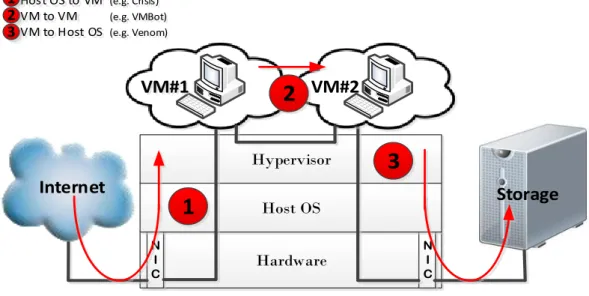
Hypervisor attacks have been witnessed in the wild. When considered individually, these attacks have successfully exploit different vulnerabilities in order to jump between the physical and virtual network layers.
When considered as a combined attack, it could be possible for malware to enter the cloud infrastructure and propagate across the network. In a CSP environment, malware could then attack the CSP infrastructure, in particular storage, or attack tenants in other logical partitions. In an IoT environment, malware could compromise multiple devices or sensors. Figure 4 shows a model for malware to exploit hypervisor weaknesses using real world attacks.