Aviation Science Program Review March 2012 Page 1
Portland Community College
Aviation Science
Program Review
March 2012
Review committee members:
Katie E. Leonard Floyd, Faculty Department Chair – Southeast Center, SAC Chair Larry Altree, Faculty Department Chair – Rock Creek
Aviation Science Program Review March 2012 Page 2
Contents
Overview... 3
Program timeline... 4
Section 1: Program/Discipline goals... 5
Section 2: Curriculum ... 8
Section 3: Needs of students and the community ... 12
Section 4: Faculty – composition, qualifications, development ... 16
Section 5: Facilities and support ... 19
Section 6: CTE programs – changing employer needs... 22
Section 7: Recommendations ... 27
Appendix A: PCC core outcomes ... 29
Appendix B: Aviation Science degree outcomes... 30
Appendix C: Core outcomes demonstrated in AVS courses ... 32
Appendix D: Core outcomes mapping (updated)... 33
Appendix E: Instructor qualifications ... 35
Aviation Science Program Review March 2012 Page 3
Overview
Since 1999, PCC's Aviation Science program has produced high-quality graduates prepared to enter the field of aviation as airplane or helicopter pilots. Our program prepares students to enter an industry with both local and global career opportunities. Situated on the Rock Creek campus and the Southeast Center, as well as at the Hillsboro and Troutdale airports, our program is convenient to students from all over the Portland-Vancouver metro area. The Aviation Science program offers numerous local industry contacts, federal approval, and a curriculum that enables students to begin working in the industry before they graduate.
Training done through the Aviation Science program is certified by the Federal Aviation Administration and approved by the Veteran's Administration. The program prepares students to take multiple national exams with the Federal Aviation Administration.
Flight training is done through our contracted provider, Hillsboro Aviation, a well-established local company with over 70 aircraft and 100 instructors. Classes are offered both in the classroom and online, to better meet the scheduling needs of our diverse student body. The Aviation Science advisory committee is composed of a cross-section of industry professionals that meets semi-annually to share information and reassess the curriculum.
Federal Aviation Regulation 14 CFR Parts 61 and 141 set forth the qualification, testing, and certification requirements for pilots, flight instructors, and ground instructors.
The Aviation Science curriculum is composed of three main parts: flight training (and associated ground training), aviation academic classes, and general education/electives. The aviation academic classes provide in-depth study into areas identified by our advisory committee as crucial for success in the aviation industry.
Classes are offered at a variety of times and in several modalities, with in-person classes offered in blocks between 8 a.m. and 8 p.m., one-on-one instruction offered on each student's individual schedule, and online classes offered year-round. The degree program is intended to be completed in two years, although many students are able to begin working in the industry as flight instructors as soon as a year after beginning the program. Many students also transfer to Embry-Riddle Aeronautical University (ERAU), which provides classes locally toward completing a bachelor's degree in several aviation-related areas. PCC has an articulation agreement with ERAU for Aviation Science and Aviation Maintenance.
Most students in the airplane degree program earn a commercial pilot certificate with engine, multi-engine, and instrument airplane ratings; and a flight instructor certificate with single-engine, multi-engine and instrument ratings. Most students in the helicopter degree program earn a commercial pilot certificate with instrument helicopter rating, and a flight instructor certificate with instrument helicopter rating.
Flight and ground training classes help prepare students for the FAA oral, written, and practical exams. The overall FAA exam pass rate for program completers is very high.
Aviation Science Program Review March 2012 Page 4
Program timeline
1999 airplane program starts 2000
2001 first full-time instructor hired, helicopter program starts 2002 Flight Crew student club founded at Rock Creek
2003 first program review, Perkins Learning Skills Specialist hired at Rock Creek 2004
2005 began offering classes at Southeast Center 2006 ground schools begin to go online
2007
2008 Perkins Learning Skills Specialist hired at Southeast Center
2009 200-level classes go online, VA Chapter 33/Post-9/11 GI Bill changes, flight labs start
2010 second full-time instructor hired, Flight Crew Southeast student club founded at Southeast Center 2011 became closed-entry program
Aviation Science Program Review March 2012 Page 5
Section 1: Program/Discipline goals
A. What are the educational goals or objectives of this program/discipline, and how do they compare with national or professional program/discipline trends or guidelines? Have they changed since the last review, or are they expected to change in the next five years?
· Provide training for those desiring certification from the FAA as pilots and flight instructors, in either airplanes or helicopters.
· Create safe, well-rounded pilots who have knowledge above and beyond the minimum required for FAA certification as pilots and instructors.
· Foster industry partnerships that promote and support a growing base of aviation activity in the Northwest.
· Respond to opportunities to offer specialized training in existing curriculum.
The goals and objectives of the Aviation Science program have been consistent with both the industry and its regulatory body since the program's inception at PCC in 1999. Overall, they have not changed significantly since the last program review, nor are they expected to change significantly in the next five years. On a curricular level, specific courses, particularly those involving flight training, have seen an increased emphasis on safety, cockpit resource management, and aeronautical decision-making, in response to the creation of FAA special emphasis areas, Advisory Board input, and national aviation accident trends. Specialized training opportunities in the next five years are anticipated to include glass cockpit operations and turbine aircraft transitions.
B. What changes have been made as a result of the last program review?
The previous program review, completed in 2003, identified “completion of flight courses” as the single biggest challenge for the program. In addition, 11 areas were classified as needing further review. Further detail on progress toward addressing these items is given below (see Table 1).
In the 2003 program review, the difficulty and financial commitment for the flight courses were identified as significant obstacles to successful program completion. Since then, three main actions have contributed to a higher completion rate for the flight classes: increased student financial accountability, increased advising (both initial and periodic), and becoming a closed-entry program.
Increased student financial accountability: Since the program’s inception in 1999, students had
employed a “pay-as-you-go” system for the flight training, and were only required to pay for each flight lesson at the completion of each flight. Beginning in fall term 2009, an estimate of the amount of money necessary to complete each flight course was attached to the course in Banner as a required fee, and students were required to provide proof of the ability to pay the entire amount before being allowed to
Aviation Science Program Review March 2012 Page 6 register for that class. Although this deterred some students from being able to register, due to not having complete funding for the course, the Aviation Science department decided after thorough discussion that ensuring student success made it a worthwhile effort.
Increased advising: Prior to fall 2009, students who registered for a flight class often had only a
single contact with the department, once they finished the class, to report their grade. In fall 2009, in conjunction with attaching the flight fees to each flight class, the AVS department began requiring departmental approval to register for any flight class. This required students to make contact with the department at every milestone in their flight training (entire licenses/certificates, or portions thereof), and initiate a discussion on whether it was appropriate for the student to register for that class at the time. The creation of the flight labs at that time also contributed to the ability to receive ongoing advising regarding flight training. All students who are either currently registered for or working toward finishing a flight class are required to register for a flight lab, which meets once per week for three hours. The purpose of the flight labs is to allow students time to prepare for upcoming flights, convey important department or flight-related information, and allow the department chairs to track the progress of every flight student.
Closed-entry program: Beginning in fall term 2011, the Aviation Science program began
instituting an application process, and restricting registration for any AVS class to declared Aviation Science majors. The main portions of the application process are proof of funding for flight training, an FAA medical certificate, and the appropriate math/writing prerequisites. Although this decision was accelerated by the need to control enrollment (due to Veterans Affairs requirements of having no more than 85% veteran students in the Aviation Science majors), discussions about closing the program to ensure student success had been taking place informally for several years. By limiting admission to only those students who are reasonably assured to succeed in their flight training, the department hopes to improve its program completion rates.
Aviation Science Program Review March 2012 Page 7 Table 1: Action items from 2003 program review
Areas needing further review (from 2003 program review)
Actions taken/results
Define Student Success for Aviation Science Courses and Program
Accommodating diverse student goals Consider committee
Investigate work in other programs
Needs further review
Develop Student Tracking Systems Flight course progress reporting Comprehensive student file
Students are required to register for flight lab if currently flying, report progress in weekly flight journals, instructors track progress manually
Electronic student file (on Spaces) is in development Investigate Alternative Program Options
Sorting of Continuing/Community Education students from Degree/Career students
Investigate work in other programs
Closing of program eliminates need to identify non-degree-seeking students
Helicopter degree without instrument option will no longer be offered (paperwork in progress)
Review Credit Hour Distribution and Content for these courses:
AVS-130 AVS-140 AVS-150 AVS-147
Changed AVS-130 from 3 to 4 credits Changed AVS-140 from 5 to 4 credits No changes made to AVS-150
Changed AVS-147 (4 credits) to AVS-157 (3 credits) and AVS-167 (3 credits)
Continue to Encourage / Establish Student Activities PCC Flight Crew (ASPCC Charter)
AVS Student mentor program
Flight Crew remains active at Rock Creek Flight Crew Southeast founded 2010 Improve Program Advising
Inclusion of financial planning
More detailed printed / web-based material Improved program orientation
Periodic
Recorded orientation available online
Required departmental advising before registering for any flight class
Weekly advising opportunities in flight lab
Began using Perkins Learning Skills Specialist for advising as well as tutoring at Rock Creek (2003) and SE Center (2008)
Continue Training of PCC Staff Financial Aid Staff
Advising Staff
Worked closely with financial aid to implement flight fees, need to continue to communicate with advising staff that program is closed
Grading Policy Review
Make-up quiz/exam policies
Uniform inclusion of attendance grading across the program
Review Flight Course Grading
Investigate inclusion of attendance, homework and other criteria
Investigate possibility of P/NP for these courses
Flight course grading changed from average of stage check scores to grade based on number of retakes of stage checks
Advisory committee reiterated their desire that the flight courses continue to receive letter grades
Other items need further review Review Stage Checks
Consider elimination of redundant stage checks
Eliminated requirement for redundant stage checks in several airplane flight courses
Review All Courses for Cultural Awareness Opportunities Investigate other programs’ work in this area. Seek outside advice
Individual instructors continue to examine their courses for relevant current opportunities
Aviation Science Program Review March 2012 Page 8
Section 2: Curriculum
A. Addressing Course-Level Outcomes: Identify and give examples of assessment-driven changes made to improve attainment of course-level student learning outcomes. Where sequences exist, also include assessment-driven changes to those sequences. (CTE programs may address this in section 6).
See section 6.
B. Addressing College Core Outcomes
B.i. Describe how the College Core Outcomes are addressed in courses, and/or aligned with program and/or course outcomes.
See Appendices A, B, and C.
B.ii. Please revisit the Core Outcomes Mapping Matrix for your SAC and update as appropriate. See Appendix D.
C. Assessment of College Core Outcomes (Note: for Career and Technical Education (CTE) programs, assessment of Core Outcomes that have been mapped into the Degree and Certificate outcomes may be addressed in that section 6B instead). This section may refer to, include or summarize the results of annual Core Outcomes assessments carried out over the last 5 years.
C.i. Describe the strategies that are used to determine how well students are meeting the College Core outcomes
C.ii. Summarize the results of assessments of these outcomes (SACs may refer and /or link to the Annual Reports, but work should be summarized here.)
C.iii. Identify and give examples of assessment-driven changes that have been made to improve students’ attainment of the Core Outcomes.
Aviation Science Program Review March 2012 Page 9 D. To what degree are courses offered in a Distance modality? Have any significant revelations, concerns or questions arisen in the area of DL delivery?
All of the ground schools and the 200-level aviation academic classes are offered strictly online, which means that students end up taking the majority of their non-flying aviation science classes online. Within these online classes, where possible, instructors have utilized synchronous online meeting software (such as Elluminate or Collaborate) to offer weekly virtual meetings, as an opportunity to interact with students. Periodically the department has revisited the idea of converting the remaining 100-level classes into online versions, but currently there is neither pressing need nor desire to do so.
Over the program’s history, enrollment has typically been high enough to justify offering classroom sections of most of the 100-level classes at both Rock Creek and Southeast Center with reasonable assurance that they will all fill, while enrollment in the 200-level classes has at times been low enough that separate sections of each 200-level class on opposite sides of the district would both be cancelled. Offering the 200-level classes online ensures enrollment from both Rock Creek and Southeast Center, and allows the class to run.
Initially, the move to begin offering classes online was driven by lower enrollment. In a typical term, every ground school is needed by at least one student, but in the higher-level ground schools, there would not be enough students to justify offering the class. In 2005 the ground schools were moved online, and a combination of automation and instructor willingness allowed the department to lump several classes together for the purposes of instructor workload. One instructor typically teaches all the online airplane ground schools (AVS-120, AVS-130, AVS-140, and AVS-230), and one instructor typically teaches all the online helicopter ground schools (AVS-110, AVS-150, and AVS-260). This allows for all the ground schools to run with, for example, 10 students in AVS-110, five students in AVS-150, and two students in AVS-260, whereas before, they all would have been cancelled in this situation due to low enrollment.
Occasional concerns have come up regarding academic honesty and cheating, particularly in the area of online exams. As a result, in 2011, the Aviation Science department decided to require
proctoring for the final exams in all the online ground schools.
In 2009, the three second-year aviation academic classes were moved online. In the initial years of the Aviation Science program’s expansion to Southeast Center, there were not enough students to justify offering a separate section of each 200-level class at both Rock Creek and Southeast Center. By moving to an online format, enrollment from both sides of town could be combined, the class would be almost guaranteed to run, and students would not need to travel extensively to get to an in-person class.
From the very first term of offering online sections of classes, students have stated that they prefer in-person classes. However, some of these same students end up doing quite well in the online environment, and furthermore, others have trouble committing to a time and location for a traditional classroom, especially since we have to serve both sides of the district. For some of the online classes (such as the ground schools), they will likely remain online due to the realities of enrollment and the
Aviation Science Program Review March 2012 Page 10 desire to be able to offer the class. For others (such as the 200-level classes), consistently high
enrollment levels over the past few years have led to the beginning of discussions within the department about offering a classroom section of each 200-level class on each campus. This would require an increase in staffing and/or workload, however, and as such may not be feasible. The possibility of offering classes in a hybrid modality, with possible in-person meetings on alternating campuses or through the Interactive Video Classrooms, is being explored.
One key benefit of offering classes online is flexibility. The Aviation Science department has seen dips and spikes in enrollment over the past 13 years. Cancelling a class may delay a student’s flight training a whole term, or extend their time-to-degree by an additional year. For students who are eager to finish their degree and begin working in the industry, this is not acceptable. By continuing to offer classes online, the department is able to maintain enough flexibility to offer classes when overall enrollment is low, allowing students to progress through the degree unimpeded.
E. Has the SAC made any curricular changes as a result of exploring/adopting educational initiatives (e.g., Service Learning, Internationalization of the Curriculum, Inquiry-Based Learning, Honors, etc)? If so, please describe.
Service-learning is offered as an option on a regular basis in AVS-127: Intro to Aviation. Many students perform volunteer work in AVS-127 toward meeting the requirements of their final project, but few also go the extra step of filling out the appropriate forms to qualify as service-learning. The
department is investigating how to better involve students in the service-learning aspect.
After participating in a Service-Learning Cohort several years ago, one faculty member also added a service-learning option to AVS-237: Aviation Law and Regulations, although only a handful of students have participated.
The Aviation Science program is currently in the process of making a transition in the flight courses from maneuvers-based training to scenario-based training (SBT). This approach, which is being strongly encouraged by the FAA, forces students to apply the flight training to appropriate, realistic, simulated situations such as they would encounter after earning each FAA certificate. These scenarios require the student to consider the operational pressures and decision-making issues that they will encounter as pilots. While decision-making has always been discussed as part of the flight training, the bulk of the actual flying lessons has traditionally been focused on performing specific maneuvers to a set of test standards. The goal of SBT is that students will focus on safe decision-making and the application of skills towards the safe completion of each scenario, and thereby finish each of their FAA certificates with a broader body of experience to from which to draw when making safety-sensitive decisions.
Aviation Science Program Review March 2012 Page 11 F. Identify and explain any other significant changes that have been made to course content and/or course outcomes since the last review.
During the last program review, the department was considering expanding the number of credits for AVS-147: Aircraft Systems & Structures. Students consistently felt overloaded by the amount of material included in this 4-credit class, and instructors consistently expressed frustration at having to cram so much information into one term. In 2007 the decision was made to split this 4-credit class into two 3-credit classes (AVS-157: Aircraft Systems – Airframe and AVS-167: Aircraft Systems – Powerplant). After several years of offering the two-term sequence, student and instructor feedback has generally been positive regarding having enough time to cover the necessary material.
Aviation Science Program Review March 2012 Page 12
Section 3: Needs of students and the community
A. What is the effect of student demographics on instruction, and have there been any notable changes since the last review?
The Aviation Science department continues to offer instruction to a diverse student population. The only significant demographic shift since the last program review is the increase in the percentage of veterans enrolled in our program (addressed in part B). AVS students come from a wide range of backgrounds and experiences.
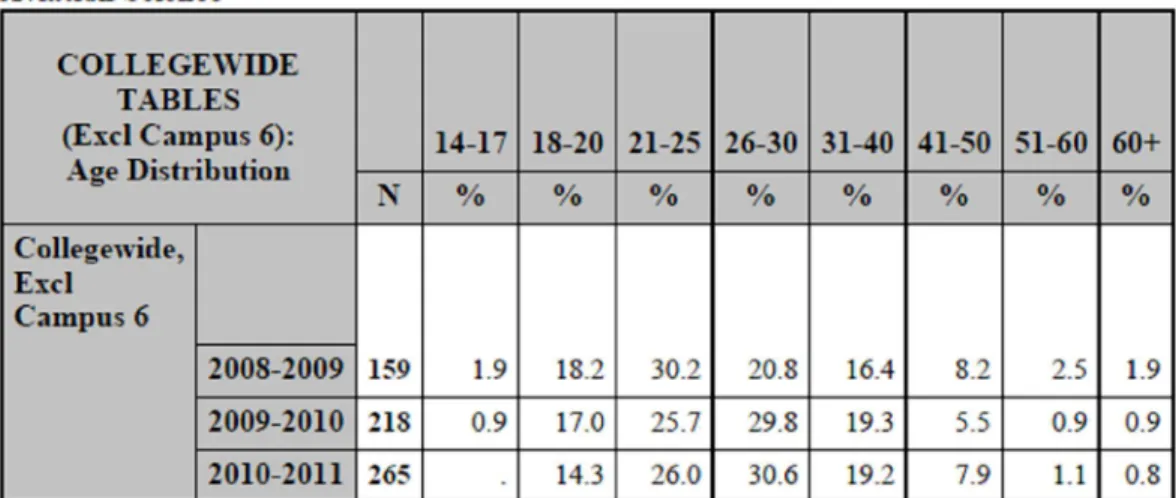
While the age of our students ranges from 17 to above 60, the majority of students are in their twenties. Although this does not mirror the pilot population, which has a fairly even spread of active pilots ranging in age from 20 to 60, it is more typical of a college setting.
Aviation Science Program Review March 2012 Page 13 Women constitute between 12 and 14 percent of our student group. This average is higher than that within the pilot population, where women make up approximately 6 percent of active pilots.
Table 3: Aviation Science students by gender
The Aviation Science program has seen students from a wide variety of minority ethnic and cultural backgrounds enter and succeed in the program.
Aviation Science Program Review March 2012 Page 14 B. Describe current and projected demand and enrollment pattern. Include discussion of any impact this will have on the program/discipline.
Demand for pilots, and thus enrollment in the Aviation Science program, is cyclical. Enrollment over the past several years has skyrocketed, primarily because of veteran students taking advantage of the benefits provided by the Post-9/11 GI Bill. Typically most classes offered every term will have a waitlist.
Table 5: Aviation Science enrollment
The department anticipates a steady flow of application from veteran students. Simultaneously, over the past several years students have had an increasingly difficult time finding private funding for their flight training. These two factors have caused the percentage of veteran students to increase significantly, to the point that the Aviation Science department anticipates needing to limit enrollment beginning in spring term 2012. A federal law limits degree programs from having more than 85% of enrolled students receiving Veterans Benefits, and the AVS program has decided to cap enrollment at 75% veterans. Recent data indicates that 28% of airplane degree students are receiving Veterans Benefits and 67% of helicopter degree students are receiving VA Benefits.
Within the industry, demand for both airplane and helicopter pilots looks extremely good over the next five years. Recent changes in legislation will force the retirement of thousands of airline pilots nationwide, providing opportunities for our airplane graduates. Many senior helicopter pilots currently working in the industry were trained in the Vietnam War era and are nearing retirement, providing opportunities for our helicopter graduates in a wide variety of settings. Our contracted flight training provider, Hillsboro Aviation, is already experiencing a shortage of airplane flight instructors as its instructors can so easily leave for another job.
C. What strategies are used within the program/discipline to facilitate access and diversity? We continue to welcome everyone into the Aviation Science program who is qualified to attend, based on academic prerequisites, medical certification, and ability to pay for flight training. Students may apply to enter the program during any term. Our flight training provider, Hillsboro Aviation, conducts
extensive international training outside the PCC program, which serves to provide PCC students with a diverse, culturally rich training environment.
Aviation Science Program Review March 2012 Page 15 D. Has feedback from students, community groups, transfer institutions, business, industry or government been used to make curriculum or instructional changes (not been addressed elsewhere in this document)? If so, describe.
Anecdotal feedback from students on a daily and class-by-class basis, as well as informal evaluation of student retention and learning by individual instructors, has led to timely revision of program curriculum. The department also works closely with industry partners, such as Hillsboro Aviation and Horizon Air, to incorporate advances in technology or changes in training.
The Aviation Science department recently made changes to the order of the helicopter commercial training to allow for advanced training opportunities and scenario-based training. In addition, the order of airplane flight instructor training was changed to allow for multi-engine training prior to single-engine training. Both of these changes were made after suggestions from industry partners and changes in Federal Aviation Administration policy.
Aviation Science Program Review March 2012 Page 16
Section 4: Faculty – composition, qualifications, development
A.i. Quantity and quality of the faculty needed to meet the needs of the program/discipline.The Aviation Science department employs two full-time faculty members, both of whom also serve as faculty department chair at Rock Creek or Southeast Center. In addition, three to four additional part-time faculty members also teach at least one section in every term. Most faculty are currently-licensed FAA certified flight instructors, and all have experience either as active flight instructors or within the aviation industry.
The quantity and quality of both full-time and part-time faculty adequately meets the needs for all the currently offered AVS sections. In recent years, enrollment increases and an increase in offered sections have periodically been covered by having full-time faculty teach overloads or also teach part-time during summer term.
There is overall an increased interest in the Aviation Science program, indicated by increased demand and waitlists for nearly every offered section. Discussions in the department are ongoing as to how additional sections may be offered to meet this increased interest. Although current enrollment levels would more than fill the teaching load of an additional full-time faculty member, the current number of part-time instructors coupled with the willingness of full-time faculty to periodically teach overloads provides the department much-needed flexibility to deal with changes in enrollment without having to increase staffing levels.
A.ii. Extent of faculty turnover and changes anticipated for the future.
No full-time faculty retirements are anticipated in the near future. Periodic part-time faculty turnover due to a variety of reasons is expected at the rate of about one part-time faculty member per academic year. Most part-time faculty remain with the department for an extended period of time, and only leave to pursue further employment within the aviation industry.
A need for back-up part-time instructors for the online ground schools has been identified, however, ensuring their availability has been difficult due to the long lead-time required by the Distance Learning department’s instructor training requirements. It takes one full term to train an instructor to qualify for online teaching, which is more notice than we can reasonably expect from our part-time instructors who may eventually have other opportunities. The Aviation Science program is currently actively recruiting and training for this purpose.
Aviation Science Program Review March 2012 Page 17 A.iii. Extent of the reliance upon adjunct faculty and how they compare with full-time faculty in terms of educational and experiential backgrounds.
Adjunct faculty within the Aviation Science program possess a wide range of educational and experiential backgrounds. Some adjuncts are relatively recently-certified flight instructors, while others have nearly a decade of instructing experience. Many adjuncts are currently working in industry, and for some their real-world experience exceeds that of some of the full-time faculty. Scheduling of classes in the department allows many adjuncts to maintain full-time employment in the aviation industry, allowing them to bring a fresh perspective to their teaching.
A.iv. How the faculty composition reflects the diversity and cultural competency goals of the institution.
Discovering and retaining qualified candidates of diverse culture or gender poses many challenges – the aviation industry is not as diverse as the population as a whole. Despite this, the number of aviation science faculty members in a given term is typically half female, overall higher than the percentage of female pilots. Finding faculty who reflect cultural diversity is an area in which the department could improve.
The student population within the Aviation Science reflects a higher-than-industry-average female enrollment and diversity. The retention of these students over the years reflects adequate cultural competencies on the part of Aviation Science faculty.
B. Report any changes the SAC has made to instructor qualifications and the reason for the changes.
The instructor qualifications underwent significant revisions in 2009, reflecting the need to clarify more finely the individual qualifications for teaching specific courses. Prior to the 2009 revision, instructor qualifications were broad and non-specific, and now each course has its own set of course-appropriate qualifications (see Appendix E).
Aviation Science Program Review March 2012 Page 18 C. How have professional development activities of the faculty contributed to the strength of the program? If such activities have resulted in instructional or curricular changes, please describe.
Aviation Science faculty remain strongly connected to the aviation industry through attending community events, engaging in periodic training and testing, and engaging in professional development opportunities. Examples of professional development activities since the last program review include:
· Biannual flight reviews and Certified Flight Instructor Refresher clinics · Aircraft Owners and Pilots Association (AOPA) Air Safety Institute seminars · Port of Portland Citizen Noise Advisory Committee
· Hillsboro Airport Issues Roundtable
· Federal Aviation Administration Safety Team (FAAST) meetings and seminars · Quality Matters initial and Peer Reviewer training (online course design) · Service-Learning Cohort
Much of the professional development has resulted in enhancing the curriculum in terms of exposure to current technology and industry trends, as well as awareness of issues that affect the aviation industry. Examples include:
· Incorporation of glass-cockpit attitude instrument flying and advanced navigation into the instrument ground school (AVS-130)
· Regulatory changes are incorporated yearly into AVS-237: Aviation Law and Regulations · Single-pilot cockpit resource management and scenario-based training, relatively new
special emphasis areas by the Federal Aviation Administration, are in the process of being incorporated into all flight courses and most associated ground schools
· Incorporation of learning into sections or courses which previously had no service-learning component (AVS-127, AVS-237)
Aviation Science Program Review March 2012 Page 19
Section 5: Facilities and support
A. Describe how classroom space, computers/technology and library/media, laboratory space and equipment impact student success.
The Aviation Science program has a relatively small facilities footprint at PCC, as most of the cost of providing flight training and maintaining aircraft is borne by our contracted flight training provider, Hillsboro Aviation. Current “smart” podiums and classroom space at both Rock Creek and Southeast Center adequately meet the needs of the aviation science program at this time.
The Aviation Science department currently owns two computer-based aviation training devices (ATDs), one at the Rock Creek campus and one at the Troutdale airport, similar to the one below.
ELITE PI-121 Basic ATD
These ATDs are extremely useful for students to practice maneuvers and procedures prior to going on an actual flight. They are limited, however, in that currently only airplane flight controls are installed on the ATDs. It would be helpful for our helicopter students if the department had a set of helicopter flight controls for each ATD, in order to more fully prepare for their flights.
In addition to the ATDs, students can also utilize the department’s yoke and pedals along with Microsoft Flight Simulator X, similar to the one below.
Aviation Science Program Review March 2012 Page 20 Twelve sets of this setup are split evenly between the Rock Creek campus and the Troutdale airport, and while these are also extremely useful to students in preparing for upcoming flights, they are limited by the lack of helicopter flight controls. Additional sets of helicopter flight controls would allow helicopter students to utilize these tools as well, and become better prepared for their flights.
B. Describe how students are using the library or other outside-the-classroom information resources.
Library facilities are not utilized heavily by AVS students except as study space. Many of the books and reference materials students acquire during their degree are used frequently during their entire flight training, and going to the library to check out a copy is not as useful as having their own copy to mark up and have on-hand at the airport for reference. In addition, some materials are required for in-flight use, and having them on-file at the library would be pointless. Students do report using the library frequently for studying or accessing the internet, and as meeting space to observe or participate in online meetings.
C. Provide information on clerical, technical, administrative and/or tutoring support.
The Aviation Science program has a Learning Skills Specialist at both Rock Creek and Southeast Center who provides tutoring for students needing additional instruction in general subjects such as math and writing. Support in academic advising, registration, searching for financial support, and the location of other student services is also provided by each Learning Skills Specialist.
The program also utilizes an Administrative Assistant at Rock Creek extensively in the
administration of the flight courses and compliance with VA requirements. This resource has resulted in a ground-breaking utilization of PCC’s “Spaces” tool for the student application process and student tracking.
D. Provide information on how Advising, the Office for Students with Disabilities and other student services impact students.
Our student population interacts with a wide variety of student services in any given term. Departmental faculty provide most advising on aviation-specific classes, while the Academic Advising office and our Learning Skills Specialists provide advising on general education and electives. Particularly since the program became closed-entry in fall 2011, the Aviation Science department has experienced challenges with various advisors giving overrides to students who are not formally admitted to the program. Continued communication with the advising offices on each campus has helped lessen this problem.
Aviation Science Program Review March 2012 Page 21 Given the high cost of the aviation program ($60,000-$70,000 for tuition and flight fees), and our high percentage of veteran students, the Financial Aid office and Veterans Services provide essential services to a majority of our students in terms of finding funding for their flight training. PCC’s Aviation Science program is approved through the Department of Veterans Affairs, including the cost of tuition, fees, and flight training.
E. Describe current patterns of scheduling (such as class size, duration, times, location, or other) address the pedagogy of the program/discipline and the needs of students.
All flight and ground classes are offered every term, as students are at a variety of points in their flight training year-round. The ground classes are all offered online, and enrollment is combined for the purposes of teaching load to allow the department to run classes with low enrollment. Current
enrollment levels in the online ground schools have reached a maximum as far as instructor workload – enrollment of 25-30 students would not typically be considered unusually high, but when distributed among 3 or 4 online classes, the volume of work for each online ground school instructor is increased significantly. Although the degree is intended to be completed in six or seven terms (depending on the option selected), motivated full-time students can potentially complete their flight training and academic coursework sooner.
The aviation academic classes are offered on a rolling basis on each campus, so a student could take all the required AVS classes exclusively at either Rock Creek or Southeast Center. Generally, classes at Rock Creek are scheduled for 3 p.m. or later, while classes at Southeast Center are scheduled before 2 p.m.
Prior to 2012, no aviation academic classes had been taught during summer term, due to full-time faculty schedules and the availability of good weather to complete flight training. Due to increasing enrollment, AVS-127: Intro to Aviation will be offered during summer term 2012, and based on its enrollment, the department may consider offering sections of other classes in the summer.
All the ground schools and the 200-level aviation academic classes are offered exclusively online. The main motivation for offering these classes online was the need to consolidate enrollment from Rock Creek and Southeast Center. Since their move online, students have expressed desire for the classes to be offered in the classroom. The department is currently exploring hybrid options that, while still preserving some of the online elements that contribute to teaching and learning efficiencies, re-introduce some of the face-to-face time that students repeatedly express an interest in.
Aviation Science Program Review March 2012 Page 22
Section 6: CTE programs – changing employer needs
A. Evaluate the impact of the Advisory Committee on curriculum and instructional content methods, and/or outcomes.
The advisory committee typically meets twice per year, and informal input is solicited on a regular basis from other industry partners. Although the advisory committee is not concerned with the minutiae of curriculum, they have provided valuable suggestions about desired course outcomes or content that have been incorporated into the aviation science program as appropriate. The advisory committee provides input on curriculum emphasis area, instructional methods, equipment and training resources, and internship or career opportunities for faculty and students.
Over the years, the advisory committee has provided input on curriculum changes regarding two-pilot crew operations, advanced training opportunities, and turbine aircraft transitions. Attendance at recent advisory committee meetings has been somewhat lacking from our industry partners, and future efforts should be made to more actively solicit participation from committee members.
B. Degree and Certificate Outcomes
B.i. List your degree and certificate student learning outcomes, and identify the strategies that are in place to assess them
Degree outcomes for both the airplane and helicopter AAS degrees are listed in Appendix B. The Aviation Science department does not currently have any certificates.
Strategies in place to assess these outcomes include both quantitative and qualitative methods. First, each degree outcome is mapped to specific AVS courses which the department feels best prepare students to meet the outcome (see Appendix C). Next, specific projects or exams within each course are selected that would allow the department to assess whether students are meeting each degree
outcome. Individual student work samples are gathered and assessed, and final data and
recommendations for improvement are distributed to all department faculty. The process is repeated on a rolling basis so that all degree outcomes are assessed on a two-year cycle.
B.ii. Summarize the results of the assessments of these outcomes.
The Aviation Science department completed its first full academic year of assessment in 2010-’11, and submitted an Annual Report for Assessment of Outcomes in June 2011 (see Appendix F).
Professional Competence and Critical Thinking & Problem Solving were the focus of this report.
Assessment for the 2011-’12 academic year is still in progress, with assessment of the remaining core outcomes to be reported in June 2012.
Aviation Science Program Review March 2012 Page 23 In the June 2011 report, the department reported several successes and failures regarding assessment, although the failures were more in the nature of the assessments to report useful data, rather than students failing to achieve outcomes.
Assessing professional competence in the flight classes was a relatively straightforward task, and data gathered from the assessment indicated that more support and encouragement should be
provided to students attempting initial stage checks or FAA checkrides. Such support has been incorporated into the flight training and flight labs.
Students should also gain professional competence by taking and passing the 100-level aviation academic classes of a more technical nature (AVS-137: Applied Aerodynamics, AVS-157: Aircraft Systems
– Airframe, and AVS-167: Aircraft Systems – Powerplant). Initially the department intended to evaluate
student success by comparing scores from the midterm and final exams; however, after gathering data and exams, the department realized that usable data could not be gleaned solely from existing exam scores. Due to the range of subjects covered in these classes, and the difference in subject matter between the midterm and final exams, simply achieving a better score on the entire exam does not necessarily mean the student knows all the information better. The department is continuing to investigate better methods to examine these classes for examples of students meeting the outcome of professional competence.
Critical thinking & problem solving was assessed in one of the 200-level aviation academic
classes, AVS-237: Aviation Law & Regulations. The department found that students were doing well in critically examining a case study for “lessons learned,” but overall they showed less competence in interpreting complex regulations. Further opportunities to practice the latter have been incorporated into the spring 2012 section of AVS-237.
B.iii. Identify and give examples of assessment-driven changes that have been made to improve students’ attainment of degree and certificate outcomes.
Additional online aerodynamics resources: In response to student and faculty feedback, and
examination of exam answers in AVS-137: Applied Aerodynamics over several terms, the department incorporated multiple online Java-based simulators from the NASA web site into the curriculum. These online simulators provide students with opportunities to apply aerodynamic theories in real-world situations, and help them better attain the degree outcomes pertaining to researching aircraft capabilities, communication, and performance of flight calculations. These degree outcomes map directly to the core outcomes of critical thinking & problem-solving and professional competence
Creation of flight labs: Data gathered on the completion rate of flight classes indicated that
students were not completing their flight training at a rate the department was happy with. In response to this data, the department created weekly flight labs that students are required to attend. The labs serve several purposes, including encouraging weekly dedicated time toward preparing for flight lessons, and offering an opportunity for the department to remain aware of each student’s flight progress. Since the implementation of the flight labs, completion rates for the flight classes are much
Aviation Science Program Review March 2012 Page 24 higher. The flight labs help students better attain the degree outcomes pertaining to exercising the privileges of their FAA pilot and instructor certificates, which map directly to the core outcome of
professional competence.
Incorporation of weekly online meetings in online ground schools: Student and faculty feedback
indicated that when the ground schools initially went online, students did not feel they were provided with enough opportunities for feedback and instructor interaction. Pass rates for all the ground schools fell initially. The department implemented weekly online meetings using synchronous meeting software (Elluminate and Collaborate) that provided time for a brief lecture or question-and-answer session live with the instructor. After incorporating the weekly online meetings, pass rates for the ground schools increased. These meetings were later incorporated into the 200-level aviation academic classes as well, due to their success in the online ground schools in helping students succeed. The weekly online meetings help students better attain the degree outcomes pertaining to researching, interpreting, and evaluating each flight to ensure its safe outcome, which maps directly to the core outcome of
professional competence.
C. Review job placement data for students over the last five years, including salary information where available. Forecast future employment opportunities for students.
Students completing the Aviation Science degree program are prepared to enter an industry with both local and global career opportunities. Initially, graduates typically work as flight instructors for a year or two, and then move on to employment as regional airline pilots or light helicopter pilots. Graduates of the AVS program have, in the past five years, gone to work for the following companies, among others:
· Horizon Air · SkyWest Airlines · Aero Air
· Ameriflight air cargo services
· Several corporate flight departments · ExpressJet
· LAN
· Petroleum Helicopters Inc. · ERA
· TEMSCO
· Sundance Helicopters · Papillion Helicopters · Columbia Helicopters
The initial salary for a regional airline pilot averages around $25,000/year, quickly increasing to the low to mid-$30,000 range in several years. The initial salary for a light helicopter pilot averages around $50,000/year. Future employment opportunities for students are forecast to be good, particularly in the
Aviation Science Program Review March 2012 Page 25 airline and light helicopter industries, in which thousands of pilots are expected to retire within the next five years.
Additionally, the 2010-’11 edition of the Occupational Outlook Handbook reported the following overall job outlook for pilots:
Aircraft pilots and flight engineers are expected to grow about as fast as the average for all occupations. Regional airlines and low-cost carriers will present the best opportunities; pilots attempting to get jobs at the major airlines will face strong competition.
Employment change: Employment of aircraft pilots and flight engineers is projected to grow 12
percent from 2008 to 2018, which is about as fast as the average for all occupations. Population growth and an expanding economy in the long run are expected to boost the demand for air travel, contributing to job growth. New jobs will be created as airlines expand their capacity to meet this rising demand by increasing the number of planes in operation and the number of flights offered.
Job prospects: Job opportunities are expected to be best for experienced pilots with the
regional airlines and low-cost carriers, which are expected to grow faster than the major airlines. Opportunities with air cargo carriers also should arise because of increasing security
requirements for shipping freight on passenger airlines, growth in electronic commerce, and increased demand for global freight. Business, commuter, corporate, and on-demand air taxi travel also should provide some new jobs for pilots.
Pilots attempting to get jobs at the major airlines will face strong competition, as those firms tend to attract many more applicants than the number of job openings. Applicants also will have to compete with laid-off pilots for any available jobs. Pilots who have logged the greatest number of flying hours using sophisticated equipment typically have the best prospects. For this reason, military pilots often have an advantage over other applicants.
In addition to job openings arising from employment growth, opportunities will result from the need to replace workers transferring to other occupations or leaving the labor force. Additional openings will result from the mandatory retirement of commercial airline pilots at age 65. Employment of pilots is sensitive to cyclical swings in the economy. During recessions, when a decline in the demand for air travel forces airlines to ground planes and curtail the number of flights, airlines may temporarily furlough some pilots.
(U.S. Dept. of Labor, Bureau of Labor Statistics, http://www.bls.gov/oco/ocos107.htm )
D. Analyze any barriers to degree or certificate completion that your students face, and consider the reason that students may leave before completion.
The Aviation Science department has identified several barriers to degree completion faced by our students. Lack of funding and employment or further educational opportunities are the primary reasons students do not complete the AAS degree.
Aviation Science Program Review March 2012 Page 26
Lack of funding: Flying is expensive – the total cost for tuition and flight fees for PCC’s two-year
degree ranges from $60,000 to $70,000 or more. If a student runs out of money halfway through their training, that may de-rail their degree plans for a single term, several years, or forever. By requiring students to have full funding for a flight class prior to registration, the department has tried to address this issue on a smaller scale, and students are for the most part able to finish each individual flight class they register for. Helping students find alternate forms of funding, such as external scholarships or loans, has also helped address this issue, but the decline in the overall economy in the past several years has made getting loans for large amounts difficult for all students.
Employment or further educational opportunities: Students are often employable as a flight
instructor before they finish their degree requirements. Particularly in the helicopter industry, where even a two-year degree is rarely required, students may have little incentive to finish their degree requirements. In addition, many students who desire a four-year degree transfer early to Embry-Riddle Aeronautical University, which accepts many of the Aviation Science courses toward their Bachelor’s degree in Professional Aeronautics. Particularly for students who wish to work in the aviation industry in a non-flying capacity (such as airport operations or management), they have no incentive to remain at PCC to finish the two-year degree before transferring to Embry-Riddle.
E. Describe and explain any additional changes (not already addressed above) that have been made to the program since the last program review.
Aviation Science Program Review March 2012 Page 27
Section 7: Recommendations
A. Identify recommendations related to teaching and learning based on assessment of student learning outcomes (course, degree, certificate and/or College Core Outcomes)
Open-entry/exit registration: Students currently must register for classes term-by-term,
regardless of where they are in their flight training. This creates awkward overlaps or gaps in training, putting students at a disadvantage and impeding the ability to attain degree outcomes. A student who, for example, anticipates completing one stage of their flight training halfway through spring term is faced with two choices: register for the next phase of training during spring term, and study advanced material for which they may not be prepared in the first half of the term; or put off registering for the next phase of training until summer, and effectively stop training for the second half of spring term. Our program could much better meet our students’ needs if it was designed in the open-entry/open-exit format, similar to welding. Significant challenges would be posed in a transition to an open-entry/open-exit format, as departments ranging from Financial Aid and Veterans Affairs to Student Records would all need to be in alignment. The department would appreciate additional consultation and assistance from the administration in investigating a transition to this format.
Re-design of online ground schools: All the online ground schools should undergo a complete
course re-design, both to incorporate recent changes in curricula and to come in line with accessibility and Quality Matters course design standards. Curriculum development funds or release time will be necessary to complete these extensive course re-designs. Redesigning the online ground schools will allow students to more thoroughly learn course material and better prepare for corresponding flight lessons, allowing them to better attain degree outcomes related to professional competence.
B. Identify recommendations relevant to areas such as maintaining a current curriculum, professional development, access and success for students, obtaining needed resources, and being responsive to community needs. (For recommendations that require additional funding , please identify those that are of greatest importance to the SAC)
Curriculum: The department has a pressing need for the ability to respond more quickly to
industry-driven changes in curriculum. At present, due to catalog publication dates and requirements of the Curriculum Office, curricular changes which have become necessary due to regulatory or industry changes can take a year to a year-and-a-half to implement in the Aviation Science classes. This delay in the ability to respond to changes puts our students at a disadvantage, as they may graduate not having acquired skills that are expected in the aviation industry. The department would appreciate additional consultation and assistance from the administration in investigating a solution to this problem.
Aviation Science Program Review March 2012 Page 28
Access and success for students: The department currently does not have a good system set up
to track and remain in touch with graduates and/or transfer students. Knowledge of these students’ career paths would be useful both for networking purposes and in gauging future improvements to the program. The department is looking into setting up some sort of database or tracking system.
Obtaining needed resources: The department currently utilizes a time-consuming manual
process of entering updates to FAA practice knowledge tests used in all of the online ground schools. There are currently outside companies (such as ASA) that maintain their own knowledge test banks, and those companies are able to respond more immediately and efficiently to changes issued by the FAA. It would be beneficial for Aviation Science students to be able to utilize these external resources; however, outsourcing the FAA practice knowledge tests would require funding for a site license.
As mentioned in Section 5A, the department feels it would be beneficial to our students to acquire up to 14 sets of helicopter flight controls to accompany existing computer flight simulators already owned by the department.
Being responsive to community needs: Since the past program review, increasing faculty
teaching, administrative and advising loads have left little time to foster relationships with industry partners. Attendance at advisory committee meetings has declined. The department would like to make a concerted effort in the coming year to re-establish and re-energize the Aviation Science Advisory Committee, perhaps bringing in new members and establishing a regular meeting schedule. This effort will assist in renewing the program’s connection with the local aviation industry.
Recommendations (requiring funding) of greatest importance to the SAC: 1. Compensation for re-design of online ground schools
2. Site license for outsourced FAA practice knowledge tests
Aviation Science Program Review March 2012 Page 29
Appendix A: PCC core outcomes
http://www.pcc.edu/resources/academic/core-outcomes/
Graduates of Portland Community College should be able to:
Communication Communicate effectively by determining the
purpose, audience and context of communication, and respond to feedback to improve clarity, coherence and effectiveness in workplace, community and academic pursuits.
Community and Environmental Responsibility Apply scientific, cultural and political perspectives to natural and social systems and use an
understanding of social change and social action to address the consequences of local and global human activity.
Critical Thinking and Problem Solving Identify and investigate problems, evaluate information and its sources, and use appropriate methods of reasoning to develop creative and practical solutions to personal, professional and community issues.
Cultural Awareness Use an understanding of the variations in human culture, perspectives and forms of expression to constructively address issues that arise out of cultural differences in the workplace and community.
Professional Competence Demonstrate and apply the knowledge, skills and attitudes necessary to enter and succeed in a defined profession or advanced academic program
Self-Reflection Assess, examine and reflect on one’s own
academic skill, professional competence and personal beliefs and how these impact others.
Aviation Science Program Review March 2012 Page 30
Appendix B: Aviation Science degree outcomes
http://www.pcc.edu/resources/academic/degree-outcome/avs.html (effective 2012)
AAS: Aviation Science - Airplane
· Exercise the privileges of the FAA certificates appropriate to the pilot career that they seek:
o Commercial pilot certificate with airplane single- and multi-engine land and instrument airplane ratings
o Flight Instructor certificate with airplane single- and multi-engine land and instrument airplane ratings
· Use knowledge and understanding of pilot industry trends, positions and operations gained in the Aviation Science program to: Implement a career plan; make informed career decisions; pursue the position of their choice in the aviation industry; and identify additional opportunities for advancement including advanced degrees and training to remain competitive in the pilot industry
· Research, interpret and evaluate the following prior to each flight such that the safe, efficient and legal outcome of a flight is never in doubt:
o Pilot self-assessment of fitness, proficiency and ability.
o Aircraft airworthiness and capabilities.
o Environmental conditions.
o Other operational considerations.
· Communicate clearly and concisely, both verbally and in writing, with fellow pilots, employers and the aviation community.
· Accurately performs calculations as required for flight operations and company records. · Operates aircraft consistent with an understanding of its impact on the environment, the
community and the economic success of the company that employs them.
· Show respect for all individuals regardless of race, religion, cultural background, economic background or other differences.
Aviation Science Program Review March 2012 Page 31 AAS: Aviation Science - Helicopter
· Exercise the privileges of the FAA certificates appropriate to the pilot career that they seek:
o Commercial Pilot Certificate with Rotorcraft Helicopter and optional Instrument Helicopter rating
o Flight Instructor Rating with Rotorcraft Helicopter rating.
· Use knowledge and understanding of pilot industry trends, positions and operations gained in the Aviation Science program to: Implement a career plan; make informed career decisions; pursue the position of their choice in the aviation industry; and identify additional opportunities for advancement including advanced degrees and training to remain competitive in the pilot industry.
· Research, interpret and evaluate the following prior to each flight such that the safe, efficient and legal outcome of a flight is never in doubt:
o Pilot self-assessment of fitness, proficiency and ability.
o Aircraft airworthiness and capabilities.
o Environmental conditions.
o Other operational considerations.
· Communicate clearly and concisely, both verbally and in writing, with fellow pilots, employers and the aviation community.
· Accurately performs calculations as required for flight operations and company records. · Operates aircraft consistent with an understanding of its impact on the environment, the
community and the economic success of the company that employs them.
· Show respect for all individuals regardless of race, religion, cultural background, economic background or other differences.
Aviation Science Program Review March 2012 Page 32
Appendix C: Core outcomes demonstrated in AVS courses
http://www.pcc.edu/resources/academic/degree-outcome/documents/CTEAVSAssessmentPLAN2010-2012v2.pdf (Note: Degree outcomes below were current in 2010 when original report was submitted)
1. Outcome (* Perkins recipient – TSA) 2. Maps to a Core Outcome? 3. Assessment Setting/Method Earn FAA certificates and ratings appropriate
to the pilot career they seek. For Airplane degree:
1. Commercial Pilot certificate with airplane single- and multi-engine and instrument airplane ratings.
2. Flight Instructor certificate with airplane single- and multi-engine and instrument airplane ratings (If Flight Instructor specialization is chosen).
For Helicopter degree:
1. Commercial Pilot Certificate with
Rotorcraft Helicopter and optional Instrument Helicopter rating.
2. Flight Instructor Rating with Rotorcraft Helicopter rating.
Professional Competence All students are required to take an FAA Airman Knowledge Test and Airman Practical test to receive certification as a pilot. The FAA sets areas of assessment and standards for passing each exam.
Students will provide their passing rate for each knowledge and practical test upon completion of a flight class that results in an FAA license, rating or certificate.
Communication Assessed in AVS-127, AVS-227 by evaluating presentation of final projects.
Community & Environmental Responsibility
Assessed in AVS-127, AVS-267 by examining final projects.
Critical Thinking & Problem Solving
Assessed in AVS-237, AVS-267 by examining final projects.
Cultural Awareness Assessed in AVS-127, AVS-267 by examining final projects.
Professional Competence Assessed in 137, 157, AVS-167 by examining raw scores from midterm & final exams.
Gain additional knowledge and skills related to the aviation industry and acting as a
professional pilot that are above and beyond the FAA certification requirements and will allow them to be safer, more effective pilots and be competitive in the pilot job market.
Self-Reflection Assessed in AVS-127, AVS-227 by examining final projects.
Explore areas in math, writing, general education and approved elective course work that will allow them to function more effectively as an aviation employee and/or continue their education towards advanced degrees.
Communication
Community & Environmental Responsibility
Critical Thinking & Problem Solving
Cultural Awareness Self-Reflection
Not sure yet where or how to assess core outcomes in classes from other departments.
Aviation Science Program Review March 2012 Page 33
Appendix D: Core outcomes mapping (updated)
http://www.pcc.edu/resources/academic/core-outcomes/avs.html
Mapping Level Indicators: 0. Not applicable
1. Limited demonstration or application of knowledge and skills
2. Basic demonstration and application of knowledge and skills
3. Demonstrated comprehension and is able to apply essential knowledge and skills
4. Demonstrates thorough, effective and/or sophisticated application of knowledge and skills
Core Outcomes:
1. Communication 2. Community and
Environmental Responsibility 3. Critical Thinking & Problem
Solving
4. Cultural Awareness 5. Professional Competence 6. Self-Reflection
Course # Course Name CO1 CO2 CO3 CO4 CO5 CO6
AVS 107 Flight Lab Level 1 3 3 4 0 4 4
AVS 110 Helicopter Private Ground 2 2 4 1 4 4
AVS 111 Helicopter: Pre-Solo 3 3 4 0 4 4
AVS 112 Helicopter: Priv Cross-Country 3 3 4 0 4 4
AVS 113 Helicopter: Priv Proficiency 3 3 4 0 4 4
AVS 115 Helicopter Private Flight 3 3 4 0 4 4
AVS 120 Airplane:Private Pilot Ground 2 2 4 1 4 4
AVS 121 Airplane: Pre-Solo Flight 3 3 4 0 4 4
AVS 122 Airplane: Pre-Cross-Cntry Flt 3 3 4 0 4 4
AVS 123 Airplane: Cross-Cntry/Test Prp 3 3 4 0 4 4
AVS 125 Airplane: Private Pilot Flight 3 3 4 0 4 4
AVS 127 Introduction to Aviation 3 4 4 2 3 4
AVS 130 Instrument Ground School 2 2 4 1 4 4
AVS 131 Airplane: Instr Attitude/Nav 3 3 4 0 4 4
AVS 132 Airplane: Instrument Approach 3 3 4 0 4 4
AVS 133 Airplane: Instrument XC 3 3 4 0 4 4
AVS 135 Airplane: Instrument Flight 2 2 4 1 4 4
AVS 137 Applied Aerodynamics 1 1 3 0 3 3
AVS 140 Airplane: Comm Pilot Ground 2 2 4 1 4 4
AVS 141 Airplane: Comm XC/Night Intro 3 3 4 0 4 4
AVS 142 Airplane: Comm XC Exploration 3 3 4 0 4 4
AVS 143 Airplane: Comm Precision XC 3 3 4 0 4 4
AVS 145 Introduction to Comm Airplane 3 3 4 0 4 4
AVS 157 Helicopter: Commercial Ground 1 2 4 1 3 3
Aviation Science Program Review March 2012 Page 34
AVS 150 Helicopter: Commercial Basics 2 2 4 1 4 4
AVS 151 Helicopter: Comm Basc Practice 3 3 4 0 4 4
AVS 152 Helicopter: Intro Comm Flight 3 3 4 0 4 4
AVS 153 Aircraft Systems: Airframe 3 3 4 0 4 4
AVS 155 Aircraft Systems: Powerplant 3 3 4 0 4 4
AVS 205 Helicopter:Commercial Flight A 3 3 4 0 4 4
AVS 207 Flight Lab Level 2 3 3 4 0 4 4
AVS 211 Helicopter: Instrument Intro 3 3 4 0 4 4
AVS 212 Helicopter: Instr Procedures 3 3 4 0 4 4
AVS 213 Helicopter: Adv Commercial 3 3 4 0 4 4
AVS 214 Helicopter: Comm Test Prep 3 3 4 0 4 4
AVS 215 Helicopter:Commercial Flight B 3 3 4 0 4 4
AVS 221 Airplane: Complex Airplanes 3 3 4 0 4 4
AVS 222 Airplane: Commercial Maneuvers 3 3 4 0 4 4
AVS 223 Airplane: Comml Proficiency 3 3 4 0 4 4
AVS 224 Airplane: Multi-Engine 3 3 4 0 4 4
AVS 225 Airplane: Commercial Flight 3 3 4 0 4 4
AVS 227 Aviation Careers 4 2 4 1 4 4
AVS 230 Airplane:Flight Instructor Grd 4 2 4 1 4 4
AVS 231 Airplane: CFI Intro 3 3 4 0 4 4
AVS 232 Airplane: CFI Test Prep 3 3 4 0 4 4
AVS 235 Airplane: Flight Instruct Flt 4 3 4 0 4 4
AVS 237 Aviation Law & Regulations 3 3 4 0 4 2
AVS 240 Airplane: CFII/MEI Ground 4 2 4 1 4 4
AVS 241 Airplane: CFII Ground/Flight 3 3 4 0 4 4
AVS 242 Airplane: MEI Ground/Flight 3 3 4 0 4 4
AVS 245 Airplane: CFII/MEI Flight 4 3 4 0 4 4
AVS 255 Airplane: Pilot Performance 4 3 4 0 4 4
AVS 260 Helicopter: CFI Ground 4 2 4 1 4 4
AVS 261 Helicopter: Intro to CFI 3 3 4 0 4 4
AVS 262 Helicopter: CFI Development 3 3 4 0 4 4
AVS 263 Helicopter: CFI Test Prep 3 3 4 0 4 4
AVS 265 Helicopter: CFI Flight 4 3 4 0 4 4
AVS 267 Economics of Flight Operations 4 4 3 2 4 3
AVS 275 Airplane: Professional Pilot 4 3 4 0 4 4