MULTIOBJECTIVE NONLINEAR SHAPE OPTIMIZATION OF STENT BASED
ON EVOLUTION PRINCIPLES
William Annicchiarico
Instituto de Materiales y Modelos Estructurales Facultad de Ingeniería. Universidad Central de
Venezuela Caracas, Venezuela.
George S. Dulikravich
Department of Mechanical and Materials Engineering
Florida International University Miami, Florida, U.S.A.
ABSTRACT
The treatment of atherosclerotic stenoses is accomplished by a well-established interventional method called Percutaneous Transluminal Angioplasty (PTA). Generally, this procedure is accompanied with the deployment of small tube shape structure to support the wall of the injured artery and improve the limitations of balloon angioplasty, such as restenosis and abrupt closure. Numerous computational studies have been carried out to investigate the expansion and mechanical behavior of different stent designs. They have limited their analysis to study and compare different commercial and theoretical stent designs using some medical and mechanical criteria, in conjunction with parameters obtained from laboratory test. However, none of them have treated its design as a multi-objective optimization task with different optimization criteria. In this sense, the objective of this work is to present and discuss an evolutionary multi-objective optimization algorithm based on evolution principles and Pareto’s dominance criteria to select, generate and evaluate compromise solutions that generation after generation lead to the optimum (or quasi-optimum) external shape of this kind of prosthesis. The main advantage of this approach is that all the different design criteria can be included in one single run.
NOMENCLATURE
C: strain energy of the structure.
Dload: stent’s diameter at the final deployment load.
Dunload: stent’s diameter after balloon deflation (unload).
F: set of n>1 objective functions.
Ki: stiffness matrix of the finite element i of the model of the structure.
L: initial stent’s length.
Lload: stent’s longitudinal length at the final deployment load.
Lunload: stent’s longitudinal length after balloon deflation (unload).
P: loading vector of the structure. X: Vector of p designs variables.
f(X): objective function.
g(X): equality constraint function. h(X): inequality constraint function. l: Number of inequality constraints. m: number of equality constraints. n: number of objective functions. p: number of designs variables.
u: displacement nodal vector of the structure.
ui: displecement vector of the finite element i of the model of the structure.
von e
σ
: Von-Mises stress of finite element e.von max
σ
: maximum Von-Mises stress of thestructure.
INTRODUCTION
Cardiovascular diseases and mainly atherosclerotic stenoses are of the greater causes of mortality in the western countries (e.g. 38% of all deaths in America last year). In this kind of diseases, arteries get blocked by accumulation of cholesterol plaques over the vessel walls, narrowing its caliber and diminishing the amount of blood flood to the irrigated tissues, causing pain and sometimes patient dead. The treatment of atherosclerotic stenoses is accomplished by a well-established interventional method called Percutaneous Transluminal Angioplasty (PTA). It
represents a mechanical solution for a clinical problem and is the most frequent therapeutical intervention world wide [1]. The study, improvement and development of PTA has deserved a great and steadily growing medical and and scientific interest [2] due to its socio-economical impact in the solution of this disease. In this procedure, a balloon is inflated in the blocked zone of the artery to reopen it and restore blood flow perfusion to the downstream tissues.
The development and use of this technique was an effective solution to this disease by several years, however in most cases, the only dilatation of the arterial walls did not lead to rehabilitation of the vessel for a long time. The idea of intravascular stent was inicially intdroduced by Dotter [3] in 1969 to deal with the arterial narrowing, and it was not until beginning of 1990 years when these intravascular prosthesis were used to solve the limitations of PTA [4]. The stents are small tube-like structure (stent, see fig. 1) design to support the wall of the injured artery, reopen arterial lumen to allow blood flow, correct any deformation (curvature) of the arterial wall and resist the forces exerted by arterial compression [5].
Different types of stents can be found in the market. In terms of the manufacture process, they are classified in slotted tubular stents and coil stents. The firsts are obtained by cutting slots in small stainless steel tubes with lasser devices and the second are manufactured by weaving tiny steel rods. Based on the technique used to their deployment, they are classified in expanded by ballon (plastic deformation) or selfexpanding (elastic or superelastic deformation). Most of them are made of stainless steel (316L) or shape memory alloys (Nitinol), among others materials.
Fig. 1. Detail of an intravascular stent. The develepment of this methodology has extended its use not only to treatment of coronary diseases, it has been successfully applied to reopen and dealing with urinary diseases and other major arteries such as iliac, renal, etc, [6]
The technical literature on this subject is extensive with numerous works related with the evaluation of mechanical properties of this device by means of finite elements methods, among the most relevants can be mention: Dumoulin and Cochelin [7] characterized and evaluated some mechanial properties of ballon expandible stents (P308 Palmaz stent) using linear and non-linear fatigue, collapse and post-buckling analysis. Etave est al. [8] compare the most representative types of stents ( slotted-tubular and coil stents) with regard their mechanical characteristics and give some parameters for their design. Migliavacca et al. [9] present a similar approach, but only dealing with slotted- tubular stent. In addition to study some mechanical properties of this kind of endoprosthesis, They give some recommendations to minimize the dogbonning effect caused by unequal expansion of the stent. In Gracia et al. [10] is simulated by finite elements the mechnical behaviour of stainless steel stents by considering global flexibility and critical buckling pressure. Other authors, Prendergast et al. [11] and Lally et al. [12], beside studying the mechanical properties of these devices, have also taking into account the interaction between the stent and the artery walls in order to analyse how its design generates reestenosis mechanism, which is the cause of the posteriori vessel obstruction. For instance, in [11] is presented the study of the interaction of different commercial stents and their interaction with the arterial tisue, reporting prolapse of the tissue and the arterial wall stresses. On the other hand, in [12] two commercial stents are compared in terms of the level of the stresses produced in the vascular tissue of the artery, which is directly related with the rate of restenosis observed in clinical studies. Recently, New drug-eluting stents have been developed to reduce the restenosis of the stent with promissing future. However, It is widely accepted that a better development in the design of these devices, including the recent drug coating stent, is required to solve or reduce in an optimum way the reestenosis problem presented in the balloon angioplasty with stent [13].
Much of the above researches have tested and proposed stent designs concerned with some of the following issues (a) sufficient rigidity to resist the compressive forces exerted by the vessel wall, (b) sufficient flexibility to navigate tortuous vessels, (c) scaffolding properties: stents must be able to hold open the vessel and scaffold the stenotic material plaque against the vessel wall,
(d) minimal longitudinal contraction when expanded, (e) minimal shearing between the stent and tissue during expansion because this denudes the vessel of its endothelial cell lining. Those research papers have limited their analysis to the study and comparison of different commercial and theoretical stent designs using some of the above criteria in conjunction with parameters obtained from laboratory test. However, none of them have treated the stent’s shape design as multi-objective optimization task with different optimization criteria.
In this sense, the objective of this work is to present and discuss a multi-objective evolutionary optimization methodology that in an comprehensive way takes all of the different design criteria in order to obtain an optimized external shape of this kind of prosthesis.
A specialized evolutionary multi-objective algorithm based on structural evolution principles [14] and Pareto’s dominance methodology [15, 16, 17] are used to select, generate and evaluate compromise solutions that generation after generation lead to the quasi-optimum or optimum solution of the optimization problem under the different criteria selected in their design.
This paper is structured as follows: the optimization problem; the structural evolutionary principles used to deal with the problem of generate comprise designs, after that, a numerical example is presented and discussed to show the versatility and the external shapes found by the multi-objective optimization approach; and finally the conclusions and future research.
STRUCTURAL EVOLUTIONARY MULTIOBJECTIVE OPTIMIZATION
The optimization problem consists in optimize at the same time a set of function objectives constrained by a set of equality and inequality functions. The formulation of this problem is stated by:
( )
( )
( )
( )
1 n j kMinimize F
X , ,
X
g X 0 j 1, ,m
subjected to
h X 0 k 1, ,l
f
f
=
=
=
⎧⎪
⎨
≤
=
⎪⎩
"
"
"
(1)The idea is to find a design vector of variables, X*, such that:
( )
X
*min
i( )
X
i
1,
,
n
i
=
f
=
"
f
(2)However, this is not the common situation and the objective functions behave among then in the opposite sense.
One way to solve this problem is to find the greater number of solutions which fulfilled domination criteria of Pareto optimization for multi-objective problems. In Pareto optimization, a solution vector, X(1), is said to dominate solution vector X(2), if the following conditions are satisfied at the same time:
1. Evaluation of solution X(1) is less or equal than evaluation of solution X(2) for all objectives:
( )
( )
1( )
( )2i
X
X
ii 1, ,n
f
≤
f
=
"
(3)2. Evaluation of solution X(1) is strictly better than solution X(2) in at least one objective function:
{
}
( )
( )1( )
( )2n n
n 1,2, ,n : Xf f X
∃ ∈ " <
(4)
Generally, there is not a common minimum (or maximum) for all objective functions. In the strict sense of the word there is not a minimization at all, so that, the task of the designer is to identify the greater number of possible Pareto minimum and in terms of them select the most suitable solution that in a compromise way solve the set of objective functions.
In general, structural evolutionary optimization is based on the principle of slowly removing the ineffective material of the structure, in a way that the performance of the structure is improved in terms of the optimization criteria. In order to generate the initial design population, modify them in accord the optimality criteria, evaluate the different merit functions and obtain the Pareto front, an optimization algorithm is developed using the suggestions given in [15], which is based on the idea of ranking the population by means of non-dominated solutions [16], and they are distributed using the sharing techniques introduced by Goldberg [17].
An optimality criterion based on stress performance of the structure can be used to control the strength of the design. In this sense, the potential failure of a structure is given by stress or deformation levels higher than the maximum allowed stress or deformation level. On
the contrary, lower levels of stress and deformation can be interpreted as inefficient use of material. Based on this concept, a local stress optimality criterion can be stated in order to slowly remove inefficient material of those areas of the structure with lower stress levels, due to in these areas the material is not used effectively. In upcoming generations of designs the stress distribution levels will be more uniform.
This criterion is implemented by using the rate between the Von-Mises elemental stress
(
σ
evon)
and the maximum Von-Mises stress(
σ
maxvon)
of the structure, if this index is less than the remotion rate (RRi) the finite element is taking off the design. This procedure continue until no more finite element can be removed under this condition. In the next cycle, the remotion rate is incremented by the evolution rate (ER). The evolution process is mantained until there is no material to remove or is stopped when stress levels of the structure are lower than a certain percentage of the maximum allowed stress (e.g.: 25%).ER
RR
RR
=
i+
<
i i+1 von max von eRR
,
σ
σ
(5) The following optimality criterion is based on the strain energy deformation of the structure (C). This concept is used as an indirect measure of the average stiffness of the structure, and is defined by:{ } { }
P
u
C
T2
1
=
(6)In this criterion, the material is taken off based on the idea of minimizing the average stiffness of the structure, which generates the greatest possible structure’s flexibility. In this sense, the index (αi) is used to evaluate how the remotion of a particular finite element of the stent’s model affect the strain deformation energy of the total structure of the stent [14]. This index is defined as:
{ }
i T[ ]
i{ }
i i2
u
K
u
1
=
α
(7)In this case, the structural evolutionary algorithm removes iteration by iteration a number of finite elements, corresponding to one or two percent of the total numbers of finite elements of the model, with the greater values of the index (αi) if the objective is to minimize the average stiffness of the structure, but if the objective is to obtain the light structure with the highest possible stiffness, the elements to be removed are those with the lower values of αi.
STENT DESIGN CRITERIA
The mechanical properties used most to evaluate the behavior of this prosthesis are [7-10]: (i) the internal pressure required to deploy and deform the stent to its final placement; (ii) the elastic intrinsic retraction of the stent due to stent’s material elastic deformation (elastic diameter recoil). This parameter is measure in terms of the relative reduction in stent’s diameter after balloon deflation:
load unload
load
D
- D
diameter recoil =
D
(8)(iii) the measurement of the relative reduction in stent’s length after balloon deflation (elastic longitudinal recoil): load unload load
L - L
longitudinal recoil =
L
(9)(iv) the strong of the stent to compression forces exerted by the atherosclerotic tissue of the artery. This resistance is evaluated as the required pressure to reduce the stent’s diameter ten percent after balloon deflation and elastic recoil; (v) the longitudinal shortening of the stent:
unload
L - L
longitudinal shortening =
L
(10)(vi) the area covered by the stent, defined as the percentage rate between the metal lateral surface in contact with the arterial cylindrical wall surface; (vii) the stent flexibility; and (viii) the stress and strain levels of the device in its deformed state.
The goal of this paper is to present and discuss a multi-objective methodology approach which allows the evaluation of stent designs taking in
consideration the above discussed criteria, the numerical example shows compromise solutions obtained by minimization of stress levels and the maximization of the device’s flexibility, which is required to deliver the stent to the deployment zone in the artery.
NUMERICAL EXAMPLE
The initial 3D Finite element model is depicted in figure 2. A typical stent of 4 mm of diameter and 30 mm of length was modeled with 3700 parallelepiped elements and 4550 nodes. The model is constrained to deform in the radial direction.
The material used to simulate the expansion of the stent is 316L stainless steel. The inelastic constitutive response is described through a Von Mises-Hill plasticity model with isotropic hardening. The Young modulus is 190 GPa, the Poisson ratio 0.3, the yield stress 205 MPa [18].
Fig. 2. Initial 3D finite element mesh. Initially, the model was loaded by an internal uniform radial pressure up to its reaching the double of its initial diameter.
The following figures show some of the successful cutting schemes obtained by the algorithm
Fig. 3: Diamond shaped scheme
Fig. 4: Rounded geometrical patter scheme. The final configuration mesh of the rounded geometrical pattern is presented in figure 5.
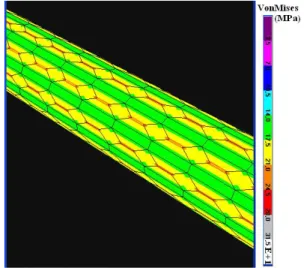
Fig. 5: Lateral view of the final mesh of the rounded geometrical pattern scheme. the following figure, the Von-Mises stresses of the last pattern show the maximum stresses are located in some of the links of the pattern.
Fig. 6: Von Mises stresses of the rounded geometrical pattern
Finally, Figures 7 display a cad reconstruction of the last design .
Figure 7, Reconstruction of one of the final designs using a CAD tool and smoothing its
edges.
CONCLUSIONS
In this paper were discussed different criteria used in the evaluation of mechanical properties of intravascular prosthesis, called stents, and how they can be used to propose a multi-objective methodology, based on the principles of evolutionary structural optimization and Pareto techniques, to generate compromise external shape configurations which satisfy conflictive objectives.
The use of optimization techniques in addition to finite element simulation has become an important tool to study, analyze and understand the mechanical behavior of this kind the devices. Its development allows proposing designs of stents in concordance with its function, decreasing the amount of experimental and clinic test which are more expensive and complicated than numerical simulation.
The authors realize that the complete design of this kind of device require a multidisciplinary approach, which involve biological, mechanical and manufacture aspects and the evolutionary optimization approach is one of the best way to deal with this problem. In this work have been consider the device’s mechanical behavior but the robustness of the optimization tool allow the future incorporation of the others mechanical and medical considerations.
ACKNOWLEGMENTS
Dr. Annicchiarico wishes to acknowledge the support provided by the Consejo de Desarrollo Científico Humanístico of the Universidad Central de Venezuela (CDCH) and by the Fondo
Nacional de Ciencia y Tecnología (FONACIT) of Venezuela for the grants provided to support this research.
REFERENCES
[1] Fleisch, M., and Meier, B., Managementand Outcome of Stents in 1998: Long-Term Outcome,
Cardiology Review, 7, 215–218 (1999).
[2] American Heart Association, Heart and Stroke Statistical Update, American Heart Association, Dallas, Texas (1999, 2000).
[3] Dotter C. T., Transluminally-placed coil spring end arterial tube grafts, long-term patency in canine popliteal artery. Investigative Radiology
4, 329-401, 1969.
[4] Fischmann D. L., Leon M. B. , Baim D. S., et al., A randomized comparison of coronary stent placement and balloon angioplasty in the treatment of coronary artery disease. New
England Journal of Medicine331, 96-501, 1994.
[5] Sigwart U., Stents: a mechanical solution for a biological problem?, European Heart Journal 18,
1068-1072, 1997.
[6] European Markets for stents in peripheral vascular and non vascular applications. HIS Health Group RPAF1226, 2002.
[7] Dumoulin C., Cochelin B., Mechanical behaviour modeling of balloon-expandable stents,
Journal of Biomechanics33, 1461-1470, 2000
[8] Etave F., Finet G., Boivin M., Boyer J., Rioufol G., Thollet G., Mechanical properties of coronary stents determined by using finite element analysis, Journal of Biomechanics 34,
1065-1075, 2001.
[9] Migliavacca F-, Petrini L., Colombo M., Auricchio F., Pietrabissa R., Mechanical behavior of coronary stents investigated through the finite element method, Journal of Biomechanics 35,
803-811, 2002.
[10] Gracia L., Puèrtolas S., Domingo S., Puèrtolas J. A., Finite element simulation of bending and buckling for a stainless steel stent in International Congress on Computational Bioengineering, Doblare, Cerrolaza, Herrera (Eds.), 676-682, 2003.
[11] Prendergast P. J., Lally C., Daly S., Reid A. J., Lee T. C., Quinn D., Dolan F., Analysis of Prolapse in Cardiovascular Stents: A constitutive Equation for Vascular Tissue and Finite Element
Modelling, ASME journal of Biomechanics
Engineering125, 692-699, 2003.
[12] Lally C., Dolan F., Prendergast P. J., Cardiovascular stent design and vessel stresses: a
finite element analysis, Journal of Biomechanics
38(8), 1574-1581, 2005.
[13] Lepor N. E., Madyoon H., Kereiakes D., Effective and efficient strategies for coronary revascularization in drug-eluting stent, Reviews in Cardiovascular Medicine3, S38-S50, 2002.
[14] Xie M. Y., Steven G. P., Evolutionary Structural Optimization, Springer – Verlag , London 1997.
[15] Srinivas N., and Deb K., Multi-objective Function Optimization Using Non-Dominated Sorting Genetic Algorithms. Evolutionary Computation, 2(3), 321-248 ,1994.
[16] Cohon J. L., Multi-objective Programming and Planning. Academic Press, NY, R. Bellman Editor, 1978.
[17] Goldberg, D. E., Genetic Algorithms for Search, Optimization and Machine Learning. Addison-Wesley Publishing Company INC, 1989. [18] Auricchio, F., Di Loreto, M., Sacco, E., Finite-element analysis of a stenotic artery revascularization through a stent insertion,
Computer Methods in Biomechanics and Biomedical Engineering 4, 249–263, 2001.