2001; 9(2): 3-10
PROJECT MANAGEMENT –
A WAY OF REDUCING UNCERTAINTIES Elena Lungu
Institute of Public Health Iasi
Motto: Two main categories of leadership behaviour have been observed: initiating structure and consideration. Consideration reflects the extent to which an individual is likely to have job relationship characterized by mutual trust, respect for subordinate’s ideas and consideration for their feelings. Initiating structure reflects the extent to which an individual is likely to define and structure his role and those of his subordinates toward goal attainment.
(Ohio State Leadership Studies) (1) Abstract. Projects and project management operate in an environment broader than that of the project it self. A project is often regarded as a desired goal, which can be realized with the available means. In this sense we try to increase our chances and minimize the risks. This article comprises concepts, principles, models of project management and different stages of a project. Key words: project, project management, product-market combinations, concepts,
principles, models
Rezumat. Proiectele şi managementul proiectelor operează într-un mediu mai larg decât proiectul însuşi. Adesea un proiect este privit ca un scop dorit care poate fi atins cu mijloacele disponibile. Astfel încercăm să creştem şansele noastre şi să minimalizăm riscurile. Acest articol cuprinde concepte, principii, modele de management al proiectelor şi diferitele etape ale proiectelor.
Cuvinte cheie: proiect, managementul proiectelor, combinaţii produs-piaţă, concepte, principii, modele
Projects and project management operate in an environment broader than that of the project itself. Because the projects are unique undertakings, they involve a degree of uncertainty. Work generally involves either operations or projects, which share many characteristics (2):
- performed by people;
- constrained by limited resources; - planned, executed and controlled. A project can be defined in terms of its characteristics: it is a temporary
endeavor undertaken to create a unique product or service, while operations are ongoing and repetitive. Unique means that the product or service is different from all-similar products or services.
All the project leaders think that, because their projects are unique, their roles must be unique. However, analysis shows that there are common characteristics (3):
- responsible for the achievement of project goals which are limited but
require visible and dynamic activity. In relation to the project, the role is similar to that of a general manager;
- unable to hide; it is clearly apparent who is in charge; it is therefore a high risk role;
- limited in direct authority;
- often working in areas new for the company, new technology, new approaches to old situations. At all levels of any organization, projects are performed. They may involve a single person or many thousands (2).
In any health care system, politics and public opinion demand action and results.
In order to perform an effective program, it is necessary to control the continuous rapid change on the work package.
Project Management is the application of knowledge, skills, tools and techniques to project activities in order to meet or extent stakeholder needs and expectations from a project (2). Meeting or exceeding stakeholders needs and expectations involves balancing demands among:
- scope, time, cost and quality; - stakeholders with different needs
and expectations;
- identified needs and unidentified expectations.
The term project management is sometimes used to describe an organizational approach to the management of ongoing operations, which is more properly called “management by projects”. This approach names many aspects of
ongoing operations as projects in order to apply project management to them. Project management is a way of structuring the questions that can be asked in a project. It indicates when and what questionnaire must be answered and what data there are needed in order to take the next step. Often, a project is regarded as a desired goal, which can be realized with the available means. In this sense we try to increase our chances and minimize the risks (2).
Working with projects has four advantages (2):
1. it promotes a systematic work development;
2. it stimulates a continuous policy development;
3. it increases certainty and control; 4. it is fun - project development for
health helps to work using imagination, energy and courage of many in building networks, orchestrating efforts, employing success and coping with challenges with can contribute to health.
The project manager must constantly ask question such as (5):
- Is the project solving the problem? - Will the project be used by the
clients?
- Is top management truly supportive of this project?
- Are the client’s needs adequately understood?
- Is the basic project mission still on target?
- Does the company have the necessary project team personnel to succeed?
Principles of project management 1. Working with projects
In the work focused on health, there are used two types of models: the basic one which reveals a link between health and its determinants: life style and environment and political, economic or informative interventions; the second one is the organizational model aimed to structure the tasks, the sequence of actions in a specific context.
2. Project definition
The following elements form the basic features of a project:
- predetermined clear objectives; - a limited duration;
- clear responsibilities; - clear defined stages.
A project is an organizational and psychological model used to produce harmony between the efforts, the working process and the collaborations in order to realize:
- a predetermined result; - at a predetermined time; - on a predetermined scale;
- for a predetermined amount of money.
3. The place of projects in policy Policy is defined as efforts to realize specific goals with specific means within specific time period.
These means can be called programs, focusing specific issues.
Each program contains routine, projects and improvisation activities. The distinction between projects and policy is in scope, scale and schedule. It is essential not to see project initiatives as being separate from policy. When there is a decision to start a project, the criteria are derived from the policy.
Furthermore, the policy sets the framework in which the results of a project are evaluated; the policy determines how the results of a project will be used in an organization and in the working relationship. In this way, projects can be incentives for new policy developments.
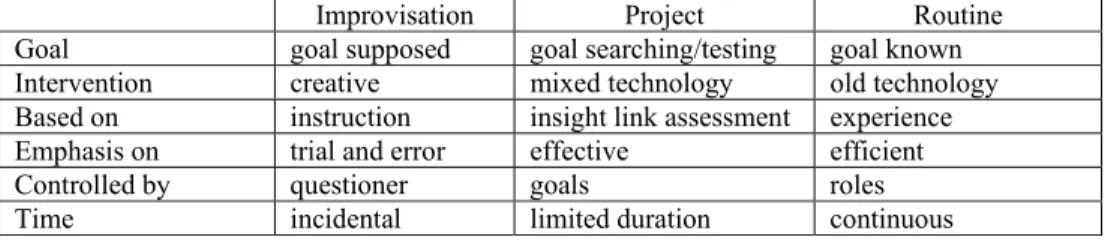
It is necessary to make a distinction between projects, improvisation and routine work within a program.
Routine activities change slowly, adopt themselves to market demand and the client, but for the organization and professionals they are “daily work”, focused more in execution than analysis.
Improvisation is short, incidental tasks that bring challenge.
They are unpredictable; some call them disturbances, and others call them exciting adventures.
In reality, the projects are a mixture of improvisation and routine.
Table 1. Project between routine and improvisation
Improvisation Project Routine
Goal goal supposed goal searching/testing goal known Intervention creative mixed technology old technology Based on instruction insight link assessment experience Emphasis on trial and error effective efficient
Controlled by questioner goals roles
4. Project types
The projects in health are derived from the business.
In the business field there are common product-market combinations (PMC) with four types of business activities. Table 2. Product-market combinations (PMC)
Old Old
implementation New product development Market
New Market development
Innovation
The development of a product or market is like an experiment in order to see if a solution is suitable and whether there is a market for it.
Innovation is always more difficult, when new products use new markets, experience teaches that less than 20% of them will be successful.
A health project combines a number of activities and each activities focuses
on specific goal to be realized with specific intervention in a specific target group. In this case the goal and target group constitute the market element in the PMC. The intervention is the product element of PMC.
Four types of projects can be distinguished in health field.
Table 3. Project type
Goal Target group Intervention
a. Innovation unknown unknown unknown
b. Market test known unknown known
c. Intervention test known known unknown
d. Implementation known known known
As the table 3 shows, these types of projects are:
a) innovation project -
An idea, a method or piece of information as being new is the main characteristics of this type of project. The more innovation aspects a project has, the more targeted research is required in order to reduce uncertainties.
This type of project explores new terrain, and requires an open-minded, experimental attitude of all those involved.
b) market test project -
In this case the problem is well known but it concerns new clients. Consequently, the goals and interventions must be tailored in order to determine whether a particular works here properly.
c) intervention test project - An old problem, known target group but the present instruments are unsatisfactory or a new technology comes into fashion.
This type of project refers in applying a new means in known field for known goals.
d) implementations project - Goal, target group and intervention are known and the emphasis is on careful planning, the gaining of support and the intervention.
Time is involved here. Ideally, it is really going to happen now.
Experience tells that implementation is frequently a slow process. Behaviour
change of institutions, professionals, politicians and people is a process that takes a long time.
5. Working with projects
Project management is a balance between ambition and capacity made by organizations.
ambition capacity
Organizations There are three levels of awareness for
a project manager: ambition (the goal
of a project), capacity (the means to reach that goal) and organization. Table 4. Levels of awareness for project management
Ambition 1. Vision 2. Intervention 3. Research 4. Publicity
- Fundamental theory, basic model
- Goal/target group/Intervention combination - Collection of necessary information - Stimulation of awareness
Capacity 5. People 6. Money 7. Time
- All those involved in the project - Available budget and hidden resources Organization 8. Leadership
9. Structure 10. Information
- Role/position and working style - Positions and responsibilities
- Channels and documents for purposes of decision-making
The following points for special attention are under those three headings: In health activities the model of problem solving can be recognized: 1. Problem identification and exploration
of alternative solutions.
2. Selection and testing of the solution. 3. Implementation of the solution. 4. Evaluation and follow up.
Project stages.
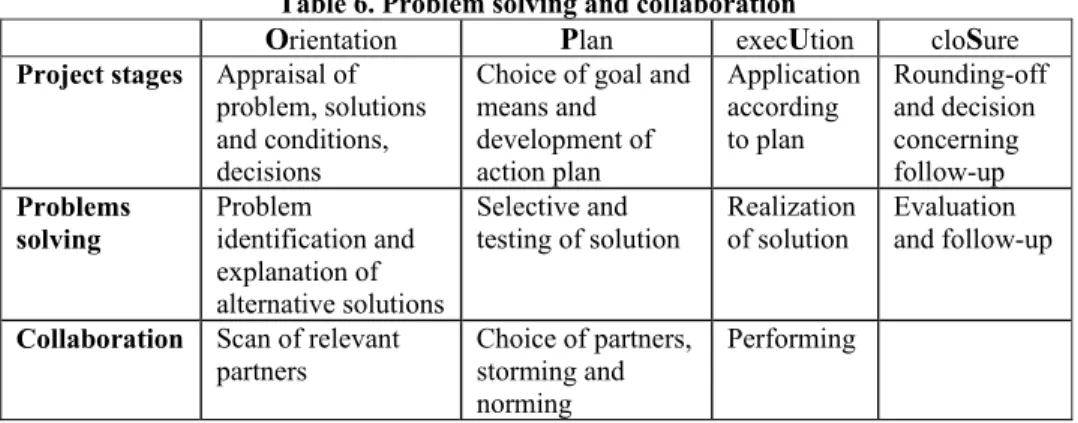
Because the project are a form of systematic social problem solving the division into steps of the problem, solving process is the basis for the division into project stages. The OPUS model (2) of project management is based on 4 stages: orientation, planning, execution and closure.
Table 6. Problem solving and collaboration
Orientation Plan execUtion cloSure Project stages Appraisal of
problem, solutions and conditions, decisions
Choice of goal and means and development of action plan Application according to plan Rounding-off and decision concerning follow-up Problems
solving Problem identification and explanation of alternative solutions
Selective and
testing of solution Realization of solution Evaluation and follow-up
Collaboration Scan of relevant
partners Choice of partners, storming and norming
Performing
I. Orientation stage This stage aims to establish: - whether the problem is justified; - which type of project it is; - what the next stages will look like. The problem can come from the experiences of those involved, newspaper articles, questions of general public, statements of policy maker’s etc.
This stage explores the possibilities and the difficulties of the project, the degree of complexity and risks, for which safety limits must be built during the plain stage.
This stage concerns with the assess the ambition of further activities and if the desired content can be realized with the available capacity. In this stage will be formulated a coherent proposal for the further planning and execution of the project.
Criteria of ambition in this orientation stage are:
1. Is the analysis complete and adequately underpinned?
2. Does the proposal fit in the analysis that has been made?
3. Does the proposal fit in the policy of the institution and department? 4. Is the policy in harmony with
other tasks?
5. Is it clear what results the plan stage must produce?
6. Does the project add extra workload to the present work? 7. Is the continuity of the other
activities guaranteed?
8. Is the impact of the project in other activities justified?
Capacity criteria in this orientation stage:
1. Has the quality and quantity of the manpower been assessed realistically? 2. Are the costs realistic?
3. Is it financial possible?
4. Is time that has been planned realistic?
5. Is it justified to invest this time? Organization criteria of this orientation stage:
1. Is the project feasible in terms of organization?
2. Is the project leader capable of leading the project?
3. Are the organization mechanisms adequately built in?
4. Who gets the credit, who gets the legacy?
5. Have working relationships with third parties been arranged adequately?
Time table:
1. Given the project type, the time proposed is reasonable?
2. Are the activities assessed and harmonized with one another? 3. Control possibilities?
4. Possibilities of ending the project without much damages?
5. Timing of publicity.
Conclusions of the orientation stage: 1. Does the project proposed justify
the investment in the plan stage? 2. Does the plan stage see realistic
and hence the execution and closure stage possible?
3. Do we prefer this project to the competing options?
II. Plan stage
This stage aims to establish:
- how the details of the project can be elaborated;
- what capacity and organization type are needed for that;
- what can happen as follow-up after the execution.
Criteria of ambition in this stage: 1. Check of relevance of goals 2. Add new goals when necessary Criteria of capacity:
1. Tasks/role, responsibilities 2. Is the income situation clear? 3. Has an estimate been made of all
expenditures?
4. Is the planning realistic?
5. Are the responsibilities clearly determined with respect to staff, external role, budget management? 6. Has an initiative group been
formed (including target group representation, intermediaries, policy makers?
III. Execution stage
This stage aims to realize according to the planning the steps specified in the plan, while monitoring the quality, lead time and the budget of the project.
Some characteristics of this stage are: - Execution according to the planning
of the steps of the project plan;
- Signaling of the necessary adaptations and/or improvements; - Regular reports on the progress of
the project.
The project leader has the role of controller during this stage. It is in charge of project management, the process of testing the execution of the project.
Criteria of ambition in this stage: - Performed activities versus planning
activities;
- Sufficient awareness of progress; - Consequences of proposal adaptation
versus the initial content of the project. Criteria of capacity:
- Invested time versus necessary time; - How the time has been invested? - Actual costs versus estimated costs; - Consequences of adaptations for
budget and time investment; - Is the project leader monitoring
main tasks?
- Are the activities checked regularly? - Is the communication satisfactory?
IV. Closure
Is the time for results, receiving the credits for passing on and learning from the experiences.
Important questions of this stage: 1. Do the realized results satisfy the
expectations specified in the project plan?
2. How do we go on? What are we going to do with the realized results?
It is first assessed if the project has satisfied the expectations.
Furthermore, in the closure stage it is important to determine what follow-up activities are required.
Final reports and plans for follow-up activities are presented for approval. In many cases, the project leader will produce different final reports according to the needs of various target groups. A financier will be interested in whether his money was spent usefully
and effectively. In a report for associate establishments, will be a description of the results of the intervention in relation with goals. Most organizations have developed their cultures. These cultures are reflected in their shared values, norms, beliefs and expectations, in their procedures, in their view if authority relationships and in other factors. Organizations’ cultures often have a direct influence on the project (4). Acknowledgements
I would like to thank Netherlands School of Public Health for providing the fellowship for training in MPH Program 1998/99.
This paper is based on the course Project Management Skills – Utrecht 1999, Coordinating Lecturer being Hans Saan, MA. I am also grateful to the MPH staff.
REFERENCES
1. Cleland D.I., Gareis R.: Global Project Management Handbook. McGraw-Hill Inc., New York, San Francisco, Washington D.C., ISBN: 070113297, 24/1-24/25, 1994. 2. Saan H., Molleman G., de Vries M.,
Keizer H. – Project Management in Health Promotion, working model and check list. NIHP, Versia IE, NIGZ, Woerden, 2-68, 1997.
3. Briner W., hastings C., Geddes M.: Project leadership. Gower Publishing Limited. Hampshire, UK, ISBN: 0566077140, 15-33, 1996.
4. Duncan W.R. – A guide to the project management body of knowledge. Project Management Institute, Upper Darby, USA, ISBN:1880410133, 1-25, 1996.
5. Pinto J.K., Slevin D.P.: The project implementation profile: an international perspective. McGraw-Hill Inc., New York, San Francisco, Washington D.C., ISBN: 0070113297, 27/1-27/27, 1994.