Proximity to Knowledge Sources and the Location of
Knowledge Based Start-ups
Rui Baptista
IN+, Instituto Superior Técnico, Technical University of Lisbon and Max Planck Institute of Economics, Jena
Joana Mendonça
IN+, Instituto Superior Técnico, Technical University of Lisbon
Preliminary Version: for presentation at the Kiel Workshop on Agglomeration and Growth
Abstract:
We use detailed longitudinal data on firms, human capital and universities to study the impact of geographical proximity to knowledge sources and local absorptive capacity on the location of knowledge-based start-ups in the Portuguese regions. There are significant differences in new firm formation in knowledge based sectors among Portuguese regions. Using municipalities as the regional unit of analysis, we examine the influence of the regional distribution of universities, yearly numbers of students and graduates, and workforce education on start-up numbers. We estimate models of regional entry using zero inflated negative binomial regression. We find that local access to knowledge and human capital significantly influences entry by knowledge based firms into regions, after controlling for other regional-level variables. Results suggest that local opportunities available for new businesses in manufacturing are fewer, and that absorptive capacity associated with human capital may also be lower than in services. Indeed, for manufacturing start-ups the creation of local absorptive capacity (i.e. human capital) seems to matter more than actual knowledge generation by universities. While proximity to the largest urban centres plays a positive role in driving entry into high and medium tech manufacturing, its effect is the opposite on entry into knowledge based services.
Keywords: Knowledge Based Start-ups; Location; Agglomeration Externalities; Knowledge Sources; Absorptive Capacity.
1. Introduction
A widespread and diverse literature regards concentration as “the most striking feature of the geography of economic activity” (Krugman, 1991, p. 5). The performance of regional economies varies markedly in terms of wage, wage growth, employment growth and innovative performance (Audretsch, 1998; Porter, 2003). Different streams of literature have looked at spatial differences in the distribution of production and innovation, generally concluding that these are due to increasing returns (or agglomeration externalities) associated with a variety of sources (Baptista, 1998; Audretsch, 2003; Audretsch and Feldman, 2004). Most empirical studies have suggested that firms are more productive and innovative when clustered within a location (Faberman, 2005). Some of these studies have looked at firm growth. For instance, Glaeser et al. (1992) explored how positive externalities arising from both regional industry concentration and diversity may contribute to firm employment growth. Other studies have linked agglomeration externalities with higher firm innovative performance (Baptista and Swann, 1998; Feldman and Audretsch, 1999).
The literature on the location of innovation has emphasised the role played by agglomeration externalities associated with access to knowledge spillovers. Spillovers occur whenever a firm shares knowledge with other bodies performing research and development,1 such as other firms, universities and government institutions (Griliches 1992). If information about new technologies, goods and processes, flows locally more easily than over great distances, than establishing direct contact with entities that can produce knowledge which is valuable for a firm’s activity should be one of the main driving forces leading to the geographic concentration of both production and innovative activities.
Regional economic development is a complex process resulting from the interaction of numerous factors, including entrepreneurial activity (Moyano et al., 2005). Entrepreneurship can be seen as a process of exploiting opportunities that exist in the environment, converting ideas (which may arise from R&D activities) into successful businesses and creating value through innovation (Shane, 2000). Thus, while the creation of new firms likely plays a central role in spawning regional economic advances (Storey 1984; Fritsch and Mueller, 2004), the pervasiveness of entrepreneurial activities across regions should vary according to the pools of innovative opportunities and human capital available in each region (Shane, 1996).
1
The present paper explores the differences in new firm formation in knowledge based sectors across Portuguese regions, looking at their relationship with accessibility to knowledge sources, and the availability of human capital capable of exploiting such knowledge to generate commercial innovations. This analysis aims at extending our knowledge of the mechanisms influencing the location of knowledge based firms, which have been found to have a greater potential to generate employment growth in the medium and long term (Baptista and Preto, 2006), thus aiding policy-makers in influencing the structural determinants that impact start-up rates and employment growth at the regional level.
The paper is organized as follows. The following section presents some literature background on new firm location, developing hypotheses to be tested with regard to the role played by accessibility to knowledge sources in the location choice of start-ups. Section 3 presents the data and methodological approach used in the present study, while section 4 reports the results obtained. Section 5 presents our main conclusions, and highlights avenues for improving and broadening this research.
2. Knowledge Accessibility and the Location of Start-ups
2.1. Knowledge spillovers and firm location
Most works on industrial location consider the existence of agglomeration externalities as a key determinant of the geographical concentration of economic activities. Externalities contribute to firm competitiveness and innovative performance through mechanisms that involve both concentration and diversity of industries (Glaeser et al., 1992), as well as the local presence of specialised workers, intellectual capital, customers and suppliers, and other sources of information concerning market conditions and technological developments (Baptista, 1998; Audretsch, 2003). Although using different theoretical tools, both urban economists and economic geographers have long advocated that urban agglomerations grow, amongst other things, because they allow people to interact and learn from each other (Jacobs, 1969; Vernon Henderson, 1974; Scott, 1992; Florida, 1995; Gertler, 1995; Fujita and Thisse, 1996; Simmie and Lever, 2002). The frequency of such interaction is enhanced by geographical proximity.
It is therefore a general belief that location matters to the development and growth of industries (Stahlecker and Koschatzky, 2004). Much literature has been developed around the notion that firms tend to concentrate in certain regions so they can benefit from co-location.
A particular stream of this literature focuses on advantages arising from sharing and accessing information and knowledge. Works in this stream argue that the regional environment is more likely to impact new, small firms than their large counterparts (Keeble and Wilkinson, 1999; Simmie, 2002). One reason for this is the fact that such firms often lack the complementary assets to develop and commercialize new products, and hence locate in geographical areas where such assets are available and can be contracted or licensed. As industries become concentrated in a few regions, new firms should be attracted to those same regions by the existence of such complementary assets, thus reinforcing this spatial clustering process (Boschma and Lambooy, 1999).
If knowledge spillovers represent a significant form of agglomeration externalities, then the location decision of new firms should be influenced significantly by access to the sources of such spillovers, including specialised human capital and institutions performing R&D activities (Audretsch et al., 2005). Also, the propensity to cluster geographically should be higher in industries where new knowledge plays a more important role, as such knowledge is less likely to be codified and easy to transmit over great distances, with no need for personal contact (Audretsch and Feldman, 1996; Baptista and Swann, 1998). Thus, access to knowledge sources should be particularly significant for high technology and knowledge based industries and services.
Companies in innovative sectors tend to choose locations where significant knowledge-generating activities associated with these sectors occur (Zucker et al., 1998, 2002; Audretsch and Stephan, 1996). These activities may be performed by universities or other firms and imply the presence of world class scientific research and human capital. Recent literature has advocated that knowledge spillovers play an important role in fostering entrepreneurship and innovative activity (Sorenson and Audia, 2000; Baum and Sorenson, 2003). Spillovers from universities, as well as from private firms, have been recognized as key sources promoting firm innovation and performance (Stuart and Sorenson, 2003; Hall et al., 2003). Stahlecker and Koschatzky (2004) indicate that spatial proximity matters for the founding and early performance of firms in the knowledge intensive business services sectors. Also, Capello (2002) has found that high tech sectors display high spatial concentration.
Empirical studies have found that new firm location at the regional level is significantly influenced by differences in industry intensity, population growth, and income growth across different locations (Armington and Acs 2002). In studying regional variations in new firm formation, Reynolds et al. (1994), and Audretsch and Fritsch
(1994) identified a number of geographic-specific characteristics that impact the location of new firms. These characteristics were generally based on factors identified in earlier studies by Carlton (1983) and Bartik (1985): firm birth rates were highest in regions with high proportions of employment in small firms, demand growth, employment specialization, and population density. In the Portuguese context, Cesário and Vaz (2004) found that certain regions generate a better entrepreneurial environment and have a better potential for the development of new businesses, while Costa and Teixeira (2005) found evidence that proximity to universities influences positively the innovative activities of technology based firms.
Relatively few studies have focused on the influence of access to knowledge sources on the locational choice decision of new firms. Audretsch et al. (2005) found that new knowledge and technology-based firms have a high propensity to locate close to universities, presumably in order to access knowledge spillovers. Karlsson and Nystrom (2006) find that accessibility to company R&D has a stronger impact on new firm formation than accessibility to university R&D. However, most of the literature on the location of new firms does not set high tech industries apart from the remaining sectors. Considering the specific knowledge and human capital requirements of firms in high tech industries, it can be argued that such a distinction should be made (Bade and Nerlinger, 2000). According to Markusen et al. (1986), the innovative nature of high tech industries demands specific conditions to develop. Hence, knowledge sources should be a specially significant determinant of start-up location choices for knowledge based industries and services.
2.2 Absorptive capacity and geographical proximity
As new knowledge spills over, one person may discover an opportunity and another may exploit it. Such knowledge may be more than just about products and processes, including also organizational forms, management procedures, or other industry trends (Anselin et al., 2000; Gilbert and Kusar, 2006). Therefore, knowledge spillovers represent key sources of opportunities for both new and existing firms to enhance process efficiency, make product improvements, and develop technological and organizational innovations (Acs and Plummer, 2005).
While the generation of new knowledge requires qualified human capital, so does the ability to absorb such knowledge. As established by the well-known work of Cohen and
Levinthal (1989, 1994), firms differ in their ability to absorb the pool new knowledge resulting from research which becomes accessible, independently of the degree or nature of its development. Such differences result from differences in the firms’ own abilities to perform R&D and, therefore, in the quality of their human capital. This suggests that the amount of positive knowledge-related externalities generated in a region depend not just on the local supply of knowledge and information spillovers, but also on the existence of a local labour pool which is capable of absorbing such spillovers generating commercial innovations (Shane, 1996; Iammarino and McCann, 2006). Andersson et al. (2005) found that patents are responsive to the spatial distribution of workers at different levels of education, as well as to the distribution of private and university R&D facilities.
2.3 Universities as knowledge sources
The local presence of universities can generate positive externalities through both the performance of knowledge-generating R&D activities and the education of specialised human capital, capable of absorbing such knowledge. Geographical proximity of an academic institution to a knowledge intensive industry may be a source of positive knowledge externalities, since firms can cultivate relationships with universities, participating in research consortia and partnering with academics that do related scientific work (Audretsch and Feldman, 2004). For instance, personal networks of academics and industrial researchers, may lead to the commercial exploitation of knowledge generated at universities by existing firms or university spin-off start-ups. Moreover, fresh graduates may be important channels for disseminating the latest knowledge from academia to the local high tech industry (Varga, 2000).
Acs et al. (1994) find that small firms are recipients of R&D spillovers generated both in universities and in the R&D centres of their larger counterparts, and such spillovers are apparently more significant in stimulating innovative activity by small firms than by large corporations. Anselin et al. (1997) find evidence of local spatial externalities between university research and high technology innovative activity. Feldman (2000) reports strong evidence in favour of a growth effect of geographical clusters influenced by active research universities for the United States. Bade and Nerlinger (2000) find a strong positive correlation between the number of new technology based firms and the location of R&D facilities for West Germany. Fisher and Varga (2003) provide evidence of the importance of
geographically mediated knowledge spillovers from university research activities to regional knowledge production in high tech industries in Austria. They find that such effects differ across industries, and increase with geographical proximity. Acosta and Coronado (2004) find that companies in those regions with a more favourable scientific environment make greater use of scientific knowledge, as indicated by the use of scientific citations in patent documents. Other studies, such as Bania et al. (1992), find that the relationship between university research and firm births varies across industrial sectors.
2.4 Hypotheses formulation
The present paper investigates whether proximity to universities is a significant determinant of the creation of new knowledge based firms in regions. Universities can be viewed as an important source of knowledge through the development of research activities, and also as the primary generator of qualified human capital that is capable of comprehending such knowledge. In addition to educating human capital which may be directly involved in the creation of new firms, either as founders or key employees, university scientists may also act as facilitators in the contact between local firms and their own (national or international) networks of colleagues, thus widening their knowledge sources. We therefore formulate the following hypothesis:
H1: The number of higher education institutions in a region has a positive effect in determining entry of knowledge based firms in that region.
H2: Regions with higher number of university students are more likely to have higher number of new firms in knowledge based sectors.
H3: Regions with higher number of university graduates are more likely to have higher number of new firms in knowledge based sectors.
3. Data and Methodology
3.1 Data and Variables
The data concerning new firm formation used for empirical estimation in the present paper come from the Quadros de Pessoal database, which results from information gathered yearly by the Portuguese Ministry of Social Security and Labour on the basis of mandatory
information submitted by firms. This is a longitudinal matched employer-employee database which includes extensive information on all private firms, establishments, workers and business owners in the Portuguese economy for the period 1982-2003. We confine our analysis to knowledge intensive business services (KIS) and knowledge based manufacturing (high and medium tech firms), building a dataset containing all new knowledge based start-ups in these sectors entering in the period 1992-2003. Start-start-ups were identified as a new entry in the yearly database,2 checking all information back to 1982, and cross-checking this date with the earliest employee admission date. Firms entering before 1992, and firms for which the entry date could not be identified, were not considered in our analysis.
Start-ups were assigned to the 275 Continental Portuguese municipalities (Concelho). Additional data on municipalities was gathered from the National Institute of Statistics (INE). Information on universities, numbers of students, and graduates was collected from the Observatory of Science and Higher Education (OCES). We followed the OECD classification of knowledge based industries, aggregated by technology level, which is defined as the sum of high technology and medium-high technology industries, post and communications, finance and insurance and business services (OECD, 2002).
The variables used in the empirical estimation are presented in table 1, together with their descriptive statistics. The dependent variable used in the study is the number of start-up firms in each year and in each region. Following Fritsch and Falk (2007), we use the number of start-ups instead of the start-up rate as dependent variable, as start-up rates may vary with changes in employment and numbers of firms in the respective industry and region. Numbers of start-ups vary considerably across municipalities, including several occurrences of zero births, and also very high numbers of start-ups for the Lisbon municipality. Also, high and medium tech industry start-ups are considerably less than knowledge intensive service (KIS) start-ups.
As explanatory variables, we usethree different measures of knowledge accessibility: the number of higher education institutions; the number of students enrolled in higher education institutions; and the number of graduates. The number of institutions in a region measures knowledge production in the region (Bania et al., 1993; Audretsch et al., 2005). The
2
Only new firm start-ups are considered, so new plants/establishments by existing firms are excluded from the analysis.
number of students indicates knowledge assimilation.3 The number of graduates indicates the creation of human capital by a region in each year. If start-ups are created as the result of the exploitation of knowledge embodied in people, regions with higher concentrations of university graduates will also show higher levels of firm formation in knowledge based sectors (Giarratana, 2004). In addition, there is evidence showing that entrepreneurs start their firms in regions where they have lived and developed their social networks so it seems reasonable to assume that scientists and recent graduates will start firms in the locations where they undertook their studies, or in adjacent regions (Figueiredo et al., 2002; Michelacci and Silva, 2005).
Several control variables are also used to account for other factors affecting the number of start-ups. New firm creation is likely to be associated with the size of the regional market. Hence, we use total sales per capita as a measure of regional development. Agglomeration externalities associated with knowledge spillovers do not originate solely in universities. Other firms may also be a significant source of knowledge. The density incumbents in a region has been shown to affect local firm formation rates significantly (Baptista and Swann 1999; Kangasharju, 2000; Acs and Plummer, 2005). We use the number of firms in knowledge based sectors in the region (per thousand inhabitants) as a measure of such agglomeration effects. If spillovers of knowledge generated by incumbents and picked up by potential entrants are significant, we expect this variable to affect entry of new firms in the region positively. Moreover, large numbers of incumbents are likely to signal low barriers to entry, thus reinforcing this effect.
As a measure of the human capital in the regions, we use the logarithm of average years of education of the labour force in the region. Previous research has shown a positive relationship between measures of human capital and entrepreneurial activity at a regional level (Audretsch and Feldman, 2004; Andersson et al., 2005). Accordingly, we expect that higher levels of human capital will have a positive effect on new firm entry in knowledge based sectors.
The logarithm of total population per square meter was used as a measure of regional demand size, which should represent an attraction for start-ups. Kangasharju (2000) indicates that many new firms are established to supply clients in local markets. Thus, we expect to
3
This measure has the advantage of capturing the relative size of higher education institutions: one large university may have a more significant impact than two smaller ones.
find higher firm formation in regions with higher population density. In addition, we use two measures of urban accessibility: firstly, distances in kilometres (km) to Lisbon and Oporto (the two major urban areas in Portugal) gauge access to the largest markets; secondly, access to regional markets is captured by the distance in km from each municipality to the corresponding district’s administrative centre. These variables also proxy access information about market and regulatory requirements, as information is usually more readily available in core regions (Figueiredo et al. 2002). We expect more firms to locate closer to urban centres.
Finally, we should point out that, following Audretsch and Fritsch (1994), and Figueiredo et al. (2002)as we focus on variables assessing factors that may affect differences in firm entry across regions, we are not concerned with capturing factors which may affect entry rates on a national or global level, but are unlikely to vary across regions in the same country, such as the minimum efficient scale in different sectors, the cost of capital, or macroeconomic fluctuations (see, for instance: Siegfried and Evans, 1994).
3.2 Methodology
Our analysis introduces knowledge accessibility as a determinant of the number of entrants in knowledge based sectors, while controlling for a set of variables believed to affect differences in entry levels across regions. We performed separate regressions for services and manufacturing. In addition, we introduced time dummies to account for time-specific influences, such as differences in the effects of business cycles across regions. Since our dependent variable is the number of firms who enter in each region, count data regression is used. We use pooled panel data observations for the 275 municipalities.
Given the high variability in the number of entrants across municipalities, and the large number of zero entrants observed, the Poisson distribution is not used in the present study. In cases where there is overdispersion, i.e. where the sample variance is higher than the sample mean, the Poisson variance assumption does not hold (Cameron and Trivedi, 1986, 1990). A Pearson residuals test was performed, confirming the inadequacy of the Poisson distribution to our sample. Since our dependent variable contains many zero values (more than 25% for services and more than 50% for industry), we use the zero inflated negative binomial model for the estimations presented (see, for instance: Greene, 1994; Mullahy, 1997). Upon estimation, the Vuong test confirmed the appropriateness of the zero inflated models for our sample.
Model estimation correcting for spatial autocorrelation (Anselin, 1988, 2001) provided non-significant coefficients, meaning that there is no spatial autocorrelation in our data when using the municipality level of analysis. Thus, new firm formation in adjacent municipalities seems to be independent. An explanation for this result may be that founders of new firms tend to locate their businesses in close proximity to their homes, and therefore a significant number of entrepreneurs set up their businesses in their own region. This is consistent with previous results obtained for Portugal (Figueiredo et al., 2002).
4. Results
4.1 Geographic distribution of knowledge based firms
Figure 1 displays the distribution of knowledge based firms (high and medium tech industry and knowledge intensive services) per thousand inhabitants in each of the 275 Portuguese municipalities for the years 1992 and 2002. Portuguese municipalities are grouped into 18 administrative districts. The maps show a considerable increase in the number of knowledge based firms from 1992 to 2002, consistent with the general emergence of knowledge related activities in developed economies. The maps reveal a high concentration of firms along the coastline, with greater incidence in the north of the country.
In 1992, knowledge based activities were mainly concentrated in a few key regions, namely Lisbon, Oporto, Aveiro, Faro, and surrounding areas, corresponding to the largest urban agglomerations. In addition, the municipalities of Leiria and Marinha Grande displayed a high concentration of firms, associated with the strong cluster of glass and moulding industries which had developed over the years in those areas.
By 2002, the geographical distribution of knowledge based firms across the country had become more even, although the difference between coastline and inland areas is still significant. The regions of Lisbon, Oporto, Aveiro and Faro maintain their prominence in terms of knowledge based firms, but Braga, to the north of Oporto, and Coimbra, in-between Lisbon and Aveiro, have also emerged as major economic centres. The map also shows an increasing sprawl of firms from the core municipalities towards the surrounding areas, likely due to rising congestion costs (i.e. real estate prices and transport/commuting times). While new firms seem to be increasingly locating in municipalities adjacent to core areas, inland
regions still display relatively low densities of knowledge based economic activities. This is particularly striking given that these regions benefited the most (in per capita terms) from EU cohesion funding, being the target of considerable investments in both physical and knowledge infra-structure (i.e. new universities and research units).
4.2 Estimation Results
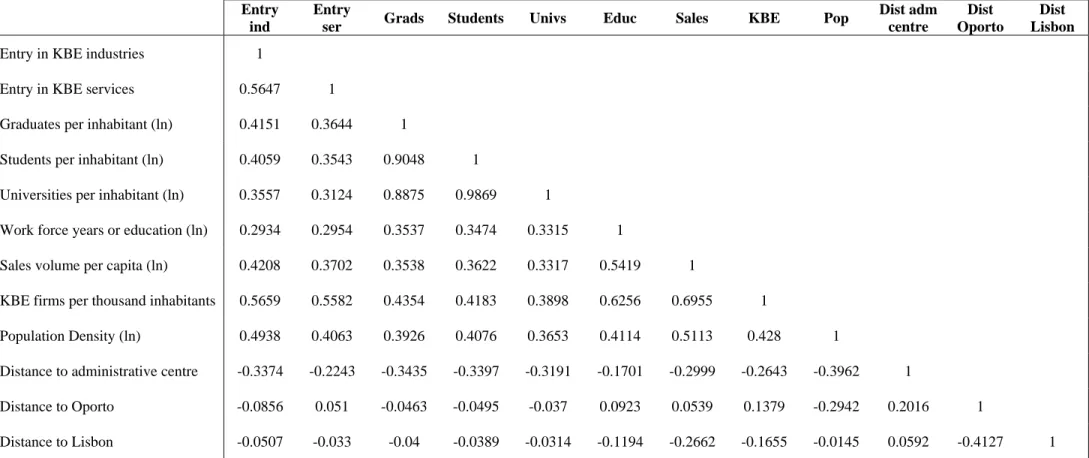
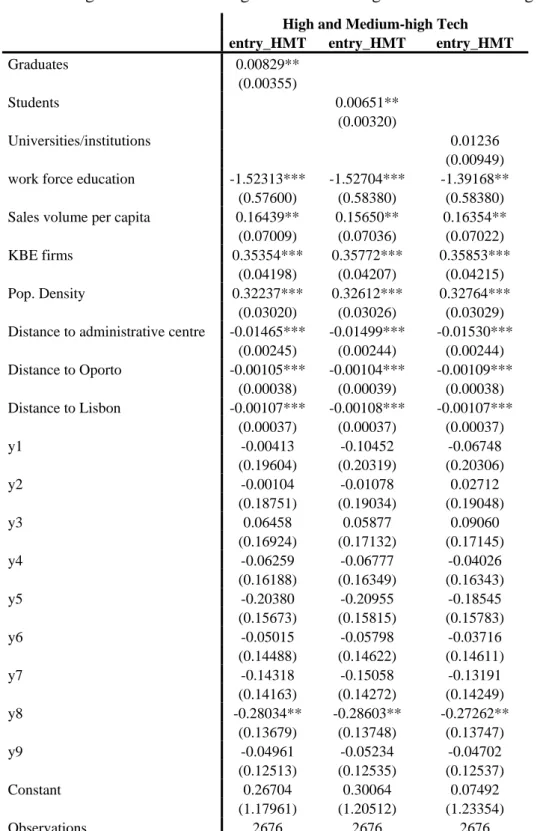
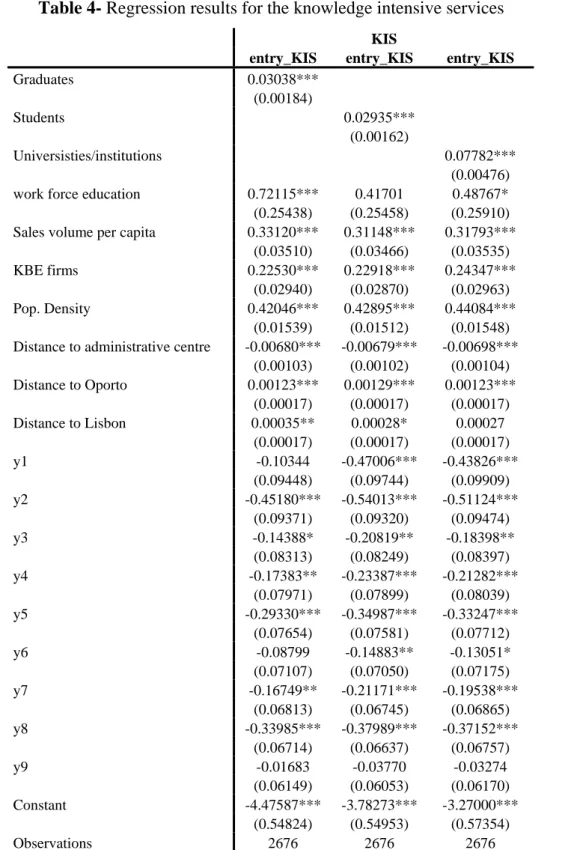
Regressions results are presented in tables 3 (for high and medium-high tech industries) and 4 (for knowledge intensive services). Given their high correlation levels (see Table 2), the explanatory variables related with knowledge sources and absorptive capacity are included in separate regressions. Column I presents results for the regression using number of graduates as the knowledge-related explanatory variable; column II presents results using number of students; and column III displays estimation results using number of universities. Coefficients for the control variables are consistent regardless of the knowledge-related explanatory variable used, so the estimations appear to be robust. The overall results suggest that variables associated with access to knowledge sources and the ability to absorb knowledge available in the environment have a significant impact on new knowledge based firm formation in both manufacturing and services.
For the manufacturing firms (high tech and medium-high tech), absorptive capacity seems to matter more than actual knowledge creation by universities: while the number of students and graduates in each year significantly increase the probability of one more firm entering the market, the local presence of a university has no significant impact. The coefficient obtained show that one more graduate increases the probability of entry by 0.8%, while one more student increases the probability of a new firm entering by 0.6% in new firm entry (Column II). The lack of significance of university presence in the municipality may also be due to the specific kind of research being undertaken. The knowledge being generated in local universities may not be easily absorbed by aspiring entrepreneurs, or may give rise to opportunities that require significant investment and may therefore be more easily implemented by incumbents. Hence, the results confirm hypotheses 2 and 3 for high and medium-high tech sectors, but reject hypothesis 1.
The regional presence of knowledge based firms is a significant driver of entry, suggesting that agglomeration externalities are indeed significant. While other kinds of positive effects arising from agglomeration – such as pools of experienced labour or
specialised suppliers – are likely to be picked up by this variable, it is also likely that incumbents are an important source of knowledge spillovers, thus contributing to increase entry. In fact, we may argue that this result supports the finding by Karlsson and Nystrom (2006) that accessibility to company R&D has a stronger impact on new firm formation than accessibility to university R&D, at least for manufacturing.
A striking result is that regional average work force education displays a negative and significant coefficient for all regressions. This suggests that more educated workers seem to be more attracted by paid employment in large incumbents, and are unwilling or unable to recognise and take advantage of opportunities for new business creation. It may also be that pools of highly skilled labour in most municipalities are still insufficient to fulfil demand by incumbents, thus leading to high wages and greater opportunity costs of starting a firm for these highly skilled workers. One may therefore conclude that a lot of new firms, even in knowledge based sectors, are being started by less educated and less experienced individuals, thus benefiting from lower entrepreneurial human capital. This conclusion is consistent with relatively high levels of necessity-based and unemployment-driven entrepreneurship, and with relatively low impacts of new firm creation on employment growth found by several studies about Portugal (see, for instance:Baptista et al., 2006; and Baptista et al., 2007).
Other control variables display the expected results. Population density and total sales have positive effects, suggesting that local market size has a positive impact on new firm creation. The results obtained for the urban accessibility variables reveal that increases in distance to administrative centres and to the largest metropolitan areas lead to decreases in new firm entry. This suggests that high and medium-high tech firms aim at markets that go beyond their local surroundings, and transport costs matter for location, particularly if scale economies in production are significant (thus confirming the arguments put forward by Krugman, 1991).
Table 4 shows that the impact of access to knowledge sources and absorptive capacity seem to matter more for the local creation of new knowledge intensive services than for knowledge based manufacturing. An increase of one more graduates increases the probability of new firm entry by 3%, while one more student increases the probability of new firm entry by about 2.9%. The number of universities in the region also displays a positive coefficient, suggesting that knowledge spillovers originating in local universities have a greater impact on entrepreneurial activity in services than in manufacturing. This is likely to be associated with lower set up costs in services when compared with manufacturing. Moreover, these results
reflect a significant trend of increasing employment in knowledge based services (including telecom, financial, insurance and real estate) during this period, as a result from privatisation, de-regulation and increased foreign investment. Also, according to the results of the Community Innovation Surveys (CIS), Portuguese firms have been significantly more innovative in services than in manufacturing (Bóia, 2003), showing higher levels of both R&D and adoption of new technologies. The results confirm hypotheses 1, 2 and 3 for knowledge intensive services.
Agglomeration effects associated with the local density of incumbents are also significantly positive on entry by new knowledge intensive service firms. However, the magnitude of the coefficients is smaller than for manufacturing. This suggests that, while incumbents play a prominent role in generating knowledge spillovers that generate new entry into high and medium-high tech manufacturing in regions, for knowledge-based services this role is more evenly shared with other sources of knowledge, such as universities.
The coefficients for the effect of regional workforce education on entry into knowledge intensive services display the opposite signals to those for entry into high and medium-high tech manufacturing. In fact, the magnitude of the positive coefficients is considerable, suggesting that highly skilled labour in likely to recognize and exploit opportunities for new business creation in knowledge based services. While this surely reflects lower set up costs and barriers to entry in services than in manufacturing, it is also likely to be associated with higher levels of innovation, R&D and new technology adoption in services than in manufacturing which, as was pointed out above, have been a feature of the Portuguese economy.
Regional sales volumes and population density display the same positive effect on entry as for manufacturing, as would be expected. Local demand effects display a greater magnitude on entry into services than on entry into manufacturing, suggesting that new firm formation in services is more likely to respond to local market needs. This conclusion is reinforced by the results for urban accessibility variables. Variables measuring distances to the largest metropolitan regions of Lisbon and Oporto display positive and significant (albeit of relatively small magnitudes) effects on entry into services, an opposite effect to that registered for manufacturing. These results suggest that local (or, at least, regional) accessibility to knowledge based services is important for customers, and creates opportunities for entry into regions that are located farther from the largest urban centres (Holl, 2004). However, distance to the district capital/administrative centre still displays a
negative significant effect on entry into a municipality, suggesting that distance matters for customers only up to a point, so while competition from firms located in urban centres that are farther from the local municipality may hinder the perceived chances of success for new start-ups aimed at the local market, competition from firms located in nearby urban centres is perceived as significant by potential entrants.
5. Concluding remarks
The purpose of this paper was to identify regional differences in new firm entry in knowledge based economic activities, relating those with the local availability of knowledge sources and of human capital capable of absorbing available knowledge, converting it into exploited entrepreneurial opportunities. This analysis aims at extending our knowledge of the mechanisms influencing the location choice of knowledge based firms. Entrepreneurship can be seen as a process of exploiting opportunities that exist in the environment. Thus, the incidence of entrepreneurial activities across regions should vary according to the pools of innovative opportunities and human capital available in each region.
There are significant differences in new firm formation in knowledge based sectors among Portuguese regions. Although the number of firms in these sectors increased significantly over the period under analysis (1992-2002), these differences have, for the most part, persisted. Our study finds that local access to knowledge and human capital plays a significant role in generating differences in entry by new knowledge based firms across regions, even after controlling for other regional-level factors, such as the size of the local market and agglomeration effects arising from the density of incumbents. However, the pattern of region-specific effects is different for manufacturing and services.
Based on previous research, we used of three different measures of local access to knowledge and human capital: i) the number of universities in the region, which allows to capture the impact of knowledge-generating R&D and education activities; ii) the number of graduates in the region; and iii) number of students in the region. These last two measures capture knowledge embodied in individuals through formal education. Furthermore, we use average levels of education of the workforce to capture more specific levels of human capital, associated with labour market experience as well as with forma education.
While the number of college students and new college graduates plays a significant role in driving entry into knowledge based sectors, local presence of universities only has a
significant positive effect on entry into knowledge intensive service sectors and not into high and medium-high tech manufacturing. This suggests that, for manufacturing, the creation of absorptive capacity (i.e. human capital) seems to matter more than actual knowledge creation by universities, and also that most knowledge that is useful for potential start-ups originates in incumbent firms. However, two sorts of matters should be taken into account:
i. the set up costs for knowledge based manufacturing are likely to be much higher than for knowledge based services, meaning that liquidity constraints will be more binding for aspiring entrepreneurs, while local markets are unlikely to be enough to support the required efficient scale;
ii. innovative activities, including R&D and technology adoption were significantly higher in Portugal for knowledge intensive services than for high and medium-high tech manufacturing during the period under analysis, so opportunities for new businesses were probably more numerous in services.
These two factors also help explain a striking difference between manufacturing and services. While regional average work force education displays a negative and significant effect on new firm formation in high and medium-high tech manufacturing, its effect on new firm formation in knowledge intensive sectors is positive and significant. This seems to confirm that opportunities for new businesses in manufacturing are indeed fewer, and that absorptive capacity associated with human capital may also be lower for manufacturing than for services. If manufacturing-specific human capital is scarce, more educated workers should be able to obtain more attractive wage offers by incumbents, thus raising the opportunity cost of starting a new business. This also suggests that, while in knowledge based services the amount of skilled human capital has reached the levels required for potentially more competitive new businesses (i.e. with greater entrepreneurial human capital) to be started, new firms in knowledge based manufacturing are more likely to be started by individuals with lower entrepreneurial human capital.
Local competition and transport costs also impact differently on manufacturing and service start-ups. Start-ups in high and medium-high tech manufacturing are less likely to appear in areas farther from large urban centres. This is probably due to the fact that these firms require access to markets that are larger than the local ones, and transport costs are significant enough to drive firms to locate closer to larger urban centres. Start-ups in knowledge intensive services are more likely to locate farther from the largest urban centres, suggesting that local markets represent a significant opportunity for new firms in these
sectors. However, proximity to local (district-level) urban centres has a negative impact on regional start-up numbers.
By focusing the analysis on the role played by local knowledge sources, and absorptive capacity embodied in local human capital, this paper adds to the still scarce literature addressing these factors as determinants of new firm entry into regions. A further contribution is provided by focusing specifically on knowledge based sectors, which have shown greater potential for employment creation in the medium and long run. The results obtained, particularly with regard to differences between manufacturing and services, offer significant insights for policy-makers. In particular, while the local development of knowledge-based manufacturing seems to require more investment in education of specialised human capital and in R&D activities that generate knowledge spillovers, development of knowledge based services seems to be undergoing a more advanced stage of development, in which competitiveness and efficiency are more likely to arise from local competition and innovative activity.
Future work needs to concentrate on more specific types of R&D activities and institutions, and human capital, so as to distinguish between knowledge sources and absorptive capacity that are more relevant for different types of knowledge-based activities (in particular, for manufacturing vs. services). Moreover, the data may be used to extend the analysis through the use panel data methods applied to count data models, while looking specific at treatment and policy effects arising from the creation of new knowledge sources (such as a new university) in specific regions.
ACKNOWLEDGEMENTS
The authors thank the Portuguese Ministry for Social Security and Labour and the National Institute of Statistics for providing the data used in this study.
Joana Mendonça is grateful to the Portuguese Foundation for Science and Technology (FCT) – grant number SFRH/BD/29303/2006 – for financial support.
References
• Acosta M. and Coronado D. (2004). “The Effects of Scientific Regional Opportunities in Science- Technology Flows: Evidence From Scientific Literature in Firms.’ ERSA conference papers.
• Acs, Z. and Plummer L. A. (2005). “Penetrating the ‘Knowledge Filter’ in Regional Economies.” The Annals of Regional Science, 39: 439-456
• Acs, Z. and Varga, A. (2004). “Entrepreneurship, Agglomeration and Technological Change.” Paper presented at the First GEM Research Conference, Berlin, Germany. • Acs, Z. Audretsch, D. and Feldman, M. (1994). “ R&D Spillovers and Recipient Firm
Size.” The Review of Economics and Statistics, 76: 336-340.
• Almus M. and. Nerlinger E.A (1999). “Growth of New Technology-Based Firms: Which Factors Matter?” Small Business Economics 13: 141-154.
• Andersson R, Quigley, J.M. and Wilhelmsson M. (2005). “Agglomeration and the Spatial Distribution of Creativity.” CESIS Electronic Working Paper Series.
• Anselin, L. (1988). “Spatial Econometrics: Methods and Models”, Dordrecht: Kluwer. • Anselin L. (2001). "Spatial Econometrics," In B. Baltagi (ed.), A Companion to
Theoretical Econometrics. Oxford: Basil Blackwell: 310-330.
• Anselin, L., Varga, A. and Acs, Z. (1997). “Local Geographic Spillovers between University Research and High Technology Innovations.” Journal of Urban Economics, 42: 422-448.
• Anselin, L., Varga, A. and Acs, Z. (2000). “Geographic and Sectoral Characteristics of Academic Knowledge Externalities.” Papers in Regional Science, 79: 435-443.
• Armington C. and Acs Z. (2002) “The Determinants of Regional Variation in New Firm Formation.” Regional Studies, 36: 33-45
• Audretsch, D. B. (1998). “Agglomeration and the Location of Innovative Activity”. Oxford Review of Economic Policy, 14(2): 19-28
• Audretsch, D. B. (2003). “Innovation and Spatial Externalities.” International Regional Science Review, 26 (2): 167–174
• Audretsch, D. B. and Fritsch, M. (1994). “The Geography of Firm Births in Germany.” Regional Studies, 28: 359-365.
• Audretsch, D. B. and Stephan, P. E. (1996). “Company-Scientist Locational Links: The case of Biotechnology.” The American Economic Review, 86: 641-652.
• Audretsch, D. B. and Feldman, M. P. (2004). “Knowledge spillovers and the geography of innovation.” Chapter 61 in Handbook of Regional and Urban Economics, vol. 4, Amsterdam: Elsevier, 2713-39.
• Audretsch, D.B., Lehmann, E. and S. Warning (2005). “University spillovers and new firm location” Research Policy, 34, 1113 – 1122.
• Bade, F.J. and Nerlinger, E. A. (2000). “The Spatial distribution of new technology based firms: Empirical results for West-Germany.” Papers in Regional Science, 79: 155-176. • Bania, N., Eberts, R. W. and Fogarty, M. S. (1993). “Universities and the Start-up of New
Companies: Can we Generalize from Route 128 and Silicon Valley?” The Review of Economics and Statistics, 75: 761-766.
• Baptista, R. (1998), “Industrial Clusters and the Geography of Innovation and Production: a Survey of the Literature” in The Dynamics of Industrial Clustering, P. Swann, M. Prevezer and D. Stout (Eds.). Oxford University Press, London.
• Baptista, R. and Swann, P. (1998). “Do firms in clusters innovate more?” Research Policy 27: 525-540.
• Baptista R. and Swann, P. (1999). “A Comparison of Clustering Dynamics in the US and UK Computer Industries.” Journal of Evolutionary Economics, 9: 373-399.
• Baptista, R. and Preto, M.T. (2006). “Entrepreneurship and Industrial Re-Structuring: What Kinds of Start-ups Matter Most for Job Creation?” Paper presented at the 3rd Hellenic Workshop on Efficiency and Productivity, University of Patras, Greece, June. • Baptista, R., van Stel, A. J. and Thurik, A. R. (2006). “Entrepreneurship, Industrial
Re-structuring and Unemployment in Portugal.” In Entrepreneurship, Growth, and Innovation: the Dynamics of Firms and Industries. International Studies in Entrepreneurship, E. Santarelli (Ed.), Springer Verläg.
• Baptista, R., Escária, V. e P. Madruga (2007). “Entrepreneurship, Regional Development and Job Creation: the Case of Portugal”, Small Business Economics, forthcoming.
• Bartik, T.J., (1985). “Business Location Decisions in The United States: Estimates of the Effects of Unionization, Taxes, and other Characteristics of States.” Journal of Business and Economic Statistics 3:14–22.
• Baum, J.A.C. and Sorenson, O. (2003). “Advances in Strategic Management: Geography and Strategy.” Vol. 20. JAI Press, Greenwich, CT.
• Bóia, M. J. (2003) “Determinants of Innovation in Portugal Designing, Implementing and Analyzing Evidence from the Third Community Innovation Survey.” Unpublished Master Dissertation. Instituto Superior Técnico, Technical University of Lisbon.
• Boschma, R. A. and Lambooy, J. G. (1999). “Evolutionary economics and economic geography.” Journal of Evolutionary Economics, 9: 411-429.
• Cameron, C., and Trivedi, P. (1986). “Econometric Models Based On Count Data: Comparisons of Some Estimators and Tests.” Journal of Applied Econometrics, 1, 29-54. • Cameron, C., and Trivedi, P. (1990). “Regression Based Tests for Overdispersion in the
Poisson Model”. Journal of Econometrics, 46, 347-364.
• Capello, R. (2002). “Entrepreneuship and spatial externalities: Theory and measurement.” The Annals of Regional Science, 36: 387-402.
• Carlton, D.W. (1983). “The Location and Employment Choices of New Firms: an Econometric Model with Discrete and Continuous Endogenous Variables.” Review of Economics and Statistics 54: 440–449.
• Cesário M. and Vaz M.T.N. (2004). "Territory and entrepreneurial performance: An exercise on some industrial Portuguese regions," ERSA conference papers.
• Cohen W.M. and Levinthal D.A., (1989) “Innovation and Learning: the Two Faces of R&D.” The Economic Journal, 99: 569-596.
• Cohen W.M. and Levinthal D.A., (1994). “Fortune Favors the Prepared Firm.” Management Science, 40:227-251.
• Costa, J. and Teixeira, A.C. (2005). “Do universities influence innovative efforts and location choices of technology based firms? The case of Portugal.” DRUID Academy. • Faberman, R.J. (2005). “What’s In a City? Understanding the Micro-Level Employer
Dynamics Underlying Urban Growth.” BLS Working Paper #386.
• Feldman, M.P. and D.B. Audretsch (1999). “Innovation in cities: Science-based diversity, specialization and localized competition.” European Economic Review 43: 409-429. • Figueiredo, O., Guimarães, P. and Woodward, D.(2000). “Home-field Advantage:
Location Decisions of Portuguese Entrepreneurs.” Journal of Urban Economies, 52: 341-361.
• Fisher, M. M. and Varga, A. (2003). “Spatial knowledge spillovers and university research: Evidence from Austria.” The Annals of Regional Science, 37: 303-322.
• Florida, R. (1995). “Towards the Learning Region.” Futures, 27: 527-536.
• Fritsch, M. and Mueller, P. (2004). “The Effects of New Business Formation on Regional Development over Time.” Regional Studies, 38: 961-975.
• Fritsch M. and Falk O. (2007). “New Firm Formation by Industry over Space and Time: A Multi-Level Analysis.” Regional Studies, 41: 157-172.
• Fujita, M. and Thisse, J.F. (1996). “Economics of Agglomeration.” Journal of the Japanese and International Economies, 10: 339-378.
• Gertler, M.S. (1995). “ “Being There”: Proximity, Organization, and Culture in the Development and Adoption of Advanced Manufacturing Technologies.” Economic Geography, 71:1-26.
• Glaeser E.L., H.D. Kallal, J.A. Scheinkman and A. Shleifer (1992). “Growth in Cities” The Journal of Political Economy, 100: 1126-1152.
• Gilbert, B. A. and Kusar, M. T. (2006). “The Influence of Geographic Clusters and Knowledge Spillovers on the Product Innovation Activities of New Ventures.” Max Planck Institute of Economics Discussion Paper on entrepreneurship, Growth and Public Policy #16/06.
• Giarratana, M. S. (2004). “The birth of a new industry: entry by start-ups and the drivers of firm growth. The case of encryption software.” Research Policy, 33: 787-806.
• Greene, W. H. (1994). “Accounting for Excess Zeros and Sample Selection in Poisson and Negative Binomial Regression Models.” Mimeo, NYU Stern School of Business. • Griliches, Z. (1992). “The Search for R&D Spillovers.” Scandinavian Journal of
Economics, 94 (Supplement): 29-47.
• Henderson, J. Vernon (1974). “The Sizes and Types of Cities.” The American Economic Review, 64: 640-656.
• Holl, A. (2004). “Transport Infrastructure, Agglomeration Economies, and Firm Birth: Empirical Evidence from Portugal.” Journal of Regional Science, 44: 693–712.
• Iammarino, S., and McCann, P. (2006). “The structure and evolution of industrial clusters: Transactions, technology and knowledge spillovers.” Research Policy, 35: 1018-1036. • Jacobs, J. (1969); The Economy of Cities; London: Penguin Books.
• Kangasharju, A. (2000). “Regional variations in firm formation: Panel and cross-section data evidence from Finland.” Papers in Regional Science, 79: 355-373.
• Karlsson C and Nyström, K. (2006). “Knowledge accessibility and new firm formation.” CESIS Working Paper.
• Keeble, D. and Wilkinson, F. (1999). “Collective Learning and Knowledge Development in the Evolution of Regional Cluster of High Technology SMEs in Europe.” Regional Studies, 33: 295-303.
• Krugman, P. (1991). “Increasing Returns and Economic Geography.” Journal of Political Economy, 99: 483-99.
• Markusen, A., Hall, P. and Glasmeier, A. (1986). “High Tech America: The what, how, where, and why of the sunrise industries” Allen & Unwin, Boston.
• Michelacci C. and Silva O., (2005). “Why so many local entrepreneurs?” CEMFI Working Paper No. 0506.
• Moyano, P., Fariña B., Aleixandre, G. and Ogando, O. (2005). “Enterprise creation at a local scale: determining factors in the case of municipalities in Castilla y Leon” ERSA conference papers.
• Mueller P. (2005). "Exploring the Knowledge Filter - How Entrepreneurship and University-Industry Relations Drive Economic Growth," ERSA conference papers.
• Mullahy, J. (1997). “Heterogeneity, Excess Zeros, and the Structure of Count Data Models.” Journal of Applied Econometrics, 12(3), 337-350.
• OECD (2002). “Science, Technology and Industry.”
• Porter, M. E. (2003). “The Economic Performance of Regions.” Regional Studies, 37.6&7: 49–578.
• Reynolds P., Storey D. J. and Westhead P. (1994). “Cross-national Comparisons of the Variation in New Firm Formation Rates.” Regional Studies, 28: 443-456.
• Scott, A. J. (1992). “Industrial Organization and Location: Division of Labour, the Firm, and Spatial Process.” Economy Geography, 62: 215-231.
• Shane, S. (1996). “Explaining Variation in Rates of Entrepreneurship in the United States: 1899-1988.” Journal of Management, 22(5): 747-781.
• Shane, S. (2000). “ Prior Knowledge and the Discovery of Entrepreneurial Opportunities.” Organization Science, 11 (4): 448-469.
• Siegfried, J. J. and Evans, L. B. (1994). “Empirical Studies of Entry and Exit: a Survey of the Evidence”, Review of Industrial Organization, 9, 121-155.
• Simmie, J. (2002). “Knowledge Spillovers and Reasons for the Concentration of Innovative SMEs.” Urban Studies, 39: 885-902.
• Simmie, J. and Lever, W. F. (2002). “Introduction: The Knowledge based City.“ Urban Studies, 39: 855-857.
• Sorenson, O. and Audia, G. (2000). “The Social Structure of Entrepreneurial Activity: Geographic Concentration of Footwear Production in the U.S., 1940–1989.” American Journal of Sociology 106: 324–362.
• Stahlecker, T. and Koschatzky, K. (2004). “On the significance of geographical proximity for the structure and development of newly founded knowledge intensive business service firms.” ERSA conference papers.
• Storey, D. J. (1984). “Small Firms in Regional Economic Development.” Regional Studies, 18: 197-275.
• Stuart, T.E. and Sorenson, O. (2003). “The Geography of Opportunity: Spatial Heterogeneity in Founding Rates and the Performance of Biotechnology Firms.” Research Policy 25: 1139–1157.
• Varga, A. (2000).” Local Academic Knowledge Transfers and the Concentration of economic activity.” Journal of Regional Science, 40: 289-309.
• Wilbon, A.D. (2002). “Predicting survival of high technology initial public offering firms” Journal of High Technology Management Research 13: 127-141.
• Zucker, L., Darby, M.R. and Armstrong, J. (1998). “Intellectual Human Capital and the Birth of U.S. Biotechnology Enterprises.” The American Economic Review 88: 290–306. • Zucker, L., Darby, M.R. and Armstrong, J. (2002). “Commercializing Knowledge:
University Science, Knowledge Capture, and Firm Performance in Biotechnology.” Management Science, 48:138-153.
Table 1- Summary statistics
Variables Mean Std. Dev. Min Max
Entry in KBE industries 0.7984 2.0168 0 25
Entry in KBE services 7.6310 29.2678 0 615
Graduates per inhabitant (ln) -19.3706 8.1803 -23.0259 5.2541
Students per inhabitant (ln) -18.3744 9.3762 -23.0259 7.0420
Universities per inhabitant (ln) -16.9506 3.1760 -18.4207 -8.3535
Work force years or education (ln) 1.803904 0.1402554 0.594739 2.262747
Sales volume per capita (ln) 8.648742 0.8649617 5.62987 12.18453
KBE firms per thousand inhabitants 1.076184 0.857649 0.042823 9.615654
Population Density (ln) 4.371502 1.369354 1.831016 8.966364
Distance to administrative centre 32.23166 18.70575 0 88
Distance to Oporto 174.1036 116.5738 3.5 463.5
Table 2- Correlation matrix Entry
ind
Entry
ser Grads Students Univs Educ Sales KBE Pop
Dist adm centre Dist Oporto Dist Lisbon
Entry in KBE industries 1
Entry in KBE services 0.5647 1
Graduates per inhabitant (ln) 0.4151 0.3644 1
Students per inhabitant (ln) 0.4059 0.3543 0.9048 1
Universities per inhabitant (ln) 0.3557 0.3124 0.8875 0.9869 1
Work force years or education (ln) 0.2934 0.2954 0.3537 0.3474 0.3315 1
Sales volume per capita (ln) 0.4208 0.3702 0.3538 0.3622 0.3317 0.5419 1
KBE firms per thousand inhabitants 0.5659 0.5582 0.4354 0.4183 0.3898 0.6256 0.6955 1
Population Density (ln) 0.4938 0.4063 0.3926 0.4076 0.3653 0.4114 0.5113 0.428 1
Distance to administrative centre -0.3374 -0.2243 -0.3435 -0.3397 -0.3191 -0.1701 -0.2999 -0.2643 -0.3962 1
Distance to Oporto -0.0856 0.051 -0.0463 -0.0495 -0.037 0.0923 0.0539 0.1379 -0.2942 0.2016 1
Figure 1- Distribution of knowledge based firms in Portuguese municipalities in 1992 and 2002
KBE firms per thousand inhabitants 0 - 0.25 0.25 - 0.5 0.5 - 1 1 - 2 2 - 4 > 4 No data 2002
KBE firms per thousand inhabitants 0 - 0.25 0.25 - 0.5 0.5 - 1 1 - 2 2 - 4 > 4 No data 1992
Table 3- Regression results for high and medium-high tech manufacturing
High and Medium-high Tech entry_HMT entry_HMT entry_HMT
Graduates 0.00829** (0.00355) Students 0.00651** (0.00320) Universities/institutions 0.01236 (0.00949)
work force education -1.52313*** -1.52704*** -1.39168**
(0.57600) (0.58380) (0.58380)
Sales volume per capita 0.16439** 0.15650** 0.16354**
(0.07009) (0.07036) (0.07022)
KBE firms 0.35354*** 0.35772*** 0.35853***
(0.04198) (0.04207) (0.04215)
Pop. Density 0.32237*** 0.32612*** 0.32764***
(0.03020) (0.03026) (0.03029)
Distance to administrative centre -0.01465*** -0.01499*** -0.01530***
(0.00245) (0.00244) (0.00244) Distance to Oporto -0.00105*** -0.00104*** -0.00109*** (0.00038) (0.00039) (0.00038) Distance to Lisbon -0.00107*** -0.00108*** -0.00107*** (0.00037) (0.00037) (0.00037) y1 -0.00413 -0.10452 -0.06748 (0.19604) (0.20319) (0.20306) y2 -0.00104 -0.01078 0.02712 (0.18751) (0.19034) (0.19048) y3 0.06458 0.05877 0.09060 (0.16924) (0.17132) (0.17145) y4 -0.06259 -0.06777 -0.04026 (0.16188) (0.16349) (0.16343) y5 -0.20380 -0.20955 -0.18545 (0.15673) (0.15815) (0.15783) y6 -0.05015 -0.05798 -0.03716 (0.14488) (0.14622) (0.14611) y7 -0.14318 -0.15058 -0.13191 (0.14163) (0.14272) (0.14249) y8 -0.28034** -0.28603** -0.27262** (0.13679) (0.13748) (0.13747) y9 -0.04961 -0.05234 -0.04702 (0.12513) (0.12535) (0.12537) Constant 0.26704 0.30064 0.07492 (1.17961) (1.20512) (1.23354) Observations 2676 2676 2676
Standard errors in parentheses
Table 4- Regression results for the knowledge intensive services
KIS
entry_KIS entry_KIS entry_KIS
Graduates 0.03038*** (0.00184) Students 0.02935*** (0.00162) Universisties/institutions 0.07782*** (0.00476)
work force education 0.72115*** 0.41701 0.48767*
(0.25438) (0.25458) (0.25910)
Sales volume per capita 0.33120*** 0.31148*** 0.31793***
(0.03510) (0.03466) (0.03535)
KBE firms 0.22530*** 0.22918*** 0.24347***
(0.02940) (0.02870) (0.02963)
Pop. Density 0.42046*** 0.42895*** 0.44084***
(0.01539) (0.01512) (0.01548)
Distance to administrative centre -0.00680*** -0.00679*** -0.00698***
(0.00103) (0.00102) (0.00104) Distance to Oporto 0.00123*** 0.00129*** 0.00123*** (0.00017) (0.00017) (0.00017) Distance to Lisbon 0.00035** 0.00028* 0.00027 (0.00017) (0.00017) (0.00017) y1 -0.10344 -0.47006*** -0.43826*** (0.09448) (0.09744) (0.09909) y2 -0.45180*** -0.54013*** -0.51124*** (0.09371) (0.09320) (0.09474) y3 -0.14388* -0.20819** -0.18398** (0.08313) (0.08249) (0.08397) y4 -0.17383** -0.23387*** -0.21282*** (0.07971) (0.07899) (0.08039) y5 -0.29330*** -0.34987*** -0.33247*** (0.07654) (0.07581) (0.07712) y6 -0.08799 -0.14883** -0.13051* (0.07107) (0.07050) (0.07175) y7 -0.16749** -0.21171*** -0.19538*** (0.06813) (0.06745) (0.06865) y8 -0.33985*** -0.37989*** -0.37152*** (0.06714) (0.06637) (0.06757) y9 -0.01683 -0.03770 -0.03274 (0.06149) (0.06053) (0.06170) Constant -4.47587*** -3.78273*** -3.27000*** (0.54824) (0.54953) (0.57354) Observations 2676 2676 2676
Standard errors in parentheses