6 Page 6-11 © MAT Journals 2018. All Rights Reserved
A Novel Mining Approach for Automatic Disease Detection in
Sugarcane Plant using Thresholding Method
1
Dr. R. Niruban, 2R. Deepa 1
Associate Professor, Department of Electronics and Communication Engineering, St. Joseph’s College of Engineering, Chennai, Tamil Nadu, India
2
Assistant Professor, Department of Computer Science and Engineering, Prince Dr. K. Vasudevan College of Engineering, Chennai, Tamil Nadu, India
Email:[email protected], [email protected] DOI: http://doi.org/10.5281/zenodo.1458988
Abstract
Disease infection of agricultural merchandise affects the agriculturists and human health and conjointly degrades the standard and amount of merchandise. The tradition approach for detecting a disease is time consuming and very costly. The plant diseases are detected by automatic detection techniques that scale back an outsized work of continuous observation and observation in massive farms by farmers or specialists. The proposed algorithms detect the variety of diseases infected in sugarcane plants. The images are captured by digital camera. The noises in digital image are removed by low pass filter. This paper presents image segmentation mistreatment thresholding technique that is employed for automatic unwellness detection of sugarcane plants. SIFT method is applied for detecting and describing the local features of the plant species. The features such as colors, size shape and texture of surface is extracted by using GLCM feature extractor. The abnormal pictures are classified by mistreatment SVM classifier. In sugarcane plant, the diseases are detected mechanically and yields ninety nine accuracy rate than existing techniques.
Keywords: Low pass filter, GLCM feature, Segmentation INTRODUCTION
In chili plant disease detection [1], the images are captured by using digital camera. Based on the affected plants, techniques are used to identify the need of pesticides and identifies whether the plant is healthy or abnormal. This technique is efficient only for chili plant.
Bio electrical impedance spectroscopy[2] is focused on the electrical and biological tissues that that identifies the diseases. The damages of vegetable and fruit tissues are avoided but this technique is very costly to implement.
The multiclass disease detection approach[3] is presented, that combines more than one features and uses different type classifiers to classify fruits and vegetables.
A fruit disease detection method provides
good quality and estimation of productivity. This method uses k-means clustering [5] method and speed-up robust feature extraction algorithm. The diseases are automatically detected by neural network method. This paper was generated only 90% accuracy.
In soybean plants, the choice support system [4] is employed. This paper used acquisition technique for capturing soybean leaves pictures, then leaves are extracted from advanced background. Finally the abnormal leaves are classified mistreatment SVM classifiers.
Different classification techniques are often used for plant disease detection. In SVM, the coaching knowledge isn't linearly severable thus it's troublesome to calculate the best parameters. [6] paper presents the technique to classify and
7 Page 6-11 © MAT Journals 2018. All Rights Reserved The artificial neural network and image
process techniques are planned in [7]. The options are extracted by the physicist filters and ANN primarily based classifier classifies completely different plant diseases and uses the mixture of textures, color and options to acknowledge the unwellness. However the popularity rate isn't correct.
The bar graph [8] matching is employed for distinctive diseases of plants. It detects the leaf diseases, supported edge detection and color feature technique. Coaching samples uses layers separation technique that separates layers of RGB image into red, inexperienced and blue layers and edges are detected. This method produces higher results for big information and needs higher extraction method.
The malady spot detection method compares the impact of HIS and YCbCr color house. The median filter is employed for smoothing. Threshold is calculated to seek out the malady spot. The background contains noise and CIELAB is employed to get rid of the noise. In [9], the classification can't be used for scheming dimensions of malady spot. Thus this method yielded higher result.
In the existing techniques, the detection methods are time consuming and very costly. So this paper is proposed to avoid such circumstances. The proposed paper presents automatic disease detection that avoids diseases in early stages, suggests pesticides and improves the quality and quantity of the crops. It is very helpful for farmers to save their life and crops life.
method
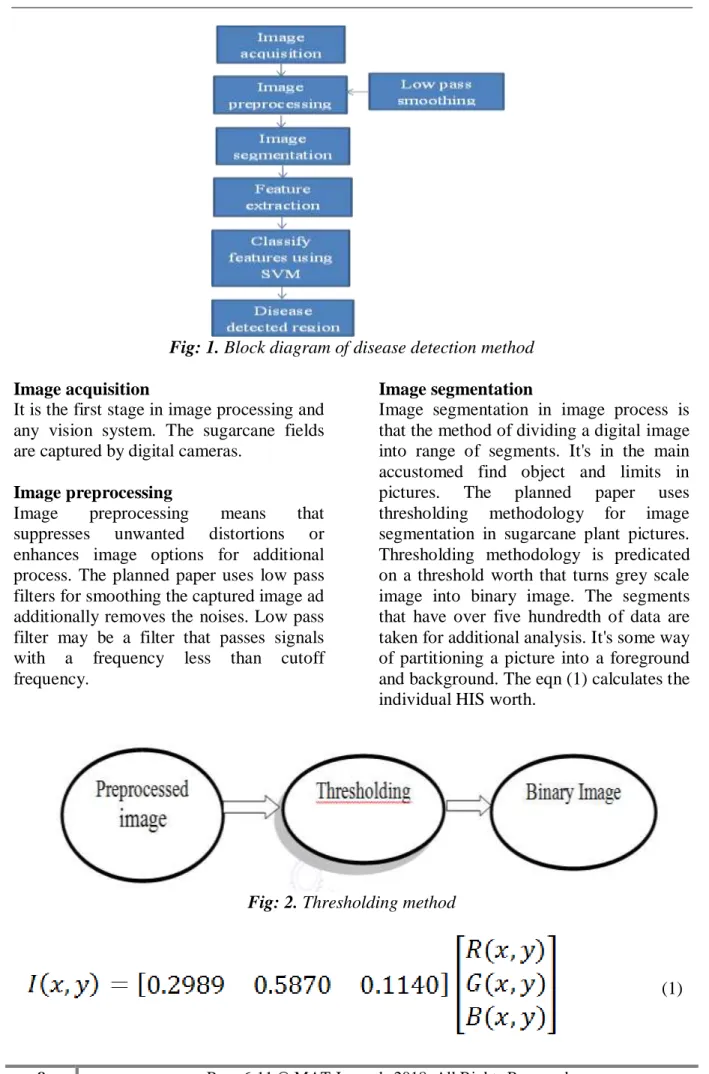
The sugarcane plant disease detection technique includes image acquisition, image preprocessing, image segmentation, feature extraction using GLCM, and SVM classifier to detect the infected regions of the plant.
The figure shows the block diagram for disease detection method in sugarcane plant. The initial step is image acquisition that is used to capture the digital images using digital cameras.
Then low pass filters are used to remove high spatial frequency noise from the captured digital images and improves the image quality. Masking is the process of setting the pixel value in an image to zero. In this technique, the specified threshold value is computed for mostly green colored pixels. If it is less than the pre-computed threshold value, the green, blue, red components of the pixel intensities are set to zero. The healthy regions of sugarcane plants are represented by using green colored pixels.
In segmentation, the infected region is segmental into range of patches. Helpful segments are obtained to classify the diseases. Texture options like form, color, texture etc. are extracted by victimisation GLCM feature extraction technique [10]. Finally diseases will be classified victimisation image classification technique referred to as SVM classifiers. The sugarcane diseases are detected mechanically and rate of accuracy is calculated
8 Page 6-11 © MAT Journals 2018. All Rights Reserved Fig: 1. Block diagram of disease detection method Image acquisition
It is the first stage in image processing and any vision system. The sugarcane fields are captured by digital cameras.
Image preprocessing
Image preprocessing means that suppresses unwanted distortions or enhances image options for additional process. The planned paper uses low pass filters for smoothing the captured image ad additionally removes the noises. Low pass filter may be a filter that passes signals with a frequency less than cutoff frequency.
Image segmentation
Image segmentation in image process is that the method of dividing a digital image into range of segments. It's in the main accustomed find object and limits in pictures. The planned paper uses thresholding methodology for image segmentation in sugarcane plant pictures. Thresholding methodology is predicated on a threshold worth that turns grey scale image into binary image. The segments that have over five hundredth of data are taken for additional analysis. It's some way of partitioning a picture into a foreground and background. The eqn (1) calculates the individual HIS worth.
Fig: 2. Thresholding method
9 Page 6-11 © MAT Journals 2018. All Rights Reserved texture of the infected areas are extracted
by victimization this system. A GLCM is a matrix where rows and columns are equal to the number of gray levels. In GLCM approach, the sugarcane RGB images are converted into HIS color space. Each pixel map is used to generate a color co-occurrence matrix that results into 3 color co-occurrence matrices for each HIS. SVM classifier
SVM classification is a two-class classification technique, which has to be modified to handle the multiclass tasks in real world situations. The main goal is to determine the accuracy of a classifier such as Support Vector Machine on object recognition and image classification. The SVM classifier is defined as, for given trained samples the algorithm outputs an optimal hyperplane which classifies new samples. After the extraction of features,
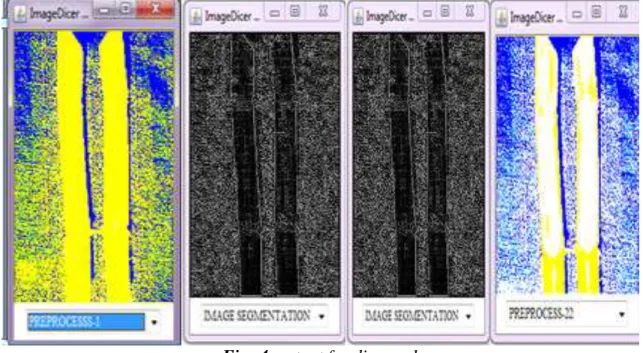
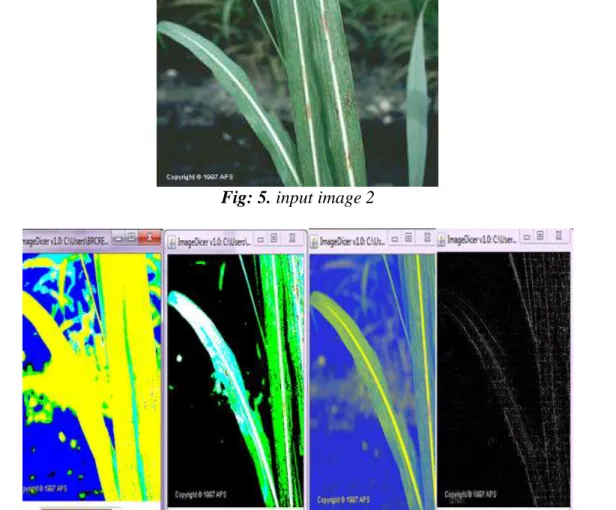
of R, G, B components of the image to the threshold images by using thresholding method and GLCM method is used for feature extraction. The detection accuracy or recognition rate of the proposed paper is 99.4% by using SVM classifiers. The fig.3 and fig. 5 shows the input images of sugarcane plant. The output images are in fig.4 and fig.6.
Fig: 3. input image 1
10 Page 6-11 © MAT Journals 2018. All Rights Reserved Fig: 5. input image 2
Fig: 6. output image for disease 2 CONCLUSIONS
This paper presents approaches used for detetcting and classifying the diseases on agricultural merchandise. The sugarcane disease pictures are taken as information samples. The low pass filter is employed for removing high spacial noises from the pictures. Then the GLCM feature extractor is employed to extract the feel chararcteristics of the image. Finally the SVM classifier is employed for automatic unwellness detetction. The planned paper yields 99.4% recognition rate than previous techniques.
REFERENCES
1. Husin, Zulkifli Bin, et al., "Feasibility study on plant chili disease detection using image processing techniques", Intelligent Systems, Modelling and Simulation (ISMS), Third International Conference on. IEEE, 2012.
2. E. Borges, A. Matos, J. Cardoso, C. Correia, T. Vasconcelos and N. Gomes, "Early detection and monitoring of plant diseases by Bioelectric Impedance Spectroscopy", Bioengineering (ENBENG), 2012 IEEE 2nd Portuguese Meeting in, Coimbra, pp. 1-4,2012.
3. Rocha, Anderson, et al., "Automatic fruit and vegetable classification from images", Computers and Electronics in Agriculture 70.1 pp. 96-104, 2010. 4. Y. Dandawate and R. Kokare, "An
automated approach for classification of plant diseases towards development of futuristic Decision Support System in Indian perspective", Advances in Computing, Communications and Informatics (ICACCI), 2015 International Conference on, Kochi, pp. 794-799, 2015.
11 Page 6-11 © MAT Journals 2018. All Rights Reserved Crop Diseases. International
Conference on Advancements in Information Technology.2011 IPCSIT vol.20 (2011).
7. Anand. H. Kulkarni, Ashwin Patil R. K. Applying image processing technique to detect plant diseases. International Journal of Modern Engineering Research.Vol.2, Issue.5, pp-3661-3664, 2012.
8. Smita Naikwadi, Niket Amoda. Advances in image processing for detection of plant diseases. International journal of application or innovation in engineering & management. Volume 2, issue 11, November 2013.
9. Piyush Chaudhary et al. Color Transform Based Approach for
Kartika Dewi3), R. V. Hari Ginardi4) International Conference on Information, Communication Technology and System, pp 93-98, 2014.
Cite as: Dr. R. Niruban, & R. Deepa. (2018). A Novel Mining Approach for Automatic Disease Detection in Sugarcane Plant using Thresholding Method. Journal of Computer Science Engineering and Software Testing, 4(3), 6–11. http://doi.org/10.5281/zenodo.1458 988