POSITIONING PAPER OF I2CAT
I2CAT Foundation
Edifici Nexus I, 2ª planta 08034 Barcelona
Phone: (+34) 93 553 25 10
Fax: (+34) 93 553 25 20
[Type text]
Page 1 of 6
Positioning paper from i2CAT
This positioning paper is submitted by i2CAT Foundation towards PPP initiative related to the needs of the usage areas, focused on contents, and their requirements on the Future Internet.
Taking advantage of the existing networks infrastructure in Europe, the scenario most appropriate is a trans-European high quality networked media service (for 2K/4K, 2D/3D video formats and beyond) in support of content repositories. The use cases can be diverse and related to the needs of different user groups, for example:
Human and veterinary medicine. Users in these groups need high quality media for recordings of examination and surgery. High quality media is needed because of level of detail for recorded object. These recordings shall be used for both research and medical practices.
Traffic research group users need to visualize traffic flows and density in very high resolution because of need of complex view to the traffic system without loss of detail.
Restoring cultural heritage groups need high quality media for being able to get a global view when restoring details in old objects. This use is not limited to film, but also for paintings, sculptures and other 3D objects.
Cultural interchange, nowadays people not only wants to consume digital culture all over the but also to create local culture, digitalize it and share it with others. HD, 3D… devices are arriving anywhere creating new necessities of information transport, indexing, localization and visualization.
Social science researchers and biologists need to have complex view to social systems, but they need to be able to track one entity within the system. Without very high definition picture they will lose detail level or complex view.
From the general user perspective, as the amount of archived content data rapidly increases, there is an increasing requirement for visualizing, delivery, adaptation and advanced real time processing in order to aid the management, sharing and dissemination of digital content, by using some functionalities such as context awareness enabled service composition.
The expected functionalities are, among others, advanced visualization, storage, and stream of media content; video requirements and user capabilities adaptation; an advanced networked
2
distributed storage; an advanced network able to integrate and test Future Internet architectures in these scenarios.
Following the PPP point of view, Media should create new connections between users and their associated communities and new applications and their related technologies creating new Business models, presented as a generic enabler.
Consequently, these functionalities have to allow the provision of a user-driven set of innovative media services for storage, searching and location of media content; networking streaming of such a content; and adaptive visualization of such content.
The experimentation environment necessary for broad large scale testing of the platform is the interconnection of existing scenarios running successfully in smaller scale, but with the previous successful experience.
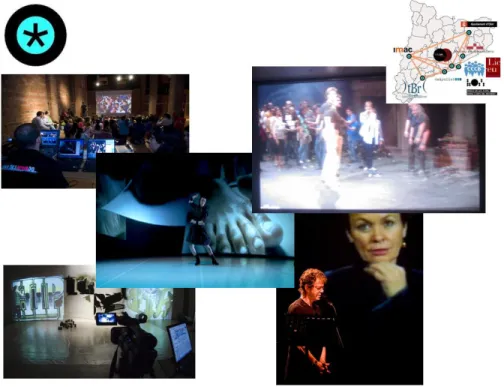
In this aspect, i2CAT can provide its own successful experiences. For example, i2CAT has created the Cultural Ring, a regional scenario with 14 interconnected cities in the Catalan territory and 19 interconnected cultural centers. Within this experience, 59 events have been programmed
(accumulative to February 2010) of different targets (11 Operas; 5 Festivals; 16 Literature/poetry; 18 Debates/formation; 1 guide tour of an exhibition; 1 Theatre; 1 visual arts production; 6 others).
3
The accumulative audience has achieved the number of 17.800 people, 3.500 hours of digital stored Cultural content.
The next steps are, in 2010, to interconnect between 5 to 15 more cities, start 3 International Projects (South-America, Canada, Center-Europe), to formalize the management team of the Cultural Ring and to share more than 25 new events.
Figure 1. The Cultural Ring
Examples of these experiences can be fed up, with additional centers around Europe, and additional services, increasing the quality of the media exchanged, and, the most important issue, with real users.
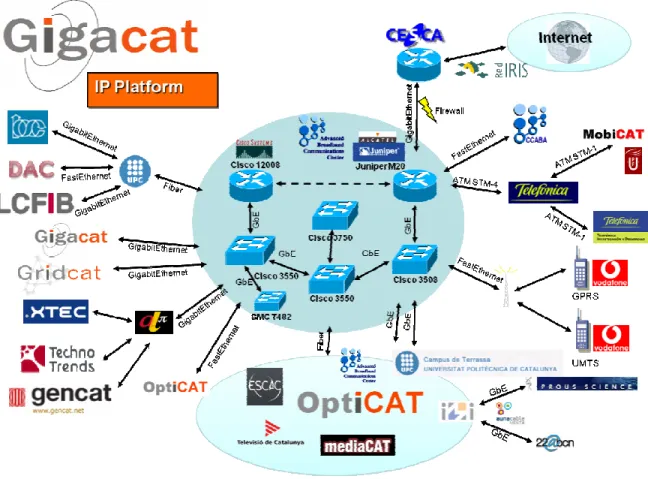
i2CAT is a center of research and innovation, which focuses its activities on the development of the future Internet. It is organized by clusters and platforms. Clusters are strategic research units that link universities, administrations and businesses that share interests in the same subject or sector within the field of advanced Internet research. The i2CAT platforms offers to the different clusters a network infrastructure and the services necessary for the proper functioning of the entire work environment, research and development of the i2CAT projects.
These platforms equipped with the latest hardware and software not only administer but also research every day to improve different aspects of the foundation, from knowledge sharing to the latest technology in high capacity networks. We can distinguish two platforms:
4
NetCAT: Specialized in the design, installation and network management. This platform is connected to major research networks in the world who participates in different international projects: Anella Cientifica, RedIris, GÉANT2, Glif, Internet2. NetCAT should be seen as a
heterogeneous network (electrical, optical and wireless links), ready to be used as a testbed for this innovative core platform, and used for new media experiments.
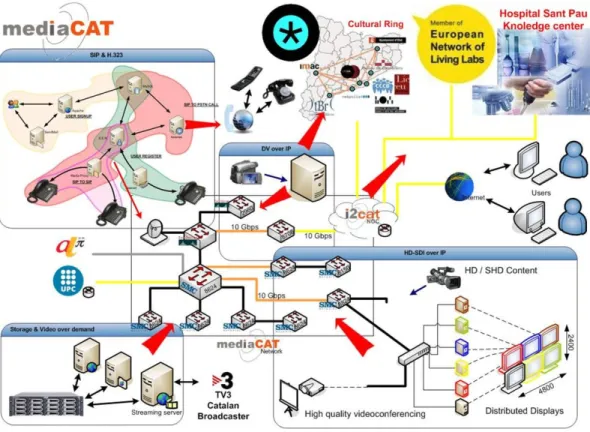
MediaCAT: Specialized in software services, multimedia and server management. This platform allows the transmission andvisualization of any kind of media contents , including uncompressed HD (2K, 4K) and 3D.
5
Figure 3. mediaCAT platform
The experience of i2CAT, additionally to the Cultural Ring example of project, is aligned with several generic enablers applied through the both above-mentioned platforms. In End-user access,
adaptation and composition of Resources (GE 4.1), i2CAT has participated in two Spanish Cenit projects (i3media and Vision), in telco infrastructure, context-awareness and content provisioning. In Service Handling and SOA Support (GE 4.2), two Celtic-Eureka projects (HDVIPER and
HIPREMED), in interactive service provisioning, continuous media control and dynamic service composition in Future Internet; this last topic is being standardized in ISO JTC1 SC6 WG7 with the relevant participation of i2CAT. In Service Preferences, profiling and context (GE 4.5), within the Spanish project i3media, customization, context gathering, context management, context processing, and recommendation and location services. Finally, in Content Delivery Network and Video, within FP7 Visionair project, the Network of Excellence EURO-NF, the Celtic Eureka project DRMSolutionNG and the Spanish Cenit project Vision, in 3D multipoint distribution and signaling, distribution content delivery, P2P, multimedia coding (SVC, MDC) and content management.