9/85
REl!R
TECHNICAL NOTECS-fY’lR-3,1
SELECTION OF A CRACK REPAIR I’v’!ETHOD
PURPOSE: To point out essential considerations in selecting a method for repair of cracks in concrete structures and to provide general guidance on how to select a repair method.
APPLICATION: This technical note should be consulted before any of the
methods described in REMR Technical Notes CS-MR-3.2 through 3.11 are applied. IDENTIFYING CAUSES OF CRACKS: Successful repair of cracks in concrete depends upon identifying the cause or causes of the cracks and selecting a repair method or methods that will take the cause into account. Conditions that can
cause cracks are listed in Table 1 along with a general guide to whether the crack being considered will remain “active” or “dormant”. Active cracks are defined as those for which the mechanism causing the cracking is still at work. (Any crack for which an exact cause cannot be determined is considered to be active.) Dormant cracks are those which were caused bv a condition which is not expected to recur.
PROCEDURE FOR IDENTIFYING CAUSES OF CRACKS: The steps outlined below will assist in
a.
b.
c.
d.
Identltying the cause ot cracking.
Step 1. Examine the appearance and the depth of the cracking to establish the basic nature of the occurrence:
10 Pattern or individual cracks? 2. Depth of cracks?
3. Open or closed cracks? 4. Extent of cracking?
Step 2. Determine when the cracking occurred. This step will require talking with the individuals who operate the structure and possibly those involved in the construction.
Step 3. Determine if the cracks are active or dormant. This step may require monitoring the cracks for a period of time to determine
if crack movement is taking place. Also, attempt to determine if crack movement detected is growth or simply cyclical opening and closing such as caused by thermal expansion. Cracks which are moving but not growing should be treated as active cracks.
Step 40 Determine the degree of restraint. This step will require a thorough examination of the structure and the construction
drawings, if available. Both internal restraint (caused by reinforcing steel, embedded items, etc.) and external restraint
Table 1 Cause Accidental loading Design error (inadequate reinforcement) Temperature stresses (excessive expansion due to elevated temperature and inadequate expansion joints) Corrosion of reinforcing steel Foundation settlement Alkali-aggregate reaction Poor construction procedures (inadequate curing, formwork, etc.) Design faults
–-use of exposed rigidly connected material to concrete which has a much different modulus of expansion
––stress concentrations –-faulty joint systems
Type of Crack Active x x x x x x Dormant x x x Comment
Limit loading according to cur– rent capacity and repair, or re-design and repair as indicated by the redesign
It may be desirable to redesign to include adequate expansion joints
Simple crack repair methods should not be used as the steel will continue to corrode and crack the concrete
Measurements must be made to de-termine if the foundation is still settling
Concrete will continue to deter-iorate as long as moisture is present. Crack repair methods will be ineffective
NOTE : This listing is intended to serve as a general guide only, It should be recognized that there will be exceptions to all of the-items listed.
(caused by foundation conditions, bonding to other concrete, or adjacent structures) must be considered.
REMR TN CS-MR-3 .1 9/85
gained in Steps 1 through 4 and the guidance presented in Table 1. A checklist for determining the cause of cracking is presented below. Using the checklist, eliminate as many potential causes as possible. If more than one potential cause remains, the final ~ determination may require a laboratory analysis of concrete samples or a detailed stress analysis.
1. Check for major errors in design. 2. Check easily identifiable causes:
(a) Corrosion of reinforcement. (b) Accidental or impact loading. (c) Poor design detailing.
(d) Foundation movement. 3. Check other possible causes:
(a) Incidents during construction. (b) Shrinkage induced stresses. (c) Temperature induced stresses:
1
Consider (1) During hydration. restraint! (2) Posthydration.(d) Volume changes:
(1) Chemical reactions. (2) Moisture changes. (3) Freezing and thawing.
SELECTING AN APPROPRIATE CRACK REPAIR METHOD: Once the cause of the cracking has been established, the following questions should be answered based upon knowledge a. b. c. d. e. f.
of the cause of the crack:
Is repair indicated? Repair of cracking caused by expansion products of internal chemical reactions may not be feasible.
Should the repair be treated as spalling rather than cracking? If the damage is such that loss of concrete mass is probable,
treatment of the cracks may not be adequate. For example, cracking due to corrosion of embedded metal or freezing and thawing would be better treated by removal and replacement of concrete than by one of the crack repair methods.
Is it necessary that the condition causing the crack be remedied? Is doing so economically feasible?
What will be the future movement of the crack? Is strengthening across the crack required? What is the moisture environment of the crack?
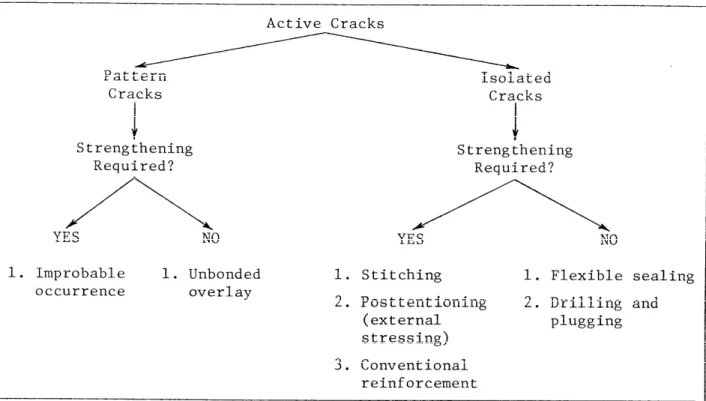
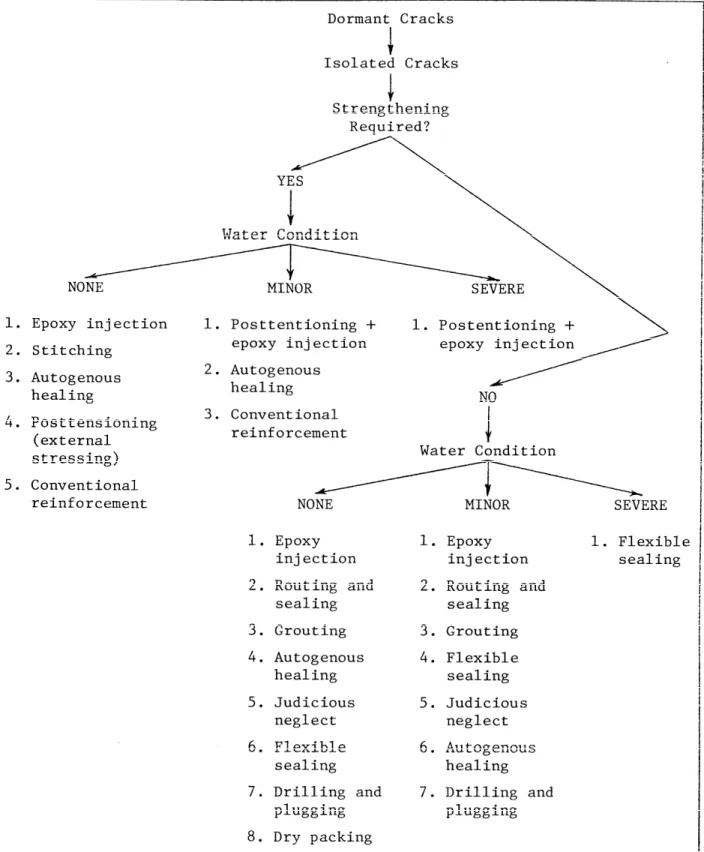
Once these questions have been answered, potential repair methods can be selected as outlined in Figure 1 through 3. Use of Figures 1 through 3 may lead to consideration of several applicable crack repair methods. Final selection of a method and a repair material should take into account ease of application, durability, life-cycle cost, available labor skills and equipment, and appearance of the final product.
Active Cracks Pattern Isolated Cracks / Cracks / Strengthening Strengthening Required? Required? AA YES NO YES NO
1. Improbable 1. Unbended 1. Stitching 1. Flexible sealing occurrence overlay
2. Posttentioning 2. Drilling and
(external plugging
stressing) 3. Conventional
reinforcement
Figure 1. Selection of repair method for active cracks
Dormant Cracks 1 Pattern Cracks 1 Strengthening Required? YES 1. Improbable occurrence / Water Condition 4
NONE MINOR SEVERE
1. Routing and sealing 1. Routing and sealing 1. Overlay
2. Judicious neglect 2. Overlay 2. Polymer impregnation 3. Autogenous healing 3. Judicious neglect
4. Overlay 4. Autogenous neglect 5. Polymer impregnation 5. Polymer impregnation
REMR TN CS-MR-3.1 9/85 1. 2. 3. 4. 5. Dormant Cracks
I
Isolated Cracks Strengthening Required? YES I Water ConditionNONE MINOR SEVERE
Epoxy injection 1. Posttentioning + 1. Postentioning + Stitching epoxy injection epoxy injection
2. Autogenous Autogenous healing healing NO Posttensioning (external stressing) Conventional 3. Conventional I reinforcement # Water Condition reinforcement NONE 1. Epoxy injection 2. Routing and sealing 3. Grouting 4. Autogenous healing 5. Judicious neglect 6. Flexible sealing 7. Drilling and plugging 8. Dry packing 1. 2. 3. 4. 5. 6. 7. MINOR Epoxy injection Routing and sealing Grouting Flexible sealing Judicious neglect Autogenous healing Drilling and plugging SEVERE 1. Flexible sealing
Figure 3. Selection of repair method for dormant isolated cracks
JUDICIOUS NEGLECT: In some instances, particularly for dormant cracks and cracks caused by alkali–aggregate reaction, the best treatment may be no treatment at all. If there is no moisture problem, this approach should be considered.
Johnson (Ref a) writes:
Dormant cracks, such as those due to shrinkage or to some inadvertency in construction such as premature removal of the forms or settlement of the sills supporting the shores, frequently are self–healing. This does not imply an autogenous healing and gain of strength as described above, but merely that the cracks clog with dirt, grease, or oil, or perhaps a little recrystalliza-tion occurs, and so on. The result is that the cracks are plugged (or sealed, if you will), and problems which may have been en– countered with leakage, particularly if leakage is due to some intermittent cause rather than to a continuing pressure head, will disappear without doing any repair.
Perhaps this is not engineering, but it works, and where there is a chance that it will occur, if aesthetic considerations permit, and if there is time to give it a try, it is by far the best answer.
Judicious neglect will certainly be an attractive repair method from a cost standpoint.
REFERENCES: a. Deterioration, maintenance, and repair of structures. S. M. Johnson. McGraw Hill, New York, 1965.