University of Mississippi University of Mississippi
eGrove
eGrove
Honors Theses Honors College (Sally McDonnell Barksdale Honors College)
Spring 5-9-2020
An Analysis of Accounting Principles As Seen Through Case
An Analysis of Accounting Principles As Seen Through Case
Studies
Studies
Brooke Baumgardner University of Mississippi
Follow this and additional works at: https://egrove.olemiss.edu/hon_thesis
Part of the Accounting Commons
Recommended Citation Recommended Citation
Baumgardner, Brooke, "An Analysis of Accounting Principles As Seen Through Case Studies" (2020). Honors Theses. 1304.
AN ANALYSIS OF ACCOUNTING PRINCIPLES AS SEEN THROUGH CASE STUDIES
By
Brooke Baumgardner
A thesis submitted to the faculty of The University of Mississippi in partial fulfillment of the requirements of the Sally McDonnell Barksdale Honors College.
Oxford May 2020
Approved by
____________________________________ Advisor: Dr. Victoria Dickinson
____________________________________ Reader: Dr. W. Mark Wilder
ABSTRACT
BROOKE BAUMGARDNER: An Analysis of Accounting Principles as Seen Through Case Studies
(Under the direction of Dr. Victoria Dickinson)
This document represents the work done over the course of a year under the direction of Dr. Victoria Dickinson in Professional Research and Development Thesis Program at the University of Mississippi. The purpose of this program is to allow students who plan to work in a professional field to complete a thesis which is more applicable to their future endeavors than a traditional thesis. The twelve case studies that are completed and represented within this thesis were chosen to cover a variety of accounting topics that are similar to what students entering this field will see on a day-to-day basis. By completing these cases, students are able to see how the principles and theories that are taught in lecture have suitable applications to real world situations. Additionally, the completion of a number of these case studies required a group effort, a condition that allowed students to work on their communication skills and gain additional practice in delegation – skills that are essential to be successful in the professional accounting sphere.
TABLE OF CONTENTS
LIST OF FIGURES……….v CASE STUDY ONE: Data Analytics – Tableau………...………..1 CASE STUDY TWO: Rocky Mountain Chocolate Factory, Inc. – Preparing Financial Statements………...7 CASE STUDY THREE: Debate Concerning Internship and Recruiting Ethics………...14 CASE STUDY FOUR: Generic Bank: Accounting for Debt Securities Sales and
Impairments………..…….19 CASE STUDY FIVE: City Selection Case………...26 CASE STUDY SIX: WorldCom, Inc. – Capitalized Costs and Earnings Quality...37 CASE STUDY SEVEN:Starbucks Corporation – Understanding Financial
Statements...44 CASE STUDY EIGHT: BP p.I.c – Contingencies...58 CASE STUDY NINE: The Wendy’s Company Equity Method
Investments...67 CASE STUDY TEN:Johnson & Johnson Retirement Obligations...77 CASE STUDY ELEVEN: On the Balance Sheet-Based Model of Financial Reporting..88 CASE STUDY TWELVE: Google Inc. – Earnings Announcements and Information Environment...99 WORKS CITED...105 THE HONOR CODE...106
LIST OF FIGURES
CASE STUDY TWO: Rocky Mountain Chocolate Factory, Inc. – Preparing Financial Statements
Figure 2-1: Summary of Case/Learning Moments and Requirement A...8 Figure 2-2: Rocky Mountain Chocolate Factory General Journal...9-10 Figure 2-3: Rocky Mountain Chocolate Factory Income Statement...11 Figure 2-4: Rocky Mountain Chocolate Factory Balance Sheet...12 Figure 2-5: Rocky Mountain Chocolate Factory Cash Flow Identification...13
CASE STUDY FIVE: City Selection Case
Figure 5-1: Monthly Operating Budget – Houston...31 Figure 5-2: Monthly Operating Budget - Austin...36
CASE STUDY SEVEN: Starbucks Corporation – Understanding Financial Statements
Figure 7-1: Common-Size Balance Sheet...56 Figure 7-2: Common-Size Income Statement...57
CASE STUDY TEN: Johnson & Johnson Retirement Obligations
Case Study One
1. Introduction
a. The purpose of this case was to introduce students to the up-and-coming and current technology being used in public accounting. This case also allowed students to explore how these technologies could affect the work that they will be doing once they begin working in the areas of audit and tax and how they could further improve the profession in the future. The particular data processing software researched by my group was Tableau, a program that allows users to create visual representations of large amounts of data for more efficient data analysis.
From this activity, I have gained an insight into the convergence of
technology and audit and tax, a pairing that I was not extremely familiar with. With this new knowledge, I feel that I am more prepared to exceed the
expectations regarding data processing software that my future employer may have of me compared to my peers who have not been introduced to this topic.
2. Identify the purpose of this tool and describe, in general, how it is used to make business decisions.
a. In the past, there have been various issues in the business world that stem from an inability to quickly analyze vast amounts of data. One solution to this problem is Tableau. This tool, Tableau, allows users to turn large swaths of data into simple to understand visuals. Separating it from similar data
processing systems is its incredibly user-friendly interface, which allows those with all levels of technological skill to obtain useful information from the
program. A visual representation of data would greatly increase the data transparency across industries, as the data can be compared to similar data within the industry. In day-to-day business operations, this transparency would expedite multiple business processes as associates would no longer have to dig through data in order to make a well-educated decision.
3. How, specifically, would you use the tool in the following business settings? Create at least three specific scenarios for each category in which the tool would lead to more efficiency and/or better effectiveness. Be sure to describe what kinds of data your tool would use for each scenario.
a. Audit
1. One feature of the Tableau program is the ability to input data from accounts such as sales and returns to analyze trends. During an audit, this trend analysis would make detecting an unusual trend or finding a numerical outlier very simple. The auditor could then pull that particular piece of data and attempt to deduce what the issue may be.
2. Also using the trend analysis feature, it would be possible for an auditor to compare the company’s growth rate to average growth rates in the industry. If the company is doing well above the norm or are on a trend curve that does not reflect the current state of the economy, it may give the auditor a reason to look further into their revenue and expense accounts.
3. A few stand-out features of Tableau are its ability to allow users to select only certain data series to display at one time and allowing multiple users to access the same file simultaneously. This would expedite the auditing process as many associates could be reviewing several accounts at one time. Also, this would allow time for reports to be checked by multiple people.
b. Tax
1. The Tableau program also contains various forecasting features. By using this, companies would be able to input their data, along with tax codes from
multiple nations, to see where they would have the lowest tax liabilities when considering expansion into international markets.
2. Also using the forecasting feature, it would be possible to determine a company’s future tax liabilities if they continue to grow at a constant rate. However, it would also be possible to predict future tax liabilities if the company performed better or worse than expected. This would allow companies to at least be aware of what taxes they may be responsible for in the future.
3. The visualization abilities of Tableau would allow companies to see the areas of operation where they are most heavily taxed. By doing this, companies would be able to decide if operation should continue or cease in these highly taxed areas depending on their revenues and expenses, among other factors.
4. Write a few paragraphs to your future public accounting partner explaining why your team should invest in the acquisition of and training in this tool. Explain how the tool will impact the staffing and scope of your future engagements.
a. Dear Sir or Madame,
After reviewing the data processing program Tableau, I believe an investment in this technology would be beneficial for the team. The data visualization this program provides would cut down on the amount of time it takes to process accounts during the auditing process. It also allows for future projections, a feature that would aid associates while consulting with companies regarding tax liabilities.
Additionally, the visual aspects of this program would allow those who are not traditionally trained in data analytics to easily interpret said data. These individuals could then also offer valuable input on the account and how it should be handled.
The time saved by no longer having to manually analyze accounts would allow associates to handle multiple clients at once, as well as reducing the number of hours they have to spend on individual clients. This time could then be used to process more clients or for staff development to ensure that the associates are up to date on training for the Tableau program.
I truly believe that this technology would benefit the firm and I thank you for taking the time to consider investing in this software. I look forward to hearing your decision.
Best,
Case Study Two
Rocky Mountain Chocolate Factory, Inc. –
Preparing Financial Statements
a. Prior to examining the company’s actual balance sheet, read the description of Rocky Mountain Chocolate Factory, above. What accounts do you expect to see on the balance sheet? Which accounts constitute the major assets? Which accounts constitute the major liabilities?
b -g, i . All transactions for requirements b -g and requirement i are included in the diagrams provided in this and the next page.
h. Construct an income statement for the year ended February 28, 2010. Use the headings from your spreadsheet rows as the account titles.
j. Prepare the February 28, 2010, balance sheet. Use the headings from your spreadsheet rows as the account titles.
k. For each transaction, indicate whether the transaction would appear in the “operating,” “investing,” or “financing” section of the statement of cash flows.
Case Study Three
Debate Concerning Internship and Recruiting
Ethics
1. Introduction
This case was very interesting as it was mainly based on the varying opinions of my classmates, myself, and Dr. Dickinson. Central topics in this case included various situations regarding internships and how they function for students and the Patterson School of Accountancy and plans for life after the undergraduate program, including graduate school, law school, and entering the workforce.
I believe that this case was beneficial for my classmates and I as it allowed us to voice our individual opinions in a way that allowed us to truly take into account all that was being said and adapt our personal opinions if we felt moved to do so. Also, the input from Dr. Dickinson, as a member of the faculty who has an abundance of experience with accounting internship placement and the aftereffects, was personally extremely helpful as she was able to answer many of my questions concerning this topic.
2. Situations Debated
a. The first situation discussed revolved around an accounting student pursuing an accounting internship while knowing they ultimately wanted to attend law school. This posed the question of is it okay to accept an accounting internship while fully knowing that you do not plan to continue your employment with that firm after the internship has concluded?
Personally, I believe that this would be an unwise decision to make as a student as it makes it appear that the School of Accountancy is unable to provide firms with students who will ultimately turn a profit.
Additionally, one large stipulation of the student’s plan to go to law school involved the fact that one of their relatives made a very high salary practicing tax law at a law firm in New York City. I think that this fact can be almost completely discounted as salaries are often related to the cost of living in the area in which you are working. In New York City, where the cost of living is ridiculously high, it makes sense that the relative would be making a very large salary compared to someone doing the same work in the Southeast where the cost of living is much lower.
b. The second situation featured multiple students discussing their uncertainty about future plans, whether that be working in a public accounting firm or entering another sector of the business world, such as Investment Banking and Finance. The question posed in this discussion centered around the idea that it is okay to use an accounting degree and internship as a sort of spring board into other areas of business or to help you decide where you see your future career going.
Personally, I completely agree with the position that these students took. As accounting is “the language of business”, an accounting degree can be extremely versatile for all areas of business. Also, as there is not normally a direct route from undergrad to something more specialized like Investment Banking and Finance, accounting provides individuals a place to hone their business skills and discern what avenues they might want to explore in the future based on their interests.
The last scenario involved a student communicating with Dr. Dickinson their desire to transfer an offer of employment within a firm from the office that they completed their internship at to one closer to home. The question that stemmed from
this dilemma was is it okay to request to transfer offices after you have only completed a ten-week internship there?
As someone who has moved many times, it is sometimes easy to tell whether you are going to enjoy living in a certain place a relatively short time into your stay there, but I have also had experiences in which it took a little bit of time to acclimate to the new environment and become comfortable there. I think that one main factor of accounting internships that scare students is the process of picking what city you want to intern in, as this is most likely where you will be (or at least should be) beginning your career and spending around the first three years of your professional life. This can be a bit overwhelming for a twenty-year-old college student. This may lead to the low rates at which offices are having of students returning to work full time after internships as some students quickly decide on a city based on how “cool” they think it will be for the ten weeks and now how well they will like it for three years.
While I do think that it would be okay for this student to request a transfer, I would recommend that they be extremely transparent with the firm as to why they would like the transfer. Also, they should not be surprised if the transfer is not immediately approved, as, especially in Dallas, there are many other schools besides Ole Miss that feed into the firms.
Overall, I believe that the key for all of these situations is being transparent with the firms about what your future plans and ambitions are during recruiting so that you are both on the same page throughout the entire process. It is also very important for current accounting students to remember that the fantastic relationships that the
developed over many years through the hard work of the faculty and past students. Thus, it is the current students’ responsibility to ensure that these relationships remain in good shape for future generations of Patterson School Students.
Case Study Four
Generic Bank: Accounting for Debt Securities
Sales and Impairments
1. Introduction
This case, presented by Dr. Brett Cantrell, focused on how banks determine if impairments will be applied to their various investments in debt securities if they are sold. In order to correctly complete this case, it was necessary to research the effects of these impairments and how they are
determined in the FASB codifications. This case also required the student to look into topics that had been unexplored in class up to this point, such as the process to sell a debt security, the requirements for a debt security to receive an
impairment, and what debt securities and impairments are. It also introduced students to some of the investing activities that banks engage in besides providing commercial and consumer loans.
I personally found this research to be interesting as I had never had the opportunity to actually look into the codifications that are discussed so frequently in class. I believe that this was a beneficial case to complete as a class because I, as well as my peers, have had very little exposure to things concerning
impairments on debt securities. Before this case, I had heard of debt securities but I was completely unaware of the technicalities that have to be met in order to trade these kinds of investments. Yet, due to the fact that the recession of 2008 and 2009 was due to defaulting on these securities, I am not surprised that the code has been updated to clarify and specify the regulations concerning these debts.
Requirements
1. Assume that Generic Bank does sell the aforementioned securities shortly after year end in early 20x3. Does Generic Bank have and impairment loss on the seven securities designated above in 20x2?
As specified in the ASC 326-30, the first step in determining if an impairment should be placed on a security is deciding whether the decrease in value comes from a fear of not being able to have the debt payed off, or if it is due to outside market forces. If it is decided that the change has to do with market conditions the next explored area will be the security’s market price compared to its amortized price. Also taken into consideration is if the bank plans to continue to hold ownership of these securities until the market price more closely aligns with the amortized price.
When looking at the securities that Generic Bank wishes to sell, they all fulfill the requirement of having a loss stemming from a market cycle. The bank is also planning on selling all the aforementioned securities, so the stipulation concerning holding securities until the market rebounds can be disregarded. However, when more closely examined, there are multiple securities whose market value is higher than their amortized value. This includes the securities with the CUSIP numbers 067 and 096, which have amortized values $16,338 and $7,867 respectively over market value.
2. Assume that Generic Bank does sell the aforementioned securities shortly after year end in 20x3. Does Generic Bank have an impairment loss on securities other than the seven securities sold? If so, how would you determine the extent of the impairment?
In order to have a recognized impairment loss, the bank would have to actually sell additional securities as impairments are not recognized on securities that the establishment shows intent to hold until market stabilization occurs. However, if the bank decided to sell other securities that it currently holds, there would be multiple that would receive impairments.
In the future, the bank may face more impairment issues due to the fact that they did sell seven securities at one time. This makes it appear that the bank is not willing to hold onto securities until the market is able to recover and it quick to dump anything that is causing a loss. Nonetheless, this may also be offset by the fact that the bank is in a very strong position financially.
In order to calculate what this impairment would be, the difference between the market value and amortized value is taken and is applied as a credit towards the amortized balance. This allows the security to be written off when it is sold at market value.
3. Does your answer change if you assume the role of Heather Herring, the external auditor? Does your answer change if you assume the role of a bank regulator? What other factors might an external auditor or regulator consider in making their determination?
On the surface, it may seem that different individuals involved in this issue would have drastically differing views on the topic based on their specific motives. I disagree with this notion. I believe that if these individuals are truly following the FASB codification, which they should be as it covers both audit and internal regulation, they would perhaps have a small difference of opinion on some nuisances of the deal, but overall, they should agree.
The main factors that both of these individuals should be taking into account should be how these impairments are decided according to the FASB codification. If these regulations are followed, the difference in opinion come down to what areas of the business they are interested in based on what the person’s position in relation to the company is.
As an auditor, Heather Herring may focus more on the timing of when these debt securities are being sold, as this may directly relate to the overall financial health of the bank and may reflect how other areas of the business are preforming. If you assume the role of the bank regulator, you may be more concerned with how selling these specific securities will affect the value of the rest of the bank’s portfolio and if it would be more profitable in the long run to hold onto the securities until market conditions improve.
4. How would your assessment of the existence of an impairment in both requirements 1and 2 change if the securities sold had been collectively in a net gain position? What if all the securities sold were in gain positions?
If the securities sold had been collectively in a net gain position, it would be necessary to look at each security on an individual basis. If one specific security had a higher market value than amortized value, then there would be no reason to place an impairment on that security. Oppositely, if there was a security that had a lower amortized value than market value, it would make sense to place an impairment on the security. Another aspect to consider is that if they did not cause the bank to take a loss overall, then there would be less of a reason to place a collective impairment on the securities.
If all of the securities were sold in a gain position, there would be no reason to place impairments on any of them as their sale is adding value to the company and is not negatively affecting its financial position.
5. Assume that Generic Bank does sell the aforementioned securities shortly after year end in early 20x3. Does Generic Bank have an impairment loss on securities other than the seven securities sold?
As the bank is in the process of restructuring to improve its financial position, there may be multiple impairments placed on its securities. If the market value and amortized values are the same as they were when the bank was in better standing, there would be reasoning for impairments to be placed on these debts. Also, even though the securities were not sold in the year 20x3, there was intent to sell in the year 20x3.
Alternately, the fact that the bank is only selling its riskiest assets reflects positively on the status of the rest of their securities, as they do not seem to have any plans to sell anything that they consider to be a safe investment. I also think that this reflects positively overall on the bank as they have a plan to improve their economic position. Similar to the situation in requirement two, I do not believe that there would currently be any additional impairments on securities not being sold as they do not meet the requirement of intent to sell.
Case Study Five
1. Introduction
The purpose of this case was to explore various aspects of two cities that we were considering starting our careers in upon graduation. Many different characteristics of the cities were discussed, including the topography, living costs, and plans to travel back home. At the conclusion of the case, students were asked to choose which city might be a better fit for them and explain the rationale behind their decision.
Overall, this case was very helpful in helping students who are trying to decide what city they may want to live in post-graduation as it brings up many issues that are often not thought about before making a move, such as where to buy groceries and how laundry is going to be done. Personally, I have had a very strong pull to Houston for my entire college career, so this was a fun case to be able to learn a little more about the city that I would love to end up in.
2. City #1 – Houston, TX
The first city that I am interested in living in upon graduation is Houston, TX. The current population of the city is 2.313 million. As I have lived in small towns for the majority of my life, I think that living in a large city would be a nice change. Houston’s climate is technically classified as humid subtropical, with highs in the 100’s during the height of the summer, and lows in the 40’s in the winter. However, one weather problem that Houston is very susceptible to is flooding, as it is low-lying and close to the Gulf of Mexico. As this is the climate of my hometown, I am very comfortable with this.
As most of the city was built on a bayou, the overall topography is relatively flat. One feature that distinguishes Houston from many other cities in Texas is its extensive highway system downtown that weaves in and out of the existing buildings. There are also various parks throughout the city and the beach is only an hour away if you need a break from the hustle and bustle.
One advantage of living in Texas in general is the fact that there are no local or state income taxes. However, they more than make up for it with higher property tax rates. Applying this, I would have to pay around $10,000 a year in federal income taxes. Property tax wise, it depends on the specific area you live in, but the median rate is around 2.3 percent. As I plan to live at home for my first year, property tax would not directly affect me, but as soon as I began to pay rent to live closer to downtown, this tax would be built into rent payments.
There are many different options for public transportation downtown, including both a METRORail and a MetroBus system. Taxis also have a $6 flat rate for any trip in the downtown area. However, the majority of young
professionals working and living downtown that I have spoken with say that it is very common to just walk to work.
The majority of companies based in Houston are in the Energy sector, namely oil and gas. Personally, I do not know much about the oil and gas industry, but I would be very interested to learn about the structure and procedures of the companies that provide the country with energy.
As Houston is one of the largest cities in the country, it has a very large medical presence. In fact, the Texas Medical Center, the largest medical center in the world, is just 10 minutes from downtown. Additionally, there are several MD Anderson centers throughout the city. I would feel very comfortable being able to access any kind of medical care I might need in Houston.
As there is a large population in Houston, there is somewhat of a high number of crimes. However, the majority of crimes are property crimes – mostly theft from vehicles – and not violent crimes. The violent crimes seem to be concentrated in the South Union area, so I would be sure to avoid that area. The high numbers do not make me quite as nervous once the population number is taken into account.
For the first year of my career, as my family is only 35 minutes from downtown, I plan to live at home to save up money for rent and future expenses, such as a car. Once I move downtown, I plan to live in the Midtown area, which is very popular with young professionals. After looking at apartments online, I believe that after 2 years I would have an accumulated rent cost of $21,948. This is based on a unit that is 1,293 square feet, has 2 bedrooms, 2 bathrooms, in-unit laundry, and an option for on-site parking for an additional $40 a month. I would
The typical mode of commuting for professionals living and working downtown is walking to work or using the METRORail. Depending on the exact location of where I live, I can see myself using either one of these options. Uber and other ridesharing apps are also very popular downtown. I believe that my commute time, even on busy days, would be no more than 30 minutes as the midtown area is very close to where multiple firm’s offices are downtown.
There are multiple grocery stores around the midtown area, including a Randall’s, an H-E-B, and a Whole Foods. I am honestly surprised that there were so many food shopping options in this area. Laundry wise, most apartment units in the midtown area have in-unit laundry, so that would not be a problem. Once I have moved to Houston, I would like to get involved in a church, although I am not opposed to driving back to the one I currently attend at home on Sundays. I would also like to get involved with the Houston Food Bank and the Houston Humane Society. I believe that volunteering in your community not only helps the community, but gives you an internal feeling of accomplishment.
While living in Houston, there are many sporting events that I would love to attend, including Astros, Texans, and Rockets games. Additionally, there are multiple concert venues in Houston including the House of Blues and the Toyota Center that would allow me to attend many performances. Another activity that I would enjoy doing in Houston would be going to the Houston Ballet. I would love to live in a city that allows for so many different entertainment options, as the town I currently live in is lacking in this area.
My hometown is only 35 minutes from downtown so it would be very easy to visit my family. I would drive back home whenever I wanted to visit and as my car gets very good gas mileage, I don’t believe it would cost more than $35 in gas to go back home.
MONTHLY OPERATING BUDGET
Figure 5-1: Monthly Operating Budget - Houston
MONTHLY INCOME – TAXES AND HEALTCARE
$3,875
RENT $914.00
UTILITIES $78.54 (split 50/50 with roommate)
CAR INSURANCE + GAS $200
GROCERIES $200
EATING OUT $300
TELEPHONE / DATA $250
3. City #2 – Austin, TX
Another city that I would be interested in living in upon graduation would be Austin, TX. Austin has a population of around 900,00 – this is smaller than Houston but still much larger than my hometown. I think that living in a bigger city, in particular the capital of Texas, would be a very cool experience to have.
As it is further north than Houston, it is much less humid, but still has long, hot summers, mild winters, and transitional temperatures in between. Austin is located on the edge the Texas Hill Country, with the downtown area being very flat. The city has a central park called Zilker Park and there are also two lakes in the vicinity.
Income taxes in Austin are similar to the income taxes in Houston as the rule of no state income tax also applies. However, income taxes in total would be lower at around $8,200 a year. The property tax rate is also slightly lower at an average of 1.9 percent. These lower rates could be beneficial in the short run, but as I don’t see myself living there long enough to purchase property, I do not see it as beneficial in the long run.
Austin has developed an integrated transportation system downtown called Capital Metro, which includes busses, rail services, and special shuttles during University of Texas game days. These options would be very useful as the downtown area is often difficult to navigate by car due to traffic.
Some of the key industries in Austin include advanced manufacturing and several technological firms. I think that it would be very interesting to audit a company dealing in advanced technology as it would be an opportunity to integrate some of the data analytic programs that we have been learning about in class with new technology. Austin has many outdoor activities for citizens to keep themselves in shape, including miles of running and biking trails. There are also 3 major healthcare systems in Austin, with each having multiple locations around the city. Having a way to exercise outside would be a great change to have after sitting in an office all day once I start my career.
Similar to Houston, the majority of the crimes that take place are centered around theft and breaking into things. In order to prevent this, I would be very vigilant of my surroundings and make sure that I lived in a secure building. The majority of the violent crimes are in the southeastern part of the city, so I would be sure to either avoid this area or use the buddy system when I went to that part of town. Similar to Houston, this level of crime does not dissuade me from moving to Austin as crime is more common in larger cities.
If I was able to sign a 3-year lease for an apartment that I was able to find near downtown, it would be $45,072 over the course of 3 years. The particular unit I found was a 1,281-square foot, 2 bedroom, 2 bathroom unit in a complex with several amenities including a pool and fitness center. There is also in-unit laundry so I would not have to worry about sending out laundry. However, no mention was made of parking arrangements so that would need to be taken into consideration. In order to have a more realistic cost of rent, I would live with one roommate.
Due to the proximity of all of the Austin offices of the Big Four, I would think it would be reasonable to assume that I would be able to walk to work when weather permitted or be able to ride a Metro Bus if there was inclement weather or during the summer when it is very hot. Also based off of the proximity, I would assume that my commute time would be relatively short.
There are many businesses in the area, including a Trader Joe’s a few blocks down and multiple smaller grocery stores called Royal Blue Grocery. I feel that this is a decent amount of variety and if I was to live in Austin, I feel that I would be more apt to eat out than to buy groceries and make food at home due to Austin’s vibrant food scene.
Some organizations that I would enjoy volunteering my time to if I was to move to Austin would be Austin Pets Alive!, Keep Austin Beautiful, and Ballet Austin. As some of the main things that drew me to Austin is the natural beauty of the area and the thriving arts scene, I think that it would be very fitting for me to give back in both of these areas.
Austin has several music and arts festivals including Austin City Limits (ACL) in October and SXSW Musical Festival in March, both of which I would like to attend. Austin is also home to the University of Texas at Austin and I would love to spend a day cheering on the Longhorns at Darrell K Royal–Texas Memorial Stadium. I would also be sure to take advantage of the multiple lakes in the area by learning how to wakeboard and possibly water ski. I think that all of these activities would be a great way to relive stress after a long week at a firm. My hometown is only a 2 ½ hour drive from Austin so being able to go back home to see my family would not be an issue. I think that this would be a good distance because it would be far enough away that I could grow as an individual without the constant influence of my family but close enough that if I need them I can hope in the car and be there within 3 hours.
MONTHLY OPERATING BUDGET
Figure 5-2: Monthly Operating Budget - Austin
MONTHLY INCOME – TAXES AND HEALTHCARE
$4,116
RENT $1,252.00
UTILITIES $100(split 50/50 with roommate)
CAR INSURANCE + GAS $200
GROCERIES $200 EATING OUT $400 TELEPHONE / DATA $250 ENTERTAINMENT $400 SAVINGS $1,314 4. Conclusion
From this analysis, I have learned that I could see myself liking either city but I believe that I should start my career in Houston, TX. I feel that not only I would fit best in this city personality wise, but there is an immense amount of opportunity. This would be an ideal place to live if I decide that I want to try private accounting after my 3 years at a public firm as there are new businesses opening every day. Also, family is very important to me and the fact that it is also the closest big city to home is a big plus.
Case Study Six
WorldCom, Inc. – Capitalized Costs and Earnings
Quality
1. Introduction
This case was a closer look into the numerical data behind the infamous WorldCom collapse. It also looked into the concept of capitalizing expenses and situations in which it is appropriate to do so and when it is not. This case also required students to replicate what certain figures WorldCom reports would’ve produced if correct entries were made
I found this case to be very interesting as I was previously familiar with WorldCom and that they had a huge scandal that led to their collapse. However, I was never sure of the specific accounting errors that had been made or what the financial statements that they issued looked like. Through the completion of this case, I was able to explore both of these areas. This was a very helpful case as it was one of the first times that I actually looked at a real-world example of accounting errors and how great of an impact they can have on all of the financial statements and more broadly, the overall financial health of the company.
2. Case Requirements
a. FASB Statement of Concepts No. 6 (a replacement for SCON No. 3), Elements of Financial Statements, describes the building blocks with which financial statements are constructed.
i. Explain, in your own words, how SCON 6 defines “asset” and “expense.”
The SCON 6 defines an asset as a physical element that a business entity has ownership of that will provide it financial benefits in the future. It continues
to define an expense as an asset that is used up while engaging in activities that produce revenue for the entity.
ii. In general, when should costs be expensed and when should they be capitalized as assets?
As a general rule of thumb, costs should be expensed when they are providing some sort of expansion of production capacity or quality for the entity. Costs should be expensed when they help to maintain the current operational outputs of the asset.
b. What becomes of “costs” after their initial capitalization? Describe, in general terms, how the balance sheet and the income statement are affected by a decision to capitalize a given cost.
When the “costs” are capitalized, they are added to the capital expenditures account. After this, that amount slowly depreciates, similar to manner in which an asset does. The costs are recognized on the balance sheet as an addition to the value of the corresponding asset. As these “costs” are
recognized as part of an asset, they are not directly reflected on the income statement. Thus, net income in the period in which theses costs are recognized and capitalized is overstated as they should be recognized as an expense and thus a deduction from revenue.
c. Refer to WorldCom’s statement of operations. What did the company report as line costs for the year ended December 31, 2001? Prepare the journal entry to record these transactions for the year. Explain in your own words, what these “line costs” are.
For the year ended December 31, 2001, WorldCom stated that its line costs were 14,739 (in millions).
Line Costs (Expense) 14,739 Cash 14,739
These “line costs” are the expense that WorldCom incurred by paying other companies to access their lines to complete calls for their customers. Short term, one would think this would save the company money as they wouldn’t have to invest more in building their lines.
d. Refer to the Wall Street Journal article. Describe the types of costs that were improperly capitalized at WorldCom. Explain, in your own words, what
transactions give rise to these costs. Do these costs meet your definition of assets in part a above?
The kinds of costs improperly capitalized were the costs that the company incurred to be able to run their day-to-day operations and to produce revenue in the current period, and thus should be expensed in the period that they are incurred, which is in line with GAAP. These costs do not meet my
above-capacity or quality of the company’s outputs.
e. Prepare a single journal entry to record the improperly capitalized line costs of $3.055 billion for the year. Where did these costs appear on the balance sheet? Where on the statement of cash flows?
The journal entry (in millions) to record the improperly capitalized costs would be:
PPE 3,055
Line Costs (Expense) 3,055
On the balance sheet, these costs appeared as part of the PPE section. On the statement of cash flows, they are reflected in the Capital Expenditures section under Cash Flows From Investing Activities.
f. In a sworn statement to the Securities and Exchange Commission, WorldCom revealed details of the improperly capitalized amounts (in millions) in 2001: $771 in the first quarter, $610 in the second quarter, $743 in the third quarter, and $931 in the fourth quarter. Assume that WorldCom planned to depreciate these capitalized costs over the midpoint of the range for transmission
equipment as disclosed in note 1. Further assume that depreciation begins in the quarter that assets are acquired (or costs capitalized). Calculate the related depreciation expense for 2001. Prepare the journal entry to record this
($743/22) * 2/4 = 16.8864 ($931/22) * ¼ = 10.5796
Depreciation Expense 83.31
Accumulated Depreciation – Transmission Equipment 83.31
g. Use your answers to parts e and f above, to determine what WorldCom’s net income would have been in 2001 had line-costs not been improperly
capitalized. Use 35% as an approximation of WorldCom’s 2001 marginal income tax rate, in your calculations. State any other assumptions you make. Is the difference in net income material?
Revenues 35,179
Depreciation and Amortization (5880-83) (5,797)
Line Costs (14,739+3,055) (17,794)
Selling, General, and Administrative (11,046)
Other Charges ___--___
Operating Income 542
Other Income
Interest Expense (1533)
Miscellaneous 412__
Income Before Income Taxes (579)
Income Taxes (35%) (203)___
Net Income (782)____
I assumed that SG & A, Other Charges, Other Income, Interest Expense, and Miscellaneous would stay consistent with the reported numbers for 2001.
The difference in Net Income would be material as it is a difference of 2,283 (in millions) and takes the company from having a profit to having a large loss.
Case Study Seven
Starbucks Corporation –
1. Introduction
The purpose of this case was to expose students to various financial statements from a Fortune 500 company and allow them to answer questions that guide them to begin thinking as an auditor does when viewing financial statements. This case was also used as a way to get students to understand the connections between financial statements and how they must all work together in order to create an accurate picture of a corporation’s financial standing. This case also allowed students to see how one-time events can leave a large mark on and effect many of a company’s financial statements.
From this case, I now have an example of what real financial statements from a large company actually look like in practice. Before this case, I had also never seen an actual opinion given by an audit team. I found this very interesting as there is not a lot of material featured on the audit report compared to the amount of work that is put in. I think that this was a great introduction to
analyzing an entire financial profile for a student like me who had not previously been exposed to these documents in their entirety.
2. Analysis
a. What is the nature of Starbucks’ business? That is, based on what you know about the company and on the accompanying financial statements, how does
The nature of Starbucks’ business is that they are a food service company with a retail division. They make money by fulfilling customer’s orders for food and drinks, and also sell various kinds of merchandise and coffee products.
b. What financial statements are commonly prepared for external reporting purposes? What titles does Starbucks give these statements? What does “consolidated” mean?
The financial statements that are commonly prepared are the income statement, the balance sheet, and the statement of cash flows. In the case of Starbucks’ financial statements, they have presented them in a condensed form. This means that they are almost just a summary of the financial position of the company and do not include as much detail as a normal financial statement would.
c. How often do publicly traded corporations typically prepare financial statements for external reporting purposes?
Publicly traded companies must prepare financial statements for external reporting four times a year. These documents are called 10-Qs. Additionally,
they must present cumulative financial statements at the end of the year. These are called a 10-K.
d. Who is responsible for the financial statements? Discuss the potential users of the Starbucks financial statements and the type of information they are likely interested in.
In the case of Starbucks, their internal accounting division and parts of their upper management would be in charge of creating their financial statements. The potential users of these statements could be both internal and external. Internal users could include upper management and they might be most interested at looking at expenses and how they could be reduced.
External users may include potential investors, Starbucks’ creditors,
stockholders, and government agencies. Potential investors may be interested in the company’s overall profit levels and what their investments into the future of the company are. Starbucks’ creditors may be interested in different ratios presented in the financial statements, including their times interest earned and their liquidity ratio. Stockholders may be interested in what their earnings per share are, both diluted and undiluted. Government agencies may be interested in information concerning how much they are paying in taxes and if the financial statements overall are following all of the guidelines set in
e. Who are Starbucks’ external auditors? Describe the two “opinion” letters that Starbucks received in 2013. In your own words, what do these opinions mean? Why are both opinions dated several months after Starbucks’ year-end?
Starbucks’ external auditors are Deloitte & Touche LLP, based out of Seattle, WA. Starbucks received two “letters” from their auditors, one concerning the reliability of their financial statements and one addressing their internal controls. The letter describing their financial statements detailed what the audit covered and where the guidelines they followed were coming from. They concluded by stating that Starbucks’ financial statements were a fair representation of their financial standing. The second letter, concerning internal controls, similarly detailed the audit process, what management’s role in the internal controls of the
corporation are and where the guidelines for internal controls can be found. It also concluded by stating that Starbucks had effective internal controls.
f. At end of document
g. Refer to Starbucks’ balance sheet for fiscal 2013 (the year ended September 29, 2013).
i. Demonstrate that the accounting equation holds for Starbucks. Recall that the accounting equation is: Assets = Liabilities + Equity.
The accounting equation still holds true for Starbucks, even though it is a large corporation. This can be seen when comparing cells B19 (Total assets) and B38 (Total Liabilities and Equity). This completes the accounting equation as it is Assets = Liabilities + Equity and the cells representing these amounts are indeed equal.
ii. What are Starbucks’ major assets? Calculate the proportion of short-term and long-short-term assets for 2013. Does this seem appropriate for a company such as Starbucks?
Starbucks' major assets include Cash and Cash Equivalent and Property, Plant, and Equipment. Short-term assets constitute 47.51percent of total assets and long-term assets make up the other 52.49 percent of total assets. It would make sense for Starbucks to have such a high amount of cash and cash equivalents as the majority of their customers pay in a way that provides them with immediate access to their funds. Also, in the food service industry it makes sense to have a lower amount of inventory as food products typically have a very short shelf life and it would be very wasteful to have a large amount of inventory that would have to be
have a high amount of PPE as they have to invest in a lot of specialty equipment for franchise in order for it to be operational.
iii. In general, what are intangible assets? What is goodwill? What specific intangible assets might Starbucks have?
Intangible assets are assets that lack physical existence and are not
financial instruments. Goodwill is technically defined as the measurement of "the excess of the cost of the purchase over the fair value of the
identifiable net assets (assets less liabilities) purchased. Some specific intangible assets that Starbucks might have include copyrights over their logo, trademarks on their name itself, or goodwill that is created when it purchases smaller coffee companies. Another possible intangible asset would be franchise licenses.
iv. How is Starbucks financed? What proportion of total financing comes from non-owners?
A large portion of the funds that the corporation brings in can be contributed to the fact that they either sold or called many of their long-term investments and some of them also matured. They also issued a decent amount of long-term debt. About 23.56 percent of Starbucks' financing comes from outside investors (C27 + C28).
h. Review the revenue recognition policies of Starbucks discussed in Note 1 (Summary of Significant Accounting Policies).
ii. Does Starbucks record revenue when they receive cash from their customers (cash-basis accounting) or do they follow a different rubric (for example, accrual accounting)? How does Starbucks record revenue on stored value cards (i.e., gift cards)? What challenges in measuring revenue do you observe? That is, are there any significant judgments management needs to make in recording sales revenues at Starbucks?
For stores that are wholly operated by the company and are not franchises, revenue is recognized when they receive it from their customers. For franchised stores, payment is received from franchisees when they receive official inventory from the parent company. The company recognizes revenue from gift cards when they are redeemed by customers or when the likelihood that they will be redeemed by customers is very low. The outstanding balances on these cards is regarded as deferred revenue and the cards have no expiration date. One challenge in matching revenue that I can see is if a customer buys a gift card and then does not use it for many
associated with attaining it due to the large gap in time. Also, customers, especially at a business like Starbucks, are more likely to either use their gift card as soon as they obtain it or are likely to almost forget about it and use it at a faraway future time. Management might need to consider general customer behavior relating to gift cards when determining how to address the revenue they create.
ii. What are Starbucks’ major expenses?
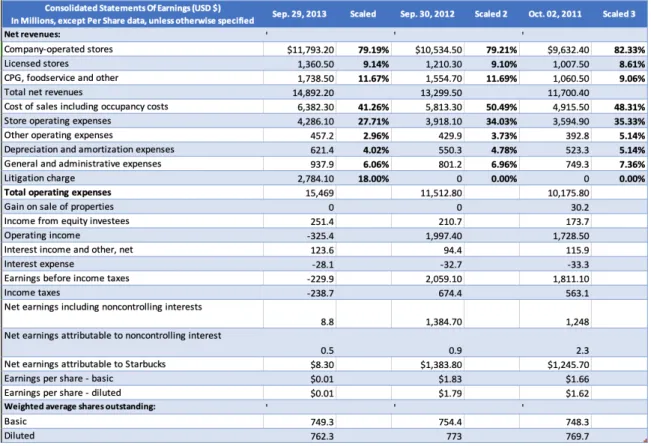
The main expenses that Starbucks incurs include their cost of sales including occupancy costs (41.26 percent), store operating expenses (27.71 percent), and a litigation charge (18 percent).
iii. Were there any significant changes in the cost structure during the most recent year?
One significant change in the cost structure is the fact that they had the additional cost of a litigation charge. This was not present in prior years. Also, in 2013 their cost of sales including occupancy costs dropped by almost 10 percent compared to the previous years. Overall, they also had a small decrease in the rest of their operating expenses.
iv. In fiscal 2013, Starbucks separately reported a litigation charge and included it in operating income. Why didn’t the company just include
this amount within the line item for general and administrative expenses? Why is it an operating expense?
The reason that the litigation expense is not part of the general and administrative expenses is general and administrative expenses are
generally not able to be linked to the production of a certain product or the completion of a specific service. As for a litigation expense, it is very easy to track what the expense is producing - defense for the corporation in a court of law.
v. Was the company profitable during 2013? During 2012? Explain your definition of “profitable.”
Mathematically, Starbucks was "profitable", but only after refunds for income taxes. If total net revenue and total operating expenses are the only things that are compared, then Starbucks operated at a loss in 2013. This loss looks even worse when you compare it to the previous years and see what a dramatic decrease it is.
i. Compare Starbucks’ net earnings to net cash provided by operating activities and explain the difference.
The difference in these ow figures, net earnings at 8.8 and 2908.3 can be attributed to the fact that there was a large amount of income taxes that they were able to defer due to their lack of profit for the fiscal year.
ii. How much cash did Starbucks use for expenditures for property, plant and equipment during fiscal 2013?
They used $1,151,200,000 in cash on property, plant, and equipment during the 2013 fiscal year.
iii. What amount of dividends did Starbucks pay during the year? How does this amount compare to the amount of dividends declared as shown in the statement of equity?
In 2013, Starbucks declared dividends of $543.7 and ended up paying $628.9 in cash dividends, according to the statement of cash flows.
j. Several notes to the financial statements refer to the use of “estimates.” Which accounts on Starbucks’ balance sheet require estimates? List as many accounts as you can. Are any accounts estimate-free?
Accounts on Starbuck's balance sheet that may require estimates are the inventory account, the goodwill account, and long-term debt accounts that are recorded at fair value, accounts receivable, PPE due to the estimate of useful life used in depreciation. Some accounts that may be estimate free are cash and cash equivalents, deferred income taxes, accounts payable, and accrued litigation charge.
Figure 7-1: Common-Size Balance Sheet
Consolidated Balance Sheets (USD $) Sep. 29, 2013 Scaled Sep. 30, 2012 Scaled
In Millions, unless otherwise specified
Current assets: ' '
Cash and cash equivalents $2,575.70 22.36% $1,188.60 14.46%
Short-term investments 658.1 5.71% 848.4 10.32%
Accounts receivable, net 561.4 4.87% 485.9 5.91%
Inventories 1,111.20 9.65% 1,241.50 15.10%
Prepaid expenses and other current
assets 287.7 2.50% 196.5 2.39%
Deferred income taxes, net 277.3 2.41% 238.7 2.90%
Total current assets 5,471.40 47.51% 4,199.60 51.09%
Long-term investments 58.3 0.51% 116 1.41%
Equity and cost investments 496.5 4.31% 459.9 5.60%
Property, plant and equipment, net
3,200.50 27.79% 2,658.90 32.35%
Deferred income taxes, net 967 8.40% 97.3 1.18%
Other assets 185.3 1.61% 144.7 1.76%
Other intangible assets 274.8 2.39% 143.7 1.75%
Goodwill 862.9 7.49% 399.1 4.86%
TOTAL ASSETS 11,516.70 100.00% 8,219.20 100.00%
Current liabilities: ' '
Accounts payable 491.7 6.99% 398.1 12.82%
Accrued litigation charge 2,784.10 39.58% 0 0.00%
Accrued liabilities 1,269.30 18.04% 1,133.80 36.52%
Insurance reserves 178.5 1.55% 167.7 5.40%
Deferred revenue 653.7 9.29% 510.2 16.43%
Total current liabilities 5,377.30 76.44% 2,209.80 71.18%
Long-term debt 1,299.40 18.47% 549.6 17.70%
Other long-term liabilities 357.7 5.09% 345.3 11.12%
Total liabilities 7,034.40 100.00% 3,104.70 100.00%
Shareholders' equity: ' '
Common stock ($0.001 par value) - authorized, 1,200.0 shares; issued and outstanding, 753.2 and 749.3 shares (includes 3.4 common stock
units), respectively 0.8 0.01% 0.7 0.01% Additional paid-in capital 282.1 2.45% 39.4 0.48%
Retained earnings 4,130.30 35.86% 5,046.20 61.40%
Accumulated other comprehensive
income 67 0.58% 22.7 0.28%
Total shareholders' equity 4,480.20 38.90% 5,109 62.16%
Noncontrolling interests 2.1 0.02% 5.5 0.07%
Total equity 4,482.30 38.92% 5,114.50 62.23%
Case Study Eight
i. Introduction
This case dives into the consequences the Deepwater Horizon oil spill had on BP’s financial statements in the year 2010. The Deepwater Horizon oil spill began with an explosion on April 10, 2010 that killed 11 people and caused a leak in an underwater oil pipe off the coast of Louisiana. This leak would not be capped for 87 days and would allow an estimated 31.9 million barrels of oil to contaminate the Gulf of Mexico. It is now considered to be the worst oil spill in U.S. history and many coastal areas, as well as wildlife, are still dealing with the ramifications of this horrendous event.
The purpose of this case was to show students to the concept of contingent liabilities in a real-world application that hits close to home, especially to those from the Mississippi Gulf Coast. This case also allowed students to explore all of the different aspects that are taken into account when estimating these liabilities and when there may not be enough information to accurately predict this amount. Personally, from this case I learned how difficult it can be to actually quantify the damage that a spill like this has on a company’s financial statements. I also learned about how the coast is still financially recovering from this disaster almost 10 years later.
By exposing students to this topic, they are more equipped to see current events and automatically thing of not only the obvious effects, whether those be political, environmental, social, or many other things, but how they may
ii. Case Requirements
a. What is a contingent liability? Explain, in your own words, when a company would record a contingent liability (i.e. a contingent loss) on its books. List some types of contingent liabilities. Do companies ever record contingent assets (i.e. contingent gains)?
A contingent liability is a liability that may or may not actually occur and is based on an uncertain future event. A company would record a contingent liability when there is an event that would cause the company to incur a loss or an expense that they believe is likely to happen and this likelihood can be reasonably estimated. Examples of contingent liabilities include likely lawsuits and
warranties, as these are both expenses that can be reasonably estimated but whose exact magnitude will not be known until the actual event occurs. Companies do not record contingent assets such as a contingent gain as this would violate the very conservative nature of accounting as a profession.
b. Product warranties are a common contingent liability. Consider a piece of equipment such as a telescopic joint, which BP purchases from GE Oil and Gas. The telescopic joint compensates for heave and offset on drilling vessels and is sold with a two-year warranty against defects. From BP’s perspective as the purchaser of the telescopic joint, what is a product warranty? From the perspective of GE Oil and Gas, the manufacturer of the telescopic joint, what is a warranty?
From the perspective of BP, the warranty can be seen as a type of prepaid asset – it is a sort of insurance policy for anything that may happen to the equipment. In the event that anything is defective, they will have an amount that will cover a part of or the whole amount to replace the defective part. From the perspective of GE Oil and Gas, this warranty would be recorded as unearned revenue with an allowance account for the amount of the warranty also being created. Once the warranty is redeemed by the buyer, the revenue would be recognized, along with the associated expenses. The liability would also be reduced at this time.
c. What judgments does management need to make to account for
contingent liabilities in general and accrued warranty costs in particular? How does a claim for damages resulting from the Deepwater Horizon oil spill differ from a warranty claim on a piece of equipment such as a telescopic joint?
Some judgements that need to be made by management in order to accurately account for contingent liabilities is what the scope of the incident may be and what lasting effects it might have. They also need to take into account if there may be any additional costs in the future that are currently undetectable. Accrued warranty costs may be difficult to estimate. In some instances historical data may be able to be used to accurately estimate this cost for similar products, but in the case of new products, things that may need to
the product, and what the product is used for and how this usage may lead to a shortened product life.
A claim for damages resulting from the Deepwater Horizon oil spill would be different than a normal warranty claim in the fact that it was not a
foreseeable or likely event. It is very unlikely that BP assumed that some sort of catastrophic event would happen and added this doubt into their financial statements. Even if they did do this, it is not probable that they estimated a large enough amount to cover the resulting damage. Compared to a normal warranty claim, there is also really no amount of insurance that BP would be able to purchase from an equipment supplier that could be enough to cover this, nor would an equipment supplier be likely to offer this kind of coverage.
This claim would also be one that BP may have little ability to place to liability on another company. Even though there might have been a defective part that caused the explosion, it is also possible that the pipe was improperly sealed during its installation, a problem that would fall back on BP. Also, with an operation as large as offshore drilling, it is certain that there were multiple parties involve, each of which were declared to have a different percentage of the blame and thus the financial responsibility. However, BP still had the largest amount of this blame, perhaps because they received the largest amount of the profit from this venture.
d.
1. Describe some of the estimates that BP must make to account for the contingencies associated with the Deepwater Horizon oil spill. By way of comparison, the Exxon Valdez oil spill took place on March 24, 1989. Litigation continues as of early 2011.
Some estimates that BP had to take into account when calculating the contingencies associated with the Deepwater Horizon oil spill were costs initially assigned by a Unified Area Command, costs associated with ongoing clean-up efforts, containment efforts, relief well drilling, grants to states whose shorelines had been effected, claims that were already made, and any expected legal costs to be incurred. They would also have to consider any sort of fine that they would be incurring but, this amount would be a little easier to estimate as it would be coming from the government and can be calculated based on a few different factors.
The largest contingency that would have to be accounted for is for future litigation. As this occurred as the country was attempting to crawl its way out of a great recession, business on the gulf coast had already taken a hit. As many areas on the coast rely on tourism as a large part of their revenue, it was devastating to have the very beaches
tourism industry affected, but all off-shore fishing had to be halted as the fish being pulled out of the gulf were temporarily unfit for
consumption. This heavily damaged the fishing industry on the coast and caused many to lose their livelihoods.
Additionally, the overall loss of income and degradation of the economy in the region caused many to migrate from the area, affecting many businesses that are essential to any community, regardless of if they are coastal or not. This category could include anything from grocery stores to gas stations to retail stores who served permanent residents of the area. As people have slowly started to return, the economy has begun to bounce back, but those businesses who were not able to weather the “storm” are long gone from the picture.
After looking deeper into the effects of the spill on residents of the coast, I found that there were many cases where those who came into contact with the oil actually developed medical conditions such as leukemia and continuous seizures. Since medical professionals have been able to link a good amount of these cases to the contaminated water, BP may even be liable for any medical expense incurred by these individuals. However, it may be difficult for an individual who sues to prove that it is only able to be linked to their exposure and not any kind of pre-existing condition they may have had.