a lysogenic state, where the phage goes dormant and replicates along with the cell. Experimental observations by P. Kourilsky are consistent with a single phage infection deterministically choosing lysis and double infection resulting in a stochastic choice. We argue that the phage are playing a “game” of minimizing the chance of extinction and that the shift from determinism to stochasticity is due to a shift from a single-player to a multiplayer game. Crucial to the argument is the clonal identity of the phage.
Organisms typically use information from the environment to suitably modify their behavior. Some of these can be con-sidered “strategic” decisions for maximizing the chances of success of the population. For example, many organisms are able to adjust their reproductive strategies according to envi-ronmental conditions. A typical signal that often triggers changes in the reproductive strategy is population density (1, 6). Temperate bacteriophages are among the simplest organ-isms that are able to sense population density and choose their reproductive strategy accordingly. In general, temperate phage choose to stay dormant and replicate along with the host (ly-sogeny) rather than making many virions and killing the host (lysis) when larger numbers of phage attack a bacterial popu-lation (4, 7, 10). Phage lambda’s choice between lysis and lysogeny has become a paradigm for developmental decisions (12). For this lysis-lysogeny decision, we use game theory to understand under what conditions different strategies might be optimal. In particular, we focus on the determinism versus the stochasticity of the strategy. We show that deterministic strat-egies are best when the phage has minimal information and must consider itself as the only “player” in the game. In con-trast, having multiple identical players can make a stochastic strategy the best.
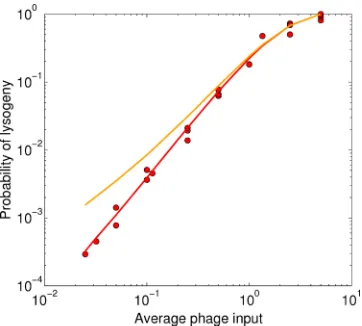
We consider the phage to be playing a game whose pur-pose is to minimize the chance of extinction. For single-player games of this kind, where the single-player has several options but limited information, the optimal strategies are typically deterministic (13). And it is indeed the case that the lysis-lysogeny decision is often deterministic. This statement is somewhat at odds with the general perception that stochastic-ity plays an important role in the decision, a view initiated by reference 2, which invoked stochasticity to explain Kourilsky’s measurements (7) of the frequency of lysogenization in lambda. However, our analysis of Kourilsky’s data (7, 8) (Fig. 1; see also Materials and Methods) shows that (i) when a single phage infects a bacterium (i.e., when the multiplicity of
infec-tion [MOI] is 1), it invariably goes lytic and (ii) when the MOI is 2, the decision is stochastic, with a slight preference toward lysogeny (this preference increases as the MOI increases).
The stochasticity in the strategy for an MOI of 2 refers to the fact that seemingly identical infection events lead to different developmental paths. This inhomogeneity in the decision could reflect either true randomness (for example, due to the sto-chasticity of individual molecular events) or inhomogeneity across different infected cells (for example, the cell size could affect the decision [14]).
The determinism in the phage decision for an MOI of 1 fits the game-theoretic expectation, as we will show, but then, the conundrum is this: why is the decision stochastic for an MOI of 2? In this paper, we argue that the shift from determinism at an MOI of 1 to stochasticity at an MOI of 2 is analogous to the shift from deterministic to stochastic strategies in single-player versus multiplayer games.
THEORY
Game theoretic view of the lysis-lysogeny decision.We con-sider the set of all phages in an infected bacterium to be one player in a game where the choice is between lysis and lysog-eny. Note that individual phage are not the players, as multiple phage inside the same bacterium cannot choose separately between lysis and lysogeny; it is the infected bacterium with all the phage that it contains that goes into one state or the other. From the point of view of a given player, one round of the game starts with the infection and the lysis-lysogeny decision and continues until one of the phage offspring released from the bacterium (either on immediate lysis or later, following prophage induction) subsequently infects another bacterium. The purpose of the game is to minimize the chance of extinc-tion of the phage populaextinc-tion. Whether this is best achieved by deterministically going lytic/lysogenic or making a stochastic decision may depend on the environmental conditions. How many bacteria are there? Do the phage outnumber the bacte-ria? Are the bacteria starving or growing well? The MOI pro-vides some information about the first two questions, specifi-cally, the relative numbers of phage to bacteria.
* Corresponding author. Mailing address: Niels Bohr Institute, Blegdamsvej 17, Copenhagen, Denmark. Phone: 45 35325430. Fax: 45 35325425. E-mail: [email protected].
䌤Published ahead of print on 9 September 2009.
11416
on November 8, 2019 by guest
http://jvi.asm.org/
Downloaded from
on November 8, 2019 by guest
http://jvi.asm.org/
Downloaded from
on November 8, 2019 by guest
http://jvi.asm.org/
(i) MOI of 1.Here, the phage in the bacterium has the least possible information about the surrounding environment. It does not know how many phage or bacteria are present or whether the phage outnumber the bacteria or not. In this situation of minimal information, we assume that the infected bacterium must play a solitary game, where it assumes it is the only player.
(ii) MOI of 2.Now, the phage inside the bacterium do have some information about the environment. First, having two phage simultaneously infect the same bacterium means it is quite likely that the phage outnumber the bacteria. It is prob-able, in this case, that there are multiple infected bacteria. We assume that the strategy takes into account the presence of multiple players all playing the same game.
The game being played by the phage involves weighing the chance of extinction in lysogeny (the bacterium and its descen-dants may die before the phage escapes it by prophage induc-tion) versus the chance of extinction if it goes lytic (for exam-ple, due to a toxic substance that kills phage before they find other bacteria to infect). We can set up a simple payoff matrix (Fig. 2) that reflects the consequences, for the phage
popula-tion, of the different choices. We usep1 to represent the net
chance that all the free phage (the ones outside bacteria) die.
We denote byp2the chance that each lysogenized bacterium
and all its descendants die before the phage escape by pro-phage induction.
Throughout the rest of this paper, we assume that the two options are asymmetric in the sense that the lytic option ex-poses all phage to the current, possibly dangerous, conditions and that the lysogenic option initiates a lineage of lysogenized bacteria. As each such lineage could stretch far into the future, the fate of each lysogen is postponed to a later time and can be assumed to be independent of the fate of other lysogens.
MATERIALS AND METHODS
Interpreting Kourilsky’s data.Kourilsky measured the probability of lysogeny,
Plys, for different values of the average phage input (API) (a) for lambda phage infecting a population ofEscherichia coliunder conditions described in refer-ences 7 and 8. The API is simply the ratio of the total number of phage to the total number of bacteria. The API is thus the MOI averaged over the whole bacterial population. From the point of view of a given bacterium, the API reflects the probability of its being infected. The probability of lysogeny versus API curve,Plys(a), shown in Fig. 1, is a combination of two probabilities:
Plys共a兲 ⫽ ⌺ m⫽0
⬁
Q共m兲 ⫻P共m,a兲, whereQ(m) is the probability of lysogeny at a
given MOI (m) andP(m,a) is the probability that a bacterium will be infected by
mphage at a given API (a). We assume, as is consistent with Kourilsky’s
data (see Fig. 4 in reference 7), thatP(m,a) is Poissonian:P共m,a兲 ⫽ ame
⫺a
[image:2.585.73.254.68.231.2]m!, i.e., adsorption and injection of phage DNA are random, and the same is true for all bacteria in the population. The only unknown, then, isQ(m), and one can try different functions to fit the data. The best fits forQ(m) are shown in Table 1. Notice that the observedPlys(a) (Fig. 1) scales as the second power ofafor a small API. That is,Plys(a) is⬃a2for smalla. In words, the probability of lysogeny is proportional to the probability that two phage infect a bacterium (i.e., the chance of getting an MOI of 2). This is precisely what constrainsQ(1) to be equal to zero. The orange curve in Fig. 1 shows that ifQ(1) differs from zero by even a small amount (5%), the resultantPlys(a) curve scales with the first power ofaat a small API and therefore clearly deviates from the data. Even if the chance of lysogeny at an MOI of 1 were as low as 1%, the resultantPlysvalue would be FIG. 1. Red circles show the fraction of bacteria that entered
ly-sogeny as a function of the API (overall phage/bacterium ratio) in Kourilsky’s experiments (7, 8, 9). Solid lines are theoretical estimates using different functions forQ(m), which is the probability of going lytic as a function of the MOI (m) (see Materials and Methods). As shown by the red curve, the best fits⫾estimated 95% intervals (Table 1) forQ(m) are 0.004⫾0.001, 0.70⫾0.04, and 0.99⫾0.08 form
values of 1, 2, and 3, respectively. Even a small amount of stochasticity in the decision for an MOI of 1 is inconsistent with the data: for the orange curve theQ(m) values are 0.05, 0.70, and 0.99 formvalues of 1, 2, and 3, respectively.
[image:2.585.317.526.69.213.2]FIG. 2. Phage game payoff matrix.p1is the probability that all free phage die, andp2is the probability that each lysogenized bacterium and all its descendants die before the phage escapes.qis the bility that the infected bacteria go lytic. “Cost” represents the proba-bility of phage extinction in a given situation and, for simplicity, is set to either 1 or 0.
TABLE 1. Best fits forQ(m), found using the least-square fitting of log10Plysa
m Q(m)
1 ...0.0038⫾0.0012 2 ...0.6960⫾0.0408 3 ...0.9886⫾0.0769 4 ...0.9886⫾0.0537 5 ...0.9886⫾0.0487 6 ...0.9886⫾0.0487 7 ...0.9886⫾0.0487 8 ...0.9886⫾0.0487 9 ...0.9886⫾0.0487
a
TheQ(0) value of 0 and theQ(mⱖ10) value of 1 were kept fixed. There are
no error bars for the data points in Kourilsky’s paper, so we determined error bars (which indicate 95% intervals) for theQ(m) fit by redoing the fit 100 times, each time randomly perturbing the data points by up to ⫾10% (uniformly distributed).
on November 8, 2019 by guest
http://jvi.asm.org/
around a factor of 2 higher than what Kourilsky observed at the lowest API that he measured and is therefore clearly ruled out by his data.
RESULTS
Deterministic strategies are optimal for single players.We
denote the decision-strategy byq, the probability that the
in-fected bacterium goes lytic. The probability that the phage population goes extinct when following this strategy in the model phage game defined in Fig. 2 is
P⫽qp1⫹共1⫺q兲p2 (1)
What strategy, i.e., what value ofq, will minimize this? Clearly,
the best strategy is as follows:qis 0 ifp1is⬎p2, andqis 1 ifp1
is ⬍p2 (if p1 equalsp2 exactly, it does not matter what the
phage does) (see also Fig. 4A). Either way, the optimal strategy is deterministic. Note that changing the precise values of the costs in the payoff matrix will change only the threshold at
which the best strategy shifts from that in whichqis 0 to that
in whichqis 1. It will not change the fact that there exists a
deterministic strategy that is at least as good as any stochastic one (see, for example, theorem 6.12 in reference 13).
The underlying mathematical reason for this is that the net
cost is a linear function ofq(a function linear inq[in general,
continuous and monotonic inq] necessarily has its minimum
value at a boundary of the region under consideration, in this
case representing aq value of 0 or 1). Intuitively, it may be
easier to understand in the simpler, but analogous, game shown in Fig. 3A. This “umbrella game” involves trying to decide whether to carry an umbrella or not on the basis of the chance of rain. If the inconvenience of carrying an umbrella on a sunny day is the same as the unpleasantness of getting soaked
by rain, then you shouldalwayscarry an umbrella if the chance
of rain is more than 50% [the net cost isp(1⫺q)⫹(1⫺p)q
ifpis the chance of rain and qis the chance of carrying an
umbrella; ifpis⬎0.5, the cost is minimized whenqis 1]. Any
stochastic strategy will be worse: the reduction in the number of times you carry an umbrella on sunny days will be
out-weighed by an increase in the number of days you get soaked. If you dislike getting wet more, a deterministic choice is still best; the threshold shifts just below 50%.
How do we then understand the stochastic decision when two phage infect a bacterium?
Stochastic strategies can be optimal for multiple players.
Let us now assume there areninfected bacteria. We will keep
the costs the same as in Fig. 2 and assume that each of the
nplayers follows the same strategy, represented byq. Further,
for a clonal phage population, it is sufficient if at least one of the infected bacteria follows the “correct” developmental path so that the clone does not go extinct. That is, if free phage are
not killed then even if only one of thenplayers chooses lysis,
the cost is zero for all the players; this is a game with a “collective” reward. The chance of extinction is then
P⫽qnp
1⫹nqn⫺1共1⫺q兲p1p2⫹n共n⫺1兲qn⫺2共1⫺q兲2p1p22/2⫹. . .
⫹nq共1⫺q兲n⫺1p
1p2n⫺1⫹共1⫺q兲np2n (2)
Each term in the above sum represents one extinction sce-nario: for instance, the first term is the probability that all
infected bacteria lyse (qn) and that all are killed (p
1), while the
last term is the probability that all infected bacteria go
lyso-genic [(1 ⫺ q)n] and that all these lysogenized lineages die
before the phage escape by prophage induction (p2n). Notice
howp2is raised to the power ofn. This is because, as discussed
earlier, we assume that the fate of each lysogenized lineage is
independent of the others, whereasp1is not raised to a power
because it represents the probability that all free phage die. That is, we assume that phage die together and that bacteria die independently of each other, an assumption that stems from the facts that bacterial lifetimes are much longer than those of phage and that therefore phage experience only the present environment whereas it is possible for bacteria to ex-perience environments indefinitely far into the future.
Figure 4B shows the value ofqthat minimizesPfor a range
ofp1and p2values at different values forn. Notice that the
optimal strategy is now stochastic whenp1is⬍p2. Essentially,
FIG. 3. (A) Umbrella game for one person, with 60% chance of rain and 40% chance of sunshine. The best strategy is to always carry an umbrella; all stochastic strategies result in more mistakes. (B) Umbrella game for two people with identical strategies. As there is a collective reward for carrying an umbrella, if the chance of rain is significant, the ideal situation is that in which one person brings an umbrella, leaving the other person free from carrying one. This is possible only with the use of a stochastic strategy, because both individuals are using the same strategy. If the chance of rain is below a certain threshold (p⬍1/3), however, then the deterministic strategy of never carrying an umbrella is best.
on November 8, 2019 by guest
http://jvi.asm.org/
[image:3.585.45.543.69.237.2]because there is a collective reward/punishment for going lytic, ideally in our model game, one infected bacterium should be lysed, leaving the rest to go lysogenic. With identical strategies, this is possible only with the use of a stochastic strategy.
Mathematically, a stochastic strategy can be optimal in this
case becausePis no longer linear inq, as there arenplayers.
However, this is not enough. If the nonlinear function could be factorized into a product of identical linear functions, then, again, the optimal strategy would be deterministic. The reason this does not happen is that the collective rewards and punish-ments associated with free phage result in an asymmetry in the
way in whichp1and p2 appear in equation 2. This becomes
clear when we rewrite equation 2 as follows:
P⫽p1关qn⫹nqn⫺1共1⫺q兲p2⫹n共n⫺1兲qn⫺2共1⫺q兲2p22/2⫹. . .
⫹nq共1⫺q兲n⫺1p
2n⫺1兴⫹共1⫺q兲np2n (3)
The absence ofp1in the last term is what makes this expression
nonfactorizable. A more generic function could also include, for example, a collective probability that all lysogenized bac-teria die. This would, in general, also be nonfactorizable. The existence of any collective rewards/punishments is enough to prevent factorization, and we have attempted to illustrate this more transparently by having such a collective cost only for the free phage. Adding a collective punishment for lysogenized bacteria would additionally favor stochastic strategies when
p1is⬎p2, a condition under which our simpler cost function
always favors deterministic lysogeny (Fig. 4).
What makes a stochastic strategy optimal?. Again, it is easier to understand what is going on by using a two-player version of the umbrella game (Fig. 3B), which is simpler than the phage game but illustrates the same point. As in the phage
game, each player uses the same strategy, represented by q,
and there is a collective reward because one umbrella is taken to be sufficient for both if it rains. The net cost is
Cost⫽2共1⫺q兲2p⫹2q共1⫺q兲共1⫺p兲⫹2q2共1⫺p兲
⫽q2共2p兲⫹2q共1⫺3p兲⫹2p (4)
To minimize this, one must choose the deterministic strategy in
whichqis 0 ifpis⬍1/3 and the stochastic strategy in whichqis
(3p⫺1)/2potherwise. For the case considered in Fig. 3, where
p is 0.6, the best strategy is therefore the stochastic one,
whereinqis 2/3.
The umbrella game shows that the basic effect—the shift from determinism to stochasticity as one goes from single to multiple players—depends on (i) identical strategies and (ii) collective rewards/punishments. The collective reward—a sin-gle umbrella is sufficient to protect everyone—means that ide-ally one person would bring an umbrella, leaving the others free. Because everyone uses identical strategies, this is possible only with a stochastic strategy. The collective reward thus al-lows a population to hedge its bets and thereby do better than the sum of individuals. In a single-player game, there is no population, and therefore stochastic strategies simply result in more mistakes.
DISCUSSION
In this paper, we have attempted to connect two pieces of information: (i) under conditions explored by Kourilsky, an MOI of 1 deterministically leads to lysis, while the decision is stochastic for an MOI of 2, and (ii) in games involving a choice based on incomplete information, optimal single-player strat-egies are deterministic, while for multiple players they can be stochastic. Looking at the lysis-lysogeny decision from a game-theoretic point of view thus leads us to the conjecture that the shift from a deterministic strategy at an MOI of 1 to a stochas-tic one at an MOI of 2 arises from a shift from a single-player to a multiplayer game. Crucial to our argument is the clonal population of the phage, which results both in identical strat-egies among the multiple players and in collective rewards/ punishments.
The game-theoretic framework used to describe the decision can be extended to incorporate elements that could be impor-tant under other conditions. For instance, the frequency of lysogenization may be influenced by properties of the bacterial cells, such as size (14) or starvation levels (5, 9). These
prop-FIG. 4. (A) Optimal strategies for the phage game for one player. Theqminstrategy, which minimizes the chance of phage extinction, is deterministic: always go lytic (qmin⫽1) whenp1is⬍p2, and always go lysogenic (qmin⫽0) whenp1is⬎p2. All stochastic strategies result in a greater chance of extinction. (B) Optimal strategy for the phage game withnidentical players. Blue,n⫽2; green,n⫽4; yellow,n⫽10; red,n⫽
100. As there is a collective reward for going lytic, if the chance of free phage dying is low, the ideal situation is that in which one infected bacterium is lysed, leaving the rest to go lysogenic. This is possible only with the use of a stochastic strategy, because each player is using the same strategy. If the danger of going lytic is above a certain threshold (p1⬎p2), however, then the best strategy is to deterministically go lysogenic.
on November 8, 2019 by guest
http://jvi.asm.org/
[image:4.585.44.541.69.215.2]strategies toward more lysogenization. We would expect then that even at an MOI of 1, one could observe phage choosing
lysogeny ifp1were low enough. However, even in this case, the
strategy would be deterministic, whereas it appears that, at least under conditions different from those used by Kourilsky, a stochastic strategy can be chosen at an MOI of 1 (9, 11, 14). Our considerations indicate that such stochasticity could sur-vive only if the phage had evolved to use a multiplayer strategy even at an MOI of 1 under these conditions. That is, if phage lambda would have evolved to behave as if, when it infected a starved bacterium, it were not the only clonal phage infecting
anE. colibacterium in its vicinity.
We have concentrated here on why phage lambda might use different strategies for the lysis-lysogeny decision in different cases. We have not addressed the separate question of how the regulatory network of phage lambda is able to use the MOI to implement this shift in strategy. Clearly, gene copy number affects the behavior of genetic circuits; reference 16 shows how this is possible for lambda, and we are currently exploring this issue for a large class of simple regulatory motifs. St-Pierre and Endy (14) point out that the lambda circuitry may not be able to distinguish between infection of a large cell by two phages and infection of a small cell by a single phage. Thus, it is possible that the conditions used by Kourilsky produced a particularly homogeneous cell population, allowing observa-tion of the deterministic lytic response at an MOI of 1.
On a more general note, the “collective reward games” that we have studied here differ in an interesting way from “coop-erative games.” Collective rewards, as we have shown, favor strategies that use stochasticity to produce diversity of behavior in the population of players. In contrast, in cooperative games it is better for multiple players to follow the same cooperative strategy. This may have relevance for the phenomenon of bac-terial persistence where occasionally bacteria that are resistant to antibiotics can arise in a clonal population, which allows the
reward nature of research.
ACKNOWLEDGMENT
This work was funded by the Danish National Research Council.
REFERENCES
1.Aldenhoven, J. M.1986. Different reproductive strategies in a sex-changing coral reef fishCentropyge bicolor(Pomacanthidae). Aust. J. Mar. Freshw. Res.37:353–360.
2.Arkin, A., J. Ross, and H. H. McAdams.1998. Stochastic kinetic analysis of developmental pathway bifurcation in phage lambda-infectedEscherichia colicells. Genetics149:1633–1648.
3.Balaban, N. Q., J. Merrin, R. Chait, L. Kowalik, and S. Leibler.2004. Bacterial persistence as a phenotypic switch. Science305:1622–1625. 4.Goffart-Roskam, J.1965. Quantitative study of sensitive and lysogenic
bac-teria surviving infection of aStaphylococcusby a temperate bacteriophage. Antonie van Leeuwenhoek31:249–261.
5.Grodzicker, T., R. R. Arditti, and H. Eisen.1972. Establishment of repres-sion by lambdoid phage in catabolite activator protein and adenylate cyclase mutants ofEscherichia coli. Proc. Natl. Acad. Sci. USA69:266–370. 6.Guisande, C.1993. Reproductive strategy as population-density varies in
Daphnia magna(Cladocera). Freshw. Biol.29:463–467.
7.Kourilsky, P.1973. Lysogenization by bacteriophage lambda. I. Multiple infection and the lysogenic response. Mol. Gen. Genet.122:183–195. 8.Kourilsky, P.1974. Lysogenization by bacteriophage lambda. II.
Identifica-tion of genes involved in the multiplicity dependent processes. Biochimie
56:1511–1516.
9.Kourilsky, P., and A. Knapp.1974. Lysogenization by bacteriophage lambda. III. Multiplicity dependent phenomena occurring upon infection by lambda. Biochimie56:1517–1523.
10.Levine, M.1957. Mutations in the temperate phage P22 and lysogeny in Salmonella. Virology3:22–41.
11.Lieb, M.1953. The establishment of lysogenicity inEscherichia coli. J. Bac-teriol.65:642–651.
12.Oppenheim, A. B., O. Kobiler, J. Stavans, D. L. Court, and S. Adhya.2005. Switches in bacteriophage lambda development. Annu. Rev. Genet.39:409– 429.
13.Ross, S. M.1992. Applied probability models with optimization applications. Dover, New York, NY.
14.St-Pierre, F., and D. Endy.2008. Determination of cell fate selection during phage lambda infection. Proc. Natl. Acad. Sci. USA105:20705–20710. 15.Weinbauer, M. G., I. Brettar, and M. G. Hofle.2003. Lysogeny and
virus-induced mortality of bacterioplankton in surface, deep, and anoxic marine waters. Limnol. Oceanogr.48:1457–1465.
16.Weitz, J., Y. Mileyko, R. I. Joh, and E. O. Voit.2008. Collective decision making in bacterial viruses. Biophys. J.95:2673–2680.
on November 8, 2019 by guest
http://jvi.asm.org/
Why Do Phage Play Dice?
Mikkel Avlund, Ian B. Dodd, Szabolcs Semsey, Kim Sneppen, and Sandeep Krishna
Center for Models of Life, Niels Bohr Institute, Copenhagen, Denmark; Department of Molecular and Biomedical Sciences (Biochemistry), University of Adelaide, Adelaide, Australia; and Department of Genetics, Eotvos Lorand University, Budapest, Hungary
Volume 83, no. 22, p. 11416 –11420, 2009. Page 11417, legend to Fig. 1: Line 5: “lytic” should read “lysogenic.”
Copyright © 2012, American Society for Microbiology. All Rights Reserved.
doi:10.1128/JVI.07236-11