This is the
Accepted Version
of a paper published in the
Journal: Construction and Building Materials
Yin, Shi, Tuladhar, Rabin, Shi, Feng, Combe, Mark, Collister, Tony, and
Sivakugan, Nagaratnam (2015) Use of macro plastic fibres in concrete: a
review. Construction and Building Materials, 93. pp. 180-188.
http://dx.doi.org/
10.1016/j.conbuildmat.2015.05.105
© 2015. This manuscript version is made available under
the CC-BY-NC-ND 4.0 license
http://creativecommons.org/licenses/by-nc-nd/4.0/
1
Use of macro plastic fibres in concrete: A review
1
Shi Yin1, Rabin Tuladhar1*, Feng Shi2, Mark Combe3, Tony Collister3, Nagaratnam Sivakugan1 2
1
College of Science, Technology & Engineering, James Cook University, QLD 4811, Australia 3
2
School of Materials Science and Engineering, Beijing Institute of Petrochemical Technology, 4
Beijing, 100000, China 5
3 Fibercon, QLD 4051, Australia
6
*Corresponding author: Rabin Tuladhar ([email protected])
7
Abstract
8
Use of macro plastic fibres to reinforce concrete has attracted widespread attention from 9
both scientists and construction industry due to the multiple sustainability benefits they offer, 10
compared to steel fibres and steel reinforcing mesh. This paper critically reviews the current 11
state of knowledge and technology of using macro plastic fibres to reinforce concrete. 12
Detailed review on the various preparation techniques and the resulting properties of macro 13
plastic fibres are presented and the effects of macro plastic fibres on the fresh and hardened 14
concrete properties are discussed in this paper. The effect of macro plastic fibres on 15
workability, plastic shrinkage, compressive strength, splitting tensile strength, flexural 16
strength, post-crack performance and dry shrinkage is discussed in this paper. Pull-out 17
behaviour and degradation behaviour of the fibre in the concrete are also reviewed. Finally, 18
some applications of the plastic fibre reinforced concrete are discussed. 19
Keywords: macro plastic fibre, concrete, fibre production, reinforcement, application 20
*Manuscript
2
1.
Introduction
21
Concrete is essentially a mixture of cement, aggregate and water. It is widely used in 22
construction industry because all the raw materials required are widely available and are of 23
low cost. Concrete is very strong in compression; however, it has a very low tensile strength. 24
To improve its tensile strength, reinforcing steel is often used in the concrete. Apart from 25
traditional steel reinforcement, various fibres are also used to improve the properties of 26
concrete, mainly for enhancing the tensile strength. There are mainly four types of fibres 27
which can be used to reinforce concrete: steel fibre, glass fibre, natural fibre and synthetic 28
fibre [1]. 29
Steel fibres can greatly improve the tensile strength and the flexural strength of concrete due 30
to their ability to absorb energy [2] and control cracks [3]. Their electric [4], magnetic [5] and 31
heat [6] conductivity properties make them suitable for some special applications. However, 32
corrosion of steel fibres can be detrimental and lead to rapid deterioration of concrete 33
structures [7]. Glass fibre has an excellent strengthening effect [8] but poor alkali resistance 34
[9]. Natural fibres, such as wood [10], sisal [11], coconut [12], sugarcane bagasse [13], palm 35
[14], and vegetable fibres [15], are cheap and easily available, but they have poor durability. 36
Synthetic fibres can be made of polyolefin [16], acrylic [17], aramid [18], and carbon [19]. 37
They can prevent plastic shrinkage cracks in fresh concrete [20] and improve post-cracking 38
behaviour of concrete [21]. 39
The schematic diagram in Fig. 1 shows the different failure modes associated with the fibre 40
reinforced concrete [22]. Fibre rupture (1), pull-out (2) and debonding of fibre from matrix (4) 41
can effectively absorb and dissipate energy to stabilize crack propagation within concrete. 42
Fibre bridging the cracks (3) reduces stress intensity at the crack tip. In addtion, the fibre 43
3 the concrete matrix to corrode reinforcing steel and degrade concrete. Fibre in the matrix (5) 45
prevents the propagation of a crack tip. Consequently, cracks will occur in other locations of 46
the matrix (6). Although every individual fibre makes a small contribution, the overall effect 47
of reinforcement is cumulative [22]. Therefore, the fibres can effectively control and arrest 48
crack growth, hence preventing plastic and dry shrinkage cracks [23], retaining integrity of 49
concrete [24], and altering the intrinsically brittle concrete matrix into a tougher material 50
with enhanced crack resistance and ductility [25]. In order to achieve considerable 51
reinforcement, the fibres should have high tensile strength and Young’s modulus [26]. 52
(Insert Fig. 1 here)
53
Plastic fibres are synthetic fibres, which can be in the form of micro plastic fibres or macro 54
plastic fibres. The micro plastic fibres refer to the plastic fibres whose diameter arrange from 55
5 to 100 μm and length are 10-20 mm [27]. These micro fibres can effectively control plastic 56
shrinkage cracking, which is caused by shrinkage of fresh concrete during the first 24 hours 57
after placement due to excessive evaporation of bleed water [28]. However, they do not 58
have any effect on the properties of hardened concrete [29]. 59
The macro plastic fibres normally have a length of 30-60 mm and cross section of 0.6-1 mm2 60
[30]. The macro plastic fibres are not only used to control plastic shrinkage [31], but also 61
mostly used for controlling drying shrinkage [32]. Drying shrinkage occurs due to the loss of 62
water molecules from the hardened concrete [33]. This type of drying shrinkage can occur in 63
large flat areas like slabs in hot and dry environments like in North Queensland, Australia. A 64
steel reinforcing mesh is normally used to prevent the drying shrinkage cracks; but now it is 65
gradually being replaced by the macro plastic fibres because of ease of construction, reduced 66
labour and lower cost. Another significant benefit is the post-cracking behaviour provided by 67
4 but the macro plastic fibres can considerably improve the post-cracking response of concrete, 69
because the plastic fibres act as a crack arrester, and alter the intrinsically brittle concrete 70
matrix into a tough material with better crack resistance and ductility. Therefore, when 71
concrete breaks, the common large single cracks can be substituted by dense micro-cracks 72
due to the presence of fibre reinforcement [35]. The macro plastic fibres now have become 73
increasingly popular in the construction of concrete footpaths [36], precast panels [37] and 74
shotcrete mine tunnels [38]. 75
The aim of this paper is to critically review the present state of knowledge and technology of 76
macro plastic fibre reinforced concrete. After a detailed review of various preparation 77
techniques and resulting properties of macro plastic fibres, attention is paid to effect of the 78
fibres on performance of the fresh and hardened concrete. The effects of macro plastic fibres 79
on workability, plastic shrinkage, compressive strength, splitting tensile strength, flexural 80
strength, post-crack performance and dry shrinkage are discussed in this paper. The pull-out 81
behaviour and degradation behaviour of the fibre in the concrete are then studied. Finally, 82
some applications of the plastic fibre reinforced concrete are presented. 83
2.
Preparation and properties of plastic fibres
84
The macro plastic fibres can be virgin and recycled polypropylene (PP), high-density 85
polyethylene (HDPE) or polyethylene terephthalate (PET) fibres. PP fibres have been widely 86
used in the concrete industry, due to its ease of production, high alkaline resistance [39], and 87
high tensile strength and Young’s modulus [26]. However, their low density (around 0.9 88
g/cm3) may make the fibres 'float up' to the surface of concrete matrix [40]. Low hydrophilic 89
nature of PP fibres, which can be reflected by low wetting tension of about 35 mN/m, also 90
significantly deteriorates workability of fresh concrete and adhesion between the fibres and 91
5 hydrophilic than PP fibres. However, HDPE fibres have low tensile strength (ranging from 26 93
to 45 MPa), which significantly limits their applications [40]. PET fibres have much higher 94
density at 1.38 g/cm3 and better wetting tension of 40 mN/m than PP fibres, so they are 95
easier to be mixed with concrete than the PP or HDPE fibres. They also have high tensile 96
strength and Young’s modulus [41], which can effectively improve post-crack performance of 97
concrete. However, PET granules must be dried for at least 6 hours before being processed 98
into fibres. The PET granules also easily crystallised and stick on the inner wall of the extruder. 99
Hence, it is more difficult and costly to process PET than PP or HDPE. Moreover, alkaline 100
resistance of the PET fibres is questionable [42, 43]. Therefore, the PP fibres have become 101
the most common commercial product as a concrete fibre, and PET fibres have attracted 102
extensive research, but HDPE fibres are still rare in practice with very little research being 103
reported in the literature. From the environmental and cost-saving perspective, researchers 104
have are now investigating the use of recycled plastic fibres in concrete [44]. However, 105
recycled plastics have uncertain processing and service history, impurities and varying 106
degrees of degradation, leading to processing difficulties and unstable mechanical properties 107
[45]. 108
The physical and chemical characteristics of the macro plastic fibres vary widely depending 109
upon the manufacturing techniques. A popular technique involves melt spinning plastic 110
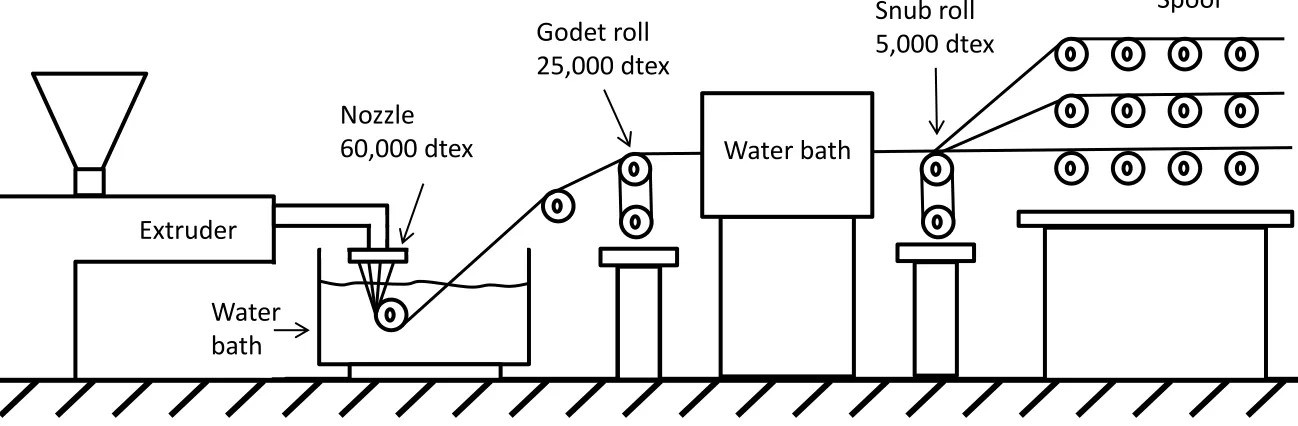
granules into filaments and then hot drawing monofilaments into fibres [46]. In the study 111
conducted by Ochi et al. [41], PET granules were melted and extruded into monofilaments 112
with a fineness of 60,000 dtex (dtex: grams per 10,000 meter length). Then the 113
monofilaments were hot drawn into 5,000 dtex through a film orientation unit shown in Fig. 114
2. The resulting monofilaments were then indented and cut into fibres of 30-40 mm long. 115
This melt spinning and hot drawing process highly oriented the molecular chains of the PET, 116
6 modulus. Through this method, PET [46]and PP [30]fibre of tensile strength above 450 MPa 118
can be obtained. 119
(Insert Fig. 2 here)
120
Another popular processing technique is extruding PET, PP or HDPE granules through a 121
rectangular die to form film sheets (0.2-0.5 mm thick). The resulting film sheets are then slit 122
longitudinally into equal width tapes (1.0-1.3 mm wide) by a slitting machine. The tapes are 123
then mechanically deformed using a patterned pin wheel, such as crimped and embossed. In 124
some cases, the fibrillated tapes are also twisted before cutting to desired lengths (40-50 125
mm) [47]. Kim et al. [48] used this technique to sucessfully prepare recycled PET fibre with 126
420 MPa tensile strength and 10 GPa Young’s modulus. 127
In order to reduce manufacturing costs, researchers have explored the potential of producing 128
recylced plastic fibres just by mechanically cutting PET bottles. The remaining bottle necks 129
and the bottoms are discarded. Foti [49] used this method to produce lamellar fibre and ‘O’-130
shaped annular fibre. The special shape of the ‘O’-fibre can assist to bind the concrete on 131
each side of a cracked section, thus improving ductility of the concrete. This technique 132
though economical in smaller scale, cannot be used for a large-scale production. Firstly, the 133
bottles should be washed before or after cutting which makes this process labour-intensive. 134
Secondly, waste bottles have different history and degradation, which results in variable and 135
poorer mechanical properties of the fibres. Both de Oliveira and Castro-Gomes [50] and Foti 136
[49] could only produce fibres of low tensile strength of around 150 MPa and low Young’s 137
modulus of about 3 GPa through this technique, which are much lower than those produced 138
by the other two techniques. 139
3.1 Fresh concrete properties
7
3.1.1 Slump
141
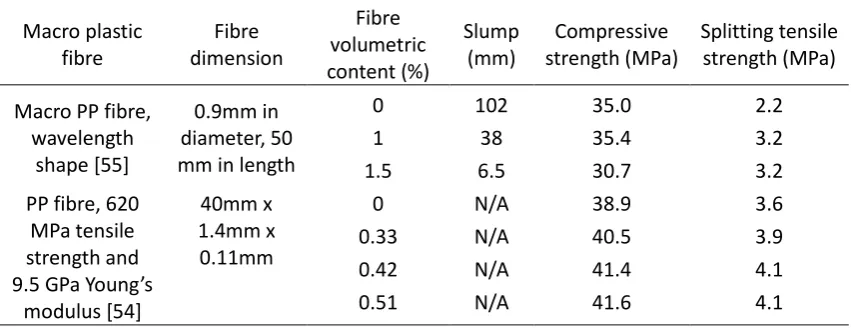
Workability of fresh concrete can be determined through a slump test [51]. Table 1 shows 142
slump test results of macro plastic fibre reinforced concrete. The results indicate addition of 143
macro plastic fibres decreases slump, thus decreasing workability of fresh concrete. This is 144
due to the fact that the addition of fibres can form a network structure in the concrete 145
matrix, thus restraining mixture from segregation and flow. Moreover, due to high content 146
and large surface area of the fibres, the fibres can easily absorb cement paste to wrap 147
around, hence increasing viscosity of the concrete mixture [52]. Mazaheripour et al. [53] 148
made following two suggestions to improve the workability of fibre reinforced concrete : (a) 149
to limit the volumetric content of macro plastic fibres to a range of 0.1 % to 1% and (b) to 150
add more water. However, addition of water will negatively affect concrete strength; hence 151
plasticiser or water reducing admixtures are often used in fibre reinforced concrete to 152
improve workability without increasing water content. [54]. 153
(Insert Table 1 here)
154
3.1.2 Plastic shrinkage
155
Plastic shrinkage cracking is caused by moisture loss after casting [55]. Generally, if the 156
moisture evaporation rate exceeds 0.5 kg/m2/hr, it causes negative capillary pressure inside 157
the concrete, resulting in internal strains [56]. Plastic shrinkage can cause cracks during the 158
initial stages, when the concrete has not yet developed adequate strength [57]. Kim et al. [47] 159
reported that although the macro plastic fibres do not affect the total moisture loss or 160
moisture loss per hour, they still can effectively control the plastic shrinkage cracking through 161
improvement of integrity of the fresh concrete. They also found that once the fraction of 162
fibre volume exceeds 0.5 %, a sufficient number of fibres are involved in controlling plastic 163
8 studied the effects of fibre aspect ratio on the plastic shrinkage crack areas. They found that 165
longer fibres (aspect ratio with length/width = 167) were extremely efficient and provided a 166
crack-free surface at a fibre dosage of 9 kg/m3, while shorter fibre (aspect ratio with 167
length/width = 67) could eliminate 94 % cracking at a dosage of 18 kg/m3. 168
3.2 Hardened concrete properties
169
3.2.1 Compressive strength
170
As shown in Table 1 [54, 59], the macro plastic fibres have no significant effects on the 171
compressive strength, which is also consistent with what was reported by Hsie et al. [60], 172
Campione [61], Fraternali et al. [46], and de Oliveira and Castro-Gomes [50]. Ochi et al. [41] 173
reported that although some variation exists, for different water-cement ratios, there is no 174
significant variation in the values of compressive strength associated with varying PET fibre 175
contents. Moreover, during the compression tests, the plain concrete failed suddenly with 176
large single cracks at the peak load, while as reported by Brandt [35] the macro plastic fibre 177
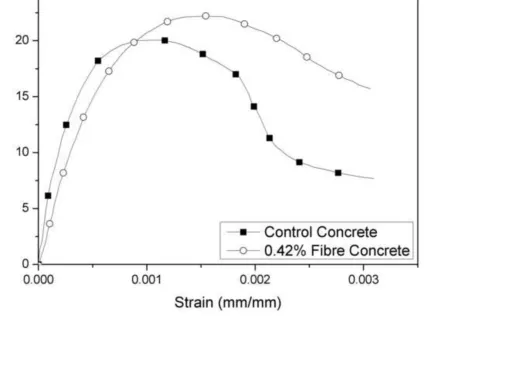
reinforced concrete cylinders failed with many minor cracks on the surface. Fig. 3 shows 178
stress-strain curves of a compressive test on concrete cylinders conducted by Hasan et al. 179
[54]. The samples with fibres showed a more ductile mode of failure and a post failure 180
structural performance. This is attributed to ability of the fibres to distribute stresses and 181
slow down the crack propagation process. 182
(Insert Fig. 3 here) 183
3.2.2 Splitting tensile strength
184
The split-cylinder test is an indirect test to obtain tensile strength of concrete [62]. As can be 185
9 the tensile stress in concrete reaches tensile strength of concrete, the stress is transferred to 187
the macro plastic fibres. The fibres can arrest the propagating macro cracks, thus improving 188
the splitting tensile strength [60]. It was shown that plain concrete cylinders failed abruptly 189
once the concrete cracks, whereas macro synthetic fibre reinforced concrete specimens 190
could retain its shape even after concrete cracked. This shows that the macro synthetic fibre 191
reinforced concrete has the ability to absorb energy in the post-cracking state [54]. 192
3.2.3 Flexural strength
193
Flexural test is another indirect tensile test which measures the ability of concrete beam to 194
resist failure in bending [63]. Three-point loading and four-point loading are normally used in 195
the flexural tests. For the three-point loading flexural test, results are more sensitive to 196
specimens, because the loading stress is concentrated under the centre loading point [36]. 197
However, in the four-point loading flexural test, maximum bending occurs on the moment 198
span [27]. Research has found that the macro plastic fibres have no obvious effects on the 199
flexural strength, which is dominated by the matrix properties [52]. The main benefit of using 200
macro plastic fibres lies in improved ductility in the post-crack region and flexural toughness 201
of concrete [50]. Brittle behaviour is always associated with plain concrete [64]. When the 202
first crack is produced, the specimen cracks and collapses almost suddenly, with very small 203
deformations and no prior warning. However, in plastic fibre reinforced concrete specimens, 204
the failure progresses with bending, but without any sudden collapse as seen in plain 205
concrete. When the conrete fails, the load is transmitted to the plastic fibres. The fibres 206
prenvent the spread of cracks as shown in Fig. 1 and hence delay the collapse [49]. 207
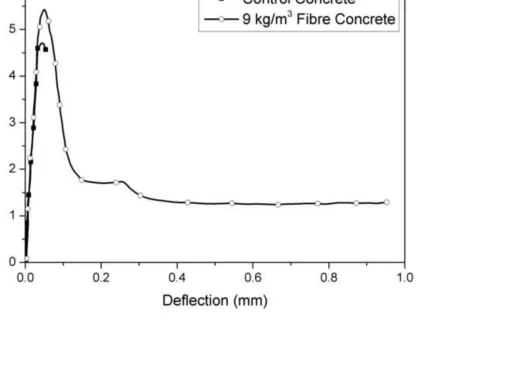
Hsie et al. [60] tested the flexural strength of macro PP fibre reinforced concrete. The PP 208
fibre had diameter of 1 mm, length of 60 mm, tensile strength of 320 MPa and Young’s 209
10 flexural strength reached the maximum at a deflection of around 0.05 mm, and then
211
decreases rapidly. The PP fibre slightly increased the maximum flexural strength to 5.5 MPa 212
at the same deflection point as the plain concrete. However, after the maximum flexural 213
strength, the load is supported by the PP fibres, thus becoming stable around 1.5 MPa. 214
Similar trends were also reported by de Oliveira and Castro-Gomes [50], Ochi, Okubo et al. 215
[41], and Meddah and Bencheikh [65]. 216
(Insert Fig. 4 here) 217
3.2.4 Post-crack performance
218
Crack Tip Opening Displacement (CTOD) and Crack Mouth Opening Displacement (CMOD) 219
tests are normally used to study the effect of fibres on the post-cracking behaviour of 220
concrete [46]. According to ASTM E1290 [66], CTOD is the displacement of the crack surfaces 221
normal to the original (unloaded) crack plane at the tip of the fatigue precrack. However, due 222
to inherent difficulties in the direct determination of CTOD, CMOD test is a preferred test to 223
assess post-crack performance of fibre reinforced concrete [67]. According to BS EN 224
14651:2005+A1:2007 [68], CMOD test measures the opening of the crack at midspan using a 225
displacement transducer mounted along the longitudinal axis. Both tests can clearly display 226
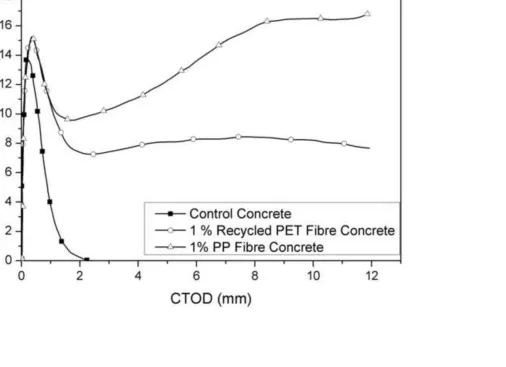
the ability of fibres to redistribute stresses and bridge the cracks formed. Fraternali et al. [46] 227
performed CTOD tests on PP and recycled PET fibre reinforced concrete specimens. The PP 228
fibre had 1.04 mm2 of cross section, 47 mm of length, 29 % of ultimate strain and 250 MPa of 229
tensile strength, while the recycled PET fibre had 1.54 mm2 of cross section, 52 mm of length, 230
19 % of ultimate strain and 274 MPa of tensile strength. The results can be seen in Fig. 5. The 231
peak load was reached at a corresponding CTOD of less than 0.6 mm for all the specimens. 232
However, compared to the plain concrete, ductility of the specimens after the peak load has 233
11 ability of macro plastic fibres to improve post-crack performance of concrete.
235
(Insert Fig. 5 here) 236
Round Determinate Panel Test (RDPT) is considered to better represent the relative 237
behaviour of different fibre reinforced concretes. This test has a significantly lower variation 238
in post-crack performance than concrete beams [69]. The panel-based performance 239
assessment is desirable because panels fail through a combination of stress actions that 240
reflect the behaviour of an fibre reinforced concrete more closely than other mechanical 241
tests [70]. RDPT, based on ASTM C1550 [71], involves bi-axial bending in response to a 242
central point load, and shows a mode of failure related to the in-situ behaviour of structures 243
such as concrete slabs-on-grade and sprayed tunnel lining construction [72]. 244
Cengiz and Turanli [70] compared the shotcrete panels reinforced by macro PP fibre, steel 245
mesh and steel fibre. The PP fibre had a length of 30 mm, a diameter of 0.9 mm, and a 246
Young’s modulus of 3.5 GPa. The steel fibre had a length of 30 mm, a diameter of 0.6 mm, 247
and flattened ends with a round shaft. The steel mesh had a diameter of 8 mm and intervals 248
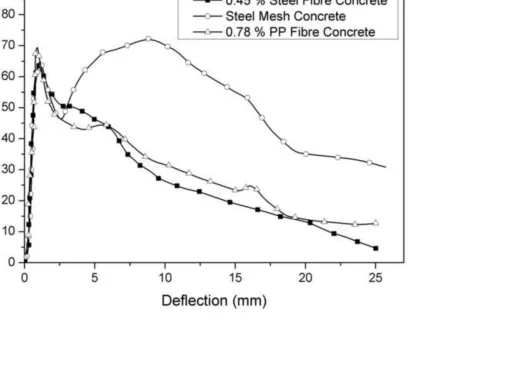
of 150 mm. As can be seen from Fig. 6, 0.45 % of steel fibre reinforced concrete showed 65 249
kN of peak load and 664 J of energy absorption at 25 mm, while 0.78 % of PP fibre reinforced 250
concrete showed better post-crack performance with 70 kN of peak load and 716 J of energy 251
absorption. Steel mesh showed very brilliant post-crack performance (1308 J in energy 252
absorption). 253
(Insert Fig. 6 here) 254
3.2.5 Drying shrinkage
255
12 concrete [73]. The drying shrinkage can be quite significant in large flat areas like footpaths 257
and slabs in hot, windy and dry environment [74]. Steel reinforcing mesh is typically being 258
used to prevent the drying shrinkage cracks, but is now being gradually replaced by macro 259
plastic fibres because of ease of construction, saving of labour and cost [70], and 260
environmental benefits [75]. 261
Soroushian et al. [52] tested the restrained drying shrinkage of plastic fibre reinforced 262
concrete, according to ASTM C157 [76]. They found that the average maximum crack width 263
of plain concrete was 0.3 mm at the 90th day, while 0.19 % of PP fibre effectively restrained 264
the crack width to 0.15 mm, and delayed the initiation of cracking. As reported by Najm and 265
Balaguru [58] and Hsie et al. [60], the plain concrete can withstand only small drying 266
shrinkage strains, which is usually neglected. However, the addition of plastic fibres 267
significantly increases the strain capacity of concrete, thus contributing to a reduction in 268
crack widths and a delayed crack occurrence time. 269
3.2.6 Pull-out behaviour of plastic fibres
270
Fibre debonding and pull-out (sliding) at the interface have a substantial impact on total 271
energy absorption during the crack propagation. Therefore, the bond of fibre and matrix 272
significantly affects capacity of the fibres to stabilise the crack propagation in concrete matrix 273
[77]. Low mechanical bonding strength may not provide sufficient bridging force to control 274
crack development. Moreover, the weak bonding strength also can cause internal micro-275
cracks in the interfacial area [41]. 276
Oh et al. [78] explored optimum shape among the various plastic fibres as shown in Fig. 7. In 277
their pull-out tests, the crimped-shape plastic fibres exhibited the highest energy absorption 278
13 MPa due to its high surface energy and friction resistance. The crimped fibre also had high 280
bond strength at 3.9 MPa, but its crimped part was stretched fully during the pull-out tests, 281
thus leading to a rapid increase in displacement and low initial stiffness. The straight fibre 282
had lowest bond strength at 1.7 MPa. 283
(Insert Fig. 7 here) 284
3.2.7 Degradation of plastic fibres in concrete
285
PP has a high resistance to chemical attack due to its non-polar nature [79]. For example, PP 286
is resistant to alcohol, organic acids, esters and ketones, inorganic acids and alkalis. However, 287
it swells when exposed to aliphatic and aromatic hydrocarbons and by halogenated 288
hydrocarbons [80]. Brown et al. [81] studied long-term properties of virgin PP fibres in the 289
concrete under a reactive environment. When PP fibres were exposed to an ionic 290
environment of sodium and chloride ions created by salt water at 71 °C and -7 °C 291
temperatures for six months, the tensile properties of the PP fibres remained unchanged. 292
Elasto Plastic Concrete (EPC) company [43] did advanced alkalinity testing for their product 293
olefin fibre. The fibres were subjected to an alkaline solution, which simulates a concrete 294
environment. They reported that their olefin fibre could last up to 100 years in an alkaline 295
environment without any decrease of strength 296
The olefin fibres, including PP and HDPE, show high resistance to alkaline environment, while 297
there is no agreement about the durability of PET fibres in Portland cement matrix. The PET 298
fibres belong to the polyester group, and polyester fibres degrade when embedded in 299
Portland cement matrix [37]. The degradation tests of EPC company showed that the PET 300
fibre only could perform well for 10 years in the concrete, after that the strength of fibre 301
decreased significantly [43]. However, Ochi et al. [41] and the ACI 544 [1] reported good 302
14 into an alkaline solution, which was prepared by dissolving 10 g of sodium hydroxide in 1 dm3 304
of distilled water, for 120 h at 60 °C. The results showed that the tensile strength of PET fibre 305
after immersion was 99% of that before immersion, showing minimal deterioration. 306
Therefore, the PET fibre was considered to have sufficient alkali resistance as a concrete-307
reinforcing fibre in their study. 308
Silva et al. [42] immersed recycled PET fibres in a Lawrence solution (0.48 g/l Ca(OH)2 +3.45
309
g/l KOH+0.88 g/l NaOH, pH=12.9) to simulate a fully hydrated cement paste. Through 310
micrographs they found that surface of the recycled PET fibres became rough after being 311
immersed for 150 days at 50 °C. Some alkaline terephthalates were found as precipitation of 312
phases. Through Fourier Transform Infrared Spectroscopy (FTIR) tests, ions Ca2+, Na+, K+, and 313
OH- were found to attack the C-O bonds of PET. The ions Ca2+, Na+, K+ reacted with aromatic 314
ring of the PET, while OH- reacted with aliphatic ester of the PET. Consequently, the PET was 315
split into Ca-, Na-, and/or K- terephthalates and ethylene glycol. The mechanical properties 316
of the PET fibre reinforced concrete, such as compressive strength, tensile strength and 317
flexural strength, were not influenced at the ages of 42, 104, and 164 days old. However, 318
toughness of the PET fibre reinforced concrete decreased with the age due to the 319
degradation of PET fibres inside the concrete. 320
3.
Applications of plastic fibre reinforced concrete
321
Reinforcing steel in concrete is expensive and its placement in concrete is labour and time 322
intensive, often requiring placement in difficult and dangerous locations. Moreover, steel is 323
highly corrosive in nature which commonly deteriorates concrete. Therefore, macro plastic 324
fibres are increasingly used in concrete and shotcrete industries for construction of footpaths, 325
non-structural precast elements (pipes, culverts, cable pits and other small components), 326
15 At mines, some locations, such as bedrock, are very difficult to support and are susceptible 328
to collapse. In these cases, there is a long-standing demand to increase the support by 329
increasing the fiber content. In the case of steel fiber reinforced concrete, difficulty of mixing 330
and formation of fiber balls have prevented the use of higher fiber contents [82]. However, 331
fiber reinforced concrete can be produced with fibre dosage more than 1% within the 332
normal mixing time without any fibre ball formation and pipe clogging issues [41]. 333
Steel reinforcing mesh is conventionally used in the footpath applications to prevent drying 334
shrinkage cracks [83]. However, some roads, such as passages in tunnels under construction, 335
passages through underground structures, urban alleyways, and bush roads, are commonly 336
narrow, winding, and steep. It is desirable to apply fibre reinforced concrete to the pavement 337
of such narrow sections of road. Unfortunately, traditional steel fibre can puncture tires, 338
corrode and also can reduce workability of concrete. Therefore, plastic fibres are now 339
gradually replacing steel reinforcing mesh and steel fibres for such usage, because of ease of 340
construction, and for saving labour and cost [70]. Table 2 lists some application of PET fibre 341
in mines and pavements in Japan[41]. 342
Macro plastic fibres are also appealing alternative to steel to reinforce precast concrete 343
elements, such as pipes [84], sleepers [85] and pits [86]. Fuente et al. [87] produced fibre 344
reinforced concrete pipes with internal diameter of 1000 mm, thickness of 80 mm and length 345
of 1500 mm. PP fibre with continuously embossed indents (54 mm in length, 0.9 mm in 346
diameter, 10 GPa Young’s modulus and 640 MPa tensile strength) was used at 5.5 kg/m3 347
dosage to reinforce the pipes. Through a crush test, they found that the peak strength of 50 348
kPa was achieved at the deflection of 1 mm, with the strength dropping to 30 kPa at the 349
deflection of 2 mm, which kept constant until 10 mm. They reported that the traditional pipe 350
16 can meet required strength classes without resorting to conventional rebar reinforcement. 352
(Insert Table 2 here) 353
4.
Conclusion
354
Use of macro plastic fibres to reinforce concrete instead of steel mesh and steel fibres has 355
become appealing to scientists and concrete industries due to its sustainability benefits. This 356
paper has presented the current state of knowledge and technology of preparation 357
techniques and properties of macro plastic fibres. It also reviewed the reinforcing effects of 358
macro plastic fibres in concrete and applications of plastic fibres reinforced concrete. The 359
major conclusions drawn from the study are: 360
1. PP, PET and HDPE are the three main raw materials used in the production of plastic 361
fibres. PP fibres have become most common commercial products in fibre reinforced 362
concrete, and PET fibres have attracted wide research, but HDPE fibres are still rare 363
in both practice and research. Different production techniques result in different 364
mechanical properties of the macro plastic fibres. 365
2. The macro plastic fibres decrease workability of fresh concrete, but effectively 366
control plastic shrinkage cracking of fresh concrete. 367
3. The macro plastic fibres have no obvious effects on compressive and flexural 368
strength, which are dominated by the concrete matrix properties. The main benefit 369
of using macro plastic fibres lies in improved ductility in the post-crack region and 370
flexural toughness of concrete. The macro plastic fibres reinforced concretes show 371
excellent post-crack performance and high energy absorption capacity. The macro 372
plastic fibres also have good crack controlling capacity of dry shrinkage. 373
17 fibres normally have various shapes and indents.
375
5. The olefin fibres, including PP and HDPE, show a high resistance to alkaline 376
environment, further researcher is need to quantify durability of PET fibres in the 377
Portland cement matrix. 378
6. The macro plastic fibres can be used in the construction of pavements, light precast 379
elements and tunnel linings. The fibre reinforced concrete is easy to handle and has 380
performed adequately in all the applications. 381
382
5.
References
383
[1] Daniel JI, Gopalaratnam VS, Galinat MA. State-of-the-art Report on Fiber Reinforced 384
Concrete. ACI Committee 544, Report 544, 1R-96, American Concrete Institute, Detroit, 385
USA2002. 386
[2] Beglarigale A, Yazici H. Pull-out behavior of steel fiber embedded in flowable RPC and 387
ordinary mortar. Constr Build Mater. 2015;75:255-65. 388
[3] Buratti N, Ferracuti B, Savoia M. Concrete crack reduction in tunnel linings by steel fibre-389
reinforced concretes. Constr Build Mater. 2013;44:249-59. 390
[4] Dai QL, Wang ZG, Hasan MRM. Investigation of induction healing effects on electrically 391
conductive asphalt mastic and asphalt concrete beams through fracture-healing tests. Constr 392
Build Mater. 2013;49:729-37. 393
[5] Al-Mattarneh H. Electromagnetic quality control of steel fiber concrete. Constr Build 394
18 [6] Sukontasukkul P, Pomchiengpin W, Songpiriyakij S. Post-crack (or post-peak) flexural 396
response and toughness of fiber reinforced concrete after exposure to high temperature. 397
Constr Build Mater. 2010;24(10):1967-74. 398
[7] Soylev TA, Ozturan T. Durability, physical and mechanical properties of fiber-reinforced 399
concretes at low-volume fraction. Constr Build Mater. 2014;73:67-75. 400
[8] Tassew ST, Lubell AS. Mechanical properties of glass fiber reinforced ceramic concrete. 401
Constr Build Mater. 2014;51:215-24. 402
[9] Sayyar M, Soroushian P, Sadiq MM, Balachandra A, Lu J. Low-cost glass fiber composites 403
with enhanced alkali resistance tailored towards concrete reinforcement. Constr Build Mater. 404
2013;44:458-63. 405
[10] Torkaman J, Ashori A, Momtazi AS. Using wood fiber waste, rice husk ash, and limestone 406
powder waste as cement replacement materials for lightweight concrete blocks. Constr Build 407
Mater. 2014;50:432-6. 408
[11] Silva FD, Toledo RD, Melo JD, Fairbairn EDR. Physical and mechanical properties of 409
durable sisal fiber-cement composites. Constr Build Mater. 2010;24(5):777-85. 410
[12] Ali M, Chouw N. Experimental investigations on coconut-fibre rope tensile strength and 411
pullout from coconut fibre reinforced concrete. Constr Build Mater. 2013;41:681-90. 412
[13] Alavez-Ramirez R, Montes-Garcia P, Martinez-Reyes J, Altamirano-Juarez DC, Gochi-413
Ponce Y. The use of sugarcane bagasse ash and lime to improve the durability and 414
mechanical properties of compacted soil blocks. Constr Build Mater. 2012;34:296-305. 415
19 mortar modified with oil palm fruit fibre and tire crumb. Constr Build Mater. 2014;73:544-50. 417
[15] Pacheco-Torgal F, Jalali S. Cementitious building materials reinforced with vegetable 418
fibres: A review. Constr Build Mater. 2011;25(2):575-81. 419
[16] Alberti MG, Enfedaque A, Galvez JC. On the mechanical properties and fracture behavior 420
of polyolefin fiber-reinforced self-compacting concrete. Constr Build Mater. 2014;55:274-88. 421
[17] Pereira-De-Oliveira LA, Castro-Gomes JP, Nepomuceno MCS. Effect of acrylic fibres 422
geometry on physical, mechanical and durability properties of cement mortars. Constr Build 423
Mater. 2012;27(1):189-96. 424
[18] Vincent T, Ozbakkaloglu T. Influence of fiber orientation and specimen end condition on 425
axial' compressive behavior of FRP-confined concrete. Constr Build Mater. 2013;47:814-26. 426
[19] Chaves LP, Cunha J. Design of carbon fiber reinforcement of concrete slabs using 427
topology optimization. Constr Build Mater. 2014;73:688-98. 428
[20] Cao ML, Zhang C, Lv HF. Mechanical response and shrinkage performance of 429
cementitious composites with a new fiber hybridization. Constr Build Mater. 2014;57:45-52. 430
[21] Pujadas P, Blanco A, Cavalaro S, de la Fuente A, Aguado A. Fibre distribution in macro-431
plastic fibre reinforced concrete slab-panels. Constr Build Mater. 2014;64:496-503. 432
[22] Zollo RF. Fiber-reinforced concrete: an overview after 30 years of development. Cement 433
Concrete Comp. 1997;19(2):107-22. 434
[23] Yoo DY, Park JJ, Kim SW, Yoon YS. Early age setting, shrinkage and tensile characteristics 435
20 [24] Yoo DY, Min KH, Lee JH, Yoon YS. Shrinkage and cracking of restrained ultra-high-437
performance fiber-reinforced concrete slabs at early age. Constr Build Mater. 2014;73:357-65. 438
[25] Park SS. Unconfined compressive strength and ductility of fiber-reinforced cemented 439
sand. Constr Build Mater. 2011;25(2):1134-8. 440
[26] Yin S, Tuladhar R, Combe M, Collister T, Jacob M, Shanks R. Mechanical properties of 441
recycled plastic fibres for reinforcing concrete. In: Proceedings of the 7th International 442
Conference Fibre Concrete, pp 1-10 From: 7th International Conference Fibre Concrete, 443
September 12-13 2013, Prague, Czech Republic2013. 444
[27] Soutsos MN, Le TT, Lampropoulos AP. Flexural performance of fibre reinforced concrete 445
made with steel and synthetic fibres. Constr Build Mater. 2012;36:704-10. 446
[28] Guneyisi E, Gesoglu M, Mohamadameen A, Alzeebaree R, Algin Z, Mermerdas K. 447
Enhancement of shrinkage behavior of lightweight aggregate concretes by shrinkage 448
reducing admixture and fiber reinforcement. Constr Build Mater. 2014;54:91-8. 449
[29] Pelisser F, Neto ABDS, La Rovere HL, Pinto RCD. Effect of the addition of synthetic fibers 450
to concrete thin slabs on plastic shrinkage cracking. Constr Build Mater. 2010;24(11):2171-6. 451
[30] Yin S, Tuladhar R, Shanks RA, Collister T, Combe M, Jacob M, et al. Fiber preparation and 452
mechanical properties of recycled polypropylene for reinforcing concrete. J Appl Polym Sci. 453
2015;132(16). 454
[31] Chavooshi A, Madhoushi M. Mechanical and physical properties of aluminum 455
powder/MDF dust/polypropylene composites. Constr Build Mater. 2013;44:214-20. 456
21 flat suspended slabs: Experimental investigation and numerical simulation. Constr Build 458
Mater. 2014;57:92-104. 459
[33] Jafarifar N, Pilakoutas K, Bennett T. Moisture transport and drying shrinkage properties 460
of steel-fibre-reinforced-concrete. Constr Build Mater. 2014;73:41-50. 461
[34] Buratti N, Mazzotti C, Savoia M. Post-cracking behaviour of steel and macro-synthetic 462
fibre-reinforced concretes. Constr Build Mater. 2011;25(5):2713-22. 463
[35] Brandt AM. Fibre reinforced cement-based (FRC) composites after over 40 years of 464
development in building and civil engineering. Compos Struct. 2008;86(1-3):3-9. 465
[36] Alani AM, Beckett D. Mechanical properties of a large scale synthetic fibre reinforced 466
concrete ground slab. Constr Build Mater. 2013;41:335-44. 467
[37] Peyvandi A, Soroushian P, Jahangirnejad S. Enhancement of the structural efficiency and 468
performance of concrete pipes through fiber reinforcement. Constr Build Mater. 2013;45:36-469
44. 470
[38] Kaufmann J, Frech K, Schuetz P, Munch B. Rebound and orientation of fibers in wet 471
sprayed concrete applications. Constr Build Mater. 2013;49:15-22. 472
[39] Santos ASF, Teixeira BAN, Agnelli JAM, Manrich S. Characterization of effluents through a 473
typical plastic recycling process: An evaluation of cleaning performance and environmental 474
pollution. Resour Conserv Recy. 2005;45(2):159-71. 475
[40] Auchey FL. The use of recycled polymer fibres as secondary reinforcement in concrete 476
structures. Journal of Construction Education. 1998;3(2):131-40. 477
22 concrete-reinforcing fiber. Cement Concrete Comp. 2007;29(6):448-55.
479
[42] Silva DA, Betioli AM, Gleize PJP, Roman HR, Gomez LA, Ribeiro JLD. Degradation of 480
recycled PET fibers in Portland cement-based materials. Cement Concrete Res. 481
2005;35(9):1741-6. 482
[43] EPC. Advanced alkalinity testing. Elasto Plastic Concrete. 2012. 483
[44] Zhou JH, Xiang H. Research on Mechanical Properties of Recycled Fiber Concrete. 484
Advances in Structural Engineering, Pts 1-3. 2011;94-96:1184-7. 485
[45] Wang YJ, Zureick AH, Cho BS, Scott DE. Properties of Fiber-Reinforced Concrete Using 486
Recycled Fibers from Carpet Industrial-Waste. J Mater Sci. 1994;29(16):4191-9. 487
[46] Fraternali F, Ciancia V, Chechile R, Rizzano G, Feo L, Incarnato L. Experimental study of 488
the thermo-mechanical properties of recycled PET fiber-reinforced concrete. Compos Struct. 489
2011;93(9):2368-74. 490
[47] Kim JHJ, Park CG, Lee SW, Lee SW, Won JP. Effects of the geometry of recycled PET fiber 491
reinforcement on shrinkage cracking of cement-based composites. Compos Part B-Eng. 492
2008;39(3):442-50. 493
[48] Kim SB, Yi NH, Kim HY, Kim JHJ, Song YC. Material and structural performance evaluation 494
of recycled PET fiber reinforced concrete. Cement Concrete Comp. 2010;32(3):232-40. 495
[49] Foti D. Preliminary analysis of concrete reinforced with waste bottles PET fibers. Constr 496
Build Mater. 2011;25(4):1906-15. 497
[50] de Oliveira LAP, Castro-Gomes JP. Physical and mechanical behaviour of recycled PET 498
23 [51] As'ad S, Gunawan P, Alaydrus MS. Fresh State Behavior of Self Compacting Concrete 500
Containing Waste Material Fibres. Proceedings of the Twelfth East Asia-Pacific Conference on 501
Structural Engineering and Construction (Easec12). 2011;14. 502
[52] Soroushian P, Plasencia J, Revanbakhsh S. Assessment of reinforcing effects of recycled 503
plastic and paper in concrete. Aci Mater J. 2003;100(3):203-7. 504
[53] Mazaheripour H, Ghanbarpour S, Mirmoradi SH, Hosseinpour I. The effect of 505
polypropylene fibers on the properties of fresh and hardened lightweight self-compacting 506
concrete. Constr Build Mater. 2011;25(1):351-8. 507
[54] Hasan M, Afroz M, Mahmud H. An experimental investigation on mechanical behavior of 508
macro synthetic fibre reinforced concrete. International Journal of Civil & Environmental 509
Engineering IJCEE-IJENS. 2011;11(03):18-23. 510
[55] Banthia N, Gupta R. Influence of polypropylene fiber geometry on plastic shrinkage 511
cracking in concrete. Cement Concrete Res. 2006;36(7):1263-7. 512
[56] Uno PJ. Plastic shrinkage cracking and evaporation formulas. Aci Mater J. 513
1998;95(4):365-75. 514
[57] Sanjuan MA, Moragues A. Polypropylene-fibre-reinforced mortar mixes: Optimization to 515
control plastic shrinkage. Compos Sci Technol. 1997;57(6):655-60. 516
[58] Najm H, Balaguru P. Effect of large-diameter polymeric fibers on shrinkage cracking of 517
cement composites. Aci Mater J. 2002;99(4):345-51. 518
[59] Choi Y, Yuan RL. Experimental relationship between splitting tensile strength and 519
24 [60] Hsie M, Tu C, Song PS. Mechanical properties of polypropylene hybrid fiber-reinforced 521
concrete. Mat Sci Eng a-Struct. 2008;494(1-2):153-7. 522
[61] Campione G. Influence of FRP wrapping techniques on the compressive behavior of 523
concrete prisms. Cement Concrete Comp. 2006;28(5):497-505. 524
[62] BSI. BS EN 12390-3. Testing hardened concrete, Part 6: Tensile splitting strength of test 525
specimens. British Standards Institution. 2009. 526
[63] ASTM. ASTM C 1018 Standard test method for flexural strength toughness and first crack 527
strength of fiber reinforced concrete. American Society for Testing and Materials Book of 528
ASTM Standards. 1997. 529
[64] Berndt ML. Properties of sustainable concrete containing fly ash, slag and recycled 530
concrete aggregate. Constr Build Mater. 2009;23(7):2606-13. 531
[65] Meddah MS, Bencheikh M. Properties of concrete reinforced with different kinds of 532
industrial waste fibre materials. Constr Build Mater. 2009;23(10):3196-205. 533
[66] ASTM. ASTM E1290. Crack-Tip Opening Displacement (CTOD) Fracture Toughness 534
Measurement. American Society for Testing and Materials Book of ASTM Standards 2008. 535
[67] Zhijun Z, Farhad A. Determination of crack tip opening displacement of concrete by 536
embedded fiber optic sensor. ICF 11, JRESEARCH PAPERS. 2005. 537
[68] BSI. BS EN 14651:2005 +A1:2007. Test method for metallic fibre concrete - Measuring 538
the flexural tensile strength (limit of proportionality (LOP), residual). British Standards 539
Institution. 2007. 540
25 specimens. Mater Struct. 2002;35(247):156-64.
542
[70] Cengiz O, Turanli L. Comparative evaluation of steel mesh, steel fibre and high-543
performance polypropylene fibre reinforced shotcrete in panel test. Cement Concrete Res. 544
2004;34(8):1357-64. 545
[71] ASTM. ASTM C1550 - 12a Standard Test Method for Flexural Toughness of Fiber 546
Reinforced Concrete (Using Centrally Loaded Round Panel). American Society for Testing and 547
Materials Book of ASTM Standards. 2012. 548
[72] Parmentier B, De Grove E, Vandewalle L, Van Rickstal F. Dispersion of the mechanical 549
properties of FRC investigated by different bending tests. Tailor Made Concrete Structures: 550
New Solutions for Our Society. 2008:123-. 551
[73] PP K. A proposed test to determine the cracking potential due to drying shrinkage of 552
cracking. Concrete Constructure. 1985;30(9):775-8. 553
[74] Sivakumar A, Santhanam M. A quantitative study on the plastic shrinkage cracking in 554
high strength hybrid fibre reinforced concrete. Cement Concrete Comp. 2007;29(7):575-81. 555
[75] Zachar J. Sustainable and Economical Precast and Prestressed Concrete Using Fly Ash as 556
a Cement Replacement. J Mater Civil Eng. 2011;23(6):789-92. 557
[76] ASTM. ASTM C157 Length Change of Hardened Hydraulic-Cement Mortar and Concrete. 558
American Society for Testing and Materials Book of ASTM Standards. 2008. 559
[77] Singh S, Shukla A, Brown R. Pullout behavior of polypropylene fibers from cementitious 560
matrix. Cement Concrete Res. 2004;34(10):1919-25. 561
26 structural synthetic fibers. Eng Fract Mech. 2007;74(1-2):243-57.
563
[79] Ha KH, Kim MS. Application to refrigerator plastics by mechanical recycling from 564
polypropylene in waste-appliances. Mater Design. 2012;34:252-7. 565
[80] da Costa HM, Ramos VD, de Oliveira MG. Degradation of polypropylene (PP) during 566
multiple extrusions: Thermal analysis, mechanical properties and analysis of variance. Polym 567
Test. 2007;26(5):676-84. 568
[81] Brown R, Shukla A, Natarajan KR. Fiber reinforcement of concrete structures. URITC 569
PROJECT NO 536101. 2002. 570
[82] Yang JM, Min KH, Shin HO, Yoon YS. Effect of steel and synthetic fibers on flexural 571
behavior of high-strength concrete beams reinforced with FRP bars. Compos Part B-Eng. 572
2012;43(3):1077-86. 573
[83] Abas FM, Gilbert RI, Foster SJ, Bradford MA. Strength and serviceability of continuous 574
composite slabs with deep trapezoidal steel decking and steel fibre reinforced concrete. Eng 575
Struct. 2013;49:866-75. 576
[84] Haktanir T, Ari K, Altun F, Karahan O. A comparative experimental investigation of 577
concrete, reinforced-concrete and steel-fibre concrete pipes under three-edge-bearing test. 578
Constr Build Mater. 2007;21(8):1702-8. 579
[85] Ramezanianpour AA, Esmaeili M, Ghahari SA, Najafi MH. Laboratory study on the effect 580
of polypropylene fiber on durability, and physical and mechanical characteristic of concrete 581
for application in sleepers. Constr Build Mater. 2013;44:411-8. 582
27 ash (PFA) to sulphate attack. Cement Concrete Comp. 2010;32(7):523-31.
584
[87] Fuente Adl, Escariz RC, Figueiredo ADd, Aguado A. Design of macro-synthetic fibre 585
reinforced concrete pipes. Constr Build Mater. 2013;43:523-32. 586
587
6.
Captions for Figures and Tables
588
589
Fig. 1 Failure mechanisms in fibre reinforced concrete. 1. Fibre failure; 2. Fibre pull-out; 3. 590
Fibre bridging; 4. Fibre/matrix debonding; 5. Fibre Preventing crack propagation; 6. Matrix 591
cracking [22] 592
Fig. 2 Apparatus for PET fibre extrusion [41] 593
Fig. 3 Average stress-strain curves for concretes with macro plastic fibres [54] 594
Fig. 4 Load-deflection curves of PP fibres reinforced concretes [60] 595
Fig. 5 Load-CTOD curves of recycled PET and PP fibres reinforced concretes [46] 596
Fig. 6 Comparison of RDPT results for concrete reinforced with steel mesh, steel fibre and PP 597
fibre [70] 598
Fig. 7 Various types of plastic fibres for pull-out tests [78] 599
600
Table 1 Properties of macro plastic fibre reinforced concrete 601
Table 2 Example applications of the PET fibres reinforced concrete in Japan [41] 602
603
Table 1 Properties of macro plastic fibre reinforced concrete
Macro plastic fibre
Fibre dimension
Fibre volumetric content (%)
Slump (mm)
Compressive strength (MPa)
Splitting tensile strength (MPa)
Macro PP fibre, wavelength
shape [55]
0.9mm in diameter, 50 mm in length
0 102 35.0 2.2
1 38 35.4 3.2
1.5 6.5 30.7 3.2
PP fibre, 620 MPa tensile strength and 9.5 GPa Young’s
modulus [54]
40mm x 1.4mm x 0.11mm
0 N/A 38.9 3.6
0.33 N/A 40.5 3.9
0.42 N/A 41.4 4.1
0.51 N/A 41.6 4.1
Table 1
Table 2 Example applications of the PET fibres reinforced concrete in Japan [41]
Prefecture Location
Concrete sprayed/ placed
Water/ Cement (%)
Fibre length
(mm)
Volumetric content of fibres (%)
Remark
Kagoshima Mine
gateway Sprayed 50 30 0.3
Replacement of steel fibre. First trial to use PET fibre in Japan. Found to be very easy to handle
Kanagawa Bush
road Placed 64 40 0.75
Replacement of wire mesh. Considerable laboursaving
Ibaragi Bush
road Placed 64 40 1
Applied successfully to road with 10% gradient
Ehime Slope Sprayed 50 30 0.3 Replacement of steel fibre on the sea front
Fukuoka Tunnel Placed 52 40 0.3 Applied to tunnel support for the first time
Tottori Tunnel Placed 52 40 0.3 A new fibre content analyser was developed and used
Kanagawa Bridge
pier Placed 50 30 0.3
Crack extension was substantially decreased
Shiga Tunnel Placed 52 40 0.3 A new fibre injector was
developed and used
Table 2
1 2 3 4 5 6
Figure 1
Extruder
Water
bath
Nozzle
60,000 dtex
Godet roll
25,000 dtex
Snub roll
5,000 dtex
Water bath
[image:32.720.53.702.292.505.2]Spool
Figure 2
Figure 3
Figure 4
Figure 5
Figure 6
Figure 7
![Table 2 Example applications of the PET fibres reinforced concrete in Japan [41]](https://thumb-us.123doks.com/thumbv2/123dok_us/153079.30223/30.595.62.531.135.433/table-example-applications-pet-fibres-reinforced-concrete-japan.webp)