1
Sdf
Independent Review of the Supporting
People Programme Transition Year
Final Report
Ymchwil gymdeithasol Social research
Number: 01/2010 Ymchwil gymdeithasol
Social research
Independent Review of the Supporting People
Programme Transition Year
Final Report
Miller Research Ltd
Katy Marrin Heulwen Hudson Nick Miller
Mair Smith
Jennie Bibbings (Shelter Cymru)
Views expressed in this report are those of the researcher and not necessarily those of the Welsh Government
For further information please contact: Simon Prothero
Housing and Regeneration Rhydycar Business Park Merthyr Tydfil
CF48 1UZT
Tel: 0300 062 8209 Fax: 01685 729006
Email: [email protected]
Welsh Government Social Research, 30 September 2014 ISBN 978-1-4734-2203-2
Table of contents
Glossary of acronyms ... i
Executive Summary ... 1
1 Introduction ... 7
2 Methodology ... 10
3 Context ... 14
4 Findings ... 24
5 Conclusions and Recommendations ... 58
Appendix I: Research framework and topic guides ... 73
Appendix II: Documents reviewed for desk review ... 79
i
Glossary of acronyms
ADSS Cymru Association of Directors of Social Services Cymru
CHC Community Housing Cymru
GNME Gwent Needs Mapping Exercise
HLC Housing Leadership Cymru
LCP Local Commissioning Plan
MoU Memorandum of Understanding
PCC Officer of the Police and Crime Commissioner
RCC Regional Collaborative Committee
RCP Regional Commissioning Plan
RDC
RSG
Regional Development Coordinator Revenue Support Grant
SPIN Supporting People Information Network
SPNAB Supporting People National Advisory Board
SPG Supporting People Grant
SPPG Supporting People Programme Grant
SPRG Supporting People Revenue Grant
WAO Welsh Audit Office
1
Executive Summary
Overview and method
1. In March 2014, Miller Research Ltd in association with Shelter Cymru were commissioned by Welsh Government to undertake an independent review of the Supporting People Programme following its transition to new structures in 2012.
2. The Supporting People Programme was launched across the UK in 2003 and aims to help vulnerable people gain and retain independence by remaining in their own homes and by providing a range of housing related support services. In Wales, up to 2012, the Programme comprised two funding streams: one
administered directly by Welsh Government to support service and housing providers; the other administered by local authorities. A review of the
Programme was commissioned in 2009, led by Professor Sir Mansel Aylward. It recommended merging the two funding streams into a single Supporting People Programme Grant (SPPG) and creating a revised governance structure for the Programme. The Programme’s new structures were launched in 2012 and comprise a Supporting People National Advisory Board (SPNAB) to provide advice on the Programme to the Minister for Housing and Regeneration and Regional Collaborative Committees (RCCs) to provide advice to local authorities and other local stakeholders on the regional and local delivery of the grant. Local authorities are allocated the SPPG to directly contract with support service and housing providers. The Programme currently provides approximately £134 million support for around 70,000 people in Wales.
3. The aim of the research was to review the various structures underpinning the Supporting People Programme since the implementation of the re-launched programme in August 2012 and to make recommendations regarding their future.
4. To address this aim the objectives of the Review were to:
2
Planning and commissioning structure and interrelation between national, regional and local arrangements
Membership Engagement Impact/Influence
Stakeholder awareness
Delivery of regional commissioning ii. Identify best practice and innovation. iii. Identify areas for improvement or action.
iv. Prioritise recommendations regarding the future of the programme.
5. The research programme comprised: a desk review of key documents relating to the programme; semi-structured interviews with 82 individuals involved in the management and delivery of the programme at regional and national levels; and group interviews/ workshops with Cymorth Cymru, Supporting People Information Network (SPIN) and Regional Development Coordinators (RDC).
Key findings
6. The potential of the post Aylward Supporting People Programme structures is recognised and there is a strong will to make regional collaboration and co-production work for the benefit of some of the most vulnerable groups in society. The SPNAB and RCCs have been praised for raising the profile of the
Programme both within local and national government and with partner statutory organisations.
3
8. The role and remit of the Programme’s Steering Board is unclear with
suggestions that it is duplicating many of the discussions held at the SPNAB. While the workstreams are seen as important there is a lack of clarity regarding their membership, outputs, timescales and accountability.
9. RCCs have brought together a range of regional stakeholders, delivery partners and statutory partner organisations. There is a lack of clarity amongst some stakeholders about RCC function and expectations of their performance. Furthermore there are perceptions that RCCs have been required to frequently (and often unnecessarily) report to the SPNAB with little feedback in return. The Programme’s high level principles are vague and it has been challenging for RCCs to assess their performance against them.
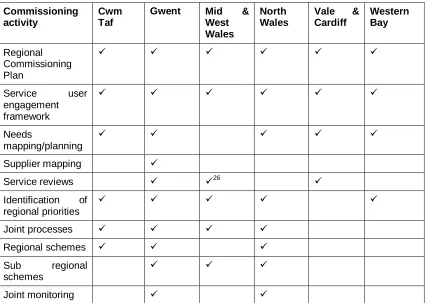
10. The extent of regional commissioning taken place to date has been varied and influenced by historical arrangements for the Programme in each region, with more activity in areas with a tradition of regional working such as North Wales and Gwent.
11. RCCs are perceived to: lack the power or authority to make decisions and hold members to account (e.g. many of the current Regional Commissioning Plans are based on an amalgamation of Local Commissioning Plans); lack understanding to scrutinise and challenge as not all members fully understand the Programme and/ or the wider regional strategic context; and increase bureaucracy and workload for many of their members.
4
13. RCC membership is seen as representative of regional stakeholders; however there is a lack consensus over whether it would be more beneficial for RCC members to be senior officers with knowledge of wider regional strategies, budgetary and decision making powers or operational officers with an in depth knowledge and understanding of the Programme. In some RCCs input and understanding of statutory partner organisation members is variable.
14. The organisational role of the RCC Chair (e.g. cabinet member, provider or senior officer) is seen as less important than the need to have the appropriate skills, knowledge and competencies to undertake the role.
15. The Regional Development Coordinator (RDC) role is integral to the RCC but there is a lack of clarity over the role and variation in its function across RCCs.
16. The emphasis on service user engagement in the Programme has been
recognised although it has proved challenging to implement given the extent of the client groups covered. RCCs have adopted a range of methods often drawing on existing fora to engage service users.
Recommendations
17. The current Supporting People Programme structures should be retained and revisited once decisions have been made regarding the recommendations made by the Williams Review in relation to the reorganisation of local government.
18. The strategic vision for the Programme should be clarified and communicated. This will drive the structures, governance, management and delivery of the Programme and address many of the current issues around leadership and clarity of function. The following actions are recommended:
Re-defining the Programme’s high level principles and the development of indicators to enable assessment of Programme and RCC
performance against them.
Clarify and communicate the roles and responsibilities of the SPNAB, Welsh Government and RCCs.
5
Ensuring there is common understanding that a robust evidence base, informed by the Outcomes Framework, for the impacts and outcomes of Supporting People funding is required to secure future funding for the programme.
19. When appropriate the SPNAB needs to consider the appropriateness of radical proposals such as potential adjustments to the current funding arrangements for organisations that are not compliant with the Programme.
20. The role and function of the Steering Board should be revisited to assess whether it can contribute to the delivery of the Programme or if task and finish groups (see 21) could report directly to the SPNAB.
21. The workstreams should be replaced by time bound task and finish groups with clear membership, remit and lines of accountability.
22. Welsh Government should explore the opportunities for increasing RCC influence through the use of alternative commissioning models such as Substance Misuse Area Planning Boards. This may incentivise engagement and collaboration of RCC members.
23. Linkages between the Supporting People Programme remit and other Welsh Government policy areas including health, social care and communities need strengthening at the national and regional levels:
Welsh Government and RCCs should to look at the linkages between Supporting People and other Welsh Government funding streams including Families First, Communities First and Flying Start.
RCCs should strengthen relationships with regional health and social care groups.
6
Annual or six monthly meetings between the Minister, the SPNAB, key Welsh Government officials and RCC Chairs/ Vice Chairs will reinforce the strategic vision and leadership for the Programme.
SPNAB and Steering Board meeting minutes, workplans and documentation need to be circulated in a timelier manner.
Decision making and other salient Programme updates need to be consistently communicated both at a national and regional level.
25. RCCs should be given more freedom to adapt processes and practice to local contexts. Requirements for RCC monitoring and reporting should be fit for purpose and reduced where deemed necessary.
26. Welsh Government officials should undertake a capacity building role to support RCCs to meet the strategic vision. Activities could include:
Facilitating communication across RCCs to share commissioning and service user engagement good practice.
Feeding back workstream activity.
Developing existing networks e.g. RDC network.
27. Welsh Government should consider developing a generic role description
outlining the knowledge, skills and competencies expected of an RCC Chair. The organisational role of the RCC Chair should be left to individual RCC discretion.
28. The RDC role should be clarified and standardised across the RCCs.
Opportunities for increasing the focus of the role on partnership and relationship building with other strategic regional groups should be explored.
29. Service user engagement should be more meaningful and representative of the Programme’s client groups and built into the Programme’s Outcomes
Framework. Welsh Government should share existing good practice and RCCs should look towards developing more service user-focused methods of
7
1 Introduction
Introduction
1.1 In March 2014, Miller Research Ltd in association with Shelter Cymru were commissioned by Welsh Government to undertake an independent review of the Supporting People Programme following its transition to new structures in 2012.
Aims and Objectives
Aim
1.2 The aim of the research was to review the various Programme structures underpinning the Supporting People Programme since the implementation of the re-launched Programme in August 2012 and make recommendations regarding their future.
Objectives
1.3 To address this aim the objectives of the Review were to:
i. Assess the effectiveness of the Programme planning and commissioning arrangements for Supporting People, in terms of (both at local and national level):
Planning and commissioning structure and interrelation between national, regional and local arrangements
Membership Engagement Impact/Influence
Stakeholder awareness
Delivery of regional commissioning ii. Identify best practice and innovation. iii. Identify areas for improvement or action.
8 Research tasks and activities
1.4 In order to address the objectives above, the review explored and assessed: i. The suitability of the Programme structure and governance to deliver
effective regional commissioning; including an assessment of Programme governance, as outlined above.
ii. How effectively each Regional Collaborative Committee (RCC) was operating in terms of their role and the high level principles specified in the Supporting People Programme Grant guidance, including specific exploration of:
Whether the correct stakeholders are represented on each RCC;
Whether and to what extent members engage with the commissioning process;
Whether effective arrangements for service users to influence commissioning decisions are in place;
The nature of each RCC’s achievements to date; and
Whether the group is making effective use of the Regional Development Coordinator (RDC).
iii. The role and effectiveness of the Supporting People National Advisory Board (SPNAB), including evaluating whether the correct people are on the Board, their level of engagement and achievements to date, as well as awareness of the Board amongst other groups within Supporting People and the wider stakeholder and service user community.
iv. The role of and requirement for the various work groups and workstreams involved with the Supporting People Programme; including how they relate to the SPNAB and the impact they have. v. The views of the wider Supporting People community (including local
authorities, RCCs and service providers) on the various structures to determine whether they are considered effective (in terms of the issues outlined above).
9 Structure of report
1.5 The remainder of the report is structured as follows:
Chapter 2 Methodology – outlines the approach to conducting the review.
Chapter 3 Context – provides a detailed background on the history and development of the Programme in Wales.
Chapter 4 Findings – presents key findings from the primary research Programme.
10
2 Methodology
Introduction
2.1 Given the complex issues to be examined by the review a qualitative research programme was implemented. The research programme was designed to ensure both geographical breadth and representation of Supporting People stakeholders at the national and regional levels of the Programme. Primary research commenced in April 2014 and was completed in early July 2014. Scoping interviews with three stakeholders (representatives of an RCC, the SPNAB and the Supporting People Steering Group) informed the development of topic guides for the wider research programme (see Appendix I).
2.2 A Steering Group comprising Welsh Government officials and representatives of Community Housing Cymru (CHC), Cymorth Cymru, a local authority
Supporting People officer and the Welsh Local Government Association (WLGA) provided oversight and scrutiny to the review.
Methodology
Desk review
2.3 A review of national, local and regional documentation relating to the Supporting People Programme provided a contextual understanding of the Programme and informed assessment of the outputs and progress of
Supporting People national bodies and RCCs. Documents reviewed are listed in Appendix II.
Interview programme
2.4 A purposive sampling approach was implemented to ensure interviewees from all interested organisations were represented in the research programme. Eighty-two semi-structured interviews were conducted with:
National stakeholders including members of: - SPNAB;
11
- Other relevant individuals (e.g. Welsh Government Officers, Ministerial Advisors).
The National Stakeholder sample was selected to ensure coverage of all organisations involved (e.g. Welsh Government, CHC, Cymorth Cymru, WLGA, Probation, Health and independent members).
Regional stakeholders including: - RCC Chairs;
- RDCs;
- A sample of local authority Supporting People Leads; and
- A sample of provider (housing and support services) representative from all RCCs.
2.5 An in depth consultation with all six RCCs was not feasible within the resource and timescales of the review. However, a more in depth consultation was conducted in three RCCs. Cwm Taf, Mid and West Wales and North Wales RCCs were selected to reflect their location and number of composite local authorities. In these RCCs, in addition to the individuals listed in 2.4 interviews were also conducted with:
Additional local authority representatives; Additional provider representatives
Representatives of statutory organisations (health and probation); The Vice Chair; and
Cabinet Members
RCC meetings were observed to provide a richer contextual understanding of committee dynamics.
2.6 It was originally intended that the in depth consultation of three RCCs would be developed into individual case studies; however as the data collection
12
and experiences negated the need for this information to be presented separately as individual case studies within this report.
Workshops and focus groups
2.7 Workshops and focus groups with Supporting People Information Network (SPIN), RDCs and at a Cymorth Board meeting facilitated discussion about the new structures and recommendations for future delivery.
Data analysis
2.8 Data analysis was conducted using a framework approach whereby a research framework based on the review objectives and activities (paragraphs 1.2 to 1.4) guided analysis.
2.9 A process of data triangulation was adopted in which information collected from the various sources of data (documentation review, interviews and focus
groups) was collated to verify findings and check for regularities.
Data collection
Data collection scope
2.10 Eighty two semi-structured interviews were conducted. As many of these interviewees sat on a range of committees and groups relating to the new structures (e.g. there were interviewees who sat on the Steering Group, workstreams and a RCC) an interview with one individual would often enable us to achieve a greater representation of the different boards and groups associated with Supporting People. To ensure anonymity of research
participants, where quotes have been used they have been attributed either to a National Stakeholder or Regional Stakeholder1.
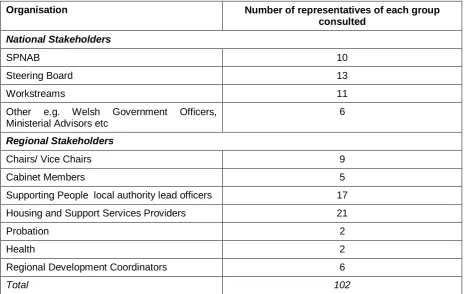
2.11 Table 1 illustrates the scope of the interview programme by Supporting People group:
1
13
Table 1: Number of representatives of each Supporting People stakeholder
group consulted
Organisation Number of representatives of each group
consulted
National Stakeholders
SPNAB 10
Steering Board 13
Workstreams 11
Other e.g. Welsh Government Officers, Ministerial Advisors etc
6
Regional Stakeholders
Chairs/ Vice Chairs 9
Cabinet Members 5
Supporting People local authority lead officers 17 Housing and Support Services Providers 21
Probation 2
Health 2
Regional Development Coordinators 6
Total 102
Data collection experience
2.12 Overall, the primary research programme achieved a balance in terms of the number of individuals consulted and their group e.g. local authority, provider, Welsh Government, etc. Representation of statutory organisations (health and probation) and cabinet members in the primary research was less than
anticipated despite concerted efforts to consult these groups. However we feel this is reflective of their level of engagement in the Supporting People
Programme which has been variable at both national and regional level2.
2
14
3 Context
Introduction
3.1 The purpose of this section is to provide a brief background on the history and development of the Supporting People Programme in Wales. This preface is integral to understanding the issues identified in Chapter 4 as well as informing the conclusions and recommendations presented in Chapter 5.
History of the Supporting People Programme
Supporting People Programme 2003 - 2010
3.2 The Supporting People Programme was launched across the UK in 2003 and aimed to help vulnerable people to gain and retain
independence by remaining in their own homes and by providing a range of housing related support services. It brought together seven separate housing related funding streams into a single ring-fenced fund. In England and Scotland the Programme was administered by local authorities; in Northern Ireland it is administered by the Northern Ireland Housing Executive. Up to 2012 the Programme in Wales comprised two funding streams: the Supporting People Revenue Grant (SPRG)
administered by the Welsh Government directly to support providers for floating support for homeless and young people, homeless hostels, domestic abuse refuges and supported living for young people; and the Supporting People Grant (SPG) administered by local authorities for the identified support costs of sheltered schemes, community alarm services and community care schemes. In Wales the Programme currently
provides approximately £134 million of support for around 70,000 people3. Analysis of Supporting People investment in Wales (2006)
3
15
found that there was a £1.68 saving to the public purse for every £1 spent by the Programme on housing related support services4.
3.3 However by 2004 it was clear that the distribution of money in England, Scotland and Wales was unequal, reflecting provision of existing
services rather than need5. In contrast Northern Ireland’s central commissioning model had ensured a distribution based on need6. By 2009 the Programme in Scotland7 and England ceased to be ‘ring-fenced’ and local authorities were no longer required to spend this funding on housing related support. In 2011 Supporting People funding in Scotland and England became a non-differentiated part of the
Formula Grant and decisions about where to allocate these funds are now entirely at the discretion of the local authorities. In Wales there had been issues relating to the funding and administration of the grant since 2003. There was work in 2006 and 2008 to assess whether local
authorities should administer both funding streams but it was
inconclusive and no action was taken. In 2010 the Programme in Wales came under further scrutiny as a result of the commissioning of a review conducted by Professor Sir Mansel Aylward which had a remit to provide the then Deputy Minister of Housing, Jocelyn Davies with advice on the current arrangements, systems and resources around the Programme and to make recommendations on how these could be strengthened.
Aylward Review
3.4 The ‘Aylward Review’ made 25 recommendations regarding the
allocation, governance and delivery of funding for the Supporting People Programme in Wales. Unlike in England and Scotland, the Review advocated the continued ring fencing of the grant outside of the
4 Matrix Research and Consultancy (September 2006) „Costs and Benefits of Supporting People‟ Report for the Welsh Assembly Government Matrix. London
5 Aylward M, Bailey K, Philips, C, Cox, K and Higgins, E (2010)The Supporting People Programme in Wales: Final report on a Review commissioned by Jocelyn Davies AM, Deputy Minister for Housing and Regeneration, Welsh Assembly Government, Cardiff 6 Ibid.
16
Revenue Support Grant (RSG). Other key recommendations included the unifying of the two funding streams into a single grant, a new distribution formula and a revised governance structure for its administration including the establishment of a Supporting People National Advisory Board (SPNAB) to be chaired by the Deputy Minister to provide independent advice and information. The Review placed a strong emphasis on the need for a collaborative approach across local authorities, housing and support providers, health services, probation and other relevant organisations with an “abiding emphasis on co-design and co-production” (p.10). The review advocated the establishment of multi-sectorial collaborative committees within each local authority boundary whose remit should include the planning, commissioning, procuring and monitoring of services (p. 70). Acknowledging the potential of regional working, in particular the approach in Gwent and North Wales8, the Review suggested that these local collaborative committees could act as an interim measure in progressing towards cross boundary arrangements.
3.5 The Review also considered the strengths and weaknesses of regional working or cross-boundary working. Identified strengths included: stronger team working; meeting the needs of some clients e.g. substance misusers and victims of domestic abuse who often travel cross local authority boundary; efficiencies for providers e.g. single regional reporting references. Identified weaknesses included:
reluctance of some local authorities to work regionally; differing agendas of some local authorities; lack of a clear ‘region’ in some areas; and potential for bureaucracy to be increased (p. 51).
8
17
Post Aylward Review Supporting People Programme
Overall structures
3.6 In 2012 the Welsh Government published guidance on the new arrangements for the Programme9. The new grant – the Supporting People Programme Grant (SPPG) – was ring fenced and allocated to local authorities who were to contract directly with support service and housing providers. A set of five high level principles to underpin the Programme were agreed: improvement to services and outcomes to the end user; probity, accountability, transparency and scrutiny;
implementation based upon the principles of equality, collaboration and co-production; provision of strategic oversight and direction in line with national, regional and local strategy and Supporting People
Commissioning plans; and a system underpinned by a robust and enforceable regime of governance. Figure 1 presents the structures for the Supporting People at the time of data collection commencing in April 2014.
18
Figure 1: Post-Aylward Review Supporting People Programme
Structures (April 2014)
Regional Collaborative Committees
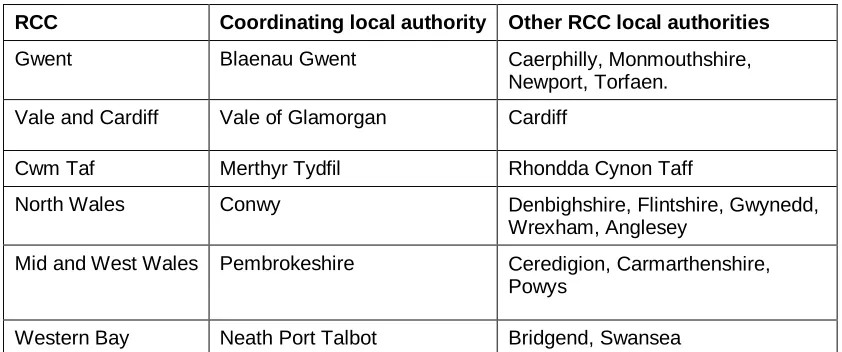
3.7 The 2010 Simpson Review10 and subsequent ‘Compact for Change11’ underlined the benefits of collaboration for achieving effective service delivery. Influenced by this broader Welsh Government policy agenda focus on increased regional working, the local multi-sectorial committees advocated by the Aylward Review were applied to a regional level. Six Regional Collaborative Committees (RCCs) (see Table 2) aligned with Health Board boundaries were established with the aim:
“To provide advice to local authorities and other local
stakeholders, and through the SPNAB, to the Welsh Ministers on regional and local collaborative delivery of the Supporting People Programme to ensure the most efficient and effective services are delivered. The RCCs will inform and advise the Welsh Ministers on the production of proposed Supporting
10
http://wales.gov.uk/docs/dsjlg/publications/localgov/110325lnrservicesv2en.pdf 11
19
People Commissioning plans for the allocation of grant against agreed priorities”12
[image:23.595.83.504.167.343.2](p. 14).
Table 2: Regional Collaborative Committees
RCC Coordinating local authority Other RCC local authorities
Gwent Blaenau Gwent Caerphilly, Monmouthshire, Newport, Torfaen.
Vale and Cardiff Vale of Glamorgan Cardiff
Cwm Taf Merthyr Tydfil Rhondda Cynon Taff
North Wales Conwy Denbighshire, Flintshire, Gwynedd, Wrexham, Anglesey
Mid and West Wales Pembrokeshire Ceredigion, Carmarthenshire, Powys
Western Bay Neath Port Talbot Bridgend, Swansea
3.8 The RCCs do not have executive powers and functions and the Guidance states that membership should comprise: local authority Cabinet Members (or delegated officials in their absence); health; probation; providers (representing long term and short term
services)1314; and service user representation. Members can be co-opted at the discretion of the RCC but will not have voting rights; and appropriate local authority officers. The Guidance also states that Welsh Government officials can attend the RCCs, but do not have voting rights. It is required that RCCs should meet a minimum of once a quarter and should be chaired by a local authority member with the position of Vice Chair occupied by the representative of another agency.
3.9 The RCC’s are coordinated by one member local authority who have the responsibility of coordinating local commissioning plans and support regional partnership working. The RCCs also employ a Regional Coordinator (RDC), a role funded by the Welsh Government but
12 Welsh Government (2013) Supporting People Programme Grant (SPPG) Guidance – Wales, Welsh Government. Cardiff
13
Providers receive support from Cymorth Cymru and CHC but do not need to be members 14
20
employed by the coordinating local authority. The Welsh Government provided a job specification1516 for the role which details the RDC’s purpose and key tasks including: working with the RCC Chair to manage and set agendas and commission papers for RCC meetings; providing a secretariat role to the RCC; working with regional stakeholders to
facilitate the agreement of regional priorities; working closely with representative bodies to assist in ensuring provider and landlord
representatives are fully engaged and supported to carry out their roles effectively; analysing information submitted to the RCC; undertaking specific pieces of work as requested by the RCC; supporting the RCC to establish procedures for how the RCC will work and regional
arrangements for regional planning and commissioning; and working closely with Welsh Government officials.
3.10 The RCCs were established between January and November 2012 and are required to report on progress and performance to Welsh
Government on annual basis in September. At the time of writing, these reports had been reviewed by the governance workstream. RCCs have also submitted RCPs outlining spend for the 2014-2017 period.
3.11 There are also a number of national and regional groups that both have an interest in the Supporting People Programme and whose members may also sit on RCCs or be involved in the management and delivery of the Programme: Supporting People Information Network (SPIN);
Cymorth Cymru supported Regional Provider Forums; CHC Supported Housing Services Forum. These groups pre-date and operate
separately to the formal Programme structures.
15
Welsh Government (2012) Regional Development Coordination Advertisement and Person Specification v2.0
16
21 Supporting People National Advisory Board
3.12 As recommended by the Aylward Review the SPNAB has been established to:
“provide advice to the Minister for Housing and Regeneration, and to make sure that the Supporting People Programme is focused on meeting the housing-related needs of vulnerable people in Wales”17
(p.12)
3.13 Up to June 2013 the SPNAB was chaired by the Minister for Housing and Regeneration; since then an Independent Member has acted as Chair. The Head of Housing Policy Division sits on the board, alongside representatives of the following organisations: WLGA; Association of Directors of Social Services Cymru (ADSS); Public Health Wales; CHC; Cymorth Cymru; Housing Leadership Cymru; Wales Probation Trust; and three independent individuals (including the current Chair). The Board meets four times a year and publishes its minutes and workplan on the Welsh Government website18.
Steering Board, workstreams and other groups
3.14 A Steering Board, workstreams (quality, governance) and working groups (strategic finance, redistribution, research and evaluation) were set up to deliver the Aylward Review’s recommendations. Membership comprises representatives of: Welsh Government, Cymorth Cymru, CHC, WLGA, Welsh Audit Office (WAO), Probation Trust, RCCs and support service and housing providers.
17 Welsh Government (2013) Supporting People Programme Grant (SPPG) Guidance – Wales, Welsh Government. Cardiff
18
22
Wider developments
3.15 The commissioning of this review and its subsequent conduct needs to be considered in light of a number of policy developments and ongoing reviews which have occurred since the implementation of the new Supporting People structures.
Williams Review
3.16 Since the introduction of the new Supporting People structures, the findings of the Commission on Public Service Governance and Delivery (2014)19 (also known as ‘the Williams Review’) has been published. In light of the current challenging financial climate, the Review strongly recommends the reorganisation of local government in Wales in order to effectively manage demand for public services. Several options for reorganisation are presented, all of which include the reduction and restructuring of local authorities and the creation of new local
government boundaries. The review also acknowledges the Welsh Government’s role in facilitating and driving collaboration but suggests collaboration should not be an end in itself and recommends that:
outcomes of collaboration should be defined; law, funding and legislation should facilitate not hinder collaboration; and that detailed models for collaboration should not be prescribed where there are viable
alternatives. A decision about the outcomes of the Review is likely to be made after the end of the current Assembly term.
Governance review
3.17 In August 2013 a review of long-term RCC governance options was published20. The review sought to address the challenges that have been identified around a collaborative un-constituted body making spending decisions in relation to a grant administered by local authorities. The review developed three options:
19
Williams, P (2014) Commission on Public Service Governance and Delivery. Welsh Government, Cardiff.
20
23
Option one – a stronger local government focus, coupled with a statutory duty to address ‘Supporting People’ needs.
Option two – place the RCCs on a statutory footing and/or become corporate legal entities.
Option three – develop a combination of RCCs established by Memorandum of Understanding (MoU), but linked to legally binding grant conditions on local authorities which confer real authority and leverage on the RCCs.
3.18 Option three was proposed as the most credible option as it enabled that SPPG money would remain with local government as recommended in the Aylward Review but it would come with legal conditions that would require local authorities to disburse it in accordance to the strategic plan developed by the RCC. The MoU would establish the RCC’s roles and responsibilities, in particular the underlying principle of the RCC being a collaborative, multi-sectorial body.
Memorandum of Understanding
24
4 Findings
Introduction
4.1 This section will present the common findings thematically. The findings draw on interviews and workshops with more than eighty individuals involved in the management and delivery of the Programme. Regardless of organisational background (e.g. provider or local authority) there was a common understanding of and views on the Post Aylward structures; however views expressed by specific groups or organisations are indicated in the text.
Understanding and views on post Aylward restructuring
Rationale
4.2 Interviewees understood the rationale for the new structures to be underpinned by the need to achieve greater equality in the delivery of the Supporting People Programme and to improve services for
vulnerable people in a challenging financial climate.
4.3 Many interviewees felt that the establishment of RCCs addressed the Welsh Government’s regional agenda and offered a compromise to the major Supporting People delivery partners. Some interviewees
suggested that there had been concerns regarding the potential implications of removing the Programme funding’s ‘ring-fenced’ status and there was the perception amongst providers that local authorities would be reluctant to fund services for some vulnerable groups.
Appropriateness of new structures
25
“the new structures have been good at letting people input to the operational details, other [Welsh Government] directorates are much more closed.” (National Stakeholder)
4.5 The formalisation of regional collaborative working through the RCCs was welcomed, with many local authorities having already undertaken a degree of local and regional collaborative working. Some interviewees felt that local level collaborative groups should have been developed before the RCCs and this would have facilitated the process of moving towards collaboration on a regional scale.
4.6 There was some acknowledgement that because the RCCs were aligned with existing regional footprints, there is imbalance in terms of the number of authorities included in each RCC e.g. North Wales RCC covers six local authorities whereas Cwm Taf, and Vale and Cardiff comprise two local authorities. Many interviewees also noted that any outcomes of the Williams review may have implications for the current regional structure of the Programme.
4.7 A common concern voiced by interviewees was that the structures do not proffer sufficient authority for the RCCs. Their remit was perceived as being an inevitable compromise between the demands of local authorities who are accountable for the budget and providers, some of whom feared that Supporting People funding would not be spent appropriately:
“Local authorities wanted a body that scrutinised, advised and acted as a critical friend. Providers wanted RCCs to have more decision making powers, so we ended up with a half-way house and as a result there is a lack of understanding in their purpose and six very different RCCs”.(National Stakeholder)
26
Supporting People National Advisory Board (SPNAB)
Purpose and effectiveness of the SPNAB
4.9 There was consensus over the SPNAB’s purpose as a high level strategic and advisory body described by one interviewee as:
“guardian of the Programme” (National Stakeholder)
4.10 Seen as having a crucial role in protecting the Supporting People Programme from reductions in spending, it was felt that its
responsibilities should include providing strategic direction, governance and oversight of the Programme as well as advising the Minister on issues such as how reductions in budget could/should be applied.
4.11 However there were concerns that SPNAB’s ability perform its strategic role had been hindered by a tendency to get waylaid by detail that should be examined by other groups involved in the Programme:
“It should be advisory and strategic but is getting bogged down in the detail looking at individual RCC meeting reports and creating another layer of bureaucracy. It should delegate more of the detail to working groups and Welsh Government officials”. (National Stakeholder)
4.12 While the SPNAB Chair’s attendance at RCC meetings was welcomed by many interviewees, including RCC members themselves, some felt that this was beyond the strategic remit of the SPNAB and unnecessary given the attendance of Welsh Government officials at RCC meetings.
Membership and engagement
4.13 Despite these concerns regarding its strategic remit, the fundamental concept of the SPNAB in terms of its role and representation of Supporting People stakeholder organisations was seen as valid.
4.14 Overall the membership of the SPNAB was deemed to be representative with no obvious omissions, although a small number of people
27
contribution given Supporting People’s work with young people. A small number of interviewees suggested that the SPNAB could also consider some form of service user representation given the requirement for RCCs to do so (although it was acknowledged that in reality this would be difficult to achieve for many of the same reasons that RCCs face as identified in 4.64 below). The contribution of independent members was valued by many interviewees for their commitment, engagement and neutrality and for bringing a different perspective. Some interviewees commented that the engagement and levels of understanding of the Programme by some statutory organisation representatives was variable.
4.15 The majority of interviewees agreed that the current level of individual representative tended to be at organisational director level and this was essential for giving the Programme the profile it requires, however this did raise some concerns regarding the extent of communication back to the operational delivery of the Programme:
“the issue is about how well the representatives sitting on the Board communicate information back to their organisations ... it’s about disseminating the information beyond the Board members.” (National Stakeholder)
4.16 Reflecting on the appointment of an independent member to the role of Chair of the SPNAB in July 2013 following the Minister’s decision to step down from the role, the majority of interviewees felt that this had had a positive impact and had enabled more open discussions within the Board.
4.17 There were concerns by some interviewees that co-production and collaboration was driving the agenda rather than the Welsh Government providing leadership and there was the risk of decision making by
committee both at national and regional levels:
28
be held together strongly – it’s a different way of working for civil servant” (National Stakeholder)
4.18 The frequency of SPNAB meetings was seen as a possible hindrance on its ability to progress its ambitious workplan:
“It’s difficult to understand the remit of the SPNAB – there are lots of agendas fighting their corners. It only meets four times a year so members don’t know each other that well or understand the remit that well” (National Stakeholder)
4.19 Interviewees recognised that the SPNAB had initiated a number of key activities undertaken by its sub groups including work on a long-term distribution formula and the Outcomes Framework.
Interrelationship with regional structures
4.20 For the majority of interviewees, both at the regional and national level, communication between the SPNAB and the RCCs was an issue. Whilst interviewees were aware of the SPNAB minutes, the delay in them being published meant that there were seen as irrelevant and out of date. For many regional stakeholders, the SPNAB was seen as a remote body with little visibility of its output:
“ we don’t receive a lot of information from SPNAB so not entirely sure what they do. Sometimes they provide useful suggestions but other times they demonstrate a clear lack of knowledge of local governance. This undermines their authority”.(Regional Stakeholder)
4.21 Queries were raised regarding the extent of understanding of RCC performance at the national level with Regional Stakeholders in
29
4.22 Both national and regional stakeholders questioned the SPNABs reporting requirements citing that the six monthly reports were time-consuming to complete and the RCCs had received little feedback on the information they had submitted:
“SPNAB doesn’t appreciate the work that is involved in getting things like reports signed off. A lot of preparation goes into reporting such as the outcomes report and data collection” (Regional Stakeholder)
Steering Board and workstreams
4.23 The work of the Steering Board and workstreams in implementing the new structures and bringing together people from different organisations was acknowledged. However all but a small minority of interviewees felt that their role was now unclear:
“the workstreams worked really well during implementation – had good project management but now they have got a bit lost and no one is sure what they are doing”. (National Stakeholder)
4.24 Furthermore there was lack of clarity regarding who sits on the workstreams, their outputs and who they report to both amongst National and Regional Stakeholders:
“Who sits on them? Who sets the agenda? Who do they report to?”(Regional Stakeholder)
4.25 Those aware of the Steering Board’s work felt it duplicated a lot of SPNAB’s activities and shared similar membership. However for a smaller number of interviewees, both the workstreams and Steering Board still had a role to play in the Programme suggesting that the work of the governance workstream was required until all of the RCCs were operating to the five high level principles21. For others, both the
21
30
workstreams and Steering Board should not be time limited and provided a valuable operational function to the SPNAB’s strategic role:
“It’s not visible as it’s designed to be a background group facilitating the ongoing workplan of the Programme overseeing practical work for SPNAB” (National Stakeholder)
Regional Collaborative Committees function and effectiveness
RCC purpose
4.26 Interviewees understood the RCCs’ purpose as one of providing a strategic overview of the region’s Supporting People vision through activities such as: coordinating decision making; looking at regional priorities; scrutinising spend; achieving better value for money; and ensuring the five high level principles are adhered to.
“the role of the RCC is to drive the commissioning agenda of supporting people, ensure compliance with the grant, ensuring value for money from services, ensuring services are effective and of high quality. Is a key route of connection between stakeholders”. (Regional Stakeholder)
4.27 However there were indications that clarity over their purpose had been diluted:
“I thought I knew but actually I’m not too sure…it should be to look at regional plan but in the RCC people are still very territorial – the MoU will help with this”. (Regional Stakeholder)
“I’m not sure anyone knows its function. It was set up in
November 2012 so it’s had 18 months but I’m not sure we know where it’s going.” (Regional Stakeholder)
RCC effectiveness
4.28 It was acknowledged that there was variation in the extent to which RCCs were fulfilling their purpose and that this could be linked to
31
historic arrangements in the region with some areas having a more established traditional of collaborative working than others:
“The value of collaboration is strong – but there needs to be something in it…something needs to shift; they need to move up a gear” (National Stakeholder)
4.29 Terms such as ‘talking shop’ and ‘rubber stamping exercise’ were commonly mentioned by most interviewees when asked about the effectiveness of the RCCs. Many of the local authority Supporting People teams felt that their respective RCC had led to an additional layer of bureaucracy instead of providing strategic regional direction.
4.30 The majority of RCC members interviewed were of the opinion that it was still too early to tell whether or not the RCCs were effective. Most RCCs had been involved in developing consistent processes and back office functions rather than developing regional services. National stakeholders seemed to have higher expectations of what the RCCs should have achieved by now than the RCC members themselves. Most regional stakeholders felt the RCCs were where they should be in terms of development with a small number of interviewees referring to
Tuckman’s ‘Forming – Storming – Norming – Performing model’22
of group development citing that most RCCs were still in the first three phases with a minority moving to performance23.
“Does everyone understand what collaboration and
co-production means? Are people actually willing to let down their barriers and work together?” (Regional Stakeholder)
4.31 A number of common overarching factors hindering RCCs’ effectiveness were identified and are explored in further detail below.
22 Tuckman, Bruce W. (1965) ‘Developmental sequence in small groups’,
Psychological Bulletin, 63, 384-399.
23
32 RCC dynamics
4.32 The dynamics within each RCC varied, with perceptions that the larger RCCs (e.g. Gwent and North Wales) were working better as they had to think differently in order to accommodate multiple views. It was
suggested that in RCCs comprised of two local authorities there could be difficulties as there is no ‘mediator’ and one local authority can dominate:
“There is a significant difference in budgets and discussions can
therefore be difficult. It is often expected that a deficit/overspend in one area can be balanced through the other. Whilst this may work in other areas which manage multiple local authorities as each one can take a share, it doesn’t work in an area with just two local authorities”. (Regional Stakeholder)
4.33 While there was a common understanding of the need to regionalise, there was some evidence of local authorities not always wanting to give up their local autonomy. For example in one RCC, local authorities had agreed an approach to developing joint systems but then one local authority decided to change its approach without consultation or explanation. However it was acknowledged in this case the RCC did challenge the local authority regarding its actions.
4.34 Members noted that they were only now at a point where they were able to work collaboratively. It was acknowledged that more recently the smaller RCCs had begun to gain momentum and that the time taken to embed collaboration should not be underestimated, given that Gwent and North Wales have a long track record of collaborating on both Supporting People and other programmes:
“You can’t force people to work regionally – it’s better to be a natural process, collaborative working in Gwent took ages to get going.” (Regional Stakeholder)
33
unique to this Programme and was often difficult to achieve because of local authority structures and legislation.
4.36 However despite frustration with progress to date, the majority of RCC member interviewees were keen to stress that they saw potential in their RCC and fully supported the intention to work regionally and
collaboratively.
RCC remit and status
4.37 The majority of interviewees felt that the RCCs lacked the status to fulfil their roles and were unable to do little more than make
recommendations and identify good practice. While the potential of the RCCs was recognised, many interviewees felt that there would be little or no challenge should members not adhere to its decisions, with the views below being typical of RCC members from both statutory and provider organisations:
“RCCs have no powers and have nothing to do with money; they’re a talking shop really”. (Regional Stakeholder)
“It hasn’t got the status it needs to fulfil role. There is no clarity on its powers to make and enforce decisions” (Regional
Stakeholder)
4.38 A small number of interviewees noted that to date there had been very few occasions where a ‘difficult decision’ needed to be made (e.g. changes to existing services in the interest of regional needs and priorities which could impact upon certain local authorities), and that when such a decision needed to be made it would be provide a true test of the RCC’s status.
4.39 Many interviewees felt that the RCCs were duplicating what local authority Supporting People officers had been doing anyway prior to their establishment. Most local authorities had been working
34
regionally prior to the new structures. Local authority members in particular commonly expressed the view that :
“there were many pre-existing local collaborative groups that already had provider reps involved and had set a culture of collaboration and co-production” (Regional Stakeholder)
4.40 Many interviewees had seen the Supporting People guidance as overly prescriptive in some areas with an excessive focus on policy and
process rather than outcomes. The MoU was published during the latter stages of data collection and a number of interviewees hoped that this would clarify much of the confusion around the RCCs’ status, powers and responsibilities:
“Overall its role is to provide a strategic and directive overview of the regions Supporting People vision however without the MoU in place it hasn’t got the ability to do so”. (Regional Stakeholder)
Funding uncertainties and disparities
4.41 The uncertainty over funding allocations to date had hindered the ability of some RCCs to undertake regional activity:
“The RCC started focusing on getting value for money and looking at commissioning regional priorities. However there was a stop on spend so they didn’t progress. It has been quite disjointed and this has the potential to happen every year as there is no guarantee of protection of Supporting People funding” (Regional Stakeholder)
35
Regional Collaborative Committee membership and engagement
Coordinating local authority model
4.43 The coordinating local authority model was seen to work well. There had been variation between the effectiveness and influence of the
coordinating local authority with some coordinating authorities taking more of a leadership role whereas other performed more of an administrative function:
“The model is ok, there is a long way to go, there have been struggles around each- others roles and moving away from how they have worked historically, it is felt that the coordinating authority is setting the pace but all in all they work well together and are definitely improving” (Regional Stakeholder)
4.44 In North Wales the local authorities bid to be elected as the coordinating authority. However the majority of interviewees in other areas were not aware how the coordinating local authority was chosen with the
perception that it was probably decided amongst Supporting People lead officers.
RCC membership
4.45 Interviewees agreed that the right organisations were represented on the RCCs; however there was considerable comment on the seniority of the individual representative and the need to achieve a balance between someone who can both influence within their own organisation and who has enough knowledge about the Supporting People Programme at an operational level to be able to actively participate, challenge and
scrutinise RCC activity:
36
4.46 The issue of whether cabinet members or senior officers should be RCC members was subject to considerable debate with the views that while the former do not necessarily have the knowledge of the Programme to be in the position to scrutinise fully, their profile did add credence to its importance:
“You need to involve politicians in things as we have a
democracy – but they are better at making decisions when they have been advised by officers. Local authority officers may have a different conversation and tend to be more cautious if cabinet member is there”. (National Stakeholder)
“RCCs should hold Supporting People managers to account and understand strategy. It needs to be senior officers”. (Regional Stakeholder)
4.47 The level of local authority representation was seen to be linked to the historic treatment of Supporting People in individual local authorities – it is a more high profile Programme in some local authorities compared to others:
“..While Supporting People is of high priority, we shouldn’t be hung up on whether there is an officer or cabinet member on the RCC… it should be down to local determination and the right person making decisions which may not necessarily be the senior officer or cabinet member.” (Regional Stakeholder)
4.48 A small number of interviewees felt that the involvement of provider representatives in making commissioning decisions could raise issues relating to conflict of interest.
37
some RCCs the attendance, understanding and contribution of these organisations were considered to be variable.
4.50 A number of RCCs (e.g. Gwent, Western Bay) had co-opted in
representatives of other organisations including the Officer of the Police and Crime Commissioner (PCC), Community Safety Partnership and Substance Misuse Panel Gwent. Mid and West Wales were also in the process of inviting a representative of the PCC to sit on the RCC.
Nonetheless there were concerns that meetings had the potential to get too big and further hinder the RCC’s ability to gain consensus,
particularly in RCCs with a large number of local authorities.
Engagement and involvement in the RCC
4.51 The levels of engagement and understanding of RCC members varied. e RCCs with more established regional collaborative and co-production working practices felt that all members contributed equally:
“RCCs are run very differently ... on paper they’ve got the right people around the table but I don’t feel there is any real
integration ... it might be because they are so new.” (National Stakeholder)
“The RCC is representative of a wide range of stakeholder groups but does everyone feel part of the RCC? Everyone can turn up but are they actually engaged?” (Regional Stakeholder)
4.52 Many RCCs had found holding sessions outside of the formal RCC meeting had increased understanding of both of the purpose of the RCC and of other members. In Cwm Taf a ‘meet the providers day’ was found to be useful in breaking barriers between elected members and
providers. Gwent have held a number of planning days including ‘De Bono Six Thinking Hats’24
day which helped members understand the purpose and function of the RCC. In Mid and West Wales, a Corporate
24
38
Development Advisor facilitated a workshop with RCC members to explore opportunities for improving the effectiveness of the RCC, an event which participants praised for improving their understanding of their roles and objectives as RCC members. In addition site visits to Supporting People Programme funded schemes had improved understanding of the Programme. Service users had been invited to present to the North Wales RCC which members found useful in improving understanding of the services supported by the Programme and its impacts.
4.53 Where collaboration and co-production were less embedded there was evidence of less equal relations within the RCCs:
“In the meetings there’s a heavy focus on the local authorities presenting as a fait accompli, without ever listening, wanting to hear views or critiquing things. There’s a difference between paying lip service to it and really acknowledging and adhering to it. Support providers are still seeking to protect their own
services to some extent, feathering their own nests”. (Regional stakeholder)
4.54 Despite the welcomed presence of statutory organisations such as health and probation, concerns were raised that Supporting People was often a small part of their remit and that they may not have sufficient understanding of the Programme to constructively challenge and scrutinise outputs such as spend plans. In some cases, RCC members were likely to turn to the local authority Supporting People lead officers when a decision needed to be made because they had the most in-depth knowledge of the Programme.
Awareness and understanding of high level principles
4.55 The majority of interviewees were aware of the high level principles of the Supporting People Programme:
39
better at providing the strategic overview and developing processes to do that.” (Regional Stakeholder)
4.56 However some interviewees felt that there was a lack of shared understanding of the high level principles and this was evident in the annual reports in which RCCs had been required to provide an
assessment of their performance against them. Both the annual reports and interviews suggested that each RCC had interpreted the high level principles differently. Furthermore even within individual RCCs,
interviewees suggested that not all members shared a common understanding of what the principles meant or how the RCC was performing against them.
RCC Roles and responsibilities
Chair
4.57 An effective Chair was seen to be integral to the performance of the RCC. A ‘good’ Chair was seen to be one that: balanced the
management of the agenda with open discussions; challenged; and linked with the national policy agenda. The majority of RCC members were satisfied with the performance of their Chair.
4.58 Although the majority of RCCs (Cwm Taf, Mid and West Wales, Western Bay and Vale and Cardiff) had political Chairs, only a small number of interviewees felt that the Chair had to be a political appointment:
“It works well having a political appointment as it’s beneficial to have somebody with political clout. It wouldn’t work as
effectively if they had mid- level managers as they need decision makers to ensure things get done”. (Regional Stakeholder)
4.59 However the vast majority of interviewees did not think a political
appointment was essential but this was often caveated with the need to have elected members on the RCC if the Chair was not a politician to ensure the RCC retained a high profile. In general it was felt that
40
background was not important, with a split between interviewees with a local authority background suggesting it had to be a local authority representative and those with a provider background suggesting it could rotate between a local authority and provider representative. A smaller number of individuals suggested that an independent member could be appointed Chair and that this may address some of the perceptions in some RCCs that: local authorities as budget holders drive the agenda; and the involvement of providers in commissioning decisions raises potential conflicts of interest.
Regional Development Coordinator
4.60 The Regional Development Coordinator (RDC) role was seen as an essential albeit complex role with wide ranging responsibilities including: supporting the Chair; arranging meetings; linking with regional
stakeholders; coordinating plans. Many interviewees felt that the RCC could not function without the RDC role:
“the RDC is an essential driver for the RCC and a linkage to people outside of it, I’d question if we don’t need an RDC then do we need an RCC” (Regional Stakeholder)
4.61 However the nature of the RDC role varied between RCCs, many had different job descriptions, pay and conditions. In some areas (e.g. Gwent25) the RDC undertakes more of a business manager role driving the work of the RCC outside of formal meetings, building links and facilitating partnerships with other key regional organisations whereas in other areas the role was more administrative and concerned with
servicing the formal meetings. RDCs felt that their role was not clear either to themselves or other partners and as a result for some it had expanded into something more than that outlined in their job description; many were undertaking activities that they did not feel equipped to do such as data analysis and the development of the service user
engagement frameworks. While RDCs believed that they should be
25
41
working for the RCC, the lack of clarity regarding the RDCs’
responsibilities had resulted in them undertaking work from other groups and organisations involved in the Supporting People Programme:
“the role is loosely defined, it’s often a case of ‘oh the RDCs’ can do that” (Regional Stakeholder)
4.62 A small number of interviewees identified a lack of clarity regarding the RDC role, particularly in terms of accountability due the fact they are funded by Welsh Government, located in one local authority, and
working on behalf of the RCC. Their location within the coordinating local authority’s Supporting People team could be problematic, for instance RDCs reported the difficulties of chasing a Supporting People lead for information when they also happened to be their line manager.
4.63 Both the RDCs and other interviewees recognised that the RDC function needed to be carefully examined in light of the issues raised above as well as the fear that local authorities could not afford to fund the role if Welsh Government were to withdraw funding.
RCC Service user representation and engagement
4.64 While interviewees agreed the principle of gaining service user input into the Programme was essential, in practice this had been challenging. The requirement of service user representation on the RCC was
queried, with the majority of interviewees suggesting that one individual would be unable to represent the views of all 19 Supporting People client groups. In addition, the RCC meeting was considered too formal a setting for service users to air their views. A service user had attended an RCC meeting in Western Bay and fed back their views:
“They found it very formal, intimidating, too much jargon, very ‘traditional’ council meeting style. Not at all like in the voluntary sector. Service users would need to be very assertive to be able to have a say” (Regional Stakeholder reporting views of a
42
4.65 All RCCs have developed a service user engagement framework, though these had not been operationalised at the time of writing.
Interviewees expressed concern at their ability to resource service user engagement sufficiently enough to ensure it was not tokenistic and suggested they would need to continue to rely on existing methods of obtaining service user engagement (e.g. via providers) unless it was resourced properly:
“There is not capacity in the RDC post to do it; separate resources should have come with it as it’s so high on the agenda – it’s a major gap” (Regional Stakeholder)
4.66 In the Western Bay RCC a service user framework based on an existing model from Swansea Council called ‘Join In’ had been developed
allowing service users to contribute to local Community Groups.
Representatives from local authorities attend these meetings and feed into a Steering Group at a regional level that report to the RCC. In addition, annual ‘Join In’ events are reportedly well attended by service users and stakeholders.
4.67 Other RCCs reported that service users were reluctant to be involved directly through formalised representation and had found alternative engagement methods more useful for example: in North Wales service users had been invited to give presentations to the RCC; and RCC members in Gwent and Western Bay had visited a number of Supporting People Programme funded schemes enabling them to talk directly to service users about their experiences; Western Bay and Gwent linked into existing provider and local authority forums, networks and