Developing DART: A Digital Learning Tool to Facilitate Equity and Access in the
Contemporary Higher Education Context
Lorelle Burton, Jill Lawrence, Jane Summers, Peter Gibbings, Karen Noble
University of Southern Queensland
Abstract
This paper describes the processes of development of an online educational tool to facilitate equity and access for the diversity of students entering the largely digital context that is higher education today. The Associate Deans (Learning and Teaching) across the five faculties at the University of Southern Queensland (USQ) responded to the issue of student diversity by developing a diagnostic and reflective tool (DART) to assist commencing students in developing their digital literacies according to their individual learning needs. DART was designed to enable and support online (digital) learning for the heterogeneous cohort of students studying at USQ, a regional Australian university. Initially, a range of theoretical perspectives were consulted to determine the knowledge, skills, and aptitudes that constitute digital literacy, including Bloom’s Taxonomy of educational objectives. Secondly, from this review, a framework was constructed to map all relevant dimensions of digital literacy, dimensions which encompassed issues related not only to technical experiences but also to students’ prior learning experiences. This stage also involved liaising with academic staff and other student support staff to further identify the threshold digital literacies required by first year students. Thirdly, two large-scale student surveys of students’ digital literacies and prior experiences in engaging with digital learning environments were conducted. These evaluation cycles informed the ongoing development and refinement of DART. The current paper reports on initial findings from these surveys and discusses implications for the future implementation of DART in the University.
Introduction
The University of Southern Queensland’s (USQ, 2009) current vision is to be recognised as a world leader in
open and flexible higher education, with the university offering learning experiences that are accessible, flexible, borderless and personalised. In this context, the computer and internet are considered to be an
important part of a student's basic learning toolkit. Indeed, the modern trend away from printed texts and written notes in all levels of education has seen the need for more emphasis on solid curriculum development
and a focus on the digital literacies of students to support this style of learning (Wilkie, 2012). Moreover there
is also a move to accommodate greater learner mobility, with predictions that, by 2013, the sales of tablet
devices such as iPads will far outstrip laptops and that the market for digital course and learning materials will
also accelerate exponentially (Wilkie, 2012).
Digital literacy is widely acknowledged as critical to the modern student’s ability to learn effectively in
a digital environment (Cagiltay, 2006; Hill & Hannafin, 2001; Holt, Smisson, & Segrave, 2006; Schrum, 2002;
Selim, 2007). More specifically, in Australian universities students need to be able to demonstrate their
knowledge of, and experience in, using personal computer hardware and software with a high degree of accuracy. This includes possessing a well-developed knowledge of email and internet technology in order to achieve successful learning outcomes in their chosen program of study.
At USQ, a medium sized regional university in Australia, the focus on digital literacies and digital
history, the University intends to continue its focus on providing learning opportunities regardless of geography
and thus the use of digital environments is seen as key to building the future market. The regional nature of
USQ, coupled with its program portfolio and emphasis on flexible pathways for both young and mature-age
learners, has resulted in a student profile with a high proportion of non-traditional university students. This
profile includes a large proportion of low socio-economic students; mature-age students; international and
culturally and linguistically diverse students (CALD); and rural and remote students. This diversity of the
student body means that it cannot be assumed that all students commencing studies at this ‘accessible, flexible and borderless’ university have acquired the appropriate functional knowledge of computer and/or internet
operations and broader digital literacies to successfully participate in, and engage with, the various learning activities provided.
The Associate Deans (Learning and Teaching) across the five USQ faculties, charged with ensuring
that students are able to negotiate this digital world with confidence, recognised the need to be more proactive in
assisting students to develop their digital learning capabilities. To this end, they initiated the development of an
innovative Diagnostic And Reflective Tool (DART) for digital literacies. DART was designed to help
commencing students self-reflect on their prior digital learning experiences and to recognise any gaps in
knowledge and skills. The objective was for commencing students to better understand the digital learning
requirements of the USQ learning context and to be linked with appropriate support services where necessary.
However, DART was also designed for use by more experienced students at any stage of their learning journey.
DART was designed so that all information relevant to digital literacies was available in one place, helping
students to successfully engage with the online student learning management and achieve academic success.
Theoretical Perspectives
Recently there has been a shift in the literature on digital literacies, which involves moving away from the idea
of “digital natives” and from other assumptions about students’ facility for digital learning to a focus on
examining how technological knowledge and experience may or may not transfer to learning (Bennett, Maton,
& Kervin, 2008). This entails recognising where assumptions have been made about students’ digital learning
abilities, including stereotypes about mature-age students, “Gen Y-ers”, first in family, non-English speaking
background (NESB), and rural and remote students.
The notion of students as digital natives is predicated on a general assumption that students coming
into universities have had a comparatively universal and uniform digital upbringing. Such a perspective assumes
that the technological experiences of students are more or less homogeneous and that most, if not all, incoming
university students are digital natives (Bennett, Maton & Kervin, 2008). Not only is it assumed that these
students will have had broadly universal experiences, but that they will also have a sophisticated knowledge and
understanding of information and communication technologies (ICTs; Buckingham, 2007). Alternative
perspectives challenge such generalisations in relation to the risk of overlooking a more complex mix of
technology based skills, knowledge, and preferences among the student population (Kennedy et al., 2007). It is
therefore more productive to focus on how all levels of experience with technology can be understood,
developed, and translated for application in digital learning. Core technology based skills do not necessarily
(2005) argued that “few students have high levels of competence across a wide range of applications” and that
“familiarity with the use of email does not imply expertise in rigorous online debate and discussion” (p. 271).
Similarly, Lorenzo, Oblinger, and Dziubam (2006) stated that “today’s students are not just the traditional-age
Net Generation, nor have they all had the benefit of state-of-the-art, ubiquitous technology. Higher education
comprises a highly diverse and growing student body imbued with a wide variety of information literacy
capabilities” (p. 4). Clearly it cannot be assumed that being a member of the ‘Net Generation’ is synonymous
with knowing how to employ technology based tools strategically to optimise learning experiences in university
settings. Nor should it be assumed that incoming students’ age or remote location implies anything in particular
about their ability to adapt to digital learning environments.
Broader understandings of student’s learning in digital environments can offer different affordances
and lead to varied (perhaps deeper) learning outcomes (Kennedy, Judd, Churchward, Gray, & Krause, 2008).
This suggests we need to develop an understanding of how we expect learners to work and the necessary literate
practices (i.e., the skills, knowledge, and ways of working) that students need to bring to digital learning
contexts. Furthermore, it highlights the need to support students in transferring whatever previous experience
they may have with ICTs and digital environments to learning and study at university. The DART is built upon
a strong evidence-based approach to informing an institutional wide framework where students have
opportunities to self-assess, practice, and re-assess their digital literacy knowledge and skills within context.
There are a range of skills and practices that constitute contemporary categories of digital literacy.
These emanate from theorists like Vitolo and Coulston (2002), Markauskite (2006), and the Learning Literacies
in the Digital Age (LLiDA) Framework (Beetham, McGill, & Littlejohn, 2009).According to Markauskaite, for
example these practices include: a fundamental perspective; basic ICT skills; cognitive capabilities;
inter-literacy; situated inter-literacy; and metacognitive capabilities. These skills and practices align with Aviram and
Eshet-Alkalai’s (2006) five skill holistic conceptual model of digital literacy: (a) photo-visual literacy, learning
to read from visuals; (b) reproduction literacy, the art of creative duplication; (c) branching literacy, hypermedia
and thinking or multiple domain thinking; (d) information literacy, the art of always questioning information;
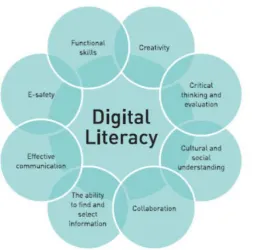
and (e) socio-emotional literacy. Hague and Payton (2010) outlined digital literacies across the curriculum (see
Figure 1), which informed the theoretical framework for DART.
Forehand’s (2005) interpretation of Bloom’s taxonomy of educational objectives contributes to the
range of tasks involved in digital learning, moving from recall and comprehension towards higher-order
thinking. The taxonomy also addresses the fact that skills develop over time and that students’ problems and
issues change. Furthermore, in the context of the heterogeneous makeup of the contemporary student cohort, it
makes no assumptions about any individual’s likely needs or how they should proceed, but allows for the
Figure 1. Digital literacies across the curriculum
(Adapted from “FutureLab” by Hague and Payton (2010, March), p. 19)
DART theoretical framework
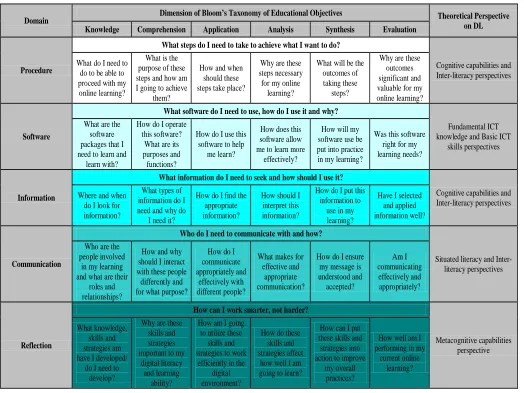
Following the literature review, a relevant framework (see Figure 2) was developed to describe the various
dimensions of the digital literacy and digital learning construct. This framework mapped relevant dimensions of
digital literacy and went well beyond mere technical capability, instead reflecting the argument that technical
experience and learning experience are different issues (Hague & Payton 2010).
The DART framework comprises a number of conceptual advantages. First, DART addresses recurrent
and developing learning capabilities rather than just entry-level instruction, and second, DART models the
complete learning experience including reflection on that learning. The relationship between tools or tasks and
learners is also conceptualised in a specific and contextual way for realising learning outcomes. Other
advantages include its holistic approach and the notion that it can be expanded or adapted without invalidating
the original theoretical approach to explaining and supporting digital literacy practices. Additionally, DART has
the capacity to inform practice-oriented learning tasks and activities to support students’ digital literacy. DART
assumes that digital literacies, like all literate practices, are created, developed, practiced and adapted in a
situated way by learners. Consequently, DART has capacity to allow for the individual to identify the questions
of immediate relevance to their learning. It is envisaged that students will be introduced to DART as part of
Figure 2: DART cross-matched against the various dimensions of Bloom’s Taxonomy of educational objectives.
Adapted from Vitolo and Coulston (2002) and Markauskaite (2006).
Domain Dimension of Bloom’s Taxonomy of Educational Objectives Theoretical Perspective on DL Knowledge Comprehension Application Analysis Synthesis Evaluation
Procedure
What steps do I need to take to achieve what I want to do?
Cognitive capabilities and Inter-literacy perspectives What do I need to
do to be able to proceed with my online learning?
What is the purpose of these steps and how am I going to achieve
them?
How and when should these steps take place?
Why are these steps necessary
for my online learning?
What will be the outcomes of taking these
steps?
Why are these outcomes significant and valuable for my online learning?
Software
What software do I need to use, how do I use it and why?
Fundamental ICT knowledge and Basic ICT
skills perspectives What are the
software packages that I need to learn and
learn with?
How do I operate this software?
What are its purposes and functions?
How do I use this software to help
me learn?
How does this software allow me to learn more
effectively?
How will my software use be put into practice in my learning?
Was this software right for my learning needs?
Information
What information do I need to seek and how should I use it?
Cognitive capabilities and Inter-literacy perspectives Where and when
do I look for information?
What types of information do I need and why do
I need it?
How do I find the appropriate information?
How should I interpret this information?
How do I put this information to
use in my learning?
Have I selected and applied information well?
Communication
Who do I need to communicate with and how?
Situated literacy and Inter-literacy perspectives Who are the
people involved in my learning and what are their
roles and relationships?
How and why should I interact with these people
differently and for what purpose?
How do I communicate appropriately and
effectively with different people?
What makes for effective and
appropriate communication?
How do I ensure my message is understood and accepted? Am I communicating effectively and appropriately? Reflection
How can I work smarter, not harder?
Metacognitive capabilities perspective What knowledge,
skills and strategies am have I developed/
do I need to develop?
Why are these skills and strategies important to my
digital literacy and learning
ability?
How am I going to utilize these
skills and strategies to work
efficiently in the digital environment?
How do these skills and strategies affect
how well I am going to learn?
How can I put these skills and
strategies into action to improve
my overall practices?
How well am I performing in my
Liaison with Staff and Students
The second stage of the DART project involved liaising with key stakeholders (academic staff; student support staff including ICT, Learning and Teaching and Student Management; Australian Digital Futures Institute (ADFI); and students) to identify the threshold digital literacies required by first year students. DART was
subsequently developed to assist students to attain the literacies needed to make a successful transition to
university studies. By utilising both a diagnostic and reflective approach throughout the DART included
identifying from the student user's perspective how they engage with various technologies and online learning
and teaching materials, with the intention of motivating and empowering students to use computer skills in ways that would build upon their prior experiences.
The project team also considered issues related to DART’s implementation at the institutional level.
This encompassed the view that DART would, ideally, be accessed by learners at a course level and be directly
relevant to their course-based tasks, students are concomitantly supported in terms of situated practice of their
digital literacies. It was also considered important that DART had the buy-in of staff in directing students to the
support tool and in making explicit comment on its relevance to specific learning tasks and outcomes. Further,
implementation plans deal specifically with how faculty and/or institution-wide implementation can be achieved
(see Means, Toyama, Murphy, Bakia, & Jones, 2009) to ensure DART is supported and accepted within the
broader educational context of the institution.
Project Design
The adoption of an evidence-based approach, as championed by Kennedy et al. (2008) provided a deeper
understanding of students’ online learning experiences within context. Focus groups were also carried out to
elicit data from students to test the usual assumptions about the correlation between student attributes and the
nature of their engagement with the digital environment. A pilot survey was conducted in semester 3, 2011 to
confirm the actual experience, attributes and needs of the cohort in terms of the nature and levels of their digital
experience. Students were asked to describe various aspects of their digital learning experience including how
often and how easily they used institutional digital affordances and support systems. This online survey of
students was conducted during a third semester of the study year when courses are offered externally and/or
online at USQ. This timing likely attracted responses from experienced online learners (N = 147). While the results from this initial survey were informative, a subsequent larger-scale survey (N = 659) was conducted in Semester 1, 2012, across all study modes. Student focus groups were once again constituted following the
administration of the second survey. Data from both sets of survey and focus groups informed the development
of DART.
Results and Discussion
Results of the initial pilot survey (N = 147) suggested that levels of experience with technology and digital tools do not necessarily correspond to age or location. Students reported high levels of confidence in operating in
institutional digital environments and felt highly confident in accessing support services offered by the
and, 70% indicated that they rarely (either monthly or never) accessed support services. Other findings indicated
that students generally expressed polar views regarding their digital learning experiences. A similar proportion
of students felt the online learning environment was either highly satisfactory or at the other end of the
continuum, disorganised and confusing. . Respondents also generally reported confidence in using various
online tools, with the exception of database tools and to some extent, spreadsheets and Voice over Internet
Protocol (VOIP) tools. These findings certainly support the view that an institutional approach needs to be
cognisant of these binaries and thus, develop strategies that cater for diversity of knowledge and skills relevant
to digital literacies within context.
While it is acknowledged that the pilot study had some methodological limitations in relation to the
representativeness of the sample (being an online survey), it nevertheless provided the project team with some
useful information upon which to build a more comprehensive understanding of students’ digital literacies. The
subsequent survey was informed by these initial findings and highlighted areas that could be explored in more
detail in the forthcoming focus groups.
Connectivity
The findings of the large-scale survey (N = 659) yielded results consistent with the pilot survey results. Almost three-quarters of the students surveyed (72.7%) indicated that they accessed the internet multiple times per day;
only a small proportion (8.4%) indicated they accessed the internet once daily. The majority of these students
(more than 90%) indicated that they had access to a reliable and fast internet connection with sufficient
download capacity. It would therefore appear from this data that students choosing to study with a university
offering programs in a flexible and largely on-line mode are not experiencing barriers to their study as a result of
poor internet connection or service.
Accessing Support Services
In order to better understand the behaviours of students in relation to access of support systems and services
currently offered by the University, students were asked about support services they had accessed and the
reasons for that access. They were also asked what other support systems they made use of during their studies.
Students indicated that they most often accessed support for course related issues via course teaching team
emails, discussion forums, Frequently Asked Questions (FAQs), other course-specific support options, and
talking with other students. Not surprisingly, most students sought assistance from their families and friends and
from students either in their current cohort or from other universities in their friendship group (31%). Indeed,
16% of students surveyed indicated that peer support was a vital form of course-related and moral support.
Technical functionality issues were the next most often cited reason (7%) for students accessing
support. Students indicated that they relied on this support when they encountered a technical difficulty in
accessing elements in the learning management system or some other technical issue that impacted on their
course experience. Assistance with administrative issues such as enrolment problems were the next most often
cited reason for seeking support and assistance. Only 5% of students surveyed indicated that they had made use
of the myriad of student learning support options offered by the University. This is a finding of interest given
The current data informed the development of DART and one of the anticipated benefits of this
educational learning tool is its ability to organise the various support options and services for students into a
more accessible and relevant location. It is likely that when faced with the need for learning support, students
may not necessarily know who to ask or where to go. DART’s framework of providing information and links to
associated support as part of the reporting of diagnostic results ensures that students receive the ‘just-in-time,
just-for-me’ information required in identifying the particular support services relevant to that issue.
The student focus groups further explored the issue of whether confidence in the use of computers and
the internet generally translated into confidence in using specific digital tools required for learning. Students
indicated that the proposed educational tool (i.e., DART) would be valuable as many were not sure whether
their particular level of skill was appropriate, less than needed, or more than needed. DART would provide
them with the opportunity to benchmark their skill level and where the outcome was positive, to feel more
confident in their learning. It would also ensure that students could be linked to necessary support to address any
identified gaps in knowledge. The DART tool would also allow students a variety of entrance points to address a
range of learning issues over the course of their learning journey as it is not a static tool designed for once only
use. The data also suggested that DART would provide a process to assist students to move from developing
digital skills to developing learning skills in a digital domain.
Some additional information gained from the discussions with students clearly highlighted issues with
the layout and consistency of the student learning management interface. It became evident that students
typically spend a lot of their time trying to find where various learning resources are located, which in turn
detracts from time spent on learning activities. They further stated that online tools needed to be of clear benefit
to their immediate learning for them to spend time understanding how to use them. In many cases, students
indicated that they were not confident in finding and using tools to help them and that a “just-in-time” approach
would be more effective for them rather than referring back to a web page that listed all the support options.
Overwhelmingly, students identified themselves as either digital natives or as “able to adapt to the
requirements for their digital learning”. A typical student comment follows: "it was sink or swim, but I learned
to swim.” The findings also showed that online learning support was perceived most useful when related to
specific learning tasks within a course. It is clear that students can identify their own learning needs and will
seek support accordingly. Students were also willing to learn to cope with online learning environments but they
expected the technology to be transparent, intuitive, relevant and to function in such a way as to make learning
easier, not harder.
Implications for Supporting Student Learning
Whilst the internet has increasingly been seen by both educators and administrators as providing a panacea for
the issues of increasing costs of higher education and increasing demand by students for authentic and
interactive learning opportunities, there is still a relative lack of authentic understanding of the digital literacies
and skills students possess. As Associate Deans we wanted to test these assumptions. Indeed the surveys
confirm that while students may access the internet regularly and feel confident in using computers, this ability
does not necessarily translate into the ability to engage with, and extract learning outcomes from, a digital
learning environment. Higher order skills such as problem solving, critical thinking, reflection, and judgement
a particular digital tool and how to work it does not necessarily mean that students will understand why they are
using that tool and how it enhances their understanding and knowledge in a particular learning context (Bawden,
2008). Digital literacy is about more than technical competency or experience, rather it is a multidimensional
concept that goes far deeper and offers a richer discourse to explore (Jones & Lea, 2008). There is mounting
evidence that many young people’s actual uses of digital technologies remain rather more limited in scope than
the digital native rhetoric would suggest (Buckingham 2007).
Some recent studies suggest that children and young people do not necessarily expect or even want to
use technology in institutional settings such as schools or libraries in the same manner as they do at home
(Lohnes & Kinzer, 2007). In this respect, young people should perhaps be seen as rather more discerning in their
desire to use (and not use) digital technologies in all aspects of their lives than the digital native rhetoric may
suggest (Selwyn, 2009). The average undergraduate uses a broad assortment of software for academic or
personal purposes, ranging in popularity from e-mail, text messaging, and word processors to virtual worlds,
geo-tagged environments, and speech recognition software (used by one in seven students). But a surprising
number of students say they are not fully confident that they have the core software skills to meet their needs—
and they wish they had more specialised software skills (Dahlstrom, de Boor, Grunwald, & Vockley, 2011). A
view supported by our focus group discussions. In addition, many students just “don’t know” if they have the
literacies required or not as they have never had the opportunity to test themselves against any threshold
dimensions.
Conclusion
The premise that technological knowledge and experience may or may not transfer to, and enhance, learning is
poorly tested in empirical settings and the current project is making progress at understanding these issues.
Further, much of the literature on this issue has at least recognised the assumptions that have been made about
students’ digital learning abilities, including stereotypes about mature-age learners, ‘Gen Y-ers’, first in family,
and rural and remote students. This current survey data indicates that there are technologically competent
students in all of these groups as well as those not as confident in their abilities. The reality is that universities
need to pay attention to how they can act to equally support all students’ digital literacy development across
courses and disciplines, and throughout the various programs of study.
Supporting digital literacy has a clear imperative based in fundamental learning theory and is high on
the priority list is the notion of scaffolding. This support is particularly important for student learning in the
digital environment where the teacher is not present and the standard face-to-face approaches do not readily
translate into this context. Educators are the first to admit that not all learners are willing to execute the tasks
and activities that lead to successful learning, and that learners need regular access to support and structured
learning experiences (Laurillard, 2002). The appeal of the concept of scaffolding lies in the fact that it directs
attention to the need for support in the learning process as needed, and does so in a way that emphasises that
good teaching is necessarily responsive to the state of understanding achieved by particular learners
(McLoughlin, 2002).
Thus, DART was designed to support a range of literacies and skills required for success at the
point into a hub for various literacy and competency diagnostics. It is envisaged that this digital learning tool
will become the first port of call for specific problems students encounter in their learning; managing learning
tasks and study habits; monitoring and developing learning skills and literate practices; and reducing isolation
from peers and developing a sense of collegiality. In this conception (see Lawrence, 2005), DART was
envisaged as comprising a range of tutorials for developing digital literacies, including reflective aids to
improve learning, troubleshooting, and problem solving resources. The DART model encompasses a
collaborative (student-based) community of practice and inquiry about online learning (e.g., forums, blogs) and
a repository for publishing the results of digital literacy development (e.g., artefacts of ICT competence such as
videos, powerpoints, webquests, blogs, and other multimedia presentations). This concept of a hub would help
ensure authentic, literacy development is embedded in learning and learning management behaviours.
Furthermore, such an approach to literacy development would be collaborative and interactive. This is in
accordance with accepted best practice in using learning management systems to deliver quality educational
experiences and outcomes. DART has the potential to enable students to benchmark their literacies, check their
progression, and confirm their understanding of their capabilities. It is therefore not only timely for this new age
of education delivery but also essential for the learners of the future.
References
Aviram, A., & Eshet-Alkalai, Y. (2006). Towards a theory of digital literacy: three scenarios for the next steps. European Journal of Open, Distance and E-Learning, 1.
Bawden, D. (2008). Origins and concepts of digital literacy. In C. Lankshear & M. Knobel (Eds.), Digital literacies: Concepts, policies and practices. New York: Peter Lang Publishing.
Beetham, H., McGill, L., & Littlejohn, A. (2009). Thriving in the 21st century: Learning literacies for the digital age (LLiDA project). London: JISC.
Bennett, S., Maton, K., & Kervin, L. (2008). The ‘digital natives’ debate: A critical review of the evidence. British Journal of Educational Technology, 39(5), 775-786.
Buckingham, D. (2007). Digital media literacies: Rethinking media education in the age of the Internet. Research in Comparative and International Education, 2(1), 43-55.
Cagiltay, K. (2006). Scaffolding strategies in electronic performance support systems: types and challenges. Innovations in Education and Teaching International, 43(1), 93-103.
Dahlstrom, E., de Boor, T., Grunwald, P., & Vockley, M. (2011). The ECAR National Study of Undergraduate Students and Information Technology. Boulder, CO: EDUCAUSE Center for Applied Research.
Forehand, M. (2005). Bloom's taxonomy: Original and revised. In M. Orey (Ed.), Emerging perspectives on learning, teaching, and technology. Retrieved December 12, 2012, from http://projects.coe.uga.edu/epltt/ Hague, C & Payton, S. (2010). Digital literacy across the curriculum. Retrieved 26
September 2012, from
http://www2.futurelab.org.uk/resources/publications-reports-articles/handbooks/Handbook1706
Hill, J., & Hannafin, M. (2001). Teaching and learning in digital environments: The resurgence of resource-based learning. Educational Technology Research and Development, 49(3), 37-52.
Holt, D., Smissen, I., & Segrave, S. (2006). New students, new learning, new environments in higher education: Literacies in the digital age. Paper presented at the Ascilite, Sydney.
Jones, S., & Lea, M. R. (2008). Digital literacies in the lives of undergraduate students: exploring personal and curricular spheres of practice. Electronic Journal of E-Learning, 6(3), 207-216.
Kennedy, G., Dalgarno, B., Gray, K., Judd, T., Waycott, J., Bennett, S., Maton, K., Krause,
K., Bishop, A., Chang, R. & Churchward, A. (2007). The net generation are not big users of Web 2.0 technologies: Preliminary findings from a large cross-institutional study. In Providing choices for learners and learning. Proceedings ascilite Singapore 2007 (pp. 517-525). Singapore: Nanyang Technological
Kennedy, G. E., Judd, T. S., Churchward, A., Gray, K., & Krause, K.-L. (2008). First year students' experiences with technology: Are they really digital natives? Australasian Journal of Educational Technology, 24(1), 108-122.
Kirkwood, A., and Price, L. (2005). Learners and Learning in the 21st Century: What do we
know about students' attitudes and experiences of ICT that will help us design courses? Studies in Higher Education 30(3), 257-274.
Laurillard, D. (2002). Rethinking University Teaching (2nd Ed.) London: Routledge. Lawrence, J. (2005). Reconceptualising attrition and retention: integrating theoretical,
research and student perspectives, Studies in Learning, Evaluation and Development, 2(3), pp.16-33. Lohnes, S & Kizer, C. (2007). Questioning assumptions about students
expectations for technology in college classrooms. Innovate. 3(5). Retrieved December 21, 2012, from: http://www.innovateonline.info/pdf/vol3_issue5/questioning_assumptions_about_students'_expectations_for _technology_in_college_classrooms.pdf
Lorenzo, G. & Dziuban, C. (2006). Ensuring the Net generation is Net savvy. EDUCAUSE Learning Initiative
Paper 2. Boulder, CO: EDUCAUSE. Retrieved May 27, 2007, from
http://www.educause.edu/ir/library/pdf/ELI3006.pdf
Markauskaite, L. (2006). Towards an integrated analytical framework of information and communications technology literacy: From intended to implemented and achieved dimensions. Information Research, 11(3). McLoughlin, C. (2002). Learner support in distance and networked learning environments: ten dimensions for
successful design. Distance Education, 23(2), 149-162.
Means, B., Toyama, Y., Murphy, R., Bakia, M., & Jones, K. (2009). Evaluation of evidence-based practices in online learning: A meta-analysis and review of online learning studies. Washington, DC: U.S. Department of Education Office of Planning, Evaluation, and Policy Development Policy and Program Studies Service. Njenga, J. K., & Fourie, L. C. H. (2010). The myths about e-learning in higher education. British Journal of
Educational Technology, 41(2), 199-212.
Schrum, L. (2002). Dimensions and strategies for online success: Voices from experienced educators. Journal of Asynchronous Learning Networks, 6(1), 57-67.
Selim, H. M. (2007). Critical success factors for e-learning acceptance: Confirmatory factor models. Computers & Education, 49(2), 396-413.
Selwyn, N. (2009). The digital native - myth and reality. Aslib Proceedings, 61(4), 364-379.
Simonson, M., Schlosser, C., & Orellana, A. (2011). Distance education research: A review of the literature. Journal of Computing in Higher Education, 23(2), 124-142.
University of Southern Queensland. (2009). Strategic plan 2009-2013: Creating sustainable futures: Embracing the digital education revolution. Toowoomba, Australia: Author.