ISSN 0378-5068
EUROPEAN CENTRE FOR THE DEVELOPMENT OF VOCATIONAL TRAINING
Yocotionoltroining
CONTENTS
2 R. TITONE
THE LINGUISTIC TRAINING OF
MIGRANT WORKERS- DIDACTIC
GUIDELINES
7 V. REGINATO
ITALIAN SCHOOLS AND THE
PROBLEMS OF EMIGRATION TO
BELGIUM, THE FEDERAL REPUBLIC OF
GERMANY AND SWITZERLAND
10 C. VACIAGO AND D. PESCAROLLO
A SCHEME FOR THE TECHNICAL
AND LINGUISTIC TRAINING OF
MIGRANT WORKERS
13
INFORMATION
This bulletin is published four times a year in Danish, German, English, French, Italian and Dutch.
The views expressed by contributors do not necessarily reflect those of the European Centre for the Development of Vocational Training. Reproduction of the text is authorized on condition that the source is indicated.
Books and documents mentioned in this bulletin may be obtained from libraries or publishers.
The Vocational Training Bulletin is produced by the European Centre for the Development of Vocational Training with the collaboration of the British Association for Commercial and Industrial Education (BACIE), London.
The Centre was established by Regulation (EEC) No. 337/75 of the Council of Ministers of the Euro-pean Communities.
PUBLISHED BY :
European Centre for the Development of Vocational Training, Bundesallee 22, 1 Berlin 31, Tel. 88 10 61.
Printed in Belgium 1978
VOCATIONAL
TRAINING
INFORMATION
BULLETIN
of the European Centre
for the Development of Vocational Training
EDITORIAL
In 1978 the bulletin will concentrate on sub-ject areas towards which the working pro-gramme of the European Centre for the Devel-opment of Vocational Training is directed.
The theme of migrant workers has been selec-ted for this first number, in part because the multiple and complex aspects which are at the root of the migrant worker problem call for particular attention.
If solutions are to be found, knowledge that the problem exists does not in itself suffice. However, a thoroughgoing treatment of the aspects involved does serve to further stimu-late interest and strengthen the already existing desire to arrive at solutions.
The problem of migrant workers is the problem of people who leave poor regions in order to contribute to the prosperity of rich regions. It is also the problem of people who, travelling the same route in reverse, often find themselves confronted with the difficulty of becoming economically and socially integrated in their home country.
It is the problem of young people whose failure at school, on the job, and in the community has been premised by the emigration of their parents.
It is the problem of adults who, having left the world of their home country, do not succeed in entering the world of the host country in which they have placed their hopes and who therefore find themselves in a marginal situa-tion characterized by social alienasitua-tion.
Particularly in times of economic recession it is preferably vocational training which is called upon to provide an answer to the employment problem. Within the totality of processes directed towards improving the situation, ef-forts to reform social structures can be effec-tively supported by training measures. In this sense vocational training plays an im-portant role. This i~ above all true for mi-grant workers for whom training can facilitate the transition from social alienation to inte-gration. If this is to be achieved, however, it does not suffice to envisage training geared to specific situations and requirements. On the contrary, there is a need to define a global strategy identifying training content and train-ing methods and fit this strategy into the broader framework of cooperation at all levels, to be initiated on the basis of the widest pos-sible exchange of information, particularly information on all pilot projects and research programmes now ongoing in this field.
CEDEFOP will actively encourage the intense study and research of relevant situations and problems in order to provide all competent bodies with useful material upon which to base their decisions and measures.
This implies the need to stimulate cooperation, understood above all as the readiness to under-take joint action. It also implies the setting up of a suitable mechanism for indispensible information.
The linguistic training of migrant
workers - directive criteria
Renzo Titone
University of Rome
A justification of the importance of an adequate
prepa-ration of migrants in the language of the host country
is so superfluous today, for the obvious reasons which
experience has highlighted so dramatically, that what
is wanted rather urgently is a paper which is definitely
on working lines. Moreover it will be helpful to bear
in mind that language preparation to comply with the
demands of emigration -
that is to say, capable of
providing the emigrant not only with a 'knowledge'
of the language but also with a 'feeling' for the language
which will make him self- sufficient and render him
immune from the dangers of social alienation -
will
have to be aimed at a combined linguistic and cultural
training, where the term 'training' implies a conscious
mastery of the means of communication used by the
host country and the term 'cultural' implies a capability
on the part of the migrant to live with awareness and
responsibility within a new culture, throwing off his
cloak of being nameless and an outsider which paralyses
him both psychologically and socially.
A programme of this kind aimed at integration without
separatism' is doubtless an ambitious one, but to a large
extent it is conditioned by the way in which one faces up to
the problem of linguistic assimilation. With this end
in view I will try to sum up in brief a number of criteria
and models of operation, some of which have already
been set out in previous contributions (Titone, 1969;
1977), so as to provide a methodological platform which
is sufficiently realistic and functional.
1.
The learning of languages during adulthood:
systematic teaching versus spontaneous
learning
Only recently has there been discussion about the question
of the difference in the conditions for language learning
(a second language) at an early age and during adulthood
1 Renzo Titone 'professor of psychopedagogy' University of Rome (Faculty of Education).
and the relative advantages and disadvantages. Apart
from the scholarly research carried out by a few
psy-cholinguists in regard to a number of features which
are common to both cases, there still remain several
important differences which cannot be ignored.
1.1.
Characteristics of the learning of a second language during adult lifeAge is still a variable which has not been discussed in
regard to the acquisition of a number of abilities connected
with knowledge or behaviour.
Itfalls within the scope
of the science of differential language teaching to discuss
the more obvious differences which are due to the age
factor.
There have been not a few studies during recent years
which have attempted to clarify whether the process
followed in learning a second language is fundamentally
identical to that of the acquisition of the first language.
Opinions are not unanimous on this point. A very
recent position, taken up by the Irish psycholinguist
J. Macnamara (1976), would tend to deny the existence
of differences between the two processes, but his
argu-ments are rather weak. A similar opinion was already
shared by a number of theoreticians a few decades ago
to such an extent as to give rise to a literal interpretation
of the so-called 'natural method' in the teaching of
languages (already publicized at the end of the 19th
century). Some are of the opposite opinion.
Never-theless, there is no lack of sound reasons which induce
us to accept that there is a partial identity between the
two processes: only partial, because it is possible to
find both differences and similarities which have to
be taken into account during teaching (Titone, 1964,
pp. 18-19).
a second language after his first language makes use
of his capacity of 'transference', of calling on processes of
learning whlch have already been consolidated previously,
so that in this way he jumps over a number of stages and
avoids that slow gradual approach, which is a feature
of the first process, in reaching certain levels of
discrimi-nation of concepts and rules.
A fifth difference
depends on the more advanced development of the
structure of knowledge in the mind of the adult student,
which is such as to favour a more conscious and rational
assimilation of the language. A sixth difference is
connected with the degree of social development and
cultural stabilization of the adult student, whlch may
either create in him positive attitudes in regard to the
foreign language and culture or give rise to negative
attitudes
(connected with forms
of chauvinism,
nationalism, racism, etc.).
It is not improbable that other differences exist in addition
to those reported by H. Lane (1962) and R. Titone
(1964), but thls list will be enough to emphasize the
undeniable fact that a different psychological approach
in learning of necessity implies a different methodological
approach in teaching. There is in fact no doubt that
the adult starts off from hls way of thinking in the
domi-nant language, or at least the first language, and only
gradually progresses to the method of thlnking in the
second language, passing through an intense
familiar-ization with the linguistic and semantic forms of the
second language.
Nonetheless, the adult offers a number of important
positive factors, specifically motivation, aptitude, and
time. Despite the scarcity of long-term studies on thls
subject, it is nevertheless possible to collect together
a few fairly sound indications.
A - According to various investigations (see Burstall,
1975),
motivationseems to be the principal factor.
To use the term motivation, however, means stating
a variety of implications and specifications:
a) 'Integrative' and 'instrumental' motivation:
all the results of various research work lead to
the conclusion that the utilitarian value of success
in the foreign language and the tendency towards
self-identification with the members of the foreign
linguistic community constitute, either jointly
or separately, a crucial key to the success oflanguage
learning.
b) Contact with the foreign culture:
Itwould
appear that above all persons endowed with the
gift of empathy develop a more intensive desire
to study the foreign language, particularly as an
oral discipline, especially when they are brought
into direct contact with the foreign country during
more or less prolonged stays there.
c) Socioeconomic factors: The positive attitudes
towards the foreign language and culture seem to
correlate better with a fairly high socioeconomic
status, perhaps not because of the status itself
but because of the fact that it may be connected
with more hlghly motivated attitudes of support
on the part of parents. But thls does no_t mean
to say that an individual of a lower social class
does not feel himself impelled to exert hlmselr'
out of a desire to overcome his social inferiority.
d) Difference of sex: One has frequently observed
a greater progress on the part of females, especially
of a lower social class; on the other hand, males
have been found to be at an advantage,
parti-cularly at secondary school level, as soon as the
linguistic gain has been revealed to them in terms
of practical advantage (economic or social).
e) Teaching situation:
It would appear that small
classes favour learning because of the possibility
of greater cooperation between the students and
more intensive contact with the teacher.
f) Teacher-student interaction: Fairly high
ex-pectations and positive attitudes towards the foreign
language and culture on the part of teachers as
well as their enthusiasm seem to stimulate a greater
commitment on the part of students.
g) Methods: The processes for the efficient
presentation of the linguistic material are those
which are best adapted to the age and the
psy-chological and social situation of the student and
most important of all which utilize multisensory
approaches or succeed in inducing an active
participation on the part of the individual student.
B -
Linguistic abilityis a factor of great importance;
experimental data (see J.B. Carroll, 1960, pp. 13-14)
rank second immediately after motivation. This
factor is said to be present in approximately 80%
of normal subjects. According to Carroll (1961,
chap. 4) it may be considered as consisting of
four abilities which are identifiable by test, namely:
a) capacity for phonetic codification (distinct
recognition and retention of phonetic material
belonging to the foreign language);
b) grammatical sensitivity (recognition of the
grammatical functions in structured contexts);
c) mechanical memorization (speed in fixing the
numerous verbal associations); and
d) capacity of linguistic induction (knowing how
to infer forms structures and rules from new
lin-guistic material in a fairly independent manner).
Recent research confirms the greatest importance
of auditive skill, which would include the ability
to discriminate between sounds easily and to
associate the sound with the relevant symbol.
mainly the result of the method and amount of
perseverance with which they are cultivated;
this applies without any doubt also to the ability
to learn foreign languages.
C -
Timerepresents another important variable, being
understood as the total amount of time actively
available in the learning situation; this is a
deter-mining factor in regard to the positive effects of
such learning (Carroll, 1963). Assimilating a
language is equivalent to a form of interior ripening
or development; acquiring a second language is like
being born a second time: there is no doubt that
every natural phenomenon takes time
(naturanonfacit saltus).
Nevertheless one may conjecture,
and not without grounds, that whereas a child
needs an extended period of time to obtain
suffi-cient advantage from a language course, an adult
is capable of profiting to a greater extent from
intensive courses because of his greater 'transfer'
capacity, or the capacity of using data acquired
from previous learning. In fact, intensive courses
for adults (cf. those organized by American military
schools) have always achieved noteworthy success.
1.2. Systematic instruction or spontaneous learning?
Adulthood, therefore, calls for a different teaching
approach. The conviction that adults cannot learn
a second language without support of systematic
struction has now been confirmed by a number of
in-teresting studies (e.g. Krashen, Jones, Zelinski and
Usprich, 1976). But 'systematic instruction' must
not be confused with 'formal' teaching: the former
implies a careful planning of situations and of material
and didactic procedures, whilst the latter is restricted
to notional and abstract forms
of presentation
of the language such as the traditional teaching of formal
grammar, which is so deprecated today. The teacher
must bear in mind that being systematic may harmonize
extremely well with coming down to earth and being
practical.
System constitutes a principle of intellectual economy:
it contributes to rapid and efficient learning without
excessive consumption of time and energy; it is
synony-mous with 'programming'.
The selection, grading,
and adequate presentation of the vocabulary and
struc-tural material of a language course, including providing
occasions for regular revision, ensure efficient order
and organization of the learning sequences (cf. Mackey,
1965).
On the other hand, the systematization of the 'formal'
type of linguistic material is not necessary for efficient
learning at any age, because it gives the learner no transfer
from abstract concepts to actually speaking the language;
since language, being essentially a behavioural system,
is learned better by means of a systematization of the
'functional' type, namely by the acquisition of
nicative affinities which are utilizable in effective
commu-nication in concrete situations of real life. Therefore,
the emphasis in teaching should be placed on planned
instruction, gradually integrated with spontaneous
ac-tivities of realistic communication.
It
isl worth while adding -
so as to better clarify the
concept of 'functional' system -
that the type of
language to be learned should conform to realistic
sociolinguistic usage. In other words, the level and
the variety belonging to the second language should
be in line with the real communicative behaviour of
the student in his own first language.
Ifthe student uses
a lower form of 'elaborated code' (Bernstein, 1971)
in his own native situation, it would be wrong to teach
him a higher form of 'elaborated code' in the second
language. Paulo Freire can teach us a lot in regard
to his reflections on the so-called 'grammar of the
oppressed' (Peters, 1977), even if it would be a mistake
and unjust not to try to raise the knowledge and language
of a person of lower class. Social and political realism
has unfortunately constituted the 'missing link' in
many foreign language programmes in which the
prin-cipal preoccupation was to introduce the student to
the values of literature before he possessed to an adequate
extent a knowledge of the language as an instrument.
2.
A special case: the teaching of languages
to migrants
In many European and non-European countries the
teaching of languages to migrant workers has today
become a crucial and dramatic problem. Because they
are adults, these persons present the frequently
insu-perable and inextricable complication of mature years,
marked atrophy of the learning and memorizing
capa-cities, utilitarian but often inadequately defined
moti-vation, advanced cultural sclerosis, inability to persevere
at and organize study, and sometimes traumatic
disap-pointments and problems in trying to find the right level
in personal and social life. Must we therefore think
that the only way to a linguistic cure is their prolonged and
deep immersion in the foreign linguistic environment,
in an intense and restorative 'language bath'?
No
linguistic immersion which is not accompanied by a
systematic guide (at least in the form of internal didactic
guidelines has ever produced a linguistic competence
which is worthy of the name. Experience proves this.
Learning 'by immersion', in other words, needs a
systematic exploitation of the occasions of linguistic
and cultural contact (see Titone, 1969).
stage. In addition to numerous official reports by
the Council of Europe, a few recent studies (e.g. Catani,
1973; Lagarde and Vigier, 1974) have emphasized the
complexity of the problem and pointed to a number
of possible solutions. Let us try to summarize the
main heads.
The following are some of the conditions or prerequisites
which can guarantee adequate results in foreign language
programmes for migrant workers:
a) The instruction must be based not so much on a
strictly defined teacher-learner relationship as on
a true 'human rapport' aimed at creating first and
foremost a democratic and welcoming atmosphere
in the class.
b)
Itis important to activate the learning process by
creating conditions of self-instruction and a complete
experience of life, so that the learning of the language
is looked upon as a total experience in the foreign
environment.
c) The training must aim at competence in
commu-nicating at the practical level. The basic text of
any linguistic exercise must relate to the migrants'
vital needs and to their working situations. The
moulding and remoulding of what they pick up from
the environment spontaneously for the purpose of
improving their communicative capacity in the
second language is more important and effective
than having them indoctrinated in grammar and
in the vocabulary of the foreign language detached
from everyday life.
d) The fundamental abilities relating to oral and written
understanding and oral and written expression must be
developed not so much by pedantic and monotonous
structural exercises (pattern drills) as by attempts
in given situations to communicate with someone.
A functional-pragmatic approach, based on real
situations of linguistic contact, must combine
flex-ibility with systematicness.
3.
Psychology of the adult pupil and didactics
of language teaching
In various parts of the world there is a continuous
in-crease in the number of adults who are starting to attend
language courses for various purposes, frequently of
a practical or utilitarian nature. Some authors have
tackled the problem of language teaching to adults
from the social and cultural point of view (among others,
Lowe and Lowe, 1965; Titone 1965; Bouton, 1969;
Van Passel, 1970; Freddi, 1974; Cembalo and Holec,
1973). The extreme variety of the psychological
back-ground and the motivations and conditions of study
make it fairly difficult to define a basic theory of teaching.
Although the accent on a 'systematic approach' is
fully justified, there do not seem to be any methods or
processes providing easy generalizations for sufficiently
wide populations of adult students. Let us try to sum
up a few indications.
3
.1. Psychological basisBouton rightly observes (1969, pp. 568 et seq.) that
learning a new language is equivalent in the case of
an adult to a true revolution in the depth of his ego,
which clings tenaciously to the native language as though
it were a lifeline. Coming out of this comfortable nest
means that the individual loses his own sense of security.
The psychological block experienced by the adult language
student is derived from tenacious defence mechanisms
rather than physiological resistance. This syndrome
presents numerous interesting symptoms such as the
following:
a) a feeling of insecurity and embarrassment which in
certain cases produces true psychomotor paralysis;
b) the feeling of the uselessness of every effort, which
is aggravated by the expectation of serious
diffi-culties;
c) an excessive muscular tension which affects the vocal
organs;
d) an unexpected sense of weariness arising from the
exhaustion of physical and mental energy;
e) a frequent sense of frustration based on the gap
between richness of knowledge and limited linguistic
competence in the second language;
f) numerous interferences at all linguistic levels
(pro-nunciation, grammar, vocabulary, etc.), depending
upon the strength and deeprootedness of the first
language, which puts up an overall resistance to
the assimilation of new and strange structures;
g) the tendency towards independent work, which
renders difficult the acceptance of standardized
instruction and guidance from the teacher.
These characteristics are to a large extent negative.
Nevertheless, it should be borne in mind that adults can
on the other hand draw upon a number of positive
features which make it possible for them to overcome
their weakness, such as, for example:
a) strong rational motivations (social, cultural,
prac-tical);
b) intellectual experience and the possibility of
trans-ferring learning strategies, provided they have
de-veloped a high degree of competence in their native
language and have already learnt another language,
If one bears all these aspects in mind, it is possible to
formulate a number of appropriate didactic guidelines.
3.2.
Didactic guidelines
a) The linguistic 'corpus' must be defined in terms of
general and specific objectives formulate dor
delib-erately accepted by the learner: linguistic usage
and the functional value of the material to be learnt
must be determining factors in defining the means
proposed to or by the learner, or in other terms,
in precisely stating the degree of ability in oral and/or
reading understanding, in written expression, and
in the choice of a basic language or a specialist
lan-guage (technical, commercial, etc.).
b) Conditioning of the oral type must be the subject of
particular care because of the phonetic resistance on
the part of the adult both on the receptive level and
on the productive level. Intensive training in auditory
perception by using a recorder or a language
labo-ratory constitutes an important step, especially at
the initial stage. Nevertheless, it should be pointed
out that a purely mechanical approach (based on
intense imitation and memorizing) could turn out
to be counterproductive in the case of adult students:
it would put a severe strain on their natural desire
for rational understanding and their intellectual
motivation.
c) The tendency found in the adult of trying to find
graphic support and to visualize oral language
frequently becomes a source of interference,
espe-cially with pronunciation. As a remedy one may
use, particularly in the case of graphic interference
arising from the nonphonetic orthography of certain
languages (English, French), a figure or illustration
which is strictly connected to the sound sequences.
d) Grammar, as is well known, is regarded by the adult
as a lifeline to which he can cling with all his strength
so as not to drown. But formal, notional, abstract
grammar cannot fail to disappoint such naive
ex-pectation. The only acceptable approach is that of
functional or practical grammar, consisting in the
use of structural explanations whenever a need for
clarification arises. In order to avoid the
inter-ference of abstract grammatical knowledge, it is
advisable to start off as a rule with examples from
the living language and to gather inductively a
number of rules and fundamental concepts. The
learning of grammar is in fact an inductive process
(Titone, 1965; 1969).
e) Self-instruction (Cembalo and Holec, 1973), in so far
as it is required by the adult student, may be
effec-tively supported by methods of programmed
instruc-tion. There are numerous programmed language
courses. However, a great deal of research is still
called for so as to construct a model which is more
efficient than the present linear or branched type
of programming, which latter does not appear to
fall perfectly into line with the intrinsic requirements
of the psychology of language learning (Titone,
1971).
4.
A functional approach at threshold level
An interesting curricular project relating to the initial
teaching of foreign languages has been developed by
a committee appointed for this purpose by the Council
of Europe (Van Ek, 1976). The 'threshold level',
as it has been called, aims at presenting an organic
language programme which would:
a) enable the great majority of students to follow;
b) correspond to a minimum benefit level;
c) make possible communication, especially oral, in the
language under study;
d) be based on the use of situations of everyday life;
e) include an initiation into learning which on the one
hand is aimed at facilitating study and on the other
hand will make it possible to acquire a sufficient
understanding of the processes of language learning
used, so that they can be possibly transferred to the
study of other languages.
The importance of such a project arises from its coherent
insistence on behavioural objectives in the learning of
the language, for which reason one is anxious to see
language learning as a fact of ability rather than simple
knowledge. The contents of the programme are
con-sequently obtained from the breaking down of linguistic
behaviour into two components: the execution of
lin-guistic functions and the expression of or reference to
semantic notions. Whoever communicates in a language
affirms, asks, orders, requests, persuades, apologizes,
etc.; these are the linguistic functions. In carrying
out such functions, those making the communication
use certain notions (reference to given facts or to reality
in general) expressing possession, displeasure, social or
physical state or condition, relationships with other
persons, etc. There then enters the vast semantic world
of the dictionary. In defining objectives for language
learning therefore, it will be well to determine which
linguistic functions the learner must be in a position
to carry out and what semantic content he will have
to be capable of selecting and organizing.
-
the type of student,
-
dominant linguistic activities,
-
variety of situations,
-
the roles present in the communication (social, as
from foreigner to foreigner, friend to friend;
psy-chological, such as neutrality, equality, sympathy,
antipathy, etc.),
-
the arguments (selected according to the students'
interests),
-
the linguistic functions (according to a criterion of
frequency and usefulness),
-
general knowledge (common to all types of
commu-nicative situation) and special knowledge (relating
particularly to certain situations and levels of
en-counter),
-
the linguistic forms (specific for each language, and
commonly used for each function and for each
notion).
A programme like this, which is a synthesis of content
and method, goes far beyond the old grammatical
schemes upheld by the frequently absurd tasks of
transla-tion. Furthermore, to functionality one must also
add a wide degree of flexibility, giving no special privilege
to any language teaching method in particular but
instead stimulating the programmer and the teacher
to look for better means to a better end.
And this in fact is the most important aspect of effective
language teaching: its adaptability to a variety of aims,
situations, and students.
References
BERNSTEIN, B., Language and roles. In R. Huxley and E. Ingram (eds.), Language acquisition: models and methods, Aca-demic Press, London and New York 1971.
BOUTON, C.P., Les mecanismes d'acquisition du franrais langue etrangere chez /'adulte, Klincksieck, Paris 1969.
BURSTALL, C., Factors affecting foreign-language learning: a consideration of some recent research findings, Language Teaching and Linguistic Abstracts, Vol. 8, No 1, Jan. 1975, pp. 5-25.
CARROLL, J.B., Foreign languages for children: what research says, The National Elementary Principal, Vol. 39, No 6, 1960, pp. 13 ff.
CARROLL, J.B., The prediction of success in intensive language training. In R. Glaser (ed.), Training research and education,
University Press, Pittsburgh 1961.
CARROLL, J.B., A model of school learning, Teachers College Record, 64, 1963, pp. 723-33.
CATANI, M., L'alphabetisation des travailleurs etrangers, Tema-formation, Paris 1973.
CEMBALO, M. and HOLEC, H., Les langues aux adultes: pour une pedagogie de l'autonomie, Melanges Pedagogiques, CRAPEL, Nancy 1973.
FREDDI, G., L'insegnamento delle /ingue ag/i adulti, Minerva Italica, Bergamo 1974.
KRASHEN, S.D., Jones, C., Zelinski, S., Usprich, C., How
im-portant is instruction?, English Language Teaching Journal,
1976.
LAGARDE, J.P., and VIGIER, C., Alphabetisation et insertion linguistique des travailleurs etrangers, Melanges Pedagogiques,
CRAPEL, Nancy 1974.
LANE, H., Some differences between first and second language learning, Language Learning, 12, 1, 1962, pp. 1-14.
LOWE, M. and LOWE, J. (eds.), On teaching foreign languages to adults, Pergamon Press, Oxford 1965.
MACKEY, W.F., Language teaching analysis, Longman, London 1965.
MACNAMARA, J., First and second language learning: same or different? Journal of Education (Boston University), Vol. 158, No 2, 1976, pp. 39-54.
PETERS, M., Prolegomenes
a
une grammaire des opprimes, Centre Mondial d'Information sur !'Education Bilingue, Paris 1977. TITONE, R., Studies in the psychology of second language learning,PAS, Zurich/Rome 1964.
TITONE, R., Aspetti della motivazione nello studio delle lingue estere, Orientamenti Pedagogici, 67, 1965, pp. 96-108.
TITONE, R., Guidelines for teaching a second language in its own environment, The Modern Language Journal, Vol. LIII, No 5, May 1969, pp. 306-309.
TITONE, R., Le nuove tecnologie educative e l'insegnamento delle lingue, Rassegna Italiana di Linguistica App/icata, III, 1971, 1.
TITONE, R., Teaching second languages in multilingual/multicultural contexts, Unesco, Paris 1977.
VANEK, J.A., The Threshold Level for modern language learning in schools, with a structural inventory by L.C. Alexander, Council of Europe, Strasbourg 1976.
VAN PASSEL, F., L'enseignement des langues aux adultes, Labor/ Nathan, Bruxelles/Paris 1970.
Italian schools and the problems
of
emigration to Belgium,
the Federal Republic of Germany
and Switzerland
Vincenzo Reginato
1IREF, Rome
General remarks
In 1976 IREF conducted on behalf of the Ministry of
Public Education an inquiry into Italian schools and
the problems of emigration to Belgium, the Federal
Republic of Germany, and Switzerland.
Starting off from the observation that within the
pre-vailing political and economic context the problems
of training migrants (not always given the necessary
attention in the past) possess features which are to some
extent new, the objective of the inquiry was to analyse
these problems under the hypothesis of a more complete
assimilation into the host country, not excluding thereby
the possibility of return to Italy. On the basis of an
analysis of the extent and nature of training d¢mand,
the task was to assess the present supply of training in
order to arrive at a general synthesis which would make
it possible to bring forward a number of pr6posals
suitable for ensuring adequate training supply both
from the quantitative and qualitative points of view.
In view of the complexity of the aspects to be inquired
into, it was considered advisable to make use of several
methods: a suitable questionnaire distributed to a
re-presentative sample of migrants, analysis of the statistical
sources available, and interviews with Italian and foreign
observers.
The following is a summary of the principal results
which emerged from the inquiry. As regards the demand
for training, those aspects will be dealt with which are
common to migrants in the three countries, whereas it
was not possible to dwell on the respective distinguishing
aspects. As regards the supply of training, a number
of the more significant data relating to each country
will be presented.
This brief article will conclude with a few operational
proposals.
Selected aspects of training demand
We should first like to emphasize the flexibility and
heterogeneity of requests for training, both as regards
type (school, work, leisure), and as regards categories
of users (young people, women, adults, etc.). It appears
to us that this flexibility is due primarily to the social
characteristics of the host country and the consequent
interaction between these characteristics and the cultural
background and material needs of the migrants.
Secondly, there emerged from the three inquiries evidence
of a general demand for greater equality in training
opportunities. Involved are the problems of school
attendance in the host countries (and consequently
of equality with the citizens of those countries) and
the scholastic problems bound up with re-entry (and
consequently of equivalence of educational certificates
and of school organization permitting smooth
reintegra-tion of the children of returnees). It is possible that
this situation is aggravated by a number of features
in the Italian school structure, in particular the strongly
selective bias of the structure, which contributes as
early as in basic education to the isolation of those
strata of the population who are in a more
disadvanta-geous social and economic position and from whom
the majority of migrants come, and also, at the higher or
in any case later educational levels, the structure's
incapacity to accept in a flexible manner and with suitable
remedial methods young adults or adults who return
from working (and training) periods abroad.
The insufficient basic training of the migrants (even
though this applies to a lesser degree in Belgium, where
many children of migrants have attended local schools)
emerges as one of the factors which negatively influence
to the greatest extent the possibilities of assimilation
in the host country. However, it is also necessary
to emphasize a different but equally important problem:
the inadequacy of our Italian training system in preparing
its users for assimilation into unfamiliar economic and
social environments.
A further problem which migrants in the three countries
under consideration have in common is the insufficient
volume of information available on general aspects
of the social and political situation in Italy and elsewhere
(such as can be obtained from the information in
news-papers) or, more specifically, on the rights of migrant
workers, their relationships with trade unions and, more
generally, ways of meeting problems arising from their
foreign citizenship and their migrant status.
Another problem is that of learning the language of
the host country. This problem is common to migrants
in all three countries and constitutes a need which
obviously is inextricably bound up with the acquisition
of wider basic cultural training.
It also has direct repercussions in most widely differing
fields ranging from information to participation and
to work. There is also another problem, one bound
up with the Italian language. There are many requests
for courses in Italian language and culture which rather
than being abstract in nature take a practical approach
to basic training, vocational training, and the situation
of migrants. These courses should be demanded within
the more general context of a pressing request addressed
to our authorities asking them to guarantee the
main-tenance of the cultural heritage of our country (of which
the language is the most evident expression), a heritage
which is not always safeguarded by the local authorities
of the host country and in regard to which there seems
to be a noteworthy lack of initiative from the Italian
side. At the same time the authorities of the host
countries should be motivated to assume greater
res-ponsibility for action in this field.
is particularly explicit and pressing, is indicative of the
disadvantageous position in which Italian migrants
find themselves.
More generally, however, the inquiry shows that migrants
of various age brackets and various occupations
(in-cluding housewives) emphasize the need for permanent
education, understood as overall training which embraces
within the various educational levels and sectors (basic
training, vocational training, adult education) a
homo-geneous acquisition of cultural ability.
This represents a substantially positive verification of one
of the hypotheses formulated at the beginning of the
inquiry, namely, that training and cultural needs, although
flexible and heterogeneous, are closely linked to everyday
life and to material problems (especially in regard to
work) which migrants must face. In this sense the
dichotomy between preservation of home country culture
and assimilation into the host country has been superseded
and is no longer relevant.
Selected aspects of training supply
Whereas training demands as indicated by the migrants
can be identified quite clearly and in some detail, this
cannot be said for training supply, which is characterized
by a much higher degree of heterogeneity in the three
countries. Such heterogeneity can be explained by
various concomitant factors, whereby two may be singled
out: the migration policy and the institutional system
of each country.
Rather than going into the merits of these differences,
we will concentrate on selected data relating to the
school attendance of Italian migrants so as to clarify
the connection which exists between training supply
and training demand as expressed by the migrants.
A first fact which ought to be emphasized is the high
rate of nonparticipation in compulsory schooling.
It
is estimated by the German Federal Government
to stand at 60% of the total number of migrants' children
in the FRG. The same situation prevails in Switzerland,
where the problem is aggravated by the considerable
secrecy in which the children of seasonal workers, who
enjoy no right of residence in Swiss territory, are forced
to live. In Belgium, on the other hand, the rate of the
nonparticipation appears to be lower, mainly because
the government itself is concerned with the checking
of registration and the frequency of school attendance.
Secondly, account must be taken of the selective function
exercised by the host country's school system in
connec-tion with the children of migrants. Selecconnec-tion is
fre-quently based on the degree of knowledge of the host
language, even though it is generally carried out with
'scientific' instruments such as intelligence measurement
tests. It takes place in various ways in the three countries
but has a common fundamental consequence, namely,
blockage to higher levels of education and admission
instead to training channels which lead directly to the
labour market at lower skill levels. In Germany,
for example, 91.2% of the Italian pupils (the data relate
to the school year 1972/73) attend extended primary
schools, the
o~tletfrom which consists in apprenticeship
for an occupation in the industrial or tertiary sector.
For most of these pupils, however, even apprenticeship
is ruled out because they do not succeed in earning
a school-leaving certificate, the precondition for entering
an apprenticeship.
The demand for vocational trammg brings to light
another field of discrimination against migrants. In
Germany this problem (which, it should be mentioned,
is absent from the mixed Commission's minutes of
the last ten years) has a fairly precise explanation:
in order to attend a vocational training course, it is
necessary to provide assurance that the objectives of
the course can be attained. In practice, this means
for foreigners that they must have excellent command
of both spoken and written German. In 1973, for
example, only 0.2% of the foreigners took part in
voca-tional training or retraining courses. In Belgium the
principle is that everybody has an equal right to
voca-tional training, but in actual fact migrants are usually
diverted towards less skilled occupations such as
brick-laying, carpentry, etc. In Switzerland there is, in
addition to the need to reform the system, which is
in any case inadequate as regards supply, the need to
render vocational training more accessible to foreign
workers. An inquiry carried out by the Federation
of Swiss Trade Unions (USS) among its affiliated
or-ganizations revealed that out of eight oror-ganizations
who replied, only three provided vocational training
facilities for migrants.
Conclusions to be drawn from the inquiry
Among the measures which are considered to be most
urgent is the extension of the principle of codecision
(established in Italy under Law 477) to cover Italian
schools abroad (codecision is already frequently practised
in local schools) so as to promote a process of
partici-pation considered to be of fundamental importance,
even if those concerned do not always seem to be explicitly
conscious of this (here it would also be desirable to
have more direct coinvolvement on the part of those
organizations which, as can be seen from the inquiry,
already carry out activities serving migrants).
Efforts should also be made to strengthen (via adaptation
to needs which have emerged) training schemes operating
abroad, particularly as regards basic schooling (at least
to the end of compulsory schooling), upper secondary
training (particularly in Belgium), and assimilation
classes (on the example of German experience). The
problem of new training schemes to be started abroad
can in any case not be solved without first solving the
problem of teaching staff. The shortage of teachers
and the inadequacy of training as regards responsibilities
and tasks involved call for rapid action in order that
an up-to-date cadre of teachers can be provided within
the shortest possible time.
Also indicated by the results of the inquiry is the need
to carry out further studies in depth. These studies
can be of great use to schemes launched in the future.
In particular it will be necessary to examine in depth
the problems connected with assimilation into the
schools of the host countries for the purpose of either
clarifying the difficulties involved or preparing definite
proposals which could result in some cases in new
experimental schemes and in others in the extension of
existing schemes (possibly after overcoming some of
their limitations). There is also a need to carry out
a further study on vocational training. In this case
it is not only a question of identifying ways of
over-coming the obstacles which prevent our migrants from
receiving such training but also of ascertaining to what
extent existing schemes meet the needs which have been
expressed. In the case of Switzerland there is also
the problem of seasonal workers and frontier workers
who, because of the specific nature of their legal status,
find themselves in a special situation which for various
reasons it was not possible to deal with during the
inquiry.
It
would be particularly useful to carry out a study
on the Italian cultural institutes in foreign countries
so as to assess on the one hand their actual function
and their ability to meet in particular the training needs
of migrants and to decide on the other hand what specific
measures could be initiated in this direction. It is
necessary to emphasize the absolute inadequacy of
their activities to date, particularly in view of the fact
that their main customers should be, but are not, Italian
migrant workers.
Also in Italy various aspects bound up with the migration
phenomenon call for a study in depth. In particular
the demand for training on the part of migrants who
have returned to Italy in recent years calls for
investi-gation, whereby the approach could be to analyse either
the quantitative aspects of re-entry (according to criteria
such as region of origin, age, occupation, etc.) or the
qualitative aspects of re-entry (training
~:eedsinherent
in catching up with school life, vocational training,
re-training, etc.).
Finally, it would be useful to undertake to identify
instruments by means of which a constant flow of
in-formation on the migration phenomenon in its various
aspects could be guaranteed, particularly at regional
level.
A scheme
for
the technical
and linguistic training
of
migrant workers
Cesare Vaciago and Daniela Pescarollo
1ISFOL, Rome
I.
SummaryISFOL, the Institute for the Development of the
Vo-cational Training of Workers (Istituto per lo Sviluppo
della Formazione Professionale dei Lavoratori), a
technical agency of the Italian Government concerned
with vocational training, has worked out a scheme for
the production of technico-linguistic teaching material
and related experimental courses for the benefit of
Italian emigrants to the Federal Republic of Germany.
This article will set out:
a) the preliminary research findings which support
the reasons for the scheme,
b) the cultural aims of the scheme,
c) the operational timetable for the experimental
courses.
The research and planning phase received substantial
financial support from the EC Commission,
Directorate-General V, Vocational Guidance and Training Division.
The experimental course phase, which will be managed
by the training bodies of the Italian trade union
move-ment (ECAP-CGIL, IAL-CISL, ENF AP- UIL,
ACLI) and ISFOL, will be financed by the Italian Min-istry of Foreign Affairs and sponsored by the European Social Fund.
In conjunction with this scheme, a presentation seminar was held in Stuttgart (the city which will be the head-quarters of the experimental scheme) on 24 June 1977. On that occasion the promoting bodies (ISFOL, Italian trade union organizations, Ministry of Foreign Affairs, EC DG V) were joined by a wide range of German cultural organizations, including above all the German Federation of Trade Unions (Deutscher Gewerkschafts-bund), the Federal Labour Office (Bundesanstalt fur Arbeit), and leading German universities. All these talents will be brought together in the scheme's Mana-gement Committee. The scheme will then constitute powerful joint action in the effort to ensure that migrant workers do not remain a separate minority group.
2. Reasons for the scheme
There are two basic reasons for the scheme:
- It is advisable at the structural level to allow Italian workers to attend technico-linguistic courses during paid working hours (ideally at the place of work or at least in nearby premises and with accommo-dation and transport facilities);
- The exercise will be meaningful at the cultural level if it is specifically planned, linking elements of lin-guistic growth with real-life situations reflecting job experience within the firm: a planned application of the situational method.
In order to provide statistical data in support of the two reasons, selected results of research carried out by ISFOL in collaboration with the ORT Union of Geneva (the inquiry related to a representative sample of appro-ximately 1 500 Italian emigrants) follow.
Table 1 - Ratings by skill (almost 58
%
unskilled)Rating Male Female Total
Unskilled 51.0 80.0 57.5
Semi-skilled 18.4 9.6 16.4
Skilled 22.0 6.6 18.6
Specialist 6.6 2.4 5.7
Middle management 2.0 1.5 1.9
Table 2 - Skill in relation to knowledge of German
Skill Poor Average Good
Unskilled 43.1 43.2 13.8
Semi-skilled 22.7 51.0 26.3
Skilled 11.4 41.6 46.9
Specialist 7.1 27.1 65.9
Middle management 3.6 17.9 78.6
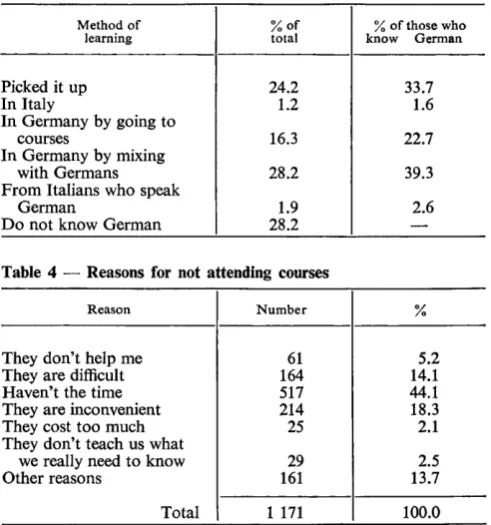
Table 3 - Method of learning German (N = 1 060)
(Only 17.5% stated that they had learned German in courses attended in Italy or Germany; informal methods of learning therefore pre-dominate.)
Method of %of % of those who learning total know German
Picked it up 24.2 33.7
In Italy 1.2 1.6
In Germany by going to
courses 16.3 22.7
In Germany by mixing
with Germans 28.2 39.3
From Italians who speak
German 1.9 2.6
Do not know German 28.2
Table 4 - Reasons for not attending courses
Reason Number %
They don't help me 61 5.2
They are difficult 164 14.1
Haven't the time 517 44.1
They are inconvenient 214 18.3
They cost too much 25 2.1
They don't teach us what
we really need to know 29 2.5
Other reasons 161 13.7
Total 1 171 100.0
The reasons most frequently given are lack of time (44%), inconvenience (18%), and diffic-y.Jty (14%).
Table 5 - Reasons for attending courses Priorities are as follows:
1. Convenience
2. Inexpensive (better if held during paid working hours) 3. Effective teaching
4. Connection between the course and working experience
1 6 4
2
7 8
5
3
Priority Reason
convenient time free or paid for convenient place easy, convenient, free helpful and serious
to improve oneself and become qualified easy, really suitable, good teachers I would attend it if I had time
%
33.9 5.9 10.5 19.0 5.5 3.4 9.6 12.2
The two groups who are in need of specific help are:
1) workers who are socially isolated and whose job is insecure (improvement as they become literate), 2) workers in the phase of vocational integration, who need the language in order to gain access to German training facilities and to skilled jobs (the scheme's tactical choice favours this group in the interest of creating an operative and credible model).
In terms of teaching strategy, the reasons listed imply:
[image:13.581.297.543.125.388.2] [image:13.581.297.544.453.603.2] [image:13.581.37.280.581.779.2]B.
conducting the training sessions at times and in
places which fit into the learner's daily life (in the
scheme: training flexibility, use of audio-visual
media and possibly also self-instruction media);
C. using real situations which are part of the learner's
social development (integration of language and
technology by the situational method).
3.
Cultural aimsa) There is a category of migrants with a marked
ten-dency towards permanent settlement whose access
to skilled jobs in firms and services of the host country
is inhibited by the absence of sound basic linguistic
and technological training.
b) Understood as an essential prerequisite also for
admission to local training facilities, this basic
training cannot, for both objective reasons (transport,
time available for study) and subjective reasons
(little inclination), be based on a school approach.
On the contrary, it presupposes:
1) holding courses on easily accessible premises,
2) making wide use of educational technologies,
3) programming course contents so as to bring
Janguage learning into line with the migrants'
material conditions of life (services, social
or-ganization) and work (technology): planned
situational approach.
Under ideal conditions, the help which would meet
these aggregate requirements:
a) is based on the development of about 120 teaching
modules, comprising teacher's guide, learner's guide,
collective audio-visual media, and learner's cassette;
b) envisages the use of each teaching module in a
two-hour course, organized on easily accessible premises
so as to take away perhaps no more than one hour
of the firm's time and one hour of the worker's
time (target : 150 hours).
N.B.:
Help in the form described is intended primarily for
employed adult migrants; however, because of its flexible
structure, it can be easily adapted to pre-work situations
(school, family). Moreover, the fact that the scheme is
being designed for Germany does not preclude the
suitability of its plan and methodology for application
in Italian migrant communities in other countries
(Switz-erland, France, etc.).
4. Operational timetable